It typically takes over a month for the Contra Costa Superior Court to process filings in limited civil cases. In fact, more like 6 weeks.
This compares badly with other superior courts throughout the state.
In San Diego Superior, for example, I’ve had papers processed within hours. In Marin County Superior Court, I’ve had papers processed within 1 or 2 days.
This is a real problem because justice delayed is justice denied.
This is a ridiculously long time when it only takes a few minutes to do the processing.
Yes, I understand that they have a lot of filings to process…but with a lot of filing don’t they also have a lot of taxpayer funding commensurate with the size of the population of the county?
So why is Contra Costa so much slower than other counties?
“the APOA is excited to work with the incoming council members”
The Antioch Police Officers Association would like to take this opportunity to express our appreciation to the members of the City Council who are departing their positions. As we transition to a new chapter in our local government, we acknowledge their hard work and efforts.
Looking ahead, the APOA is excited to work with the incoming council members. We are optimistic about the new leadership and their commitment to prioritizing public safety in our city.
Given the findings of the recent Grand Jury report and the serious allegations of sexual harassment, it is clear that Mayor Hernandez-Thorpe’s tenure has been marked by controversial behavior that has negatively impacted our community. The APOA looks forward to a future under Mayor Ron Bernal, who we believe will bring a renewed focus on transparency, accountability and effective governance.
The APOA is dedicated to supporting initiatives that enhance public safety, improve community relations, and ensure that our officers have the resources they need to effectively serve the public. We look forward to collaborating with the new council to implement strategies that will contribute to the overall safety and quality of life in Antioch.
We encourage the community to engage with their new representatives and participate in discussions that shape the future of our city. Together, we can build a stronger, safer Antioch for everyone.
According to “Mental Health America” in 2024, one in four adults with mental distress couldn’t get help because they couldn’t afford it. In hopes of helping people in Antioch to be able to afford help with their mental health if they want it, I am sharing this information with you.
I sadly had a friend who could not afford to get the help they needed with their anxiety and self-medicated themselves with alcohol to numb it. They died young after being run over by a car while walking in the middle of a busy road at night while drunk. I always wondered if they wouldn’t have turned to alcohol, and died young if they had been able to get the help they needed with their anxiety.
We often write-off our anxiety as stress and call it “normal”, as if there is no way to escape our discomfort due to the day and age we live in. There is a difference between stress and anxiety just as there is a difference between getting sad and having depression. Most importantly, we can help ourselves to start to feel better regardless of what we call our emotional discomfort.
It is obvious that we are injured when we have a broken leg and can just barely limp along with a cast on crutches. It is easy for all people to see when someone has a broken leg, but sometimes only we know if we are hurting emotionally. When we have a broken dream, promise, relationship or heart, regrets that won’t leave us alone or failures that continue to haunt us, we can feel just as hurt or worse than if we had a broken leg.
An analysis appearing in 2011 in the journal Psychiatric Times reports that up until that year over 20 studies had examined brain changes after therapy for depression, anxiety disorders, obsessive-compulsive and related disorders, and trauma disorders like PTSD; all found that therapy changes the brain as much as psychiatric medication. Please note that I am not in any way telling people who need medication to not take it.
There are local mental health therapists, who take various types of health insurance, provide free services and sliding scale services to help people to cope regardless of their income levels. If time is a stressor, you may be able to find a therapist who can help you with regular phone calls or telehealth meetings. California State Licensed therapists go through 8+ years of college education in order to practice in the state of California, often a testament to their desire to help you feel better. In closing, please remember that all people experience challenges at points in their lives and there is no shame in asking for help.
Here is the contact information for some of the free, low-cost, sliding scale therapy services and crisis hotlines available to Antioch, California residents:
3727 Sunset Lane, Antioch, CA 94509, (925) 778-1667
9) The Crisis Center’s Crisis Lines
Provide crisis and suicide intervention, emotional support, counseling and resource information for Contra Costa County. This program provides 24/7 Support via Call or Text. If you are in a crisis and need help immediately, please call 211 or 800-833-2900 or text ‘‘HOPE” to 20121 now. Doing so will quickly put you in touch with one of the program’s call specialists.
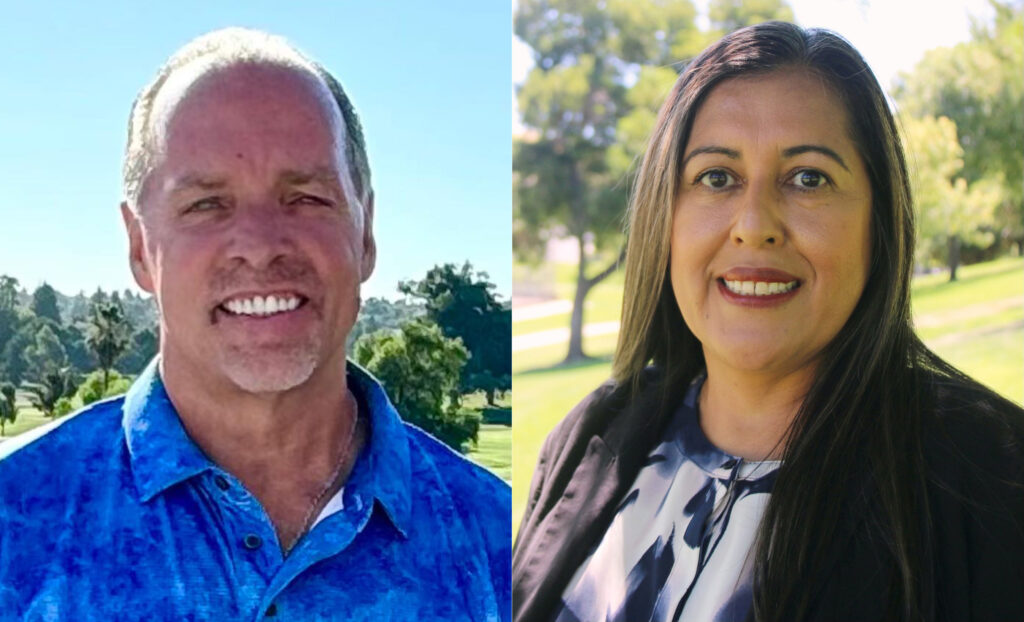
The Antioch Herald endorses the following candidates: (Upper left) Olga Cobos-Smith for Antioch School Board Area 4 Trustee, (bottom left) Lori Ogorchock for Antioch City Treasurer, (center left-right) Ron Bernal for Mayor, Don Freitas for City Council District 3, Scott Bergerhouse for Antioch School Board Area 3 Trustee, Louie Rocha for City Council District 3 together at the 2024 Antioch Sports Legends Hall of Fame Gala (Source: Louie Rocha Facebook page) and Mike Barbanica (upper right) for County Supervisor District 5.
Scott Bergerhouse is running for Antioch School Board in Trustee Area 3 and Olga Cobos-Smith is challenging incumbent Gary Hack in Area 4. Photo sources: Candidates’ 2024 campaigns
By Allen D. Payton
With his years of experience in multiple positions in the Antioch Unified School District, as well as a graduate of its schools, himself, endorsing Scott Bergerhouse for Area 3 Board Trustee was another easy decision this election season. In Area 4, while I don’t know her and never heard of her until this year, I’m willing to give newcomer Olga Cobos-Smith the opportunity to serve and help lead the district offering her experience on the board to help the district’s students.
Bergerhouse for Area 3 Trustee
As the only candidate of the four running in the two competitive races for school board, this year, to reach out to the Herald and provide an announcement about his campaign, Bergerhouse’s slogan of “Putting Students First” pretty much sums up his career in education. He has worked with thousands of students and their families over the years as a teacher, a school principal and most recently, a district administrator. He’s running for the open seat in Area 3 being vacated by Dr. Clyde Lewis who chose not to run for re-election after just one, tumultuous term on the Board.
As previously reported, Bergerhouse began his career with AUSD as an English teacher in 1984 at what was then Park Junior High School. He then worked as an administrator at Antioch High School, Antioch Middle School, Park Middle School, Deer Valley High School and then, Carmen Dragon Elementary. In 2010, he was named High School Principal of the year by the Association of California School Administrators. For seven years, Bergerhouse was selected by administrators in the district to serve as president of the Antioch Management Association.
He also served as the second principal of Dozier-Libbey and in 2019 he was hired to be the Director of Student Support Services in the school district’s offices from which he later retired.
Bergerhouse says he, “will advocate for programs that support not only academic success but also the overall well-being of our students; will also work to enhance safety for both students and staff;” he “will focus on increasing student attendance;” and “work to enhance safety for both students and staff;” and the first-time candidate for public office says he’s “committed to fostering collaboration between the Antioch School Board and the City Council for the benefit of our entire community.”
That should be done for both bringing back the on-campus Community Service Officers – once the Antioch Police Department is fully staffed, again – and the use of the pool at Deer Valley High School by the City’s Recreation Department as was agreed to before the new high school was built.
Finally, Bergerhouse says, “Together, we can address the challenges facing our schools and build a future where every student can succeed.” That’s what Antioch needs, especially for the districts Black and Hispanic students.
My one challenge with him is he doesn’t have a campaign website. Connect with Bergerhouse at www.linkedin.com/in/scott-bergerhouse-2613063a or www.facebook.com/scott.bergerhouse or email contact him at scottbergerhouse4antioch@gmail.com.
His opponent, political newcomer Dee Brown, whose ballot designation is “Educational Program Director” shares on her campaign website, https://deebrownca.com, her priorities are Students with Disabilities, Safe and Valued School Communities, Expand After School Programs and Career Technical Education Pathways, which are all good things. But the focus of the Board of Trustees needs to be on math, reading and science for students in first through eighth grades.
Brown says she served on the District’s Equity and Excellence Committee and “collaborated with elected representatives, school staff, and community members to review the School District’s first Equity Audit and provide pivotal recommendations for building more inclusive schools.”
In her ballot statement Brown shares she served “as a preschool teacher, early education school director, and foster parent for children with disabilities…and adoptive mom,” which are noble and beneficial pursuits. But nowhere does she mention how or where she is an Educational Program Director or her education. Nor can a LinkedIn profile be found for her.
The biggest concern I have about Brown is the fact she’s been endorsed by two of the school board incumbents, current President and Area 1 Trustee Antonio Hernandez and Area 2 Trustee Dr. Jag Lathan, who played political games with the superintendent’s position, this past year, as well as Antioch Mayor Pro Tem and District 4 Councilwoman Monica Wilson, who has proven to be corrupt while in office. So, that should say enough about Brown’s alliances, and to whom she’ll be beholden when it comes down to tough votes as a member of the board. Why she would think aligning with Wilson is a positive thing makes no sense to me.
Cobos-Smith for Area 4 Trustee
In the race for Area 4 Trustee, incumbent Gary Hack, listed on the ballot simply as Incumbent, is running for his fourth term on the board, having been elected in 2010, then lost in 2014, elected again in 2016 and re-elected in 2020. He faces challenger and another political newcomer, Olga Cobos-Smith, whose ballot designation is Pediatric Nurse and Entrepreneur and campaign slogan is “Building a Brighter Future for Antioch Schools” which they desperately need.
While I’ve not heard from either of them during the campaign, no announcement, email or phone call, I cannot in good conscience support Hack for re-election.
As I wrote, previously, Hack shouldn’t run again as he failed during his presidency to do what was necessary to properly oversee the board’s one employee, failed worse when he let Board President Antonio Hernandez off the hook and the worst due to the abysmal test scores of the district’s students. If you’re too tired to fight the necessary battles and do what’s right with the authority and responsibility given to you, it’s time to move on.
That was after the incumbent chose to abstain instead of voting to censure Hernandez – who’s getting a free ride this time with no opponent in his campaign for re-election in Area 1 – for his inappropriate behavior earlier this year revealing private personnel matters for both a district employee and Superintendent Stephanie Anello, opening up the district to potential lawsuits, which could and might still be filed.
We need people to serve who can demonstrate they have a backbone and will exercise it when necessary and that was one time it clearly was.
Unlike Hack, Cobos-Smith has a campaign website where she shares her background, including earning a master’s degree in health policy from UCSF, how she’s served the school district, her priorities and what she plans to do if elected. Her priorities include Student Outcomes, Health and Safety, School Resources and Measure B Funds from the $56.5 million bond to renovate and modernize Antioch High School buildings and classrooms.
According to her website, Cobos-Smith served on the school site council (SSC) for Sutter Elementary, was elected to the English Learners Advisory Council (ELAC) and served as Vice President during her second year. When her granddaughter transitioned to Park Middle School, the candidate transitioned with her continuing to serve on both SSC and ELAC at Park.
Like Dee Brown, Cobos-Smith says she has also served as a member of the School District’s Equity and Excellence Committee, working “with elected representatives, school staff and community members to launch the first Equity Audit to ensure we’re building more inclusive schools that meet our demands today.”
She says it is her “goal to ensure that every child of Antioch can succeed at life to the best of their ability” which “can be realized by positively impacting education policy with focuses on Science, Technology, Engineering, Arts and Math (STEAM), improving literacy outcomes and the social/emotional well-being of our students.” I want to give her that opportunity.
On the https://onyourballot.vote411.org/ website, under Top Three Priorities, Cobos-Smith wrote, “1) improving reading rates across all grade levels 2) improving the environment that teachers and support staff work and our children learn in 3) ensuring union workers receive project labor agreements for the planned renovations with Measure B funds.” Hack didn’t provide any information on that website where his opponent also shares she, “participated in the parent advisory committee which assisted with creating the Local Control and Accountability Plan (LCAP) for the 2024/25 school year.”
Cobos-Smith’s background also includes working as a Pediatric Clinical Faculty member at Cal State East Bay. But her website does not mention what business she owns and operates as an entrepreneur. Efforts to reach her was unsuccessful prior to publication time.
She also has the support of local teachers, having been endorsed by their union, the Antioch Education Association. It says a lot that Hack has lost their support having been a teacher in the district and at one time the organization’s president.
While I recognize it might change the balance of power on the school board for the first time in many years to have someone elected who might side with those on the board I haven’t agreed with in their efforts and decisions to get rid of Anello, but now that she’s gone, I’m willing to give their side a try and see what they can do. As it can’t be much worse than the results we’ve already seen, especially in the areas of math, reading and science for the majority of the District’s Black and Hispanic students.
Cobos-Smith adds, “Vote for me so we can give our children a fighting chance at realizing their full potential.” That’s what AUSD needs for all of its students.
To learn more about Cobos-Smith and her campaign visit olgasmith4antiochschools2024.com or on her Facebook page entitled, “Olga Cobos Smith for Antioch Schools 2024, Area 4”, email contact@olgasmith4antiochschools2024.com or call (925) 384-2637.
UPDATE: Cobos-Smith responded on Monday, Nov. 4 writing, “Apologies if I seemed inaccessible. I generally need at least one week turn around time for responses during busy seasons (e.g., election campaign). Your understanding is much appreciated.
My entrepreneurial endeavor currently consists of a pop up bookstore. You can find my website here: https://reflections-bookstore.com. My FB page: www.facebook.com/profile.php?id=100095275466876 and my IG: www.instagram.com/reflectionsbookstore. I am a member of the American Booksellers Association and the California Independent Bookseller Alliance (CALIBA).
I have not had the opportunity to focus on my business since about April due to caring for my mother during a new medical diagnosis. Once my mom was situated, I gave all my attention to the school board campaign. You are welcome to review the public information and share liberally. However, with the election coming to a close I will be doing a complete revamp of the business all the way down to the logo. Stay tuned, my plan is for a brick and mortar bookstore here in Antioch.
My relevancy may wane after the election, but the events I have attended throughout my campaign have been because the host has reached out to me. Now that you have found me, I am happy to connect for a more in depth discussion. My campaign time was spent going directly to the voters of Area 4 (i.e., text banking, canvassing). I am sure you can understand why that was important for me as a “newcomer” to Antioch politics.
Happy voting!!”
Please join me in supporting Scott Bergerhouse for Area 3 Trustee and Olga Cobos-Smith for Area 4 Trustee on the Antioch School Board in this year’s election.
Antioch District 3 Councilwoman and City Treasurer candidate Lori Ogorchock. Source: 2024 campaign
Davis had his turn, newcomer Rojas falsely claims Antioch had “balanced…budgets in the last four years” and calls facing three years of double-digit deficits “financial progress”
By Allen D. Payton, Publisher
In the race for Antioch City Treasurer there are only really two candidates who should be considered, current District 3 Councilwoman Lori Ogorchock and former Mayor and Councilman Jim Davis. The decision between the two common-sense candidates was a challenge.
The third candidate in the race, newcomer Jorge R. Rojas, Jr., doesn’t have a campaign website nor even a Facebook page, but has been endorsed by Mayor Lamar Hernandez-Thorpe. That’s enough to disqualify him, as the mayor has proven he cannot be trusted with the workings inside City Hall, and previous elected and appointed allies have played political games. Rojas might be willing to do the same in reporting the use of our taxpayer dollars. Plus, while there’s little he can do in the position, it could give him a leg up for a future council run. Antioch can’t afford another ally of the mayor on the city council.
Rojas
The only information about Rojas and his campaign are found in his ballot designation of Chief Financial Officer, what in his ballot statement, which shows he’s an immigrant from Peru and works for a janitorial services company, and his campaign finance reports. Those show he chose to not raise or spend more than $2,000 in the campaign, and his only contribution was $1,449 from Hernandez-Thorpe. But Rojas did not submit a report of how he spent those funds.
The candidate never once reached out to the Herald nor respond to the effort to contact him to provide any information about him and his campaign to our readers. Worse, his candidate statement provides false information about the City’s finances. He wrote, “Antioch has built a $63,000,000 rainy day fund, balanced its over $220,000,000 budgets in the last four years, and made significant efforts to pay down employee retirement debt. We need to protect our city’s financial progress.”
Yet, as previously reported, about the “rainy day fund” first mentioned by the mayor, City Finance Director Dawn Merchant responded, “I am not sure about the claim as we do not have a $63M rainy day fund. I can only assume that claim is adding the Stabilization Fund and General Fund reserves, however, again, I am not sure.”
Furthermore, as that report shows, the City has been deficit-spending using money from those two funds. The budgets for this and the past three Fiscal Years include the following deficits: $3,995,625 in FY 2022-23; $5,343,928 in FY 2023-24; and $4,617,143 projected for the current, FY 2024-25.
In addition, according to the General Fund Projections for 2023-2028 presented to the city council on June 11, 2024, the General Fund is projected to run the following deficits: $12,995,259 in FY 2025-26; $13,561,074 in FY 2026-27; and $14,855,649 in FY 2027-28.
Furthermore, because those projected double-digit deficits the Budget Stabilization Fund will be depleted by the end of June 2008. It will result in that last year’s deficit being covered by the General Fund reserve leaving it with an Ending Balance of just $17.4 million or 17.06% in reserves versus over 31% and 32% for the previous fiscal years.
If that’s what Rojas thinks is “our city’s financial progress” he’s seriously misguided. While his candidate statement shows he “enrolled in DVC to study Business Administration” before a “20-year career in the banking industry, specializing in financial services” it appears Rojas needs to school to gain more education and a better understanding of budgets, deficits and “financial progress.”
Davis
Jim Davis is a good man, and my friend, and has served our community well as a councilman, mayor and then as city treasurer. He has also served as president of the Antioch-Chichibu Sister City Organization. While his background is in banking, Jim had his turn in the position, and I endorsed him for it in 2020, but he was defeated for re-election by current City Treasurer Lauren Posada, that year. I’m sure he will continue to serve Antioch in one way or another.
Orgorchock
That brings me to Councilwoman Ogorchock, who is also a friend, and with whom I’ve interacted since she first ran for city council. She has a background in real estate and years on the council dealing with the City’s budgets. Yet, this year for her is bitter-sweet as she was unable to run for re-election to the city council. That was due to the corruption by the mayor and his two council allies, Tamisha Torres-Walker and Monica Wilson, who gerrymandered Lori out of District 3, literally drawing the line around her neighborhood in live time during a council meeting for all to see and moving her into neighboring District 4 represented by Wilson. While Ogorchock ran for that seat in 2022, due to two others in the race splitting the vote, she lost to Wilson. Worse, the three planned it during at least one private meeting at Hernandez-Thorpe’s home and were investigated for it by the Contra Costa DA’s Office and Civil Grand Jury.
Thus, being elected and serving as city treasurer will be kind of like a consolation prize for Ogorchock and I’m sure she will do a good job. Plus, she has been endorsed by the incumbent, Posada, who chose to not seek re-election and that says something.
So, I’m happy to support and ask you to join me in voting for Lori Ogorchock for Antioch City Treasurer in Tuesday’s election. To learn more about her and her campaign, visit the Facebook page entitled “Lori Ogorchock for Antioch City Treasurer.”
By Rudy Recile, Retired U.S. Army Major, candidate for Congress, CA District 8
Rudy Recile. Source: 2024 campaign
Grassroots candidates running for an office don’t have it easy. People don’t know your name, you have no money in your campaign account and adding insult to injury, depending on what party you are affiliated with, the media may or may not be friendly towards you or your campaign.
With a title like that would any challenger have a chance? Depending on whether or not the reader keeps up with current events would determine what type of article they are reading. I don’t know if this was an article, opinion statement or hit piece.
I know Rep. John Garamendi has cancer, and I mentioned to the reporter during the interview I wouldn’t disparage the congressman in any way. I wanted to run a clean race and not a smear campaign. Instead of John Garamendi going after me the reporter decided to write an article seemingly attacking me.
All stories have a point of view and there is always some truth in the telling of the story. When I was being interviewed, I didn’t remember all of the details of the current events we were discussing. I was able to get most of the information correct and instead of the reporter doing her due diligence she took the negative side and stated I am passing dis-information.
For example, when hurricane Helene devastated the east coast, I stated the Government was restricting air space and it was in fact happening.
Eventually the restrictions were lifted. The point the reporter emphasized was the lifting of restrictions which means there were restrictions in place. The reporter failed to mention that FEMA and other federal agencies didn’t show up for almost a week after the hurricane and there were many people posting on social media platforms that they were being restricted from flying.
I spoke about a Veteran being evicted to make way for migrants. The reporter found an article where some people acted and reported they were evicted to make way for migrants from a hotel which was found to be a hoax. The article I was referring to was about a New York Army Veteran who was evicted from a nursing home to make way for migrants and not the story she mentioned. https://nypost.com/2023/11/30/news/army-vet-kicked-out-of-nyc-nursing-home-to-make-room-for-migrants/ There are many stories out there she could have chosen but the story she chose to back her story was the one regarding the hoax.
I also mentioned how crime is not being reported based on an article in the Wall Street Journal entitled, “Contrary to Media Myth, U.S. Urban Crime Rates Are Up” – https://www.wsj.com/opinion/contrary-to-media-myth-u-s-urban-crime-rates-are-up-violence-cities-9ce714f6. “National Crime Victim Survey (NVCS) 2023 finds no statistically significant evidence that violent crime or property crime is dropping in America…” NVCS. “In the 2023 NVCS, crime victims conveyed that a majority – 55% of violent victimizations weren’t reported to the police, while 70% of property crime victimizations weren’t reported.”
Since crime is not being reported as it was in the past the statistics seem to be decreasing. It is so easy to find articles regarding how Prop 47 has affected California. She decided to identify an article which soft plays Prop 47 which I mentioned.
Even with all the negativity the best parts of the article were the parts where she directly quoted my full statement and not just parts of my statements
The bottom line is this, if you’re a grassroots candidate, realize running for office isn’t easy and it won’t be all sunshine and rainbows. If you’re going to vote, do your own due diligence and be an educated voter before you vote. Vote the policies the person supports and not the person or the party.
With experience in law enforcement, private sector and government he offers common-sense views unlike his left-leaning opponent
By Allen D. Payton, Publisher
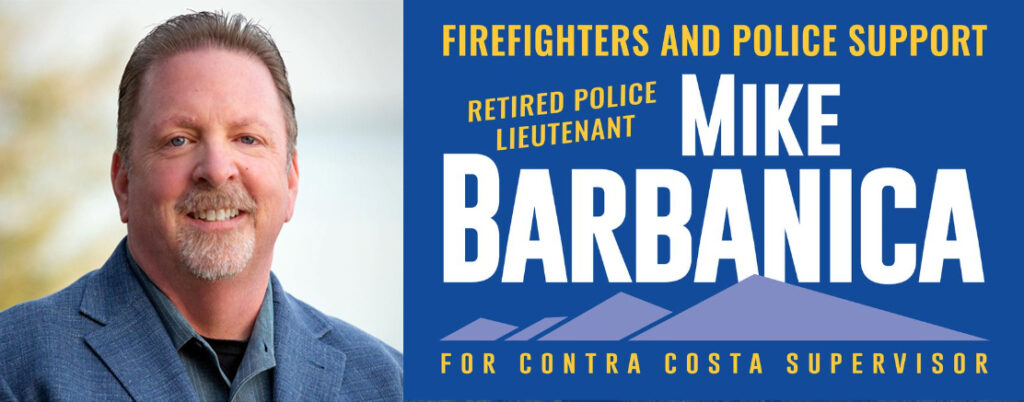
In the race for Contra Costa County Supervisor District 5 seat held by Federal Glover who is retiring after six consecutive terms, Antioch Councilman Mike Barbanica is clearly the best choice to replace him. He faces Pittsburg Councilwoman Shanell Scales-Preston in the November run-off, after both made it past the four-candidate March primary election. The district includes the county’s northern waterfront cities and communities from the Senator John A. Nejedly-Antioch Bridge in East County to Hercules in West County.
Scales-Preston is Too Socialist and Progressive
Scales-Preston has some applicable experience having served as a councilmember and rotated vice mayor and mayor for the City of Pittsburg for the past six years, as well as on the four transportation boards serving East County, three for just the past two years, as past president and current member of the East Bay League of California Cities, and chair of the Los Medanos Health Advisory Committee. That committee worked with the now defunct healthcare district where Antioch Mayor Lamar Hernandez-Thorpe was the executive director for which the County Board of Supervisors settled with two of his female employees over sexual harassment claims for $350,000.
According to her bio on the City of Pittsburg’s website, Scales-Preston grew up in the City of Pittsburg graduated from Pittsburg High School and earned a degree in Political Science with an option in Pre-Law from Cal State East Bay. Her career has been in government, working for over 20 years as a staff member for both former Congressman George Miller and now Congressman Mark DeSaulnier.
That’s one of the challenges I have with Scales-Preston. Unlike her current boss, DeSaulnier who was a restaurateur in Concord before getting elected to local, then state and now federal office, Shanelle hasn’t worked in the private sector. So, she can’t truly understand what it takes to create jobs or wealth and grow the economy. That’s what is one of the key issues that needs to be addressed in District 5, especially along the waterfront.
Another issue I have with Scales-Preston is her political alliances and from whom she has accepted and promotes endorsements. They include Our Revolution East Bay, which according to their website, ourrevolutioneastbay.org, is “a progressive political organization that emerged from the historic Bernie Sanders campaign.” Sanders for decades described himself as a democratic socialist and has been the most liberal member of the U.S. Senate, except when now-Vice President Kamala Harris was serving. Those are not the kind of bigger, more expensive government views we need on the Board of Supervisors.
That brings up another issue, the blatant injection of partisan politics into local, non-partisan races, which I’ve harped on for the past 12 years, ever since Antioch Councilwoman Monica Wilson put her face and name on one side of a mailer and Obama’s on the other. Scales-Preston’s running a billboard ad on Highway 4 in Antioch with her face on one side of the ad and Harris’ on the other side. That’s completely inappropriate, and unnecessarily, and foolishly divisive. Scales-Preston also touts the endorsements of several Democratic Party organizations, including the State Party which surprisingly is opposing Prop. 36, the anti-crime measure, on the November ballot.
Finally, the other alliance and endorsement Scales-Preston promotes in her campaign is from the nation’s top abortion provider, Planned Parenthood. As I called out District Attorney Diana Becton for doing the same in 2022, I’m calling out Shanelle. Why would a Black woman take the endorsement of an organization founded in racist eugenics which by Margaret Sanger who spoke about and worked to eliminate the Black and brown races, which includes Hispanics, and has been very successful. Because the majority of abortions in the U.S. each year are by Black and Hispanic mothers. That’s why Planned Parenthood continues to focus and located their so-called “clinics” in neighborhoods with high populations of African- and Hispanic Americans. Scales-Preston is literally siding with the organization that continues to work against her own people of color. (Please see Margaret Sanger: Ambitious Feminist and Racist Eugenicist, https://womanisrational.uchicago.edu/2022/09/21/margaret-sanger-the-duality-of-a-ambitious-feminist-and-racist-eugenicist/)
While I like her and find that she’s a nice lady in our few conversations, Shanelle is seriously misdirected in her thinking and views and needs some experience with a job in the private sector before running either for re-election or higher office, again.
Backed by the Badge, Councilman, Former Cop, Business Owner Barbanica is Better and Best for the Board
Barbanica, on the other hand, has a much broader career experience having served as an officer and retired lieutenant after 21 years with the Pittsburg Police Department, where he helped fight against eight dirty cops, one of whom is still in prison for murder. He also worked as a sexual assault detective and a homicide detective, where he “helped women in the worst times of their lives,” Barbanica stated. That included saving a 13-year-old girl from repeated sexual assaults from an older man. He also ran the traffic division, oversaw not only Code Enforcement and all the other specialized enforcement units, including gangs, alcohol and tobacco, and street-level drug dealing teams.
He developed and led a six-officer team for six years, that worked on violent and street-level crime, which was reduced by almost 24% over a few years. Barbanica also ran the K-9 and Field Training Officer programs, and the Emergency Operations Center working with the FBI after 9-11 to prevent any terrorist attacks inside local industrial plants.
For the past 19 years he’s owned a successful, local real estate business in both residential and commercial sales, property ownership and management, the appropriately named Blue Line Property Real Estate & Management. That has given him the experience of dealing with renters and owners, understanding the issues that both sides have to deal with.
For the past four years, Barbanica has also served on the embattled Antioch City Council where he’s been the mature voice of reason in spite of the chaos, cronyism and corruption in which he did not participate. Nor can he be blamed for it, as he was on the short end of a variety of 3-2 and 4-1 votes while at the same time he was able to push for and successfully obtain majority votes in favor of his proposals, such as body cameras for police officers and dash cams for their vehicles, and tougher penalties for sideshows. In fact, Barbanica was the one who found common ground with the mayor to include penalties for advertisers planners, participants and spectators, as well.
He also pushed for expanding Antioch’s Code Enforcement by seven officers, doubling it to 14.
Barbanica has developed private-sector solutions to the challenge of homelessness in our county. He worked to revise the existing HUD contract with the County “to make it more palatable for owners to want to do business with homeless residents,” he said. “The program was actually my wife’s idea. We started with one single mom with her children, one of whom is disabled, and who are still housed with us, today.”
They expanded it to include homeless veterans.
“We work with seven different agencies to get people off the street and today, we have over 575 people housed that were facing homelessness or instability, who now have a roof over their head,” the candidate shared.
Barbanica’s platform focuses on his top priorities which are public safety, homelessness and blight.
Asked about economic development he said, “It’s always a constant. But we have to deal with the other issues, first. If we want business to come here, we have to provide them a place where their business will thrive.”
Regarding the Northern Waterfront Initiative, “It needs retooling,” Barbanica stated. “Because the zoning doesn’t match the long-term plans and developers have struggled and are very frustrated with the County. I’m going to be an advocate to develop that area and work with those developers but balance it with the concerns for the environment.” He will also work on the Green Empowerment Zone, “to bring green jobs into our county to boost our local economy,” he added.
Barbanica also worked to bringing in 1,100 new, upscale homes in the Sand Creek area of Antioch in which “both sides, the developer and the environmental community, specifically Save Mt. Diablo, were satisfied,” following multiple meetings.
About transportation, he says supports extending BART to Tracy and back to Pleasanton, as well as completing the Highway 4 bypass / extension and building Route 239 from Brentwood to Tracy to connect Highway 4 to I-5, 205 and 580, “an East Bay loop” he said. It will permanently open East County for economic development. “Finally, it’s being planned after being on the books for almost 65 years,” Barbanica added.
Not surprisingly, he has the support of law enforcement, including Contra Costa County Sheriff David Livingston, the Contra Costa County Deputy Sheriffs Association, Contra Costa County District Attorney’s Association, Contra Costa County District Attorney Investigators’ Association, California Association of Highway Patrolmen, PORAC – Police Officers Research Association of California, as well as the Police Officers Associations of Antioch, Pittsburg, Concord, Martinez, Hercules, Brentwood, Clayton, Moraga, Pinole, Pleasant Hill, Richmond and Walnut Creek and the United Professional Firefighters of Contra Costa County.
Regarding the police scandals that affected both the Antioch and Pittsburg Police Departments, one thing needs to be clarified. When Antioch’s mayor and one councilwoman were irresponsibly and publicly calling for all 35 Antioch officers caught up in the racist text scandal to be fired – most of whom merely received the texts, but didn’t send any, and before the investigations were completed, and most returned to their jobs – Barbanica was again, the voice of reason. He said he, the mayor and other council members needed to shut their mouths and let the investigators work through the process, and not give the dirty, guilty cops anything they could use to keep their jobs, such as claiming their terminations were politically motivated. Yet, his opposition has been attempting to twist his words to mean something he didn’t.
One additional thing I like about him, having dealt and worked with with him in a councilman-reporter relationship for the past four years, Barbanica is available and responds to phone calls, texts and emails including any and all questions no matter how challenging. I respect that in an elected official.
“I truly believe the media’s responsibility is to keep government and politicians honest, and the people informed,” he stated. I completely agree.
On a personal note, Barbanica is married to Kristine, they have three children and six grandchildren, most of whom live in the area. Two of his children have followed him into law enforcement as his son is a Pittsburg Police Officer who “works my old beat with the same call sign assigned to it,” Barbanica shared. His youngest daughter is a prosecutor in another county in California. His older daughter is a physician’s assistant.
For the benefit of the northern portion and all of Contra Costa County, please join me in supporting Mike Barbanica as our next Supervisor representing District 5.