The Martins, the broken window of David’s rental car and one of his cameras that was stolen containing a photo of the bride, Antioch resident, Jenna Wesenhagen-Banks. Source: GoFundMe
Antioch native David Martin, Jr. seeks public’s help for return of photos, hard drives and equipment or replacement
By Kirsten Mitchell, Communications Associate, GoFundMe
The newlyweds Jenna Wesenhagen-Banks and Nick Banks on Sunday, Oct. 4, 2026. Photo by Carla Taylor Acevedo on Facebook
An Antioch couple’s wedding photos were reportedly stolen from their photographer’s rental car in Oakland just three days after their ceremony, and now the community is helping them try to recover those memories. David Martin, Jr., an Antioch native now based in Southern California, returned to photograph Jenna and Nick Banks’ October 4 wedding. According to the GoFundMe, thieves took nearly all the equipment he uses to support his family, along with drives holding years of work and the only copies of the couple’s wedding photos. Loved ones are asking for help finding the stolen drives and memory cards while raising funds to replace his gear and refund the couple if their photos aren’t recovered.
“What should have been a lifetime of cherished memories vanished in an instant. David is devastated, not only by the loss of his livelihood, but by the thought that Jenna and Nick may never get to relive the most important moments of their special day. Cameras can be replaced. A wedding day cannot.”
In a video on the GoFundMe page entitled “Restore David’s Livelihood”, Martin, who owns David Martin Jr. Photography according to his Facebook page, and is based in Orange County, CA according to his website, says, “I “lost…80% of my equipment.”
According to a KTVU FOX2 news report, break-in of his rental car in downtown Oakland happened days after the wedding in which “gear worth $35,000, including two cameras, lenses, a drone, a laptop as well as a hard drive and memory cards with the couple’s photos” were taken.
Post on GoFundMeby Lina Martin for David Martin
“On October 7, David Martin, a hardworking photographer and family man, had his vehicle broken into in Oakland. Thieves stole nearly all of his professional photography equipment, including cameras, lenses, drone, a laptop, accessories and hard drives holding years of irreplaceable work.
“In a matter of minutes, David lost the tools he depends on to support his family.
“The most heartbreaking part is that the stolen memory cards and hard drive held the only copies of Jenna and Nick Banks’ wedding photos. The couple had been married just three days earlier, on October 4. What should have been a lifetime of cherished memories vanished in an instant. David is devastated, not only by the loss of his livelihood, but by the thought that Jenna and Nick may never get to relive the most important moments of their special day. Cameras can be replaced. A wedding day cannot.
“David is doing everything he can to make it right. If the photos aren’t recovered, he will refund Jenna and Nick in full. He’ll also photograph them again, at no cost, in their wedding attire so they have something beautiful to hold on to.
“The theft also hit David in the middle of a video project in the Bay Area. All of the footage he had already captured was lost, which means he has to reshoot from scratch and cover the cost of travel all over again, on top of replacing his gear.
“For 12 years, David has photographed weddings, families, and milestones for people across Los Angeles and Orange County. Photography isn’t just his passion. It’s how he puts food on the table for his family.”
Where your donation goes
“Your support will replace the cameras, lenses, lighting, drone, laptop, accessories and storage David needs to get back to work, cover the travel costs of reshooting his lost video project, and help fund a full refund to Jenna and Nick if their photos can’t be recovered.”
Help us find the photos
“There’s still a chance the drives turn up. If you see cameras, lenses, laptops, or hard drives being sold in the Oakland area, on Facebook Marketplace, OfferUp, Craigslist, or anywhere else, please reach out through the “Contact” button on this page. A police report has been filed (RD# 26-042959). Getting those drives and or SD/Express cards back is the only way Jenna and Nick get their wedding photos.”
How you can help
“Every donation, no matter the size, makes a difference. If you can’t donate, please share this page. The more people who see it, the better the chance someone spots the stolen gear.
“Let’s come together and help David get back behind the camera.
“Thank you for supporting David and his family.”
—————
As of 9:30 p.m. Tuesday, Oct. 13, 2026, $14,215 has been raised from 54 donations of the total goal of $16,000.
Discuss 2027-28 General Fund Budget with projected $11.2M deficit, consider closing Marina due to annual subsidy
Receive reports on APD Reform, Youth Services, Delta Landing homeless hotel in Pittsburg, vote on 3% COLA for final employee group
By Allen D. Payton
During their meeting Tuesday night, Oct. 13, 2026, the Antioch City Council will deal with 315 pages of a full agenda with 18 items, including 16 items on the Consent Calendar. They will begin with a Special Meeting at 5:00 p.m. to discuss and give input to staff on development of the Fiscal Year 2027-2028 General Fund Budget. Then at 7:00 p.m. their Regular Meeting will begin.
2027-28 General Fund Budget Development
During their Special Meeting, the Council will discuss the 2027-28 General Fund Budget Development which shows the City facing a $16.25 million deficit before a $5 million transfer from the Budget Stabilization Fund for a projected net $11.25 million deficit for the fiscal year.
One item of controversy is the possible closing of the Antioch Marina. According to the City staff report, “as mentioned at the August 25th session, the non-departmental budget reviewed included a reduction in the subsidy to close the Marina and provide for only debt service repayment and the existing full-time staffing at the Marina, which would need to be re-assigned to other areas within Public Works. If the Marina were closed, this could potentially provide $185K in budget savings in 2027/28, however the loss of a recreational facility and potential harmful business impact to the restaurant at the Marina may negate the financial savings.”
Presentations
Toward the beginning of the Regular Meeting the Council will be provided with three presentations including:
Delta Landing: Program Operations, Service and Outcomes report by Contra Costa Health for the homeless hotel in Pittsburg at the former Motel 6 site on Loveridge Road.
Consent Calendar
Under the Consent Calendar the Council will vote on accepting completion for the Antioch Water Park Concrete improvements 2026 Project (Item 15.L.) and Pool Resurfacing Project (Item 15.M.). Plus, they will vote on rejecting all bids and re-evaluating the scope of the Installation of Park Signage Project (Item 15.N.) because the lowest responsive bid that could be accepted was over $86,000 more than budgeted. Finally, the Council will vote on approving the Memorandum of Understanding between the City of Antioch and the Confidential Unit for a 3% COLA at a total cost of $111,883, with $92,419 from the General Fund, and approving a Fiscal Year 2026/27 budget amendment to cover the additional costs (Item 15.P.). As previously reported, the Confidential Unit includes a variety of staff positions: the Deputy City Clerk, Account Specialists, Analysts, Assistants, Coordinators, Specialists and Technicians. The 26 employees in the Unit have been working without a contract since September 30, 2025. See City’s Master Salary Schedule.
Reestablishing Economic Development Department
Under Item 16, the Council will vote on reestablishing a standalone Economic Development Department separate from Community Development, determine funding for an Economic Development Director position with an amended job classification and amended salary range, an Economic Development Specialist, and assigning a Department budget.
Downtown Security Services
Finally, under Item 17, the Council will give direction to staff on reestablishing private security services for downtown Rivertown. That includes initiating a competitive Request for Qualifications (RFQ) process for private security services; determining the geographic scope of services, including whether coverage should be limited to City-owned properties and designated public areas in the Rivertown/Downtown area or include additional areas throughout the City; and determining the days and hours of operation for private security services. The council will decide on a budget during a future meeting.
Meeting Details
The Special Meeting begins at 5:00 p.m. and Regular Meeting begins at 7:00 p.m., both in the Council Chambers at City Hall, 200 H Street, in historic, downtown Rivertown and can be viewed via livestream on the City’s website, on Comcast cable TV channel 24 or AT&T U-verse channel 99 or on the City’s YouTube channel.
See the complete agenda packet with staff reports here.
ANTIOCH, Calif. — In response to the announcement by Chief Joe Vigil earlier Friday, October 9, 2026, Antioch Mayor Ron Bernal today recognized a significant achievement for the city following the U.S. Department of Justice’s determination that the Antioch Police Department has reached substantial compliance with the requirements of its agreement with the federal government. (See related article)
The determination brings the 21-month agreement to a close and marks an important step forward for the department and the Antioch community.
“This is good news for Antioch and an accomplishment our community can be proud of,” said Mayor Bernal. “For the past 21 months, Chief Vigil and the men and women of the Antioch Police Department have worked hard to meet the DOJ’s requirements while making meaningful improvements to the department. They deserve recognition for what they’ve accomplished.”
Throughout the agreement, the department worked to address the DOJ’s requirements while strengthening its policies, practices, and commitment to accountability and community engagement.
Bernal said the conclusion of the agreement is an opportunity to recognize the department’s work while remaining focused on the future.
“Meeting the requirements of this agreement was important, but our responsibility to the community doesn’t end here,” Bernal said. “We have an obligation to keep improving, to hold ourselves to high standards, and to earn the confidence of the people we serve.”
The mayor said the city will continue supporting the department’s efforts to build on the improvements made over the past 21 months.
“Our goal hasn’t changed,” Bernal said. “We want Antioch to be home to one of the best police departments in the country. We’ve taken an important step toward that goal, and we’re going to keep working to get there.”
Councilman Rocha Praises Chief Vigil
In addition, District 2 Councilman Louie Rocha also responded writing, “I offer my praise of APD Chief Vigil working in collaboration with City leadership to successfully implement into practice police reform initiatives identified in the US DOJ agreement that has resulted in the release of federal DOJ oversight. I believe the research based best practices, procedures and supervision will continue to improve community public safety services that will become a model for other law enforcement agencies to follow.”
Former City Manager Scott is Proud of Team
When informed of the decision by the DOJ, former City Manager Bessie Scott shared her thoughts and appreciation. She wrote, “I’m extremely proud of our team for being able to negotiate this settlement agreement and work diligently to set up the structures and processes for sustaining substantial compliance at APD! Chief Vigil, Captain Bower, (Assistant City Attorney) Kevin Kundinger, and (consultant) Manjit Sappal are dedicated to the success of maintaining the reforms we worked hard on to achieve.”
“I believe this may be the fastest exit from a Consent Decree to date, and I am proud of our team for their commitment to advancing constitutional policing in Antioch,” she added.
Vigil later responded simply, “Team effort.”
UPDATE 1: Torres-Walker Responds
In a brief post on her official Facebook page Saturday morning, District 1 Councilwoman Tamisha Torres-Walker offered her thoughts on Chief Vigil’s announcement writing, “All these years of hard work are paying off.
“I want to thank Chief Vigil, Former City Manager; Bessie Marie Scott, out of the way; all members of the Antioch Police Department; and Community members who never stopped fighting. Without your commitment and hard work, this great milestone would not be possible.
“Progress should always be applauded while understanding that there is still more work to do.”
The councilwoman was asked to clarify what she meant by “out of the way” but did not respond to efforts to reach her.
The other two council members were also asked for their comments but did not respond prior to publication time.
The Antioch Police Officers’ Association (APOA) is pleased to announce its endorsement of Sandra White for City Council District 4 and Joy Motts for City Council District 1.
Our members are dedicated to protecting and serving the people of Antioch, and we believe strong, collaborative leadership at City Hall is essential to that mission. Sandra White and Joy Motts have shown a commitment to public safety and to the future of this community. We are proud to support them.
The APOA’s endorsement reflects its members’ shared goal of a safe, thriving Antioch for residents, families, and local businesses. The Association looks forward to working with both candidates to support the city’s police department, strengthen community trust, and build a better future for Antioch.
The APOA encourages all Antioch residents to learn about the candidates, make a plan to vote, and take part in the upcoming election.
Prevents former ICE agents with history of misconduct from becoming law enforcement officers in California
Claims participating in ICE operations during Trump’s 2nd term “demonstrates an immorality”
Could be challenged in court, deemed unconstitutional
By Allen D. Payton
On Tuesday, Sept. 29, 2026, Governor Gavin Newsom signed into law AB 1627, the Misconduct Ends Law-enforcement Trust Act of 2026 (MELT ICE) by Assemblywoman Anamarie Ávila Farías (D-Martinez), which disqualifies officers employed by U.S. Immigration and Customs Enforcement (ICE) from being employed as a peace officer in California, if they “engaged in serious misconduct that would have resulted in their certification being revoked…if employed as a peace officer in this state.”
While the law makes clear that existing police hiring rules covering serious misconduct by former law enforcement officers now, also apply to officers involved in immigration enforcement, it applies even if the ICE officer was not found guilty of misconduct in their current or previous position.
However, the soon to be new law could be challenged in court because of possible violation of federal labor law and deemed unconstitutional in part due to the “immorality” clause. That clause reads, “Participating in the operations of United States Immigration and Customs Enforcement on or after January 20, 2025, demonstrates an immorality that California cannot afford to have in its ranks of peace officer.”
On August 30th, the bill passed the state Senate on 29 to 10 party-line vote, and the Assembly by 57 to 16 also on a party-line vote. It was enrolled and presented to the Governor on Sept. 9th at 1 p.m.
Part of Package of Federal Immigration Enforcement Related Bills Signed by Governor
According to a press release from the governor’s office that day, “Governor Newsom signed 21 bills earlier today cementing California’s longstanding efforts to support immigrant communities and reflecting on the state’s response to an intensified federal immigration enforcement environment.”
“This action builds on years of work by Governor Newsom and the Legislature to support (illegal) immigrant families, protect communities and the economy from reckless immigration actions, strengthen transparency and oversight of detention facilities, and ensure that state resources are focused on public safety and the needs of Californians.
The governor’s office claims the package of bills, “Prohibits ICE officers who have committed serious misconduct on the job from becoming peace officers or public employees in California.”
Included in the bills was AB 1627 by Ávila Farías, described as “Public employment: disqualifications”, and known as the MELT ICE Act.
Legislative Counsel’s Digest of AB 1627
According to the Legislative Counsel’s Digest, “Existing (state) law specifies circumstances that disqualify a person from holding office or being employed as a peace officer, including, among other things, any person previously employed in law enforcement in any state or United States territory or by the federal government whose name is listed in any of specified indexes whose certification as a law enforcement officer in that jurisdiction was revoked for misconduct or who, while employed as a law enforcement officer, engaged in serious misconduct that would have resulted in their certification being revoked by the commission if employed as a peace officer in this state.
“This bill would specify that, for purposes of the disqualification circumstances described above, the terms ‘employed in law enforcement’ and ‘law enforcement officer’ include a law enforcement officer employed in any state or United States territory or by the federal government who engages in immigration enforcement, as provided.”
Bill Text Claims Participating in ICE Operations During Trump’s Second Term “Demonstrates an Immorality”
According to the Bill Text in, “SECTION 1. The Legislature finds and declares all of the following:
“(a) Beginning in 2025, United States Immigration and Customs Enforcement officers have terrorized California residents, United States citizens and noncitizens alike, through untargeted arrests and brutality based on nothing more than a person’s racial appearance, language spoken, means of earning a living, or exercise of First Amendment-protected expression.
“(b) Beginning in 2025, the United States Department of Homeland Security has recruited peace officers to United States Immigration and Customs Enforcement with the promise of being unrestrained in the manner in which officers engage with civilians or by the laws of the State of California.
“(c) Participating in the operations of United States Immigration and Customs Enforcement on or after January 20, 2025, demonstrates an immorality that California cannot afford to have in its ranks of peace officers whose duties include interacting with the public.”
Further according to the Bill Text, “…except as provided in subparagraph (B), any person previously employed as a sworn law enforcement officer or individual contractor, and personally engaged in immigration enforcement,” is “disqualified from holding office as a peace officer or being employed as a peace officer of the state, county, city, city and county, or other political subdivision, whether with or without compensation, and is disqualified from any office or employment by the state, county, city, city and county, or other political subdivision, whether with or without compensation, which confers upon the holder or employee the powers and duties of a peace officer.”
Subparagraph B (ii) reads, “‘Immigration enforcement’ includes any and all efforts to investigate, enforce, or assist in the investigation or enforcement of any federal civil immigration law, and also includes any and all efforts to investigate, enforce, or assist in the investigation or enforcement of any federal criminal immigration law that penalizes a person’s presence in, entry, or reentry to, or employment in, the United States.”
However, the bill “does not prohibit or restrict any governmental entity or official from sending to, or receiving from, federal immigration authorities information regarding the citizenship or immigration status, lawful or unlawful, of an individual, or from requesting from federal immigration authorities immigration status information, lawful or unlawful, of any individual, or from maintaining or exchanging that information with any other federal, state, or local governmental entity.” That means existing law enforcement officers can cooperate with ICE within limits of California’s sanctuary state laws.
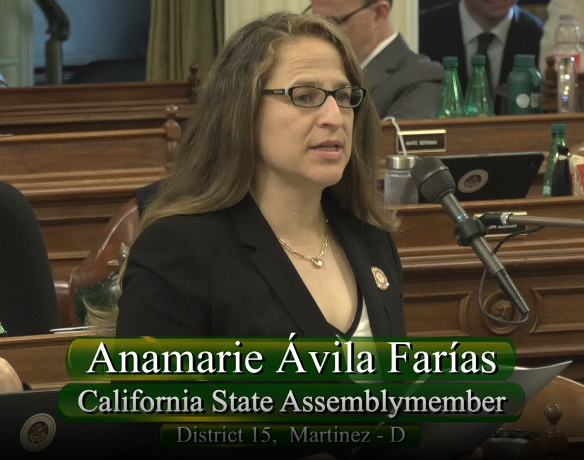
Assemblywoman Ávila Farías speaks about her bill, AB1627 on the Assembly Floor On May 27, 2026. Video screenshot source: CalMatters
Ávila Farías Comments About Bill, Signing by Governor
A press release issued earlier this year, after the State Assembly passed her bill, reads, “On the Assembly Floor, Assemblymember Ávila Farías emphasized that ICE enforcement has created fear across California—impacting both citizens and immigrants alike—and legislation is needed to proactively safeguard our communities and critical spaces.”
She is further quoted in a FOX11 Los Angeles report as saying in a statement, “California’s peace officers…must be guardians of constitutional rights, not participants in their erosion.” and “argued that participating in ICE operations during this period ‘demonstrates an immorality that California cannot afford to have in its ranks.’”
In her brief speech on the Assembly Floor on May 27th, Avila Farias said, “Communities are safer when we are policed by people who are committed to protecting the public rather than kidnapping them.”
During a presentation before the Assembly Standing Committee on Public Safety in April, she said, “Frankly, I don’t want my kids or anyone else’s counting on people who flaunt the rule of the law.” Ávila Farías also claimed, “this bill, does not have any legal issues, and challenges, because we’re simply doing a modest expansion of existing law in a way to protect our community members and holding the highest regard of what our law enforcement professionals. It also is not honing into the individuals that are doing their jobs to the letter of the law. This is protecting vulnerable community populations…”
She repeated her remarks before the state Senate Standing Committee on Public Safety in June saying, “AB 1627 ensures that immigration enforcement personnel are disqualified from becoming a peace officer in California if they have committed misconduct in their prior roles. This bill is about restoring public trust and holding federal law enforcement to the same standards as any other peace officer in California.”
About the governor signing her bill Ávila Farías said, “Our kids deserve role models in uniform, not individuals tied to fear and intimidation. AB 1627 is about accountability, integrity, and reducing harm before it happens. With the signing of the MELT ICE Act of 2026, California sends a clear message: Federal agents who have disregarded constitutional rights are not to be entrusted with peace enforcement roles in our state. Thank you, Governor Newsom, for your commitment to upholding the rule of law and protecting our communities.”
Ávila Farías’ office issued a press release about the bill’s signing.
“Today, Governor Gavin Newsom signed my bill to prevent former ICE employees with documented histories of misconduct from becoming peace officers in California.
“AB 1627, the Misconduct Ends Law-Enforcement Trust Act of 2026, started with people in my community speaking up. One year ago, at a No Kings Rally in Concord, our community came together and spoke out about the fear many immigrant families were experiencing. That community activism helped inspire this legislation, and I am proud that their voices helped lead to meaningful change.
“AB 1627 was not written overnight. It was the result of many conversations, a lot of listening, and working with people who care deeply about public safety and accountability.
“At the heart of this bill is a simple principle: if someone has a documented history of misconduct, they should not be able to leave one agency and simply put on another uniform without accountability.
“I am honored and humbled to have played a part in creating one more barrier to prevent individuals who have abused their authority from becoming peace officers in California. This is about protecting public trust and making sure the people entrusted with a badge are held to a high standard.
“I want to thank Governor Newsom, my legislative colleagues, the community partners who stood with me, and the law-enforcement professionals who worked with us throughout this process. “This is what people power looks like. A community raised its voice, we listened, we worked together, and we turned that vision into law.
“AB 1627 takes effect January 1, 2027.”
Opposed by Statewide Police Organization
According to a report on MSN.com, “The Peace Officers Research Association of California (PORAC) has voiced opposition to the bill. ‘This bill is unnecessary, duplicative and it jeopardizes qualified immunity for California employees,’ stated David Mastagni on behalf of PORAC.
The report further claims, “Critics argue the measure represents ‘guilty by association’ and could worsen existing staffing shortages in California’s police departments and schools. According to data from PORAC, law enforcement agencies throughout California have lost over 3,300 sworn officers since 2020, with an average of 10% of policing roles remaining unfilled.”
Could Be Challenged in Court, Deemed Unconstitutional
However, the new law could be ruled unconstitutional if challenged in court as questions have arisen whether the state can legally enforce a lifetime ban on a specific class of former federal employees without violating federal labor protections or constitutional due process.
According to a report by iHeart Radio in February, “Legal experts question whether California can legally enforce a lifetime ban on a specific class of federal employees without violating federal labor protections or constitutional due process rights.”
Inclusion of the “immorality” clause could give further basis for a court challenge.
You agreed on the price. Have you agreed on the meetup?
Buying or selling on Facebook Marketplace, OfferUp, or another online platform? Plan the exchange before you leave home.
Antioch Police Department has a designated Exchange Zone in our main parking lot at 300 L Street. Look for the posted sign.
A few practical tips for BOTH buyers and sellers:
Don’t follow a last-minute location change. “Come around the corner” or “meet my friend somewhere else” changes the arrangement. You can cancel or reschedule—even if you’ve already driven there.
Buyers: Check the item, not just the box. Open the packaging, compare the model and accessories with the listing, and test it before paying. For electronics, agree on how you’ll test them before meeting.
Sellers: A payment screenshot isn’t proof. If accepting an electronic payment, open your own app to check it. Don’t rely on their screen, an email, or a link they send. Never share a verification code.
Set the terms before the trip. Agree on the price, payment method, who’s meeting, and what’s included. Meet during daylight and bring another adult when possible.
Keep a record. Save the listing, seller or buyer profile, and messages before the meetup. Keep communication in the platform.
You don’t owe anyone a completed sale. Pressure to rush, skip inspection, or change the plan is a reason to pause.
The Exchange Zone does not guarantee safety. City employees cannot serve as official witnesses, authenticate items, or settle civil disputes.
Save this for your next meetup—or send it to someone who buys and sells online.
Cops will be on, provide extra patrols in and around campus today
By Antioch Police Department
The Antioch Police Department is aware of messages and rumors circulating regarding a possible act of violence at Antioch High School today.
We are working closely with Antioch High School administrators and school security and are actively investigating the information that has been reported. At this time, we have no information that supports the rumor.
As a precaution, Antioch Police officers will be present at the school today, and officers will conduct additional patrols in and around the campus. We will remain in close communication with school officials throughout the day.
We understand that messages like these can be concerning for students, families, and staff. We ask everyone to rely on information from official school and Antioch Police Department sources and to avoid sharing unverified rumors or screenshots on social media.
See something, say something. If you have firsthand information, screenshots, messages, or other specific information that may assist the investigation, please contact the Antioch Police Department at (925) 778-2441. Tipsters may remain anonymous.
Please call 9-1-1 for an immediate threat or emergency.
Our Dispatch Center is receiving a high volume of calls regarding this situation. If you do not have new information to report or need police assistance, please monitor official school and Antioch Police Department channels for updates rather than calling Dispatch for a status update.
We will provide additional information if there are significant developments.
Join us for our upcoming Community Violence Forum, a space for community members to share their experiences, concerns, and ideas about violence in our community. Your voice can help shape conversations and efforts toward creating a safer Antioch for everyone.