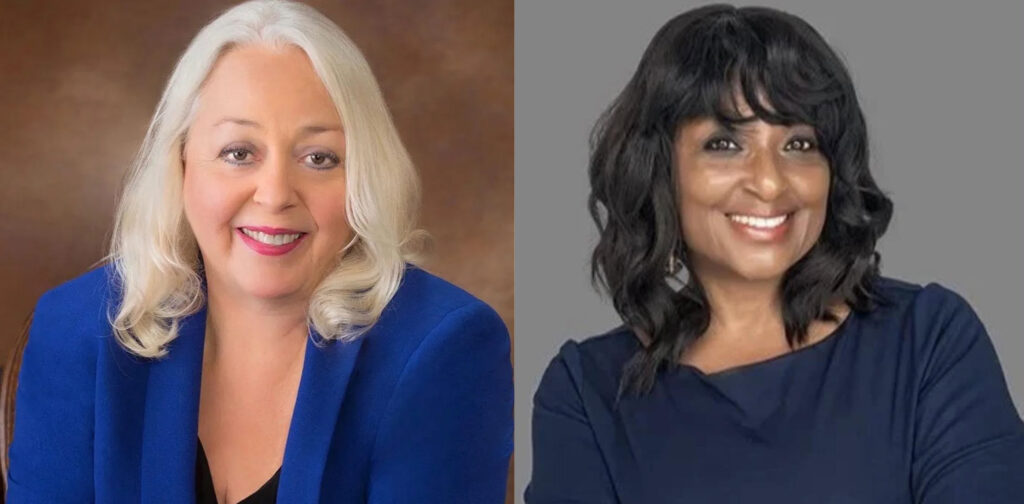
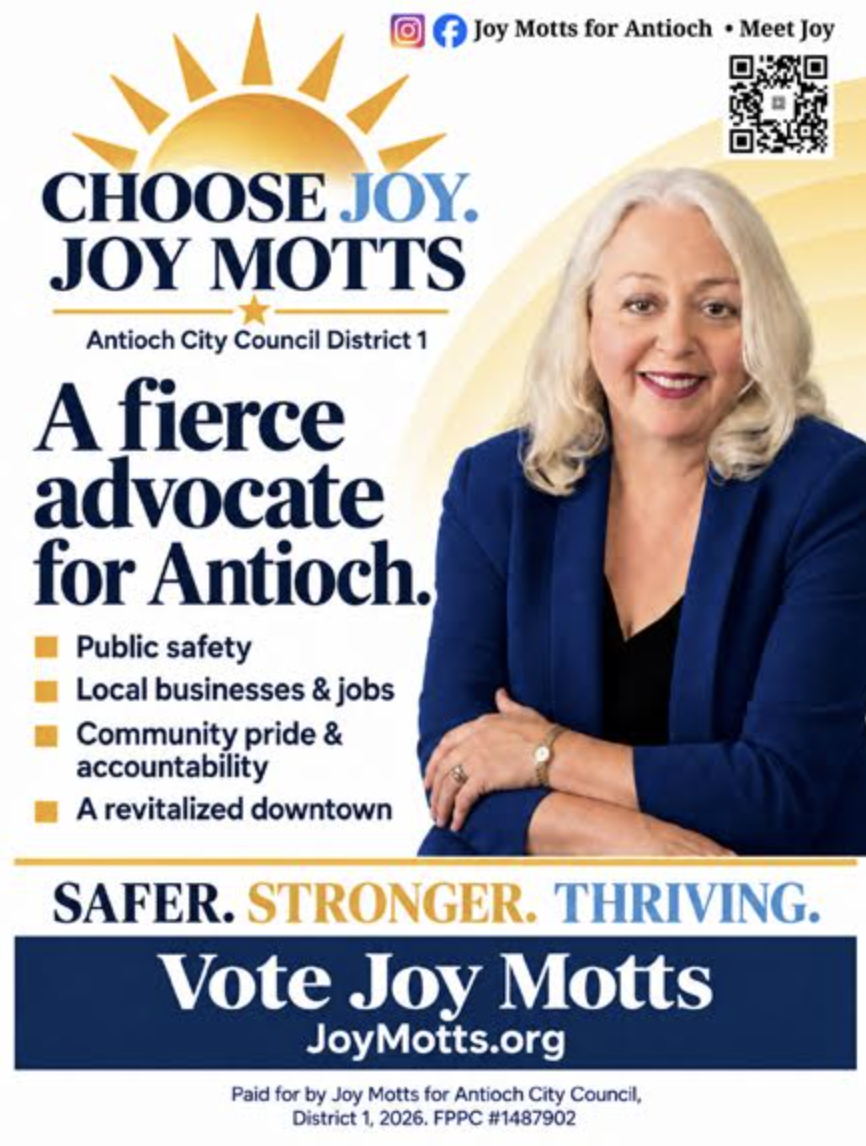
Please vote for Joy Motts for the District 1 Antioch City Council seat. She has the experience, cares about Antioch, and I believe she is the better candidate versus the current incumbent.
The current incumbent asks to be recycled back to that District seat but has not served the public as she has has a responsibility to do. As an elected council member she has really failed to abide by some critical required actions, instead has ignored such and been silent when pressed to carry them out.
During her past six years on the City Council she has, failed to work for and enforce our serious need for the General Plan’s required full complement of police manpower (Sections 3 and 8 dictated 1.2 per thousand sworn officers per thousand residents), and failing to provide a safer and less dangerous Antioch.
We do not need to recycle her back in! We need Joy Motts to be the replacement, which she will work to correct if elected.
Our sworn police manpower is 85 (a deficit of 60 sworn officers in accordance with our General Plan). it should be about 145 sworn officers, proof that she has ignored and therefore continues to endanger our community during her tenure! She needs to be shown the exit door, via instead voting for Joy Motts.
As 50-plus years (about 75,000 hours) of my direct experience in public safety, I have personally brought this to the full Council for years and the incumbents Walker, Wilson and others have instead voted in projects that have further created the public safety issues we have been put under! No way Jose, do not recycle Tamisha and Monica just to get the same ole, same ole!
Also, as a past sworn Officer/investigator/Inspector/Supervisor/Police Trainer, etc., I know what needs to be done! First….do not vote for them just to be recycled. Joy Motts should be voted for in District 1.
For the Antioch City Council The Herald endorses Joy Motts in District 1 and Sandra White in District 4. Sources: Campaign photos.
Torres-Walker has accomplished much of her agenda to “reimagine Antioch”, 14 years for Wilson is more than enough, they’ve worn out their welcomeand it’s time for renewed and new leadership.
By Allen D. Payton
After much thought, review and consideration about this year’s races for the Antioch City Council, I have decided to endorse Joy Motts in District 1 and Sandra White in District 4. While that may not be much of a surprise to anyone based on my past support for each of them and opposition and challenges to the incumbents, Councilwomen Tamisha Torres-Walker in District 1 and Monica Wilson in District 4, the bottom line is they’ve each had more than enough time to accomplish what they set out to. Yet, the challenge has been all the problems they helped create and the irresponsible decisions they’ve made during that time which are reasons enough to support pretty much anyone else who might have run this year.
About the two incumbents, stealing from the name of the 1966 Clint Eastwood movie of the same name, I offer The Good, The Bad and The Ugly of their time on the Council:
The Good
Torres-Walker has served for six years, since she was elected during the height of the Black Lives Matter movement, and the defund police sentiment amongst some at the height of the COVID pandemic in 2020. She has accomplished much of what she intended in her efforts to “reimagine Antioch”. While she started out against the police Torres-Walker ended up supporting the hiring of additional police and even a police department substation in the Sycamore neighborhood, which is still the City’s highest crime area. Plus, she has pushed for and has been able to accomplish several proposals regarding police reform, including the formation of the Antioch Police Oversight Commission, affordable housing measures and efforts to secure state and federal grant funds, such as the $2 million California Violence Intervention and Prevention (CalVIP) Grant.
Wilson, on the other hand, has little to show for her 14 years on the council as far as proposing ideas that were approved and implemented and has primarily been a third, fourth or fifth vote for the ideas of other council members. She does get credit for the formation of the City’s crisis response team – which I’d say is her greatest accomplishment. But she unfortunately and successfully proposed to name it after someone who would not have been helped by the team, Angelo Quinto.
I will also give them both credit for their efforts to address homelessness, which has benefited some of the unhoused residents in Antioch, mainly using federal COVID-relief funds. But the problem remains and has actually grown during their time in office.
The Bad
Natural Gas Pipeline Shut Down & Unnecessary Gas and Oil Drilling Moratorium
Wilson’s other accomplishments includes the council majority’s foolish shutdown of the natural gas pipeline that runs beneath the city, which Torres-Walker also voted for and actually resulted in even more greenhouse gas emissions, and an unnecessary moratorium on drilling for oil and gas in Antioch, even though the only person who has the rights to drill had no plans to do so nor was informed of the proposal even after it was placed on a council agenda for a vote. Plus, the council’s action can’t prevent him from exercising his rights, so, if he wants to, he can still drill. That was all done to grandstand in an effort to please out-of-town environmental groups to boost her unsuccessful efforts running for County Supervisor and later, State Assembly. It has also resulted in a lawsuit against the City by the pipeline owner. (See related articles here, here and here)
Overreaction to Text Scandal, Civil Rights Violations by Antioch Police Officers
Wilson served on the Council during the time the racist and offensive texts were being sent be a few Antioch Police officers and received by many more on their personal cell phones, out of reach of both department and city leadership, and she and Torres-Walker served during the time of their revelation and the resulting scandal caused by that and the civil rights violations against Antioch residents and others by our city’s officers. While I believe it was good that two Black women were on the Council during that time to help address a response to the situation, Torres-Walker overreacted by calling for the resignation of all officers named, even those who merely received the texts. That’s being guilty by association and interfering in the process instead of allowing the investigations by the Contra Costa DA’s Office, FBI and California Department of Justice to be completed, first. (See related article)
Turnover in City Leadership Positions & Staff Vacancies – Grand Jury Report
Their decision-making when it came tohiring City leaders has been less than stellar and in fact was the subject of A Report of The 2023 – 2024 Contra Costa County Civil Grand Jury, number2405, issued June 12, 2024. In that report it outlines three “Challenges Facing the City of Antioch” including, 1. Turnover in city leadership (six permanent or acting City Managers since 2013) which has resulted in an average tenure for Antioch City Managers that is less than half the state average (less than two years vs. 4.5-year average); 2. A city employee vacancy rate that is 4-times the national average (21.6% vs. 5.3%); and 3. Possible Brown Act violations by the Mayor and certain City Council members, as outlined in a letter to Antioch’s Acting City Manager from the Contra Costa District Attorney. (See below)
Wilson was first elected in 2012. Torres-Walker was elected in 2020.
Following Ron Bernal’s announcement he would retire at the end of December 2021, Cornelius “Con” Johnson was hired as Interim City Manager on Nov. 9, 2021, on 3-2 vote with Wilson and Torres-Walker voting in favor.
Then, as previously reported, with only two weeks before that year’s election, during their meeting on Tuesday, Oct. 25, 2022, the Antioch City Council on a 3-2 vote, with Wilson and Torres-Walker in the majority, appointed Interim City Manager Cornelius “Con” Johnson as the permanent city manager for another 22 months.
Community Development Director Forrest Ebbs then served as Acting City Manager from March 17 until June 13, 2023, and remained as Community Development Director until July 14, when he left to take another position in a different city.
Economic Development Director Kwame Reed was then appointed Acting City Manager on June 13, 2023, and served in the position until Oct. 2024.
Parks and Recreation Director Brad Helfenberger was then appointed as Interim Assistant City Manager by Reed on June 26, 2023. Senior Planner Kevin Scudero was appointed as Acting Community Development Director, around the same time.
City Manager Bessie M. Scott was hired on August 27, 2024, on another 3-2 vote, with Torres-Walker and Wilson voting in favor and filled the position on Oct. 7th, less than a month before that year’s election when a new mayor and two new council members were elected.
Reed was then promoted to Assistant City Manager by Scott on Jan. 23, 2025, and served in that position until he left for a job with the County Clerk-Recorder’s Office on March 21st.
On April 1, 2025, Helfenberger was again appointed Acting Assistant City Manager, Scott Buenting was named Public Works Director/City Engineer after serving in an acting role for 2.5 years; David Storer was appointed Interim Director of the Community & Economic Development Department, and Shahad Wright was appointed the Acting Parks and Recreation Director. (See related article)
As of May 13, 2025, Antioch was left without an Assistant City Manager or Economic Development Director, and an Acting Police Chief, Acting City Attorney, Acting Community Development Director and Acting Public Works Director/City Engineer. (See related article)
Then Helfenberger was appointed to be the City’s Director of Information Systems effective October 20, 2025, and the Assistant City Manager position has remained vacant since. Interim Director of the Department of Public Safety and Community Resources Monserrat Cabral was appointed Director that same day. Also, that same day, Interim Director of Parks and Recreation Shahad Wright was appointed Director of the Recreation Department. (See related article)
A new Community & Economic Development Director started on Oct. 6, 2025, But was gone by March 3, 2026.
Storer again appointed Interim Community & Economic Development Director but then was let go in May 2026 after Scott was placed on leave and Principal Planning Kevin Scudero was appointed Acting Community & Economic Development Director.
Scott was placed on paid leave May 5, 2026, on a 4-0 vote with Torres-Walker voting to abstain and Human Resources Director Ana Cortez was appointed Acting City Manager effective the next day, also on a 4-0 vote, and was to remain in the position until June 30, 2027. Another person in the HR Dept was appointed the Acting HR Director. The Council also voted not to fill the assistant city manager’s position until sometime in 2027.
However, during their Oct. 7th meeting the Council decided to hire an interim city manager while they search for someone to fill the role permanently.
So, currently, the City has an acting city manager, no assistant city manager and an acting director of Community and Economic Development. But the council did vote in September to reestablish a separate Economic Development Department and create the director position, again, and begin the search process to fill it.
Repeated Deficits, Poor Spending Decisions
The decisions and votes of both councilwomen have helped create the annual deficits the City continues to face. Their repeated votes for all the cannabis businesses, while bringing in one-time funds for the City and local non-profit organizations, have actually hurt the City’s reputation and economic development efforts, and created more calls for service to the police.
They both also voted to shut down the Rivertown Resource Center in the former police station on W. 10th Street, displacing 16 non-profit organizations, for a new department, which the Council on a 3-2 vote agreed to spend $14 million for design and construction of a new, two story building in its place. Later, the Council voted to purchase the two-story former PG&E building on W. 2nd Street at a cost of $1.83 million to house the new department, instead. Yet, the City has not been able to occupy it because the elevator was not compliant with the federal Americans with Disabilities Act (ADA). The W. 10th Street building was going to be sold to the Fire District and has sat vacant, gathering dust and
Although the Council cut spending in the past two budget cycles, the City is still facing an $11.2 million deficit in Fiscal Year 2027-28 even after a $5 million transfer into the General Fund from the Budget Stabilization Fund. (See related articles here, here and here)
Both Voted to Name Crisis Response Team for Angelo Quinto, Give His Family $7.5 Million Despite No Knee to Neck, Wrongdoing by Officers
Both Wilson and Torres-Walker voted to name the City’s crisis response team after Angelo Quinto, a clear slap in the face to the Antioch Police officers who saved his family from him attacking them. It was the family who called the police in the first place. It’s also in spite of the fact the DA cleared Antioch Officers of any wrongdoing, said there had been no knee to his neck by the officers, and Quinto died three days later in the hospital while not in police custody, in spite of the false reports by Bay Area and national media. (See related articles here and here)
The DA reported, “Antioch Police officers engaged with Quinto in a manner that was lawful and objectively reasonable under the circumstances” and “an internal examination showed no bone fractures or damage to Quinto’s larynx and trachea” and “accounts of what transpired in the bedroom are consistent among all witnesses in that no police officer applied pressure to Quinto’s neck.”
Also, the Coroner’s autopsy determined Quinto died of drug intoxication, psychiatric conditions, physical exertion and cardiac arrest and an independent toxicology report found presence of Fentanyl in Quinto’s blood – in addition to Modafinil and Levetiracetam.
“I want to say to the Quinto family, you lost your son, that’s how we got here,” Torres-Walker said. “Your loss has spurred some change, but it didn’t have to happen.”
Both councilwomen voted to create an unnecessary, new City department with a new director, by taking five existing services from other City departments, adding two new services that could have been handled by the police department, and gave it the confusing name, “Department of Public Safety and Community Resources” even though it had nothing to do with police or fire services. The department name was Torres-Walker’s brainchild, who tried to argue, “public safety is a lot more than policing. It’s about quality of life, environmental justice, youth services, housing. Public safety is about economic dignity, access to jobs, clean water, clean air.” It was supposed to be located in the W. 10th Street building.
The department was finally renamed this year to simply, the Community Services Department. But it’s still not needed and the responsibilities can be divided among other City departments to save money which is sorely needed. (See related articles here, here and here)
Voted to Rezone 10 Commercial Properties to Allow Low-Income Apartments
Torres-Walker’s focus has been too much on low-income housing, and her and Wilson’s votes to rezone 10 commercial parcels throughout the city to allow for extremely-low, very-low and low-income apartment units, then later claiming they thought they were voting for mixed use – which was only one of the three options – are unacceptable. Especially, when the state did not require it and worse, one of those projects currently under construction is near the golf course where the residents in the nearby neighborhoods rose up over 20 years ago and successfully defeated a proposed apartment complex across the street. (See related articles here, here and here)
Antioch has more than enough affordable housing and needs upscale housing in its mix, like Brentwood has, to attract seniors and residents with higher incomes who will spend their money in town, shop in our stores and dine in our restaurants, and hopefully, bring their businesses to town to employ our commuting residents. They don’t seem to get that, even though it’s been in the City’s plans for 30 years. We need council members who will support that type of housing instead and I have no doubt both Motts and White will.
Both Voted to Bypass City Manager, Hire Police Chief Directly
During the Council meeting on August 22, 2023, with Torres-Walker and Wilson voting in favor, the Council twice voted 3-2 to directly hire the police chief but delayed implementation of the ordinance for 90 days so the acting city manager could complete the process of hiring an interim chief. Torres-Walker proposed a time limit of possibly one year before the authority would revert back to the city manager which was supported by Wilson. But that wasn’t part of the approved motions.
Both Voted for 18.45% Pay Raise
During their current term, both councilwomen voted to give themselves an 18.45% pay raise during the Council meeting on Tuesday, August 27, 2024. As previously reported, the council approved on a 4-1 vote, with Ogorchock opposing, an 18.45% pay raise or $296, from $1,604 to $1,900 per month, for a total of $22,800 per year, which went into effect after that year’s election. It benefited the two councilwomen, and the new mayor and council members.
Neither Called Out Mayor’s Misbehavior
Plus, both incumbents, while calling out the wrong actions and behavior of Antioch police officers, kept their mouths shut when it came to calling out and challenging Hernandez-Thorpe’s DUI and later sexual harassment of two female employees who worked for him. Motts called for the mayor’s resignation. Instead, when their fellow councilmembers, Ogorchock and Mike Barbanica also called for Hernandez-Thorpe’s resignation, Wilson called it, “racially divisive grandstanding,” even though the County Board of Supervisors voted to settle with the two women for $350,000. (See related articles here, here and here)
Torres-Walker Helped Take Control of Juneteenth Celebration Away from Young African American Woman & Her Committee
As previously reported, in 2022, with a little over two months before the planned and promoted annual Antioch Juneteenth Celebration, Mayor Thorpe, Torres-Walker and Interim City Manager Con Johnson decided to take the event from Claryssa Wilson, the young African-American college student who had organized it for the previous two years and her committee of 11 other African-American Antioch residents, and instead, had the City organize and operate it.
THE UGLY
Corruption: DA Letter on Secret Meetings at Mayor’s House Violating State Open Meeting Law
Some of their actions and decisions have just been plain corrupt.
They were both called out by the District Attorney for holding private meetings at former Mayor Lamar Hernandez-Thorpe’s home at which they discussed City business in clear violation of the state’s Brown Act open meeting law. It was later shared by a former friend of the mayor who was also there that they discussed redistricting and moving fellow Councilwoman Lori Ogorchock out of her district and into Wilson’s, which they all three did later in live time during a council meeting.
In a letter from Contra Costa County District Attorney Diana Becton she wrote, “there is evidence that Mayor Thorpe and Councilmembers Torres Walker and Wilson met at Mayor Thorpe’s home in 2022 and held discussions. Furthermore, it appears that the discussions may have included an agreement to take action on matters within the subject matter jurisdiction of the council. As defined by Government Code section 54952.6, ‘action taken’ means a collective decision, or even a commitment or promise to make a decision, on a matter concerning the city. Our investigation leads us to believe that Mayor Thorpe and Councilmembers Torres Walker and Wilson did meet and may have developed a collective occurrence absent a public forum. Any similar meeting on matters concerning the city could subject council members to criminal liability.”
In addition, the mayor’s former friend said the meetings occurred and she attended them. Finally, Torres-Walker didn’t deny and Thorpe admitted to participating in the private meetings. (See related article)
More Corruption: Gerrymandered Council District Boundaries to Move Ogorchock into Wilson’s District
Both Torres-Walker and Wilson helped redraw then voted for the new council district boundaries in 2022 to gerrymander Ogorchock out of her district, moving her neighborhood into District 4, forcing the District 3 councilwoman to run for re-election against Wilson.
That’s in spite of two almost identical maps drawn by members of the public having been submitted during the open process in which the Council encouraged the public to draw and submit proposed maps, that would have kept each of the councilmembers in their districts and used major city streets as the boundary lines. (See related article)
While she has mellowed some since first being elected in 2020, Torres-Walker’s rhetoric continues to be radical, has even been racist at times, filled with emotion and anger and even a false allegation of murder by Antioch Police officers. Plus, she disrespects our flag and country by not participating in the Pledge of Allegiance at the beginning of Council meetings. She merely stands there facing the flag with her hands behind her back. That’s unacceptable for an elected official who took the oath to “support and defend the Constitution of the United States…against all enemies, foreign and domestic.”
During her current term, after being re-elected by just four votes in 2022, Torres-Walker has said some comments that raised eyebrows and had people shaking their heads. One statement was rather revealing when she stated, “I’m a governmental radically deconstructionist,” during the Council meeting on August 22, 2023. But that same night Torres-Walker also falsely and irresponsibly accused Antioch Police officers of murder when she stated, “We’ve been going through a public process for the past 18 months since we found out Angelo Quinto was murdered in his family’s house.”
Said, “City as a Whole” Has a “Deeply Entrenched Racist Culture”,
In a post on her official Facebook page on Thursday, May 18, 2023, Torres-Walker wrote, “My position on this is…an expression of my commitment to not ignore the deeply entrenched racist culture within the Antioch Police Department and the City as a whole.”
Said Fellow Councilwoman Ogorchock Had “White Privilege Fits” and “White Fragility”
During the council meeting on Friday, May 19th, 2023, Torres-Walker said about her council colleague, “last year when Councilwoman Lori Ogorchock had her white privilege fits right here, in this public space, I didn’t say a word. I’m growing tired and I thank God that I have patience because I have seen some growth. But white fragility doesn’t move me at all.” (See related article)
Then, during the most recent regular Council meeting on Oct. 14, 2026, when discussing the proposed “Ethical Investing” policy with “Socially Responsible and Ethical Investment Exclusions” proposed by a small group of activists after meeting with the city treasurer, Torres-Walker took swipes at our nation and its allies.
She also said, “we exist within a genocidal government that invests in the military industrial complex…that also sells weapons to other genocidal governments. It is a conundrum because we’re existing right now on stolen, colonized land.” (See related article)
Torres-Walker Disrespects Our Nation and Flag
At the beginning of Council meetings during the Pledge of Allegiance, instead of placing her hand over her heart and reciting the Pledge, Torres-Walker disrespects the nation and the flag it represents by merely standing there with her hands behind her back. Yet, she’ll post small “Pride” flags on the dais in front of her – in direct violation of the City Flag Policy – and wear a Palestinian keffiyeh neck scarf during council meetings.
Torres-Walker’s Own Run-Ins With the Law, Forced to Resign from Council Committee – Refuses to Release Police Body Cam Footage
Torres-Walker has had her own run-ins with police from her first months in office. That’s when her sons were pulled over for illegally riding dirt bikes on city streets, and she came to their defense but in doing so accused the two officers of wrongdoing and they claim she said, “I’ll have your (expletive) badge. Do you know who I am?” They in turn sued her.
She demanded an outside investigator which cost the City $45,000 and the report showed all her claims were “unfounded” or “not sustained”. There were two outside investigations with the second into Torres-Walker at the request of the Antioch Police Officers Association. Then-City Manager Ron Bernal both contracted for and stopped the second one. (See related articles here and here)
Then in October of 2021, when confronted by police at her home about noise complaints including dirt bikes riding in the street, loud music and five or six gunshots, Torres-Walker was arrested for interfering with police who were trying to question another woman there. It was just one of eight incidents at her home that resulted in 11 calls for police service. She claimed police were targeting her family, which they denied.
Under pressure from her fellow council members, a few days later, she stepped down as Chair of the Council’s Antioch Police Oversight Committee. But before she did, Torres-Walker claimed, “negative and retaliatory behaviors from APD.”
The councilwoman was charged with a misdemeanor for resisting, obstructing, delaying of a Peace Officer or EMT.
Finally, in September 2022, the DA dropped the charges against the councilwoman. That followed a contributed $500 contribution by Torres-Walker to Becton’s reelection campaign. Becton said she later returned the contribution.
Multiple efforts were made to request APD to release the officer’s body camera video footage, and both of her opponents in the 2022 election, including Motts, called for it, as well. But neither Torres-Walker nor the police department will release the footage so the public can see, hear and know what occurred in front of her house that night, claiming it’s “privileged”. That’s not right. They shouldn’t be protecting a sitting council member, and she should be more transparent with the public, even if it’s embarrassing and costs her politically.
Arrogance in Office: Both Refuse to Answer Questions, Respond to Phone Calls, Texts, Emails
Another pet peeve for me is, both have demonstrated arrogance in office as only once in the past several years has either of them responded to my emails, texts and phone calls, which is a sign they don’t think they have to answer questions posed to them by the media to inform the public and don’t like being challenged. Most of the time they were included in group emails to all council members and given the opportunity to comment about a matter.
While I see and speak to her periodically in the community and Wilson and I are cordial with each other, they rarely if ever communicate with me about City issues, which is frustrating.
Torres-Walker only responded recently to answer questions and provide information about the sale of El Campanil Theatre and her unsuccessful efforts to get the City to purchase it. But since then, crickets. Also, Wilson is the only one who was either on the council or on City staff at the time it was first in the process of being sold in 2022 and 2023 to not tell the public what she knew about it. I offered her the opportunity to not respond directly to my questions but post her answers on her official Facebook page which she still hasn’t done.
Torres-Walker once complained to me in early 2022 via text in response to questions about the lawsuit against the City and her by the two officers involved in the incident with her sons back in 2020, claiming I was using her “family for click bait” and that I “fan the flames of misinformation” although I merely reported what was claimed in the lawsuit and gave her the chance to offer her side of the matter. She finished with, “Here is where we part ways and it wasn’t for a lack of trying.”
If you’re going to be an elected official, at times you’re going to be asked tough questions that are not comfortable to keep the public informed. She is the one who made the incident with her sons go public by complaining they were mistreated by the two officers, resulting in the lawsuit. As the old saying goes, don’t shoot the messenger, especially for doing my job and merely asking questions and reporting what people write, do and say, especially elected officials.
Torres-Walker and Wilson Have Worn Out Their Welcome on the Council
On the positive side, I’ve had the opportunity to interact and get to know Torres-Walker, off the dais, and I, frankly, like and find her, fun to be around. Plus, she’s been more involved in the community in the past year, specifically with the Rivertown area and the new Downtown Antioch Association, specifically, working to help the businesses with private security to supplement police efforts. But she still rarely attends any Rivertown events while her opponent does.
Yet, while I believe Torres-Walker is well intentioned, has been a leader for the causes she’s championed, has grown in the position and matured as an individual, is less strident than when she first began and represents a constituency in Antioch, she still says crazy and radical things during what I’ve labeled her “diatribes from the dais”, and does things that are embarrassing and unbecoming of an elected representative.
So, I believe her time for her service in the position on the Council has come to an end. As Esther in the Bible who was in place as the queen, “for such a time as this,” to get the king to save her people, I believe Tamisha has fulfilled her role, has completed her task and it’s time for someone else with a different viewpoint focused on the future to step in to represent District 1 and all of Antioch. Should she lose, Torres-Walker can spend more time working on her worthwhile non-profit organization in Richmond.
For Wilson, whose 14 years have been way too much time for her decision-making negatively affecting our community, her time on the Council has also come to an end – especially, now that the City has been released from the U.S Department of Justice’s agreement regarding the Antioch Police Department, which Torres-Walker applauded. (See related articles here and here)
So, while some good has been accomplished, the bottom line is the bad and the ugly far outweigh it and the result is Torres-Walker and Wilson have worn out their welcome on the Council.
Time for Renewed & New Leadership on the City Council
Instead, it’s time for renewed and new leadership on the Antioch City Council. Motts brings renewed leadership having served previously on both the Antioch School Board in 2010-14 and on the City Council in 2018-20 and White brings new leadership with some City government experience having served as Chair of the Antioch Police Crime Prevention Commission, helping organize Neighborhood Watch and Business Alert programs, before it was disbanded so the Antioch Police Oversight Commission could be formed.
Torres-Walker defeated Motts in 2020 receiving only 36.2% of the vote with a third candidate in the race. Then Motts challenged her in 2022, and with a third candidate in the race, again, Motts lost by just three votes on Election Day. But following a costly recount, Motts ended up losing by four votes but Torres-Walker received only 34.4% of the vote meaning 65.6% of the voters wanted someone else to represent them. With no other candidate in the race this year, the one-on-one competition should prove more favorable for Motts. But she believes it will be close, either way.
For full disclosure, I helped raise funds to pay for her costly recount in 2022.
I’ve also worked with Joy multiple times to promote all the various events of the Celebrate Antioch Foundation, since the beginning when we helped form the organization, for which she has been serving as president since 2010.
In her role with Celebrate Antioch, Motts helped organize the City’s Sesquicentennial 150th Anniversary of Cityhood Celebration in 2022 with a year’s long of events and activities. While some complained she and the other two leaders of the organization were paid by the City for their work, it was a total of $25,000 split amongst them, which is a pittance for the amount of time they put in.
Motts has championed the Rivertown Square project on the former Antioch Lumber Company lot in downtown which, if built, it would be in place of the large, Barbara Price Marina Park that was removed years ago when the new Marina Boat Launch and parking lot were built. Unfortunately, the Council, including Torres-Walker and Wilson, after having voted for the project in 2021 and to hire a firm to design it, then City staff held community meetings for public input on the design, the councilwomen voted against pursuing state grant funds for it, this year. Wilson had also previously voted to allow for the park and event center there in June 2015, but just two months later she flip-flopped and voted to sell the lot to a private developer. Fortunately, that never transpired.
In general, I agree with Motts on many if not most issues, but not everything. The one major issue I remember having a challenge with her previously, was Motts’ vote in 2020, along with Wilson and Thorpe, to postpone indefinitely the proposed project by Gabriel Chiu, known as the Delta Fair Village, which included apartments and commercial space on Delta Fair Blvd. where the FoodMaxx store was previously located. Their issue was he hadn’t been keeping that or his other commercial properties in the city cleaned up. I believe she should have voted for the project with the condition Chiu clean up his properties before a building permit would be issued for the new development. Instead, they lost all of their leverage and still nothing has happened with the property, although plans have been submitted to the City.
Motts was a leader on dealing with the City’s homeless problem and instrumental in the establishment of the Opportunity Village homeless hotel on E. 18th Street, the City’s first major effort to address the issue. She was one of the three council members who first voted to advance the transitional housing project. (See related articles here and here)
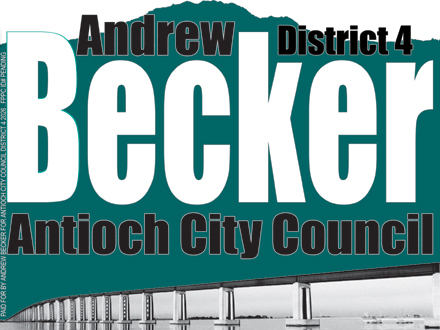
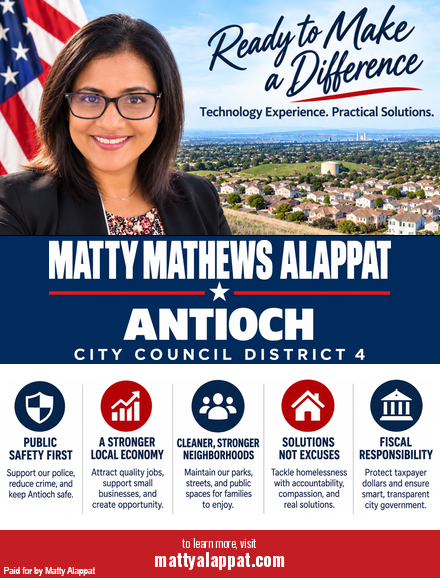
White first ran for City Council in 2020 in a three-candidate race but lost to Wilson by a little more than two-to-one. She ran again in 2022 in a four-candidate race which included both Wilson and Ogorchock but placed fourth. As they say, third time is a charm and although this year there are also four candidates in the race, including homeless and affordable housing advocate Andrew Becker, who is a regular at council meetings speaking on a variety of issues and newcomer Matty Alappat, I’m hoping that’s the case and believe Sandra has a better shot at winning, especially with the baggage Wilson is carrying.
On a side note, my encouragement to Andrew is to continue doing his detailed research, speaking out on the issues and challenging both the council members and City staff. But as I’ve told him directly, he needs to temper his tone if he wants to be more effective in winning them over to his side. For Matty, who I have yet to meet but have spoken to and believe she’s quite sharp, I encourage her to apply for a commission appointment to get more knowledge about Antioch and some experience serving the community before seeking office, again.
I believe White is the best choice of the three challengers in this year’s District 4 race as she has also proven herself through community service and leadership as a Board Member of the Antioch Schools Education Foundation and Delta Learning Center and as a former President of the Antioch Rotary Club.
White will bring common sense to the City Council, plus, leadership experience in management in the private sector from her job which, according to her LinkedIn profile, is as the Vice President of Human Resources for the Center for Social Dynamics. According to their website, the California-based corporation with locations in seven other states, “helps individuals and families navigating autism and other behavioral conditions make meaningful progress through personalized, research-backed ABA (Applied Behavior Analysis) therapy.”
Also, White offers fiscal responsibility and will focus on her priorities of Economic Development, Public Safety, Responsible Support for the Unhoused – which are all sorely needed in Antioch – plus, Community Partnerships & Accountability.
But one challenge I have with White, unlike Motts and Becker, is she takes too long to respond to phone calls, texts and emails which is very frustrating. She will need to work on improving in that area if she’s elected.
Finally, both Motts and White have the right temperament, the commitment to all of Antioch and the heart to serve us well in the position and they also will represent our city both locally and regionally in a positive, respectful way.
For renewed and new leadership on the Antioch City Council please join me in choosing Joy Motts and Sandra White for election.
AUSD is at a crisis point. This is no time to elect someone without the experience, financial or otherwise, to keep the district afloat while critical decisions are being made.
Mary Rocha voted:
• No on hiring the current embattled superintendent,
• No on salary increases without budget impact information,
• No on mass layoffs, without Explanation on how students would still be served with less staff.
Mary has pressed the superintendent to focus on students, parents, and the community, and she has been the voice of reason while the superintendent provided little to no information about the current fiscal crisis
Experience matters. Mary has served on the board since 2018 and is the only trustee who brings experience and institutional understanding to the table. Two members (Cabos Smith and Brown) are in their first term. The current board president (Jag) is not running again and will be replaced in December by a new board member (Reese). The immediate past president (Hernandez) is in his sixth year, however he spent those years pursuing graduate work at Stanford and Davis toward becoming a physician, and in my view gives minimal attention to his role as trustee.
The political practice of districting, implemented in 2022, brought four new members to the board who lacked the experience to make decisions with long-term consequences.
It was not always this way. Before districting, the board was made up of trustees with varied backgrounds and focus. Gary Hack, a former teacher and AEA president, brought understanding of and advocacy for employees. Claire Smith, who had children in the district for many years, was the voice of parents, families, and students. As a former corporate director and nonprofit executive director, I spent my 12 years focused on contracts and fiscal solvency. A diverse board with diverse opinions has always served this district best.
The results of the current board’s decisions are clear:
The superintendent’s hiring. She was hired by a 4-1 vote without fully vetting her background. A simple Google search shows she left Sequoia Union High School District in December 2022 with a $299,000 severance package under a mutual separation agreement, and that her later tenure at Pacifica School District drew backlash over budget deficits and job cuts. Her contract gave her the same number of workdays as a principal, which is unheard of. A new salary scale was created for her, far above those of former superintendents. A $12,000 relocation package was included, and the reimbursements approved only by the board president at the time (Hernandez) are questionable.
Raises for all. The board approval was 4-1 based on a positive certification reported in 2025–26 First Interim Report (December 2025), which should have begun with “once upon a time…
Layoffs. After a deficit of more than $30 million was uncovered, layoffs were made without a solid plan from the superintendent. The scattershot approach, meant to save $18 million, did little to achieve fiscal solvency, and more layoffs are coming.
Special education. The department was reorganized to save $600,000. Directors were combined, left for other districts, or not rehired. That decision gutted the department and leaves the district open to lawsuits, as students may not be receiving their IEP-mandated services.
Today, the district faces a serious deficit, superintendent is on paid administrative leave and has filed a lawsuit naming AUSD, Mary Rocha as an individual, and Unnamed Individuals 1 through 50. In my opinion, that suit is a strategy to secure another package to quietly go away, as she did at Sequoia.
Antioch has faced a number of challenges over the past year—from legal threats by housing developers to unpaid fuel bills, cuts to critical services, vacant commercial properties, a water park that was left closed all summer, and the loss of the El Campanil Theatre. More than ever, the city needs bold leaders who are capable of seeing things as they really are, thinking clearly, and taking decisive action.
In the District 1 council race, only one candidate has those qualities—and it’s not former Antioch councilwoman Joy Motts.
Joy has deep roots and strong ties in the community. Her passion for Antioch and nonprofit work as president of the Celebrate Antioch Foundation, which puts on the city’s Fourth of July Celebration, are commendable. But her track record as an elected official says something different.
Between 2010 and 2014, when Joy served on the Antioch Unified School District Board of Trustees, the district was operating under a 2009 settlement with the ACLU over discriminatory disciplinary practices against students of color. Joy left the board in 2014 with the problem unresolved—in fact, district data showed Black students were suspended more than 2,700 times during the 2013-14 school year compared with 430 white students, according to a report in the East Bay Times. The East County NAACP would later sue the district over similar issues.
In April 2013, when Joy was board president, the families of several special education kindergartners filed a federal lawsuit against the district, alleging a teacher slapped, pinched and verbally abused their children at Mno Grant Elementary and that the district failed to report the abuse to police or Child Protective Services. Trustees voted to pay $8 million to settle the case.
Joy lost reelection to the school board in 2014, ran again in 2016, and lost that race as well. Then in 2018, she was elected to the Antioch City Council.
On June 18, 2020, in the wake of George Floyd’s murder at the hands of Minneapolis police, the city council held special meetings to decide whether to create an ad hoc committee on police reform. The need was obvious, as the Antioch Police Department did not use body cameras, had no formal policy for reviewing deadly use-of-force incidents, and had already settled several costly lawsuits involving in-custody deaths.
After testimony from 700 Antioch residents, some of whom had personally experienced racism and mistreatment by Antioch police, Joy voted against police reform, opting instead for a series of town halls that went nowhere. That decision would have profound consequences on Antioch taxpayers and the city’s reputation.
Four days after Joy’s vote, on June 22, 2020, APD officer Eric Rombough sent a photo on his phone depicting a large naked Black man with his penis exposed sitting on the neck of George Floyd. That text was one of many later uncovered by a Contra Costa District Attorney’s investigation, which showed that dozens of Antioch police officers had exchanged racist and homophobic messages and that some had admitted committing crimes against people of color, including K-9 attacks.
The texting scandal led to the convictions and prison sentences of several Antioch police officers, federal oversight by the U.S. Department of Justice, and $4.6 million paid to settle civil rights claims filed against the city by 23 victims of police misconduct.
Six months after Joy’s vote, four cops showed up to the home of Navy veteran Angelo Quinto, who was experiencing a mental health crisis. One officer knelt on his neck, leading to his death three days later and ultimately a $7.5 million settlement with the city.
It was left to the new city council majority to clean up a mess that made national headlines—a mess that many in the community saw coming, but not Joy.
The progress Antioch has made since then is now in jeopardy. Mayor Ron Bernal—who as city manager was responsible for overseeing the police department when officers were committing crimes against Antioch residents—has already tried to put the Antioch Police Oversight Commission on hold. Meanwhile, the Angelo Quinto Community Response Team, established to prevent another senseless killing, has seen its hours reduced from 24/7 to 12 hours a day, which could place other lives at risk.
The mayor and his deep-pocketed friends are now vigorously supporting Joy’s campaign because they want a rubber-stamp council. But what they want is not what Antioch needs. The city needs leaders who are capable of collaborating, but who are also ready to stand up and fight for those who don’t have a seat at the table and keep the city out of legal jeopardy.
District 1 already has such a leader in Tamisha Torres-Walker.
Tamisha not only supported the creation of the Angelo Quinto Community Response Team, but also the creation of the Antioch Police Oversight Commission, the city’s first civilian police oversight body, and helped advance body cameras for officers and other critical police reforms.
Tamisha fought to bring in over $10 million in outside funding to the Department of Community Resources, including grants to support gun violence prevention and the city’s paid internship program for young adults. She also championed a $34.9 million grant for permanent supportive housing for the city’s unhoused residents and the creation of the Sycamore Square police substation.
And when it was discovered that Antioch had the highest tenant eviction rates during the pandemic, Tamisha supported ordinances to stabilize rents, protect tenants from landlord harassment, and require just cause evictions. She is now pushing for a vacancy tax to hold absentee property owners accountable and reduce blight.
Too often, voters in cities like Antioch choose candidates who know how to get elected but don’t know how to lead. It’s why the same names keep recycling in and out of positions on the school board and city council.
Sure, they care about Antioch and seem to say the right things. Everyone wants downtown revitalization, safe neighborhoods and functional city services. But they lack the courage, vision, and energy to act decisively in critical moments, before it’s too late.
Tamisha Torres-Walker was built for those moments. She has spent her time on the council listening to constituents, doing the work, and using her council seat to advocate for all Antioch residents—and she has the track record to prove it. District 1 voters need to send her back to the council for four more years of progress.
How do we move forward when it feels like we keep taking steps backward?
That’s the question I find myself asking every time a new City Council agenda is released – and why I talk so much.
Across the Bay Area and throughout California, communities are finding creative ways to adapt to a changing economy, workforce shortages, tightening budgets and the evolving needs of residents. They are identifying opportunities, thinking bigger and finding ways to move projects forward.
For example:
Brentwood, CA is nearly complete with the Sand Creek Sports Complex
Kern County is developing one of California’s largest master-planned active-lifestyle communities for seniors.
Martinez has a draft of what its waterfront could look like.
Oakley, CA is breaking ground on the Amtrak station this week and has a 55-acre park plus other sports fields coming in the future.
Ontario, CA is developing a 200-acre sports empire with a 6,500 seat baseball stadium and eight baseball/softball diamonds.
Pittsburg, CA Dream Courts are nearing completion.
Plumas Lake, north of Sacramento, is getting a wave park on more than 100 acres.
Rancho Cordova is moving forward with plans for a 7,500-plus-seat arena.
Richmond, CA has $550 million coming from Chevron that they get to put to work.
Walnut Creek, CA is making major improvements in Heather Farms.
Antioch…. Crickets.
Actually, scratch that. In Antioch, we are losing things such as the El Campanil Theatre, Babe Ruth Fields, our Amtrak Station and are mall is on its last leg.
Every other community in State of California isn’t sitting around waiting for opportunity to knock. They’re creating it by doing the work and actually being inviting—it also helps when a city is clean and crime is under control.
For a decade, Antioch has used the word “opportunity” as its motto, yet actions say otherwise. At what point do we stop talking about opportunity and instead put shovels in the ground and begin working towards our potential.
Too often, it feels like we wait, hope something happens or throw up our hands before we even get started. That mentality has to change. Our city deserves better, our residents deserve better, and our future is worth fighting for.
We have so many underutilized assets that its embarrassing – the delta waterfront, the foothills of Mount Diablo, our agricultural heritage. Instead, Antioch apparently has lost its identity and we have no idea what we want to be in 10, 20, or 30 years from now.
It’s difficult to create a roadmap for the future when we haven’t even agreed on where we’re trying to go. There is no map. There is no vision. There is no plan.
And that’s where leadership matters.
If we want meaningful plans that reflect the priorities, needs and aspirations of our residents, we need a City Hall that is capable of helping lead those conversations. That requires strong leadership from the city manager’s office, competent department heads and a culture that encourages innovation, accountability and problem-solving.
Unfortunately, when leadership breaks down, the entire organization suffers – which we are experiencing right now with Band-Aid solutions to lipstick on a pig commentary.
How can we expect staff, or even investors, to bring forward bold ideas, pursue economic development opportunities or engage residents in meaningful discussions when we are still struggling to manage basic contracts?
Look no further than what happened at the last City Council meeting.
I raised concerns about nearly $500,000 in contract amendments involving work at the water park. These amendments were placed on the consent calendar, where items are typically approved without discussion.
The council ultimately approved the amendments, potentially avoiding a legal dispute with the contractor.
But here’s the problem: The work had already been completed nearly a month before the amendments were brought to the council for approval.
Think about that for a moment.
Under the city’s contracting rules, agreements exceeding $50,000 require City Council approval. Yet somehow, additional work approaching half a million dollars was either authorized beyond the appropriate approval process or allowed to proceed without sufficient oversight.
Then, after the work was completed, the council was essentially asked to approve the bill.
What would have happened if the council had voted no?
Would the city have faced a lawsuit? Would taxpayers have been left paying even more? Who was responsible for ensuring the proper approvals were obtained before the work began?
These aren’t minor administrative questions. They go directly to accountability, communication, financial oversight and the basic responsibility of protecting taxpayer dollars.
And frankly, the City Council should never be put in a position where it is asked to approve nearly $500,000 in additional spending after the work is already finished.
This is precisely the type of dysfunction that erodes public confidence in City Hall – and this isn’t even bringing up the staff report on the Economic Development Department and staff mailing in the item for council to basically work through with few details and boundaries, such as the budget.
I realize I am a candidate in Antioch District 4, but with an election coming quickly, I would hope all voters would require candidates to actually explain how they intend to fix basic problems at city hall. Not with campaign rhetoric, talking point, fancy slogans we here every year, but provide an actual plan that could result in real solutions.
Perhaps Mayor Pro Tem Don Freitas is onto something with his request for a centralized purchasing department responsible for all contract administration, compliance, and ensuring proper procedures are followed. It warrants some serious consideration given the water park example above.
It’s a practical proposal that deserves discussion which apparently went over the head of the rest of the city council.
There is no doubt in my mind that many parts of City Hall seem to operate like the Wild West, with inconsistent oversight, questionable communication and problems being addressed only after they’ve already occurred.
That isn’t how a professional organization should function, particularly one responsible for managing millions of dollars in public funds. It is almost worth a call to the Grand Jury and let them see if my hunches are correct.
Antioch needs leadership that sets expectations, holds departments accountable, empowers employees to succeed and ensures that basic government operations are handled correctly.
We also need a City Council willing to require those standards rather than simply accepting explanations after the fact.
Bottom line: You cannot build a city of opportunity on a foundation of dysfunction and not everyone playing by the same rulebook.
We should be talking about economic development, new amenities, attracting investment, supporting local businesses and creating a community that future generations are proud to call home. You know, showcasing potential.
Instead, we’re spending valuable time cleaning up preventable mistakes over and over again.
Our community has tremendous potential. The location, the people, the natural beauty and the opportunities are all here. What we need now is the leadership, vision and discipline to put those assets to work.
We shouldn’t have to wait another year or two for competent management, better communication and basic accountability. And we certainly shouldn’t have to wait for detail oriented staff reports with all the information that would inform a community – it would actually shorten council meetings.
Antioch should understand that opportunity isn’t something you hang on a wall or put on letterhead and it happens. It’s something you pursue, plan for and deliver.
And until City Hall starts operating with that mindset, we’re going to keep asking the same frustrating question: How do we move forward when we keep shooting ourselves in the foot with the same issues over and over again.
Rescued produce sorted at White Pony Express before delivery to community partners in Contra Costa County. Photo: WPE
Guest Commentary
By Tyler McCarthy, Outreach Associate, White Pony Express
On Friday afternoon, for a student who eats breakfast and lunch at school, the dismissal bell does more than end the school day. It starts a 68-hour clock. The last dependable school meal of the week has just been served. The next one won’t arrive until Monday morning.
We hear from our school partners what those hours can mean. As one parent liaison put it: “My thinking was that if I can give them a meal for Saturday, then they only have to get through Sunday. That lessens the need.”
California has done something remarkable. In 2022–23, it became the first state in the nation to guarantee every public school student access to free breakfast and lunch, regardless of family income. Nearly 3.5 billion school meals have been served since the program began.
It works. And at a time when changes to federal nutrition programs are putting additional pressure on some California families, it’s an achievement we must protect.
But hunger doesn’t follow a school calendar.
California’s universal meals program feeds children during the school day. Children still need to eat Friday night, Saturday, Sunday, holidays and school breaks. California has also embraced summer grocery benefits for eligible families, another important piece of the solution. But summer assistance does not solve the gap that arrives every week between Friday afternoon and Monday morning.
For a family already choosing between rent, utilities, transportation, and groceries, those aren’t simply gaps in a schedule. They can be the days the refrigerator runs empty. That’s where White Pony Express makes an enormous difference.
Every day, White Pony Express drivers collect surplus food from grocers, farms, wholesalers, and restaurants – high-quality food that is perfectly good but has nowhere to go. We sort it for quality the same day and deliver it, free of charge, to neighbors throughout Contra Costa County. Of the 135,000 people White Pony Express serves each year, nearly one-third – about 40,300 – are children.
Photo: WPE
Our School Pantry Program brings fresh groceries directly into 23 school communities where 80 percent or more of students qualify for free or reduced-price meals. Families shop at no cost, with no forms and no questions asked.
One pantry coordinator remembers a young mother raising three children alone after losing her husband. She came to the pantry for groceries, including peanut butter and chicken.
“She doesn’t have money to buy much,” the coordinator told us, “but she told me it’s a blessing to have White Pony Express helping us.”
Since the School Pantry Program began in 2015, White Pony Express has delivered more than three million pounds of food to school communities – the equivalent of roughly 2.5 million meals.
The model works because it connects two resources that already exist: good food that would otherwise go unused and trusted neighborhood schools where families already gather.
It also demonstrates something larger. Public programs and community organizations do not have to compete with one another. They can complete one another.
Photos: WPE
California has shown what is possible when we make a public commitment to feed children at school and then build a system capable of doing it at an extraordinary scale. Now we need to look just as honestly at the hours the school cafeteria cannot cover.
More than two million California children still lack reliable access to healthy food. For them, the problem doesn’t begin Monday morning. It begins Friday afternoon, when the bell rings. And that is a gap communities like ours can – and must – close.
To volunteer, donate food, or support the School Pantry Program, visit whiteponyexpress.org.
An offer has been accepted, and a closing date has been set. Now the home is going through escrow, and the process begins and ends once the financing is approved and the buyer and seller have fulfilled their requirements. So how does it work?
A neutral third-party agent of the principals—buyer, seller, lender and borrower—is designated the escrow holder. This agent assists with the transfer of ownership by ensuring that the terms of the transaction are completed including safeguarding all funds (including the buyer’s deposit) and documents.
The escrow holder is given instructions from the buyer and seller and keeps track of obligations. For example, if the seller is required to supply a termite inspection, the escrow holder will make sure it is fulfilled before any funds are transferred to the seller. Findings in the termite inspection report must be corrected on or before the close of escrow.
In addition, the escrow holder receives from the title company a complete ownership history of the property and any liens on record in the preliminary title report. Any discrepancies that affect the condition of the title, such as condo liens, judgments, etc., against the buyer and seller, must be addressed prior to close of escrow.
Source: thepaymentsbusiness.com
The escrow process can last any number of days depending on what is agreed upon between the buyer and the seller. To ensure a timely closing, it is important that each party provides the escrow holder requested information as soon as possible. For example, a lender will not fund a new home without a homeowner’s insurance policy. Without the lender’s verification that there is insurance, the escrow process may be delayed. An unsecured source of funding, such as a personal check, can also delay the process, because it takes longer for those types of funds to clear.
Most buyers think that their check will not be cashed until the close of escrow, but that is not the case. The check is cashed by the escrow company immediately and held in a trust account. If anything out of the ordinary is to be done at the close of escrow with the seller’s proceeds, the escrow holder must be notified. A signed amendment is required for wiring funds or splitting proceeds.
The escrow process is just one step towards fulfilling the dream of homeownership. Your real estate professional can provide more detail on the escrow process, as well as answer other questions you may have about home buying and selling.
Patrick McCarran is a local Realtor and Broker DRE# 01325072. He can be contacted by phone or text at (925) 899-5536, pmccarran@yahoo.com or www. CallPatrick.com. An independently owned and operated office. In association with Realty One Group Elite DRE# 0193160. Equal Housing Opportunity.
Rick Carreher in a 2021 photo the year he stepped down as executive director of the theatre. Photos courtesy of El Campanil Theatre Preservation Foundation
And for City to be ready to step in
September 10, 2026
To the Editor:
As the founding executive director of the El Campanil Theatre Preservation Foundation, I feel compelled to speak now — not only because I started this venture, but because this is the critical moment when the Theatre’s future will be decided.
The El Campanil opened in 1928 as a vaudeville house and later operated as a church before our foundation acquired it in 2003. Restoring it to working order required more than a million dollars. Since then, it has hosted community events and major stage acts, and it has remained open to the public throughout.
Source: El Campanil Theatre
In 2023, after COVID wiped out major funding, the theatre nearly went bankrupt. We honored the right of first refusal we had given the city, but the city took no action. We then accepted a bid from an out-of-state investor, and the foundation stayed on as tenant.
Now, facing closure again in 2026, the property owner listed the building. A church has made an offer, but that congregation expects to outgrow it and faces serious parking problems. Meanwhile, the city holds roughly seven million dollars earmarked for acquiring community-beneficial buildings.
We ask the church to reconsider its offer, and we ask the City to be ready to step in the moment the church finds a better fit — so this Theatre can keep serving Antioch for generations to come.