







Archive for the ‘East Bay’ Category

East Bay Parks District Ward 7 Director faces opponent’s very unique campaign

Monday, October 19th, 2026
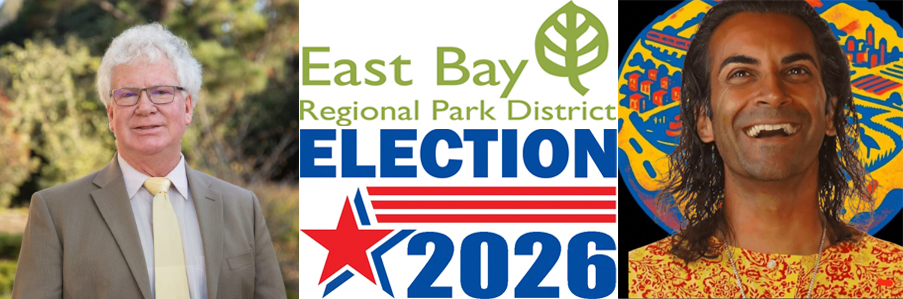
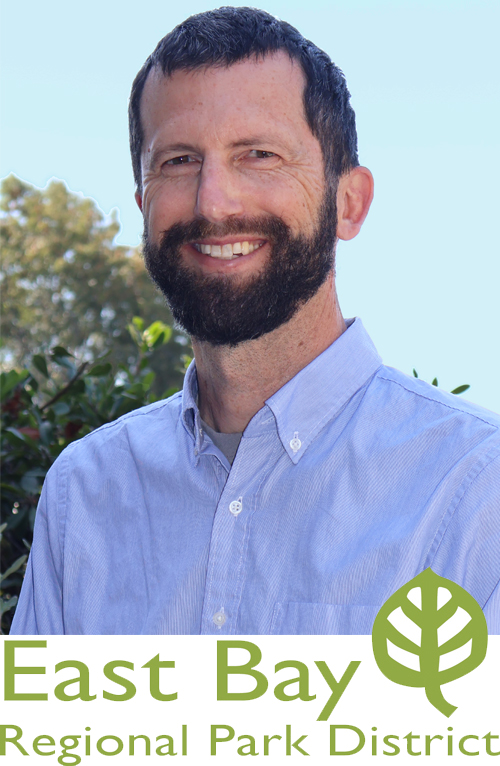
Incumbent Colin Coffey is facing challenger Inderprit Sekhon in this year’s East Bay Regional Park District Ward 7 race. Photos: EBRPD and LinkedIn

Colin Coffey’s challenger, Inderprit “Indy Rishi Singh” Sekhon, wants “to promote and educate about ecological medicine” and “dance for office instead” while the incumbent touts his accomplishments and plans

By Allen D. Payton

Running for a third four-year term as a Director on the East Bay Regional Parks District in Ward 7, Colin Coffey faces a unique candidate, Inderprit “Indy Rishi Singh” Sekhon, who is running a different campaign while dancing to a different tune and offering an alternative focus and approach to the position. Ward 7 includes the northern waterfront portion of Contra Costa County from Pinole and Hercules in the west to the eastern county line north of Discovery Bay. (See map and below)

Cities and Communities in Ward 7 include: A portion of Alhambra Valley south of Martinez, Antioch, Bay Point, Bethel Island, Brentwood, Clyde, Crockett, Hercules, Knightsen, Martinez, and the adjacent Mountain View on the east side, Oakley, Pacheco, Pittsburg, Port Costa, Rodeo and Vine Hill between Martinez and Pacheco.

The Regional Parks in Ward 7 include: Antioch/Oakley Regional Shoreline, Bay Point Regional Shoreline, Big Break Regional Shoreline in Oakley, Black Diamond Mines Regional Preserve in Antioch, Briones Regional Park west of Pleasant Hill, Browns Island Regional Preserve north of Pittsburg, Carquinez Strait Regional Shoreline, Clayton Ranch Regional Preserve, Contra Loma Regional Park in Antioch, Crockett Hills Regional Park, Delta Access Regional Recreation Area north of Discovery Bay, Radke Martinez Regional Shoreline in Martinez, Rancho Pinole Regional Preserve east of Pinole, San Pablo Bay Regional Shoreline, and the Waterbird Regional Preserve/McNabney Marsh near Martinez.

Asked why Rancho Pinole doesn’t appear in the list of parks on the District’s website, Coffey shared, “Rancho Pinole lands in a section of the 2013 Master Plan that will be a regional park. It’s not currently operated by the District, but by the John Muir Land Trust. It includes Fernandez Ranch, about 1,000 acres, also includes the Franklin Canyon Ranch, surrounding the golf course. It totals about 2,000 acres so far. The Park District has partial ownership interest in Fernandez Ranch. The plans show someday it will all be converted to an East Bay Regional Park District park.”

Also, Deer Valley Regional Park south of Antioch, which includes the former Roddy Ranch Golf Course “is being returned to its original natural habitat. They’re ripping up the golf course paths as they’re not suitable for hiking,” he continued. “We recently acquired more land on Briones Valley Road near Brentwood. It will possibly break ground early next year. Within a year it’s possible we’ll open to the public. We already have a parking lot there, which really helps. We’re doing public programming there, already.”
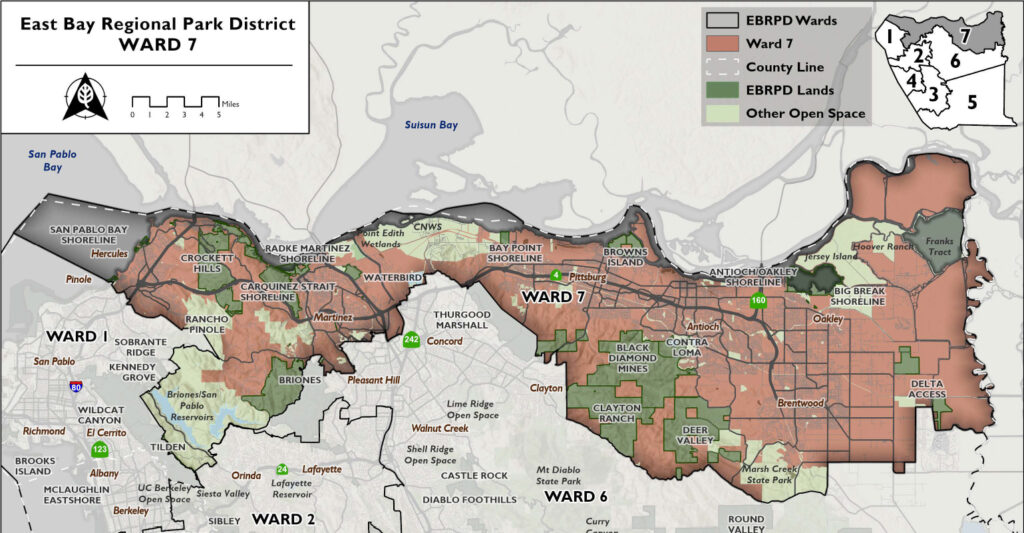
East Bay Regional Park District Ward 7 boundary map. Source: EBRPD

About Coffey

According to his bio on the East Bay Regional Parks District website, retired attorney Coffey is a resident of Hercules and “was appointed to the Board in January 2017. Previously, he served on the Park District’s Park Advisory Committee twice, first appointed by former EBRPD Director Ted Radke from 2001-2009 and appointed by the Contra Costa County Board of Supervisors from 2012- 2017. He has also been a volunteer Ambassador for the parks for 19 years. He is a longtime supporter of the John Muir Land Trust and a member of the Regional Parks Foundation.

“Director Coffey is a retired partner with the (law) firm Best, Best & Krieger in Walnut Creek. Director Coffey is a public health attorney, representing public and nonprofit healthcare providers. He is a past president of the Contra Costa Bar Association. Director Coffey is married, has two children and resides in Hercules. He is a lifelong resident of Contra Costa County.”

According to his campaign website, Coffey “was elected to the Board in 2018 and re-elected in 2022. He was a public health attorney, representing public and nonprofit healthcare providers and is a past president of the Contra Costa BAR association.

“Coffey’s family was politically active, and he served as an intern in then-Congressman George Miller’s Washington, DC office in his youth and later was the Congressman’s appointee to the Democratic Central Committee for 23 years.

“Coffey, his wife Mila and their two adult children are life-long parks and trails enthusiasts.”

His campaign is focused on the following issues: “Preservation of New Open Space and Wildlife Habitat / Aggressive Pursuit of Wildfire Risk Reduction / Enhanced Public Safety in the Parks; New Open Spaces; and Wildfire Mitigation.”

Coffey offers a long list of his accomplishments while in office under the categories of Leadership, Preservation of Open Space and Wildlife Habitat or Restoration of Natural Areas and Excellence in Programs and Policies.

He also shares under “Looking Forward – If Re-elected:” that fact that in “2027 I will be President of the Board and working with our new GM Max Korten. This will represent a huge opportunity for North and East Contra Costa input into open space preservation and wildlife habitat preservation. I will help complete a new 10 year Master Plan, highlighting future preservation of open space and wildlife habitat, more ways to enjoy open space, and continued focus on wildfire risk reduction.” Plus, other projects such as, “Extend the Marsh Creak Regional Trail to Dutch Slough on the North and to Round Valley Regional Park on the South” and “Build the proposed Delta Bay Trail from Bay Point to Antioch/Oakley and beyond,” and “Repairing and funding Hazel Atlas Mine and Great House Visitor Center to keep consistently open,” in East County.

Plus, “Rancho Pinole acquisitions and regional park development in partnership with JMLT (John Muir Land Trust) to create a future large regional park in the Hercules and Pinole area” and “Support Rodeo Community Association campaign to have EBRPD expand Lone Tree Point Park and clean up contaminated land in the area. Incorporate Greenway Vision for Rodeo shoreline into Master Plan” in West County.

About Inderprit “Indy Rishi Singh” Sekhon

According to the campaign website for Crockett resident Inderprit “Indy Rishi Singh” Sekhon, he “is a regenerative farmer, community organizer and systems thinker. His work focuses on the relationship between personal health, community wellbeing and the health of the land. He is running because he believes the Park District can build on its legacy of land protection and become a more active partner in public health, climate resilience, ecological restoration and community stewardship. His question is straightforward: How can the land we have already protected do more good for the people and places around it?”

In a post in August on his LinkedIn profile page, Sekhon wrote, “I’m on the California ballot as Inderprit Sekhon (government name). Check out what East Bay Regional Park District does and get involved with our campaign. We are seeking to collaborate with healers, artists, educators, ecological stewards, farmers, and anyone who feels like their skills/ideas are important, but not valued enough by government or current economic systems. Learn more about my intention to promote and educate about ecological medicine,” with a link to the website for his non-profit organization named Cultivating Self.

In that same LinkedIn post is a video which he says, “I don’t know why I’m doing this. But I’m running for office this fall. But, yeah, maybe I do know why I’m doing this. But I also feel it’s good to not know why I’m doing this,” with a laugh. “How can an organization with so much money and have so many resources how can it be a resource for the community, an asset for the community…how can that be part of our preventative, ecological medicine? That’s why I’m doing this. I don’t even know why and also, I do know that we need to do something…”

Then, in a post on Friday, Sept. 18, Sekhon wrote, “What if a neurodivergent Generalist ran for office? What if he decides to dance for office instead? find out what’s possible: https://lnkd.in/gsQVRw8h.”

That takes you to his campaign website where it shares his slogan, “Healthy land. Healthy people. Public money that works.” He writes, “The District has spent generations protecting land. Indy’s campaign asks how that protected land can more fully sustain the people and communities around it,” and his platform is to “Protect. Connect. Deliver.”

Under “Protect” Sekhon writes, “Care for the land before the emergency.Keep land, water, roads, trails and fire-prone landscapes healthy and safe — with maintenance and ecological stewardship matched to the places the District manages,” and lists “Wildfire resilience, Wetlands and shorelines, and Healthy soil and habitat.”

Under “Connect” he writes, “Make parks work for more people.Treat parks as public-health and belonging infrastructure, with better access, locally relevant programming and meaningful ways for residents to participate,” and lists, “Health and wellbeing, Transit and first-visit access, and Youth and paid stewardship.”

Finally, under “Deliver” Sekhon wants to, “Make public money produce visible results.Modernize field systems, publish priorities and costs, and make it easier to see what is being fixed, restored and improved,” and lists, “Transparent priorities, Modern field tools and Measurable outcomes.”

The first-time candidate also offers what he calls his Donut Vision 2036, of “A safe and thriving place for people and planet,” and writes, “Doughnut Economics asks how we meet more human needs without damaging the living systems we depend on. Indy’s 2036 vision applies that question to Ward 7’s parks and communities.”

Under the subheading, “People thrive” Sekhon shares about “Health, Food, Youth and Access,” and under the subheading, “Nature thrives” he writes about “Fire resilience, Shorelines, Biodiversity and Circular systems,” specifically, “Turn organic material back into useful ecological value.”

Sekhon also writes, “The theory of change: If we invest in parks as infrastructure for both people and planet, healthier land can support healthier communities, healthier communities can become stronger stewards, and accountable public systems can reinforce both.”

He then offers what the future will look like by following his vision, writing, “Ward 7, 2036. See the place. Imagine the next chapter.” Sekhon offers six parts to his vision: “The Shoreline We Can Restore, The Park That Heals, The Park That Feeds, The Park That Creates Work, The Government You Can See, and The Land We Care for Before Crisis.”

Under “Public money that works – You should be able to see what your Park District is doing,” Sekhon writes, “The argument is not that every public dollar is discretionary. It is that a large public institution should make its priorities, costs and results understandable.”

He includes eight focus areas: “Maintenance response & repair times; Trail & facility condition over time; Wildfire hazards treated & acres restored; Water quality & ecological outcomes; Residents reached; Local organizations contracted; Ward 7 investment; and Project costs, owners & timelines.”

Under “Heartstorming Ward 7 Listening that leads somewhere” Sekhon explains, “Most public engagement begins with a survey. Heartstorming begins with a place, a conversation and a practical question: What would help your community thrive here?” He lists five tasks to accomplish it: “1 Experience the place, 2 Share what you see and need, 3 Imagine what could change, 4 Connect ideas to policy and action, and 5 Invite people back into the work.”

Finally, Sekhon offers, “Plain-language FAQ What does this mean?” and asks and answers four questions: “Why call it ‘Doughnut Vision’? The doughnut is a simple model: make sure people can thrive while keeping ecological systems healthy. The campaign uses it as a long-horizon method, not as a prerequisite for understanding the platform.”

He continues, “Is every 2036 idea already an official Park District program? No. The site distinguishes campaign proposals and future concepts from existing District programs. Partnerships are not implied until they are actually established.”

Recognizing his limitations as only one of seven board members Sekhon writes, “What does one Park District director control? One director does not control the District alone. Indy would need to build public support and Board support for pilots, policies and investments.”

Finally, the challenger asks, “Why focus on public systems?” His answer is, “Maintenance, ecological care, field data and capital decisions are connected. Better information and clearer priorities can help staff, the Board and residents understand what needs attention and what progress looks like.”

Sekhon then invites voters to “Help shape Ward 7’s next decade. Vote. Volunteer. Share a park story. Come to a Heartstorming event. Help turn a long-horizon vision into practical work.”

He also shares more videos about his campaign on his Facebook page.

The election is Tuesday, Nov. 3.
GoFundMe account established for photographer whose equipment and photos of Antioch couple’s wedding stolen

Wednesday, October 14th, 2026
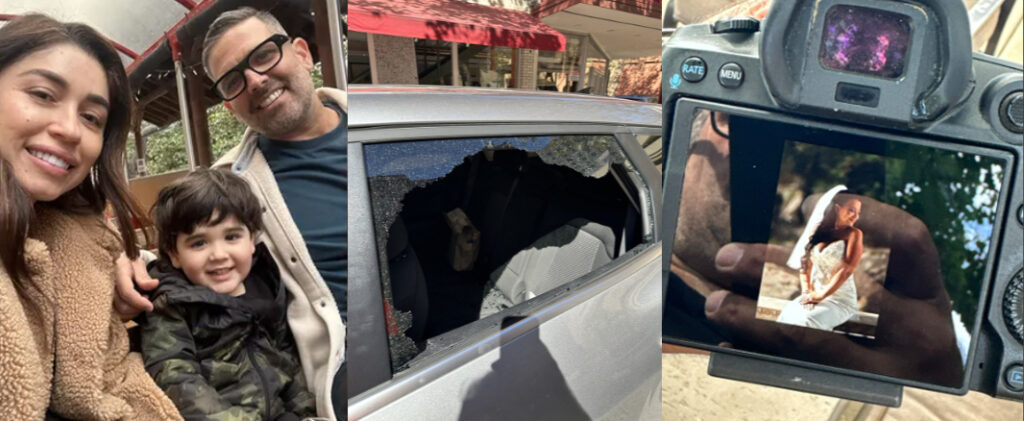
The Martins, the broken window of David’s rental car and one of his cameras that was stolen containing a photo of the bride, Antioch resident, Jenna Wesenhagen-Banks. Source: GoFundMe

Antioch native David Martin, Jr. seeks public’s help for return of photos, hard drives and equipment or replacement

By Kirsten Mitchell, Communications Associate, GoFundMe

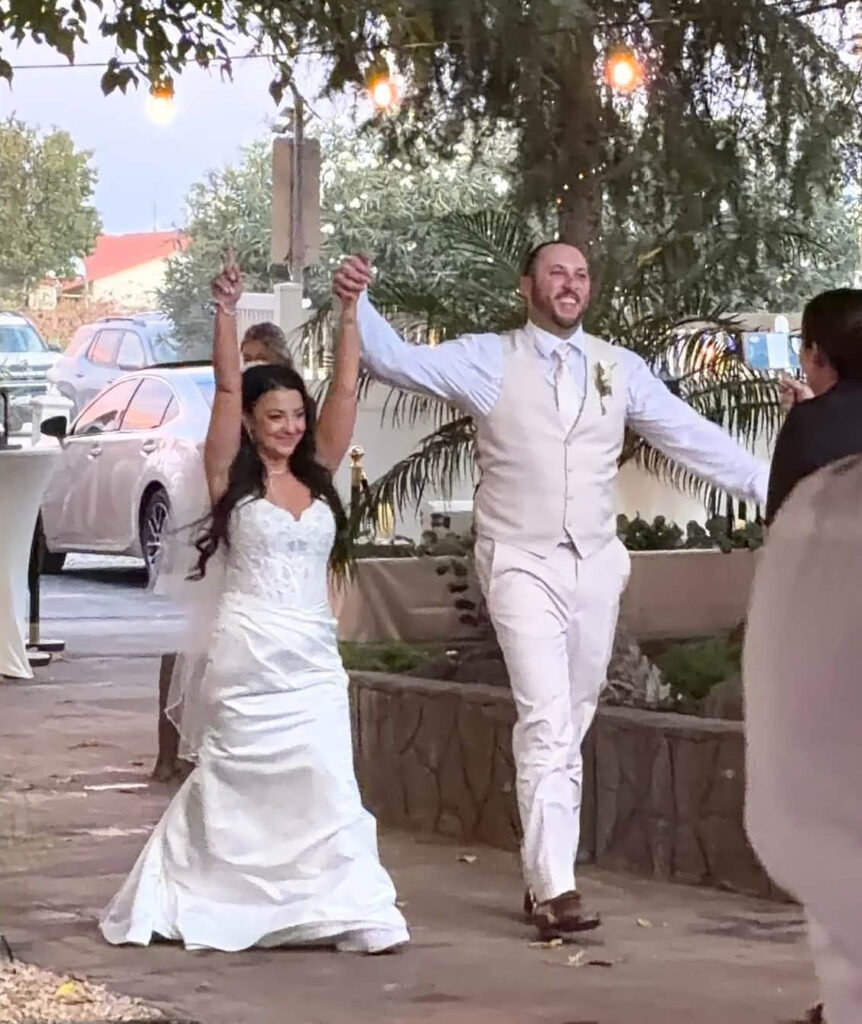
The newlyweds Jenna Wesenhagen-Banks and Nick Banks on Sunday, Oct. 4, 2026. Photo by Carla Taylor Acevedo on Facebook

An Antioch couple’s wedding photos were reportedly stolen from their photographer’s rental car in Oakland just three days after their ceremony, and now the community is helping them try to recover those memories. David Martin, Jr., an Antioch native now based in Southern California, returned to photograph Jenna and Nick Banks’ October 4 wedding. According to the GoFundMe, thieves took nearly all the equipment he uses to support his family, along with drives holding years of work and the only copies of the couple’s wedding photos. Loved ones are asking for help finding the stolen drives and memory cards while raising funds to replace his gear and refund the couple if their photos aren’t recovered.

“What should have been a lifetime of cherished memories vanished in an instant. David is devastated, not only by the loss of his livelihood, but by the thought that Jenna and Nick may never get to relive the most important moments of their special day. Cameras can be replaced. A wedding day cannot.”

In a video on the GoFundMe page entitled “Restore David’s Livelihood”, Martin, who owns David Martin Jr. Photography according to his Facebook page, and is based in Orange County, CA according to his website, says, “I “lost…80% of my equipment.”

According to a KTVU FOX2 news report, break-in of his rental car in downtown Oakland happened days after the wedding in which “gear worth $35,000, including two cameras, lenses, a drone, a laptop as well as a hard drive and memory cards with the couple’s photos” were taken.

Post on GoFundMe by Lina Martin for David Martin

“On October 7, David Martin, a hardworking photographer and family man, had his vehicle broken into in Oakland. Thieves stole nearly all of his professional photography equipment, including cameras, lenses, drone, a laptop, accessories and hard drives holding years of irreplaceable work.

“In a matter of minutes, David lost the tools he depends on to support his family.

“The most heartbreaking part is that the stolen memory cards and hard drive held the only copies of Jenna and Nick Banks’ wedding photos. The couple had been married just three days earlier, on October 4. What should have been a lifetime of cherished memories vanished in an instant. David is devastated, not only by the loss of his livelihood, but by the thought that Jenna and Nick may never get to relive the most important moments of their special day. Cameras can be replaced. A wedding day cannot.

“David is doing everything he can to make it right. If the photos aren’t recovered, he will refund Jenna and Nick in full. He’ll also photograph them again, at no cost, in their wedding attire so they have something beautiful to hold on to.

“The theft also hit David in the middle of a video project in the Bay Area. All of the footage he had already captured was lost, which means he has to reshoot from scratch and cover the cost of travel all over again, on top of replacing his gear.

“For 12 years, David has photographed weddings, families, and milestones for people across Los Angeles and Orange County. Photography isn’t just his passion. It’s how he puts food on the table for his family.”

Where your donation goes

“Your support will replace the cameras, lenses, lighting, drone, laptop, accessories and storage David needs to get back to work, cover the travel costs of reshooting his lost video project, and help fund a full refund to Jenna and Nick if their photos can’t be recovered.”

Help us find the photos

“There’s still a chance the drives turn up. If you see cameras, lenses, laptops, or hard drives being sold in the Oakland area, on Facebook Marketplace, OfferUp, Craigslist, or anywhere else, please reach out through the “Contact” button on this page. A police report has been filed (RD# 26-042959). Getting those drives and or SD/Express cards back is the only way Jenna and Nick get their wedding photos.”

How you can help

“Every donation, no matter the size, makes a difference. If you can’t donate, please share this page. The more people who see it, the better the chance someone spots the stolen gear.

“Let’s come together and help David get back behind the camera.

“Thank you for supporting David and his family.”

—————

As of 9:30 p.m. Tuesday, Oct. 13, 2026, $14,215 has been raised from 54 donations of the total goal of $16,000.

Link to the GoFundMe: www.gofundme.com/f/restore-davids-livelihood-and-jenna-nicks-memories.

Allen D. Payton contributed to this report.

Want to serve on the East Bay Regional Parks District’s Park Advisory Committee?

Tuesday, October 13th, 2026

Representing Contra Costa County; Application deadline: Nov. 9

By Diana Oyler, Sr. Deputy, Contra Costa County Administrator’s Office & Office of Communications & Media

(Martinez, CA) – The Contra Costa County Board of Supervisors is seeking an individual who is interested in park land use to represent the County on the East Bay Regional Parks District Park Advisory Committee (PAC).  The PAC is a 21-member citizens’ advisory group that studies issues and makes recommendations and comments on myriad policy issues, such as grazing, dogs, horses and bikes in parks, the Park District budget, naming of park facilities, park land use plans, new concessions, and more.

Members are appointed for two-year terms and may serve a total of four consecutive terms, or eight years. The term of office for this appointment will be January 1, 2027 through December 31, 2028. Service is voluntary and members receive no compensation. Meetings are held on the fourth Monday of each month at 4 p.m.

Application forms for the Contra Costa County seat can be obtained from the Clerk of the Board of Supervisors by calling (925) 655-2000, or the application can be completed online by visiting the County website at  https://www.contracosta.ca.gov/3418.  Applications should be submitted to the Clerk of the Board of Supervisors, County Administration Building, 1025 Escobar St., Martinez, CA  94553, no later than 5:00 p.m. on Monday, November 9, 2026.

Applicants should plan to be available for public interviews to be held virtually via Zoom on Monday, November 23, 2026. 

More information about the Park Advisory Committee can be obtained on their website at: https://www.ebparks.org/public-meetings/park-advisory or by calling Erich Pfuehler at the East Bay Regional Parks District at (510) 544-2006.

CHP targets Bay Bridge approach for stepped-up enforcement campaign

Wednesday, September 9th, 2026
Photos: (Left) MTC (Right) Credit John Huseby, Caltrans

Carpools allowed in bus lane only during weekday peak periods

By Cindy Ramirez, CHP, Bart Ney, Caltrans and John Goodwin, Bay Area Toll Authority

SAN FRANCISCO, Sept. 9, 2026. . . The California Highway Patrol, in partnership with Caltrans and the Bay Area Toll Authority, this month will resume concentrated enforcement of the laws governing the westbound approach to the San Francisco-Oakland Bay Bridge. This includes strict enforcement of vehicle-type and vehicle-occupancy laws in the bus/carpool lane that bypasses the San Francisco-Oakland Bay Bridge toll plaza at the far-right side of the roadway.

This lane — which can be accessed by traffic approaching the bridge from Interstate 80, Interstate 880 or West Grand Avenue — may be used by buses, motorcycles or carpools with three or more occupants during the weekday commute periods of 5 a.m. to 10 a.m. and 3 p.m. to 7 p.m. Only buses may lawfully use the lane at other times, including all day on Saturdays and Sundays. Drivers cited for improper use of the bus/carpool lane outside weekday commute hours are subject to a fine of $490 or more.

“The signs at access points to the lane are clear and unambiguous. They read ‘Buses Only,’” noted Lt. Ed Clarke of the CHP’s Oakland Area. “But many drivers have not consistently followed the rule in recent years.” The CHP, Caltrans and BATA agree that focused enforcement will help address ongoing violations, improve compliance with the posted restrictions, and ensure the lane remains available for its intended use.

Acting Caltrans District 4 Director and BATA Commissioner Doanh Nguyen reminds drivers that the toll booths at the Bay Bridge and other state-owned toll bridges will soon be a thing of the past. “The transition to open-road tolling already is underway, with the new system set to debut next year at the Richmond-San Rafael Bridge,” he said. “The comprehensive reconfiguration of the approaches to every state-owned toll bridge will improve safety and efficiency by allowing drivers to pay their tolls without having to slow down to squeeze past the obsolete toll booths.”

BATA administers all toll revenues from the region’s seven state-owned toll bridges. Caltrans owns and operates the state highway system, including state-owned toll bridges such as the Bay Bridge.

La Policía de Caminos de California (CHP) se enfoca en el acceso al puente Bay Bridge para una campaña de reforzar el control

Los vehículos compartidos solo pueden circular por el carril de autobuses durante las horas pico de los días laborables

SAN FRANCISCO, 9 de septiembre de 2026. . . La Policía de Caminos de California (CHP), en colaboración con Caltrans y la Autoridad de Peajes del Área de la Bahía, reanudará este mes la aplicación intensiva de las leyes que rigen el acceso en dirección oeste al puente San Francisco-Oakland Bay Bridge. Esto incluye la aplicación estricta de las leyes sobre el tipo y la ocupación de vehículos en el carril para autobuses y vehículos compartidos que evita la plaza de cobro del puente San Francisco-Oakland Bay Bridge por el lado extremo derecho de la carretera.

Este carril — al que pueden acceder los vehículos que se acercan al puente desde la Interestatal 80, la Interestatal 880 o West Grand Avenue — puede ser utilizado por autobuses, motocicletas o vehículos compartidos con tres o más ocupantes durante días laborables en los horarios pico de 5 a.m. a 10 a.m. y 3 p.m. a 7 p.m. Solo los autobuses pueden utilizar el carril en otros momentos legalmente, incluyendo todo el día los sábados y domingos. Los conductores

que reciban una infracción por el uso indebido del carril para autobuses y vehículos compartidos fuera de los horarios pico de los días laborables están sujetos a una multa de $490 o más.

“Las señales en los puntos de acceso al carril son claras e inequívocas. Dicen ‘Solo autobuses’,” señaló el teniente Ed Clarke del Área de Oakland de la CHP. “Sin embargo, muchos conductores han omitido cumplir la norma de forma consistente en los últimos años.” La CHP, Caltrans y la BATA coinciden en que una aplicación rigurosa de la ley ayudará a abordar las infracciones continuas, mejorará el cumplimiento de las restricciones establecidas y garantizará que el carril siga disponible para el uso previsto.

El director interino del Distrito 4 de Caltrans y comisionado de la BATA, Doanh Nguyen, recuerda a los conductores que las casetas de cobro en el puente de la Bahía y otros puentes de cuota de propiedad estatal pronto pasarán a ser historia. “La transición al sistema de cobro de cuotas en carretera abierta ya está en marcha, y está previsto que el nuevo sistema entre en funcionamiento el próximo año en el puente Richmond-San Rafael. La reconfiguración integral de los accesos a todos los puentes de cuota de propiedad estatal mejorará la seguridad y la eficiencia, al permitir que los conductores paguen sus cuotas sin tener que reducir la velocidad para pasar por las casetas de cobro obsoletas.”

BATA administra los ingresos de peajes de los siete puentes de peaje de propiedad estatal en la región. Caltrans es propietario y opera el sistema de carreteras estatales, incluyendo los puentes de cuota de propiedad estatal como el puente Bay Bridge.

BB guns prohibited in East Bay Regional Parks

Wednesday, August 26th, 2026
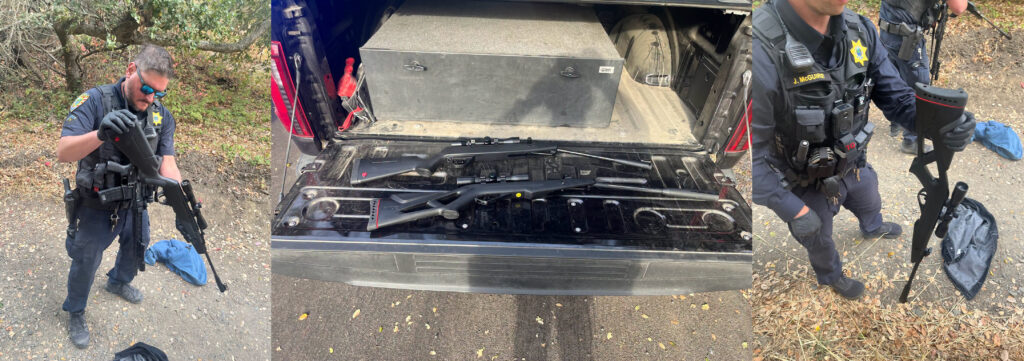
Some BB guns look like real guns. Photos: East Bay Regional Park District PD

By East Bay Regional Park District Police Department

BB guns can look incredibly similar to real firearms, especially from a distance or during a fast-moving situation. That makes it difficult for both the public and law enforcement officers to immediately tell whether someone is carrying a BB gun or a real rifle.

That uncertainty can quickly create a dangerous situation.

It’s also important to remember that East Bay Regional Park District Ordinance 38, Section 403.1 prohibits BB guns in East Bay Regional Parks.

Please leave BB guns and similar weapons at home when visiting our parks. Following park rules helps keep visitors, staff, and responding officers safe.

Max Korten appointed East Bay Regional Park District General Manager

Wednesday, August 5th, 2026

Brings proven record of securing park funding, protecting land, and expanding public access

New General Manager Max Korten. Photo: EBRPD

OAKLAND, Calif. – Twenty-seven years ago, Max Korten was a young ranger in the Sierra Nevada, leading campfire talks for the U.S. Forest Service. On Tuesday, August 4, 2026, the East Bay Regional Park District Board of Directors voted 6-0 to appoint him General Manager, putting him at the helm of one of the largest regional park systems in the country. Korten has served as Acting General Manager since November 2025.

“Max has demonstrated steady, thoughtful leadership and a deep commitment to the East Bay Regional Park District’s mission, employees, and the communities we serve,” said Olivia Sanwong, president of the Board of Directors and representative for Ward 5. “The Board is confident that his experience, collaborative approach, and clear vision will guide the Park District forward as we expand access to nature, preserve our rich heritage of natural and cultural resources, provide meaningful environmental education, and ensure that an environmental ethic continues to guide all that we do. We are pleased to appoint him as general manager and look forward to continuing our work together.”

Korten joined the Park District as Deputy General Manager in October 2024. From the start, he worked closely with teams across the District to resolve challenges and build a more cohesive organization. Korten has worked diligently to build trust between the Board and staff through increased communication, transparency, and engagement. His accomplishments include collaborating with union leaders to reach an agreement on a new telework policy and working with neighboring city officials to preserve the historic Flag Barn in Brentwood. Korten is currently supporting staff and partners in efforts to reduce traffic on Del Valle Road in Livermore and is working with the Trust for Public Land, state leaders, and the cities of Berkeley and Albany on the potential acquisition of Golden Gate Fields.

Before joining the Park District, Korten spent 10 years at Marin County Parks, the last eight as director and general manager, leading an agency responsible for 34 open space preserves, 45 parks, and about 150 employees on a $35 million annual operating budget. He reported directly to the Marin County Board of Supervisors and worked with nine commissions and board-appointed committees.

During his tenure at Marin County Parks, Korten led the passage of the 2022 renewal of Measure A, the countywide sales tax that funds park maintenance, wildfire fuel reduction, farmland preservation, and public access, winning voter approval by about 75%. He also worked to eliminate park entrance fees, an initiative that aimed to expand equitable public access. He was also successful in passing a $20 million acquisition bond measure.

Looking ahead, Korten has prioritized aligning the Park District’s fire, stewardship, and operations teams around a cohesive vegetation management strategy. The effort includes mapping wildfire risk and habitat opportunities across the Park District for the first time. He is also leading development of District planning to support the Board in establishing shared goals and strategies to guide implementation in the years ahead. 

“I’m honored and grateful for this opportunity, and I don’t take it lightly,” Korten said. “The Park District is a special place, and I’ve learned so much from the people who came before me. These parks are meant to be here forever, for everyone, and my focus is on keeping the organization strong so we can protect these resources while making sure they remain accessible and welcoming to all.”

Earlier in his career, Korten served as a wilderness ranger for the U.S. Forest Service, as natural resources program director for Conservation Corps North Bay, and as a backcountry ranger and trail crew supervisor for the Bureau of Land Management. 

Korten holds a bachelor’s degree in environmental studies from the University of California, Santa Cruz, and a master’s degree in natural resources from Humboldt State University. He lives with his family in Berkeley, where he is a regular on the trails of Tilden Regional Park.

The East Bay Regional Park District is the largest regional park system in the nation, comprising 73 parks, 55 miles of shoreline, and over 1,330 miles of trails for hiking, biking, horseback riding, and environmental education. The Park District receives an estimated 30 million visits annually throughout Alameda and Contra Costa counties in the San Francisco Bay Area.

Not Loud Concerts return to the East Bay with Summer Sessions

Wednesday, July 8th, 2026

With Blues Night, Country Boogie Night & Vintage Rock Night

“Not too loud, not too long and not too expensive.”

By Rebecca Roudman

On July 26, Aug. 23 and Sept. 20 at Gilman Brewing in Berkeley, the folks from Not Loud Concerts are presenting Summer Sessions. These music festivals are part of the Not Loud Concert Summer Series – a set of concerts designed to be Not too long, Not too expensive, and of course, Not too loud.

Designed with the audience’s comfort in mind, these short festivals will be held outdoors at Gilman Brewing. There, 2 bands will be on stage at the same time, trading songs and dueling it out. Each concert will have a different theme. 

July 26 is Blues Night featuring Delta Wires, an exciting harmonica and horns blues powerhouse and Dirty Cello, a world-traveling, high-energy blues band. 

Aug 23 is Country Boogie Night featuring the Alex Lucero Band, a boot-stompin’ Americana band and Dirty Cello, a high-energy band known for their crazy takes on classic country. 

Sept. 20 is Vintage Rock Night featuring The Rockbusters, a roaring nostalgia-filled cover band playing all of your favorite songs from the 80’s. They’ll be joined by Dirty Cello, who are known for their crazy and electrifying performances of everything from the Stones to CCR.

Food and drinks will be available for purchase. The audience is welcome to bring chairs, and chairs will also be provided. There will be room to dance and room to sit. No porta-potties, but plenty of clean, indoor bathrooms.

Not Loud Concerts focus on creating an experience that is casual and fun for both the musicians and the audience. The concerts are never too long, never too expensive and of course never too loud.

Not Loud Concerts presents… Summer Sessions at Gilman Brewing

July 26 – Blues Night

Aug 23 – Country Boogie Night

Sept 20 – Vintage Rock Night 

7 – 9 pm

Tickets: NotLoudConcerts.com

Here are a couple short videos about the festivals: https://youtu.be/rsu32TPUOjw?si=ye_r5_2ig6lofFLp and https://youtube.com/shorts/GwNNu6WiPwc?si=K_EPLIyDrRDgDhxr

Paid advertisement.

East Bay Anza 250 Symposium at Los Medanos College April 11

Monday, March 23rd, 2026

Learn about the Juan Bautista de Anza Expedition in Contra Costa County and throughout California as the Declaration of Independence was being signed

By LeighAnn Davis, Executive Director, Contra Costa County Historical Society

As our nation approaches its 250th anniversary, land managers, historians, educators and civic leaders across the East Bay formed the East Bay Anza 250 Symposium committee dedicated to exploring a parallel milestone: the 250th anniversary of the Juan Bautista de Anza expedition. This journey profoundly shaped California’s history and continues to influence our communities today.

Anza Expedition Map. Source: National Park Service

According to the National Park Service, the Juan Bautista de Anza National Historic Trail covers over 1,200 miles through the homelands of 70+ Tribal communities including in Contra Costa County. It follows the historic route of the 1775-76 Spanish colonizing expedition from Sonora, Mexico to San Francisco, CA. Whether urban or rural, the trail offers adventure, diverse cultural perspectives and an opportunity to experience history.

Painting by David Rickman. Courtesy of U.S. National Park Service

On June 27, 1776, as the Declaration of Independence was being signed in Philadelphia, the colonists of the Anza expedition arrived at their destination in what would become San Francisco. Both of these events would dramatically shape the cultural and political landscapes of the United States. In 2025 and 2026, the Anza Trail invites communities along the historic path of the 1775-76 colonizing expedition to commemorate the complicated and evermore fascinating history of the paths and events that make up this National Historic Trail.

Third leg map of the Anza expedition shows campsites 99, 100 and 101 in Contra Costa County. Map created by Emanuel Delgado. Source: National Park Service

Campsites and Trail in Contra Costa County

A map of the Third Leg of the Anza Expedition shows three campsites in Contra Costa County with the Arroyo del Puerto Dulce campsite 99 in Rodeo, the Arroyo de Santa Ana del Flugino campsite 100 in Concord and the San Ricardo campsite 101 along the Antioch/Oakley border.

According to the Juan Bautista de Anza Historic Trail website, “On April 1st (1776) the group camped at a small stream. Today, the campsite is at the conjunction of Parker and San Pablo Avenues and Rodeo Creek. A commemorative marker from the 1976 reenactment is on Parker Road between 4th and 6th Streets in front of the post office in the town of Rodeo.”

The Anza Expedition campsite 99 historic marker in Rodeo, campsite 100 historic marker in Concord and campsite 101 historic marker at the Antioch/Oakley Regional Shoreline. Photos by Andrew Ruppenstein. Source: The Historical Marker Database HMdb.org

According to The Historical Marker Data Base, a marker designating campsite 100 in Concord is located on Grant Street south of Olivera Road. The marker designating campsite 101 is located in the Antioch/Oakley Regional Shoreline park at the end of Bridgehead Road.

The East Bay Park District’s Delta de Anza Regional Trail is named to commemorate the route taken during de Anza’s expedition into the Delta region of today’s East Contra Costa County. The paved, multi-use hiking, bicycling and equestrian trail currently spans over 15 miles of the planned 25-mile length. When completed, it will generally follow the East Bay Municipal Utility District’s corridor and the Contra Costa Water District’s canal.

This trail connects communities in central and eastern Contra Costa County and provides access to regional and community parks, many schools and Los Medanos College. It intersects Antioch’s Mokulumne Trail and the Marsh Creek Regional Trail in Oakley. It connects the cities and communities of Concord, Bay Point, Pittsburg, Antioch and Oakley and provides access to Contra Loma Regional Park and Black Diamond Mines Regional Preserve through Antioch’s Worth Shaw Community Park. See driving map of Anza Historic Trail

Symposium

The East Bay Anza 250 Symposium will take place on Saturday, April 11, 2026, 9AM-4PM and is a collaborative gathering that explores the expedition’s impact on the East Bay, honors Indigenous legacies, and fosters dialogue about how this history informs our present.

The symposium will include:

  • Live Performances
  • Keynote Speakers
  • Panel Discussions that Dive into the History, Teaching, and Environmental Impacts of the Expedition.
  • An Exhibit Hall Filled with Cultural Exhibitions and Displays

Symposium registration is $30 for General Admission and $20 for students and seniors.

Lunch is included in your registration fee if reserved before April 1st, 2026.

To register, please visit the Eventbrite site for Grassroots Poetry using the QR code.

Keynote Speakers: Our speaker series brings together a vibrant tapestry of voices to explore the multifaceted legacy of the Anza Expedition. By pairing the scholarly insights of local historians and naturalists with the deeply personal narratives of expedition descendants, we aim to provide an inclusive history that honors the trail’s complex past.

Panel Discussions: Join our interdisciplinary panels, featuring local historians, expert naturalists, and descendants of the expedition, for a compelling look at the impact of Anza 250 years later. These sessions bring together diverse voices to explore the environmental, cultural, and personal history of the trail, offering a unique, in-depth, and engaging perspective on this historic journey.

Exhibit Hall: Our Exhibit Hall is a testament to the power of community partnership. The exhibit hall is a collaborative space showcasing exhibits and information from local historical societies and land management agencies. Connect with local experts in this dedicated space for a deeper, context-rich understanding of the historical and cultural significance of the Anza Trail.

Event Information:

The Event is Saturday, April 11th, 2026, from 9AM until 4PM with a lunch break at noon. An optional walk will take place along the trail that intersects with the LMC campus at 8AM. All members of the community are invited to join us and enjoy the speakers, poets and music guests!

About our location:

The Los Medanos College Student Union is located on the campus at 2700 East Leland Road, Pittsburg.

We encourage all symposium attendees to consider alternate ways to get to campus. You can bike, walk, carpool or take public transportation. If you plan to arrive by car, parking is free on the day of the event. More information about how to get to campus here: LMC Transportation and Parking Information

Thank you to all our partners for your support:

  • Grassroots Poetry
  • Independent Arts and Media
  • Los Medanos College Honors Program
  • National Park Service
  • Anza Trail Foundation
  • Sacramento-San Joaquin Delta Conservancy
  • Contra Costa County Historical Society
  • Museum of the San Ramon Valley

For more information contact Dwayne Eubanks, Chair East Bay Anza 250 Symposium at EastBayAnza@gmail.com.

This event is brought to you by Grassroots Poetry and Los Medanos Honors Program and fiscally sponsored by Independent Arts Media, a 501(c)3 organization.

Allen D. Payton contributed to this report.