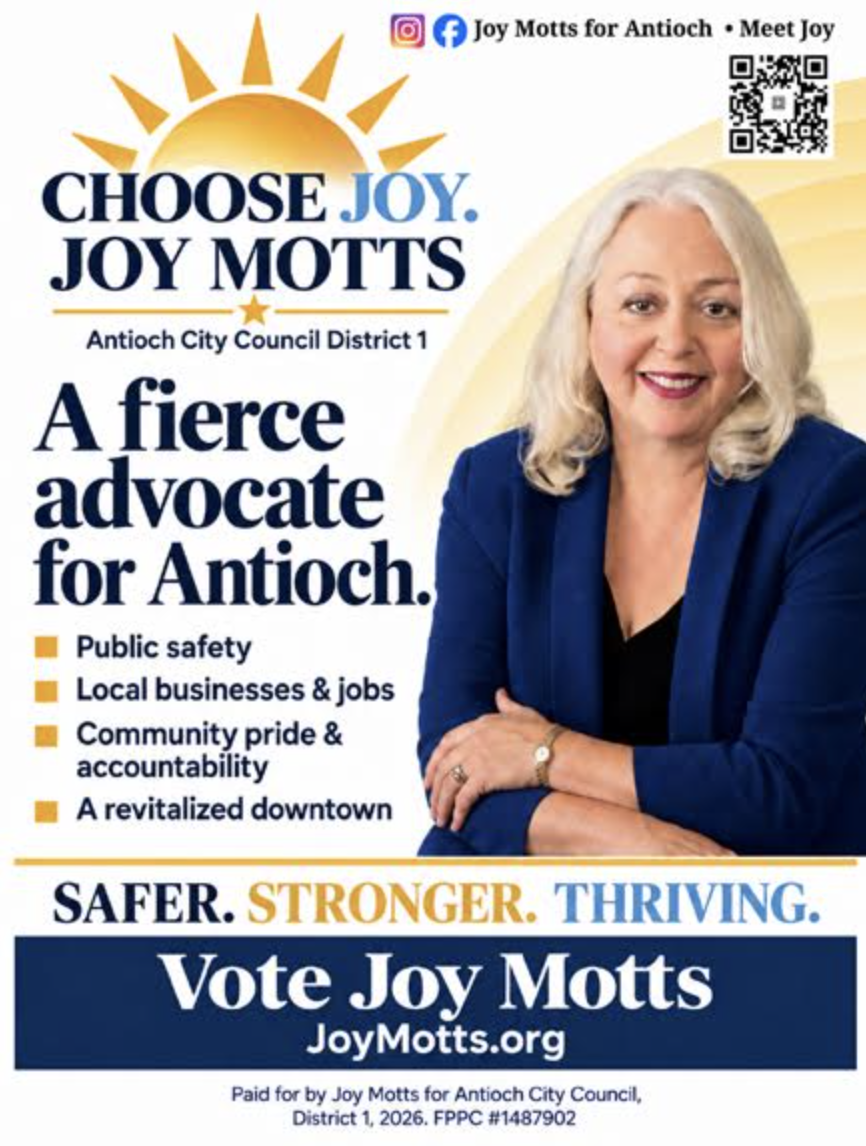
Please vote for Joy Motts for the District 1 Antioch City Council seat. She has the experience, cares about Antioch, and I believe she is the better candidate versus the current incumbent.
The current incumbent asks to be recycled back to that District seat but has not served the public as she has has a responsibility to do. As an elected council member she has really failed to abide by some critical required actions, instead has ignored such and been silent when pressed to carry them out.
During her past six years on the City Council she has, failed to work for and enforce our serious need for the General Plan’s required full complement of police manpower (Sections 3 and 8 dictated 1.2 per thousand sworn officers per thousand residents), and failing to provide a safer and less dangerous Antioch.
We do not need to recycle her back in! We need Joy Motts to be the replacement, which she will work to correct if elected.
Our sworn police manpower is 85 (a deficit of 60 sworn officers in accordance with our General Plan). it should be about 145 sworn officers, proof that she has ignored and therefore continues to endanger our community during her tenure! She needs to be shown the exit door, via instead voting for Joy Motts.
As 50-plus years (about 75,000 hours) of my direct experience in public safety, I have personally brought this to the full Council for years and the incumbents Walker, Wilson and others have instead voted in projects that have further created the public safety issues we have been put under! No way Jose, do not recycle Tamisha and Monica just to get the same ole, same ole!
Also, as a past sworn Officer/investigator/Inspector/Supervisor/Police Trainer, etc., I know what needs to be done! First….do not vote for them just to be recycled. Joy Motts should be voted for in District 1.
AUSD is at a crisis point. This is no time to elect someone without the experience, financial or otherwise, to keep the district afloat while critical decisions are being made.
Mary Rocha voted:
• No on hiring the current embattled superintendent,
• No on salary increases without budget impact information,
• No on mass layoffs, without Explanation on how students would still be served with less staff.
Mary has pressed the superintendent to focus on students, parents, and the community, and she has been the voice of reason while the superintendent provided little to no information about the current fiscal crisis
Experience matters. Mary has served on the board since 2018 and is the only trustee who brings experience and institutional understanding to the table. Two members (Cabos Smith and Brown) are in their first term. The current board president (Jag) is not running again and will be replaced in December by a new board member (Reese). The immediate past president (Hernandez) is in his sixth year, however he spent those years pursuing graduate work at Stanford and Davis toward becoming a physician, and in my view gives minimal attention to his role as trustee.
The political practice of districting, implemented in 2022, brought four new members to the board who lacked the experience to make decisions with long-term consequences.
It was not always this way. Before districting, the board was made up of trustees with varied backgrounds and focus. Gary Hack, a former teacher and AEA president, brought understanding of and advocacy for employees. Claire Smith, who had children in the district for many years, was the voice of parents, families, and students. As a former corporate director and nonprofit executive director, I spent my 12 years focused on contracts and fiscal solvency. A diverse board with diverse opinions has always served this district best.
The results of the current board’s decisions are clear:
The superintendent’s hiring. She was hired by a 4-1 vote without fully vetting her background. A simple Google search shows she left Sequoia Union High School District in December 2022 with a $299,000 severance package under a mutual separation agreement, and that her later tenure at Pacifica School District drew backlash over budget deficits and job cuts. Her contract gave her the same number of workdays as a principal, which is unheard of. A new salary scale was created for her, far above those of former superintendents. A $12,000 relocation package was included, and the reimbursements approved only by the board president at the time (Hernandez) are questionable.
Raises for all. The board approval was 4-1 based on a positive certification reported in 2025–26 First Interim Report (December 2025), which should have begun with “once upon a time…
Layoffs. After a deficit of more than $30 million was uncovered, layoffs were made without a solid plan from the superintendent. The scattershot approach, meant to save $18 million, did little to achieve fiscal solvency, and more layoffs are coming.
Special education. The department was reorganized to save $600,000. Directors were combined, left for other districts, or not rehired. That decision gutted the department and leaves the district open to lawsuits, as students may not be receiving their IEP-mandated services.
Today, the district faces a serious deficit, superintendent is on paid administrative leave and has filed a lawsuit naming AUSD, Mary Rocha as an individual, and Unnamed Individuals 1 through 50. In my opinion, that suit is a strategy to secure another package to quietly go away, as she did at Sequoia.
Antioch has faced a number of challenges over the past year—from legal threats by housing developers to unpaid fuel bills, cuts to critical services, vacant commercial properties, a water park that was left closed all summer, and the loss of the El Campanil Theatre. More than ever, the city needs bold leaders who are capable of seeing things as they really are, thinking clearly, and taking decisive action.
In the District 1 council race, only one candidate has those qualities—and it’s not former Antioch councilwoman Joy Motts.
Joy has deep roots and strong ties in the community. Her passion for Antioch and nonprofit work as president of the Celebrate Antioch Foundation, which puts on the city’s Fourth of July Celebration, are commendable. But her track record as an elected official says something different.
Between 2010 and 2014, when Joy served on the Antioch Unified School District Board of Trustees, the district was operating under a 2009 settlement with the ACLU over discriminatory disciplinary practices against students of color. Joy left the board in 2014 with the problem unresolved—in fact, district data showed Black students were suspended more than 2,700 times during the 2013-14 school year compared with 430 white students, according to a report in the East Bay Times. The East County NAACP would later sue the district over similar issues.
In April 2013, when Joy was board president, the families of several special education kindergartners filed a federal lawsuit against the district, alleging a teacher slapped, pinched and verbally abused their children at Mno Grant Elementary and that the district failed to report the abuse to police or Child Protective Services. Trustees voted to pay $8 million to settle the case.
Joy lost reelection to the school board in 2014, ran again in 2016, and lost that race as well. Then in 2018, she was elected to the Antioch City Council.
On June 18, 2020, in the wake of George Floyd’s murder at the hands of Minneapolis police, the city council held special meetings to decide whether to create an ad hoc committee on police reform. The need was obvious, as the Antioch Police Department did not use body cameras, had no formal policy for reviewing deadly use-of-force incidents, and had already settled several costly lawsuits involving in-custody deaths.
After testimony from 700 Antioch residents, some of whom had personally experienced racism and mistreatment by Antioch police, Joy voted against police reform, opting instead for a series of town halls that went nowhere. That decision would have profound consequences on Antioch taxpayers and the city’s reputation.
Four days after Joy’s vote, on June 22, 2020, APD officer Eric Rombough sent a photo on his phone depicting a large naked Black man with his penis exposed sitting on the neck of George Floyd. That text was one of many later uncovered by a Contra Costa District Attorney’s investigation, which showed that dozens of Antioch police officers had exchanged racist and homophobic messages and that some had admitted committing crimes against people of color, including K-9 attacks.
The texting scandal led to the convictions and prison sentences of several Antioch police officers, federal oversight by the U.S. Department of Justice, and $4.6 million paid to settle civil rights claims filed against the city by 23 victims of police misconduct.
Six months after Joy’s vote, four cops showed up to the home of Navy veteran Angelo Quinto, who was experiencing a mental health crisis. One officer knelt on his neck, leading to his death three days later and ultimately a $7.5 million settlement with the city.
It was left to the new city council majority to clean up a mess that made national headlines—a mess that many in the community saw coming, but not Joy.
The progress Antioch has made since then is now in jeopardy. Mayor Ron Bernal—who as city manager was responsible for overseeing the police department when officers were committing crimes against Antioch residents—has already tried to put the Antioch Police Oversight Commission on hold. Meanwhile, the Angelo Quinto Community Response Team, established to prevent another senseless killing, has seen its hours reduced from 24/7 to 12 hours a day, which could place other lives at risk.
The mayor and his deep-pocketed friends are now vigorously supporting Joy’s campaign because they want a rubber-stamp council. But what they want is not what Antioch needs. The city needs leaders who are capable of collaborating, but who are also ready to stand up and fight for those who don’t have a seat at the table and keep the city out of legal jeopardy.
District 1 already has such a leader in Tamisha Torres-Walker.
Tamisha not only supported the creation of the Angelo Quinto Community Response Team, but also the creation of the Antioch Police Oversight Commission, the city’s first civilian police oversight body, and helped advance body cameras for officers and other critical police reforms.
Tamisha fought to bring in over $10 million in outside funding to the Department of Community Resources, including grants to support gun violence prevention and the city’s paid internship program for young adults. She also championed a $34.9 million grant for permanent supportive housing for the city’s unhoused residents and the creation of the Sycamore Square police substation.
And when it was discovered that Antioch had the highest tenant eviction rates during the pandemic, Tamisha supported ordinances to stabilize rents, protect tenants from landlord harassment, and require just cause evictions. She is now pushing for a vacancy tax to hold absentee property owners accountable and reduce blight.
Too often, voters in cities like Antioch choose candidates who know how to get elected but don’t know how to lead. It’s why the same names keep recycling in and out of positions on the school board and city council.
Sure, they care about Antioch and seem to say the right things. Everyone wants downtown revitalization, safe neighborhoods and functional city services. But they lack the courage, vision, and energy to act decisively in critical moments, before it’s too late.
Tamisha Torres-Walker was built for those moments. She has spent her time on the council listening to constituents, doing the work, and using her council seat to advocate for all Antioch residents—and she has the track record to prove it. District 1 voters need to send her back to the council for four more years of progress.
How do we move forward when it feels like we keep taking steps backward?
That’s the question I find myself asking every time a new City Council agenda is released – and why I talk so much.
Across the Bay Area and throughout California, communities are finding creative ways to adapt to a changing economy, workforce shortages, tightening budgets and the evolving needs of residents. They are identifying opportunities, thinking bigger and finding ways to move projects forward.
For example:
Brentwood, CA is nearly complete with the Sand Creek Sports Complex
Kern County is developing one of California’s largest master-planned active-lifestyle communities for seniors.
Martinez has a draft of what its waterfront could look like.
Oakley, CA is breaking ground on the Amtrak station this week and has a 55-acre park plus other sports fields coming in the future.
Ontario, CA is developing a 200-acre sports empire with a 6,500 seat baseball stadium and eight baseball/softball diamonds.
Pittsburg, CA Dream Courts are nearing completion.
Plumas Lake, north of Sacramento, is getting a wave park on more than 100 acres.
Rancho Cordova is moving forward with plans for a 7,500-plus-seat arena.
Richmond, CA has $550 million coming from Chevron that they get to put to work.
Walnut Creek, CA is making major improvements in Heather Farms.
Antioch…. Crickets.
Actually, scratch that. In Antioch, we are losing things such as the El Campanil Theatre, Babe Ruth Fields, our Amtrak Station and are mall is on its last leg.
Every other community in State of California isn’t sitting around waiting for opportunity to knock. They’re creating it by doing the work and actually being inviting—it also helps when a city is clean and crime is under control.
For a decade, Antioch has used the word “opportunity” as its motto, yet actions say otherwise. At what point do we stop talking about opportunity and instead put shovels in the ground and begin working towards our potential.
Too often, it feels like we wait, hope something happens or throw up our hands before we even get started. That mentality has to change. Our city deserves better, our residents deserve better, and our future is worth fighting for.
We have so many underutilized assets that its embarrassing – the delta waterfront, the foothills of Mount Diablo, our agricultural heritage. Instead, Antioch apparently has lost its identity and we have no idea what we want to be in 10, 20, or 30 years from now.
It’s difficult to create a roadmap for the future when we haven’t even agreed on where we’re trying to go. There is no map. There is no vision. There is no plan.
And that’s where leadership matters.
If we want meaningful plans that reflect the priorities, needs and aspirations of our residents, we need a City Hall that is capable of helping lead those conversations. That requires strong leadership from the city manager’s office, competent department heads and a culture that encourages innovation, accountability and problem-solving.
Unfortunately, when leadership breaks down, the entire organization suffers – which we are experiencing right now with Band-Aid solutions to lipstick on a pig commentary.
How can we expect staff, or even investors, to bring forward bold ideas, pursue economic development opportunities or engage residents in meaningful discussions when we are still struggling to manage basic contracts?
Look no further than what happened at the last City Council meeting.
I raised concerns about nearly $500,000 in contract amendments involving work at the water park. These amendments were placed on the consent calendar, where items are typically approved without discussion.
The council ultimately approved the amendments, potentially avoiding a legal dispute with the contractor.
But here’s the problem: The work had already been completed nearly a month before the amendments were brought to the council for approval.
Think about that for a moment.
Under the city’s contracting rules, agreements exceeding $50,000 require City Council approval. Yet somehow, additional work approaching half a million dollars was either authorized beyond the appropriate approval process or allowed to proceed without sufficient oversight.
Then, after the work was completed, the council was essentially asked to approve the bill.
What would have happened if the council had voted no?
Would the city have faced a lawsuit? Would taxpayers have been left paying even more? Who was responsible for ensuring the proper approvals were obtained before the work began?
These aren’t minor administrative questions. They go directly to accountability, communication, financial oversight and the basic responsibility of protecting taxpayer dollars.
And frankly, the City Council should never be put in a position where it is asked to approve nearly $500,000 in additional spending after the work is already finished.
This is precisely the type of dysfunction that erodes public confidence in City Hall – and this isn’t even bringing up the staff report on the Economic Development Department and staff mailing in the item for council to basically work through with few details and boundaries, such as the budget.
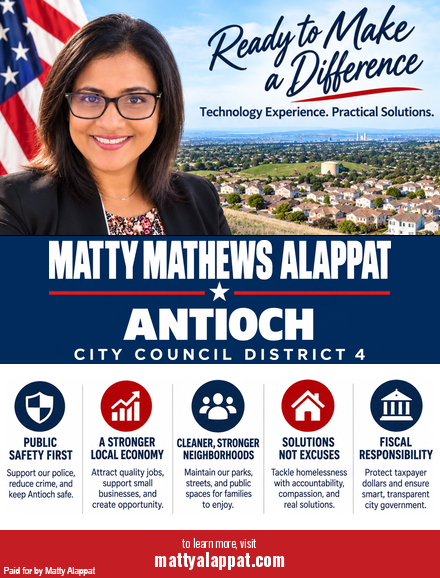
I realize I am a candidate in Antioch District 4, but with an election coming quickly, I would hope all voters would require candidates to actually explain how they intend to fix basic problems at city hall. Not with campaign rhetoric, talking point, fancy slogans we here every year, but provide an actual plan that could result in real solutions.
Perhaps Mayor Pro Tem Don Freitas is onto something with his request for a centralized purchasing department responsible for all contract administration, compliance, and ensuring proper procedures are followed. It warrants some serious consideration given the water park example above.
It’s a practical proposal that deserves discussion which apparently went over the head of the rest of the city council.
There is no doubt in my mind that many parts of City Hall seem to operate like the Wild West, with inconsistent oversight, questionable communication and problems being addressed only after they’ve already occurred.
That isn’t how a professional organization should function, particularly one responsible for managing millions of dollars in public funds. It is almost worth a call to the Grand Jury and let them see if my hunches are correct.
Antioch needs leadership that sets expectations, holds departments accountable, empowers employees to succeed and ensures that basic government operations are handled correctly.
We also need a City Council willing to require those standards rather than simply accepting explanations after the fact.
Bottom line: You cannot build a city of opportunity on a foundation of dysfunction and not everyone playing by the same rulebook.
We should be talking about economic development, new amenities, attracting investment, supporting local businesses and creating a community that future generations are proud to call home. You know, showcasing potential.
Instead, we’re spending valuable time cleaning up preventable mistakes over and over again.
Our community has tremendous potential. The location, the people, the natural beauty and the opportunities are all here. What we need now is the leadership, vision and discipline to put those assets to work.
We shouldn’t have to wait another year or two for competent management, better communication and basic accountability. And we certainly shouldn’t have to wait for detail oriented staff reports with all the information that would inform a community – it would actually shorten council meetings.
Antioch should understand that opportunity isn’t something you hang on a wall or put on letterhead and it happens. It’s something you pursue, plan for and deliver.
And until City Hall starts operating with that mindset, we’re going to keep asking the same frustrating question: How do we move forward when we keep shooting ourselves in the foot with the same issues over and over again.
Rick Carreher in a 2021 photo the year he stepped down as executive director of the theatre. Photos courtesy of El Campanil Theatre Preservation Foundation
And for City to be ready to step in
September 10, 2026
To the Editor:
As the founding executive director of the El Campanil Theatre Preservation Foundation, I feel compelled to speak now — not only because I started this venture, but because this is the critical moment when the Theatre’s future will be decided.
The El Campanil opened in 1928 as a vaudeville house and later operated as a church before our foundation acquired it in 2003. Restoring it to working order required more than a million dollars. Since then, it has hosted community events and major stage acts, and it has remained open to the public throughout.
Source: El Campanil Theatre
In 2023, after COVID wiped out major funding, the theatre nearly went bankrupt. We honored the right of first refusal we had given the city, but the city took no action. We then accepted a bid from an out-of-state investor, and the foundation stayed on as tenant.
Now, facing closure again in 2026, the property owner listed the building. A church has made an offer, but that congregation expects to outgrow it and faces serious parking problems. Meanwhile, the city holds roughly seven million dollars earmarked for acquiring community-beneficial buildings.
We ask the church to reconsider its offer, and we ask the City to be ready to step in the moment the church finds a better fit — so this Theatre can keep serving Antioch for generations to come.
Dear Antioch Unified School District Board Members,
Given the severity of the district’s deficit, the community deserves to understand why the Board continues to authorize expensive contractors to perform work that qualified district staff are fully capable of handling. In education, sustainable improvement comes from setting clear expectations, providing support, and building internal capacity. Antioch is a resilient community filled with talented professionals. Our people deserve the opportunity and the trust to meet the standard.
It is also important to acknowledge that many of these same consultants were used in Pacifica and Sequoia, districts where the Superintendent departed in under two years amid controversy. Why would the Board select a leader without a demonstrated record of long-term, successful superintendent leadership.
Board President Dr. Jag Lathan, you are currently running for County Superintendent. If effective oversight and leadership cannot be demonstrated in a mid‑sized district like Antioch, how will you lead an entire county. Voters are watching and waiting for you to do what is right.
The district’s increasing reliance on high‑cost consultants is fiscally irresponsible and deeply concerning especially during a financial crisis. This year alone, consultant contracts are projected to exceed half a million dollars, including external providers for executive coaching, financial consulting, data analysis, and organizational climate assessments. Only a small portion of these contracts appear justified given staffing shortages. The rest raise serious questions about duplication of services, transparency, and fiscal priorities. The district already employs dedicated, effective leaders who have invested their careers and their hearts into serving Antioch’s students. Overlooking this internal capacity wastes resources and damages morale. Replacing qualified internal leaders with consultants occupying long‑term roles is unjust, irresponsible, and demoralizing. At what point will the Board accept accountability for these decisions?
There has also been a mass exodus of leadership and long‑term teachers. This exodus is directly tied to the current district leadership. Why is the Board not interviewing these long-standing, highly respected employees to understand why they are leaving AUSD?
Attorney fees have been repeatedly discussed at board meetings and often dismissed by comparing them to previous years. But this year, the number of law firms brought in under Dr. Williams has significantly increased legal costs. If the highly publicized employee bullying lawsuit from last year were removed from the comparison, would last year’s attorney fees still exceed the current year’s. That is a question the community deserves answered.
According to individuals familiar with the superintendent hiring process, community panelists were puzzled by the Board’s decision. Several candidates reportedly ranked higher among parents, staff, and students including two Latino leaders who panelists felt could more closely relate to and serve the district’s student population. Insiders state that Dr. Williams ranked last among five finalists in some community feedback summaries. Despite these concerns, Dr. Williams assumed leadership of AUSD in July 2025.
It is public knowledge that entering the 2025–26 school year, AUSD faced an approximate $12 million deficit. The CBO in place at the time who had full knowledge of the deficit and a fiscally sound plan to address it without harming student services or requiring staff layoffs was placed on leave almost immediately by Dr. Williams. It has been stated repeatedly at board meetings that the approved raises and continued 100% district‑paid health benefits did not contribute to the now $31 million deficit. That is not accurate. The increased deficit is directly tied to the raises and benefits negotiated by Dr. Williams and her attorney.
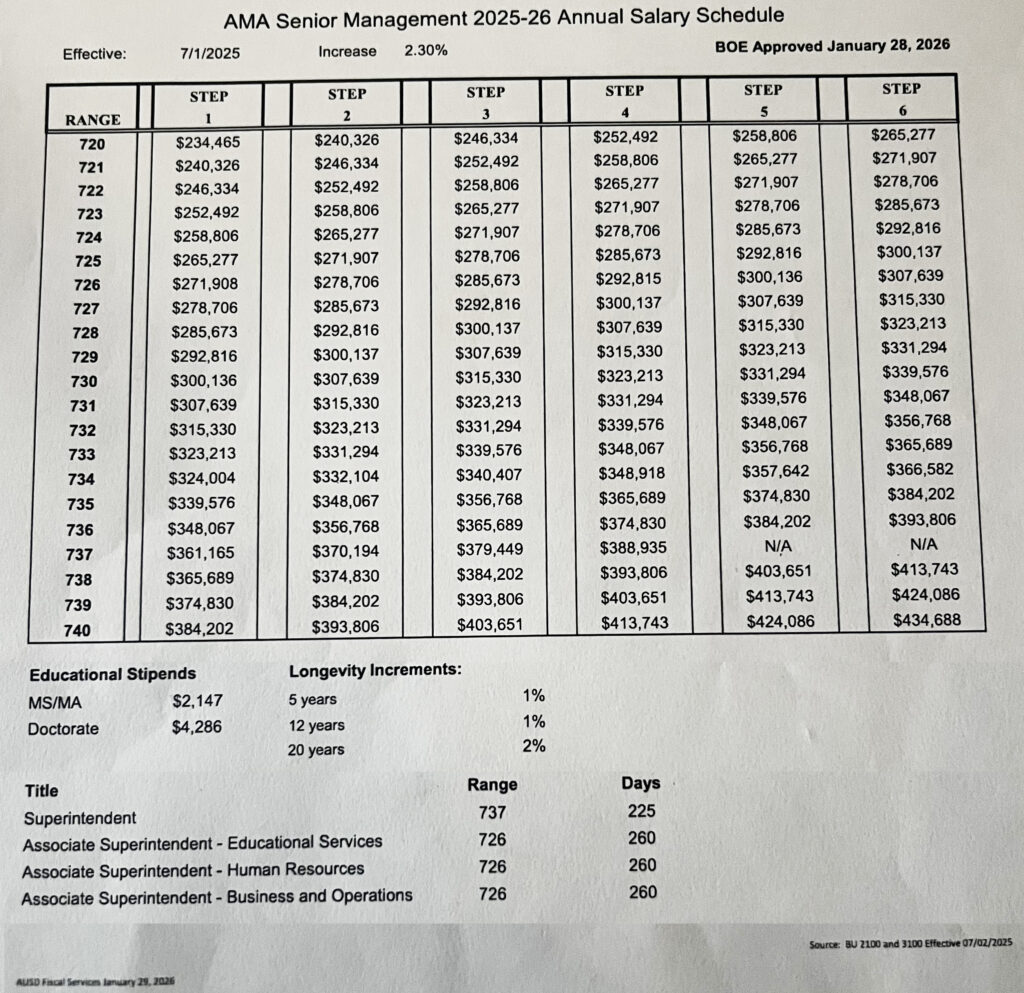
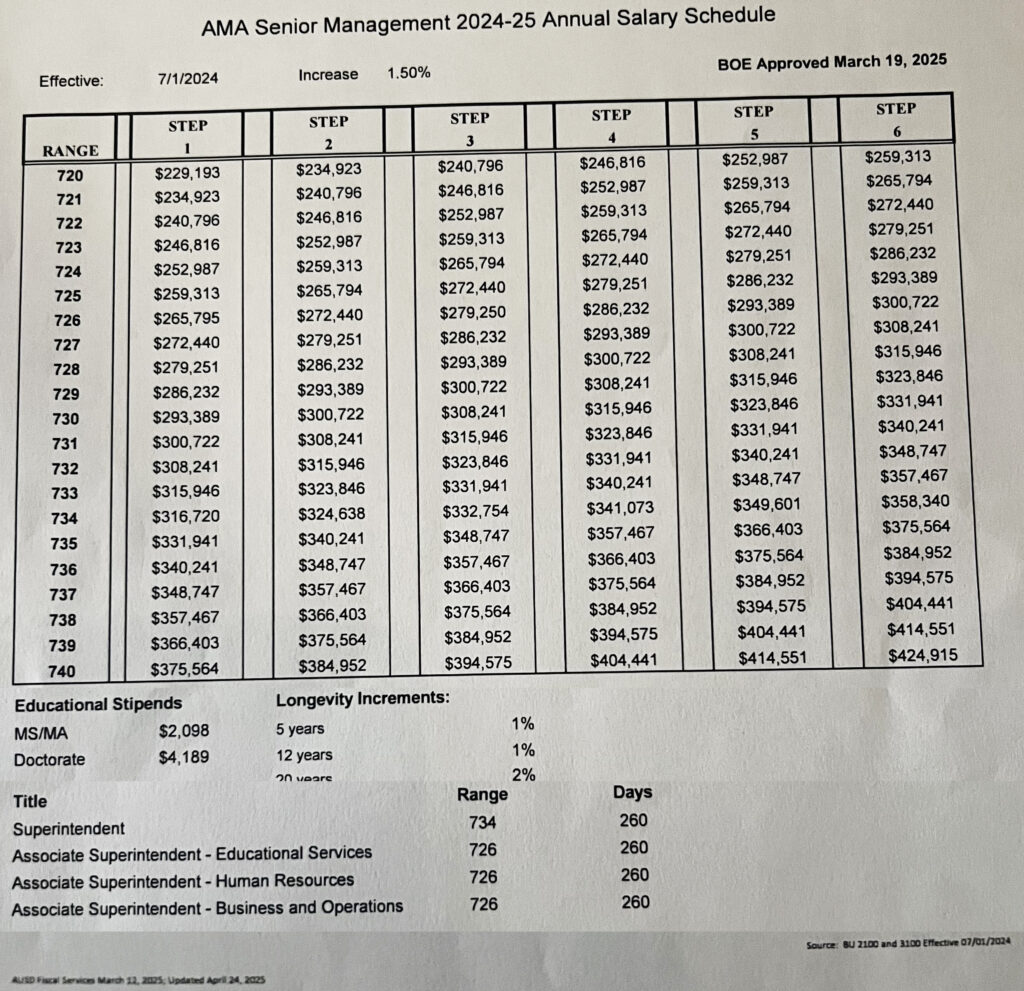
Another contributing factor is the Superintendent’s newly created salary schedule. Historically, AUSD superintendents were placed on salary schedule 734 with a 260-day work year. Dr. Williams negotiated a new 737 range with a 225-day work year 35 fewer days than her senior management team. The previous superintendent, at year six, earned $358,340 annually ($1,378 per day). Dr. Williams began at $361,165 annually ($1,605 per day) and will top out at $1,728 per day.
Despite this significantly higher, per‑day rate, district staff report that Dr. Williams is rarely present in the district office, and when she does arrive, it is often afternoon. She is not beginning her day at school sites, and her whereabouts during the workday are frequently unaccounted for. Given these concerns, why was an entirely new salary schedule created without any data demonstrating long‑term success, improved student outcomes, or consistent leadership presence. Her history shows the opposite, with districts left in turmoil.
At what point will the Board seek honest insight from current and former employees rather than relying on soundbites and publicity efforts. The community is asking for transparency, accountability, and the responsible use of AUSD funds. Every dollar spent should reflect a commitment to students, staff, and the long‑term stability of this district—not to unnecessary contracts, unchecked legal fees, or inflated administrative compensation.
Respectfully,
Amy Bettencourt, former Director of Educational Services, Antioch Unified School District and Concerned Staff, Parents and Citizens
In a note included with the emailed letter to the editor Bettencourt wrote, “I know I left Antioch USD at the end of February due to the toxicity and storm the new superintendent brought to the district, but I continue to hear from a large group of employees who are desperately trying to elevate their concerns publicly.”
I think a little embarrassment may bring humility. One would hope anyway.
CA has made it too easy to steal without consequences. At the very least, a little shame may deter people from being outed.
The thief would be greatly embarrassed when friends, family, co-workers, children, neighbors, etc. see what they have been doing during their free time.
I’m really concerned that stores are closing and having to add expensive anti-theft measures that have made shopping unenjoyable.
It’s not fun shopping anymore, to me, a 60-year-old person AND when I do shop, it’s sad to see empty storefronts.
I no longer shop at a Mexican Creamery near the closed Macy’s in older Antioch because that shopping area is literally a ghost town. Somersville area. I don’t feel safe.
I hope the Antioch/Brentwood shopping centers along Lone Tree Way, don’t suffer the same fate. Thank you!
It typically takes over a month for the Contra Costa Superior Court to process filings in limited civil cases. In fact, more like 6 weeks.
This compares badly with other superior courts throughout the state.
In San Diego Superior, for example, I’ve had papers processed within hours. In Marin County Superior Court, I’ve had papers processed within 1 or 2 days.
This is a real problem because justice delayed is justice denied.
This is a ridiculously long time when it only takes a few minutes to do the processing.
Yes, I understand that they have a lot of filings to process…but with a lot of filing don’t they also have a lot of taxpayer funding commensurate with the size of the population of the county?
So why is Contra Costa so much slower than other counties?