By Officer Daniel Gilmore, PIO, CHP Contra Costa Area
ANTIOCH, Calif. – A woman was pronounced deceased on Sunday morning, after being struck by multiples vehicles, while searching for a lost item within the lanes of traffic on the freeway.
Our preliminary investigation indicates a 20-year-old female had been riding as a passenger in a vehicle on SR-4 eastbound, when she lost an item on the freeway. The vehicle she was riding in pulled over in the center median of SR-4 eastbound, just east of Contra Loma Blvd. The woman exited the vehicle, walked into the lanes of traffic in an attempt to retrieve the lost item, and was subsequently struck by two vehicles. The woman sustained fatal injuries and was tragically pronounced deceased on scene. Both drivers stopped and are being cooperative with the investigation. Officers do not suspect alcohol or drug impairment to be a factor in this crash at this time.
All lanes of SR-4 eastbound, just east of Contra Loma Blvd. were closed from approximately 2:49 a.m. to approximately 5:27 a.m. for scene investigation.
In addition, Antioch Police issued an advisory that the eastbound on ramp at Contra Loma Boulevard would remain Closed for an extended period of time.
This crash remains under investigation. Anyone who witnessed the crash or the events leading up to it is asked to contact the CHP’s Contra Costa Area office in Martinez at (925) 387 1900 or 320Investigations@chp.ca.gov.
The mission of the California Highway Patrol is to provide the highest level of Safety, Service, And Security.
12-hour statewide effort focuses on identifying and arresting impaired drivers
By Jaime Coffee, Director of Communications, Office of Media Relations, California Highway Patrol
SACRAMENTO — One impaired driver can change or end a life in an instant. To help prevent these tragedies, the California Highway Patrol (CHP) is mobilizing uniformed personnel statewide for a targeted enforcement effort to keep impaired drivers off California roads. Drivers should plan ahead, arrange a sober ride and never get behind the wheel while impaired.
Beginning at 6 p.m. on Friday, Oct. 2, and continuing through 5:59 a.m. on Saturday, Oct. 3, all uniformed CHP personnel will participate in a statewide Maximum Enforcement Period (MEP). During the MEP, officers will increase their presence on California roads and focus on identifying and stopping impaired drivers.
“The message is clear: Impaired driving will not be tolerated on California roads. It is preventable, dangerous and puts every person nearby at risk. If you plan to drink or may be impaired, arrange a sober ride home. During this statewide enforcement period, CHP personnel of every rank will make it their mission to identify and remove impaired drivers from our roads.”
– CHP Commissioner Sean Duryee
By the Numbers
From 2022 through 2024, data from the CHP’s Statewide Integrated Traffic Records System show that alcohol- or drug-impaired driving contributed to an average of nearly 800 fatal crashes each year and a total of more than 39,400 injury crashes on California roads.
During last October’s 12-hour MEP, held over the Halloween weekend, CHP officers arrested more than 500 impaired drivers. Officers also issued nearly 2,000 speeding citations, including 96 citations for drivers traveling faster than 100 mph.
Help Keep Impaired Drivers Off the Road
As California’s state police, the CHP remains committed to keeping California’s roads safe for everyone. The CHP asks the public to remain vigilant and report suspected impaired drivers. Driving unusually slowly, swerving between lanes or nearly colliding with obstacles are a few indicators that a driver may be operating a vehicle under the influence.
If you see a suspected impaired driver, call 9-1-1 and provide as much information as possible, including the vehicle’s make, model, license plate number and direction of travel.
Never drive impaired or ride with an impaired driver. Designate a sober driver, use public transportation or arrange for a rideshare service.
Together we can help keep California’s roads safe for everyone.
The mission of the CHP is to provide the highest level of Safety, Service,and Security.
Photos: (Left) MTC (Right) Credit John Huseby, Caltrans
Carpools allowed in bus lane only during weekday peak periods
By Cindy Ramirez, CHP, Bart Ney, Caltrans and John Goodwin, Bay Area Toll Authority
SAN FRANCISCO, Sept. 9, 2026. . . The California Highway Patrol, in partnership with Caltrans and the Bay Area Toll Authority, this month will resume concentrated enforcement of the laws governing the westbound approach to the San Francisco-Oakland Bay Bridge. This includes strict enforcement of vehicle-type and vehicle-occupancy laws in the bus/carpool lane that bypasses the San Francisco-Oakland Bay Bridge toll plaza at the far-right side of the roadway.
This lane — which can be accessed by traffic approaching the bridge from Interstate 80, Interstate 880 or West Grand Avenue — may be used by buses, motorcycles or carpools with three or more occupants during the weekday commute periods of 5 a.m. to 10 a.m. and 3 p.m. to 7 p.m. Only buses may lawfully use the lane at other times, including all day on Saturdays and Sundays. Drivers cited for improper use of the bus/carpool lane outside weekday commute hours are subject to a fine of $490 or more.
“The signs at access points to the lane are clear and unambiguous. They read ‘Buses Only,’” noted Lt. Ed Clarke of the CHP’s Oakland Area. “But many drivers have not consistently followed the rule in recent years.” The CHP, Caltrans and BATA agree that focused enforcement will help address ongoing violations, improve compliance with the posted restrictions, and ensure the lane remains available for its intended use.
Acting Caltrans District 4 Director and BATA Commissioner Doanh Nguyen reminds drivers that the toll booths at the Bay Bridge and other state-owned toll bridges will soon be a thing of the past. “The transition to open-road tolling already is underway, with the new system set to debut next year at the Richmond-San Rafael Bridge,” he said. “The comprehensive reconfiguration of the approaches to every state-owned toll bridge will improve safety and efficiency by allowing drivers to pay their tolls without having to slow down to squeeze past the obsolete toll booths.”
BATA administers all toll revenues from the region’s seven state-owned toll bridges. Caltrans owns and operates the state highway system, including state-owned toll bridges such as the Bay Bridge.
La Policía de Caminos de California (CHP) se enfoca en el acceso al puente Bay Bridge para una campaña de reforzar el control
Los vehículos compartidos solo pueden circular por el carril de autobuses durante las horas pico de los días laborables
SAN FRANCISCO, 9 de septiembre de 2026. . . La Policía de Caminos de California (CHP), en colaboración con Caltrans y la Autoridad de Peajes del Área de la Bahía, reanudará este mes la aplicación intensiva de las leyes que rigen el acceso en dirección oeste al puente San Francisco-Oakland Bay Bridge. Esto incluye la aplicación estricta de las leyes sobre el tipo y la ocupación de vehículos en el carril para autobuses y vehículos compartidos que evita la plaza de cobro del puente San Francisco-Oakland Bay Bridge por el lado extremo derecho de la carretera.
Este carril — al que pueden acceder los vehículos que se acercan al puente desde la Interestatal 80, la Interestatal 880 o West Grand Avenue — puede ser utilizado por autobuses, motocicletas o vehículos compartidos con tres o más ocupantes durante días laborables en los horarios pico de 5 a.m. a 10 a.m. y 3 p.m. a 7 p.m. Solo los autobuses pueden utilizar el carril en otros momentos legalmente, incluyendo todo el día los sábados y domingos. Los conductores
que reciban una infracción por el uso indebido del carril para autobuses y vehículos compartidos fuera de los horarios pico de los días laborables están sujetos a una multa de $490 o más.
“Las señales en los puntos de acceso al carril son claras e inequívocas. Dicen ‘Solo autobuses’,” señaló el teniente Ed Clarke del Área de Oakland de la CHP. “Sin embargo, muchos conductores han omitido cumplir la norma de forma consistente en los últimos años.” La CHP, Caltrans y la BATA coinciden en que una aplicación rigurosa de la ley ayudará a abordar las infracciones continuas, mejorará el cumplimiento de las restricciones establecidas y garantizará que el carril siga disponible para el uso previsto.
El director interino del Distrito 4 de Caltrans y comisionado de la BATA, Doanh Nguyen, recuerda a los conductores que las casetas de cobro en el puente de la Bahía y otros puentes de cuota de propiedad estatal pronto pasarán a ser historia. “La transición al sistema de cobro de cuotas en carretera abierta ya está en marcha, y está previsto que el nuevo sistema entre en funcionamiento el próximo año en el puente Richmond-San Rafael. La reconfiguración integral de los accesos a todos los puentes de cuota de propiedad estatal mejorará la seguridad y la eficiencia, al permitir que los conductores paguen sus cuotas sin tener que reducir la velocidad para pasar por las casetas de cobro obsoletas.”
BATA administra los ingresos de peajes de los siete puentes de peaje de propiedad estatal en la región. Caltrans es propietario y opera el sistema de carreteras estatales, incluyendo los puentes de cuota de propiedad estatal como el puente Bay Bridge.
By Jaime Coffee Director of Communications Office of Media Relations
SACRAMENTO — As Labor Day weekend approaches, the California Highway Patrol is urging motorists to plan ahead, make responsible choices and never drive impaired.
To help keep California’s roads safe, the CHP will conduct a Labor Day Holiday Enforcement Period (HEP) from 6:01 p.m. Friday, Sept. 4, through 11:59 p.m. Monday, Sept. 7. During the HEP, CHP officers statewide will focus on removing impaired drivers from the road and educating motorists about the dangers of driving under the influence.
The CHP’s HEP coincides with the National Highway Traffic Safety Administration’s “Drive Sober or Get Pulled Over” campaign, which runs Aug. 19 through Sept. 7.
“There is no excuse for driving impaired. If you choose to drink or use a substance that affects your ability to drive, make a plan and stay out of the driver’s seat. Your decision could be the difference between everyone getting home safely and a tragedy that can change lives forever.” – CHP Commissioner Sean Duryee
During last year’s Labor Day HEP, CHP officers made more than 1,200 impaired-driving arrests. During the same 78-hour reporting period, nearly 500 DUI-related crashes occurred statewide, resulting in more than 270 injuries and eight deaths, according to preliminary data from the CHP’s Statewide Integrated Traffic Records System. These figures underscore the devastating consequences of impaired driving.
DUI Is More Than Just Alcohol
Impaired driving is not limited to alcohol. Cannabis, prescription medications, illegal drugs and some over-the-counter medications can impair a driver’s ability to safely operate a vehicle and make the split-second decisions required behind the wheel.
Driving impaired can cost someone their license, freedom or life — or take the life of someone else. The CHP urges motorists to think twice before driving impaired or getting into a vehicle with an impaired driver.
Arrive Safely, Make Responsible Choices
If you plan to drink, plan for a safe ride home before the celebration begins.
Designate a sober driver, use public transportation or a rideshare service, call a taxi, or stay where you are for the night.
If you are hosting a gathering where alcohol will be served, make sure your guests have a safe and sober way home.
Always wear your seat belt. It remains one of your best defenses in a crash.
If you see a suspected impaired driver on the road, call 9-1-1. Your call could save a life.
The mission of the CHP is to provide the highest level of Safety, Service,and Security.
Entitled “Get Educated and Ride Safe” (GEARS) VIII – countywide through Sept. 30
141 crashes, 29 major injuries, 5 fatalities involving motorcycles in Contra Costa in 2025
By Officer Daniel Gilmore, PIO, CHP Contra Costa Area
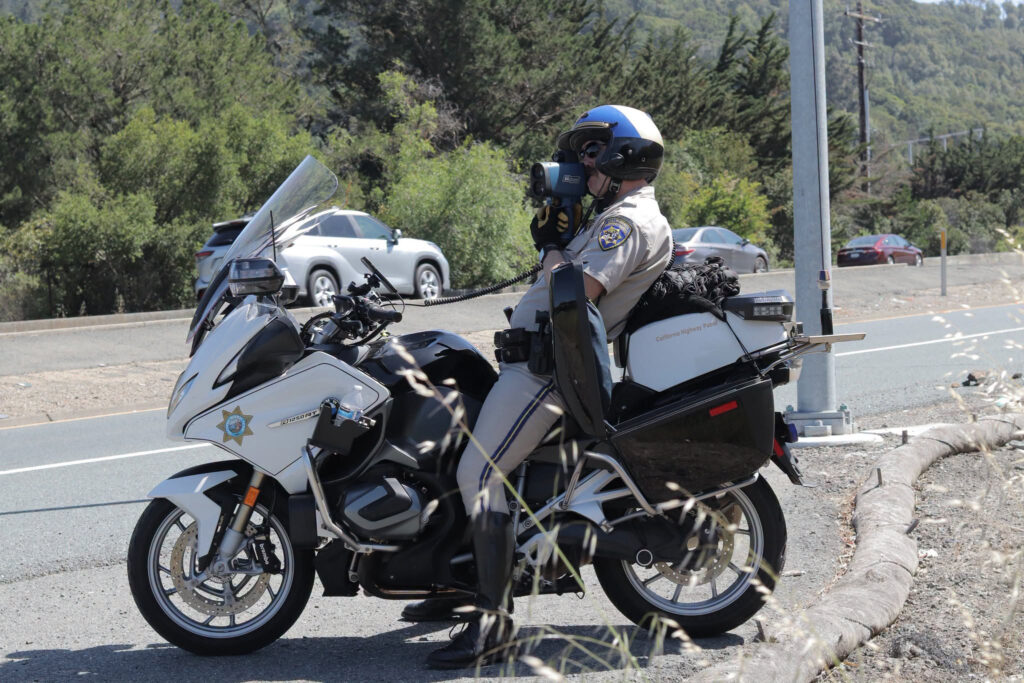
CONTRA COSTA, Calif. – In an effort to reduce the number of motorcycle crashes, California Highway Patrol (CHP) Contra Costa Area will deploy additional officers August 20, 2026, on Interstate 80, and unincorporated roadways in Contra Costa County. Officers will look for violations by both motorcycle riders and drivers that make roads dangerous for other traffic, including unsafe speed, following too closely, unsafe lane changes, and improper turning.
Motorcycle-involved crashes continue to be a major concern for the CHP Contra Costa Area. From January 2025 through December 2025, provisional statistical data revealed there were 141 crashes involving motorcycles within our jurisdiction. Of those crashes, 29 involved major injuries, and five resulted in fatalities.
Funding for these operations is provided by a grant from the Office of Traffic Safety, through the National Highway Traffic Safety Administration. Titled “Get Educated and Ride Safe (GEARS) VIII, the grant funding assists the CHP in reducing deadly and serious injury crashes involving motorcycles. The CHP Contra Costa Area will continue to deploy additional enforcement efforts through September 30, 2026.
If you have any questions or need additional information, please contact Public Information Officer D. Gilmore, at (925) 586-1879.
The mission of the CHP is to provide the highest level of Safety, Service and Security.
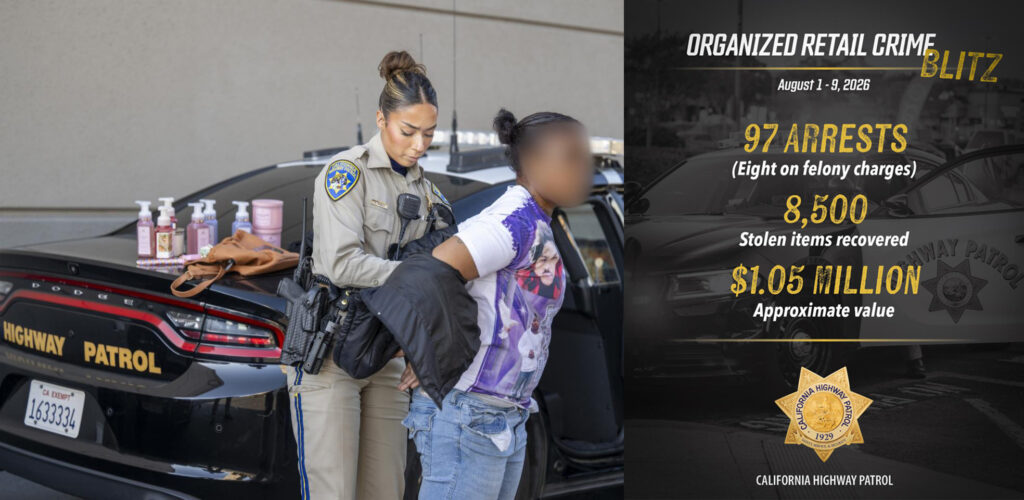
A suspect is arrested in the Bay Area after attempting to steal multiple items and Organized Retail Crime Blitz statistics. Photos & source: CHP
By Jaime Coffee, Director of Communications Office of Media Relations, CHP
SACRAMENTO — The California Highway Patrol (CHP) continues to make steady progress in dismantling organized retail crime networks throughout the state. Recently, the CHP joined more than 100 law enforcement agencies for a National Organized Retail Crime Blitz, helping recover $1.05 million in stolen goods. Building on last year’s success, this event reaffirms the CHP’s commitment to holding retail theft suspects accountable.
From August 1 through 9, the CHP Organized Retail Crime Task Force (ORCTF) saturated communities and led coordinated enforcement operations at several businesses, shopping centers and retail stores statewide. Officers proactively identified and apprehended offenders suspected of organized retail theft.
————
“The impacts of retail theft on businesses and communities are long-lasting. The CHP will continue to dedicate resources to catching perpetrators and holding accountable those who take from businesses and victimize communities.” – CHP Commissioner Sean Duryee
————
As a result of the CHP’s statewide efforts, officers arrested 97 suspects, including eight on felony charges, and recovered more than 8,500 stolen items valued at approximately $1.05 million.
“The proactive operations conducted during the blitz are a snapshot of the work the Organized Retail Crime Task Force is committed to doing every day,” added Commissioner Duryee. “We will continue to do our part year-round to identify problematic areas, reduce retail theft and make California a safer place to work, live and visit.”
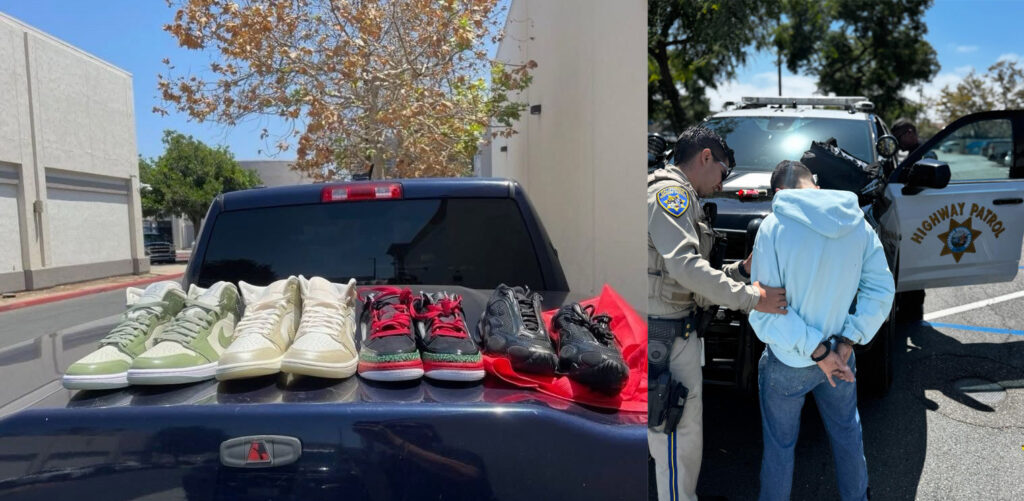
Numerous stolen sneakers recovered during coordinated enforcement efforts in San Diego. A suspect is arrested by the CHP Border Division during the ORC Blitz.
Yearly Progress Snapshot
Looking at the broader picture, the blitz builds on years of steady enforcement. Since the ORCTF’s inception in 2019, the CHP has been involved in more than 4,700 investigations, resulting in more than 5,300 arrests and the recovery of more than 1.6 million stolen items valued at more than $76.6 million as of July 30.
In the first seven months of 2026, the CHP made nearly 350 retail theft arrests, investigated more than 280 incidents, and assisted partner agencies with more than 80 investigations, recovering an estimated $6.7 million in stolen goods.
Organized retail crime affects more than businesses. It can impact employees, consumers and the communities where these businesses operate. The CHP will continue to work with its law enforcement partners to disrupt organized retail crime and protect California’s communities.
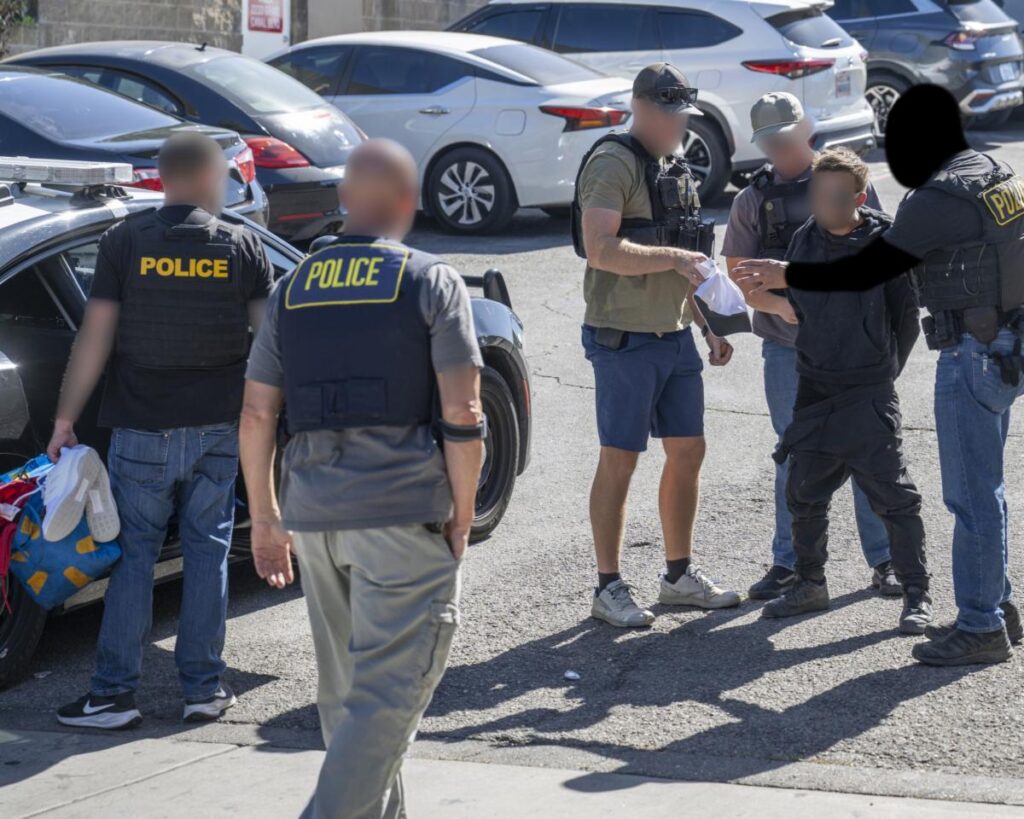
Officers arrest a retail theft suspect during a series of proactive blitz operations in Roseville, Lodi and Stockton.
Organized Retail Theft Program
In response to AB 1065, the CHP, in consultation with the DOJ, developed a task force concept to work with allied agencies to combat organized retail theft. The CHP encourages victims of organized retail crime to use the tip link resource located on this page to report qualifying incident(s)
Beginning in 2019, Assembly Bill (AB) 1065 required the Department of the California Highway Patrol (CHP), until July 1, 2021, to coordinate with the Department of Justice (DOJ) to convene a regional property crimes task force to identify geographic areas experiencing increased levels of property crimes and assist local law enforcement with resources, such as personnel and equipment. The recent passage of Assembly Bill 331 will extend the operation of the regional property crimes task force until January 1, 2026.
As reported by the National Retail Federation, organized retail theft accounts for nearly $30 billion in economic loss per year. This loss is carried by retailers on several levels but is ultimately passed on to consumers through price inflation to offset economic loss. While the problem is most commonly associated with shoplifting, it extends well beyond into associated organized criminal activity. Commercial burglary, vehicle burglary, identity theft, credit card fraud, forgery, and fencing (selling or distribution of) stolen property are part of a bigger picture that finance ongoing criminal operations.
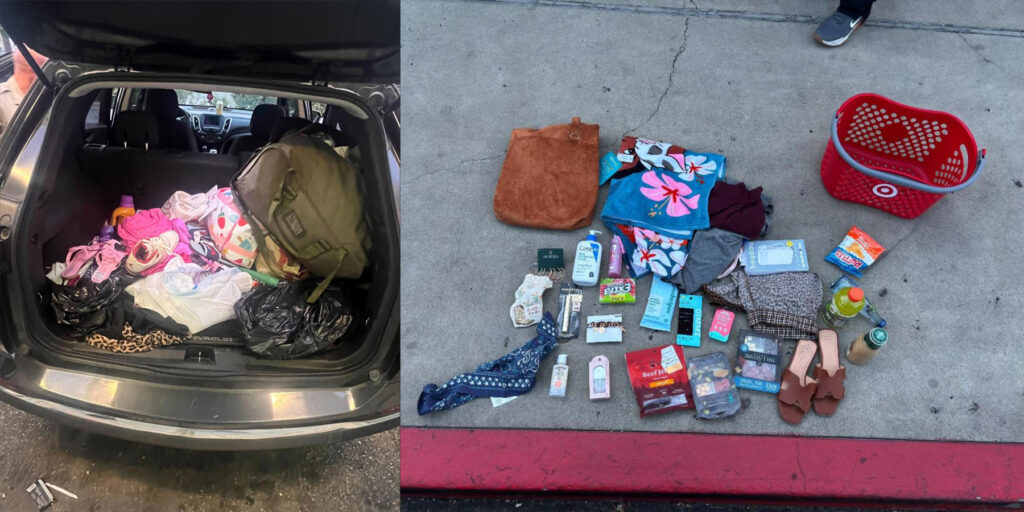
A trunk full of stolen items was recovered and multiple stolen items recovered from a Target as a result of proactive operations throughout Bakersfield and Turlock.
In response to AB 1065, the CHP, in consultation with the DOJ, developed a task force concept to work with allied agencies to combat organized retail theft. Three regional task forces, known as Organized Retail Crime Task Forces (ORCTF), were established by the CHP in five field Divisions with the greatest need for immediate action: Golden Gate Division (encompassing the greater Bay Area), Southern Division (encompassing the greater Los Angeles region), Border Division (encompassing Orange and San Diego counties), Valley Division (encompassing the greater Sacramento area and surrounding counties), and Central Division (encompassing the San Joaquin Valley).
The CHP encourages victims of organized retail crime to report qualifying incident(s) which are covered under California Penal Code Section 490.4, Organized Retail Theft.
12-year-old Isaiah and 13-year-old Gianni Figueroa were missing from Antioch for a week, and 33-year-old Yesenia Villasenor was listed as a suspect. Source: CHP
Biological mother has history of arrests including by Antioch Police on July 12thfor battery.
By Allen D. Payton
In a post on X (formerly Twitter) on Sunday, July 19, 2026, the CHP announced two boys from Antioch have been missing since July 13. It reads, “ENDANGERED MISSING ADVISORY – San Joaquin and Contra Costa Counties Last seen: Redwood Drive and Gentrytown Drive, Antioch. IF SEEN, CALL 9-1-1.”
The boys are 12-year-old Isaiah and 13-year-old Gianni Figueroa who are listed as victims and a 33-year-old woman named Yesenia Villasenor is listed as a suspect. But the flier does not mention her relationship to the boys or that she kidnapped them.
The post included the above flier which reads, “This EMA has been activated by the CHP ENTAC (Emergency Notification and Tactical Alert Center) on behalf of the Antioch Police Department. The CHP ENTAC was notified on July 19, 2026 at 1415 Hours (2:15 PM).”
Updated flier showing the boys have been located. Source: Antioch PD
The flier also shares that the boys were “last seen on July 13, 2026, at approximately 1800 hours, in Antioch, Contra Costa County. Isaiah and Gianni are possibly traveling in a vehicle.”
A photo, license plate and description of a vehicle is included in the flier: White 2109 Toyota Highlander with CA license plate number 8KJR109.
In response to efforts to reach Antioch Police about the matter, as of 5:43 pm, Lt. Bill Whitaker wrote, “They are safe. Post coming out shortly.”
UPDATE 1: A post later Monday on the APD Facebook page reads, “f you have seen this posted on social media or on the freeways, we wanted to update you that the children have been safely located. No further assistance is needed. Thank you.”
Whitaker was asked for additional details and if Villasenor was arrested. He responded, “No arrests.” It was a “custodial and court order issue.”
UPDATE 2: Asked if she is the boys’ mother and where they were located, Whitaker responded, “Yes, their biological mother. We won’t answer their whereabouts for the safety of all involved.”
According to localcrimenews.com, Villasenor has been arrested multiple times dating back to 2015 by various agencies including Antioch, Concord and Pleasant Hill Police, and most recently by the El Dorado Sheriff’s Department on March 1, 2026, for inflicting corporal injury on a spouse or cohabitant. Her other arrests were for DUI alcohol with blood alcohol continent greater than .08, driving while license is suspended and for warrants or holds only.
Use common sense when parking and exiting your vehicle:
Take your vehicle’s key; do not leave it in or on your vehicle.
Close and lock all windows and doors when you park.
Park in well-lit areas if possible.
Never leave valuables in your vehicle, especially if they can be seen from outside the vehicle.
Thieves want vehicle parts and valuable items, too.
Radios and wheel covers aren’t the only popular stolen vehicle parts thieves take. They want whatever sells, from the mandated labeled parts to those that aren’t. Some of the most popular items stolen from vehicles include air bags, GPS units, cell phones, iPads, laptops, and purses. Parts like doors, engines and transmissions are stripped and sold.
While thefts declined last year, prevention starts with simple habits:
Keep valuables out of sight.
Lock your doors and roll up all windows.
Park in well-lit, visible areas.
Install a GPS tracker or recovery system
Use anti-theft tools
(steering wheel locks, alarms)
Always turn off your car and take your keys.
NEVER leave it running unattended.
A few seconds of prevention can save you the time, expense, and frustration of having your vehicle stolen.
Help protect your vehicle and don’t make it an easy target.