Antioch District 4 Councilwoman Monica Wilson announced on her official Facebook page, Tuesday, July 28, 2026, that she will run for a fifth term. First elected in 2012, she is currently the longest-serving member of the council. Wilson, currently in her fourth, or rather third-and-a-half term as she was re-elected in 2016, then in 2020 for a two-year term following the City’s move to district elections, then again in 2022 for another full, four-year term.
Wilson also posted the above campaign flier with the slogan, “Proven Experience. Trusted Leadership.”
In her announcement Wilson wrote, “I’m proud to announce that I am running for re-election to the Antioch City Council.
“Antioch is at a critical moment. We face real challenges, but we also have important opportunities to strengthen our neighborhoods, support families, and build a more stable and resilient local economy.
“As your Councilmember, I have always believed in collaborative leadership, transparent decision-making, and practical solutions that deliver real results for Antioch residents. I’m proud of the work we have done together, and I know there is more work ahead.
“When I was first elected, I made history as Antioch’s first African American woman to serve on the City Council. Today, I remain just as committed to serving this community with integrity, experience, and a deep belief in Antioch’s future.
“I’m running for re-election because Antioch needs steady, proven leadership focused on results, stability, and long-term progress.
“I would be honored to continue serving the residents of District 4 and working every day to move Antioch forward.”
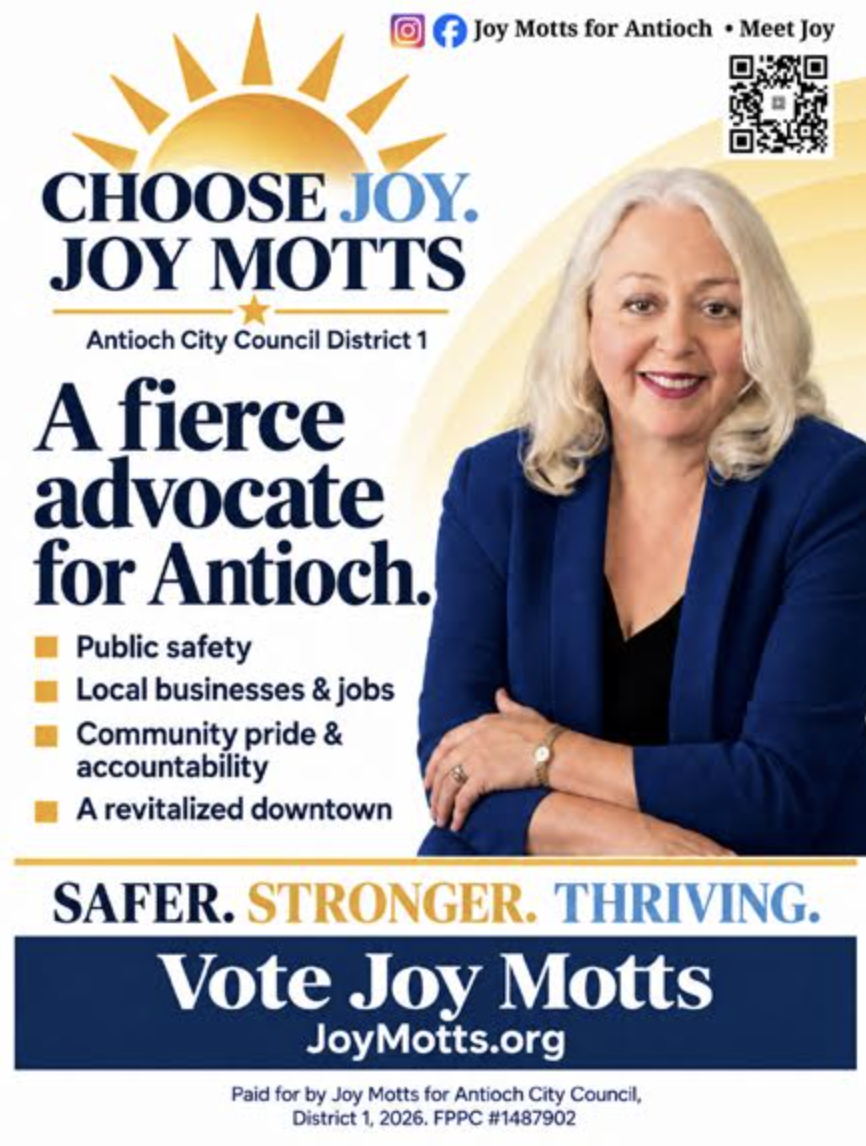
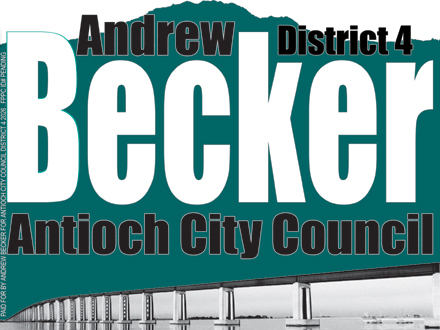
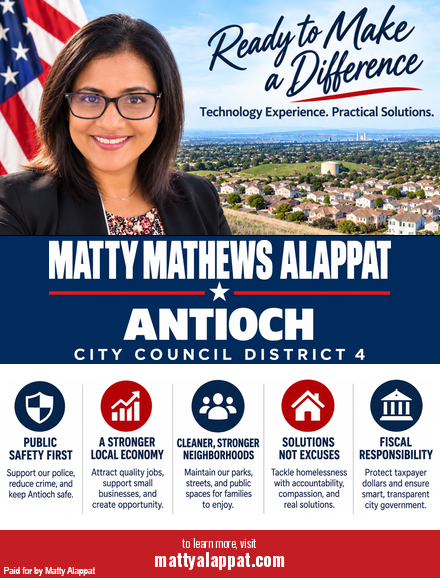
UPDATE: The election for council districts 1 and 4 will be on Tuesday, Nov. 3rd. So far, Wilson faces one potential opponent, former Antioch Police Crime Prevention Commission Chair Sandra White, who announced her third campaign against Wilson, local homeless advocate Andrew Becker and newcomer Metty Mathews Alappat, neither of whom have announced nor yet have websites or social media for their campaigns. According to her LinkedIn page, Alappat was a Senior Technical Account Manager for Amazon Web Services until July 2025. All four have pulled nomination papers but none of the four have filed as of Wednesday, July 29th. The filing period closes at 5:00 p.m. Friday, August 7, 2026.
Takes action with Torres-Walker absent who was not allowed to attend via Zoom due to apparent staff mistake
“To say there’s no plan is wrong. We are not doing nothing.” – Mayor Bernal
By Allen D. Payton
Following multiple meetings on the matter, the City being awarded nearly $35 million in state Homekey+ grant funds and voting to approve the purchase and conversion of the hotel for the program, during their meeting on Tuesday, July 28, 2026, the Antioch City Council voted 3-1, to reject the funding and withdraw from the project. The funds would have been used to convert the 123-room Antioch Inn & Suites to 84 units of permanent supportive housing for veterans and homeless residents from Antioch and throughout the county. But it would have required a significant financial commitment from the City for five to 15 years which the mayor and two councilmen said Antioch can’t afford following two years of budget cuts and future deficits looming on the horizon.
District 4 Councilwoman Monica Wilson was the lone vote against the motion and Councilwoman Tamisha Torres-Walker, in whose District 1 the project would have been located, was absent and unable to attend via Zoom due to an apparent staff mistake.
A new state law allows council member participation and public comments via Zoom which requires council members to submit information prior to the meeting. Earlier in Tuesday night’s meeting residents said Torres-Walker had informed her fellow councilmembers and Acting City Manager Ana Cortez she would miss the meeting and sent the necessary information to participate remotely. But something happened that prevented the councilwoman from participating in the meeting. Resident Leslie May called it, “sabotage” and as a result, she and local homeless advocate Nichole Gardner called for the agenda item to be postponed so Torres-Walker could be in attendance. But that didn’t happen and the councilwoman called in later during public comments on the matter to offer her thoughts in support of the project.
The Primary Issue: City Financial Commitment
While one of the issues was that all those housed on the property would not have been from Antioch, the primary issue for the three councilmen was the City’s financial commitment. To accept the state funding, it would have required ongoing operating assistance from the City averaging up to approximately $1.2 million annually during the initial five-year period, for a total of up to an additional $6 million. Over the full fifteen-year period, the total potential City contribution could have been approximately $18.75 million, primarily from the General Fund.
On average, the state and city funds combined would total $41.75 million or about $500,000 per unit over the first five years and approximately $54.4 million or $640,000 per unit over the full 15-year period.
Competing Views Offered During Public Comments
Following a brief staff presentation on the agenda item, #7, during public comments some residents spoke against while most spoke in favor of the project.
A woman asked, “Why Antioch? Antioch is the poster child for low-income housing. There is no guarantee it will house Antioch residents. It can go on for 55 years.”
Patrick Scott said he opposed the project, “primarily for economic reasons. This project will increase the deficits. We’ve already spent more than $25 million on homeless programs and services. In spite of these services, we still face homeless in front of our businesses, on our streets and shuttered businesses.”
He spoke of growing “encampments along the railroad tracks and in downtown.”
“Neither of our neighbors to the west or the east are experiencing the problems we have,” Scott stated.
He then spoke of the City’s projected budget deficits over the next few years and the $1.2 million annual cost for the project.
Resident Leslie May said, “The place is located in District 1. Most of the people who stand and speak against it don’t live in District 1. The railroad tracks are not the responsibility of the City of Antioch. Unless you live in District 1 and have to work with the people who are unhoused…you don’t understand what it is. It is humane to give these people a clean place.” “Antioch residents will definitely have first choice,” she explained. “They reason they’re not in Pittsburg, Oakley and Brentwood is because they pushed them all here.”
“The City of Antioch is already spending $1.2 million a year to do these sweeps, so why not spend the money on this…up to $1.2 million,” she concluded.
“Why would the council even consider adopting the Homekey project in Antioch? It’s ludicrous,” said Evelyn Scott. “Especially with the current budget shortfalls.”
“Residents can come from anywhere in the county,” she continued. “You cannot continue to dip into reserves…especially when you’re taking prime properties.
Cielo Martinez spoke next saying, “I’m 29 years old. I’ve been homeless for almost seven years. I work myself. I don’t do drugs. I don’t do alcohol. I work every day. So does my husband. I can’t afford a home, right now. The rent out here is crazy.”
Rebecca B. said, while choking back tears, “I’ve been on the streets for 15 years. We need homes. A lot of us don’t want to be out here. This is not a choice. We’re not getting better. We’re getting bitter. A lot of us want to work but we can’t work. I’m diabetic. I don’t have teeth. I can’t get a job because you want to judge me by my teeth, by my face, by my dog. I want a home. How much more in life am I supposed to take? It’s not my duty, it’s not my job. It’s your job. Please, help us. We don’t want to be out there.”
Local real estate broker Mark Jordan spoke next saying, “This is an incredibly emotional discussion. However, the City of Antioch only has one option and that’s Option B. Because the contract price is not a realistic price…of $15.1 million.”
“This particular property has a 17% occupancy rate. This property uses revenue to determine value,” he explained.
“There’s no appraisal for this property to the public,” Jordan continued. He cited state government code that it requires one unless it’s a gift.
California Penal Code…section 424 makes it a felony if an elected official overpays for a property and commits waste. Protect yourself, protect the city. The property is in foreclosure. Buy it at the foreclosure price.”
A woman who referred to herself as a reverend said, “It’s not just a fiscal issue. Housing is the most essential thing you can spend your money on. I think you can find the money. There are grants you can apply for. The amount of money you are spending on homeless people already would be offset. We can’t tolerate what’s going on in the Bay Area anymore. Even wealthy, middle-class people are struggling to pay their rent. I pray you…make the right decision.”
Joey Flegel-Mishlove, Policy Manager for the Bay Area Housing Mission, said, “Starting from the human question of what it’s like to sleep in the cold, the heat or the rain. Homelessness…as elected officials it is the most important issue. It is a fiscally sound choice to enter into this contract.”
“How in a deficit can we turn down the largest grant the State of California has ever offered us?” he asked. “Partners have been offering to help us. I hope you can say, ‘we can get this done. We will get this done.”
Former Councilman Ralph Hernandez said, “The Homekey thing, I don’t think we can afford it. You’re taking…something that is income generating for the community. They pay tax monies to the city.”
“I’m not saying deny the money from the state. Is there another way that it can be used?” he asked.
“Financially, the City cannot afford it and the homeless need to understand that,” Hernandez concluded.
A woman named Pastor Phillips said, “I’m for the housing…for the people to get housed. I’m praying that God touch your heart. It’s necessary. Give them somewhere to live. All things are possible through Christ. Have a heart. Help these people then you can clean up the community.”
Resident Joe W. said, “It’s very cut and dry. If you have money coming in you can help the deficit. If you give people a place to stay you help the community. You ain’t got no worry to get a felony off this.”
As members in the audience wouldn’t quiet down at the direction of the mayor, the council took a five-minute recess. Following the break, the council then voted to extend the meeting until 11:30 p.m.
Joe W. continued his comments saying, “You literally have the money to invest in a program. It’s a fiduciary responsibility of the committee to make a sound decision. The community of District 1 is very supportive of this. The money is there. You also need to look inside yourself. The city council is supposed to solve problem. You have wasted $25 million trying to move it away. Basically, you have a decision to invest in your people.”
Another speaker was Ankit Panchal who formerly managed and works with the owners of the hotel said, “Let’s clarify some of the false narratives. There was an appraisal that was done by the City in 2025. Cost to build a room? $300,000 for a brand, new hotel room. So, this is a bargain. This project was conditionally approved and signed by the City. If the City pulls out, will it cost the city thousands or millions?”
“The City of Antioch has a golf course,” he stated offering a funding option. “40,000 rounds of golf times four is 160,000. I believe each golfer can afford $5 extra for around of golf. That’s $800,000 per year. There’s your funding, right there.”
Former Antioch School Board Trustee Diane Gibson-Gray who said, “You’re deficit spending. So, you’re living on savings. We’re going to be sued if there’s fights.”
“What happens if the operator goes out of business?” she asked. “If you want to spend $14,500 per unit, spend it here in Antioch. I’m sure there’s some good things you could do with that money. “
Torres-Walker spoke via Zoom as a resident saying, “Wow. Tonight, has been very interesting. We have a city that is divided on a moral issue. We have months if not years to address this issue. The city invested in Opportunity Village…in clearing encampments. You have a large moral dilemma.”
She spoke of the City not having a strategy for economic development or staffing.
“I don’t know what the solution is, tonight.” Torres-Walker continued. “If I was there tonight and had the opportunity to vote, I would vote to move forward.”
Opportunity should live here in Antioch for everybody,” she stated.
“Whatever decision you make tonight…think about me and my neighbors who have to live with them every day. Support Homekey,” she concluded.
The council again voted to extend the meeting, this time for another hour until 12:30 AM. It passed 4-0.
All other public comments were in favor of the project.
Council Questions, Discussion and Decision
District 2 Councilman Louie Rocha was first to speak saying, “When this process started, I supported this application….because of the significant dollars from the state coming to our city for permanent, supportive housing.”
He spoke of the federal Community Development Block Grant (CDBG) funds that help keep people in their homes.
“I thought the $34.9 million would come to the City to offset our costs. But in time I learned that would go to the property for rehabilitation,” he continued.
“There’s no disagreement to do what we can to help our neighbors, the unhoused community,” Rocha stated. “What I think about is being a steward of taxpayer dollars.”
“I was thinking 84 beds, that would be about a third of our homeless. But the…system has a wait list throughout the county. It’s a regional problem, not just here in Antioch,” he shared. “We’re not in a position to take on a long-term commitment of taxpayer dollars,”
“What I’ve heard is partnering with neighboring communities. But that hasn’t transpired.”
“What I’m hearing from residents in District 2 and beyond, is do something with funding…but when it comes down to taxpayer dollars, that’s the part I’m struggling with.
“I don’t see money coming in to offset the deficits next year and the years that follow,” he concluded.
District 3 Councilman Don Freitas spoke next saying, “There isn’t a simple solution to many of the problems and questions asked tonight. When the council did decide to go forward it was based on the information we had at that time. We thought the information was complete and comprehensive. I voted for it. Although, unfortunately, afterwards a lot of questions came up and more and more, without answers. Our regional partners have tried to respond and give us answers.”
“A lot of speakers say, ‘it’s $35 million. What’s you’re problem? Just accept it.’ Fiscal responsibility is not a negative thing. Bankruptcy is not a wonderful thing,” he continued. “We have to make decisions individually and collectively for the 120,000 people we represent.”
“Let’s spend millions of dollars on this project knowing it’s irresponsible, knowing some future city council will have to declare bankruptcy,” Freitas stated. “We took no pleasure in cutting…and using reserves, $5 million last year, $5 million this year…and with a $15 million deficit for the next fiscal year. That’s why we’re so concerned…in August, we will begin to focus on the budget so the City will not go into bankruptcy.”
“Having receivership is not something we would welcome in this community,” he continued.
“I would love to address the homelessness in the City of Antioch. This Homekey project doesn’t guarantee it,” Freitas stated. “We can go ahead and spend $19 million for the next 15 years and the impact that we will have to spend money to oversee how we’re spending money. I just can’t understand why there’s such a fight in this community and division, and frankly, a lot of hatred…coming to us, because we want fiscal responsibility.”
“I agree with what Nichole Gardner said. ‘If not this, what are we going to do to figure this out?’ For me, Homekey+ application is not it,” he stated.
“We’re going to spend $15 million to buy a property that’s in foreclosure. Really?” the councilman asked. “We could go through all of this and not one homeless Antioch person would be helped. Not one. That is not acceptable to me. This is not the right project at the right time with the consequences. So, I believe the prudent response is the second option.”
Some in the audience then erupted into chants of “Fight, fight, fight. Housing is a human right.”
“Not helpful,” Freitas responded.
“This report, if you read it in its entirety, you’ll see it’s not a good project,” he added.
District 4 Councilwoman Monica Wilson said, “I need to hear from staff, particularly the city manager, why Councilwoman Torres-Walker wasn’t in this meeting tonight. She’s been the number one advocate here and we did not hear her voice, tonight and I find it very disrespectful. She let staff know over a month ago.”
“If we don’t do this, what are we going to do?” she asked “What we’re currently doing is not working. It’s a crisis on the street. We need to figure something out because people email us every day. People call us every day. They’re concerned about homeless, because they don’t want to see it. We can’t turn our backs on this population…because other cities have pushed their problems. I refuse to be a problem pusher.”
“Somebody bought that hotel and fixed it up. But we didn’t help it. We didn’t utilize it,” Wilson continued and then mentioned it’s going to be fenced in and boarded up.
“I’m probably going to be the only one to still support Homekey,” she concluded.
Mayor Ron Bernal spoke next saying, “In 2021, the city council developed and adopted policies how we’re going to help homeless. Those still stand. In December 2023…it provided specific tactics and strategies how staff was going to help homeless in the City of Antioch. We spent $500,000 to develop those plans. To say there’s no plan is wrong. We are doing aspects of that plan, with ERF (state Encampment Resolution Funds) to help 30 or 40 homeless off the streets. We are not doing nothing.”
“Let me thank staff for doing that, because it wasn’t council,” Wilson interjected.
“Yes. It was staff,” Bernal responded.
“Other cities do not use their General Fund monies for these programs,” he continued. “When this program came forward it required General Fund monies which are very precious. We faced a $54 million budget…I didn’t think we could commit $1.2 million per year. At that time, I was the only ‘no’ vote. So, I’ve been the bad guy which is fine. Because I don’t think we can add…to our deficit. That’s with 15 vacancies…deferring all of our $4 million in roof project. We have a building across the street that’s going to cost…I don’t know why we have that.”
“We as a city do not have the resources at this time to make a long-term commitment…up to $18 million in the future,” Bernal stated.
“We have a permanent housing element that with discussion with regional opportunities…I’ve reached out to other cities and there is not an appetite…for people to commit money to what people often believe is Antioch’s problem,” he shared.
“This project is not going to solve homelessness in Antioch,” Bernal continued. “This is a very expensive proposition which is going to help people, but Antioch does not have the funds.”
“My position is to rescind the Homekey funding,” he concluded.
Bernal then made the motion to rescind the prior authorization and withdraw from the project. Rocha seconded the motion and it passed 3-1 with Wilson voting against and Torres-Walker absent.
(For more background on the project see related articles here, here, here and here).
Torres-Walker Speaks During Public Comments at End of Meeting
Torres-Walker then called in again during the Public Comments at the end of the meeting.
“In advance of the meeting, I submitted all the necessary documents to participate,” she said. “It speaks to the disfunction. This is in no way a sleight to Acting City Manager Cortez. So, I don’t blame Ms. Cortez for not posting my location within 72 hours before the meeting.”
“Ms. Scott is not coming back, and we are in desperate need of quality leadership,” the councilwoman added.
By Claryssa Wilson & Velma Wilson, 4EverMe Foundation
The 4ever Me Foundation is excited to announce the 14th Annual Stuff the Bus School Supply Giveaway, returning on Saturday, August 1, 2026, from 10:00 a.m. to 2:00 p.m. at the Contra Costa County Event Park, 1201 W. 10th Street, Antioch, California.
This has been the most stressful year planning this event by far… it will be the first without my favorite bald guy to vent to and I’m honestly devastated but I know he is beyond proud of me.
This event is a testament of faith and perseverance and I am so amazed to see how this has grown from a small idea to help my classmates to a whole beacon a hope, a space where a whole community can be supported. Over 40,000 families since the start 14 years ago and I’m genuinely grateful to have been able to pour into others in this way for over half my life.
What a blessing.
We still need volunteers as this will be a labor of love far bigger than me. If you’re able to come and help, please sign up via this link: https://forms.gle/cqadRNFQxtGNaViB6
We are still accepting donations and resource vendors! the QR code will have that information.
Thank you to those who have supported and continue to pour into this event!
Founded in 2012 by Claryssa Wilson, Stuff the Bus has grown into one of East Contra Costa County’s premier back-to-school outreach events. Over the past fourteen years, the initiative has served more than 60,000 students and families by providing free backpacks, school supplies, educational resources, and encouragement.
“Our mission has always been to remove barriers to education while creating unforgettable experiences for children and families,” said Claryssa Wilson, Founder of the 4ever Me Foundation. “Every backpack represents hope, every volunteer represents compassion, and every smile reminds us why this work matters.”
Event Highlights
· FREE backpacks and school supplies (while supplies last)
· FREE haircuts and hair-care services
· Ride in a real Monster Truck
· Community Resource Fair
· Educational and youth services
· Food trucks
· Live entertainment
· Interactive games and family activities
· Local nonprofit organizations and vendors
Event Information
Date: Saturday, August 1, 2026 Time: 10:00 a.m. – 2:00 p.m. Location: Contra Costa County Event Park 1201 W. 10th Street Antioch, CA 94509 Admission: FREE
About 4ever Me Foundation
The 4ever Me Foundation is a nonprofit organization dedicated to empowering youth through education, mentorship, leadership development, and community engagement. Since 2012, the Foundation has impacted more than 60,000 students and families through school supply distributions, mentoring, holiday assistance, and community outreach.
To discuss Sheriff’s Office response to ICE civil immigration enforcement activities
By Kristi Jourdan, PIO, Contra Costa County & Jimmy Lee, PIO, Contra Costa County Sheriff’s Office
(Martinez, CA) – The Contra Costa County TRUTH Act Community Forum to discuss civil immigration enforcement activities is scheduled for 10 a.m., Tuesday, Aug. 25, during the regular Board of Supervisors meeting.
The forum discussion will present Contra Costa Sheriff’s Office 2025 data on responses to ICE Requests for Notification for serious and/or violent offenders currently in custody, in compliance with state law. The annual forum has been held since 2017 in accordance with California’s Transparent Review of Unjust Transfers and Holds (TRUTH) Act, which requires local jurisdictions to hold a public forum and report on certain interactions with federal immigration authorities.
Jourdan and Lee were asked why they are referred to as, “civil immigration enforcement activities” when the forum will discuss “responses to ICE Requests for Notification for serious and/or violent offenders currently in custody” and shouldn’t they be considered criminal immigration enforcement activities.
Jourdan responded, “we use ‘civil immigration enforcement’ in alignment with the definition of ‘ICE access’ under section 7283(d).”
“The annual TRUTH Act forum reflects our commitment to strengthening trust through open dialogue,” said Board Chair Diane Burgis, District 3 Supervisor. “By creating a space for the public to ask questions, hear information directly from local law enforcement, and share their concerns, we ensure these conversations are grounded in transparency that keeps our community informed and engaged.”
Before subjecting an individual in its custody to an interview by Immigration and Customs Enforcement (ICE) a local law enforcement entity shall provide the individual with a written consent form, in a language that is understandable to the individual, that explains all of the following:
The purpose of the interview;
That the interview is voluntary; and
That he or she may decline the interview or may choose to be interviewed only with his or her attorney present.
Upon receiving any detainer, notification, or transfer request, the local law enforcement agency shall:
Provide a copy of the request to the individual; and
Inform the individual whether the law enforcement agency intends to comply with the request.
If a local law enforcement agency chooses to provide ICE with notification that an individual will be released from custody on a certain date, the local law enforcement agency must promptly provide the same notification in writing to the individual and to his or her attorney or other person designated by the individual being held.
All records relating to ICE access provided by local law enforcement agencies, including all communication with ICE, are public records for purposes of the California Public Records Act, but to protect the privacy of individuals, personal identifying information may be redacted prior to public disclosure.”
Ways to Participate:
Attend the forum in person on August 25 at 1025 Escobar St. in Martinez
Provide comments or questions in person, by phone, or Zoom during the meeting, or provide public comment in advance by emailing it to TRUTHAct@cob.cccounty.us or mailing it to the Clerk of the Board, 1025 Escobar St., 1st Floor, Martinez, CA 94553.
Your voice can help shape the future of health in our city
By City of Antioch
Contra Costa Health, Hijas del Campo and the City of Antioch invite residents to participate in an upcoming Community Health Assessment, an opportunity to share your experiences, identify community needs and help guide future health services, programs, and investments in Antioch and East County.
The Community Health Assessment (CHA) is an important effort to better understand the health needs of our communities throughout Contra Costa County, and advance health equity. Guided by a Steering Committee made up of county staff, community‑based organizations,and local health institutions/Medi-Cal providers, the CHA uses both primary data (surveys, listening sessions, focus groups, etc.) and secondary data (existing health and demographic information) to build a full picture of community health.
To hear from as many residents as possible, a survey in 16 languages is being launched and CCH is supporting listening sessions across Contra Costa County, with a focus on reaching communities that are most vulnerable or historically underrepresented, as part of primary data collection.
The findings from the analysis of the primary and secondary data will be shared in a CHA report on the CCH website and will help shape the Community Health Improvement Plan (CHIP). This work reflects our commitment to listening to community voices and using what we learn to guide the future of health in Contra Costa County.
The feedback collected will play an important role in shaping decisions that impact our community for years to come. We encourage residents of all backgrounds to attend and make their voices heard.
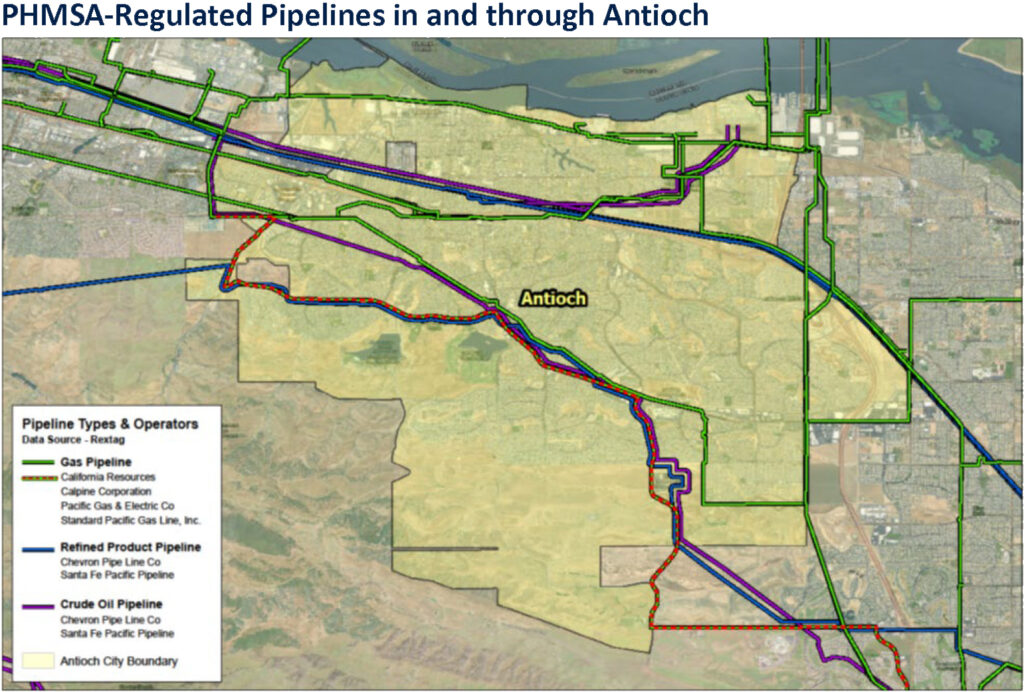
Map of the U.S. Pipeline and Hazardous Materials Safety Administration-regulated pipelines that run in and through Antioch. Source: CRPC
Will also end five-year lawsuit against City; but City staff claim company continued unauthorized use of pipeline
By Allen D. Payton
During their meeting tonight, Tuesday, July 28, 2026, the Antioch City Council will vote on the Encroachment Permit Appeal of California Resources Pipeline Company, LLC (CRPC), owner of the low-pressure, natural gas pipeline that runs under the city and has been shut off since 2021.
As previously reported, after operating for 30 years without incident, the 35-mile-long pipeline, including the 8.5-mile section through Antioch, that run from Union Island in the Delta to Pittsburg and serves the Chevron oil refinery in Richmond, the CRPC’s Franchise Agreement expired on February 7, 2021. On or about February 10, 2021, CRPC applied to renew the Franchise for an additional 10-year term that would run from February 7, 2021, until February 7, 2031. On September 28, 2021, the City Council voted 2-3 not to approve the proposed ordinance that would have granted CRPC’s requested 10-year renewal and the Franchise Agreement remained expired. Current Councilmembers Monica Wilson and Tamisha-Torres Walker were joined by then-Mayor Lamar Thorpe in voting against renewing the franchise agreement. Then Councilmembers Lori Ogorchock and Mike Barbanica voted to renew the franchise agreement.
The 12.75-inch pipeline, buried at a minimum of four feet, carried 1.8 million cubic feet of natural gas daily which is enough to supply about 9,000 homes. It’s one of many natural gas pipelines that run through the city.
In the past, the council’s renewal votes had been non-controversial, and the annual franchise fee only generated $16,871.90. Wilson led the effort in Antioch following the lead of Brentwood Councilwoman Jovita Mendoza. Their council, also on a 2-3 vote, opposed renewing that city’s franchise fee renewal in May 2021, even though only a small portion of the pipeline runs through their city.
Torres-Walker claimed, “Environmental injustices exist all around us and they impact frontline communities the most,” as a reason to oppose the franchise agreement renewal. She also called the pipeline, “dangerous” even though, “The pressures are 50% below the allowable pressures” and “The volumes are very low” a CRC representative explained.
Increased Greenhouse Gas Emissions
Also, as previously reported, shutting down the pipeline actually increased greenhouse gas emissions as 50% of gas now supplied to CRPC’s customers in Contra Costa originates in Canada as much as 3,500 miles away instead, about 80% is from fracking and some of the gas has to be transported via truck.
Tuesday Night’s Agenda Item
Under Item 6 on Tuesday night’s agenda, City staff are recommending “that the City Council affirm the City Engineer’s denial of the Encroachment Permit Application submitted by…CRPC in June 2022.”
• On or about June 29, 2022…CRPC’s predecessor-in-interest, California Resources Production Corporation, applied for an encroachment permit to maintain its existing Union Island Pipeline within the City’s public right-of-way.
• CRPC’s application included all information required by the City’s form, including necessary renderings, a surety bond, and proof of relevant liability and property insurance.
• On May 15, 2023, the City Engineer denied the application solely on the basis that two years prior the City Council had voted to deny CRPC’s franchise extension application.
• On May 22, 2023, CRPC timely appealed the City Engineer’s decision.
• Because the City Engineer did not have substantive comments or technical conditions to place on the permit application as a basis for rejection, the City Engineer had a duty to grant the permit.
• The Department of Transportation Pipeline and Hazardous Material Safety Administration (“PHMSA”) audits pipeline records, inspection programs, safety protections to prevent leaks or overpressures, operating procedures, training, and emergency response programs. The UIP inspections demonstrated:
• 2015 – No findings or violations.
• 2018 – No findings or violations.
• 2024 – No findings or violations.
• 2022: Independent consultants, Bear, INC., at the direction of the City of Brentwood, conducted a safety assessment of the pipeline. The assessment involved evaluating previous pipeline inspections and concluded: “Overall, this pipeline is well maintained, in good condition, and has had more inspections than the average pipeline, and the inspections were sufficiently thorough.”
“Without UIP, the Richmond refinery must import its natural gas, making California’s fuel supply more expensive,” the CRPC presentation concludes.
City Claims CRPC Continued Unauthorized Use of Pipeline
However, the staff report claims, “The City Engineer did not err in concluding that CRPC’s Encroachment Permit Application was in conflict with the City’s Encroachment Regulations. Specifically, as detailed in the May 15, 2023 written denial letter provided to CRPC, CRPC continued to use the Union Island Pipeline on City owned and/or controlled property without authorization after the expiration of CRPC’s Franchise with the City on February 7, 2021.
“This use continued after the City Council voted not to extend the Franchise on September 28, 2021 – and thus after the City expressly declined to re-authorize CRPC to use the City’s rights of way for the purpose of operating the Union Island Pipeline. This use also continued after the City Engineer sent a notice of termination informing CRPC that it was excluded from further use of the public highways, streets, alleys, and public places which it was previously granted permission to use under the Franchise Agreement. The City Engineer knew that CRPC’s continued use of the Union Island Pipeline was the subject of ongoing litigation between the City and CRPC wherein the City contends CRPC’s continued use of the City’s property is an unauthorized encroachment.
“As such, the City Engineer fairly concluded that denial was warranted because CRPC’s Encroachment Permit Application – submitted while CRPC was encroaching on the public right of way and did not have the City’s consent – was in conflict with the City’s Encroachment Regulations, and in particular with Antioch Municipal Code sections 7-2.204 and/or 7-2.304.”
Council Options
The current council majority can either vote to approve the appeal and renew the franchise agreement or deny the appeal, continue being sued by CRPC and keep the pipeline shuttered.
Meeting Details
Following the 6:00 p.m. Closed Session meeting, the regular meeting will begin at 7:00 p.m. inside the Council Chambers at City Hall, 200 H Street in Antioch’s historic, downtown Rivertown. It can be viewed livestream on the City’s website or the City’s YouTube channel.
Will also vote on a 3% pay raise for police officers, Street Light & Landscape Maintenance District assessments, natural gas company’s appeal to reopen pipeline and recognize 60 years of Antioch-Chichibu Sister City relationship
By Allen D. Payton
During their meeting on Tuesday night, July 28, 2026, the Antioch City Council will again discuss state funding for the Homekey+ California Supportive Housing (CSH) Mahogany Housing Project. It is expected they will vote to either accept or reject the $34.9 million grant which requires matching City funds to create 84 units of permanent supportive housing for veterans and homeless individuals in Antioch and from throughout the county.
Before the regular meeting begins at 7:00 p.m., the Council will hold a closed session at 6:00 p.m. to discuss “Initiation of Litigation”, as the agenda item is simply described.
Homekey+ CSH Mahogany Housing Project
During their meeting on June 23rd, which lasted past midnight, after receiving public comments on both sides of the issue, the Council postponed a decision on the Homekey+ funding until tomorrow night’s meeting. Then on June 29th, the Council held a study session to get their questions answered regarding the project and the funding.
According to the staff report for agenda Item 7, the Council has two options.
“Option A – Reaffirm Continued Participation and Proceed with Implementation Receive the report; acknowledge the additional due diligence conducted since the June 29, 2026, Study Session; reaffirm the City’s continued participation as a Homekey+ co applicant and the funding commitments previously approved under Resolution No. 2025/201; direct staff to continue working with the California Department of Housing and Community Development (HCD), California Supportive Housing (CSH), and project partners to negotiate and finalize the most favorable financial and operational terms reasonably available to the City, including opportunities to reduce the City’s long-term financial commitments where feasible; and proceed with execution of the Homekey+ Standard Agreement and associated project documents consistent with the authority previously granted by the City Council.”
“Option B – Rescind Prior Authorization and Withdraw from the Project Receive the report and direct staff to rescind the City’s prior authorization under Resolution No. 2025/201, notify HCD that the City will not execute the Homekey+ Standard Agreement, and withdraw the City from continued participation as a Homekey+ co-applicant.”
Background
On average, the state and city funds for the project, combined, would total $41.75 million or about $500,000 per unit over the first five years and approximately $54.4 million or $640,000 per unit over the full 15-year period.
According to the City staff report for the June 23rd meeting, “consistent with the approved Homekey+ application and prior City Council authorization, the City identified a proposed $750,000 contribution to support acquisition and rehabilitation costs associated with the project. The proposed contribution is reflected in the City’s Five-Year Consolidated Plan and Annual Action Plan. Funding for this contribution is included in the proposed FY 2026/27 Housing Successor budget.
Following Council direction at their meeting on May 22, 2025, the City applied for the Homekey+ funding. “The project application assumes ongoing operating assistance averaging approximately $1.2 million annually during the initial five-year period,” for a total of an additional $6 million. “If such funding levels were maintained over the full fifteen-year period, the total potential City contribution could be approximately $18.75 million, from the General Fund.”
“The City would receive the benefit of approximately $34.9 million in State Homekey+ funding,” awarded in May 2026, “for acquisition and rehabilitation of the project. The City would assume ongoing administrative, monitoring, and compliance responsibilities associated with participation in the program.”
“While the City was a co-applicant and recipient of the award, the City has not executed the Homekey+ Standard Agreement with HCD and has not formally accepted the grant funds. Because the…Agreement has not been executed, the City currently has no contractual obligation to participate in the project. The City would not assume the reporting, compliance, monitoring, or administrative responsibilities associated with the Homekey+ Program.” However, if the Council declines the grant funds, “the City could experience reduced competitiveness for certain future discretionary housing funding opportunities.”
Council Gets Questions Answered During June 29th Study Session
During a special study session on Monday, June 29, 2026, that lasted three-and-a-half hours, the Antioch City Council asked a variety of questions of staff regarding the proposed Homekey+ California Supportive Housing (CSH) Mahogany Housing Project at the Antioch Inn & Suites, formerly Comfort Inn.
In attendance to answer questions was Jamie Schecter, Homeless Services Chief with Contra Costa Health, Housing and Homeless Services, who oversees the County’s Continuum of Care, she mentioned two other Homekey projects, Delta Landing Interim Housing Program at the former Motel 6 in Pittsburg and another in San Pablo. She also spoke of a similar upcoming project in Richmond the County is working with. Also in attendance were Richmond City Manager Shasa Curl and her Community Development Director, Lina Velasco, who has worked on that city’s Homekey project, who provided a presentation about it.
Mayor Pro Tem and District 3 Councilman Don Freitas asked, “The City of Richmond is actually the owner of this property?”
“Yes, we will own the property,” Velasco responded. “However, during the term of the ground lease, the lessee will own the improvements. They’ll be responsible for all the maintenance and the improvements.” “The wrap-around services, are they provided from City staff of Richmond or are they contracted out?” he asked.
“They’re contracted,” Velasco stated.
“How is occupancy determined?” Freitas asked.
“We cannot be limited to Richmond residents but there is a prioritization that’s considered,” she explained. “However, we’ll serve countywide.”
Mayor Ron Bernal asked if any of the funding pays for staff time and consultants. Velasco responded, “Some of the Homekey funding has predevelopment costs. However, it’s not reimbursing, like, the time I take to write an annual report and expenditure report. So, that’s part of what we’ve been absorbing outside of a loan for the rehab. But there were some early draws for the legal fees. The developer is paying for the architectural fees, the permit fees. Those costs were included in the grant award.”
“During the 55-year term of the project, will there be any funding for staff from the Homekey,” Bernal pressed further.
City Manager Curl responded, “I would say, ‘no’ and I think it’s important for the Antioch City Council to understand, our contribution of $10.3 million is an advance from the General Fund in excess of whatever was in our Housing In Lieu fund. So, as that is replenished that will pay back the City.”
“This is the first time we’ve done something of this magnitude,” Curl continued. “So, the city council has a third-party, neutral analysis that was separate from staff. In addition, the project looked at through the construction management lens, especially the change orders, especially with inflation. So, having that third party has been extremely helpful for staff working with the building official.”
“What is your program during that 55-year period for making sure the building is properly being maintained and when there is a problem…how are they handled?” Freitas asked.
“Our plan is to do annual inspections annually,” Velasco stated. “We do within our budget have a capital reserve for issues…including turnover.”
“How do you define success over a 55-year period?” Freitas then asked.
“For me…this housing type is very important and difficult to produce,” she responded. “I think making sure the property is well-maintained also, well-operated. Hoping the tenants that come in are not losing their housing or being expelled due to lease violations…making sure supportive services include tenancy sustaining services. I think those are the big things and just making sure it doesn’t become a nuisance property for the City.”
Freitas then asked about 24-hour security costs.
“So, we are talking about that. We do have that in our budget,” Velasco explained. “We may look at that overtime based on how the property is operating and the need.”
District 2 Councilman Louie Rocha asked if the occupancy would be “100% unhoused that you will be serving?”
“Yes. When we wrote our application it was for targeting the chronically homeless,” she stated. “There is a lega definition in our regulatory agreement with HCD (California Department of Housing and Community Development).”
“Is it a similar focus with individuals, youth and veterans?” Rocha asked.
“If they fit the definition,” Velasco said. “But unlike Homekey plus, you have more target definitions.”
“With your case managers is there a ratio that you have identified?” the councilman asked.
“Currently our budget is two case managers for the property,” she responded for 48 units.
“With Mahogany, it’s 100% just for those being served,” Rocha asked his fellow councilmembers. Torres-Walker nodded in agreement.
“Without those ERF funds (State Encampment Resolution Funds) and the Homekey, I think it would have been a heavy lift for the City,” Cass stated. “So, I think between that and the CDBG funds it was really important to get all of the partners to the table. For me, the price per unit is what makes it an acceptable public policy solution…because the cost per unit is less than if we were building a new unit. That was part of the rationale and because it takes so long to get a new unit online.”
Staff Answer Council Member Questions
Council members asked staff some of the outstanding questions not answered in the staff report for the agenda item.
Regarding the hotel’s current financial condition facing foreclosure, Freitas asked, “If the property owner sells the property with those debts, how is the City made whole?”
He mentioned “$400,000 or more in delinquent taxes.”
“And the water,” said Acting City Manager Ana Cortez.
“The City of Antioch is a co-applicant – said Assistant City Attorney Kevin Kundinger
“So, we’re just paying bills,” Freitas stated.
“Yes,” Kundinger replied. “I think the decisions are made collaboratively.”
Freitas asked for the breakdown of the $34.9 million in state funds.
The project developer said, “The capital award is the purchase price $27,500,00. Other costs are about $7 million.
“Approximately $700,000 is for operation and the $1.2 million from the City,” Freitas stated.
The councilman then asked about the veterans’ units.
In response to a question by Mayor Ron Bernal, the developer said there will be no senior-designated units.
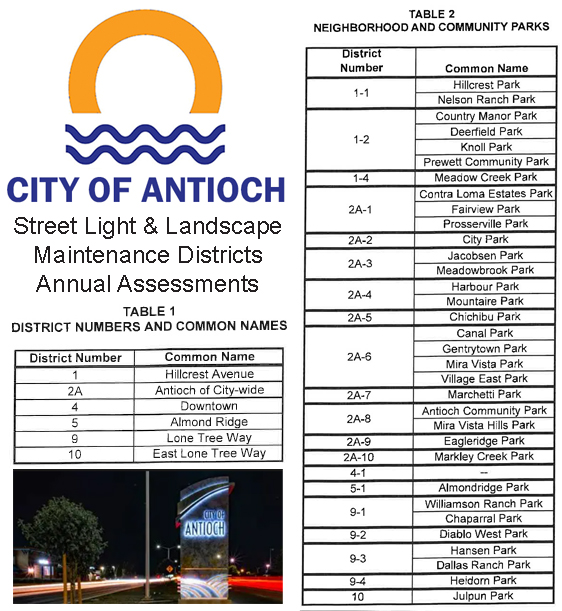
Under Item 5 on the agenda, the Council will vote on the annual assessments for six Streetlighting & Landscape Districts throughout the city. They annual rates range from $8 in District 9, Zone 3, the Lone Tree Way District to as high as $331 per year in District 2-A, Zone 10, the Black Diamond Ranch units of the Citywide District, depending on the individual parcel.
The Public Works Department’s Parks & Landscape Division maintains 34 City parks and a wide variety of landscaped areas that enhance the aesthetic of our community. This includes:
City Parks and open space areas
Medians and right-of-ways
Trails and cul-de-sacs
Coordinate and oversee the annual weed abatement project
Street lighting is maintained by the Street Maintenance Division.
3% Pay Raise for Antioch Police Officers
Under Item 8, the Council will vote on the Tentative Agreement between the City of Antioch and the Antioch Police Officers’ Association that will include a 3% Cost of Living Adjustment (COLA) for Fiscal Year 2026-27 at a cost of $661,430 and other matters. According to the City staff report, “No COLA or additional increase to uniform allowance was including in the adopted FY26/27 budget, thus requiring a budget amendment.” The previous Tentative Agreement covered the period of Sept. 1, 2021 – Aug. 31, 2025. If the council approves the agreement, a Memorandum of Understanding (MOU) will be prepared to replace the agreement and require another vote by the council.
In addition to the 3% COLA, the Tentative Agreement includes the following:
Increase to four floating holidays in a calendar year.
Travel meal reimbursement increase to $25.00 for breakfast, lunch or dinner.
Lateral Police Officer and Dispatcher new hire vacation credit of one week upon employment.
Plus, increases to the uniform allowance, adjustments to benefits, retirement and vacation, sick leave and bereavement leave language defined and/or updated, as well as updates to the department’s grievance procedure.
Following the 6:00 p.m. Closed Session meeting, the regular meeting will begin at 7:00 p.m. inside the Council Chambers at City Hall, 200 H Street in Antioch’s historic, downtown Rivertown. It can be viewed livestream on the City’s website or the City’s YouTube channel.
See separate article on the Natural Gas Pipeline Encroachment Permit Application Appeal.
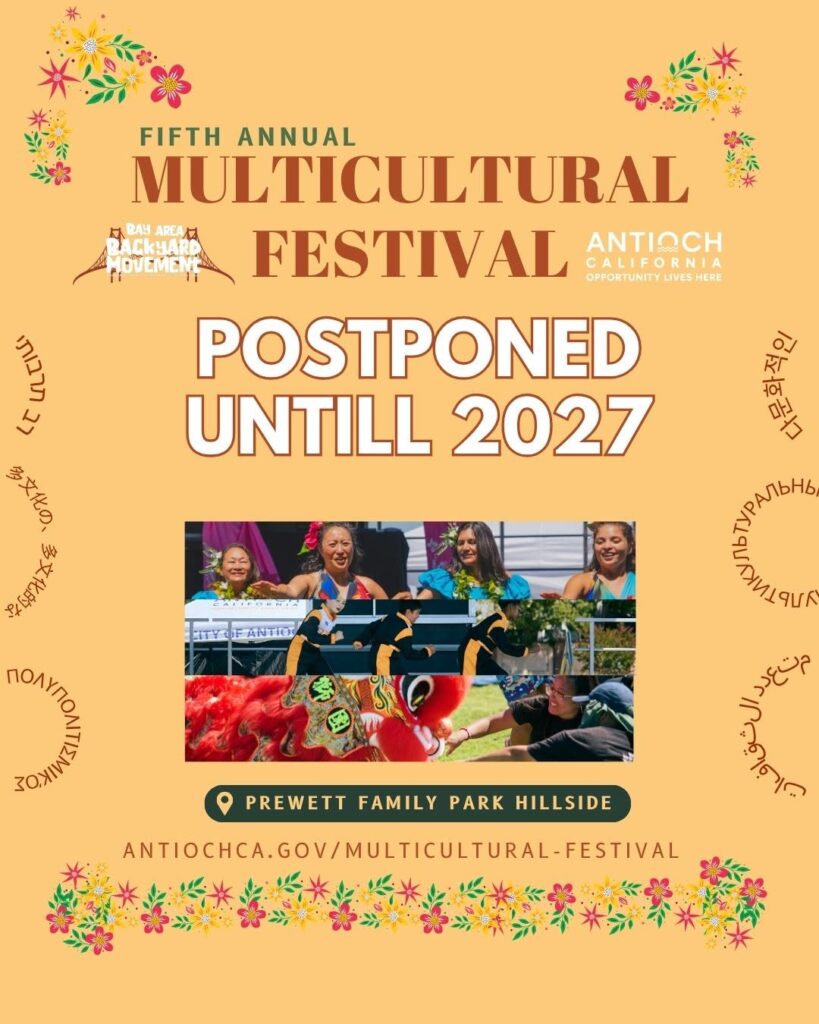
Thank you for your excitement and support for Antioch’s Fifth Annual Multicultural Festival. After careful consideration, this year’s festival has been postponed until 2027. While we’re disappointed we won’t gather this year, we’re looking forward to bringing our community an even more memorable celebration of the diverse cultures that make Antioch so special.
Thank you for your understanding and continued support. Stay tuned for future updates!