Following a Closed Session at 11:00 a.m. to discuss a potential lawsuit, on Thursday, Oct. 1st, the Antioch City Council will hold a Special Meeting at 12:00 p.m. to discuss outstanding fuel invoices, rescinding the current fuel service contract and approving a new agreement with a different provider.
Closed Session Matter: Possible Litigation
The description of the Closed Session item reads as follows: Significant exposure to litigation pursuant to Government Code Section 54956.9(e)(2): Number of potential cases: (1). The City is in receipt of information concerning facts and circumstances that might result in litigation against the City which are known to a potential plaintiff or plaintiffs pertaining to possible Labor Code Section 1102.5, and Fair Employment and Housing Act violations.
Fuel Services
During their meeting on Sept. 22nd, the Council discussed and weren’t happy with the outstanding balance for the City’s fuel services between July 1, 2026 through August 31, 2026, of $178,042.33 and the fact the contractor did not have the required insurance coverage. Staff was also requesting approval to purchase fuel on an emergency basis through December 31, 2026, in an amount not to exceed $500,000. (See 3:21:00 mark of meeting video)
However, staff explained that the company is insured, but the City wanted to be named as an additional insured on the company’s policy.
Under Item 1 on the agenda, the Council will vote on paying the balance of the outstanding fuel invoices now totaling $228,705.61 as of Sept. 24th and Under Item 2, rescinding the existing fuel services contract, approving a new one with a different supplier, and amend the Fiscal Year 2026/27 Vehicle Maintenance Internal Service Fund budget in the amount of $650,000 for fuel purchases and $650,000 in corresponding billing revenue to departments for fuel usage, through July 1, 2027.
Meeting Details
The meeting will be held in the Council Chambers at 200 H Street, in Antioch’s historic, downtown Rivertown and can be viewed in-person, via livestream on the City’s website, on Comcast cable TV channel 24, AT&T U-verse channel 99, or on the City’s YouTube channel.
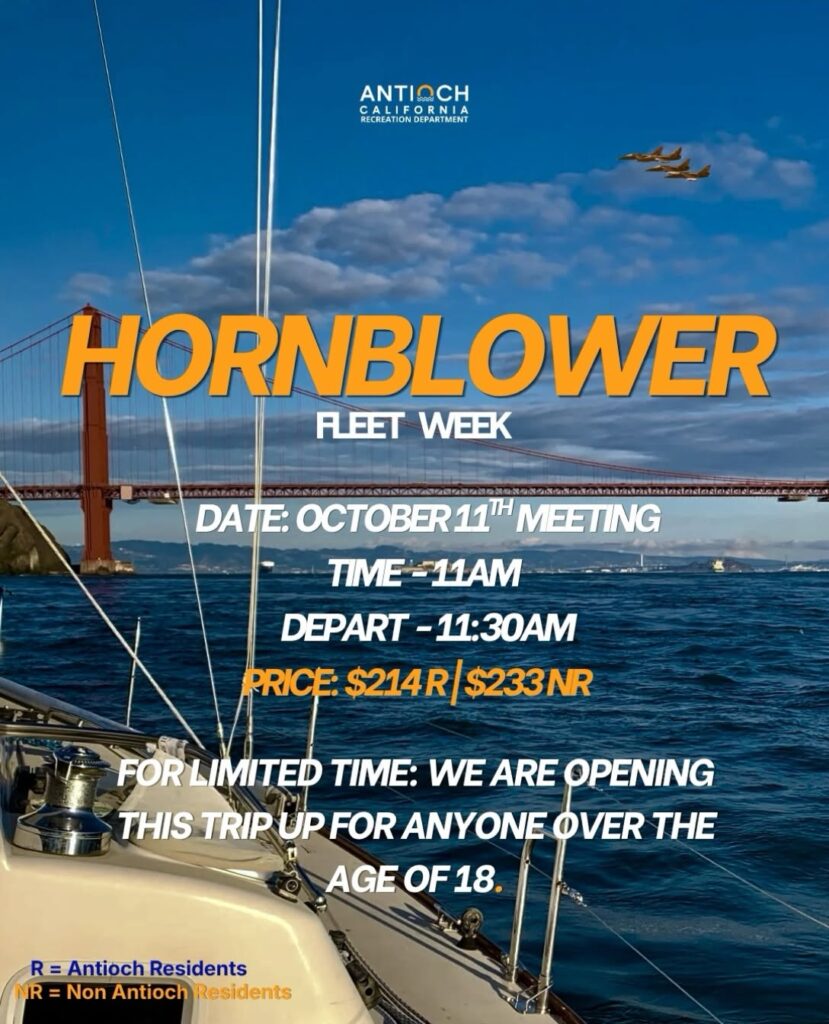
Join us aboard a Hornblower Cruise on October 11th for an unforgettable day on the San Francisco Bay! Enjoy spectacular views of the San Francisco skyline, Golden Gate Bridge, and Fleet Week festivities all from the water.
Sunday, October 11th – Meet: 11:00 am | Depart: 11:30 am $214 Resident | $233 Non-Resident Activity #14471
LIMITED TIME: Want to bring someone along? Now you can! This trip is open to anyone 18+, so grab your adult kids, grandkids, or family members and experience Fleet Week together from the water!
Accessibility: Level 2 – may include periods of standing and light walking on stairs, inclines, and uneven surfaces. Wheelchair, cane, and walker accessible.
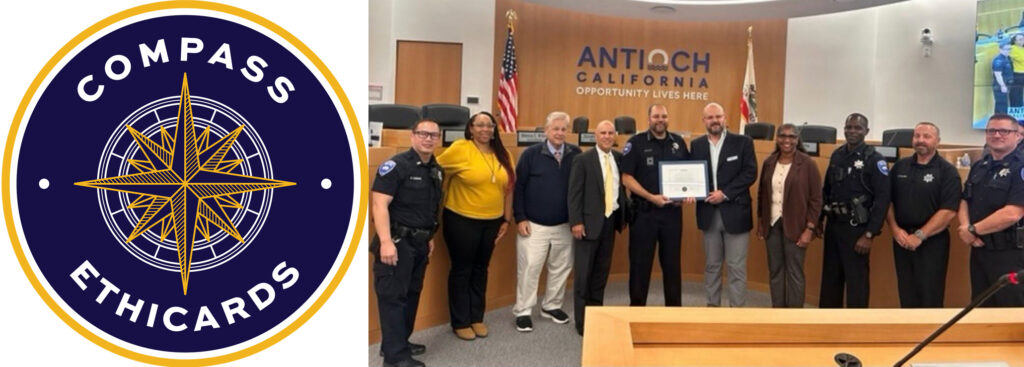
Joined by the council members, Professor Bradley Strawser, Founder and CEO of EthiCards presents Chief Vigil and leaders of the Antioch Police Department, with the “Compass Leader in Ethical Culture” certificate. Photo: Antioch PD
“Developed by military experts, proven in combat zones, adapted for law enforcement.”
“Antioch is a true leader, here, in this space.” – Founder & CEO of EthiCards
By Antioch Police Department
Integrity in policing is built through continuous practice, open dialogue and a commitment to doing what is right every single day.
On Tuesday, Sept. 22, 2026, Lt. Franco Cesar delivered a presentation to the Antioch City Council introducing EthiCards – an innovative, scenario-based ethics training program designed to engage officers across all ranks in regular, real-world ethical problem-solving. (See 1:57:00 mark of meeting video)
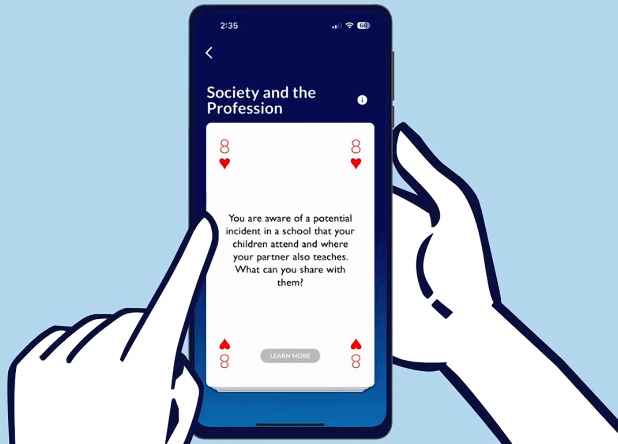
EthiCards moves beyond traditional classroom lectures, putting structured ethical dilemmas directly into daily briefings and roll calls to sharpen critical thinking, promote active bystandership, and reinforce procedural justice in the field.
Following the presentation, Founder and CEO of EthiCards, Bradley Strawser, a Professor of Military Ethics and Chair of the Defense Analysis Department at the Naval Post Graduate School in Monterey, honored Chief Vigil and the Antioch Police Department with the “Compass Leader in Ethical Culture” certificate. This award recognizes APD’s outstanding leadership in going above and beyond to prioritize ethics, accountability, and continuous professional development for our personnel.
Strawser told the City Council, “We started this program based on over a decade of research. Most ethics approaches within law enforcement just don’t do much. It’s just sort of a check the box exercise. We’re in about 150 departments across the country, right now which sounds like a lot but it’s not. There are thousands of police departments across the country. So, really Antioch is a true leader, here, in this space.”
EthiCards app example. Video screenshot source: EthiCards.
According to the Compass EthiCards website, they were “Developed by military experts, proven in combat zones, adapted for law enforcement” and “grounded in behavioral science and organizational psychology—research that reveals what actually drives ethical behavior.”
They are “52 expertly crafted cards with real-world policing scenarios, organized into 4 suits with ethical insights from our experts” and offer “Personalized features like marking cards as completed and saving favorites for each team member.” The company also offers access to “Access to the EthiCards app and website for your entire department—not just sworn officers,” and “Annual Deck Updates” with “a brand new set of 52 fresh scenarios to keep discussions current and relevant.”
The company claims the cards have “Reduced Misconduct, Improved Retention,” they “Lower Liability” and are “Proven Globally” and “The result: a healthier, ethical culture built from the inside out.”
Thank you to the City Council and our Antioch community for your continued support as we invest in proactive, high-standard training for our officers!
You agreed on the price. Have you agreed on the meetup?
Buying or selling on Facebook Marketplace, OfferUp, or another online platform? Plan the exchange before you leave home.
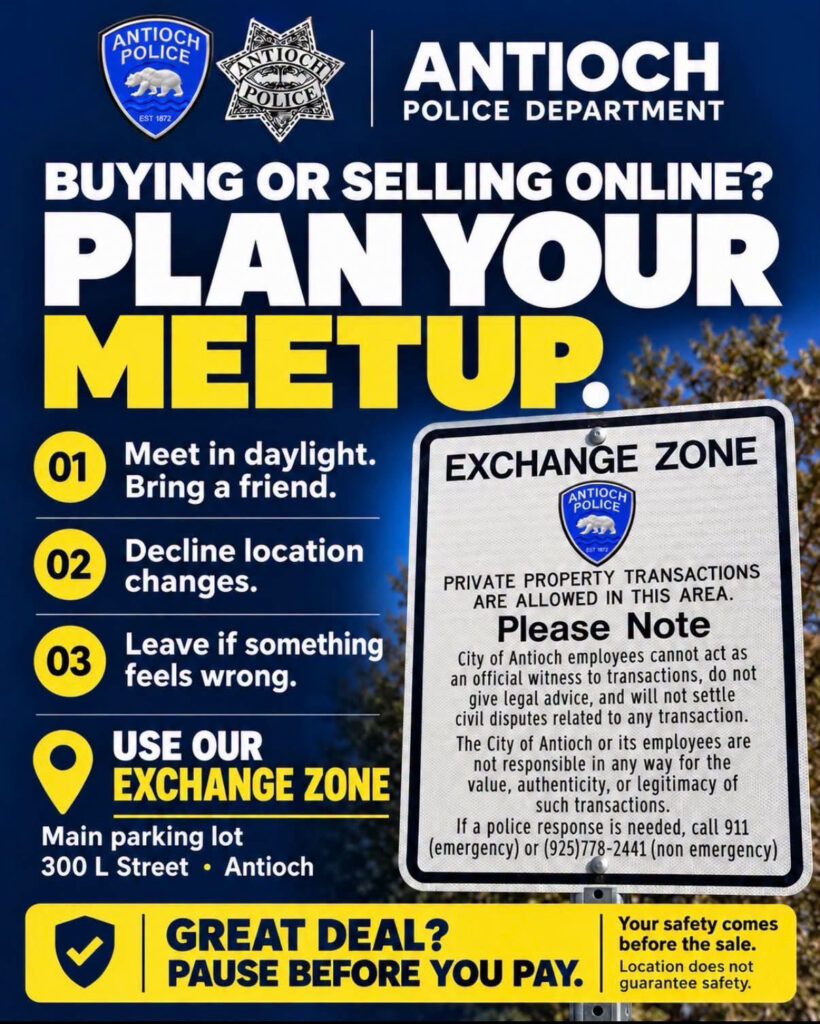
Antioch Police Department has a designated Exchange Zone in our main parking lot at 300 L Street. Look for the posted sign.
A few practical tips for BOTH buyers and sellers:
Don’t follow a last-minute location change. “Come around the corner” or “meet my friend somewhere else” changes the arrangement. You can cancel or reschedule—even if you’ve already driven there.
Buyers: Check the item, not just the box. Open the packaging, compare the model and accessories with the listing, and test it before paying. For electronics, agree on how you’ll test them before meeting.
Sellers: A payment screenshot isn’t proof. If accepting an electronic payment, open your own app to check it. Don’t rely on their screen, an email, or a link they send. Never share a verification code.
Set the terms before the trip. Agree on the price, payment method, who’s meeting, and what’s included. Meet during daylight and bring another adult when possible.
Keep a record. Save the listing, seller or buyer profile, and messages before the meetup. Keep communication in the platform.
You don’t owe anyone a completed sale. Pressure to rush, skip inspection, or change the plan is a reason to pause.
The Exchange Zone does not guarantee safety. City employees cannot serve as official witnesses, authenticate items, or settle civil disputes.
Save this for your next meetup—or send it to someone who buys and sells online.
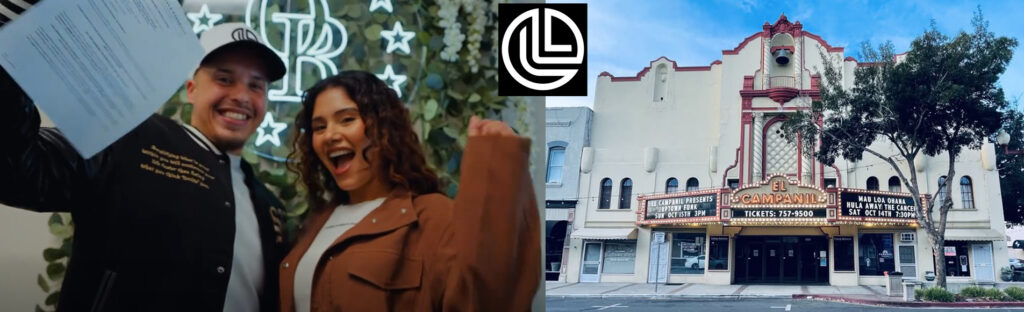
Pastor Eli and Jane Herrera celebrate the title signing for El Campanil Theatre on Tuesday, Sept. 22, 2026. Video screenshot by Legendary Movement Church (left) and photo by El Campanil Theatre (right).
Pastor calls it “historic moment” declares a “Year of Movement” for church
UPDATE 1: Says “not coming into downtown Antioch to diminish, erase, or destroy” but “add to the incredible history…” and“Church remains intentional about seeing Antioch and the Rivertown District thrive.”
UPDATE 2: Theatre foundation served with 60-day rental termination notice; “We’ll have shows thru Nov 30th it looks like!” – Foundation Board Chair Sobel Idul
By Allen D. Payton
Escrow on the sale of the 98-year-old El Campanil Theatre in Antioch’s historic downtown Rivertown closed Friday, September 25, four days earlier than originally planned for today, Sept. 29th. Legendary Movement Church is now the owner, only the fourth owner in the building’s history, including the Stamm and Beede families who built it, the El Campanil Theatre Preservation Foundation and Tung and Tiffany Bui.
But there are still performances scheduled in the theatre through December, including the next three Saturdays, and some members of the public, especially those who have already purchased tickets want to know if the show will go on.
In an email to tenants Friday afternoon, the Buis announced the close of escrow writing, “We…have been informed that the sale of the theater is complete and recorded.”
In a Facebook video post on Saturday by Eli Herrera, Lead Pastor of the church, which purchased the building, he encouraged his members to be at church on Sunday for a “Big Announcement”. Below that he also shared the Friday post on the Antioch Herald Facebook page announcing the close of escrow which reads, “Breaking: El Campanil Theatre sold! It’s been confirmed by the Herald that the sale recorded today, Friday, Sept. 25, four days earlier than originally scheduled.” Herrera wrote, “Well now that the news is out. Join us this Sunday at Legendary Movement for full statement and celebration. GOD DID IT.”
Then on Sunday, in a video posted on the church’s Instagram account and Facebook page, Herrera showed himself and his wife, Jane talking about the purchase while driving to and entering the Old Republic Title office, then meeting with the title officer and real estate broker Michael Temby, for the signing which occurred on Tuesday, September 22nd.
Eli and Jane Herrera speaking in their car on the way to the title office on Tuesday, Sept. 22, 2026. Video screenshots source: Legendary Movement Church
Herrera said, “It’s closing day, baby and I’m super excited. I don’t know about ya’ll but I’m beyond ecstatic. Because today we close, we get the key, the church gets the key, the family gets the key, the Kingdom gets the key. What God starts, no man can stop. The doors that God opens nobody can shut. God’s ‘yes’ goes beyond anything we could ever think, ask or imagine.”
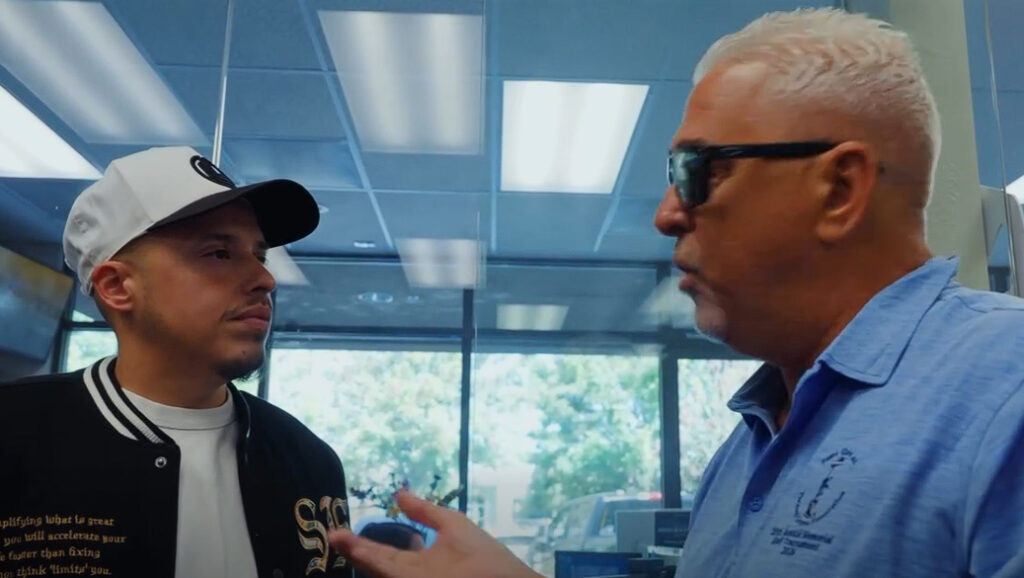
Real Estate Broker Michael Temby, who represented the church, speaks with Eli Herrera at the title office before the signing. Video screenshot.
In light of the resistance they’ve experienced from many in the community over the purchase of the theater, Temby offered some wisdom to the Herreras saying “Pilots love blue skies and tailwinds because that pushes you along and there’s no resistance. But there’s always headwinds in life and when you get the headwinds is when you grow and learn, and those create some extra character. We’ve all had some headwinds in this journey.” Eli replied, “Absolutely. It’s been a journey.”
Eli signs the purchase documents and the title office, Herreras and Temby pray together over the title docs. Video screenshots
After signing the papers, the four of them then prayed together over the transaction with their hands on the title documents and the Herreras celebrated with smiles while holding a signed document and a kiss.
Eli then thanked, “everybody who believed in the vision. Thank you to everybody who sowed a seed. Thank you to the families for all the hard work. I know this took an entire tribe to get this done.” Jane then said, “It was truly God’s super meeting our natural. We’re forever grateful for each and everyone of you who have believed and sowed into good soil.” That’s a reference to Jesus’ Parable of the Sower in the book of Matthew, chapter 13 in the Bible.
Eli concluded the video by saying, “I just want to encourage you, you ain’t seen nothing yet. God is still moving. God is still doing. Rivertown will be saved for Jesus. Love you all.”
“The harvest is ready,” Jane added.
“Historic Moment” for Church
With the post of the video the Herreras also wrote, “TODAY, WE MADE HISTORY.
Today marks a historic moment for Legendary Movement Church as we announced that we are officially the owners of the El Campanil Theatre at 602 W. 2nd Street in downtown Antioch, California.
There were mountains. There were battles. There were moments when we didn’t know how it was going to happen.
But God did.
Not man. Not our strength. Not our ability.
GOD DID THIS.
Every prayer. Every sacrifice. Every person who gave. Every person who stood in the gap. Every person who believed with us. We will never forget what it took to get here, and we will never forget WHO brought us here.
All glory belongs to Jesus.
And while today is a day to celebrate, we know this is not the finish line.
It’s the starting line.
There is work to do. People to reach. Families to restore. Generations to impact. A city to serve. A region to love. And a house to build for the glory of God.
We didn’t just acquire a building.
God entrusted us with a place where generations will encounter His presence.
Legendary, we’re home.
And we’re just getting started.
TO GOD BE ALL THE GLORY.”
————-
Efforts to reach Herrera since Friday have been unsuccessful. He was at a men’s retreat over the weekend. Herrera was asked if the performances currently planned for the theatre through December will go on, including the Nutcracker, which is a production of Black Diamond Ballet, owned by current foundation board president, Sharon Sobel Idul, and if he’s spoken to her.
Asked if she had spoken to Herrera, Sobel Idul responded on Monday, Sept. 28, “Still as of today no contact from the church or the pastor.”
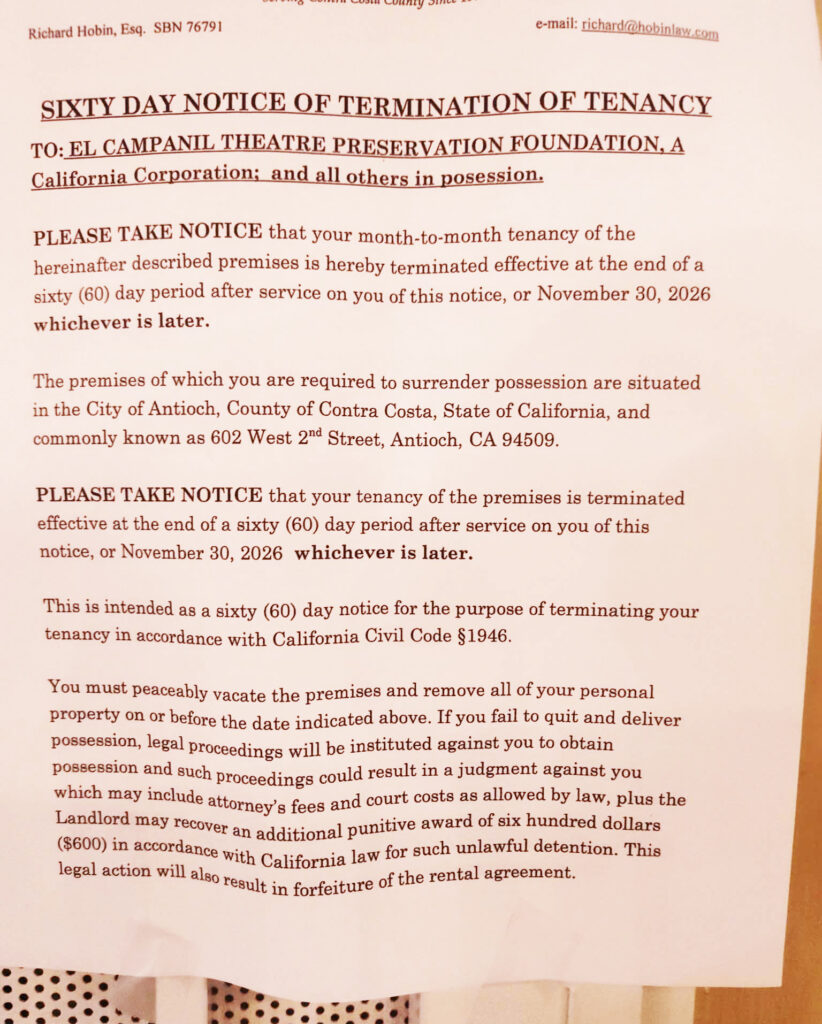
A Sixty Day Notice of Termination of Tenancy was attached to the door to the ticket office of El Campanil Theatre Wednesday morning, Sept. 30th. Photo courtesy of Sharon Sobel Idul
UPDATE 2: Theatre Foundation Served with 60-Day Rental Termination Notice
The theatre foundation was served with a Sixty Day Notice to Terminate Tenancy on Wednesday, Sept. 29. Sobel Idul said, “It was taped to our door this morning.” California requires a 60-day notice to terminate tenancy for commercial buildings. So, the shows scheduled in October will go one.
Asked if she had spoken with the pastor, yet regarding possible other performances such as the Nutcracker in December, Sobel Idul responded, “Haven’t been by the theatre yet, but a community member posted this and his attorney called and confirmed that it was processed. Still no communication from the church. We’ll have shows thru Nov 30th it looks like!”
UPDATE 1: Pastor Tells Downtown Association Not Coming “to Diminish, Erase or Destroy” But “Add to the Incredible History”
However, during the monthly meeting of the Downtown Antioch Association Tuesday evening, Sept 29th, organization leader Debbie Blaisure received a message from Herrera which he asked her to read as he was unable to attend as planned, she shared.
He wrote, “To everyone gathered tonight, I know many of you are aware of Legendary Movement Church’s recent purchase of the El Campanil Theatre. I also understand that there may be different opinions and perspectives surrounding the purchase, and I respect that.
“What I want everyone to know is that my heart and our heart as a church remains intentional about seeing Antioch and the Rivertown District thrive.
“My family, our congregation, and I are not coming into downtown Antioch to diminish, erase, or destroy its history. We are simply believing that we can help add to the incredible history that has already been written here.
“You can count on Legendary Movement Church to have conversations, listen, participate, support community events, build relationships, and do our part to strengthen unity throughout our city. We want to be known as people who bring love, grace, compassion and a genuine desire to serve.
“As we enter the final quarter of this year and approach the holiday season, my prayer is that we can move forward together with peace, unity, and joy. We may not always agree on everything, but I believe we can still work together toward something we all share: a desire to see Antioch and Rivertown thrive and become everything we know they can be.
“God bless you all, and I look forward to the conversations and opportunities ahead.
“Pastor Eli Herrera Legendary Movement Church”
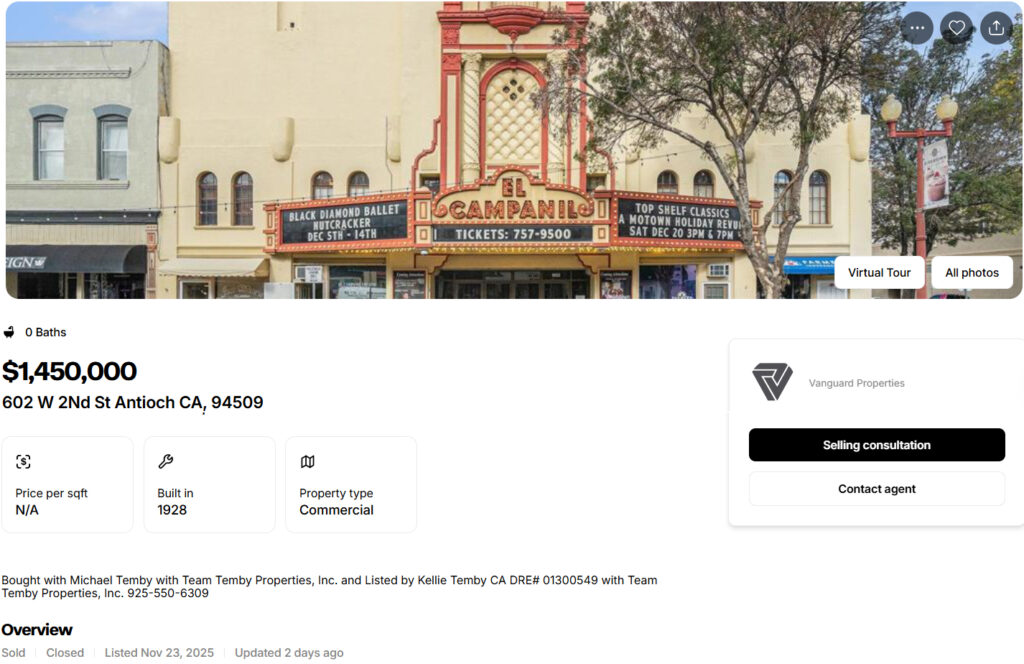
Screenshots of the listing for the theater building on the Vanguard Properties website on Monday, Sept. 28, 2026.
Real Estate Broker, Former Owner Won’t Say Why They Stopped Speaking With City
The listing on Vanguard.com shows the building was listed for sale on November 23, 2025, and remained on the market for 257 days. The description reads, “Prime opportunity to acquire a landmark property in the heart of Antioch’s revitalizing Rivertown Business District. Originally constructed in 1928 and restored beginning in 2003, El Campanil Theatre offers a unique blend of historic character and proven performance as a community arts venue. The property benefits from exceptional visibility along the Antioch waterfront, steady public traffic, and a long-standing reputation as a regional cultural destination. With a history of hosting over 100 annual events, performances, and rehearsals, the theatre provides immediate operational potential for continued arts programming, live entertainment, film screenings, special events, and private rentals. Its Spanish-style architecture, established community recognition, and central downtown location make it a standout asset for investors seeking a versatile, income-producing property with long-term upside. Surrounded by ongoing downtown development and the broader Rivertown Renaissance vision, El Campanil presents a strategic opportunity for investors, nonprofits, or developers looking to anchor growth in a high-exposure corridor. Ideal for continued performing arts use or adaptive reuse concepts such as mixed cultural venues, event operations, entertainment ventures, or community partner.”
As previously reported, Tung Bui said Michael Temby was his agent. However, it was later learned by the Herald, in a purchased Property Report, that Temby, a real estate broker, represented the church and his wife, Kellie, both of Discovery Bay-based Team Temby Properties, was the listing agent representing the Buis. That information is also available on real estate websites showing the listing of the theater building, including realty.com and Vanguard Properties which, as of Monday, September 28th, the sale price showed $1.45 million, $50,000 less than the $1.5 million asking price. As previously reported, the Buis bought the building from the foundation in May 2023 for $800,000.
As previously reported, Antioch District 1 City Councilwoman Tamisha Torres-Walker said she, Mayor Pro Tem Don Freitas, Acting City Manager Ana Cortez and Sobel Idul had been in discussions with Bui and Temby about the City possibly buying the building but was “blindsided” to see the video by Herrera posted on the church’s Instagram account about needing to raise the downpayment. Freitas later said he hadn’t spoken with either Tung Bui or the Tembys.
On Monday, Sept. 21st, Michael Temby and Tung Bui were sent a link to the article and asked if they were speaking with representatives of the City before accepting the church’s offer and, if so, why did the discussions stop. Temby was also asked if it was because he and Kellie were representing both parties. Neither responded. Previously, Temby said he would be, “Happy to answer any questions after escrow closes.”
But efforts to reach him following the sale with those and additional questions were unsuccessful prior to publication time.
Herrera Declares a “Year of Movement” for Church
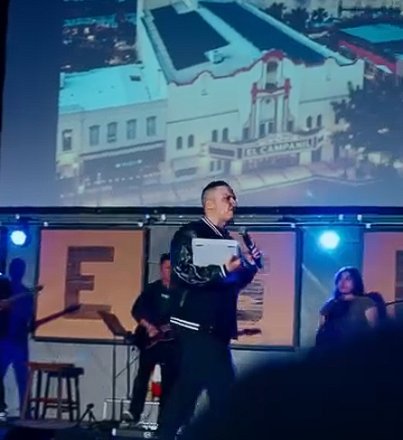
Pastor Eli Herrera preaches during the Legendary Movement Church service at their current location in Pittsburg on Sunday, Sept. 27, 2026, with an aerial photo of El Campanil Theatre on the screen behind him. Video screenshot of Facebook post.
In a video posted on the church’s Facebook page on Tuesday, of his sermon this past Sunday, Herrera spoke about the church’s new ownership of the building while preaching from the book of 1st Samuel chapter 7 about King David, with an aerial photo of the theater on the wall behind him, “The Bible says they took territory they took everything. He’s sitting there in a big house, in a big mansion. Sitting in the big building in the middle of a great city…his mind does not think of the possession, his mind thinks of the presence of God. I make you this vow as your pastor, I will never fall more in love with a building than the presence of God. The presence of God is everything. We won’t go if the presence of God does not come with us. His presence delivers us. His presence heals us. His presence brings salvation. His presence brings revival.”
Above the video he wrote, “YEAR OF MOVEMENT
“We don’t just want the promise. We want His presence. We don’t just want the territory. We want Jesus. We don’t just want a building. We want revival. Jesus is everything. Antioch doesn’t just need another church. Antioch needs an encounter with Jesus. LORD, IF YOUR PRESENCE DOESN’T GO WITH US, WE DON’T WANT TO GO. Revival is here in Antioch, California. And it will be all for His glory. #revivalinthecity#revival#legendarymvmnt#legendary#antiochca”
In the post directly below that, Herrera wrote, “His presence means everything to us. More than the building. More than the moment. More than the growth. If we have everything but His presence, we have nothing. Jesus, You are the reason for it all.”
Community invited to anniversary celebration and ribbon cutting October 3
By Martha Goralka, Executive Director
ANTIOCH, Calif. — Delta Learning Center invites the community to celebrate its 50th anniversary on Saturday, October 3, 2026, from 10 a.m. to 2 p.m. in Antioch. A ribbon cutting ceremony will take place at 10:30 a.m.
Established in 1976, Delta Learning Center has provided five decades of educational support to learners in East Contra Costa County. The nonprofit offers personalized, one-on-one tutoring by credentialed teachers, helping students strengthen academic skills and build confidence. The anniversary celebration will recognize the students, families, educators, volunteers and community supporters who have contributed to the center’s history while looking ahead to its continued service.
Current and former students, families, neighbors, local businesses and community partners are invited to attend and help celebrate this milestone. Members of the media are welcome to cover the celebration and ribbon cutting.
About Delta Learning Center Founded in 1976, Delta Learning Center is a nonprofit tutoring organization serving East Contra Costa County. The center provides individualized educational support for prekindergarten, K–12 and adult learners. For more information, visit http://www.deltalearningcenter.org or call 925-757-1310
World’s largest bounce house with over 50,000 square feet of fun offers action-packed, all-ages experience featuring live DJs, food trucks, gift shops & more — tickets on sale now!
By Greg Wiley, Public Relations Manager, The Big Bounce America
Contra Costa, CA (September 21, 2026) –The Big Bounce America, home to the world’s largest bounce house, extending its high-energy experience in the Bay Area for two weekends, October 17-18 and Oct 24-25. Featuring more than 50,000 square feet of inflatable attractions, the event transforms the Contra Costa Fair and Event Park into a fully immersive playground filled with live music, laughter, and unforgettable fun for ALL!
Designed for all ages, The Big Bounce America features dedicated sessions for younger children, bigger kids, and adults — so everyone can JUMP IN and join the fun.
“This isn’t just an event, it’s a full-blown, larger-than-life experience,” saidDavid Taube, Tour Director of The Big Bounce America. “We’re talking about the biggest bounce house on the planet, live DJs, a 900-foot-long obstacle course, and nonstop energy from the moment you walk in. We’re bringing a festival-level atmosphere where kids, parents, teens, and adults can jump, dance, and lose themselves in the fun. It’s truly an unforgettable experience for everyone.”
The event features seven massive inflatable attractions, including:
The World’s Largest Bounce House
Covering over 24,000 square feet and standing 32 feet tall, this record-breaking inflatable is a full-blown party zone. Inside, guests will find giant slides, ball pits, climbing towers, basketball hoops, and colorful interactive elements. A live DJ keeps the energy high with music, games, and competitions tailored to each age group—turning every session into a dance party in the sky.
The Giant
At over 900 feet long, this epic obstacle course is built for thrill-seekers of all skill levels. With more than 50 challenges and a massive finale slide, it’s perfect for friendly competition—or just bouncing your way through a wildly fun adventure.
Sport Slam
Get ready to bring your A-game! Sport Slam is a high-energy, action-packed arena where bouncing meets friendly competition. Packed with hoops, goals, climbing challenges, and fast-paced games, this inflatable playground lets you dunk, kick, race, and battle your way to bragging rights. Challenge your friends, take on your family, or jump into the chaos with new competitors—every corner is built for non-stop movement and big-time fun. Whether you’re channeling your inner all-star or just looking to let loose, Sport Slam keeps the adrenaline pumping from start to finish.
airSPACE
Step into an immersive, space-themed world filled with aliens, moon craters, and intergalactic fun. Featuring a towering inflatable alien, multi-lane slides, and endless ball pits, airSPACE delivers an out-of-this-world experience for explorers of all ages.
Other on-site Activities
Additional on-site attractions include food trucks, shaded rest areas, and family-friendly entertainment. Guests can bring their own food and drinks or purchase from on-site vendors.
Note: Attractions subject to change.
TICKETS: All-Access tickets are available now and include a three-hour pass to the event, featuring a timed session in The World’s Largest Bounce House plus unlimited access to all other attractions. Advanced purchase is strongly encouraged, as sessions frequently sell out. Tickets start at $35. Buy tickets at https://TheBigBounceAmerica.com/Tour-Dates/.
LOCATION: Contra Costa Fair and Event Park (1201 W 10th St, Antioch, CA 94509)
DAYS/TIMES: Saturday, October 17th: 9a-9p; Sunday, October 18th: 9a-6p; Saturday, October 24 9a-9p; Sunday, October 25 9a-6p.
The Big Bounce America is the world’s largest traveling bounce house experience, welcoming thousands of guests in countries around the world since 2007. Learn more at www.thebigbounceamerica.com.
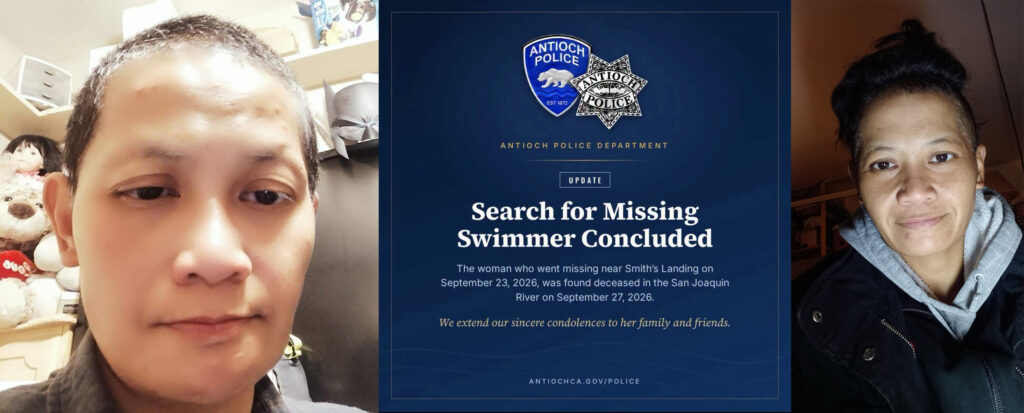
The body of missing Antioch swimmer Edgielyn Torrente, seen in photos on her Facebook pages on Feb. 27, 2023, and Nov. 9, 2022, has been located.
46-year-old Edgielyn Torrente located Sunday morning about one mile west of where she went missing on September 23rd; family notified
By Lt. Michael Mellone, Antioch Police Field Services Bureau
ANTIOCH, Calif. – Edgielyn “Lynn” Torrente, 46, who went missing while swimming near Smith’s Landing Seafood Grill in Antioch on September 23, 2026, was found deceased in the San Joaquin River on Sunday, September 27, 2026.
Her family has been notified, and this update was held until that notification was complete.
The Antioch Police Department extends its sincere condolences to her family and friends.
RECOVERY
At about 7:06 a.m. on September 27, 2026, officers responded to multiple calls reporting a person in the water west of Smith’s Landing. She was located about one mile farther west. The Contra Costa County Sheriff’s Office Marine Patrol and the Pittsburg Police Department recovered her from the water. The Sheriff’s Office Coroner’s Division responded and took custody.
The Coroner’s Division will determine the cause and manner of death. No foul play is suspected.
BACKGROUND
As previously reported, on Wednesday, September 23, 2026, at 6:12 p.m., officers responded to reports of two women in distress in the water behind Smith’s Landing Seafood Grill. The women had been swimming when a strong current pulled them from shore. Officer Molina reached one of the women, Farrah Moore, on a personal watercraft and brought her to safety.
According to his mother, Judy Dossey, “The private citizen on scene who was operating the jet ski is Jeff Lewis, an Antioch resident. Mr. Lewis also assisted in the rescue of the swimmer in distress.”
Antioch resident Jeff Lewis assists Officer Molina on a jet ski. Video screenshots source: Antioch PD
The U.S. Coast Guard, the Contra Costa County Fire Protection District, and the Sheriff’s Office Air Support Unit joined APD in water and aerial searches for Torrente.
Lt. Cesar Franco said it was his understanding the two women were homeless. According to a post on the Homelessness in Antioch & Community Connection Facebook page, local homeless advocate, Nichole Gardner, wrote on the day she was rescued, “Farrah is out of the hospital and is back downtown.” She also shared that Torrente went by “Lynn”.
The Antioch Police Department thanks each of these agencies, the Pittsburg Police Department, and the community members who called 911. CASE NO. 26-9135