By Dan Radovich, ADA Coordinator & Communications Manager, Contra Costa County Superior Court
The Contra Costa County Superior Court has released its Strategic Plan for 2027–2029. This three-year roadmap focuses on improving access to justice, developing and retaining a skilled workforce, expanding community outreach and partnerships, maintaining secure court facilities and information systems, and streamlining operations through technology and data.
The plan is built on key input gathered earlier this year from Contra Costa County residents and court users through a public survey, as well as from County partners, justice partners, and members of the bench and court staff.
The plan includes five Strategic Priorities with three goals for each:
Accessible Justice
Workforce Excellence
Trusted Courts
Safe & Secure Courts and
Operational Excellence & Innovation
The Court thanks everyone who took the time to contribute their perspectives and ideas, especially the residents and court users who completed the survey. This feedback was essential to shaping the plan’s priorities and goals.
The Antioch Historical Society is seeking passionate community leaders to join our Board of Directors in 2027.
After 50 years, the Antioch Historical Museum is embarking on an exciting journey of transformation, reimagining how we preserve, share, and celebrate our community’s rich history for future generations. This is a unique opportunity to help guide that vision and ensure that Antioch is preserving its history, including historic buildings.
We are especially interested in individuals with experience in:
• Nonprofit organizations
• Finance and accounting
• Business or organizational leadership
• Fundraising and grant writing.
Serving on the Board is both meaningful and rewarding. You’ll work alongside dedicated volunteers who are passionate about preserving our heritage while helping build a vibrant and sustainable future for the museum.
If you’re ready to contribute your skills, leadership, and enthusiasm to an organization making a difference in our community, we’d love to hear from you.
Please contact us no later than Oct. 25 at 5 p.m. Send email to: carlamarymee@gmail.com if you’re interested.
Join us as we write the next chapter of Antioch’s story.
The Antioch Police Department is asking for the public’s help finding Stephen Simmons, a 33-year-old Antioch man who has a developmental disability and cannot care for himself. Simmons is described as a Black male, 5 feet 6 inches tall, weighing 110 pounds. He was last seen wearing a zip-up jacket and pants.
Simmons was last seen leaving his home in Antioch with a family member on Wednesday, October 14, 2026, at approximately 8:20 p.m. The family member was later located safe in Antioch. The car they were believed to be traveling in was found unoccupied early Friday morning, October 16, on Brannan Street near 7th Street in San Francisco.
Simmons’s current location is unknown. He could be in Antioch, San Francisco, or anywhere in between. The Antioch Police Department is working with the San Francisco Police Department on the search.
Simmons is very soft-spoken and has limited speech. He may not respond to his name or be able to ask for help. Anyone who sees him should approach calmly, stay with him if it is safe to do so, and call 911 right away.
Anyone with information about where Simmons may be, or who saw him at any time since Wednesday night, is asked to contact the Antioch Police Department at (925) 778-2441 and reference case number 26-9954.
Description: • Black male, 33 years old • 5’6″, about 110 lbs, very thin build • Last seen wearing a zip-up jacket and pants
If you have seen Stephen anywhere since Wednesday night, please contact us. Call 911 if you see him. Information: Antioch PD (925) 778-2441 Case #26-9954
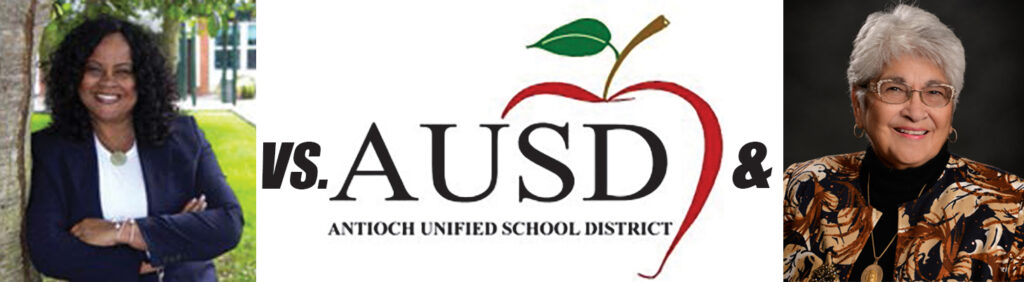
AUSD Superintendent Dr. Darnise Williams is suing the District and Area 5 Trustee Mary Rocha. Photos: AUSD
Dr. Darnise Williams, in her 4th job in the past 6 years, claims a “campaign to remove” her for refusing “to overlook questionable payments” and because she “disclosed fiscal and legal noncompliance to officials empowered to correct it,” plus, “she made an internal complaint concerning discriminatory, biased, harassing, and retaliatory treatment by Board leadership, including conduct directed at her as a Black woman” and makesmultiple accusations against Rocha – the only Trustee to vote against hiring her
“I was the only one who didn’t vote to hire her. But on top of it, it takes three votes to get rid of her and she only targets me. Interesting, huh?” – Trustee Mary Rocha
By Allen D. Payton
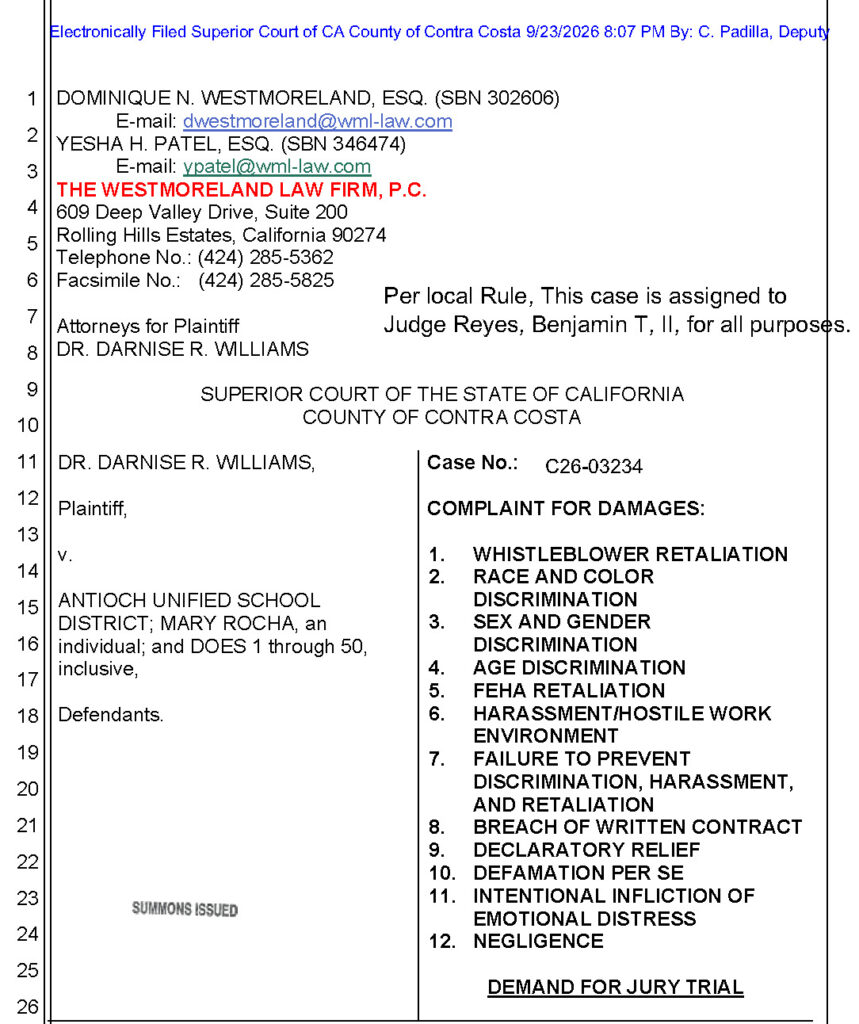
Embattled Antioch Unified School District Superintendent Dr. Darnise Williams has responded to being placed on paid leave by suing the District, Area 5 Trustee Mary Rocha and unnamed “DOES 1-50” claiming a list of 12 “Damages” including whistleblower retaliation, discrimination, harassment and more. She is seeking a jury trial.
Specifically, the lawsuit, filed in Contra Costa Superior Court on Sept. 23rd, claims race and color discrimination, sex and gender discrimination, age discrimination, plus, Fair Employment and Housing Act (FEHA) retaliation, harassment/hostile work environment, failure to prevent discrimination, harassment and retaliation, breach of written contract, declaratory relief, defamation per se, intentional infliction of emotional distress, and negligence. According to findlaw.com, “Defamation per se means that a false statement was so inherently harmful that further proof of harm isn’t necessary. The statement would have been likely to cause reputational damage regardless of the context.”
Williams doesn’t want punitive damages against the District, just against Rocha.
Background
On a 4-1 vote, with Board President and Area 2 Trustee Dr. Jag Lathan the only school board member to vote “no”, Williams was placed on paid administrative leave on Aug. 25, 2026, after less than 14 months in the job. Williams was hired during the June 11, 2025 School Board meeting on a 3-1 vote with Rocha the lone dissenter and Area 4 Trustee Olga Cobos-Smith absent. This is Williams’ fourth position in the past six years, her starting annual base salary was $353,045, plus contractual benefits, according to the lawsuit, and she was paid $357,234 last school year. (See related article)
The Board agendized the performance evaluation of Williams for that meeting and during three previous meetings, as well.
At their Special Meeting on May 27, which was not live-streamed, the report out reads, “There was no reportable action taken during closed session.”
Then during the August 5 Special Board Meeting, which was also not live-streamed, the report out of Closed Session reads, “The Board took action by unanimous vote of all trustees present to assign Trustee Cobos-Smith with the duty of compiling the Board’s evaluation of the superintendent consistent with Board Policy 2140.”
Finally, during their Regular Meeting on August 19th, the Board again agendized the performance evaluation of the superintendent. But Lathan did not report out from Closed Session any action on the matter.
Cobos Smith was asked ifthe performance evaluation was ever provided to Dr. Williams.
“The evaluation was complete and submitted to her,” she stated in response.
The school board held a special meeting on Oct. 7th during which they met in Closed Session to discuss the lawsuit. Under item A. described as, “CONFERENCE WITH LEGAL COUNSEL—Existing Litigation (Paragraph (1) of subdivision (d) of Section 54956.9) Name of Case: Dr. Darnise R. Williams v. Antioch Unified School District, et al., Contra Costa County Superior Court, Case No. C26-03234.”
Since there was no video of the meeting and the minutes are not yet available on the District’s website, asked about the results from that Closed Session, Cobos Smith stated, “There was no reportable action and Dr. Lathan did not attend. The attorney just shared the complaint with us so that we would know about it through official channels before it went public.”
Yet Williams claims in her lawsuit that the Board did not conduct the oral and written annual performance review required by her employment agreement. But later in her lawsuit she claims to have received an “unsatisfactory assessment,” but reiterated that the Board “did not provide the contractually required oral evaluation.”
Cover page of Dr. Williams’ lawsuit against AUSD, Mary Rocha, et al.
Lawsuit Details
In the 30-page complaint, Williams shares the fact that she “is a Black and African-American woman over the age of forty…and therefore belongs to protected race and color classes.” The lawsuit also claims, “She was…qualified for and capable of performing the Superintendent position and performed that work successfully.”
The lawsuit explains Williams “timely presented a written claim to the District as required by the Government Claims Act. The District did not act within the statutory period, and the claim was deemed rejected.”
To support Williams’ claims of damages, the lawsuit provides general accusations and details against both the District, i.e. the Board of Trustees and staff, and specifically, against Rocha.
She claims, “Rocha…personally participated in the harassment alleged” and “Each DOE Defendant participated in, authorized, ratified, aided, or failed to prevent the unlawful conduct alleged here.”
The Introduction reads, “1. This action arises from a public school district’s campaign to remove its first-year Superintendent after she insisted that public funds, employee compensation, fiscal controls, and Board governance comply with law. Plaintiff was hired to lead and stabilize the District. She did that work. When she refused to overlook questionable payments and disclosed fiscal and legal noncompliance to officials empowered to correct it, influential trustees turned the scrutiny onto her.
“2. The retaliation followed a recognizable sequence: race- and gender-charged remarks; escalating personal hostility; dissemination of accusations that an outside investigation did not substantiate; manipulation of the contractual evaluation process; a manufactured unsatisfactory assessment untethered to the agreed performance goals; and, ultimately, removal from active duty on paid administrative leave while the District moved immediately toward interim leadership.
“3. The paid leave is nevertheless materially adverse: it stripped her of the duties and authority of Superintendent, impaired her reputation and future employability, denied contractual evaluation and compensation rights, and positioned the District to end her employment.
“4. The District did not conduct the oral and written annual performance review required by Plaintiff’s written employment agreement. After Plaintiff invoked the contract’s notice-and-cure procedure, the District still failed to complete the agreed review. Under the contract, her evaluation therefore became satisfactory and the applicable salary-step increase was due retroactively. The District instead issued a procedurally defective document built on generalized and stereotyped criticisms.
“5. Plaintiff seeks…no punitive damages against the District…only against Rocha based on malice, oppression, or fraud shown at trial.”
Specific Claims – Discovered Illegal Payments to Trustees,
Williams’ lawsuit offers details about multiple matters and claims the following:
First, regarding her claim of whistleblower status, under section B. Protected Disclosures and Opposition the superintendent alleges she “discovered cash-in-lieu health-benefit payments to trustees, including Rocha, that Plaintiff reasonably believed were unauthorized or otherwise inconsistent with governing law and lawful use of public funds…stopped or corrected the…payments…disclosed the issue to persons with authority to investigate, discover, or correct the noncompliance…sought legal guidance and refused to approve or perpetuate payments she reasonably believed unlawful.” Williams “also disclosed other fiscal and governance concerns, including unauthorized compensation or salary placements, failures of internal control, and conduct she reasonably believed implicated open-meeting, labor, or public-fund requirements…to District officials, Board members, counsel, auditors, fiscal professionals, and other persons or public bodies with authority over” her “or authority to investigate and correct the reported violations.”
Her complaint claims, “The District, Rocha, and other decisionmakers knew of Plaintiff’s disclosures and protected opposition before taking the adverse actions.”
Williams’ lawsuit also shares that, “She made an internal complaint concerning discriminatory, biased, harassing, and retaliatory treatment by Board leadership, including conduct directed at her as a Black woman.”
Claims Rocha Wanted a Latino Superintendent, Plus, Racial, Gender and Age Discrimination by District
Under section C. Defendants Violated Plaintiff’s Civil Rights, the lawsuit continues, “Rocha told Plaintiff (Williams) in substance that Plaintiff had not been Rocha’s preferred choice because Rocha wanted a Latino Superintendent. Rocha also invoked the prior Black Superintendent having been run out of the District. These remarks directly revealed race and ethnicity as considerations in Rocha’s view of District leadership.”
Williams also claims to have “challenged payments benefiting Rocha” and “Rocha and aligned decisionmakers repeatedly cast” the superintendent “through racialized stereotypes: angry, aggressive, threatening, bullying, incoherent, and unprofessional.” But Williams claims, “Those labels were not supported by specific contemporaneous facts and were inconsistent with witness accounts and investigative findings.”
She also claims that treatment was unfair and inconsistent as “the District treated white administrators and executives more favorably in evaluations, discipline, succession decisions, workplace complaints, and access to a fair process. White counterparts who exercised forceful leadership, enforced fiscal controls, rejected improper demands, or encountered complaints were not subjected to the same racialized labels, irregular procedures, removal of duties, or accelerated replacement activity. The comparative records are within Defendants’ possession and control.” However, only the superintendent is hired directly by the school board, while all other top district leaders are hired by the superintendent.
Williams’ complaint also claims, “race and color were substantial motivating reasons for those actions, as shown by direct race-based remarks, racialized stereotypes, materially less favorable treatment than similarly situated white counterparts, disparate handling of complaints, failure to follow objective procedures, and the participation of biased decisionmakers” and she was subjected as “a Black woman in the District’s highest executive position, to gendered and intersectional stereotypes” and that she was treated differently than “similarly situated male leaders” and that her “sex and gender were substantial motivating reasons for the altered evaluation, denial of compensation rights, removal of duties, paid leave, and succession activity, independently and in combination with race and color.”
Finally, Williams claims she “was over forty and qualified for the Superintendent position” and that “decisionmakers favored materially younger candidates for interim or permanent leadership, evaluated younger leaders more favorably, and considered Plaintiff’s age when accelerating succession planning” and claims further that her “age was a substantial motivating reason for the altered evaluation, denial of compensation rights, removal of duties, paid leave, and succession activity.”
Yet, after placing Williams on leave, the Board hired a retired superintendent, Jose Banda, who began his education career in 1984, as the District’s interim superintendent which would place his age to be in the mid-60’s.
Alleged Physical Incident with Rocha
Under section D. Manufactured Complaints and a Predetermined Evaluation, Williams claims an alleged physical incident with Rocha was “a brief interaction” in which she “did not yell at, threaten, touch, hit, block, or accost Rocha, and did not shake a phone in her face. Contemporaneous witnesses reported that Plaintiff was not angry and did nothing improper.” Further, the superintendent claims, “Rocha initially indicated that Plaintiff’s phone was not in her face and that she was fine. She later filed a formal complaint portraying the exchange as angry, aggressive, threatening, and physical.”
Williams’ lawsuit also claims that Rocha “later falsely stated as an asserted fact that Plaintiff hit or physically assaulted her” and “knew the accusation was false because no such contact occurred” with which Rocha disagrees (see below), and that, “Rocha advanced the accusation at a critical point in Plaintiff’s evaluation cycle, circulated it within the Board, and used it to advocate for Plaintiff’s removal.”
The superintendent’s complaint further explains, “An outside investigation did not sustain the principal accusation against Plaintiff,” with which Rocha agrees (see below). But Williams states, “The District nevertheless continued to rely on the accusation’s stigmatizing themes and allowed Rocha to participate in decisions affecting Plaintiff.”
Unfair, Incomplete Evaluation, Changed Process, Not Neutral or Done in Good-Faith
In that same section, Williams claims, “Before a fair evaluation was completed, Board members and agents changed the agreed process, marginalized the agreed goals, and relied on generalized complaints that staff felt bullied, that Plaintiff’s communications lacked clarity, that accountability was absent, and that social-media complaints had increased.” Further the superintendent claims the Board, “did not fairly apply the agreed instrument to the mutually established goals, and did not identify concrete facts sufficient to permit meaningful response,” and that “The assessment was signed or supported by persons who had participated in accusations against Plaintiff or had conflicts affecting their neutrality. Other trustees did not sign it. The process was irreconcilable with a neutral, good-faith evaluation.”
Finally in that section, Williams alleges, she “timely submitted a detailed written rebuttal. Defendants did not cure the process or apply the contract’s deemed-satisfactory provision and earned salary increase.”
Alleges Rocha Committed Unlawful Conduct, Made Defamatory Statements
Under section E. Rocha’s Unlawful Conduct and Defamatory Statements, Williams repeats her accusations against Rocha and further claims the Area 5 Trustee, “voluntarily republished the false accusation” that Williams “hit or physically assaulted” Rocha both “orally and in writing to District employees, community members, and other third persons who had no official role in, legitimate need for, or common interest in any such proceeding” and that “Those extrajudicial republications were not made in any official proceeding, were not made to initiate or achieve the objects of any official proceeding, and were not logically related to any such proceeding.”
Williams further claims that Rocha’s accusations, “directly injured Plaintiff in her profession as Superintendent by portraying her as violent, dangerous, and unfit to lead a public school district. It caused presumed and actual reputational, professional, economic, and emotional harm” and “District administrators and supervisory employees knew or reasonably should have known of Rocha’s hostility, bias, escalating retaliation, false accusation, and the foreseeable risk of reputational and emotional harm. They nevertheless failed to use reasonable care to separate conflicted actors, supervise the process, prevent unnecessary dissemination, correct known falsehoods, and conduct a neutral evaluation and investigation.”
Thus, Williams’ lawsuit asserts, “Those operational failures were negligent acts and omissions of District employees acting within the scope of their employment, not a claim that the District is directly liable at common law or liable
for Rocha’s misrepresentation” and their “conduct caused Plaintiff severe emotional distress and the other injuries alleged above.”
Alleges Being Placed on Leave by Board Was “Planned”
Finally, under section F. Paid Administrative Leave and Continuing Harm, Williams’ lawsuit claims that since, for the special Board meeting on Aug. 25th, “the agenda combined Plaintiff’s evaluation, dismissal or discipline, and appointment of interim leadership” the “sequence reflected that the result had been planned before any lawful and fair decision making process was completed.”
Actually, both terms “acting” and “interim” were included on the agenda for that meeting, and the items were options provided to the Board so, that if the second action was taken, they could take the third action and not have to wait to come back at a future meeting to appoint an acting superintendent. The three agenda items read: “A. Public Employee Evaluation – Superintendent; B. Public Employee Discipline/Dismissal/Release; and C. Public Employee Appointment – Acting and/or Interim Superintendent.”
However, it does appear that both individuals to fill the roles of acting and interim superintendent were already lined up. After announcing Williams had been placed on leave, Board President Dr. Jag Lathan reported out that the Board also, “took action in Closed Session by a unanimous vote…to appoint Ed Dacus as Acting Superintendent effective August 26th through August 30th, 20206 and Jose Banda as Interim Superintendent effective August 31st, 20206 through and until his services are no longer needed.”
Williams lawsuit claims, “When immediate termination could not lawfully proceed at that meeting, Defendants relied on a separate electronic-signature allegation as a basis to remove Plaintiff from active duty and open another investigation,” and that “interim or successor activity began before the formal leave decision, further showing pretext and predetermined removal.”
As a result, she alleges, “The leave nevertheless removed Plaintiff’s authority, duties, access, and professional platform as Superintendent; stigmatized her before staff and the community; interfered with contractual performance; impaired her reputation and future earning capacity; and denied the salary increase due under the agreement,” and she “has suffered and continues to suffer economic loss, lost contractual compensation and benefits, loss of professional opportunities, injury to reputation, humiliation, anxiety, panic symptoms, sleep disruption, headaches, emotional distress, and related harm.”
Finally, Williams complaint claims, “The temporal proximity, shifting explanations, deviation from established procedure, selective investigations, direct bias evidence, and use of unsupported stereotypes demonstrate that Plaintiff’s protected disclosures and protected characteristics were substantial or contributing reasons for the adverse actions,” and “If Defendants terminate her or otherwise reduce compensation, she will seek the resulting back pay, front pay, severance, benefits, retirement losses, and future earning losses.”
Causes of Action
The lawsuit then lists the 12 causes of action:
1. Whistleblower Retaliation — Labor Code §§ 1102.5 and 1102.6 Against District and DOES 1–25
2. Race and Color Discrimination — Government Code § 12940(a) Against District and DOES 1–25
3. Sex and Gender Discrimination — Government Code § 12940(a) Against District and DOES 1–25
4. Age Discrimination — Government Code § 12940(a) Against District and DOES 1–25
5. FEHA Retaliation — Government Code § 12940(h) Against District and DOES 1–25
6. Harassment and Hostile Work Environment — Government Code § 12940(j) Against All Defendants
7. Failure to Prevent Discrimination, Harassment, and Retaliation – Government Code § 12940(k) Against District and DOES 1–25
8. Breach of Written Contract Against District and DOES 1–25
9. Declaratory Relief Against District and DOES 1–25
10. Defamation Per Se Against Rocha and DOES 26–30
11. Intentional Infliction of Emotional Distress Against Rocha and DOES 26–30
12. Negligence — Government Code §§ 815, 815.2, and 820 Against District and DOES 31–50
Relief Sought
Williams seeks the following 11 items as relief:
From the District she wants, “general, special, compensatory, and consequential damages according to proof, including emotional-distress and reputational damages;
“economic damages…including unpaid contractual compensation and benefits, lost professional opportunities, and impaired earning capacity;
“back pay, front pay, severance, lost benefits, retirement losses, and future earnings to the extent such losses accrue and are recoverable; and
“the civil penalty authorized by Labor Code section 1102.5(f); That section is about retaliation and reads, “an employer is liable for a civil penalty not exceeding ten thousand dollars ($10,000) per employee for each violation of this section to be awarded to the employee who was retaliated against.”
Williams also seeks, “declaratory relief determining the parties’ rights and obligations under the employment agreement;
“the District to correct or remove the defective evaluation, honor the deemed-satisfactory and salary provisions, cease unlawful retaliation and discrimination, preserve relevant evidence, and provide other appropriate prospective relief;
“reasonable attorney’s fees; and costs of suit and prejudgment and postjudgment interest as permitted by law.”
From Rocha Williams wants, “presumed and actual damages for defamation per se against Rocha, including reputational, professional, and economic harm; punitive and exemplary damages against Rocha only on the harassment, defamation, and intentional-infliction-of-emotional-distress claims, in an amount sufficient to punish and deter.”
Finally, Williams wants, “other and further relief as the Court deems just and proper.”
Rocha Responds, Doesn’t Have Copy of Lawsuit
Rocha is the only incumbent running for re-election and the only one specifically named in the lawsuit.
When reached for comment Trustee Rocha said, “I was the only one who didn’t vote to hire her. But on top of it, it takes three votes to get rid of her and she only targets me. Interesting, huh?”
“She’s suing me for $5 million, is what I was told,” she added. But the lawsuit does not list any specific total dollar amount that Williams is seeking.
Asked if she attended the Oct. 7th Closed Session meeting Rocha said, “I was there.” Asked if she had to hire her own attorney she said, “No, not under these circumstances since I’m under the school board and the school district attorney represents me, is my understanding.”
Asked if she’s seen the lawsuit or has a copy of it, Rocha said, “I haven’t asked. I haven’t even been bothered with it, right now.” But it was reviewed with her and the other Board members during their Closed Session meeting on Oct. 7th.
Asked about the claim that she told Williams she wanted a Latino superintendent instead, Rocha said, “Yes, it’s true I didn’t vote for her. But that doesn’t mean I’m racist. I told her about the Hispanic candidate and that they were both equal in their background. But majority rules.”
“A majority of students in the District are Hispanic,” she pointed out.
Rocha also spoke about the incident with Williams when she claims things got physical saying, “It was during one of the meetings at the Deer Valley High theater between the restrooms and the state. “Dee saw it happen and stepped in between us.”
“I filed a letter to put in her file. I have never done that in my life. The attorney found it was no cause,” she added.
“They’re trying to find something to kick me out because they haven’t been able to,” Rocha stated. Then about why she’s running again said, “I want to get back there because I want to clean up things she’s made a mess of.”
“When people look at the disaster in the District, they’re going to think I’m part of it. But I didn’t vote for her. I didn’t vote for the wages. I didn’t vote for a lot of things,” Rocha stated. “I’ve been fighting this all the way, but I didn’t have the other two votes. Then two of them did join me,” referring to Brown and Cobos Smith. She said that occurred following the incident when things allegedly got physical.
Rocha faces one opponent in the November election, which will be held on Tuesday, Nov. 3rd. Lathan chose not to run for re-election for Area 2 Trustee and only Roxanne Reece filed to run.
– Student proficiency in math and English language arts rose slightly, though remains below pre-Covid levels, according to newly released California standardized test scores.
– Achievement gaps persist between Black and Latino students and white and Asian students.
– It’s likely still too early to see improvements from investments in early literacy.
California students’ proficiency in math and English language arts follows the same trend in 2026 as the past few years: incremental improvement from the year prior, with the majority of students below grade-level standards.
The state’s release of 2025-26 student test scores on Thursday showed slight growth in several areas, but California still hasn’t reached the elusive milestone of raising scores back to pre-Covid levels.
In English language arts, 49.3% of students scored proficient or advanced in 2025-26, up just a half percentage point from the previous year, according to the latest standardized test results released Thursday.
In math, the number of students earning a proficient or advanced score increased by 1.2 percentage points, with 38.4% earning proficient or advanced.
Prior to the pandemic, in 2018-19, 51.7% of California students met or exceeded state standards in English language arts, and 39.7% were proficient in math.
Fewer students — 36% — achieved a proficient or advanced score on the science test, though it was the subject with the most improvement. The portion of students meeting standards in science rose 3.3 percentage points since last year, and 6.1 points since before the pandemic.
“Today’s results tell a story of continued progress, but also of the work that remains ahead,” Linda Darling-Hammond, president of the State Board of Education, said in a statement. “Our responsibility now is to build on this momentum and ensure that progress reaches every student and every community.”
Black and Latino students made larger gains than white and Asian students but yawning racial and ethnic achievement gaps remain. Black students were the only group to surpass pre-pandemic proficiency levels in both math and English.
While education leaders are often encouraged by academic growth, the pace of growth — half a percent to a little over a percent in most cases — is “unacceptable,” said Troy Flint, chief information officer at the California School Boards Association.
“It does not suggest that we have the right strategic or operational infrastructure in place to properly support our school districts and county offices of education in accelerating student achievement,” Flint said. “We need serious reforms to state level education governance and operations and assessment, or we will never deliver for our kids at the level that we need.”
Disparities persist among different racial, ethnic, socioeconomic groups
The number of proficient Black and Latino students remains far below their white and Asian peers, and similar gaps exist between students based on income.
The number of Black students reaching proficiency in English language arts increased 0.9 percentage points from last year to 33.7%. The number of proficient Latino students rose to 39.6%, a gain of 0.8 percentage points from last year. Asian students’ proficiency fell by 0.9 percentage points to 73.5%. About 61.7% of white students scored proficient in English language arts, a figure essentially flat from the prior year.
In math, about 21.5% of Black students scored proficient, a 1.5 percentage-point improvement from 2025, the highest jump across the four student groups. About 27% of the state’s Latino students scored proficient, 1.2 percentage points higher than 2025. Asian students (70.5% math proficiency) and white students (51.4%) saw more modest growth.
Although socioeconomically disadvantaged students improved in both subjects, most still did not meet standards. About six in 10 (61.1%) did not meet the English standards. Nearly three in four (72.6%) did not meet the math standards.
The achievement gap between students who are socioeconomically disadvantaged and the rest of their peers remains at about 30 percentage points in both subjects.
Melissa Valenzuela-Stookey, research director at EdTrust West, called the test scores “sobering.”
“Once again, the results show glaring gaps in outcomes for Black and Latino students, Native American students, English learners and students from low-income households, which suggests that our systems still aren’t providing the supports and opportunities they need to reach their full potential,” Valenzuela-Stookey said.
No improvement in early reading yet
The percentage of California third graders who scored proficient or advanced on the English language arts test stayed flat, from 44.2% in 2024-25 to 44.1% in 2025-26.
The state has invested millions in improving how schools teach children to read, but it is likely too soon to see many results from the new policies. Last year, schools began screening all students in grades K-2 for risk of reading difficulties to provide support for kids who need it.
The children who benefited from that last year won’t take standardized tests until this school year. The State Board of Education only recently approved a list of literacy training programs for districts to use.
“While the state has gotten a lot more focused on improving reading, it’s not surprising it wouldn’t have an impact yet,” said Marshall Tuck, CEO of EdVoice and one of the advocates that pushed for the reading reforms. “The earliest you would see impacts from those policies directly would be this school year.”
English language proficiency
More than 133,000 English learners —15.4% — tested as proficient on the English Language Proficiency Assessment for California (ELPAC) in 2025-26. Under a new state law, those students are now eligible to be automatically reclassified as fluent and proficient in English. The percentage of English learners who achieved proficiency was similar to last school year.
English learners who have not yet achieved proficiency in English tend to do poorly on standardized tests, but once they are reclassified as fluent in English, they often do better on tests than native English speakers.
In 2025-26, 60.9% of former English learners achieved proficiency in English language arts, compared to 53.5% of native English speakers.
Martha Hernandez, executive director of Californians Together, a nonprofit advocacy group for English learners, said the scores show that the state needs to do more work to make sure English learners have full access to the curriculum in all subjects and to move more students to proficiency.
“Students who become proficient in English do not stop becoming part of the English learner success story,” Hernandez said.
Dashboard released simultaneously
For the first time this year, the California Department of Education released the test scores at the same time as the “dashboard,” the state’s accountability system. The dashboard measures schools’ improvement over time on test scores and on other measures, such as graduation, college and career readiness, suspension and chronic absenteeism.
The state gives schools a color of the rainbow ranging from red (signaling the least achievement or improvement), orange, yellow, green and blue (signaling the highest achievement).
The state gave schools an overall score of orange for English language arts, and yellow for math and science.
Jessica Sawko, director of education at Children Now, advocated for science to be included in the state’s accountability system because she said science helps prepare students for college and career.
She said it was “heartening” to hear that there was improvement in science scores, but the percentage of students achieving proficiency is much too low.
“Here we are at not even 40% of kids achieving proficiency or better. That’s more than half of the kids not there yet, and yet we’re at a yellow?” she said.
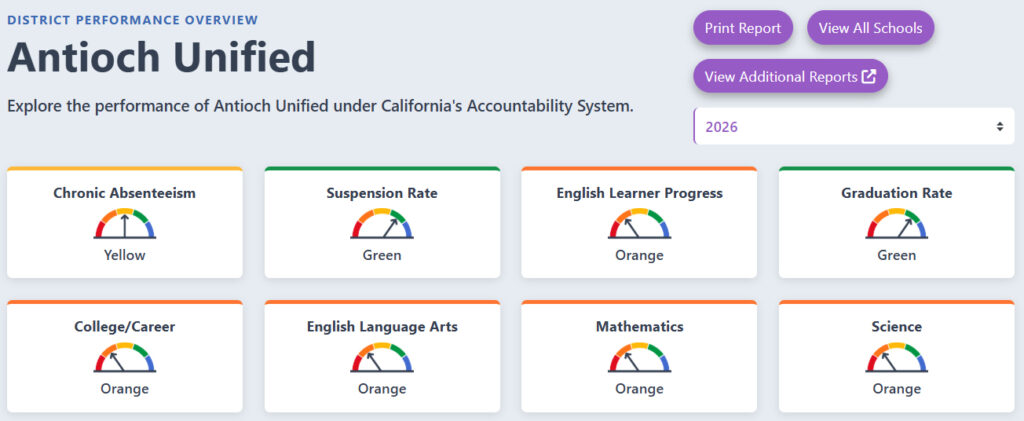
Antioch Unified School District’s Performance OverviewChart
UC Multi-campus Research Programs and Initiatives (MRPI) project for salinity management adaptation by UC Davis (MAIN), UC Berkeley, UC San Diego and UC Merced
By Brett Milligan, Professor of Landscape Architecture and Environmental Design Director, Metamorphic Landscapes Lab & Maggie Gallagher, Geography Graduate Group,University of California, Davis
The Just Transitions in the Delta research team cordially invites the public to attend the project’s final public workshop and interactive exhibition at the Jean Harvie Community Center in Walnut Grove, CA on Thursday, November 5th from 9:00am – 4:00pm.
In addition, an interactive exhibition of research findings will be open to the public at the Jean Harvie Center from Tuesday, November 3rd – Saturday November 7th from 11:00am – 3:00pm.
For the past four years, the Just Transitions in the Delta Project has explored climate change and salinity management adaptation scenarios for the Delta with multiple communities, experts and public participants, and designed six Delta climate adaptation scenarios based on this public input. On November 5th, the project team – including interdisciplinary experts from across four UC campuses – will present the results of modeling of the future effects of these scenarios, as well as comparison of their performance across key social, ecological, and economic indicators.
However, salinity intrusion into the Delta was a challenge and first measured in the 1800’s and early 1900’s according to the California Water and Environmental Modeling Forum and, according to a 2010 Contra Costa Water District report, it was primarily natural and “the result of tides that move seawater into the system and are controlled in large part by the amount of fresh water passing through the system.” Much of the additional challenge today is due to the upstream and in-Delta diversion of fresh water for agricultural, residential and commercial uses, as well as south Delta pumping according to the Delta Stewardship Council.
The term Just Transition is used in the domains of climate, energy, and environmental justice and refers to efforts to reduce inequity in society. This project seeks to advance such efforts by democratizing science and decision making in the Delta through a participatory scenario planning process. This method of public engagement provides opportunities for all communities affected by Delta policy and planning outcomes to contribute to and inform efforts to adapt to a rapidly changing world.
The workshop and interactive public exhibition will focus on sharing the final outcomes of the project with the public, and receiving input on future directions for Delta climate adaptation and participatory planning. All workshop and exhibition participants will have an opportunity to cast their vote for the most preferred scenario.
Please join us for the exhibition, the workshop, or both!
Open House Exhibition: Daily, Tuesday November 3rd – Saturday November 7th, 11:00am – 3:00pm
All project content and research findings will be on display in an open gallery setting, with opportunities to immerse yourself in the future visions of the Delta at your own pace. The exhibit will consist of detailed scenario visualizations and interactive digital models that reveal how scenarios compare across a range of publicly defined criteria. Participants can cast their vote for most preferred scenario through an interactive water component of the exhibition.
Public Workshop: Thursday November 5th, 9:00am – 4:00pm (open gallery and reception from 9-10am)
This more structured event will include presentations by the project team, breakout sessions on focused topics, and group discussions. All activities will be aimed at sharing and reviewing the results of the project’s scenario planning process, with time for reflection on what was learned by all who have participated in the project. Morning refreshments and lunch will be provided.
The Martins, the broken window of David’s rental car and one of his cameras that was stolen containing a photo of the bride, Antioch resident, Jenna Wesenhagen-Banks. Source: GoFundMe
Antioch native David Martin, Jr. seeks public’s help for return of photos, hard drives and equipment or replacement
By Kirsten Mitchell, Communications Associate, GoFundMe
The newlyweds Jenna Wesenhagen-Banks and Nick Banks on Sunday, Oct. 4, 2026. Photo by Carla Taylor Acevedo on Facebook
An Antioch couple’s wedding photos were reportedly stolen from their photographer’s rental car in Oakland just three days after their ceremony, and now the community is helping them try to recover those memories. David Martin, Jr., an Antioch native now based in Southern California, returned to photograph Jenna and Nick Banks’ October 4 wedding. According to the GoFundMe, thieves took nearly all the equipment he uses to support his family, along with drives holding years of work and the only copies of the couple’s wedding photos. Loved ones are asking for help finding the stolen drives and memory cards while raising funds to replace his gear and refund the couple if their photos aren’t recovered.
“What should have been a lifetime of cherished memories vanished in an instant. David is devastated, not only by the loss of his livelihood, but by the thought that Jenna and Nick may never get to relive the most important moments of their special day. Cameras can be replaced. A wedding day cannot.”
In a video on the GoFundMe page entitled “Restore David’s Livelihood”, Martin, who owns David Martin Jr. Photography according to his Facebook page, and is based in Orange County, CA according to his website, says, “I “lost…80% of my equipment.”
According to a KTVU FOX2 news report, break-in of his rental car in downtown Oakland happened days after the wedding in which “gear worth $35,000, including two cameras, lenses, a drone, a laptop as well as a hard drive and memory cards with the couple’s photos” were taken.
Post on GoFundMeby Lina Martin for David Martin
“On October 7, David Martin, a hardworking photographer and family man, had his vehicle broken into in Oakland. Thieves stole nearly all of his professional photography equipment, including cameras, lenses, drone, a laptop, accessories and hard drives holding years of irreplaceable work.
“In a matter of minutes, David lost the tools he depends on to support his family.
“The most heartbreaking part is that the stolen memory cards and hard drive held the only copies of Jenna and Nick Banks’ wedding photos. The couple had been married just three days earlier, on October 4. What should have been a lifetime of cherished memories vanished in an instant. David is devastated, not only by the loss of his livelihood, but by the thought that Jenna and Nick may never get to relive the most important moments of their special day. Cameras can be replaced. A wedding day cannot.
“David is doing everything he can to make it right. If the photos aren’t recovered, he will refund Jenna and Nick in full. He’ll also photograph them again, at no cost, in their wedding attire so they have something beautiful to hold on to.
“The theft also hit David in the middle of a video project in the Bay Area. All of the footage he had already captured was lost, which means he has to reshoot from scratch and cover the cost of travel all over again, on top of replacing his gear.
“For 12 years, David has photographed weddings, families, and milestones for people across Los Angeles and Orange County. Photography isn’t just his passion. It’s how he puts food on the table for his family.”
Where your donation goes
“Your support will replace the cameras, lenses, lighting, drone, laptop, accessories and storage David needs to get back to work, cover the travel costs of reshooting his lost video project, and help fund a full refund to Jenna and Nick if their photos can’t be recovered.”
Help us find the photos
“There’s still a chance the drives turn up. If you see cameras, lenses, laptops, or hard drives being sold in the Oakland area, on Facebook Marketplace, OfferUp, Craigslist, or anywhere else, please reach out through the “Contact” button on this page. A police report has been filed (RD# 26-042959). Getting those drives and or SD/Express cards back is the only way Jenna and Nick get their wedding photos.”
How you can help
“Every donation, no matter the size, makes a difference. If you can’t donate, please share this page. The more people who see it, the better the chance someone spots the stolen gear.
“Let’s come together and help David get back behind the camera.
“Thank you for supporting David and his family.”
—————
As of 9:30 p.m. Tuesday, Oct. 13, 2026, $14,215 has been raised from 54 donations of the total goal of $16,000.
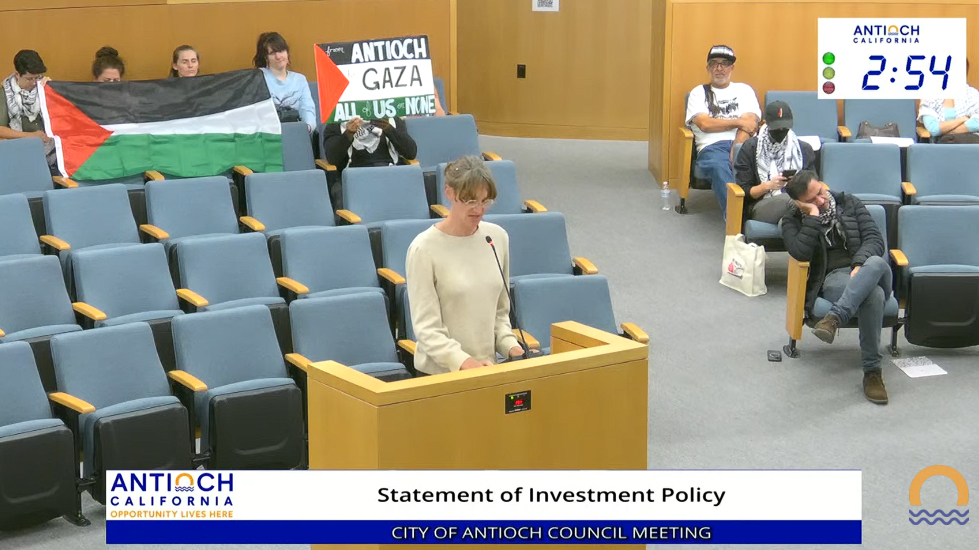
A member of the public speaks after midnight during the Antioch City Council meeting on the topic of the Statement of Investment Policy as the few remaining audience members hold signs and Gaza flags and fight sleep early Wednesday morning, Oct. 14, 2026. Video screenshot.
Would exclude investments in aerospace, coal, oil and gas, specifically in Chevron and BP, as well as Caterpillar whose heavy equipment products have been used in Gaza demolition
“I’m not sure this is right for primetime.” – Mayor Pro Tem Don Freitas
“…we exist within a genocidal government that invests in the military industrial complex…that also sells weapons to other genocidal governments. It is a conundrum because we’re existing right now on stolen, colonized land.” – Councilwoman Tamisha Torres-Walker
“I’m not in support of changing our policy.” – Mayor Ron Bernal
By Allen D. Payton
Just before midnight Tuesday, October 13, 2026, the Antioch City Council voted 4-0, with District 4 Councilwoman Monica Wilson absent, to extend the meeting that is usually to end by 11:00 p.m., until 1:00 a.m., to take up the matter of a proposed “Ethical Investing” policy that excludes certain industries and specific companies, because some of their products are used by Israel in Gaza. The proposals were developed by a work group that included City Treasurer Jorge Rojas, Jr., the City’s investment advisor, and three members of Contra Costa Divest, an activist group opposed to investing in oil, natural gas and coal, and more. But no decision was reached as council members said the proposed policy was too broad, they did not have enough information and shared concerns that it gave the City Treasurer too much power.
Proposed Policy Language
Under Section IV, entitled, “Ethical Investing”, the proposed policy includes the following language:
“It is the City’s objective to integrate socially responsible and ethical investing into investment decisions to the extent practicable and possible as a way to make a positive impact on human rights by minimizing potential investment exposure to abuses such as slavery, apartheid or genocide. The City will not invest in industries that are known to harm human health or the environment. Section VI outlines prohibited investments under this objective.
“Nothing in section VI shall restrict the City Treasurer from determining additional specific companies that do not comply with socially responsible and ethical investing. The City Treasurer will periodically review the City’s investment portfolio against current known facts and circumstances from trusted sources for any potential investments held that would not be considered socially responsible or ethical and notify the investment advisor to divest as soon as it is economically practical.
“Previously held investments that are not consistent with the criteria defined and prohibited in Section VI will be liquidated prior to maturity if and only if the sale would not result in a financial loss for the City. If the early sale would result in a financial loss to the City, the investment will be held until either (1) the time at which it can be sold without a loss or (2) until maturity.
Section VI, subsection 3. entitled “Socially Responsible and Ethical Investment Exclusions” includes the following proposed language:
“a. The City will not invest in any companies that produce alcohol for public consumption or tobacco products [defined by Bloomberg sectors: Beverages-Wine/Spirits, Brewery, Tobacco].
b. The City will not invest in any aerospace and defense companies, including those that produce or manufacture firearms, and ammunition, explosives, and military electronics [defined by Bloomberg sectors: Firearms & Ammunition, Explosives, Electronics-Military].
c. The City will not invest in any private prisons [defined by Bloomberg sector: Private Prisons].
d. The City will not invest in companies that produce or manufacture coal, oil and gas, oil and gas services and pipelines [defined by Bloomberg sector: Coal, Oil & Gas, Oil & Gas Services, Pipelines].
e. The City will not invest in these specific companies:
i. Chevron Corp
ii. Caterpillar Inc
iii. Lockheed Martin Corp
iv. BP PLC
f. Any companies the City Treasurer deems not socially responsible or ethical upon verification with trusted sources, and subsequently notified in writing to the investment advisor and approved by the City Council.”
The Council heard from the public and then discussed the matter.
Public Comments
All but one member of the public spoke in favor of the proposed City investment policy changes. Only this reporter, speaking as an Antioch resident, spoke against some aspects of the proposal.
I said, “First, this new, controversial investment policy should not be decided by the Council after midnight when most residents have already gone to bed and can’t participate. But if you’re going to make a decision tonight, I don’t think it’s unethical to invest in aerospace, such as SpaceX. What are they doing wrong? Nor is it unethical to invest in oil or gas which we all use every day, and specifically Chevron which directly employs 1,200 people at the refinery in Richmond and an additional estimated 1,800 contractors, some of which I’m sure live in Antioch. But guess what? They’re not here tonight to speak on this matter because they’re probably in bed already getting ready to go to work tomorrow.”
“As for Caterpillar…other than the fact their products are being used in Gaza, how can you blame a company for what others do with their products? Where does that start, where does that end?” I asked.
“Also, I would a add to the end of subsection ‘f.’ regarding giving the City Treasurer the power, to add the words, ‘and approved by the City Council.’ Because the current City Treasurer was not elected by the people with their knowledge that he would be given this much power or anybody. It should wait until after the next election if you’re going to apply that,” I concluded.
Council Discussion But No Decision
District 2 Councilman Louie Rocha was first on the dais to speak saying, “I’m impressed with where we are from our previous conversations. I’m happy to see there’s a working group come together. When I’m looking through the document the one question I have…it does seem somewhat of a subjective thought about the City Treasurer.”
“So, one individual is going to determine what we’re going to do as a City?” he asked.
Mayor Pro Tem and District 3 Councilman Don Freitas then said, “I have questions for Justin (Resuello from PFMAM the City’s investment advisor). Amended item number six. Defined by Bloomberg. We don’t have a copy.”
“As part of our…monitoring…we use Bloomberg terminals,” Resuello responded. “We want to make it very clear that Bloomberg…We’re trying to be very explicit and we’re using Bloomberg.”
“So, the United States of America is the largest manufacturer of weapons. So, with that, how can we invest in bonds?” Freitas asked.
“The United States is not a company,” Resuello responded.
“The government has contracts with all the companies that manufacture bombs and weapons,” the District 3 councilman pointed out.
“We could still invest in U.S. bonds because they’re not companies,” the investment advisor stated.
“Even though they invest, buy and distribute all war materials to Israel, in this case, it keeps coming up,” Freitas continued. “It’s peculiar to me that you can make a distinction between the two. That’s the problem I have with the policy. It’s so broad that if we’re going to be in compliance with it, it’s very clear the City won’t invest in any of these. I don’t know how you distinguish.”
City Finance Director Dawn Merchant said, “The government according to Bloomberg is not defined as an aerospace or defense company. It is a government agency.”
Regarding oil, coal and gas he said, “The United States leases our land.”
“To me, the policy is too broad,” he stated. “There’s nothing from Bloomberg attached here.”
“I’m absolutely opposed to the City Treasurer making decisions. He can make recommendations. It’s up to the City Council…to set policy,” Freitas continued. “That’s another very big issue I have.”
“I applaud the people who have gotten together. But it’s just too broad for me,” he said. “I like the language, ‘the City will not invest in industries that will harm health and the environment’.”
“You could change ‘F’ that whatever companies the Treasurer deems is unethical will bring back to the Council for discussion,” Merchant interjected but added, “It’s the elected City Treasurer’s role. It’s not the Council’s role.”
“I think that’s an improvement,” Freitas responded.
“That’s why I brought it up. That would have to be modified,” Rocha added.
“What kind of impact has such an investment policy had for other agencies?” Freitas asked Resuello.
“I couldn’t say these socially responsible investment policies…had a positive or negative result,” the investment advisor responded. “They are fee neutral.”
“Those portfolios have outperformed non-ESG portfolios over the last 10 years. But if you turn the clock back…non-ESG strategies outperformed ESG portfolios from say 2005 to 2020,” Resuello stated.
When pressed further on the difference by Freitas, he said, “Within one basis point.”
“So, one-one-hundredth. OK,” Freitas responded.
“There would be about an $11,000 loss if we sold one of the investments right now,” Merchant shared, speaking of the City’s investment in Lockheed Martin.
“It’s scheduled to mature in August 2028,” Resuello explained.
District 1 Councilwoman Tamisha Torres-Walker spoke next saying, “I guess what my brain is telling me at almost one in the morning. I guess what Mayor Pro Tem Freitas is saying is that we exist within a genocidal government that invests in the military industrial complex…that also sells weapons to other genocidal governments. It is a conundrum because we’re existing right now on stolen, colonized land. So, I can see how we can get to that conclusion. We are currently under a genocidal government. So, the argument would be what difference would this policy make if we are going to invest in America anyway when the American government consistently is investing in the military?”
“I support the policy as is, with the change, obviously around the Treasurer,” she stated then asked, “Things do have to come back to the Council as recommendations to make final, yes or no?”
“The City Treasurer has complete autonomy to make the decision with the investment advisor,” Merchant stated.
“The Treasurer is an elected official with these duties already. What we’re talking about is stripping the elected official of his duties. So, wouldn’t we need a completely different conversation about that?” Torres-Walker.
“Yes,” City Attorney Lori Asuncion responded.
“The Constitution of the State of California determines the duties of an elected City Treasurer,” Freitas said. “I don’t think we’re changing the Constitution of the State of California.”
Mayor Ron Bernal was the last council member to speak on the matter saying, “I’d like to thank everyone who was part of the discussion, city staff. I understand the importance of the genocide discussion and the claim. I guess the thing I’ve always had challenge with…if I look around the world…there are atrocities happening, now, not just in Gaza and by Israel.”
“The four…corporations that have been picked out, when there’s a list of many, many companies that provide weapons…all kinds of suppliers that supply Israel with…equipment, with all kinds of things,” he continued. “A U.N. report…2025…Human Rights Office database identified 158 companies involved in specified activities of Israel settlements. So, picking out four specific companies that are listed here, to me there are many companies that could have been listed, as well. I just believe that the list is too long and too broad to try to capture it for this purpose. I also agree…the City Treasurer should not have…to me, again, nothing towards Jorge. But anybody in that position it gives too much authority.”
“I’m not in support of changing our policy. I think we stay with what we currently have as a policy,” Bernal stated.
Merchant then proposed language for the City Treasurer clause.
“In section four it says, ‘nothing in section six restricts the City Treasurer.’ That would have to change because we’re doing exactly that,” Freitas stated.
Merchant responded with more defined language.
“It’s 12:51 so, it’s going to die without a second or die without a majority vote,” Torres-Walker said and made a motion to “approve the policy with the exceptions recommended by Finance Director Dawn Merchant.” But no one seconded the motion.
“Because I have hesitancy,” Freitas interjected. “It really is Lockheed. I’m willing to keep Lockheed there but delete the other three. I can live with that. I would like this to come back on a quarterly basis. I want to know if this will be the policy. My concern, it’s too broad…and there needs to be oversight. I’m willing to try for a year. But it needs to come back in a year.”
Bernal then mentioned the clause regarding, “not investing in industries that are known to harm human health or the environment.”
“I’m willing to support your recommended changes,” Torres-Walker said to Freitas.
Merchant said what Bernal quoted is a broad description.
But he reiterated, “In industries that are known to harm human health or the environment. That includes pretty much everything. I’d like to strike that statement. It’s too broad.”
“My concern is it’s too broad,” Freitas reiterated. “The committee has worked this far. I’d say, ‘go back’. This is the first time the council has heard it. I’m not sure this is right for primetime. I think, really, you need to go back, and various members of the council, I don’t think you’re going to get a second or three votes of council, right now.”
“I think it needs to come back with what the Bloomberg directions are,” he added.
“I’d like to see the specific statutory, what the City Treasurer can and can’t do under state law…what the responsibilities the Treasurer has” Bernal added.
With no other motion the council ended discussion of the matter.