Archive for the ‘Police & Crime’ Category

Shooting in Antioch last Wednesday sends man to hospital

Wednesday, December 29th, 2021

By Strategic Communications Officer Darryl Saffold, Antioch Police Investigations Bureau

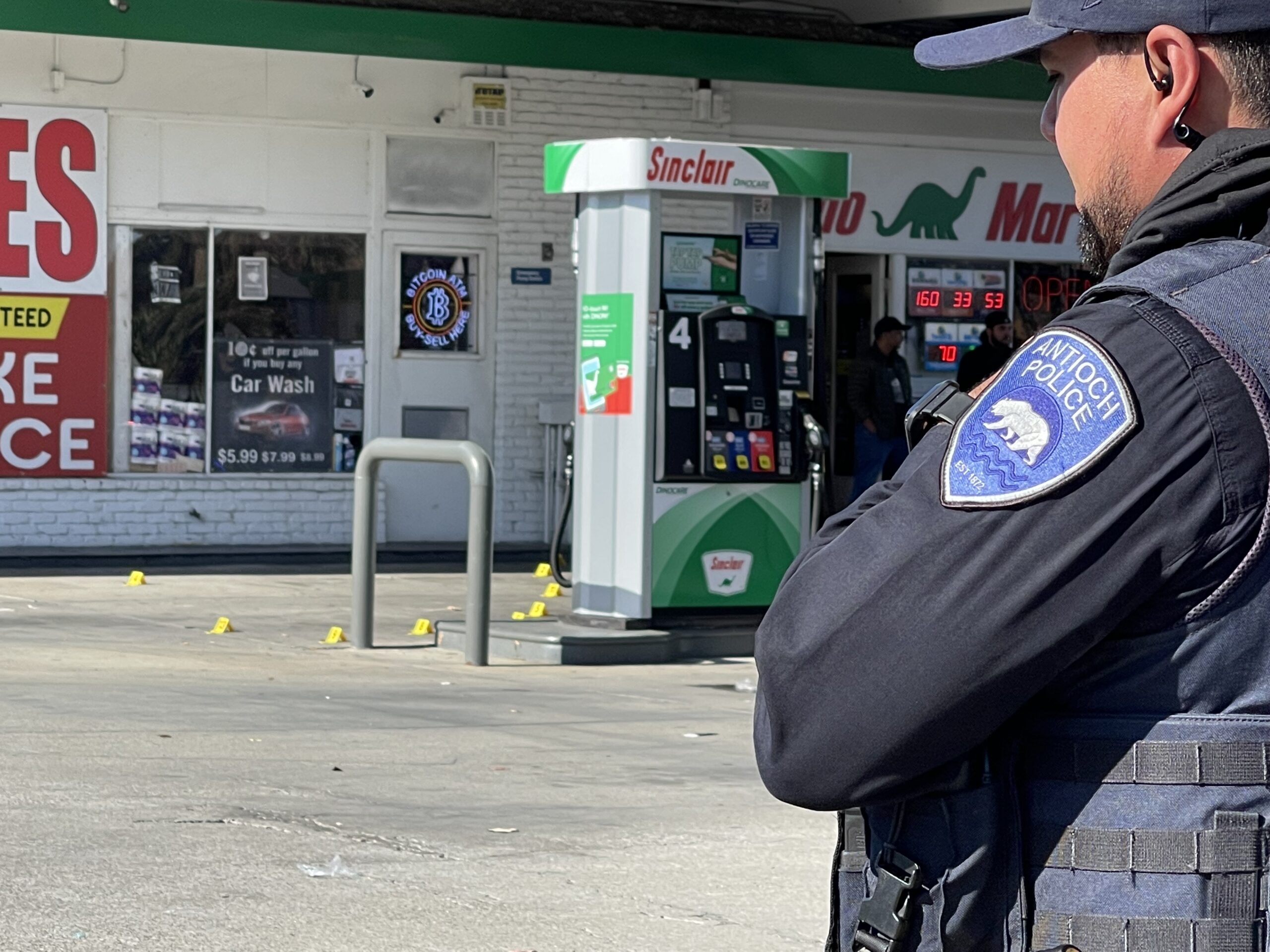
On Wednesday, Dec. 22, 2021, at approximately 9:13 PM, Antioch Police Department Dispatch began receiving numerous 911 calls of multiple gunshots being fired in the area of Vista Grande Drive and Catanzaro Way. When patrol officers arrived, they found multiple casings in the street and located blood on the sidewalk and on a vehicle that was parked in the area.

Moments later, a victim that had multiple gunshot wounds was dropped off at Kaiser Emergency Room and was immediately rushed into surgery. At the time of this release, the victim, a 27-year-old Black male was still in critical condition. No update on his condition was available as of Wednesday, Dec. 29.

Due to the ongoing and active nature of the investigation, no further information will be released at this time. This information is made available by the Support Services Division.

Anyone with additional information is asked to contact Detective Whitaker at (925) 779-6890 or at wwhitaker@Antiochca.gov.

Shoplifting suspect in Antioch arrested with help of K9 officer on Christmas

Sunday, December 26th, 2021

Antioch Police at 7-11 and the suspect’s knives on Saturday, Dec. 25, 2021. Photos: APD

Canine Purcy on Christmas. Photo: APD

By Antioch Police Department

While you were enjoying your holiday, thought you’d like to know that a team of dedicated officers were patrolling the town day and night stopping Grinches in their tracks.

Earlier Christmas day, one such Grinch pulled out a knife while shoplifting alcohol and snacks from the 7-Eleven at Hillcrest and East Tregallas. The introduction of the knife turned this petty theft misdemeanor into a felony armed robbery. The employee got on the phone right away with 9-1-1 and spoke to one of our highly skilled dispatchers, who put the call out immediately. The employee obtained a great description, which allowed Officer Amiri and his faithful companion Canine Purcy to sniff him out quickly.

When officers contacted said Grinch, he did not want to give up right away, so they used de-escalation skills, and the presence of Canine Purcy to get him safely into handcuffs without any further malfeasance. It was off to the County Jail and our Blue Day Shift team handed the reins to our evening shift to watch over our fair city.

Merry Christmas Antioch! Call us if you need us.


Antioch sideshow participants throw items at police, damage vehicle last Sunday

Thursday, December 23rd, 2021

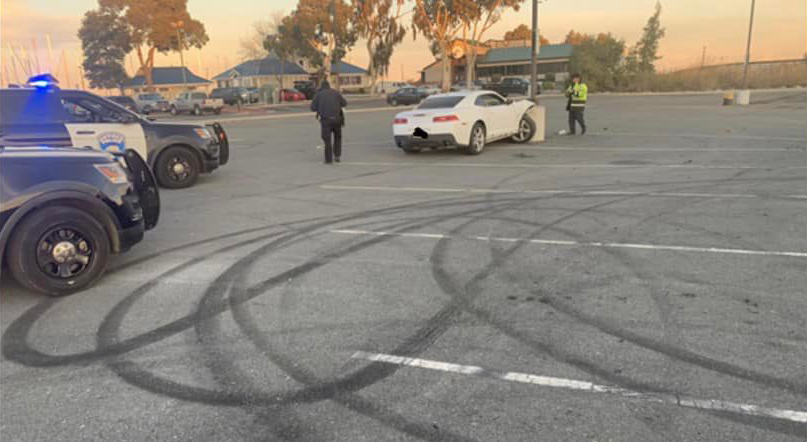
Tire marks in the intersection of L Street and Sycamore Drive in Antioch from the sideshow on Sunday, Dec. 19, 2021, also resulting in damage to a police vehicle windshield and one vehicle impounded for 30 days. Photos by APD.

By Antioch Police Department

Last weekend, APD and several agencies in our region, were plagued with large groups of more than 100 vehicles taking over intersections and doing sideshows. When we arrived to deal with the problem, some of the participants threw items at officers and damaged a police vehicle.

Last Sunday, a group attempted to take over the intersection of ‘L’ Street and Sycamore Drive, but officers were able to successfully disperse them. Four participants were issued citations and a vehicle was impounded for 30 days.

APD continues to work with our law enforcement partners and our community to address the continual problem created by these sideshows.


Injured Antioch Community Service Officer out of hospital, stops by PD

Wednesday, December 22nd, 2021

Antioch Police Community Service Officer Gaitan (in light blue shirt) visits with other officers at the police department on Thursday, Dec. 16, 2021. Photo: APD

By Antioch Police Department

Many of you asked about our CSO who was injured in a traffic collision Friday, Dec. 10. CSO Gaitan stopped-by Thursday, Dec. 16 to let us know he is on the road to recovery. He sends his thanks to everyone for their well-wishes and cannot wait to get back to work!

Gaitan was struck by a car while helping block one of the streets surrounding the scene of the shooter on Dove Court. (See related article)

Allen Payton contributed to this report.

Antioch Police seek suspect in early Sunday morning fatal hit and run

Monday, December 20th, 2021

By Sergeant Rob Green #3639, Antioch Police Field Services Division

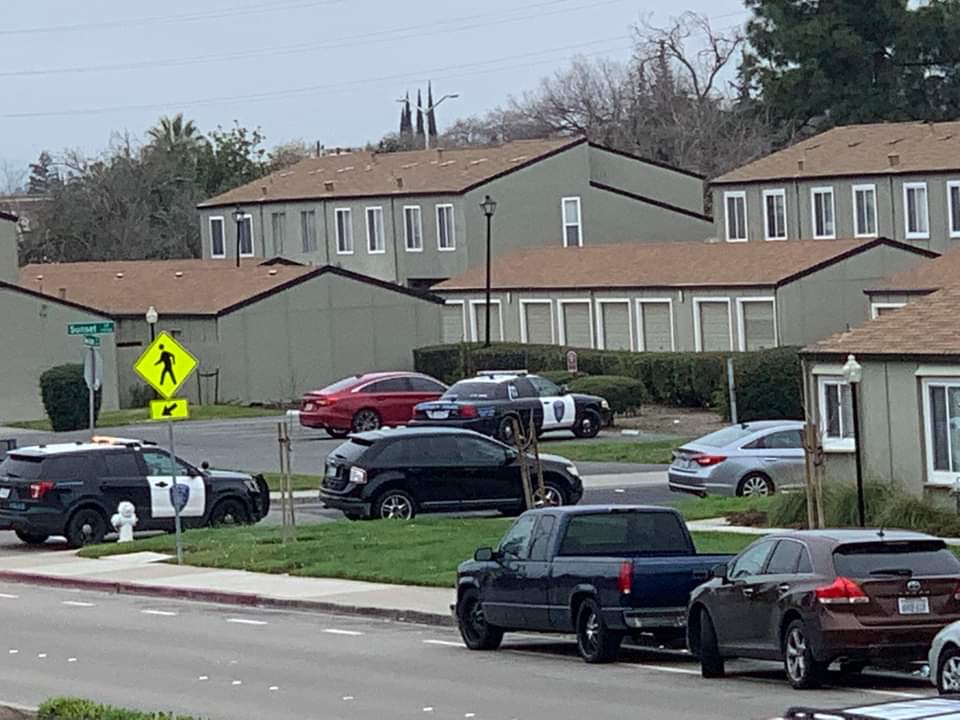
On December 20,2021, at 12:13 AM, a citizen reported finding a male down in the middle of the street in the 1200 block of Sunset Drive. Officers arrived on scene and found an unresponsive 40-year-old male adult with major injuries. Officers performed life saving measures on the male, but the male was ultimately pronounced deceased. Based on preliminary investigations, it appears the male had been struck by a vehicle.

Antioch Police Department Traffic Unit responded to the scene and took over the investigation. This investigation is in the early stages and there is no further information to release at this time. There are no suspect or vehicle description, and no one is in custody.

Anyone with information is asked to call the Antioch Police Department non-emergency line at 925-778-2441. You may also text-a-tip to 274637 (CRIMES) using the key word ANTIOCH.

Contra Costa DA announces restorative justice program U.S. DOJ found to be moderately effective or worse

Friday, December 17th, 2021

By Allen Payton

The Contra Costa District Attorney’s Office announced, last Friday, their new Neighborhood Restorative Partnership program. It is a neighborhood-focused restorative justice initiative addressing root causes of criminal behavior, reducing recidivism, enhancing community relationships, and promoting public safety and quality of life. The NRP is a program in which eligible individuals are given an opportunity to take responsibility and repair the harm they caused through a community-based process, instead of a courtroom.

This program is:

  • A community-based pre-filing program.
  • A program designed to give individuals an opportunity to take responsibility and repair harm they cause.
  • And will consist of community volunteers trained as panelists to find solutions that help address the harm caused by these offenders and by focusing on restoring all who have been impacted.

U.S. DOJ Study Found “Moderate” and Lower Program Results

A U.S. Department of Justice Office of Justice Programs study, published in 2017, that “systematically reviewed all available research that, at a minimum, compared participants in a restorative justice program to participants processed traditionally by the juvenile justice system”, found that such programs had a “moderate reduction in future delinquent behavior” and the “results were smaller for the more credible random assignment studies”.

“Abstract – The distinctive feature of restorative justice programs is the objective of addressing the causes of the offender’s delinquent behavior while remedying the harms caused to the victims. A fundamental component of restorative justice programs is some form of dialog or interaction between the offender and the victim or a victim surrogate, with some programs extending participation to family and community members. Examples of restorative justice programs include victim-offender mediation, family group conferencing, and sentencing circles. Also, some routine practices of the juvenile justice system such as restitution are consistent with restorative justice principles, and some programs incorporate some aspect of the framework, such as teen courts. This systematic meta-analysis of evaluation research on restorative justice programs identified 99 publications, both published and unpublished, reporting on the results of 84 evaluations nested within the 60 unique research projects or studies. From these studies, the meta-analysis extracted results related to delinquency, non-delinquency, and outcomes for the youth and victims participating in these programs. Overall, the evaluations of restorative justice programs and practices showed a moderate reduction in future delinquent behavior relative to more traditional juvenile court processing; however, these results were smaller for the more credible random assignment studies, which raises concerns about the robustness of this overall result. Additional high-quality research of such programs is warranted, given the promising but uncertain findings. 14 tables, 30 figures, and search notes”

Questions for DA Becton & Program Coordinator

Both District Attorney Diana Becton and program coordinator and Janet Era, Assistant Investigator/Facility K9 Handler with the DA’s office, were asked the following questions about the program on Monday:

Do you have more details about the Neighborhood Restorative Partnership that you can share?

How will the community-based process work? Is it just for juveniles or adults, too?

How many panelists per neighborhood panel? When and where will the panels meet?

How can you assure an individual that is the focus of the effort will actually attend their meeting with the neighborhood panel?

What percentage of individuals assigned to such programs actually show up for their neighborhood panel meeting? If they do, what are the kinds of assignments that can be ordered by the panel for the individual to “to take responsibility and repair the harm they caused”? Who provides the enforcement to ensure the assignment is completed?

Are the assignments based on a negotiated agreement with the individual and victims?

What if there are costs involved to repair the harm they caused will the individual be required to pay those costs? What if they can’t afford to do that, will the costs be paid for by the program?

Once the assignment is completed, what happens next? Is their record expunged?

How much will the program cost?

Finally, are you aware of the US DOJ study published in 2017 showing such programs for juveniles have a moderate impact or less?

Program Coordinator Responds

In an email response received, today, Era wrote, “The Neighborhood Restorative Justice Partnership (NRP) is an adult diversion program. NRP provides an opportunity for the participant to resolve their case in the community as opposed to a courtroom, by utilizing restorative justice practices. Offenders are given an opportunity to take responsibility and repair the harm they caused through a community-based resolution process.

NRP provides an opportunity for the victim to be heard and for the community to participate in the resolution process. We anticipate three panelists per panel. Eligible cases are diverted by the District Attorney’s Office into the NRP program. While participation is voluntary, participants must be willing to take accountability for their actions that caused the harm. Each case is unique; therefore, panelists will prepare individualized obligation plans for each participant.

Upon successful completion of the program, criminal charges will not be filed. NRP will track recidivism of the participants who complete the program for a period of 24 months. We have shadowed other agencies in other counties, including Yolo County, Los Angeles City Attorney, and San Francisco County. These counties have published a high rate of success at reducing recidivism. If the individual does not complete the program, criminal charges will be filed by the District Attorney’s office.

The procedures, guidelines, and logistics for the Neighborhood Restorative Justice Partnership are still under development. Participation is voluntary and confidential. There are no program fees, however there may be costs associated with repairing the harm caused by the individual.”

Program Contact Information

If interested in becoming a panelist with the Contra Costa County District Attorney’s Office, please complete an application and send to:

Contra Costa County

District Attorney’s Office

Attn: Janet Era

Assistant Investigator/Facility K9 Handler

Contra Costa County Office of the District Attorney

Neighborhood Restorative Partnership

900 Ward Street, 2nd Floor

Martinez, CA 94553

DA-NRP@contracostada.org

Click on this link for a copy of Application

Click on this link to view NRP Flyer

Contra Costa Supervisors appoint Ellen McDonnell as county’s new public defender

Thursday, December 16th, 2021

Makes permanent position for Interim Public Defender after 20 years with the department; will earn $433,641 in annual salary and benefits

New Contra Costa Public Defender Ellen McDonnell. Source: CCPD

By Allen Payton

As previously reported, during their final meeting of the year on Tuesday, the Contra Costa Board of Supervisors promoted Interim Public Defender Ellen McDonnell as Contra Costa Public Defender at an annual salary of $340,510 in addition to $93,131 in pension annual compensation.  She will officially take over the role of Public Defender from the retiring Robin Lipetzky effective Jan. 1, 2022.

She started with the department in 2001 and will oversee a $36 million budget and 145 employees.

McDonnell holds a Juris Doctors degree from California Hastings College of the Law and a Bachelor of Arts degree and double major in Spanish and Italian from Florida Atlantic University in Boca Raton.

She has been a member of the California State Bar since 2011.

When reached for comment District 1 Supervisor John Gioia showered praise on the county’s new public defender.

“Ellen has been at the department for several years, so, it’s great to elevate to the top position someone who has worked their way up in the department,” he said. “She understands the issues, has support of her staff and will be a great public defender.”

“Ellen understands the constitutional balance in our system, for those who are accused, so innocent people aren’t convicted,” Gioia continued. “She has been very involved in re-entry solutions. She and the department have helped individuals successfully, and safely, return to housing and employment, which lowers the chance of repeating offenses and keeps the community safer.”

McDonnell had been serving as the Interim Public Defender for Contra Costa County since August, she shared. According to the Contra Costa Public Defenders’ website,  during her two decades at CCPD, Ellen has specialized in representing clients in serious felony cases, been the public face of the office throughout the community and the local criminal court system, and led a dramatic expansion in innovative and holistic defense programs. Most recently, as Chief Assistant, she managed CCPD’s operations and oversaw the office’s divisions. As Interim Public Defender, Ellen stewards the office’s commitment to client advocacy, high-quality litigation, and holistic defense.

“I’m so honored to have been appointed by the Board of Supervisors with the recommendation of County Administrator Monica Nino,” McDonnell said. “I am thankful for their leadership and the trust that they’re placing in me with this appointment.”

“I’m excited to continue to lead an office of highly skilled and talented attorneys, investigators, social workers, legal assistants and clerical staff, and continue to serve the community of Contra Costa,” she continued.

“The mission of the Public Defender’s office is to vigorously defend our clients at all stages of the criminal justice process,” McDonnell shared. “A core part of our mission is also to bring our clients back into the community with support that leads to better outcomes for those we represent, their families and the community at large. We do that by connecting our clients with community-based solutions for housing, employment, healthcare and mental health resources.”

“When we look at the whole person in stabilizing individuals, we play a critical role in contributing to public safety,” she concluded. “Our office will remain committed to addressing racial disparities in the local criminal legal system and implementing new, needed, legal reforms.”

Since becoming interim public defender, McDonnell has been and will continue serving on the county’s Racial Justice Oversight Body which focuses on that commitment.

Ellen joined CCPD in 2001 after receiving her Juris Doctorate from UC Hastings College of Law, where she was a member of the Hastings Law Review. She represented clients with misdemeanors and felony cases, and has tried numerous homicide and life cases. Ellen is a skilled trial attorney and a fierce advocate, especially for those suffering from mental health conditions.

Ellen led the expansion of CCPD’s Clean Slate program and spearheaded community outreach efforts in response to the passage of Proposition 47 in 2014. Ellen coordinated and led numerous Clean Slate Day community events. She collaborated with justice system stakeholders and community-based organizations in order to assist thousands of community members in clearing their records and providing a path to rehabilitation.

Ellen has been at the forefront of implementing legislated criminal justice reforms in the Contra Costa legal system, including Prop 47, Prop 64, Felony Murder Reform, and Bail Reform. Through Ellen’s leadership, Contra Costa County has seen a reduction of incarceration rates, improved sentence equity, the minimization of court-imposed debt, and the elimination of barriers for impacted people.

Ellen has also collaborated with local groups working towards a more just and safer Contra Costa.  These include the county’s Pretrial Services work group, Contra Costa LEAD diversion Local Advisory Committee (LAC), the Prerelease Planning work group, the Smart Reentry Task Force, the Alliance to End Abuse Core Project Team, and the Steering Committee for the Reentry Success Center.

Ellen helmed CCPD’s holistic defense approach.  She expanded the scope and reach of the office’s services through grant funded programs, garnering state and federal recognition as a model for other defender organizations.  In 2016, Ellen became the supervisor of the office’s reentry programs unit, managing CCPD’s AB109 budget and securing philanthropic and governmental funding for reentry services. Ellen also launched the Early Representation Program (EarlyRep) dedicated to preventing failures to appear in court and diverting cases from the criminal justice system. EarlyRep was awarded the Defender Program of Year by the California Public Defender Association in 2019.

Ellen secured funding to launch the Holistic Intervention Partnership (HIP), a collaborative public-private partnership which offers intensive case management, funding for housing services, and other critical resources to those impacted by our criminal legal system. CCPD was one of only two Public Defender’s Offices in the state to receive Justice Assistance Grant (JAG) funding for innovation in indigent defense.

Ellen is regularly invited to speak about holistic defense and implementing criminal justice reforms.  She has presented to many groups including the California Judicial Council, the US Department of Justice, National Legal Aid and Defender Association (NLADA) Chief Defender Council, and the American Society of Criminology.

Ellen was appointed by the Chief Justice of the California Supreme Court to the Judicial Council’s Price of Justice Initiative: Ability to Pay Workgroup, the Futures Traffic Workgroup, and the Traffic Advisory Committee.  She was also appointed as a member of the Executive Steering Committee of the State Board of Community Corrections tasked with making recommendations for Law Enforcement Assisted Diversion (LEAD) funding.

Ellen, who grew up in West Virginia and Florida, is a resident of Walnut Creek, where she lives with her husband and two children. Ellen speaks fluent Spanish, and she is proud to be a lifelong Contra Costa Public Defender.

Dan Borsuk contributed to this report.


Antioch Council approves police department Positional Asphyxia Policy on 4-0-1 vote

Wednesday, December 15th, 2021

After revising language to satisfy both the interim police chief, police officers association; Torres-Walker votes to abstain, calls it “a public hatchet job

“It puts the onus on the officer if the policy says, ‘you should not do it.’” – Interim Police Chief Morefield.

By Allen Payton

As the final act of this year’s police reform efforts, the Antioch City Council, during their Tuesday night meeting, approved a new Positional Asphyxia Policy for inclusion in the Antioch Police Department Policy Manual on a 4-0-1 vote. District 1 Councilwoman Tamisha Torres-Walker voted to abstain.  APD Positional Asphyxia Policy ACC121421

The development of the policy was recommended by the council acting as the Police Oversight Standing Committee in September. (See related article)

A debate surrounded the words “shall” and “will”, which were the stated desire of members of the public who spoke on the matter, including family members of Angelo Quinto, versus “should” which was the recommendation of the Antioch Police Officers Association (APOA) regarding language in the policy of what officers must do. Interim Police Chief Tony Morefield supported and advocated the recommended APOA revisions during his presentation to the council.

Quinto’s father and sister spoke about the new law, Assembly Bill 490, The Justice for Angelo Quinto Act of 2021, that will go into effect on January 1, and ban positional asphyxia by police, statewide. The law reads, “(1) A law enforcement agency shall not authorize the use of a carotid restraint or choke hold by any peace officer employed by that agency” and (2) A law enforcement agency shall not authorize techniques or transport methods that involve a substantial risk of positional asphyxia. (See related articles here and here)

Council Discussion and Approval

The council then discussed the recommended revisions by the APOA. The council members all agreed to add the words “and suffocation” to “asphyxia” in the language of the policy.

District 2 Councilman Mike Barbanica, a retired police lieutenant, said he supported using the word “should”.

Morefield said, “it puts the onus on the officer if the policy says, ‘you should not do it.’”

“The ‘shalls’ are there at the important spots,” he continued. “But in those incidents of a physical struggle…we have some officers who are 120 pounds. Having two of them on a 300-pound man on meth…this prevents the dog pile situations. I honestly think the simplest way to do it is to adopt a ‘should’ instead of a ‘shall’.”

City Attorney Thomas Lloyd Smith offered, “shall make every reasonable effort to avoid placing weight on the persons neck…that’s a middle response.”

Barbanica and District 3 Councilwoman Ogorchock said they were comfortable with the word “should”.

When asked Torres-Walker simply said, “no”.

Mayor Pro Tem Monica Wilson asked for Smith to repeat his proposed language, which he did.

Barbanica then asked to hear from the chief for his view on Smith’s proposed language.

“It’s an interesting way to create a policy for a police department,” Morefield said. “I would certainly say two officers is sufficient for restraining a person’s head. There are times when a suspect is banging his head against a wall or a police vehicle.”

Smith then offered the additional language of “unless necessary to protect an individual from injuring themselves or others”. That was acceptable to Morefield.

“In the same spirit of ‘should’ the officer would have to explain why they did it,” Mayor Lamar Thorpe stated.

Barbanica then made the motion to adopt the policy with the city attorney’s recommendations and it passed on a 4-0-1 vote with Torres-Walker voting to abstain without explanation. At the end of the meeting, she explained her vote.

“The last vote I abstained from because the community spoke…What I witnessed was a public hatch job that didn’t take into consideration what the public said,” Torres-Walker said. “I thought the policy should have gone back to the committee. I want to thank the Antioch Police Department for their work on the policy and for Interim Chief Morefield for supporting progressive policies.”

2019 Study Showed Knee-on-Back Techniques Not Dangerous

The Antioch council adopted the policy in spite of a 2019 study concluding “none of four knee-on-back techniques commonly taught and used in law enforcement transfers any amount of weight even close to being dangerous, regardless of how heavy the officer applying the force is,” according to Force Science News.

The six-person research team was headed by Dr. Mark Kroll, an internationally renowned biomedical scientist with the University of Minnesota and California Polytechnic State University who testifies frequently as an expert witness in police litigation. He said, “Our data do not support a risk of restraint asphyxia occurring from standard knee-on-back techniques.”

“Our findings are important,” Kroll told Force Science News, “because North American officers control and restrain agitated and resistant subjects in the prone position over half a million times each year. Subjects end up being proned out in about 60 percent of physical force encounters—without a death or serious injury resulting. Prone restraint is needed for officer safety, and the stake needs to be driven into the heart of the stubborn myth that this procedure is inherently excessive and dangerous.”

Kroll’s report on the knee research appears in the American Journal of Forensic Medicine & Pathology, under the title “Applied Force During Prone Restraint: Is Officer Weight a Factor?

According to Science1 website by Lexipol, “The Force Science Institute (FSI), (publisher of Force Science News), is comprised of a team of physicians, lawyers, psychologists, scientists, police trainers and law enforcement subject matter experts dedicated to the advancement of knowledge and training in criminal justice matters.

FSI conducts sophisticated scientific research studies into human behavior documenting the physical and mental dynamics associated with the societal demands of the peace-keeping function, including high-pressure situations and use-of-force incidents. Its findings apply to citizen-involved uses of force, as well as impacting investigations of officer-involved force applications. FSI research when applied to training enhances officer performance and public safety.”

Positional Asphyxia Susceptibility Factors

According to an article entitled “How To Prevent Positional Asphyxia” on PoliceMag.com, “The following is a closer look at some factors and circumstances that can make an individual more susceptible to death from positional asphyxia.

Violent Struggle—People who have engaged in a difficult and aggressive struggle may be more susceptible to respiratory muscle fatigue and failure.

Excited Delirium—Subjects who are under the influence of cocaine or methamphetamine while in restraints may experience a condition known as excited delirium. This disorder results in disorientation, hallucinations, and impaired thinking. Excited delirium may raise the individual’s susceptibility to a sudden increase in heart rate, which can rise to a critical level and result in cardiac arrest. (NOTE: The Contra Costa County Coroner’s Office ruled Angelo Quinto succumbed to excited delirium and prescription drugs during the physical altercation with officers).

Alcohol Intoxication and Drugs—Alcohol is a significant risk factor in positional asphyxia because it lowers the respiratory drive. Individuals who have been drinking heavily are among the most likely to die in custody from medical events.

Body Position—Death due to a head-down position with hyper flexion of the neck is a rare event. It is however a critical condition arising out of particular body positions that can lead to mechanical obstruction of respiration. Studies have suggested that restraining a person in a face-down position is likely to cause greater restriction of breathing than restraining a person face-up.”