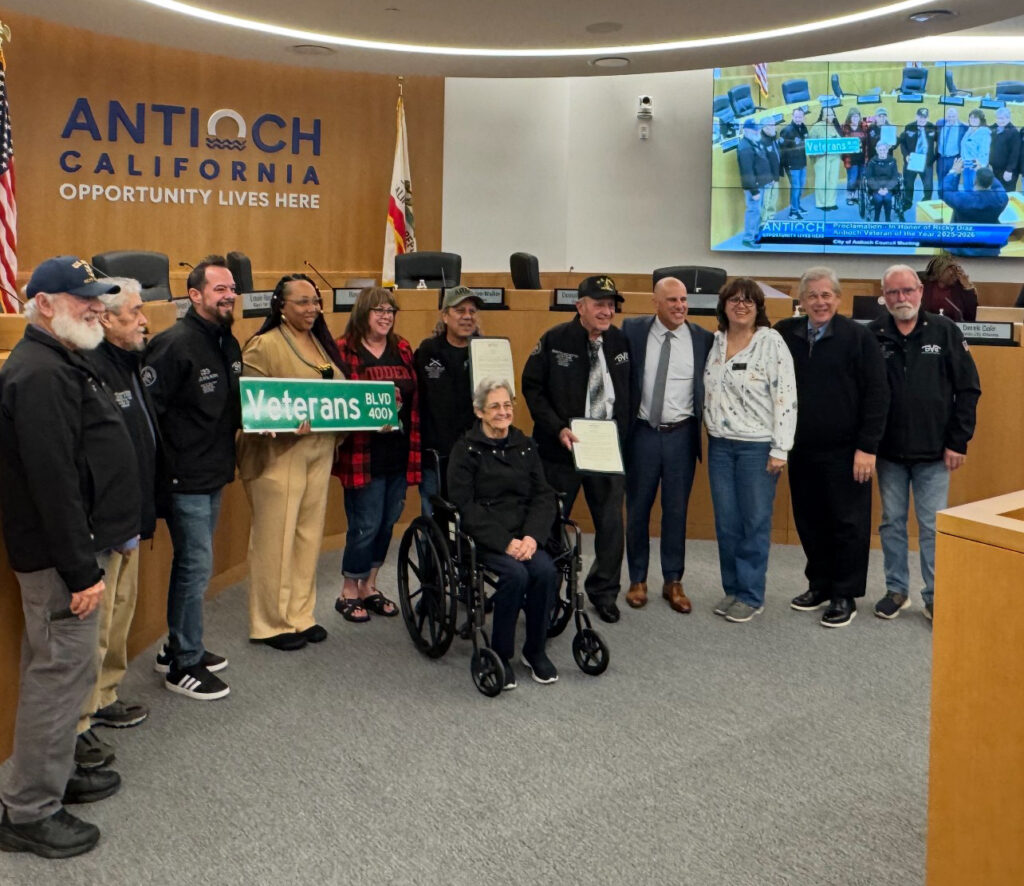
2025-26 Antioch Veterans of the Year, Ricky Diaz and Bob Franchetto (holding certificates) are joined by their wives, Gerri Diaz and Mary Franchetto (in wheelchair) family and council members, and former Antioch Veterans of the Year during the council meeting Thursday, Nov. 20. Photo courtesy of Chris Trotta.
Bob Franchetto, Antioch Lifetime Veteran of the Year and Ricky Diaz, Antioch Veteran of the Year
By Allen D. Payton
During their special meeting on Thursday, November 20, 2025, the Antioch City Council honored the 2025-26 Veterans of the Year, Bob Franchetto and Ricky Diaz, by approving proclamations for each recipient. The awards were announced during last week’s annual Antioch Veterans Day Ceremonies and both U.S. Army veterans were presented with plaques and jackets with their names embroidered. (See related article)
Both Mayor Pro Tem and District 2 Councilman Louie Rocha and District 4 Councilwoman Monica Wilson were absent from the meeting.
Proclamations
IN HONOR OF
BOB FRANCHETTO
Antioch Lifetime Veteran of the Year 2025-2026
WHEREAS, Bob Franchetto was born on June 23rd, 1938, in Fort Dodge, Iowa, and relocated with his family to the City of Antioch in 1947. He attended Antioch High School, where he contributed to the Panther newspaper, before graduating in the spring of 1956;
WHEREAS, In 1961, Bob Franchetto enlisted in the United States Army as a 717 – Clerk with Crypto Clearance and was stationed at Fort Baker, Sausalito where he served for three years;
WHEREAS, after completing his service, in 1964, he returned home to Antioch with his beloved wife, Mary, whom he met while serving in the Army, together, they continued the legacy of his family business, Cottage Florist, established in 1947 and purchased by Bob in 1959, carrying forward the family tradition that had been maintained by his parents during his time in the military;
WHEREAS, for decades, Bob and Mary’s commitment to family and community has been evident in all they have done. Married for 61 years, they raised three children – Bob, Tony, and Paula – each carrying forward the spirit of service and family pride. Their daughter Paula has continued the family’s legacy, owning and operating Paula’s Family Florist, formerly known as Cottage Florist, preserving the Franchetto name as a cherished part of Antioch’s history;
WHEREAS, Bob’s lifetime of giving back to Antioch exemplifies the true spirit of this award. His enduring dedication, quiet leadership, and steadfast love for his community remind us all that service does not end when the uniform comes off – it simply takes on new meaning;
WHEREAS, for his lifetime of service to his community and country, the Delta Veterans Group and the City of Antioch proudly recognize U.S. Army Veteran Bob Franchetto as the Antioch Lifetime Veteran of the year for 2025-2026;
NOW, THEREFORE, I, RON BERNAL, Mayor of the City of Antioch, do hereby salute, commend and honor Bob Franchetto for his dedication, commitment, and positive influence to our community and the Veterans in the City of Antioch.
NOVEMBER 20, 2025
RON BERNAL, Mayor
—————-
IN HONOR OF
Ricky Diaz
Antioch Veteran of the Year 2025-2026
WHEREAS, Ricky Diaz was born on September 29, 1961, in East Contra Costa County; WHEREAS, In 1979, Ricky enlisted in the United States Army, where he served with the 1st Battalion, 37th Field Artillery at the Fort Richardson duty station in Anchorage, Alaska, until 1982. Ricky continued to live and work in Alaska for four more years before returning to his hometown of Antioch;
WHEREAS, Ricky has given countless volunteer hours to local organizations, including the Antioch VFW, the Antioch Historical Society, and the Antioch Bedford Center – quietly making a difference without ever seeking recognition. His humility, commitment, and heart for service truly reflect the values of our Veteran community;
WHEREAS, Ricky met his wife, Gerri, in 2007, and the two were married in 2013, at the Antioch Historical Society Museum – a fitting place for a man whose life and service are woven into the very history of our city;
WHEREAS, U.S. Army Veteran Ricky Diaz has been proudly honored as the Antioch Veteran of the Year 2025-2026, a man who continues to serve his community with honor, humility, and heart;
NOW, THEREFORE, I, RON BERNAL, Mayor of the City of Antioch,
do hereby salute, commend and honor Ricky Diaz for his dedication, commitment, and positive influence to our community and the Veterans in the City of Antioch.
During a special meeting on Thursday, Nov. 20, 2025, instead of their regular meeting next Tuesday, the Antioch City Council will discuss reallocating a little over $9 million from budget savings for Fiscal Year 2024/25. In addition, the Council will honor Bob Franchetto, 2025-2026 Antioch Lifetime Veteran of the Year and Ricky Diaz, 2025-2026 Antioch Veteran of the Year who were recently recognized during the Veterans Day ceremony. (See related article)
During the Closed Session before the meeting, which begins at 3:00 p.m., the Council will discuss recruitment of a permanent City Attorney, the Trent Allen, et al. v. City of Antioch, et al., lawsuit, the City Manager’s performance evaluation and lease of the Lynn House Gallery on W. 1st Street.
Budget Savings Reallocation
According to the City staff report on the agenda item (#6), City revenues exceeded expenditures (surplus) by $9,034,582. But the true net surplus for the fiscal year end is $3,883,367 after reducing the total by $1,826,144 for Police Department CIP Re-Appropriated to FY 2025/26 and $3,325,071 for Encumbrances/Projects at 6/30/25 to be Rolled Over (Exhibits A & B).
The City received $1,054,449 higher than projected revenues and spent $10,445,898 less than projected for Fiscal Year 2025 which ended June 30th.
Expenditures were primarily reduced by:
$2,946,282 in salary savings from all unfilled positions, including $1,720,034 in non- Police salary savings;
$2,587,805 in project/purchase budgets not yet entirely spent. The carryforward of the budgets for these is included in the budget amendments total of the aforementioned $3,325,071;
$1,826,144 in Capital Improvement Plan budgets that were unspent and re-budgeted/carried forward to FY26 with adoption of the 5-year capital budget;
$737,266 in purchase orders not yet spent;
$661,726 less in operating subsidy to the Animal Shelter; and
$437,861 less in operating subsidy to Recreation Services.
In addition, the budget amendments include a $1,021,585 reduction in sales tax revenue based on the latest projections from the City’s sales tax consultant, $1,664,166 in salary savings that can be recognized thus far this fiscal year and American Rescue Plan Act (ARPA) revenues of $3,085,330 representing the balance of ARPA funds remaining on June 30th and projected interest earnings. All ARPA funds must be spent by December 31, 2026.
Even with the savings, the City is still facing a budget deficit of $11,657,947 next year even after the existing budgeted $5M transfer in from the Budget Stabilization Fund approved by City Council to be utilized in FY26. $5,151,215 of the deficit is attributable to the encumbrances and other budget items being rolled over, leaving a true remaining additional deficit (net of the $5M Budget Stabilization transfer) of $6,506,732 which will draw upon General Fund reserves to “balance” the budget.
Staff is recommending reallocating the FY24-25 savings as amendments to this fiscal year’s budgets for the General Fund as well as other City funds. (See Agenda Item 6 staff report and Exhibits A, B and C).
The meeting will be held in the Council Chambers at City Hall, 200 H Street, in Antioch’s historic, downtown Rivertown, with the Special Meeting beginning at 7:00 p.m. It can also be viewed via livestream on the City’s website and the City’s YouTube Channel, on Comcast Cable Channel 24 or AT&T U-verse Channel 99.
During their meeting on Tuesday, November 4, 2025, the Antioch City Council voted unanimously to approve the following proclamation recognizing Homelessness Awareness Month in November.
HOMELESSNESS AWARENESS MONTH
November 2025
WHEREAS, November is recognized as Homelessness Awareness Month across the United States to recognize the numerous reasons people become homeless, the challenges faced by adults, young adults, youth, and families experiencing homelessness, and to mobilize community-wide efforts toward lasting solutions;
WHEREAS, the City of Antioch recognizes that homelessness impacts individuals and families from all walks of life;
WHEREAS, research shows that criminalizing homelessness worsens the crisis and deepens existing racial inequities and systemic disparities;
WHEREAS, according to the January 2025 Point-in-Time count, the City of Antioch had the highest number of unsheltered individuals in Contra Costa County – 246 persons, representing approximately 11.6 percent of the countywide total – a significant decrease from 413 persons counted in 2024;
WHEREAS, the City of Antioch, through the Opportunity Village program, is providing interim housing and supportive services for 37 Devpar, specific, encampment residents and their 25 dogs;
and WHEREAS, the City of Antioch is committed to working in coordination with Contra Costa County and local organizations to provide housing, shelter, supportive services, and basic resources to all people experiencing homelessness.
NOW, THEREFORE, I, RON BERNAL, Mayor of the City of Antioch, hereby proclaim November 2025 as “Homelessness Awareness Month” and encourage all City of Antioch citizens, partners and businesses to recognize the need for, and commit to building and sustaining, a coordinated and equity-driven continuum of care that meets the complex needs of people experiencing homelessness, rooted in dignity, equity, and hope. NOVEMBER 4, 2025
RON BERNAL, Mayor
According to the Substance Abuse and Mental Health Services Administration (SAMHSA), a branch of the U.S. Department of Health and Human Services, “November is National Homelessness Awareness Month and National Homeless Youth Awareness Month. SAMHSA works in partnership with federal, state and local partners and national experts to provide training on housing, treatment and recovery models focused on adults, children, and families who are experiencing or at risk of homelessness and have serious mental illness and/or serious emotional disturbance, and substance use. These partnerships contribute to housing stability, recovery, and ending homelessness. SAMHSA also supports the field through technical assistance to states and localities, treatment systems and individual providers on these issues.”
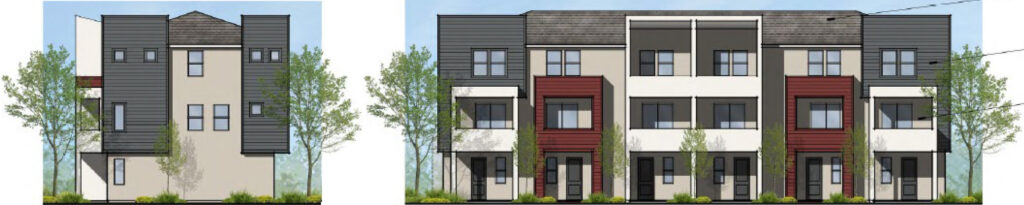
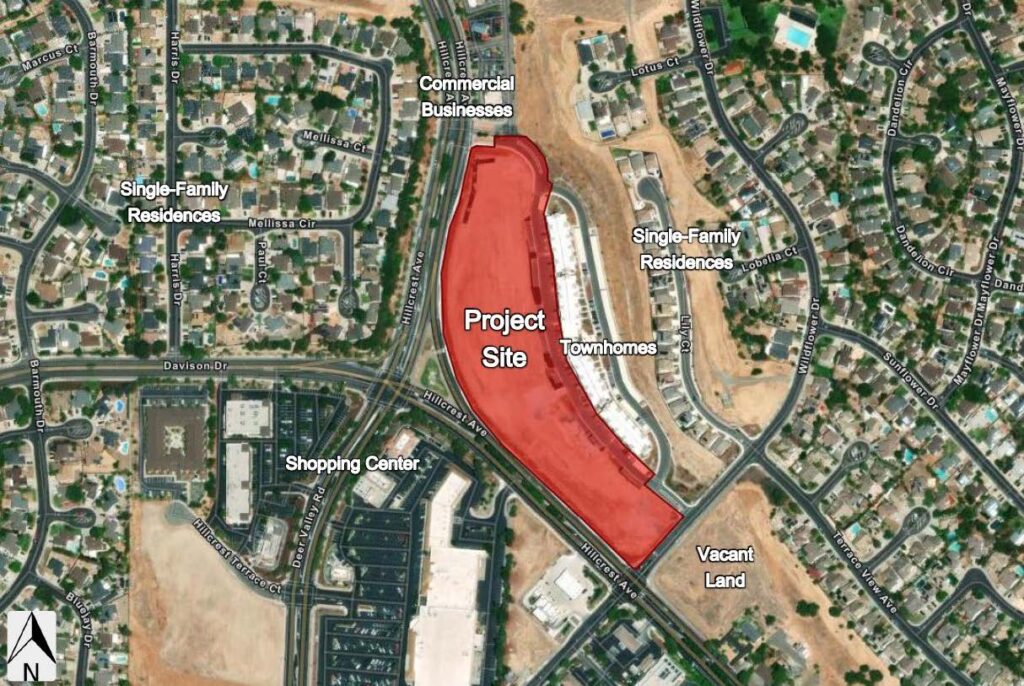
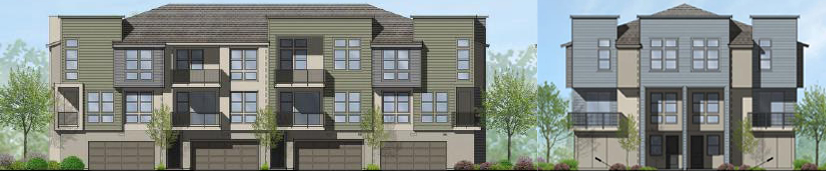
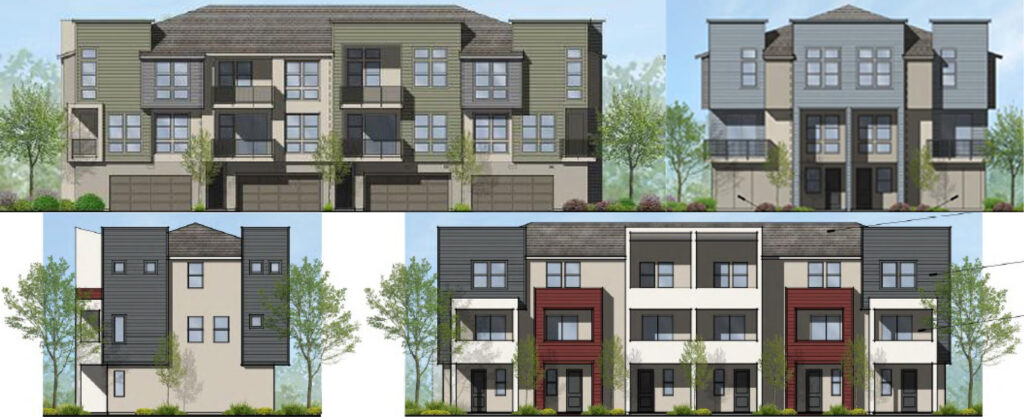
Renderings of the proposed Wildflower Station Row Townhomes. Source: DeNova Homes
Will again consider Wildflower Station Townhomes 2 project by troubled developer Tuesday night
Learn how state law is forcing Council to approve new housing developments
By Allen D. Payton
After the Antioch City Council held a public hearing during their meeting on Sept. 23, 2025, on the proposed Wildflower Station Townhomes 2 Multifamily Residential Project by troubled DeNova Homes, postponed a decision until their meeting last Tuesday, Oct. 28, but split 2-2, with District 1 Councilwoman Tamisha Torres-Walker was absent, the Council will once again consider the project during a special meeting tomorrow night, Tuesday, Nov. 4, 2025.
The council meeting is scheduled then instead of the regular day of the second Tuesday of each month due to the Veterans Day holiday on Nov. 11th.
It will be the third time the Council will consider the project by the embattled developer, whose father and son leaders were indicted in April on charges of bribing an Antioch city councilman last year. (See related articles here, here and here). During last Tuesday’s meeting, Antioch resident Melissa Case named former Councilman Mike Barbanica as the target of the attempted bribe but who has repeatedly told the Herald he will not speak about an open investigation. So, the target could also have been former Mayor Lamar Hernández-Thorpe.
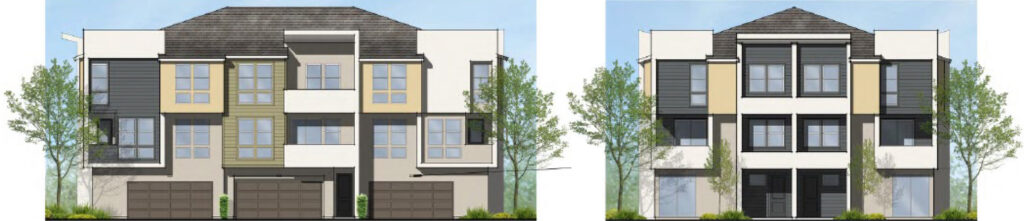
Rendering of proposed Wildflower Station Back-Back Townhomes. Source: DeNova Homes.
Council Approved Developers’ Other Townhomes Project on Oct. 28
Like DeNova Homes’ Slatten Ranch Townhomes Project, approved last Tuesday night on a 3-1 vote, with District 3 Councilman Don Freitas voting against, the Council is expected to also approve the Wildflower Station project because it, too, was submitted under SB330 which basically ties the councilmembers’ hands. The law gives certain protections to developments that follow the law’s procedures. (See below)
Both Mayor Pro Tem and District 2 Councilman Louie Rocha and District 4 Councilwoman Monica Wilson complained during last week’s council meeting about the state forcing the councilmembers to approve the project. Yet, Wilson along with Freitas, voted against it. The Council then voted 4-0 to continue the item until tomorrow night’s meeting which Torres-Walker is expected to attend and potentially break the tie vote.
Antioch’s Regional Housing Needs Allocation of between 2023-31 shows the quantity of units in each of four income categories for a total of 3,106 new units that must be approved by the City Council. Source: Association of Bay Area Governments
State Housing Law Forces Councilmembers to Approve New Developments – HAA, HCA, RHNA
Retroactively “freezes” residential zoning standards to what they were on January 1, 2018.
Does not allow jurisdictions to enforce moratoriums or growth control measures on new housing development.
Prevents jurisdictions from imposing or enforcing new design standards on housing projects that are not “objective”.
Plus, “The HCA strengthens the Housing Accountability Act – HAA – (Gov. Code §65589.5) which states that a housing development project that complies with the objective standards of the general plan and zoning ordinance must be approved by the agency, unless the agency is able to make written findings based on the preponderance of the evidence in the record that either: 1) the local government has already met its Regional Housing Needs Assessment (RHNA) requirement (Antioch hasn’t); 2) there is an impact to the public health and safety and this impact cannot be mitigated; 3) the property is agricultural land (it’s not); 4) the approval of the project would violate State or Federal law and this violation cannot be mitigated; or, 5) the project is inconsistent with the zoning and land use designation and not identified in the general plan housing element RHNA inventory (it isn’t).”
According to a Sept. 2020 Technical Assistance Advisory by the California Department of Housing and Community Development’s Division of Housing Policy Development, the HAA “establishes limitations to a local government’s ability to deny, reduce the density of, or make infeasible housing development projects, emergency shelters, or farmworker housing that are consistent with objective local development standards and contribute to meeting housing need.”
In addition, the Advisory explains that SB330/HCA “set forth vesting rights for projects that use a new pre-application process,” which both townhome projects did. Most of the bill’s provisions were to sunset on January 1, 2025, but they were extended until January 1, 2030, with the passage of SB8.
The RHNA – now referred to as the Regional Housing Needs Allocation – requires the City of Antioch to approve 3,016 new homes in four income categories between 2023 and 2031. (See related articles here and here, and chart above)
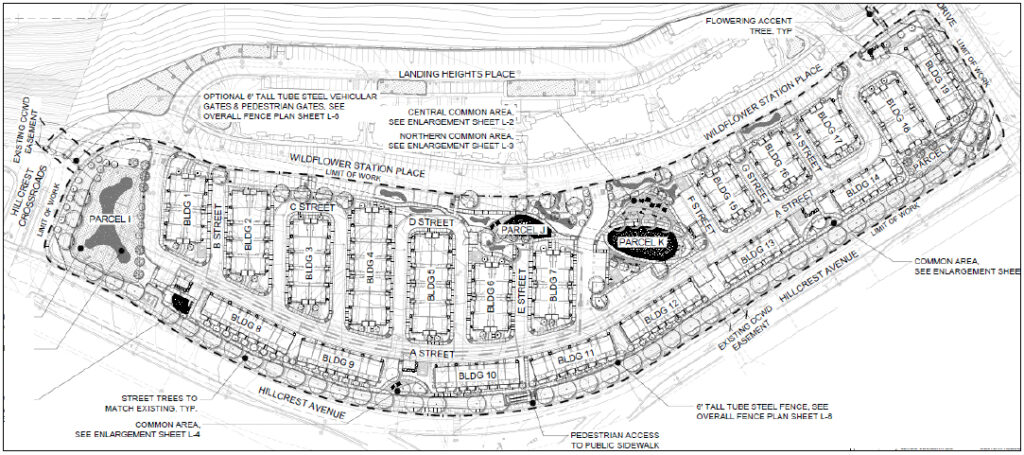
Wildflower Station Townhomes 2 Site Map. Source: City of Antioch
Wildflower Station Townhomes 2 Project
The proposed Wildflower Station Townhomes 2 Multifamily Residential Project is a 159-unit townhome-style condominium development. It is planned for the four-parcel, 10.35 acre vacant property near the intersection of Hillcrest Avenue and Deer Valley Road and bordered by Wildflower Drive to the east and the road next to the KFC restaurant in the Hillcrest Crossroads shopping center which also serves the existing condo development.
According to the City staff report for the agenda item, #6, the proposed project consists of a Vesting Tentative Subdivision Map to create 19 residential lots for 19 three-story buildings, containing 159 new townhome condominiums in two different building styles: “back-to-back” and row townhome-style. Both styles of townhomes include individual one-car or two-car garages with the living areas primarily on the second and third levels above the garage parking.
Proposed Wildflower Station Townhomes 2 Project Site Map. Source: DeNova Homes
The proposed project would include a total of 2.8 acres of landscaping and open space, consisting of two open play areas and open space for bioretention. The play areas would include 25 additional parking spaces with another 57 surplus shared parking spaces with the adjacent Wildflower Station development. The 159 residential units would consist of a mix of two- and three-bedrooms units, ranging in size from 1,135 to 1,381 square feet.
The project site was part of the larger 23-acre Wildflower Station project that includes 22 single family homes (on the ridgeline above), the 98-condominium stacked flat homes immediately adjacent and planned commercial development that was entitled in 2018. The single-family homes and condos were built, but the commercial parcels along Hillcrest Avenue (the current project site) weren’t and the land sat undeveloped.
In 2023, the City Council revised the General Plan and rezoned the four parcels to High Density Residential District (R-25). The proposed project would result in a density of approximately 20 du/ac.
The project was also submitted in 2023 as a Preliminary Housing Application under SB330.
Con Fire Quarterly Report
Before the item is heard, the Council will receive the Contra Costa County Fire Protection District – Quarterly Report presentation by Fire Chief Lewis Broschard.
The meeting will be held in the Council Chambers at City Hall, 200 H Street, in Antioch’s historic, downtown Rivertown. They can also be viewed via livestream on the City’s website and the City’s YouTube Channel, on Comcast Cable Channel 24 or AT&T U-verse Channel 99.
Renderings of the planned Slatten Ranch Townhomes approved by the City Council on Tuesday, Oct. 28, 2025. Source: DeNovaHomes
Embattled DeNova Homes’ 129 units at Slatten Ranch passes on split vote; 159 units at Wildflower Station fails on tie vote with Torres-Walker absent, continued until next Tuesday.
“It’s…unfortunate our hands are going to be tied due to state law” – District 4 Councilwoman Monica Wilson
“We are very limited in what actions we can take.” – Mayor Pro Tem Louie Rocha
By Allen D. Payton
During their meeting on Tuesday, October 28, 2025, the Antioch City Council voted to approve one of two new townhome projects by DeNova Homes in the Slatten Ranch area on the eastern edge of the city on a split 3-1 vote. Another townhome project on Hillcrest Avenue and Deer Valley Road in the Wildflower Station development failed on a 2-2 vote with District 1 Councilwoman Tamisha Torres-Walker absent. The council members pointed out that their hands are tied by state law, SB330 – The Housing Crisis Act of 2019, under which plans for both developments were submitted, and were forced to approve both.
It was the second time the Council reviewed the projects by the embattled developer, whose father and son leaders were indicted in April on charges of bribing an Antioch city councilman. (See related articles here, here and here).
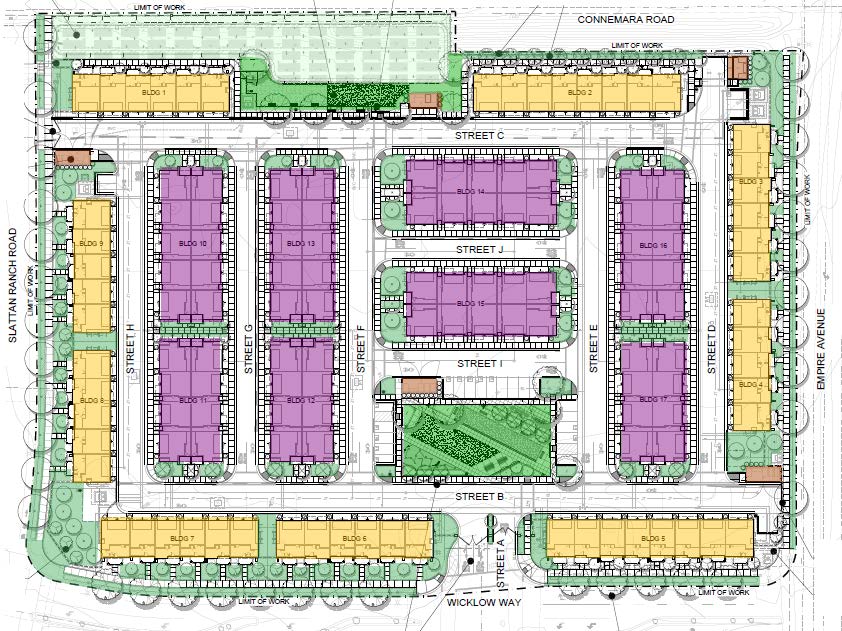
Slatten Ranch Townhome Development Plan. Source: DeNova Homes
Approve 129 Slatten Ranch Townhomes
Following another presentation on the 129-unit Slatten Ranch Townhomes project by the developer’s representatives as well as public comments by residents including some members of local unions concerned about growth and jobs, the council members discussed the project and questioned City staff.
District 3 Councilman Don Freitas who has been critical of the project, especially that it allows housing in the City’s 200-acre East Lone Tree Focus Area that was intended for commercial and economic development foorr creation of local, well-paying jobs, was first to question staff. He said, “In the report…it states that…the project has been adequately analyzed…under CEQA (California Environmental Quality Act) and further review is not required. Traffic…will exceed City standards at the intersection…Level of Service F, which is the worst traffic conditions we can have.”
“The mitigation…they’re going to give one-fourth of the traffic light,” he asked with incredulity. “Empire and Wicklow. Level F. How does that pass CEQA?”
Antioch Planning Manager Zoe Merideth responded, “Vehicle miles traveled is a different standard…that’s what’s in the Housing Element EIR (Environmental Impact Report). Also, in the City’s General Plan, we have the Level of Service…and guidelines under that.”
“We’re still going to have Level F at Empire…and Wicklow for all of Eastern Contra Costa County,” Freitas reiterated.
“But we’re going to have mitigation,” Planning Manager Meredith stated.
“One-fourth of traffic signal is adequate?” Freitas asked again.
“There will be a turn pocket,” Meredith responded. “There will be additional left-turn storage prior to…building permit and occupancy. They’re looking at build out (in the area)not just at the project.”
Then Freitas again raised the issue of the children’s park that would be seen at the entrance to the development.
“Even though the public testimony about children’s safety, nothing’s changed,” he stated.
“Our issues and concerns that led us to pausing this until tonight,” said Mayor Pro Tem and District 2 Councilman Louie Rocha. “SB330, it says, is intended to streamline housing…to address the housing crisis in California. The concerns we brought up about traffic, children’s safety, just fall off the table…since they meet CEQA standards, there’s nothing else we can do.”
“As a General Law City we…are being required to follow laws…and in this case it has do with housing laws,” he continued. “We would hope that the applicant would show concerns we have for our residents and families.”
“It’s very clear…as far as local government we are very limited in what actions we can take. That’s what brings us here, tonight,” Rocha stated.
District 4 Councilwoman Monica Wilson then asked the developer’s attorney, Golub about his possible comment at the last council meeting of not having to care about the working conditions. “I hope I misheard you,” she stated.
“So, am I. I really don’t recall raising that,” he responded. “I certainly don’t have any notes in front of me. I don’t think I mentioned that at all.”
Then he recalled what he did say that Wilson might have misunderstood.
“State law is very explicit and clear…any CEQA review…the opponent has to show any peculiar I’m not aware of any evidence why this project would address any of those concerns. We reviewed carefully the comments raised by the labor union’s attorney. The issues that seem to be raised don’t relate to any peculiar aspects of this project. It’s a standard development. We’re not taking any kind of unusual conditions that will have any unusual impacts on working conditions. There are a bunch of state laws we have to follow.
“The project is supposed to be approved,” he added.
“I think it’s unfortunate you didn’t take the opportunity to hear all the concerns the last time. I feel like you’re just reiterating in your letter. You didn’t address any of their concerns,” Wilson stated.
“It’s also unfortunate our hands are going to be tied due to state law,” she added.
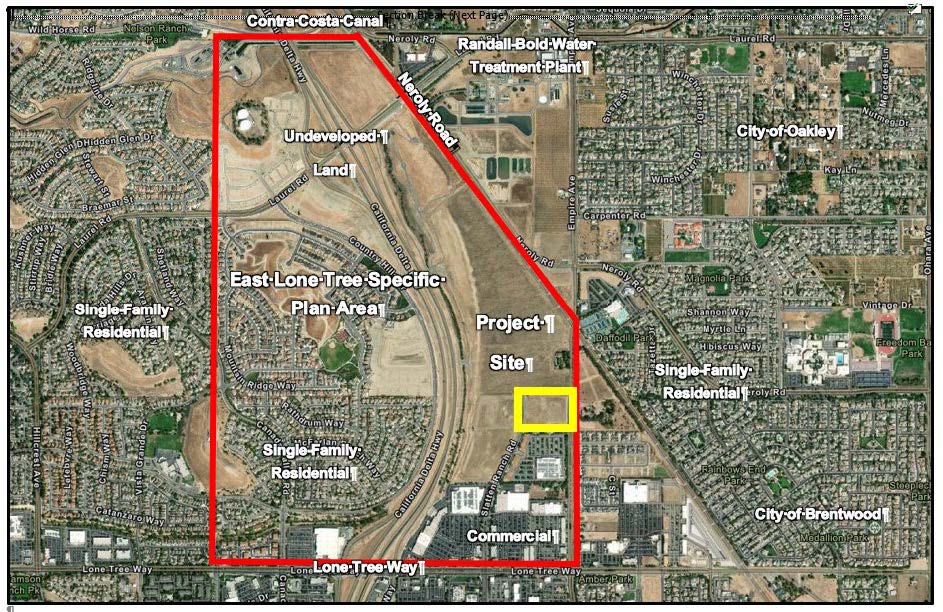
East Lone Tree Focus Area Map and Slatten Ranch Townhome Project location (in yellow box). Source: City of Antioch
Dana Tsubota, Chief Legal Officer of DeNova Homes said, “We’re happy to have conversations with all of the staff members. We’ve gone through two years of detailed review with staff. We’re happy to continue to have those discussions. When we build something, we’re in partnership with the City for a very long time.
We are limited by the City’s objective standards,” she continued. To make sure all the pieces fit and have all the units in the project as the City is requiring. If there is something we can do we’re happy to.”
“There’s a period of time between an approval and building permit…to ameliorate or soften the impact…there’s a certain amount of latitude we have to change the site plan,” said Antioch Interim Community and Economic Director David Storer.
“This council saw it for the first time a little over a month ago,” said Mayor Ron Bernal.
He then asked about Empire Avenue saying, “Historically, it’s been a joint project with the City of Brentwood. There is no condition of approval for them to build one-half of the street on their side. If this builder doesn’t build it…it falls back on the City and we don’t have any money…we don’t have an impact fee.”
“The center median is not included,” said Scott Buenting.
“Who will build it?” Bernal asked about the additional lane of traffic on the west side of Empire Avenue adjacent to the project.
“We have curb and gutter on our side,” Buenting responded.
“Why isn’t this project being conditioned to do it?” Bernal asked about the widening of Empire Avenue next to the project.
“I’m not sure,” said Buenting.
“I’d like to add it as a condition of approval. As long as Antioch fulfills our responsibility, for our half of the street,” Bernal stated.
“You’ll have to ask the applicant,” Storer responded.
“We’d be happy to look at a specific proposal,” said Golub. “But we don’t necessarily see a nexus of impact by this development. It could be very costly.”
After a 10-minute break for City staff to consult with the developer’s representatives, Interim City Attorney Derek Cole said, “To deal with this issue, there will be a general conditions that will require the improvements to the road…that will allow us to work with the applicant to reduce the concerns of the impacts of nexus. I believe we have to hear from the developer on this.”
Storrer then proposed some language for the council to consider for the additional condition of approval on the road widening.
The developer’s attorney Dan Golub. “I think we just heard there’s an objective standard. The time has come and gone. We’re willing to sit and work with you on this.”
“It’s an arterial design standard,” Bernal stated.
“I must go on the record opposing this. The outcome of that would be something we could agree to. We will work with you,” Golub stated.
Bernal, in violation of Roberts Rules of Order, then made a motion to approve the project with the added condition that the developer is required to improve Empire Avenue to one-half arterial road standard with consultation with Design Review and City Attorney.”
In proportionate share,” Cole added. “The City Engineer will make that determination.”
“From Wicklow to the north property line of the project,” Bernal added.
Rocha seconded the motion which passed 3-1 with Freitas voting against.
Rendering of proposed Wildflower Station Back-Back Townhomes. Source: DeNova Homes
Don’t Approve 159 Wildflower Station Townhomes on Tie Vote
The Council then received a brief presentation on the 159-unit Wildflower Station Townhomes 2 Multifamily Residential Project planned for the four-parcel, 10.35 acre vacant property near the intersection of Hillcrest Avenue and Deer Valley Road and bordered by Wildflower Drive to the east and the road next to the KFC restaurant in the Hillcrest Crossroads shopping center which also serves the existing condo development.
“According to our General Plan, developers are supposed to pay their way,” said former Councilman Ralph Hernandez during Public Comments. This project has been another one that’s being dumped on the city, not properly mitigated. You have to charge the right amount of money…for our police services. The project right next door is already telling you how dangerous it is.” He was referring to the condo project previously built and units sold.
Alora McGuire spoke next “on behalf of Contra Costa Residents for Responsible Development”, representing union members and residents in Antioch and surrounding areas. She said the group did not want the council to oppose the project but wanted the developer to address noise impacts.
Jason Buster of Plumbers and Steamfitters union Local 159, representing 300 Antioch families that are members of other unions, including electricians and sheet metal workers. “We advocate for projects that are more sustainable and equitable for the city of Antioch. We’re proud of our work to reduce the environmental impacts of projects.”
“The project is fully exempt from CEQA due to SB330,” said DeNova’s attorney Golub. “We’re very willing to fence and gate this property. It’s not an objective standard. But it doesn’t mean we’re not willing to consider it.”
Proposed Wildflower Station Townhomes 2 Project Site Map. Source: DeNova Homes
Wilson asked, “Why was the commercial piece removed from this plan?”
“This is a Housing Element site, and it was rezoned with the update,” Meredith said.
“That’s unfortunate,” Wilson stated even though she approved the rezoning during a council vote.
Rocha then made a motion to approve the project.
“Obviously, it was intended at one time to be a mixed development. But that was changed in 2023,” he stated.
Wildflower Station Townhomes 2 Site Map. Source: City of Antioch
Bernal seconded the motion and without further discussion the council did not approve the project on a two-two tie with both Freitas and Wilson voting to oppose.
“The motion does not carry. This does not preclude us from continuing the item until we have a fifth member present,” Cole explained.
Bernal then made a motion to continue the item until the Council’s next meeting on Tuesday, Nov. 4th. (It will be held instead of the normal second Tuesday, which falls on Veterans Day, Nov. 11th. Rocha seconded the motion and it passed 4-0.
Renderings of the proposed Slatten Ranch Townhomes (above) and Wildflower Station Townhomes (below). Source: DeNova Homes
DeNova Homes proposes129-unit Slatten Ranch Townhomes Project, next to J.C. Penney store which Freitas strongly opposes and 159-unit Wildflower Station Townhomes 2 Multifamily Residential Project on Hillcrest Avenue near Deer Valley Road
“I am furious that this is being shoved down our throats. I do not want to give up some prime property for economic development.” – District 3 Councilman Don Freitas
By Allen D. Payton
The two proposed housing projects by DeNova Homes will return for the Antioch City Council to consider during their meeting on Tuesday, Oct. 28, 2025. An indictment by the U.S. Attorney’s Office for the Northern District of California of the company’s co-founder and his vice president son for alleged bribery of an Antioch Councilman last year was announced in April.
The alleged bribe was related to a previous project in Antioch, known as Aviano, a multi-phase, 533-unit single-family home residential development in the Sand Creek area on the south side of the city.
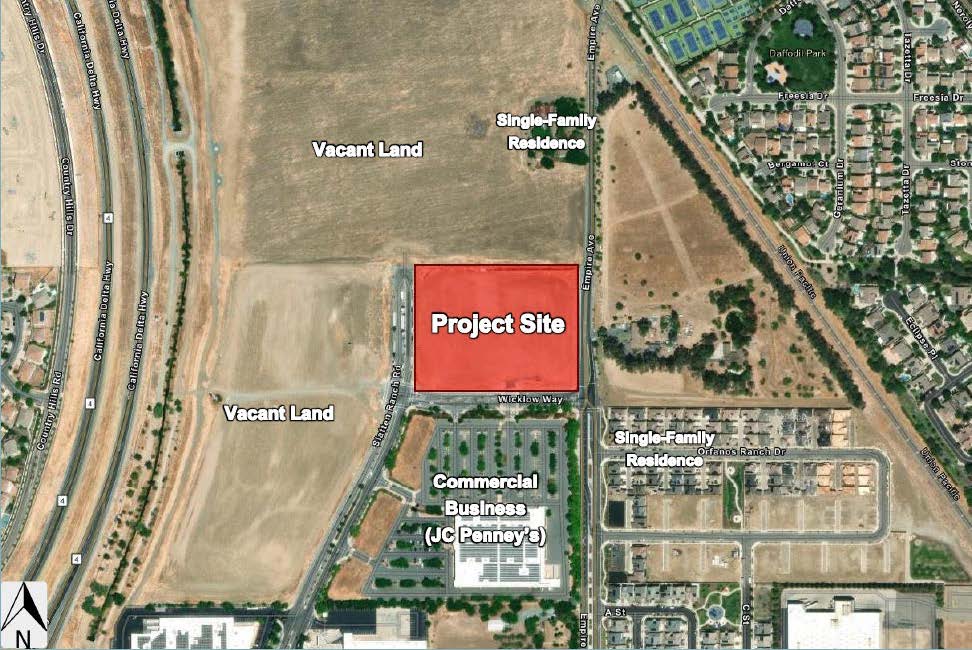
Proposed Slatten Ranch Townhome Project Location Map. Source: DeNova Homes
The two developments are the proposed 129-unit Slatten Ranch Townhomes Project (#5 on the agenda), located on a 6.41-acre vacant project site north of Wicklow Way next to the J.C. Penney store, east of Slatten Ranch Road and west of Empire Avenue; and the 159-unit Wildflower Station Townhomes 2 Multifamily Residential Project (#6 on the agenda) planned for the four-parcel, 10.35 acre vacant property near the intersection of Hillcrest Avenue and Deer Valley Road and bordered by Wildflower Drive to the east and the road next to the KFC restaurant in the Hillcrest Crossroads shopping center which also serves the existing condo development.
Wildflower Station Townhomes 2 Site Map. Source: City of Antioch
The Council previously considered the projects during their meeting on Sept. 23, 2025, but postponed both to Tuesday’s meeting following opposition from the public and council concerns. District 3 Councilman Don Freitas offered the strongest opposition to the Slatten Ranch project which is planned for the East Lone Tree Focus Area. The 200 acres north of Hwy 4 and east of Laurel Road were set aside by the City Council in 1998 and planned for commercial and economic development for the creation of local, well-paying jobs. But the previous council rezoned a portion of the property to allow for housing.
“I have lots of problems with this particular project. It’s both a blessing and a curse,” he stated then shared that during his years as mayor from 2000-2008, “J.C. Penney’s came forward and locate on the site they eventually built on,” due to the freeway access.
“That area was envisioned as one of the most important economic development sites in the City of Antioch,” Freitas continued. “This project doesn’t belong in this space. That’s why I oppose this project.”
“While housing is critical, so is economic development,” he added. “I am furious that this is being shoved down our throats. I do not want to give up some prime property for economic development.” (See 3:01:51 mark of meeting video)
However, plans for the housing projects were submitted under SB 330, the Housing Crisis Act of 2019 (D-Skinner), which Freitas referenced, and gives development special provisions in the approval process, which, among other things, limits the total number of hearings by a local government agency.
Slatten Ranch Townhome Development Plan. Source: DeNova Homes
City staff recommends that the City Council adopt the resolution approving the Vesting Tentative Subdivision Maps for both the development of the 17 Slatten Ranch Townhome and 19 Wildflower Station Townhome buildings and Design Review for the proposed architecture and landscaping for each project.
The meeting will be held in the Council Chambers at City Hall, 200 H Street, in Antioch’s historic, downtown Rivertown. They can also be viewed via livestream on the City’s website and the City’s YouTube Channel, on Comcast Cable Channel 24 or AT&T U-verse Channel 99.
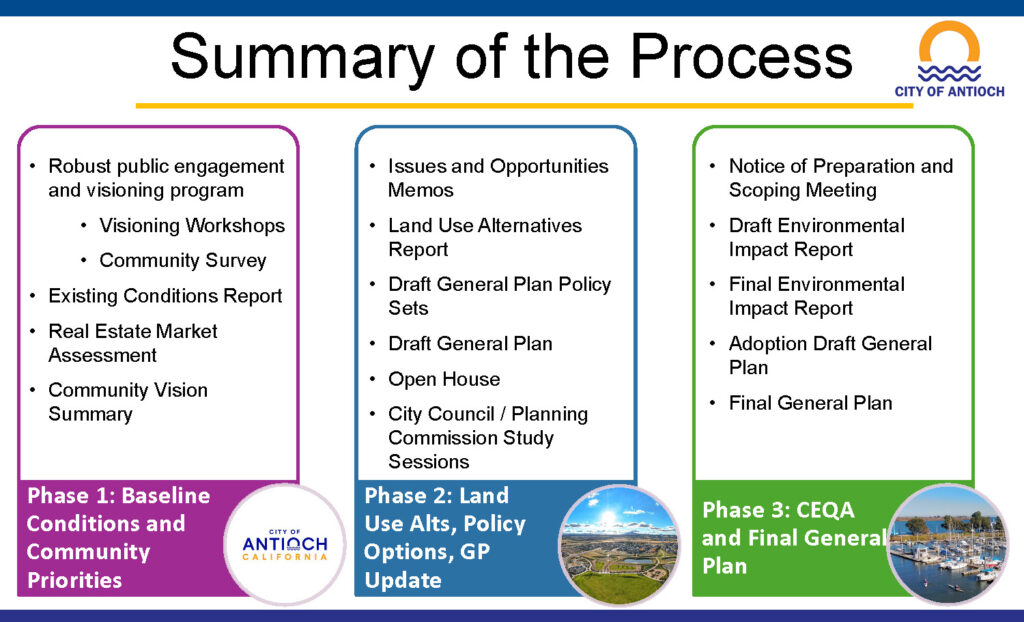
Join us for the General Plan Update Kickoff Meeting on Tuesday, October 21st at 6:00 PM at the Antioch Community Center in Prewett Family Park at 4703 Lone Tree Way.
This special joint session with the City Council and Planning Commission will serve as a “General Plan 101” and is a great opportunity to learn how Antioch plans for the future and how YOU can get involved!
Every city and county in California is required by state law to prepare and maintain a planning document called a General Plan. A General Plan is designed to serve as the jurisdiction’s “constitution” or “blueprint” for future decisions concerning land use, social issues, circulation, recreation, infrastructure, public services, environment, and resource conservation. This General Plan Update will ensure Antioch addresses recent changes in state law, proactively plans for future challenges and opportunities, prioritizes economic growth and vitality, and builds upon the City’s unique heritage and community-focused atmosphere. The update, through each element, will provide a basis for local decision making and involves the community in the process of identifying goals and policies to define how the City should respond to needs for physical development over time.
On August 26, 2025, the City Council selected the De Novo Planning Group team to prepare its General Plan Update. The team’s subconsultants will provide technical expertise: W-trans (traffic and circulation), EPS (economic development and fiscal sustainability), Kearns & West (community outreach), and Cogstone Resource Management (cultural and historical resources).
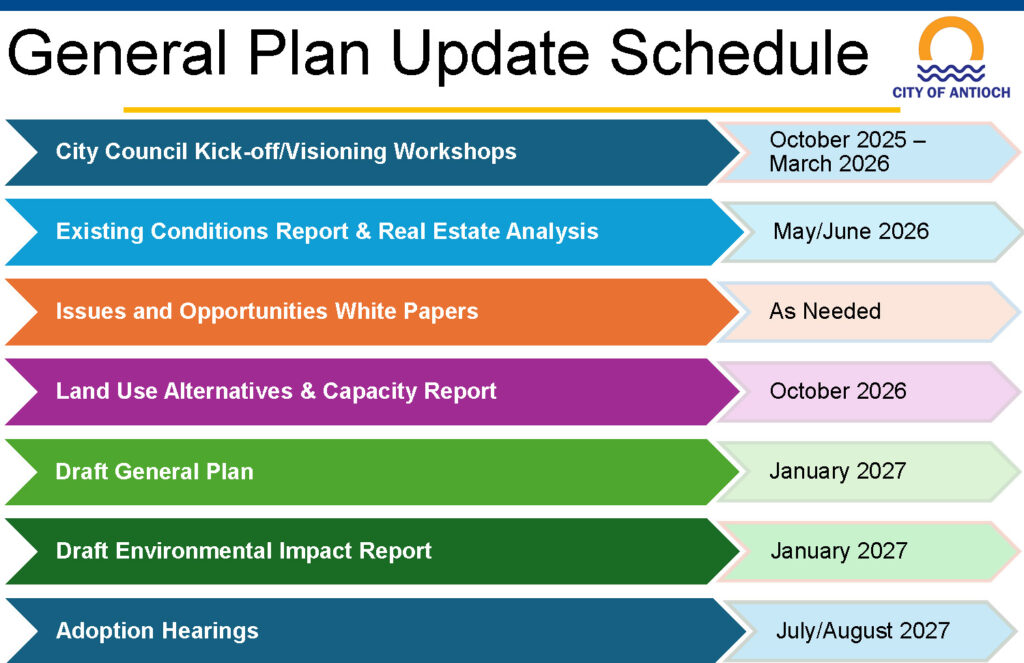
The process will occur over the next two years with the Draft General Plan to be issued in January 2027 and final adoption by the Council in July or August 2027.
Source: City of Antioch
The Council and Commission will hear and see the presentation from De Novo Planning Group regarding the General Plan Update process and provide staff and the consultant with input regarding the following:
Opportunities, Issues, and Priorities
1. What are the top three most critical issues or opportunities you believe this General Plan Update must address to best serve Antioch’s future?
2. Are there any specific geographic areas or corridors within Antioch (e.g., the waterfront, specific commercial districts, a neighborhood) that you feel require special attention or a focused vision during this process?
3. Beyond fulfilling state requirements, what key achievement or outcome will define this General Plan Update as a success for the City of Antioch?
Source: City of Antioch
General Plan Advisory Committee
The Council and Commission will also discuss forming an advisory committee.
To ensure the General Plan Update receives consistent and focused feedback, an advisory committee is often established. The structure of this committee is a key decision that shapes how community and technical input is integrated into the process. We seek direction on whether one should be established, and, if so, the preferred model for Antioch. Common options include:
• Option A: Community-Based Advisory: This is a committee appointed by the City Council, typically composed of 9 to 15 residents, business owners, and community stakeholders who represent a diversity of geographic areas, interests, and demographic backgrounds. With this approach, the GPAC would hold a series of public meetings to discuss General Plan topics and provide an opportunity for public comment. Locally, the City of Brentwood and Contra Costa County have used this approach for their General Plan Updates.
• Option B: Technical Advisory Committee: This approach relies on a committee of technical experts from City departments (e.g., Planning, Public Works, Economic Development) and key partner agencies (e.g., school districts, regional transit, utility providers). The TAC ensures the plan is technically feasible and coordinated. In this model, broader public input is gathered primarily through the visioning workshops, open houses, and focused community meetings rather than a standing citizen committee. The City of Pittsburg employed this approach for its recent General Plan Update.
• Option C: Hybrid Model with the Planning Commission: In this streamlined model, the Planning Commission serves as the primary advisory body, holding dedicated study sessions throughout the process to provide policy guidance. This approach prioritizes efficiency, leveraging the Commission’s existing knowledge of land use issues and is often supplemented by a staff-level TAC for technical review.
Let’s talk about the big picture: growth, housing, transportation, parks and more. Your voice matters in shaping the future of Antioch.
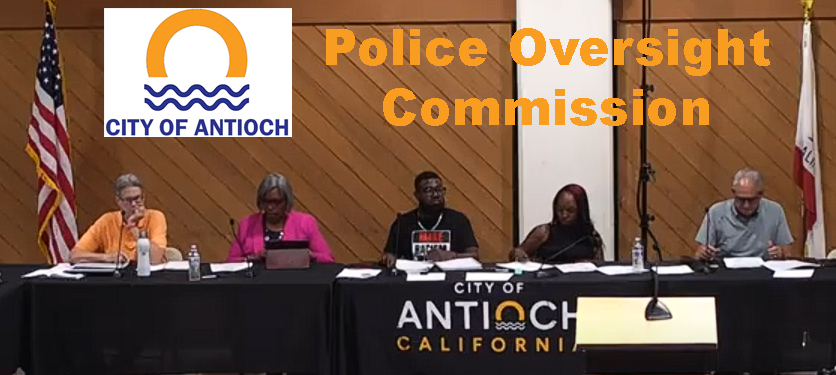
Video screenshot of the Antioch Police Oversight Committee on Sept. 15, 2025.
Would require background process for commissioners, allow current police officers from other agencies or former APD or other agency officers, family members to serve
By Allen D. Payton
During their meeting on Tuesday, Oct. 14, 2025, under agenda Item 1, the Antioch City Council will receive a staff report on the Antioch Police Oversight Commission and consider recommended changes to the ordinance.
According to the City staff report, “On July 7, 2025, staff sought input from the APOC regarding updates to this ordinance. APOC’s suggestions were reviewed and consolidated with the suggestions that staff now presents to the City Council. This collaborative effort aims to ensure that any revisions to the ordinance reflect community values, enhance oversight effectiveness, and support the City’s broader goals of transparency, accountability, and continuous improvement.
“This effort is being carried out in response to City Council direction and aims to identify opportunities to strengthen the Commission’s structure, clarify its authority, and improve its effectiveness. One of the main goals of this review is to ensure consistency with best practices in civilian oversight and to support compliance with the Memorandum of Agreement between the City of Antioch and the U.S. Department of Justice.”
The suggested amendments to the ordinance include the following:
Under Section 4-3.103 MEMBERSHIP AND APPOINTMENT, adding “the Chair, Mayor, and City Manager shall interview applicants and make recommendations to the Council”; adding a background process for commission applicants with information from personal interviews and social media reviews, and have them sworn in by the City Clerk or an authorized member of the Clerk’s Office;
Revise the language to read: “The Mayor and City Council shall strive to appoint and confirm members to the Commission with the intent of ensuring meaningful representation from individuals with diverse backgrounds and perspectives. While not required to include representation from each category listed below, and recognizing that some individuals may reflect more than one category, the following are important Factors to consider when making appointments:”
Delete the following sub-subsections which list the individuals currently ineligible to serve as a Police Commissioner: a) current sworn police officer or his/ her spouse; c) former Department sworn employee or his/ her spouse; or d) current or former employee, official, or representative of an employee association representing sworn police officers or his/ her spouse. The only remaining prohibition would be for a current City employee or his/ her spouse.
Under Section 4-3.104 TERMS OF OFFICE AND REMOVAL FROM OFFICE, adding the City Manager, Mayor, or any member of the City Council has the authority to make the recommendation; under subsection D) Regarding the removal of a Commission member add, “the City Manager, Mayor, or any member of the City Council has the authority to make the recommendation.” (4) – sub-subsection d) Regarding “absences from at least three meetings in a one- year span of time” delete word “unexcused;” (5) – sub-subsection e) Change to “violation of the APOC Rules of Decorum and conduct policy.”
Under Section 4-3.106 MEETINGS, subsection (A) – change to “at least once each month” and delete “July and December” language and that APOC would have the authority to hold additional meetings by majority vote.
Under Section 4-3.108 BUDGET, include a sentence that the funding will be incorporated into the City Manager’s budget, with the specific allocation amount determined during each budget cycle.
Under Section 4-3.109 TRAINING, Add a requirement that each Commissioner complete a police ride-along within the first 30 days of appointment and participate in at least two ride-alongs annually. Additionally, Commissioners must complete use-of-force simulator training within 90 days of appointment and annually thereafter. Commissioners are also required to complete all training outlined in the APOC Training Plan. Add a requirement that all training requests requiring city funding must be pre-authorized by the City Manager.
Under Section 4-3.110 POWERS AND DUTIES, Add “Personnel Complaints” to list of policies. Edit: subsection (B) “Work with the City Attorney to clarify the process for recommending changes to the specified policies. If APOC and the department agrees on the proposed changes, the Police Chief shall amend the policy accordingly. If APOC and the Department disagree, the proposed changes shall be forwarded to the City Council for final approval or rejection.” Under subsection (D) – Discussion of the requirement for APOC to review the proposed budget and conduct at least one public hearing.”
Addition: Temporary pause of APOC. The City Council has the authority to temporarily pause APOC. Such action may only be approved by a majority vote of the City Council and will be based on factors including, but not limited to, the Commission’s effectiveness, compliance with legal obligations, budget constraints, or shifts in city priorities. The temporary suspension cannot exceed three months within a rolling 12-month period. APOC does not have the authority to pause, without City Council Authorization.”
The City Council can also offer additional recommendations.
The meeting will be held in the Council Chambers at City Hall, 200 H Street, in Antioch’s historic, downtown Rivertown. They can also be viewed via livestream on the City’s website and the City’s YouTube Channel, on Comcast Cable Channel 24 or AT&T U-verse Channel 99.