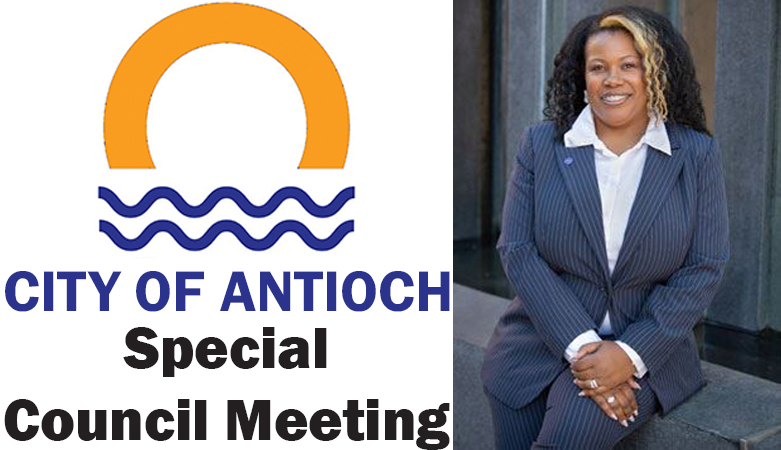








Antioch City Manager Bessie Scott’s performance will be evaluated by the city council Tuesday afternoon, May 5, 2026. Photo: City of Antioch
Deal with possible lawsuit by city employee during special meeting before another budget study session
Staff does not provide baseline budget to council as requested but shows annual deficits for this, next two years
By Allen D. Payton
CORRECTION: This reporter and members of the community misinterpreted the intent of the agenda items for today’s City Council Closed Session meeting. Because nothing was agendized to discipline or release a city employee, it was not possible for the Council to discuss terminating City Manager Scott.
During a special afternoon Closed Session meeting today, Tuesday, May 5, 2026, the Antioch City Council will discuss City Manager Bessie Scott’s performance evaluation, then deal with a potential lawsuit from an unnamed city employee and appoint an interim city manager. That means Scott could be placed on paid leave. That meeting begins at 4:00 p.m. It will be followed by another budget session at 5:30 p.m.
Scott started in October 2024 and just completed 19 months in her position out of her two-year contract. As previously reported, she was hired on a split, 3-2 City Council vote in August 2024.
The fact that City staff did not provide “a baseline budget that represents only the required minimum municipal services that the City has to provide” for the 2026-27 Fiscal Year, as requested by the mayor, according to the staff report for the Budget Study Session, that may be one of the reasons for the Council’s actions.
The Closed Session agenda reads as follows:
1) PUBLIC EMPLOYEE PERFORMANCE EVALUATION: CITY MANAGER.
This closed session is authorized pursuant to California Government Code section 54957(b)(1).
2) CONFERENCE WITH LEGAL COUNSEL- SIGNIFICANT EXPOSURE TO LITIGATION. The city is in receipt of facts and circumstances that might result in litigation against the City which are known to a potential plaintiff and that pertain to potential employment-related claims by the potential plaintiff against the City. This closed session is authorized pursuant to California Government Code sections 54956.9(d)(2) and 54956.9(e)(2). Number of cases: One.
3) PUBLIC EMPLOYEE APPOINTMENT: ACTING CITY MANAGER. This closed session is authorized pursuant to California Government Code section 54957.
The legal matter may be a possible lawsuit by Scott if she is being terminated for cause and the council doesn’t plan to pay her six months of severance included in her contract. But that is mere speculation as the agenda provides no other information to the public.
Mayor Ron Bernal and the four council members were asked why they’re holding a meeting to fire the city manager and hire an acting city manager at 4:00 p.m. when most people can’t attend. They were also asked why now when she only has six more months on her contract.
Only Freitas responded with, “They Mayor is responsible for setting the agenda. And, due to confidentiality I am legally prevented from discussing this matter with you.”
Additional efforts to reach Bernal and efforts to reach Scott were unsuccessful prior to publication time.
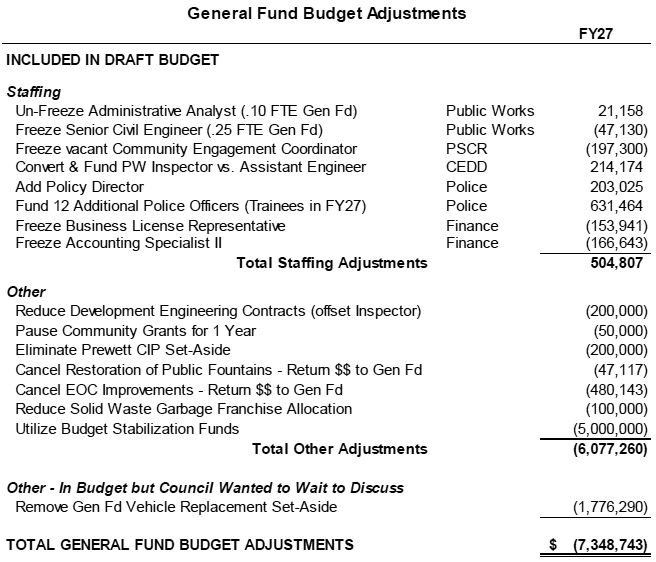
Adjustments from City Council meeting on April 28, 2026. Source: City of Antioch
Budget Study Session – Includes Deficits for This, Following Two years
For the special Budget Study Session beginning at 5:30 p.m., City staff did not provided the Council with the requested baseline budget. The staff report for the one agenda item reads, “At the Special Meeting of April 21, 2026, the Mayor requested that staff provide a baseline budget that represents only the required minimum municipal services that the City has to provide; to then afford the City Council to layer upon that budget to address priorities. As stated by the City Manager and Finance Director, with only 9 weeks to go until the City is required to adopt a budget, this is an impossible exercise to complete in such a short time frame to ensure we have time to research legal mandates as well as do a thorough review of departmental expenditures for what ‘qualify’ as the bare minimum and what is considered to be beyond the minimum. Should Council want to pursue this budget process, it is recommended to start this in August for building the Fiscal Year 2027-28 budget and potential mid-year adjustment for Fiscal Year 2026-27.”
Furthermore, the staff report reads, “With the budget as presented this evening, Council will need to determine what the acceptable level of deficit they are willing to proceed with and potentially direct specific cuts to incorporate if the Council is not willing to adopt this budget.”
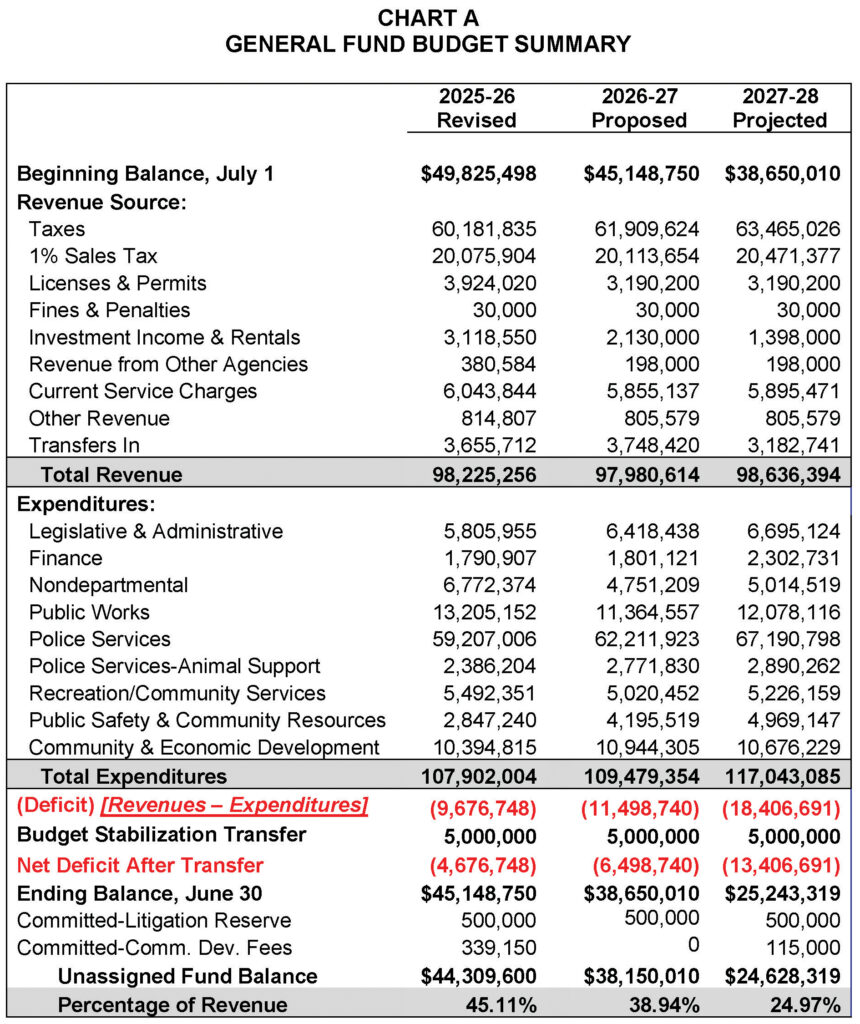
Included in the proposed budget are the adjustments the Council proposed at their meeting on April 28th which amount to almost $2.4 million in cuts, plus, the $5 million transfer from the Budget Stabilization Fund.
Source: City of Antioch
Even with those cuts and an annual transfer of $5 million from the Budget Stabilization Fund, the General Fund Budget Summary shows an ending deficit for this year of $4.7 million, proposed for the 2026-27 Fiscal Year of $6.5 million and projected for the 2027-27 Fiscal Year of $13.4 million.
The Closed Session will begin and the Budget Study Session will be held in the Council Chambers at City Hall located at 200 H Street in Antioch’s historic, downtown Rivertown. They can also be viewed via livestream on the City’s website, on Comcast Cable Channel 24 or AT&T U-verse Channel 99 and a recording posted later on the City’s YouTube Channel. The public can speak before the Closed Session to give input prior to the council adjourning to the closed door meeting.
Oversight Committee not holding Council accountable to 80-10-10 split
By Allen D. Payton
The City of Antioch is supposed to be spending the funds from Measure W’s one-cent sales tax measure, passed by the voters in November 2018, on an 80-10-10 split, with 80% for maintaining public safety, 10% for youth services and the remaining 10% to support quality of life, and fiscal stability and accountability. However, the 2023-24 budget spent only 60% of Measure W funds on police, last year’s budget increased the amount to 65.4% and the current fiscal year’s City budget allocated 70%. Plus, last year’s budget only allocated 4.6% to Youth Network Services.
Funds in Fiscal Year 2024-25 instead were spent on Code Enforcement and homeless services, as well as street lighting and landscaping.
According to the adopted 2025-26 City Budget, “The adopted fiscal year 2023-25 budget allocated 60% of funds to the Police Department, 20% to Quality of Life and 20% to Youth. For fiscal year 2025-26, City Council is allocating 70% to the Police Department, 15% to Quality of Life and 15% to Youth” ignoring the original intent of the council that voted to place the measure on the ballot.
City of Antioch Measure W Funding allocations FY25 versus FY26 Budgets. Source: City of Antioch
Sales Tax Citizens’ Oversight Committee Report
According to the Sales Tax Citizens’ Oversight Committee Fiscal Year 2024-25 Annual Report on Measure W provided to the City Council on March 24, 2026 (relegated to the Consent Calendar under agenda item 5.N.), “In FY24, the City received $20,160,685 in Measure W revenue and allocated funds at 60% Police, 20% Quality of Life, and 20% Youth.”
For the fiscal year that ended June 30, 2025, “The largest share of Measure W funds—65.4%, or $13,077,475—was directed to the Antioch Police Department. These funds supported a portion of police personnel costs ($40,376,709 in total department personnel expenditures) and services and supplies ($11,436,353). Measure W revenue represents approximately 24.5% of the Police Department’s total FY25 expenditures of $53,413,941, sustaining patrol operations, 911 response capacity, and related public safety services.”
Also, according to the report, the other Measure W revenues were spent in FY 2024-25 in order of greatest amount to least, as follows:
Recreation 15.4%;
Code Enforcement 8.6%;
Youth Network Services 4.6%;
Quality of Life 4.4%; and
Landscape Enhancements 1.6%
Source: City of Antioch Sales Tax Citizens’ Oversight Committee FY2024-25 Report.
2024-25 Measure W Expenditure Report Details
Under section 3 entitled, “Alignment with City Council Stated Priorities” the report offers details for each of those expenditure categories, but does not identify which council stated the priorities nor cite when that occurred. The report reads as follows:
Youth Violence Prevention and Community Safety
The Public Safety and Community Resources (PSCR) Department received $878,748 (100% Measure W funded) for Quality of Life programs. Within the department’s broader operation, the Violence Intervention and Prevention unit had a budget of $281,094 with $137,814 expended, during the fiscal year while the Housing and Homelessness unit budgeted $351,575 and expended $207,645. Community Engagement budgeted $27,697 with $27,629 expended. These programs directly address community safety, violence intervention, and quality of life for Antioch residents.
Youth Afterschool and Summer Programs
A combined total of $3,998,811 in Measure W funds supported youth-focused programs. Youth Network Services received $919,813 (100% Measure W funded) for personnel ($477,538) and services and supplies ($442,275). Recreation received $3,078,998, representing 46.7% of the department’s total expenditures. Recreation’s programs include youth afterschool activities, summer programming, and community recreation services.
Code Enforcement and Community Cleanup
Code Enforcement received $1,714,021 in Measure W funds, constituting 81.6% of the division’s total expenditures. The division’s work addresses illegal dumping, nuisance abatement, and property maintenance standards—directly supporting the Council’s priorities of cleaning up parks and combating blight. Personnel costs totaled $1,785,197, with services and supplies at $314,916.
Landscape Enhancements
A total of $325,000 (100% Measure W funded) was transferred to the Lighting and Landscape Districts for maintenance and enhancements across the city’s public landscaped areas, contributing to park and neighborhood beautification.
History of Measure W
As previously reported, during their meeting on Tuesday, July 24, 2018, the Antioch City Council voted 5-0 to place a ballot measure that would extend and double the transaction and use tax, or sales tax, permanently from the half-cent sales tax of Measure C, passed in 2013, to one cent. (See related article)
The council members discussed the draft version of the proposed one-cent sales tax measure. It allocated 60% of revenue for the maintenance of public safety, 20% for youth services, and the remaining 20% for supporting quality of life and fiscal stability and accountability.

But during the meeting the council discussed changing these amounts from percentages of 60-20-20 to an 80-10-10 allocation had the support of three council members. That split was advocated for by both Councilwoman Lori Ogorchock, who included it in her motion which was seconded by Councilman Tony Tiscareno, and Mayor Sean Wright during his comments.
20-Year Sunset Clause, Public Oversight Added
Then during a special meeting on August 7, 20218, the Council on a 3-2 split vote, approved adding a 20-year sunset clause and including language to continue the Citizens Sales Tax Oversight Committee to the measure with then-Mayor Pro Tem Lamar Thorpe and Councilwoman Monica Wilson voting against. Placing the measure on the ballot required a two-thirds vote of the council, or favorable votes by four of the five councilmembers.
The council held another meeting two days later on August 9th at which the two who opposed it switched course. They joined the other three councilmembers for a unanimous, 5-0 vote to included both the 20-year sunset clause and citizens oversight language in the ballot measure.
Council Meeting Minutes on Measure W Votes
According to the minutes of the council meeting on July 24, 2018, the original motion is reported as follows:
“Councilmember Ogorchock moved to 1) Adopt the resolution of the City Council of the City of Antioch Calling for a Municipal Election on November 6, 2018 to Request City Voters Extend and increase the City’s Transaction and Use Tax from One-Half Cent to One Cent to Provide for Public Safety and 911 Service, Support Youth, and Maintain Other Quality of Life Services; and, 2) Enact an Ordinance of the City Council of the City of Antioch Submitting a Proposition to The Voters of the City of Antioch to Amend Article 4 of Chapter 5 of Title 3 of the Antioch Municipal Code to Increase the City’s Transactions and Use Tax from a Half Cent to One Cent and to Impose This Tax Until Repealed by the Voters. 3) Maintain Public Safety target for Antioch Police Department at 80 percent, support youth services 10 percent, support quality of life/fiscal stability and accountability at 10 percent.
Councilmember Tiscareno seconded the motion”
In addition, the minutes read, “Mayor Wright…noted that he would support 80 percent of the tax being allocated to public safety.”
However, following input from the city attorney and city clerk, the motion adopted by the council did not include specific allocation figures. According to the meeting’s minutes for the item: “Following discussion, Councilmember Ogorchock amended her motion. Councilmember Tiscareno agreed to second the amended motion, which was approved as follows:
“On motion by Councilmember Ogorchock, seconded by Councilmember Tiscareno, the City Council unanimously 1) Adopted a Resolution of the City Council of the City of Antioch Calling for a Municipal Election on November 6, 2018 to Request City Voters Extend and Increase the City’s Transaction and Use Tax from One-Half Cent to One Cent to Provide for Public Safety and 911 Service, Support Youth, and Maintain “Other Quality of Life Services; and 2) Enacted an Ordinance of the City Council of the City of Antioch Submitting a Measure to The Voters of the City of Antioch to Amend Article 4 of Chapter 5 of Title 3 of the Antioch Municipal Code to Increase the City’s Transactions and Use Tax from a Half Cent to One Cent and to Impose This Tax Until Repealed by the Voters. With the following changes:
Amending the Ordinance under the ‘Now, Therefore, Be It Resolved’ to read: ‘that the People of Antioch do ordain as follows:’
Striking the word ‘Proposition’ from the Ordinance and replacing it with ‘Measure’.”
Again, the additional clauses adding a 20-year sunset and citizen oversight to the measure were adopted at later meetings in 2018 before the measure’s final language was placed on the ballot.
Measure W Ballot Language
The final ballot language included in the measure which passed with 66.11% of the vote but only needed a simple, 50% plus, one vote was as follows: Antioch’s Quality of Life Measure. To maintain Antioch’s fiscal stability, police patrols, 911 emergency response, youth violence prevention programs; ensuring water quality/safety; repairing streets; cleaning up parks/illegal dumping; restoring youth afterschool/summer programs; other essential services; shall the measure be adopted approving an ordinance to renew the sales tax at the one-cent rate, raising approximately $14,000,000 annually, expiring in twenty years, with mandatory annual independent financial audits, and independent citizens oversight?
Although the first motion to place Measure W on the ballot, which had majority council support, included the 80-10-10 split, it is not part of the actual ballot language, meaning the city council is not bound by those amounts and can spend the funds in any way they deem necessary.
Page 2 of the Antioch Herald October 2018 edition.
Yes on W Campaign Message
Yet, that’s how the measure was sold to the voters and how Antioch residents expect the funds to be spent.
Since the measure passed, the new Department of Public Safety and Community Resources was formed, with attempts by some council members to redefine and expand the meaning of “public safety” in Antioch to include more than just police services. Yet, the campaign in support of Measure W was very specific.
In a letter to the editor on Oct. 30, 2018, then-Mayor Wright wrote, “Measure W gives us a choice to increase our financial ability to make our community safer, create more activities for our youth after school and to improve our quality of life.”
Plus, in a Yes on W campaign ad run on page two of the Antioch Herald October 2018 edition, under “The Whys on W” headline it read, “Maintaining 911 police response and number of officers patrolling the streets.” At the time, there were 97 sworn officers on the Antioch Police force.
That was in spite of the commitment by the city council of hiring 22 more police “immediately” from the funds generated by Measure C, the half-cent sales tax precursor to Measure W, which passed in 2013 when there were 90 sworn officers on the force.
The ad also offered the other Whys, including, “Maintaining quality of life and financial stability; Ensuring water quality and safety; Cleaning up illegal dumping; and Restoring after school and summer programs for youth.”
Committee’s Incorrect Claims
While the Oversight Committee’s report claims, “Expenditures across all funded departments were within budgeted amounts for FY25, demonstrating sound fiscal management of Measure W resources,” it’s clear the revenues have been not been appropriately allocated. In fact, past and current councils have been robbing Peter to pay Paul, as the old saying goes, which is what those who opposed the measure were afraid of.
Furthermore, the committee concluded its report claiming, “Measure W revenues for FY25 were expended in a manner consistent with the City Council’s stated priorities,” they’re ignoring the fact the council majority at the time they voted to place the measure on the ballot supported the 80-10-10 allocation split. So, even if the city council has since then, or in 2024 before adopting the FY 2024-25 budget, voted to change the allocation split of Measure W revenues, the funds were not “expended in a manner consistent with the City Council’s stated priorities” and are definitely out of alignment with the original intent.
Committee Needs to Represent and Advocate for Original Intent of the Council, Will of the Voters
Every year, the Oversight Committee’s report should include the city council’s original intent of allocating the revenue from Measure W on an 80-10-10 split and remind the current council members and public of that fact. Simply reporting how the council and City spent the funds based on information provided by City staff isn’t good enough. They need to hold the current council members accountable and advocate on behalf of the voters and residents of Antioch that they fulfill that intent. Otherwise, what’s the point of having an oversight committee? The members need to remember that although they were appointed to the committee by the city council, they’re not there to please the council but to represent the will of the people. Hopefully, the five new members who are expected to soon be appointed will.
Measure W funds listed as “1% Sales Tax” under Revenue Source. Source: City of Antioch
Council Needs to Return to Original Intent of Measure W Revenue Allocation
As the city council works to finalize the Fiscal Year 2026-27 budget they need to be reminded of the original intent of the allocation of Measure W revenues and increase the amount being spent on police to 80%. While it’s good the council has expressed support for increasing the total number of sworn officers on the Antioch Police force, the allocation of the correct percentage of Measure W funds should be a key part of that. The good news is the projected revenue from Measure W for the next fiscal year is expected to increase by almost $120,000 to a little over $20.1 million. So, that will help some and it makes the math simple: $16.08 million to police, $2.01 million to youth services and $2.01 million to quality of life budget items. It all comes down to priorities.
Application deadline for 5 vacancies: Friday, May 1st
By City of Antioch
The City of Antioch encourages residents to become involved in their local community. One way to do so is to serve on one of the various Boards, Commissions, and Committees. Any interested resident is invited to apply for the following vacancies by Extended Deadline Date: 5:00 p.m., Friday, May 1, 2026.
SALES TAX CITIZENS’ OVERSIGHT COMMITTEE
Three (3) Full-Term Vacancies, expiring March 2030
Two (2) Part-Term Vacancies, expiring March 2028
The Sales Tax Citizens’ Oversight Committee shall review the expenditures and report publicly how the funds from the City’s Measure W one-cent sales tax are being used to address the City Council’s stated priorities of maintaining Antioch’s fiscal stability, police patrols, 911 emergency response, youth violence prevention programs; ensuring water quality/safety; repairing streets; cleaning up parks/illegal dumping; restoring youth afterschool/summer programs; and other essential services. Each year, an independent auditor shall complete a public audit report of the revenue raised and its expenditure. The Committee’s review shall be completed in conjunction with the City’s budget process. The Committee’s report on its review, whether oral or written, shall be considered by the City Council at a public meeting before April 1 of each year. Any written report shall be a matter of public record.
The Council’s intent of Measure W is to split the revenue on the following basis: 80% for the maintenance of public safety, 10% for youth services, and the remaining 10% for supporting quality of life and fiscal stability and accountability. The sales tax passed by Antioch voters in November 2018 lasts for 20 years. (See related Herald articles here, here and here)
The official ballot measure language reads: “Antioch’s Quality of Life Measure. To maintain Antioch’s fiscal stability, police patrols, 911 emergency response, youth violence prevention programs; ensuring water quality/safety; repairing streets; cleaning up parks/illegal dumping; restoring youth afterschool/summer programs; other essential services; shall the measure be adopted approving an ordinance to renew the sales tax at the one-cent rate, raising approximately $14,000,000 annually, expiring in twenty years, with mandatory annual independent financial audits, and independent citizens oversight?”
Committee Seats: Seven (7) Members, 4-year terms.
Meetings: The Committee shall meet at least twice a year.
Staff Liaison: Dawn Merchant, City of Antioch Finance Director
Requirements:
Must be a resident of the City of Antioch.
At least one member of the Committee shall have a financial, accounting or auditing background.
Commissioners are required to submit the Fair Political Practices Commission (FPPC) Form 700 (Statement of Economic Interests) upon assuming office, and every year thereafter.
Commissioners are required to complete a 2-hour online AB1234 Ethics course within one year of their appointment.
Newly appointed and reappointed Members are required to take an Oath of Office administered by the City Clerk.
To be considered for the vacancy position(s), please complete an application and submit it to the City Clerk’s Office by the deadline date listed above. Applications are located on the City’s Website: www.antiochca.gov and may be picked up in person at Antioch City Hall, 200 H Street, Antioch, CA.
Please email your completed application to: cityclerk@antiochca.gov. You can also drop off your application (Attn: City Clerk) in the water billing drop-off box located in the parking lot just outside of Antioch City Hall.
Plus, this year’s National Night Out and Sister City activities; but no mention of Holiday Delites Celebration
By Allen D. Payton
During their special meeting budget workshop on Tuesday, April 21, 2026, the Antioch City Council directed staff to keep funding for four community events and activities. They include this year’s Juneteenth celebration, the July 4th celebration on the nation’s 250th Independence Day and the National Night Out event. Also, the council protected funding for this year’s Sister City activities with Chichibu, Japan.
While reviewing a list of Deficit Reduction Proposals from city staff, Council postponed decisions for several of the items asking for more information from staff, first. Those are expected at a Budget Session before next Tuesday’s regular Council meeting.
Council’s decisions on the Deficit Reduction Proposals for FY 2026-27 budget. Source: City of Antioch
“Since we’re hosting, this year, I’ll say ‘no’,” Mayor Pro Tem and District 3 Councilman Don Freitas said to the recommendation to “Pause Sister City Activities.” The other three council members and Mayor Ron Bernal agreed.
Following are the costs to the City’s General Fund budget for the four items:
Juneteenth – $54,606, which includes vendors, supplies and police staffing;
July 4th – $157,586, which includes fireworks, vendors, supplies and police staffing;
National Night Out – $3,842 for police overtime; and
Sister City activities – $15,000
City Finance Director Dawn Merchant asked the council members to confirm they were agreeing to only fund the three events, plus, Sister City activities, they each responded, “Yes.”
However, none of the council members or staff mentioned the annual Holiday Delites Celebration in December which wasn’t on the list for cutting. A question asking about funding for that event was sent to council members and staff.
UPDATE: Later, Bernal responded, “Forgot about that one. I’m sure we can add it when we do our next study session.”
Proposed budget cuts include cancelling annual July 4th celebrationduring nation’s 250th Independence Day
By Allen D. Payton
The Antioch City Council will hold a Special Meeting Tuesday, April 21, 2026, with Study Sessions on the Budget for Fiscal Years 2026-2027 and the Five-Year Capital Improvement Program for 2026-31.
Budget Study Session
The Council will discuss follow-up items from their meeting on March 24, 2026, including Position Vacancies, Consultant Services Contracts, Fiscal Year 2027 Fleet Replacements, American Rescue Plan (“ARPA”) funds remaining budgets, Budget Deficit Reduction Proposals totaling $5,360,641.
After transferring in $5 million from the Budget Stabilization Fund and making the proposed cuts, the City will end the 2027 Fiscal Year on June 30, 2027, with a $2,884,167 deficit.
One line item in the proposed budget cuts is to Cancel the 4th of July event. But it’s not clear if that is for this year during the nation’s 250th Independence Day celebration or for July 4th, 2027.
UPDATE: In response to questions for city council members and staff, Finance Director Dawn Merchant said, “This would be for this July. Although we pay for a lot of the expense to vendors in June, for accounting purposes, this is recorded as a ‘prepaid expense’ at June 30th and then booked as an expense in July 2026 since the actual event is in July. I hope this clarifies for you.”
Deficit Reduction Proposals for FY 2026-27 budget. Source: City of Antioch
Capital Improvement Program Study Session
According to the City staff report for the agenda item, the $74,359,000 Capital Improvements Budget for Revised Fiscal Year 2025/26 and $29,125,000 Capital Improvements Budget for Fiscal Year 2026/27 will be included in the City’s operating budget. Projects in the outlying years of the 5 Year Capital Improvement Program (CIP) 2026-2031 are for planning purposes and may be incorporated into future budgets.
The Council meeting begins at 5:00 p.m. in the Council Chambers at City Hall, 200 H Street in Antioch’s historic, downtown Rivertown. The meeting can also be viewed via livestream on the City’s website.
The Antioch City Council approved public financing for both the Joyfield at Lakeview Center and Buchanan Crossings apartments projects Tuesday night, April 14, 2026. Graphics source: City of Antioch
Opposes one, approves two others
By Allen D. Payton
During their meeting Tuesday, April 14, 2026, the Antioch City Council on split votes opposed public financing for one affordable apartment complex but approved it for two others. The three projects are part of the 10 Commercial Infill Housing (CIH) Overlay District parcels the council rezoned in 2022 that will allow extremely-low, very-low and low-income apartment complexes throughout the city. (See related articles here and here)
After an impassioned effort by Mayor Pro Tem and District 3 Councilman Don Freitas, public financing for the Hillcrest Summit Apartments received a 2-2-1 vote with Mayor Ron Bernal and District 2 Councilman Louie Rocha voting yes, Freitas and District 4 Councilwoman Monica Wilson voting no, and District 1 Councilwoman Tamisha Torres-Walker voting to abstain. That’s in spite of the fact the latter two voted for the CIH Overlay District rezoning and Bernal complained about how the four-story apartment buildings would look.
The proposed and City staff-approved Hillcrest Summit Apartments Location Map shows the buildings planned to be built immediately adjacent to the gas station and convenience store with a 24-7 car wash. Source: City of Antioch
At one point, things became contentious as Freitas responded to the project proponent, who was speaking via call-in and defending the project saying they didn’t create the zoning and were only following it, saying, “Shame on you” for designing the layout of the apartments the way they did.
The District 1 Councilwoman later explained her vote saying she abstained because she didn’t like the fact that, as Freitas pointed out, the 165 apartments are planned to be built immediately adjacent to the 76 gas station and 7-Eleven that has a 24-7 carwash on the corner of Hillcrest Avenue and E. Tregallas Road. Freitas wants the project to be redesigned with the apartments located on the other side of the 4.9-acre parcel. But due to the rezoning vote in 2022, the City Council has no say and all of the CIH projects only require staff-level, administrative approval without any public input.
The other two affordable apartment complexes also received split votes but were approved 3-2 with Freitas and Wilson voting against the public financing for both. That’s in spite of Bernal raising concerns about traffic at the Lone Tree Way, Golf Course Road and Bluerock Drive intersection. In response to City staff’s argument that the traffic levels would be the same as when the parcel was previously zoned commercial, the mayor pointed out that traffic from residential development occurs at different times than traffic from commercial development.
The 195-unit Buchanan Crossings CIH project, a multifamily rental housing project on 5.4 acres located at 3210 Buchanan Road next to the Grocery Outlet is being built by the same developer as the 233-unit Lakeview Center CIH, multifamily rental housing project. That will be located on 5.3 acres next to the CVS store on the southwest side of the aforementioned intersection. Wilson said she had received significant opposition to the project from residents.
The financing would not have been from City funds, and the Hillcrest Summit Apartments project developer can still obtain them through another local agency, like the County, according to City Attorney Lori Asuncion. But the developer’s rep for the other two projects the council approved said, if they voted against the financing it would have killed both projects. That’s due to timing on the financing and because the dirt from the Lakeview Center Apartments project will be used as fill for the Buchanan Crossings Apartments project. Yet, a majority of council members approved the public financing for both.
“Hardworking Californians face a severe shortage of affordable housing options, and minimum wage workers must work an average of 88 hours per week to afford a modest one-bedroom rental at fair market rates. The HOME Act will help change that,” said Representative Garamendi.
“The Senate’s affordable housing legislation includes my HOME Investment Partnerships Program, which, for the first time since 1994, will bring this crucial program into the 21st century,” Garamendi continued. “It will provide states and local governments with the funding needed to construct and rehabilitate affordable rental housing, as well as expand homeownership opportunities for working families. I’d also like to thank Senator Masto for introducing this bill in the Senate and Representative Beatty for co-leading in the House.”
On February 9th, Garamendi voted in favor of the Housing for the 21st Century Act (H.R. 6644), which passed the House with strong bipartisan support. Then, on March 12, the Senate overwhelmingly passed the 21st Century ROAD to Housing Act. The bipartisan bill combines elements of both the House and Senate-passed legislation. The 21st Century ROAD to Housing Act includes 18 sections drawn from both the House and Senate bills, including Garamendi’s HOME Act.
This comprehensive housing package will take important steps to boost the nation’s housing supply, improve affordability, and increase oversight and efficiency of federal regulators and housing programs.
HOME Background
The HOME Investment Partnerships Program (HOME) is the largest federal affordable housing block grant and is HUD’s flagship affordable housing production program.
Since 1990, HOME has helped state and local housing agencies support a wide variety of housing needs, from financing new construction and home repairs to funding down payment and rental assistance. It also provides additional funding to housing developments financed by the Low-Income Housing Tax Credit, helping the program serve more extremely low-income people, including seniors, veterans, those experiencing homelessness, and people with disabilities.
Since 1992, the HOME program in California has:
Invested $5.27 billion into housing across the state;
Built or preserved 121,727 homes;
Given rental assistance to 43,840 families;
Supported 277,318 jobs; and
Generated $19.2 billion in local income.
The program was last re-authorized in 1994 and needs critical updates to better address today’s housing crisis. Garamendi’s HOME Investment Partnerships Reauthorization and Improvement Act would reauthorize the HOME program and make several much-needed improvements. Specifically, it would:
Authorize $5 billion in HOME funding for fiscal year 2024 and boost the funding for the program by five percent annually through 2028. Garamendi’s legislation would address chronic underfunding of the affordable housing investment program, which received only $1.5 billion in 2023;
Improve HOME’s ability to provide downpayment assistance to homebuyers and home repair assistance to homeowners;
Enable HOME funds to support Community Land Trusts and other shared equity homeownership programs; and
Increase access to HOME funds for nonprofits and provide state and local governments loan guarantee options that would allow them to leverage their future HOME funds for investments today.
Representative Garamendi has spent his entire career advocating for affordable housing, robust homeowner protections, and rental assistance programs. As California’s first-ever elected Insurance Commissioner, Garamendi successfully implemented Proposition 103, which reformed the homeowner insurance industry and lowered homeownership insurance rates.
In 2023, Garamendi and Rep. Zoe Lofgren (D-CA) led members of California’s congressional delegation in sending a letter to California Insurance Commissioner Ricardo Lara urging him to use his power under state law to protect homeowners in the face of an insurance crisis. During his congressional tenure, Garamendi worked with Habitat for Humanity to establish a financing mechanism that utilized existing funding to build new veteran housing units.
The Office of Congressman John Garamendi has also worked with local partners to increase access and support the development of affordable housing projects throughout California’s 8th Congressional District including: Contra Costa County Board of Supervisors, East Bay Housing Organizations, Tiny Village Spirit, Eden Housing, Multi-Faith ACTION Coalition (MFAC), Hope Solutions, Interfaith Council of Contra Costa, Crankstart Foundation, and the California Association of Housing Authorities.
The bill is endorsed by: Hercules Vice Mayor Alexander Walker-Griffin, Hercules Council Member Dilli Bhattarai, Richmond City Council Member Cesar Zapeda, National Council of State Housing Agencies, Institute of Real Estate Management, National Association of Hispanic Real Estate Professionals, National Association of Realtors, Enterprise Community Partners, National Apartment Association, National Multifamily Housing Council, National NeighborWorks Association, National Community Development Association, National Alliance of Community Economic Development Associations, National Association of Local Housing Finance Agencies, Council of State Community Development Agencies, National Coalition for Asian Pacific American Community Development, Local Initiatives Support Corporation, Grounded Solutions Network, and Habitat for Humanity.
Garamendi represents California’s 8th Congressional District in the U.S. House of Representatives which includes the northern and western portions of Contra Costa County and a majority of Solano County.
Will discuss oversight of Special Education funding
“…we need to ensure everyone, including presenters, can attend.” – Trustee Dee Brown
By Allen D. Payton
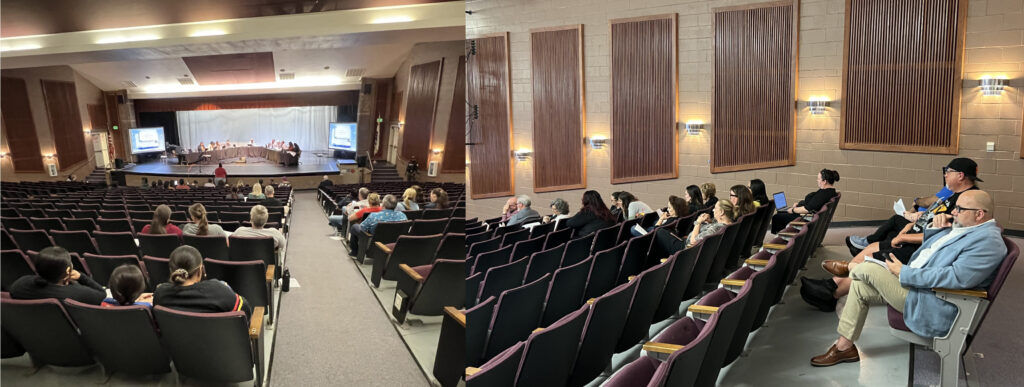
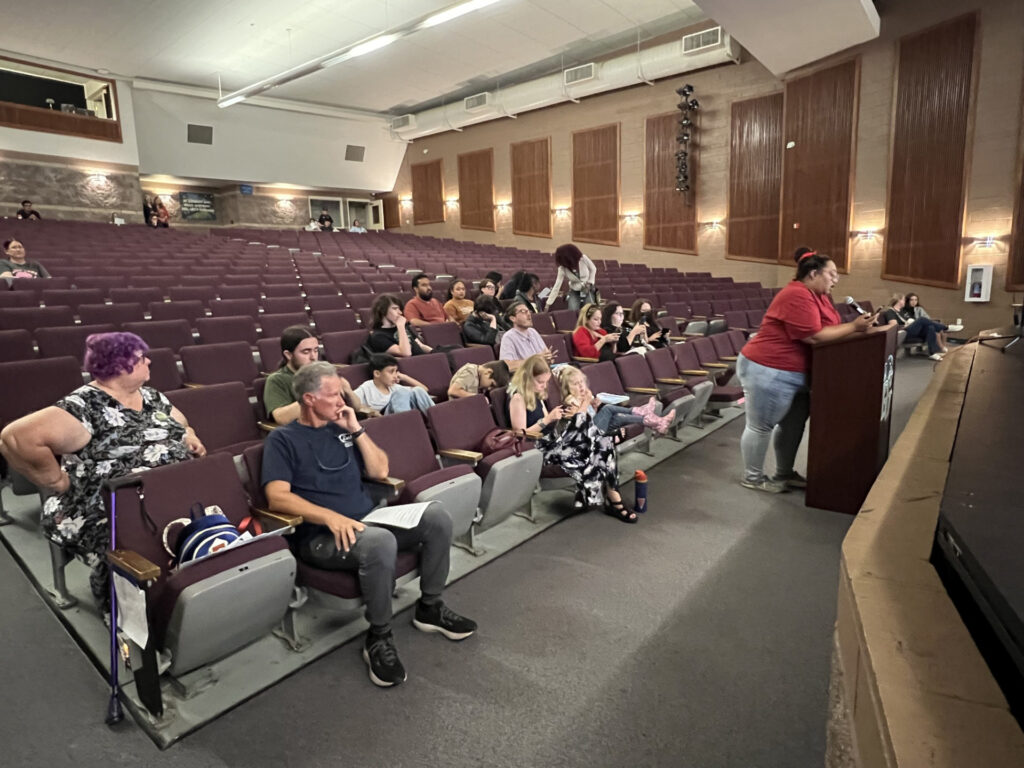
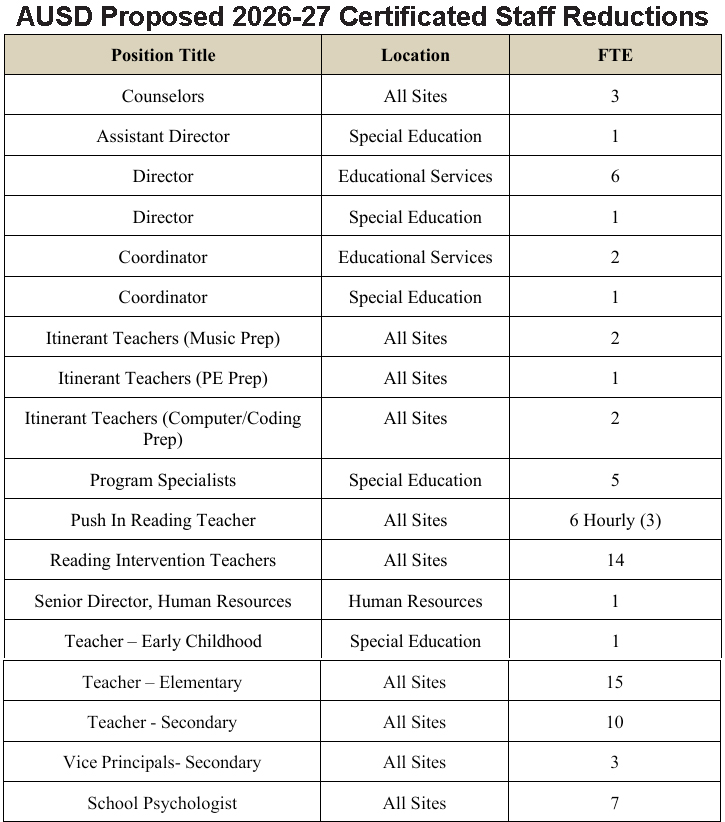
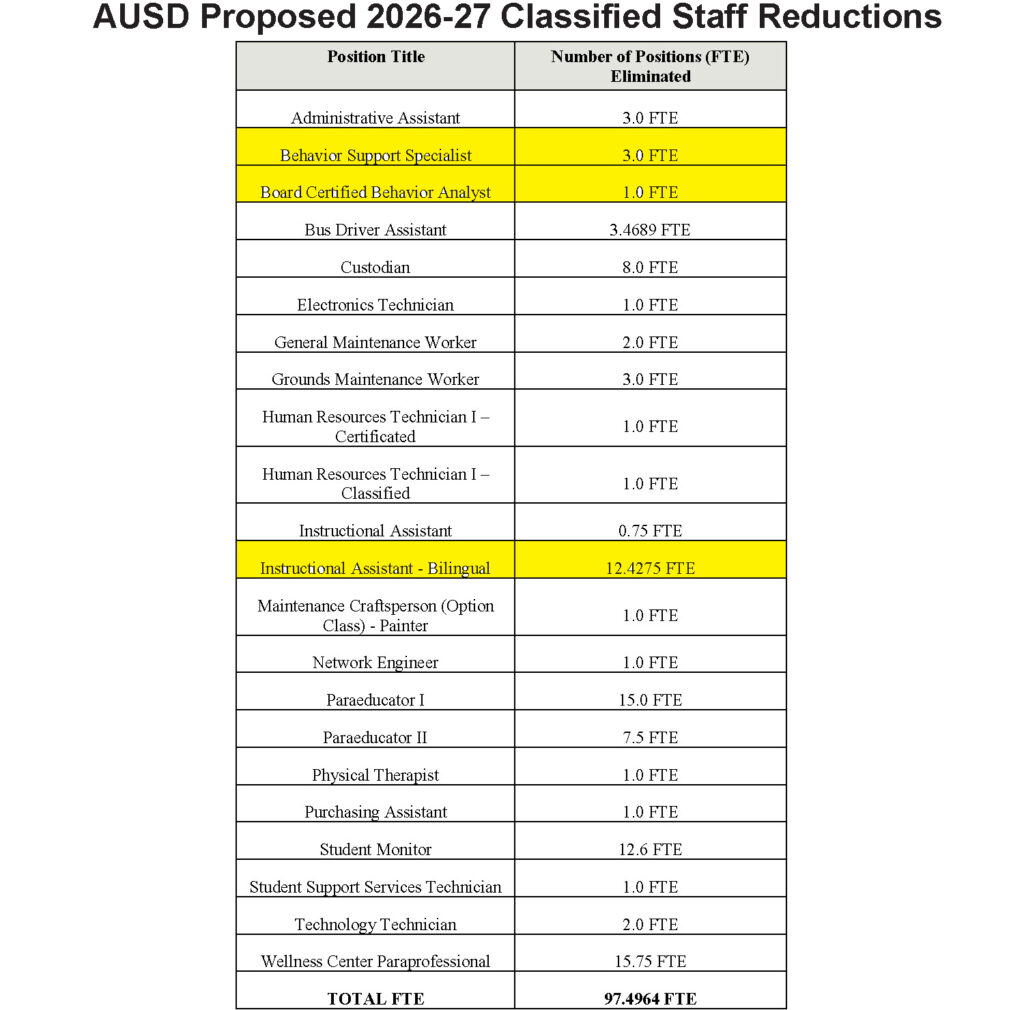
Facing a $32 million deficit, the Antioch Unified School District Board of Trustees will hold a Budget Study Session during a special afternoon meeting on Thursday, April 9, 2026.
According to the agenda, “The purpose of the Budget Study Session is to strengthen Board–District oversight of Special Education funding by examining spending practices, ensuring alignment and compliance, discussing reductions, and identifying opportunities for improved monitoring, transparency, and accountability.”
However, there are no attachments to the agenda, including no staff presentation for the board members to study or discuss. They do have presentations from their Feb. 11th and March 11th meetings.
Questions for Board
Board President Jag Lathan and the other four members were asked why they are holding the Budget Study Session this Thursday at 4:00 p.m. when most residents they represent can’t attend and provide input especially when the District is facing a $32 million deficit and so many budget cuts are proposed.
They were also asked why not have it after the Closed Session at 5:30 p.m. and why have it on a Thursday instead of on a Wednesday night like when their regular meetings are held.
Lathan, who is also running for County Superintendent of Education, has an auto response from her official District email which reads, “Thank you for your message. Your experience and input are invaluable in helping us reach our goals. Due to the high volume of emails, I may not be able to respond to each one. However, I make every effort to read all messages and respond when possible.”
But neither she nor three of the other school board members responded on the record.
4/9/26 UPDATE: However, in a post on her official Facebook page and a message to the Herald, only Trustee Dee Brown responded. She wrote, “Hello AUSD community. There have been several messages asking why today’s meeting was scheduled for 4:00 pm.
When planning a meeting, we need to ensure everyone, including presenters, can attend. This day and time is best for everyone who will be a part of the meeting.
Understanding the time is not ideal, which is why those who would like to go back and watch the replay to take notes will have the opportunity to do so and can forward any questions over to us. I know this is probably not the best response for our community, but it is an honest response.”
A Budget Collaborative, consisting of principals, teachers, classified employees, parents and district staff leadership, will be meeting again on April 13th and 22nd.
At 5:30 p.m., the Board will adjourn to Closed Session for labor negotiations with four employee organizations. They include the Antioch Education Association made up of the District’s teachers, California School Employees Association, Chapter 85, also known as Classified staff; Antioch Management Association and Senior Management.
The Agency Negotiator will be Associate Superintendent Dr. Camille Johnson for the first two employee organizations, Superintendent Dr. Darnise Williams for the third, and Williams and Legal Counsel Scott Holbrook for the fourth negotiation.
The meeting will be held in the District Office Board Room at 510 G Street in Antioch’s historic, downtown Rivertown. It can also be viewed live on the District’s YouTube channel.