






Archive for 2026

City of Antioch reveals details of $5.21 million in settlement payments from class action civil rights lawsuit

Thursday, March 5th, 2026

Range from $37,500 to $725,000 paid to 18 plaintiffs last year, but lawsuit not finalized; two who received large payouts are serving 19 and 20 years in prison for voluntary manslaughter

By Allen D. Payton

While one portion of the class action civil rights lawsuit against the City of Antioch, specific police officers and former chiefs was settled for just attorney’s fees, 23 plaintiffs also settled their claims last year with 18 receiving payouts costing millions.

During a press conference held on Friday, Dec. 19, 2025, John Burris, civil rights attorney for the plaintiffs, called the settlement “historic” and a “win-win” and explained, “There were two parts of the case, one involving the individuals, which we settled, 23.”

Although the settlement announced that day only cost the City plaintiffs’ attorney’s fees for close to $155,000, the City paid out $5,210,000 in 18 of the 23 settled cases that were never announced publicly, nor information provided until now. Some of the cases were past the statute of limitations so those plaintiffs received a lesser payout.

On Monday, February 9, 2026, the City responded to a Public Records Act request submitted by the Herald on Dec. 20, for all of the settlement documents related to the class action civil rights lawsuit against the City showing the names of the parties, how much each was paid including the City’s portion versus the amounts paid by the insurance pool to which the City contributes. In addition, City Manager Bessie Scott’s prepared remarks offered at the press conference were also requested.

The settlements are associated with Trent Allen, et al. v. City of Antioch, et al., United States District Court, Northern District of California (Case No. 3:23-cv-01895-TSH), a class action lawsuit against the City, as well as police officers and chiefs. As previously reported, Allen is one of four suspects convicted of the 2021 murder of Arnold Marcel Hawkins and the attempted murder of Aaron Patterson. He and a variety of other plaintiffs claimed civil rights violations by the officers.

Oakland civil rights attorney John Burris and associates filed the lawsuit in April 2023, naming five then-current and former officers, for their racist and other offensive texts and mistreatment of citizens, plus, three past police chiefs, the City of Antioch and Does 1-100. (See related articles here and here)

Plaintiffs in the suit included Shagoofa Khan, Adam Carpenter, Joshua Butler, Diego Zavala, the son of Guadalupe Zavala, who was unarmed when he was shot and killed by police in 2021 after a seven-hour stand-off with police (whose last name is listed in the lawsuit as Savala), as well as Allen and Terryonn Pugh, whose murder case resulted in the release of the texts.

Honored as the 2017 Antioch Youth of the Year, Khan was the subject of one of the vile texts, was one of the lead protesters in the city in 2020, and arrested a few times including at former Chief Tammany Brooks’ farewell party in September 2021, and another time for felony arson in January 2021, the incident for which she was granted a settlement payment by the City.

Allen and Pugh are serving 19 and 20 years in state prison, respectively, for attempted murder and voluntary manslaughter

Settlement Details in Order of Date Signed

Shaquille Hilliard Settlement Agreement dated March 10, 2025, for $37,500 over an incident on Jan.13, 2020.

Daniel Mackin Settlement Agreement dated March 10, 2025, for $650,000 over an incident on July 3, 2022. (See related articles here, here and here).

Mandingo Cain Settlement Agreement dated March 28, 2025, for $110,000 over an incident on July 3, 2022.

Marcell Lewis Settlement Agreement dated April 1, 2025, for $55,000 over an incident on July 3, 2022.

Gregorio Yarborough Settlement Agreement dated April 1, 2025, for $400,000 over an incident on July 3, 2022.

Adam Carpenter Settlement Agreement dated April 8, 2025, for $50,000 over an incident on Nov. 3, 2020. (See related article)

Shagoofa Khan Settlement Agreement dated April 8, 2025, for $150,000 over an incident on Jan.15, 2021. (See related article)

Jamari Allen Settlement Agreement dated April 8, 2025, for $600,000 over an incident on Aug. 21, 2021.

Joshua Butler Settlement Agreement dated April 8, 2025, for $65,000 over an incident on Feb. 3, 2022.

Terry Robinson, Jr. Settlement Agreement dated April 10, 2025, for $275,000 over an incident on July 1, 2022.

Danyel Lacy Settlement Agreement dated May 15, 2025, for $37,500 over an incident on July 3, 2022.

Dreshawn Jackson Settlement Agreement dated May 29, 2025, for $225,000 over an incident on Feb. 12, 2018.

Kardell Smith Settlement Agreement dated June 11, 2025, for $650,000 over an incident in 2019.

Jessie Wilson Settlement Agreement dated June 20, 2025, for $475,000 over an incident on Aug. 24, 2021.

Dejon Richards Settlement Agreement dated June 20, 2025, for $80,000 over an incident on Sept. 21, 2023.

Quincy Mason Settlement Agreement dated July 23, 2025, for $125,000 over incidents on Sept. 12, 2018, and Dec. 1, 2020.

Additional Settlements for Two Serving Sentences for Voluntary Homicide

Terryonn Pugh Settlement Agreement dated April 11, 2025, for $500,000 and Trent Allen Settlement Agreement dated May 11, 2025, for $725,000 over an incident on March 31, 2021. (See related articles here and here)

As previously reported, on March 9, 2021, Terryonn Deshawn Pugh, Trent Allen, Eric James Windom and Keyshawn Malik McGee engaged in a shooting in the City of Antioch wherein they discharged firearms at a vehicle in a residential neighborhood. The barrage of bullets killed Arnold Marcel Hawkins and injured another person.

The four defendants were charged on a six-count felony complaint with enhancements in November 2021 and on May 6, 2024, the Contra Costa District Attorney’s Office reached a resolution in the 2021 murder of Hawkins and the attempted murder of Aaron Patterson.

In resolving the case, the four defendants entered pleas of no contest to the following:

Terryonn Pugh: No contest on two counts of attempted murder and voluntary manslaughter – with an additional punishment for the use of a firearm. He was sentenced on May 8th, 2024, to 20 years in state prison.

Trent Allen: No contest on one count of attempted murder and voluntary manslaughter — with an additional punishment for the use of a firearm. He will also serve a concurrent term for an unrelated robbery. Allen was sentenced on May 10th, 2024, to 19 years in state prison.

Eric Windom: No contest on one count of attempted murder and voluntary manslaughter — with an additional punishment for the use of a firearm. He will also serve a concurrent term for a robbery that is unrelated to this case. Windom was sentenced on May 8th, 2024, to 19 years in state prison.

Keyshawn McGee: No contest on one count of attempted murder and voluntary manslaughter — with an additional punishment for the use of a firearm in both the murder and voluntary manslaughter charges. McGee was sentenced on May 10th, 2024, to 13 years, 8 months in state prison.

The four were part of the arrests of 48 gang members and associates during a complex, six-month investigation involving 24 agencies, for murder, attempted murder and illegal guns. The effort removed 40 firearms, including 15 “ghost guns” off the streets and over $100,000 in cash. (See related article)

City Manager’s Press Conference  Comments

During the press conference on Dec. 19, 2025, City Manager Scott said, “I want to start by acknowledging what this period has meant for people in Antioch. The last few years have been difficult and, for many residents, deeply unsettling. Trust was strained. Confidence in institutions took a serious hit. Many in our community have carried that weight in ways that don’t show up in headlines.

“Today reflects the culmination of a long, demanding process. It has taken ongoing effort, patience, and a willingness to stay engaged even when it was uncomfortable. I want to recognize the people who kept showing up and kept working.

“I’m grateful to John Burris and his team. We have approached this from different sides, but there was a shared understanding that Antioch needed a path forward that is durable and serious. That kind of alignment does not erase differences. It makes progress possible.

“I also want to thank our City staff and legal team for moving this work forward with discipline and care, and I want to recognize the community, residents, advocates, and neighborhood voices who insisted the City meet a higher standard and kept that expectation in front of us.

“I appreciate the Antioch Police Oversight Commission and City leadership for supporting forward movement, and for the decision to hire a Chief who reflects the values this moment requires. Leadership sets the tone and over time, it shapes culture.

“Today is about refusing to let the City remain defined by the failures and controversy that brought us to this point. Antioch deserves a government that listens, adjusts, and delivers. It deserves public service that is fair, professional, and consistent across every neighborhood and every interaction.

“As we move into the next chapter, our focus is steady execution, staying transparent about progress, and earning trust through sustained performance and measurable improvements.”

See KTVU FOX2 video of the Dec. 19th press conference.

Questions for Council, Staff

On February 9th, the day the PRA request was partially fulfilled, an email was sent to City Manager Bessie Scott, Mayor Ron Bernal and all four council members, Assistant City Attorney Kevin Kundinger who worked on the settlements, City Clerk Michael Mandy and City PIO Jaden Baird.

They were asked to provide the breakdown of how much was paid by the City for each of the 18 settlements and how much was paid by the insurance pool.

They were also informed that during the press conference attorney John Burris said there had been 23 cases settled and asked  for the information about the other five.

The PDF’s of each of the 18 settlements provided were incomplete as they do not include the signatures of the City’s legal representative on the settlements showing the dates each was finally settled. The final versions with the signatures and dates signed by the City’s legal representative were requested.

They were also asked why the City didn’t announce each of the settlements when they occurred last March, April, May, June and July based on the dates the agreements were signed by the plaintiffs and a representative of John Burris’ law firm; why did they wait so long to provide the details to the public and only after a PRA request was made and how is that being transparent.

Finally, they were asked why the lawsuit is still referred to as “Existing Litigation” and was discussed during the Closed Session of the City Council meeting on Tuesday, Feb. 10th if it’s all been settled.

Since no response was received from any of the city council or staff members, an email with the same requests and questions was, again sent on Feb. 24 and included City Finance Director Dawn Merchant in hopes she could share the amounts the City paid out on each of the 18 settled lawsuits and how much was paid by the insurance pool.

A meeting was then held with City Clerk Michael Mandy on Feb. 25th in another attempt to get the PRA request completely fulfilled. But still, no response was received.

Finally, all five council members and aforementioned City staff were emailed again on Feb. 26th, and included then-Interim City Attorney Derek Cole and Assistant City Clerk Christina Garcia.

Interim City Attorney Says Lawsuit Settlement “Not Currently Finalized”

On Friday, February 27, 2026, Cole responded, “In response, I note that much of what you ask about in your email are questions for comment, not requests for records under the Public Records Act.  This consolidated lawsuit remains active as the settlement agreement is not currently finalized and executed.  Therefore, neither our office nor City Administration believe it is appropriate to comment on your questions at this time.

“Further, to the extent you have stated proper requests for public records, we note that the City does not have an obligation until after the litigation has concluded to produce any response records.  (See Gov. Code sec. 7927.200(a).)  

“We do note that, to date, the City’s employment risk manager has paid nearly all of the legal fees and litigation costs for the consolidated action.  The City will have to reimburse these expenses after the conclusion of the consolidated action, but as of this time, the City does not have information it can share on what its ultimate share of the litigation expenses will be. 

“We also note that the City has agreed to pay the plaintiff’s attorney fees for this case and we do provide a copy of the order the parties entered into to effectuate that agreement.  The amount of the attorney fees to be paid is stated in the order.”

The order entitled, “Attorneys’ Fees Agreement” and dated Jan. 8, 2026, shows the City paid Plaintiffs’ counsel attorneys’ fees in the amount $154,902.50 to Burris Nisenbaum Curry & Lacy, LLP.

Nominations now open for Los Medanos College 2026 César Chávez Awards

Wednesday, March 4th, 2026

Deadline: March 11th

By Juliet V. Casey Geary, Director of Marketing & Media Design, Los Medanos College

We are pleased to announce the call for nominations for the 2026 César Chávez Awards is open. The awards celebrate the life of labor leader and human rights activist César Chávez and recognize East Contra Costa County community members who follow his example of service, activism and non-violent social change. 

Nomination form and event details are available on the event web page. Nomination deadline is Wednesday, March 11. 

See our call-to-action video.

Save the date for the awards ceremony, which this year will be held at 6 p.m. on Friday, April 3 in the Student Union at the LMC Pittsburg Campus, 2700 E. Leland Road. The event is free and open to the public, though space is limited.

Values of César Chávez:

  • Service to Others:  Empowering individuals by engendering self-determination, self-sufficiency and self-help, rather than charity.
  • Sacrifice:  Recognizing the obligation every individual has to contribute to their community, despite having to endure great hardship.
  • Help the Most Needy:  Supporting efforts to reach those in need, those dispossessed, and those most forgotten individuals.
  • Determination:  Instilling an attitude that through steadfast commitment, patience, and optimism, people can overcome great adversity. 
  • Non-violence:  Achieving social and economic justice and equality through bold and courageous action.
  • Tolerance:  Promoting and supporting ethnic and cultural diversity as a means toward informing and strengthening communities.
  • Respect for Life:  Holding land, people, and all other forms of life in the highest regard.
  • Celebrating Community:  Sharing expressions of cultural identity through art, song and dance.
  • Knowledge:  Pursuing self-directed learning, the development of critical thinking, and constructive problem-solving.
  • Innovation:  Creating strategies and tactics to resolve problems and situations that often seem insurmountable.

Awards recognize recipients in the following categories: 

César Chávez Award for Exemplary Community Service

The César Chávez Award for Exemplary Community Service recognizes a local resident who demonstrates a long-standing commitment to service and who best represents the core values modeled by César Chávez: Service to Others, Sacrifice, Help the Most Needy, Determination, Non-Violence, Acceptance of All People, Respect for Life and the Environment, Celebrating Community, Knowledge and Innovation.

East County Educator Award 

The César Chávez East County Educator Award recognizes a member of the educational community who demonstrates the qualities of César Chávez and a commitment to student success and equity, particularly for students of color and those from low-income families.

Chávez Spirit Award 

The César Chávez Spirit Award recognizes an emerging student leader who embodies the spirit of César Chávez and who within the past year affected change in the areas of advocacy and social justice.

About Los Medanos College (LMC): LMC is one of three colleges in the Contra Costa Community College District, serving the East Contra Costa County community. Established in 1974, LMC has earned federal designations as a Minority-Serving and Hispanic-Serving institution. It offers award-winning transfer and career-technical programs support services, and diverse academic opportunities in an inclusive learning environment. With exceptional educators, innovative curriculum, growing degree and certificate offerings, and state-of-the-art facilities, the college prepares students to succeed in their educational pursuits, in the workforce, and beyond. LMC’s Pittsburg Campus is located on 120 acres bordering Antioch, with an additional education center in Brentwood.

City of Antioch to host annual Eggstravaganza March 28

Wednesday, March 4th, 2026

With four Easter Egg Hunts!

By Antioch Recreation Department

Antioch families, plan to hop on over to your neighborhood park for a community-wide egg hunt on Saturday, March 28th!

The Recreation Department invites residents to enjoy a free egg hunt and festive photos with the Easter Bunny at a park near you. We will be coming to each district in the city, so gather your baskets, bring your friends and neighbors, and celebrate the season right in your own backyard. Take a look at our list of parks to locate the park closest to you:

Eggstravaganza – Easter Egg Hunts

Saturday, March 28, 2026

10AM-11AM

Contra Loma Estates Park | Mahogany Way

Gentrytown Park | Monterey Drive

12PM-1PM

Meadow Creek Park | Vista Grande Drive

Diablo West Park | 2000 Prewett Ranch Drive

For inquires contact recreation@antiochca.gov or call our front desk at (925) 776-3050.

Let’s fill our parks with smiles, laughter, and community spirit. We can’t wait to see you there!

Just five months on the job City of Antioch’s Community & Economic Development director no longer with City

Tuesday, March 3rd, 2026
The City’s Antioch Community and Economic Development Director is no longer with the City as of Tuesday, March 3, 2026.

Former interim director will return to the position; posting for new assistant city manager will occur soon

By Allen D. Payton

After just shy of five months on the job, the City of Antioch Community and Economic Development is longer in the position as of Tuesday, March 3, 2026. As previously reported, he started on Oct. 6, 2025.

When informed of his possible departure, City Manager Bessie Scott was asked, Tuesday afternoon, if the director had been terminated and for any details. She did not respond. City PIO, Jaden Baird was asked about the matter, but he was not aware of it and said he would contact Scott.

Then thanks to a resident who shared a copy of it with the Herald at 7:59 PM and chose to remain anonymous, it was revealed that Scott sent the following email entitled, “Staffing Update: Community and Economic Development Department” to “All City Employees” at 5:55 PM:

Hello Team Antioch,

I want to share an important staffing update. As of today…our Community and Economic Development Director, is no longer with the City. We thank him for his service during the time that he was here and wish him well in his future endeavors.

While leadership transitions are never easy, our focus remains on maintaining continuity in the important work of supporting Antioch’s economic growth and business community. In the meantime, we will be continuing with the ongoing economic development activities that are currently underway while we begin a formal recruitment process for a new Community and Economic Development Director. David Storer will be the Interim Community and Economic Development Director for the time being. 

Economic development remains a top priority for the City. We will continue advancing efforts to attract investment, support local businesses, and position Antioch for long-term economic vitality.

I appreciate the professionalism and dedication our staff brings to this work every day. As we move through this transition, I will keep you informed of next steps in the recruitment process.

Thank you for your continued commitment to serving our community. ~Bessie

Bessie Marie Scott, EMPA, CIG

City Manager

————

However, no announcement was provided to the local media to inform the public.

The following questions were then sent to both Scott and Baird:

“Was he terminated or did he voluntarily resign? Why after just six months on the job? Did he not meet expectations? Was he supposed to accomplish something that he didn’t? What did he actually accomplish during his brief tenure?” They were also asked for anything else they could share.

City Limited in What Can be Shared About Personnel Matters

UPDATE 1: In response, Baird wrote, “The City can confirm that (he) is no longer employed with the City of Antioch. As the City Manager shared with staff earlier this evening, we thank him for his service during the time he was here and wish him well in his future endeavors.

“Due to the confidential nature of personnel matters, the City is not able to comment on the circumstances surrounding an employee’s separation, including whether it was a resignation or termination, performance-related matters, or internal discussions.

“Economic development work will continue uninterrupted. David Storer will serve as Interim Community and Economic Development Director while the City begins a formal recruitment process for the position.

“This reflects the information the City is able to provide at this time. Thank you for your understanding.”

Baird and Scott were pressed further and asked, “If he was terminated, did he have a severance clause in his employment agreement, was that triggered and how much is that costing the City?”

New City Attorney Lori Asuncion started on Monday. Asked last week if she had considered, lately hiring an assistant city manager, Scott responded, “Yes! Posting coming out soon.”

Please check back later for any updates to this report.

Hidden Dragon Chinese restaurant in Antioch voluntarily closes after second shut down for dead rodents Dec. 9th

Tuesday, March 3rd, 2026
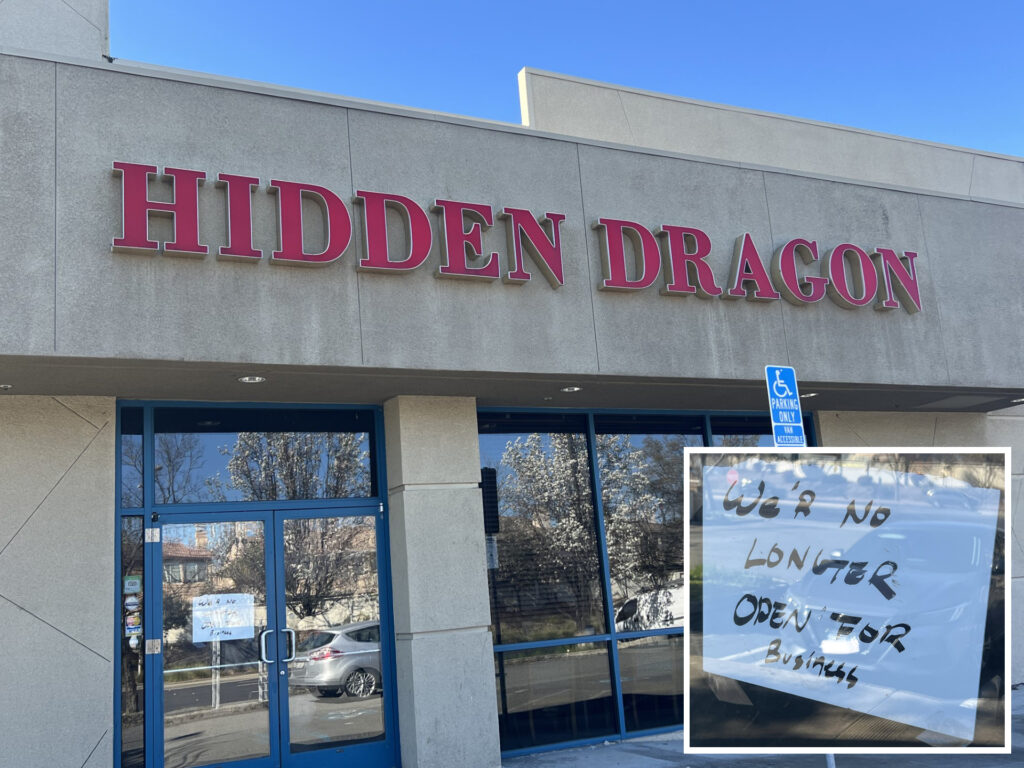
A handwritten sign in the window shows the Hidden Dragon Chinese restaurant on Lone Tree Way in Antioch is “no longer open for business.” Photos by Allen D. Payton

By Allen D. Payton

According to the Contra Costa Health Department’s Environmental Health Division, Hidden Dragon Chinese restaurant in Antioch was shut down last April for violations including insects, rodents referred to as rats and mice, birds or animals present. It was shut down again on Dec. 9th for some of the same problems. Both times the owners were instructed to, “Cease and Desist all food activities.”

Located at 4106 Lone Tree Way in the same shopping center at Dallas Ranch Road as the former Rite Aid and now closed Sherwin-Williams Paint Store, the restaurant reopened Dec. 12th following a re-inspection. Then, the owners voluntarily and permanently closed the restaurant in January. An Environmental Health inspector did not learn of that until attempting a re-inspection, yesterday, Monday, March 2, 2026.

The Food Facility Routine Inspection Report dated April 23, 2025, showed a Minor Violation for not having “6. Adequate hand-washing facilities: supplied and accessible. Minor Observations: A) Soap dispenser in employee restroom observed inoperative. B) No paper towels in wall-mounted dispenser in employee restroom. – Ensure all handwashing stations are accessible and stocked with soap and paper towels in mounted dispensers at all times. Corrective Action: Adequate facilities shall be provided for hand washing with soap & towels or drying device provided in dispensers; dispensers shall be maintained in good repair (113953, 113953.1, 113953.2).”

The Major Violation was listed as “22. No insects, rodents, birds or animals present.”

Source: Contra Costa Health Department Environmental Health Division

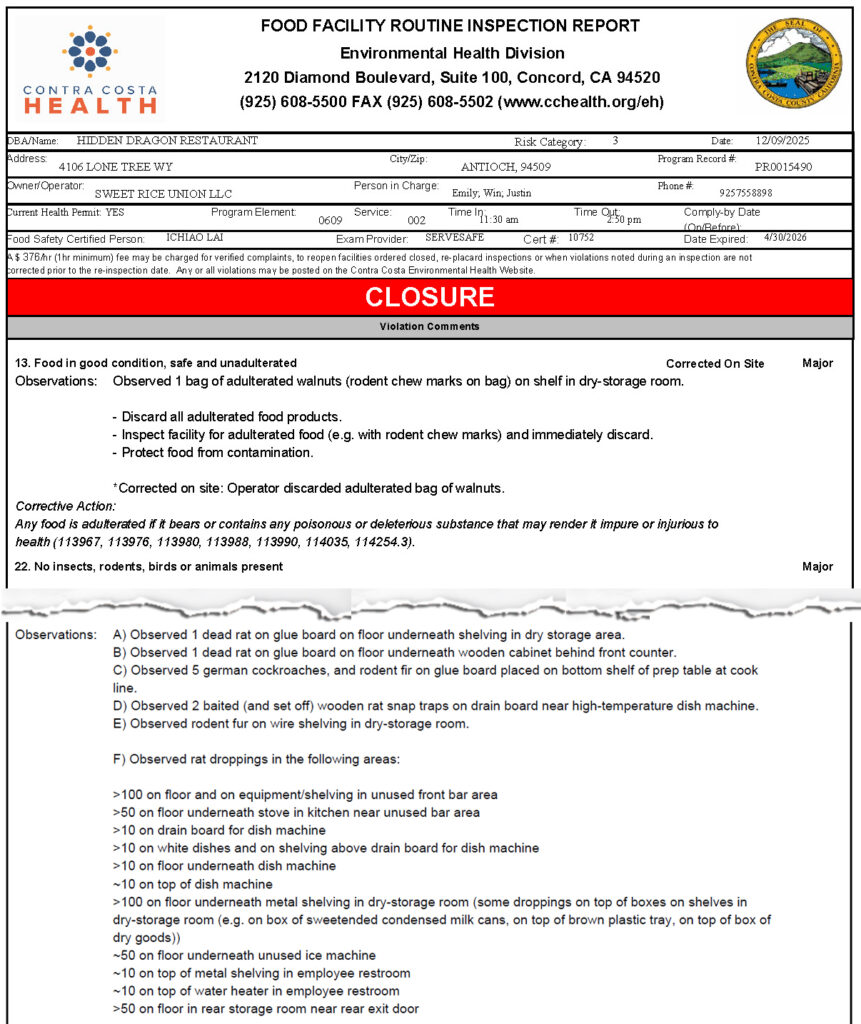
The Dec. 9th Inspection Report showed two major violations. It read:

13. Food in good condition, safe and unadulterated Corrected On Site

Observations: Observed 1 bag of adulterated walnuts (rodent chew marks on bag) on shelf in dry-storage room.

– Discard all adulterated food products.

– Inspect facility for adulterated food (e.g. with rodent chew marks) and immediately discard.

– Protect food from contamination.

*Corrected on site: Operator discarded adulterated bag of walnuts.

Corrective Action: Any food is adulterated if it bears or contains any poisonous or deleterious substance that may render it impure or injurious to health (113967, 113976, 113980, 113988, 113990, 114035, 114254.3).

22. No insects, rodents, birds or animals present

In addition, the report included details of the violations, including:

“A) Observed 1 dead rat on glue board on floor underneath shelving in dry storage area.

B) Observed 1 dead rat on glue board on floor underneath wooden cabinet behind front counter.

C) Observed 5 german cockroaches, and rodent fir on glue board placed on bottom shelf of prep table at cook line.

D) Observed 2 baited (and set off) wooden rat snap traps on drain board near high-temperature dish machine.

E) Observed rodent fur on wire shelving in dry-storage room.

F) Observed rat droppings”

The restaurant was again instructed to, “Cease and Desist all food activities.

– Remove dead rodents, dead cockroaches, and all rodent droppings from facility.

– Thoroughly clean and sanitize all affected areas (including but not limited to floors, shelves, dishes).

– Remove glue boards and snap traps from shelving and from dish-machine drain board. Do NOT place snap traps and glue boards on shelving or on drainboard for dishes.

– Obtain professional pest-control service. Email pest-control report to Daniel.Chavez@cchealth.org. Maintain copies of pest-control reports on site, available for review during inspections.”

County Health Staff Provide Details

When asked about the closure, Karl Fischer, Communications Coordinator for Contra Costa Health asked if there was a red placard in the window. When informed there was just a handwritten sign he said, “It sounds like they might have closed themselves. When we shut down a restaurant, we usually require them to post a red placard in the window.”

“Restaurants are required to close down if they don’t have water or if they have insects,” Fischer continued. “They might be shutting down because they know they have a problem and shouldn’t be serving food, right now.”

Contra Costa County uses a color-coded Placard Program for Permanent  and Mobile Retail Food Facilities to publicly report the results of food safety inspections, which includes green, yellow and red placards. Colors are determined based upon inspection findings with green meaning Pass, yellow meaning Conditional Pass and Red meaning Closed. A white placard stands for Placard Pending.

“As soon as they take care of it, they’re back in business. After a day or two, they’ll call us for a reinspection,” he added.

When informed of the report in April 2025 Fischer said, “The restaurant also got shut down on Dec. 9th for rodents.”

According to Kristian Lucas, the County’s Director of Environmental Health, “We regularly encourage all food facilities to self-close when there are any major issues that may affect public health and their food service as a result. Therefore, it may very well be that this facility chose to close on their own volition if Env Health did not officially close the facility.”

In an email, Tim Kraus, Supervising Environmental Health Specialist for Contra Costa Health then shared, “We did not close them permanently. It appears Inspector Daniel Chavez attempted an inspection yesterday and found the same sign mentioned below. His report indicates he communicated with the former owner via text message, who indicated they closed permanently in January of their own volition.  I’ve attached a copy of the report from yesterday since it doesn’t appear to have worked its way through to the website yet.  I’ve also attached the 12/9 routine inspection that resulted in a closure and the 12/12 reinspection where they were re-opened.”

“The last activity prior to yesterday’s inspection attempt that I see in our system was the re-opening inspection on 12/12/25,” he added.

The restaurant was incorporated as Sweet Rice Union, LLC. But the owners’ names are not listed on the Bizapedia page.

Kiwanis Club of the Delta-Antioch to host Annual Romano Marchetti Memorial Dinner March 14

Sunday, March 1st, 2026

Join the Kiwanis Club of the Delta-Antioch Club for the Annual Romano Marchetti Memorial Dinner fundraiser on Saturday, March 14th, 2026. Profits of the dinner, opportunity drawing and auction contribute to the support of Kiwanis community and youth charities.

The event will be held at the VFW Hall at 815 Fulton Shipyard Road in Antioch and begins at 5 PM with Social Hour and Silent Auction, 6 PM Dinner which includes two kinds of meat, pasta, baked beans, cole slaw, salad, ice cream and all the trimmings, catered by Chef Archie S&Q.

Plus, Opportunity Drawing and Live Auction!

Tickets are $60 each.

For tickets and information call: Archie Smith Jr. (510) 367-3452 archiesandq@gmail.com

Tickets are also available to purchase in person at Willow Park Mercantile 205 G Street, in Antioch’s historic, downtown Rivertown.

Thank you to our sponsors! Dr. Ali Shirani Dentistry, Snug As a Bug, East Bay Community Foundation and Beswick Family Fund.

Kiwanis is the Premier Community Service Organization Celebrating over 110 years serving the Children of the World, One Child, and One Community at a Time.

For more information about the club visit Kiwanis Club of The Delta-Antioch.

Antioch Police Department to host Sycamore Substation Grand Opening March 11

Saturday, February 28th, 2026
The Antioch Police Department’s Sycamore Substation is located in the Sycamore Square shopping center at the corner of Sycamore Drive and L Street. Photos by Allen D. Payton

By Jaden Baird, PIO, City of Antioch

ANTIOCH, CA — The Antioch Police Department will host a grand opening ceremony for its new Sycamore Substation in the Sycamore Square shopping center on Wednesday, March 11, from 5:30 p.m. to 7:00 p.m.

During their meeting on April 22, 2025, the Antioch City Council voted 5-0 to approve an 18-month lease agreement between the City of Antioch and Yahya Korin Sycamore Square, LLC for a Police Department Substation located at 1084 Sycamore Drive, at a cost not to exceed $33,127.50.

As previously reported by the Herald, the total approved by the council includes Lease Costs for monthly rent of $1.00 for three months and $840.00 for 15 months for a total of $12,603.00.

In addition, the council approved spending $10,524.50 for the City’s 50% share of the total $21,049.00 cost for Ballistic Glass and Installation as well as Substation Setup Costs including one-time expenditures for furnishings, signage, technology and operational readiness for $10,000.00.

The new substation represents a strategic investment in public safety infrastructure and community-based policing in Antioch. The project was supported in part by a $25,000 award through the Contra Costa County Community Impact Fund. The funding was recommended by District 3 Supervisor Diane Burgis and jointly supported by District 5 Supervisor Shanelle Scales-Preston, with each district contributing $12,500.

The funding was recommended for approval by Burgis and approved by the Contra Costa County Board of Supervisors. The allocation supports the department’s continued efforts to strengthen neighborhood safety and improve response capabilities in Eastern Contra Costa County.

City Manager Bessie Marie Scott expressed appreciation for the County’s partnership, stating, “I want to express our sincere gratitude for your decision to allocate funding to our police department for the Substation in Sycamore. Your commitment to public safety and to ensuring that our officers have the resources they need to serve our community is deeply appreciated. This investment strengthens not only the department, but the wellbeing of our neighborhoods as a whole. Thank you for your leadership, your responsiveness to community needs here in Antioch, and your dedication to keeping our city safe.”

The grand opening event will include brief remarks from City and County representatives and an opportunity to tour the facility.

Allen D. Payton contributed to this report.

BART Board votes 8-1 to close up to 15 stations if proposed Nov. tax measure fails

Friday, February 27th, 2026
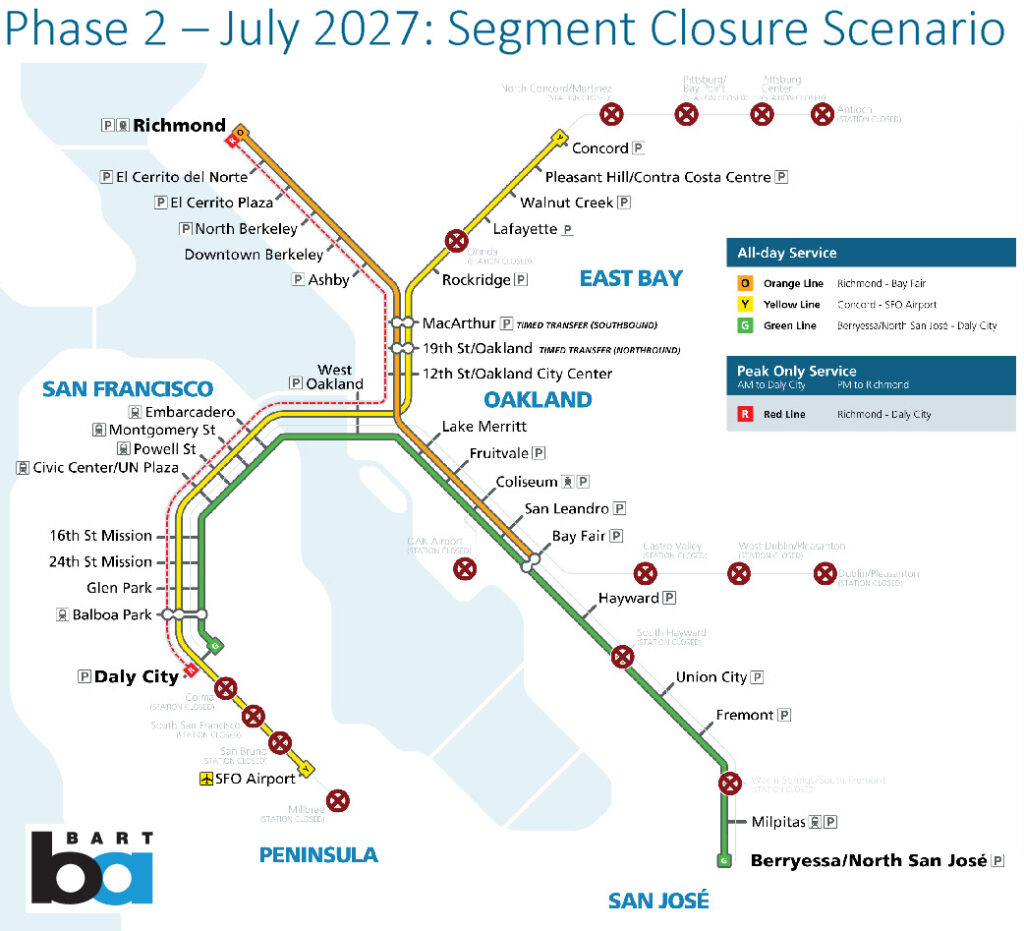
The BART Board voted to close all stations serving East County if the proposed Nov. sales tax measure fails. Source: BART

Contra Costa’s 4 representatives vote to adopt Alternative Service Plan to balance budget including 1,170 employee layoffs

Ridership still down 50% post-COVID

By Allen D. Payton

On Thursday, Feb. 26, 2026, the BART Board of Directors, on vote of 8-1, adopted an Alternative Service Plan outlining specific budget balancing details to solve a $376M deficit for the next fiscal year if no new funds become available to BART. According to a District press release, BART is facing a structural deficit of $350M to $400M because ridership is still down 50% compared to pre-pandemic levels and BART’s current funding model relies heavily on passenger fares. 

As previously reported by the Herald, the stations on the list for potential Phase 1 closure in January 2027 include the 10 lowest ridership stations: North Concord, Orinda, Pittsburg Center, Oakland International Airport, West Dublin/Pleasanton, Castro Valley, San Bruno, South Hayward, South San Francisco and Warm Springs/South Fremont.

Phase 2 Closures Include Antioch and Pittsburg/Bay Point Stations

The Phase 2 – July 2027 Segment Closure Scenario, Contingent on Phase 1 implementation, would result in a 70% reduction in train hours and 25% reduction in system miles; Segment closures would stop service on most system segments opened after 1976: Yellow line service would end at Concord, shuttering the Pittsburg/Bay Point and Antioch Stations; Orange line service would end at Bay Fair,; Blue line service would be discontinued shuttering the West Dublin/Pleasanton Station; Most stations south of Daly City would be closed except for direct service to SFO would continue for revenue retention; Service continues to Milpitas and Berryessa due to terms of BART/VTA agreements.

Based on Proposed Transit Tax Measure Failing

The plan is based on the assumption a sales tax increase measure proposed for the November ballot in five Bay Area counties fails. As previously reported, voters would be asked to consider a one-half sales tax increase in Contra Costa, Alameda, San Mateo and Santa Clara counties and a one-cent sales tax increase in San Francisco County. The 14-year regional transportation sales tax would generate approximately $980 million annually with 60 percent dedicated to preserving service on BART, Muni, Caltrain and AC Transit, as well as San Francisco Bay Ferry and smaller transit agencies providing service in the five counties to keep buses, trains and ferries moving, including WestCat, County Connection and Tri Delta Transit. About one-third of the revenue would go to Contra Costa Transportation Authority, Santa Clara VTA, SamTrans and the Alameda County Transportation Commission, with flexibility to use funds for transit capital, operations, or road paving projects on roads with regular bus service.

Also, as previously reported, an effort is underway to gather signatures to place the measure on the ballot. The sales tax increase would be in addition to the half-cent sales tax for BART operations in Contra Costa, Alameda and San Francisco counties in place since the 1960’s.

Motion and Vote Details

Following public comments and discussion among the Board members a vote was taken on the following motion: The Board adopts the attached Resolution “In the Matter of Initially Approving an Alternative Service Plan to Take Effect January 2027 in the Event the Connect Bay Area Measure Fails to Receive Voter Approval at the Statewide General Election on November 3, 2026 and BART is Unable to Secure Other Revenue Sources.”

The motion was made by District 4 Director Robert Raburn, seconded by District 1 Director Matt Rinn, and passed on a vote of 8-1 with the additional support of District 7 Director Victor Flores, District 2 Director Mark Foley, District 3 Director Barnali Gosh, District 8 Director Janice Li, Board Vice President and District 9 Director Edward Wright and Board President and District 5 Director Melissa Hernandez.

District 6 Director Liz Ames was the only member of the Board of Directors to vote “No”.

Foley represents portions of Central County and all of East County, Rinn represents portions of Central Contra Costa County, all of Lamorinda and most of the San Ramon Valley, Gosh represents all of West County and Hernandez represents portions of San Ramon.

Approved Plan Details

The plan includes specific cuts and financial strategies needed to balance both the FY27 (July 1, 2026-June 30, 2027) and FY28 (July 1, 2027-June 30, 2028) budgets. The plan includes service cuts, station closures, fare increases, a 40% reduction in system support services, laying off 1,170 employees and a series of deferrals and one-time resources. The plan does not name specific stations to be closed and makes clear the BART Board will be responsible for all decisions on station closures. You can read the Alternative Service Plan resolution, resolution attachment and presentation to the BART Board.

BART has already made budget cuts across all departments and instituted a series of cost controls, including rightsizing service, labor savings, operational efficiencies, and reducing BART’s office space footprint. At the same time, BART has also worked to increase revenue by installing new fare gates, leasing out BART parking lots, and offering new fare products such as Clipper BayPass. View a detailed list of cost savings implement by BART at bart.gov/fiscalcliff. 

Alternative Service Plan Details 

To take place in January 2027: 

  • 3-line service (Yellow, Blue, and Orange line service only, with limited peak service in only the peak commute direction on the Red and Green lines). 
  • 30-minute frequencies on every line.  
  • Closing at 9 pm seven days a week.  
  • This service plan represents a 63% reduction in train hours. 
  • 30% fare and parking fee increases (the estimated average fare would increase from $4.98 to $6.38). 
  • Target approximately $30M in savings over 6 months from non-service budget reductions to fleet and non-fleet maintenance, police, cleaning, and administrative support functions. 
  • Continue deferrals of priority capital allocations and retiree medical contributions. 
  • Balance remainder of FY27 with one-time resources and financial deferrals. 

Following the January 2027 cuts, staff will continuously assess ridership and revenue impacts and the performance of all District functions to determine if further reductions can be safely and legally implemented. 

To take place in July 2027 if feasibly safe: 

  • Target over $175M in annual cost reductions through a cumulative 70% reduction in service hours: 
  • Maintain 3-line service, 30-minute frequencies on each line, closing at 9pm. 
  • Close up to 15 stations and/or up to 25% of system track miles. 
  • The BART Board will be responsible for all decisions on station or line segment closures. 
  • Increase fares and parking fees up to a cumulative 50%. The estimated average fare would increase to $7.26. 
  • Target annual operating expense savings of more than a cumulative $130M from non-service budget reductions to fleet and non-fleet maintenance, police, cleaning, and administrative support functions. 
  • Continue to defer retiree health contributions; defer most remaining capital allocations. 

Contingency: 

  • If at any point it is determined BART can’t safely or legally operate with available resources, stop passenger service.
  • Use existing District tax revenues to secure system assets. 
  • Work to determine system’s future. 

Use of the State Loan  

BART can’t use state loan money to avoid station closures and service cuts if no new revenue becomes available because without new revenue, there is no way to pay the loan back. The state loan primarily helps with cash flow if a November 2026 transit funding measure is successful. It is a bridge loan that gives BART reassurances money will be available to continue to deliver the best service possible until the sales tax dollars from the successful ballot measure become available for BART’s use. This is projected to happen in July 2027 but could take longer. If a funding measure succeeds, BART will use $97M in loan funds to help balance the FY27 budget.