For kids in grades 3-8; deadline extended to Aug. 17
By Antioch Recreation Department
The field is calling — there’s still time to GET IN THE GAME! NFL FLAG Football registration has been EXTENDED through August 17!
Calling all kids in grades 3–8 — grab your friends and get ready to run, catch, score, and HAVE FUN! Whether you’re new to football or ready to show off your skills, we want YOU on the field!
Rookies (ages 8-10), All-Stars (ages 10-12), Champions (12-14)
DON’T MISS THE NEW DEADLINE: AUGUST 17!
Experience the speed, skill, agility and action of the gridiron without the contact associated with tackle football. This co-ed program will feature one 45-minute practice during the week followed by one 45-minute game on Saturday mornings. The goal of this program is to develop the skill of our young athletes while also exposing them to sportsmanship, teamwork and healthy lifestyles that so important to local youth; all while having fun. Each child receives their own NFL Flag Football Jersey and flag belt. Volunteer coaches receive a 50% discount from their child’s registration fee.
KP LAUNCH Program Coordinator Stephanie Ponce with Summer Intern Jessica Chambers and Jessica in her scrubs at Kaiser Permanente Antioch Medical Center. Photos: Kaiser Permanente
Including Antioch resident, an LMC student
By Elissa Harrington, Senior Media Relations & Public Relations Representative, Kaiser Permanente Northern California
Stephanie Ponce, an Antioch resident and student at Los Medanos College in Pittsburg, spent her summer interning at the Kaiser Permanente Antioch Medical Center.
She applied for the eight-week paid summer internship program, earning $25.09-$29.16 per hour, after taking a college course that piqued her interest in medicine.
“This is an amazing opportunity to see if health care is for you,” said Ponce. “There are many jobs in health care that aren’t just working with patients, but also administrative roles.”
Ponce is one of more than 300 interns who participated in Kaiser Permanente’s KP LAUNCH program. The paid internship gives high school and college aged students exposure to careers in health care at Kaiser Permanente hospitals and medical offices. They learn practical skills and receive mentoring from health care professionals.
Ponce said she did administrative work and had the chance to shadow pediatric nurses. She watched one nurse help a child who was scared to get a shot. “I saw how she comforted the patient during a shot. She stayed there, talked to them, and explained what the medication was and how it was going to work.”
Jessica Chambers is a Program Coordinator for the KP LAUNCH program at the Antioch Medical Center. She helped with scheduling and coordinated with the departments on how to provide opportunities for the interns to learn and grow.
“We educated the interns on a variety of different topics,” said Chambers. “We have different people who come out and tell them a little bit about their departments or their jobs.”
Chambers said it was important to keep the interns engaged every day and provide them with opportunities to develop their skills. “We gave the interns an opportunity to see what it looks like in real life. We also had a variety of different guest speakers, because every journey is not the same,” she said.
Ponce said she has always loved helping people, and this internship confirmed she’s on the right career path: “It reinforced my love for health care and doing a people-facing job like this.”
Advice from pediatric experts across Sutter Health on helping children and teens thrive this school year.
By Monique Binkley-Smith, Manager, Media Relations, Sutter Health
The countdown to a new school year has begun. For many families, that means shopping for supplies, filling out forms and preparing for busy schedules. It’s also the perfect time to reset healthy habits.
Pediatricians across Sutter Health share 11 back-to-school tips to help children and teens stay healthy, focused and ready to learn.
Start adjusting sleep schedules now
One of the biggest mistakes families make is waiting until the night before school starts to reset bedtime.
“As the school year approaches, it’s time to start adjusting your sleep routine,” says Dr. Dan Brennan, Greater Central Coast Children’s Service Line medical director with Sansum Santa Barbara Medical Group in Santa Barbara. “In the weeks leading up to the start of school, start moving bedtime up by 15 minutes a night until you get to the expected school-year bedtime.”
Know how much sleep children really need
Adequate sleep helps regulate metabolism, maintain a healthy weight, promote positive mood and behavior, and support memory retention and mental alertness needed for academic success, says Dr. Jessica Tsai, with Sutter East Bay Medical Group in Antioch.
Dr. Rakhi Mehrotra, with Palo Alto Foundation Medical Group in Livermore, also recommends helping kids and teens stay on track by keeping the same bedtime and wake-up time every day, including weekends.
Drs. Tsai and Mehrotra recommend the following hours of sleep by age:
• Preschoolers: 10-13 hours daily, including naps
• Children age 6-12: 9-12 hours nightly
• Teens: 8-10 hours nightly
Fuel kids for learning and growth
Healthy eating habits help children get the nutrients they need for energy, growth, focus and overall well-being, according to Dr. Mehrotra.
She recommends:
• Starting the day with breakfast
• Eating a variety of fruits, vegetables, whole grains, protein and dairy each day
• Choosing colorful fruits and vegetables throughout the week
• Filling half the plate with fruits and vegetables, one-quarter with whole grains and one-quarter with healthy protein
• Choosing healthy snacks such as fruit, yogurt, nuts, vegetables and whole-grain options
Make water the beverage of choice
Hydration becomes especially important as children spend more time outdoors and return to sports.
“With kids outside more, we want to encourage families to provide as much hydration as possible, water being our first choice,” explains Dr. Brennan.
Sugary and caffeinated beverages should be avoided. Caffeinated beverages work against hydration and generally lead to more dehydration, he notes.
Encourage kids to get moving
Physical activity supports both physical and mental health.
“Whether it’s organized sports, riding bikes, walking the dog or playing at the park, daily physical activity supports both physical and mental health,” says Dr. David Tejeda, with Sutter West Bay Medical Group in San Francisco.
For children interested in organized athletics, Dr. Brennan suggests recreational sports leagues and individual activities such as swimming, running, biking, gymnastics, and rock climbing.
Avoid specializing in one sport too soon
Playing the same sport year-round may sound like a path to success, but pediatricians often see the downside.
“I discourage my pediatric patients from specializing in one sport too early,” emphasizes Dr. Brennan. “High-level athletes benefit from cross training that comes with playing a variety of sports.”
He notes that children who play one sport year-round can develop chronic overuse injuries.
Prepare young athletes before the season begins
As children return to practices, tryouts and games, Dr. Anita Juvvadi, with Sutter West Bay Medical Group in San Francisco, encourages families to focus on the basics:
• Increase activity gradually before organized practices begin
• Stay hydrated throughout the day
• Prioritize consistent sleep
• Eat enough to support increased activity
“The body needs time to acclimate to new movement and sustained activity,” she says.
Warm up the right way
Before sports and physical activity, Dr. Liang Xue, with Sutter East Bay Medical Group in Brentwood, recommends active, dynamic warm-ups rather than static stretching.
Dynamic warm-ups use movements such as jogging, skipping, lunges and arm circles to increase blood flow, raise body temperature and prepare muscles and joints for activity.
In contrast, holding static stretches before exercise may temporarily reduce strength and power. Saving static stretching for after activity, when muscles are warm, can help improve flexibility and support recovery.
Protect growing bodies and brains
Protective gear matters, according to Dr. Brennan.
“A helmet when riding a bike, skateboard, or scooter can protect that precious brain, and don’t forget to buckle the helmet,” he advises.
He also cautions parents about e-bikes and electric scooters, which account for a growing number of serious injuries, emergency room visits and hospitalizations.
“When possible, skip the electric version and stick to good old-fashioned pedaling,” he says.
Know the signs of concussion
As children return to school sports, parents should familiarize themselves with concussion symptoms.
Dr. Angela Lumba-Brown, a pediatric emergency medicine physician with Palo Alto Foundation Medical Group in Palo Alto, reminds parents to watch for:
• Worsening headaches
• Repeated vomiting
• Balance problems
• Seizures
• Neck pain
• Unusual behavior
“If a concussion is suspected, children should be removed from play and evaluated before returning to sports,” she says.
Don’t forget vaccines and sun protection
The start of the school year is an ideal time to review routine immunizations.
“Vaccines save lives and keep children healthy by building immunity to many serious viral and bacterial infections,” advises Dr. Brennan.
He stresses the importance of families staying up to date on routine vaccinations and annual flu vaccines.
For outdoor activities, Dr. Yvonne Nicole Lee, with Palo Alto Foundation Medical Group in Santa Clara, recommends broad-spectrum sunscreen with SPF 30 or higher, hats, UV-protective clothing and sunglasses. Sunscreen should be applied 10 to 15 minutes before sun exposure and reapplied every two hours.
The Bottom Line
Healthy school years don’t happen by accident. Good sleep, nutritious meals, physical activity, hydration, injury prevention and routine healthcare all work together to help children learn, grow and thrive.
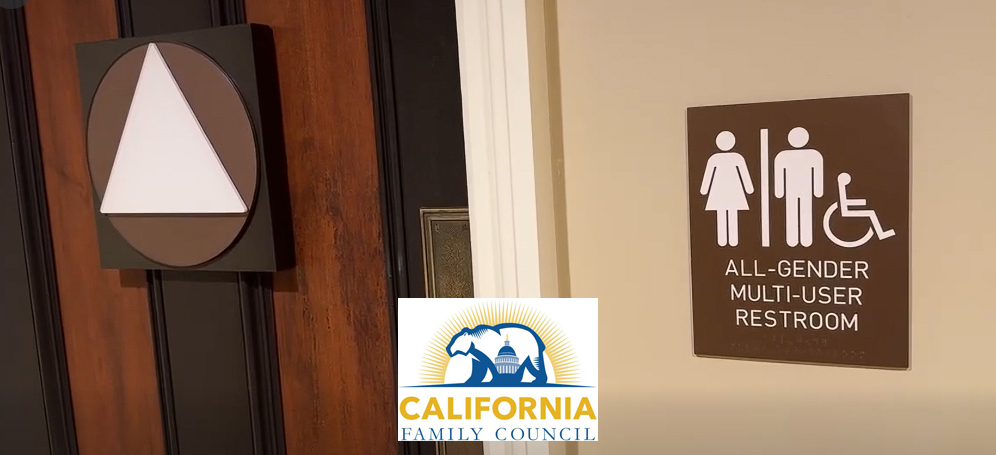
All-gender restroom in California’s State Capitol building. Video screenshot source: CA Family Council
“The law requires that every school campus have at least one all-gender restroom option available to students.”
By Greg Burt, Vice President, California Family Council
SACRAMENTO, CA — California is quietly moving toward mixed-sex bathrooms in K-12 public schools, and the state’s own Department of Education is leading the way.
A new law California Family Council opposed, SB 760, now requires schools to provide at least one “all-gender” restroom option on campus.
Passed in September 2023, the bill was cosponsored by then-State Senator Steve Glazer (D-Orinda). He, then-State Senator Nancy Skinner, now-State Sen. Tim Grayson and Assemblymembers Rebecca Bauer-Kahan, Buffy Wicks, and Lori Wilson who represent Contra Costa County, voted for the bill.
The stated goal was to make transgender-identified students feel safer from bullying. But in the rush to accommodate those students’ feelings, lawmakers apparently gave little thought to a different safety question: what happens when boys are given access to girls’ bathrooms and locker rooms?
The State Is Already Building the Roadmap
The California Department of Education has an entire webpage dedicated to “All Access Restrooms,” describing it as a resource offering background information, planning and design resources, laws and regulations, and references for implementing “gender-inclusive” restrooms in K-12 schools.
The background information on that page acknowledges that “the designs of all-access restrooms have been trending in schools throughout the state, the country, and the world,” while noting there are currently no California design standards for these facilities. In other words, the trend is already underway, and the standards are still catching up.
The planning section of the CDE page is even more candid about the scope of what is being proposed. It describes “shifting from multi-user gendered restrooms and single-user all-gender restrooms to offering blocks of restroom facilities for all students;” meaning the goal is not just a single converted nurse’s bathroom tucked in a hallway. The ambition is to redesign entire blocks of school restroom facilities so that boys and girls share the same space.
What Would It Look Like?
The new all-gender bathroom designs typically eliminate urinals entirely, replacing them with individual private stalls accessible to everyone. The CDE’s resources page recommends an academic article published in the Education Sciences Journal titled “Expanding the Scope of Universal Design: Implications for Gender Identity and Sexual Orientation,” by Ellyn Couillard and Jeanne L. Higbee (2018), as a guide for implementation. That an academic paper on gender identity ideology is among the state’s recommended planning resources tells you something about the ideological framework driving these design decisions.
But keep in mind, SB 760 doesn’t require a complete redesign of a single-sex bathroom for it to become all-gender.
You Already Saw It at the State Capitol
If you want to get a glimpse of what legislators have in mind when they convert a single sex bathroom into an all gender bathroom, take a look at one of the converted male bathrooms at the state capitol, used by legislative staffers, adult visitors, and elementary school children visiting on field trips. California Family Council recently took a video of the empty bathroom located to one side of the Capitol Dome.
“I’m pretty sure most parents would object to their young children sharing a bathroom while men are using the urinals,” Burt said. “Even without the adult issue, I’ve witnessed the chaos that occurs when young boys are pouring into the same bathrooms as the girls while visiting the Capitol. The girls are not happy about it.” (Watch video tour of Capitol bathroom https://www.youtube.com/watch?v=okTcKcP3ACQ)
So, what should parents expect when multi-stall bathrooms are converted to all gender at their child’s school?
What the Law Actually Requires — And What It Doesn’t
It is important to be clear about what SB 760 does and does not mandate. The law requires that every school campus have at least one all-gender restroom option available to students. It could be single-stall or multi-stall. It must be supplied with menstrual products starting in 3rd grade, and it must be unlocked and easily accessible. But there are no requirements that urinals be removed or that additional privacy measures be added to stalls.
Sex-separated restrooms are still permitted, and most schools will continue to have them.
Burt explained what this means in practice for families. “How each school fulfills this new requirement is entirely up to the local school board. A conservative district might simply relabel a single-occupancy nurse’s bathroom and call it done. A progressive district could use this law as a green light to convert entire multi-stall restroom facilities to mixed-sex use. Parents need to find out right now what their district is planning,” he said.
The CDE’s planning resources make clear that the broader vision goes well beyond a single-stall accommodation in the corner of the building. It points toward a wholesale redesign of school bathroom facilities, one that treats sex-separated restrooms as a problem to be solved rather than a common-sense protection for children.
The Question Nobody in Sacramento Answered
SB 760’s supporters argued the law was needed to protect transgender-identified students from harassment, but the legislature never seriously asked the parallel question: does giving boys access to girls’ bathrooms and locker rooms create new opportunities for harassment and assault of girls?
California has seen case after case in recent years where policies designed to accommodate gender identity have created unsafe situations for female students. The discomfort of girls sharing intimate spaces with biological males is not a lesser concern. Lawmakers who refused to weigh it have not protected children. They have simply chosen which children’s safety matters.
Parents: Now Is the Time to Speak Up
Because each school board will decide how to implement SB 760 on its own campuses, parents have a real opportunity to influence what happens at their child’s school, but that window will not stay open indefinitely. Decisions about restroom redesigns and facility changes get made early in the budget and planning process, often before most parents are even aware the conversation is happening.
If you want a say in how your district handles this new requirement, call your school board member and school administrators now. Ask them directly: how does our district plan to fulfill the SB 760 all-gender restroom requirement? Will existing sex-separated restrooms be preserved? Will multi-stall facilities be converted? Every parent deserves to know the answers.
California Family Council works to advance God’s design for life, family, and liberty through California’s Church, Capitol, and Culture. By advocating for policies that reinforce the sanctity of life, the strength of traditional marriages, and the essential freedoms of religion, CFC is dedicated to preserving California’s moral and social foundation.
Join us this Saturday, July 18th, from 9:00 AM to 3:00 PM at the Antioch Walmart for our annual Backpack Drive!
We are coming together to support local families in need and ensure our students in the Antioch Unified School District start the school year ready to succeed. Last year, thanks to your incredible generosity, we donated 300 backpacks, let’s beat that record this year!
Registration is now open for the 16th Annual Antioch PAL Golf Tournament—a day of golf that directly supports youth programs through the Antioch Police Activities League.
Whether you’re signing up as an individual golfer, bringing a foursome, or sponsoring the event, your participation helps provide positive opportunities for local youth.
Sponsorship opportunities are also available for businesses and community partners looking to make an impact while gaining visibility throughout the event.
By Matt J. Malone, PIO, Contra Costa County Superior Court
The Contra Costa County Superior Court is pleased to announce the return of its Juvenile Dependency Mediation Program effective July 1, 2026.
Dependency mediation is a confidential, voluntary process that offers families and other participants an opportunity to resolve issues outside of a contested court hearing. The program is facilitated by specially trained, neutral mediators who do not make decisions or determine case outcomes. Instead, mediators guide productive discussions, help participants identify areas of agreement, and support the development of informed, mutually acceptable resolutions that prioritize the safety, well-being, and best interests of the child while also considering the safety of all family members.
As a program of the Juvenile Court, dependency mediation provides a collaborative forum where parents, child welfare professionals, and other involved parties can openly discuss concerns, explore potential solutions, and work toward agreements. Any agreement reached through mediation is submitted to the judicial officer for review and approval. Once approved, the agreement becomes an enforceable court order.
By encouraging communication and cooperative problem-solving, dependency mediation helps reduce conflict, promotes meaningful participation by all parties, and often resolves matters more efficiently than a contested hearing. The process also minimizes the emotional impact of litigation on children and families by focusing on the family’s strengths and supporting long-term collaboration in addressing the child’s needs.
Notice: All Contra Costa County Superior Court locations will be closed on Friday, July 3, 2026, in observance of Independence Day. Regular court operations will resume on Monday, July 6, 2026.