Archive for the ‘Politics & Elections’ Category

Congressman Garamendi announces re-election in California’s newly redrawn 8th District which includes northern Contra Costa

Thursday, December 23rd, 2021

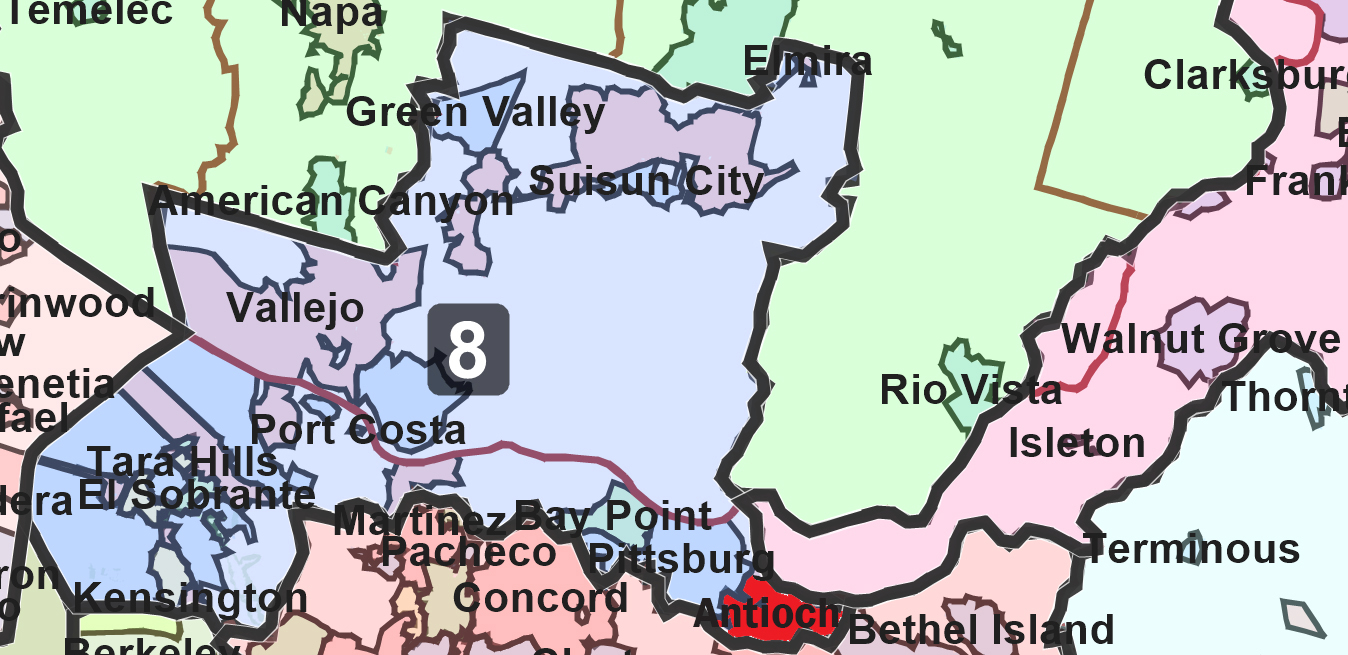
The new 8th Congressional District with the portion of Antioch inside the district in red and showing the location of Walnut Grove (right) where Garamendi lives. Source: WeDrawTheLinesCA.org

Former California State Assemblyman, State Senator, two-time Insurance Commissioner, and Lt. Governor

District includes northern half of Antioch

Rep. John Garamendi. Official photo.

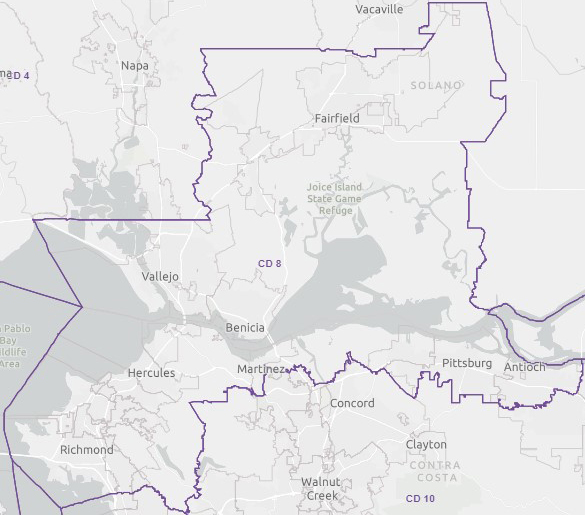
Contra Costa and Solano Counties – Following the release of the final district maps by the California Citizens Redistricting Commission on Monday, Congressman John Garamendi (D-CA) announced, that day, he is running for re-election in the newly redrawn 8th Congressional District of California. The district now includes most of Solano County and the northern, waterfront portions of Contra Costa County from Antioch to Richmond.

Garamendi has served in Congress since 2009 and represented Contra Costa and Solano Counties during his tenure, which are included in CA-08. Prior to his election to Congress, Garamendi served in the California Assembly and Senate, twice as California’s elected Insurance Commissioner, as Deputy Secretary of the U.S. Department of Interior under President Bill Clinton, and as California’s Lieutenant Governor. Garamendi also served in the Peace Corps with his wife, Patti Garamendi. The two have raised six children who share their commitment to public service. They also have 13 grandchildren.

“The 760,000 residents of the 8th Congressional District want a proven progressive who will fight for them every single day. That’s exactly what I’ve done my entire tenure in Congress, and that’s what I’ll continue to do. That’s why, today, I’m kicking off my re-election campaign for Congress,” Garamendi said.

Although he lives in Walnut Grove, in the newly redrawn 7th Congressional District, where both Representatives Doris Matsui and Ami Bera also live, members of the House of Representatives aren’t required to live in the district they represent. They’re only required to live in the same state. The 76-year-old Garamendi currently represents most of Solano County in the 3rd Congressional District and previously represented Antioch and other portions of Contra Costa County in the then-10th District, from 2009 to 2013.

“When our economy is strong, America is strong. In Congress, I fight every day for a fairer economy that works for middle class families, not just those at the very top,” the congressman stated.

“We know the economy can’t move if people can’t move. That’s why I helped champion the Infrastructure and Jobs Act—the largest investment in our infrastructure ever—and secured an $86 million grant to expand lanes on I-80 and reduce traffic,” Garamendi continued. “We know that a strong middle class is the bedrock of our nation. That’s why I fought for the American Rescue Plan, which combatted the COVID-19 pandemic, created the largest tax cut for the middle class ever, put students safely back in school, and helped create over 6 million new jobs for hardworking families.”

The new 8th Congressional District map. Source: WeDrawTheLinesCA.org

First elected to public office in 1974 as a member of the State Assembly, then the State Senate in 1976, Garamendi was elected California Insurance Commissioner in 1990. From 1995 to 2003 he served as the Deputy Secretary of the Interior during the Clinton Administration. In 2002 he was elected, again as Insurance Commissioner, then Lieutenant Governor in 2006. Garamendi was first elected to Congress in a special election in 2009.

“We know that Americans deserve universal paid family leave, affordable housing, cheaper prescription drugs, universal healthcare, cleaner air and water, affordable education, and a free and just society. That’s why I’ve helped champion these efforts in Congress and voted to make this attainable for every American,” he shared.

“All of this and more is what we achieved in 2021 alone, and we are just getting started. I have devoted my life to public service, and I will continue fighting for you every day. That’s why I’m announcing my re-election campaign for Congress in the 8th district. I want to continue fighting for a bold, progressive, and transformative vision of America—and I would be honored to have your support,” Garamendi concluded.

According to his Wikipedia page, Garamendi was born in 1945 in Camp Blanding, Florida, and was raised in Mokelumne Hill, California. His paternal grandparents were Basque immigrants from Spain and his mother was of half Irish and half Italian ancestry. Garamendi received a degree in business from U.C. Berkeley, where he was a football player and wrestler, and a Master of Business Administration degree from Harvard Business School. He served in the Peace Corps in Ethiopia from 1966 to 1968. Garamendi is an Eagle Scout and a member of Sigma Chi, as a brother of the Alpha Beta Chapter at Berkeley.

Below is an overview of Garamendi’s priorities and recent achievements in Congress. More information is available at Garamendi.org:

A Champion for Working Families

Congressman Garamendi believes that every American has a right to a good-paying job, and he fights every day in Congress to build a strong middle class. In 2021 alone, Garamendi fought for:

  • The Largest Middle Class Tax Cut in History: Congressman Garamendi secured an Expanded Child Tax Credit that cuts taxes for middle class familiesin our region by $3,000 per year on average and lifts half of all children out of poverty. This helps families put food on the table, purchase school supplies, cover rent, pay down debts, support the local economy, and make ends meet.
  • Universal Pre-K & Affordable College: Garamendi voted to establish a universal pre-K program for all children. He also successfully led the effort in Congress to expand the Pell Grant to help millions of students attend community college of a four-year university without significant student loan debt.
  • Paid Family Leave: America is the only major nation without a national paid family leave program, and Garamendi thinks this is unconscionable. That’s why Congressman Garamendi voted to create America’s first ever universal paid family leave program to ensure no family must choose between caring for their newborn or receiving their paycheck.
  • New Affordable Housing: We know that California’s housing prices are out of control and working families are losing more of their paychecks to rent or mortgage payments. Garamendi knows that this forces middle class families to make the impossible choice between paying their rent or supporting their healthcare and education. That’s why Garamendi voted to create 1 million new affordable rental homes and cut taxes for the middle class to help cover rent and mortgage payments.
  • A Fighter for Stronger, Climate-Resilient Infrastructure

Congressman Garamendi knows that the economy can’t move if people can’t move. As he works to represent us, he sees that traffic on I-80 is bumper-to-bumper, Highway 4 has too many potholes, and public transportation needs to be improved and expanded.

Many elected officials simply talk about rebuilding our infrastructure, but John Garamendi acts. In 2021, Congressman Garamendi helped design the new Infrastructure and Jobs Act and enact it into law. Through that, Garamendi helped secure:

  • $25 billion to rebuild California’s roads and bridges. This will create 1.5 million new jobs every year, which will go to middle class families and include strong wages and benefits.
  • $9.45 billion to improve California’s public transportation.
  • $86 million to expand lanes on I-80 and reduce traffic.
  • $65 billion to build a new power grid and provide affordable electricity and increase fire safety.
  • $50 billion for drought relief.
  • $55 billion to replace every lead water pipe in America.
  • Expand Make it in America and Buy America requirements to ensure we rebuild our infrastructure using American Materials and workers.

Additionally, Garamendi helped expand BART services into Contra Costa County. He also authored and passed the “Ocean Shipping Reform Act” in the U.S. House of Representatives to fight inflation, address the supply chain crisis, and support American businesses and jobs.

All the infrastructure improvements Garamendi helped secure will be built to withstand the impacts of climate change. They will also help reduce pollution to ensure the air we breathe and the water we drink is clean for all.

A Supporter of Medicare for All and a Green New Deal

Congressman Garamendi served as California’s first ever elected Insurance Commissioner. There, he

  • Introduced and passed the first universal healthcare plan anywhere in America. His plan was adopted by President Bill Clinton and used as a national.
  • Fought against redlining and other unfair insurance practices to protect consumers.
  • Now, in Congress Garamendi is a champion for Medicare for All. Congressman Garamendi believes healthcare is a basic human right, and he won’t stop fighting until every American has universal healthcare coverage.

Congressman Garamendi also believes that climate change is the defining issue of our time. We know that California’s fire season is now 12-months, droughts are more frequent and severe, and our coats are threatened by sea level rise. Garamendi has shown a lifelong commitment to saving our planet from the climate crisis and ensuring clean water and air is available for our children. In Congress he’s fighting for:

  • A Green New Deal that provides historic relief to combat the climate crisis, create millions of good-paying union jobs, and establish a renewable energy economy for the future.
  • $555 billion in clean energy and climate investments—the largest single investment in climate resiliency in American history.
  • Clean energy tax credits to promote wind and solar energy. Garamendi authored the first ever California renewable energy tax credit as a member of the California Assembly.

Allen Payton contributed to this report.

College board trustees ask for more public input on ward redistricting, staff offers workshop, two more gerrymandered maps, online survey

Wednesday, December 22nd, 2021

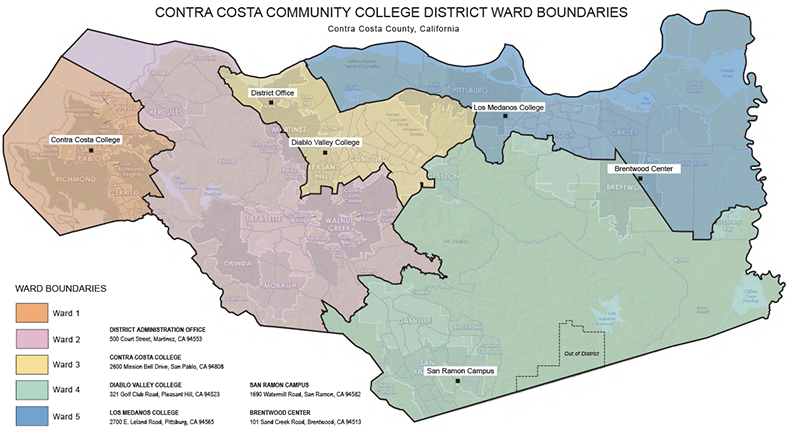
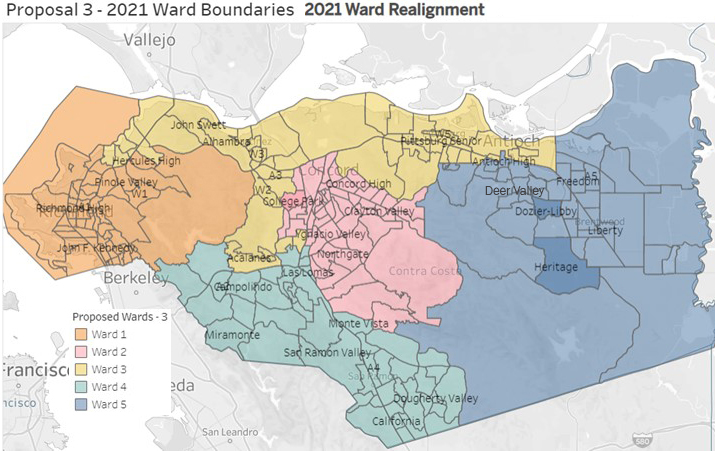
Proposed Contra Costa Community College District Ward Realignment Map 3 balances populations using the county Supervisor’s newly adopted map as a guide and includes the locations of the high schools (the name of Deer Valley High in Antioch added by the Herald). But Trustee Ward 3 in this proposed map is significantly different than the new Supervisorial District 5. See the other two proposed maps at www.4cd.edu/gb/redistricting/. Source: 4CD

Sandoval pushes for more community input, transparency; he and Barrett ask for more maps; Walters asks for informal, round table meeting; one new proposed map similar to Board of Supervisors’ new map; Community Roundtable on Ward Redistricting during special Zoom meeting Jan. 6 for community input; second public hearing on redistricting during regular board meeting Jan 12.

By Allen Payton

In response to public pressure, the Contra Costa Community College District (4CD) Governing Board is seeking additional community input to adjust trustee ward boundaries and ensure population balance based on county demographic changes identified in the 2020 Census. During the Dec. 8 board meeting, (see 36-minute mark) Ward 5 Trustee Fernando Sandoval and Ward 2 Trustee Rebecca Barrett pressed for more public input, and wanted to review more than just the one map provided by the district’s staff and attorney David Saldani. They only provided slight changes to the current, gerrymandered map. (See related article)

Board Calls for More Public Input

At their December 8, 2021, meeting, (see item 10.A.) the Board reviewed only one staff-recommended map that highlighted how trustee area boundaries could change and received community input on the proposed map before determining the need for additional community input. In 2010, both the college board and the Contra Costa County Board of Education adopted the same exact maps, according to Saldani. The 4CD staff is expected to collaborate with the board of education, again, this year.

Only two members of the public offered comments during the hearing, including former college board trustee Greg Enholm who said “I hope the trustees agree that voters should choose their representatives not the reverse.  He also said he agreed with this reporter “regarding his concerns about the proposed ward map,” referring to the current map being drawn based on political considerations to protect incumbents at the time it was adopted.

“I also hope that Board Vice President Walters and Board Secretary Sandoval will explain why they are not advocating for an independent redistricting body to redraw the wards as they pledged to do,” Enholm stated.

“The map must be the best one possible meeting all requirements,” he concluded and said he provided to the trustees a copy of the 1990 map.

“We support a good governance model which includes community meetings. We are a little surprised that…the college district did not engage in a community participation process,” said Maria Alegria, representing Latinx for Inclusion. “It looks like you’ve done this in-house for the past three decades.”

Barrett had questions about the process, including the FAIR Maps Act.

“Certainly, this year, more than ever, the politics surrounding redistricting is greater,” said Executive Vice Chancellor, Education and Technology Mojdeh Mehdizadeh. “This is the first year that the Census data was released six months later than usual.”

“Can you explain the California FAIR Maps Act of 2017 and how it impacts the way cities and counties conduct their post-Census redistricting?” Barrett asked.

“We don’t have to comply with the provisions. It gives more direction with the criteria,” Saldani responded. “The FAIR Maps Act requires cities and counties have…two pre-map hearings then two post-map hearings. It doesn’t apply to the college district.”

“We used traditional redistricting criteria,” he added.

Sandoval said “you spoke about population balance. You guys really didn’t talk about communities of interest. What Mr. Enholm stated…there was some work that was done for political boundary changes in the past and I’m concerned those still haven’t been addressed.”

“It’s not just population balance, it’s communities,” Sandoval continued. “We’re here to make sure the maps represent the communities of interest as they go forward.”

“The other thing I’m concerned about is, the map itself that we have in there, is not an interactive map. You should be able to show that,” he stated. “The fact that we only have one map says that we only have one option. I’m all about transparency. When I talked about the independent commission it’s really about transparency and making sure that the public has an opportunity to weigh in and put a comment…so the board can go ahead and try to understand what the concerns of the community are. We don’t know what they are, right now. I think we need to do more.”

“From my perspective there’s not have enough transparency and we need to ensure we go ahead and take care of the public interest,” he concluded.

“In fact, we heard public feedback, tonight,” said Saldani.

“I think we haven’t done enough,” Sandoval responded. “Give them more of an opportunity. Publicizing it and just having it on our website is not enough. We should have more than one map.”

Barrett then said, “I do have some concerns. I would like to have a more detailed map. Are the politicians giving feedback? Because it’s self-serving. The staff and demographer have worked to keep this away from board input. In some respects, I would hope the board and public could get a more detailed map with geographic markers…things to help identify. I would appreciate a little more detail and understanding. I think the board could give you more input that communities of interest don’t fit nicely…in your statistical analysis. I do think multiple maps would have been helpful. It would give the public a sense that there are choices.”

“I think most of us won’t be here, in 10 years on this board,” she continued. “So, one of the things we can do as a board is to codify our expectations around the redistricting process. Do we want to look at an independent redistricting commission or some kind of hybrid? But that’s a more long-term project.”

“Your free of the accusation that you’re trying to benefit yourself,” Barrett added.

“Would it be possible to have, I’ll use the word workshop, or gathering?” asked Board Vice President Judy Walters.

“Certainly. I thought that’s what we were doing, here, tonight,” responded Mehdizadeh.

Walters suggested a meeting that is “less formal…more of a roundtable kind of thing.”

“On a personal level, I’m happy with the work done, tonight,” she said. “I’m concerned that we have to meet our deadline and we don’t spend a jillion dollars doing stuff.”

“We’re happy to answer any additional questions and do a deeper dive from an interactive perspective,” Mehdizadeh responded. “While we would love to do that, we’re not resourced to do that.”

“We tried to keep it in-house. Let them do their independent work,” Board President Andy Li said. “I’m supportive of some open, community input.”

“The document…that’s…showing racial demographics is wonderful,” Walters added. But she didn’t call for an independent citizen redistricting commission as she committed to do during her campaign, last year.

“I heard some requests to follow the county in drawing our districts,” Li said. “But I found that there are three trustees in the same ward.”

However, where incumbents live is not a requirement that must be considered when redrawing ward boundaries.

“I appreciate the work done by the county. But they have different communities of interest than we do,” Barrett said. “We could be drawing our maps off of the school district boundaries.”

“We tried to keep as many as communities together as possible,” Mehdizadeh said.

Staff agreed to consider offering more public meetings and has since offered two more maps and post all three on the district’s website.

January 6 Community Roundtable on Ward Redistricting

The public can review three mapping options of how trustee boundaries could be balanced on the 4CD website located at www.4cd.edu/gb/redistricting . Community members can use a new interactive mapping feature that will help identify how each mapping option could change your trustee representation. The website also gives the public the opportunity to provide online comments and feedback that will be considered by the Board. In addition, 4CD will conduct a Community Roundtable on Ward Redistricting during a special Governing Board meeting via Zoom on Thursday, January 6, 2022, beginning at 5:00 p.m. to conduct a community roundtable to review the different mapping options and receive additional community input. Zoom details can be found in the official Governing Board meeting agenda for this community roundtable.

January 12 Second Redistricting Public Hearing

The Board will review the additional community input and hold a second redistricting public hearing at their regularly scheduled public meeting on January 12, 2022, beginning at 6:00 p.m. The public is invited to attend this meeting in-person at 500 Court Street, 2nd Floor Board Room, in Martinez or via Zoom. Zoom details for this meeting are contained in the official Board meeting agenda located on the 4CD website.

“Based on the community input we received so far, the Board decided it was prudent to expand the redistricting choices available and provide more opportunity for the public to weigh in on this important decision,” said Walters. “The additional steps we are taking, which are beyond what is legally required, are appropriate and convey to our community we are rebalancing our trustee wards in a transparent way, and is being completed in a fair, objective, and non-partisan manner.”

Special districts like 4CD are legally obligated to follow Education Code Section 5019.5, which highlights the process to follow, ensuring the population of trustee wards is balanced based on the changing demographics of the community. Legally, the population can be as great as 10% between districts. Despite receiving the 2020 Census data six months late, 4CD is still required to complete this process by February 28, 2022.

After receiving the 2020 Census data in September 2021, staff began working with legal counsel to analyze and prepare its ward redistricting recommendation. The Board received a report outlining the plan to rebalance the ward boundaries at their November 10, 2021, meeting, including a review of the population changes throughout Contra Costa County.

Public Participation

Should you wish to make public comment in person, please fill out the yellow public comment card (sample attached) that will be available at the meeting and give it to the Executive Coordinator.  For those attending remotely, the Governing Board President will ask for general comments or those specific to a certain agenda item.

  • Please note that submissions of public comments will be considered a public record under the Public Records Act and are therefore subject to public disclosure; submissions must either address an item on the agenda or be within the subject matter jurisdiction of the Governing Board.
  • If a translator for the speaker is needed, please contact the Executive Coordinator at pkaya@4cd.edu or leave a message at 925.229.6821, the Friday prior to the meeting so appropriate accommodations may be made.

According to Government Code Section 54954.2(a), when responding to public comment, Governing Board members and staff may respond as summarized below.

  • Briefly respond to statements made or questions posed by persons making public comment;
  • ask questions for clarification or make a brief announcement;
  • provide a reference to staff or other resources for factual information;
  • request staff to report back to the body at a later meeting; or
  • direct staff to place the matter on a future agenda.

Timothy Leong, 4CD Public Information Officer, contributed to this report.

Two more days to offer input on California Citizens Redistricting Commission’s final maps for state districts

Tuesday, December 21st, 2021

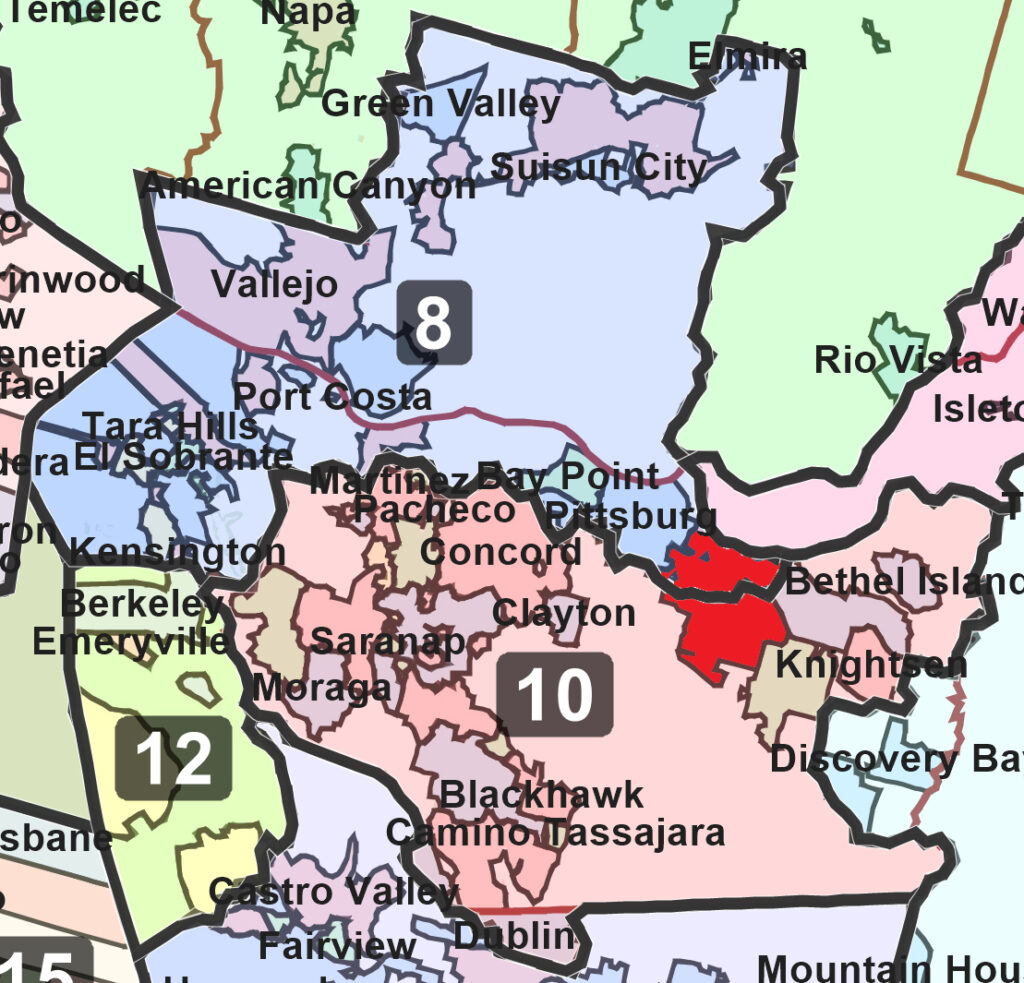
The commission’s final map shows Antioch (in red) divided into Congressional Districts 8 and 10. Source: WeDrawTheLinesCA.org

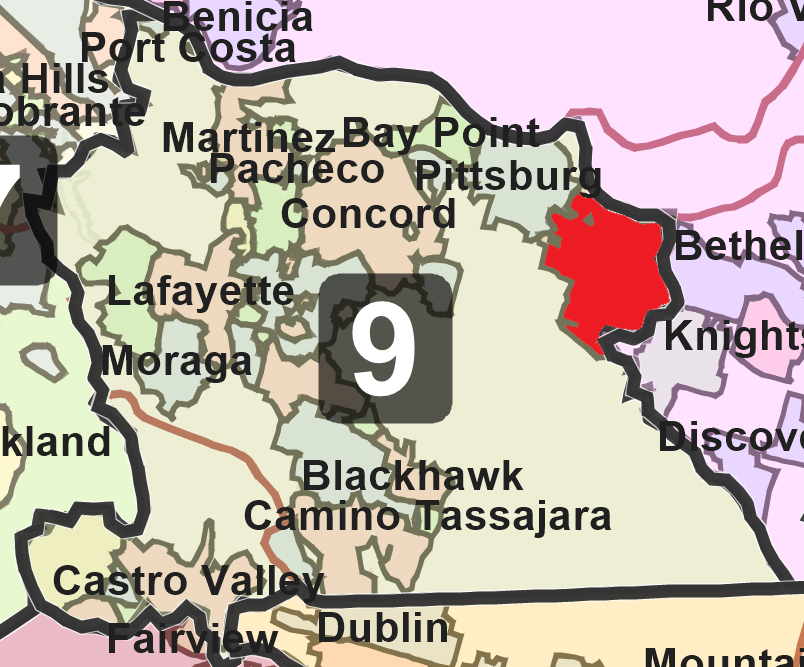
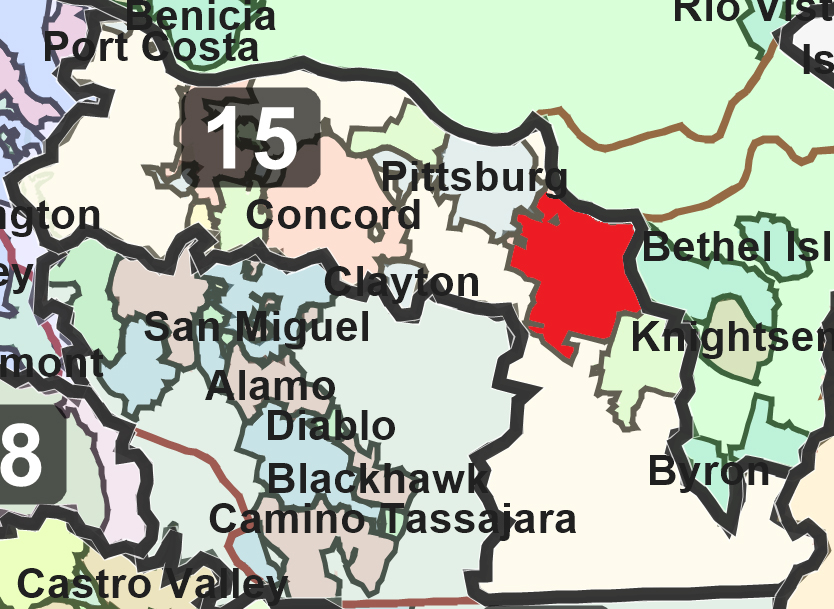
Antioch still split into two congressional districts; shares State Senate district with San Leandro; shares State Assembly district with Concord and Crockett

Divides Contra Costa County in multiple ways, combining portions with communities in other counties as far away as Sonoma and Yolo Counties over 90 miles away

By Allen Payton

On Monday, the 2020 California Citizens Redistricting Commission completed and approved final maps for the state’s Congressional, Senate, Assembly, and Board of Equalization districts that are significantly different than the draft maps presented last month. The new maps, which will be in place and affect elections for the next 10 years, split up Contra Costa County in multiple ways and combine portions with other counties and communities as much as 93 miles away.

The California Constitution states that public comment shall be taken for at least three days from the date of public display of any final statewide maps. Additionally, the Commission shall not display any other map for public comment during that period. (To offer additional public comment click here)

“We have reached the finish line for the people’s redistricting process in California. When voters approved the Voters FIRST Act, it created a monumental shift in this decennial process,” stated Commission Chair Alicia Fernandez. “As Californians, my colleagues on this Commission and I answered the call to serve for this great state we honor and love. We conclude our map drawing responsibilities with pride in our final product. We started this process leaving politics out of the equation in hopes of achieving fairer and more equitable maps. I think I speak for my colleagues when I say mission accomplished! Thank you to all that participated in this process.”

The Commission drew 4 Board of Equalization districts, 52 Congressional districts, 40 Senatorial districts, and 80 Assembly districts. All districts were drawn within the permissible population deviation.

The commission’s final map shows all of Antioch (in red) in State Senate Districts 9. Source: WeDrawTheLinesCA.org

Maps Split Up Contra Costa County More

While the current maps approved in 2011 divide the county amongst four Congressional, two State Senate and three State Assembly districts, what the Commission did to Contra Costa, this time, was split it up even more into three Congressional, three State Senate, and four Assembly districts.

For the State Senate map, the majority of the county, from Crockett in West County to Antioch in East County is combined with San Leandro, Castro Valley and San Lorenzo in southwest Alameda County. Like the draft maps issued by the Commission in November, the new Senate map includes the Far East County cities of Brentwood and Oakley and communities of Discovery Bay, Byron, Bethel Island and Knightsen in the same district as Vallejo, Napa, Rohnert Park in Sonoma County, over 90 miles away.  In addition, the map combines all of West County with the cities of Berkeley, Oakland and Alameda.

For the State Assembly map, the Commission keeps the county split in four districts keeping Far East County except for Brentwood, in the same district as most of Solano County including Vallejo, Fairfield, Vacaville and Dixon. It keeps most of West County in the same district, except for Crockett, which is included in the same district as Martinez, Pleasant Hill, Concord, Clayton, Bay Point, Pittsburg, Antioch and Brentwood.

The commission, only split the county amongst three districts for the Congressional map. But it splits up East County into those three, new separate districts by carving out Discovery Bay and Byron and leaving them in the same district as most of San Joaquin County. The proposed final map also combines the southern portion of Antioch, plus Brentwood, Oakley, Bethel Island and Knightsen with Central County, including most of Concord, plus Lamorinda, the San Ramon Valley and a portion of Dublin in the same congressional district. Finally, it splits off the northern portion of Antioch, plus Pittsburg and Bay Point, and includes it in a district with the other part of Concord, plus Martinez, West County cities of Richmond, El Cerrito, San Pablo, Pinole, Hercules and Crockett with most of Solano County.

Independent Commission Creates Maps That Benefit Democrats

The place of residence of any incumbent or political candidate may not be considered in the creation of a map, and districts may not be drawn for the purpose of favoring or discriminating against an incumbent, political candidate, or political party.

However, according to a news report by the left-leaning Politico, “California’s new congressional map boosts Democrats” in their “uphill quest to maintain their minuscule House majority”. The new lines “create more challenging districts for Republican incumbents without substantially undermining the prospects of vulnerable Democrats.” The “map could point to Democrats holding ground or picking up seats.”

The commission’s final map shows all of Antioch (in red) in Assembly Senate Districts 15. Source: WeDrawTheLinesCA.org

See Shape Files/Equivalency Files/Stats and Map Viewer: https://www.wedrawthelinesca.org/final_maps

In accordance with the California Constitution, the Commission followed these criteria, in this order, to draw district maps:

  1. Districts must be of equal population to comply with the U.S. Constitution.
  2. Districts must comply with the Voting Rights Act to ensure that minorities have an equal opportunity to elect representatives of their choice.
  3. Districts must be drawn contiguously, so that all parts of the district are connected to each other.
  4. Districts must minimize the division of cities, counties, neighborhoods and communities of interest to the extent possible.
  5. Districts should be geographically compact: such that nearby areas of population are not bypassed for a more distant population. This requirement refers to density, not shape. Census blocks cannot be split.
  6. Where practicable each Senate District should be comprised of two complete and adjacent Assembly Districts, and Board of Equalization districts should be comprised of 10 complete and adjacent State Senate Districts.

The last of the criteria makes sense, as there are twice as many Assembly districts as Senatorial districts, and the Commission could have simply divided each Senatorial district into two. But they chose not to follow it when drawing the new maps.

Additional Commission Meetings

The Commission is continuing to hold meetings Sunday and next Monday and accepting additional public comments on the final maps. At the start of Tuesday’s meeting, Chair Fernandez announced that the meetings scheduled for tomorrow (Wednesday) and Thursday, as shown on the Commission’s website, have been cancelled.

December 26, 2021 CRC Business Meeting – 2020 Citizens Redistricting Commission Meeting – 11:00 A.M. – 1:00 P.M. daily or upon conclusion of business  Public Input Form

December 27, 2021 CRC Business Meeting  – 2020 Citizens Redistricting Commission Meeting – 11:00 A.M. – 1:00 P.M. daily or upon conclusion of business  Public Input Form

Background on Redistricting and Commission

Every 10 years, after the federal government publishes updated census information, California must redraw the boundaries of its electoral districts so that the state’s population is evenly allocated among the new districts.

In 2008, California voters passed the Voters First Act, authorizing the creation of the independent California Citizens Redistricting Commission to draw new State Senate, State Assembly, and State Board of Equalization district lines. In 2010, the Voters First Act for Congress gave the Commission the responsibility of drawing new Congressional districts following every census.

For more information, please visit www.WeDrawTheLinesCA.org. To offer additional comments to the Commission about the proposed final maps visit www.wedrawthelinesca.org/contact by Thursday, Dec. 23 at 5:00 p.m.

Lewis declines Antioch School Board presidency, Hack elected instead

Thursday, December 16th, 2021

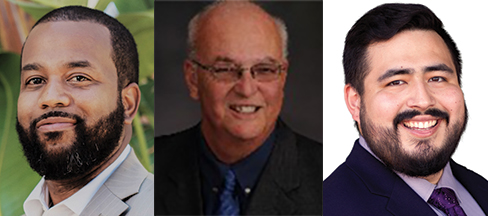
AUSD Board Trustee Clyde Lewis, new Board President Gary Hack and new Board Vice President Antonio Hernandez.

Hernandez appointed vice president; board declines public online mapping tool for redistricting process, will make “tweeks” to current trustee area map

By Allen Payton

In a surprise move, Wednesday night, during the Antioch School Board meeting, Dr. Clyde Lewis, District 3 Trustee and board vice president chose to not accept the promotion to the one-year, rotated position of president. Instead, District 4 Trustee Gary Hack was nominated by Lewis and voted in as board president. District 1 Trustee Antonio Hernandez was voted in as board vice president. The board reviewed two proposed maps for the redistricting of trustee areas. Lewis and Trustee Mary Rocha pushed for more public participation and input in the process. But the board declined to include an online mapping tool for the public to use and submit alternative maps. However, the proposed maps are now available on the AUSD Redistricting page.

The school board briefly honored outgoing City Manager Ron Bernal and will provide him with a proclamation, Superintendent Stephanie Anello stated.

“Tweeks” for Redistricting of Trustee Areas

The school board received a presentation on redistricting of trustee areas from Scott Newell, from consultant Cooperative Strategies, hired by the district’s law firm, and Larry Schoenke, the district’s attorney. The board members reviewed two proposed maps that offer very minor changes to the current trustee areas

Newell suggested the Board “adopt the tweeks” his firm made to the map the board approved in 2019 for last year’s election based on the 2010 Census. The new map is based on the population from the 2020 Census. (See related article)

“We must balance the population and consider the protected classes,” he said, referring to Black and Hispanic residents.

“I am leaning more to Scenario 2,” said Board President Ellie Householder.

“My initial question is how much public input has happened with this.

Under redistricting we haven’t had any. Under districting we were required to have plenty. Under redistricting we aren’t

“My consideration is that we have public input around where these lines are drawn.

Public input is not required,” said the district’s attorney. “Your next board meeting isn’t until Jan. 26. You also have the ability, on Jan. 26 we’re going to here

“We’ve also included an interactive page on our website,” said Anello.

“I want to make sure the public is included,” Lewis stated.

“I believe it’s important to have the public input,” Rocha said in agreement.

“We plan to go to all our parent meetings to get public input,” Anello explained.

“Now we’re going for the next 10 years, and we need to be very careful,” Rocha continued.

Hernandez asked about citizen voting age population differences between the scenarios.

“We haven’t looked at it because we’re required to look at total population,” Newell responded.

“I’m comfortable with the presentation made, today and I look forward to the revisions,” Hack said.

“We had a lot of rich discussion around communities of interest. The City has a mapping tool. But for this we don’t have a mapping tool,” Householder said. “What would be the best way for folks to give input?”

“We provide some survey links for the public to use,” Newell said and mentioned “the interactive tools, we create for other clients, are in development.”

“By law it says you can revisit what you’ve already adopted. You can always go through an entire creation process,” Schoenke said.

“As you know, soliciting feedback it’s always hard to get out,” said Newell. “We have an email link. Sometimes they take a photo and submit a marked-up map.”

Lewis asked for the details from the public input from the 2019 process in which the current trustee area map was created.

Only one member of the public spoke, Lindsey Amezcua, who asked for an online mapping tool.

Householder asked for more data on the maps for the next meeting on Jan. 26 and asked for preferences from the other board members.

Board President and Vice President

Trustee Rocha made a motion to appoint Hack as board president which Lewis seconded, surprising almost everyone watching. Lewis was expected to be promoted from his position as board vice president. After the meeting, Lewis told the Herald he had only spoken about his decision to not accept the presidency to a few people prior to the meeting.

One member of the public spoke, with the last name of Hernandez, Antonio’s sister, urging the board to not elect Rocha for one of the two positions. However, Velma Wilson spoke in support of Rocha and what she’s done for the community as a trustee.

“I was under the impression that Trustee Lewis as board vice president would step in as board president” Hernandez said.

“I would hate to see another Black trustee passed up,” Householder said, referring to both Crystal Sawyer-White and Debra Vinson, who are Black and were vice president, but passed over for the position of president. But that was against their wishes. Lewis chose not to take the position for personal reasons.

“This is a very difficult decision for me,” he said. “I have some family challenges.”

“Not my immediate family,” Lewis said with a chuckle to clarify the issue. “It’s family caregiving that came up.”

“So, you’re saying that if you were nominated for board president you wouldn’t accept it?” Householder asked.

“I would likely decline,” Lewis responded. “It’s not that I don’t want the position. It’s simply that we have a familial care issue.”

“You would still entertain being the vice president?” Householder said to which Lewis laughed.

“Hearing your laugh, I will take that as a ‘yes’,” Householder responded.

Amezcua spoke during public comments. “Dr. Lewis, I’m very saddened you are not taking the position,” she said. “But I believe Trustee Hack will do a phenomenal job.”

“I’m not going to be supporting this,” Householder said. “I would like to see someone else in the position.”

Hernandez then offered himself for the position, arguing against Hack’s appointment.

“I don’t think what this school district needs is stability, we need progress forward,” Hernandez said. “Something that pushes us forward. I would like to take the position of board president. It’s important that we keep moving forward. As a Latino male I’ve been underestimated my entire life. That is the context that I take my next vote, not that Trustee Hack can’t do the job.”

“It takes three to move things forward. It’s not the chair,” Rocha said in response. “The chair is only the one who takes care of the board meetings.”

Householder then made a substitute motion to elect Hernandez as board president, seconded by Hernandez. But it failed on a 2-3 vote.

“My vote was not that Trustee Hernandez cannot do the job,” said Lewis. “He’s a brilliant, brilliant leader. Brilliant young man. I’ve struggling with this. I’m struggling with it, now.”

The original motion to appoint Hack as board president was then voted on and passed on a 3-2 vote with Householder and Hernandez voting against.

Lewis then nominated Hernandez as board vice president, and it was seconded by Householder. Without discussion the motion passed 5-0.


Antioch School Board will consider two gerrymandered draft maps during public hearing on redistricting tonight

Wednesday, December 15th, 2021

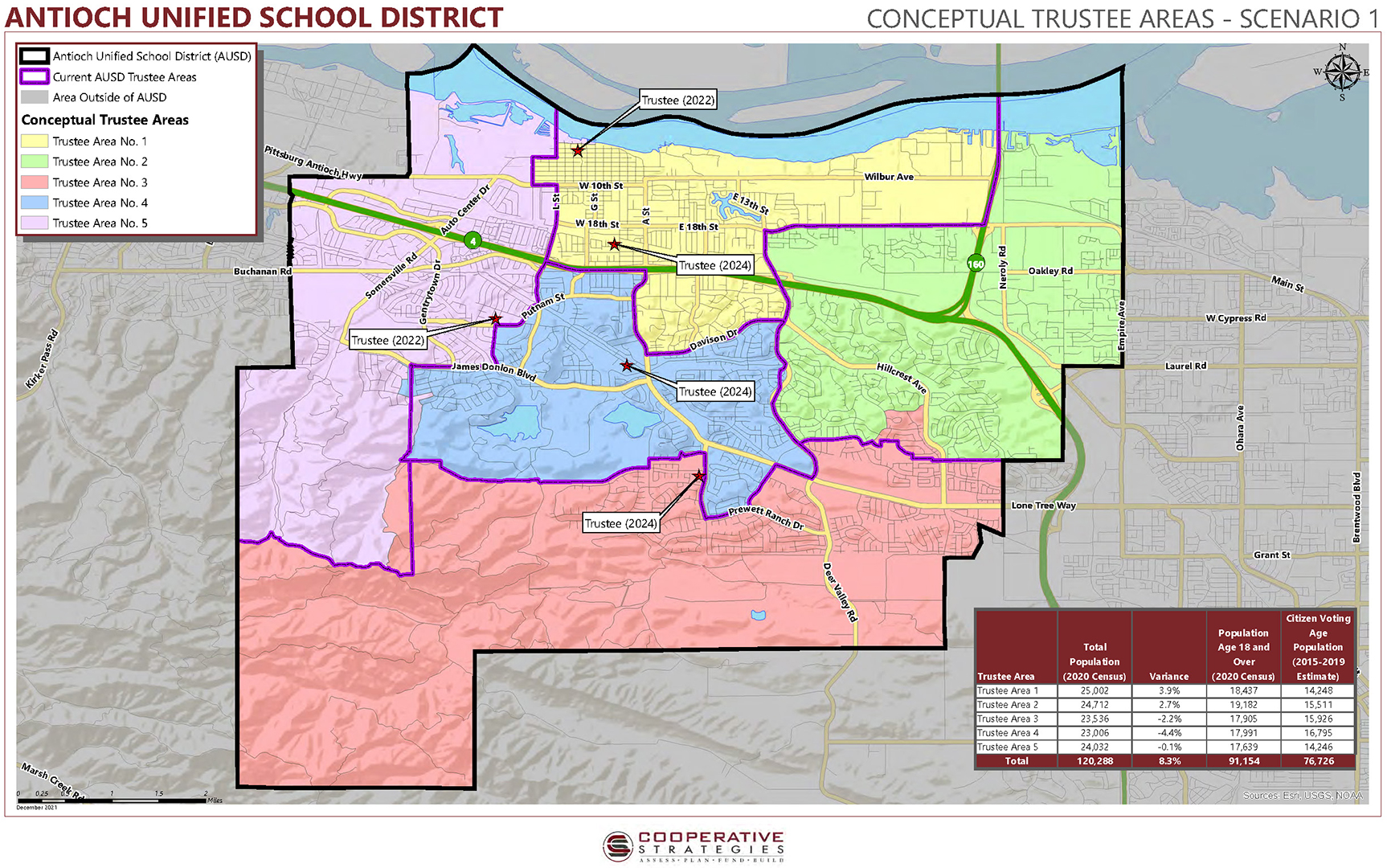
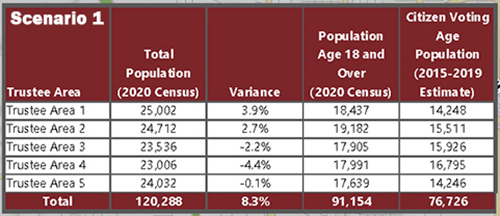
Proposed Antioch School Board Trustee Areas Redistricting Map Scenario 1 indicating the locations of the trustees’ residences. Source: AUSD

Trustee areas drawn to protect most incumbents; will be in place for the next 10 years; no online mapping tool for public to use to provide input; trustees will also reorganize with new president, VP

By Allen Payton

During their meeting on Nov. 10th, the Antioch School Board received a presentation on redistricting the five trustee areas following the 2020 Census. The trustees will be review and consider two gerrymandered draft maps during their Dec. 15th meeting, tonight, drawn by Cooperative Strategies, the same consultant hired to help draw the original district maps in 2019. The current trustee areas were created using data from the 2010 Census. (See related article)   AUSD_ProposedMapPresentation 121521

Since then, the population in the school district has grown by 12.4% or 13,252 residents. All five trustee areas experienced population growth with the greatest growth in Area 2 of 20.5%. That’s followed by Area 5 growth at 13.5%, Area 1 at 11.1%, Area 4 at 10.2% and Area 3 at 6.3%.

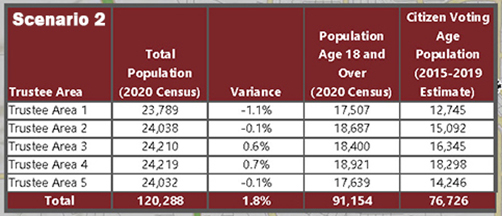
The ideal trustee area population is 24,058. The proposed maps show the percentage deviation for each area from that average size. The goal in order to fulfill the constitutional intent of one-person-one-vote is to have no deviation between districts. Congressional districts can only vary by one person.

The current map of trustee areas was only in effect for last year’s school board election. The new map and trustee areas will be in effect for the next ten years and must be finalized by March 1, 2022.

Politically-based drawing of representative district or area maps is referred to as gerrymandering which is designed to protect incumbents or a political party’s control of a legislative body.

According to the staff report, “By law, following every Decennial Census, school districts that elect their governing boards ‘by-trustee area’ must review updated population data from the Census to insure that the trustee areas remain balanced by total population. District consultants will provide an overview of the process and requirements for insuring compliance with the population balance requirements of Education Code section 5019.5.”

That section reads, “(a)(1) The population of each area is, as nearly as may be, the same proportion of the total population of the district as the ratio that the number of governing board members elected from the area bears to the total number of members of the governing board.

(2) The population of each area is, as nearly as may be, the same proportion of the total population of the district as each of the other areas.

(b) The boundaries of the trustee areas shall be adjusted by the governing board of each school district or community college district, in accordance with subdivision (a), before the first day of March of the year following the year in which the results of each decennial census are released. If the governing board fails to adjust the boundaries before the first day of March of the year following the year in which the results of each decennial census are released, the county committee on school district organization shall do so before the 30th day of April of the same year.”

However, maximum population variance allowed between trustee areas can be as much as 10% and still be in compliance with the legal requirements. Due to the population growth Antioch School Board trustee areas have a total variance of 17.7% which is out of compliance.

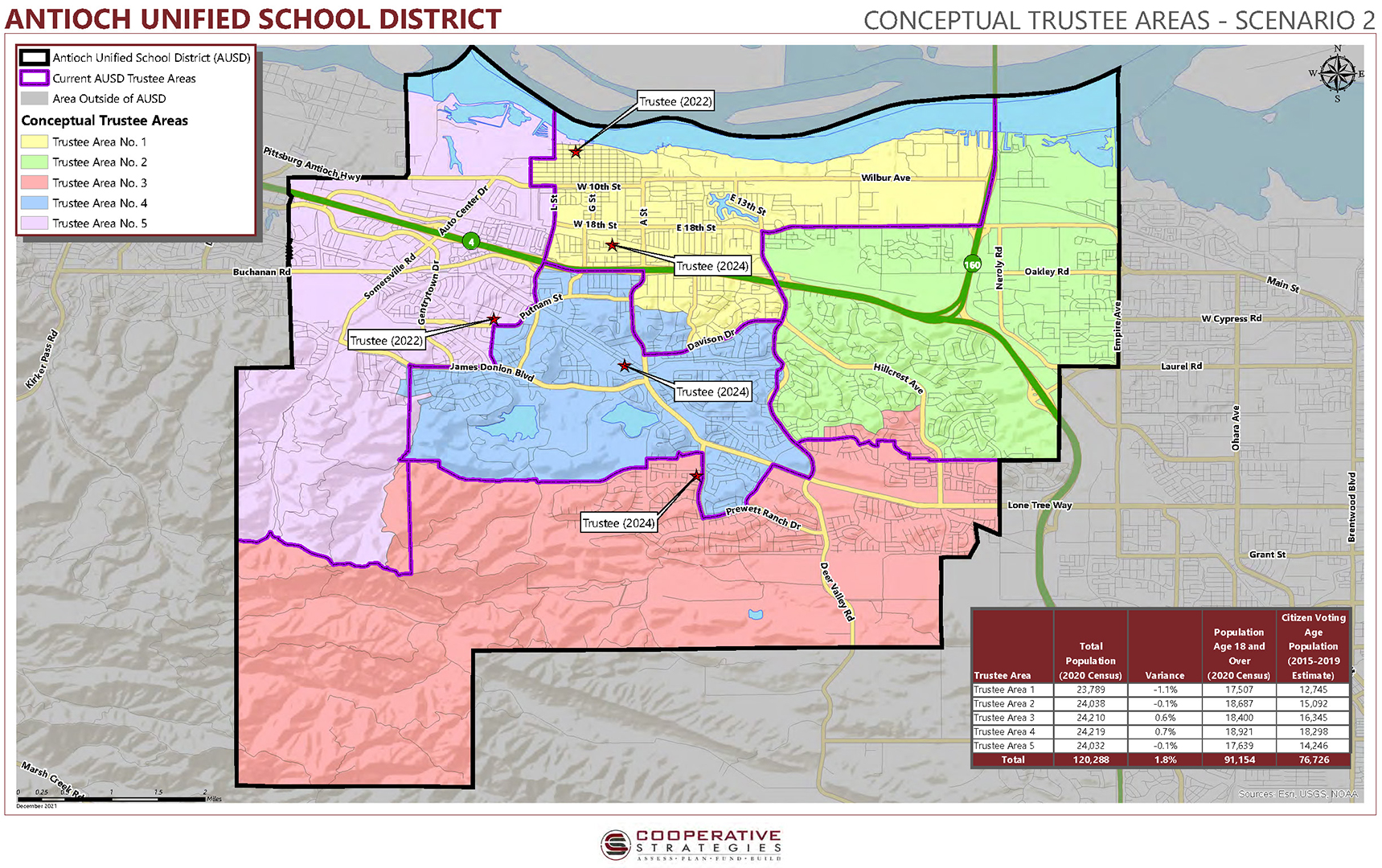
Proposed Antioch School Board Trustee Areas Redistricting Map Scenario 2 indicating the locations of the trustees’ residences. Source: AUSD

Superintendent Claims Changes Are Minor, No Online Mapping Tool, Offers Analysis of Proposed Maps

Asked if there would be an online mapping tool for the public to use to submit proposals, Superintendent Stephanie Anello responded, “Our changes are so minor compared to what it looks like (at first blush) compared to what the city council is proposing. So, we have not planned for an online mapping tool.”

Anello also shared, “I’ve been looking over the maps since we received them and here are my thoughts: We have not received any complaints or concerns regarding the current boundaries since we moved to Trustee Areas in 2019 so Cooperative Strategies looked at making the least impactful changes as possible while maintaining the community of interest (Black/African American voters in Area 3) that was established during the initial map selection process. The only two areas with significant fluctuation are Area 2 (which is creating a variance of 9.1%) and Area 3 (which is creating a variance of -8.5%). The population difference between these two areas is 4,246 residents.

Map 1 shifts approximately 1,500 residents from Area 2 to Area 3 for a variance of 8.3%, which is within the statutory limits. Map 2 decreases the variance to 1.8% by shifting approximately 2,200 residents from Area 2 to Area 3, as well as 650 residents from Area 1 to Area 4.”

Gerrymandered Draft Map Scenarios

Although neither federal election law nor state education code include where incumbents live as a criteria or requirement for drawing trustee area boundaries, both of the maps, labeled Scenario 1 and Scenario 2, appear to be drawn to protect at least four of the trustees. Current Board President Ellie Householder and Trustee Mary Rocha were both living in the current Area 5. But Householder moved to Antioch’s downtown and now lives in Area 1 which is currently represented by Antonio Hernandez, who was elected last year, along with Area 3 Trustee Clyde Lewis and Area 4 Trustee Gary Hack.

There is no incumbent presently living in the current Area 2 nor in that area on either proposed map. Elections for both Areas 2 and 5 will be held next November. But both proposed maps are mislabeled indicating Householder’s residence and referring to her as facing election in 2022 instead of providing that indication in Area 2 on the scenarios. Householder, who is currently serving in a district-wide seat with the term ending next year, just like Rocha, and is facing recall from that position. Householder will be ineligible to run for re-election if one of the proposed map scenarios is approved and she remains living in Area 1. Even if she is recalled, Householder could move into either Areas 2 or 5 and run for re-election, there. If so, then Householder won’t be up for election next year, but the Area 2 seat will be.

In addition, both proposed maps barely keep Lewis inside Area 4 and Rocha inside Area 5, with both trustees’ residences on the edge of the boundary with Area 4.

Additional Board Meetings on Redistricting

The board is scheduled to have at least two more meetings on redistricting before the March 1 deadline. The proposed schedule from Cooperative Strategies is as follows: January 26 – Board Meeting: Review Revised and/or Additional Scenarios; Adopt Final Trustee Areas (Tentative) and February 9 or 23, 2022 – Board Meeting: (Only If Needed) Adopt Final Trustee Areas.

Board Leadership Reorganization

Also, during their meeting, the trustees will choose a new board president and vice president for the following year. Embattled president, Householder is expected to pass the proverbial gavel to current Board Vice President Clyde Lewis, and Hernandez is expected to be voted in to replace Lewis.

Meeting and Public Comment Information

The meeting will begin at 7:00 p.m. following a brief Closed Session at 6:40 p.m. and held at the Deer Valley High School theater at 4700 Lone Tree Way in Antioch. It can also be viewed live stream on the district’s YouTube page. Public comments can only be made in person at the meeting by completing and submitting a speaker card. To see the entire agenda, click here.

No maps submitted by public included in agenda packet for Antioch Council’s redistricting public hearing tonight

Tuesday, December 14th, 2021

Lindsey Amezcua’s Map 2 and statistics (left) and the Antioch Herald map, statistics and boundary details.

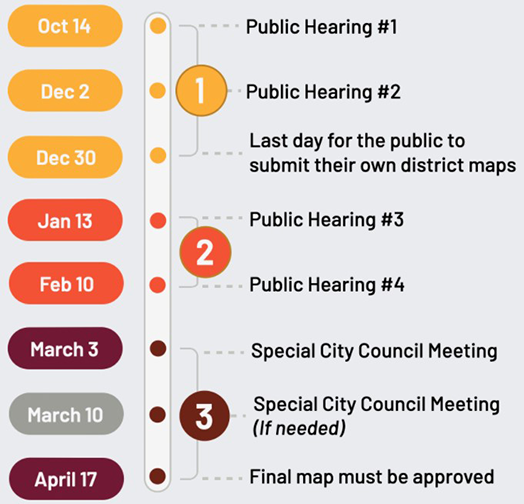
But five proposed maps created and submitted by residents using online mapping tool on City’s website will be included in discussion – see three of them, here; Antioch rushing to be done by end of January; Brentwood using more transparent process with independent citizens commission, showing all maps created on their redistricting website, won’t be finished until April 17

By Allen Payton

At the beginning of Tuesday night’s regular Antioch City Council meeting, at 7:05 p.m., a public hearing will be held on the redistricting of council districts. But only the maps created by the consultant, Q2 Data and Research which were considered at the council’s last hearing on redistricting were included with the agenda packets. Only two maps created and submitted by members of the public using the City’s online mapping tool were received by Q2 as of yesterday, three more Tuesday morning, two of which had been submitted on Nov. 15 and 16, by resident Lindsey Amezcua. She provided them to the Herald and are published, above and below. Antioch Council Redistricting Hearing presentation 121421

Lindsey Amezcua’s Map 1 and statistics.

Jan Hood of Q2 said “two maps from the public had been received as of yesterday (one of which was from the Herald) and three more, this morning. They will all be presented to council and be part of the public hearing, tonight.”

4:15 PM UPDATE: Late Tuesday afternoon, Hood shared, “that all publicly submitted maps (that Q2 has received) have been posted on the redistricting website under the ‘Public Map Submissions’ section.”

Antioch Redistricting Public Map #11162021449 (antiochca.gov)

Antioch Redistricting Public Map #11212021458 (antiochca.gov) – The Antioch Herald map. One correction to the label on the map placed by Q2. Districts 2 and 4 are not divided by Contra Loma Blvd. but the boundary of the Contra Loma Regional Park.

Antioch Redistricting Public Map #11282021434 (antiochca.gov)

Antioch Redistricting Public Map #1152021439 (antiochca.gov)

Antioch Redistricting Public Map #12142021487 (antiochca.gov) One correction to the label on the map placed by Q2. Districts 2 and 4 are not divided by Contra Loma Blvd. but the boundary of the Contra Loma Regional Park.

———————-

Following are the individual district maps and details submitted by the Antioch Herald:

AH AntiochCityCouncil_District 1    AH AntiochCityCouncil_District 2   AH AntiochCityCouncil_District 3

AH AntiochCityCouncil_District 4   Antioch Herald – 2021 Council Redistricting Map & Details

The Herald’s map was drawn based on principles of compactness, keeping Communities of Interest together, and using common-sense boundaries such as major roadways, in order for the public to easily understand in which district they reside. It also moves the Mira Vista Hills/Silverado Drive area into District 2 instead of District 4, and makes Districts 2, 3 and 4 north-south oriented districts instead of east-west, with each one bounded on the north by Highway 4. There are no changes to District 1’s current boundaries. Although incumbency is not a required consideration for the process, the Herald’s map leaves all current council members in their current districts.

Difficulties Using Online Mapping Tool

All five council members, City Attorney Thomas L. Smith and Q2 staff were informed by this reporter that it took four tries using the City’s online mapping tool, three after logging in and on the third try, I was able to submit. But what was sent shows it was a blank map. On the fourth try, without logging in, I created the above map which I did submit, and is labeled Antioch Herald map. A minor challenge is the district colors are too similar and the user doesn’t get to choose them. Thus Districts 1 and 4 look like the same color and Districts 2 and 3 are very similar, as well.

Amezcua said she, too had difficulty using the online mapping tool.

Unlike the district maps approved for last year’s elections, which were only in place for two years, the district maps approved this time will be in place for 10 years.

Brentwood Using Independent Citizens Commission, More Transparent Process

The City of Brentwood’s redistricting process includes an independent citizens redistricting commission made up of five members of the public and alternates appointed from those who applied by a retired judge, to review submissions and then send two or more designs to the council for a decision on a final map which the council members can’t modify. All submitted and draft maps designed by the public are on their city’s redistricting webpage for the public to review. Their process began in September and won’t be completed until April 17. (See Brentwood’s  Online Mapping Tool)

Questions for Council, City and Q2 Staff

Questions were sent Monday night to all five council members, City Attorney Smith and Q2 staff, asking, “Why aren’t any maps drawn and submitted by members of the public, including mine, included for Tuesday night’s public hearing on redistricting? Why are only the three maps drawn by Q2 included that were presented at the last meeting?”

It was shared that this reporter was told by Q2 staff in a Zoom meeting held with them, that they redrew the maps for each district created and submitted for the process by the Herald   Why didn’t that occur? How many maps were submitted by members of the public? What’s the point of having an online mapping tool for the public to use if you’re just going to disregard what they have submitted?”

None of them are available on the City’s redistricting page.

They were also asked, “did the mapping tool get fixed so it produces one complete map of all four districts and not just the four individual maps, using the same color for each?”

The Antioch council members and staff were also asked, “Why can’t Antioch use that same process?  What is the rush to get this done by the last meeting in January when the Brentwood City Council won’t be completed with their process until April 17?”

None of the council members nor city staff responded prior to publication time on 1:00 p.m. Tuesday.

Q2 Responds

In response, Hood of Q2 also said, “As of now, the mapping tool does not provide a final citywide map. It shows the four final maps, individually. I will follow up regarding your suggestions and discuss them with our team”.

Asked for copies of the other two maps created by members of the public to include them with this report, Hood said she was waiting to hear back from city staff for permission.

Hood asked if members of the public have created and submitted a redistricting map using the City of Antioch’s online mapping tool but it is not part of tonight’s council public hearing, to please email Q2 at support@publicredistricting.com.

Attend or View Council Meeting

The meeting will be held in-person in the Council Chambers at 200 H Street and are televised live on Comcast channel 24, AT&T U-verse channel 99, or live stream at www.antiochca.gov/government/city-council-meetings.

Public Comments

Members of the public wishing to provide public comment may do so one of the following ways (#2 pertains to the Zoom Webinar):

  1. Fill out an online speaker card by 3:00 p.m. the day of the Council Meeting located at: https://www.antiochca.gov/speaker_card.
  2. Provide oral public comments during the meeting by clicking the following link to register in advance to access the meeting via Zoom Webinar: https://www.antiochca.gov/speakers

– You will be asked to enter an email address and a name. Your email address will not be disclosed to the public. After registering, you will receive an email with instructions on how to connect to the meeting.

– When the mayor announces public comments, click the “raise hand” feature in Zoom. For instructions on using the “raise hand” feature in Zoom, visit: https://www.antiochca.gov/raise_hand. When calling into the meeting using the Zoom Webinar telephone number, press *9 on your telephone keypad to “raise your hand”. Please ensure your Zoom client is updated so staff can enable your microphone when it is your turn to speak.

  1. Email comments to cityclerk@ci.antioch.ca.us by 3:00 p.m. the day of the Council Meeting. The comment will be read into the record at the meeting (350 words maximum, up to 3 minutes, at the discretion of the mayor). IMPORTANT: Identify the agenda item in the subject line of your email if the comment is for Announcement of Community Events, Public Comment, or a specific agenda item number. No one may speak more than once on an agenda item or during “Public Comments”.

All emails received by 3:00 p.m. the day of the Council Meeting will be entered into the record or the meeting. Speakers will be notified shortly before they are called to speak.

Please check back later for any updates to this report.


Letters: Antioch recall proponent felt pressured to stop signature gathering during Holiday Delites event

Monday, December 6th, 2021

Dear Editor:

After an over two-month limbo period, the proponents for the recall Lamar Thorpe campaign received the news we have all been waiting for on December 2nd, 2021. We finally had the go-ahead to begin gathering signatures to start the process to recall Lamar Thorpe.

The Holiday Delites event seemed a perfect fit to have our first signature gathering event. We knew so many of our fellow residents who support this cause would be in attendance. So, image our surprise when Joy Motts, candidate for District 1 in the 2022 elections and president of the Celebrate Antioch Foundation, attempted to halt our signature gathering and interfered with local businesses obtaining new clientele.
I, along with several other proponents for both Recall Lamar Thorpe and Recall Ellie Householder (AUSD), spent Saturday from 10 AM to 4:30 PM in front of both Rivertown Treasure Chest on G St. and RiverTown Sweets on 2nd Street with the blessing from both owners.

We were informed that day that Motts made multiple attempts to contact business owners and asked other individuals to contact us to say we either must move inside or stop the signature gathering. Motts eventually approached me herself around 2:00 pm and asked that I move inside the already crowded bakery which I was in front. I responded that it was our plan to be off the street before the start of the parade. Motts continue to ask that we immediately vacate.

Crystal Philbrook, owner of RiverTown Sweets advised Motts that every time there was a recall signature gathering new customer business was up over 50% and with that kind of statistics, she advised Joy that we would be welcome to be in front of her location anytime as we brought in business. The same sentiment was echoed by the owner of Rivertown Treasure Chest. Being true to our word we vacated the 2nd Street location – which was the Holiday Delites parade route at 4 pm for a parade that started at 5 pm.

Joy Motts being part of the Celebrate Antioch Foundation (a local nonprofit) and a District 1 2022 candidate was completely out of line to make such a request. Joy Motts’ bullying tactics will not be tolerated, nor will it deter us from the mission of gathering the required signatures. Businesses giving permission to us to gather signatures in front of their stores have seen increased foot traffic and sales when having the signature gathering events in front of their storefront, something that Motts and the Celebrate Antioch Foundation doesn’t seem to care about.

If Joy Motts and the Celebrate Antioch Foundation were concerned that the signature gathering tables brought a negative political aspect to the Holiday Delites event, then why are political floats allowed in the parade?

It appears she wanted us off the street as her friend, the mayor, was going to be in the parade with Householder. Yet another example of dirty underhanded politics at play in the City of Antioch.

It makes me wonder, what truly were Ms. Motts’ motives by all her behind the scenes activity to stop us?

Kathy Cabrera

Recall Lamar Thorpe proponent

Publisher’s Note: Asked when an organization is granted a street closure by the City if that means they also control the sidewalks, Motts said she didn’t think so. She shared that the concern of the Celebrate Antioch Foundation leadership was there would be a perception the non-profit organization, which works with the City, was taking sides in a political issue and that they stay out of politics. Motts also said they were informed the signature gathering would occur inside the businesses and wanted to ensure the table on W. Second Street wouldn’t be there during the parade for the public to be able to use the sidewalk. 

CC Community College Board proposed redistricting map keeps wards gerrymandered protecting incumbents

Saturday, December 4th, 2021

COE refers to County Office of Education and indicates the residence location of a county Board of Education Trustee. Source: 4CD. Additional city and community information added by the Herald.

Will hold their only public hearing on Wed., Dec. 8; staff’s one map makes few changes to wards, keeps six cities split, splits two more including Clayton, violates community of interest and compactness guidelines

By Allen Payton

The Contra Costa Community College District (4CD) will hold a public hearing at the December 8, 2021, Governing Board meeting to seek community input on a staff proposal to adjust trustee area boundaries and ensure population balance that keeps the wards gerrymandered with few changes to the politically drawn 2011 map. The regular meeting begins at 6:00 p.m., and will include a review of the proposed ward map based on population changes unveiled in the 2020 Census. (See related article)

The current trustee ward boundary map approved in 2011, was drawn to benefit the late Trustee Sheila Grilli, who represented Ward 3, and include Bay Point, where former Trustee Greg Enholm lives, in a separate district, so he couldn’t run against her, again. He was elected to the board the following year. The current map also benefited the late Trustee John Nejedly, who represented Ward 4, by including most of San Ramon with the more politically conservative portions of Antioch and Brentwood in East County.

It also combined the southern portions of Pittsburg with Concord, rather than use the hills as a natural boundary. The current map also splits Alamo from the rest of the San Ramon Valley, and includes Lamorinda with portions of Martinez and Hercules, as well as Rodeo and Crockett, not using the hills as a natural boundary. The trustee representing that ward must travel outside of their ward to get to the other sections. Such politically based drawing of representative district maps is referred to as gerrymandering.

Both the current and proposed maps violate two basic principles for drawing district or ward boundary maps including keeping communities of interest together and compactness. That’s in spite of the fact Board president Andy Li recently wrote “4CD is following a process to re-draw ward boundaries to ensure population balance and proportion as stipulated in Education Code. Other considerations presented and discussed at the Governing Board’s November 10, 2021, meeting, included ensuring compliance with the federal voter rights act, compact and contiguous areas, respecting communities of interest as much as possible, and respecting incumbency.”

However, respecting incumbency is not one of the guidelines in the state education code and is not a requirement for redrawing boundary maps. It’s a political consideration. For example, the Antioch School Board drew their area boundary map in 2019 resulting in two incumbents residing in the same district. The same can occur with the new college board ward map.

Proposed Trustee Wards Map

While the proposed trustee ward map has a total population deviation of just 1.7% between wards – which is closer to the intent of the Constitution of ensuring one-person-one-vote than the new map recently approved by the Board of Supervisors with a 9.77% population deviation between districts – it keeps things pretty much the same as the 2011 map. It continues to split Antioch, Brentwood, Pittsburg in East County, Martinez, Concord, Walnut Creek and one of the county’s smallest cities, Clayton, in Central County, and in West County, instead of splitting Pinole, as the current map does, the proposed map splits Hercules.

The proposed map indicates where the incumbents currently live, labeled as W’s and shows both Ward 2 Trustee and Board Vice President Judy Walters and Ward 3 Trustee Rebecca Barrett both live in Martinez.

The proposed map also indicates where the county Board of Education (labeled with A’s and COE for County Office of Education) trustees live, because that board normally uses the same map that the college board approves.


Incorrect List of Ward Member Cities and Communities for Both Maps

The staff report includes a list of cities and unincorporated communities associated with each ward for both maps. But it is incorrect. The correct information is as follows:

Ward 1 John E. Márquez 2011: El Cerrito, El Sobrante, Kensington, Richmond, San Pablo, parts of Pinole

2021: El Cerrito, El Sobrante, Kensington, Pinole, Richmond, San Pablo, and parts of Hercules

Ward 2 Judy E. Walters 2011: Alamo, Canyon, Crockett, Hercules, Lafayette, Moraga, Orinda, Port Costa, Rodeo, parts of Pinole, parts of Pleasant Hill and parts of Walnut Creek

2021: Alamo, Canyon, Crockett, Lafayette, Moraga, Orinda, Port Costa, Rodeo, parts of Clayton, parts of Hercules, parts of Pleasant Hill and parts of Walnut Creek

Ward 3 Rebecca Barrett 2011: Pacheco, parts of Bay Point, parts of Concord, parts of Martinez and parts of Pleasant Hill

2021: Pacheco, parts of Clayton, parts of Concord, parts of Martinez, parts of Pittsburg and parts of Pleasant Hill

Ward 4 Andy Li 2011: Blackhawk, Byron, Danville, Discovery Bay, San Ramon, Camino Tassajara, and parts of Antioch, parts of Brentwood and parts of Clayton

2021: Blackhawk, Byron, Danville, Discovery Bay, San Ramon, Camino Tassajara, parts of Antioch and parts of Brentwood

Ward 5 Fernando Sandoval 2011: Bay Point, Bethel Island, Clyde, Knightsen, Oakley, parts of Antioch, parts of Brentwood and parts of Pittsburg

2021: Bay Point, Bethel Island, Clyde, Knightsen, Oakley, parts of Antioch, parts of Brentwood and parts of Pittsburg.

Public Hearing In-Person and Online

The community is invited to participate in this conversation by either attending the meeting in-person at 500 Court Street, Second Floor Board Room, Martinez, California, or by joining the meeting via Zoom. A link to the public meeting is located on the 4CD website at www.4cd.edu in the December 8, 2021, Governing Board meeting agenda.

Special districts like 4CD are legally obligated to follow Education Code Section 5019.5, which highlights the process to follow, ensuring the population of trustee wards is balanced based on the changing demographics of the community. Community college districts are required to complete this process by February 28, 2022.

The first phase of this work began at the Governing Board’s November 10, 2021, meeting, when trustees received a presentation that outlined the demographic changes of Contra Costa County highlighted in the 2020 Census. Under the direction of legal counsel, 4CD research staff analyzed the 2020 Census information to develop the proposed ward map.

4CD Regular Governing Board Meeting – 12.8.21 agenda

The agenda for the above meeting and a memo highlighting certain reports are attached. The agenda can also be accessed at:  2021-12-08-GB Agenda

If you are attending in person, public session will begin at 6:00 p.m. and will be held in the Second Floor Board Room.  Please note that according to Contra Costa Health Services and effective August 3, 2021, masks are required for everyone, regardless of vaccination status, in indoor public spaces such as businesses, classrooms and offices.

If you are attending remotely, please see the information below to access the meeting.

Meeting link:                https://tinyurl.com/2021-12-08-GB-Agenda                       

            Meeting ID No.:           972 7628 0768

            Passcode:                     205040         

            Phone option:               1.669.900.6833          

Public Comment:  You may address an item on the agenda or a subject of your choice. The desired goal is to create an environment of mutual respect between participants of Governing Board meeting discussions; to enhance intellectual thought; and to insure that all present have an opportunity to present their views in an orderly fashion.  If you would like to make public comment at this meeting, please see the information listed on the attached agenda.  A fillable public comment card is also attached within the agenda and included here: 4CD Board Mtg Public Comment Card