








Antioch inaugurates first Police Oversight Commission, will serve in advisory role only
Friday, February 16th, 2024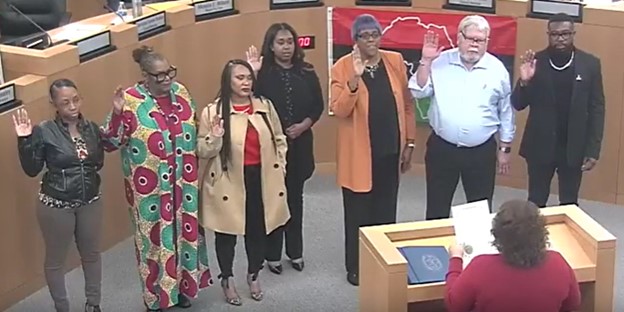
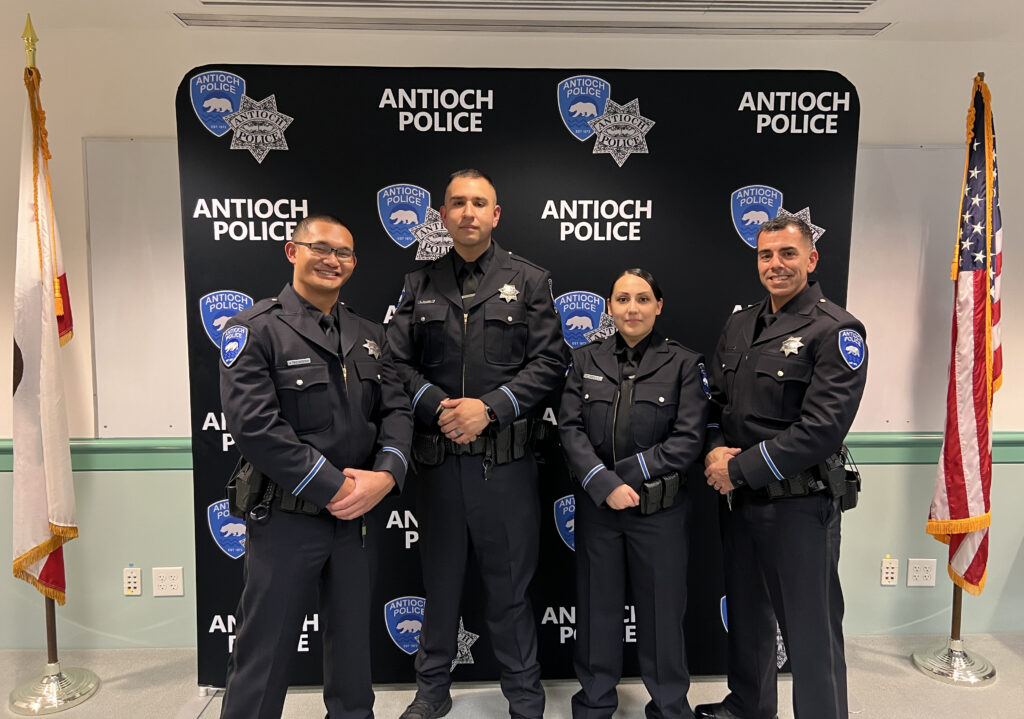
7 members appointed, sworn in Tuesday night, presented during Wednesday ceremony; does not replace Police Crime Prevention Commission
“We’re creating an advisory, oversight board.” – Mayor Lamar Hernandez-Thorpe
“They did not need to form a new commission.” – former Police Crime Prevention Commission Chair Sandra White
Commissioners ran have criminal records
Former councilman says some commissioners biased toward police, shouldn’t be appointed
By Allen D. Payton
During their meeting on Tuesday, Feb. 13, 2024, the Antioch City Council on 3-0 votes appointed seven members to the new Police Oversight Commission. Mayor Pro Tem Monica Wilson and District 2 Councilman Mike Barbanica were absent. Because Antioch is a general-law city, the commission has limited authority and will only serve in an advisory role to the council. Each of the four councilmembers selected one commissioner from their respective districts. The other three were appointed by Mayor Lamar Hernandez-Thorpe, including one representing the faith community. One of the new commissioners, Harry Thurston had previously served as a member of the Police Crime Prevention Commission. (See 1:18:00 mark of meeting video)
Background
The mayor held a ceremonial oath of office re-enactment event the next morning which was attended by all seven commissioners and District 1 Councilwoman Tamisha Torres-Walker. In his announcement about the event, Hernandez-Thorpe shared in February 2021, he announced several police reform measures, including establishing the commission and claims it was “once an opposed concept, now a reality to assist in building trust between community and police department.” In his post about the event on his official Facebook page, he offered a “a special THANK YOU to all his colleagues on the Antioch City Council for actively participating in the selection process that included community members and the East County Branch of the NAACP.”
According to the City staff report for the May 10, 2022, council meeting, “City staff researched (1) police oversight commissions and boards in general law and charter cities; (2) the differences between police oversight commissions in general law cities and charter cities; and (3) solutions that can be achieved under each type of government within state and local laws and policies.
City staff…prepared an ordinance forming the Antioch Police Oversight Commission with the aim of strengthening trust, transparency, accountability, and police-community relations in the City of Antioch by ensuring that the Antioch Police Department’s policies, practices, and customs meet or exceed national standards of constitutional policing.”
The new commission was approved on a 3-1 vote with Barbanica opposing formation of the commission, saying he believed they should give Interim Police Chief Ford more time in his position and get input from him prior to the formation of this Commission. Ogorchock was absent for that meeting. (See 1:19:16 mark of the meeting video)
Commissioners Must Be Antioch Residents, Can Have Criminal Records
As previously reported, the adopted resolution also included details on membership of the commission:
(A) The Police Commission shall consist of seven (7) voting members appointed by the Mayor and confirmed by the City Council.
(B) All voting members of the Police Commission shall be residents of the City of Antioch.
(C) The Mayor and the City Council shall strive to appoint and confirm at least:
(a) one (1) representative from each of the four (4) councilmember voting districts of the City;
(b) one (1) representative of the Antioch faith-based community;
(c) one (1) representative of the Antioch business community; and
(d) one (1) employee or student of the Antioch Unified School District.
(D) No one shall be excluded from the Police Commission because he or she has a criminal record.
(E) The following shall not be eligible to serve as a Police Commissioner:
(a) current sworn police officer or his/her spouse;
(b) current City employee or his/her spouse;
(c) former Police Department sworn employee or his/her spouse; or
(d) current or former employee, official, or representative of an employee association representing sworn police officers or his/her spouse.
(F) Commissioners shall not be issued and shall not display, wear, or carry badges that so resemble a peace officer’s badge that an ordinary reasonable person would believe that Commissioners have the authority of a peace officer.
On May 24, 2022, the Antioch City Council, under Consent Calendar Item F., voted 3-1 to create the Police Commission, with District 3 Councilwoman Lori Ogorchock opposing without explaining her vote and Barbanica absent.
Ogorchock Explains Votes for Appointments
Asked why she voted for the appointments when she opposed the formation of the commission, Ogorchock said, “Because it was going to happen no matter what. The division has to stop some place. So, I wanted to ensure my district was well represented by an individual with an appropriate background and Mahogany Spears fills that. She was very qualified.”
“Claryssa Wilson and Deer Valley High Senior Class President Corey Hawkins helped me choose Mahogany,” The District 3 councilwoman continued. “We interviewed three candidates. Mahogany is overqualified for this.”
Had Ogorchock voted against the appointments, the agenda item and appointees would have had to return at a future council meeting when Wilson, who supported the commission’s formation was in attendance.
Purpose of Commission
According to the City staff report for the item on Tuesday’s council meeting agenda, the purpose of the Police Oversight Commission is as follows:
- to strengthen trust, transparency, accountability, and police-community relations in the City of Antioch by ensuring that the Antioch Police Department’s policies, practices, and customs meet or exceed national standards of constitutional policing.
- advise the City Council, City Manager, and Chief of Police on the administration of the Antioch Police Department and on policy matters concerning public safety within the City of Antioch.
- facilitate community participation and oversight by reviewing and recommending policies, procedures, practices, and programs designed to result in community policing that is effective, responsive, and sensitive to the diverse needs of the residents of the City.
- promote and encourage open communication and cooperation between the Antioch Police Department and residents of the City, recognizing that policing the City of Antioch is a shared responsibility.
- develop, review, and make policy recommendations aimed at informing the community of its rights and responsibilities when interacting with police officers.”
Public Speaker Says Some Commissioners Biased Against Police
During public comments on the appointment votes, former Antioch Councilman Ralph Hernandez, who is also a former Pittsburg Police Officer, said the commissioners, “could muddle the waters and cause problems for the community. Some of those you have proposed to appoint, have come up here many council times and criticized the police. They wanted them fired. They wanted them defunded. They already have a predisposition against the police. That is not what you want any commission to be. They have to be honest and open-minded not attack the police just because.” (See 1:26:00 mark of council meeting video)
Hernandez then spoke specifically against the appointment of Devin Williams. Ogorchock responded to those comments saying, “I just want to say one thing to all the individuals being appointed, tonight. I do not believe that you’re coming into this with a predisposed notion of making certain changes without hearing all the facts before you, each time it comes to you. I think you will have an open mind. You will listen to the public and you will do the public’s work, just as this council does. So, I hope and pray, and I believe in my heart that’s how this commission is going to act.”
She then moved approval of Williams’ appointment.
Limited Authority in General Law City
Unlike charter cities such as San Francisco, which has a Police Commission that oversees the San Francisco Police Department and the Department of Police Accountability, and “sets policy…conducts disciplinary hearings on charges of police misconduct…imposes discipline as needed and hears officer appeals from discipline imposed by the Chief of Police,” Antioch is a General Law city. Thus, the new commission has limited oversight power of the police department and does not have the authority to conduct matters such as the SF Police Commission can.
During the May 10, 2022, meeting in explaining the new commission’s role, Hernandez-Thorpe spoke of the police commissions in San Francisco as well as in Oakland, for which City Attorney Thomas L. Smith served as chair, “that actually have power. The Oakland oversight board had the power to fire the chief of police. And so that’s not what we’re creating, here today. We’re creating an advisory, oversight board.”
According to the meeting Minutes for the agenda item (#6), “any recommendations or policies would have to be codified by the City Council.”
Former Commission Chair Says New Commission Unnecessary
Asked if the Police Crime Prevention Commission could have handled the responsibilities of the new commission, former Chair Sandra White said, “Yes. If the mayor and the city council would have wanted. But they would have had to vote on that. They did not need to form a new commission. Our goal was to bring forth Neighborhood Watch meetings. But it was independent of whatever the police department was doing.”
UPDATE: Hernandez-Thorpe later shared, “The police oversight commission was not created to replace crime prevention commission. Crime prevention still exists and is under review in terms of purpose and scope of work.”
However, the commission has not held a meeting since Sept. 2021. A note on the Boards and Commissions page of the City’s website beneath the Police Crime Prevention Commission reads, “On April 11th, 2023, the Antioch City Council created an Ad Hoc Committee to define the purpose and structure of the PCPC. Please check back at a future date for more details.“
“It still exists,” the mayor reiterated. “We had a meeting about it a few months ago specifically working on its purpose. I put a pause on appointing new commissioners until the work group came back to council with their recommendations.”
Seven Appointees & Backgrounds
According to the City staff report: Because this is the initial appointment of commissioners, all seven members are vacant. The City Council shall strive to appoint the members as follows: One member representative from each of the four councilmember districts; one member representative of the Antioch faith-based community; one member representative of the Antioch business community; and one member representative that is an employee or student of the Antioch Unified School District.
Two commissioners will have one-year terms; two commissioners will have two-years terms; and three commissioners will have three-year terms.
Hernandez-Thorpe nominated, and the council approved the appointment of the following Antioch citizens to the Police Commission: (click on names for backgrounds)
One-year terms, expiring November 2024 – Alicia Dianne Lacey-Oha (Hernandez-Thorpe) and Devin Williams (Hernandez-Thorpe);
Two-year terms, expiring November 2025 – Porshe Taylor (faith-based community, chosen by Hernandez-Thorpe) and Leslie May (Torres-Walker); and for
Three-year terms, expiring November 2026 – Mahogany Spears (Ogorchock), Treva Hadden (Barbanica) and Harry Thurston (Wilson).
Neighborhood Watch Not Part of New Commission’s Responsibilities
White was also asked if Thurston, as the only former member of the previous commission, ever suggested taking on any of the responsibilities of the new commission she said, “No. He always said, ‘police business is completely separate than the commission business’.”
When reached for comment Thurston was asked the same question. He said, “when I was there, that commission was solely based off of Neighborhood Watch. It was outside of that commission to talk about oversight. Our role was to work with the public on crime prevention. It was not there to monitor the police. The chief was very strict about.”
“That role is a very valid one that works directly with the public to help prevent crime from happening to them,” Thurston added.
Asked if the new commission will continue to work with Neighborhood Watch he said, “We’ll be involved with that to some extent, to collect citizen opinion, so we can include that in our oversight responsibility. But I don’t think we will be involved in the Neighborhood Watch program. We might be going to the August Night Outs.”
“So, we will interact with the community. We’ll probably hold town hall meetings,” Thurston continued. “We want people to attend meetings so the public will have a say in the policing of their city. We want to make sure we have citizen input for everything we do.”
Asked who will be the liaison for the police department, Thurston said, “The police chief will be involved with the commission. He will be a key partner with us. He will be interacting with the commission as far as I anticipate.”
Powers & Duties of Commission
The new commissioner then shared from the ordinance adopted by the city council forming the commission, in Section 4-3.110 Powers and Duties, subsection “(E) Require the Chief of Police to submit an annual report to the Police Commission regarding such matters as the Police Commission shall require” and from subsection “(F) Report at least once a year to the Mayor, the City Council, and to the public to the extent permissible by law, the information contained in the Chief’s report in addition to such other matters as are relevant to the functions and duties of the Police Commission.”
Thurston also shared under Section 4-3.110 Public Reports, subsection “(B) The Police Commission shall provide annual public reports to City Council, City Manager, and City Attorney on the Police Department’s progress on Police Commission recommendations and other updates relevant to the mission of the Police Commission.”
Organizing Meeting in March
Asked when the first commission meeting will be held, where and how often Thurston said, “The only word I have is we’re going to get together in March. We will have to identify a chair and vice chair, and the administrative details.”