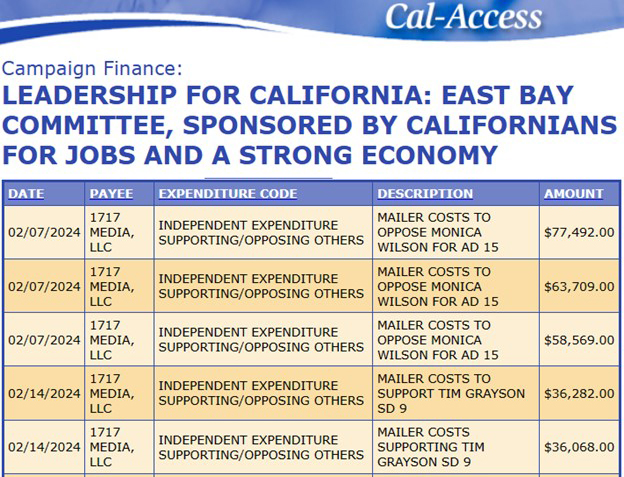
The Leadership for California: East Bay Committee financial disclosure reports show expenditures for three mailers against Monica Wilson in the Assembly District 15 race and two mailers supporting Tim Grayson in the State Senate District 9 race. Source: Cal-Access
Same PAC supporting Grayson in Senate District 9 race
By Allen D. Payton
So far, a political action committee named “Leadership for California: East Bay Committee, Sponsored by Californians for Jobs and a Strong Economy” has spent $214,162 to oppose Antioch Mayor Pro Tem Monica Wilson in her campaign for the State Assembly District 15 seat.
To date the PAC has paid for six mailers against Wilson between Feb. 7th to 15th, ranging in cost from $35,242 to $77,492. According to the PAC’s Form 460 financial disclosure report from Jan. 1 thru Feb. 17, 2024, there are two mailers that had yet to be mailed. Most likely they have been by now.
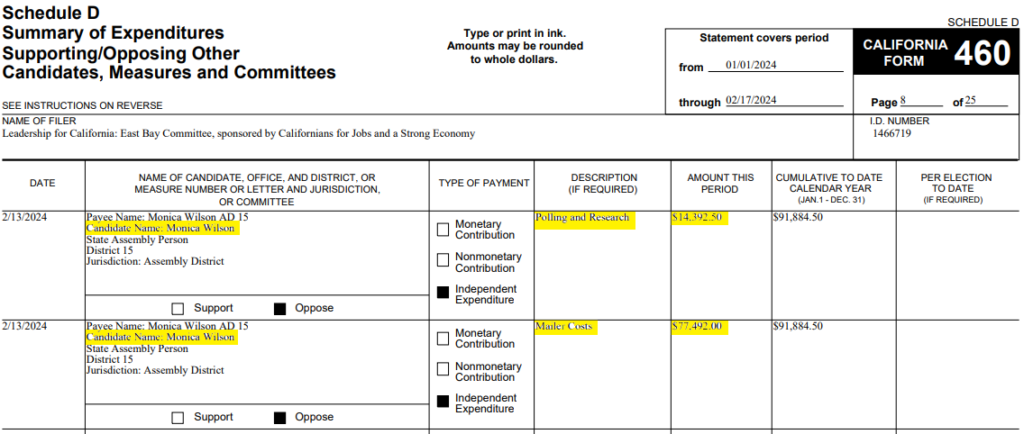
The Leadership for California East Bay Committe Form 460 report dated Feb. 17, 2024, shows expenditures for polling, research and a mailer against Wilson. Source: Cal-Access
$260,000 from Californians for Jobs and a Strong Economy ID# 1275549
$49,000 from American Beverage Association California PAC
$10,000 from Keeping Californians Working, a Coalition of Insurance Agents, Technology, Energy, and Health Care Providers
$14,392.50 as an in-kind non-monetary contribution by Brighter Future for All ID# 1463665 for polling and research.
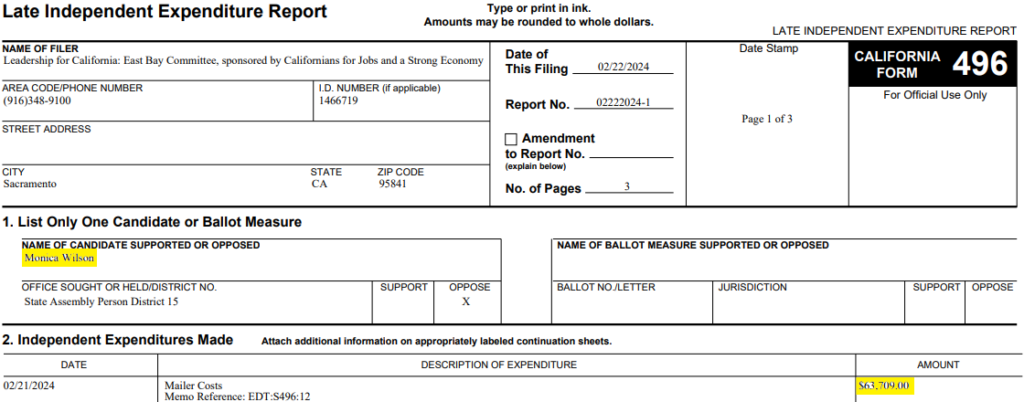
The Leadership for CA East Bay Committe Form 496 report dated Feb. 22, 2024, shows expenditures for another mailer against Wilson. Source: Cal-Access
Californians for Jobs and a Strong Economy Supported By Medical, Business Interests
According to Cal-Access, contributors to The Californians for Jobs and a Strong Economy PAC include the California Medical Association PAC, Target, Dart Container, Cooperative of American Physicians State PAC, Californians Allied for Patient Protection PAC, California Cable Telecommunications Association, Davita, Lyft, Peace Officers Research Association of California (PORAC) PAC, Fresenius Medical Care, In-N-Out Burgers, California Real Estate PAC, Chevron, PG&E, Walmart, Chime Financial, Inc., Anheuser-Busch Companies, McDonald’s Corporation and California Bankers Association State PAC.
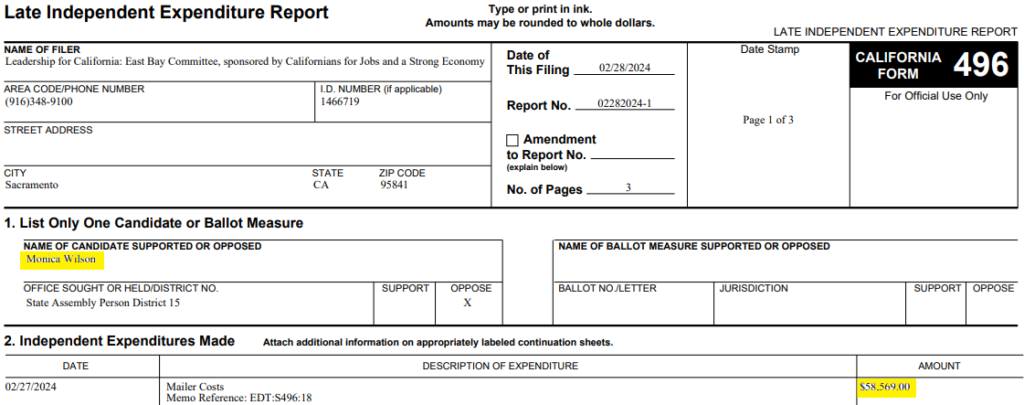
The Leadership for CA East Bay Committe Form 496 report dated Feb. 28, 2024, shows expenditures for a third mailer. Source: Cal-Access
Same East Bay PAC is Supporting Grayson for Senate
The same Leadership for California: East Bay Committee PAC also spent $72,350 on two mailers supporting Assemblyman Tim Grayson, for whose seat Wilson is seaking, in his campaign for State Senate District 9.
Wilson is facing three opponents in the race for Assembly District 15, including two fellow Democrats, County Board of Education Trustee Anamarie Avila Farias and former County Supervisor Karen Mitchoff, and one Republican, Realtor Sonia Ledo. The election is next Tuesday, March 5th and the top two vote-getters will face off in the November general election.
Blake Harper Trujillo with dad, Timothy and mom, Josephine Trujillo born Feb. 29, 2024, at Kaiser Antioch Medical Center. Photo: Kaiser Permanente
By Antonia Ehlers, PR and Media Relations, Kaiser Permanente Northern California
Pittsburg mother-to-be Josephine Trujillo had a big surprise Wednesday night – she went into labor! What began as a trip to see a midwife at the Kaiser Permanente Delta Fair Medical Offices ended at the Kaiser Permanente Antioch Medical Center. A few hours later – at precisely 12:04 a.m. Thursday, Feb. 29, 2024, – Josephine gave birth to baby Blake Harper. The adorable baby with lots of hair and steel blue eyes is one of the Bay Area’s first 2024 Leap Year babies.
Proud dad Timothy Trujillo, a project manager at the Worley Group, said the little bundle of joy weighed in at 9 pounds, 6 ounces and measured 21 inches.
“It feels surreal but excellent,” he said.
Josephine, a middle school science teacher at Edna Brewer Middle School in Oakland, said everything happened so fast once she went into labor.
“Our due date was February 27, but it was still a surprise,” she said. “Our care at Kaiser Permanente was amazing – they made it easy. Everyone was on top of it. ‘We’ve been calling him our ‘little chonker’ and we’re just ecstatic.”
“Congratulations to the Trujillo family on the birth of baby Blake,” said Pam Galley, Kaiser Permanente senior vice president and area manager for the Diablo Service Area. “Our health care team at the Kaiser Permanente Antioch Medical Center welcomed a very special Leap Year baby today, and we wish his family all the best.”
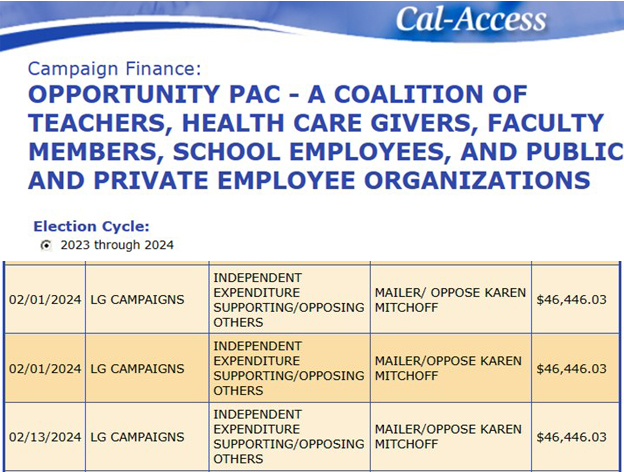
The Opportunity PAC’s financial disclosure reports show expenditures for three of the four “hit piece” mailers against Karen Mitchoff in the Assembly District 15 race. Source: Cal-Access
By Allen D. Payton
One of four mailers opposing Mitchoff paid for by Opportunity PAC with funds form by unions.
Some of the same unions backing Antioch Mayor Pro Tem Monica Wilson in the Assembly District 15 race on the March primary ballot have spent almost $253,000 attacking one of her three opponents, former Contra Costa County Supervisor Karen Mitchoff.
At least four mailers have been sent to Democrat voters in the district criticizing Mitchoff’s pay raise she voted for while on the board, and her votes against pay raises for county employees.
Two of the mailers obtained by the Herald show they were paid for by “Opportunity PAC – A coalition of teachers, health care givers, faculty members, school employees, and public and private employee organizations.” The political action committee’s Top Funders for the mailers are listed as SEIU (Service Employees International Union) California State Council, California Faculty Association (of the UC and CSU systems) and California School Employee Association.
Another of four mailers opposing Mitchoff paid for by Opportunity PAC with a similar message about her vote for a pay raise for the Board of Supervisors.
When asked about the mailers Mitchoff said they’re all pretty much about the same issue. “The same group with the same message. My decision on the pay raise was made over 10 years ago because I wanted to make sure the county supervisors were paid enough to make it a full-time position.” She also pointed out that she did vote for pay raises for county employees, “in 2022, giving them 5% a year for four years, for a total increase of 20%.”
The interesting part is that some of the state teachers’ unions including college and university faculty and staff are helping pay for the mailers, even though as a member of the Board of Supervisors, Mitchoff had no say about education funding.
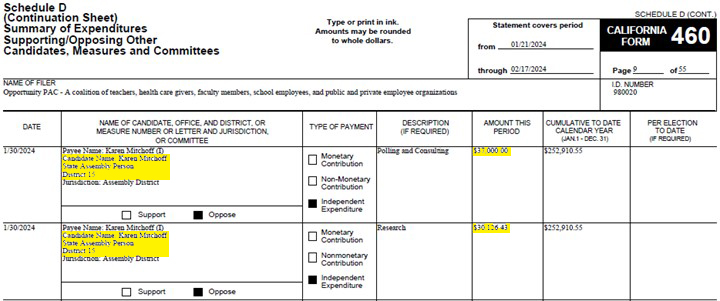
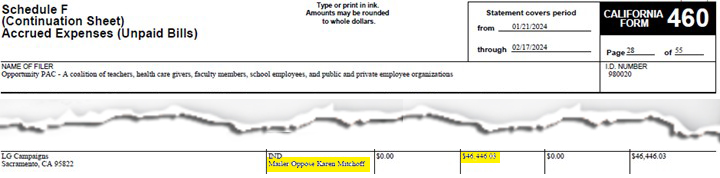
According to Cal-Access, the California Secretary of State’s campaign finance reporting website, so far, the PAC has made three expenditures of $46,446.03 each for three mailers opposing Mitchoff, two on Feb. 1 and one on Feb. 13, 2024. The cost for a fourth mailer that appear under the PAC’s Accrued Expenses show an additional $46,446.03. That totals $185,784.12. In addition, the PAC spent $37,000.00 on polling and consulting and $30,126.43 on research in their effort against Mitchoff.
Other Opportunity PAC Expenditures opposing Mitchoff were for polling, consulting and research. Source: Cal-Access
Contributions to PAC Total Over $2.5 Million
The PAC is supporting and opposing a variety of candidates throughout the state. Their most recent Form 460 financial disclosure report dated Feb. 17, 2024, shows they have raised $1.715 million this year and their report ending Dec. 31, 2023, shows $803,500 was raised last year for a total of $2,518,500. They had cash on hand of over $1.1 million as of Feb. 17th.
Contributions include the following amounts and sources:
$750,000 from the California Teachers Association Independent Expenditure Committee;
$534,500 from SEIU California State Council for Working People;
$225,000 from PACE (Political Action for Classified Employees) of California School Employees Association;
$190,000 from Smart Justice California Action Fund;
$150,000 from United Food and Commercial Workers Western States Council Independent Expenditure PAC;
$150,000 from California Federation of Teachers COPE (Committee on Political Education);
$150,000 from Service Employees International Union Local 1000, Keeping California Healthy, Safe and Strong;
$100,000 from Service Employees International Union Local 721 CTW, CLC Workers’ Strength Committee;
$75,000 from SEIU United Healthcare Workers West PAC;
$59,500 from Faculty for Our University’s Future, a committee sponsored by California Faculty Association;
$59,500 from Standing Committee on Political Education of the California Labor Federation AFL-CIO;
$50,000 from the LGBT (Lesbian, Gay Bisexual & Transgender) Caucus Leadership Fund; and
$25,000 from SEIU California State Council (nonprofit 501 (c)(5))
Opportunity PAC Accrued Expenses as of their Feb. 17, 2024 report includes $46,446.03 for a fourth mailer opposing Mitchoff. Source: Cal-Access
Wilson’s Backers Funding Mitchoff Opposition Effort
Wilson’s campaign has been the beneficiary of support from many of those same unions. On her campaign website, Wilson shows endorsements by the California Faculty Association, SEIU California, National Union of Healthcare Workers (NUHW) and United Food & Commercial Workers Local 5, as well as unions that are members of the AFL-CIO.
Wilson and Mitchoff also face two others in the race, including County School Board Trustee Anamarie Avila Farias and Realtor Sonia Ledo in the March 5th primary election next Tuesday. The top two will face off in the November election.
Key to the City of Antioch recipients on Feb. 29, 2024 (top row L-R) Frances Green, Shamawn Wright, Supervisor Federal Glover, Willie Mims, and (bottom row L-R) the late Antioch Councilman Reggie Moore and Dietra King. Source: Antioch Mayor Lamar Hernandez-Thorpe
To two former Antioch residents posthumously, three Pittsburg residents and one Oakland resident
By Allen D. Payton
During Antioch’s Black History Month Closing Celebration, this evening, Thursday, Feb. 29, 2024, Mayor Lamar Hernandez-Thorpe will present a Key to the City to each of “six deserving individuals who have significantly impacted our community,” according to the Eventbrite invitation. “This prestigious honor recognizes their outstanding achievements and dedication.”
The recipients include two former Antioch residents who have passed away, Antioch’s first African American councilmember, the late Hon. Reginald “Reggie” Moore and the late Dietra King, co-owner of Dad’s BBQ and owner, broker of Hearts Realty. In addition, three Pittsburg residents, Board of Supervisors Chair Federal Glover, local civil rights and community activist Willie Mims and NAACP East County Branch leader and Building Black Political Power PAC President Frances Green will also receive a Key to the City.
Finally, a sixth Key to the City will be presented to Oakland resident Shamawn Wright, Founder of the non-profit Bridge Builders to the New Generation which has an office inside the East Family Justice Center in Antioch and serves Antioch youth.
The mayor chose each of the recipients and has said in the past that it doesn’t require council approval.
The event will be held at Delta Bay Community Church, 1020 E. Tregallas Road in Antioch. Doors open at 6:30 PM, and the program begins promptly at 7:00 pm. A special reception with music and hors-d’oeuvres will follow the program.
Group behind effort to defeat her has spent over $233,000
By Allen D. Payton
Hit piece mailer against Avila Farias.
At least two campaign mailers against candidate for State Assembly District 15 Anamarie Avila Farias were sent to voters this month by a group named “Contra Costa Neighbors opposed to Farias for Assembly 2024”, and the most recent mailer clearly stretches the truth in one of its claims. They’re part of an effort that has spent over $233,000 to defeat her, so far.
The mailer readers “Typical Politician Anamarie Avila Farias’ Double-Dipping Record Hurt Progress on Homelessness” and among other accusations claims she, “Collected salaries and benefits from multiple governmental agencies at the same time.”
First, while I prefer employees for one government agency to not serve as elected officials for another, it’s not uncommon for local elected officials to also work for other government agencies. That was the case for Avila Farias 10 and 11 years ago. Since then, she has worked for a non-governmental agency and non-profit organization, while serving as both an elected and appointed official.
Some of that information is listed on Avila-Farias’ campaign website.
Government Employment
When reviewing the information about the Assembly candidate on the Transparent California website, it shows she previously worked in government positions as a Senior Management Analyst for the City of Oakland in 2013, then a Program Analyst for the City of Concord in 2013 and 2014, for which she was paid a salary and benefits. Those positions aren’t mentioned on her campaign website but are the only government positions she has held.
Non-Government, Elected & Appointed Positions
Avila Farias currently works as the executive director for the Juvenile Hall Auxiliary of Contra Costa County, a non-profit organization, for which she first served on the board of directors. Avila Farias said she stepped down from the board after being hired to run the organization in 2019.
As a member of the Martinez City Council from 2012-16, Avila Farias received pay and benefits totaling $16,552.01 to $18,791.48 per year. She is now serving in her first term as an elected trustee on the Contra Costa County Board of Education, having been elected in 2020, for which she receives about $550 in stipend and $2,500 in benefits per month.
Avila Farias has also served on the Board of Directors of the California Housing Finance Agency since she was appointed in 2015, for which she said she receives a small stipend of $100 per meeting. That was confirmed by agency staff and is also reflected on the Transparent California website. Avila Farias also serves on the Board of Directors of the Carquinez Regional Environmental Education Center, but that is not a paid position.
According to her profile on the Finance Authority’s website, “She held multiple positions at the Housing Authority of Contra Costa County from 1989 to 2018, including Housing Policy and Program Analyst and Central Waiting List Housing Manager.” However, according to the Housing Authority website, it is not a government agency even though its seven-member board includes all five county supervisors.
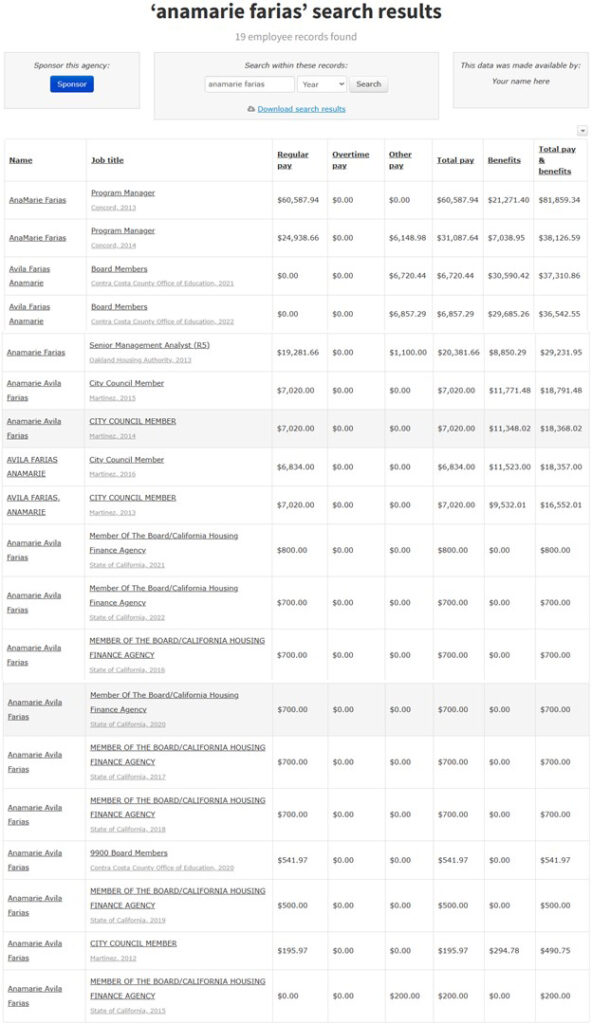
Transparent California website search results for Avila Farias.
Following is the list of Avila Farias’ government position-related compensation from the Transparent California website to which the mailer provides the link, in order of years:
Year Position Pay Benefits Total
2012 Martinez Council Member $195.97 $294.78 $490.75
2013 Martinez Council Member $7,020.00 $9,532.01 $16,552.01
2013 Senior Management Analyst, City of Oakland $20,381.66 $8,850.29 $29,231.95
2013 Program Manager, City of Concord $60,587.94 $21,271.40 $81,859.34
2014 Program Manager, City of Concord $31,087.64 $7,038.95 $38,126.59
2014 Member, Martinez Council $7,020.00 $11,348.02 $18,368.02
2015 Member, Martinez Council $7,020.00 $11,771.48 $18,791.48
2022 Member, Contra Costa Board of Education $6,857.99 $29,685.26 $36,542.55
Mostly False
So, there were only two years, 2013 and 2014 that Avila Farias received pay and benefits both as a government employee and as an elected official, supporting the mailer’s claim of her “double dipping”. But even that is a stretch as she wasn’t paid a salary for both positions, merely a stipend for her elected position and benefits for both and it was for only two agencies at a time. Thus, the mailer’s claim that Avila Farias “Collected salaries and benefits from multiple governmental agencies at the same time” is mostly false.
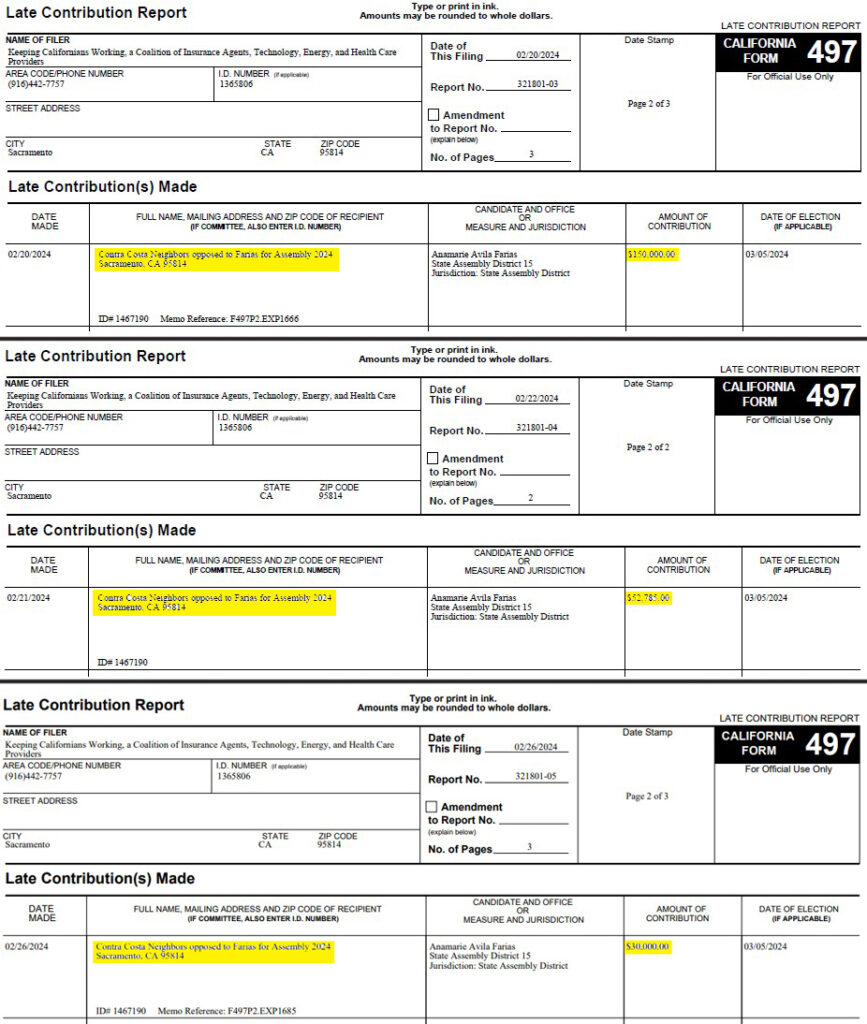
Keeping Californians Working Form 497 Late Contribution Reports dated Feb. 20, 22 & 26, 2024. Source: CA Secretary of State’s Cal-Access website.
Group Behind the Mailer
According to the disclosure requirement on the mailers, the group behind them “a coalition of charter public school advocates, insurance agents, technology, energy, and health care providers” and the “Ad Committee’s Top Funder” is listed as a political action committee (PAC) named “Keeping Californians Working.” A search of the California Secretary of State’s Cal-Access campaign finance website shows the committee’s FPPC ID number is 1365806 and as of the Feb. 17, 2024, report has raised $521,500 and spent $658,516.89 this year, with ending cash of $759,206.46. The PAC raised $1.125 million in 2023.
According to the PAC’s reports the coalition has spent over $233,000 to defeat Avila Farias. The PAC’s Form 497 Late Contribution Report number 321801-05 dated Feb. 26, 2024, shows they contributed $30,000 to the Contra Costa Neighbors opposed to Avila Farias coalition. According to the PAC’s Form 497 Late Contribution Report number 321801-04 dated Feb. 22, 2024, the committee also contributed $52,785 to defeat her, and report number 21801-03 dated Feb. 20, 2024, shows they contributed $150,000 to the effort against Avila Farias. Another Form 497 report number 321801-06 was filed today, Wednesday, Feb. 28 for an additional $1,000 contribution to the coalition’s efforts.
The PAC’s major contributors include $125,000 from the Personal Insurance Federation of CA Agents & Employees PAC; $250,000 from the Pharmaceutical Research And Manufacturers Of America IEC (Independent Expenditure Committee); $250,000 from Uber Innovation Political Action Committee; $250,000 from Powering California’s Future, Sponsored by Edison International, the Los Angeles-area energy company; $250,000 from DaVita, Inc., a kidney dialysis company; and most recently, $10,000 from Leadership for California: East Bay Committee, whose ID number was pending as of the date of the Form 49 report on Feb. 5, 2024. The PAC is also spending money to support other candidates in other parts of the state.
The election is next Tuesday, March 5. Avila Farias faces fellow Democrats former Contra Costa County Supervisor Karen Mitchoff, Antioch Mayor Pro Tem Monica Wilson and Republican Realtor Sonia Ledo in the race to replace Assemblyman Tim Grayson who is running for State Senate. The top two candidates will face off in the November general election.
Supervisors suspend all-electric requirements following U.S. Court of Appeals ruling
(Martinez, CA) – The Contra Costa County Board of Supervisors Tuesday suspended enforcement of its requirement that most new buildings be constructed as all-electric buildings. The County’s all-electric building requirement, as part of the County’s building code, had prohibited the installation of natural gas infrastructure in most new buildings and required developers to use electricity as the sole source of energy in the building. With Tuesday’s action, the County’s all-electric building requirement will not be enforced.
Last month, the U.S. Court of Appeals for the Ninth Circuit invalidated a City of Berkeley ordinance that prohibited natural gas infrastructure in new buildings. The court held that the federal Energy Policy and Conservation Act precludes cities and counties from adopting building codes that prohibit the installation of gas plumbing in buildings.
Contra Costa County’s all-electric building requirement, like the invalidated City of Berkeley ordinance, prohibits the installation of gas plumbing in new buildings. The County is therefore suspending this requirement in response to the Ninth Circuit’s decision.
At the same time, the Board of Supervisors remains committed to the goals that prompted it to adopt the all-electric requirement: improving public health and fighting what they believe contributes to climate change. The Board referred the topic of reducing greenhouse gas emissions from buildings to its Sustainability Committee and directed staff to report on alternatives for advancing this objective at the Committee’s next meeting.
“Contra Costa County remains committed to reducing the use of fossil fuels in buildings and continues to support the construction of new buildings using all-electric technologies,” said Board Chair Federal D. Glover, District 5 Supervisor. “We are eager to identify new and innovative ways to continue to pursue our goal of reducing greenhouse gas emissions from buildings.”
The County encourages residents and businesses to continue to install all-electric building systems and appliances. There are many benefits of all-electric construction, some of which include:
Cleaner air and better health outcomes from eliminating the emissions associated with burning fossil fuels, particularly indoors.
Not having to pay to install gas pipes in new buildings.
Taking advantage of financial incentives and rebates for all-electric appliances.
Resilience against power outages, particularly when electric technologies are paired with battery storage.
Hedging against high electricity costs by being able to schedule electric appliances to operate at times of day when electricity costs are lowest.
Preparing for the potential discontinuation of gas appliances in the future that could occur from possible regulatory actions by regional, state, or federal agencies.
There are many good resources on the benefits of all-electric buildings, including:
The County’s sustainability web site has information on state and federal incentives, rebates, and other ways to fund all-electric upgrades.
MCE, the community choice energy provider for most of Contra Costa County, offers rebates and incentives.
The Switch Is On, sponsored by the Building Decarbonization Coalition, is a collaborative campaign to support all-electric home conversion by providing tools, support, and resources to Californians.
Rewiring America provides information about the benefits of all-electric technologies, and helps generate a personalized plan for individuals, including costs and savings.
PG&E also has resources on all-electric buildings, including rebates, incentives, rate plans, and design guides.
New Antioch Interim Police Chief Brian Addington is administered his ceremonial oath of office by Deputy City Clerk Christina Garcia and followed by the pinning of the chief’s badge by his wife, Lori, Tuesday afternoon, Feb. 27, 2024. Photos by Allen D. Payton
Officially sworn in Monday before starting in his new position that day
“With a new day, there’s a renewed hope and we will rise to the challenge and achieve positive changes.” – Interim Antioch Police Chief Brian Addington
By Allen D. Payton
Antioch’s new Interim Police Chief Brian Addington was given a ceremonial oath of office Tuesday afternoon, Feb. 27, 2024, inside the breezeway of City Hall. It was attended by Mayor Lamar Hernandez-Thorpe, all four council members, city department heads, current and retired police personnel from Antioch and Pittsburg, as well as two chiefs and a former chief from other agencies in the county, plus, family and friends.
Addington began work in his new position on Monday, Feb. 26 and said he was sworn in that morning.
Addington signs his oath of office with the help of Deputy City Clerk Garcia.
During Tuesday’s ceremony, following welcome remarks by Hernandez-Thorpe and an introduction of the new interim chief by Acting City Manager and Economic Development Director Kwame Reed, Deputy City Clerk Christina Garcia administered the oath of office and Addington’s wife, Lori pinned the chief’s badge to his chest. He left the breezeway and entered the Council Chambers for a moment, returning with a bouquet of flowers which he presented to his wife.
Addington then shared his thoughts about his new, temporary role saying he recalled Councilman Mike Barbanica was the first to reach out to him. “I thought he was joking. I chuckled. I said, ‘nah, I don’t think so.’”
Then Addington said he was asked by a recruiter about the interim position last June, which he declined and said he didn’t know anyone who was interested. But when Addington was asked around November if he would reconsider, he responded, “I couldn’t say no. Somebody needed to step up.”
“I’m humbled to work here and to lend my hand in stabilizing this organization and taking the next steps that are needed to improve,” Addington stated. “Obviously, we need to increase staff and just as importantly, retain the dedicated women and men who are tirelessly working, here keeping our community safe.”
“My focus will be on assuring we have sufficient resources to keep our residents and businesses safe,” he continued. “I’m committed to being open and transparent both inside the department and with our community.”
“Accountability and consistency will serve as the foundational pillars for us to enhance our culture, ensuring continuous improvement and integrity in all that we do,” Addington stated. “I want every in Antioch to know the police department is here for you.”
Interim Chief Addington speaks following his ceremonial oath of office.
“We will have a renewed focus on customer service,” he continued. “Make no mistake, I have very high expectations for everyone who works at the Antioch Police Department, and I will hold them accountable.”
Addington then introduced his wife and family members and acknowledged Pittsburg Police Chief Steve Albanese and San Pablo’s Interim Police Chief Brian Bubar. (For those who remember him, Albanese is the son of Joe Albanase who was a Antioch Police Reserve Officer for 20 years and very involved in youth sports in the community).
Addington then closed by saying, “I’m an optimist” and shared two of 13 leadership principles he learned from one of his heroes, former U.S. Secretary of State Colin Powell, and tries to live by. “Perpetual optimism is a force multiplier and it ain’t as bad as it looks or ain’t as bad as you think. It will look better in the morning” the interim chief shared. “I think this especially applies to the Antioch Police Department as we face our current challenges.”
“With a new day, there’s a renewed hope and we will rise to the challenge and achieve positive changes, and I’m excited to be involved in leading these efforts,” Addington added.
(Watch video for Addington’s entire comments beginning at the 9-minute mark.)
Unlike the grand oath of office celebration for Steve Ford, Antioch’s last interim police chief to be sworn in two years ago, the ceremony was not publicly announced and a much more muted affair.
Reed said, “It’s designed to be a small event.” Asked why and reminded of Ford’s ceremony, the acting city manager responded, “Neither Chief Addington nor I want that.”
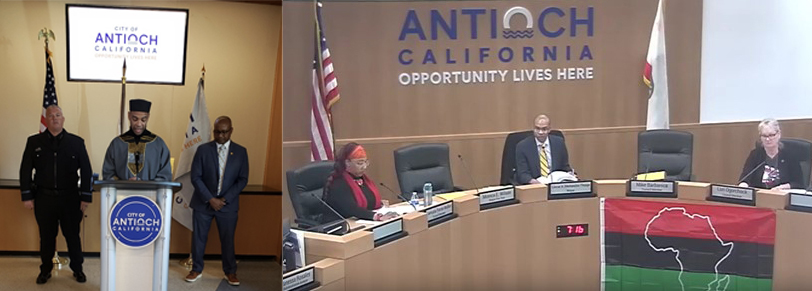
Mayor Hernandez-Thorpe wearing a Dashiki during Chief Addington’s ceremonial oath of office on Feb. 27, 2024. (Photo by Allen D. Payton) The Pan African flag hangs on the Antioch City Council dais during their meeting on Feb. 13, 2024. Video screenshot.
Hernandez-Thorpe, who spoke first during the ceremony, and Mayor Pro Tem and District 4 Councilwoman Monica Wilson were dressed in African-style clothing. Asked about his clothing and if it was for Black History Month, the mayor said it was Dashiki from Nigeria and it was because the council would be raising the Pan African flag (also known as the Afro-American flag and Black Liberation flag, as has been displayed on the council dais during the Feb. 13th meeting) on the City Hall flagpole during the council meeting Tuesday night.
It is expected Addington will serve until a permanent city manager is hired, following the current nationwide search, who will in turn hire a permanent police chief. Read more about Interim Chief Addington, here.
First grade teacher Sandra Morales discusses sentences with a student. Credit: Zaidee Stavely / EdSource
State could retain unpopular written literacy test
By Dana Lambert, EdSource.org – republished with permission
Newly proposed legislation sponsored by the California Teachers Association would eliminate all performance assessments teachers are required to pass, including one for literacy that it supported three years ago. The result could leave in place an unpopular written test that the literacy performance assessment was designed to replace.
Senate Bill 1263, authored by state Sen. Josh Newman, D-Fullerton, would do away with the California Teaching Performance Assessment, known as the CalTPA, through which teachers demonstrate their competence via video clips of instruction and written reflections on their practice.
Eliminating the assessment will increase the number of effective teachers in classrooms, as the state continues to contend with a teacher shortage, said Newman, chairman of the Senate Education Committee.
“One key to improving the educator pipeline is removing barriers that may be dissuading otherwise talented and qualified prospective people from pursuing a career as an educator,” Newman said in a statement to EdSource.
The bill also would do away with a literacy performance assessment of teachers and oversight of literacy instruction in teacher preparation programs mandated by Senate Bill 488, authored by Sen. Susan Rubio, D-West Covina, in 2021.
The literacy performance assessment is scheduled to be piloted in the next few months. It is meant to replace the Reading Instruction Competence Assessment (RICA) set to be scrapped in 2025.
New law could leave RICA in place
The proposed legislation appears to leave in place a requirement that candidates for a preliminary multiple-subject or education specialist credential pass a reading instruction competence assessment, said David DeGuire, a director at the California Commission on Teacher Credentialing.
“At this time, it is unclear what that assessment would look like, but it could be that the state continues to use the current version of the RICA,” he said.
Newman will present the legislation to the Senate Education Committee in the next few months. Discussions about whether the RICA remains in use are likely to take place during the legislative process.
Rubio recently became aware of the new legislation and had not yet discussed it with Newman.
“For three years, I worked arduously and collaboratively with a broad range of education leaders, including parent groups, teacher associations and other stakeholders to modernize a key component of our educational system that in my 17 years as a classroom teacher and school administrator I saw as counterproductive to our students’ learning,” Rubio said of Senate Bill 488.
Teachers union changes course
The California Teachers Association, which originally supported Senate Bill 488, now wants all performance assessments, including the literacy performance assessment, eliminated.
“We are all scratching our heads,” said Yolie Flores, of Families in Schools, a Los Angeles-based education advocacy organization. “We were really blindsided by this (legislation), given the momentum around strengthening our teacher prep programs.”
The results of a survey of almost 1,300 CTA members last year convinced the state teachers union to push for the elimination of the CalTPA, said Leslie Littman, vice president of the union. Teachers who took the survey said the test caused stress, took away time that could have been used to collaborate with mentors and for teaching, and did not prepare them to meet the needs of students, she said.
“I think what we were probably not cognizant of at that time, and it really has become very clear of late, is just how much of a burden these assessments have placed on these teacher candidates,” Littman said.
Teacher candidates would be better served if they were observed over longer periods of time, during student teaching, apprenticeships, residencies and mentorship programs, to determine if they were ready to teach, Littman said. This would also allow a mentor to counsel and support the candidate to ensure they have the required skills.
California joins science of reading movement
California has joined a national effort to change how reading is being taught in schools. States nationwide are rethinking balanced literacy, which has its roots in whole language instruction or teaching children to recognize words by sight, and replacing it with a method that teaches them to decode words by sounding them out, a process known as phonics.
Smarter Balanced test scores, released last fall, show that only 46.6% of the state’s students who were tested met academic standards in English.
Last week Assemblymember Blanca Rubio, D-Baldwin Park, introduced Assembly Bill 2222, which would mandate that schools use evidence-based reading instruction. California, a “local control” state, currently only encourages school districts to incorporate fundamental reading skills, including phonics, into instruction.
“It (Newman’s SB 1263) goes against not only the movement, but everything we know from best practices, evidence, research, science, of how we need to equip new teachers and existing teachers, frankly, to teach literacy,” Flores said. “And that we would wipe it away at this very moment where we’re finally getting some traction is just very concerning.”
Lori DePole, co-director of DeCoding Dyslexia California, said the proposed legislation would cut any progress the state has made “off at the knees.”
Among her concerns is the elimination of the requirement, also authorized by Senate Bill 488, that the California Commission on Teacher Credentialing certify that teacher preparation programs are teaching literacy aligned to state standards and a provision that requires the commission to report to the state Legislature annually on how stakeholders are meeting the requirements of the law.
“It would be going away,” DePole said. “Everyone agreed with SB 488, all the supporters agreed, this was the direction California needed to go to strengthen teacher prep with respect to literacy. And before it can even be fully implemented, we’re going to do a 180 with this legislation. It makes no sense.”
Flores said teachers want to be equipped to teach reading using evidence-based techniques, but many don’t know how.
“We know that reading is the gateway, and if kids can’t read, it’s practically game over, right?” said Flores. “And we are saying with this bill that it doesn’t matter, that we don’t really need to teach and show that teachers know how to teach reading.”
Teacher tests replaced by coursework, degrees
California has been moving away from standardized testing for teacher candidates for several years as the teacher shortage worsened. In July 2021, legislation gave teacher candidates the option to take approved coursework instead of the California Basic Education Skills Test, or CBEST, or the California Subject Examinations for Teachers, or CSET. In January’s tentative budget, Gov. Gavin Newsom proposed eliminating the CBEST and allowing the completion of a bachelor’s degree to satisfy the state’s basic skills requirement.
Littman disagrees with the idea that there will be no accountability for teachers if the legislation passes. “There’s always been, and will continue to be, an evaluation component for all of our teachers in this state,” she said. “It just depends on what your district does and how they implement that. There’s always been a system of accountability for folks.”