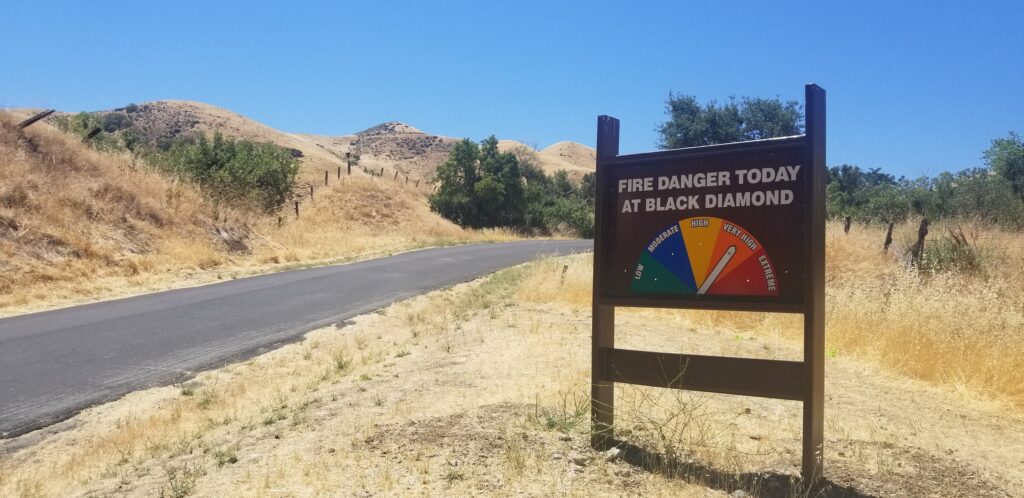
Due to high temperatures and extreme fire danger, Black Diamond Mines Regional Preserve in Antioch will be closed Saturday, July 6. Dry and windy conditions are expected, which can lead to extreme fire weather risks.
When the park is open again, please still take precautions when hiking in the heat. Here are some safety tips:
• Avoid the hottest part of the day. If you do visit, go in the morning or early evening when it is cooler.
• Drink plenty of fluids to stay hydrated.
• Wear sunscreen and lightweight, light-colored clothing.
• Avoid drinking alcohol and caffeine, which can worsen the heat’s effects on your body.
• Don’t forget your pets! Carry water for them.
• No smoking. Smoking is prohibited in all regional trails, parks, and shorelines.
• No open fires or barbecues of any type. Gas-fueled stoves are permitted.
• Stay on designated roads – no off-road driving. Heat from a vehicle’s undercarriage can start a fire.
• Secure all tow chains – dragging tow chains can spark fires.
The Flock Safety camera system technology was used to ID the shooting suspect’s vehicle. He was stopped, arrested and his gun, ammunition and drugs were confiscated. Photos (left & center) by Flock Safety, (right) by CHP
Bay Bridge road-rageshooting suspect from San Pablo, former Antioch resident, identified, arrested by Contra Costa Sheriff’s Deputies
6’7″ felon charged with attempted murder, multiple gun crimes
By Jaime Coffee, Director of Communications, CHP Office of Media Relations
A freeway shooting suspect is in custody and a firearm has been recovered after a road rage incident on the San Francisco – Oakland Bay Bridge (SFOBB) early Monday morning, July 1, 2024. The suspect was identified through one of the newly installed high-tech “Flock” cameras, which provide law enforcement with real-time information and alerts to identify and locate vehicles associated with criminal activity. California Governor Gavin Newsom announced the purchase of the cameras as part of the state’s ongoing public safety investments and work in the East Bay to combat criminal activity and freeway violence.
“Through new state-of-the-art technology and the deployment of officers, California is doubling down in our efforts to keep our communities safe. I thank the California Highway Patrol and allied agencies for their persistent work to secure accountability in this case and help ensure that Californians are safe and secure,” said Governor Gavin Newsom.
“The CHP is excited to have this new technology located on freeways in the Bay Area,” said Commissioner Sean Duryee. “Our investigators will utilize this technology to identify and apprehend those who engage in criminal activity and put California’s motorists at risk.”
On Monday, July 1, 2024, at approximately 6:40 a.m., officers assigned to the CHP’s San Francisco Area office were dispatched to a call of a freeway shooting on westbound Interstate-80, just west of the Treasure Island on-ramp. Officers were advised, the victim in the incident was not struck by the bullet; however, he received lacerations from flying glass inside the vehicle. The victim was able to safely exit the freeway, into the city of San Francisco, where she was met by officers and paramedics.
Detectives from the CHP’s Golden Gate Division Special Investigations Unit (SIU) responded to the scene and spoke with the victim, who mentioned the shooting took place following a merging conflict on the Treasure Island on ramp. A description of the suspect vehicle was obtained, allowing detectives to begin a review of Flock camera data. Detectives quickly identified the suspect vehicle and obtained a license plate number, which allowed them to issue a “Be on the lookout” (BOLO) broadcast to Bay Area law enforcement agencies.
At approximately 10:20 a.m., Contra Costa County Sheriff’s deputies located the vehicle traveling on 7th Street near Pennsylvania Avenue in Richmond and conducted an enforcement stop. The driver, 42-year-old Adrian Martinez Emerson of San Pablo, Calif., was detained and turned over to SIU detectives for questioning. A search of Emerson’s 2016 Honda Accord resulted in the recovery of a pistol believed to have been used in the shooting.
Emerson was subsequently booked into San Francisco County Jail on felony charges of attempted murder, assault with a firearm, and discharging a firearm from a vehicle.
According to localcrimenews.com, the six-foot, seven-inch, 170-pound Emerson is Black and was previously arrested by Richmond Police in 2014 on felony parole violation while he was an Antioch resident. No additional information could be located from an online search about Emerson’s previous conviction.
According to the San Francisco Sheriff’s Office, he is being held on no bail and is also include discharge of a firearm at an inhabited enclosure or vehicle, possession of firearm with prior conviction and by a felon, assault with a semi-automatic firearm, carrying a loaded firearm when not the registered owner, possession of ammunition, having a concealed firearm in a vehicle and carrying a loaded firearm. His court date has not yet been set.
The mission of the CHP is to provide the highest level of Safety, Service, and Security.
Swim facilities, shoreline regional parks remain open
Some hills and inland East Bay Regional Parks closed due to extreme fire conditions and excessive heat
Weather Service extends Red Flag , Excessive Heat Warnings through Saturday, July 6
By Dave Mason, Public Information Supervisor, Public Affairs, East Bay Regional Park District
Parks closed Tuesday by the East Bay Regional Park District will remain closed during this week’s increased temperatures and extreme fire danger (subject to change). The National Weather Service extended a Red Flag Warning and Excessive Heat Warning through Saturday, July 6. The Park District will reassess conditions and provide additional information Friday evening.
A Red Flag Warning means that dry and windy conditions are expected, leading to extreme fire weather risks. The Park District closed the following parks/areas below on July 2.
Also, Anthony Chabot Campground will be closed through the weekend. Please check www.ebparks.org/alerts-closures for the most updated information.
Swim facilities and Shoreline Regional Parks will remain open. Follow these safety rules and tips:
Avoid the hottest part of the day. If you do visit, go in the morning or early evening when it is cooler.
Drink plenty of fluids to stay hydrated.
Wear sunscreen and lightweight, light-colored clothing.
Avoid drinking alcohol and caffeine, which can worsen the heat’s effects on your body.
Don’t forget your pets! Carry water for them.
No smoking. Smoking is prohibited in all regional trails, parks, and shorelines.
No open fires or barbecues of any type. Gas-fueled stoves are permitted.
Stay on designated roads – no off-road driving. Heat from a vehicle’s undercarriage can start a fire.
Secure all tow chains – dragging tow chains can spark fires.
The East Bay Regional Park District is the largest regional park system in the nation, comprising 73 parks, 55 miles of shoreline, and over 1,330 miles of trails for hiking, biking, horseback riding, and environmental education. The Park District receives an estimated 30 million visits annually throughout Alameda and Contra Costa counties in the San Francisco Bay Area.
Six new Antioch Police Officer Recruits meet with department leaders on Wed. July 3, 2024, before entering the academy next Monday. Photos by APD
Chief Addington honors former CSO and new recruit Jose Collazo with CHP award for stolen car recovery
By Antioch Police Department
Exciting News!!!
Chief Addington wished Recruit Officers Daniel Cabada, Jose Collazo, Brandon Michaud, Brian Rose, Zafar Sahel, and David Taylor the very best as they embark on their journey at the Contra Costa Sheriff’s Academy this Monday! These dedicated individuals will undergo six months of intensive training to become the next generation of police officers committed to keeping our community safe.
Interim Antioch Police Chief Brian Addington honors former CSO and now Police Officer Trainee Jose Callazo during the meeting. He begins the Contra Costa Sheriff’s Academy on Monday.
A special congratulations to Police Recruit Jose Collazo, who also received the prestigious CHP 10851 award! Jose, who previously served as a Community Services Officer, has shown exceptional dedication by recovering a significant number of stolen vehicles. We’re proud to see him advance in his career and join the ranks as a full-fledged police officer.
Are you inspired by their dedication and looking for a meaningful career? Join us and make a difference! We offer an expedited hiring process, outstanding pay, benefits, incentives, a $30K hiring bonus, and a variety of exciting assignments.
Visit Joinantiochpd.com for more information and start your journey in serving and protecting our community!
By Sergeant Kristian Palma #6286, Antioch Police Investigations Bureau
On July 3, 2024, at approximately 11:26 PM, Antioch Police Officers responded to the 1600 block of Vineyard Drive for a report of a 58-year-old man shot near the vineyards.
When officers arrived, they located a male adult suffering from multiple gunshot wounds. Antioch
Police Officers rendered medical aid until the Contra Costa County Fire Protection District took over care. Unfortunately, the victim succumbed to his injuries and was pronounced deceased at the scene. A second victim, 44-year-old female adult, later arrived at Sutter Delta Medical Hospital. The second victim suffered at least one gunshot wound and was transported to John Muir Medical Center Walnut Creek in critical condition.
The Antioch Police Department’s Investigations Bureau, consisting of Crime Scene Investigators and detectives with the Violent Crimes Unit took over the investigation. This is an active investigation, and no further information will be released. The identities of the victims are being withheld pending notification to the next of kin. This appears to be an isolated incident and there is no immediate threat to the community.
Additional inquiries or information can be directed to Antioch Police Detective John Cox at (925) 481-8147 or by emailing Jcox@antiochca.gov.
The Contra Costa County Civil Grand Jury issued a report to the Antioch City Council following the Contra Costa DA’s letter to the acting city manager earlier this year about possible state open meeting law violations.
In response to letter from Contra Costa DA sent earlier this yearCivil Grand Jury issues report to Antioch Council on city staff leadership turnovers, vacancies, possible Brown Act violations
“Any similar meeting on matters concerning the city could subject council members to criminal liability.” – DA Becton, Deputy DA for Public Corruption Bolen
Barbanica calls for resignations of Hernandez-Thorpe, Wilson, Torres-Walker and reopening investigation
Mayor says they were “get-togethers, not meetings”
“This is betrayal to the community and to the people they work with on the council,” Councilman Mike Barbanica
“What I’m not going to do is get caught up in Barbanica’s nonsense,” – Mayor Lamar Hernandez-Thorpe
By Allen D. Payton
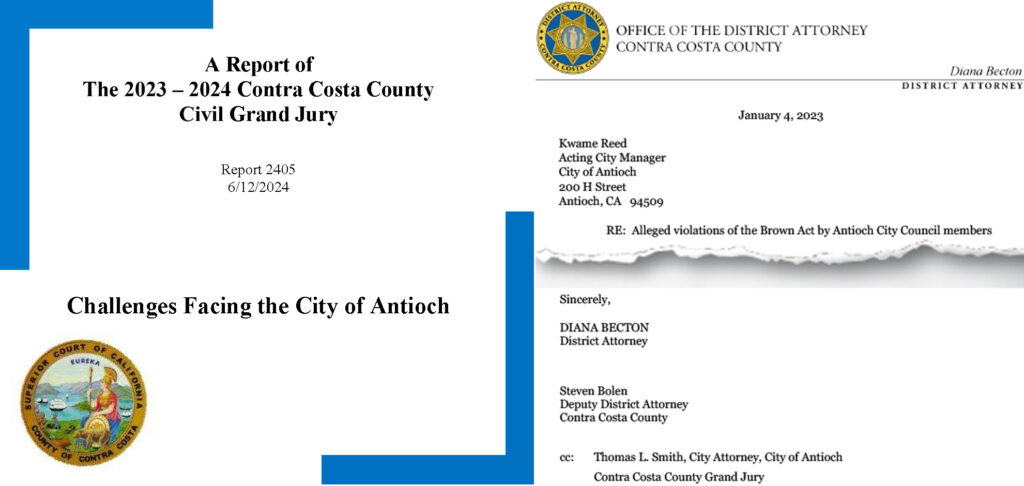
The Contra Costa County Civil Grand Jury publicly released, on Tuesday, July 2, 2024, a report entitled, “Challenges Facing the City of Antioch.” It was sent with a cover letter to the council members on June 14 and includes three areas of concern including turnover in city leadership, city employee vacancies and “possible Brown Act (state open meeting law) violations by the Mayor and certain City Council members, as outlined in a letter to Antioch’s Acting City Manager from the Contra Costa District Attorney.”
While Mayor Lamar Hernandez-Thorpe denies the gatherings at his home attended by current Mayor Pro Tem Monica Wilson and District 1 Councilwoman Tamisha Torres-Walker were meetings at which city business was discussed, his former love interest, Lacy Ferguson, said she offered testimony to the DA’s Office and Grand Jury that the three did discuss redistricting of council districts.
The report also includes five recommendations, two with deadlines by Jan. 1, 2025. The cover letter signed by Grand Jury Foreperson Joanne Sarmento, copied to Acting City Manager Kwame Reed, requires a written response from the city council by Sept. 13, 2024.
The report reads, “Antioch is a dynamic and diverse city that faces a number of challenges. Among these challenges are:
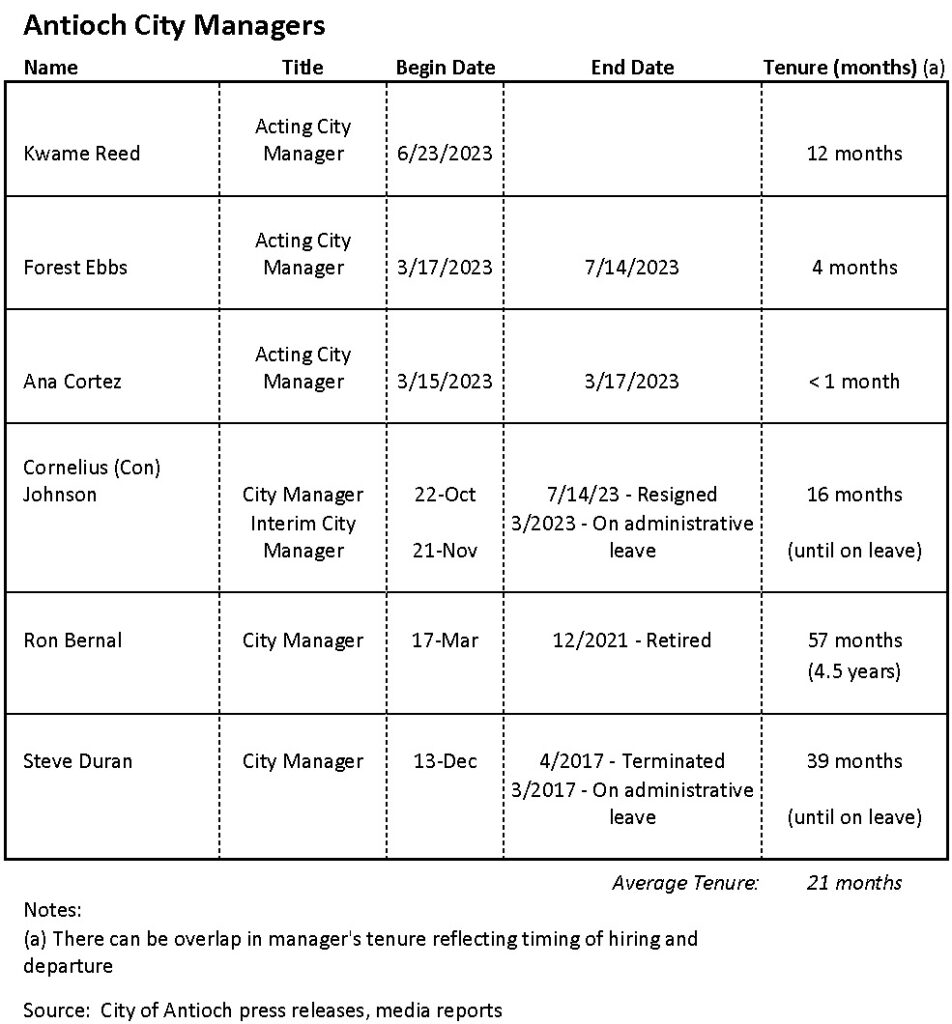
1. Turnover in city leadership (six permanent or acting City Managers since 2013) which has resulted in an average tenure for Antioch City Managers that is less than half the state average (less than two years vs. 4.5-year average).
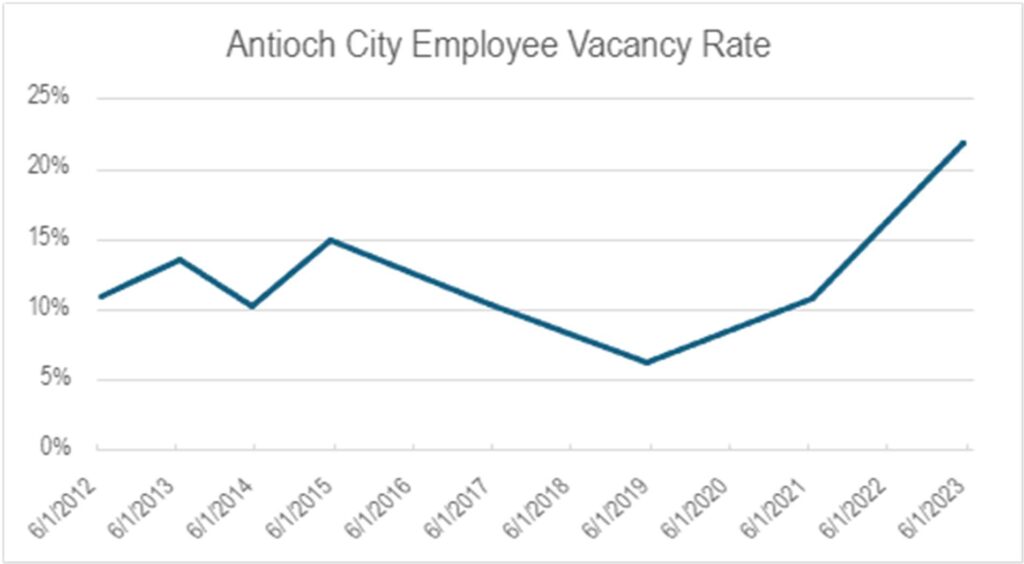
2. A city employee vacancy rate that is 4-times the national average (21.6% vs. 5.3%).
3. Possible Brown Act violations by the Mayor and certain City Council members, as outlined in a letter to Antioch’s Acting City Manager from the Contra Costa District Attorney (see Appendix A).”
Of the recommendations for the city council to follow, two are to be implemented immediately, one six months after the new city manager is hired, and two by next January 1st. The second recommendation is a reminder that city regulations preclude the mayor and council members “from having any direct authority to direct, supervise, hire or fire any city employee, other than the City Manager and City Attorney.”
Herald Publisher Participated in Grand Jury‘s Local Media Panel Discussion
For full disclosure, this reporter was one of three members of the media invited to meet with the Civil Grand Jury in June 2023, including Dan Borenstein of the East Bay Times and Tamara Steiner, publisher of the Concord/Clayton Pioneer. Issues regarding the hiring of the Antioch city manager and other matters were discussed and answers provided to questions from the jurors. However, it is unknown if anything discussed that day was used as a basis for the Grand Jury’s investigation or findings.
UPDATE: Asked if any of the input provided during the meeting with the local media panel was part of the basis for the Grand Jury’s investigation and report, new Foreperson Peter Appert responded, “As the deliberations and work of the Grand Jury are conducted in secret, we are unable to respond to your question. But thank you for your participation in Jury orientation last year.”
Letter from District Attorney, Deputy DA for Public Corruption Re: Private Meetings
That letter to Kwame Reed, sent on Jan. 3, 2024 (but incorrectly dated Jan. 3, 2023) and copied to City Attorney Thomas L. Smith and the Grand Jury was entitled, “RE: Alleged violations of the Brown Act by Antioch City Council members.”
DA Becton and Deputy District Attorney Steven Bolen, who was then in charge of public corruption, wrote, “The Contra Costa County District Attorney’s Office was contacted earlier this year regarding alleged violations of the Brown Act by Antioch Mayor Thorpe, Antioch Councilmember Torres-Walker and Antioch Councilmember Wilson. Specifically, we were told that those three council members met in private to discuss matters within the council’s jurisdiction regarding the Public Works Department and the hiring of the City Engineer. Our investigation also led to an allegation that those three city officials met in private to discuss the redistricting of the city’s electoral map. The District Attorney’s Office reviewed these allegations and the applicable law and then interviewed potential witnesses to determine whether any Brown Act violations occurred.”
“The Brown Act… prohibits a majority of the members of a legislative body to develop a collective concurrence as to action to be taken on any item within the subject matter jurisdiction of the legislative body unless such a meeting is open and public,” the letter continued. “…there is evidence that Mayor Thorpe and Councilmembers Torres-Walker and Wilson met at Mayor Thorpe’s home in 2022 and held discussions” and “Our investigation leads us to believe that Mayor Thorpe and Councilmembers Torres-Walker and Wilson did meet and may have developed a collective occurrence absent a public forum.”
The letter explained why there would be no action taken against the three councilmembers. It reads, “the District Attorney’s Office has serious concerns that non-compliance with the Brown Act may have occurred, however, there is insufficient evidence to prove beyond a reasonable doubt intentional violations of the statute at this time.”
Instead, Becton and Bolen decided to inform Reed, “in order for you to impress upon the council the importance of the Brown Act and the requirements of the statute. Any similar meeting on matters concerning the city could subject council members to criminal liability.”
“As the Brown Act makes clear, the deliberations and actions of our governmental representatives must occur openly and be subject to public scrutiny,” the letter concludes.
They also said they sent the “letter to the Contra Costa County Grand Jury to provide that body the opportunity to take any action it may deem appropriate.” (See CCDA letter re Antioch City Council)
The Grand Jury responded five months later with their report.
Hernandez-Thorpe Admits Private Meetings With Two Councilwomen, Torres-Walker Doesn’t Deny It
In a March 28, 2024 article by The Mercury News/East Bay Times, Hernandez-Thorpe admitted to meeting privately with Wilson and Torres-Walker. The report reads, “As to whether or not he met with Torres-Walker and Wilson, Hernandez-Thorpe said that he had but not for a nefarious purpose.”
“’We coordinate campaigns and whatnot, because we’re Democrats. We’re together all the time,’ Hernandez-Thorpe said. He later added, ‘I think if they can demonstrate that we violated the Brown Act, we’re more than happy to take corrective action.’”
Torres-Walker didn’t deny the private meetings and saying, “that she had no problem with whoever tipped off the DA using the proper channels to voice their concerns,” the article further reported.
Grand Jury Report
The report shared multiple statistics supporting the concerns outlined and offered an explanation for issuing it.
“We concluded that the police force was receiving adequate attention from other investigative bodies…However, the Grand Jury learned that the issues surrounding the police force are related to other issues of oversight and management within city government. In particular, we noted the average tenure for Antioch City Managers has been less than half the California state average over the last decade (average City Manager tenure of less than 2 years in Antioch vs. 4.5 years for the state).”
Source: CCC Civil Grand Jury
Methodology
The report shares the steps taken by the Grand Jury to obtain their information:
We interviewed government officials in Antioch and experts in city government practices
and regulation.
We reviewed press reports and other documents related to Antioch’s city government
operations and performance.
We reviewed recordings and transcripts of city council meetings.
We reviewed city budgets for the past 20 years.
We also reviewed documents related to city government best practices.
Discussion Points
The report then offered three main discussion points and 15 specific findings about the City of Antioch and its governance providing details for each. The discussion points matched the three challenges outlined in the report:
Excessive City Manager Turnover is a Negative for Antioch;
High Employee Vacancy Rates Negatively Impact City Services; and
Brown Act Compliance
Source: CCC Civil Grand Jury
Findings
The report summarizes the findings by the Grand Jury investigation, as follows:
F1. Antioch’s City Manager has broad responsibility to ensure the efficient operation of the city, including supervision of an approximately $100 million general fund budget and an authorized staff of over 400 employees.
F2. The city began the process of recruiting a new permanent City Manager in January 2024. As of June 10, 2024, no hiring decision has been announced.
F3. As outlined in both the City Manager job description and in city recruitment materials, the City Manager position requires a qualified and experienced individual.
F4. There has been a lack of continuity in City Managers in Antioch, with six City Managers or Acting City Managers since December 2013.
F5. Under city ordinances the City Council, including the Mayor, has no direct authority to direct, supervise, hire, or fire any city employees, other than the City Manager and City Attorney (Ordinance 246-A).
F6. The Mayor and City Council members have on occasion overstepped their authority in seeking to make personnel decisions, including terminating the then Public Works Director in December 2022, in ways not permitted by city ordinance (Antioch City Code § 2-2.06 and § 2-2.10).
F7. The Mayor and City Council members have on occasion sought to conduct meetings with City Staff without the approval or involvement of the City Manager, as required by city ordinance (Antioch City Code § 2-2.10).
F8. Antioch’s city government had a 21.6% employee vacancy rate as of February 2024, roughly four-times the national average for government agencies.
F9. In the absence of a permanent City Manager since March 2023, the city has deferred hiring new department heads when openings occur.
F10. The Police, Public Works and Community Development departments currently are without permanent department heads.
F11. Seven of the eleven most senior positions in Antioch city government are currently held by acting or part-time personnel, including City Manager, Assistant City Manager, Directors of Community Development, Police Services, and Public Works (all acting) and the Directors of Economic Development and Recreation (both part-time).
F12. The employee vacancy rate is above the city-wide average in the Public Works Department (26% vacancy rate) and Community Development Department (35% vacancy rate), both of which currently do not have permanent directors.
F13. Recruitment and retention of staff has been impacted by the absence of a permanent City Manager and the lack of permanent department heads in multiple city departments.
F14. The Contra Costa County District Attorney’s Office conducted an investigation into alleged Brown Act violations by Mayor Lamar Hernandez-Thorpe and Council Members Tamisha Torres-Walker and Monica Wilson, which was forwarded to the Grand Jury.
F15. The District Attorney’s Office noted serious concerns that noncompliance with the Brown Act may have occurred, however, there was insufficient evidence to prove beyond a reasonable doubt intentional violations of the statute occurred.
Source: CCC Civil Grand Jury
Grand Jury Recommendations
In the report, the Grand Jury also issued five recommendations, as follows:
R1. “The Mayor and City Council should follow through on the ongoing process of hiring an experienced and qualified City Manager.
R2. The Mayor and City Council should abide by city regulations (Antioch City Code § 2-2.06 and § 2-2.10) that preclude the Mayor and City Council from having any direct authority to direct, supervise, hire or fire any city employee, other than the City Manager and City Attorney.
R3. The new City Manager should, within 6 months of their appointment to the position of City Manager, recruit and appoint permanent department heads to fill current department head vacancies.
R4. By 1/1/2025 the City Council should direct the City Manager to undertake a study to determine the factors leading to the city’s high employee turnover and vacancy rates.
R5. By 1/1/2025 the Mayor and City Council should consider directing the City Manager and
City Attorney to organize an annual training session focused on Brown Act requirements and compliance for the Mayor, City Council members, relevant city employees and members of city boards and commissions.
Written Response Required by Sept. 13, Six Months to Implement Recommendations
The report asks for a written response from the city council by Sept. 13, 2024, required by state law, providing whether the council agrees, disagrees or partially disagrees with each of the findings and include explanations for each one with which they either disagree or partially disagree. It also requires the council members outline how they are going to implement the recommendations or if they cannot, why not. The council has six months to implement the recommendations.
Only Hernandez-Thorpe, Barbanica Respond to Questions for Councilmembers
Questions were sent Tuesday evening to all five council members asking for their comments about the three matters and the direction given by the Grand Jury. They were also asked, besides the search for a new city manager, what is being done to fill the staff vacancies and stem the tide of City employees leaving. The council members were also asked where they are in the process of hiring a permanent city manager, if they have interviewed any candidates, yet, how many, and if they have set a date for the process to be completed.
Hernandez-Thorpe, Wilson and Torres-Walker were specifically asked why they held meetings together outside of either closed session or regular city council meetings, how many private meetings were held at which the three were present, and if any city business was ever discussed.
They were also asked if the discussions involved the hiring of former City Manager Cornelius “Con” Johnson, restructuring the Public Works Department, hiring a city engineer and/or redistricting the city’s electoral map, as is included in the report, and if not, what was discussed during the meetings.
Finally, all five were asked what their response will be to the Grand Jury as requested.
Mayor Has Campaign Spokesman, Former City PIO Respond with Statement
Hernandez-Thorpe responded Tuesday night writing simply, “Rolando will respond on my behalf. Thanks! -LH.” The mayor was referring to Rolando Bonilla, his re-election campaign’s “Communications Director”, and the City’s previous public information officer whose contract was terminated last year. That occurred following the controversy over a press release with words attributed to then-Police Chief Steve Ford critical of the Antioch Police Officers Association, which Ford denied saying. Bonilla said he was later offered the job back by Acting City Manager Forrest Ebbs who was appointed after City Manager Con Johnson was placed on paid leave, and provided a copy of an email between Bonilla and Ebbs as proof. (See related articles here, here and here)
Bonilla wrote, “The Mayor isn’t going to waste his time responding to conspiracy theories, as he is focused on reforming a city government that was so unaccountable that it allowed its police department to publicly embrace a culture of hate and racism that would still be in place today were in [sic] not for the FBI intervening.
As far as the Brown Act, If the civil grand jury believed that the Mayor did something wrong then they should have had the guts to have detailed the allegations with facts. Instead, they hid behind a letter that had zero evidence of wrong but hid behind the word ‘possible’. Weak.”
Hernandez-Thorpe was reminded the Grand Jury is requiring a response from the city council by Sept. 13 and it was pointed out to him that Bonilla’s response did not answer the questions sent to the mayor and councilmembers. The questions were sent again to Hernandez-Thorpe.
Bonilla responded with the same statement. After pressing the mayor again for answers to the questions about the other issues and recommendations from the Grand Jury, Hernandez-Thorpe’s campaign spokesman wrote, “You got your answers. Run it if you want, or don’t. That’s all you are getting.”
YouTube video screenshot of Councilman Mike Barbanica’s comments on the Contra Costa Civil Grand Jury report posted on Tuesday, July 2, 2024.
Barbanica Posts Video Calling for Resignation of Mayor, Councilwomen, Further Investigation
About an hour after the questions were emailed by the Herald, District 2 Councilman Mike Barbanica posted a video on his YouTube channel and his county Supervisor’s campaign Facebook page Tuesday evening in which he called for the resignation of his three council colleagues.
“Last year the DA’s Office got a report from somebody that said that these Brown Act violations were occurring,” the retired police sergeant stated. “A criminal investigation was conducted at that time.”
“They in turn forwarded that off to the Contra Costa County Civil Grand Jury who launched an investigation,” he continued. “When they do those investigations, they’re done in secrecy.”
“Yes, they believe Brown Act violations possibly occurred, here, in secret meetings that were conducted at Mayor Thorpe’s house with all three of those members outside of the view of the public, with no other council members there and the public not having the ability to attend the meeting and it wasn’t properly noticed,” Barbanica shared. “That is a secret meeting where people collude, essentially is what the Brown Act is designed to guard against, issues of concern.” He then mentioned the matters believed to be discussed outlined in the DA’s letter.
“They can’t prove the content of the meeting,” he continued about the DA’s Office and Grand Jury’s findings. “Often what that’s from is people not talking about what occurred.”
“I’m urging…the two council members and mayor to step down,” the councilman stated. “Do the right thing.” This is not the way cities are supposed to operate. This is supposed to be open to the public, fair, transparent. This is not transparency.”
Barbanica also urged “DA Becton to reopen a criminal investigation and investigate this to the fullest extent of the law. I realize there are prior relationships there. If, in fact, you don’t feel comfortable doing that, please refer it over to the state Attorney General and have it investigated, there.”
“This has got to stop,” he exclaimed. “Many of us have felt that this has been occurring for some time. But now we have the DA’s Office saying, ‘hey, we think it might be, as well’ and we have the Civil Grand Jury saying, ‘we, too, think it might be, as well.’”
“I urge them to probe further into this and find out if criminal acts did in fact happen and if they did, prosecute them,” Barbanica stated. He then reiterated his call for “all the members, just do the right thing and step down.”
“We all know we can’t violate the Brown Act and I’m calling on the county Board of Supervisors to back me publicly, in this request, not only to the DA’s Office but to the members on the Antioch City Council, as well,” he concluded.
The mayor and councilwomen were then asked for their responses to Barbanica’s video.
Hernandez-Thorpe Says They Weren’t Meetings, Won’t Respond to Barbanica
But when reached for comment, later, the mayor said, “What I’m not going to do is get caught up in Barbanica’s nonsense.”
He then responded to the allegations of Brown Act violations saying, “We’ve had get-togethers at my house but not meetings. My house has always been the gathering place. The law is very clear and what you can’t do is have a discussion where you’ve had a predetermination where the public can’t participate. That didn’t happen.
“I appreciate the Grand Jury took a long view in terms of staffing issues. But the issue, for example in the Maintenance Department is compaction,” Hernandez-Thorpe stated. “There’s not enough pay differential between leadership and subordinates. But I can tell you we are dealing with it.”
Regarding low staffing levels in the police department, he said, “I’m sorry but they caused this problem internally,” referring to the FBI and DA investigations including for the racist text scandal.
About the report, Hernandez-Thorpe said, “We’ve had it for a couple weeks. The Grand Jury calls you in for the findings and they did that with Barbanica and me.”
The council is already addressing the first of the recommendations. Asked about hiring a new, permanent city manager the mayor said, “We’re close to the end. I can tell you that. We’ll probably have this wrapped in a month or month-and-a-half. What I will be doing is visiting the candidate and other council members are welcome to do it as well to spend some time with the candidate to see if it feels right.
Regarding the other recommendations and the required response letter Hernandez-Thorpe said, “We’ve never done it before. We’ll figure it out. It can be helpful. We’ve changed the Animal Shelter based on the Grand Jury’s recommendations.”
“There are times we have clearly violated the Brown Act,” he continued. “The CDBG Committee was meeting without notices. So, when I became mayor, I fixed that. When we put (former City Manager) Con (Johnson) on paid leave, Barbanica, Monica and Lori violated the law. I went on camera and said we messed up.”
“If we did something wrong we’re more than happy to correct it,” the mayor added.
“We’re all Democrats and tend to lean progressive. We don’t have to have secret meetings. We just tend to agree,” he explained.
Hernandez-Thorpe then shared statistics of the council’s votes as an argument about not just he and the two council members agreeing most of the time. He said, “Of 525 votes in 2021, 17 were 3-2 votes.”
The information is based on research by the Municipal Fellow working in City Hall funded by the Urban League, the mayor shared. Hernandez-Thorpe said he told him to look at voting trends. “In terms of split votes, we’ve had 4-1 votes 16 times and 4-0-1 votes when someone abstained, were 48 times. He looked at all of the votes.”
Former City Manager Con Johnson Denies Attending Gatherings at Mayor’s Home, Blames City Attorney
When asked if he had been in attendance at any of the gatherings where the mayor and two council members allegedly discussed city business, former City Manager Cornelius “Con” Johnson said, “No. I was not involved in any of those shenanigans. I was not part of any hiring process. I was not involved in either of those things. I was not at Lamar’s house when it came to my hiring or to the redistricting.”
“I do know the council was aware of it on other issues,” he continued. “I did send notices about violations to (City Attorney) Thomas Smith.”
“I think the city council started on a slippery slope. They were disclosing information to the press that was unlawful,” Johnson stated. “I do know that I did bring possible Brown Act violations. I blame Thomas because he failed to keep the council safe. It’s the city attorney who is to make sure the city council doesn’t cross that line. I can only speak to what I brought to Thomas, the city attorney of the Brown Act violations.”
Barbanica Says Witness Approached Him Before Going to DA
When reached later for answers to the questions emailed to him specifically about the issues of city staff leadership turnover and vacancies, Barbanica stated, “We’re in a sad state of affairs right now because a lot of the employees who have come into the city have seen what’s going on from the Grand Jury and DA’s office, and when they see opportunities in other cities, they take them.”
“We either need a full commitment from the council to do things the right way or we need a new council,” he said.
He was then asked why he’s calling for their resignations, now knowing he has more than five months remaining in his term, as Barbanica is running for county supervisor not re-election, and will have to continue to work with the mayor and two councilwomen. The councilman said, “This is a much bigger picture and nobody should stand silent just to get a third vote when we have serious violations that are occurring at the expense of the city. If that means I don’t have a third vote for calling this out for what it is, then so be it.”
Asked about the response letter required by the Grand Jury, Barbanica doubled down on his call for reopening the investigation.
“I will be responding individually to the Grand Jury and my recommendation in my response is to stand with me to pressure the DA’s office or the Attorney General’s office to reopen the investigation,” he stated.
“This is betrayal to the community and to the people they work with on the council,” the District 3 councilman exclaimed. “This is totally contrary to the way the council is supposed to operate. To look at us on the council and members of the community in the eye, knowing all along that this is a predetermined vote, that is betrayal to the community.”
“I will tell you the person who shared this information that led to the investigation came to me with it,” Barbanica offered. “By the time it got to the Grand Jury they were talking to multiple people. I sat with that person and talked with them and learned of the information at one point.”
“But I have assured that person I will not be the one to reveal their identity to the public,” the councilman added.
Mayor’s Former Love Interest Told DA, Grand Jury 3 Councilmembers Discussed Redistricting in Private
Both Antioch City Clerk Ellie Householder and Lacey Ferguson, Hernandez-Thorpe’s former friends had a falling out with him following, had a falling out with him following settlement by the Board of Supervisors of the sexual harassment claims against him in 2022. The women were each provided with the DA’s Office letter, cover letter from the Grand Jury foreperson and the report and asked if they were in attendance at any of the same gatherings at the mayor’s home, as he and the two council members. They were also asked, if so, do they remember what was discussed by the three council members, if they spoke with anyone in the Contra Costa DA’s Office or the Grand Jury, and for any other information they’d like to provide.
Ferguson responded, “I was a cooperating witness in the investigation, and you can reach out to the DA for any info you need regarding that. I live in another state.”
“I believe my recorded interview is the only evidence used in front of the Grand Jury to confirm discussions regarding redistricting, as I didn’t feel it was right to do to Lori.” She was referring to the gerrymandering by the three council members that created a new Council District 3 and 4, moving Ogorchock into Wilson’s neighboring district. It prevents Ogorchock from running for re-election this year. (See related article)
First Amendment Coalition CEO Says Private Discussions Violate the Law
After reading the letter from the DA’s Office, the cover letter from the Grand Jury foreperson and the report, David Snyder, CEO of the First Amendment Coalition, a government watchdog organization responded, “I’d say that while neither the DA’s letter nor the grand jury report definitely conclude that members of the city council violated the Brown Act, it appears there was substantial evidence that was that case. That’s very troubling. Public officials meeting in private to discuss such consequential matters as the redistricting of the city’s electoral map is a breach of the public trust, not to mention a violation of state law.”
Attempts to reach Householder and additional efforts to reach Wilson, Torres-Walker and Ogorchock were unsuccessful prior to publication time. Please check back later for any updates to this report.
For more information read the complete Brown Act state open meeting law.
By Dave Mason, Public Information Supervisor, Public Affairs, East Bay Regional Park District
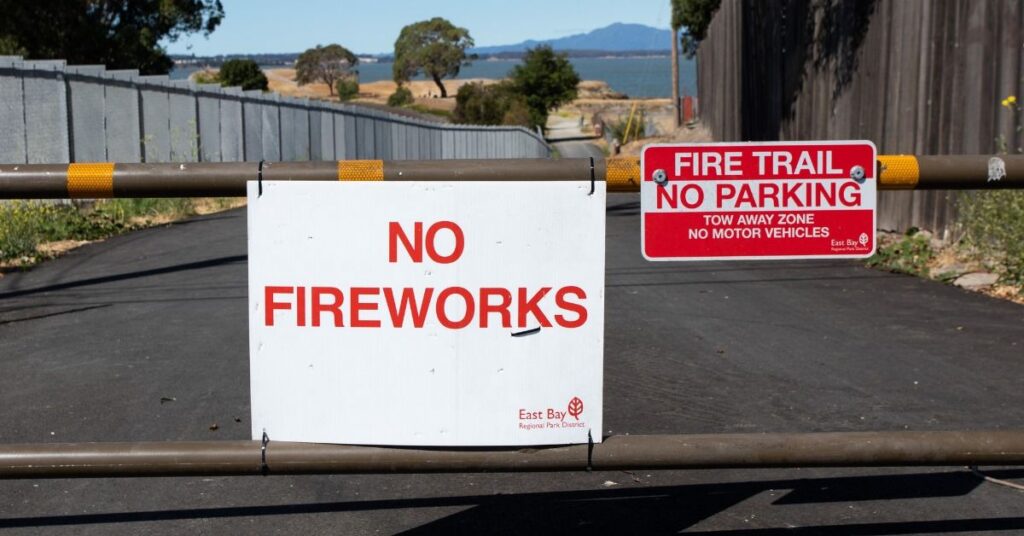
Fire Safety Advisory – Fireworks are not allowed in East Bay Regional Parks. July is a special month full of sunny days and warm summer nights. It’s also a time to take extra precautions due to the increased risk of wildfires in Regional Parks and neighboring communities. With July 4th celebrations coming up this week, remember that fireworks are not allowed in Regional Parks or shorelines.
Source: EBRPD
Wildfire safety remains one of the East Bay Regional Park District’s top priorities. Be fire smart and aware of fire danger levels, red flag warnings, and fire safety. The Park District urges all visitors to enjoy their Regional Parks safely and responsibly. Be prepared for the upcoming wildfire season – visit www.ebparks.org and search for “Fire Safety Tips.”
Lakeside Laps on July 20 at Lake Chabot Regional Park. Lakeside Laps is a trail running and walking event hosted by the Regional Parks Foundation in partnership with Brazen Racing Sports & Community. In celebration of the East Bay Regional Park District’s 90th Anniversary, Lakeside Laps proceeds will benefit the Regional Parks Foundation and its mission to connect youth with nature and expand access to parks.
Register today for the family-friendly Trout Trot 5K, 10K, or half marathon – all fitness levels are welcome! The Finish Line Festival will feature snacks, vendors, photo walls, awards, and more. Food and beverages provided by Equator Coffee, Harmless Harvest, and Drake’s Brewing Company. For registration info, start times, and general event information, visit www.brazenracing.com/lakesidelaps.
Photo by Jen Vanya. Source: EBRPD
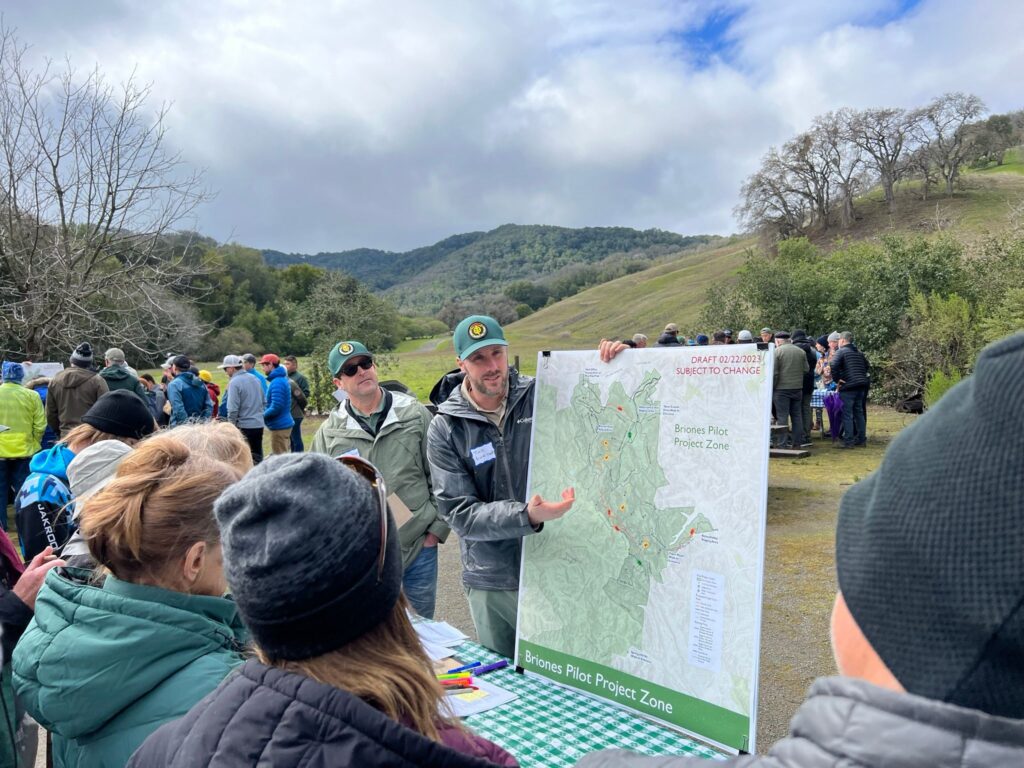
Feedback Needed on the Briones Pilot Project. The Briones Pilot Project was launched in April 2023 in a portion of Briones Regional Park to test new ways to safely share trails, improve the trail experience, and protect habitat, wildlife, and watersheds. At the recent Briones Pilot Project Community check-in meeting, about 75 community members – hikers, cyclists, and equestrians – joined the East Bay Regional Park District staff to discuss the first year of the pilot project and provide their feedback on what has improved and where challenges remain. Feedback is needed! Visit the project webpage to fill out an online survey or drop a comment on the interactive map at www.ebparks.org/BPP.
Photo by Carl La Rue. Source: EBRPD
Save the Date: National Night Out on August 6 at Lake Chabot. An exciting evening of community bonding and fun at Lake Chabot awaits! The East Bay Regional Park District is hosting its second annual National Night Out on August 6 from 4-7 p.m. at Lake Chabot Regional Park, where parkgoers are invited to come together to celebrate and strengthen community ties. Meet the Park District’s public safety officers, firefighters, lifeguards, and park rangers who are instrumental in keeping the community safe. Visit with Park District naturalists at the Mobile Visitor Center and learn about the nature exhibits on display. Stroll around Lake Chabot and enjoy the lake’s serene beauty. All are welcome to this FREE event. For more information, visit www.ebparks.org/nno.
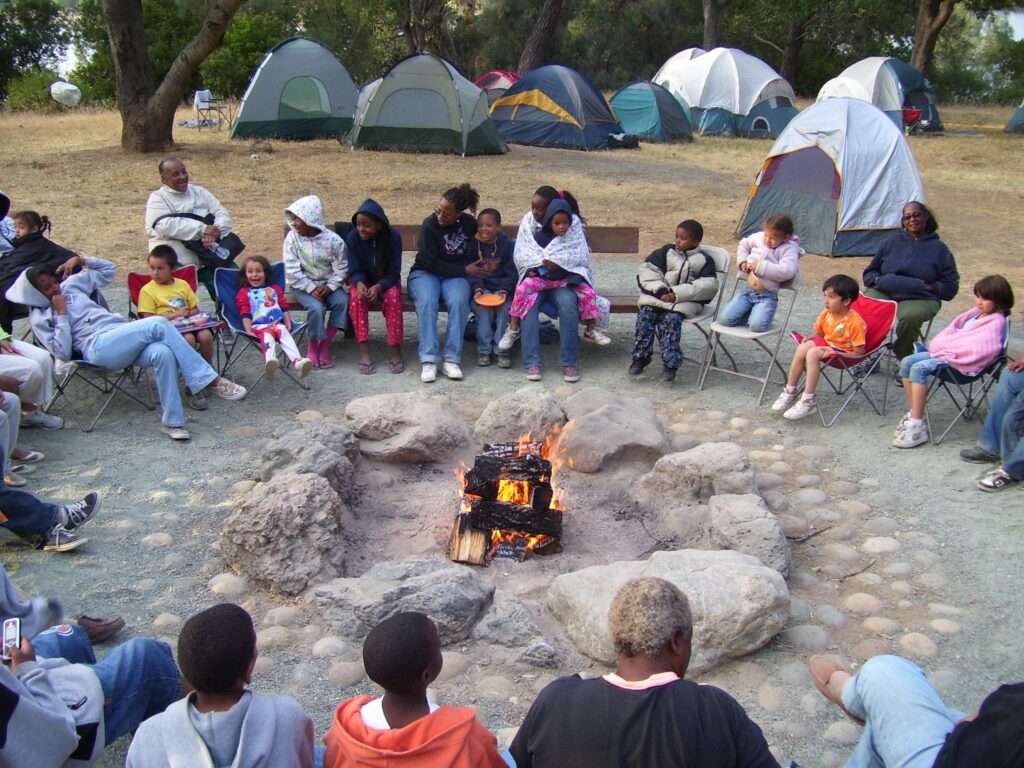
Family campfire with co-op group at Lake Del Valle. Photo: EBRPD
Campfire gatherings first became popular in the United States around the turn of the last century, with growth in the National Park system. At the time, there was an incentive to get more children out of urban cities and into the nature of these new National Parks, and the result was the emergence of summer camps and campfire programs. By the 1920s, more than 1,000 summer camps were offering outdoor activities such as canoeing, archery, hiking, arts and crafts, and fire-making. These camps also developed new traditions like campfires, s’mores, and sing-a-longs. Today, this tradition continues throughout the East Bay Regional Park District.
Experience unforgettable evenings under the stars with captivating campfire programs at Del Valle Regional Park, Big Break Regional Shoreline, Dumbarton Quarry Campground on the Bay, and Anthony Chabot Campground. These family-friendly events offer nature education, storytelling, and stargazing, while fostering a deep appreciation for the outdoors. Engage in hands-on activities, learn about local wildlife, and connect with the community around the warmth of the fire with naturalist-led campfire programs. Go to www.ebparks.org/calendar and search for “campfire.” Campfire programs are subject to change due to Park District fire restrictions and National Weather Services-Bay Area Fire Advisories and Red Flag Warnings.
CA State Bat golden-haired pallid bat. Photo: EBRPD
Did you know that California has a state bat? The pallid bat was designated as the California state bat in October 2023. Its golden fur, diverse range of habitats, and positive effects on the environment fit in well with the rest of the Golden State’s symbols. These golden-haired pallid bats, as well as other bat species, are found at parks throughout East Bay Regional Park District. Join Park District naturalists for bat-related activities all summer long! Go to www.ebparks.org/calendar and search for “bats.” Learn more about the bats of the East Bay at www.ebparks.org/programs/digital-learning/naturalist-videos/plants-animals/bats.
The East Bay Regional Park District is the largest regional park system in the nation, comprising 73 parks, 55 miles of shoreline, and over 1,330 miles of trails for hiking, biking, horseback riding, and environmental education. The Park District receives an estimated 30 million visits annually throughout Alameda and Contra Costa counties in the San Francisco Bay Area.
Due to an unexpected power outage, the Antioch Community Center, Prewett Library (4703 Lone Tree Way), and the Antioch Water Park (4701 Lone Tree Way) in Prewett Family Park will be CLOSED on Wednesday, July 3rd.