Michelle Hidalgo in a post on her Facebook page on October 26, 2022.
Sentenced to 15 years to life
By Ted Asregadoo, PIO, Contra Costa District Attorney’s Office
A 29-year-old resident of Antioch was sentenced today, July 11, 2024, in Contra Costa Superior Court for sexual abuse of a young child.
Michelle Nicole Hidalgo, was sentenced by the Honorable David Goldstein after she pled guilty to engaging in sexual acts with a child 10 years old or younger [PC 288.7(b)]. Hidalgo was a nanny to the minor victim and has been in custody since her arrest on September 22, 2023. As part of a negotiated agreement, Hidalgo was sentenced to 15 years to life in state prison – which will begin immediately. She was also ordered to register as a sex offender for life.
On September 21, 2023, the Contra Costa County Internet Crimes Against Children Task Force was alerted to sexually explicit images of a small child being shared on X (formally Twitter). A search warrant was served at a residence in Antioch, seized equipment used in the production and distribution of pornographic images of minors and Hidalgo was arrested. She was employed as a part-time nanny for the victim’s family. (See related article)
Pursuant to her plea, Hidalgo admitted to abusing the child on September 19, 2023. Evidence also demonstrated Hidalgo created visual depictions of the abuse and shared those images with other X users. Text messages sent from Hidalgo to others were recovered. Those messages indicated her intent to further
abuse the child the next time she was with the victim. Investigators are currently working with the National Center for Missing and Exploited Children to ensure those images are flagged if shared online in the future.
“The sentence delivered today reflects the severity of the crime committed,” said District Attorney Diana
Becton. “Our system of justice is dedicated to protecting victims and safeguarding the community by holding offenders accountable.”
Deputy District Attorney Jenna Franklin from the DA’s Sexual Assault Unit prosecuted the case. The investigation was led by the Contra Costa County Internet Crimes Against Children Task Force (ICAC). Detectives and investigators who participated in the ICAC investigation are from the Walnut Creek, Concord, Pleasant Hill, Brentwood, Oakley, Pittsburg, San Ramon and Danville police departments, the Contra Costa County Sheriff’s Office, Special Agents from the United States Secret Service and Homeland Security Investigations, and Inspectors from the Contra Costa County District Attorney’s Office.
According to the Contra Costa Sheriff’s Office, the five-foot, three-inch tall, 250-pound Hidalgo is Hispanic was born on December 23, 1994 and is being held in the West County Detention Facility on $800,000 bail. Her Facebook profile shows she lives in Antioch and is from Pacifica, CA where she studied at Terra Nova High School.
Case No. 01-23-02982 | The People of the State of California v. Hidalgo, Michelle Nicole
Frank Rupani in a 2016 photo posted on his Facebook page and in his Antioch Police Reserve Officer uniform. Photo (right): APD
By Antioch Police Department
It is with a heavy heart that we inform you about the passing of Reserve Officer Frank Rupani. Frank was a dedicated member of the Antioch Police Department for over 26 years, serving our community with utmost commitment and professionalism.
He began his service on October 30, 1997, and has received numerous commendations and letters of appreciation from the public. In May 2014, Rupani was honored by then-Chief Allan Cantando as a Reserve Sergeant.
Prior to his retirement from the APD Reserve Unit in 2017, Rupani was assigned to assist the Parking Enforcement unit with a huge backlog of abandoned vehicles in the City. According to then-Police Chief Tammany Brooks, Rupani had been instrumental in getting the number down to a manageable level. He continued to serve the citizens of Antioch by transitioning to the Volunteers In Police Service (VIPS) program and could be seen at community events, including parades in downtown Rivertown, as well as Veterans Day and Memorial Day ceremonies.
Following his retirement Frank Rupani was honored with a plaque for his 20 years of service by then-Chief T Brooks as Captain Tony Morefield looks on during an Antioch Police Ceremony on May 17, 2018. Photos: APD
Officer Rupani’s unwavering dedication to his duty and his selfless service to the Antioch community will always be remembered. He was a true asset to our department, and his loss will be deeply felt by all of us.
During his time with us, Officer Rupani exemplified the values of integrity, compassion, and bravery. He was not only a respected colleague but also a trusted friend to many. His positive impact on our community and the lives he touched cannot be overstated.
As we mourn the loss of Officer Rupani, let us also remember and celebrate the incredible legacy he leaves behind. His contributions to public safety and his unwavering commitment to serving others will continue to inspire us all.
Our thoughts and prayers are with Officer Rupani’s family, friends, and colleagues during this difficult time. We extend our deepest condolences and offer our full support to those affected by this loss.
According to his Facebook page, Rupani is from Burgettstown, Pennsylvania and studied for his Bachelor’s of Science in Mechanical Engineering at The University of Akron.
Born on June 24, 1944, Rupani had just turned 80 and is survived by his wife Inelda who, according to family members, was by his side when he passed on July 10, 2024.
Please join us in honoring Officer Frank Rupani’s memory and the invaluable service he provided to our community.
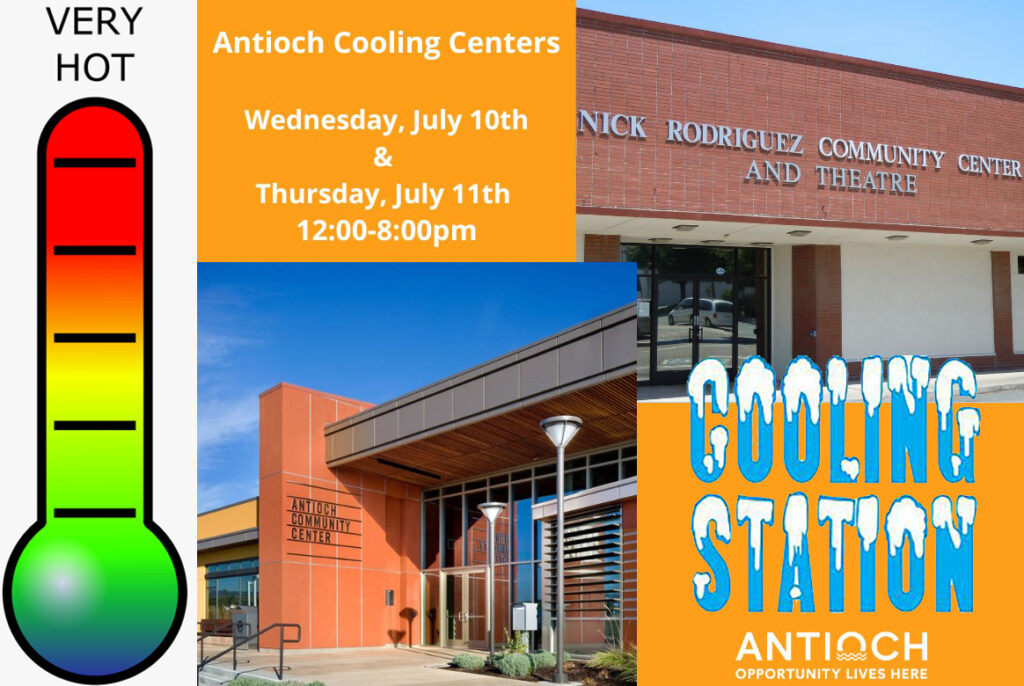
Due to the excessive heat occurring throughout this week, with the temperature forecast of 102 degrees on Wednesday and 105 degrees on Thursday, the City of Antioch is providing cooling centers for your convenience. Residents without home air conditioning or with conditions made worse with extreme heat and poor air quality are encouraged to seek out the cooling centers.
Cooling centers will be held:
Wednesday and Thursday, July 10th and July 11th | 12pm-8pm
Rep. John Garamendi announces his cancer diagnosis in a video on his X feed on Monday, July 8, 2024 and his official photo.
By Office of Representative John Garamendi
WASHINGTON, DC—Congressman John Garamendi (CA-08) on Monday, July 8, 2024, released the following statement about his diagnosis of early stage, treatable blood cancer:
“My wife Patti, a leader in the Congressional Families Cancer Prevention Program, ensures I stay vigilant about preventative screenings and care. Freezing abnormal bumps is standard, but a call from my doctor changed everything: “When will you be back in California? You need to come in for a series of tests.” Thus began my journey with early-stage Multiple Myeloma, a form of treatable blood cancer.
“Today, I started my path to remission with chemo-immunotherapy as an outpatient at Kaiser Oncology in Sacramento. With early detection, excellent doctors, and the love and support of Patti, our entire family, my extraordinary staff, and congressional colleagues, I know I’ll get through this while continuing to serve my constituents and advance American democracy. I’m grateful our President initiated the Cancer Moonshot and that California’s efforts in stem cell research and taxing cigarettes in the 1980s for cancer research have advanced therapies benefiting not only me, but every family dealing with cancer.
“Throughout my treatments, which my doctor expects will last a few months, I will continue working on my long list of projects and goals for my constituents in Contra Costa and Solano counties. However, alongside destroying cancer cells, chemotherapy weakens natural antibodies and the immune system. My doctors have cautioned me to minimize exposure to COVID-19, flu, and other viruses, so I will limit travel to Washington and public events during the treatment process.
“My thoughts and support are with families managing cancer or any health condition, and with the doctors, nurses, and medical personnel who offer comfort and hope. I am confident that the treatments will be effective, allowing me to continue serving impacted families and my constituents in Congress for years to come.”
In a video post on his X (formerly Twitter) feed on Monday, Garamendi read his statement and wrote, “Like 1.9 million Americans each year, I recently received the dreaded call from my doctor informing me that I had cancer. I am thankful to have caught this early, and we are confident that I will soon be in remission.”
The 79-year-old Garamendi represents the northern waterfront and western communities of Contra Costa County including the northern portion of Antioch in the U.S. House of Representatives.
New Antioch Police Officer Pedro Diaz (left) was sworn in, and Sgt. Kris Palma, Corporal Dan Fachner, Sgt. Randall Gragg, and Sgt. Bill Whitaker were promoted by Interim Chief Brian Addington (right) on July 8, 2024. Photo by APD
Three to sergeant, one to corporal; sergeant, CSO honored with CHP 10851 award
Brings force to 76 sworn officers
By Allen D. Payton
During a ceremony on Monday, July 8, 2024, Antioch Interim Police Chief Brian Addington swore in one new officer and promoted four others within the department. He offered background on each and also administered the Oath of Honor to the five.
In addition, Sgt. Rob Green and CSO Rudy Nieves received the CHP 10851 award for their recovery of a number of stolen vehicles
CSO Rudy Nieves (left) and Sgt. Rob Green (right) were presented with the CHP 10851 award by Interim Chief Brian Addington on July 8, 2024. Photo by ADP
Sgt. Bill Whitaker
Bill Whitaker has been a police officer for over 22 years. He started his career at the Sunnyvale Department of Public Safety, working as a police officer and a firefighter. Since he joined APD Sgt. Whitaker has held specialty positions as a CSI, FTO, K9 handler, and detective.
He has also held collateral assignments as a gang investigator, drone operator, recruiting team, and background investigator.
Sgt. Whitaker enjoys teaching and mentoring the next generation of police officers. He is an EVOC Instructor, use-of-force instructor, and K9 evaluator.
Off duty, he enjoys relaxing with family and friends, watching his son play football, and watching documentaries.
Sgt. Whitaker is honored to move from Corporal to Sergeant and is excited about the new challenge of further serving the community.
Fun Fact: If Bill could live on a farm and raise hurds of dogs for a job he would retire.
Sgt. Kris Palma
Kris was raised in Martinez. He graduated from Alhambra High School and pursued his dream of becoming a police officer. Sgt. Palma started as a civilian with the Contra Costa County Sheriff’s Office before attending the Law Enforcement Training Center in Pittsburg. His passion for policing came from his father, who served 39 years with the San Francisco Police Department. Sgt. Palma also has a brother who serves as a police Lieutenant in the neighboring community of Pittsburg.
He started his career with the Richmond Police Department, where he spent 15 years as a police officer. While with Richmond PD, Sgt. Palma excelled in several assignments, including Field Training Officer, SWAT team member, Firearms and Tactics Instructor, K-9 handler, and Robbery Unit detective. He engaged with the community by teaching several blocks of instruction for the department’s Citizens’ Academy, speaking to at-risk youth, and participating in numerous K-9 demonstrations.
In 2016, Sgt. Palma was voted Officer of the Year by his peers for outstanding leadership and community service. During the same year, he received a Life Saving Metal for rendering lifesaving aid to a kindergarten teacher who was the unintended victim of a nearby shooting.
Sgt. Palma joined the Antioch Police Department in 2021. Due to his experience, he was selected as a FTO, Firearms instructor, SWAT team member, and Detective in the Special Investigations Unit. Sgt. Palma was chosen to be deputized as a United States Marshal and served with the USMS Pacific Southwest Regional Fugitive Task Force. Most recently, he took on the role of the acting sergeant of the Investigations Bureau, where he was afforded the opportunity to work with some of the best and brightest detectives.
Sgt. Palma is married to his amazing wife Lurdes, who when not at home with their three boys, spends her time in the emergency room helping those in need as a registered nurse.
Fun Fact: Kris loves spending time with his family, camping trips, and coaching his boys in baseball and football.
Sgt Randall Gragg
Sgt. Gragg grew up in Antioch. He graduated from Contra Costa County’s 175th Law Enforcement Academy and was sworn in with Antioch PD in November 2014. His experience includes over five years of patrol. While assigned to patrol, he was a member of the Vehicle Theft Suppression and Enforcement Team (VSET), APD’s Honor Guard, and currently is a SWAT team member and SWAT Sniper.
Sgt. Gragg has been assigned to Investigations for just over four years. He has worked a variety of assignments within Investigations, but most recently, he has been assigned as a homicide and violent crimes detective. He has recently participated in the APD Mentorship Program and become a WRAP instructor.
Before Law Enforcement, Sgt. Gragg served in the USMC reserves for six years as an infantry Marine from 2009-2015.
He has three AAs from Los Medanos College in Social Science, Art and Humanities, Math, and Behavioral Science.
Sgt Gragg is married with three kids, and a fourth is almost due. In his free time, he enjoys working out and spending time with his family.
Fun Fact: Randall is currently learning to play the guitar.
Corporal Dan Fachner
Dan grew up in the Bay Area and enlisted in the Air Force in 1990 after graduating high school. He served on active duty for 11 years as a jet engine mechanic on KC-135 air refuelers. In 2001, Corporal Fachner was honorably discharged from active duty in the Air Force and hired by the San Jose Police Department as a Police Officer. He attended and graduated from the San Jose Police Academy at Evergreen Community College.
9/11 occurred during his Police academy, and Corporal Fachner decided to serve his country again and joined the Air Force Reserves. After graduating from the Police Academy, he was activated and returned to active-duty service. Corporal Fachner proudly served during Operation Enduring Freedom, where he worked on KC10 aircraft refuelers, responsible for worldwide support.
While at the San Jose Police Department, Corporal Fachner worked in patrol field services for 12 years. He was a Rifle Team member and an instructor for the field training program. Dan had a collateral assignment as a gang suppression officer, where he helped reduce gang crimes in the City of San Jose.
In 2013 Corporal Fachner retired from the Air Force after serving for 23 years. He joined the Antioch Police Department in 2013 as a Police Officer and was assigned to patrol field services. While in patrol field services, Dan was a K9 handler, Rifle Team member, Field Training Officer, and Drone Operator. He had a collateral assignment and was assigned to the Contra Costa County Vehicle Suppression Enforcement Team, which focused on reducing vehicle thefts.
Corporal Fachner enjoys traveling with his wife, Crissy, when he is not at work. He is also an avid golfer and bass fisherman.
Fun Fact: Dan recently qualified for a bass fishing Tournament of Champions series, where he could win a new bass boat.
New Officer Pedro Diaz
Pedro was raised in Linden, CA, and then moved to Stockton, CA, where he currently lives. Officer Diaz graduated from the San Joaquin Delta Post Academy last October. He is dedicated and hopes to make an impact in the City of Antioch.
Fun Fact: Officer Diaz likes to play soccer.
With the addition of Diaz, that brings the total to 76 sworn officers on the Antioch Police force out of 115 authorized in the budget.
In the 3rd photo, it’s the promotions and the order is Palma, Fachner, Gragg, and Whitaker.
Over 1,300 DUI-related during Maximum Enforcement Period
By Synthia Ramirez, CHP Media Relations
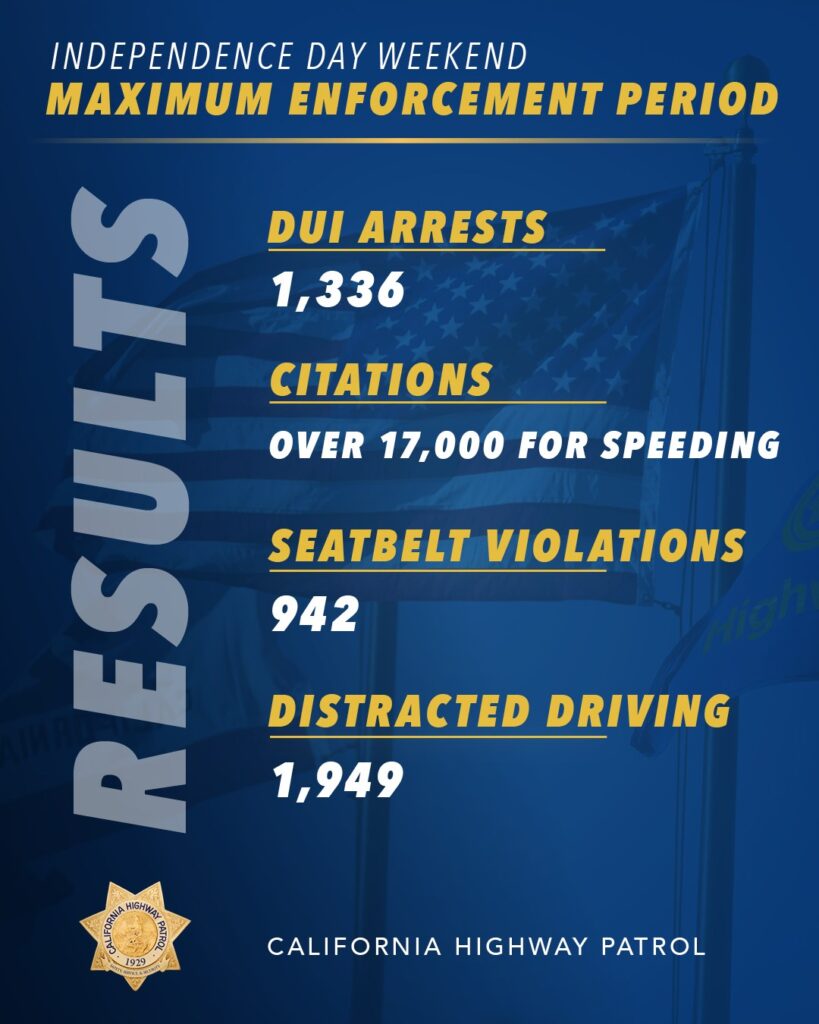
During the Independence Day weekend, the California Highway Patrol conducted a Maximum Enforcement Period to ensure the safety of all Californians. The statewide statistics from this effort are as follows:
Over 1,600 arrests, with over 1,300 being DUI-related
Nearly 30,000 citations issued, including over 17,000 for excessive speed
Over 600 citations for drivers exceeding 100 miles per hour
Nearly 1,000 seatbelt violations cited
Over 1,900 distracted driving citations issued
Great job to all CHP areas that worked tirelessly to keep California safe this Independence Day weekend. Even when it’s not a Maximum Enforcement Period, let’s continue to work together to make responsible choices: drive sober, avoid distractions, follow speed limits, and always buckle up. The primary mission of the California Highway Patrol is to provide the highest level of Safety, Service, and Security.
“Demonstrates continued progress toward key plan goals” of housing, transportation, economy and environment in the nine counties including “a gradual shift away from the use of single-occupancy cars and trucks.”
Includes over $1.2 trillion to maintain existing transportation system, build and buy affordable housing, “Provide an income-based monthly payment to all Bay Area households” and to “Adapt to Sea Level Rise.”
Also working on parallel Transit 2050+ plan
Public input opportunities
By MTC & ABAG staff
The Metropolitan Transportation Commission (MTC)’s and the Association of Bay Area Governments (ABAG)’s newly released Plan Bay Area 2050+ Draft Blueprint analysis outlines how the nine-county region can advance an affordable, connected, diverse, healthy and vibrant Bay Area for all residents by the year 2050.
The Blueprint is essentially a draft version of the plan. It is a foundational framework for a future vision of the Bay Area that includes:
Forecasts and Assumptions about the Bay Area’s future (population, jobs, financial needs and revenues, sea level rise, etc.);
Strategies for public investment and policy reform; and
Geographies where future housing and/or job growth can be focused under the plan’s Strategies.
The Blueprint is then analyzed through computer-generated models and simulations to measure how successful the strategies are in achieving shared goals for the future, such as housing affordability, reduced greenhouse gas emissions and much more.
As the first draft of the Bay Area’s next long-range plan, the Draft Blueprint demonstrates significant progress toward reaching key goals for housing affordability, post-pandemic economic recovery and environmental health and sustainability. This includes the addition of 840,000 affordable homes, with a total of nearly 1 million permanently affordable homes regionwide by 2050; a 17 percent increase in the number of lower-income households living within a half-mile of transit service; and a gradual shift away from the use of single-occupancy cars and trucks. MTC and ABAG planning staff stress that the expected progress would only come about if all the strategies to be detailed in Plan Bay Area 2050+ are implemented.
Source: MTC & ABAG
The full range of performance and equity outcomes from the Plan Bay Area 2050+ Draft Blueprint analysis may be found in the Draft Blueprint Compendium, which also demonstrates how the Bay Area can accommodate some 1.3 million additional jobs and nearly 1 million new households by the year 2050.
The Compendium shows the following proposed budget highlights for three of the Plan’s categories:
Transportation Strategies
$382 billion for T1 – Operate and Maintain the Existing System. Commit to operate and maintain the Bay Area’s roads and transit infrastructure while transitioning to zero-emission transit vehicles.
Housing Strategies
$250 billion for H2 – Preserve Existing Affordable Housing. Acquire homes currently affordable to low- and middle-income residents for preservation as permanently deed-restricted affordable housing, including opportunities for resident ownership.
$302 billion for H4 – Build Adequate Affordable Housing to Ensure Homes for All. Construct enough deed-restricted affordable homes to fill the existing gap in housing for the unhoused community and to meet the needs of low-income households.
Economic Strategies
$205 billion for EC1 – Implement a Statewide Guaranteed Income. Provide an income-based monthly payment to all Bay Area households to improve family stability, promote economic mobility and increase consumer spending.
Environment Strategies
$94 billion for EN1 – Adapt to Sea Level Rise. Adapt shoreline communities, infrastructure and ecosystems affected by sea level rise.
The Draft Blueprint also identifies challenges that will have to be addressed as part of the Final Blueprint process over the coming months. More work is needed to reduce greenhouse gas emissions as well as to identify transportation investment priorities for the plan’s fiscally constrained transportation project list. The Draft Blueprint does not include significant transportation expansion or enhancement investments, as these will be identified through Transit 2050+ and the Final Blueprint process.
hoto source: MTC. Credit: Joey Kotfica
What’s Next?
In light of the pandemic’s lasting impact to public transportation, MTC is collaborating with the region’s transit operators on Transit 2050+ , a parallel planning effort to re-envision the future of public transit in the nine-county Bay Area. Two key updates in this process will be released in July: the Draft Project Performance Assessment and the Transit 2050+ Draft Network. It will be a comprehensive overhaul of the six transit-related strategies included in Plan Bay Area 2050.
The Draft Project Performance Assessment will analyze the costs and benefits of major capacity-increasing projects being considered for inclusion in Plan Bay Area 2050+, the vast majority of which are transit projects. These investments, including those adopted in Plan Bay Area 2050, now face a significantly reduced projected revenue stream. This is due largely to slow post-pandemic transit ridership recovery and other economic changes.
The Transit 2050+ Draft Network will identify strategies and investments (capital and operating) envisioned through 2035 and over the long term through 2050. Development of the Draft Network has been guided in part by public engagement conducted in summer 2023, when nearly 3,000 Bay Area residents provided input on the future of Bay Area transit. The Draft Network also is being informed by an existing needs and gaps assessment conducted in partnership with local transit agencies, the Draft Project Performance Assessment, local priorities and improvements to transit network connectivity and customer experience.
Source: MTC & ABAG
Summer 2024 Public Engagement
Beginning in August, MTC staff will conduct a second round of public engagement for Plan Bay Area 2050+, the content of which will focus on:
Sharing both the Draft Blueprint outcomes and the Transit 2050+ Draft Network
Gathering feedback to inform the development of the Final Blueprint and address identified Draft Blueprint challenges
Identifying early priorities for implementing Plan Bay Area 2050+
There will be a variety of in-person and virtual opportunities for the public to participate. Stay up-to-date on upcoming engagement activities in your community by subscribing to the Plan Bay Area 2050+ mailing list. There also will be dedicated engagement opportunities for technical partners and stakeholders, which will be publicized on the Plan Bay Area website’s Partner Engagement page.
Following an analysis of public input, the Commission and the ABAG Executive Board are expected to consider approval of the Final Blueprint in late 2024.
Swim facilities, shoreline regional parks remain open
By Jen Vaya, Public Information Specialist, East Bay Regional Park District
Parks previously closed by the East Bay Regional Park District will remain closed through Saturday and will reopen Sunday morning. Some hill and inland East Bay Regional Parks were closed on Tuesday, July 2, due to extreme fire conditions and excessive heat.
Park status is subject to change depending on conditions. Check www.ebparks.org before heading to a park.
The National Weather Service-Bay Area has extended its Red Flag through Saturday, July 6, with Level 2 restrictions in effect DISTRICT WIDE. A Red Flag Warning means that dry and windy conditions are expected, leading to extreme fire weather risks.
Level 2 Extreme Fire Danger Restrictions Include:
No smoking. Smoking is prohibited in all regional parks, trails, and shorelines. (Prohibited year-round)
NO fireworks. Fireworks are not permitted in any Regional Parks. (Prohibited year-round)
No open fires or barbecues of any type. Only gas-fueled stoves are allowed.
Drive only on designated roadways – no off-road driving. Do not drive or park on dry grass, as heat from a vehicle’s undercarriage can start a fire.
Secure all tow chains – dragging tow chains can spark fires.
Parks Closed and Reopening Sunday:
Park Closed and Reopening Sunday:
• Anthony Chabot • Bishop Ranch • Black Diamond Mines • Briones • Brushy Peak • Carquinez/Crockett Hills • Claremont Canyon • Contra Loma • Deer Valley
• Dry Creek • Diablo Foothills (trails closed) • Dublin Hills • Five Canyons • Garin • Huckleberry • Las Trampas
Anthony Chabot Campground will remain closed through Sunday, July 7. Please check www.ebparks.org/alerts-closures for the most updated information.
Swim facilities and Shoreline Regional Parks will remain open. Follow these safety tips:
Avoid the hottest part of the day. If you do visit, go in the morning or early evening when it is cooler.
Drink plenty of fluids to stay hydrated.
Wear sunscreen and lightweight, light-colored clothing.
Avoid drinking alcohol and caffeine, which can worsen the heat’s effects on your body.
Don’t forget your pets! Carry water for them.
The East Bay Regional Park District is the largest regional park system in the nation, comprising 73 parks, 55 miles of shoreline, and over 1,330 miles of trails for hiking, biking, horseback riding, and environmental education. The Park District receives an estimated 30 million visits annually throughout Alameda and Contra Costa counties in the San Francisco Bay Area.