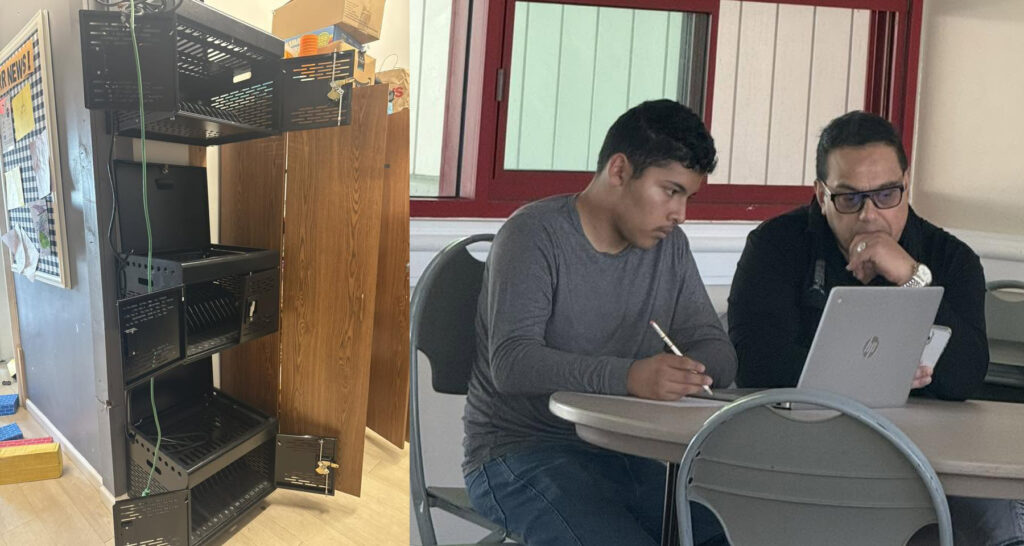
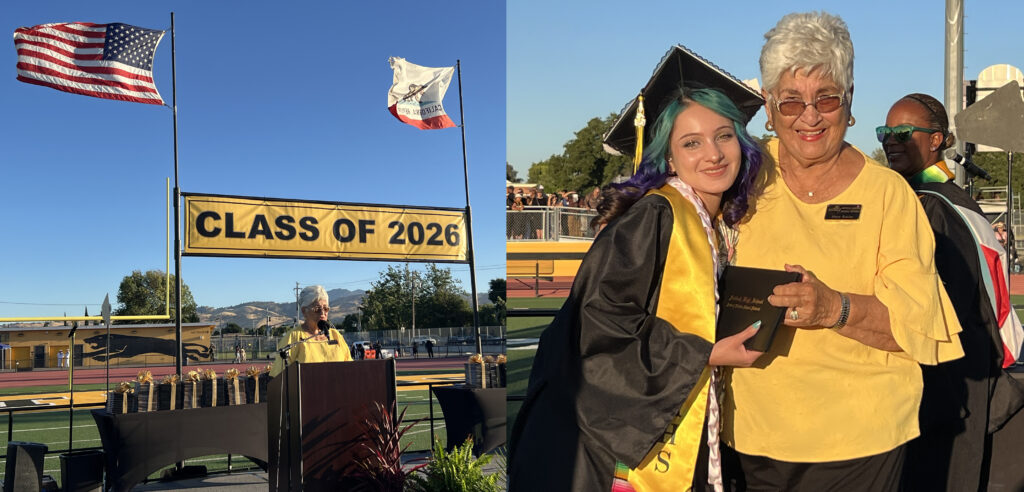
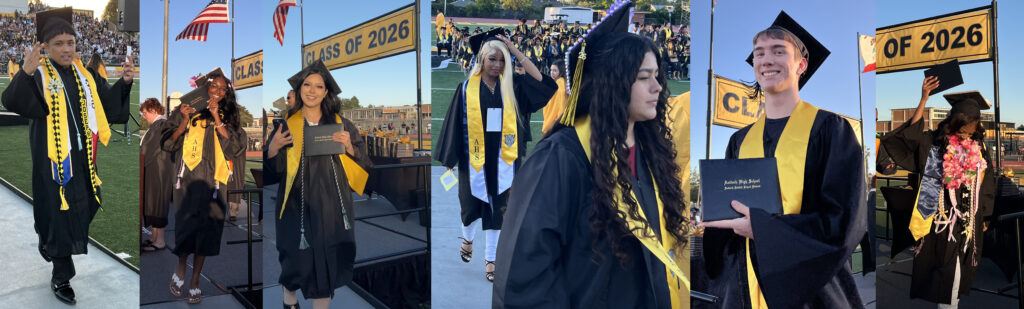
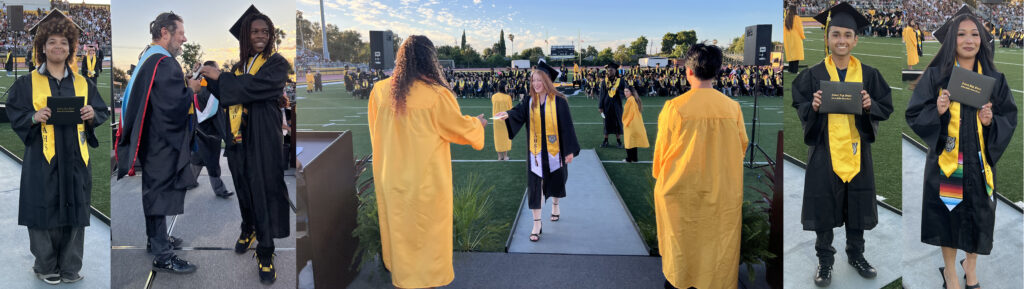
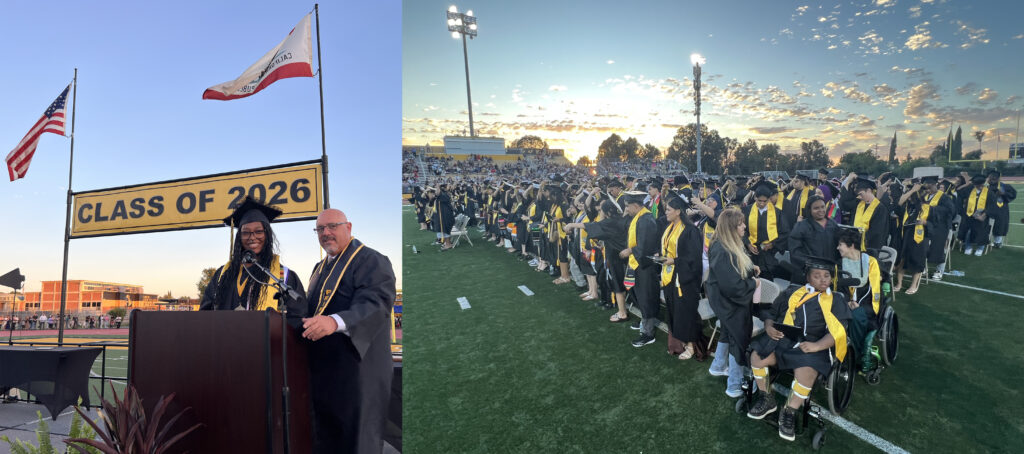
Laptops and electronic equipment were stolen from the RRTH Learning Center last week. Photo: RRTH Learning Center
Police investigating, public asked for help
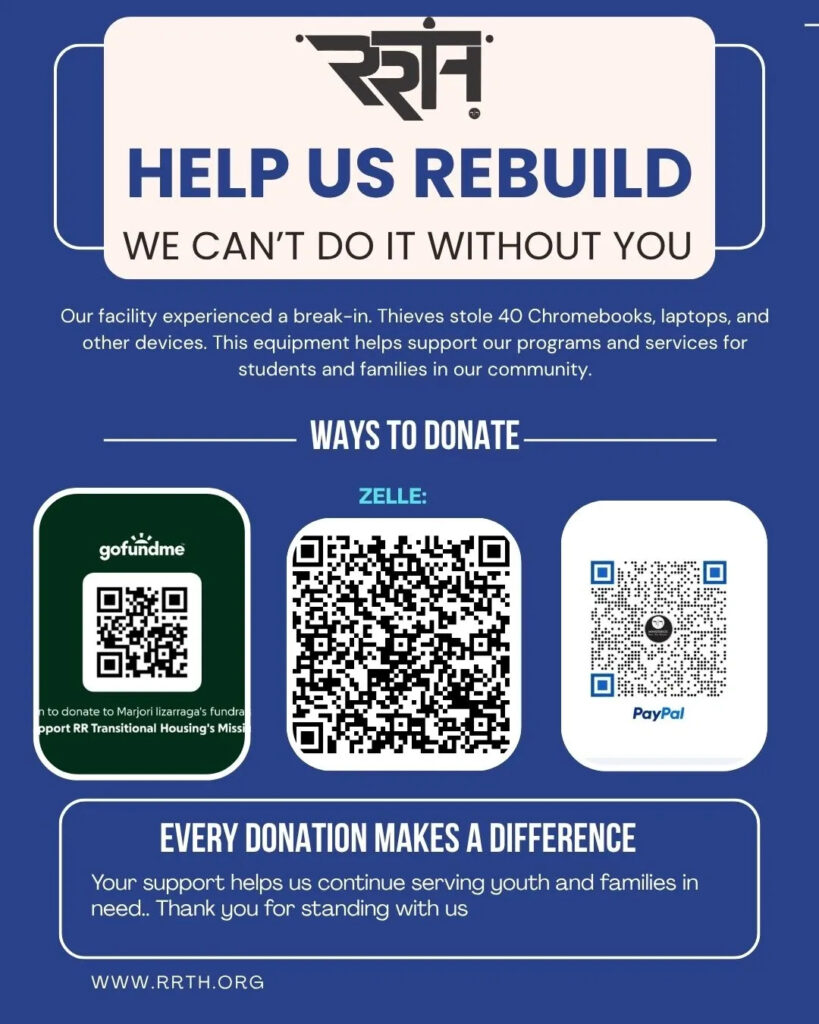
Fundraisers Sunday, June 28th and online
By RRTH Learning Center & RR Ministries
Our organization, RR Transitional Housing Learning Center, helps more than 250 students in Contra Costa County and we have been recently burglarized. They stole 40 Chromebooks from our kids.
Between Thursday, June 18, 2026, after 4:00 PM and Friday, June 19, before 6:00 PM, our location at 512 W. 2nd Street in Antioch was broken into. During the burglary, all of the Chromebooks donated by the Antioch Rotary Club were stolen.
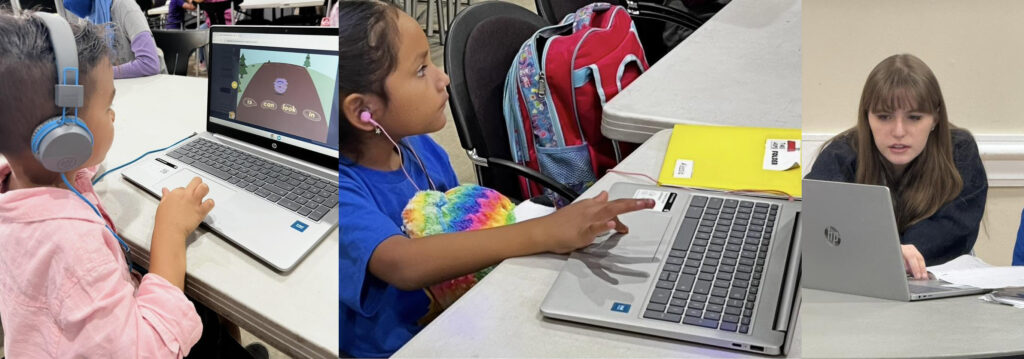
These Chromebooks were used daily in our free tutoring program, youth job readiness program, homework support services, reading intervention activities, and educational workshops. Every service we provide is offered at no cost, making these resources vital for the children, youth, and families we serve.
In addition to the Chromebooks, our livestream equipment, personal laptops, and other devices were also taken.
We are also addressing attempts to access our financial and communication platforms, including Venmo, PayPal, email and banking-related accounts. We have taken immediate steps to secure our systems, filed a police report, and are working with law enforcement.
Our hearts are heavy. These resources helped children learn, complete homework, build confidence, and prepare for their futures.
We are asking for the community’s help. If you were near 512 W. 2nd Street in Antioch between June 18 and June 19 and saw anything suspicious, have information about this incident, or notice someone attempting to sell multiple Chromebooks or other electronic equipment, please contact us or local law enforcement.
According to Antioch Police Lt. Mike Mellone, a report was taken and the burglary is under investigation.
While this is heartbreaking, it will not stop our mission. We remain committed to serving our community and providing free programs to the children, youth and families who depend on them.
As we prepare for our summer programs, we urgently need your help replacing these essential resources so we can continue providing free services to the hundreds of students and families who rely on us each year.
Every donation, no matter the size, helps us move one step closer to restoring these vital programs. If you are unable to donate, sharing our story with others is equally appreciated.
By Rachel Clark, Senior Marketing & Communications Manager, 10,000 Degrees
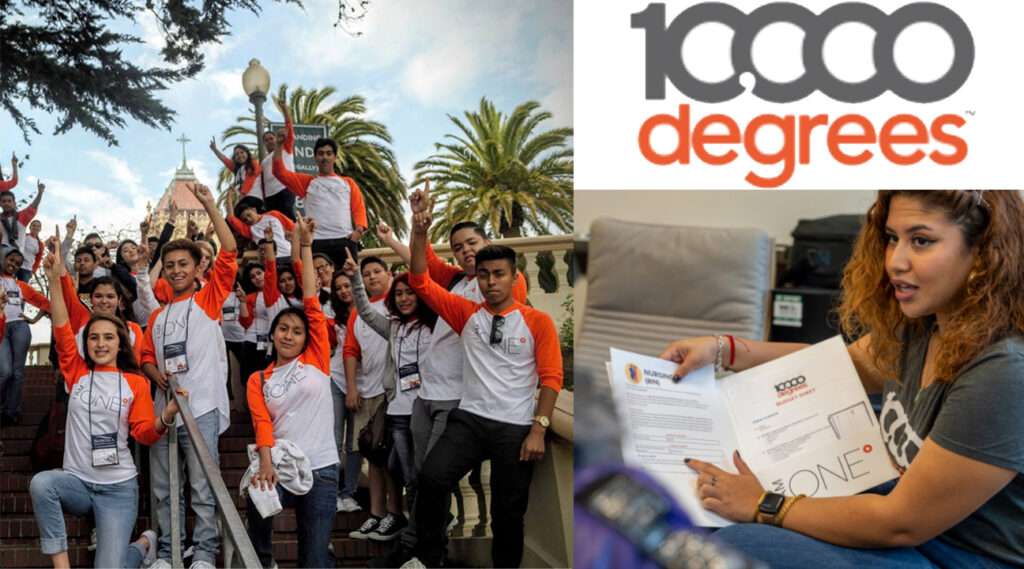
The 10,000 Degrees College Access Program presents The Summit, a FREE one-day, in-person summer event on Saturday, July 18 | 9:00 – 5:00 PM, where students will visit San Francisco State University.
Lunch and transportation will be provided for FREE.
Open to Juniors and Sophomores who attend a high school in the following counties: Contra Costa, Sonoma, Lake, Napa, Marin, San Francisco, San Mateo and Santa Clara.
Students will: Dive into action-oriented college workshops. Get an insider’s look at SF State. Explore essential student resources at a resource fair. Connect with the 10,000 Degrees team and learn about our scholarship. Bonus: Win raffle prizes.
About 10,000 Degrees College Access Program
We are dedicated to helping high school students from low-income backgrounds get to college, whether you enroll at a four-year university or community college. Students at our partner schools can receive support from Fellows right on campus and attend financial aid and college readiness workshops and events all year.
Our College Access Program for high school students starts with The Summit, an incredible college immersion program held in the summer before your senior year. You can participate in our programming as early as the spring of your junior year by checking out our program application! From there, we provide informational, action-oriented workshops to help you explore your college options, apply for free financial aid and the 10,000 Degrees Scholarship, complete college application, and more. Throughout your senior year, we also offer comprehensive college support at our partner high school directly on campus.
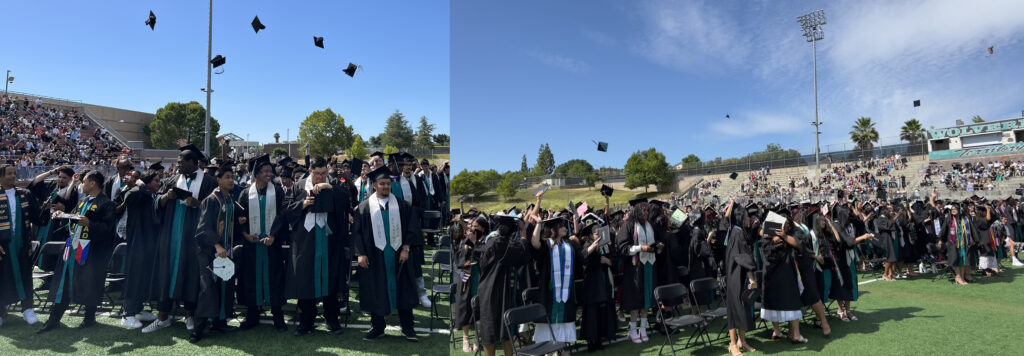
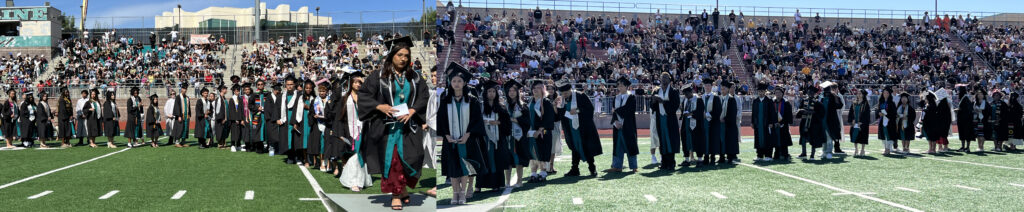
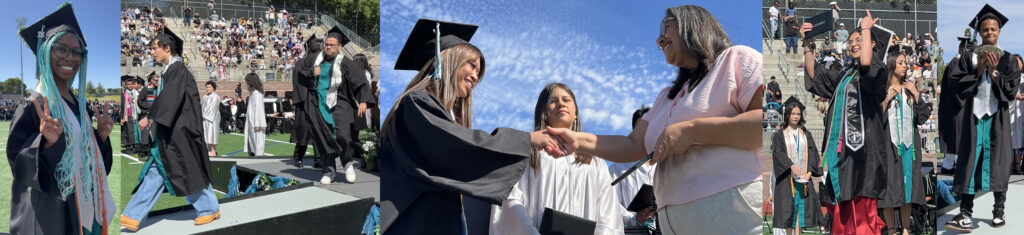
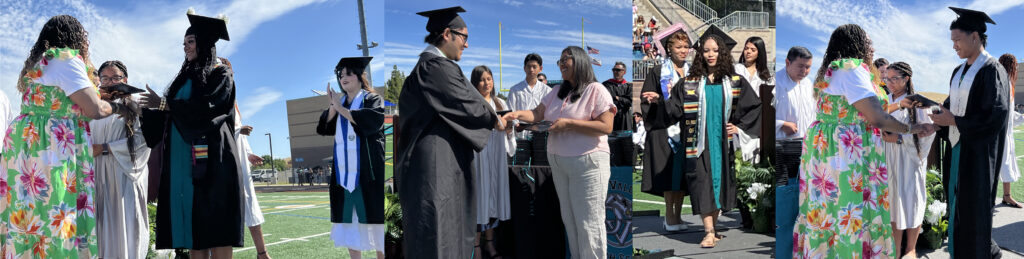
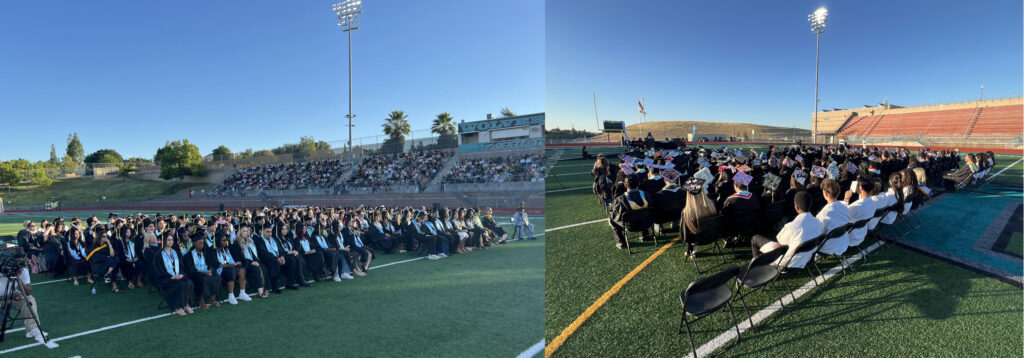
The Deer Valley High School Class of 2026 graduates toss their caps into the air in celebration inside Wolverines Stadium Saturday morning, June 6, 2026. Photos by Allen D. Payton
By Allen D. Payton
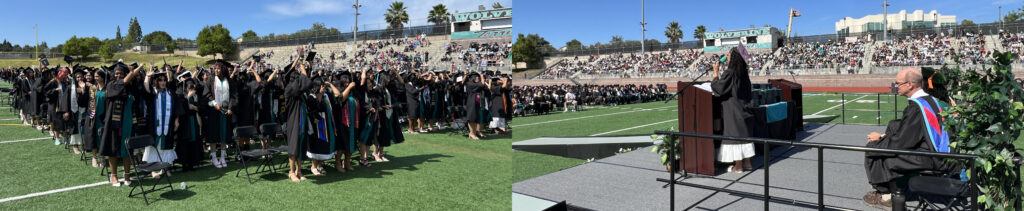
The 382 graduates of the Deer Valley High School Class of 2026 celebrated with their faculty, family and friends during the school’s 30th year, Saturday morning, June 6th.
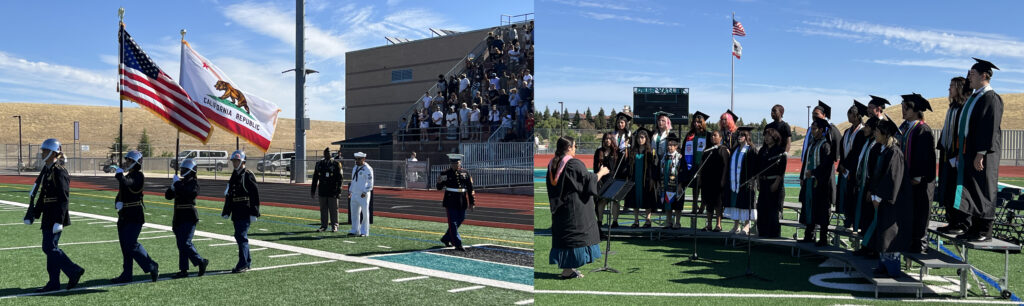
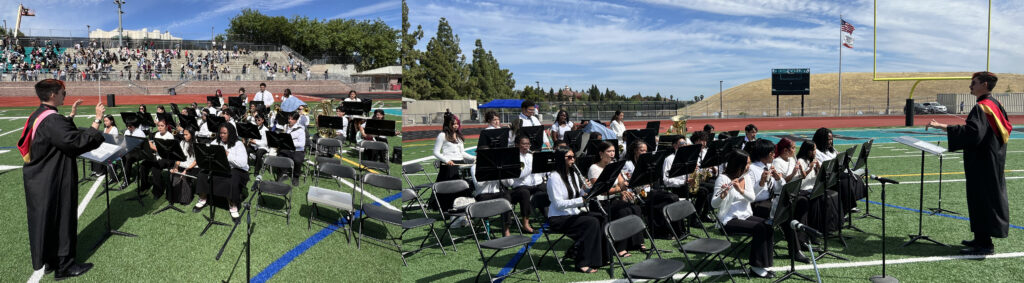
The class entered Wolverines Stadium to the traditional sounds of Pomp and Circumstance by the Deer Valley High School Band, led by Music Director Ryan Carr. The Deer Valley Jr. ROTC Cadets, under the leadership of U.S. Army Sgt. First Class Ronnie McGee, provided the Presentation of Colors.
The DVHS Jr. ROTC Presented the Colors and the Divine Voices performed the National Anthem.
The National Anthem was then performed by the Divine Voices, led by Choral Director Alivia Logan and Salutatorian Natalie Hill then asked her classmates to be seated.
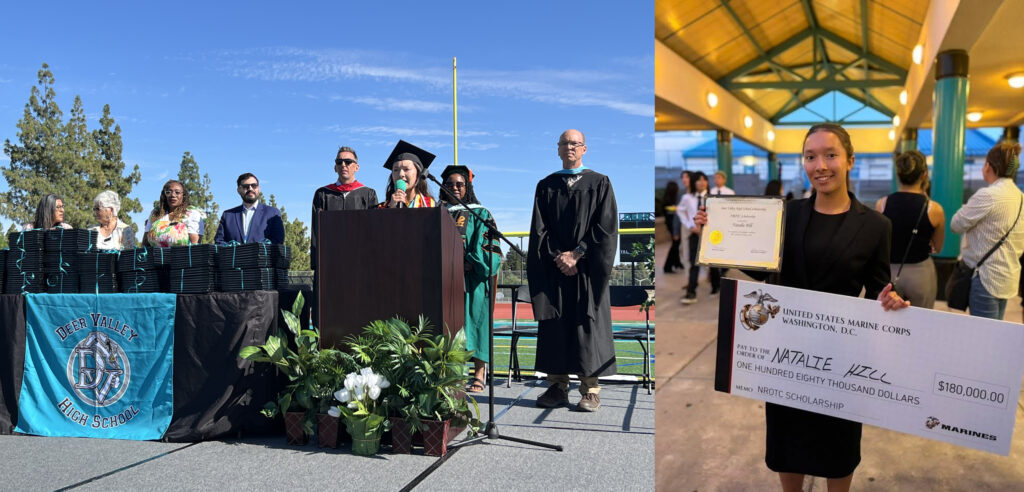
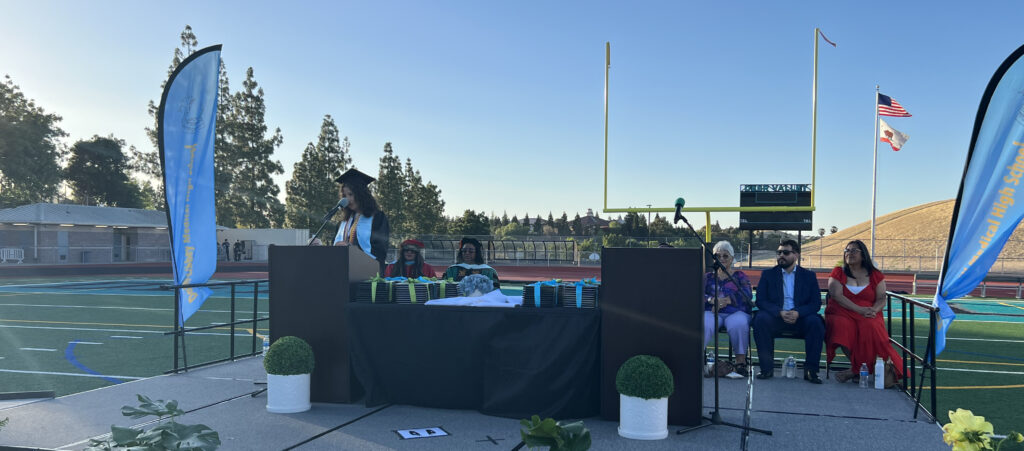
DVHS Class of 2026 Salutatorian Natalie Hill speaks during the ceremony as district and school officials look on and with her U.S. Marine Corps scholarship ceremonial check and certificate following the school’s Awards Ceremony earlier this year. Right photo courtesy of Stephanie Hill
House 2 Vice Principal Mike Green, once again, served as Master of Ceremonies. He mentioned that Hill “will attend UCLA in the fall on a full-ride scholarship to study political science. She plans to participate in the ROTC and become a military officer upon graduation.”
Earlier this year, Hill received a $180,000 college scholarship from the U.S. Marine Corps.
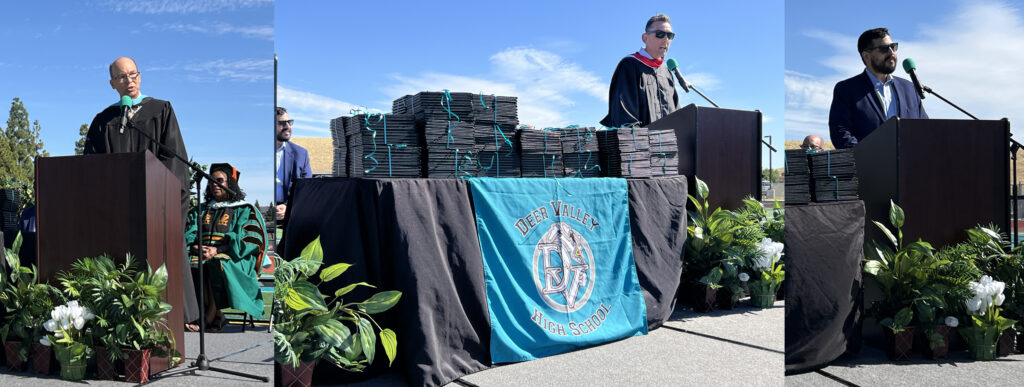
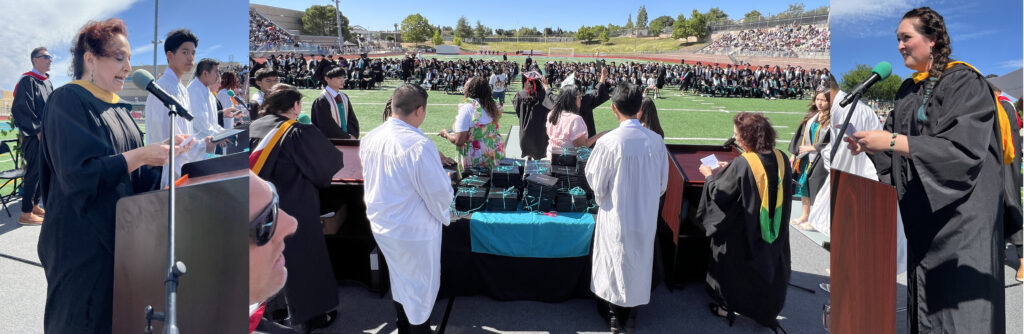
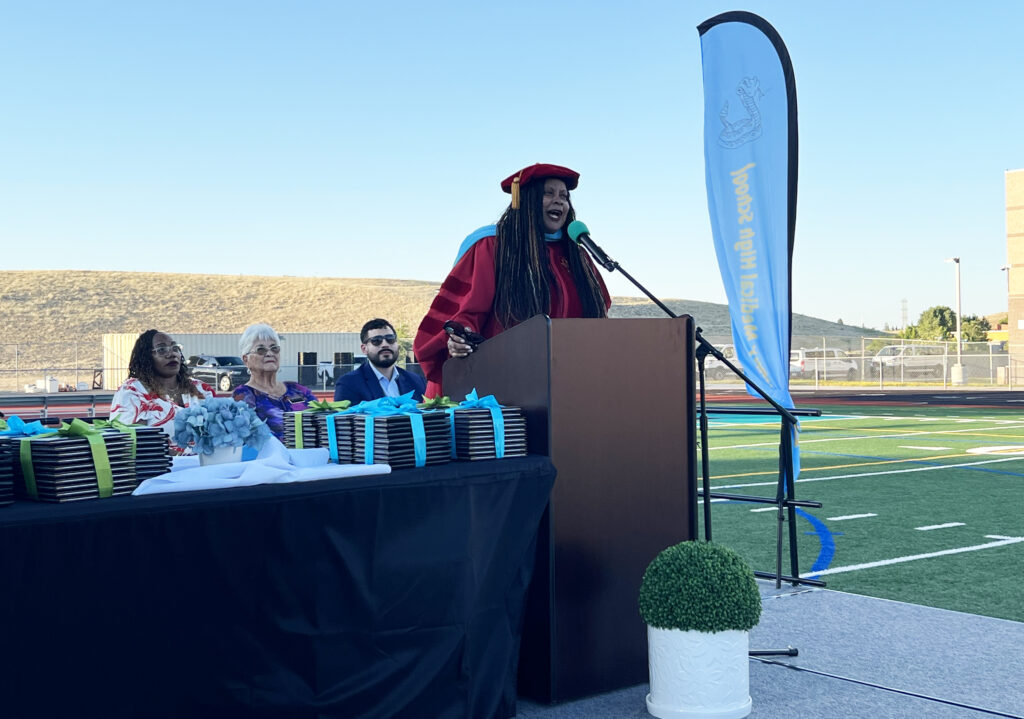
DVHS Vice Principal Mike Green, Principal Robert Bowers and Trustee Antonio Hernandez speak to the graduates of the Class of 2026 Saturday morning.
Green mentioned the Antioch Unified School District officials in attendance for the ceremony. They included Trustees Antonio Hernandez, Mary Rocha, Dee Brown and Olga Cobos Smith who each later handed out the diplomas. Also, in attendance was Dr. Camille Johnson, Associate Superintendent for Human Resources.
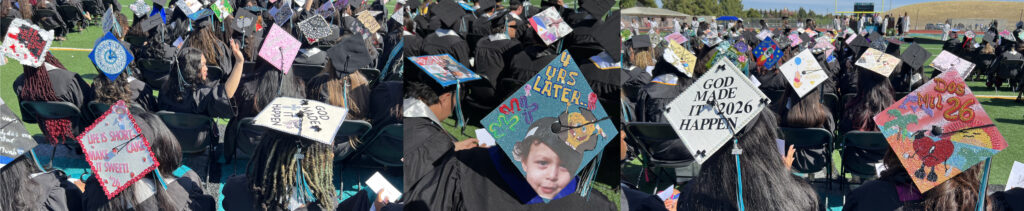
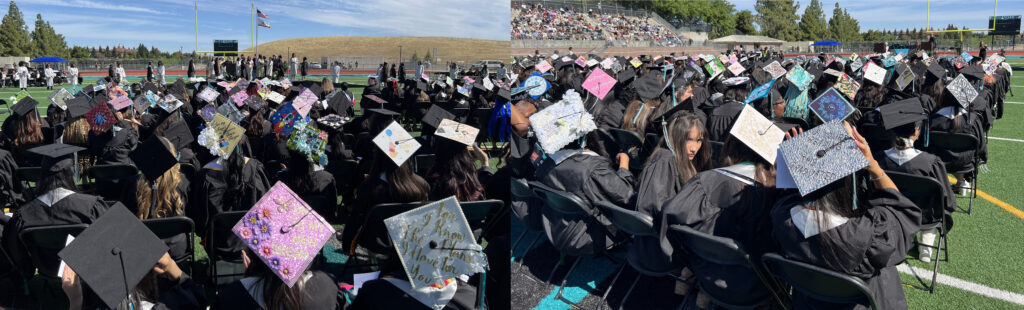
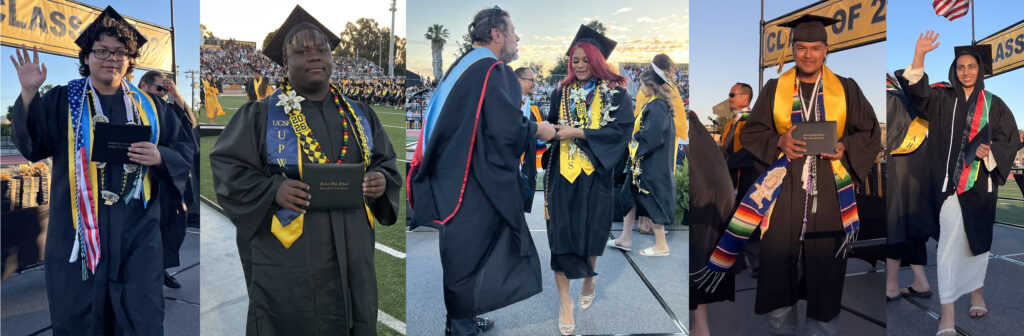
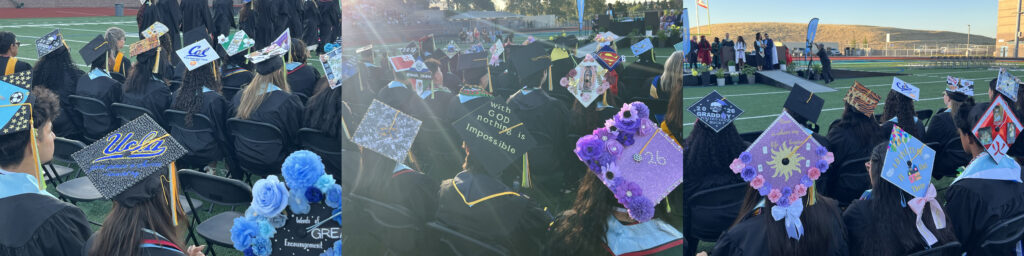
Many of the graduates decorated their caps with personal messages.
Green then introduced Principal Robert Bowers who spoke to the graduates saying, “You’re a special class. Over the past four years you’ve accomplished amazing things. You’ve created memories that have built a culture that will be remembered long after today.”
“This year marks the 30th anniversary of DVHS,” he continued. “I’ve been incredibly impressed by your kindness, resilience. The world you are entering needs exactly what you have to offer. Believe in yourselves the way I believe in you. Dream big, work hard, take chances and make a difference. Go change the world.”
Trustee Hernandez then shared about his own experience growing up in Antioch, graduating from Dozier Libbey Medical High School, going on to college and now, in med school.
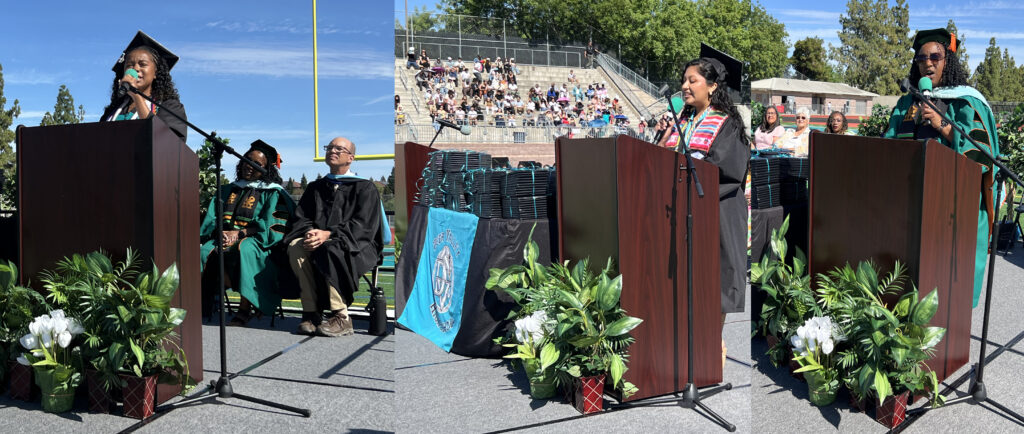
DVHS Senior Class President Amanda Brown (left) and Valedictorian Emma Canales (center) speak to the graduates. AUSD Associate Superintendent Dr. Camille Johnson (right) accepts the Class of 2026.
Green introduced Senior Class President Amanda Brown saying, “She will attend (Cal State) Fullerton in the fall and study early childhood development. She has also been awarded the City of Antioch’s 2025 Youth of the Year.”
She then spoke about her and her fellow graduates’ time in school and compared it to a garden of flowers referring to a poem she quoted.
“We used it to grow. Every challenge made us stronger, and every supporter gave us life,” she stated. “To our parents and teachers, thank you. Thank you for helping water our garden.”
To her classmates she concluded, “My encouragement to you is to keep building your garden.”
Green introduced Valedictorian Emma Canales saying, “She will attend U.C. Berkeley on a full-ride scholarship in the fall to study electrical and computer engineering.”
She offered thanks to her family, “who have pushed me past my limits. To everyone else, friends, teachers and mentors…who have encouraged me to become the person I am today.”
Canales then spoke of “The multiverse” and mentioned her own upbringing including the fact, “the doctor gave me to the wrong mother. My grandmother advocated for me.”
“Push back against every barrier,” she encouraged her fellow graduates. “As you move forward in your journey, take a moment to realize how much you’ve been given and you’ve given to others. I’m confident your resilience and passion you’ve demonstrated will become your best assets. Give yourself grace and humility.”
Associate Superintendent Johnson accepted “the Class of 2026 of Deer Valley High School. I certify that each of you have completed the graduation requirements of the Antioch Unified School District. Henceforth you are to be considered graduates and alumni of Deer Valley High School.”
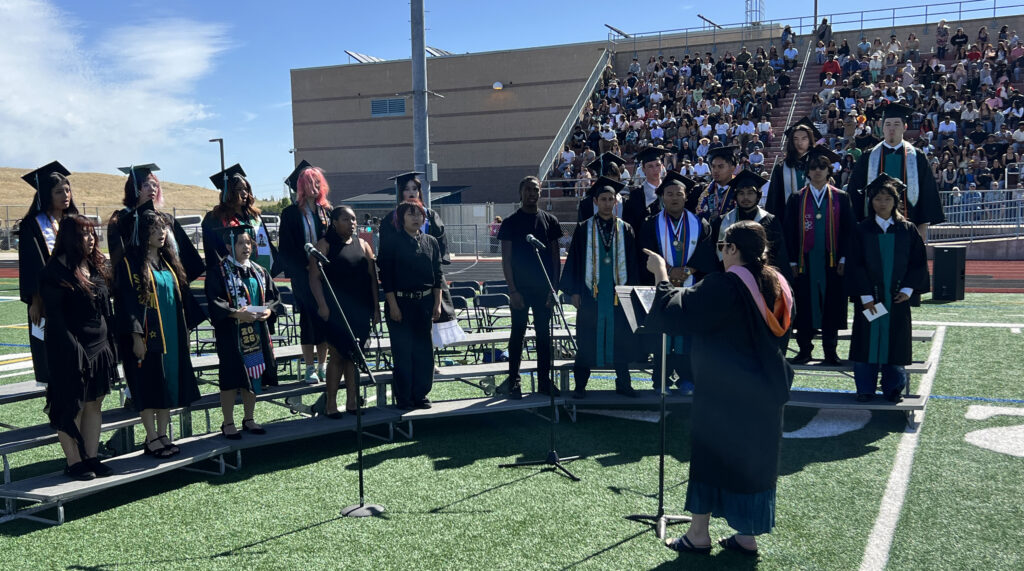
The Divine Voices then performed, “It’s So Hard to Say Goodbye to Yesterday” and “Ad Astra” which was followed by the Reading of the Names of the graduates by DVHS Math Department Chair Maria McClain and Math Instructor Jessika Tate.
The Deer Valley Divine Voices perform “It’s So Hard to Say Goodbye” during the ceremony Saturday morning.
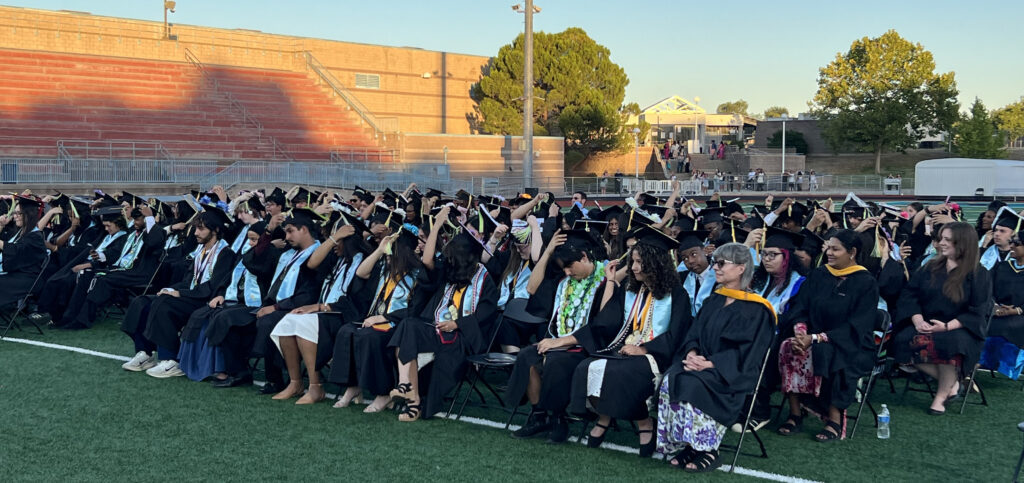
Class President Brown then led her classmates in the turning of their tassels to officially demonstrate they had graduated, as some tossed their caps in the air in celebration.
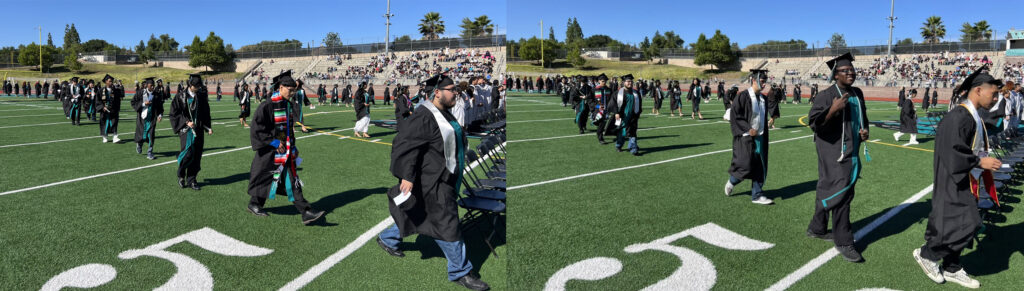
The graduates were then led off the field by Green and Bowers during the Recessional to the sounds of the DVHS Band.
Congratulations, Class of 2026 and God bless you in your future endeavors!
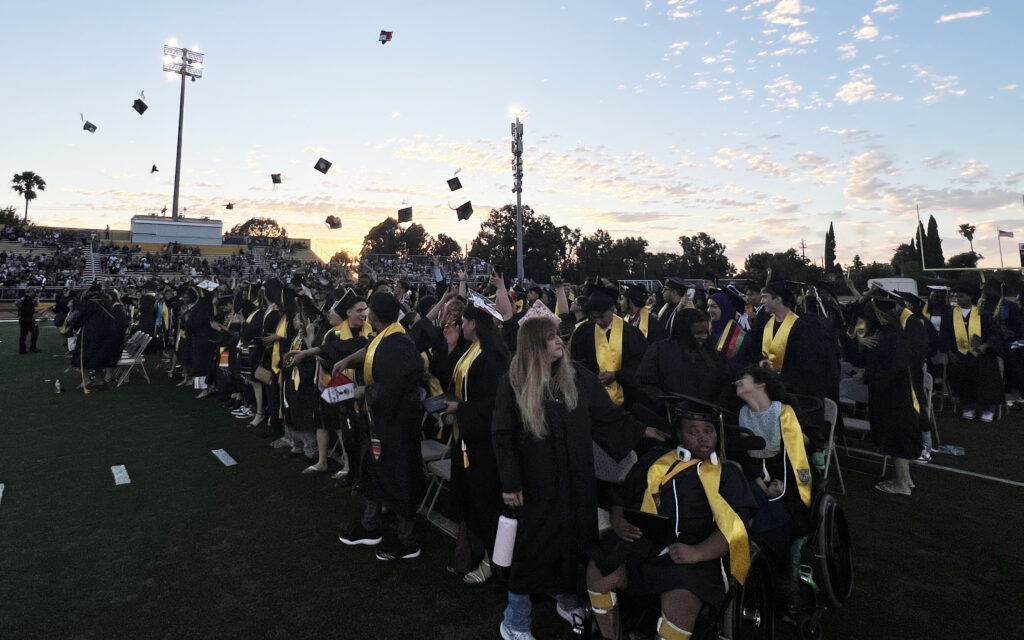
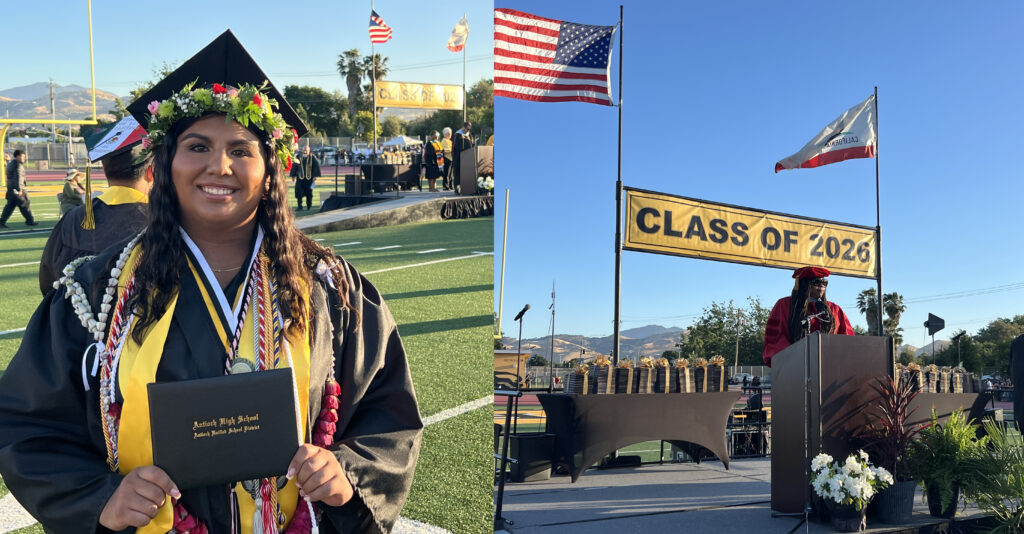
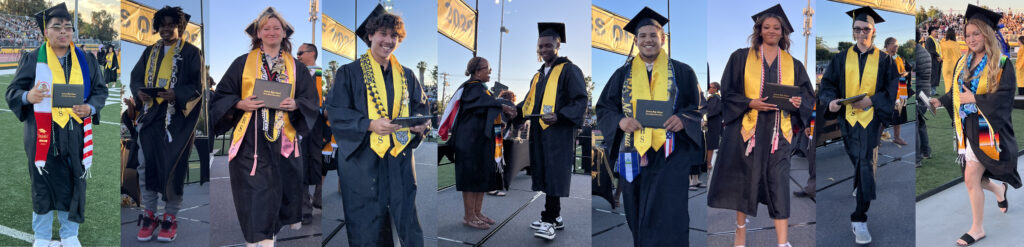
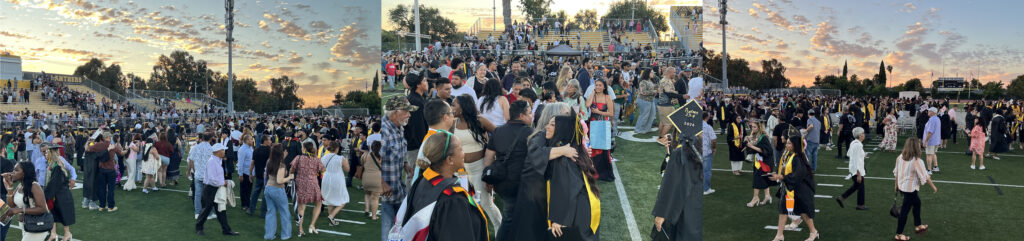
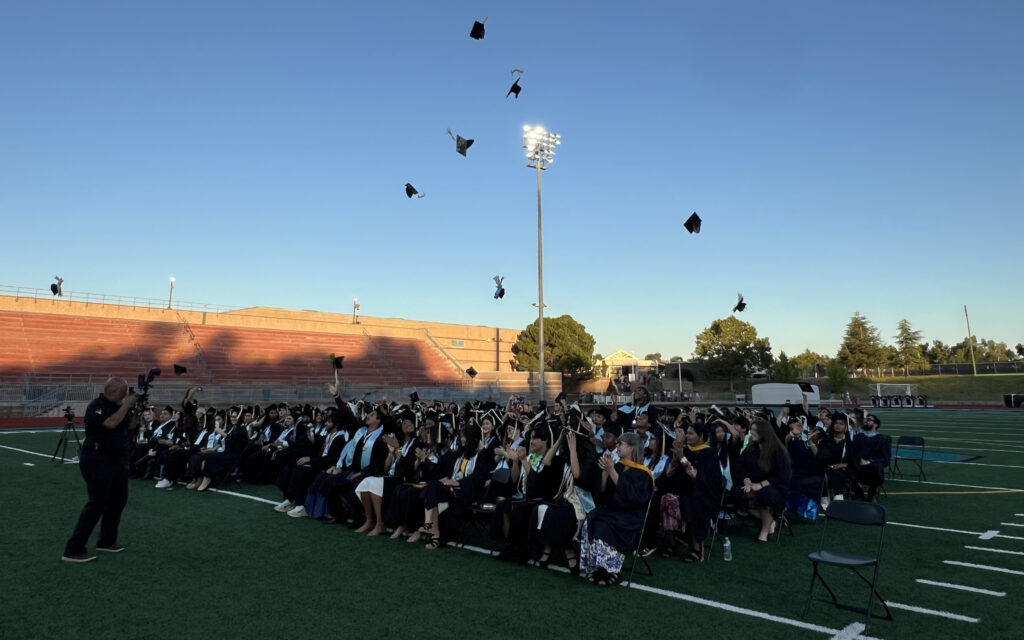
The Antioch High School Class of 2026 graduates toss their caps into the air to celebrate inside Eells Stadium as the sun sets on Friday night, June 5, 2026. Photos by Allen D. Payton
Smallest class size in years
By Allen D. Payton
During an evening Commencement Ceremony on Friday, June 5, 2026, the 330 members of the Antioch High School Class of 2026 celebrated with family and friends their four-year accomplishment inside the school’s Eells Stadium.
In the program Principal John Jimno wrote, “It is with great pride that I present to you the Class of 2026. The administration and staff of Antioch High School believe that these young people are well prepared to embark upon the next phase of their lives…what a journey they have ahead of them!
“I hope this occasion, shared with families and friends, will create fond memories to last for many years to come. This presentation is a well-documented rite of passage from childhood to adulthood and is very meaningful to the graduates and their families. This commencement ceremony exemplifies the high standards of Antioch High School and its students, staff and community. Congratulations, Class of 2026!”
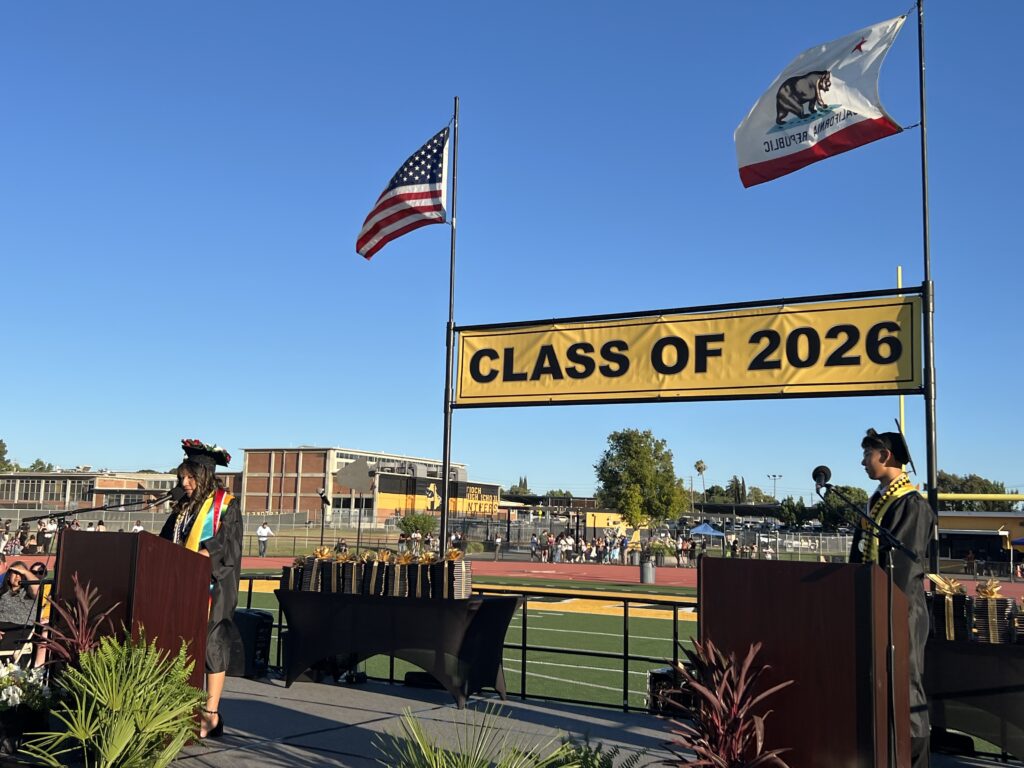
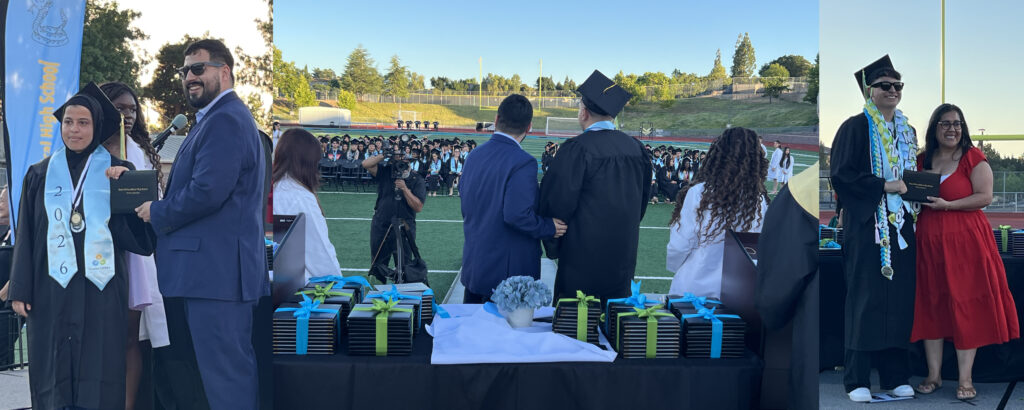
Antioch High ASB President Kailani Torres with her diploma. Superintendent Dr. Darnise Williams accepts the class.
Following their entrance to the traditional sounds of Pomp and Circumstance and the playing of the National Anthem, known as The Star-Spangled Banner, the classmates and all in attendance were welcomed by ASB President Kailani Torres.
Jimno introduced the dignitaries including four members of the Antioch Unified School District Board of Trustees, Vice President Olga Cobos Smith, Mary Rocha, Dee Brown and Antonio Hernandez, Superintendent Dr. Darnise Williams, Director of Educational Services Dr. Lindsay Lopez-Wisely and City Councilmembers Tamisha Torres-Walker and Louie Rocha, the past principal of Antioch High.
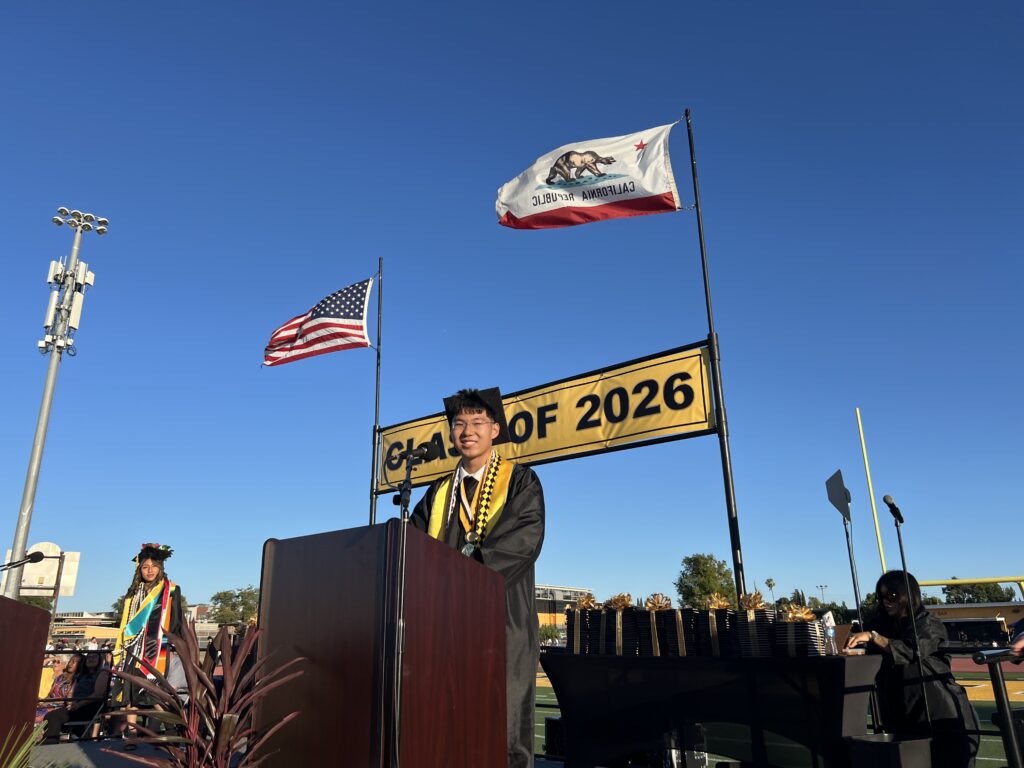
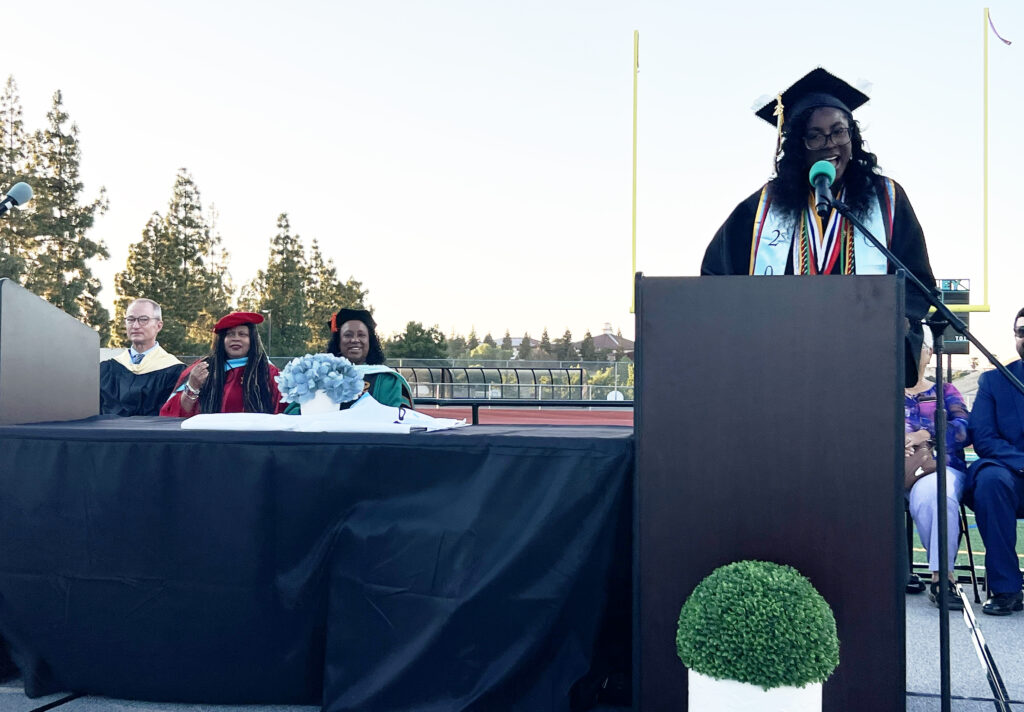
Antioch High Class of 2026 Salutatorian McKeyla Feliciano speaks to her fellow graduates as Valedictorian Daniel Fung looks on.
Jimno then introduced Salutatorian McKeyla Feliciano and Valedictorian Daniel Fung who addressed the graduates.
Feliciano spoke of perseverance and shared memories of her high school experience.
“I believe in you all,” she said. “We are young, we are foolish, we have dreams. Hashtag, keep going.”
Valedictorian Fung said, “Thank you for raising a real goat” meaning greatest of all time, to laughter from his classmates.
Antioch High Class of 2026 Valedictorian Daniel Fung speaks to his classmates as Salutatorian McKeyla Feliciano looks on.
“I wanted high school to end before it even started. I wanted to stay at home all day and play video games. I was always dreaming about my future,” he continued. “The future is today for all of us. I was wrong. High school wasn’t so bad. Sometimes I wish it was a little bit longer.”
“I was always afraid of change. Now, I see it is beautiful,” Fung stated. “Thank you, high school for teaching me that.”
“It’s not about how you finish. It’s about how you navigate this world and make this life uniquely yours. Be ambitious. We are dreamers. So, let’s keep dreaming,” he concluded.
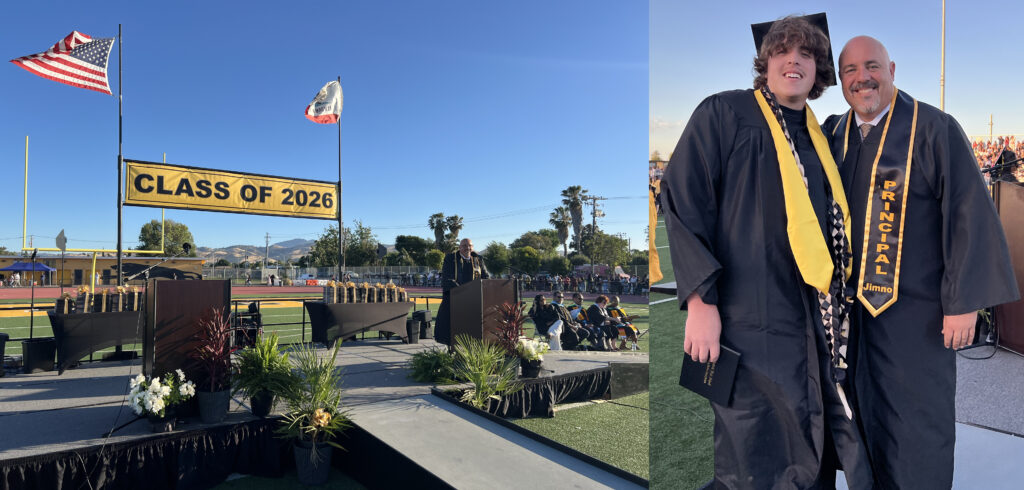
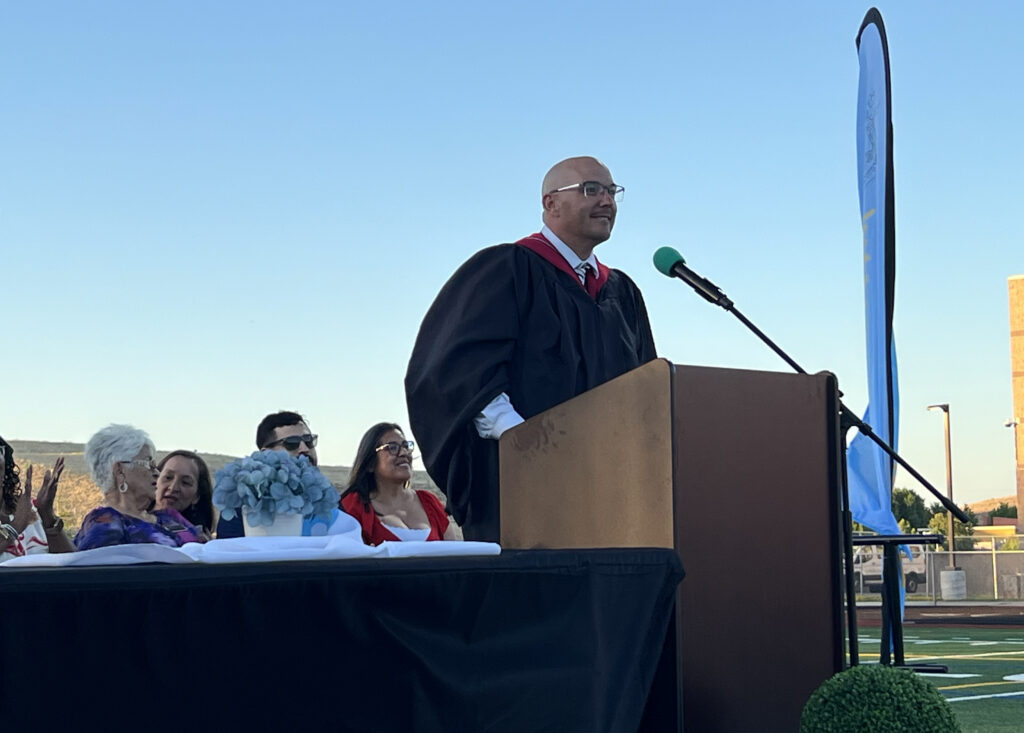
Antioch High School Principal John Jimno speaks to the graduates and celebrates with his son, Matthew who graduated Friday night.
Jimno then spoke saying, “This class is special.” He then mentioned that he would be watching his “son Matthew graduate tonight.” To the graduates he said, “I’ve spent the last seven years watching you grow up from little kids to adults. Watching you showcase your talents has been amazing.”
“Carry yourself with confidence, continue to work hard and follow your passion,” Jimno concluded.
AUSD Trustee Mary Rocha speaks to the graduates and celebrates with her granddaughter Miley Fernandez who graduated Friday night.
Trustee Mary Rocha representing the board spoke next. She mentioned Jimno’s son graduating and then said, “I have my granddaughter graduating, here. So, we’re a family. Today, my final family member will graduate, Miley Fernandez.”
Rocha spoke first in Spanish then in English.
“I want to acknowledge the great sacrifice of your parents and family in your academic achievement. What an exciting time for all and fear for what the future holds,” she continued. “You’ve been given the tools. Congratulations Class of 2026.”
Before officially accepting the class, Dr. Williams said, “You all did it and you did it big. Always question the status quo. The world needs more people to step forward when others step back. The future is not something that happens to you, it is something you come to shape.”
She then accepted “the 2026 Class from Antioch High School…upon the recommendation of the faculty and Board of Trustees.”
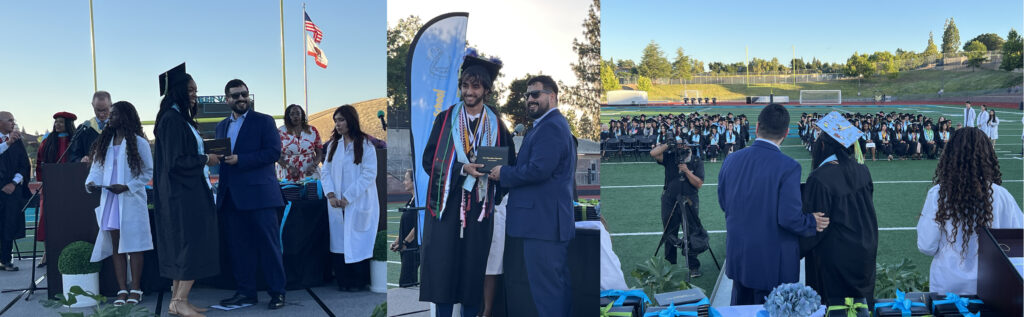
The graduates’ names were then read, and their diplomas were presented to them by a few of their teachers, Sandy Bentancourt, Melissa Johnson, Jeff Meeks and Andre TimTim.
Antioch High 2026 Senior Class President Alanna-Joi Sheard with Principal Jimno before offering closing remarks and leading her classmates in the turning of their tassels.
Closing Remarks were offered by Senior Class President Alanna-Joi Sheard who then then led her classmates in the turning of their tassels signifying they had officially graduated.
Many tossed their caps into the air before family and friends joined them on the field to celebrate.
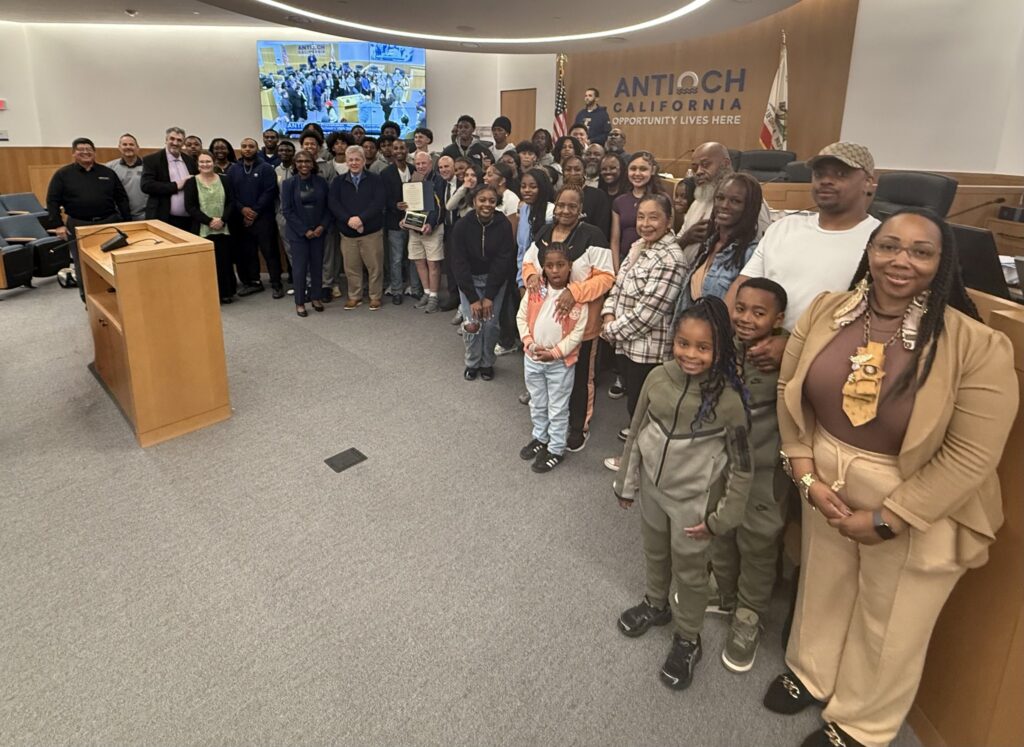
The Cornerstone Christian School championship basketball teams were honored by the Antioch City Council on April 14, 2026. Photo: City of Antioch
By Allen D. Payton
During their meeting on April 14, 2026, the Antioch City Council honored both the Cornerstone Christian School Cougars boys’ and girls’ varsity basketball teams for their state championships this year. In addition, on Thursday, May 28, 2026, the Antioch Sports Legends hosted and honored the teams, in their wing inside the Antioch Historical Museum.
Source: CIF
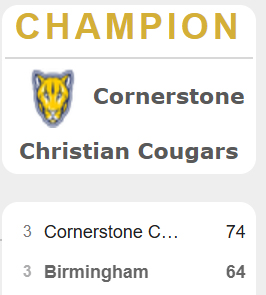
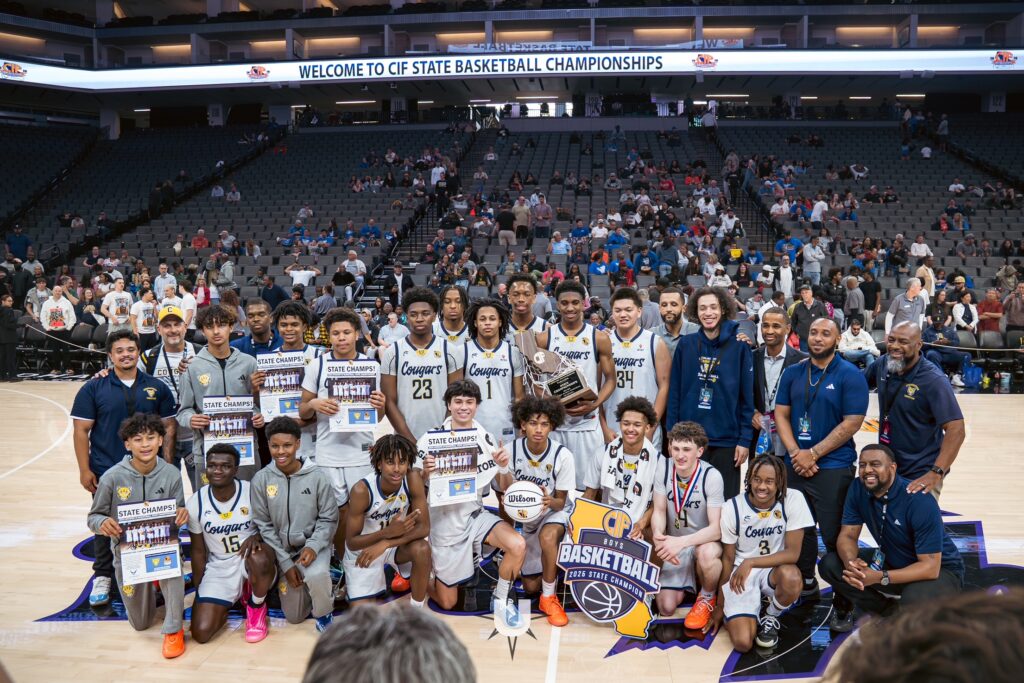
The undefeated boys’ team won the California Interscholastic Federation (CIF) Boys Division III State Championship defeating the Birmingham Patriots of Lake Balboa, CA, 74-64 at the Golden One Center in Sacramento on March 13th. They ended their season with a 29-8 overall record and 12-0 for first place in league. (See game video)
The boys’ basketball team was also the 2024 North Coast Section (NCS) and Norcal State Champions.
Photo courtesy of Cornerstone Christian School.Source: MaxPreps
Source: CIF
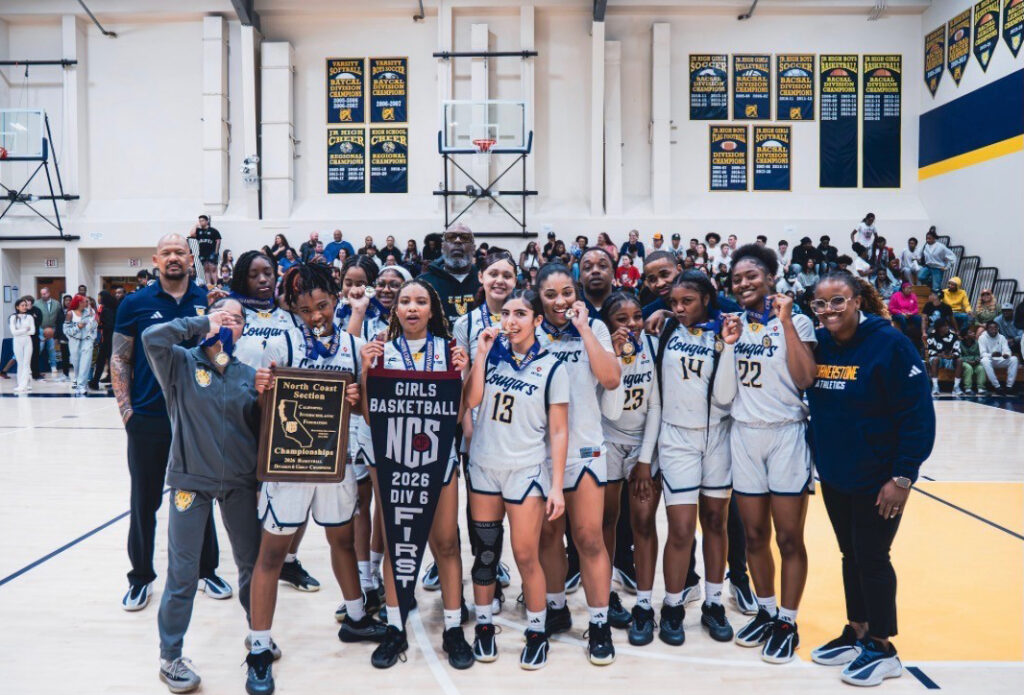
The undefeated, number one seeded girls’ team won the NorCal Girls Division VI Championship by dominating and defeating the number two seed Redding Christian Lions 48-27 inside the Cornerstone Christian gym on March 11th. They ended the season with a record of 27-7 and 10-0 for first place in league. (See game video)
The girls’ team was also the 2023 NCS and Norcal State Champions.
Photo courtesy of Cornerstone Christian School.Source: MaxPreps
The City Council’s proclamation reads as follows:
RECOGNITION HONORING CORNERSTONE CHRISTIAN SCHOOL’S
2026 STATE CHAMPIONSHIP BASKETBALL TEAMS
APRIL 2026
WHEREAS, Cornerstone Christian Center and Cornerstone Christian School have long served as valued institutions in the Antioch community, fostering spiritual growth, community engagement,
and a commitment to developing young people of purpose, integrity, and service;
WHEREAS, Cornerstone Christian School has built a strong reputation for providing an education that supports the development of students academically, spiritually, and athletically, while
encouraging excellence, discipline, leadership, and character;
WHEREAS, throughout the 2025–2026 basketball season, both the Cornerstone Christian School Girls and Boys High School Basketball Teams demonstrated extraordinary perseverance, teamwork, sportsmanship, and dedication, representing their school and the City of Antioch with pride and distinction;
WHEREAS, the Cornerstone Christian School Girls Basketball Team achieved an exceptional milestone by winning the 2026 CIF State Division VI Championship, reflecting the team’s resilience, unity, and unwavering commitment to excellence;
WHEREAS, the Cornerstone Christian School Boys Basketball Team achieved a historic accomplishment by securing the 2026 CIF State Championship, establishing a new legacy of excellence for the school and bringing great pride to the Antioch community;
WHEREAS, these accomplishments reflect not only the talent and hard work of the student-athletes, but also the invaluable leadership of coaches, the support of families, and the strength of the broader Cornerstone Christian School community; and
WHEREAS, the success of these teams has brought honor to the City of Antioch and serves as an inspiration to future generations to pursue excellence in athletics, academics, and character.
NOW, THEREFORE, I, RON BERNAL, Mayor of the City of Antioch, hereby proclaim April 14, 2026, as a day of recognition honoring the Cornerstone Christian School, Girls and Boys Basketball Teams for their 2026 CIF State Championship victories, and extend sincere congratulations to the student-athletes, coaches, school leadership, families, and the entire Cornerstone Christian School community.
Cornerstone Christian, CIF Boys Div. III State Basketball Champions Left to right: Alkeise Boddie, Brian McMurtrie, Pierre Tyson, Benjamin Lukacs, Elijah Longstreth, Marijan Kelly, James Perry, Tom Menasco (ASL Co-Founder), Jaden Taylor-West, Head Coach Michael Thomasson, Anthony Thomasson, Eddie Beaudin (ASL Co-Founder), Amari Woodard, Antonio Coleman, Jacob Williams, Ethan Banks. Not pictured: Ryan Seto, Uriah Wade, Ethan Banks, Brian McMurtrie, Assistant Coaches Thomas Brown, Tyree Murray, Jaden Shyne, Terrell Woodard. Photo: Antioch Sports Legends
Antioch Sports Legends Also Honor Teams
According to a May 29th post on their Facebook page, the “Antioch Sports Legends had the honor of welcoming the Cornerstone Christian High School varsity basketball teams to the museum to celebrate an incredible season!
“The students-athletes had the opportunity to explore the Sports Legends Hall of Fame—many for the very first time.
“We proudly recognized two outstanding teams:
CIF Boys Division III State Champions the Cornerstone Christian HS Boys Team
NorCal Girls Division VI Champions the Cornerstone Christian HS Girls Team
Azariah Wiley, Camille Bartolo, Kayli Bertrand, Tom Menasco (ASL Co-Founder), Coach Ariel Jackson, Eddie Beaudin (ASL Co-Founder), Jada Mayse, Danielle Balogun, Sanaa Boykin, Evalyn Mucio, Alexandrea Hall, Kenenna Amajioyi. Not pictured Laila Alexander, Bre’ah Butler, Bri’elle Phillips, Head Coach Madison Alexander. Photo: Antioch Sports Legends
“A special thank you to Gary Bras and Kris Del Monte for organizing this memorable event, and to Sports Legends co-founders Tom Menasco and Eddie Beaudin for presenting awards to these talented student-athletes.
“Congratulations to Cornerstone Christian High School on a remarkable year—we are proud to celebrate your success and dedication both on and off the court.”
Both teams were presented with plaques bearing the Antioch Sports Legends logo recognizing their accomplishments.
Cornerstone Christian School provides a well-rounded academic, extra-curricular, and spiritual experience. The foundational purpose of our facilities, programs, curriculum choices, and most of all our dedicated teachers and staff is to inspire your child in the joy of learning and a love for God and His Son Jesus. We want to partner with you, the parent, to bring about the best in your child. The school is located at 1745 E. 18th Street in Antioch. For more information visit www.cornerstonechristianschool.net.
Dozier-Libbey Medical High School Class of 2026 graduates toss their caps into the air in celebration Wednesday night, June 3, 2026. Photos by Allen D. Payton
By Allen D. Payton
Antioch’s Dozier-Libbey Medical High School Class of 2026 celebrated their graduation Wednesday evening, June 3, 2026. The 150 graduates were cheered by family and friends inside the Deer Valley High Wolverines Stadium.
The 150 members of the DLMHS Class of 2026 participate in Wednesday night’s Graduation Ceremony.
Following the Presentation of the Colors by the U.S. Navy, the National Anthem was performed by Daniela Edeh and Rachelle Leon. The Pledge of Allegiance was then led by ASB President Bethany Fumar.
Principal Blair Wilkins welcomed everyone and introduced the distinguished guests which included four Antioch Unified School Board Trustees, Antonio Hernandez, Mary Rocha, Olga Cobo Smith and Dee Brown, Superintendent Dr. Darnise Williams and Dr. Camille Johnson, Associate Superintendent for Human Resources.
The grads shared on their caps personal messages and the colleges they plan to attend in the fall.
Area 1 Trustee Hernandez, a member of the first DLMHS graduating class, offered opening remarks to the graduates. “It’s always great to be back with the amazing students of Dozier-Libbey Medical High School.” Speaking of his own college education experience he encouraged the Class, “You can always find new ways to reopen doors that people tell you are closed.”
Valedictorian Natalia Cortez speaks as members of the district leadership look on.
The Student Commencement Speakers were Senior Class President Daniela Edeh, who spoke about change and Valedictorian Natalia Cortez, who encouraged her classmates by saying, “The greater the struggle, the greater the triumph.”
The class Salutatorian was Jose Perez, who did not speak during the ceremony.
Before Wilkins presented the Class of 2026 to Superintendent Williams he said, “You are prepared to face all of life’s adversities because you attended and successfully completed Dozier-Libbey Medical High School’s graduation requirements.”
AUSD Superintendent Dr. Darnise Williams offers her Acceptance of the Class of 2026.
Williams then said, “I certify that each of you has completed the graduation requirements set forth by the Antioch Unified School District. I proudly confer upon each of you the high school diploma with all its rights, honors and responsibilities. Henceforth, you are to be considered high school graduates and alumni of Dozier-Libbey Medical High School. Congratulations.”
Trustees Antonio Hernandez (left) and Olga Cobos Smith hand out the diplomas and take photos with the graduates.
Kevin Landski, a teacher at the school, then announced the graduates’ names as they received their diplomas and took photos with the trustees.
Wilkins then certified the graduating class saying, “I certify Dozier-Libbey Medical High School’s Class of 2026” to loud applause from the graduates and audience.
DLMHS Principal Blair Wilkins issues the Certification of the Class of 2026.
Class President Edeh then led her classmates in the turning of their tassels completing the ceremonies. “Congratulations. We are now graduates,” she said, as several of them tossed their caps into the air in celebration.
Senior Class President Daniela Edeh leads her classmates in the turning of their tassels.
Wilkins and Landski then led the graduates off the field to meet their families and friends for further celebration.
The DLMHS Class of 2026 graduates turn their tassels to complete the ceremony.
Congratulations, Dozier-Libbey Class of 2026. God bless you in your future endeavors!
Brentwood Union School District Superintendent will apply his student-centered approach countywide
“We have a moral responsibility to make sure our children’s education is better than the one that we received,” – Dr. Dana Eaton
By Lisa Tucker
BRENTWOOD – In January, Dana Eaton launched his candidacy for Contra Costa County Superintendent of Schools. This is an open seat.
“Students and learning are at the center of my work as superintendent of schools for the Brentwood Union School District and in my previous roles as a teacher and principal,” said Eaton. “I have consistently championed early literacy, student mental health, supporting the whole child, and school safety as foundational priorities, and will continue to do so as Contra Costa Superintendent of Schools.”
Dr. Eaton is serving his 13th year as superintendent of schools for the Brentwood Union School District and his 17th year as a superintendent overall. According to his LinkedIn profile, he previously worked as Superintendent for the Jefferson School District in Tracy from 2009 to 2013. Eaton has a nearly 30-year career in education including as a teacher and principal.
Dana with his wife, Renee and their children, James and Emily. Source: Eaton campaign.
He earned his Bachelor’s degree in Liberal Arts and Sciences/Liberal Studies from San Francisco State University, a Master’s degree in Educational Leadership from Saint Mary’s College of California and a Doctor of Education – EdD degree in Educational Leadership from the University of La Verne.
“This experience has prepared me to help districts maintain sound fiscal practices and improve their Local Contral and Accountability Plans (LCAPs) to provide outstanding educational opportunities to every student,” said Eaton.
Current Contra Costa Superintendent of Schools, Lynn Mackey, is retiring and will not run for re-election. She has endorsed Eaton, stating “Dana is a highly experienced, well-respected superintendent here in Contra Costa County. He is deeply committed to public education, understands the role of the County Office, and brings steady, student-centered leadership.”
Dr. Dana Eaton speaks during a campaign fundraiser at McCauley Estate Vineyards in Brentwood on April 7, 2026. Photos by Allen D. Payton
During a campaign fundraiser on April 7th, the candidate said, “I really believe in the power of public education. At the same time, I think we’re in a time when we are at risk for our children and our children’s children having an inferior education. I think that as adults who have benefited from a public education that we have a moral responsibility to make sure our children’s education is better than the one that we received. And that’s why I’m running for County Superintendent of Schools.”
In recognition of Eaton’s leadership, he was named ACSA Superintendent of the Year for Alameda and Contra Costa Counties in both 2016 and 2023. He was also named Brentwood Citizen of the Year in 2019 by the Brentwood Chamber of Commerce.
“As Superintendent, I will work to attract and support high-quality teachers and prioritize student success and learning whether in general education, special education, or alternative settings,” said Eaton.
Eaton comes from a long line of educators. His grandparents, mother, sister and wife all served their communities as teachers. Eaton lives in Brentwood with his family.
The primary election is in June in which he faces one opponent. Whoever receives a majority of the vote wins and will begin their term in December.
On June 2, Contra Costa County voters will decide whether to saddle themselves — and their children — with the largest bond debt in the history of the Contra Costa Community College District (4CD). Measure G asks for $920 million in new borrowing. With interest, the true cost climbs to $1.88 billion, with final payoff projected in 2059. CoCoTax has opposed this measure in official ballot arguments, in public presentations, and in a detailed response to a recent article in the Contra Costa College Advocate.
The case against Measure G is straightforward: it is far too much money, sought too soon given outstanding bond debt, by a district that hasn’t demonstrated the fiscal discipline to deserve it.
Already Drowning in Debt
4CD still owes on three bond measures as is: 2002’s Measure A ($120 million), 2006’s second Measure A, ($286.5 million), and 2014’s Measure E ($450 million) — totaling $856.5 million in principal alone. County taxpayers still owe nearly $727 million on those existing obligations, with the final payment on Measure E not expected until 2039. Measure G would pile $1.88 billion more on top of all that. If it passes, total bonded indebtedness reaches $2.61 billion, secured by Contra Costa County property values — with no senior exemption.
Enrollment Is Down 28% — Yet They Want to Build More
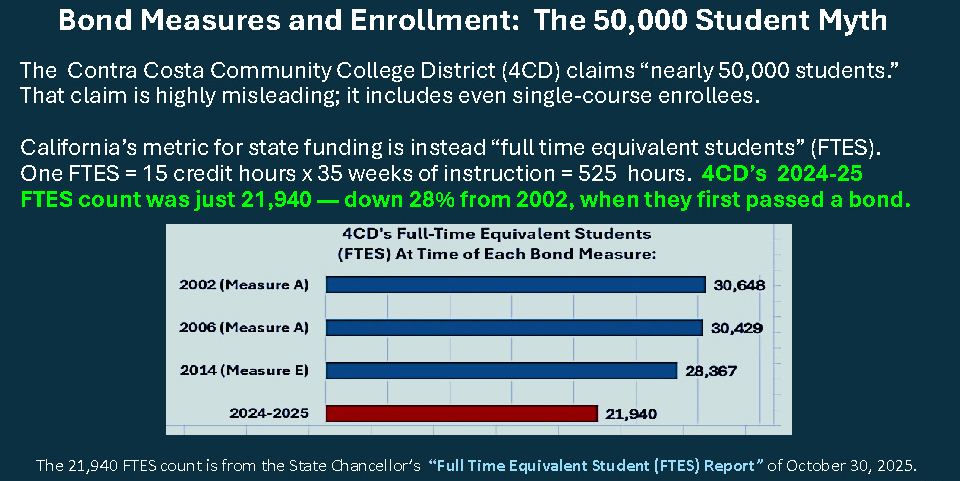
4CD advertises “nearly 50,000 students,” but that figure is misleading. California’s actual funding metric is Full-Time Equivalent Students (FTES). According to the State Chancellor’s October 2025 FTES Report, 4CD’s count was just 21,940 — down 28% from 30,648 when Measure A passed in 2002. Expanding costly new facilities while enrollment trends sharply downward is the opposite of responsible stewardship.
“Deferred Maintenance” — Deferred Forever?
Roofing repairs, seismic retrofits, HVAC upgrades, and electrical work appear repeatedly in 4CD bond project lists going back to 2002. How many bond measures must pass before these basics get done? There’s a core problem: 4CD’s maintenance budget has crept from just 0.10% to 0.20% of Plant Replacement Value over the past decade, when the commercial building standard is 2–5%. Routine maintenance gets deferred so the general fund can support other priorities — including lavish administrative compensation — and then bond money pays for the fixes, with interest on top.
Executive Pay That Outstrips the Governor’s
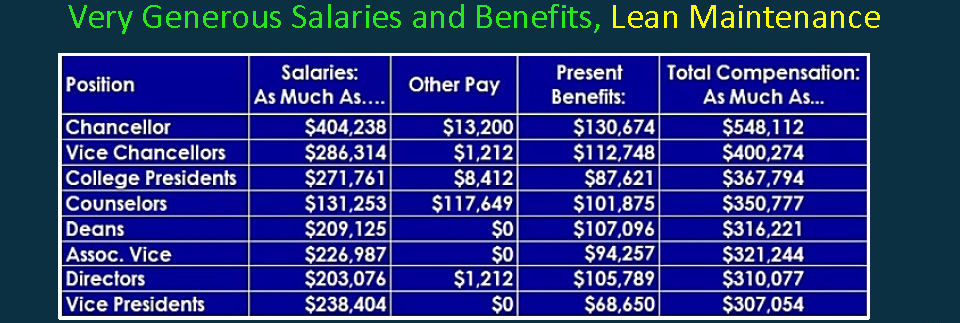
While seeking $920 million in new principal from taxpayers, 4CD’s Chancellor drew a $404,238 salary (as of 2024) — plus $130,674 in benefits, for total compensation reaching $548,112. That salary alone exceeds the official pay of the President of the United States and far surpasses Governor Newsom’s $245,929. Vice Chancellors, College Presidents, and Directors also earn hundreds of thousands in total compensation. Lavish pay and lean maintenance are two sides of the same General Fund coin.
Who’s Funding “Yes on G”?
The pro-Measure G campaign has raised nearly $400,000 so far — with the bulk coming from the tax-exempt Contra Costa College Foundation ($100,000), the DVC Foundation ($50,000), and multiple construction unions (IBEW Local 302, Plumbers Local 159, Sheet Metal Workers Local 104, and others). Contractor unions have a direct financial interest in a $920 million construction program. Ordinary property-tax-paying residents have no equivalent organized voice — a textbook example of what economists call “Public Choice Theory.”
The Bottom Line
Property owners already pay an average of $13.97 per $100,000 of assessed value toward 4CD’s existing bonds. Measure G adds another $10 — and that rate could rise if the county’s assessed values don’t grow at the 4% annual pace 4CD projects, projections that, by 4CD’s own admission, “are not binding upon 4CD.”
4CD should maintain its existing buildings with its existing budget rather than repeatedly turning to taxpayers for borrowed billions. Vote NO on Measure G.