






Author Archive

Supervisors approve spending $75 million of Measure X funds for county medical center

Thursday, December 16th, 2021
Source: Contra Costa Health Services

Will provide garage, medical clinical office, and expanded radiology lab at Contra Costa Medical Center in Martinez; following crackdown, one restaurant still violating COVID-19 health orders as cases increase; appoint new Public Defender

“If you want to send me an email and still want to call me a ‘b***’ go ahead.” – Supervisor Karen Mitchoff in response to critics of her crusade to crack down on restaurants out of compliance with county health orders

By Daniel Borsuk

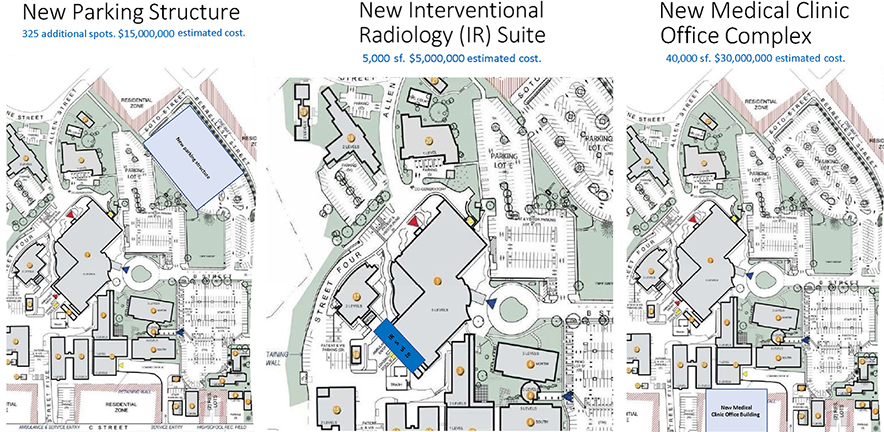
On a 4-0 vote, the Contra Costa County Board of Supervisors paved the way for officials of the over-used Contra Costa Regional Medical Center to spend $75 million of Measure X half-cent sales tax funds to construct a parking garage, a medical office complex and a state-of-the-art public health laboratory at Tuesday’s final board meeting of the year. (See CCRMC Proposed Master Plan)

With Board Chair Diane Burgis absent because of the death of her husband Richard Clayton for whom supervisors adjourned the meeting in honor of, supervisors narrowly met the super-majority requirement to tap into 2020 vote-approved sales tax measure revenues for the purpose of enhancing facilities at the over-used medical complex in Martinez.

Contra Costa Public Health Director Anna Roth pitched the three CCRMC capital improvement projects based on the fact the publicly funded medical center in the past year has treated 142,000 patients due to COVID-19, a 540 percent increase.  The center has saved the lives of about 26,000 county residents, 70 percent of whom are on Medi-Cal. Seventy percent of the CCRMC patients do not speak English, Roth noted.

She said the medical center has been crushed with a 540 percent increase in patients seeking medical care over the past 20 years while the physical components of the medical center have been unchanged. Roth also shared there has been at least one case where a pregnant woman had safely delivered her baby in the medical center parking lot because of the unavailability of parking. According to the presentation, three babies were born in the parking lot during the last year. The proposed 325-space parking structure along with valet parking would help alleviate the parking problem, she asserted.

Marianna Moore, chair of the board of supervisors’ appointed Measure X Advisory Committee, cast concern that the supervisors’ action on the medical center capital projects might be premature and negatively hit future Measure X funding of other public services.

“This is a one-time expenditure,” responded District 4 Supervisor Karen Mitchoff of Pleasant Hill. “There will be money for other projects. The longer we delay on capital improvement projects like these the more expensive it becomes.”

Upon acknowledging Measure X chairperson Moore’s comments, District 1 Supervisor John Gioia remarked “I hear the concerns of the Measure X panel for this board to be transparent and open.” Yet, he pointed out how three major local nonprofit health providers – Kaiser Permanente, John Muir and Sutter Medical – skirt regulations that county-operated medical institutions must obey.

“They get an equity worth $25 billion in tax breaks and don’t have to encounter public scrutiny that publicly operated health care operations like Contra Costa County’s have to abide by. I am proud of the public health successes in Contra Costa County, but we need help from the nonprofit health care organizations too.”

In addition to the proposed parking garage, the supervisors’ action paves the way for the medical center to have a $30 million 40,000 square foot medical-clinical office building constructed and a $5 million 5,000 square foot state-of-the-art intervention radiology suite built.

One Restaurant Remains Out of Compliance With COVID-19 Health Order, Mitchoff on the Defense

In a follow up to last week’s meeting where Supervisor Mitchoff questioned the Health Department’s code enforcement capabilities in shutting down 13 restaurants willfully out of health code compliance, Roth announced there is currently only one eatery that is still not following health code requirements.

She did not identify the business. “All but one of the establishments are now in compliance,” said Roth.

Roth said her department has added four code enforcement officers since last week when Mitchoff blew the lid off the health department’s health code performance.

“I appreciate the progress the health department has made,” said Mitchoff. “There is still one restaurant to follow up on. One restaurant will probably have to close.”

Mitchoff, who will serve as board chair next year instead of vice chair Federal Glover of Pittsburg in recognition of her public service as she has announced she won’t seek reelection in 2022, attacked her critics on her crusade to shut down out-of-compliance restaurants.

“There’s recently been vitriolic and unclear language and comments lodged at me,” said Mitchoff, whose been a frequent target of hate emails. “If you want to send me an email and still want to call me a ‘b***’ go ahead. It would be much better if those who dislike me to write letters and that everyone gets vaccinated and wears masks. I hope to start the new year with much more appreciated language.”

County COVID-19 Cases Increase

In the meantime, Roth said Contra Costa County’s vaccination rate of 76.8 percent remains above the national average of 69.9 percent.

The county’s active COVID-19 case load stands at 1,463, an increase of 18.9 percent over a two-week period. Forty-three patients were in hospitals in the county because of COVID-19.

“Ninety-seven percent of the cases in Contra Costa County are of the Delta strain,” remarked Roth. She said there have been signs of the new Omicron variant appearing in wastewater in the county, but nowhere else.

Because of wintertime conditions forcing Californians to hunker down indoors, Contra Costa County Health Officer Dr. Chris Farnitano informed supervisors the State was expected to announce a new indoor public face mask order. The order would be in place through Jan. 15, 2022.

In a related action, supervisors adopted an ordinance calling for the continuation of remotely conducted meetings into January 2022.  The ordinance also applies to commissions and advisory committees.

Ordinance Temporarily Halts North Richmond Fulfillment Center Openings  

In response to increasing vehicle emission air pollution and traffic-pedestrian safety concerns issues stemming from the buildup of fulfillment centers in the unincorporated North Richmond and Richmond areas, supervisors imposed a 45-day moratorium on the opening of new fulfillment centers.

“Richmond and North Richmond have become a major destination for fulfillment centers,” said Supervisor Gioia, whose District 1 cover those areas. “We don’t want North Richmond to become a wall-to-wall fulfillment center magnet.”

The purpose of the ordinance Gioia has introduced is to compel these enterprises to deliver their products with electric vehicles.   It aims to have 33 percent of a company’s fleet of vehicles electrified immediately and by 2027 100 percent of a business’s fleet of vehicles must be electrified.

At least five fulfillment centers are either under construction or planning phase, said John Kopchick, director of the Contra Costa County Conservation and Development Department.

No one from the fulfillment center sector spoke on the ordinance regulating the electrification of vehicle fleets, but Donald Gilmore of North Richmond Recreation said the ordinance does not go far enough.

“North Richmond is significantly impacted by these warehouses and the traffic coming from them. Pedestrian safety is a pressing problem. We need more time to figure out a plan,” said Gilmore.

Appoint New Public Defender

Ellen McDonnell. Source: CCPD

Supervisors promoted Deputy Public Defender Ellen McDonnell as Contra Costa Public Defender at an annual salary of $340,510 in addition to $93,131 in pension annual compensation.  She will officially take over the role of Public Defender from the retiring Robin Lipetzky effective Jan. 1, 2022.

She started with the department in 2001 and will oversee a $36 million budget and 145 employees.

McDonnell holds a Juris Doctors degree from California Hastings College of the Law and a Bachelor of Arts degree and double major in Spanish and Italian from Florida Atlantic University in Boca Raton.

She has been a member of the California State Bar since 2011. (Read more about McDonnell in a separate article.)
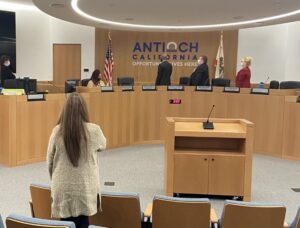


Antioch Council extends redistricting process one month, approves another cannabis business, $285K for 15 homeless at Pittsburg site

Wednesday, December 15th, 2021

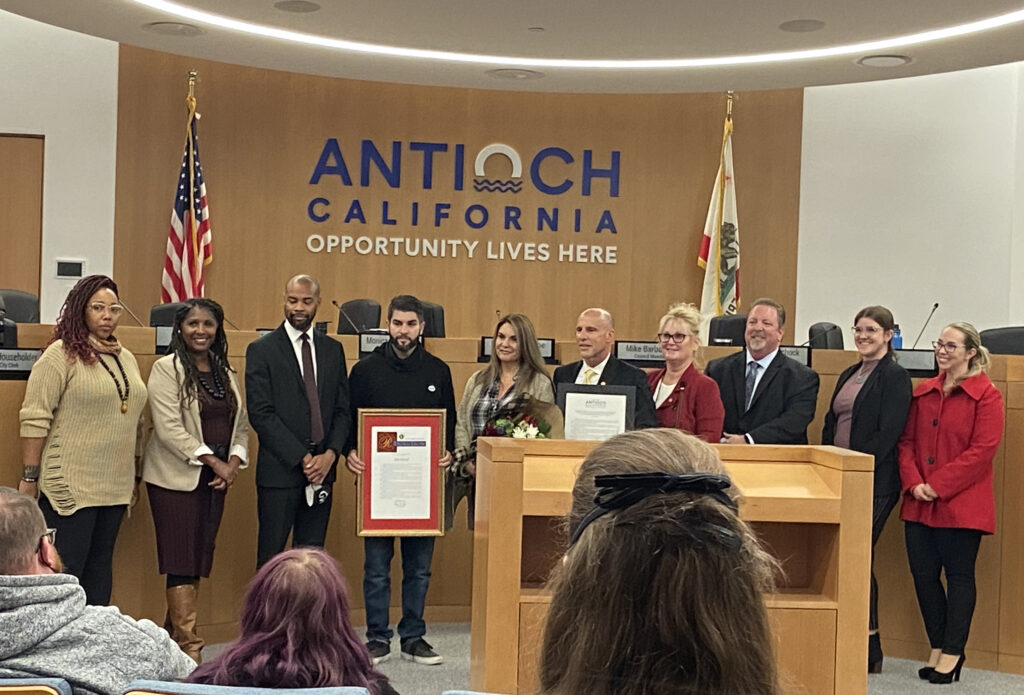
Outgoing City Manager Ron Bernal with his wife, Irma (center) was honored by city council members, city clerk and city treasurer during his final council meeting in the position, Tuesday night Dec. 14, 2021. Photo by Kathy Cabrera

Appoints Barbanica the next mayor pro tem; honors outgoing city manager Ron Bernal; spends $60,000 on Chinatown history exhibit at Antioch Historical Society Museum; approves $145,000 for Antioch’s Sesquicentennial Celebration; approves minutes for past five meetings

Torres-Walker again doesn’t stand for the Pledge of Allegiance, keeps her back to the American flag; Thorpe says Con Johnson started as interim city manager on Monday without any announcement he’s passed the background check

By Allen Payton

Antioch District 1 Councilwoman Tamisha Torres-Walker won’t stand for the Pledge of Allegiance during the city council meeting on Tuesday, Dec. 15, 2021. Photo by Kathy Cabrera.

In response to the urging by members of the public and city council for more time for additional public comment and input, the Antioch City Council voted 3-0-1 to extend their redistricting process by one month until the end of February. During the very full agenda, for their final meeting of the year, the council also approved another cannabis business on W. 10th Street, spending about $285,000 to place 15 Antioch homeless residents in the soon to reopen Delta Landing site in Pittsburg, and $60,000 for a Chinatown exhibit inside the Antioch Historical Society Museum on W. 4th Street. In addition, the council voted to grant $145,000 to the Celebrate Antioch Foundation for next year’s Sesquicentennial celebration of Antioch’s 150th anniversary of cityhood.

In addition, the council honored outgoing City Manager Ron Bernal with a presentation for his five years in the position and 26 years total with the City of Antioch.

At the beginning of the meeting, District 1 Councilwoman Tamisha Torres-Walker again remained seated, with her back to the American flag during the Pledge of Allegiance.

Approve Minutes for Past Five Meetings

During the consent calendar, the council then approved the minutes from their regular and special meetings of Oct. 26, Nov. 2, Nov. 9, Nov. 16 and Nov. 23. At the meeting on Nov. 23 the council voted to postpone the approval of the minutes from the first four aforementioned meetings because they had not yet been prepared by the city clerk’s office. Minutes of the previous meeting are supposed to be prepared and included in the next meeting’s agenda. As of Wednesday evening, Dec. 15 the minutes for meetings since June 22 through Oct. 16 were finally on the council’s Agendas and Minutes page on the City’s website and the agenda for last night’s meeting is now on that page, although it wasn’t there as of yesterday, before the meeting began. The public was directed to the City’s calendar page to find them. (See related editorial)

Redistricting Presentation of 8 Alternative Maps, Process Extended

In response to a question by District 2 Councilman Mike Barbanica about the redistricting deadline, Jane Hood of consultant Q2 Data and Research, who provided the presentation during the third of four scheduled public hearings, Tuesday night, the council has until April 17 to choose a final map of new district boundaries. The schedule was to conclude with a final vote on January 25 but both Barbanica and District 3 Councilwoman Lori Ogorchock agreed with those who spoke during public comments that residents and the council needed more time. Mayor Pro Tem Monica Wilson was absent for the presentation and District 1 Councilwoman Tamisha Torres-Walker who made no comments during the discussion voted to abstain on the motion to extend the process, without explanation.

All eight maps were presented to the council, including the three created by Q2 staff and the five submitted by the public. (See related article)

Two members of the public urged the council to approve Map B. Ogorchock, who expressed her displeasure with that option, asked Hood to make some changes to Map C between Districts 3 and 4 on the east end of Antioch north of Lone Tree Way. But the modifications resulted in District 3 having too high of a population percentage deviation greater than 5% from average, which is the legal limit, and District 4 with too small of a population, also greater than the 5% deviation from average. So, Ogorchock abandoned the effort.

Thorpe said all eight maps would be brought back for consideration at the next public hearing on redistricting on January 11.

Unanimously Approve Cannabis Cultivation Facility

The council, on a 5-0 vote, approved the application by KWMA Collective, LLC to operate a cannabis cultivation facility at 2101 W. 10th Street in the same building that houses both the Delta Dispensary and the recently approved Delta Labs. (See related articleKWMA Collective cannabis biz ACC121421

Approve Funds for Transitional Housing for 15 Antioch Unhoused Residents

The council on a 5-0 vote also approved spending $284,700 to place 15 unhoused Antioch residents at the new Delta Landing Interim Housing site in Pittsburg, which is estimated to re-open its doors within 30 days. The action was in response to the recommendation by the Council’s Ad Hoc Committee on Unhoused Residents made up of Mayor Lamar Thorpe and Councilman Barbanica, earlier this month. (See related article)

According to the City staff report the funds will be spent “for a duration of 12 months; to be drawn from the current General Fund budget balance of previously earmarked funds to address unhoused resident needs.”

In addition, the staff report explains, “As part of ongoing dialogue between the City and County, a MOU (Memorandum of Understanding) has been developed that provides access to City initiated, CORE (the county’s Coordinated Outreach Referral, Engagement program) approved referrals for a maximum of 15 bed nights at any one time over a period of one year. The cost to the City is $52/night when City referrals are placed and beds are utilized. Wrap around support services include benefit assistance, medical services, behavioral health services, as well as case management, housing navigation and rapid rehousing assistance.”

“The timing for securing potential space through a formal agreement is immediate should the City wish to exercise bed options upon facility re-opening,” the staff report continues. “It is a rare and unique window to have access to a total of 15 new City referred, CORE approved placements at one time.”

Barbanica moved approval of the expenditure and MOU and it was approved on a 5-0 vote.

Approves $145,000 for Antioch’s Sesquicentennial Celebration

During the consent calendar, the council approved spending $145,000 for the Celebrate Antioch Foundation to put on events for next year’s Sesquicentennial celebration of Antioch’s 150th anniversary of cityhood. According to the City staff report, the Celebrate Antioch Foundation is also committing to raising $56,500 to be used toward Sesquicentennial Events. A variety of events and activities are planned throughout the community, beginning on Feb. 6 the day the City was incorporated in 1872.  Sesquicentennial CAF Budget ACC121421

Council Spends $60,000 on Chinatown Historical Exhibit

Earlier in the meeting, the council, on a 5-0 vote, agreed to spend $60,000 on a contract with the same San Francisco-based firm that developed the new City logo, ad campaign “Opportunity Lives Here” and the Rivertown Dining District logo, to create a new Chinatown exhibit inside the Antioch Historical Society Museum. Antioch’s Chinatown was burned down in 1876. In June, during the signing ceremony by the council of a resolution apologizing for that tragedy and the racism against Chinese immigrants in the late 1800’s, the Asian Pacific Islander American Public Affairs Association (APAPA) Foundation agreed to donate $10,000 for the exhibit. (See related article)

Appoints Barbanica City’s New Mayor Pro Tem

During the 15th and final agenda item of the council meeting, City Attorney Thomas Lloyd Smith said, “According to the ordinance in our municipal code passed by city council, we have a rotation of the guard. It’s more of a formality because it’s already outlined in the municipal code.” (See related article)

Without discussion or public comment Ogorchock made the motion “to appoint Mike Barbanica as our next mayor pro tem”. Torre-Walker seconded the motion. It passed on a 5-0 vote.

“Are you ready for this? You may have to call a press conference from time to time, visit a crime scene,” Mayor Lamar Thorpe joked.

Barbanica replaces Wilson in the position who held it this year, having gained the highest percentage of votes of all four council members in last November’s election. The councilman garnered the second highest percentage of votes.

Bernal Offers Farewell

City Manager Ron Bernal will retire at the end of the month, briefly said at the end of his final meeting in the position, “I wanted to thank the council…for the past five years. It’s been a privilege and an honor.”

Thorpe Announces Interim City Manager Started Monday

“Welcome to our interim city manager who started on Monday, Mr. Con Johnson,” Thorpe added, then wished everyone a Merry Christmas and Happy Holidays.

No announcement had yet been offered by either the mayor or city staff that Johnson had successfully passed his background check. Questions were emailed Wednesday morning to the mayor, council members, and city staff asking about that. No response was received as of late Wednesday night.

The next regular Antioch City Council meeting will be held on Tuesday, Jan. 11, 2022.

Kaiser Permanente Nor Cal receives international recognition for life-saving advance alert monitor program

Wednesday, December 15th, 2021

Kaiser Permanente Northern California is recognized at the 44th World Hospital Congress. Pictured, far right, Carrie Owen Plietz, FACHE, president of Kaiser Permanente’s Northern California region accepts the award from representatives of Austco in Barcelona, Spain on Nov. 11, 2021. Source: Austco

The International Hospital Foundation recognizes Kaiser Permanente Northern California with the Autsco Excellence Award for Quality and Patient Safety

By Antonia Ehlers, PR and Media Relations, Kaiser Permanente Northern California

OAKLAND, Calif., – An early detection system that helps care teams predict when Kaiser Permanente Northern California’s hospitalized patients are at risk for clinical deterioration was recognized by the International Hospital Foundation with the Autsco Excellence Award for Quality and Patient Safety.

Kaiser Permanente Northern California received the Gold Award, the highest level possible, for its Advance Alert Monitor (AAM) program, which is in place at all 21 Northern California hospitals. The program is a sophisticated monitoring system that analyzes electronic hospital patient data to identify those at risk of deteriorating and alerts a specialized team of virtual nurses who determine if on-site intervention is needed. The nurses contact a rapid response team, which perform an assessment, and then work with the care team and the patient and/or family to develop a patient-centered treatment plan.

AAM predicts the probability that hospitalized patients are likely to decline, require transfer to the intensive care unit or emergency resuscitation, and benefit from interventions. Early warnings could be helpful for patients at risk of deterioration where intervention may improve outcomes.

An analysis of the program in a recent publication of the New England Journal of Medicine showed outcomes associated with lower hospital mortality, a lower incidence of ICU admission, and a shorter length of stay in the hospital.

“This program reflects our commitment to providing the safest care possible by using technology in the hands of our expert care teams to identify those patients who need immediate attention,” said Carrie Owen Plietz, FACHE, president of Kaiser Permanente’s Northern California region. “Because of this program, we are saving lives and providing the high-quality, exceptional care our patients and families deserve.”

The vital signs of Kaiser Permanente patient Erin Fowler-Jones of Pacifica triggered her to be included in the Advance Alert Monitor program when she was hospitalized last month after developing complications from foot surgery. She said she only knew that nurses were always rounding on her, making sure she was receiving the care she needed to recover.

“Staff was constantly monitoring me, which was a huge comfort,” said Fowler-Jones, a retired Kaiser Permanente nurse. “I had no idea I had been flagged for a special monitor program. I just knew that I was getting good care and safe care.”

The 2021 International Hospital Foundation Awards were revealed during the 44th World Hospital Congress in Barcelona, Spain in November. The IHF Awards celebrate and recognize hospitals and health care organizations with demonstrable excellence, innovations, and outstanding achievements in the health care industry. This year 250 entries were submitted from more than 38 countries/territories – a record since the awards were established in 2015.

Kaiser Permanente Northern California’s monitoring program was heralded as an example of how hospitals are committed to providing high-quality care and patient safety. The success of the program has reached other health care systems, which are inquiring about implementing it in their hospitals.

“This program demonstrates our expertise in using a predictive algorithm and standardized response workflow to provide the best care possible to our patients,” said Dr. Vanessa Martinez, DNP, MHA, RN, who is the Director of Virtual Nursing Care at Kaiser Permanente Northern California. “This innovative program is a major step forward in making sure our hospitals are the safest in the world and ensuring our patients are well-cared for as we focus on identifying problems, intervening early, and providing the appropriate medical treatment.”

About Austco

Austco is a worldwide provider of IP Nurse Call Solutions with over 27 years’ experience in the healthcare market, across 4500+ sites, in over 60 countries. With products designed to comply with global healthcare standards, the Austco team is fully committed to providing quality products and global support services to all our clients. Our flexibility to integrate into various technologies enables a healthcare facility to continue to drive efficiencies to achieve an overall quality healthcare solution. Austco is a wholly owned subsidiary of Austco Healthcare Ltd (ASX:AHC).

About International Hospital Foundation

The International Hospital Federation (IHF) is an international not for profit, non-governmental membership organization.

Our members are worldwide hospitals and healthcare organizations having a distinct relationship with the provision of healthcare. We provide them with a platform for the exchange of knowledge and strategic experience as well as opportunities for international collaborations with different actors in the health sector.

Established in 1929 after the first International Hospital Congress in Atlantic City, USA as the International Hospital Association, it was re-named after the Second World War in 1947. With its Headquarters in Geneva the IHF is constituted under the Civil Code of Switzerland. The IHF recognizes the essential role of hospitals and health care organizations in providing health care, supporting health services and offering education. Our role is to help international hospitals work towards improving the level of the services they deliver to the population with the primary goal of improving the health of society.

About Kaiser Permanente

Kaiser Permanente is committed to helping shape the future of health care. We are recognized as one of America’s leading health care providers and not-for-profit health plans. Founded in 1945, Kaiser Permanente has a mission to provide high-quality, affordable health care services and to improve the health of our members and the communities we serve. We currently serve almost 12.5 million members in 8 states and the District of Columbia. Care for members and patients is focused on their total health and guided by their personal Permanente Medical Group physicians, specialists, and team of caregivers. Our expert and caring medical teams are empowered and supported by industry-leading technology advances and tools for health promotion, disease prevention, state-of-the-art care delivery, and world-class chronic disease management. Kaiser Permanente is dedicated to care innovations, clinical research, health education, and the support of community health. http://about.kaiserpermanente.org

Antioch School Board will consider two gerrymandered draft maps during public hearing on redistricting tonight

Wednesday, December 15th, 2021

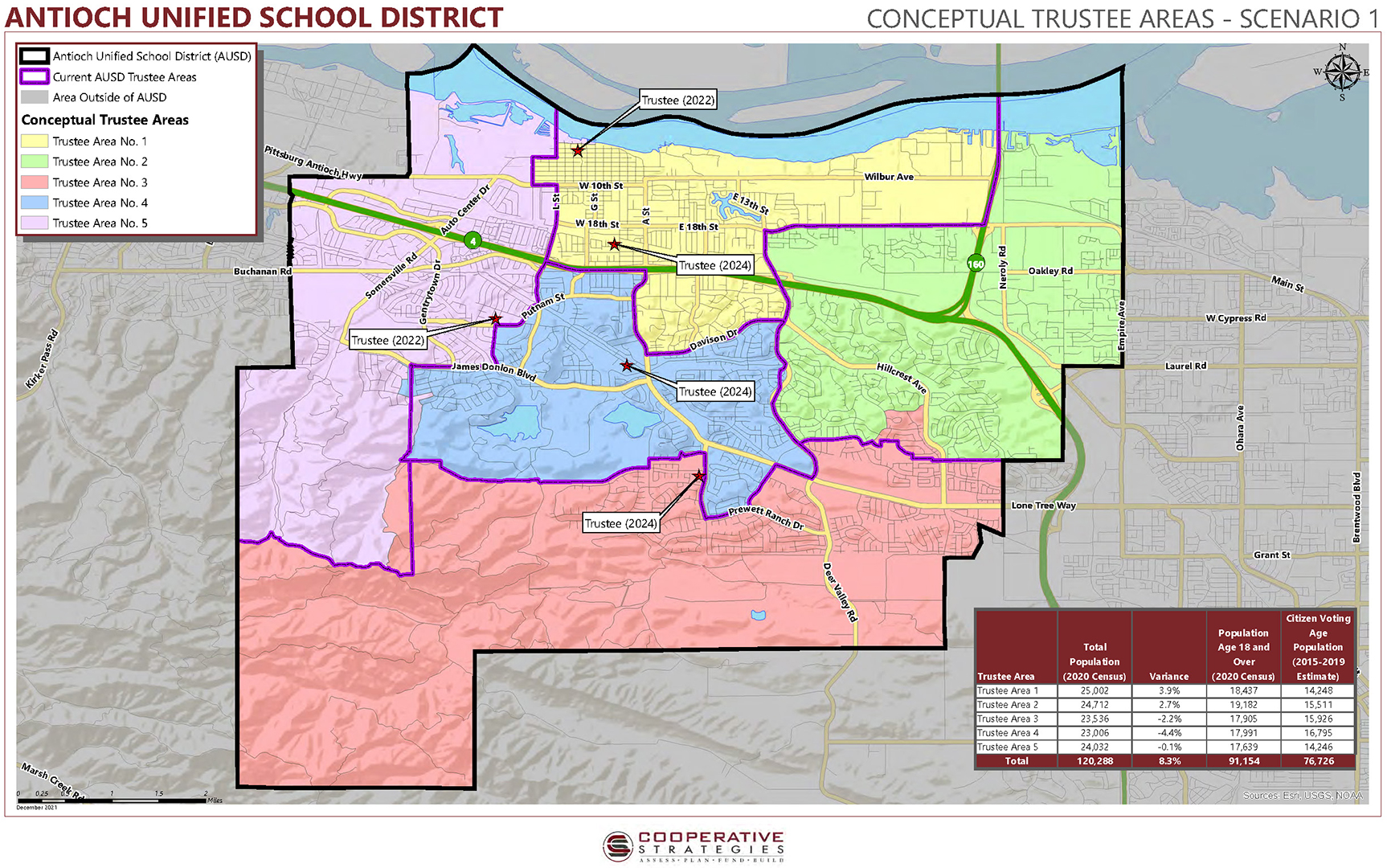
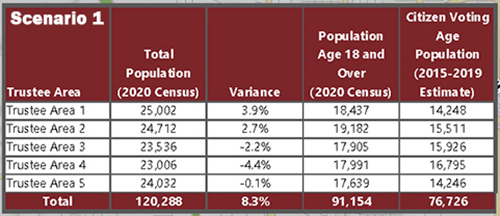
Proposed Antioch School Board Trustee Areas Redistricting Map Scenario 1 indicating the locations of the trustees’ residences. Source: AUSD

Trustee areas drawn to protect most incumbents; will be in place for the next 10 years; no online mapping tool for public to use to provide input; trustees will also reorganize with new president, VP

By Allen Payton

During their meeting on Nov. 10th, the Antioch School Board received a presentation on redistricting the five trustee areas following the 2020 Census. The trustees will be review and consider two gerrymandered draft maps during their Dec. 15th meeting, tonight, drawn by Cooperative Strategies, the same consultant hired to help draw the original district maps in 2019. The current trustee areas were created using data from the 2010 Census. (See related article)   AUSD_ProposedMapPresentation 121521

Since then, the population in the school district has grown by 12.4% or 13,252 residents. All five trustee areas experienced population growth with the greatest growth in Area 2 of 20.5%. That’s followed by Area 5 growth at 13.5%, Area 1 at 11.1%, Area 4 at 10.2% and Area 3 at 6.3%.

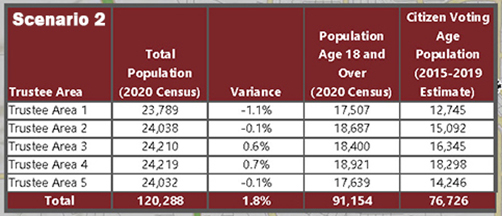
The ideal trustee area population is 24,058. The proposed maps show the percentage deviation for each area from that average size. The goal in order to fulfill the constitutional intent of one-person-one-vote is to have no deviation between districts. Congressional districts can only vary by one person.

The current map of trustee areas was only in effect for last year’s school board election. The new map and trustee areas will be in effect for the next ten years and must be finalized by March 1, 2022.

Politically-based drawing of representative district or area maps is referred to as gerrymandering which is designed to protect incumbents or a political party’s control of a legislative body.

According to the staff report, “By law, following every Decennial Census, school districts that elect their governing boards ‘by-trustee area’ must review updated population data from the Census to insure that the trustee areas remain balanced by total population. District consultants will provide an overview of the process and requirements for insuring compliance with the population balance requirements of Education Code section 5019.5.”

That section reads, “(a)(1) The population of each area is, as nearly as may be, the same proportion of the total population of the district as the ratio that the number of governing board members elected from the area bears to the total number of members of the governing board.

(2) The population of each area is, as nearly as may be, the same proportion of the total population of the district as each of the other areas.

(b) The boundaries of the trustee areas shall be adjusted by the governing board of each school district or community college district, in accordance with subdivision (a), before the first day of March of the year following the year in which the results of each decennial census are released. If the governing board fails to adjust the boundaries before the first day of March of the year following the year in which the results of each decennial census are released, the county committee on school district organization shall do so before the 30th day of April of the same year.”

However, maximum population variance allowed between trustee areas can be as much as 10% and still be in compliance with the legal requirements. Due to the population growth Antioch School Board trustee areas have a total variance of 17.7% which is out of compliance.

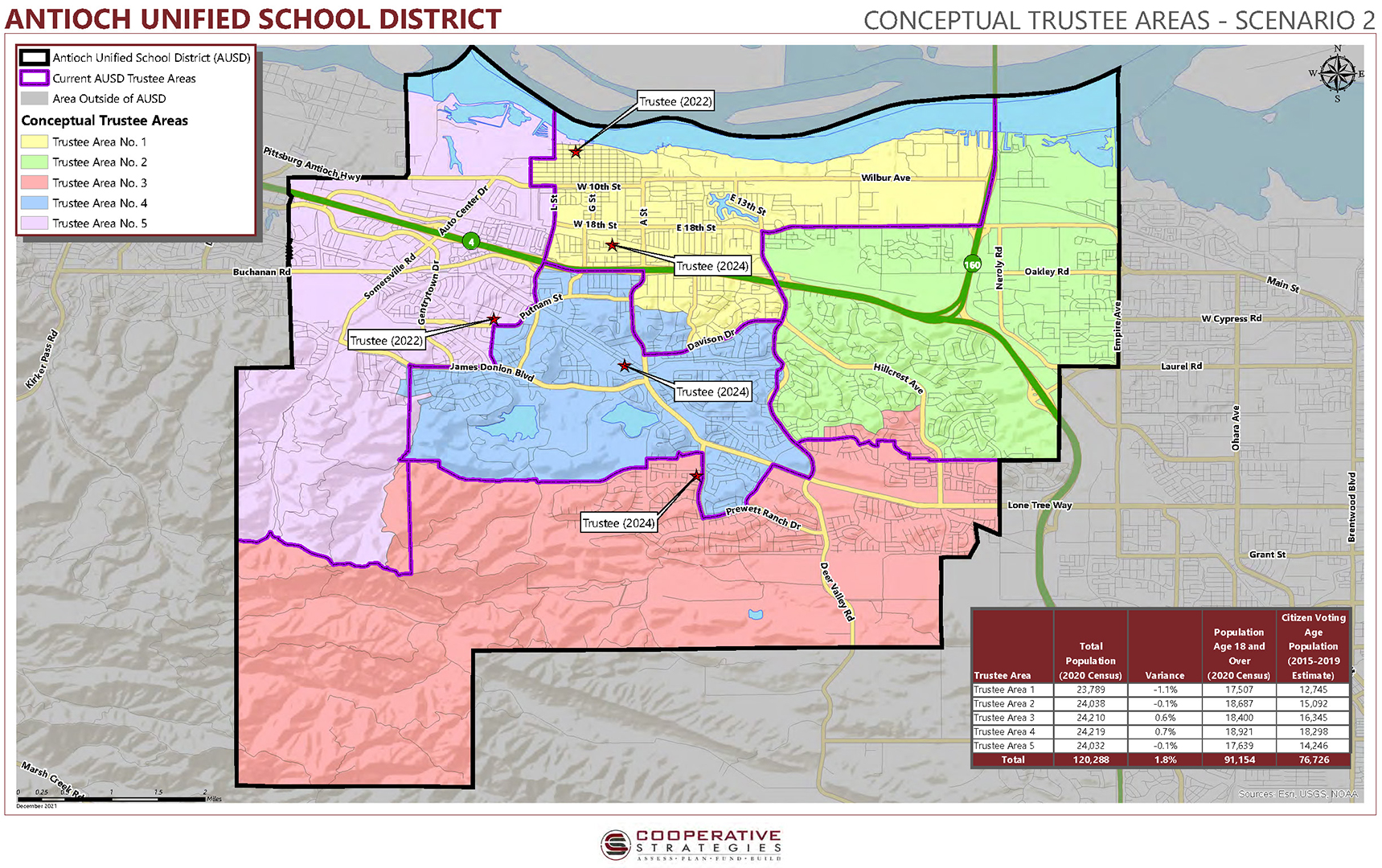
Proposed Antioch School Board Trustee Areas Redistricting Map Scenario 2 indicating the locations of the trustees’ residences. Source: AUSD

Superintendent Claims Changes Are Minor, No Online Mapping Tool, Offers Analysis of Proposed Maps

Asked if there would be an online mapping tool for the public to use to submit proposals, Superintendent Stephanie Anello responded, “Our changes are so minor compared to what it looks like (at first blush) compared to what the city council is proposing. So, we have not planned for an online mapping tool.”

Anello also shared, “I’ve been looking over the maps since we received them and here are my thoughts: We have not received any complaints or concerns regarding the current boundaries since we moved to Trustee Areas in 2019 so Cooperative Strategies looked at making the least impactful changes as possible while maintaining the community of interest (Black/African American voters in Area 3) that was established during the initial map selection process. The only two areas with significant fluctuation are Area 2 (which is creating a variance of 9.1%) and Area 3 (which is creating a variance of -8.5%). The population difference between these two areas is 4,246 residents.

Map 1 shifts approximately 1,500 residents from Area 2 to Area 3 for a variance of 8.3%, which is within the statutory limits. Map 2 decreases the variance to 1.8% by shifting approximately 2,200 residents from Area 2 to Area 3, as well as 650 residents from Area 1 to Area 4.”

Gerrymandered Draft Map Scenarios

Although neither federal election law nor state education code include where incumbents live as a criteria or requirement for drawing trustee area boundaries, both of the maps, labeled Scenario 1 and Scenario 2, appear to be drawn to protect at least four of the trustees. Current Board President Ellie Householder and Trustee Mary Rocha were both living in the current Area 5. But Householder moved to Antioch’s downtown and now lives in Area 1 which is currently represented by Antonio Hernandez, who was elected last year, along with Area 3 Trustee Clyde Lewis and Area 4 Trustee Gary Hack.

There is no incumbent presently living in the current Area 2 nor in that area on either proposed map. Elections for both Areas 2 and 5 will be held next November. But both proposed maps are mislabeled indicating Householder’s residence and referring to her as facing election in 2022 instead of providing that indication in Area 2 on the scenarios. Householder, who is currently serving in a district-wide seat with the term ending next year, just like Rocha, and is facing recall from that position. Householder will be ineligible to run for re-election if one of the proposed map scenarios is approved and she remains living in Area 1. Even if she is recalled, Householder could move into either Areas 2 or 5 and run for re-election, there. If so, then Householder won’t be up for election next year, but the Area 2 seat will be.

In addition, both proposed maps barely keep Lewis inside Area 4 and Rocha inside Area 5, with both trustees’ residences on the edge of the boundary with Area 4.

Additional Board Meetings on Redistricting

The board is scheduled to have at least two more meetings on redistricting before the March 1 deadline. The proposed schedule from Cooperative Strategies is as follows: January 26 – Board Meeting: Review Revised and/or Additional Scenarios; Adopt Final Trustee Areas (Tentative) and February 9 or 23, 2022 – Board Meeting: (Only If Needed) Adopt Final Trustee Areas.

Board Leadership Reorganization

Also, during their meeting, the trustees will choose a new board president and vice president for the following year. Embattled president, Householder is expected to pass the proverbial gavel to current Board Vice President Clyde Lewis, and Hernandez is expected to be voted in to replace Lewis.

Meeting and Public Comment Information

The meeting will begin at 7:00 p.m. following a brief Closed Session at 6:40 p.m. and held at the Deer Valley High School theater at 4700 Lone Tree Way in Antioch. It can also be viewed live stream on the district’s YouTube page. Public comments can only be made in person at the meeting by completing and submitting a speaker card. To see the entire agenda, click here.

Contra Costa’s local indoor-masking order remains in effect with limited exceptions for gyms and offices

Wednesday, December 15th, 2021

By Contra Costa Health Services

new statewide masking order now requires everyone to wear masks in indoor public spaces regardless of their vaccination through Jan. 15, 2022. Since Contra Costa already has a local masking order in place, the new statewide masking mandate doesn’t affect us – and we will retain limited exceptions for certain indoor settings not open to the general public such as offices and gyms where everyone is vaccinated.

People in Contra Costa, regardless of vaccination status, will have to keep wearing face coverings in public settings as they have been doing since August.

While cases in Contra Costa have gone up since Thanksgiving, the county has one of the highest vaccination rates in California and hospitalizations are far below levels seen during the past summer and lower than in many other counties.

“The limited exceptions we made are for very low-risk scenarios where everyone is vaccinated,” said Health Officer Dr. Chris Farnitano. “Our community already understands and is following these rules and it would be confusing to change them for just one month.”

Contra Costa’s indoor-masking order will stay in place unless the county meets criteria for lifting the local mandate. The order is as follows:

The counties of Alameda, Contra Costa, Marin, Napa, San Francisco, San Mateo, Santa Clara, Sonoma and the City of Berkeley will lift the indoor masking requirement in public spaces not subject to state and federal masking rules when all the following occur:

  1. The jurisdiction reaches the moderate (yellow) COVID-19 transmission tier, as defined by the Centers for Disease Control & Prevention (CDC), and remains there for at least three weeks;
    AND
  2. COVID-19 hospitalizations in the jurisdiction are low and stable, in the judgment of the health officer
    AND
  3. 80% of the jurisdiction’s total population is fully vaccinated with two doses of Pfizer or Moderna or one dose of Johnson & Johnson (booster doses not considered) OR Eight weeks have passed since a COVID-19 vaccine has been authorized for emergency use by federal and state authorities for 5- to 11-year-olds

To see our progress for meeting those criteria, visit our Indoor Mask Mandate Dashboard.

Antioch Council approves police department Positional Asphyxia Policy on 4-0-1 vote

Wednesday, December 15th, 2021

After revising language to satisfy both the interim police chief, police officers association; Torres-Walker votes to abstain, calls it “a public hatchet job

“It puts the onus on the officer if the policy says, ‘you should not do it.’” – Interim Police Chief Morefield.

By Allen Payton

As the final act of this year’s police reform efforts, the Antioch City Council, during their Tuesday night meeting, approved a new Positional Asphyxia Policy for inclusion in the Antioch Police Department Policy Manual on a 4-0-1 vote. District 1 Councilwoman Tamisha Torres-Walker voted to abstain.  APD Positional Asphyxia Policy ACC121421

The development of the policy was recommended by the council acting as the Police Oversight Standing Committee in September. (See related article)

A debate surrounded the words “shall” and “will”, which were the stated desire of members of the public who spoke on the matter, including family members of Angelo Quinto, versus “should” which was the recommendation of the Antioch Police Officers Association (APOA) regarding language in the policy of what officers must do. Interim Police Chief Tony Morefield supported and advocated the recommended APOA revisions during his presentation to the council.

Quinto’s father and sister spoke about the new law, Assembly Bill 490, The Justice for Angelo Quinto Act of 2021, that will go into effect on January 1, and ban positional asphyxia by police, statewide. The law reads, “(1) A law enforcement agency shall not authorize the use of a carotid restraint or choke hold by any peace officer employed by that agency” and (2) A law enforcement agency shall not authorize techniques or transport methods that involve a substantial risk of positional asphyxia. (See related articles here and here)

Council Discussion and Approval

The council then discussed the recommended revisions by the APOA. The council members all agreed to add the words “and suffocation” to “asphyxia” in the language of the policy.

District 2 Councilman Mike Barbanica, a retired police lieutenant, said he supported using the word “should”.

Morefield said, “it puts the onus on the officer if the policy says, ‘you should not do it.’”

“The ‘shalls’ are there at the important spots,” he continued. “But in those incidents of a physical struggle…we have some officers who are 120 pounds. Having two of them on a 300-pound man on meth…this prevents the dog pile situations. I honestly think the simplest way to do it is to adopt a ‘should’ instead of a ‘shall’.”

City Attorney Thomas Lloyd Smith offered, “shall make every reasonable effort to avoid placing weight on the persons neck…that’s a middle response.”

Barbanica and District 3 Councilwoman Ogorchock said they were comfortable with the word “should”.

When asked Torres-Walker simply said, “no”.

Mayor Pro Tem Monica Wilson asked for Smith to repeat his proposed language, which he did.

Barbanica then asked to hear from the chief for his view on Smith’s proposed language.

“It’s an interesting way to create a policy for a police department,” Morefield said. “I would certainly say two officers is sufficient for restraining a person’s head. There are times when a suspect is banging his head against a wall or a police vehicle.”

Smith then offered the additional language of “unless necessary to protect an individual from injuring themselves or others”. That was acceptable to Morefield.

“In the same spirit of ‘should’ the officer would have to explain why they did it,” Mayor Lamar Thorpe stated.

Barbanica then made the motion to adopt the policy with the city attorney’s recommendations and it passed on a 4-0-1 vote with Torres-Walker voting to abstain without explanation. At the end of the meeting, she explained her vote.

“The last vote I abstained from because the community spoke…What I witnessed was a public hatch job that didn’t take into consideration what the public said,” Torres-Walker said. “I thought the policy should have gone back to the committee. I want to thank the Antioch Police Department for their work on the policy and for Interim Chief Morefield for supporting progressive policies.”

2019 Study Showed Knee-on-Back Techniques Not Dangerous

The Antioch council adopted the policy in spite of a 2019 study concluding “none of four knee-on-back techniques commonly taught and used in law enforcement transfers any amount of weight even close to being dangerous, regardless of how heavy the officer applying the force is,” according to Force Science News.

The six-person research team was headed by Dr. Mark Kroll, an internationally renowned biomedical scientist with the University of Minnesota and California Polytechnic State University who testifies frequently as an expert witness in police litigation. He said, “Our data do not support a risk of restraint asphyxia occurring from standard knee-on-back techniques.”

“Our findings are important,” Kroll told Force Science News, “because North American officers control and restrain agitated and resistant subjects in the prone position over half a million times each year. Subjects end up being proned out in about 60 percent of physical force encounters—without a death or serious injury resulting. Prone restraint is needed for officer safety, and the stake needs to be driven into the heart of the stubborn myth that this procedure is inherently excessive and dangerous.”

Kroll’s report on the knee research appears in the American Journal of Forensic Medicine & Pathology, under the title “Applied Force During Prone Restraint: Is Officer Weight a Factor?

According to Science1 website by Lexipol, “The Force Science Institute (FSI), (publisher of Force Science News), is comprised of a team of physicians, lawyers, psychologists, scientists, police trainers and law enforcement subject matter experts dedicated to the advancement of knowledge and training in criminal justice matters.

FSI conducts sophisticated scientific research studies into human behavior documenting the physical and mental dynamics associated with the societal demands of the peace-keeping function, including high-pressure situations and use-of-force incidents. Its findings apply to citizen-involved uses of force, as well as impacting investigations of officer-involved force applications. FSI research when applied to training enhances officer performance and public safety.”

Positional Asphyxia Susceptibility Factors

According to an article entitled “How To Prevent Positional Asphyxia” on PoliceMag.com, “The following is a closer look at some factors and circumstances that can make an individual more susceptible to death from positional asphyxia.

Violent Struggle—People who have engaged in a difficult and aggressive struggle may be more susceptible to respiratory muscle fatigue and failure.

Excited Delirium—Subjects who are under the influence of cocaine or methamphetamine while in restraints may experience a condition known as excited delirium. This disorder results in disorientation, hallucinations, and impaired thinking. Excited delirium may raise the individual’s susceptibility to a sudden increase in heart rate, which can rise to a critical level and result in cardiac arrest. (NOTE: The Contra Costa County Coroner’s Office ruled Angelo Quinto succumbed to excited delirium and prescription drugs during the physical altercation with officers).

Alcohol Intoxication and Drugs—Alcohol is a significant risk factor in positional asphyxia because it lowers the respiratory drive. Individuals who have been drinking heavily are among the most likely to die in custody from medical events.

Body Position—Death due to a head-down position with hyper flexion of the neck is a rare event. It is however a critical condition arising out of particular body positions that can lead to mechanical obstruction of respiration. Studies have suggested that restraining a person in a face-down position is likely to cause greater restriction of breathing than restraining a person face-up.”

Antioch Council moves forward $2 million one-year non-police healthcare response program pilot

Tuesday, December 14th, 2021

Antioch Care Team one-year pilot will operate 24 hours, 7 days a week at an estimated cost of $1.8 to $2.2 million

By Allen Payton

During the Antioch City Council voted unanimously to formally accept the Final Report from Urban Strategies Council for the Antioch Care Team Program Pilot and direct City staff to proceed with the process to hire an organization to operate it. The one-year pilot program at an estimated cost of $1.8 to $2.2 million, is projected to begin in June 2022 with full implementation beginning in October 2022.

According to the City staff report, “following a panel interview process that included the Interim Police Chief, City Attorney, Youth Services Network Manager and Medical Director from the Contra Costa Fire Protection District, the City selected and engaged Urban Strategies Council in late July of 2021. Urban Strategies Council is a research and advocacy organization dedicated to social, economic, and racial equity. They aim to hold institutions and systems accountable to community needs. Prior experience in developing local adaptations of community crisis response models and the organization’s mission were determined to align with the City’s intent to design a program that recognizes and incorporates the complexity of Antioch’s diverse needs.”

During the August 10th Antioch City Council meeting the not-for-profit social justice organization was introduced and hired to design a mobile, mental health crisis intervention model for the City of Antioch, to address non-emergency calls using well-trained community respondents.  (See related article)

According to the 219-page report by Urban Strategies Council, “The desired impacts of ACT are to: reduce non warrant arrests that result during a 911 response; reduce the number of individuals transported to the emergency department for non-life threatening medical-related issues that could instead be addressed in a pre-hospital care setting; and reduce the number of behavioral health and lower acuity medical calls traditionally responded to by Police and Fire.”

David Harris, President and CEO of Urban Strategies Council said it will be 24-hour, citywide healthcare, non-police response model for low-level 9-11 calls which will reduce arrests and save money for the police department.

He read from his organization’s report saying, “Cities across the country, including the City of Antioch (CA), are working to advance innovation and best practices in local law enforcement and public safety services. Specifically, in non-violent, non-health (life-threatening) response situations where a gun and badge isn’t needed or helpful, both the individuals involved, and the police are better served by alternative non-police responses.”

According to the report, “From 2018 to 2020, the Antioch Police Department (APD) received approximately 90,000 911 calls for service per year. In 2020, 4,142 of the total calls were either for homelessness-related or mental health/drug-related issues. Of these calls, approximately 1,373 were categorized as potentially low-level calls.”

Types of Calls ACT Will Respond To

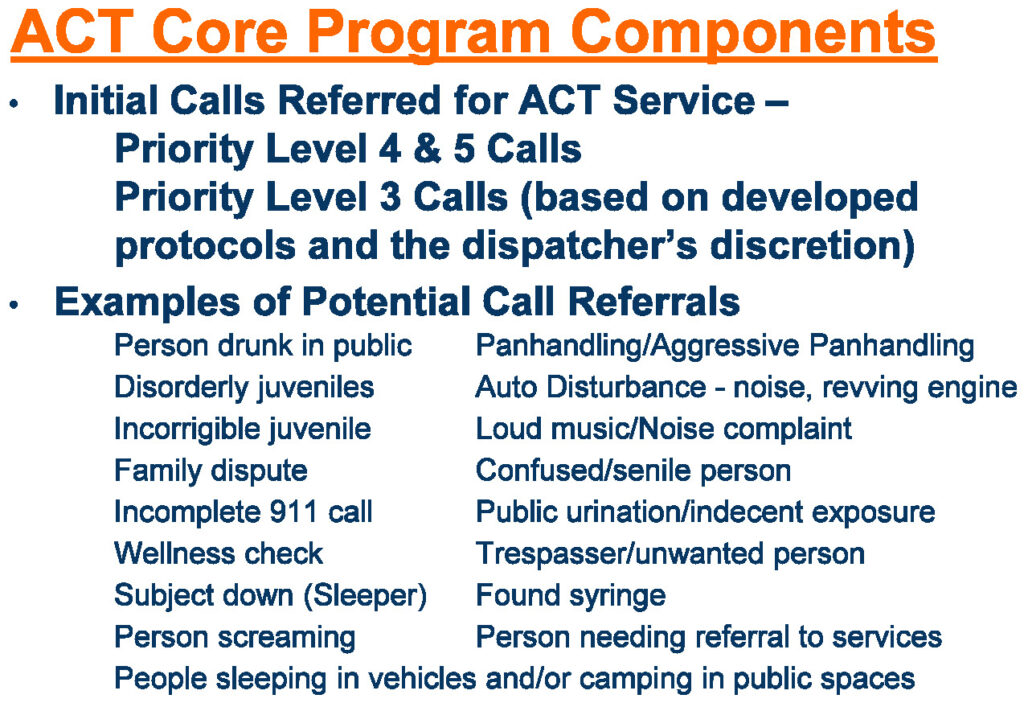
Also, according to the report, “For the pilot program, APD Dispatch will refer calls from priority levels 4 & 5 to the ACT unit, with some priority level 3 calls (based on developed protocols and the dispatcher’s discretion). Initially, ACT will respond to dispatch-referred calls initiated through the 911 system. A sample of the call situations that ACT may respond to includes: Person drunk in public Panhandling/Aggressive Panhandling Disorderly juveniles – group Auto Disturbance – noise, revving engine Loud music – Noise complaint Incorrigible juvenile Confused/senile person Family dispute Incomplete 911 call Public urination/indecent exposure (without criminal intent) Wellness check Subject down (typically a resident asleep in public) Trespasser/unwanted person Found syringe Person screaming Person needing referral to services w/o access to phone People sleeping in vehicles and/or camping in public spaces.”

The primary design components of the program include: Program scope, Core personnel, Support personnel, Staff development, Pilot facilities, Community outreach / engagement, Prevention planning, APD integration, Evaluation planning, Program budget, Pilot startup phases / timetable, and APD call referrals.

The Antioch Care Team will consist of a program director, community response specialist, an EMT, case manager/network developer and a clinical coordinator. It will take about 14.5 full-time equivalent employees to staff the 24-hour operation.

“We recommend a one-year pilot after the vendor is selected,” Harris said. “It’s scheduled to coincide with the end of your Fiscal Year 2023.”

Five members of the public spoke in favor of the program, including Angelo Quinto’s aunt, sister and father.

In response to a question from District 1 Councilwoman Tamisha Torres-Walker about costs, Interim Antioch Police Chief Tony Morefield said, “I’ll say that we’ve been supportive of this process from the start. The only costs I see would be police radios.”

“The one thing that was brought up was coordinating with the county. I want to make sure we are in partnership with the county going forward,” said District 3 Councilwoman Lori Ogorchock. She also asked about costs.

“Being that this would be a non-profit organization we did not include pension costs for employees,” Harris responded.

With no further discussion the council adopted the resolution on a 5-0 vote.

To see the complete report, visit Antioch-Care-Team.pdf (antiochca.gov)

Resume of interim Antioch city manager candidate released, refuses to explain discrepancy in titles

Tuesday, December 14th, 2021

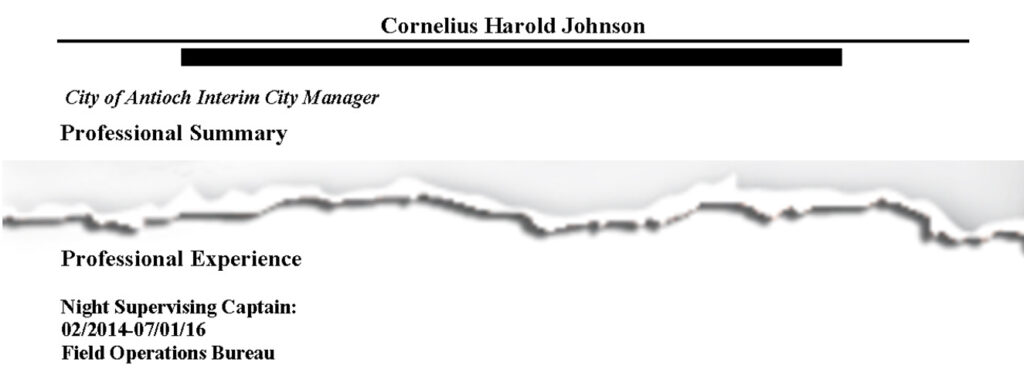
Excerpt from Cornelius Johnson’s Resume showing final position with the San Francisco Police Department of Night Supervising Captain. Source: City of Antioch

Con Johnson retired as a Lieutenant III but his resume shows last title of “Night Supervising Captain” without qualifying as an “acting” position; refuses to answer questions about it

Cornelious “Con” Johnson. Source: Mayor Lamar Thorpe’s Facebook page.

By Allen Payton

On Nov. 9, the Antioch City Council, on a 3-2 vote, approved the conditional hiring of Cornelius “Con” Johnson as the interim city manager, following City Manager Ron Bernal’s retirement at the end of December. The one condition is that Johnson successfully pass a background check. In response to a Public Records Act request by the Herald, Antioch City Attorney Thomas L. Smith released a copy of Johnson’s resume and cover letter to the city council. It shows Johnson lists his last position with the San Francisco Police Department as Night Supervising Captain from Feb. 2014 until the day he retired on July 1, 2016, without qualifying it as an “acting” position.

While he was paid a higher salary for that title, Johnson was never promoted to the position of captain and is being paid as a retired Lieutenant III according to David Ng, Senior Clerk of Personnel for the SFPD who said, “regarding Cornelius Johnson’s retirement, the highest ranking was lieutenant. The system shows lieutenant. The job code is Q62 which is lieutenant,” as previously reported. (See related articles here, here, here, and here)

Cornelius Johnson – Cover Letter Redacted       Cornelius Johnson – Resume Redacted

Leadership Experience

According to his resume, as Night Supervising Captain, Johnson wasresponsible for the managing and overseeing of the San Francisco Police Department resources, activities, operation between the hours of 1900 hrs to 0500 hrs. The Night captain is responsible for the planning, administering, directing, evaluating, and overseeing of activities of approximately 600 staff members (civilian personnel, patrol officers, sergeants and mid-level manager)”.

Prior to that, Johnson held leadership positions with the SFPD of Platoon Commander from Feb. 2010 to Feb. 2014; and Director of Community Policing from Jan. 2004 to F2010.

Not Hired as Bridging the Gap Forums Facilitator

Last year, Johnson applied to be the city council’s facilitator for the Bridging the Gap forums held late last year and early, this year. But the panel, which included Mayor Lamar Thorpe, City Manager Ron Bernal, Administrative Services Director Nickie Mastay and then-Chief Tammany Brooks, chose to hire a consulting firm, instead.

Johnson Refuses to Answer Questions

Previous efforts to reach Johnson were unsuccessful. In addition, he did not respond to a phone call or text to him on Tuesday, even though when this reporter who knows Johnson, saw and spoke with him recently, he agreed to respond.

Johnson was asked why his resume shows a title of captain, which is different than the title he retired at of Lieutenant III. Johnson was also asked if he was ever promoted to the position of captain or just acting captain for his final three years on the force. He was also asked if it is normal practice to use a title if the retiree was only serving in an acting role. Finally, Johnson was asked “why inflate your credentials when you don’t need to for the position of interim city manager when you have all the experience with the SFPD and your master’s in public administration?”

Johnson still had not responded prior to publication time at 6:40 p.m.

Please check back later for any updates to this report.