Author Archive

Three cases of COVID-19 Omicron variant detected in Contra Costa County, none hospitalized

Monday, December 20th, 2021

Two fully vaccinated; symptoms described as mild and “extremely mild”

By Allen Payton

Contra Costa Health Services announced, Monday, that genomic sequencing of positive COVID-19 test results from the county has identified three cases with the Omicron variant of the virus. The results confirm the presence of the highly contagious variant in the county. However, according to reports from throughout the U.S. and internationally, symptoms have been described as mild, and “extremely mild” by Dr. Angelique Coetzee, the South African doctor who first discovered and announced the new strain.

None of the three people in Contra Costa infected with Omicron had gotten a booster shot, although two were fully vaccinated. So far, no one has been hospitalized.

According to the CDC, the first confirmed U.S. case of Omicron was identified on December 1, 2021. In addition, “CDC expects that anyone with Omicron infection can spread the virus to others, even if they are vaccinated or don’t have symptoms.”

“We knew it was just a matter of time before the omicron variant appeared in Contra Costa County,” said Dr. Chris Farnitano, Contra Costa County health officer. “We’ve been encouraging anyone who is eligible to get a booster dose of the Pfizer or Moderna vaccine to do so. With today’s news and the holidays just around the corner, that message is even more important. People who get the booster are far less likely to get gravely ill or be hospitalized. That’s our wish for this holiday season.”

Omicron likely circulated in the community for several weeks. It had previously been detected in several other Bay Area counties, and genetic evidence of the variant was detected in a wastewater sample from central Contra Costa on Dec. 8.

Just Over One-Third of County Residents Have Had Booster Shots

As of today, just over one-third of eligible Contra Costa residents had received a booster dose of the COVID-19 vaccine.

While public health experts are not recommending that those who are vaccinated and or who have received the booster dose cancel holiday plans, they are urging caution. Ways to reduce risk of becoming exposed or spreading COVID-19 include:

  • Staying home and isolating themselves if they develop COVID-19 symptoms, which can often resemble cold or flu symptoms
  • Getting a COVID-19 test promptly if symptoms develop
  • Getting a COVID-19 test before traveling or gathering with people who do not live with you, and again three to five days after traveling or gathering
  • Wear masks or face coverings in indoor public spaces, and when gathering indoors with people who do not live with you

Home COVID-19 tests are fast, convenient, and available at many drugstores. No-cost testing is also available through CCHS by calling 1-833-829-2626 or making an online appointment.

The 7-day average number of daily new COVID-19 cases reported in the county has increased about 5% over the past two weeks, and the number of people hospitalized in Contra Costa because of the virus has remained stable so far, this month.

The delta variant of COVID-19 remains the predominant strain in Contra Costa, accounting for more than 97% of genetically sequenced COVID-19 samples collected in the county.

Visit cchealth.org/coronavirus for updates and more information about Contra Costa’s emergency response to the pandemic.


Antioch Police seek suspect in early Sunday morning fatal hit and run

Monday, December 20th, 2021

By Sergeant Rob Green #3639, Antioch Police Field Services Division

On December 20,2021, at 12:13 AM, a citizen reported finding a male down in the middle of the street in the 1200 block of Sunset Drive. Officers arrived on scene and found an unresponsive 40-year-old male adult with major injuries. Officers performed life saving measures on the male, but the male was ultimately pronounced deceased. Based on preliminary investigations, it appears the male had been struck by a vehicle.

Antioch Police Department Traffic Unit responded to the scene and took over the investigation. This investigation is in the early stages and there is no further information to release at this time. There are no suspect or vehicle description, and no one is in custody.

Anyone with information is asked to call the Antioch Police Department non-emergency line at 925-778-2441. You may also text-a-tip to 274637 (CRIMES) using the key word ANTIOCH.

Final Regional Housing Needs Allocation Plan requires 441,176 more homes in Bay Area by 2031

Friday, December 17th, 2021

Source: ABAG

3,016 more in Antioch; 44,000 in Contra Costa

After two years of collaboration, plan to expand Bay Area’s housing opportunities approved during public hearing, Thursday night

“The next steps are for (the 110) Bay Area cities, towns and counties to update their housing elements by January 31, 2023…and plan for housing at all income levels.” – ABAG President and Berkeley Mayor Jesse Arreguín

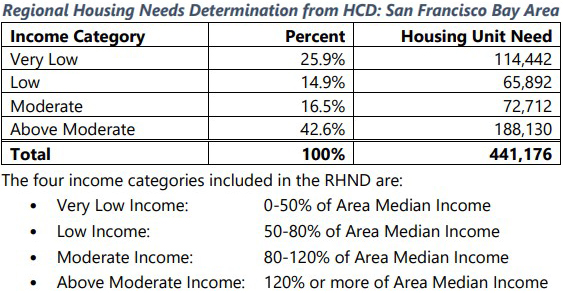
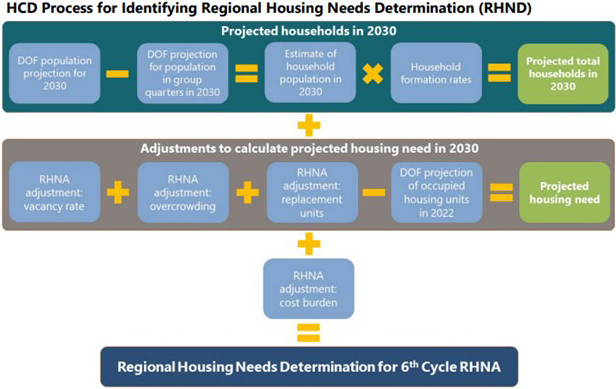
SAN FRANCISCO, December 17, 2021 . . . The Association of Bay Area Governments (ABAG) at last night’s Executive Board meeting approved the Final Regional Housing Needs Allocation (RHNA) Plan for the San Francisco Bay Area, 2023-2031.  The state Housing and Community Development Department requires the Bay Area to plan for and revise local zoning to accommodate 441,176 additional housing units during the 2023-31 period.  The approved final RHNA plan distributes this requirement among the region’s nine counties and 101 cities and towns, with allocations ranging from 72 units in the Napa County town of Yountville to more than 82,000 units in San Francisco.

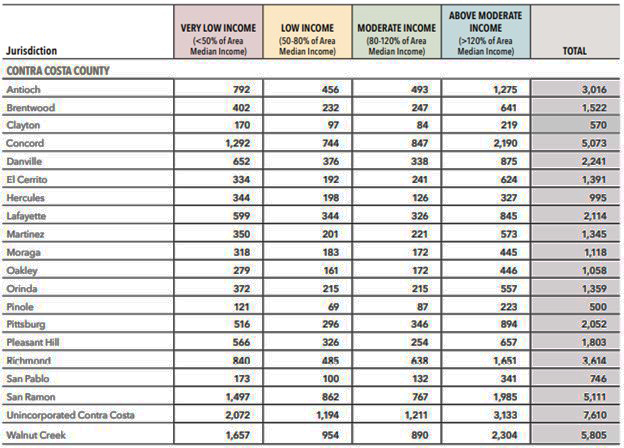
The plan requires communities in Contra Costa County to add 43,970 housing units, almost 10% of the total, during the time period, with Walnut Creek (5,805 units), San Ramon (5,111) and Concord (5,073) being allocated the highest number of housing units, followed by Richmond and Antioch being allocated 3,614 and 3,016 units, respectively. More than half of Antioch’s allocated units are in the Moderate (80-120% of Area Median Income) and Above Moderate (Greater than 120% of Area Median Income) which should be easily met with the more upscale, remaining homes to be approved and built in the Sand Creek area of the city.

Source: ABAG

“The Final RHNA Plan’s passage concludes a two-year regional collaborative process, reflecting hundreds of hours of work by staff, elected officials and stakeholders,” noted ABAG President and Berkeley Mayor Jesse Arreguín. “This is an important step in our region’s efforts to address our housing crisis. Every city and county must do their part to address our housing and homelessness crises. With this RHNA Plan, local governments will have to rezone and plan for significantly more housing than before. This plan also affirmatively furthers fair housing by distributing housing growth equitably throughout the region addressing decades of racial and economic segregation. This is also part of a much bigger effort being undertaken by ABAG and the Metropolitan Transportation Commission to provide resources and technical assistance to local agencies and generate new funding sources for affordable housing in the Bay Area.”

Source: ABAG

“The next steps,” Arreguín continued, “are for Bay Area cities, towns and counties to update their housing elements by January 31, 2023, to reflect the new RHNA allocations and plan for housing at all income levels. The Regional Housing Technical Assistance Program (RHTA) is ready to provide local jurisdictions with the financial support and technical assistance they need to complete these steps.”

Funded by the state’s Regional Early Action Planning grant, ABAG created RHTA to help local agencies update the housing elements of their general plans, ensuring that Bay Area cities, towns and counties take the steps to move from plans to implementation and remain competitive for various state funding programs to increase housing opportunities. RHTA includes some $11 million in direct assistance to local governments as well as other support.

Source: ABAG

The Bay Area Housing Finance Authority (BAHFA) is another part of ABAG’s and the Metropolitan Transportation Commission’s expanded regional housing portfolio. “As the first regional housing finance authority in California, BAHFA has the potential to raise hundreds of millions of dollars to help meet the Bay Area’s urgent housing affordability challenges,” explained Oakland Mayor Libby Schaaf, who chairs the BAHFA Oversight Committee. “The RHNA Plan establishes the housing at each income level that Bay Area’s communities need to plan for, but BAFHA provides an opportunity to fund the solution: providing more housing for everyone in the Bay Area. This makes it an important part of the Bay Area’s housing toolbox as we work together to protect existing affordable housing, to prevent displacement of current residents and to promote the construction of more new housing units.”

ABAG is the council of governments and the regional planning agency for the 101 cities and towns, and nine counties of the Bay Area. Additional information is available on the regional housing programs’ individual webpages:

RHNA: https://abag.ca.gov/our-work/housing/rhna-regional-housing-needs-allocation

RHTA: https://abag.ca.gov/our-work/housing/regional-housing-technical-assistance

BAFHA: https://abag.ca.gov/our-work/housing/bahfa-bay-area-housing-finance-authority

Allen Payton contributed to this report.

After two strikes, hundreds of Sutter Delta healthcare workers ratify agreement to increase staffing, improve patient care

Friday, December 17th, 2021

By Renée Saldaña, Media Relations, SEIU-United Healthcare Workers West

ANTIOCH, Calif. –  Following two strikes, more than 350 healthcare workers won their effort to improve patient care at Sutter Delta Medical Center by ratifying a contract agreement that will address safe staffing levels, a top issue for the frontline caregivers who earlier this year went on strike twice due to difficult working conditions. (See related article)

“This agreement was possible because we as a union stood together to improve patient care and advocated for safe staffing levels. We are relieved to know that dozens of positions have now been posted,” said Stefanye Sartain, a respiratory therapist at Sutter Delta Medical Center in Antioch. “We are proud to have negotiated a four-year agreement that recognizes the skill and dedication we bring to our work and gives us the peace of mind to focus on safely caring for our patients.”

Details of the agreement include:

  • Posting all 37 unposted staff positions, many of which have already been filled
  • Emphasizing the need to attract and retain quality caregivers by providing annual raises of 3 or 4 percent in each of the four years, with bonuses to recognize the dedication of long-term employees
  • A 4-million-dollar investment in Futuro Health, a non-profit dedicated to training thousands of healthcare workers to address the workforce shortage

SEIU-UHW members at Sutter Delta Medical Center include frontline workers such as emergency room technicians, respiratory therapists, phlebotomists, transporters, and licensed vocational nurses.

Sutter Health Responds

A Sutter Health spokesperson responded with, “We enter every labor negotiation with the same mindset: putting patients above politics. While we understand the union’s desire to position this agreement as a win, the truth is that it’s consistent with the agreements that every other SEIU-represented hospital in our integrated network of care approved months ago. Despite the disruptions of two strikes called by SEIU representatives who claim they prioritize patient safety, we reached an agreement that hits the critical benchmarks we set for ourselves: supporting and rewarding our employees for their important work and maintaining the strength and stability of our hospital for everyone who depends on us.”

Allen Payton contributed to this report.

Contra Costa DA announces restorative justice program U.S. DOJ found to be moderately effective or worse

Friday, December 17th, 2021

By Allen Payton

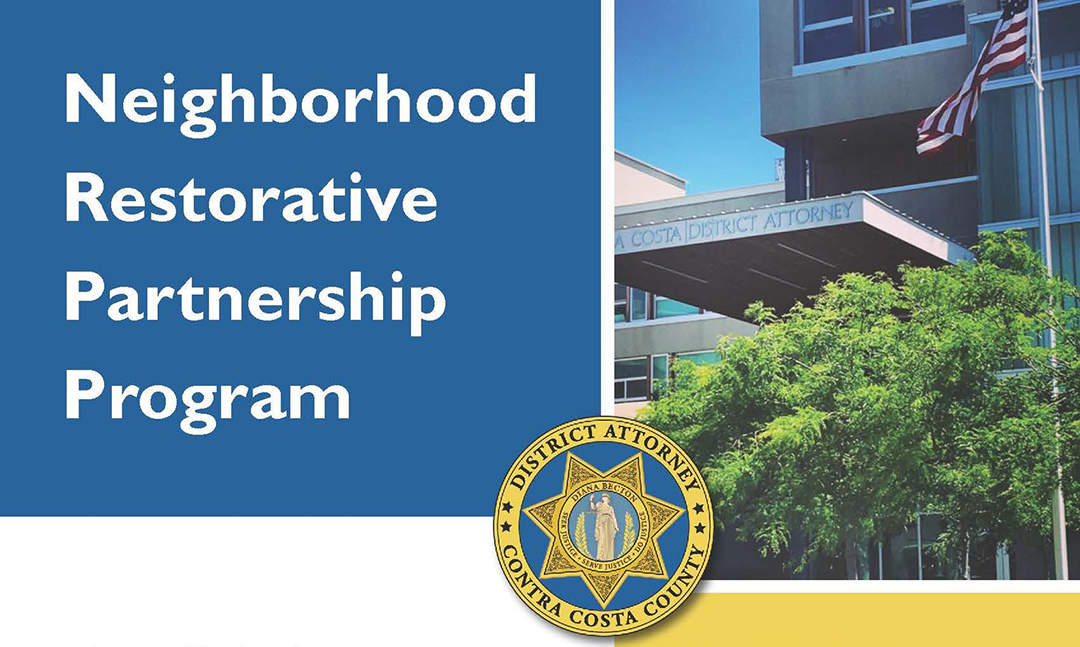
The Contra Costa District Attorney’s Office announced, last Friday, their new Neighborhood Restorative Partnership program. It is a neighborhood-focused restorative justice initiative addressing root causes of criminal behavior, reducing recidivism, enhancing community relationships, and promoting public safety and quality of life. The NRP is a program in which eligible individuals are given an opportunity to take responsibility and repair the harm they caused through a community-based process, instead of a courtroom.

This program is:

  • A community-based pre-filing program.
  • A program designed to give individuals an opportunity to take responsibility and repair harm they cause.
  • And will consist of community volunteers trained as panelists to find solutions that help address the harm caused by these offenders and by focusing on restoring all who have been impacted.

U.S. DOJ Study Found “Moderate” and Lower Program Results

A U.S. Department of Justice Office of Justice Programs study, published in 2017, that “systematically reviewed all available research that, at a minimum, compared participants in a restorative justice program to participants processed traditionally by the juvenile justice system”, found that such programs had a “moderate reduction in future delinquent behavior” and the “results were smaller for the more credible random assignment studies”.

“Abstract – The distinctive feature of restorative justice programs is the objective of addressing the causes of the offender’s delinquent behavior while remedying the harms caused to the victims. A fundamental component of restorative justice programs is some form of dialog or interaction between the offender and the victim or a victim surrogate, with some programs extending participation to family and community members. Examples of restorative justice programs include victim-offender mediation, family group conferencing, and sentencing circles. Also, some routine practices of the juvenile justice system such as restitution are consistent with restorative justice principles, and some programs incorporate some aspect of the framework, such as teen courts. This systematic meta-analysis of evaluation research on restorative justice programs identified 99 publications, both published and unpublished, reporting on the results of 84 evaluations nested within the 60 unique research projects or studies. From these studies, the meta-analysis extracted results related to delinquency, non-delinquency, and outcomes for the youth and victims participating in these programs. Overall, the evaluations of restorative justice programs and practices showed a moderate reduction in future delinquent behavior relative to more traditional juvenile court processing; however, these results were smaller for the more credible random assignment studies, which raises concerns about the robustness of this overall result. Additional high-quality research of such programs is warranted, given the promising but uncertain findings. 14 tables, 30 figures, and search notes”

Questions for DA Becton & Program Coordinator

Both District Attorney Diana Becton and program coordinator and Janet Era, Assistant Investigator/Facility K9 Handler with the DA’s office, were asked the following questions about the program on Monday:

Do you have more details about the Neighborhood Restorative Partnership that you can share?

How will the community-based process work? Is it just for juveniles or adults, too?

How many panelists per neighborhood panel? When and where will the panels meet?

How can you assure an individual that is the focus of the effort will actually attend their meeting with the neighborhood panel?

What percentage of individuals assigned to such programs actually show up for their neighborhood panel meeting? If they do, what are the kinds of assignments that can be ordered by the panel for the individual to “to take responsibility and repair the harm they caused”? Who provides the enforcement to ensure the assignment is completed?

Are the assignments based on a negotiated agreement with the individual and victims?

What if there are costs involved to repair the harm they caused will the individual be required to pay those costs? What if they can’t afford to do that, will the costs be paid for by the program?

Once the assignment is completed, what happens next? Is their record expunged?

How much will the program cost?

Finally, are you aware of the US DOJ study published in 2017 showing such programs for juveniles have a moderate impact or less?

Program Coordinator Responds

In an email response received, today, Era wrote, “The Neighborhood Restorative Justice Partnership (NRP) is an adult diversion program. NRP provides an opportunity for the participant to resolve their case in the community as opposed to a courtroom, by utilizing restorative justice practices. Offenders are given an opportunity to take responsibility and repair the harm they caused through a community-based resolution process.

NRP provides an opportunity for the victim to be heard and for the community to participate in the resolution process. We anticipate three panelists per panel. Eligible cases are diverted by the District Attorney’s Office into the NRP program. While participation is voluntary, participants must be willing to take accountability for their actions that caused the harm. Each case is unique; therefore, panelists will prepare individualized obligation plans for each participant.

Upon successful completion of the program, criminal charges will not be filed. NRP will track recidivism of the participants who complete the program for a period of 24 months. We have shadowed other agencies in other counties, including Yolo County, Los Angeles City Attorney, and San Francisco County. These counties have published a high rate of success at reducing recidivism. If the individual does not complete the program, criminal charges will be filed by the District Attorney’s office.

The procedures, guidelines, and logistics for the Neighborhood Restorative Justice Partnership are still under development. Participation is voluntary and confidential. There are no program fees, however there may be costs associated with repairing the harm caused by the individual.”

Program Contact Information

If interested in becoming a panelist with the Contra Costa County District Attorney’s Office, please complete an application and send to:

Contra Costa County

District Attorney’s Office

Attn: Janet Era

Assistant Investigator/Facility K9 Handler

Contra Costa County Office of the District Attorney

Neighborhood Restorative Partnership

900 Ward Street, 2nd Floor

Martinez, CA 94553

DA-NRP@contracostada.org

Click on this link for a copy of Application

Click on this link to view NRP Flyer

Local youth competition for the Knights of Columbus Free Throw and 3-Point Championship in Antioch Jan. 14

Friday, December 17th, 2021

Three of the 2021 state Knights of Columbus Free Throw champions from East County with their local awards, (L-R) Brigida Coria, Kylie Wisely and Ryan Wisely. Photo by Wayne Steffen.

Local Knights of Columbus Council to Sponsor Youth Basketball Shooting Competitions

All boys and girls ages 8 to 14 are invited to participate in the local level of competition for the Knights of Columbus Free Throw Championship.  Boys and girls 15-17 are invited to participate in the local level of competition for the Three Point Shooting Championship.  Age eligibility is determined by the age of the contestant as of January 1, 2022.

The competitions will be held on January 14, 2022, at Giovannoni Parish Center, 21 East 15th St., Antioch, CA.

Free Throw

Ages 8-11        registration at 5:30pm competition begins at 6:00pm

Ages 12-14      registration at 6:30pm competition begins when 8-11 yr. old competitors are done

Three Point

Ages 15-17      registration at 7:00pm competition begins when free throw competition is done

The Knights of Columbus Free Throw Championship is sponsored annually, with winners progressing through local, district, and jurisdictional competitions.  International champions are announced by the Knights of Columbus international headquarters based on scores from the jurisdiction-level competitions.   In 2021, four of our local champions were California State champions.

For more information contact Wayne Steffen 925.890.0119 or Mike Hayes 925.565.4482.

Council #3265 in Antioch, CA is one of 17,000 Knights of Columbus councils that make up the world’s largest Catholic fraternal service organization. Founded in 1882 to assist working-class and immigrant Catholics

in the United States, today the approximately two million members of the Knights put their faith into action through a broad range of charitable causes locally, nationally and internationally with financial contributions and hands-on service.

Lewis declines Antioch School Board presidency, Hack elected instead

Thursday, December 16th, 2021

AUSD Board Trustee Clyde Lewis, new Board President Gary Hack and new Board Vice President Antonio Hernandez.

Hernandez appointed vice president; board declines public online mapping tool for redistricting process, will make “tweeks” to current trustee area map

By Allen Payton

In a surprise move, Wednesday night, during the Antioch School Board meeting, Dr. Clyde Lewis, District 3 Trustee and board vice president chose to not accept the promotion to the one-year, rotated position of president. Instead, District 4 Trustee Gary Hack was nominated by Lewis and voted in as board president. District 1 Trustee Antonio Hernandez was voted in as board vice president. The board reviewed two proposed maps for the redistricting of trustee areas. Lewis and Trustee Mary Rocha pushed for more public participation and input in the process. But the board declined to include an online mapping tool for the public to use and submit alternative maps. However, the proposed maps are now available on the AUSD Redistricting page.

The school board briefly honored outgoing City Manager Ron Bernal and will provide him with a proclamation, Superintendent Stephanie Anello stated.

“Tweeks” for Redistricting of Trustee Areas

The school board received a presentation on redistricting of trustee areas from Scott Newell, from consultant Cooperative Strategies, hired by the district’s law firm, and Larry Schoenke, the district’s attorney. The board members reviewed two proposed maps that offer very minor changes to the current trustee areas

Newell suggested the Board “adopt the tweeks” his firm made to the map the board approved in 2019 for last year’s election based on the 2010 Census. The new map is based on the population from the 2020 Census. (See related article)

“We must balance the population and consider the protected classes,” he said, referring to Black and Hispanic residents.

“I am leaning more to Scenario 2,” said Board President Ellie Householder.

“My initial question is how much public input has happened with this.

Under redistricting we haven’t had any. Under districting we were required to have plenty. Under redistricting we aren’t

“My consideration is that we have public input around where these lines are drawn.

Public input is not required,” said the district’s attorney. “Your next board meeting isn’t until Jan. 26. You also have the ability, on Jan. 26 we’re going to here

“We’ve also included an interactive page on our website,” said Anello.

“I want to make sure the public is included,” Lewis stated.

“I believe it’s important to have the public input,” Rocha said in agreement.

“We plan to go to all our parent meetings to get public input,” Anello explained.

“Now we’re going for the next 10 years, and we need to be very careful,” Rocha continued.

Hernandez asked about citizen voting age population differences between the scenarios.

“We haven’t looked at it because we’re required to look at total population,” Newell responded.

“I’m comfortable with the presentation made, today and I look forward to the revisions,” Hack said.

“We had a lot of rich discussion around communities of interest. The City has a mapping tool. But for this we don’t have a mapping tool,” Householder said. “What would be the best way for folks to give input?”

“We provide some survey links for the public to use,” Newell said and mentioned “the interactive tools, we create for other clients, are in development.”

“By law it says you can revisit what you’ve already adopted. You can always go through an entire creation process,” Schoenke said.

“As you know, soliciting feedback it’s always hard to get out,” said Newell. “We have an email link. Sometimes they take a photo and submit a marked-up map.”

Lewis asked for the details from the public input from the 2019 process in which the current trustee area map was created.

Only one member of the public spoke, Lindsey Amezcua, who asked for an online mapping tool.

Householder asked for more data on the maps for the next meeting on Jan. 26 and asked for preferences from the other board members.

Board President and Vice President

Trustee Rocha made a motion to appoint Hack as board president which Lewis seconded, surprising almost everyone watching. Lewis was expected to be promoted from his position as board vice president. After the meeting, Lewis told the Herald he had only spoken about his decision to not accept the presidency to a few people prior to the meeting.

One member of the public spoke, with the last name of Hernandez, Antonio’s sister, urging the board to not elect Rocha for one of the two positions. However, Velma Wilson spoke in support of Rocha and what she’s done for the community as a trustee.

“I was under the impression that Trustee Lewis as board vice president would step in as board president” Hernandez said.

“I would hate to see another Black trustee passed up,” Householder said, referring to both Crystal Sawyer-White and Debra Vinson, who are Black and were vice president, but passed over for the position of president. But that was against their wishes. Lewis chose not to take the position for personal reasons.

“This is a very difficult decision for me,” he said. “I have some family challenges.”

“Not my immediate family,” Lewis said with a chuckle to clarify the issue. “It’s family caregiving that came up.”

“So, you’re saying that if you were nominated for board president you wouldn’t accept it?” Householder asked.

“I would likely decline,” Lewis responded. “It’s not that I don’t want the position. It’s simply that we have a familial care issue.”

“You would still entertain being the vice president?” Householder said to which Lewis laughed.

“Hearing your laugh, I will take that as a ‘yes’,” Householder responded.

Amezcua spoke during public comments. “Dr. Lewis, I’m very saddened you are not taking the position,” she said. “But I believe Trustee Hack will do a phenomenal job.”

“I’m not going to be supporting this,” Householder said. “I would like to see someone else in the position.”

Hernandez then offered himself for the position, arguing against Hack’s appointment.

“I don’t think what this school district needs is stability, we need progress forward,” Hernandez said. “Something that pushes us forward. I would like to take the position of board president. It’s important that we keep moving forward. As a Latino male I’ve been underestimated my entire life. That is the context that I take my next vote, not that Trustee Hack can’t do the job.”

“It takes three to move things forward. It’s not the chair,” Rocha said in response. “The chair is only the one who takes care of the board meetings.”

Householder then made a substitute motion to elect Hernandez as board president, seconded by Hernandez. But it failed on a 2-3 vote.

“My vote was not that Trustee Hernandez cannot do the job,” said Lewis. “He’s a brilliant, brilliant leader. Brilliant young man. I’ve struggling with this. I’m struggling with it, now.”

The original motion to appoint Hack as board president was then voted on and passed on a 3-2 vote with Householder and Hernandez voting against.

Lewis then nominated Hernandez as board vice president, and it was seconded by Householder. Without discussion the motion passed 5-0.


 

Contra Costa Supervisors appoint Ellen McDonnell as county’s new public defender

Thursday, December 16th, 2021

Makes permanent position for Interim Public Defender after 20 years with the department; will earn $433,641 in annual salary and benefits

New Contra Costa Public Defender Ellen McDonnell. Source: CCPD

By Allen Payton

As previously reported, during their final meeting of the year on Tuesday, the Contra Costa Board of Supervisors promoted Interim Public Defender Ellen McDonnell as Contra Costa Public Defender at an annual salary of $340,510 in addition to $93,131 in pension annual compensation.  She will officially take over the role of Public Defender from the retiring Robin Lipetzky effective Jan. 1, 2022.

She started with the department in 2001 and will oversee a $36 million budget and 145 employees.

McDonnell holds a Juris Doctors degree from California Hastings College of the Law and a Bachelor of Arts degree and double major in Spanish and Italian from Florida Atlantic University in Boca Raton.

She has been a member of the California State Bar since 2011.

When reached for comment District 1 Supervisor John Gioia showered praise on the county’s new public defender.

“Ellen has been at the department for several years, so, it’s great to elevate to the top position someone who has worked their way up in the department,” he said. “She understands the issues, has support of her staff and will be a great public defender.”

“Ellen understands the constitutional balance in our system, for those who are accused, so innocent people aren’t convicted,” Gioia continued. “She has been very involved in re-entry solutions. She and the department have helped individuals successfully, and safely, return to housing and employment, which lowers the chance of repeating offenses and keeps the community safer.”

McDonnell had been serving as the Interim Public Defender for Contra Costa County since August, she shared. According to the Contra Costa Public Defenders’ website,  during her two decades at CCPD, Ellen has specialized in representing clients in serious felony cases, been the public face of the office throughout the community and the local criminal court system, and led a dramatic expansion in innovative and holistic defense programs. Most recently, as Chief Assistant, she managed CCPD’s operations and oversaw the office’s divisions. As Interim Public Defender, Ellen stewards the office’s commitment to client advocacy, high-quality litigation, and holistic defense.

“I’m so honored to have been appointed by the Board of Supervisors with the recommendation of County Administrator Monica Nino,” McDonnell said. “I am thankful for their leadership and the trust that they’re placing in me with this appointment.”

“I’m excited to continue to lead an office of highly skilled and talented attorneys, investigators, social workers, legal assistants and clerical staff, and continue to serve the community of Contra Costa,” she continued.

“The mission of the Public Defender’s office is to vigorously defend our clients at all stages of the criminal justice process,” McDonnell shared. “A core part of our mission is also to bring our clients back into the community with support that leads to better outcomes for those we represent, their families and the community at large. We do that by connecting our clients with community-based solutions for housing, employment, healthcare and mental health resources.”

“When we look at the whole person in stabilizing individuals, we play a critical role in contributing to public safety,” she concluded. “Our office will remain committed to addressing racial disparities in the local criminal legal system and implementing new, needed, legal reforms.”

Since becoming interim public defender, McDonnell has been and will continue serving on the county’s Racial Justice Oversight Body which focuses on that commitment.

Ellen joined CCPD in 2001 after receiving her Juris Doctorate from UC Hastings College of Law, where she was a member of the Hastings Law Review. She represented clients with misdemeanors and felony cases, and has tried numerous homicide and life cases. Ellen is a skilled trial attorney and a fierce advocate, especially for those suffering from mental health conditions.

Ellen led the expansion of CCPD’s Clean Slate program and spearheaded community outreach efforts in response to the passage of Proposition 47 in 2014. Ellen coordinated and led numerous Clean Slate Day community events. She collaborated with justice system stakeholders and community-based organizations in order to assist thousands of community members in clearing their records and providing a path to rehabilitation.

Ellen has been at the forefront of implementing legislated criminal justice reforms in the Contra Costa legal system, including Prop 47, Prop 64, Felony Murder Reform, and Bail Reform. Through Ellen’s leadership, Contra Costa County has seen a reduction of incarceration rates, improved sentence equity, the minimization of court-imposed debt, and the elimination of barriers for impacted people.

Ellen has also collaborated with local groups working towards a more just and safer Contra Costa.  These include the county’s Pretrial Services work group, Contra Costa LEAD diversion Local Advisory Committee (LAC), the Prerelease Planning work group, the Smart Reentry Task Force, the Alliance to End Abuse Core Project Team, and the Steering Committee for the Reentry Success Center.

Ellen helmed CCPD’s holistic defense approach.  She expanded the scope and reach of the office’s services through grant funded programs, garnering state and federal recognition as a model for other defender organizations.  In 2016, Ellen became the supervisor of the office’s reentry programs unit, managing CCPD’s AB109 budget and securing philanthropic and governmental funding for reentry services. Ellen also launched the Early Representation Program (EarlyRep) dedicated to preventing failures to appear in court and diverting cases from the criminal justice system. EarlyRep was awarded the Defender Program of Year by the California Public Defender Association in 2019.

Ellen secured funding to launch the Holistic Intervention Partnership (HIP), a collaborative public-private partnership which offers intensive case management, funding for housing services, and other critical resources to those impacted by our criminal legal system. CCPD was one of only two Public Defender’s Offices in the state to receive Justice Assistance Grant (JAG) funding for innovation in indigent defense.

Ellen is regularly invited to speak about holistic defense and implementing criminal justice reforms.  She has presented to many groups including the California Judicial Council, the US Department of Justice, National Legal Aid and Defender Association (NLADA) Chief Defender Council, and the American Society of Criminology.

Ellen was appointed by the Chief Justice of the California Supreme Court to the Judicial Council’s Price of Justice Initiative: Ability to Pay Workgroup, the Futures Traffic Workgroup, and the Traffic Advisory Committee.  She was also appointed as a member of the Executive Steering Committee of the State Board of Community Corrections tasked with making recommendations for Law Enforcement Assisted Diversion (LEAD) funding.

Ellen, who grew up in West Virginia and Florida, is a resident of Walnut Creek, where she lives with her husband and two children. Ellen speaks fluent Spanish, and she is proud to be a lifelong Contra Costa Public Defender.

Dan Borsuk contributed to this report.