Gift wrapping fundraiser for AAUW at Somersville Towne Center
Thursday, December 23rd, 2021
Somersville Towne Center is located at 2550 Somersville Road in Antioch.
Learn more about the American Association of University Women at www.aauw.org.











Somersville Towne Center is located at 2550 Somersville Road in Antioch.
Learn more about the American Association of University Women at www.aauw.org.
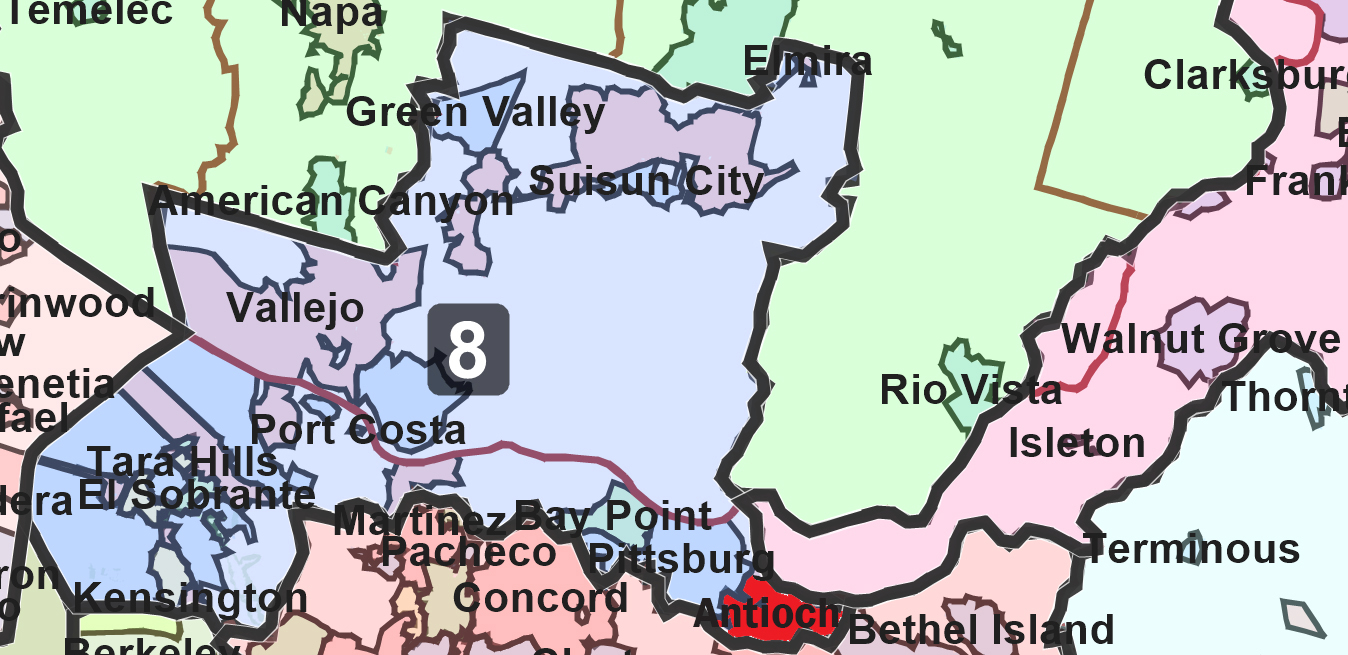
The new 8th Congressional District with the portion of Antioch inside the district in red and showing the location of Walnut Grove (right) where Garamendi lives. Source: WeDrawTheLinesCA.org
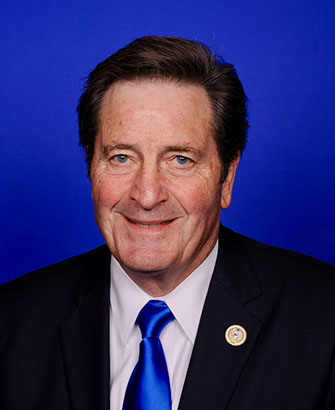
Rep. John Garamendi. Official photo.
Contra Costa and Solano Counties – Following the release of the final district maps by the California Citizens Redistricting Commission on Monday, Congressman John Garamendi (D-CA) announced, that day, he is running for re-election in the newly redrawn 8th Congressional District of California. The district now includes most of Solano County and the northern, waterfront portions of Contra Costa County from Antioch to Richmond.
Garamendi has served in Congress since 2009 and represented Contra Costa and Solano Counties during his tenure, which are included in CA-08. Prior to his election to Congress, Garamendi served in the California Assembly and Senate, twice as California’s elected Insurance Commissioner, as Deputy Secretary of the U.S. Department of Interior under President Bill Clinton, and as California’s Lieutenant Governor. Garamendi also served in the Peace Corps with his wife, Patti Garamendi. The two have raised six children who share their commitment to public service. They also have 13 grandchildren.
“The 760,000 residents of the 8th Congressional District want a proven progressive who will fight for them every single day. That’s exactly what I’ve done my entire tenure in Congress, and that’s what I’ll continue to do. That’s why, today, I’m kicking off my re-election campaign for Congress,” Garamendi said.
Although he lives in Walnut Grove, in the newly redrawn 7th Congressional District, where both Representatives Doris Matsui and Ami Bera also live, members of the House of Representatives aren’t required to live in the district they represent. They’re only required to live in the same state. The 76-year-old Garamendi currently represents most of Solano County in the 3rd Congressional District and previously represented Antioch and other portions of Contra Costa County in the then-10th District, from 2009 to 2013.
“When our economy is strong, America is strong. In Congress, I fight every day for a fairer economy that works for middle class families, not just those at the very top,” the congressman stated.
“We know the economy can’t move if people can’t move. That’s why I helped champion the Infrastructure and Jobs Act—the largest investment in our infrastructure ever—and secured an $86 million grant to expand lanes on I-80 and reduce traffic,” Garamendi continued. “We know that a strong middle class is the bedrock of our nation. That’s why I fought for the American Rescue Plan, which combatted the COVID-19 pandemic, created the largest tax cut for the middle class ever, put students safely back in school, and helped create over 6 million new jobs for hardworking families.”
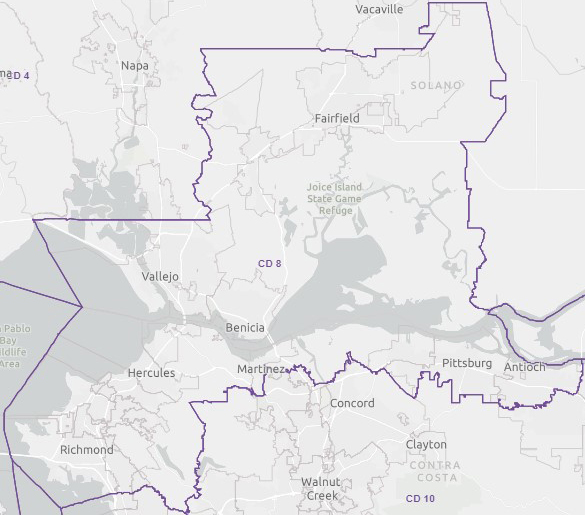
The new 8th Congressional District map. Source: WeDrawTheLinesCA.org
First elected to public office in 1974 as a member of the State Assembly, then the State Senate in 1976, Garamendi was elected California Insurance Commissioner in 1990. From 1995 to 2003 he served as the Deputy Secretary of the Interior during the Clinton Administration. In 2002 he was elected, again as Insurance Commissioner, then Lieutenant Governor in 2006. Garamendi was first elected to Congress in a special election in 2009.
“We know that Americans deserve universal paid family leave, affordable housing, cheaper prescription drugs, universal healthcare, cleaner air and water, affordable education, and a free and just society. That’s why I’ve helped champion these efforts in Congress and voted to make this attainable for every American,” he shared.
“All of this and more is what we achieved in 2021 alone, and we are just getting started. I have devoted my life to public service, and I will continue fighting for you every day. That’s why I’m announcing my re-election campaign for Congress in the 8th district. I want to continue fighting for a bold, progressive, and transformative vision of America—and I would be honored to have your support,” Garamendi concluded.
According to his Wikipedia page, Garamendi was born in 1945 in Camp Blanding, Florida, and was raised in Mokelumne Hill, California. His paternal grandparents were Basque immigrants from Spain and his mother was of half Irish and half Italian ancestry. Garamendi received a degree in business from U.C. Berkeley, where he was a football player and wrestler, and a Master of Business Administration degree from Harvard Business School. He served in the Peace Corps in Ethiopia from 1966 to 1968. Garamendi is an Eagle Scout and a member of Sigma Chi, as a brother of the Alpha Beta Chapter at Berkeley.
Below is an overview of Garamendi’s priorities and recent achievements in Congress. More information is available at Garamendi.org:
A Champion for Working Families
Congressman Garamendi believes that every American has a right to a good-paying job, and he fights every day in Congress to build a strong middle class. In 2021 alone, Garamendi fought for:
Congressman Garamendi knows that the economy can’t move if people can’t move. As he works to represent us, he sees that traffic on I-80 is bumper-to-bumper, Highway 4 has too many potholes, and public transportation needs to be improved and expanded.
Many elected officials simply talk about rebuilding our infrastructure, but John Garamendi acts. In 2021, Congressman Garamendi helped design the new Infrastructure and Jobs Act and enact it into law. Through that, Garamendi helped secure:
Additionally, Garamendi helped expand BART services into Contra Costa County. He also authored and passed the “Ocean Shipping Reform Act” in the U.S. House of Representatives to fight inflation, address the supply chain crisis, and support American businesses and jobs.
All the infrastructure improvements Garamendi helped secure will be built to withstand the impacts of climate change. They will also help reduce pollution to ensure the air we breathe and the water we drink is clean for all.
A Supporter of Medicare for All and a Green New Deal
Congressman Garamendi served as California’s first ever elected Insurance Commissioner. There, he
Congressman Garamendi also believes that climate change is the defining issue of our time. We know that California’s fire season is now 12-months, droughts are more frequent and severe, and our coats are threatened by sea level rise. Garamendi has shown a lifelong commitment to saving our planet from the climate crisis and ensuring clean water and air is available for our children. In Congress he’s fighting for:
Allen Payton contributed to this report.
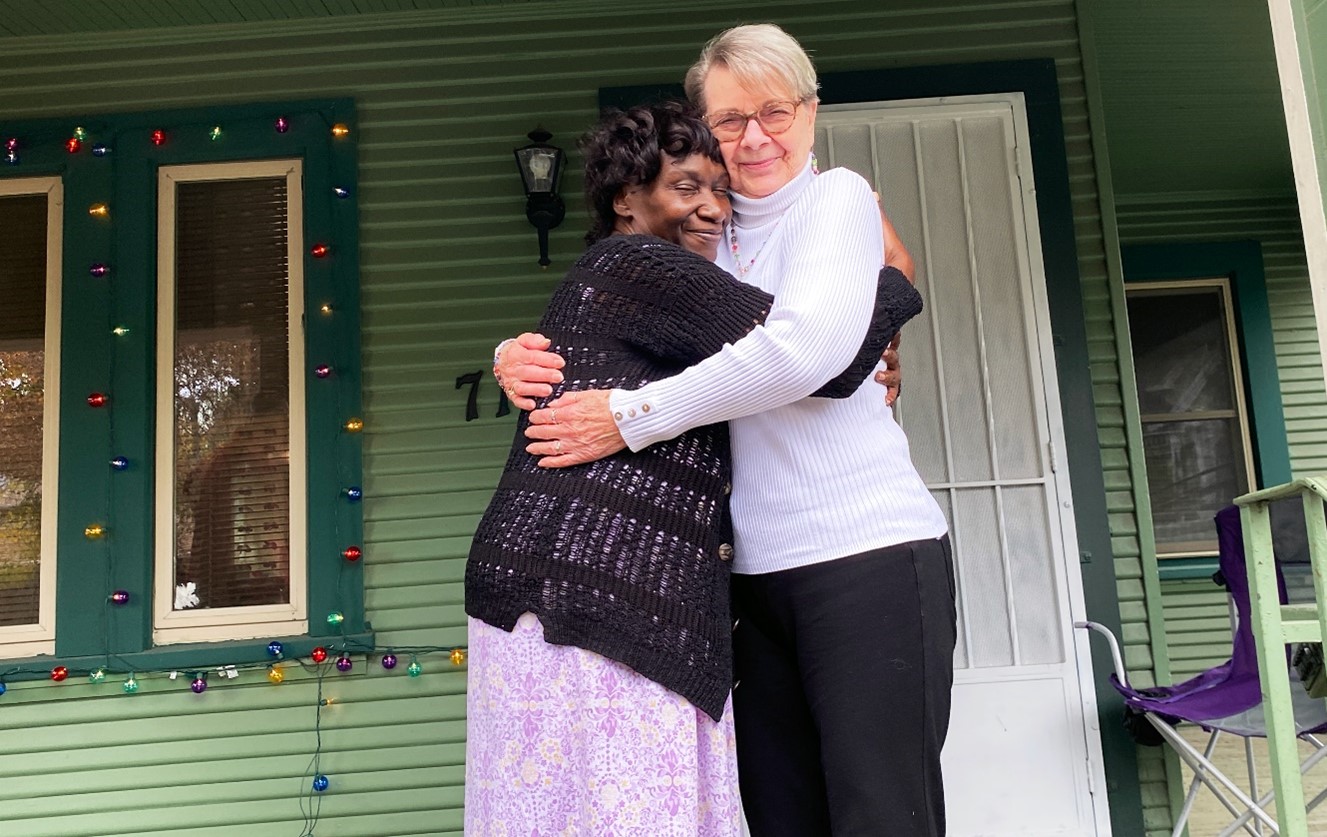
Mary Turner (left), a graduate of the WFD program at St. Vincent de Paul, hugs her mentor Gail F. (right) outside of her newly purchased home in Stockton, California. Photo: St. Vincent de Paul of Contra Costa
The Workforce Development Program at St. Vincent de Paul is a paid job training program aimed at helping the unemployed re-enter the workforce and find stable employment. The COVID-19 pandemic has seen millions suddenly find themselves out of work. In these hard times, it is more important than ever that job applicants understand workplace expectations and have the soft skills to be a contributing employee. The 24-week program teaches participants skills and techniques to find a job and be successful in the workplace, offering training in resume development, interviewing, and organizational skills in a supportive & compassionate environment. Mandatory orientation sessions, applicants should choose either the Pleasant Hill, Brentwood, or the Pittsburg sessions.
The Pleasant Hill Sessions take place on Thursday, Jan. 6 and Tuesday, Jan. 11, 2022, from 10 AM – 1 PM at Christ The King Church at 199 Brandon Road. The Brentwood Sessions take place on Saturday, Jan. 8 and Friday, Jan. 14 from 10 AM – 1PM at the St. Vincent de Paul Thrift Store at 8890 Brentwood Blvd. The Pittsburg Sessions will take place on Monday, Jan. 17 and Friday, Jan. 21 from 2 PM – 5 PM at the St. Vincent de Paul Family Resource Center at 2210 Gladstone Drive. Applicants must be at least 18 years of age.
The Workforce Development Program aims to help tear down the barriers that stand in the way of employment for individuals who have struggled to obtain and maintain employment. Participants work with mentors and take weekly classes to develop workplace skills. A new class of participants is selected every three months.
Participants gain paid, part-time, (22.5 hours per week), work experience in a St. Vincent de Paul thrift store or SVdP’s transportation department. Additional training in retail operations including cash register operations, inventory display and optimization, and warehouse operations is also provided.
Success for program participant is life-changing. Mary Turner, a graduate from SVdP’s Workforce Development Program, was living in her car when she began the program. A senior citizen, Mary found herself having to return to work when her rent increased beyond the means of her fixed income. After successfully graduating from the WFD program at St. Vincent de Paul, Mary found work as a medical support assistant. In October 2021, Mary purchased her first home in Stockton, California.
“It was hard, I was living on SSI and Disability, but my rent just kept increasing until I couldn’t afford it,” Mary said. “Now, I have a good job as an Advanced Medical Support Assistant (with the Veterans Administration), and I have my daughter and grand-babies stay in my home. If you want to be a home owner, it’s possible. It’s hard, it’s a struggle, but it’s worth it and it’s possible, and the people at St. Vincent de Paul showed me that.”
St. Vincent de Paul of Contra Costa County has provided safety-net services in the county for over 57 years, serving 100,000 people annually and distributing over $1M of direct financial assistance and over $1.7M of in-kind aid. Over 750 SVdP volunteers and a small staff lead operations in Contra Costa including the SVdP Family Resource Center in Pittsburg, 28 branches, and 3 Thrift Stores. One of the largest charitable organizations in the world, St. Vincent de Paul is an international, nonprofit, Catholic lay organization of more than 800,000 men and women who voluntarily join together to grow spiritually by offering person-to-person service to the needy and suffering in 155 countries on five continents.
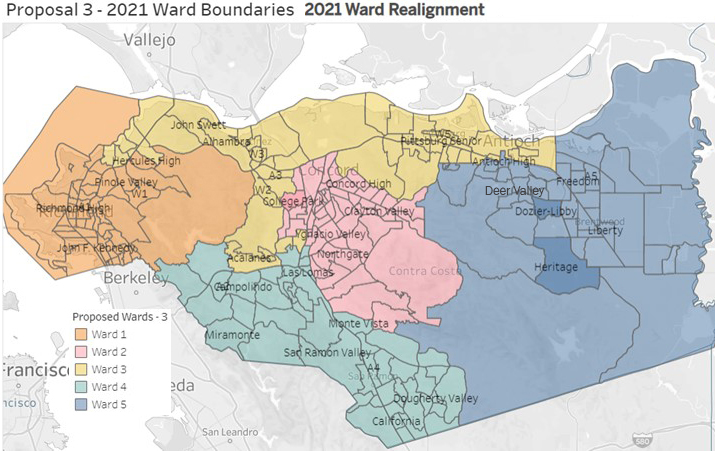
Proposed Contra Costa Community College District Ward Realignment Map 3 balances populations using the county Supervisor’s newly adopted map as a guide and includes the locations of the high schools (the name of Deer Valley High in Antioch added by the Herald). But Trustee Ward 3 in this proposed map is significantly different than the new Supervisorial District 5. See the other two proposed maps at www.4cd.edu/gb/redistricting/. Source: 4CD
By Allen Payton
In response to public pressure, the Contra Costa Community College District (4CD) Governing Board is seeking additional community input to adjust trustee ward boundaries and ensure population balance based on county demographic changes identified in the 2020 Census. During the Dec. 8 board meeting, (see 36-minute mark) Ward 5 Trustee Fernando Sandoval and Ward 2 Trustee Rebecca Barrett pressed for more public input, and wanted to review more than just the one map provided by the district’s staff and attorney David Saldani. They only provided slight changes to the current, gerrymandered map. (See related article)
Board Calls for More Public Input
At their December 8, 2021, meeting, (see item 10.A.) the Board reviewed only one staff-recommended map that highlighted how trustee area boundaries could change and received community input on the proposed map before determining the need for additional community input. In 2010, both the college board and the Contra Costa County Board of Education adopted the same exact maps, according to Saldani. The 4CD staff is expected to collaborate with the board of education, again, this year.
Only two members of the public offered comments during the hearing, including former college board trustee Greg Enholm who said “I hope the trustees agree that voters should choose their representatives not the reverse. He also said he agreed with this reporter “regarding his concerns about the proposed ward map,” referring to the current map being drawn based on political considerations to protect incumbents at the time it was adopted.
“I also hope that Board Vice President Walters and Board Secretary Sandoval will explain why they are not advocating for an independent redistricting body to redraw the wards as they pledged to do,” Enholm stated.
“The map must be the best one possible meeting all requirements,” he concluded and said he provided to the trustees a copy of the 1990 map.
“We support a good governance model which includes community meetings. We are a little surprised that…the college district did not engage in a community participation process,” said Maria Alegria, representing Latinx for Inclusion. “It looks like you’ve done this in-house for the past three decades.”
Barrett had questions about the process, including the FAIR Maps Act.
“Certainly, this year, more than ever, the politics surrounding redistricting is greater,” said Executive Vice Chancellor, Education and Technology Mojdeh Mehdizadeh. “This is the first year that the Census data was released six months later than usual.”
“Can you explain the California FAIR Maps Act of 2017 and how it impacts the way cities and counties conduct their post-Census redistricting?” Barrett asked.
“We don’t have to comply with the provisions. It gives more direction with the criteria,” Saldani responded. “The FAIR Maps Act requires cities and counties have…two pre-map hearings then two post-map hearings. It doesn’t apply to the college district.”
“We used traditional redistricting criteria,” he added.
Sandoval said “you spoke about population balance. You guys really didn’t talk about communities of interest. What Mr. Enholm stated…there was some work that was done for political boundary changes in the past and I’m concerned those still haven’t been addressed.”
“It’s not just population balance, it’s communities,” Sandoval continued. “We’re here to make sure the maps represent the communities of interest as they go forward.”
“The other thing I’m concerned about is, the map itself that we have in there, is not an interactive map. You should be able to show that,” he stated. “The fact that we only have one map says that we only have one option. I’m all about transparency. When I talked about the independent commission it’s really about transparency and making sure that the public has an opportunity to weigh in and put a comment…so the board can go ahead and try to understand what the concerns of the community are. We don’t know what they are, right now. I think we need to do more.”
“From my perspective there’s not have enough transparency and we need to ensure we go ahead and take care of the public interest,” he concluded.
“In fact, we heard public feedback, tonight,” said Saldani.
“I think we haven’t done enough,” Sandoval responded. “Give them more of an opportunity. Publicizing it and just having it on our website is not enough. We should have more than one map.”
Barrett then said, “I do have some concerns. I would like to have a more detailed map. Are the politicians giving feedback? Because it’s self-serving. The staff and demographer have worked to keep this away from board input. In some respects, I would hope the board and public could get a more detailed map with geographic markers…things to help identify. I would appreciate a little more detail and understanding. I think the board could give you more input that communities of interest don’t fit nicely…in your statistical analysis. I do think multiple maps would have been helpful. It would give the public a sense that there are choices.”
“I think most of us won’t be here, in 10 years on this board,” she continued. “So, one of the things we can do as a board is to codify our expectations around the redistricting process. Do we want to look at an independent redistricting commission or some kind of hybrid? But that’s a more long-term project.”
“Your free of the accusation that you’re trying to benefit yourself,” Barrett added.
“Would it be possible to have, I’ll use the word workshop, or gathering?” asked Board Vice President Judy Walters.
“Certainly. I thought that’s what we were doing, here, tonight,” responded Mehdizadeh.
Walters suggested a meeting that is “less formal…more of a roundtable kind of thing.”
“On a personal level, I’m happy with the work done, tonight,” she said. “I’m concerned that we have to meet our deadline and we don’t spend a jillion dollars doing stuff.”
“We’re happy to answer any additional questions and do a deeper dive from an interactive perspective,” Mehdizadeh responded. “While we would love to do that, we’re not resourced to do that.”
“We tried to keep it in-house. Let them do their independent work,” Board President Andy Li said. “I’m supportive of some open, community input.”
“The document…that’s…showing racial demographics is wonderful,” Walters added. But she didn’t call for an independent citizen redistricting commission as she committed to do during her campaign, last year.
“I heard some requests to follow the county in drawing our districts,” Li said. “But I found that there are three trustees in the same ward.”
However, where incumbents live is not a requirement that must be considered when redrawing ward boundaries.
“I appreciate the work done by the county. But they have different communities of interest than we do,” Barrett said. “We could be drawing our maps off of the school district boundaries.”
“We tried to keep as many as communities together as possible,” Mehdizadeh said.
Staff agreed to consider offering more public meetings and has since offered two more maps and post all three on the district’s website.
January 6 Community Roundtable on Ward Redistricting
The public can review three mapping options of how trustee boundaries could be balanced on the 4CD website located at www.4cd.edu/gb/redistricting . Community members can use a new interactive mapping feature that will help identify how each mapping option could change your trustee representation. The website also gives the public the opportunity to provide online comments and feedback that will be considered by the Board. In addition, 4CD will conduct a Community Roundtable on Ward Redistricting during a special Governing Board meeting via Zoom on Thursday, January 6, 2022, beginning at 5:00 p.m. to conduct a community roundtable to review the different mapping options and receive additional community input. Zoom details can be found in the official Governing Board meeting agenda for this community roundtable.
January 12 Second Redistricting Public Hearing
The Board will review the additional community input and hold a second redistricting public hearing at their regularly scheduled public meeting on January 12, 2022, beginning at 6:00 p.m. The public is invited to attend this meeting in-person at 500 Court Street, 2nd Floor Board Room, in Martinez or via Zoom. Zoom details for this meeting are contained in the official Board meeting agenda located on the 4CD website.
“Based on the community input we received so far, the Board decided it was prudent to expand the redistricting choices available and provide more opportunity for the public to weigh in on this important decision,” said Walters. “The additional steps we are taking, which are beyond what is legally required, are appropriate and convey to our community we are rebalancing our trustee wards in a transparent way, and is being completed in a fair, objective, and non-partisan manner.”
Special districts like 4CD are legally obligated to follow Education Code Section 5019.5, which highlights the process to follow, ensuring the population of trustee wards is balanced based on the changing demographics of the community. Legally, the population can be as great as 10% between districts. Despite receiving the 2020 Census data six months late, 4CD is still required to complete this process by February 28, 2022.
After receiving the 2020 Census data in September 2021, staff began working with legal counsel to analyze and prepare its ward redistricting recommendation. The Board received a report outlining the plan to rebalance the ward boundaries at their November 10, 2021, meeting, including a review of the population changes throughout Contra Costa County.
Public Participation
Should you wish to make public comment in person, please fill out the yellow public comment card (sample attached) that will be available at the meeting and give it to the Executive Coordinator. For those attending remotely, the Governing Board President will ask for general comments or those specific to a certain agenda item.
According to Government Code Section 54954.2(a), when responding to public comment, Governing Board members and staff may respond as summarized below.
Timothy Leong, 4CD Public Information Officer, contributed to this report.
By Jaime Coffee, Information Officer II, CHP
 SACRAMENTO, Calif. – The Christmas season is upon us and the California Highway Patrol (CHP) is reminding everyone to put safety first and follow the rules of the road while traveling California’s roadways.
According to data from the CHP’s Statewide Integrated Traffic Records System, at least 38 people were killed in crashes in California throughout the Christmas holiday enforcement period last year. During that 78-hour Maximum Enforcement Period, CHP officers made 573 arrests for driving under the influence.
“The CHP will be out on California’s roadways while the public travels to join friends and family this weekend,” said CHP Commissioner Amanda Ray. “Our goal is the same as yours, to make certain you arrive safely at your destination. From our family to yours, we wish you all a safe and happy holiday.”
The CHP will begin its Maximum Enforcement Period at 6:01 p.m. on Friday, December 24, and continue it through 11:59 p.m. on Sunday, December 26. During that time, all available officers will be on the road for enhanced enforcement and to assist any motorists or pedestrians in need of help.
Wherever your holiday travels take you, remember to plan ahead, buckle up, avoid distractions, and never drive while impaired.
The mission of the CHP is to provide the highest level of Safety, Service, and Security.
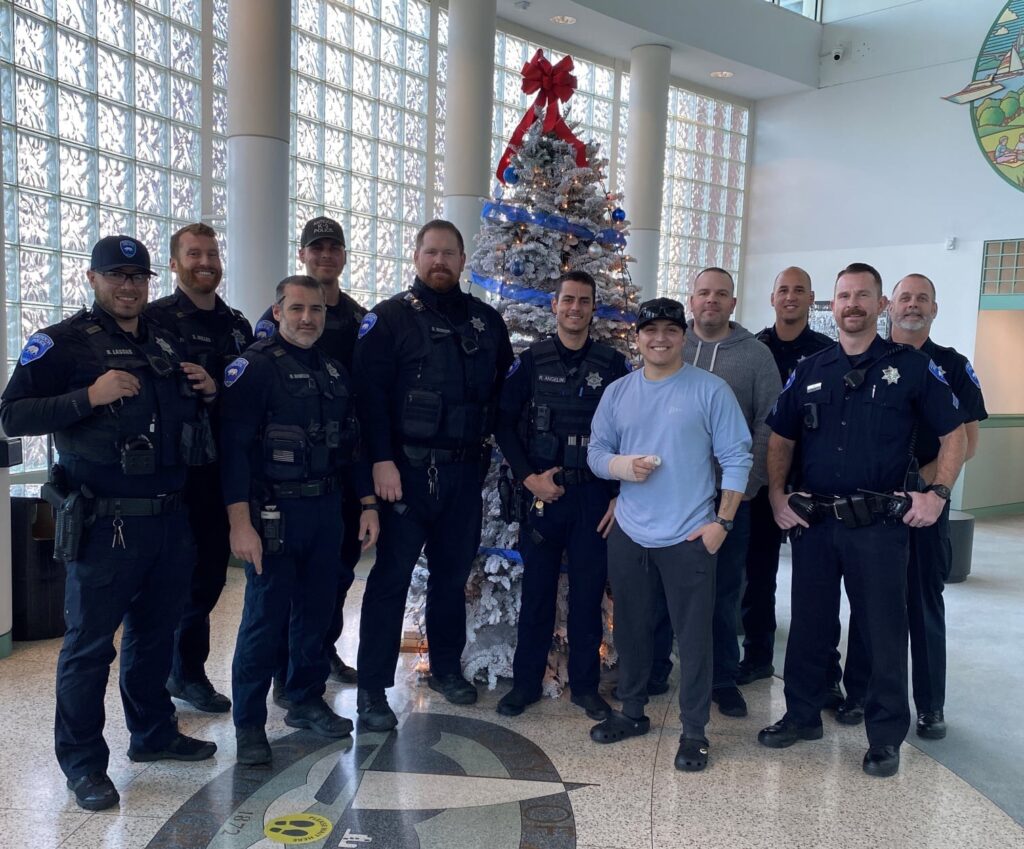
Antioch Police Community Service Officer Gaitan (in light blue shirt) visits with other officers at the police department on Thursday, Dec. 16, 2021. Photo: APD
By Antioch Police Department
Many of you asked about our CSO who was injured in a traffic collision Friday, Dec. 10. CSO Gaitan stopped-by Thursday, Dec. 16 to let us know he is on the road to recovery. He sends his thanks to everyone for their well-wishes and cannot wait to get back to work!
Gaitan was struck by a car while helping block one of the streets surrounding the scene of the shooter on Dove Court. (See related article)
Allen Payton contributed to this report.
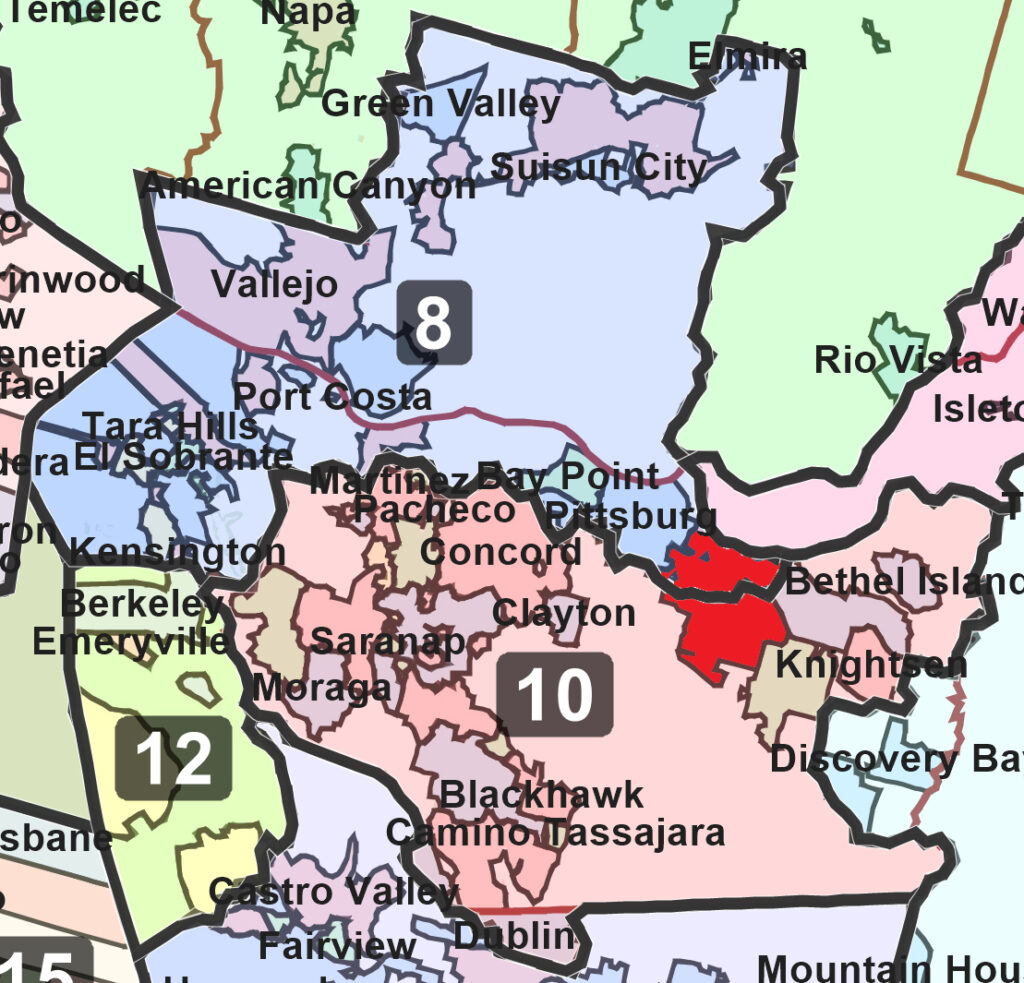
The commission’s final map shows Antioch (in red) divided into Congressional Districts 8 and 10. Source: WeDrawTheLinesCA.org
By Allen Payton
On Monday, the 2020 California Citizens Redistricting Commission completed and approved final maps for the state’s Congressional, Senate, Assembly, and Board of Equalization districts that are significantly different than the draft maps presented last month. The new maps, which will be in place and affect elections for the next 10 years, split up Contra Costa County in multiple ways and combine portions with other counties and communities as much as 93 miles away.
The California Constitution states that public comment shall be taken for at least three days from the date of public display of any final statewide maps. Additionally, the Commission shall not display any other map for public comment during that period. (To offer additional public comment click here)
“We have reached the finish line for the people’s redistricting process in California. When voters approved the Voters FIRST Act, it created a monumental shift in this decennial process,” stated Commission Chair Alicia Fernandez. “As Californians, my colleagues on this Commission and I answered the call to serve for this great state we honor and love. We conclude our map drawing responsibilities with pride in our final product. We started this process leaving politics out of the equation in hopes of achieving fairer and more equitable maps. I think I speak for my colleagues when I say mission accomplished! Thank you to all that participated in this process.”
The Commission drew 4 Board of Equalization districts, 52 Congressional districts, 40 Senatorial districts, and 80 Assembly districts. All districts were drawn within the permissible population deviation.
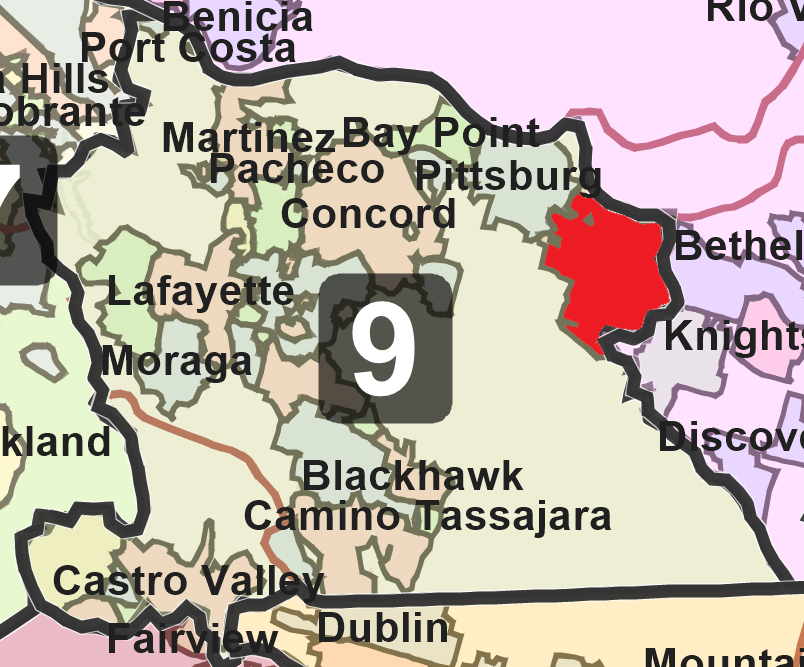
The commission’s final map shows all of Antioch (in red) in State Senate Districts 9. Source: WeDrawTheLinesCA.org
Maps Split Up Contra Costa County More
While the current maps approved in 2011 divide the county amongst four Congressional, two State Senate and three State Assembly districts, what the Commission did to Contra Costa, this time, was split it up even more into three Congressional, three State Senate, and four Assembly districts.
For the State Senate map, the majority of the county, from Crockett in West County to Antioch in East County is combined with San Leandro, Castro Valley and San Lorenzo in southwest Alameda County. Like the draft maps issued by the Commission in November, the new Senate map includes the Far East County cities of Brentwood and Oakley and communities of Discovery Bay, Byron, Bethel Island and Knightsen in the same district as Vallejo, Napa, Rohnert Park in Sonoma County, over 90 miles away. In addition, the map combines all of West County with the cities of Berkeley, Oakland and Alameda.
For the State Assembly map, the Commission keeps the county split in four districts keeping Far East County except for Brentwood, in the same district as most of Solano County including Vallejo, Fairfield, Vacaville and Dixon. It keeps most of West County in the same district, except for Crockett, which is included in the same district as Martinez, Pleasant Hill, Concord, Clayton, Bay Point, Pittsburg, Antioch and Brentwood.
The commission, only split the county amongst three districts for the Congressional map. But it splits up East County into those three, new separate districts by carving out Discovery Bay and Byron and leaving them in the same district as most of San Joaquin County. The proposed final map also combines the southern portion of Antioch, plus Brentwood, Oakley, Bethel Island and Knightsen with Central County, including most of Concord, plus Lamorinda, the San Ramon Valley and a portion of Dublin in the same congressional district. Finally, it splits off the northern portion of Antioch, plus Pittsburg and Bay Point, and includes it in a district with the other part of Concord, plus Martinez, West County cities of Richmond, El Cerrito, San Pablo, Pinole, Hercules and Crockett with most of Solano County.
Independent Commission Creates Maps That Benefit Democrats
The place of residence of any incumbent or political candidate may not be considered in the creation of a map, and districts may not be drawn for the purpose of favoring or discriminating against an incumbent, political candidate, or political party.
However, according to a news report by the left-leaning Politico, “California’s new congressional map boosts Democrats” in their “uphill quest to maintain their minuscule House majority”. The new lines “create more challenging districts for Republican incumbents without substantially undermining the prospects of vulnerable Democrats.” The “map could point to Democrats holding ground or picking up seats.”
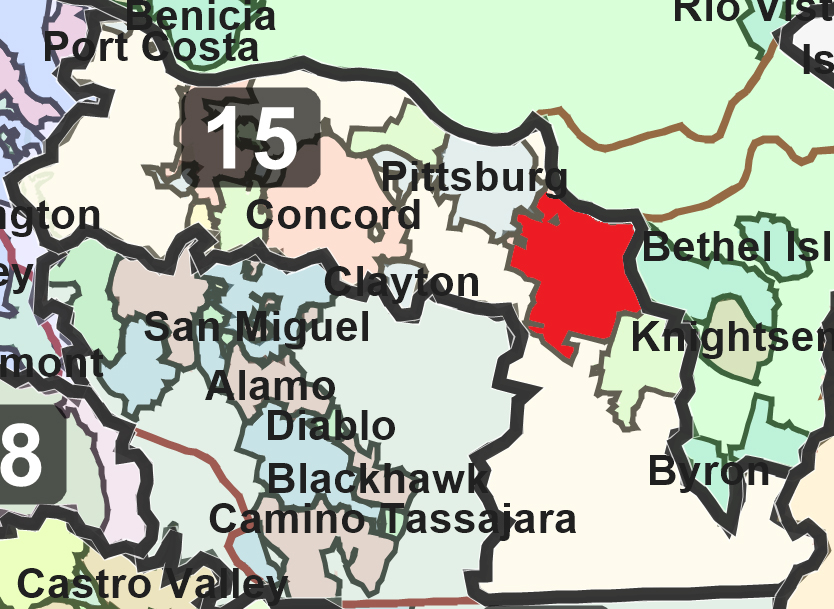
The commission’s final map shows all of Antioch (in red) in Assembly Senate Districts 15. Source: WeDrawTheLinesCA.org
See Shape Files/Equivalency Files/Stats and Map Viewer: https://www.wedrawthelinesca.org/final_maps
In accordance with the California Constitution, the Commission followed these criteria, in this order, to draw district maps:
The last of the criteria makes sense, as there are twice as many Assembly districts as Senatorial districts, and the Commission could have simply divided each Senatorial district into two. But they chose not to follow it when drawing the new maps.
Additional Commission Meetings
The Commission is continuing to hold meetings Sunday and next Monday and accepting additional public comments on the final maps. At the start of Tuesday’s meeting, Chair Fernandez announced that the meetings scheduled for tomorrow (Wednesday) and Thursday, as shown on the Commission’s website, have been cancelled.
December 26, 2021 CRC Business Meeting – 2020 Citizens Redistricting Commission Meeting – 11:00 A.M. – 1:00 P.M. daily or upon conclusion of business Public Input Form
December 27, 2021 CRC Business Meeting – 2020 Citizens Redistricting Commission Meeting – 11:00 A.M. – 1:00 P.M. daily or upon conclusion of business Public Input Form
Background on Redistricting and Commission
Every 10 years, after the federal government publishes updated census information, California must redraw the boundaries of its electoral districts so that the state’s population is evenly allocated among the new districts.
In 2008, California voters passed the Voters First Act, authorizing the creation of the independent California Citizens Redistricting Commission to draw new State Senate, State Assembly, and State Board of Equalization district lines. In 2010, the Voters First Act for Congress gave the Commission the responsibility of drawing new Congressional districts following every census.
For more information, please visit www.WeDrawTheLinesCA.org. To offer additional comments to the Commission about the proposed final maps visit www.wedrawthelinesca.org/contact by Thursday, Dec. 23 at 5:00 p.m.
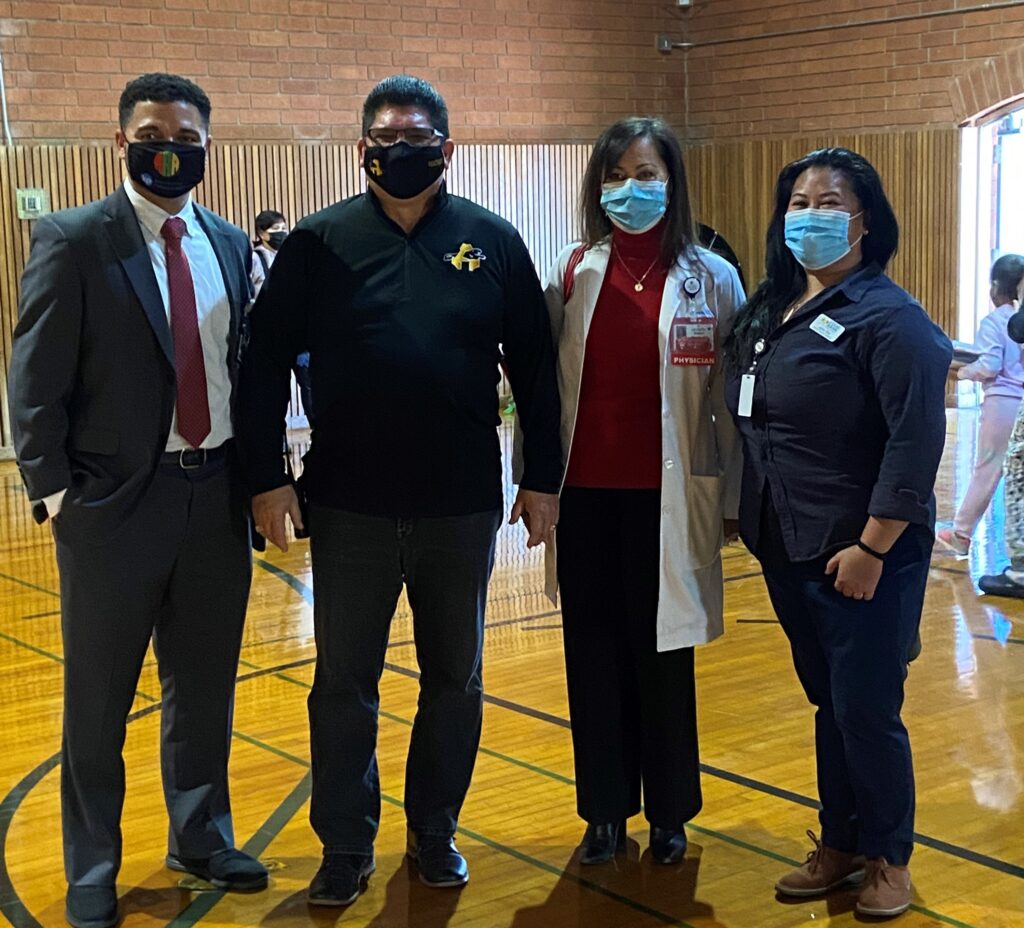
Antioch High School Principal Louie Rocha (center) joined Antioch Medical Center Chief Operating Operator Dante Green, FACHE (left), Kaiser Permanente Diablo Service Area Physician-in-Chief Sharon Krejci Mowat, MD, FAAP, and Food Bank of Contra Costa and Solano Program Coordinator Jamie Diaz (far right) at the Warm for the Holidays event on Friday, Dec. 17, 2021. Photo: Kaiser Permanente
By Antonia Ehlers, PR and Media Relations, Kaiser Permanente Northern California
The line into the Antioch High School gymnasium was long, last Friday afternoon, as local families queued up on a chilly day for the annual Warm for the Holidays event, a joint effort of Kaiser Permanente, the Food Bank of Contra Costa and Solano, the high school, and other community organizations. The school district invited K-12 students of all ages, along with their families to “shop” for food, clothing, books and toys.
More than 2,000 pounds of food was distributed to families in the community.
“The Antioch High School Warm for the Holidays annual event has been a heartwarming experience for our students and staff, who have discovered the power of service to community,” said Antioch High School Principal Louie Rocha. “Despite the recent COVID-19 restrictions, we continue to provide our school community with necessities and gifts to share with their loved ones.”
Kaiser Permanente and the Food Bank of Contra Costa and Solano provided the food portion of the distribution. The Antioch Rotary Club, Holy Rosary Church and the Antioch Woman’s Club donated clothing, toys, books and games.
Through a $550,000 grant to the Food Bank of Contra Costa and Solano, Kaiser Permanente is helping fight food insecurity in the community.
“In order for children to learn in school, we need to increase access to healthy food in our communities,” said Sharon Krejci Mowat, MD, FAAP, Kaiser Permanente Diablo Service Area Physician-in-Chief. “This has been a particularly difficult year for so many families, and partnerships like these in our community our critical to ensuring families have the food they need to lead healthy lives.”
Food insecurity has been an increasing concern throughout the COVID-19 pandemic. Since March 2020, the Food Bank of Contra Costa and Solano has distributed more than 50 percent more food than the previous fiscal year and has served 80,000-100,000 more people each month over last year.
“With generous funding from Kaiser Permanente, the Food Bank of Contra Costa and Solano has been able to purchase fresh produce along with nutritious shelf-stable food for distribution at schools across the community,” said Lindsay Drakeley, leadership gifts manager at the Food Bank of Contra Costa and Solano. “The Food Bank is thankful to have strong community partnerships that make events like this possible.”
Gift wrapping fundraiser for AAUW at Somersville Towne Center
Thursday, December 23rd, 2021St. Vincent de Paul of Contra Costa announces new cycle of paid job training starting Jan. 6
Thursday, December 23rd, 2021Providing safety on the roads is CHP’s gift to motorists this Christmas
Wednesday, December 22nd, 2021Injured Antioch Community Service Officer out of hospital, stops by PD
Wednesday, December 22nd, 2021Kaiser partners with Food Bank to support Antioch High’s Warm for the Holidays event Friday
Monday, December 20th, 2021













© 2026 Antioch Herald - Entries (RSS) - Comments (RSS) - Log in
Theme design by Christian Gnoth - 