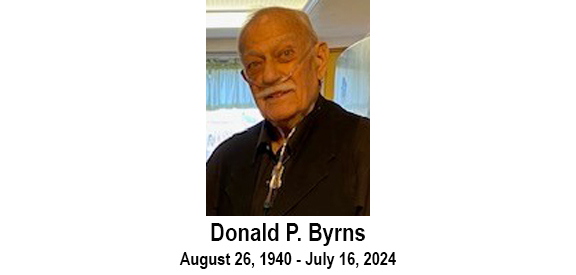
Donald Paul Byrns, 83 passed away peacefully on July 16, 2024, in Vacaville, CA.
Don was born on August 26, 1940, and was proceeded in death by his loving wife Gloria Jean of 50 years and Grandson Anthony DiGiovanni. Don was a carpenter by trade followed by a long career as a Building Inspector for the City of Antioch and Oakley, CA. For nearly 40 years Don and Jean made their home and raised their family in Antioch before retiring to Red Bluff, CA in 2004.
An avid outdoorsman, Don loved hunting, camping and firearms. He was a lifetime member of the National Rifleman’s Association. He had an amazing talent and passion for leather work. He tooled many beautiful items over the years. Those who possess these will cherish them forever. Don was a true Red, White and Blue American, and loved the USA only second to his family and friends.
Don is survived by his daughter Nancy (Frank) DiGiovanni, son Edward Byrns, daughter Paula (Mark) Toponce, 7 Grandchildren and 13 Great Grandchildren.
Funeral:
Wednesday, July 24, 2024
Rockville Stone Church/Cemetery 4219 Suisun Valley Road, Fairfield 94534
Viewing 10:00 am
Services 11:00 am
A luncheon will be served at the Bally Keel Estate 4286 Suisun Valley Road, Fairfield 94534 following the services.
As Don was a life-long Cowboy, please feel free to wear your Western/Cowboy/SASS attire.
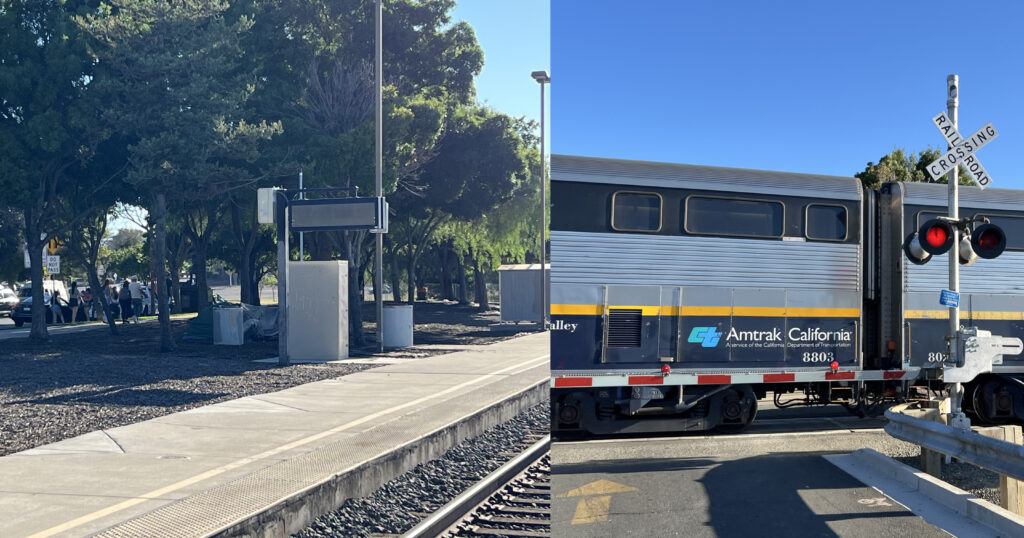
The Antioch Amtrak station is scheduled to be decommissioned in the fourth quarter of 2025. The council will vote to oppose the closure Tuesday night. Herald file photos.
Resolution doesn’t mention former city manager’s name
Will consider approving $340K for another year of the 2024-25 Mayor’s Apprenticeship Program; potential creation of a Diversity, Equity, Inclusion, and Belonging (DEIB) Officer position
Proclamation recognizing Antioch-Chichibu Sister City delegation from Japan
By Allen D. Payton
Sixteen months after the San Joaquin Joint Powers Authority Board of Directors voted to decommission the Antioch Amtrak station, during their meeting on Tuesday, July 23, 2024, the Antioch City Council will consider approving a resolution to send a message opposing the closure. It’s almost two years after then-City Manager Con Johnson learned of the proposed closure from SJJPA staff and in turn informed Mayor Lamar Hernandez-Thorpe.
In spite of the mayor saying at the end of the last council meeting he wanted to include the name of former city manager Ron Bernal, who Hernandez-Thorpe has repeatedly accused of approving the closure which Bernal denies and has been proven false through public records, the mayor’s opponent in the November election is not named in the resolution. (See related article)
According to the City staff report on the item (#9 on the agenda), “The Antioch-Pittsburg San Joaquins Passenger Stop began providing service to the east Contra Costa County region in Antioch on October 28, 1994. The Stop is served by the San Joaquins line that operates passenger rail service between Oakland and Bakersfield.
According to ridership data, the Antioch-Pittsburg San Joaquins Passenger Stop has provided approximately 106,000 on-boards and 118,200 off-boards between July 2016 and January of 2024. This equates to a daily average of 82 combined boarding types.
The San Joaquin Joint Powers Authority was established after the passage of Assembly Bill 1779 on August 30, 2012. This bill enabled local and regional agencies the ability to protect the San Joaquins rail service throughout the region.
On March 24, 2023, the SJJPA voted to decommission the Antioch-Pittsburg San Joaquins Passenger Stop (Amtrak Station). The decision to decommission the Antioch-Pittsburg San Joaquins Passenger Stop (Amtrak Station) did not have a comprehensive community engagement process nor an analysis concerning the impacts of their decision.
The decommissioning of the Antioch-Pittsburg San Joaquins Passenger Stop (Amtrak Station) will have an immediate negative impact on the local disadvantaged community which include low-income people of color, seniors, veterans, and small businesses that rely on the station.”
Following is the resolution of opposition prepared for discussion and adoption by the city council:
A RESOLUTION OF THE CITY COUNCIL OF THE CITY OF ANTIOCH OPPOSING THE DECOMMISSIONING OF THE ANTIOCH-PITTSBURG SAN JOAQUINS PASSENGER STOP (AMTRAK STATION) IN ANTIOCH
WHEREAS, the Antioch-Pittsburg San Joaquins Passenger Stop (Amtrak Station) in Antioch, CA, has been a vital transportation hub for residents and visitors, providing essential connectivity to regional and national destinations since it;
WHEREAS, the Antioch-Pittsburg San Joaquins Passenger Stop (Amtrak Station) has provided approximately 106,000 on-boardings and 118,200 off-boardings between July 2016 and January 2024 that equates to a daily average of 82 combined boardings;
WHEREAS, the City of Antioch is committed to maintaining and enhancing its transportation infrastructure to ensure the mobility, safety, and well-being of its residents and to support the City’s economic vitality and quality of life;
WHEREAS, the San Joaquin Joint Powers Authority was established after AB 1779 was passed by the State Legislature on August 30, 2012, to enable local and regional agencies to protect the San Joaquin Rail Service throughout the San Joaquin Corridor;
WHEREAS, the San Joaquin Joint Powers Authority voted to decommission the Antioch-Pittsburg San Joaquins Passenger Stop (Amtrak Station) on March 24, 2023, at Robert J. Cabral Station South Hall Meeting Room 949 East Channel Street Stockton, CA 95202 without providing official notice to the City government or people of Antioch;
WHEREAS, the decision to decommission the Antioch-Pittsburg San Joaquins Passenger Stop (Amtrak Station) did not have a comprehensive community engagement process nor an analysis concerning the impacts of the closure of the Antioch-Pittsburg San Joaquins Passenger Stop (Amtrak Station) on riders who utilize the station to travel to and from the Antioch-Pittsburg San Joaquins Passenger Stop (Amtrak Station);
WHEREAS, the decommissioning of the Antioch-Pittsburg San Joaquins Passenger Stop (Amtrak Station) will have an immediate negative impact on the local disadvantaged communities which include low-income people of color, seniors, veterans, and small businesses that rely on the station;
WHEREAS, the closure of the Antioch-Pittsburg San Joaquins Passenger Stop (Amtrak Station) would adversely affect the quality of life in Antioch; and
WHEREAS, the decommissioning of the Antioch-Pittsburg San Joaquins Passenger Stop (Amtrak Station) impacts the City of Antioch and other regional municipalities from accessing state funding that is associated with having a transportation corridor.
NOW, THEREFORE, BE IT RESOLVED, that the City Council of the City of Antioch, California, hereby opposes the closing of the Antioch-Pittsburg San Joaquins Passenger Stop (Amtrak Station) in Antioch and urges Amtrak, the San Joaquin Joint Powers Authority, and relevant stakeholders to explore all possible alternatives to keep the station open and operational.
BE IT FURTHER RESOLVED, that the City Council of the City of Antioch calls upon federal, state, and local officials to join in opposition to the closure of the Antioch-Pittsburg San Joaquins Passenger Stop (Amtrak Station) and to advocate for the continued operation and investment in this critical transportation asset.
BE IT FURTHER RESOLVED, that copies of this resolution will be transmitted to the Governor of California, members of the California State Legislature, the United States Congress, the San Joaquin Joint Powers Authority, and other relevant parties to underscore the City of Antioch’s strong opposition to the closing of the Antioch-Pittsburg San Joaquins Passenger Stop (Amtrak Station).
BE IT FURTHER RESOLVED, Antioch-Pittsburg San Joaquins Passenger Stop (Amtrak Station), protest the decision of the San Joaquin Joint Powers Authority to close the Antioch-Pittsburg San Joaquins Passenger Stop (Amtrak Station), and call on the San Joaquin Joint Powers Authority to not eliminate regular service to the Antioch-Pittsburg San Joaquins Passenger Stop (Amtrak Station) but rather operate both the Oakley and Antioch-Pittsburg San Joaquins Passenger Stop (Amtrak Station).
Proclamation Recognizing Antioch-Chichibu Sister City Delegation from Japan
At the beginning of the meeting, the council will vote to adopt a Proclamation in Honor of Welcoming the Visiting Delegation from Antioch’s Sister City of Chichibu, Saitama, Japan. The group of 14, including 10 students and four adults, will stay with local host families while here for a 10-day tour.
Will Consider Approving $340,000 for the 2024-25 Mayor’s Apprenticeship Program
On the Consent Calendar, item K., the council will consider authorizing the Acting City Manager or designee to execute an agreement with Rubicon Programs to provide professional services from September 1, 2024, through December 31, 2025, for an amount not to exceed $340,000 for the Mayor’s Apprenticeship Program.
According to the city staff report, the program “began as a pilot initiative in November 2022 and has completed its first two cohorts…recruited young adults ages 18-26 and employed 20 underemployed, underserved and underestimated participants who faced multiple barriers, including justice involvement, homelessness and the foster care system. Participants underwent 60 hours of workforce development training before placement…(and) ongoing professional development…throughout their part-time employment. Participants were placed in the Public Works Department of the City of Antioch to practice, learn and hone skills that would equip the for future employment.”
Potential Creation of Diversity, Equity, Inclusion, and Belonging (DEIB) Officer Position
At District 1 Councilmember Tamisha Torres-Walker’s request the council will consider the potential creation of a Diversity, Equity, Inclusion and Belonging (DEIB) Officer position under agenda item #10. No information about the proposed position is provided in the city staff report including its purpose, in what department it would be placed and who the person would answer to. The report only shows, “The recommended action has no fiscal impact at this time.” But if the position is created, a salary and benefits package will be developed for it.
Across the country, government agencies, universities and businesses have been either cutting back or completely abandoning their DEI efforts due to significant backlash and the passage of new state laws according to a May 2024 report by Forbes.
According to an article on The Wharton School website, “Diversity, equity, and inclusion initiatives that began during the racial reckoning of 2020, when the murder of George Floyd renewed demands for social justice, are being pulled apart by political and cultural shifts,” and “more than 30 states have introduced laws banning or limiting DEI initiatives, and many companies are cutting their DEI teams.”
At a time the city council members are 60% Black even though according to the U.S. Census Bureau, Black residents make up only 19.5% of the city’s population as of July 1, 2023, and the city staff has included two Black police chiefs, one permanent, one interim, a Black city attorney, two Black city managers, one permanent and the current one acting, and the Director of the Human Relations Department is an Hispanic woman, people are wondering why the position is even necessary.
The council is being asked to discuss the proposal and offer direction to staff.
The council meeting begins with a Closed Session at 6:00 p.m. in which includes conference with legal counsel on a lawsuit against the city, real property negotiation for the sale of the building at 275 W. Tregallas Road across from the Antioch Main Post Office that currently houses the Delta Learning Center, and the Public Employment – Recruitment of the City Manager.
Regular Session begins at 7:00 p.m. Council meetings can be watched livestream on the City’s website, on Comcast local cable channel 24 or AT&T U-verse channel 99, or in person inside the Council Chambers at City Hall, 200 H Street in historic, downtown Rivertown.
Former Plant Engineer at Crown Zellerbach, Inland Paper and Gaylord Paper
Services Tuesday, July 23, 2024
Antioch Police Officers Association Mourns His Passing
Frank Rupani, age 80, passed away suddenly at home with his wife by his side on Wednesday, July 10.
Frank was born on June 24, 1944, in Burgettstown, PA to the late Frank and Pauline (Combi) Rupani. After graduating from Union High School in 1962, he went on to the University of Akron earning his BS in Mechanical Engineering as well as the rank of 2nd Lieutenant in the Air Force. It was in Del Rio, Texas where he met Inelda Rendon, his wife of 54 years.
During the Vietnam War, Frank served as a navigator on the B-52 Stratofortress, based in Guam and Thailand. His missions over Vietnam earned him many medals including two Distinguished Flying Crosses.
After leaving the Air Force with the rank of Captain, Frank and Inelda settled in Antioch, CA where he took a job as Plant Engineer for Crown Zellerbach and Inland Paper, which ultimately became Gaylord Paper. After the plant closure, he remained to supervise the dismantling, remediation and ultimate sale of the property. During this time, he went to Golden Gate University to earn his MBA.
While still working his full-time job, at the age of 53, he was drawn to serve his community as a Reserve Officer with the Antioch Police Department for 20 years, retiring as Sergeant in 2017, then continuing to serve an additional 6 years in the VIPS (Volunteer in Police Service) program.
Frank was a man of exceptional character. He was loving, kind, caring, and selfless and was admired by all who knew him. He will be sorely missed.
He was predeceased by: his parents, Frank Rupani and Pauline Rupani (Combi). He is survived by: his wife Inelda; his sister Marlene (Gary Lafever); his siblings-in-law, Sylvia Slater (Robert) of Oklahoma City, OK, Henry (Robin) of San Antonio, TX, Gerard of San Antonio, TX and Alfred Rendon (Liz) of San Antonio, TX; his nieces and nephews, Ryan Slater, Valerie Ochs (Matt), Christopher Galluze (C. J.), Matt Slater (Crystal) and Sarah Simpson (Tucker); his great-nieces and great-nephews, Allyson, Zachary Ochs, Lillian, Nina Slater and Christopher A. Galluze; and his goddaughter Donna Aiken (Tom).
Arrangements are by Higgins Chapel in Antioch.
Visitation will be held on Tuesday, July 23rd, 2024, from 9:00 AM to 10:45 AM at the St. Ignatius Church, 3351 Contra Loma Blvd, Antioch, CA. A funeral service will be held on Tuesday, July 23rd, 2024, from 11:00 AM to 12:45 PM at the same location. A graveside service will be held on Tuesday, July 23rd, 2024, from 1:00 PM to 1:45 PM at the Oak View Memorial Park (2500 E 18th St, Antioch, CA 94509). The military honors will be held on Tuesday, July 23rd, 2024, at the Oak View Memorial Park Cemetery, 2500 E 18th Street, Antioch, CA.
In lieu of flowers, contributions can be made to your favorite charity in his name.
You can send your sympathy in the guestbook provided and share it with the family, here.
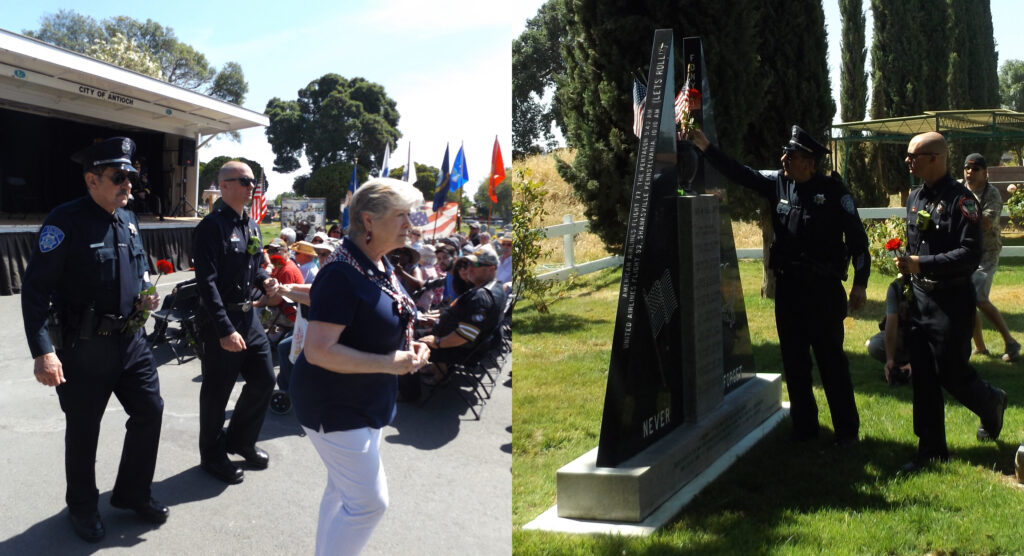
Frank Rupani helps place the rose on the 9-11 Memorial during the 2016 Antioch Memorial Day Ceremony at Oak View Memorial Park. Photos by Allen D. Payton, Antioch Herald
Antioch Police Officers Association Mourns Passing
“It is with a heavy heart that we inform you about the passing of Reserve Officer Frank Rupani. Frank was a dedicated member of the Antioch Police Department for over 26 years, serving our community with utmost commitment and professionalism.
Officer Rupani’s unwavering dedication to his duty and his selfless service to the Antioch community will always be remembered. He was a true asset to our department, and his loss will be deeply felt by all of us.
During his time with us, Officer Rupani exemplified the values of integrity, compassion, and bravery. He was not only a respected colleague but also a trusted friend to many. His positive impact on our community and the lives he touched cannot be overstated.
As we mourn the loss of Officer Rupani, let us also remember and celebrate the incredible legacy he leaves behind. His contributions to public safety and his unwavering commitment to serving others will continue to inspire us all.
Our thoughts and prayers are with Officer Rupani’s family, friends, and colleagues during this difficult time. We extend our deepest condolences and offer our full support to those affected by this loss.
Please join us in honoring Officer Frank Rupani’s memory and the invaluable service he provided to our community.” (See related article)
Former Antioch Mayor Don Freitas will run for the City Council in District 3. Photo source: Facebook posted on June 12, 2022. Map: City of Antioch
Don Freitas to seek District 3 seat after Ogorchock gerrymandered out
By Allen D. Payton
In a post on his Facebook page on Tuesday, July 2, 2024, former Antioch Mayor Don Freitas announced he will seek election to the city council in District 3, this year.
He wrote, “Let me state that I am a candidate for the Antioch City Council, District 3 seat on November 5th, 2024. As a life long resident of Antioch I have had the privilege of of [sic] representing our community in a number of elected and appointed positions such as Mayor from 2000 to 2008.The direction of our City by the current Mayor Lamar Thorpe and some members of the present Council for the last several years has been an unmitigated disaster. And today, the Contra Costa County Civil Grand Jury has factually documented many of the issues facing us in a report entitled “Challenges Facing the City of Antioch”. It is a must read!!! I am asking all registered voters in Antioch to ‘vote for change’ in this election. We need new leadership that is concerned about the betterment of our residents instead of the political ambitions of a few elected officials that have effectively damaged our community…And on November 5th support much needed positive change in Antioch.”
Freitas was referring to the Civil Grand Jury’s investigation into three areas of concern including turnover in city leadership, city employee vacancies and possible Brown Act (state open meeting law) violations by Mayor Lamar Hernández-Thorpe and Councilwomen Monica Wilson and Tamisha Torres-Walker, as outlined in a January 2024 letter from the Contra Costa District Attorney to Antioch’s Acting City Manager.
The District 3 council seat is open since incumbent Councilwoman Lori Ogorchock is precluded from running for re-election as the current council majority of the aforementioned three members gerrymandered her out of the district while redrawing and approving the council map in March 2022. They drew the boundary line between Districts 3 and 4 around the neighborhood in which Ogorchock lives, moving it into District 4. In Nov. 2022 she ran unsuccessfully against Wilson, who continues to represent District 4. (See related articles here and here and City Council Districts Map here)
Before the 69-year-old Freitas was elected to the city council in 1998, he served 16 years on the Contra Costa Water District Board of Directors. In 2008, he lost re-election as mayor to Jim Davis in a four-way race with two write-in candidates (including this reporter). In 2012 Freitas retired as the County’s Clean Water Manager and attempted a comeback in the race for mayor but placed third in a four-man race behind Wade Harper, who was elected, and the late-Councilman Gary Agopian. (See related article)
Prior to Freitas serving on the city council, his wife, Cathryn, served as a councilwoman from 1986 to 1994. Freitas graduated from Antioch High School in the Class of 1973 and from U.C. Davis in 1978. The couple has one adult son, Patrick.
Efforts to reach Freitas for further comment were unsuccessful prior to publication time. Please check back later for any updates to this report.
Juan Garcia was one of 828 students in San Joaquin County to receive the State Seal of Biliteracy in 2023. Courtesy of San Joaquin County Office of Education
The State Seal of Biliteracy is a gold, embossed seal that can be affixed to a student’s high school diploma or transcript. It is awarded to recognize a student for achieving a high level of proficiency in speaking, reading and writing in both English and another language. California first began awarding the State Seal of Biliteracy in 2012.
What is the benefit of obtaining a State Seal of Biliteracy?
The State Seal of Biliteracy validates students’ hard work to learn more than one language. It can be shown to colleges and potential employers, to prove that you can speak, read and write in at least one language, in addition to English. Some colleges may give academic credit to students for the seal. In addition, some organizations, such as Language Testing International, award scholarships to seal recipients.
In one study, partially funded by the U.S. Department of Education and focused on a school district in New Mexico, students who earned a Seal of Biliteracy enrolled in four-year colleges at higher rates than their peers who did not earn the seal.
Source: CA Dept of Education
What languages does the State Seal of Biliteracy recognize?
The State Seal of Biliteracy can be awarded in any language other than English. The most common language recognized with a Seal of Biliteracy in 2022-23 was Spanish, followed by French, Chinese (Mandarin or Cantonese), Japanese, American Sign Language, Vietnamese, Korean, Tagalog and German, in that order.
The state has also awarded the seal in many other languages, including Albanian, Arabic, Armenian, Bengali, Czech, Farsi, Hebrew, Hindi, Hmong, Igbo, Indonesian, Italian, Latin, Mixteco, Polish, Portuguese, Punjabi, Russian, Swahili, Urdu and Yurok, among others.
Do all public schools in California offer the State Seal of Biliteracy?
All public schools are eligible to participate, but participation is voluntary, not obligatory. In 2022-23, the latest school year for which data is available, 1,188 schools in 356 school districts or county offices of education awarded the seals. Check here to see if a school or district participates (click on the “Data” tab).
What can you do if your school does not yet participate?
You can contact a counselor, teacher or administrator at your school and share information about the State Seal of Biliteracy with them, to encourage them to participate.
How do you apply for the Seal of Biliteracy?
Contact your school counselor, principal or other administrator.
What are the requirements to prove you are proficient in a language other than English?
You must either complete coursework or take a test to prove proficiency.
For coursework, you must successfully complete a four-year course of study in a world language at the high school or college level and attain an overall GPA of 3.0 or higher in that course of study. In addition, you must demonstrate oral proficiency in the language comparable to that required to pass an Advanced Placement or International Baccalaureate examination.
You also have the option to take one of four tests, instead of coursework:
Pass a world language Advanced Placement (AP) exam with a score of 3 or higher
Pass an International Baccalaureate (IB) exam with a score of 4 or higher
Pass both an ACTFL Writing Proficiency Test (WPT) and an Oral Proficiency Interview (OPI) with scores of intermediate mid or higher
Pass an exam approved by the school district that meets the rigor of a four-year high school course of study in the language and assesses speaking, reading and writing in a language other than English at the proficient level or higher. These are most often used in the case of a language for which AP, IB, or ACTFL tests do not exist. A list of locally approved world language proficiency assessments is posted on the California Department of Education’s State Seal of Biliteracy web page under the “Assessments” tab.
Can courses completed in another country count toward coursework in another language?
Yes. High-school level courses in another country in a language other than English, with the equivalent of an overall grade point average of 3.0 or above, can count toward the coursework requirement. These might be courses completed as an exchange student, or courses completed in another country by a newcomer student before arriving in the U.S. They must be verified by a transcript.
What if a language doesn’t have a written or spoken component?
If a language does not have a written system, or is not spoken (for example, American Sign Language), the district can approve an assessment on the components of the language that are used.
What are the requirements to prove you are proficient in English?
You must either complete coursework or take a test to prove proficiency.
For coursework, you must complete all English language arts requirements for graduation with an overall grade point average (GPA) of 3.0 in those classes.
You also have the option to take one of four tests to prove proficiency in English, instead of coursework:
Pass the California state standardized test (California Assessment of Student Performance and Progress) for English language arts administered in grade 11 at or above the “standard met” achievement level
Pass an English Advanced Placement exam (AP English Language and Composition, AP English Literature or Composition, or AP Seminar) with a score of 3 or higher
Pass an English International Baccalaureate (IB) exam with a score of 4 or higher
Achieve a score of 480 or above on the evidence-based reading and writing section of the SAT.
What additional requirements do English learners have to complete?
In addition to the requirements mentioned above, students who are currently classified as English learners and have not yet been reclassified as proficient in English must attain an oral language composite score of level 4 on the English Language Proficiency Assessments for California (ELPAC).
Can you apply for a State Seal of Biliteracy in more than one language other than English?
Yes. You can earn seals in more than one language, as long as you fulfill the requirements to show a high level of proficiency in each language.
Are the requirements different for students who qualify for special education and have IEPs?
According to the California Department of Education, the requirements to obtain a State Seal of Biliteracy may be modified for a student with an individualized education program (IEP), if the student’s IEP team determines it is necessary. The CDE website says the IEP team should review the student’s assessment plan and transition plan and determine what assessment(s) to use and what score would indicate proficiency, based on the student’s IEP.
How many students typically receive the Seal of Biliteracy every year?
Sick woman staying at home and talking to her doctor online on a video call using telemedicine concepts. Source: Sutter Health
TeleCARE improves access to care, resources through video visits
by Monique Binkley Smith,Media Relations Manager, Sutter Health
The distraught woman arrived at an Antioch, California hospital emergency department with nothing: Her car, wallet and cell phone were stolen by her abusive boyfriend. She was treated for her injuries, but many victims of interpersonal violence can’t or won’t go to the hospital because they are afraid, lack access to transportation or childcare or, like the woman, their abuser has taken their ID.
And the problem goes beyond accessing care for injuries. Many interpersonal violence survivors and their children haven’t been seen by a doctor for preventive care or for treatment of a chronic condition such as high blood pressure, diabetes or asthma.
That’s where a unique collaborative telehealth service in Contra Costa County, called TeleCARE, comes in. The program safely connects survivors of interpersonal violence with the healthcare services they desperately need including medical care, mental health counseling, prescriptions and even dental care –all at no-cost to the patient.
Now in its fourth year, TeleCARE was founded by Dr. William Francis, a Sutter Delta Medical Center emergency medicine physician with Emeryville-based Vituity medical group, and Contra Costa Family Justice Center.
“At Contra Costa Family Justice Center, our priority is to help get people to safety. Once they’re safe, we’re able to connect them through the TeleCARE program to the healthcare services they and their children need. Whether it’s for traumatic injuries suffered at the hands of their aggressor or addressing long-term health issues, TeleCARE can help,” says Susun Kim, director of Contra Costa Family Justice Center.
Dr. Francis developed TeleCARE as a way to provide convenient –and safe— access to healthcare for people he treats in the emergency department for injuries sustained at the hands of their aggressors but who also need preventive care and treatment for illnesses and chronic medical conditions. And he wanted a way to offer care to survivors who were too frightened to come to the hospital at all.
“The goal of TeleCARE is to improve healthcare for people suffering interpersonal violence with no need for proof of insurance or requirement for ability to pay before connecting them with a clinician,” says Dr. Francis. “These are people who have immediate need of care for injuries or illnesses but who also often need care to manage their chronic conditions. It can be extremely difficult for them to access care in the traditional model because their aggressor prevents it.”
Dr. Francis says many survivors of interpersonal violence refuse to be taken to the hospital by ambulance when in distress, often because they lack childcare or because of the cost on top of the fear of potentially being revictimized by their aggressors.
Now, instead of just hoping survivors get the care they need, even if they refuse transport to the hospital, Contra Costa EMS responders give them a TeleCARE business card so they can arrange for a video visit with a provider when it’s safe for them to do so.
Seven private and public organizations in Contra Costa County now provide support to TeleCARE through the Green Light Collaborative. Thanks to this broad-based community support, TeleCARE has expanded its offerings to help survivors solve problems like obtaining prescriptions for themselves and their children and finding reliable transportation to work.
Dr. Francis is quick to point out how pervasive—and devastating—interpersonal violence is, with widespread impact on the entire community, especially as a primary cause of homelessness. The National Coalition Against Domestic Violence reports one in three women and one in four men have experienced interpersonal violence from a partner, and according to the National Network to End Domestic Violence, domestic violence is the leading cause of homelessness for women and their children.
“I’m so proud that as a physician practicing at Sutter, my colleagues and I are part of a network that works collaboratively with the community. Together, we can tackle the array of areas where we can improve access to care for underserved populations like survivors of domestic violence,” says Dr. Francis.
TeleCARE is made possible through grant funding, making the program rare, if not entirely unique, in its reach, accessibility and scope of collaboration throughout Contra Costa County. Part of the not-for-profit Sutter Health network of care, Sutter Delta Medical Center works to improve outcomes beyond its walls through investment in community partnerships and programs such as TeleCARE and the Green Light Collaborative.
Need help? County residents can access TeleCARE on-site at Contra Costa Family Justice Center, or call one of three Family Justice Center locations in Contra Costa County for an appointment: