Antioch Police catch a burglar at Savers on July 9th and assigned to Slatten Ranch Shopping Center on July 26, 2024. Photos by APD
Recover several $1,000’s of merchandise, equipment
By Antioch Police Department
To deter crime and quickly respond to crimes in progress, APD has assigned officers specifically to the Slatten Ranch shopping center on Lone Tree Way. You may have noticed our officers on foot and in vehicles in the area. Officers have made contact with several of the highest impacted stores and are stationed in the area ready to respond to thefts, burglaries, or any other crimes that may occur.
In addition, Antioch Police worked with the new Savers store on Somersville Road, at the former location of Big Lots, earlier this month to catch a burglary suspect. A post on APD’s Facebook on July 11th reads:
“Teamwork Makes the Dream Work!
We’re proud to report a successful collaboration between the Savers store and the Antioch Police Department, resulting in the arrest of a burglary suspect!
– 07/6/24 at 9:30 pm: Roof hatch and rappel burglary
– 07/7/24 at 9:30 pm: Roof hatch and rappel burglary
– 07/8/24 at 12:30 am: Roof hatch and rappel burglary
– Reported: 07/8/24
Several thousand dollars in merchandise and equipment stolen.
7/9/24 at 2:17 pm: Officers recovered stolen items near San Jose and Delta Fair.
On 7/9/2024, at 9:05 pm, the store manager spotted the burglar on a live feed. Officers swiftly set a perimeter and apprehended the suspect as he exited.
This arrest highlights the power of teamwork between Savers and APD. Thank you to everyone involved for their diligence and quick response!
By Annette Bakker, President, Children’s Tumor Foundation
Imagine receiving the shattering news that your daughter has cancer. Suddenly, you’re battling for her life. In the midst of treatment, you’re asked to sign a flurry of consent forms for her tissue to be donated for scientific research.
Seeking to help others devastated by the same cruel disease, you agree. But in a twist, you’re never told how her tissue samples are actually being used — or if they ever get used at all.
You wouldn’t be alone. I lead the Children’s Tumor Foundation, a nonprofit dedicated to fighting a rare genetic disease called neurofibromatosis, or NF. There’s no cure for the condition, which causes tumors to grow on nerves. The families I work with are desperate for treatments. That’s why they sign the many lengthy “informed consent” documents presented to them at hospitals, asking for permission to use tissue taken for research. But they have no control over how those samples are eventually utilized. Often, specimens simply collect dust on shelves.
The same thing happens frequently to older cancer patients and those battling other diseases. Many have undergone a biopsy or provided another tissue sample for the purpose of testing or treatment. They often wrongly assume that their samples will be used to aid research, and so sign out of a wish to help others.
Unlike organ donation, the market for “biomaterial” is largely unregulated. Hospitals typically provide it to “biobanks,” storage facilities that enter into partnerships with hospitals to gain access to tissue.
Currently, biobanks often impede medical progress by hoarding specimens. I know firsthand that a lack of access to tumor samples and cell lines is a major problem for NF research. I regularly encounter obstacles in helping researchers obtain these materials.
Even when biobanks do provide specimens to researchers, they typically choose those with whom they have strong personal relationships or who can help them publish in prestigious publications. That means researchers in many fields lack access to tissue that would validate their hypotheses.
Most cancer patients want to support research, even if they don’t stand to benefit directly. But it’s deeply unfair to take someone’s tissue or bone marrow without telling them how such tissue will be used — or giving them a say in who gets to use it.
Beyond basic ownership, patients should have more input on how their biomaterial is used. They should be able to decide for themselves which researchers receive their specimens — or consult with trusted patient organizations to make such decisions. They should also have the option to donate only to nonprofit biobanks, or to stipulate that access to their material shall not be restricted at all.
While some biobanks tout a supposed commitment to valuing patient input, these proclamations are little more than window dressing in practice. To give patients a real say in the tissue donation process, we need patient committees for biobanks at large hospitals. Numerous studies have found that public involvement in biobanks bolsters long-term medical research and ensures more samples end up in laboratories.
Patients deserve transparency and influence when it comes to how their own bodies are used for research. Empowering them to make informed decisions will help accelerate medical progress for the greater good.
For information about the Children’s Tumor Foundation visit www.ctf.org.
In a post on the Antioch Animal Services Facebook page on July 20, 2024, Acting Animal Services Manager / Animal Services Supervisor Cat Cottle offered a tribute to volunteer Stephanie Pitman who passed away in February. A celebration of life was held for her on Saturday, July 20th.
She wrote, “We will not be having our PetCo Mobile adoptions today as some of our staff and volunteers will be celebrating the life of one of our volunteers, one of our team, one of our friends, who passed away in February of this year.
Stephanie was one of the greatest souls and more than a pleasure & blessing to have in our midst.
Words cannot ever describe the enormity of Stephanie’s heart, for her family, for her volunteering, for her spiritual beliefs, for her work, for all people, for all creatures & for life.
I would often be stuck wondering at the beginning or end of her volunteer shift if her tears today were those of joy or sadness……sometimes it was both, always it was from a place of love.
Stephanie dedicated so much of her life to others and then she jumped on the volunteer train at Antioch Animal Services – we were so fortunate to have her, equally fortunate to have her late Mom, Rhea and to still have her amazing son Gregory here – a triple blessing for us & a testament to wonderful family values.
Stephanie would commit herself to many of our long term dogs and refer to them as her ‘shelter hubbies’, but the one who stole her heart in the end, and that she attributed to discovering her illness, was Lucy.
I could write many stories about Stephanie, but nothing sticks more with me than how she made me feel. I know everyone felt it. She lifted the room. She radiated positivity. Her attitude was contagious. Even when Lucy was giving her some ‘trouble’ with reactivity, she powered through and worked so hard to ensure Lucy got the tools she needed to stay by her side….often telling me ‘but she’s such a good girl, Cat’.
Everything in the world was bettered by Stephanie’s presence and to know her was to love her. We are honored to celebrate her memory today and we know she will want us to return to doing our best for the animals she loved so much…..and we will.
By Sergeant Rob Green #3639, Antioch Police Traffic Unit
On July 27, 2024, at approximately 7:43 PM, Antioch Police Officers responded to a report of a vehicle collision between a motorcycle and a SUV in front of Bev Box at 907 W. 10th Street. Officers found the 32-year-old male (Brentwood resident) motorcyclist on the ground and unresponsive. Officers performed lifesaving aid and the motorcyclist was transported to an area hospital where he succumbed to his injuries.
Traffic Accident Investigators took over the investigation and determined from witness statements and from video collected at the scene that speed was a contributing factor to the crash. This case is in the preliminary stages and the names of the parties involved are not being released at this time.
Anyone with information is asked to call the Antioch Police Department non-emergency line at (925) 778-2441 or Traffic Collision Investigator Sergeant Green at 925-779-6864, email rgreen@antiochca.gov. You may also text-a-tip to 274637 (CRIMES) using the key word ANTIOCH.
With Wilson absent also approves resolution opposing Amtrak station closure
Staff working on developing possible DEI policies, not position, yet
Torres-Walker issues another diatribe from the dais, slams DA, Grand Jury investigations of alleged Brown Act violations
Close meeting in honor of late former Reserve Officer Frank Rupani, woman shot and killed by police in Illinois
By Allen D. Payton
After over 10 months of discussing an ordinance and multiple votes, with Mayor Pro Tem Monica Wilson absent, the Antioch City Council, on Tuesday night, July 23, 2024, voted 3-0-1 to finally barely approve a ban on sideshow organizers, advertisers and spectators. District 1 Councilwoman Tamisha Torres-Walker voted to abstain. The council also approved on a unanimous vote a resolution opposing the decommissioning of the Antioch Amtrak station.
Ban on Sideshow Organizers, Advertisers and Spectators
Before council discussion of the second reading for the ordinance banning organizing, advertising and being a spectator at sideshows, public comments were received. Former councilman Ralph Hernandez spoke first saying, “I fully support that the city enact a very strict ordinance. These are very dangerous things. They’re advocating for criminality. When you have people actually come to Antioch to see these sideshows…they have actually become art of a conspiracy which is not just a misdemeanor, it’s a felony. They’re standing on the sidewalk encouraging the participants. They’re actually becoming participants…aiding and abetting the criminality.
“Give the police the weapons they need to fight this kind of crime,” he added.
Alexander Broom said, “Last meeting we discussed possibly narrowing the definition of what a spectator is for this ordinance. Although I do support the ordinance, still…I don’t think we should leave any slack in what a participant is and obviously, a participant and a spectator in these situations are different and I think the language used in this ordinance is just far too broad and it opens things up.”
“I don’t think we should be discouraging people observing, witnessing these events,” he continued. “Especially, if that prevents them from assisting police in capturing license plates and these illegal acts. It’s not illegal to observe a crime.”
“I just ask that we consider, tonight narrowing down what a participant is to not… giving our law enforcement officers the opportunity to make a mistake. Because those mistakes are costly for the city…for the residents…for those who may not be guilty of this crime,” he concluded.
During council discussion, District 3 Councilwoman Lori Ogorchock said it was, “another tool in the toolbelt for our police officers.” She then attempted to again add in the ordinance items she had requested that the other councilmembers wouldn’t accept at their meeting on June 25. They include “impounding vehicles until the court date and increasing fines and fines for our resources.” The councilwoman asked that they be brought back, “to see if those can be added to the ordinance at a later date.”
Torres-Walker then asked Acting Chief Brian Addington multiple questions about sideshows in the city and how the department will enforce the ordinance asking, “How many, year-to-date, so, in the past six months, how many sideshows have occurred…with 50 to 100 spectators?”
He responded, “Unfortunately, I wasn’t prepared for that question so, I don’t have the exact stats. But I would venture to say there’s been more than 15.”
“With 50 to 100 spectators?” the councilwoman repeated. “Not vehicles, not drivers, just spectators.”
“With 50 to 100 people participating in the event,” said the chief.
“Excluding the drivers,” Torres-Walker pressed further.
“Yes. With hundreds of people out there,” Addington stated.
“So, maybe 15. I’m just trying to get the number because it hasn’t been in anything I’ve seen,” said the councilwoman.
She then asked, “How many of these activities have you needed to request mutual aid for from other cities”
The chief responded, “I would say at least half of those and some smaller ones, as well.”
“What typically happens is they start as big ones and then they start breaking up into smaller ones,” he continued. “So, you may have two or 300 at one event, and the next thing you know that breaks up and the next one is 100 and it may go down to 50.”
“Right. So, more than half the sideshows that you experienced with the potential for 50 to 100 participants plus, spectators, you’ve needed mutual aid from outside cities for,” Torres-Walker asked again.
“We have requested mutual aid,” Addington clarified. “Sometimes some other agencies have been able to send officers to assist. Sometimes they have not.”
“How large is your current traffic division,” she then asked.
“Right now, we have one sergeant and one officer assigned to the traffic division,” the Chief answered.
“So, two?” the councilwoman asked. “And when you need to respond to a large sideshow how do you make up the difference? You pull everybody from all beats to the one location.”
“Yes,” the Chief said. “Most traffic officers generally work during the day and a lot of our sideshows occur in the late evening and on the weekends. Sometimes we have our traffic officers working those hours, obviously, so, we want to be prepared. But the vast majority of sideshows are handled by the beat officers, and we have to pull all of our resources to go and deal with these sideshows. Then, as I mentioned, call in additional resources when they’re available from other agencies. So, it’s a considerable undertaking.”
“How does it work to enforce this ordinance? Is that through the department of vehicle or through the district attorney or both?” Torres-Walker asked. “How is somebody charged with a misdemeanor that would trigger the fine, the forced, the volunteering? Who imposes that? Is it the district attorney’s office?”
“So, usually there’s two routes…the criminal prosecution route or you could do the administrative citation route which would be a function of the City,” the Chief responded. “But generally, it is through the criminal route and it goes through the district attorney’s office.”
“The route this ordinance is proposing is a citation?” she asked and then answered her own question saying, “It will be both.”
“Yes,” Addington confirmed.
“Have you had the chance to talk to anybody at the district attorney’s office?” Torres-Walker then asked.
“Yes, ma’am,” he responded.
“And what was that conversation like,” she asked.
“We talked about training. We talked about different sections that are applicable and the use of the ordinance, as well,” the Chief responded.
“And so, they’re familiar with all of this? They already know how to run it through?” the councilwoman asked. “And I’m sure every citation will be under a microscope.”
“They know how to review these cases, yes,” Addington stated.
Torres-Walker then asked, “Do you believe that there’s any potential of any policy to have disparate impact on certain communities?”
“I think our officers are going to do the best they can to enforce the law based on the information that they see at the time,” the chief responded.
The District 1 councilwoman said the initial focus was on “proactive enforcement. How do you stop it before it happens?”
“The $1,000 fines that are being collected, where’s that money going and how is it going to be spent,” she asked City Attorney Thomas L. Smith and Acting City Manager Kwame Reed.
Smith responded, “Those fines are not going to be delivered to the city for expenditure. Those are under the penal code and so, I don’t know exactly how they spend them. But it’s not the city’s pot of money if that’s the question.”
“Well, I know that the fines won’t come to the city,” Torres-Walker stated. “I just wanted you to say it so people in the public who have asked me will know that these particular fines won’t come back to the city in any type of way for any monetary value for any other use or purpose and they also won’t be going to the police department. So, there’s no physical [fiscal] benefit that the city will be receiving by passing this ordinance.”
“I think that the devil is really in implementation and enforcement and we won’t really know if it works or doesn’t until it’s enacted and we trust current officers who are committed to quality policing in Antioch to enforce this ordinance and see where it goes,” Torres-Walker concluded.
District 2 Councilman Mike Barbanica then made the motion to adopt the ordinance which was seconded by Ogorchock. With no further discussion the ordinance was adopted on a vote of 3-0-1 with Torres-Walker abstaining. (For details on the ordinance see related article)
Mayor Pro Tem Monica Wilson was absent during the council meeting on Tuesday, July 23, 2024. Video screenshot.
Resolution Opposing Decommission of Amtrak Station
Then, 16 months after the vote, at the suggestion of Councilwoman Ogorchock, the council considered, discussed and then adopted a resolution sending a message to the San Joaquin Joint Powers Authority (SJJPA) opposing the decommissioning of the Antioch Amtrak station. As previously reported, the SJJPA board voted with the support of a minimum of six members in favor in March 2023.
Leslie May was the first of only three members of the public to speak on the matter saying, “I am opposed to closing this station, as well, because I use it. I don’t have to depend on my daughter driving me. I have friends in Oregon I like to go see. There’s a lot of seniors that use it. I hope you do pass this resolution, tonight.”
Eddie Dotts spoke next saying “I’m just here to thank you in advance for passing this. I just got here today from the train, riding Amtrak. I always end up seeing someone I know on the train. I saw a senior who’s got to be at least 90 years old, up walking around on the train. Do everything you can to make sure Antioch stays viable in transportation.”
Andrew Becker said, “It’s frustrating. The resolution speaks of passenger rail service starting here in 1994. But that’s not true. The rail service came to Antioch all the way back to when the transcontinental rail was completed.”
“In 1910, passenger service started over in the downtown waterfront area,” he continued. “There was siding for trains to pull off. But in the 80’s the City of Antioch decided it was time to use redevelopment dollars to get rid of that siding. It was said it couldn’t be there anymore, it was too dangerous…in its current form and fashion.”
“Nobody has talked about what the rail authority wants…and the City of Antioch owns most of the right-of-way on each side of the rail line,” Becker added.
One proposal by the SJJPA staff during the March 24, 2023, board meeting was to add another track or siding, to allow for trains to pass each other along the route, which would allow for the Antioch station to remain open.
Ogorchock made the motion to oppose the decommissioning of the Amtrak station, Torres-Walker seconded it and the motion was adopted 4-0. (See resolution in related article)
No Action on Creating DEIB Officer Position, but Staff Says They’re Already Working on Developing DEIB Policies
Upon introducing the proposed Diversity, Equity, Inclusion and Belonging Officer Position for the city, Torres-Walker said, “this was my request.”
During public comments Chima Oluo said he was “a springboard intern for our city attorney. I am in favor of a DEIB officer position…bring Antioch closer to a more equitable city.”
“I believe that more people don’t know what this is,” he continued. “DEI is fundamentally about promoting fairness and equal processes for all.” He gave examples of the City of Oakland and San Francisco and their DEI practices then said, “I believe Antioch can do this, too. Antioch can establish similar initiatives tailored to the needs of our residents. This will lay the foundation for a more inclusive Antioch.”
Torres-Walker then claimed the idea was the result of a conversation she had with one city employee.
The councilwoman said, “I would like to take full credit for this item, but this really came out of a conversation with a city staff person who wants to remain anonymous about the lack of human rights and racial equity policies in this city and the lack of diversity and inclusion in city staffing and in our policies.”
“We talked about the potential for this position because it exists in other cities,” Torres-Walker continued. “And giving the direction that this city is going in, we’re always saying we’re the third most, the second most diverse city and yet our public policy doesn’t show that, our hiring practices often doesn’t show that. So, I think it’s important to listen to city staff…because they don’t feel like it’s inclusive.”
“The last update I got from Acting City Manager Kwame Reed is that there might be an effort to look into the need for this position in this city,” she continued. “I can’t help myself because I’m a Black Latina and I’m a Black woman. When we talk about what we want to do for Black people, we say, ‘let’s do a feasibility study and see if Black people have any discrimination they face and then once we come back with those findings then we’ll see if there’s a policy needed to stop discriminating against Black people. Oh, let’s see if people with disabilities are really struggling.’”
“So, why do we need to do studies on issues that people are consistently telling us there’s an issue?” the District 1 councilwoman asked rhetorically. “Is there a need for this position? I would say that there is. I would say that we need to look into it.”
Then she broached the subject of the council’s Human Rights and Racial Equity Ad Hoc Committee.
“We had one public meeting to talk with the public about how they felt about human rights, racial equity and belonging in this city and then we haven’t discussed it again,” Torres-Walker continued.
She wanted another ad hoc committee “to actually create human rights and racial equity policies in this city because they do not exist.”
“Before we can have a Human Rights and Racial Equity Commission, we first need to have policies that address human rights and racial equity disparities in this city as well as a Diversity, Equity, Inclusion and Belonging Officer position to oversee and work with that commission to make sure that these policies are enforced,” the councilwoman stated. “And that good customer service that Councilman Barbanica was talking about. That happens when a city is inclusive.”
“So, I would love for that ad-hoc…to create the policies…to actually come back to the agenda,” she reiterated.
“The three of us did meet,” said Reed, referring to Acting Assistant City Manager Brad Helfenberger and Tasha Johnson, Director of the Public Safety and Community Resources Department. “This was the second RFP that we’re considering to bring back to council. The idea was not to make a determination on whether or not this position was needed…but to develop and do an assessment on how we can formulate the policies. So, it was not about whether this position was needed but how to get a game plan for the position to go forward. The idea is to hire a consultant to come in, do an assessment of the city and look at everything. That’s what we’re looking to do.”
“Our office is happy to help in any way…if you decide to move forward with the initiative,” City Attorney Smith said.
“I would like for the council to agree to allow the city manager, assistant city manager and Tasha Johnson to continue to move forward with the effort around an assessment,” Torres-Walker continued. “But to also grant my request for an ad hoc…to work on…policy for the city.”
Hernandez-Thorpe said, “I just think we need an expert to develop the policies. I’m agreeing with you on this position. Do we really need…we know the culture, here. It’s not rocket science. We did this before with youth services. Then we hired somebody and created an entire department. If we’re going to do all these studies to tell us what we already know.”
“The Department of Public Safety and Community Resources was created by me, thank you,” Torres-Walker then said.
“I think there are experts who do this we can contract out to,” the mayor said. “I don’t think this should sit in one department. It has to be a higher level. The department level, everybody has to be involved.”
“I hear you saying we shouldn’t do this. I hear you saying we need all departments involved,” Torres-Walker continued. “All policies would have to be evaluated.”
Reed said, “We always work together on things. So, we will work together on this.”
“That’s not normal in this city in my experience,” Torres-Walker responded.
“It doesn’t need our approval,” Ogorchock said.
“What’s on the agenda is the position,” Hernandez-Thorpe said.
“We’re not giving the direction to create a position,” Torres-Walker said.
“If you’re doing what you’re doing, then we’re good,” Hernandez-Thorpe said to Reed.
“I think we should have staff look into the creation of this position,” the District 1 councilwoman reiterated. “And it’s already happening and we’re really grateful.”
Then looking at the audience she said, “And we’re all going to be watching, aren’t we?”
However, city staff only said they are looking into developing DEIB policies, not creating the position.
Final Agenda Item Tabled
On the final item, #11 to create a Health and Safety Analyst position for the Human Resources Department, Torres-Walker said a city staff member who also wanted to remain anonymous suggested the position to her, “with concerns about safety, health and safety in the city, in our buildings and within our policies.”
But saying she wanted to “table this…not indefinitely, for me to have a deeper conversation with Acting City Manager Kwame Reed about what he’s been able to find,” the District 1 councilwoman then offered a motion to table. With no public or council comments the motion passed 4-0.
District 1 Councilwoman Tamisha Torres-Walker speaks during Council Communications at the end of the meeting on Tuesday, July 23, 2024, for which Mayor Pro Tem Monica Wilson was absent. Video screenshot
Torres-Walker Issues Another Diatribe from the Dais During Council Communications
During Council Communications, without identifying to or about whom she was speaking or referring, Torres-Walker provided another of her diatribes saying, “It’s a crazy time we’re in. What I want to say is Black face and minstrel shows never excited me and I don’t like Black face or minstrel shows. Which is why I will never let clear people use me to climb the political ladder to gain power over me and my community.”
“When we are in a time when well-educated professionals cannot think critically about what information they are getting and dissect it for truth and lies, we’re in a bad way,” she continued. “You have pencil pushers and keyboard warriors who are masquerading as journalists, voicing their opinions and not one smart person in the room could think to themselves that they need to be critical of what they’re reading over the internet.”
“And so, what I want to say tonight is that every accusation that has been thrown at every council member on this council, whether it was being a corrupt cop, which people have come and said all the time, or whether it’s a resident coming and talking about breeding dogs and selling them online, community members have come to this council accusing all of, every last one of us just about anything,” Torres-Walker stated. “What I want to say is think critically, know what you’re reading and taking in. Protect your ear gates. And the next time the mayor throws a karaoke or pizza party at his house we will be sure to invite the public, so they don’t mistake it for a public meeting. Thank you.” (See 2:53:30 mark of council meeting video)
That last comment was in reference to the accusations against her, Wilson and Hernandez-Thorpe of violating the state’s Brown Act open meeting law when they were at his home and allegedly discussed council business, including the redistricting of Councilwoman Ogorchock, moving her neighborhood from Districts 3 to 4, preventing her from running for re-election. The accusations resulted in an inconclusive investigation by the Contra Costa District Attorney’s Office and a separate investigation by the county’s Civil Grand Jury which issued a report to the council with directives on that matter and two others related to city staffing, ordering them to respond by September 13, 2024, and take actions to rectify within six months. (See related article)
Close Meeting in Honor of Former Antioch Reserve Officer, Woman Shot, Killed by Police in Illinois
The council then closed the meeting in honor of former Antioch Reserve Officer Frank Rupani, who recently passed away, and also, at the request of Torres-Walker, Sonya Massey, who was shot and killed by police in Springfield, IL during an incident earlier this month, caught on officers’ body cam footage.
By Sergeant Rob Green #3639, Antioch Police Traffic Unit
On Saturday, July 27, 2024, at approximately 12:10 AM, Antioch police officers responded to a vehicle collision in the area of Lone Tree Way and Sagebrush Drive. Upon the officers’ arrival, it was determined that a vehicle struck an adult female who was riding a bicycle. Officers rendered first aid until Con Fire paramedics arrived. Unfortunately, the 29-year-old female succumbed to her injuries and was pronounced deceased by emergency medical personnel.
The 38-year-old male driver (Antioch resident) of the involved vehicle remained on scene and was contacted by patrol officers. Alcohol was suspected to be a contributing factor. The Antioch Police Department’s Traffic Investigators responded to the scene and took over the traffic collision investigation. The male driver was arrested for suspicion of driving under the influence of an alcoholic beverage causing serious bodily injury or death. This investigation is in its preliminary stages and the names of the involved parties are not being released pending proper notifications.
Anyone with information is asked to call the Antioch Police Department non-emergency line at (925) 778-2441 or Traffic Collision Investigator Sergeant Green at 925-779-6864, email rgreen@antiochca.gov.
Despite efforts across various sectors, adults throughout California continue to struggle to access education opportunities that can be critical for their family’s economic mobility.
The panel at EdSource’s roundtable, “Adult education: Overlooked and underfunded,” discussed how adults and their families can benefit from adult education, the common barriers to access and ways to overcome them.
“During the pandemic, our emergency room took in some of our most at-need people and triaged them to the right medical care that they need,” said John Werner, the executive director of Sequoias Adult Education Consortium at Thursday’s discussion. “Adult schools do very similar work with education.”
Barriers to adult education
Panelist Francisco Solano grew up in Mexico, where he earned a high school education but had no interest in continuing his schooling. About 16 years ago, he came to the United States and found himself working for salad-packing companies.
He eventually enrolled in adult education classes at Salinas Adult School and is now wrapping up a doctorate in molecular biology at UCLA.
But the road through his adult education was “exhausting” and “not convenient at all.”
“That’s what I see with my peers,” Solano said. “They are not able to get out of that lifestyle because it’s so difficult for them to be able to have a job that secures rent and food for the families and, at the same time, find time and resources to go to school or try something else.”
Solano also believes that larger companies do not want migrants like him to succeed because that would take away a source of cheap labor.
Rural areas — where barriers associated with time and distance are greater — have a high need for adult education.
Steve Curiel, the principal of Huntington Beach Adult School, said not enough conversations about adult education are held at the policy level because most people in elected positions are unlikely to understand the critical role it plays, having experienced more traditional educational journeys.
Raising awareness and marketing
Carolyn Zachry, the state director and education administrator for adult education at the California Department of Education, stressed the importance of raising awareness and sharing stories like Solano’s among potential students.
“That gives the courage to come forward and to walk in those doors of that school,” she said. “And once they’re inside those school doors, then that school community wraps around them and really supports them.”
Werner also emphasized the importance of actively seeking students. He mentioned specific efforts to speak to individuals at local community events, like farmers markets and flea markets. A TV or radio presence can also be helpful, he said.
Helping communities overcome barriers
Numerous organizations are enacting measures to expand access to adult education, including creating remote and virtual options as well as providing childcare for students while they are in school.
Several panelists agreed that virtual learning can be a helpful way to bring educational opportunities to adults at home — though Kathy Locke, who teaches English as a second language in Oakland Unified, emphasized the importance of in-person instruction, so adults can learn the skills they need to succeed online.
“The more marginalized, the greater your need in terms of English level, the harder it is to access the technology to be able to use the technology to do distance learning well,” Locke said.
To improve access to online learning, Curiel said the Huntington Beach Adult School has provided laptops and channels for internet connection.
Providing childcare is another way to help reduce barriers for adults.
“Our classes provide babysitting for our students to be able to come with their children. Their children go to child care, and then they’re able to come and learn,” Locke said.
“I think that as a district, we really named that as a barrier and really put our money where our mouths were, I think, and made that a priority to get adults in our classrooms, so that they can do the learning that they need.”
Broader benefits of adult education
Adult education also helps support a child’s education, the roundtable panelists agreed.
For example, a child’s literacy benefits when parents attend English language classes, Locke said. And parents are more likely to be involved with their child’s education later on.
“If you want to help a child in poverty, you have to help an adult in poverty,” Werner said. “Only the adult can go get a job tomorrow.”
Adult Education Offered in Antioch, East County
The Antioch Unified School District offers education for adults to obtain their diploma, GED and High School Equivalency diploma at Prospects High School. The Fall 2024 Semester registration begins July 29th, 2024, Placement Testing begins August 8th and the first day of classes is August 19th. For more information visit https://antiochadultschool.asapconnected.com.
Adult education is also offered by the Pittsburg Adult Education Center. For more information visit https://paec.pittsburgusd.net.
The Liberty Union High School District also offers their Liberty Adult Education. For more information visit https://libertyadulted.org.
Retired Antioch High Principal, Louie Rocha is running for Antioch City Council in District 2. Photo courtesy of Louie Rocha for Antioch City Council District 2, 2024
To replace District 2 Councilman Barbanica who’s running for county supervisor
“I believe organizational change starts with change of leadership,” – Louie Rocha
By Allen D. Payton
Louie Rocha, the retired principal of Antioch High School, announced his campaign for the Antioch City Council in District 2, today, July 27, 2024. He is running for the open seat to replace current Councilman Mike Barbanica who chose to run for county supervisor, instead of re-election. Rocha is the son of former mayor and current school board trustee, Mary Rocha.
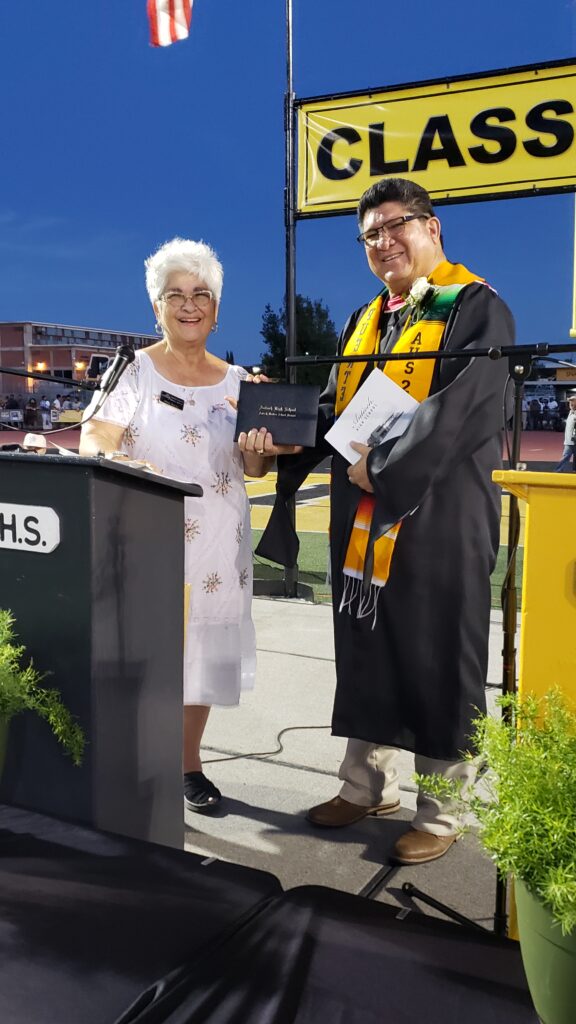
AUSD Trustee Mary Rocha presents her son, AHS Principal Louie Rocha with his “retirement diploma” during his final graduation ceremony in June 2022. Herald file photo
In a statement issued Saturday morning Rocha wrote, “I am a 55-year resident of our community. I grew up in the Mira Vista neighborhood in District 2 and graduated from Antioch High School in 1979.
Following college graduation from SDSU (San Diego State University) in 1984, I returned home to marry my wife, Tammy of 38 years, purchase our family home and raise our twin sons, Louis and Ruben.
I am the retired principal of Antioch High School who served our community as a teacher, football coach, counselor, and school administrator.
As a lifetime resident of Antioch, I have a vested interest in the future of our community. I am concerned about the current challenges that are impacting the health and safety of our residents. Decisions made today will determine the future of our beloved community. I have decided to run for City Council because I believe organizational change starts with change of leadership. Based on the Grand Jury report, there are numerous Brown Act and Human Resources violations that have resulted in high turnover of city staff due to a toxic work environment.
I am committed to restoring city leadership staffing and law enforcement staffing within the allocated resources for vacant positions.
I am committed to resolving the problems of today with long-term solutions that will create a safe, healthy and inclusive community for all of our residents and local businesses.
‘Focused on our Future’
Thank you,
Louie Rocha”
————–
The first-time candidate for public office also shared his resume showing his extensive background serving the Antioch community.
Employment: Program Coordinator, Antioch Sports Legends Hall of Fame Museum at Antioch Historical Society 2022-2024
Itinerant School Administrator AUSD 2023-2024
Retired Principal of Antioch High School. 2006-2022
Assistant Principal at Antioch High School 1999-2006
Varsity Football Coach at Antioch High School 1995-1999
School Guidance Counselor at Prospects High School 1996-1999
REACH Project Teacher / Counselor at Park Jr. High School 1985-1996
Elected Offices:
Antioch Community Foundation (ACF) Board Member/ Secretary 2022-2024
California Interscholastic Federation (CIF)
Executive Committee 2022-2026
North Coast Section (NCS)
Executive Committee 2019-2024
President 2021-2023
American College Testing (ACT)
ACT State Organization President 2016-2018
Honors / Awards
Congressman Mark DeSaulnier Congressional Record of Recognition, Principal of AHS College and Career Academies 2022
Association of California School Administrators (ACSA) Secondary School Principal of the Year 2017
Los Medanos Community College Cesar Chavez Educator Award 2016
President, Antioch Management Association (AMA) 2007-2010 (Serving AUSD employees)
Education: Saint Mary’s College, Master of Arts Degree in Educational Leadership 1992
San Diego State University, Bachelor of Arts Degree Psychology 1985
Los Medanos College, Associate of Sciences Degree 1982
Antioch High School, Graduation Diploma 1979
Faces At Least One Opponent
So far, Rocha, who is also a grandfather of four, is the only candidate to officially announce for the open seat. However, according to her campaign’s Facebook page discovered by the Herald, today, Dominique King, who unsuccessfully ran against Mary Rocha for school board in Area 5 in 2022, posted her campaign logo on Nov. 19, 2023, raised funds last December and held a campaign kick-off event on May 19th. According to the City Clerk’s campaign finance portal, King filed her Candidate Intention Statement on Sept. 29, 2023, and formed her committee on Oct. 17, last year.
Rocha said he doesn’t yet have a campaign website or Facebook page but is expected to have the setup by next week.
The filing period for the seat will be extended until Wednesday, Aug. 14th since the incumbent is not running for re-election.