To meet Nov. 30 deadline for 2027-28 Fiscal Year General Fund reductions
By Allen D. Payton
The Antioch Unified School District Board of Trustees will hold a special meeting for a Budget Study Session on Tuesday, Oct. 20, 2026, at 4:00 p.m. According to the meeting agenda, “The Board will review the District’s current fiscal status and discuss potential budget strategies.”
An overview entitled, “Fiscal Recovery & Financial Stability” will be provided by Rosa Ma Loza, the District’s Assistant Superintendent for Business and Operations, which explains the purpose of the study session is to “Understand Where the revised General Fund budget is allocated; Prioritize What to protect and which unrestricted expenditures to evaluate first; and Direct Board to give staff a clear direction toward October 28 and November 18.”
After having made actual cuts of $10.28 million from the General Fund budget, the Board needs to make an additional $7.99 million in reductions previously reported as attained but as of Oct. 8, now updated as unattained.
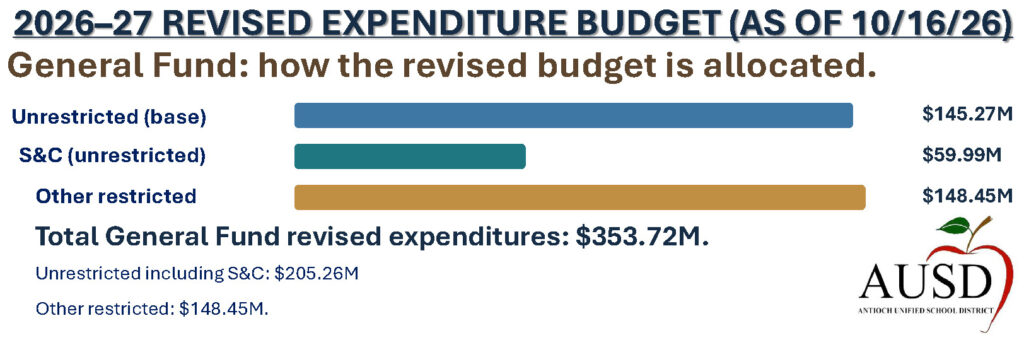
Source: AUSD
Note: S&C refers to Standards and Contract dollars. According to the California Department of Education (CDE), in California school finance, “standard dollars” generally refer to the state’s per‑student Local Control Funding Formula (LCFF) and related budget standards, while “contract dollars” refer to the actual contractual amounts districts must spend or bid for services, often tied to specific agreements or procurement rules.
Standard Dollars — State Funding Standards
The CDE defines “standard” criteria in its Criteria and Standards for Fiscal Solvency for school district budgets. These are the benchmarks used to review and approve district budgets.
Contract Dollars — Procurement and Contractual Obligations
“Contract dollars” are the actual dollar amounts in contracts that districts must follow, often set by law or regulation.
Meetings with Parents, Community, District Leadership & Staff Oct. 26 & 27before Nov. 30 Deadline
The District must submit the detailed list of Board-approved budget reductions for 2027–28 to the Contra Costa County Office of Education by Nov. 30th. Prior to that the Board will hold meetings with parents and the community on October 26, in the morning and afternoon, and with District leadership and staff on October 27.
Meeting Details
The school board meeting will be held in the District Office Board Room at 510 G Street in Antioch’s historic, downtown Rivertown. It can be viewed livestream on the District’s website or the District’s YouTube channel.
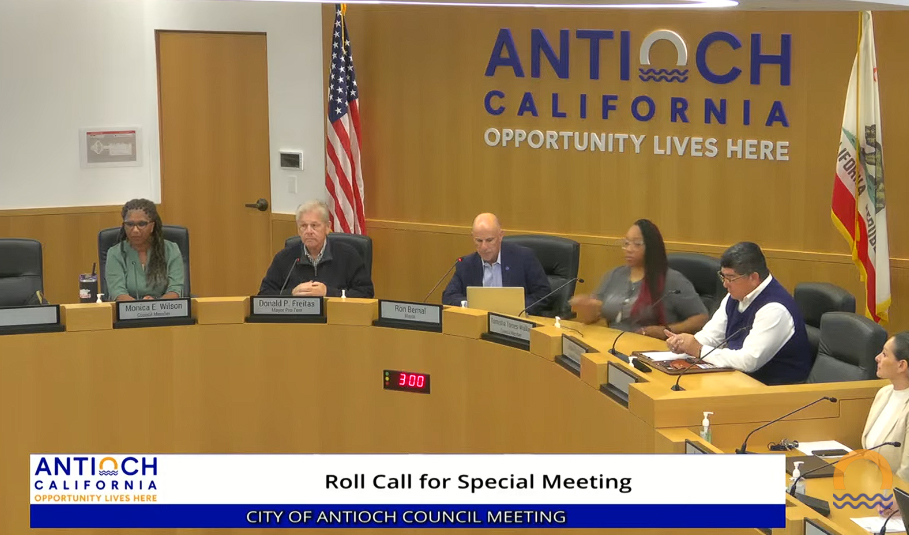
The Antioch City Council gathers for a special meeting before adjourning to a two-hour closed session Monday afternoon, Oct. 19, 2026. Video screenshot
By Allen D. Payton
During a special Closed Session meeting on Monday afternoon, Oct. 19, 2026, the Antioch City Council discussed hiring an interim city manager to take the place of current, Acting City Manager Ana Cortez, who is also the City’s Human Resources Director, until a permanent city manager is hired. But after two hours they took no reportable action City Attorney Lori Asuncion reported out after she and the council members returned to the dais inside the Council Chambers. (See related article)
The one item on the meeting’s agenda read, Public Employee Appointment:Interim City Manager. However, as previously reported, during the Council’s special meeting on Oct. 7th, Asuncion reported out from that meeting’s Closed Session, “If and when an interim city manager is chosen and an agreement reached, the appointment and agreement will be brought to open session during a regular city council meeting for consideration.”
Before adjourning to the closed-door meeting on Monday, the mayor allowed public comments on the matter, which does not usually occur during special meetings but is if the comments are not general but specifically focused on the agendized matters. Yet, no member of the public spoke in person, via Zoom or call-in about the appointment.
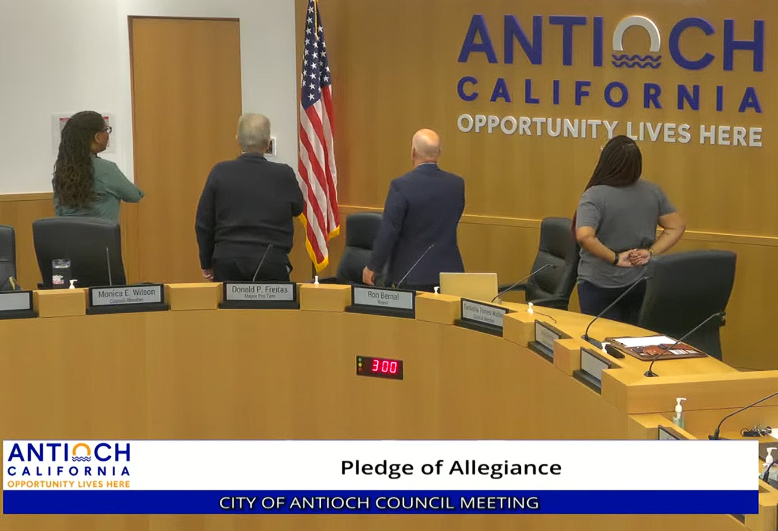
During the Pledge of Allegiance at the beginning of Monday’s special meeting, District 1 Councilwoman Tamisha Torres-Walker can once again be seen not saluting the U.S. flag. Video screenshot.
Report Out from Closed Session
After returning from Closed Session shortly after 4:00 p.m., City Attorney Asuncion said, “there’s nothing to report out.”
For now, the City will continue to operate with an acting city manager, acting director for the Community and Economic Development Department and no assistant city manager. However, the Council has begun the process to hire an economic development director after voting to re-establish that department, again.
Being held on $70,000 bail, has history of 42 arrests in multiple counties since 2016
By Allen D. Payton
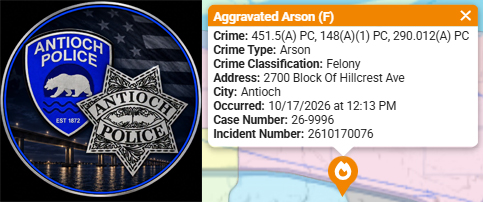
On Saturday afternoon, Oct. 17, 2026, at 12:13 PM, Antioch Police responded to a report of arson at the 7-11 in the 2700 block Of Hillcrest Avenue at E. Tregallas Road. According to CitizenRIMS, 35-year-old Devin Howard Javaughn Taylor (born 3/9/1991) is listed as five-foot, nine-inches tall, 150 pounds, is Black of African American and was charged with two felonies and one misdemeanor for 451.5(a) PC: aggravated arson (F), 148(a)(1) PC: obstructing, resisting, etc. a public, peace officer or emergency medical technician – simple (M), and 290.012(a) PC: sex offender who failed to update their annual registration (F).
According to localcrimenews.com, he has been arrested 41 other times by multiple agencies since 2016, for crimes including sexual battery, indecent exposure, battery on a spouse / co-habitant / former spouse, cruelty to a child by inflicting injury, child endangerment, robbery, burglary, carjacking, battery on a peace officer, willfully harming a peace officer’s horse or dog with injury, DUI, petty theft, trespassing, vandalism and being a transient required to register as sex offender. His most recent arrest was on Sept. 30th this year by Antioch Police for attempting to remove a firearm from a peace officer and resisting an officer or attempting to deter or prevent a public officer from performing their duty.
Save the date for the East Bay Men’s Recovery Center’s Car Show + Trunk or Treat Oct. 31st, 10am- 4pm in Downtown Rivertown, Antioch!
Vehicles will be displayed on G Street from the river (bulb) to 4th Street and on W. 2nd Street from I (eye) Street to F Street.
We’re excited to spend time in our community, create a safe space for kids to get their candy, and raise money for our recovery program!
Interested in becoming a sponsor? Give us a call or send us a message at 1-800-418-6139 or info@ebmrc.net.
The East Bay Men’s Recovery Center works to give “men struggling with addiction a hand up, not a handout” offering a 12-month program at their location in Antioch. For more information about ebmrc.net.
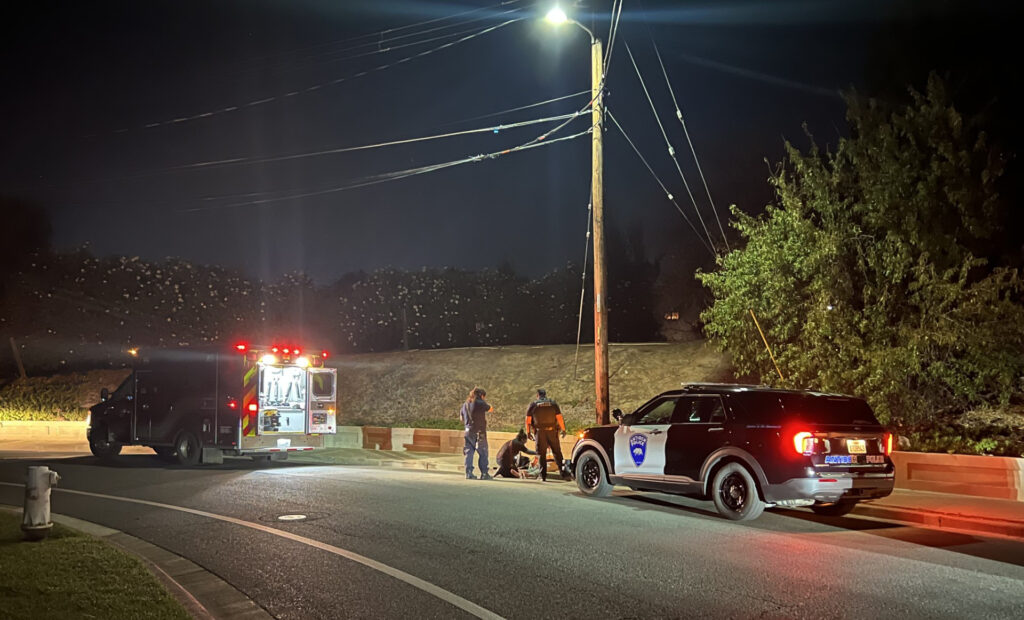
Con Fire and Antioch Police personnel attend to the stabbing victim near the corner of N. Lake and E. Lake Drives early Sunday morning. Photos by Allen D. Payton
By Allen D. Payton
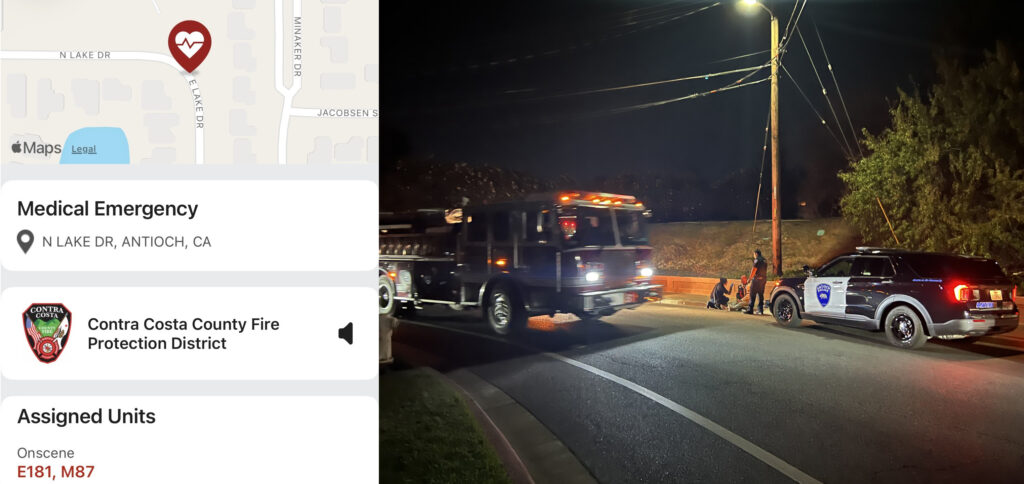
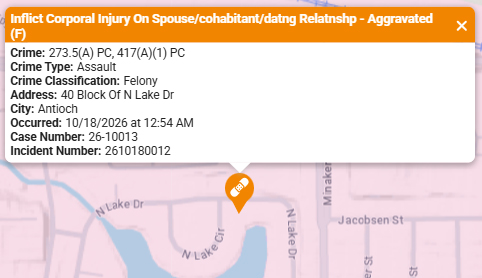
Early Sunday, Oct. 18, 2026, at 12:54 AM, Antioch Police were called to a stabbing, according to dispatch. According to the Antioch Police CitizenRIMS, the incident occurred in the 40 block of N. Lake Drive, police and Con Fire personnel responded and were seen treating a man sitting on the sidewalk near the home.
A Con Fire engine leaves the scene as the victim is attended to early Sunday morning.
The incident is described as a domestic dispute and inflicting corporal injury on a spouse, cohabitant or dating relationship – aggravated 273.5(A) PC., the crime type is listed as an assault and classified as a felony.
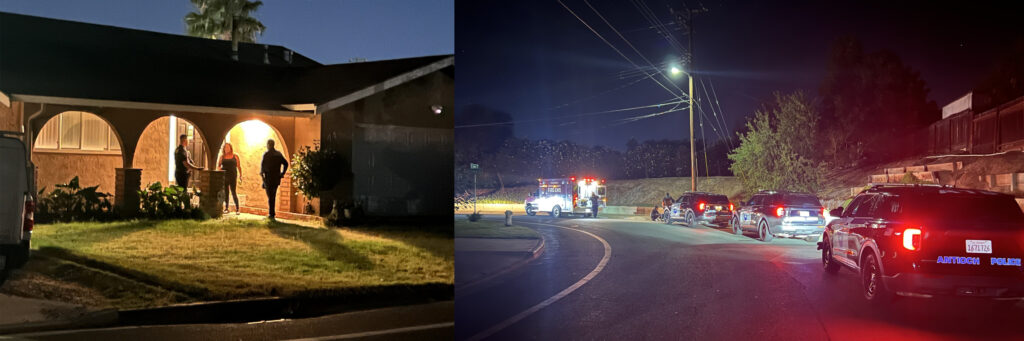
Multiple officers responded and two could be seen speaking with a woman at the home where the stabbing occurred.
Teresa Linda Iglesias, age 44, was arrested and charged with the aforementioned crime and 417(a)(1) PC: exhibiting a deadly weapon other than a firearm – weapon law violations, misdemeanor. The five-foot, six-inch tall, 170-pound suspect is white.
According to the Contra Costa County Sheriff’s Office, Iglesias was booked into county jail at 7:47 AM Sunday and bonded out of custody at 12:56 PM that same day.
28 charged in statewide Operation Protect the Vote, five in Bay Area
By Ciaran McEvoy, PIO, U.S. Attorney’s Office Central District of California
LOS ANGELES – Federal law enforcement throughout California today arrested 11 foreign nationals living in the United States who are charged in criminal complaints with federal crimes, including that they fraudulently registered to vote in U.S. elections, electoral contests in which most of them cast illegal and fraudulently obtained ballots.
A total of 28 people were charged statewide, 21 who actually voted in elections and 11 were arrested today. Law enforcement is seeking the other individuals or they have been summoned.
Source: republicanpollworkers.com
Today’s arrests are part of “Operation Protect the Vote” – a coordinated effort among all four California-based United States Attorney’s Offices to combat and root out fraud in U.S. elections and protect electoral integrity.
All 28 foreign nationals charged are lawful permanent residents (LPRs), or “green card” holders. Although LPRs have legal immigration status in the United States, they are not U.S. citizens and are not permitted to vote in U.S. elections.
The criminal charges include making false statements in a naturalization application and some of the defendants also are charged with fraudulent voter registration. Both charges are felonies that carry a statutory maximum sentence of five years in federal prison.
The defendants arrested today are expected to make their initial appearances this afternoon in U.S. District Court. No pleas will be taken today.
On October 13, the federal government provided a list of these individuals to California to ensure that their vote-by-mail ballots were set aside until these individuals’ citizenship status could be confirmed. California declined to assist the federal government in setting aside their ballots, prompting a lawsuit by the United States that seeks a court order to prevent the unlawful dilution of American citizens’ votes and to uphold the integrity of our elections.
“Every illegal vote cancels out the vote of a lawful American citizen,” said Acting Deputy Attorney General Trent McCotter. “Each of the 28 defendants charged today appears on the list of more than 20,000 likely noncitizen registrants we provided to California election officials last week. California refused to look at that list. Today’s charges show exactly what that refusal puts at risk. California must verify the citizenship of those more than 20,000 registrants before mail-in ballots are counted.”
“Today’s arrests prove what we have been saying,” said First Assistant United States Attorney Bill Essayli. “California is mailing ballots to noncitizens, and they are refusing to comply with federal law, which makes it a crime for noncitizens to vote. The voting rights of American citizens must be protected.”
“Homeland Security Investigations (HSI) is committed to protecting the integrity of our nation’s electoral process by investigating allegations of criminal conduct that undermine public confidence in our elections,” said HSI Acting Executive Associate Director John A. Condon. “Working with our federal, state, and local law enforcement partners, we will continue to pursue those who knowingly violate federal law, while ensuring that every investigation is conducted fairly, thoroughly, and consistent with due process.”
According to court documents, the defendants knowingly and willfully lied under oath in their voter registration applications that they were U.S. citizens to be permitted to vote in California. Their fraudulent voter registration applications were approved, and, in many cases, the defendants illegally voted in recent U.S. elections. They subsequently lied in their paperwork to become naturalized U.S. citizens that they had never claimed U.S. citizenship, nor had they registered to vote or voted in U.S. elections.
Broken down by jurisdiction, the following defendants are charged in today’s takedown:
Central District of California
All the following defendants below in this jurisdiction face felony charges, including false statements in a naturalization application:
Omar Alexander Muñoz, 72, a Belizean national living in Commerce, fraudulently registered to vote in September 2019, claiming his was a U.S. citizen, then voted in U.S. elections in 2020, twice in 2022, and in 2024. He also lied on his application to become a naturalized U.S. citizen when he falsely stated under oath to have never claimed to be a U.S. citizen.
Amandeep Kaur, 30, an Indian national living in Rancho Palos Verdes and who is seeking to become a U.S. citizen, fraudulently registered to vote in December 2022 and voted in the November 2024 U.S. election.
Ana Domínguez, 60, a Salvadoran national living in Long Beach, fraudulently registered to vote in July 2006 and lied in her naturalization paperwork in March 2026.
Axel Giovani Prera García, 46, a Guatemalan national and Pico Rivera resident, fraudulently registered to vote in 2002 and 2005, and lied in his naturalization paperwork in June 2025.
Flavio Alejandro Zúñiga, 43, a Mexico national and La Puente resident, fraudulently registered to vote in 2003 and lied in his naturalization paperwork in February 2026.
Butleng Taing, 43, a Cambodian national living in Long Beach, fraudulently registered to vote in July 2021, voted in the 2022 and 2024 U.S. elections, and lied on his naturalization paperwork in August 2025.
Carlos Antonio Galeas, 54, a Honduran national and West Covina resident, fraudulently registered to vote in 2012 and 2016, then lied in his naturalization paperwork in September 2018.
Ernest Gutiérrez Ruvalcaba, 57, a Mexican national living in Wilmington, fraudulently registered to vote in February 2024 and voted one month later.
Jesús Narez-Madrigal, 52, a Mexican national living in Carson, fraudulently registered to vote in 2014, voted in the 2024 U.S. general election, and lied in his naturalization paperwork in June 2024.
José Antonio Bañuelos-Díaz, 42, a Mexican national and West Adams resident, fraudulently registered to vote in 2007 and lied on his naturalization paperwork in March 2025.
Muhammad Khan, 50, a Pakistani national and Anaheim resident, submitted a provisional ballot in 2020 and lied on his naturalization paperwork five years later.
Rouzbeh Seyamaknejad, 63, a Canadian national and Rancho Palos Verdes resident, fraudulently registered to vote in December 2018, lied in his naturalization application in January 2024, and voted in the November 2024 U.S. election.
Sulema de León, 35, a Mexican national and Long Beach resident, fraudulently registered to vote in 2013, lied on her naturalization application in 2019, and voted in the November 2020 U.S. general election.
Eastern District of California
The following defendants are charged with voting by an alien in a federal election, a misdemeanor that carries a statutory maximum sentence of one year in federal prison:
Maricela Nazarín González, 43, a Mexican national living in Clovis, registered to vote in 2020, indicating that she was a U.S. citizen, and voted in elections in 2022, twice in 2024, and 2025.
Rony de Jesús Sicaja, 38, a Guatemalan national living in Fresno, fraudulently registered to vote in 2017, and voted in the June 2022 primary election and the November 2024 general election in the United States.
Camino Giles Jiménez, 51, a Mexican national living in Kerman, knowingly voted in three U.S. elections despite knowing he is a noncitizen, the most recent election being the June 2026 primary.
Juan Antonio Rivas García, 46, a Mexican national and Sacramento resident, fraudulently registered to vote in 2018 and 2020, both times falsely asserting under oath that he was a U.S. citizen. Rivas voted in the 2022 and 2024 U.S. elections.
Giezell Viduya Adawag, 41, a Philippines national and Vacaville resident, fraudulently registered to vote the day of the November 2024 general election, falsely certified that she was a U.S. citizen, and voted in the election that day.
Kamlesh Navnitlal Shah, 67, an Indian national living in Sacramento, fraudulently registered to vote on the day of the November 2024 general election and voted that day. He is charged via information.
Northern District of California
The following defendants are charged with attempted procurement of naturalization contrary to law, false statement under oath in any matter relating to naturalization or citizenship, and voting by an alien:
Verónica Bullene, 43, a.k.a. “Verónica Hernández Martínez,” a Mexican national living in Petaluma, made false statements on her naturalization application that she had never claimed to be a U.S. citizen when, in fact, she did so under penalty of perjury to register to vote in 2022 and 2023 then voted in 2024.
David Shapiro, 41, a Georgian national living in San Jose, fraudulently registered to vote in 2024 and later voted in a U.S. election, and made false statements on his naturalization application that he had never claimed to be a U.S. citizen.
Moe Thida Lwin, 57, a Myanmar national and Daly City resident, fraudulently registered to vote in 2024 and then proceeded to illegally vote in a U.S. citizen. She made false statements on her naturalization paperwork as well.
Manakotau Mataele Finau, 61, a Tongan national and Hayward resident, fraudulently registered to vote in the 2024 election then vote, then lied about it in naturalization paperwork.
Maribel del Carmen Garcés Barriga, 62, an Ecuadoran national and San Francisco resident, made false statements in her naturalization paperwork that she never claimed U.S. citizenship and had never voted in a U.S. election or had registered to vote. In fact, Garcés fraudulently registered to vote in 2024 and proceeded to vote in a U.S. election.
Southern District of California
The following defendants are charged with false claim to citizenship to vote, unlawful attempted procurement of naturalization, and false statement under oath in matter relating to naturalization or citizenship:
José Probitsado Amaro, 51, a citizen of the Philippines living in National City, fraudulently registered to vote by falsely claiming to be a U.S. citizen. He then cast a ballot in the November 2024 general election and made false statements during his naturalization interview, denying that he had ever claimed U.S. citizenship and misrepresenting his voting history.
Jennifer Jung, 31, a Canadian national living in San Diego, fraudulently registered to vote by falsely claiming to be a U.S. citizen. She then cast a ballot in the November 2024 general election and made false statements during her naturalization interview, denying that she had ever claimed U.S. citizenship and misrepresenting her voting history.
Erick Ronaldo Soto Mendizábal, 64, a citizen of Guatemala and former Oceanside resident now living in Moreno Valley, fraudulently registered to vote by falsely claiming to be a U.S. citizen. He then cast a ballot in the November 2024 general election and made false statements in his naturalization application, denying that he had ever claimed U.S. citizenship and misrepresenting his voting history.
Pamele Arbués Line, 56, a citizen of the Philippines living in Escondido, registered to vote, cast a ballot in the November 2024 general election, and made false statements in her naturalization interview, denying that she had ever claimed U.S. citizenship and misrepresenting her voting history.
Criminal complaints and informations merely contain allegations. All defendants are presumed innocent until proven guilty beyond a reasonable doubt in a court of law.
Homeland Security Investigations (HSI) is investigating these matters in the Central District of California. HSI and the FBI are investigating these matters in the Eastern and Northern Districts of California. HSI, the FBI, and United States Citizenship and Immigration Services are investigating the matters in the Southern District of California.
Assistant United States Attorneys Michael Wheat and Minjae Kim of the Orange County Office are prosecuting the Central District of California cases. Assistant United States Attorneys Kevin Khasigian and Joshua Banister are prosecuting the Eastern District of California cases. Special Assistant United States Attorney Roger Dinh is prosecuting the Northern District of California cases.
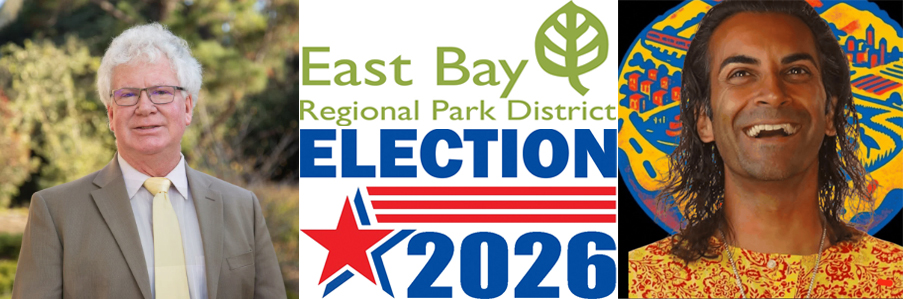
Incumbent Colin Coffey is facing challenger Inderprit Sekhon in this year’s East Bay Regional Park District Ward 7 race. Photos: EBRPD and LinkedIn
Colin Coffey’s challenger, Inderprit “Indy Rishi Singh” Sekhon, wants “to promote and educate about ecological medicine” and “dance for office instead”while the incumbent touts his accomplishments and plans
By Allen D. Payton
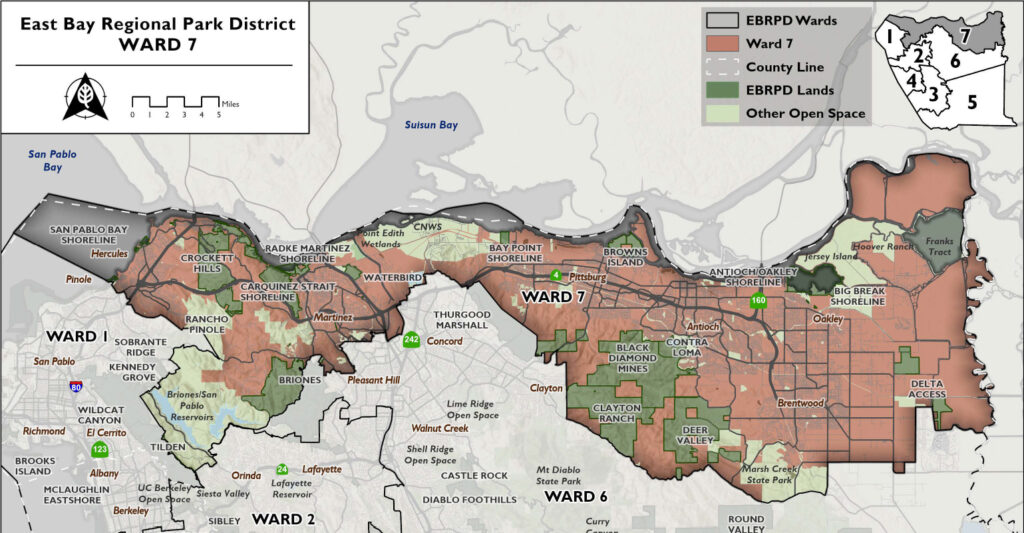
Running for a third four-year term as a Director on the East Bay Regional Parks District in Ward 7, Colin Coffey faces a unique candidate, Inderprit “Indy Rishi Singh” Sekhon, who is running a different campaign while dancing to a different tune and offering an alternative focus and approach to the position. Ward 7 includes the northern waterfront portion of Contra Costa County from Pinole and Hercules in the west to the eastern county line north of Discovery Bay. (See map and below)
Cities and Communities in Ward 7 include: A portion of Alhambra Valley south of Martinez, Antioch, Bay Point, Bethel Island, Brentwood, Clyde, Crockett, Hercules, Knightsen, Martinez, and the adjacent Mountain View on the east side, Oakley, Pacheco, Pittsburg, Port Costa, Rodeo and Vine Hill between Martinez and Pacheco.
The Regional Parks in Ward 7 include: Antioch/Oakley Regional Shoreline, Bay Point Regional Shoreline, Big Break Regional Shoreline in Oakley, Black Diamond Mines Regional Preserve in Antioch, Briones Regional Park west of Pleasant Hill, Browns Island Regional Preserve north of Pittsburg, Carquinez Strait Regional Shoreline, Clayton Ranch Regional Preserve, Contra Loma Regional Park in Antioch, Crockett Hills Regional Park, Delta Access Regional Recreation Area north of Discovery Bay, Radke Martinez Regional Shoreline in Martinez, Rancho Pinole Regional Preserve east of Pinole, San Pablo Bay Regional Shoreline, and the Waterbird Regional Preserve/McNabney Marsh near Martinez.
Asked why Rancho Pinole doesn’t appear in the list of parks on the District’s website, Coffey shared, “Rancho Pinole lands in a section of the 2013 Master Plan that will be a regional park. It’s not currently operated by the District, but by the John Muir Land Trust. It includes Fernandez Ranch, about 1,000 acres, also includes the Franklin Canyon Ranch, surrounding the golf course. It totals about 2,000 acres so far. The Park District has partial ownership interest in Fernandez Ranch. The plans show someday it will all be converted to an East Bay Regional Park District park.”
Also, Deer Valley Regional Park south of Antioch, which includes the former Roddy Ranch Golf Course “is being returned to its original natural habitat. They’re ripping up the golf course paths as they’re not suitable for hiking,” he continued. “We recently acquired more land on Briones Valley Road near Brentwood. It will possibly break ground early next year. Within a year it’s possible we’ll open to the public. We already have a parking lot there, which really helps. We’re doing public programming there, already.”
East Bay Regional Park District Ward 7 boundary map. Source: EBRPD
About Coffey
According to his bio on the East Bay Regional Parks District website, retired attorney Coffey is a resident of Hercules and “was appointed to the Board in January 2017. Previously, he served on the Park District’s Park Advisory Committee twice, first appointed by former EBRPD Director Ted Radke from 2001-2009 and appointed by the Contra Costa County Board of Supervisors from 2012- 2017. He has also been a volunteer Ambassador for the parks for 19 years. He is a longtime supporter of the John Muir Land Trust and a member of the Regional Parks Foundation.
“Director Coffey is a retired partner with the (law) firm Best, Best & Krieger in Walnut Creek. Director Coffey is a public health attorney, representing public and nonprofit healthcare providers. He is a past president of the Contra Costa Bar Association. Director Coffey is married, has two children and resides in Hercules. He is a lifelong resident of Contra Costa County.”
According to his campaign website, Coffey “was elected to the Board in 2018 and re-elected in 2022. He was a public health attorney, representing public and nonprofit healthcare providers and is a past president of the Contra Costa BAR association.
“Coffey’s family was politically active, and he served as an intern in then-Congressman George Miller’s Washington, DC office in his youth and later was the Congressman’s appointee to the Democratic Central Committee for 23 years.
“Coffey, his wife Mila and their two adult children are life-long parks and trails enthusiasts.”
His campaign is focused on the following issues: “Preservation of New Open Space and Wildlife Habitat / Aggressive Pursuit of Wildfire Risk Reduction / Enhanced Public Safety in the Parks; New Open Spaces; and Wildfire Mitigation.”
Coffey offers a long list of his accomplishments while in office under the categories of Leadership, Preservation of Open Space and Wildlife Habitat or Restoration of Natural Areas and Excellence in Programs and Policies.
He also shares under “Looking Forward – If Re-elected:” that fact that in “2027 I will be President of the Board and working with our new GM Max Korten. This will represent a huge opportunity for North and East Contra Costa input into open space preservation and wildlife habitat preservation. I will help complete a new 10 year Master Plan, highlighting future preservation of open space and wildlife habitat, more ways to enjoy open space, and continued focus on wildfire risk reduction.” Plus, other projects such as, “Extend the Marsh Creak Regional Trail to Dutch Slough on the North and to Round Valley Regional Park on the South” and “Build the proposed Delta Bay Trail from Bay Point to Antioch/Oakley and beyond,” and “Repairing and funding Hazel Atlas Mine and Great House Visitor Center to keep consistently open,” in East County.
Plus, “Rancho Pinole acquisitions and regional park development in partnership with JMLT (John Muir Land Trust) to create a future large regional park in the Hercules and Pinole area” and “Support Rodeo Community Association campaign to have EBRPD expand Lone Tree Point Park and clean up contaminated land in the area. Incorporate Greenway Vision for Rodeo shoreline into Master Plan” in West County.
About Inderprit “Indy Rishi Singh” Sekhon
According to the campaign website for Crockett resident Inderprit “Indy Rishi Singh” Sekhon, he “is a regenerative farmer, community organizer and systems thinker. His work focuses on the relationship between personal health, community wellbeing and the health of the land. He is running because he believes the Park District can build on its legacy of land protection and become a more active partner in public health, climate resilience, ecological restoration and community stewardship. His question is straightforward: How can the land we have already protected do more good for the people and places around it?”
In a post in August on his LinkedIn profile page, Sekhon wrote, “I’m on the California ballot as Inderprit Sekhon (government name). Check out what East Bay Regional Park District does and get involved with our campaign. We are seeking to collaborate with healers, artists, educators, ecological stewards, farmers, and anyone who feels like their skills/ideas are important, but not valued enough by government or current economic systems. Learn more about my intention to promote and educate about ecological medicine,” with a link to the website for his non-profit organization named Cultivating Self.
In that same LinkedIn post is a video which he says, “I don’t know why I’m doing this. But I’m running for office this fall. But, yeah, maybe I do know why I’m doing this. But I also feel it’s good to not know why I’m doing this,” with a laugh. “How can an organization with so much money and have so many resources how can it be a resource for the community, an asset for the community…how can that be part of our preventative, ecological medicine? That’s why I’m doing this. I don’t even know why and also, I do know that we need to do something…”
Then, in a post on Friday, Sept. 18, Sekhon wrote, “What if a neurodivergent Generalist ran for office? What if he decides to dance for office instead? find out what’s possible: https://lnkd.in/gsQVRw8h.”
That takes you to his campaign website where it shares his slogan, “Healthy land. Healthy people. Public money that works.” He writes, “The District has spent generations protecting land. Indy’s campaign asks how that protected land can more fully sustain the people and communities around it,” and his platform is to “Protect. Connect. Deliver.”
Under “Protect” Sekhon writes, “Care for the land before the emergency.Keep land, water, roads, trails and fire-prone landscapes healthy and safe — with maintenance and ecological stewardship matched to the places the District manages,” and lists “Wildfire resilience, Wetlands and shorelines, and Healthy soil and habitat.”
Under “Connect” he writes, “Make parks work for more people.Treat parks as public-health and belonging infrastructure, with better access, locally relevant programming and meaningful ways for residents to participate,” and lists, “Health and wellbeing, Transit and first-visit access, and Youth and paid stewardship.”
Finally, under “Deliver” Sekhon wants to, “Make public money produce visible results.Modernize field systems, publish priorities and costs, and make it easier to see what is being fixed, restored and improved,” and lists, “Transparent priorities, Modern field tools and Measurable outcomes.”
The first-time candidate also offers what he calls his Donut Vision 2036, of “A safe and thriving place for people and planet,” and writes, “Doughnut Economics asks how we meet more human needs without damaging the living systems we depend on. Indy’s 2036 vision applies that question to Ward 7’s parks and communities.”
Under the subheading, “People thrive” Sekhon shares about “Health, Food, Youth and Access,” and under the subheading, “Nature thrives” he writes about “Fire resilience, Shorelines, Biodiversity and Circular systems,” specifically, “Turn organic material back into useful ecological value.”
Sekhon also writes, “The theory of change: If we invest in parks as infrastructure for both people and planet, healthier land can support healthier communities, healthier communities can become stronger stewards, and accountable public systems can reinforce both.”
He then offers what the future will look like by following his vision, writing, “Ward 7, 2036. See the place. Imagine the next chapter.” Sekhon offers six parts to his vision: “The Shoreline We Can Restore, The Park That Heals, The Park That Feeds, The Park That Creates Work, The Government You Can See, and The Land We Care for Before Crisis.”
Under “Public money that works – You should be able to see what your Park District is doing,” Sekhon writes, “The argument is not that every public dollar is discretionary. It is that a large public institution should make its priorities, costs and results understandable.”
He includes eight focus areas: “Maintenance response & repair times; Trail & facility condition over time; Wildfire hazards treated & acres restored; Water quality & ecological outcomes; Residents reached; Local organizations contracted; Ward 7 investment; and Project costs, owners & timelines.”
Under “Heartstorming Ward 7 Listening that leads somewhere” Sekhon explains, “Most public engagement begins with a survey. Heartstorming begins with a place, a conversation and a practical question: What would help your community thrive here?” He lists five tasks to accomplish it: “1 Experience the place, 2 Share what you see and need, 3 Imagine what could change, 4 Connect ideas to policy and action, and 5 Invite people back into the work.”
Finally, Sekhon offers, “Plain-language FAQ What does this mean?” and asks and answers four questions: “Why call it ‘Doughnut Vision’? The doughnut is a simple model: make sure people can thrive while keeping ecological systems healthy. The campaign uses it as a long-horizon method, not as a prerequisite for understanding the platform.”
He continues, “Is every 2036 idea already an official Park District program? No. The site distinguishes campaign proposals and future concepts from existing District programs. Partnerships are not implied until they are actually established.”
Recognizing his limitations as only one of seven board members Sekhon writes, “What does one Park District director control? One director does not control the District alone. Indy would need to build public support and Board support for pilots, policies and investments.”
Finally, the challenger asks, “Why focus on public systems?” His answer is, “Maintenance, ecological care, field data and capital decisions are connected. Better information and clearer priorities can help staff, the Board and residents understand what needs attention and what progress looks like.”
Sekhon then invites voters to “Help shape Ward 7’s next decade. Vote. Volunteer. Share a park story. Come to a Heartstorming event. Help turn a long-horizon vision into practical work.”
AUSD is at a crisis point. This is no time to elect someone without the experience, financial or otherwise, to keep the district afloat while critical decisions are being made.
Mary Rocha voted:
• No on hiring the current embattled superintendent,
• No on salary increases without budget impact information,
• No on mass layoffs, without Explanation on how students would still be served with less staff.
Mary has pressed the superintendent to focus on students, parents, and the community, and she has been the voice of reason while the superintendent provided little to no information about the current fiscal crisis
Experience matters. Mary has served on the board since 2018 and is the only trustee who brings experience and institutional understanding to the table. Two members (Cabos Smith and Brown) are in their first term. The current board president (Jag) is not running again and will be replaced in December by a new board member (Reese). The immediate past president (Hernandez) is in his sixth year, however he spent those years pursuing graduate work at Stanford and Davis toward becoming a physician, and in my view gives minimal attention to his role as trustee.
The political practice of districting, implemented in 2022, brought four new members to the board who lacked the experience to make decisions with long-term consequences.
It was not always this way. Before districting, the board was made up of trustees with varied backgrounds and focus. Gary Hack, a former teacher and AEA president, brought understanding of and advocacy for employees. Claire Smith, who had children in the district for many years, was the voice of parents, families, and students. As a former corporate director and nonprofit executive director, I spent my 12 years focused on contracts and fiscal solvency. A diverse board with diverse opinions has always served this district best.
The results of the current board’s decisions are clear:
The superintendent’s hiring. She was hired by a 4-1 vote without fully vetting her background. A simple Google search shows she left Sequoia Union High School District in December 2022 with a $299,000 severance package under a mutual separation agreement, and that her later tenure at Pacifica School District drew backlash over budget deficits and job cuts. Her contract gave her the same number of workdays as a principal, which is unheard of. A new salary scale was created for her, far above those of former superintendents. A $12,000 relocation package was included, and the reimbursements approved only by the board president at the time (Hernandez) are questionable.
Raises for all. The board approval was 4-1 based on a positive certification reported in 2025–26 First Interim Report (December 2025), which should have begun with “once upon a time…
Layoffs. After a deficit of more than $30 million was uncovered, layoffs were made without a solid plan from the superintendent. The scattershot approach, meant to save $18 million, did little to achieve fiscal solvency, and more layoffs are coming.
Special education. The department was reorganized to save $600,000. Directors were combined, left for other districts, or not rehired. That decision gutted the department and leaves the district open to lawsuits, as students may not be receiving their IEP-mandated services.
Today, the district faces a serious deficit, superintendent is on paid administrative leave and has filed a lawsuit naming AUSD, Mary Rocha as an individual, and Unnamed Individuals 1 through 50. In my opinion, that suit is a strategy to secure another package to quietly go away, as she did at Sequoia.