Former Mayor and City Treasurer Jim Davis takes his oath of office at the Antioch City Clerk’s Office on Friday, Aug. 8, 2024, to run for City Treasurer, again. Photo: Davis for Treasurer
It’s Jim Davis vs. Lori Ogorchock, so far
By Allen D. Payton
Former Antioch mayor and city treasurer, Jim Davis, filed to run for treasure again in the November election, challenging District 2 Councilwoman Lori Ogorchock. Incumbent Lauren Posada, who beat Davis in 2020, is not seeking re-election. As a result, the filing period is extended until next Wednesday, Aug. 14 at 5:00 p.m.
Ogorchock filed her paperwork on Thursday, according to the City Clerk’s report.
A press release announcing Davis’ campaign reads, “Having worked and served with integrity and distinction for 35 years in the private sector and 16 years in the public sector including City Treasurer for the City of Antioch, I have extensive experience and knowledge to honorably serve and fulfill the duties of the office of City Treasurer for the City of Antioch”
“Antioch needs a dedicated, transparent and independent watchdog to oversee the function of this important office,” he continued. “It’s imperative Antioch fully comprehends our serious financial strains as well as our operating budget and financial reserves including stewardship over our investment accounts and policies.”
Davis has a background in banking.
Having been gerrymandered out of her district by the council majority in 2022, Ogorchock is precluded from running for re-election to the city council. At one point she considered running for mayor but chose not to. Ogorchock’s background is as a real estate agent.
A third candidate, Jorge R. Rojas, Jr., pulled papers on Wednesday, but had not yet filed them as of Friday. An effort to reach Ogorchock for comment was unsuccessful prior to publication time.
Please check back later for any updates to this report.
Photo sources: Bernal campaign. Hernandez-Thorpe Official Faceebook page.
Challenger raised almost $128K since January launch a majority from within Antioch
Incumbent raised $59K this year mostly from outside Antioch but transferred $58K from recall opposition committee after reimbursing it $5,700 giving him $117K to spend on re-election.
Mayor’s reports show $5,200 in travel expenses this year; plus, multiple errors including incorrect dates, amounts, but corrected after Herald inquiry; fails to disclose all required information; refuses to answer most questions; state watchdog agency reviewing reports
By Allen D. Payton
In the race for Mayor of Antioch for the November election, former city manager Ron Bernal has outraised incumbent Lamar Hernández-Thorpe by more than double this year, according to the most recent campaign finance reports. Known as a 460 Recipient Committee Statement required by state law for transparency, Bernal’s report, covering Jan. 1 through June 30, 2024, show he raised $127,645.34 in cash and in-kind contributions, of which almost $111,000 was cash, while the mayor’s reports show he raised $58,794 in cash. But Hernandez-Thorpe transferred $58,221.60 from his recall opposition campaign giving him $117,015.60 to spend in support of his re-election.
As of June 30th, Bernal’s campaign had spent $39,847.37 leaving him with $87,797.97 cash remaining to spend. (See Bernal for Mayor 460 report for 01/01-06/30/24)
The Lamar Hernández-Thorpe for Antioch Mayor 2024 committee’s 460 report for the period Jan. 1 and June 30, 2024, shows $58,794 in contributions in the totals. It also includes the amount of $58,221.60 shown on the Termination Statement for his Stop the #KAREN Recall of Mayor Lamar Thorpe 2022 committee, for the period beginning Jan. 1, 2024, ending on Feb. 14, 2024, and filed the next day, that was transferred to his mayoral campaign committee. So, Hernandez-Thorpe’s total funds available during the period were $117,015.60. His re-election committee spent $17,761.29 leaving the mayor with $99,204.31 to spend. (See Hernández-Thorpe’s re-election committee 460 report)
He formed his re-election committee on Sept. 26, 2023, but didn’t begin raising funds for it until this year.
Another contrast between the two candidates’ campaign finances is that most of the funds received by Bernal were from within Antioch while most of the mayor’s funds came from outside the city.
Mayor’s Multiple Mistakes, Miscalculations, Missing Money and Information
Although he previously ran three times for the Antioch City Council, including once for mayor, and raised funds to defeat the attempted recall against him in 2022, Hernández-Thorpe and his treasurer Vicki Robinson haven’t been reporting his campaign finances properly as they show multiple mistakes in both calculations and dates, and have not provided required disclosure information. However, after questions from the Herald, his campaign submitted corrected versions of the two final reports for his Stop the #KAREN Recall Committee covering July 1 through Dec. 31, 2023, and Jan. 1 through Feb. 14, 2024, when he terminated the committee and transferred the balance to his re-election committee.
Recall Opposition Committee Reports Were Missing $4,000
The mayor’s original recall opposition committee report for July 1 through Dec. 31, 2023, showed an Ending Cash Balance of $59,936.54 (p.3). But the committee’s original 460 report for Jan. 1 through Feb. 14, 2024, the date it was terminated, shows a Beginning Cash Balance of $55,929.86 on the Summary Page (p.3) a difference of $4,006.68. He was asked where did that money go, and if he borrowed the funds, not report it and later reimburse the recall opposition committee $4,099.02 on Feb. 12, 2024, to cover it. (See Stop the #KAREN Recall Committee 460 for 01/01-06/30/23 amended prior to the Herald’s review, original 460 report for 07/01-12/31/23, and original Termination 460 Report for 01/01-02/14/24)
Instead of responding, Hernandez-Thorpe submitted Amendments to the reports on Monday, Aug. 5. (See below)
Hernández-Thorpe Reimbursed Recall Opposition Committee Almost $5,700
Hernández-Thorpe’s Stop the #KAREN Recall committee original report for July 1 through Dec. 31, 2023, has incorrect dates on the Schedule I, Miscellaneous Increases to Cash (p.8) showing the “Statement covers period from 07/01/2024 through 12/31/2024” and an amount of $1,331.09 reimbursed by the mayor on Jan. 29, 2024. While the subtotal shows $1,339.09 the correct $1,331.09 figure appears on the Summary Page (p.3).
In addition, his recall committee’s original Termination Statement 460 dated Feb. 14, 2024, on Schedule I, Miscellaneous Increases to Cash, shows he reimbursed the committee an additional $4,099.02 on Feb. 12, 2024 (p.5).
His Amended 460 for the recall opposition committee for Jan. 1 through June 30, 2023, shows another $251.02 in “Returneding [sic] funds”.
That totals $5,681.31 that Hernández-Thorpe reimbursed his recall opposition committee before terminating it and transferring the remaining funds to the re-election committee.
He was asked if those amounts were for personal expenditures on which he shouldn’t have spent committee funds. But Hernández-Thorpe did not respond.
His 460 report for Jan. 1 through June 30, 2023, for the Stop the #KAREN Recall committee shows expenditures including a contribution to his former employee, Nichole Gardner’s non-profit, Facing Homelessness in Antioch of $500, and another contribution to Team Jesus Ministries in Bay Point of $100, to which he contributed an additional $1,500 this year.
The amounts on the original 460 report for the time period of July 1 through Dec. 31, 2023, for the Stop the #KAREN Recall committee under Schedule E Payments Made are also incorrect (see pages 4-7). The total of Itemized payments (for amounts $100 or more) for the period from the four pages was actually $4,005.34, but the amount shows only $3,098.84, a difference of $906.50. The report also shows a total of $999 in payments made of less than $100 for a total of what should be $5,004.34. Yet, the Total Cash Payments on the Summary Page (p.3) show only $4,097.84. The Ending Cash Balance shows $59,956.34 but it should have been $59,049.84. But without any additional contributions, only $58,171.60 was transferred to his 2024 re-election committee, a difference of $878.24.
Combined with the correct Beginning Cash Balance of $62,221.05, the Ending Cash Balance for the recall opposition committee Termination Report should have shown as $58,547.80 of which $58,171.60 was transferred to his re-election committee leaving a balance of $376.20. But with expenditures this year by the recall opposition committee of $1,809.98 and the reimbursement of $4,099.02, that leaves a discrepancy of $2,665.24 in missing funds.
However, as mentioned, the mayor submitted an amended form earlier this week with the correct figures. (See below)
Spent $5,200 on Travel This Year
Hernández-Thorpe’s re-election committee report shows he spent almost $5,200 in the category of “candidate travel, lodging and meals” labeled as TRC. (See pages 13-18) That includes $198.10 paid to United Airlines, $131.09 to Spirit Airlines, $185 for the Delphi Hotel in Los Angeles, $1,389.08 for a stay at the Hotel Washington in D.C., $549 to the Bethesdan Hotel in Bethesda, Maryland, and another $641 was paid to the Morrison Hotel, also in Washington, D.C. and $150 and $178 for parking at SFO, two payments for $554.11 each to United Airlines and spent $651.70 at the Marriott Metro Center hotel, also in Washington D.C. for a total of $5,181.19.
The mayor was asked what those trips were for and how they benefited his re-election campaign.
The FPPC was asked if that is allowed for a local candidate running for re-election if he’s not there for campaign events benefitting his campaign, such as fundraisers, etc.
Most Questions for Hernández-Thorpe Go Unanswered
The mayor was again asked about his campaign finances specifically, why a reimbursement in January of this year was included in the report ending Dec. 31, 2023, why did he reimburse the recall opposition committee those amounts, was he informed those are considered personal expenditures that weren’t allowed to be spent using committee funds and for which previous committee expenditures did those reimbursements cover.
He was also asked where the $502.40 came from and where did the $2,665.24 in missing funds from the Stop the #KAREN Recall committee Termination Report go. But those were later answered with the amended reports.
The mayor was also asked how the trips he took were connected to his re-election campaign and was he holding fundraisers or meeting with major contributors in D.C. and L.A., and to provide the dates he traveled to both cities and the events he held and/or attended.
He was also asked why he didn’t, instead hire a business in Antioch to handle his website design in order to shop local, what the payment of $259.66 to the Best Western in Oakley was for and when, and what the payment of $698.00 to the AUSD Transportation Division, listed as a civic donation, was for and when.
Finally, regarding his committee paying $621.95 to Holy Rosary Catholic School he was asked what it was for and when, and if his daughter attends there. That’s the only question that was directly answered, and it’s allowed if the childcare occurred while the mayor was campaigning.
Hernández-Thorpe’s Campaign Consultant Responds
Instead of responding directly, Hernández-Thorpe had his campaign spokesperson, former City of Antioch Public Information Officer, Rolando Bonilla respond. He wrote incorrectly, “Thank you for reaching out. As the mayor mentioned, you’re reviewing the wrong report. Please see attached. Also, please remember that CA Government Code 89510(b) states all ‘contributions deposited into the campaign account shall be deemed to be held in trust for expenses associated with the election of the candidate or for expenses associated with holding office.’ Lastly, before he became CA’s Attorney General, Rob Bonta sponsored AB 220, signed into law by Gov. Gavin Newsom that says, ‘officeholder may use campaign funds for childcare expenses resulting from directly engaging in campaign activity including that which is both political and legislative or governmental.’”
In response, he and Hernández-Thorpe were informed the information was from the Amended report for Jan. 1 through June 30, 2023. They were asked the same questions, again with a few changes in light of the information provided by Bonilla, including how those trips were connected to the mayor’s re-election campaign, was he holding fundraisers or meeting with major contributors in D.C. and L.A. or were they “for expenses associated with holding office” and to provide the dates he traveled to both cities, the events he held and/or attended while there, and if they were campaign or City-related.
Finally, Hernández-Thorpe was asked, as has been asked of other candidates in the past who submit incorrect campaign financial disclosure reports, if he can’t handle properly reporting of thousands of dollars, how can he expect the public to trust him in making decisions about millions of their hard-earned tax dollars.
Bonilla responded on Monday, August 5, 2024, at 8:26 AM first writing, “We will look into your questions.” Then at 9:31 PM he wrote, “Forms were amended and submitted to city clerk today. Should be posted within the next 24 hours,” without providing copies to the Herald as requested. Nor did either he or the mayor answer the other questions posed to them about the campaign finance reports.
Hernández-Thorpe Submits Two Amended Finance Reports for Recall Opposition Committee
After being asked by the Herald about the mistakes and discrepancies in his campaign finance reports, the mayor submitted Amendments to his final two 460 forms for the Stop the #KAREN Recall committee on Monday, Aug. 5. On Wednesday, Aug. 7th, the City Clerk’s office posted the reports on the Office’s campaign finance portal and provided copies to the Herald.
The Ending and Beginning Cash Balances now match, and his Termination Report now shows an expense of $3,167.98to Waikiikii Designs of Antioch for Social Media Support and Content Design Services resulting in all the figures being correct. But the reports still show the two amounts that he “returned” or “reimbursed” to the closed committee, plus the amount returned between Jan. 1 and June 30, 2023. (See Amended Stop the #KAREN Recall Committee 460’s for 07/01-12/31/23 and 01/01-02/14/24)
FPPC Says Using Campaign Funds for Personal Use is “Egregious” Violation; All Complaints Against Hernández-Thorpe Rejected
The Fair Political Practices Commission, the state’s campaign watchdog and enforcement agency, was asked about Hernández-Thorpe’s reimbursements to his recall opposition campaign, specifically, if he spent those amounts for personal use are they violations of campaign finance law, as written in Chapter 6 Use of Funds of the FPPC’s Manual 1 dated August 2023. Manual 1, Chapter 6 Use of Campaign Funds
They were also asked, if not, shouldn’t he have instead reported them as contributions on Schedule A Monetary Contributions rather than listed as “Returned” or “Reimbursed”. Finally, they were asked to verify if a complaint, that the Herald was informed of, had been filed about the mayor’s campaign finance reports and if they are under investigation.
Jay Wierenga, FPPC Communications Director responded with the following:
“Before I delve into and/or ask some of my colleagues to delve into the 460’s, the first thing I’m going to do is check to see if any recent complaints came in to FPPC Enforcement Division regarding this committee/individual. On our public portal it shows a few complaints from the past few years, and the portal shows they were all rejected. (our public portal is on our homepage, the transparency tab, and the enforcement tab).
Generally speaking, I/my office usually refrains from actually looking at one individual, or a specific situation, and saying something is ‘wrong’ or ‘violating the law’ or the like, as that is a public accusation of wrongdoing before and lacking any investigation by the appropriate entity, which is usually the FPPC Enforcement Division, or potentially any DA or the AG’s Office. To do so would not only be a public accusation which could prejudice any investigation but also I/my office could be wrong (after an investigation finds no wrongdoing), thereby harming and damaging my credibility as a Communications Director as well as our credibility as an agency.
What I/my office tries to do is to point to the specific statutes and/or regulations that may be pertinent to show what the law says.
I am willing to do so in this case after I hear back from our Enforcement Division, because, if there is a complaint, we can’t comment on any complaint or open case, per regulation. Again, all I can do is point you to pertinent statute/regulation.
What I also can say is a couple of things. First, how people/committee’s file their reports is something I/we can’t speculate as to why they do or don’t do some things. They are obviously supposed to follow the instructions, the law, to the best of their ability, ask for advice or help to do so if needed (we have our Advice unit for just such requests), and the candidate/officeholder/treasurer are responsible for filling out and filing forms accurately, truthfully, and to the best of their knowledge under penalty of perjury.
Second, recognize mistakes can be made, things can be forgotten, etc. That is why we always encourage compliance first, to bring folks into compliance, before worrying about or acting on potential violations, so the public gets the information they are legally entitled to as quickly as possible. Then comes the determination of consequences.
Finally, while we take all violations of the Political Reform Act seriously, we recognize some are more harmful than others. Using campaign funds for personal use is one of the most egregious violations of the Act and violations of public trust, as it is taking money from people who are donating to a campaign and using it instead on one’s self. The Commission is on record and has a history of seeking the highest possible penalties in such cases.”
Weirenga later shared, “We (FPPC Enforcement Division) did receive a recent complaint against Hernandez-Thorpe that was rejected.”
Former DA, County Clerk Fined, Forced to Resign, Latter Given Jail Time for Personal Use of Campaign Funds, Lying About It
Spending campaign funds for personal use is a very serious matter as it is what caused former Contra Costa District Attorney Mark Peterson and later, County Clerk-Registrar of Voters Joe Canciamilla to be fined thousands of dollars. Plus, according to an NBC Bay Area news report, “The state attorney general’s office filed 12 counts of felony perjury and one count of felony grand theft against Peterson” to which he plead no contest. “In exchange for his plea and resignation, the state agreed to dismiss the other charges” and he “was sentenced to 250 hours of community service and will be on probation for three years.”
Later, the State Bar placed Peterson on interim suspension, and “effective Aug. 21, 2017, Peterson cannot practice law pending the outcome of the discipline case. The California Supreme Court has the final say in attorney discipline matters.” He was disbarred on March 31, 2018.
In addition, Canciamilla was charged with 34 felonies including four for grand theft of campaign funds for his personal use, pled guilty to nine and was sentenced to one year in jail which he served under electronic home detention. According to a Mercury News editorial, “under a plea deal…with District Attorney Diana Becton, he will probably spend six months on home detention at his oceanfront Hawaii home while continuing to draw his full public pension.” (See related articles here, here, here, here and here)
Most of Bernal’s Contributions from Within Antioch
Because Antioch doesn’t have its own campaign finance limitation ordinance, state law limits contributions to a candidate’s campaign committee to $5,500 per individual or business. In his only report covering the period Jan. 1 through June 30, 2024, Bernal shows $16,823.78 in Non-Monetary or what are referred to as in-kind contributions, with the largest amount from local business and commercial property owner, Sean McCauley and his family members totaling $15,923.78 for fundraisers held at his family’s home and olive and wine grape business on Deer Valley Road in Antioch. The next highest in-kind contribution Bernal received was $600 of campaign buttons from Tom Baldwin of Antioch who is listed as retired. (See Schedule C, pages 51 & 52)
Bernal received a total of $110,821.86 in cash contributions, of which only $5,703.56 was from less than $100. Of the $105,118.30 in reportable contributions of $100, a majority were from within Antioch, $54,846 compared to $50,272 from outside the city, unless you take into account $11,000 from the owners of Drill Tech located on Fulton Shipyard Road but live in Byron. That would make the totals $65,846 from within Antioch and $39,272 from outside the city.
Bernal’s Largest Contributors are Business Owners, Developers, Other Real Estate Interests, Contractors
The former city manager’s largest contributors include the following:
$5,500 each from Bryan Bento of Antioch, listed as an Investor, Beehive Hospitality; Ann Creson of Byron, Owner, Drill Tech in Antioch and Shannon Creson of Byron, Owner, Drill Tech in Antioch;
$4,500 each from Jeffrey Voss of Belmont, Business Owner, The Zeka Group, Inc. and Robert Katin of Antioch, retired;
$2,500 from Charles Wall of Walnut Creek, Contractor, Brosamer & Wall, LLC;
$2,200 from Dennis Bernal of Walnut Creek, his brother, listed as self-employed roofing contractor;
$2,050 from Perry Realty Team Inc, Oakley;
$2,000 from Robert McGrew of Dixon, Ranch/Farming, Self-employed;
$1,500 each from Martin Fernandez of Antioch, retired; Marjorie Katin of Antioch, Engineer, Katin Engineering Consulting; Bradley Jacob of Danville, Sales, McKesson Corporation and Patricia Curtin of Lafayette, Attorney, Wendel Rosen LLP;
$1,050 from Joseph Mitchell, Retired/Part time Antioch Police Dept;
$1,000 each from Gabriel Chiu of Pleasanton, listed as retired, but is the owner of two shopping centers in Antioch; Glen McCauley Investments of Brentwood; Sharon Hannaford of Oakley, retired; Information Technology, Data & Security Solutions LLC of Concord; former Antioch Economic Development Commission Chairman Tim McCall listed as Business Owner, Genesis Landscape, Inc.; Louisa Zee Kao of Hillsborough, CA, President/CEO, The Zeka Group, Inc. owners and developers of The Zeka Ranch; Joseph Goralka of Antioch, retired; Lisa Carter of Antioch, Vice President, CD & Power; Desmond Bittner of Lafayette, Police Lieutenant, City of Antioch; Duane Anderson of Antioch, retired; Scott Dellinger of Antioch, Owner, Restoring Dreams LLC; Andrea Fontana of Antioch, retired; Gordon Gravelle of Alamo, retired Antioch developer and professional football player; Terry Ramus of Antioch, Scientist, Diablo Analytical, Inc.; SIAFU Enterprises, Inc. of Antioch and two-time Antioch City Council candidate Sandra White of Antioch, VP Human Resources Center for Social Dynamics.
Bernal’s Report Shows Almost $21,000 Paid to Consultant, $3,500 to Out-of-County Businesses
In addition, Bernal’s 460 shows $20,985.90 was paid to Praetorian Public Relations of Walnut Creek for campaign consulting.
Like Hernandez-Thorpe, Bernal paid out-of-town and out-of-county businesses for work that could have been done by either Antioch or other local businesses in East County or Contra Costa. He paid Goprint.com of Burbank, CA $2,258.48 to print his door hangers and Imprint.com of Houston $1,300.97 for yard signs.
While there is no longer a printer in Antioch, there are in East County, and two sign companies in Antioch and others in East County. Bernal was asked why he didn’t shop local and use Antioch or other businesses in East County or Contra Costa to print his door hangers and yard signs.
The campaign responded, “Since there’s no longer a printer in Antioch we shopped the best prices and found one in Burbank. They’re a California vendor. Ron will do the same when he’s in office to ensure fiscal responsibility and use of taxpayer dollars.”
He was also asked about the correct reporting on two of his contributors, one about their city of record for the contribution, which was later confirmed to be correct, and about another’s employment, specifically, Gabriel Chiu of Pleasanton who is listed as retired. Yet, Chiu is the owner of two shopping centers in Antioch, including the Deer Valley Plaza on Lone Tree Way where the Food Maxx store is now located, and the Delta Fair Shopping Center where the Food Maxx store was previously located, for which the council majority, including Hernández-Thorpe, voted in 2020 to postpone indefinitely Chiu’s improvement plans. Those plans included a new 210-apartment complex, 4,000 square feet of new retail and renovation of the remaining existing 73,535 sf of retail space. (See related articles here and here)
Bernal responded, “Gabriel Chie is a Business Owner.”
Most of Hernández-Thorpe’s Contributions from Outside Antioch
The mayor raised a total of $58,794 in cash contributions, of which only $1,067 was less than $100. Of the reportable contributions of $100 or more, he received $57,727, of which only $7,375 was from within Antioch and most, or $36,652 was from outside the city, not including $13,700 from political action committees (PACs) and unions.
Largest Contributors are Unions, Business Owners, Building Industry, Real Estate Interests, Garbage Company, Cannabis
Hernández-Thorpe’s largest contributors include the following:
$5,500 each from Build Jobs PAC ID# 761102, Sponsored by the Building Industry Association of the Bay Area; Yua Huan Li of San Francisco, no information was provided. But according to Bizpedia, he is the Manager of ON Dog Dog LLC also in San Francisco; Longlife A LLC in Oakland; EL W Estate Management in San Francisco; LH Real Estate Management LLC of San Francisco; Republic Services in Concord, Antioch’s garbage collection company; and Manuel Robles of Los Angeles, self-employed;
$5,000 from Richard Hoke of Antioch, owner, Delta Dispensary cannabis/marijuana business in Antioch;
$2,500 from Sheet Metal Workers Union Political Committee ID 850381 in Livermore; and
$1,002 from Rolando Bonilla of San Jose, Strategist, Voler.
Hernández-Thorpe’s Greatest Expenses Were for Travel, Event Catering, Photography
Of the Payments Made totaling $17,761.29 for the period, the aforementioned $5,181.19 was spent for travel expenses and $4,226 was paid to Chef Clarise LaGrone of Antioch for three different events, plus, $1,200 to Bronze Girl Productions for an event performance, and $1,059.61 to LowKii Photography in Antioch.
08/09/24 5:45 PM UPDATE: Filing for the mayor’s race closed today, Friday, Aug. 9 at 5:00 p.m., and Hernández-Thorpe filed to run for re-election according to the report by the City Clerk. As of Thursday, he hadn’t completed filing his paperwork. Another candidate has also filed to run for mayor, Rakesh Kumar Christian, who ran in 2020 and placed last out of the five candidates. The election is November 5th.
Please check back later for any updates to this report.
Retired Antioch High Principal, Louie Rocha is running for Antioch City Council in District 2. Photo courtesy of Louie Rocha for Antioch City Council District 2, 2024
To replace District 2 Councilman Barbanica who’s running for county supervisor
“I believe organizational change starts with change of leadership,” – Louie Rocha
By Allen D. Payton
Louie Rocha, the retired principal of Antioch High School, announced his campaign for the Antioch City Council in District 2, today, July 27, 2024. He is running for the open seat to replace current Councilman Mike Barbanica who chose to run for county supervisor, instead of re-election. Rocha is the son of former mayor and current school board trustee, Mary Rocha.
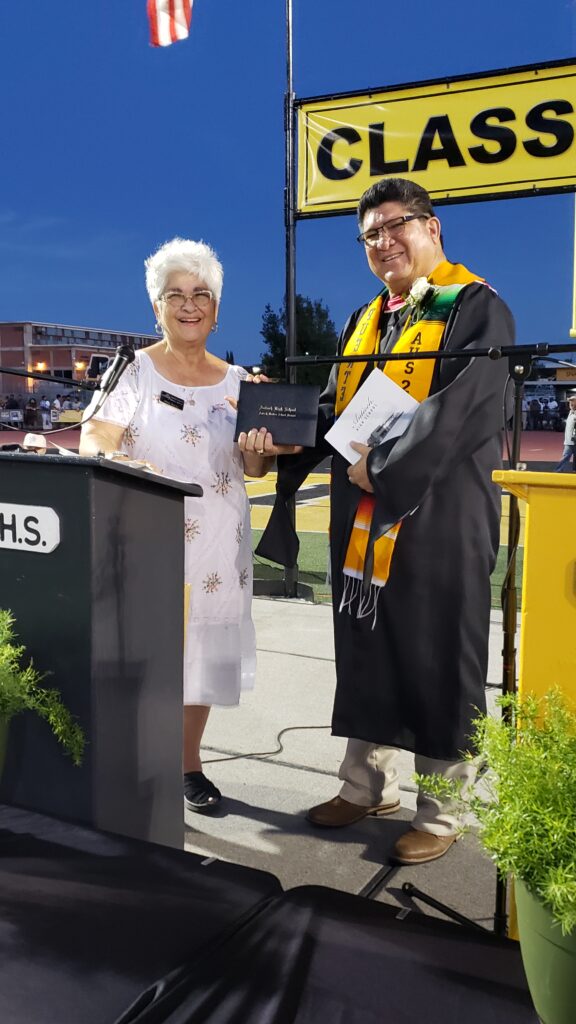
AUSD Trustee Mary Rocha presents her son, AHS Principal Louie Rocha with his “retirement diploma” during his final graduation ceremony in June 2022. Herald file photo
In a statement issued Saturday morning Rocha wrote, “I am a 55-year resident of our community. I grew up in the Mira Vista neighborhood in District 2 and graduated from Antioch High School in 1979.
Following college graduation from SDSU (San Diego State University) in 1984, I returned home to marry my wife, Tammy of 38 years, purchase our family home and raise our twin sons, Louis and Ruben.
I am the retired principal of Antioch High School who served our community as a teacher, football coach, counselor, and school administrator.
As a lifetime resident of Antioch, I have a vested interest in the future of our community. I am concerned about the current challenges that are impacting the health and safety of our residents. Decisions made today will determine the future of our beloved community. I have decided to run for City Council because I believe organizational change starts with change of leadership. Based on the Grand Jury report, there are numerous Brown Act and Human Resources violations that have resulted in high turnover of city staff due to a toxic work environment.
I am committed to restoring city leadership staffing and law enforcement staffing within the allocated resources for vacant positions.
I am committed to resolving the problems of today with long-term solutions that will create a safe, healthy and inclusive community for all of our residents and local businesses.
‘Focused on our Future’
Thank you,
Louie Rocha”
————–
The first-time candidate for public office also shared his resume showing his extensive background serving the Antioch community.
Employment: Program Coordinator, Antioch Sports Legends Hall of Fame Museum at Antioch Historical Society 2022-2024
Itinerant School Administrator AUSD 2023-2024
Retired Principal of Antioch High School. 2006-2022
Assistant Principal at Antioch High School 1999-2006
Varsity Football Coach at Antioch High School 1995-1999
School Guidance Counselor at Prospects High School 1996-1999
REACH Project Teacher / Counselor at Park Jr. High School 1985-1996
Elected Offices:
Antioch Community Foundation (ACF) Board Member/ Secretary 2022-2024
California Interscholastic Federation (CIF)
Executive Committee 2022-2026
North Coast Section (NCS)
Executive Committee 2019-2024
President 2021-2023
American College Testing (ACT)
ACT State Organization President 2016-2018
Honors / Awards
Congressman Mark DeSaulnier Congressional Record of Recognition, Principal of AHS College and Career Academies 2022
Association of California School Administrators (ACSA) Secondary School Principal of the Year 2017
Los Medanos Community College Cesar Chavez Educator Award 2016
President, Antioch Management Association (AMA) 2007-2010 (Serving AUSD employees)
Education: Saint Mary’s College, Master of Arts Degree in Educational Leadership 1992
San Diego State University, Bachelor of Arts Degree Psychology 1985
Los Medanos College, Associate of Sciences Degree 1982
Antioch High School, Graduation Diploma 1979
Faces At Least One Opponent
So far, Rocha, who is also a grandfather of four, is the only candidate to officially announce for the open seat. However, according to her campaign’s Facebook page discovered by the Herald, today, Dominique King, who unsuccessfully ran against Mary Rocha for school board in Area 5 in 2022, posted her campaign logo on Nov. 19, 2023, raised funds last December and held a campaign kick-off event on May 19th. According to the City Clerk’s campaign finance portal, King filed her Candidate Intention Statement on Sept. 29, 2023, and formed her committee on Oct. 17, last year.
Rocha said he doesn’t yet have a campaign website or Facebook page but is expected to have the setup by next week.
The filing period for the seat will be extended until Wednesday, Aug. 14th since the incumbent is not running for re-election.
Former Antioch Mayor Don Freitas will run for the City Council in District 3. Photo source: Facebook posted on June 12, 2022. Map: City of Antioch
Don Freitas to seek District 3 seat after Ogorchock gerrymandered out
By Allen D. Payton
In a post on his Facebook page on Tuesday, July 2, 2024, former Antioch Mayor Don Freitas announced he will seek election to the city council in District 3, this year.
He wrote, “Let me state that I am a candidate for the Antioch City Council, District 3 seat on November 5th, 2024. As a life long resident of Antioch I have had the privilege of of [sic] representing our community in a number of elected and appointed positions such as Mayor from 2000 to 2008.The direction of our City by the current Mayor Lamar Thorpe and some members of the present Council for the last several years has been an unmitigated disaster. And today, the Contra Costa County Civil Grand Jury has factually documented many of the issues facing us in a report entitled “Challenges Facing the City of Antioch”. It is a must read!!! I am asking all registered voters in Antioch to ‘vote for change’ in this election. We need new leadership that is concerned about the betterment of our residents instead of the political ambitions of a few elected officials that have effectively damaged our community…And on November 5th support much needed positive change in Antioch.”
Freitas was referring to the Civil Grand Jury’s investigation into three areas of concern including turnover in city leadership, city employee vacancies and possible Brown Act (state open meeting law) violations by Mayor Lamar Hernández-Thorpe and Councilwomen Monica Wilson and Tamisha Torres-Walker, as outlined in a January 2024 letter from the Contra Costa District Attorney to Antioch’s Acting City Manager.
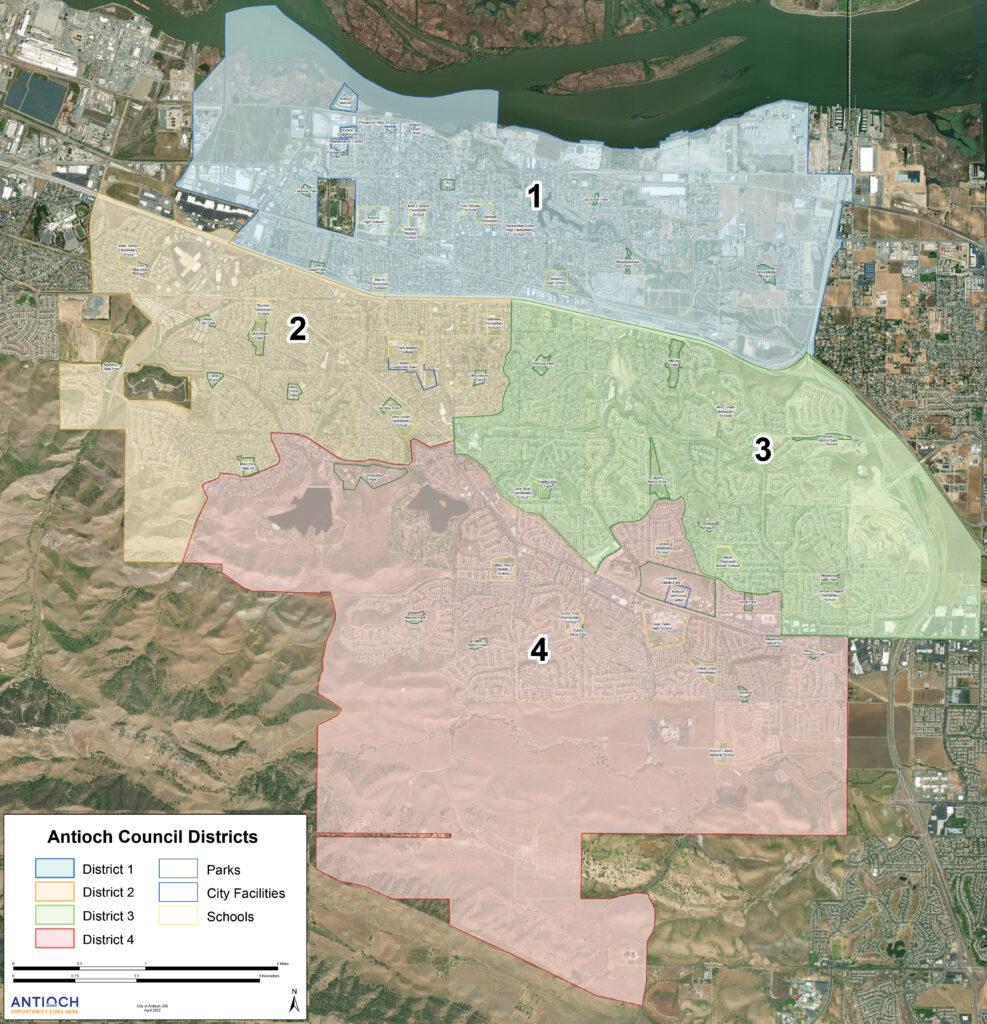
The District 3 council seat is open since incumbent Councilwoman Lori Ogorchock is precluded from running for re-election as the current council majority of the aforementioned three members gerrymandered her out of the district while redrawing and approving the council map in March 2022. They drew the boundary line between Districts 3 and 4 around the neighborhood in which Ogorchock lives, moving it into District 4. In Nov. 2022 she ran unsuccessfully against Wilson, who continues to represent District 4. (See related articles here and here and City Council Districts Map here)
Before the 69-year-old Freitas was elected to the city council in 1998, he served 16 years on the Contra Costa Water District Board of Directors. In 2008, he lost re-election as mayor to Jim Davis in a four-way race with two write-in candidates (including this reporter). In 2012 Freitas retired as the County’s Clean Water Manager and attempted a comeback in the race for mayor but placed third in a four-man race behind Wade Harper, who was elected, and the late-Councilman Gary Agopian. (See related article)
Prior to Freitas serving on the city council, his wife, Cathryn, served as a councilwoman from 1986 to 1994. Freitas graduated from Antioch High School in the Class of 1973 and from U.C. Davis in 1978. The couple has one adult son, Patrick.
Efforts to reach Freitas for further comment were unsuccessful prior to publication time. Please check back later for any updates to this report.
Mayor, council Districts 2 & 3, clerk, treasurer and trustee Areas 1, 3 & 4
By Allen D. Payton
The nomination period for local offices in Antioch including mayor city council Districts 2 and 3, City Clerk, City Treasurer and Antioch School Board Trustee Areas 1, 3 and 4 opens on Monday, July 15, 2024. The nomination period runs through 5:00 pm Friday, August 9, 2024. The election will be consolidated with the statewide General Election on Tuesday, November 5th, 2024.
Papers for offices that are up for election for city candidates will be available at the City Clerk’s office inside City Hall, 200 H Street in historic, downtown Rivertown and for school board candidates at the Contra Costa Elections Office, 555 Escobar Street in Martinez.
Source: City of Antioch
“The 2024 General Election has officially begun,” said Kristin B. Connelly, Contra Costa Registrar of Voters. “Candidate Filing begins Monday July 15, and our Candidate Services team is ready to help our residents who are looking to serve their communities in an elected position.”
If an incumbent does not file to run for office by the deadline on August 9th, the filing period for that office will extend until 5:00 pm on Wednesday, August 14, 2024.
Interested candidates for Antioch School Board can schedule an appointment through email at candidate.services@vote.cccounty.us or by calling 925-335-7800. Walk-ins are accepted, but service is subject to the availability of staff. Appointments are available on weekdays from 8:30 am to 4:30 pm. Filing documents and information will be provided to interested constituents at their appointment. The process takes 20 minutes.
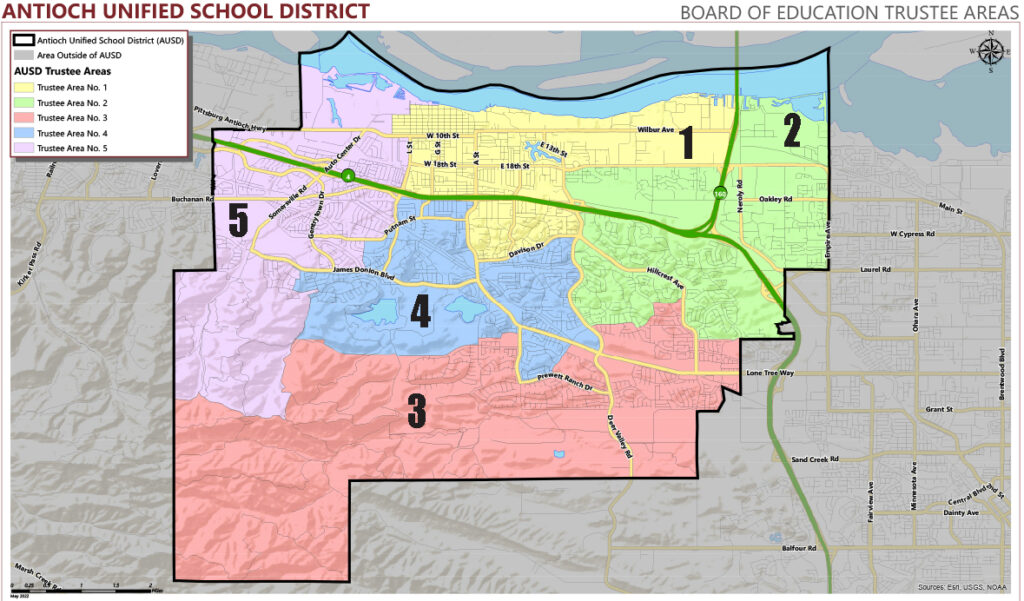
AUSD Trustee Areas Final Map 2022
For further information on the General Election and key dates, go to www.contracostavote.gov
The following candidates have announced for the election in November:
Mayor of Antioch – Incumbent Lamar Hernández-Thorpe, Ron Bernal
District 3 City Councilmember –Antwon Webster, Don Freitas
See list of all offices up for election in Contra Costa County in November, here.
Kristin B. Connelly, County Clerk-Recorder and Registrar of Voters and Dawn Kruger, Civic Outreach and Engagement Specialist, Contra Costa Clerk-Recorder-Elections Department contributed to this report.
First-of-its-kind measure to help build and preserve more than 70,000 homes
Contra Costa County would receive $1.9 billion
By John Goodwin, Assistant Director of Communications & Rebecca Long, Director, Legislation & Public Affairs, Metropolitan Transportation Commission
The Bay Area Housing Finance Authority (BAHFA) on Wednesday, June 26, 2024, adopted a resolution to place a general obligation bond measure on the November 5 general election ballot in each of the nine Bay Area counties to raise and distribute $20 billion for the production of new affordable housing and the preservation of existing affordable housing throughout the region. BAHFA is jointly governed by the Association of Bay Area Governments (ABAG)’s Executive Board and by the BAHFA Board, which is comprised of the same membership as the Metropolitan Transportation Commission (MTC).
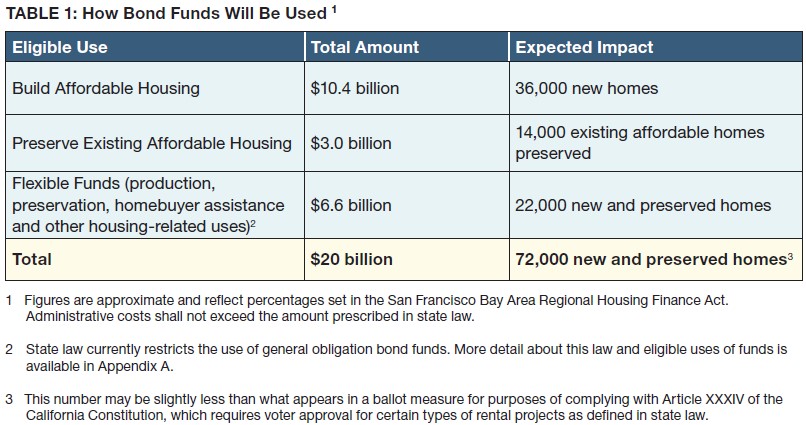
The bond could create 72,000 new affordable homes – more than double what would be possible without a bond. Without more funding, only about 71,000 affordable homes will be built or preserved in the Bay Area over the next 15 years – a status quo that is failing to meet the needs of the people who live and work here.
Currently, the Bay Area doesn’t have enough homes for the people who live here. As a result of the region’s housing shortage:
In 2022, 37,000 people were unhoused in the Bay Area.
1.4 million people—23% of Bay Area renters—spend over half their income on rent.
High rents and home prices force people to live far from work, making congestion and pollution much worse, and putting a major strain on working families.
Too many Bay Area residents live in overcrowded and unsafe housing.
Vital employees and community members are leaving the area.
Wednesday’s unanimous vote by the BAHFA Board marks the final discretionary step in the process to place the measure on the November ballot. Under state law, each Bay Area county will now take a non-discretionary, ministerial vote to place the measure on the ballot in that county, in accordance with election deadlines.
The BAHFA bond measure currently would require approval by at least two-thirds of voters to pass. Voters throughout California this November will consider Assembly Constitutional Amendment 1 (ACA 1) — which would set the voter threshold at 55 percent for voter approval of bond measures for affordable housing and infrastructure. If a majority of California voters support ACA 1, the 55 percent threshold will apply to the BAHFA bond measure.
“Today’s vote is the culmination of so many years of effort by so many people all around our region,” observed BAHFA Chair and Napa County Supervisor Alfredo Pedroza. “The Bay Area’s longstanding housing affordability problems affect all of us, our friends, our neighbors and our family members. This vote is about preserving opportunity for everyone.”
Source: BAHFA
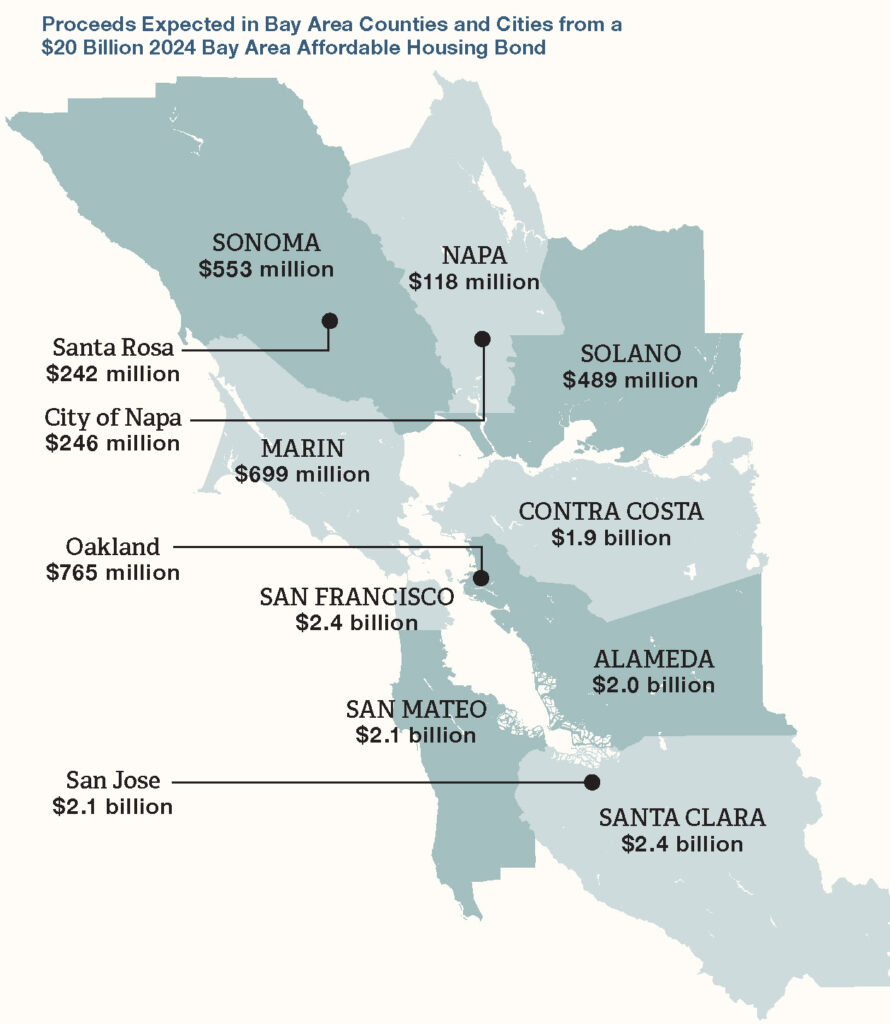
The proposed BAHFA bond measure calls for 80 percent of the funds to go directly to the nine Bay Area counties (and to the cities of San Jose, Oakland, Santa Rosa and Napa, each of which carries more than 30 percent of their county’s low-income housing need), in proportion to each county’s tax contribution to the bond. In consultation with its cities and towns, each county would determine how to distribute bond funds to best meet its jurisdictions’ most pressing housing needs. These distributions would include:
Contra Costa County: $1.9 billion
Alameda County: $2 billion
Marin County: $699 million
Napa County: $118 million
San Francisco County: $2.4 billion
San Mateo County: $2.1 billion
Santa Clara County: $2.4 billion
Solano County: $489 million
Sonoma County: $553 million
City of Napa: $246 million
City of Oakland: $765 million
City of San Jose: $2.1 billion
City of Santa Rosa: $242 million
The remaining 20 percent, or $4 billion, would be used by BAHFA to establish a new regional program to fund affordable housing construction and preservation projects throughout the Bay Area. Most of this money (at least 52 percent) must be spent on new construction of affordable homes, but every city and county receiving a bond allocation must also spend at least 15 percent of the funds to preserve existing affordable housing. Almost one-third of funds may be used for the production or preservation of affordable housing, or for housing-related uses such as infrastructure needed to support new housing.
Source: BAHFA
The California Constitution currently does not allow bond funds to be used for tenant protections such as rental assistance, but planned investments in new housing and affordable housing preservation will protect tens of thousands of low-income renters and vulnerable residents.
The BAHFA Board also adopted, on Wednesday, resolutions approving the Authority’s Business Plan and its Regional Expenditure Plan, which explain the prioritization for use of the funds that would be directly administered by BAHFA.
Oversight and accountability provisions to be included in the BAHFA bond measure include the creation of a special bond proceeds account; establishment of a Citizens’ Oversight Committee that would review the expenditure of bond proceeds and report to the BAHFA and ABAG Executive Boards on whether the funds were spent appropriately; an independent annual performance audit; a requirement that all bond-projects be consistent with state laws on labor standards; a requirement that administrative costs not exceed the amount prescribed in state law; and a prohibition against any public official who voted to send the ballot measure to the voters bidding on any work funded with proceeds from the bond.
The ABAG Executive Board voted unanimously at its April meeting to adopt a resolution approving BAHFA’s Business Plan and its Expenditure Plan, as well as to endorse placement of the bond measure on the November ballot. In her remarks preceding the vote, ABAG President and Napa County Supervisor Belia Ramos noted, “This is a remarkable milestone moment for our region. Housing stability is essential for our community to thrive, and this proposal is a once-in-a-generation opportunity.”
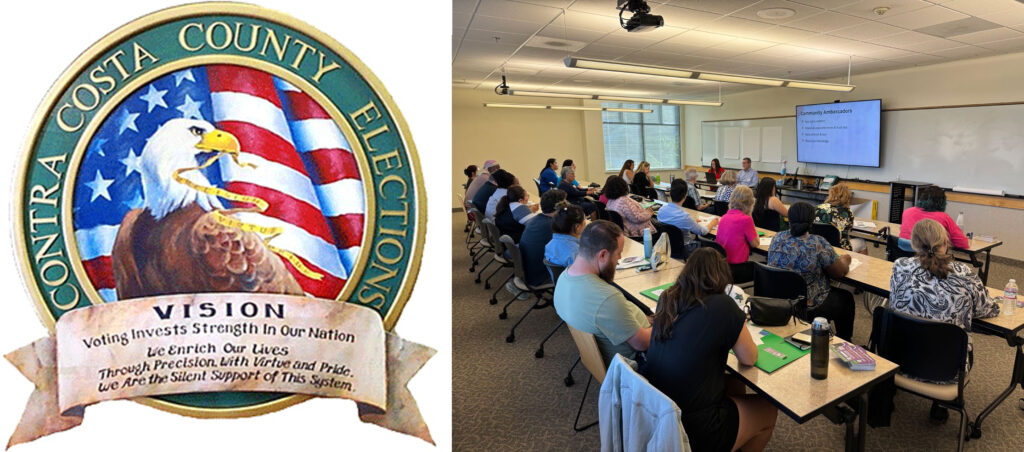
Community Ambassadors meeting. Photo: CCC Elections Division
“Contra Costa County is home to one of the safest, most secure, and transparent election systems in the nation.”
By Contra Costa Elections Division
In light of a growing tide of election misinformation, the Contra Costa County Clerk-Recorder-Elections Department is taking a stand. The Elections Division is launching a far-reaching marketing and community engagement campaign this week to reassure voters of election integrity and security by shining a light on the comprehensive steps taken to deliver on that promise.
“Elections are more secure than ever and we’re proud of Contra Costa County’s reputation for fair and secure elections. We have to make sure our voters know about the work we’re doing and have the information that inspires faith in our elections,” says Kristin B. Connelly, Contra Costa Registrar of Voters.
Asked for examples of election misinformation in Contra Costa County, the Election Division’s Community and Media Relations Coordinator Dawn Kruger responded, “Unfortunately, we’ve seen and heard lots of misinformation on social media and media comment sections as well as at community meetings.
Some of the most common misconceptions and questions we get are about voter registration requirements, voting by mail, how we prevent voter fraud, and how we secure election technology.
Thanks to the 48 election security safeguards we have in place, elections are more secure than ever, and we want to show voters everything the Contra Costa County Elections Division does to protect their vote. That’s why we’ve compiled all the information voters may want to know and made it available to the public. Voters can get clear and accurate information and responses to some of the most common questions about election security at www.secure-election.org/facts.”
Source: CCC Elections Division
Marketing Campaign
A multi-faceted marketing campaign is in place to deliver that message. In addition to county-wide advertising in print, television, radio and digital media, the campaign also includes the recruitment and training of nearly 100 election ambassadors who have volunteered to carry forward the election integrity message through social media channels and speaking engagements around the county. A companion website, www.secure-election.org, has also been launched, which includes a comprehensive collection of videos, fact sheets, Q&As and social media graphics illustrating how Contra Costa County protects its elections. All this is complemented by opportunities for the public to observe election activities and the county’s award-winning Certified Election Observer program.
“While trust in Contra Costa County elections is high, we’re facing a growing tide of mis- and disinformation that confuses voters and undermines the legitimacy of our elections,” said Kruger. “This voter education campaign fights those myths with solid facts and information, equipping volunteers in our community with a host of tools to help put the real story out there about how safe elections are.”
Contra Costa County was one of 10 election divisions nationwide to be awarded a grant to improve its election processes and chose to pilot this voter education work. The ambitious and robust campaign is expected to reach every resident of the county multiple times and in different ways, hammering home the many steps and precautions in place to ensure only eligible voters vote, that every legitimate vote is counted, and that the county’s election system is secure from fraud. The campaign is predicated on transparency, inviting the public to look more closely at how elections are handled and the exhaustive efforts to protect them.
The first wave of election integrity advertising will run June – July and a second wave will run September – October. These advertisements will coincide with the ambassador’s social media efforts and speaking engagements. Any organization interested in scheduling an ambassador speaking engagement can email info@contracostavote.org. For more information about the campaign and election security, visit secure-election.org.
“The measure exceeds the scope of the power to amend the Constitution via citizen initiative” – CA Supreme Court
“Today’s ruling is the greatest threat to democracy California has faced in recent memory…the California Supreme Court has put politics ahead of the Constitution” – Californians for Taxpayer Protection and Government Accountability
By Allen D. Payton
In response to a lawsuit by Gov. Gavin Newsom and the state legislature, the California Supreme Court justices unanimously ruled, today, Thursday, June 20, 2024, the measure known as the Taxpayer Protection and Government Accountability Act amounts to an illegal constitutional revision and removed it from the November election ballot. However, proponents vowed tocontinue to explore their legal options and efforts to minimize
According to Ballotpedia, “The initiative would have amended the California Constitution to define all state and local levies, charges, and fees as taxes. The initiative would have also required new or increased taxes to be passed by a two-thirds legislative vote in each chamber and approved by a simple majority of voters. It would also have increased the vote requirement for local taxes proposed by local government or citizens to a two-thirds vote of the local electorate. The increased vote requirements for new or higher taxes would have not applied to citizen-initiated state ballot measures. As of 2024, state tax increases require approval by a two-thirds vote in each chamber or a simple majority vote at a statewide election
In addition, a ‘yes’ vote on the measure would have supported “amending the state constitution to define all state and local levies, charges, and fees as taxes and to require new state taxes proposed by the state legislature to be enacted via a two-thirds legislative vote and voter approval and new local taxes to be enacted via a two-thirds vote of the electorate.”
However, according to the Associated Press, “The biggest impact…would have been that the measure threatened to retroactively reverse most tax increases approved since Jan. 1, 2022. Local governments warned they would have lost billions of dollars in revenue that had previously approved by voters. And it would have threatened recent statewide tax increases.”
Proponents
Proponents of the measure, Californians for Taxpayer Protection and Government Accountability, self-described as “a bipartisan coalition of homeowners, taxpayers and businesses committed to ensuring California remains affordable for families and accountable to its voters,” led the campaign in support of the initiative. The campaign explained the initiative, saying, “The Taxpayer Protection and Government Accountability Act will give voters the right to vote on all future state taxes and holds politicians accountable for new fees and other increased costs paid by working families and all Californians. The measure increases accountability by requiring politicians to spend new or higher tax revenue on its intended purpose. It will provide much-needed relief to families, farmers, and business owners, helping them to combat the growing cost-of-living crisis facing all Californians.”
According to the NAIOP, the measure would have given “voters the right to vote on all future state taxes and holds politicians accountable for new fees and other increased costs paid by working families and all Californians.” It would have increased “accountability by requiring politicians to spend new or higher tax revenue on its intended purpose. It will provide much-needed relief to families, farmers, and business owners, helping them to combat the growing cost-of-living crisis facing all Californians. The Act doesn’t cut any current state or local government funding. It simply gives voters the right to vote on all future tax increases and stops working families from paying billions more in “hidden taxes” imposed by unelected bureaucrats. They are currently gathering signatures and will need $70 million in fundraising efforts to pass the ballot measure in November of 2022.”
Supporters Respond, Will Seek Legal Options, Continue Efforts
In response to the court’s ruling, the Taxpayer Protection and Government Accountability Act (TPA) campaign issued the following statement from Rob Lapsley, president of the California Business Roundtable, Jon Coupal, president of the Howard Jarvis Taxpayers Association (HJTA) and Matthew Hargrove, president and CEO of the California Business Properties Association:
“Today’s ruling is the greatest threat to democracy California has faced in recent memory. Governor Newsom has effectively erased the voice of 1.43 million voters who signed the petition to qualify the Taxpayer Protection Act for the November ballot. Most importantly, the governor has cynically terminated Californians’ rights to engage in direct democracy despite his many claims that he is a defender of individual rights and democracy. Evidently, the governor wants to protect democracy and individual rights in other states, but not for all Californians.
We are disappointed that the California Supreme Court has put politics ahead of the Constitution, disregarding long-standing precedent that they should not intervene in an election before voters decide qualified initiatives.
Direct democracy and our initiative process are now at risk with this decision, showing California is firmly a one-party state where the governor and Legislature can politically influence courts to block ballot measures that threaten their ability to increase spending and raise taxes. Using the courts to block voters’ voices is the latest effort from the Democrats’ supermajority to remove any accountability measures that interfere with their agenda – a failed agenda that continues to drive up the cost of living with little accountability and few results.
This ruling sends a damning message to businesses in California and across the country that it is politically perilous to invest and grow jobs for the future.
In light of this ruling and the state’s large budget deficit, a huge amount of tax increases are on the way that are sure to make California’s cost of living even higher.
We will continue to explore our legal options and fight for the people’s right to hold their government accountable through direct democracy.”
———–
Opponents
The measure was opposed by Governor Newsom, CA Attorney General Rob Bonta, FSCME California, SEIU California State Council, California Special Districts Association, California State Association of Counties, and League of California Cities. Graham Knaus, executive director of the California State Association of Counties (CSAC), said, “This deceptive initiative would undermine the rights of local voters and their elected officials to make decisions on critical local services that residents rely upon. It creates major new tax loopholes at the expense of residents and will weaken our local services and communities.”
Bonta had relabeled the measure’s title to, “Limits Ability of Voters and State and Local Governments to Raise Revenues for Government Services. Initiative Constitutional Amendment.” The summary he required to be included on signature petition sheets read as follows: “For new or increased state taxes currently enacted by two-thirds vote of Legislature, also requires statewide election and majority voter approval. Limits voters’ ability to pass voter-proposed local special taxes by raising vote requirement to two-thirds. Eliminates voters’ ability to advise how to spend revenues from proposed general tax on same ballot as the proposed tax. Expands definition of ‘taxes’ to include certain regulatory fees, broadening application of tax approval requirements. Requires Legislature or local governing body set certain other fees.”
In spite of that, supporters were still able to gather the required signatures to qualify the measure for the ballot. The signature gathering occurred in 2022.
Court’s Decision
According to information about the case #S281977 entitled LEGISLATURE OF THE STATE OF CALIFORNIA v. WEBER (HILTACHK) on the state Supreme Court’s website, it “presented the following issues: (1) Does the Taxpayer Protection and Government Accountability Act (TPA) constitute an impermissible attempted revision of the California Constitution by voter initiative? (2) Is this initiative measure subject to invalidation on the ground that, if adopted, it would impair essential government functions?”
The court wrote in its unanimous opinion, “we conclude that the TPA would clearly ‘accomplish such far reaching changes in the nature of our basic governmental plan as to amount to a revision’ of the (state) Constitution. The measure exceeds the scope of the power to amend the Constitution via citizen initiative.”
“It is within the people’s prerogative to make these changes, but they must be undertaken in a manner commensurate with their gravity: through the process for revision set forth in Article XVIII of the Constitution,” the decision continued.
The court concluded by “directing the (CA) Secretary of State to refrain from taking steps to place” the initiative “on the November 5, 2024 election ballot or to include the measure in the voter information guide.”
However, Section 3 of that Article clearly reads, “The electors may amend the Constitution by initiative.” Coupal of the HJTA was asked to explain what the court is referring to and what other approach or process should the proponents have followed. He did not respond prior to publication time.