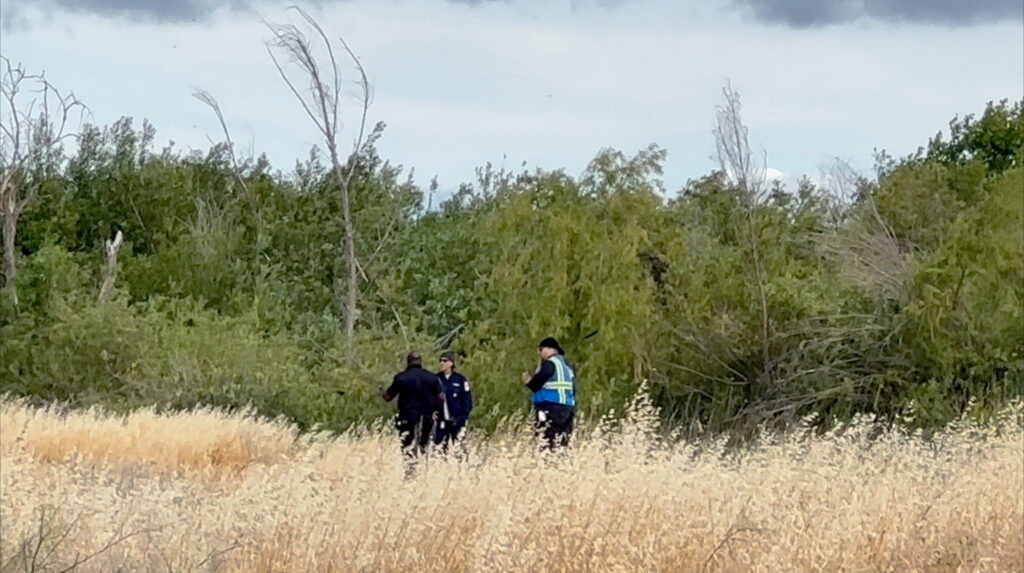
Antioch Police officers investigate in the Corteva Wetlands where the body of Cleyber Cruz-Gamez was located on Monday morning, June 3, 2024. Photo courtesy of Ronn Carter, Emergency Spotlight
Police Chief says “No foul play” suspected in death of Cleyber Cruz-Gamez
Antioch Police investigated the matter and “Initial reports suggested the body was located at the old Babe Ruth fields on Auto Center Drive. However, authorities…confirmed that the body was found approximately 100 yards west of the Antioch Marina, near one of the main walking trails” inside the wetlands,” Carter wrote.
When asked by the Herald about the incident Interim Police Chief Brian Addington shared, “A man who had been staying on Corteva property was found deceased. No foul play. It’s a suspected drug overdose but pending toxicology.”
Contra Costa County Deputy Coroner Wong identified the man on Friday, June 28th, as Cleyber Cruz-Gamez, age 44, who was “presumed to be a transient in the Antioch area.” The office won’t share the results of toxicology tests, which “most likely has not been signed off by the doctor, yet,” Wong shared.
When asked if she knew Cruz-Gamez, local homeless advocate Nichole Gardner said, “Nobody downtown said anything about it, yet. That’s so sad.”
SB 1327 gets required two-thirds vote approving $500 million in annual tax credits
Funded by fee on large internet companies
SACRAMENTO – Senator Steve Glazer’s bill to help strengthen local newsrooms with $500 million in annual tax credits was approved Thursday on a required two-thirds vote. It now moves to the Assembly.
The bill, SB 1327, was approved on a bipartisan 27-7 vote. A two-thirds vote was required because the bill assesses a Data Extraction Mitigation Fee on large Internet companies. It would distribute the money through tax credits to California news organizations.
“The passage today of my bill, SB 1327, is a step toward helping to revive news organizations across California,” said Glazer, D-7-Contra Costa. “Independent journalism is the lifeblood of our democracy by keeping our citizens informed on the workings of their government.
“This measure will mitigate the damage caused by platforms who use our personal data and their subsequent advertising profits to gut our mainstream news channels. I will continue to work with all stakeholders in the weeks ahead to chart a path forward that restores and expands independent news organizations, so critical to our democracy.”
Assemblywoman Buffy Wicks, D-14-Oakland, who represents portions of West Contra Costa County and has her own legislation, AB 886, to help news organizations, applauded the bill’s passage.
“I am encouraged to see SB 1327 move forward, and grateful to my Senate colleagues for recognizing the importance of this issue,” said Wicks. “The advancement of Sen. Glazer’s bill will allow us to continue working collaboratively toward a solution that protects and grows newsrooms across California.”
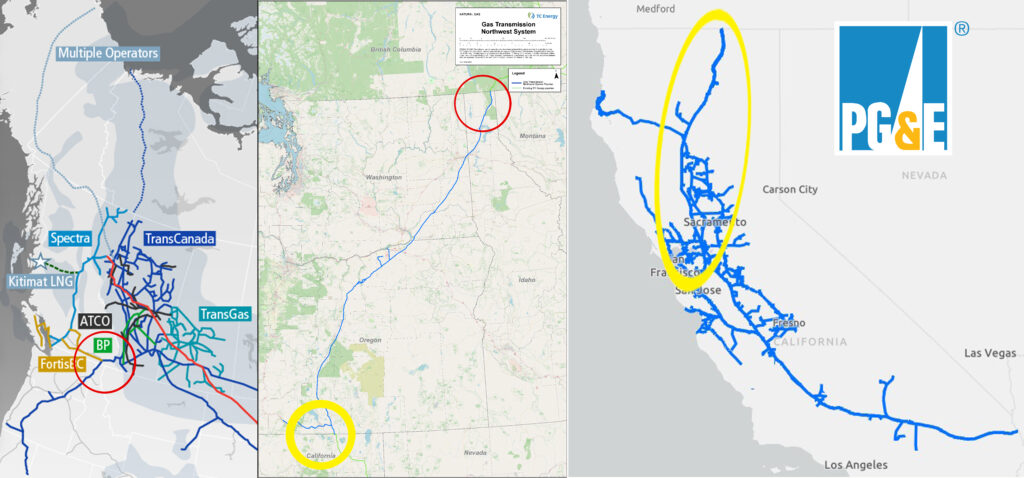
(Left) Maps of western Canada natural gas pipelines; Source: Canadian Energy Pipeline Association – defunct – and (center) TC Gas Transmission Northwest pipeline from Canada to California. Source: TC Energy provided by CRPC – see red circles for connecting point at national border crossing and (right) PG&E natural gas pipelines in California. Source: PG&E – see yellow circles for connecting point at Oregon-California state line and the pipelines to northern, central and western Contra Costa County.
50% of gas now supplied to owner’s customers in Contra Costa originates in Canada as much as 3,500 miles away instead of 35, about 80% from fracking
“The farther that natural gas must travel to its destination, the greater the carbon emissions” – California Resources Production Corporation
They’re “just doing it for political reasons. That only benefits them, not us on climate change.” – local oil producer Bob Nunn
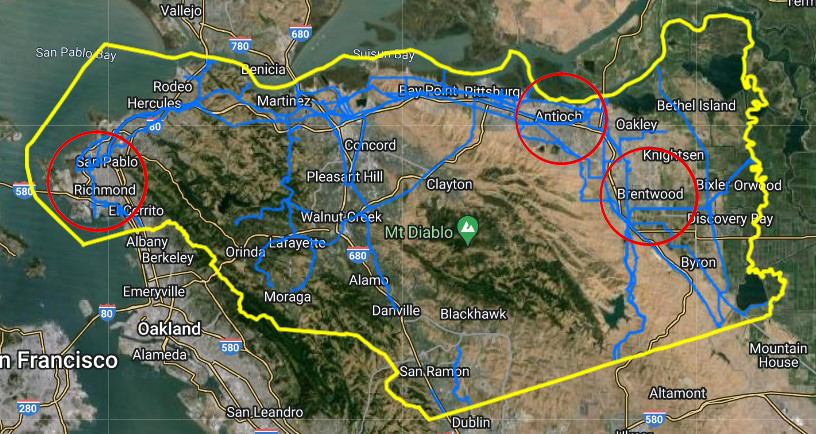
Proposed by District 4 Councilwoman Monica Wilson, Mayor Lamar Hernandez-Thorpe and District 1 Councilwoman Tamisha Torres-Walker joined her in opposing the 35-mile long, 12-inch pipe which carried 1.8 million cubic feet of natural gas daily which is enough to supply about 9,000 homes. District 2 Councilman Mike Barbanica and District 3 Councilwoman Lori Ogorchock supported the motion to renew the agreement. The result has been an increase in the emission of greenhouse gases and a much dirtier product being used by the refineries, from which Antioch is downwind, thus defeating the purpose the three council members claimed was the reason for their action.
Gas pipelines in Contra Costa County and the three cities in the yellow circles affected by the two city councils’ decisions. Source: National Pipeline Mapping System
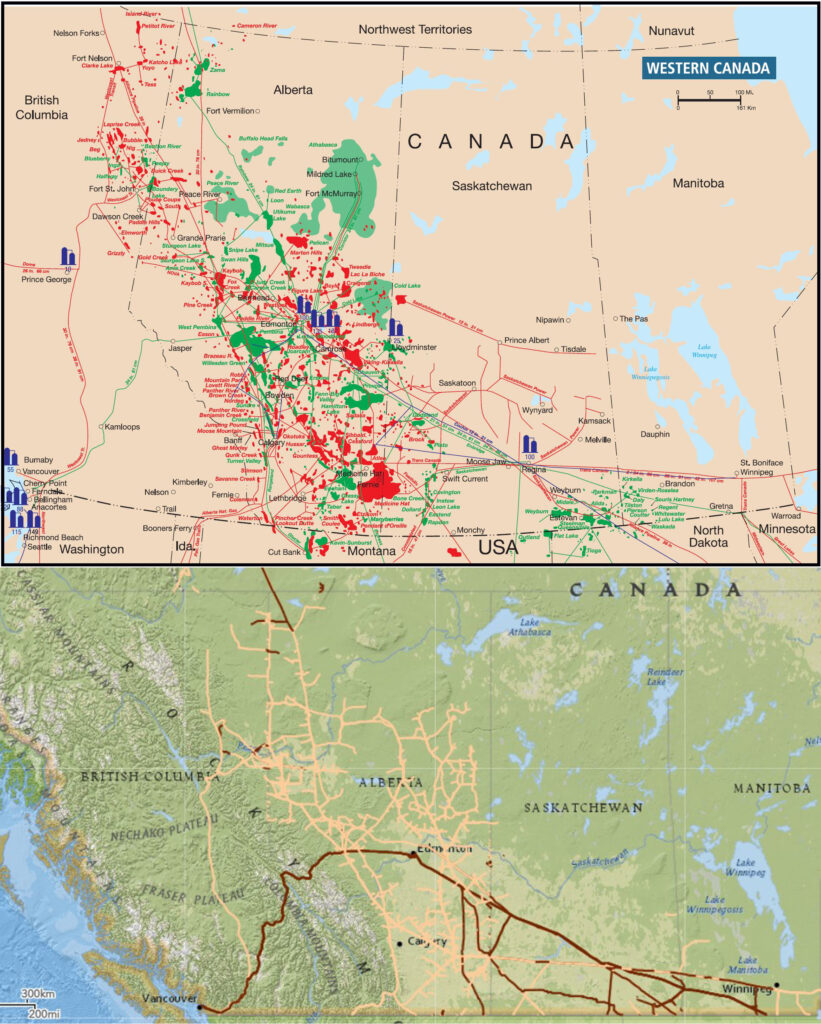
The gas had been supplied from the Brentwood natural gas field, and natural gas fields in western San Joaquin County on Union Island in the Delta, southeast of Discovery Bay, as well as in French Camp and Lathrop. But the council’s decision also forced the pipeline company’s customer that it served, Chevron refinery in Richmond, to obtain their supply elsewhere. At least 99% of that supply originates out of state with over half from natural gas fields in British Columbia, Alberta and Saskatchewan east of the Rocky Mountains in Canada, traveling a distance of as much as 3,500 miles instead of just 35.
(Top) Canadian Natural Gas Fields map shows the locations of natural gas and oil found in Canada. Red represents gas fields and green represents oil fields. Source: The Canadian Encyclopedia (Courtesy International Petroleum Encyclopedia 2010, ed. Joseph Hilyard, PennWell Corporation, 2010). (Bottom) Map of natural gas (pink) and oil (brown) pipelines in western Canada. Source: Canada Energy Regulator
In Canada, natural gas production is concentrated in the Western Canadian Sedimentary Basin (WCSB), with the highest production in the provinces of Alberta and British Columbia with more than twice as much from Alberta than from BC.
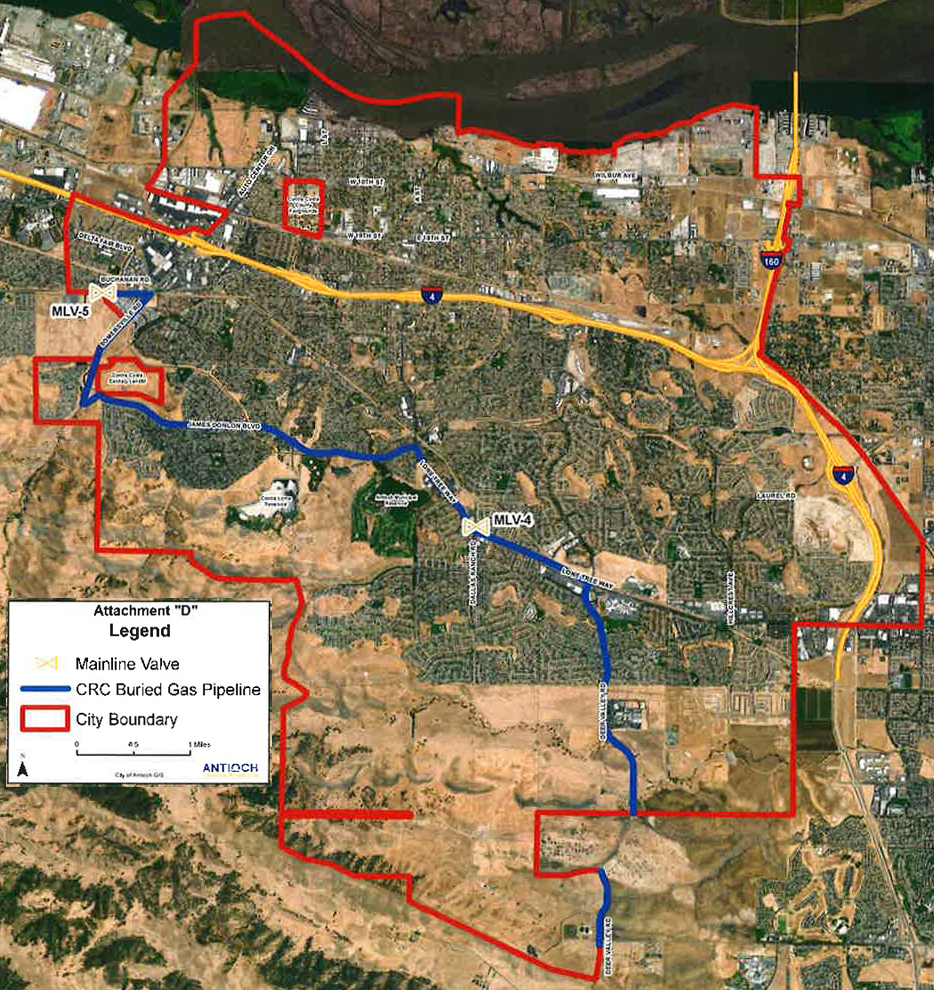
Map showing the route of CRC’s natural gas pipeline that runs through Antioch. Source: City of Antioch
Pipeline Owner Sues City
Following the decision, the company that owns the pipeline, California Resources Corporation (CRC), believed they had the right to continue operating the pipeline. At that time, spokesman Richard Venn, Senior Director, Communications said, “We believe there are legal protections in place that prevent an arbitrary and immediate shutdown, and we will continue to work with the city and its staff on the best solution.”
However, that was not to be the case, the pipeline was shut down, and on Dec. 27, 2021 the company’s subsidiary, California Resources Production Corporation (CRPC), filed a lawsuit against the City of Antioch over the council’s decision.
CRPC did not file a lawsuit against the City of Brentwood and the company has reapplied for the franchise agreement for the portion of the pipeline that runs beneath that city.
CRPC did not file a lawsuit against the City of Brentwood and the company has reapplied for the franchise agreement for the portion of the pipeline that runs beneath that city.
Questions were sent on May 12, 2024, to a representative for CRC about the status of the lawsuit, details about the pipeline and any impacts the change in supply is having on the environment. Venn responded on May 28, 2024, with the company’s answers:
1. Where is CRC in the process with its lawsuit against the City of Antioch? Was one also filed against the City of Brentwood? When were they filed and how soon does CRC expect them to be finalized?
On May 25, 2023, the trial court sustained the City’s motion to dismiss CRPC’s complaint, effectively ending trial court proceedings against the City. On August 25, 2023, CRPC appealed this decision. The parties are currently briefing the appeal. CRPC’s opening appellate brief was filed on April 22, 2024. The City’s brief is due July 3, 2024. CRPC’s reply will be due on August 16, 2024. A decision is unlikely to occur until late 2024 or even early 2025.
No lawsuit has been filed against Brentwood. The application for renewal of the Brentwood franchise is still pending. Per the Brentwood City Council’s request, CRC hired independent consultants, Bear, Inc., to perform a safety study on the Union Island (“UI”) Pipeline, which was published in April 2022. The study confirmed the UI Pipeline is a very well maintained and safe pipeline.
2. If the company had certain rights granted by the California Public Utilities Commission (PUC) that would prevent the cities from stopping CRC from operating the pipeline and continuing to ship gas through it how has the City of Antioch been winning in court? What have been the decisions in favor of the City?
CRPC does not presently have any rights granted to it by the PUC related to the UI Pipeline. However, CRPC has applied for a certificate for public convenience and necessity (“CPCN”) to have the UI Pipeline converted from a private pipeline to a common carrier pipeline. If the CPCN is granted, CRPC would become a regulated public utility, with the CPUC controlling certain aspects of the UI Pipeline’s operations and the rates that CRPC can charge for use of the Pipeline. The UI Pipeline’s day-to-day operations would not change however, after flow through the UI Pipeline restarts, and CRPC would be subject to the same federal and state regulations for safety and environmental protection.
If the UI Pipeline right-of-way were condemned to allow it to resume operations as a common carrier pipeline, as part of the condemnation proceedings, CRPC would have to provide “just compensation” for use of the right of way.
3. Where does the natural gas originate that was running through the pipeline in Antioch and Brentwood?
The natural gas that was running through the pipeline originates from the French Camp, Lathrop, and Union Island natural gas fields in western San Joaquin County and the Brentwood natural gas field in Contra Costa County.
4. Who are the customers served by the pipeline?
The gas is transported from the UI Pipeline to Chevron Corporation’s Richmond Refinery. The gas is used to power the refinery and used in its industrial processes to make jet fuel, diesel and gasoline that is distributed throughout Northern California.
5. From where are those customers now receiving the gas?
The gas that the Richmond refinery is no longer receiving from the UI Pipeline is supplanted by gas from PG&E’s system. The overwhelming majority of PG&E-supplied gas is from out of state. According to the most recent published information on PG&E’s gas sources, over 50% of the natural gas supplied by PG&E comes from Canada via the Gas Transmission Northwest (“GTN”) system. See 2023 California Gas Report, Table 5, https://www.socalgas.com/sites/default/files/Joint_Biennial_California_Gas_Report_2023_Supplement.pdf. Only around 1% of PG&E’s gas comes from California.
Around 80% of the natural gas produced in British Columbia, the upstream production region feeding the GTN pipeline, is produced by fracking. See https://stand.earth/.
6. Is the gas coming from Canada, is it not as clean as that produced in California, and how many miles is the gas now being shipped versus how many miles, previously?
As stated above, 80% of the natural gas produced in British Columbia is produced by fracking. Accordingly, we expect the majority of PG&E gas from Canada to be the result of fracking. This means that by stopping the UI Pipeline from operation, the City may be prioritizing the use of fracked gas.
The >1,300-mile figure does not reflect the total distance Canadian gas must travel to reach Richmond, California, though. The GTN system only runs from the Canadian border in Montana to northern California. Accordingly, Canadian gas going to the Richmond refinery must be transported from wherever the natural gas fields are located in Canada to the mouth of the GTN system in Montana. It must also be transported from northern California to the Bay area. Accordingly, gas from Canada travels well over 1,300 miles to reach the Richmond refinery.
By contrast, the UI Pipeline assisted in the transportation of local gas from the natural gas fields in western San Joaquin County and the Brentwood natural gas field in Contra Costa County to Richmond, a drastically shorter distance.
7. Have there been any environmental impacts because of the change in the natural gas supply to those customers?
The farther that natural gas must travel to its destination, the greater the carbon emissions attendant to those pipeline operations. Additionally, the gas transported by the UI Pipeline is not fracked, as compared to the majority of PG&E’s gas obtained from Canada.
Finally, any GHG emissions from gas production in California are compensated for under the cap-and-trade program, which is not the case in most of the other jurisdictions supplying PG&E.
8. Has there been a change in the costs to CRC’s customer(s) in both the purchase of the natural gas from one or more different sources and the production of their products to their customers? And ultimately to the consumers?
Without the UI Pipeline, local gas cannot be delivered to the Chevron refinery. The contribution of local gas to the refinery helps keep gas prices competitive, which further keeps prices low and the refinery open. The Richmond refinery has a workforce of over 2,700 company employees and 850 contract workers, according to the Richmond Chamber of Commerce. See https://www.rcoc.com/membership-directory-2/name/chevron-richmondlorenz/.
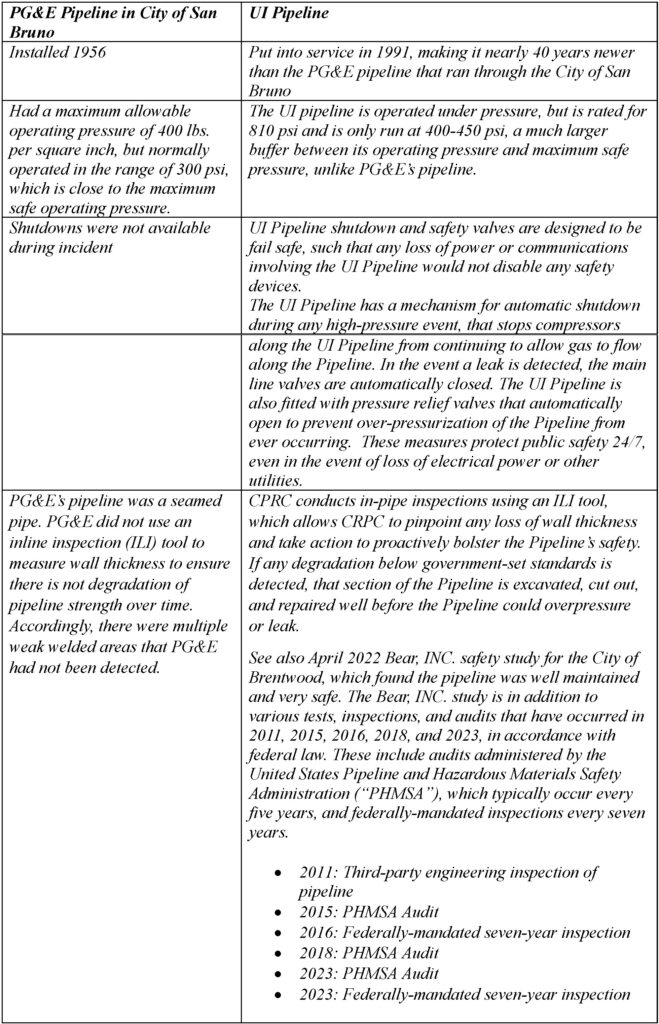
9. Is the pipeline that runs through Brentwood and Antioch different than the high-pressure line that exploded in San Bruno in 2010? What are the differences between the two pipelines?
Source: CRPC
10. What could the Antioch and/or Brentwood City Council do to remedy the situation?
The City could extend the franchise to allow for operation of the UI Pipeline. With an extension, the City could propose additional conditions on the operation of the Pipeline to address any of its continuing concerns. Using this authority to ensure enhanced protections or benefits for the City, while allowing the Pipeline to safely transport gas as it has for the past thirty years, was not something the City officials considered during the public hearing on the franchise renewal. This kind of win-win solution would have protected the citizens from the costs of litigation, brought revenue to the City, and given the City peace of mind about the UI Pipeline’s operations.
It is also important to keep in mind that the UI Pipeline is by no means the only natural gas pipeline running through Antioch. All federally regulated natural gas and hazardous liquid pipelines can be identified using the National Pipeline Mapping System Public Viewer, which can be accessed at https://pvnpms.phmsa.dot.gov/PublicViewer/.
There are several natural gas transmission pipelines running through Antioch besides the UI Pipeline. Some of these are high-pressure pipelines, in contrast to the UI Pipeline, which is considered a low-pressure pipeline. In addition to these other natural gas pipelines, there are over 34,000 natural gas connections in Antioch.
11. If the council(s) choose to settle the lawsuit(s) would the city(ies) have to reimburse CRC for their attorney’s fees?
The terms of any settlement would govern whether attorney’s fees are reimbursed by either side.
12. Is there anything else you would like to share about the matter?
CRPC is committed to operating in a manner focused on safety, environmental stewardship, and promoting the health and welfare of all Californians. One of our leading “Values” is being a responsible operator, meeting – if not exceeding – California’s high standards for safety and environmental protection. We have a decades-long successful track record of safely and efficiently operating critical energy infrastructure such as the UI Pipeline within the City of Antioch and we look forward to continuing to work with the City and its staff to provide safe, reliable, and low carbon.
Local Environmental and Economic Benefits of Pipeline, Supports Farmers
In addition, CRPC shared information from their application to the state’s PUC about the pipeline and its benefits to the environment and local economy. The company wrote, “The UI Pipeline currently provides the only viable avenue for the natural gas produced from the Fields to reach the market, including the Richmond Refinery, which currently utilizes all of the natural gas carried on the UI Pipeline. The use of in-state natural gas displaces the use of out-of-state natural gas produced in other states and transported by pipeline into California. Currently, California imports over 90% of its natural gas from out-of-state fields where the environmental and greenhouse gas regulations may not be as stringent as those required here in California. Absent the UI Pipeline, production from the Fields would cease and the State would have to look to alternate natural gas capacity at a time when natural gas supply constraints have been widely reported.
“Given California’s current natural gas demand, the natural gas production from these Fields would likely be replaced by out-of-state production, which would be contrary to statutory preferences for in-state production of natural gas and would result in appreciable environmental impacts and increased costs. Natural gas produced out of state is not obligated to follow California’s more stringent environmental and greenhouse gas regulations, and transporting natural gas from out of state through interstate pipelines increases greenhouse gas emissions, as compared to in-state production. Furthermore, in the future, the Field would be capable of converting to carbon dioxide storage and sequestration, which is widely considered a necessary component to achieving long-term climate goals. The UI Pipeline is therefore a key component in not only ensuring the Fields continue to provide in-state natural gas, but also in reducing the environmental impact of natural gas consumption. In-state natural gas production may also mitigate the substantial increases in natural gas costs to California customers over the past year.
“Closure of the UI Pipeline would also have a significant economic impact to the local community. Over 200 local landowners receive revenue from royalties associated with natural gas transported on the UI Pipeline. Many of the royalty holders are local farmers, and monetizing these mineral rights helps support local farming operations. Closure of the UI Pipeline would eliminate any opportunity for those mineral owners to monetize their assets.”
Questions for Council Members Go Unanswered
All five council members were informed of the answers provided by CRPC on Monday, June 24, 2024. Herandez-Thorpe, Wilson and Torres-Walker were asked if, knowing now that the action by the council majority has had a greater impact on the environment, will they reconsider and reverse their vote to deny the franchise agreement allowing the pipeline to resume operations in Antioch.
They were all also asked if they know how much the City has spent to date defending against the lawsuit by the pipeline owner.
None of the council members responded prior to publication time.
Additional Questions for CRC
Asked if the Antioch City Council reverses its decision and approves their franchise agreement can the pipeline reopen, company spokesman Venn said, “The renewal for the franchise for Brentwood is still pending.”
Both cities must approve their separate franchise agreements in order for the pipeline to reopen.
Local Oil Producer Says Council Members “Doing the Opposite of What They Claim”
When reached for comment about the information from CRPC and the council’s decision to shutter the pipeline, Brentwood businessman, Bob Nunn, whose company is the only holder of a permit to drill for natural gas and oil in Antioch said, “We have the strictest rules for oil and gas in California. The energy used to move the gas 100 times further is going to be greater.”
“California is doing its best in the name of climate change. But in the last three years, California has used more oil each year than in the previous year,” he continued. “The production of oil in California to support that demand has gone down each of those three years. CARB (California Air Resources Board) will show you, on the whole, imported oil will have more emissions than oil produced in California.”
“If they’re doing it in the name of climate change, they’re doing the opposite of what they claim,” Nunn stated. “The issue is to lower demand not squeeze supply. It’s Economics 101. Their model is flawed.”
“I support decisions that will reduce man’s impact on climate change. But make sure you do your homework that their positions are for the benefit of climate change,” he said. “If not, then you’re just doing it for political reasons. That only benefits them, not us on climate change.”
Please check back later for any updates to this report.
First-of-its-kind measure to help build and preserve more than 70,000 homes
Contra Costa County would receive $1.9 billion
By John Goodwin, Assistant Director of Communications & Rebecca Long, Director, Legislation & Public Affairs, Metropolitan Transportation Commission
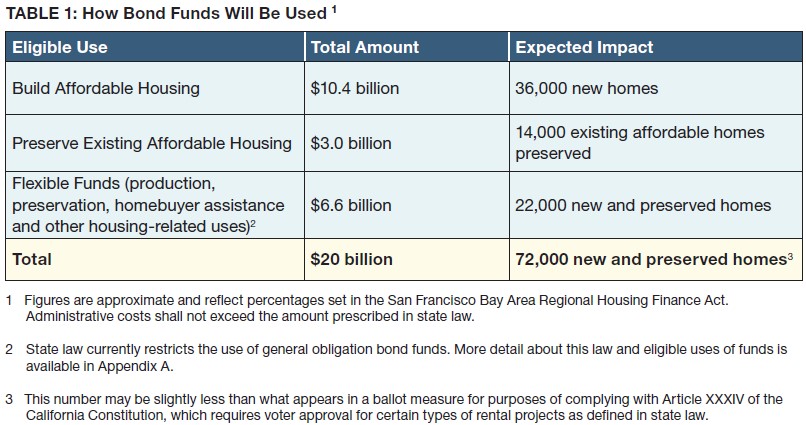
The Bay Area Housing Finance Authority (BAHFA) on Wednesday, June 26, 2024, adopted a resolution to place a general obligation bond measure on the November 5 general election ballot in each of the nine Bay Area counties to raise and distribute $20 billion for the production of new affordable housing and the preservation of existing affordable housing throughout the region. BAHFA is jointly governed by the Association of Bay Area Governments (ABAG)’s Executive Board and by the BAHFA Board, which is comprised of the same membership as the Metropolitan Transportation Commission (MTC).
The bond could create 72,000 new affordable homes – more than double what would be possible without a bond. Without more funding, only about 71,000 affordable homes will be built or preserved in the Bay Area over the next 15 years – a status quo that is failing to meet the needs of the people who live and work here.
Currently, the Bay Area doesn’t have enough homes for the people who live here. As a result of the region’s housing shortage:
In 2022, 37,000 people were unhoused in the Bay Area.
1.4 million people—23% of Bay Area renters—spend over half their income on rent.
High rents and home prices force people to live far from work, making congestion and pollution much worse, and putting a major strain on working families.
Too many Bay Area residents live in overcrowded and unsafe housing.
Vital employees and community members are leaving the area.
Wednesday’s unanimous vote by the BAHFA Board marks the final discretionary step in the process to place the measure on the November ballot. Under state law, each Bay Area county will now take a non-discretionary, ministerial vote to place the measure on the ballot in that county, in accordance with election deadlines.
The BAHFA bond measure currently would require approval by at least two-thirds of voters to pass. Voters throughout California this November will consider Assembly Constitutional Amendment 1 (ACA 1) — which would set the voter threshold at 55 percent for voter approval of bond measures for affordable housing and infrastructure. If a majority of California voters support ACA 1, the 55 percent threshold will apply to the BAHFA bond measure.
“Today’s vote is the culmination of so many years of effort by so many people all around our region,” observed BAHFA Chair and Napa County Supervisor Alfredo Pedroza. “The Bay Area’s longstanding housing affordability problems affect all of us, our friends, our neighbors and our family members. This vote is about preserving opportunity for everyone.”
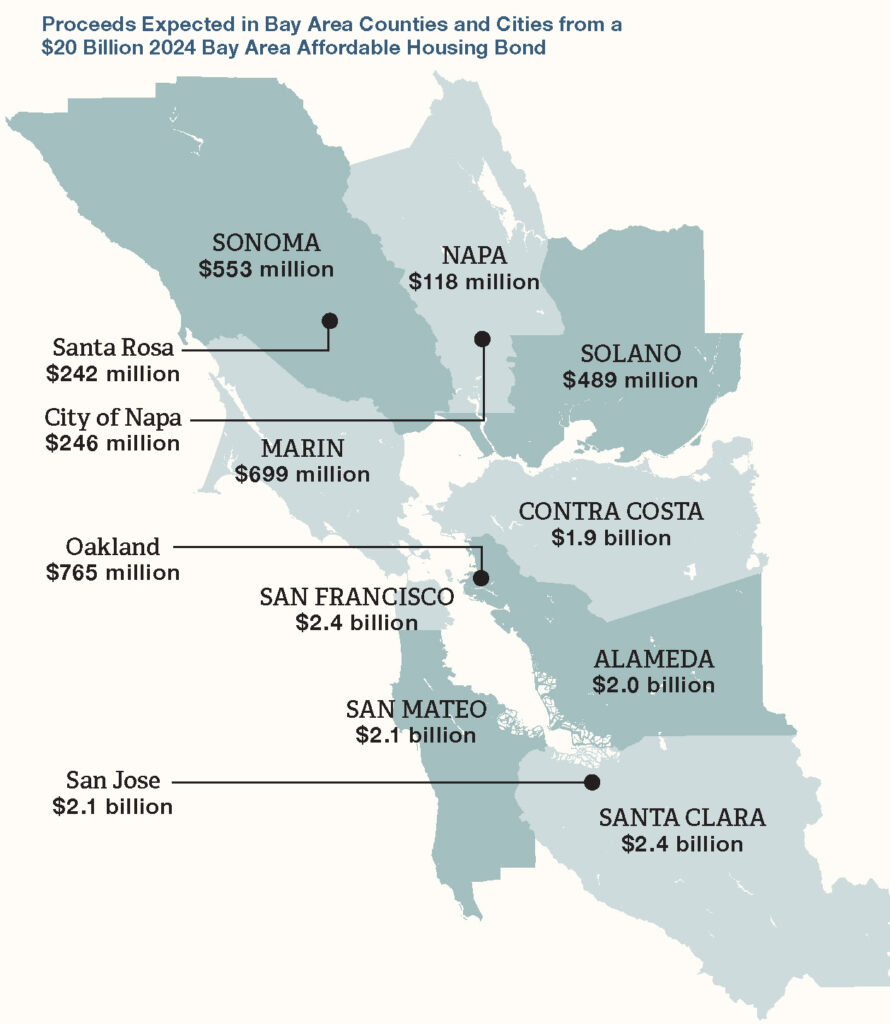
Source: BAHFA
The proposed BAHFA bond measure calls for 80 percent of the funds to go directly to the nine Bay Area counties (and to the cities of San Jose, Oakland, Santa Rosa and Napa, each of which carries more than 30 percent of their county’s low-income housing need), in proportion to each county’s tax contribution to the bond. In consultation with its cities and towns, each county would determine how to distribute bond funds to best meet its jurisdictions’ most pressing housing needs. These distributions would include:
Contra Costa County: $1.9 billion
Alameda County: $2 billion
Marin County: $699 million
Napa County: $118 million
San Francisco County: $2.4 billion
San Mateo County: $2.1 billion
Santa Clara County: $2.4 billion
Solano County: $489 million
Sonoma County: $553 million
City of Napa: $246 million
City of Oakland: $765 million
City of San Jose: $2.1 billion
City of Santa Rosa: $242 million
The remaining 20 percent, or $4 billion, would be used by BAHFA to establish a new regional program to fund affordable housing construction and preservation projects throughout the Bay Area. Most of this money (at least 52 percent) must be spent on new construction of affordable homes, but every city and county receiving a bond allocation must also spend at least 15 percent of the funds to preserve existing affordable housing. Almost one-third of funds may be used for the production or preservation of affordable housing, or for housing-related uses such as infrastructure needed to support new housing.
Source: BAHFA
The California Constitution currently does not allow bond funds to be used for tenant protections such as rental assistance, but planned investments in new housing and affordable housing preservation will protect tens of thousands of low-income renters and vulnerable residents.
The BAHFA Board also adopted, on Wednesday, resolutions approving the Authority’s Business Plan and its Regional Expenditure Plan, which explain the prioritization for use of the funds that would be directly administered by BAHFA.
Oversight and accountability provisions to be included in the BAHFA bond measure include the creation of a special bond proceeds account; establishment of a Citizens’ Oversight Committee that would review the expenditure of bond proceeds and report to the BAHFA and ABAG Executive Boards on whether the funds were spent appropriately; an independent annual performance audit; a requirement that all bond-projects be consistent with state laws on labor standards; a requirement that administrative costs not exceed the amount prescribed in state law; and a prohibition against any public official who voted to send the ballot measure to the voters bidding on any work funded with proceeds from the bond.
The ABAG Executive Board voted unanimously at its April meeting to adopt a resolution approving BAHFA’s Business Plan and its Expenditure Plan, as well as to endorse placement of the bond measure on the November ballot. In her remarks preceding the vote, ABAG President and Napa County Supervisor Belia Ramos noted, “This is a remarkable milestone moment for our region. Housing stability is essential for our community to thrive, and this proposal is a once-in-a-generation opportunity.”
Rendering of Hope Solutions’ Hope Village tiny-home project in Walnut Creek.
Reallocates excess funds from Downtown Roadway Project, $550,000 were originally slated for housing
By Allen D. Payton
During their meeting on Tuesday, June 25, 2024, the Antioch City Council approved spending $6.4 million of federal Community Development Block Grant (CDBG) and state funding on affordable housing and homeless services, including 102 units on the properties of two churches to serve close to 300 residents in the city. District 1 Councilwoman Tamisha Torres-Walker was absent for the meeting.
At the beginning of the regular meeting Assistant City Attorney Brittany Brice reported out of closed session that on the civil rights lawsuit by Trent Allen, et al vs. City of Antioch and on the recruitment of the city manager there was “no reportable action”.
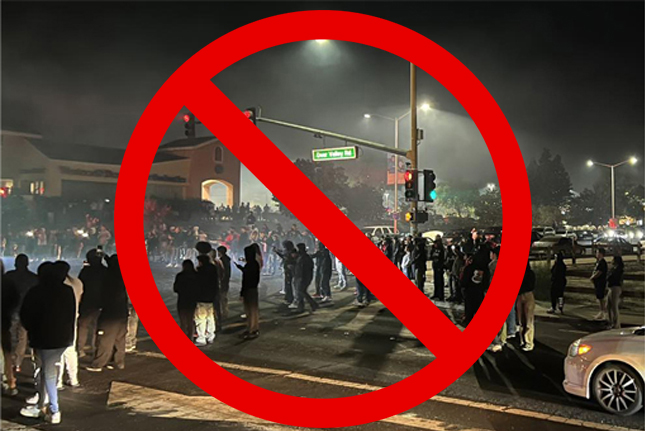
Besides approving the sideshow ordinance on a 4-0 vote, which outlaws organizers, advertisers and spectators, the council approved spending funds for affordable housing and services for Antioch’s homeless residents.
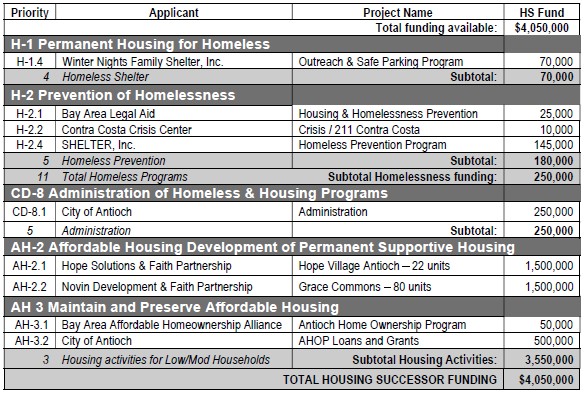
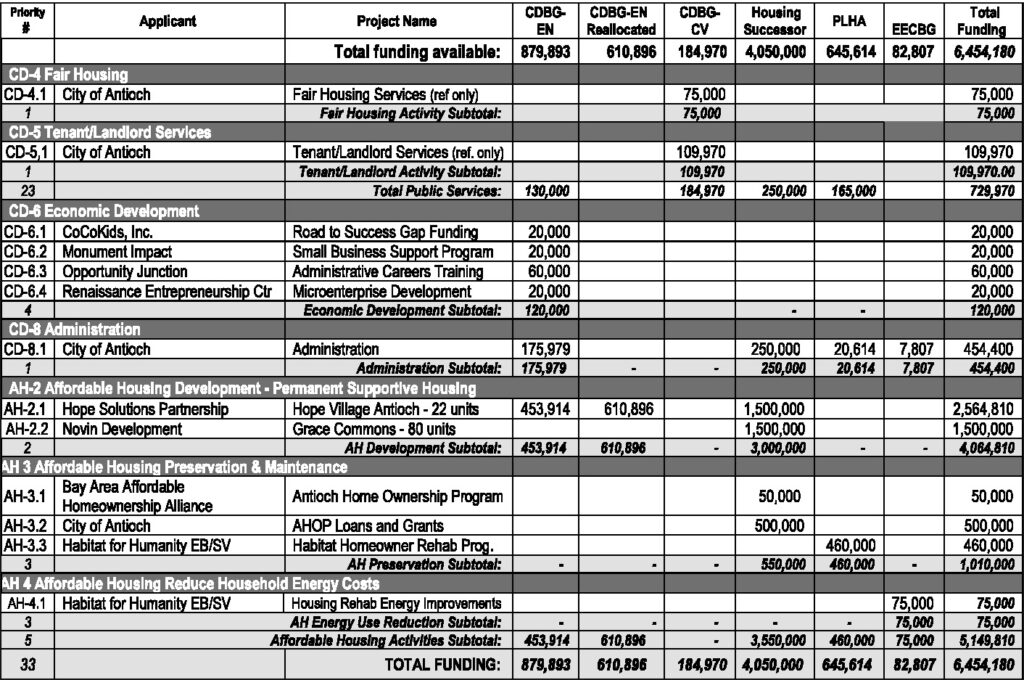
Housing Successor Funding allocated by the Antioch City Council on June 25, 2024. Source: City of Antioch
Based on the funding recommendations of the CDBG Committee, consisting of Torres-Walker and District 3 Councilman Mike Barbanica, it includes $4,050,000 in Local Housing Successor funding from the City’s former redevelopment agency for homeless services and the development of affordable housing with 80 units on the property of Grace Bible Fellowship of Antioch on Oakley Road,
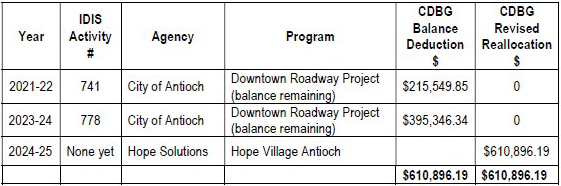
Another $610,896.19 was reallocated from excess funds that weren’t needed for the Downtown Roadway Project, for the development of affordable, supportive housing for extremely low-income and homeless households. It will be used for 22 housing units on a 2.17-acre parcel located at 3195 Contra Loma Blvd. in Antioch, purchased from First Family Church, through Hope Solutions.
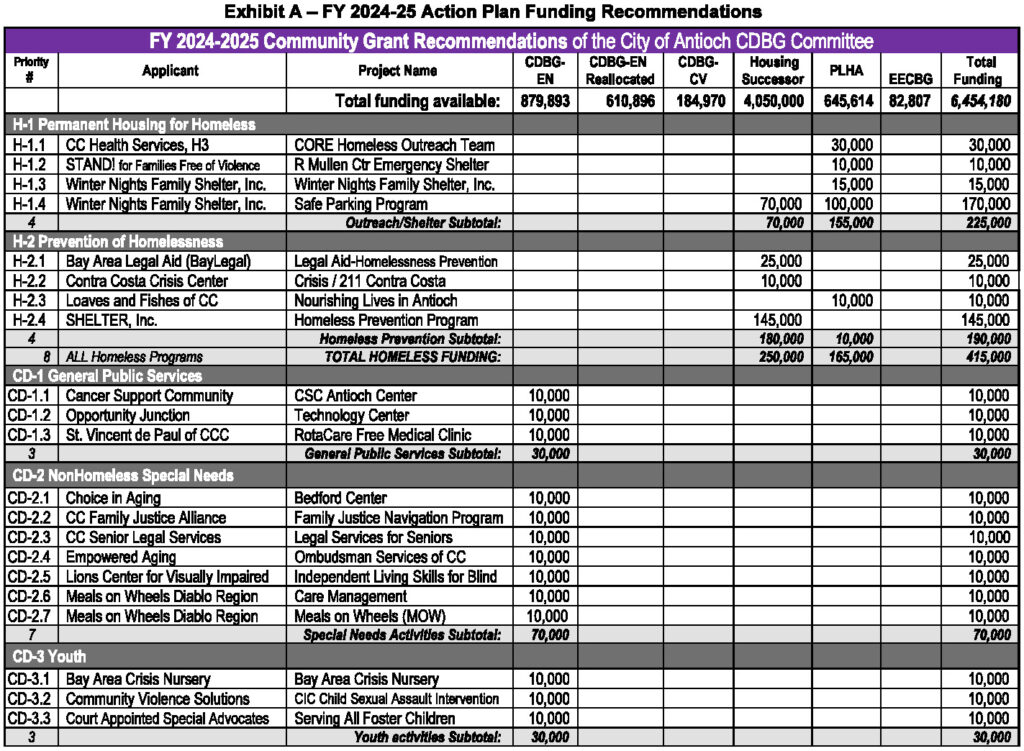
An additional $6,454,180 of funding to address identified high priority needs of lower income residents in Antioch was approved for spending by the council. That amount includes $879,893 in CDBG entitlement funds, $610,896 in reallocated CDBG funds, $184,970 in previously approved CDBG-CV (Covid) funds, $4,050,000 in Local Housing Successor funds, $645,614 in Permanent Local Housing Allocation (PLHA) funds, and $82,807 in Energy Efficiency and Conservation Block Grant (EECBG) funds.
Agenda Item 10 was a public hearing on the spending and included amending the FY 2024-25 Budget. The council first heard from Public Safety and Community Resources Department Director Tasha Johnson who introduced Teresa House, the City’s housing and homeless consultant, to provide the staff presentation.
“It’s been quite some time since we’ve had an allocation this large and it’s exciting,” she stated. “It’s the plan we present to the federal government for the block grant funds.”
House mentioned the Hope Village project, which is a planned “22-unit housing development on church land” and “Grace Commons. They are partnering with Grace Bible Fellowship…for 80 units. The cost is $50,871” per unit from the City’s grant funds.
However, the total cost is estimated to be $45-50 million for the project.
The cost per home for the Hope Village units will be $27,768 from the City’s grant funding out of a total of $17 million budgeted for the project.
House said this was “the first affordable housing project (of its type) to come before the city or the county in over 15 years.”
Source: City of Antioch
Reallocation of Excess CDBG Funds for Downtown Roadway Project
Regarding the reallocation of the Downtown Roadway Project funds for affordable housing, House said, “These were not in any way negligently unspent. These were residual funds waiting for their next allocation.”
“The Downtown Roadway Project received an extra $550,000 by dissolving the rotating housing loan funds,” she continued. “HUD does not allow cities to hold on to monies. If we have excess funds on hand we’re sanctioned by HUD. It’s very necessary we spend the funds.”
“We’re recapturing that $550,000 and additional funds, and spending them on affordable housing, which they’d like to build in our community,” she explained.
No one spoke as the proponent for the public hearing, but resident Andrew Becker spoke as the opponent.
“It’s concerning because we see the growing need in our community and the impact we see as we drive these streets and talk with our community members who speak about the cost of housing,” he said. “We can’t find within our General Budget the funds for shelter housing beyond what we have. We say we don’t have dollars. We ask what it would cost to house the people on the street, but no one can give us those numbers because no one is working on it.”
“Our Point-In-Time Count went up. We know there are more people on the street,” Becker continued. “Instead, we choose to allocate dollars to housing rehabilitation in our community.”
PLHA is money that’s supposed to go to rapid deployment solutions,” he stated. “What is the cost of putting up 50 pallet shelters instead of paying a hotel operator $100,000 a month for 30 rooms?”
“You didn’t even choose to have that conversation. I don’t understand why I have to hear from our housing consultant that, ‘I don’t have enough time.’”
“What are we doing here besides paying that consultant a lot of dollars when what she’s developed doesn’t meet the community’s needs?” he asked. “And some of you don’t even want to sit down and talk with me.”
“We have such few dollars. As far as the millions of dollars going into these developments. What’s concerning when I show up to these CDBG meetings, the developer doesn’t even show up. There should have been the opportunity for council members to ask the developer questions,” Becker complained. “I feel like, as much as staff is right the County is saying we want to see local commitments, there are grey areas of concern.”
“There could be $50 million in costs,” he stated. “Sometimes developers…see these dollars as free money. It’s almost $7 million and when you look at the true intent of what a Housing Successor Agency does…and the misuse of those dollars, you see the cycle continue in a different model unless we have leaders who are responsible who say, ‘I’m not comfortable in giving $1 million in taxpayer dollars.”
“It’s a large cost so I really hope those questions
“I don’t want to see a 80-unit project go up on a church that doesn’t know what kind of waters it’s stepping into,” Becker stated. “If you’re going to ask the people for the dollars, it’s got to make sense.”
Grace Commons
According to the city staff report, the Grace Commons three-story housing project will include 80 units serving 200+ people for an estimated cost of $45-50 million. Funding is coming from capital campaign by church which has been successful for all structures on the property, County, State applications, federal, large tech companies.
Pastor Kirkland Smith spoke about the project planned for his church’s property saying, “This…goes back to 9-11. I’s the dream Grace Bible Fellowship has had for this community.”
He then shared about other services the church provides for the community including “Grace House Sober Living Home on our campus, Grace Closet, Grace After School Tutoring Program…and Midnight Basketball.”
“We’ll provide wrap-around services that will come into Grace Commons. Chalk is the name of the service provider,” Smith explained.
“Antioch is the number one for unhoused in Contra Costa County,” he pointed out.
“When we commit to a project…it’s going to happen. It’s going to come to pass,” Smith assured the council.
“I’m a 29-year resident of Antioch. I’m invested in this community,” the pastor shared. “I’m excited about the opportunity and I will focus on the work and not those who are trying to frustrate the work.”
Hope Village
According to the city staff report, Hope Solutions is proposing 22 doors/households for an estimated 95 residents maximum to be named Hope Village. The city money will be used for development of the units. Total costs are $17 million in budget with a capital campaign, plus, they will be going back next year to the County and will pursue other sources.
Jasmine Tarkoff, a representative of Hope Solutions spoke about the organization saying they had, “a long history of service in this county for close to three decades. We serve 3,500 individuals with our…services.”
“We spoke to dozens of people in Antioch, house and unhoused about Cottage Communities on faith-owned land” she stated and said the 22-unit project would consist of one-, two- and three-bedroom manufactured homes.
“Hope Solutions will serve as the professional service provider,” Tarkoff continued. “In addition, we will provide the professional property management services on site…every single day.”
“Hope Solutions has launched a capital campaign to raise private funds to couple with this project,” she added.
Antioch resident Louise Greene spoke next saying, “There’s talk, ‘we’re going to build this and they’re going to move in.’ No, they’re not. Those aren’t normal homeless people. They’re unstable.”
“By law you can’t force anyone into a program. It’s not just building a box. It’s building a home,” she continued. “It cost us $17,000 over three years to help my sister. There’s no instant solutions and the cost is a lot. If you can’t give them back their dignity that’s not the right program.”
“Along with these services they’re looking to build, is family help for the whole wrap,” Green stated. “The people on the street have the final say of what kind of housing, what kind of program they want to go into.”
“I’d love to know, with Grace, if you have to be a church member to receive housing or with Hope Solutions,” shared another woman who said she had been homeless twice.
Ralph Hernandez was the last public speaker on the matter, saying he agreed with the comments made by Andrew Becker.
“All of that money going to that private hotel, the City didn’t end up having any ownership in it,” he stated. “They had their…motel rooms improved and upgraded.”
“It was a drug haven, and you had some prostitutes going there and being run by thugs,” Hernandez continued.
“The City has to know what you are spending and giving public monies for. You’re supposed to evaluate what the money is going to. These groups have plans to have this housing…it’s great. But you, as the City should have some ownership…not just give taxpayer money out and say, ‘you own it. 100%.’”
“Now, what I’m reading is the City won’t have enough money to continue that program, there,” he stated. “Is the City going to throw more money into it? You’ll still have no ownership.”
Source: City of Antioch
Council Discussion & Unanimous Votes
During council discussion on the use of the funds, Barbanica spoke first asking questions of Ms. House.
“There is some concern with the public that we’re shorting projects that are out there for curbs, gutters, roadways with these monies moving from one fund to another.”
“Are we shorting something, now?” he asked.
Acting Public Works Director Scott Buenting said, “The answer is no. There is nothing being worked on, currently that these monies would be spent on.”
“How much are we spending to hand over to these two groups?” Barbanica then asked.
“That is $4 million and some change,” House responded.
“Just so the public understands. This is not money coming out of our General Funds,” the councilman stated.
“CDBG and Housing Successor Funds,” House explained. “That money is all a loan. We’re not giving anyone anything. It’s bringing $70 million coming from elsewhere.
“This will help 250 people to get off the streets,” he said.
“That’s correct,” House responded.
“Where will the public get the most out of it? This is permanent, long-term housing,” Barbanica stated. “It’s not just bridge housing.”
“It’s a loan. We have recourse to go after the property,” he explained. “I support the project.”
“The agreement for affordability with the City, it must remain for 55 years,” House added.
“For Hope Solutions, the purchase will most likely be from CDBG funds,” she said in response to a question from Ogorchock. “The Housing Successor funds won’t be available until 2025.”
“The timing for Hope Solutions is 2026 and the other one, 2027,” Ogorchock stated.
“That timetable was if they got funding from the County. They did not…so that timetable will get pushed out,” House explained and added that another project “took nine years”
“There is not one way into homelessness and there’s not going to be one way out of homelessness,” Hernandez-Thorpe stated. “To think there’s one magic bullet…is a ridiculous notion. While homelessness increased overall in the county, imagine if we didn’t have these programs in place.”
Barbanica made the motion to approve the expenditure of the $4 million in CDBG funds for the two projects. It was seconded by Ogorchock and passed 4-0.
Barbanica then moved approval of the reallocation of the remaining Downtown Roadway Project funds of $611,000 for the use of development of affordable housing for extremely low-income households. Ogorchock seconded the motion and it also passed 4-0.
Finally, Barbanica made the motion to approve spending CDBG funds, including Coronavirus funds and Housing Successor funds for affordable housing. Ogorchock seconded the motion and it passed 4-0.
“Congratulations to you both,” Barbanica said to the representatives of the organizations building the housing projects.
During their meeting on Tuesday, June 25, 2024, the Antioch City Council on a 4-0 vote passed an ordinance banning organizers and advertisers of and spectators at sideshows. The matter was finally dealt with after discussing the matter since last fall and holding two previous votes, one which adopted an ordinance without targeting spectators and the follow up vote, for which none of the three council members present supported it. (See related articles here, here, here and here)
Most of the residents who spoke during public comments on the agenda item were opposed to including a ban on spectators citing possible constitutional issues and profiling by police, and concerns that those stuck in their cars could be cited.
Before hearing from residents during the public hearing, Mayor Lamar Hernandez-Thorpe said, “The city attorney would have acted as the proponent” but was absent from the meeting. The mayor then asked who would be the opponent, resident Alexander Broom volunteered and was given 10 minutes to speak.
“There are some large concerns I have with Attachment A which goes after the spectators,” he said. “I don’t think there’s a crime that I could be a witness to and be guilty of a crime. I think there are some constitutional issues there.”
“Anyone who is found to be within 200 feet witnessing or observing a sideshow,” he pointed out as one example.
“There are multiple instances that I would go to part of car culture, then you have people who show up and ruin the event,” he stated. “Me just being present doesn’t mean I’m a participant. This ordinance…is far too broad. I would encourage you to not include the spectator portion.”
“I had one of my friends come out to one of these events and a car show broke out. He was profiled,” he stated. “I could face up to six months in jail for being at the wrong place at the wrong time.”
“There are so many other routes you can go after spectators for this disturbance,” he said. “I think this opens up the city to more lawsuits…to more civil rights violations.”
“I’m open to compromise. I’d rather see the second ordinance go forward that doesn’t include spectators,” he concluded. “This is far too broad.”
Ralph Hernandez said, “These car culture violators should figure out how to lawfully and peacefully cruise. You should keep option 1 to include spectators.”
These are not really spectators. They’re encouraging bad conduct In law, that’s aiding and abetting,” he continued. “I think the police are smart enough…to make differentiation who is a spectator. How do those people claim they’re merely parked there?” he asked. “Come on you have to sell that to someone else.”
“The 200-feet limit, it’s appropriate because these sideshows take up a lot of space,” Hernandez continued. “Is that car culture? They’re violators of the law…by those actively participating, drivers, blockers. If they don’t want to be considered a violator they should not go there.”
“Their cell phones should also be confiscated,” he added. “It’s dangerous. It’s not a football game.”
Teshina Garrett, ACCE Antioch asked, “Who or what is considered a spectator?” and then spoke of her experience being stuck due to a sideshow. “We took photos…of people doing stupid stuff in the middle of the street. Does that make us a spectator?”
“Use these drones, Take their license plates, confiscate their vehicles,” she added.
Resident Dr. Kimberly Payton, Vice President of the NAACP East County Branch, spoke next about her own experience of getting stuck in traffic due to a sideshow. “Therefore, I don’t understand how you can tell a spectator and someone who is stuck. I just encourage you to consider the definition of a spectator if that’s the route the council is going.”
Andrew Becker also shared about “a sideshow that popped up. Within two minutes there were 200 people there. They were jumping on my car. I understand there’s a subjective component there. I also understand you have to have these tools. It’s the individuals…who are driving these things. I’m wondering if…an individual who is cited, they can have it reviewed by the Oversight committee. I think that would be monumental. It might alleviate some of the concerns here.”
Gavin Payton asked, “Some of the sideshows are actually dangerous for cars and for pets, the next day because they’re throwing bottles and the glass is breaking on the curbs and the bushes. Is there going to be some kind of action for that, as well?”
A resident named Devin said, “We really need to determine what a spectator is. We all know that the definition that some will use is not fair to everyone. People can determine who’s participating in these things, who’s taking videos and advertising these things. This is a problematic issue we are having in this city. But the language…people being accused of being a spectator, but they weren’t. Two hundred feet…that’s not fair.”
A woman named Laura said, “I am not an expert on car culture but I’m an excellent driver…and I am a parent. I think it’s dangerous to include spectators …because…systemic racism is a thing. So, I don’t think spectators should be included in this.”
Louise Green spoke last saying, “Using the simple word spectator is scary to everyone. I think this is more targeted to spectator participants. It’s a game they play. They were throwing T-shirts over their license plates. They’re actually throwing their bodies into the cars. You’ll have to put the spectator clause in there. Unless you can get real specific on the language, they are spectators, but a participant spectator. They have racing guns that they signal when the police are coming. There were maybe five people on the sidewalk. But the 200 were spectator participants. They get out of their vehicles. If I’m trapped in my car, they’re going to know, they’re not part of it. We do have to include them because they’re part of the problem.”
Council Discussion
Barbanica spoke first saying, “We’re talking, here about active participants. Not someone sitting in their cars. There’s also a big difference with someone videoing, when an officer rolls up. They say, officer, ‘here’s my phone.’”
“They leapfrog ahead to the next sideshow. It’s very detrimental to the community,” he stated. “This has terrorized the community long enough.”
“These are roving sideshows that are very organized. We have to go after people who are active participants,”
“These sideshows are getting more and more frequent and they’re roving around the city,” Ogorchock stated. “I would ask the city attorney’s office if we can increase the penalties not just $1,000.”
“A San Joaquin Sheriff would not release the cars from a sideshow until the participants’ court dates,” she shared. “These cars are part of evidence.”
“I think we should also look at reimbursement for the use of our resources,” Ogorchock continued. “As we as community members, these are our dollars. These people, the majority of them are coming from outside the community.”
“This is a quality-of-life issue,” she stated. “If we can’t add these to the ordinance toight
Wilson said, “I’m going to steal the term spectator participant. These spectator participants…they’re filming and livestreaming it to let their friends know where they are. We need to hold those participants accountable along with the organizers and advertisers.’
“I betcha there are people from inside our community,” she added.
“We need to start talking about why is this happening. What’s the root cause?” Wilson asked. “We definitely need to include something about the spectators.”
Hernandez-Thorpe spoke last saying, “this doesn’t necessarily stop sideshows. These are tools that once sideshows are happening they can be used. These aren’t preventative. What actually prevents sideshows is determining who is starting them. But unfortunately, our traffic division has been decimated.”
“I’m all for all of them, spectators, organizers and those who advertise,” he stated. “If we pass something tonight it will come back late July and will go into effect 30 days later, at the end of the summer months. If we need to make changes, we do it in the fall.”
“The technology in the police department in my opinion allows them to differentiate between a spectator,” the mayor shared. “Let’s pass something now, tonight and build on it and not let perfection be the enemy of progress.”
Ogorchock then made a motion saying, “I’m going to add” then read the ordinance that included banning spectators, “including not releasing vehicles until court dates and reimburse costs of resource.”
The Assistant City Attorney said, “I think there are some concerns…that we can’t address tonight” in response to a question from Barbanica.
No one seconded the motion.
Barbanica then moved approval of the ordinance including spectators as written. It passed 4-0.
Ogorchock then asked, “that we come back with the two proposals.” But both Barbanica and Wilson had already left the dais, so the mayor said, “Uh, no. There’s no consensus. Everybody left.” They then took a two-minute recess.
She tried again following the break but none of the other council members supported her proposals.
Ordinance Details
The ordinance adopted includes the following:
City Council introduced the proposed ordinance adding Chapter 4 to Title 4 (Public Safety) to the Antioch Municipal Code, which prohibits organizing, advertising, and being a spectator at street racing, sideshows, and reckless driving exhibitions;
Organizing or Advertising Street Races, Sideshows, and Reckless Driving Exhibitions Prohibited
It is unlawful for any person to knowingly organize a street race, sideshow, reckless driving exhibition, or exhibition of speed conducted within the City on a public street, highway, or in an offstreet parking facility.
B. It is unlawful for any person to advertise, within the City, a street race, sideshow, or exhibition of speed conducted or to be conducted in the City on a public street, highway, or in an offstreet parking facility.
C. It is unlawful for any person to advertise online, including on social media, a street race, sideshow, or exhibition of speed conducted or to be conducted in the City on a public street, highway, or in an offstreet parking facility.
Spectators at Sideshows, Street Races, and Reckless Driving Exhibitions Prohibited
It is unlawful for any individual who to be knowingly present as a spectator, either on a public street or highway, or on private property open to the general public without the consent of the owner, operator, or agent thereof, at an illegal motor vehicle sideshow, street race, or reckless driving exhibition.
B. It is unlawful for any individual to be knowingly present as a spectator, either on a public street or highway, or on private property open to the general public without the consent of the owner, operator, or agent thereof, where preparations are being made for an illegal motor vehicle sideshow, street race, or reckless driving exhibition.
C. Local law enforcement shall have the authority to cite any spectator in violation of this Chapter with an administrative citation.
D. An individual is present at the illegal motor vehicle sideshow, street race, or reckless driving exhibition if that individual is within two hundred (200) feet of the location of the event, or within two hundred (200) feet of the location where preparations are being made for the event.
Enforcement
A. Any person who violates this chapter is guilty of a misdemeanor subject to a maximum of six (6) months in jail, a fine of $1,000, or both, unless at the discretion of the district attorney or a court of competent jurisdiction, the violation is reduced to an infraction.
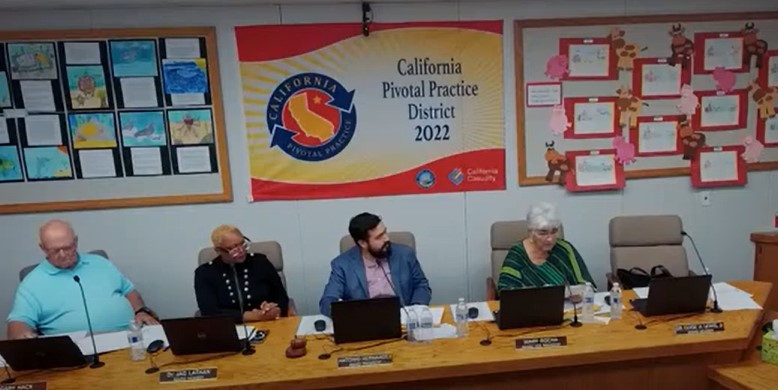
Antioch School Board Vice President Mary Rocha (right) reads a prepared statement during the May 22, 2024 board meeting calling for a vote to censure President Antonio Hernande. Source: AUSD YouTube video screenshot
Resolution claims Antonio Hernandez committed 12 violations of board policies and bylaws, federal HIPPA law and Brown Act open meeting law cited
By Allen D. Payton
During the Antioch School Board meeting on Wednesday, June 25, 2024, Board President Antonio Hernandez faces a vote to censure him proposed by fellow Trustee and Board Vice President Mary Rocha for publicly divulging personnel and closed session matters and to the media, among other reasons. It occurred while he spoke with an NBC Bay Area TV about the accusations by district employees of bullying by a supervisor and called for Superintendent Stephanie Anello’s resignation for not handling the situation they way he would have preferred.
At the end of the May 22nd board meeting, Rocha read a statement calling for the censure to be placed on the next board meeting agenda. However, Hernandez pointed out that Area 3 Trustee Dr. Clyde Lewis would be absent for that meeting, so the item was placed on Wednesday night’s meeting agenda. (See 3:10:00 mark of the meeting video)
Under Resolutions for Immediate Action, agenda Item 15F reads, Resolution No. 2023-24-57 Censure of Board President Antonio Hernandez. It outlines 12 times he violated board policies and bylaws, federal HIPPA law and the state’s Brown Act open meeting law which includes:
Board President Hernandez divulged confidential, privileged information regarding personnel matters with members of the media;
Board President Hernandez divulged confidential, privileged information regarding closed session matters with members of the media;
Board President Hernandez violated the Health Insurance Portability and Accountability (HIPPA) Act by divulging confidential health-related information of a District employee to the media;
Board President Hernandez, violated Board Policy 9200, by speaking out of turn, in public, regarding private and confidential personnel matters, appearing to take on an administrative role;
Board President Hernandez, violated Board Policy 9200, by acting in an administrative capacity to resolve complaints;
Board President Hernandez, sought to evaluate the Superintendent in a public forum, outside of the closed session arena in violation of Board Policy 2140;
Board President Hernandez, used his public Facebook account to post confidential correspondence from a District paid for legal counsel, breaking the confidentiality of the document posted, and posting confidential correspondence to the Board of trustees, which was directed to a closed session item in violation of Board Bylaw 9012;
Board President Hernandez attempted to schedule two Special Board Meetings, while also being told that there would not be a quorum for the meeting;
Board President actually commandeered the Board Room to hold an unsanctioned meeting with members of the public, placing members of the administration in potential jeopardy of violating California’s Open Meeting Law (the “Brown Act”);
Board President Hernandez usurped the authority of the Board by appearing to speak on behalf of the Board or Trustees in media news reports, via his Facebook posts, and in public meetings in violation of Board Bylaws 9010 and 9012;
Board President Hernandez, failed to implement Board Bylaw 9121, when a local media reporter verbally attacked the Superintendent during a Governing Board Meeting;
the Governing Board hereby finds and determines that Board President Hernandez’s conduct is unacceptable, unprofessional, and a violation of the Board Bylaws and State Laws cited above.
The proposed resolution concludes with four resolutions and orders including:
“NOW, THEREFORE, BE IT RESOLVED and ORDERED that the Governing Board of the Antioch Unified School District hereby finds that the foregoing recitals are true and correct.
…that based on these recitals, the Governing Board of the Antioch Unified School District hereby formally censures Board President Hernandez and proclaims publicly that this Board disapproves of the aforementioned conduct and finds it to be a violation of the Board Bylaws and State Laws and constitutes unacceptable behavior that shall not be tolerated.
…that Board President Hernandez shall treat fellow Board members and all District staff with dignity and respect at all times and in all forums, and that he refrains from any further violation of Board Policies and Bylaws.
…that any further violations of Board Policies and Bylaws by Board President Hernandez may result in his removal as Board President.”
The school board meeting begins at 7:00 p.m. in the board room at the Antioch Unified School District office building at 510 G Street in Antioch’s historic downtown Rivertown. It can be viewed live on the District’s YouTube channel.
Of 764 city employees Antioch’s highest paid was a police sergeant at $349,993
SACRAMENTO — State Controller Malia M. Cohen has released the 2023 self-reported payroll data for cities and counties on the Government Compensation in California website. The data covers 517,358 positions and a total of more than $40.72 billion in 2023 wages.
Users of the site can:
View compensation levels on maps and search by region;
Narrow results by name of the entity or by job title; and
Export raw data or custom reports.
The newly published data includes 462 cities and 52 counties. The City of Hayward had the highest average city employee wage in California, followed by Atherton, Pleasant Hill, and Beverly Hills. The counties with the highest average employee wages were Alameda, Contra Costa, Napa, Monterey, and Ventura. The city employee with the highest total wages in California was a police officer for the City of Santa Monica, while the top 20 highest-paid county employees work in health care professions.
For the City of Antioch, the data show a total of 764 employees worked sometime during the year who were paid $44,888,017 in wages and $13,815,659 in retirement and health contributions. The highest paid employee was a police sergeant who earned total wages of $349,993 which included $165,795 in regular pay, $126,573 in overtime and $57,625 in other pay, listed as car allowances, meeting stipends, incentive pay, bonus pay, etc.
California law requires cities, counties, and special districts to annually report compensation data to the State Controller. The State Controller also maintains and publishes state and CSU salary data. Five counties and 20 cities failed to file or provided incomplete or late information. San Francisco is both a city and a county; the website reports San Francisco as a city.
Since the website launched in 2010, State Controller’s Office has published pay and benefit information on more than two million government jobs in California, as reported annually by each entity.
As the chief fiscal officer of California, Controller Cohen is responsible for accountability and disbursement of the state’s financial resources. The Controller has independent auditing authority over government agencies that spend state funds. She is a member of numerous financing authorities, and fiscal and financial oversight entities including the Franchise Tax Board. She also serves on the boards for the nation’s two largest public pension funds. Follow the Controller on X at @CAController and on Facebook at California State Controller’s Office.