Malaya (left) is one of Antioch Animal Services’ longest canine residents, who has been with them 157 days. Photo: Antioch Animal Services
“We hope that this free adoption fee event will help…find new homes for the plethora of wonderful pets in our care.” – Acting Animal Services Manager Cat Cottle
Antioch Animal Services is excited to announce that we are participating in BISSELL Pet Foundation’s Summer National Empty the Shelters™ reduced-fee adoption event, taking place from July 8th to July 31st. This event aims to find loving homes for deserving pets by offering reduced adoption fees and promoting pet adoptions. As the nation’s largest funded adoption event, Empty the Shelters has helped more than 253,000 pets find loving homes. During each nationwide event, BISSELL Pet Foundation sponsors reduced adoption fees of $50 or less to make adoption affordable for prospective pet owners.
Antioch Animal Services will participate July 8-31 offering $0 adoption fees for all dogs and cats.
Our business hours are Tuesday – Saturday, 10am to 5pm
All pets are listed at 24petconnect.com, and are spayed/neutered, microchipped & vaccinated
Walk ins are welcome, appointments will get priority, phone lines open at 830am, (925) 779-6989
“Shelters are struggling with a variety of challenges right now – some are evacuating pets because of wildfires, tornadoes, or even loss of air conditioning in extreme heat, and others are overcrowded and having to euthanize highly adoptable pets to make space, a tragic situation,” said Cathy Bissell, Founder of BISSELL Pet Foundation. “BISSELL Pet Foundation’s upcoming Summer National Empty the Shelters event is a crucial opportunity for people to make a real difference in their community through adoption. Every single adoption saves a life and creates space to save another. Please adopt and give a pet a chance it might otherwise not have. If you can’t adopt, fostering saves lives when shelters are full. Deserving pets across the country are counting on all of us.”
Following are key points and additional facts about BISSELL Pet Foundation and Antioch Animal Services:
Empty the Shelters is the nation’s largest funded adoption event and has helped more than 233,000 pets find homes
across the country and in Canada since its inception in 2016.
Empty the Shelters provides reduced adoption fees at shelters, typically ranging from $0 to $50 per animal adoption.
Each participating organization has their own adoption process and requirements.
Our nation’s shelters need your support. Please consider fostering or donating if you unable to add a pet to your family.
Antioch Animal Services has been a party of the Bissell Empty the Shelters™ event since 2016.
All of our adoptable pets are listed at 24petconnect.com, filter by zip code 94509.
“Our little shelter by the Delta is not escaping the effects of the rising cost of living, the increased cost of veterinary care and the restrictions placed on rentals / leases that require hefty deposits or don’t allow any pets to live in them and so, we have many owners requesting surrender of their pets or not coming to get them if they have come in as stray,” said Acting Animal Services Manager Cat Cottle. “With 4th of July fast approaching we know we will be seeing a spike in the number of stray animals that get loose after being spooked by the fireworks and so we will be waiving redemption fees for anyone’s pet that arrives at Antioch Animal Services between July 2nd and July 7th.”
“We hope that this free adoption fee event will help alleviate the overcrowding we have been experiencing and find new homes for the plethora of wonderful pets in our care,” she added.
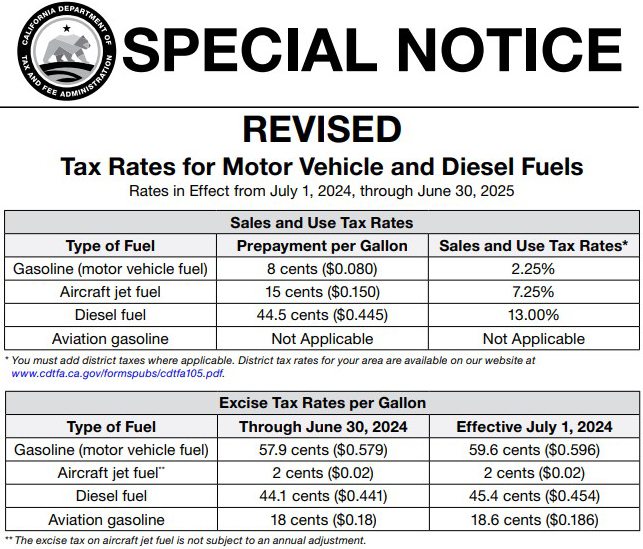
State’s excise tax on gasoline increased July 1 from 57.9 to 59.6 cents per gallon and from 44.1 to 45.4 cents per gallon for diesel fuel.
No end in the lawto annual increases based on state CPI
By Allen D. Payton
If you’re not already aware, the State of California gas tax increased today, July 1, 2024 according to the announcement in May by the Department of Tax and Fee Assessment (CDTFA). According to that notice as reported by the California Taxpayers Association, the state’s excise tax* on gasoline increased today “from 57.9 cents per gallon to 59.6 cents per gallon and from 44.1 cents per gallon to 45.4 cents per gallon for diesel fuel.”
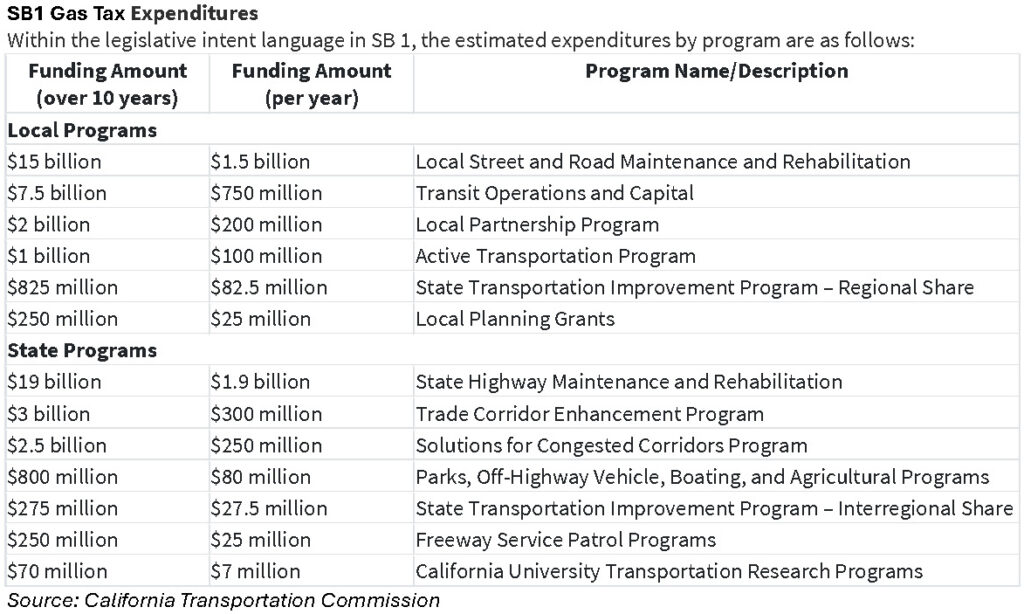
According to the California Transportation Commission, “the Legislature passed and the Governor signed SB 1 (Beall, 2017)…increasing transportation funding and instituting much-needed reforms. SB 1 provides the first significant, stable, and on-going increase in state transportation funding in more than two decades.”
Contra Costa’s representatives at that time split on the bill, with then-Assemblyman Jim Frazier, who was chairman of the Assembly Transportation Committee, and Assemblyman Tim Grayson voting in favor, and State Senator Steve Glazer voting against.
Source: AAA
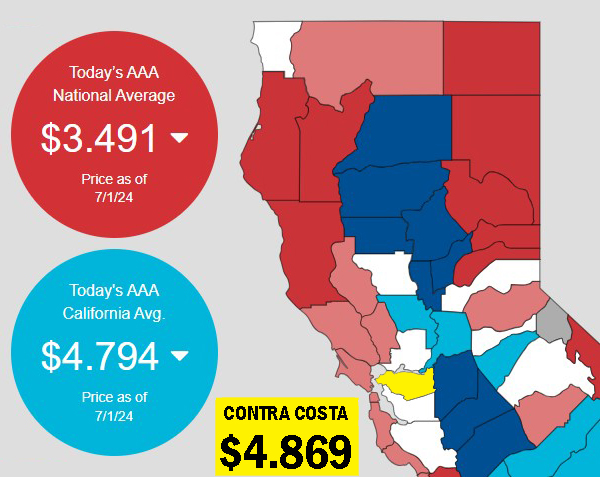
As of Monday, according to the American Automobile Association (AAA), which updates prices daily, drivers in Contra Costa County are paying an average of $4.869 per gallon of regular unleaded gas, while today’s Bay Area average is $4.943, California’s average is $4.794 and the national average is $3.491 per gallon.
Taxes & Fees in the Price for a Gallon of Gas
According to data from the California Energy Commission, drivers are now paying 90 cents in taxes per gallon of gas:
$0.596 on state excise tax
$0.184 on the federal excise tax
$0.10 cents on more state and local sales taxes
$0.02 for a state underground storage tank fee
Plus, $0.51 for state environmental programs fee for a total of $1.41 in taxes and fees per gallon of gas.
Source: CA Dept of Tax & Fee Assessment
But why does the state gas tax keep increasing each year? It’s due to the passage of a bill in 2017, not a vote of the people, as some folks misremember. According to the Metropolitan Transportation Commission (MTC), State Senate Bill 1 (SB1) entitled the Road Repair and Accountability Act of 2017, “was passed by a two-thirds majority in the California Legislature and signed into law by Governor Jerry Brown in 2017. As the largest transportation investment in California history, SB 1 is expected to raise $52.4 billion for transportation investments statewide over the next decade.” It marked “the first increase in the state excise tax on gasoline since 1994.”
It requires the CDTFA to annually adjust the rate by the increase in the California Consumer Price Index (CPI) which is as calculated by the Department of Finance (CDFI). According to the CADFI, the CPI “measures price changes in goods and services purchased by urban consumers. The all urban consumer (CPI-U) represents the spending patterns of the majority of the population which includes professionals, the self-employed, the poor, the unemployed, and retired people, as well as urban wage earners and clerical workers (CPI-W). The U.S. Bureau of Labor Statistics (BLS) compiles and publishes the CPI for the Los Angeles area monthly, the Riverside area bimonthly, San Diego County bimonthly, the San Francisco area bimonthly, and the nation each month. A California CPI is calculated…as a population-weighted average of the BLS-published local area CPIs. The California CPI formula was developed by the California Department of Industrial Relations (CADIR).”
According to the CDIR, the CPI “Is a measure of the average change over time in the prices paid by urban consumers for a fixed market basket of goods and services. The CPI provides a way to compare what this market basket of goods and services costs this month with what the same market basket cost, say, a month or year ago.” This year, the California CIP was determined to be 3.3% in February and 3.8% in April.
History of Recent CA Gas Tax Increases
In addition, according to details provided by the CDTFA, “*Effective July 1, 2010, under the Fuel Tax Swap Law, purchases and sales of gasoline are exempt from the state portion of the sales and use tax rate (then 6 percent), and a corresponding increase in the excise tax rate on that gasoline was imposed.” Then, “Effective November 1, 2017, Senate Bill 1 imposed an additional $0.12-per-gallon gasoline tax.” Finally, “Effective July 1, 2020, Senate Bill 1…requires CDTFA to annually adjust the rate by the increase in the California Consumer Price Index.”
Proposed Use of Funds
The majority of the revenue from the state gas tax is intended for “Local Street and Road Maintenance and Rehabilitation” at $1.5 billion per year over 10 years and $1.9 billion for “State Highway Maintenance and Rehabilitation.”
Also, according to the MTC, “In the Bay Area, most of this money will be directed to cities, counties and public transit agencies to tackle the enormous backlog of maintenance and repairs for local streets, roads and transit systems. SB 1 money also will be available for new projects, including bicycle and pedestrian improvements.”
Asked if the law sunsets and the annual increases end or if they continue indefinitely a staff member for CDTFA responded, “CDTFA is required by law to adjust the motor vehicle fuel and diesel fuel excise tax rates annually based on the California Consumer Price Index as calculated by the Department of Finance. SB1 did not include a sunset date.”
For additional information on SB1 see the answers by the California Department of Transportation (Caltrans) to the Frequently Asked Questions, here and by the California State Controller’s Office, here.
Microenterprise Home Kitchen Operations can offer meals for dine-in, delivery and takeout and with limits, in addition to Cottage Food Operations already allowed
By Contra Costa Health
Contra Costa residents interested in selling home-cooked food to the public can now get a health permit to do so, an affordable option for entrepreneurs that ensures the safety of their customers.
Beginning July 1, Contra Costa Health (CCH) offers a new type of food permit for small-scale, home-based restaurants operated inside private homes by their residents. Microenterprise Home Kitchen Operations (MEHKOs) can offer meals for dine-in, delivery and takeout. MEHKOs can offer meals for dine-in, take-out, and/or delivery, and can also be used as a commissary for permitted food carts.
“By providing this option we ensure that people who sell food out of their homes do so in a safe manner that protects the health of our community,” said Federal Glover, chair of the Contra Costa County Board of Supervisors. “We also open the door for neighborhood businesses, and for more access to healthy, nutritious food in areas where options may be limited.”
The board unanimously adopted an ordinance in May authorizing the county to offer the permit under terms of a 2018 state law. Several other Bay Area jurisdictions already do so, including Alameda, San Mateo, Santa Clara and Solano counties, and the City of Berkeley.
The permit allows meals to be stored, handled, and prepared to be served or delivered in a private residence. Most other food permits require a commercial kitchen in a restaurant or similar facility.
A permitted home can also serve as a space to prepare food for sale on street carts, a requirement to obtain a cart vendor health permit that has proven to be a significant barrier in Contra Costa.
As with holders of standard commercial food permits, MEHKO permit holders must meet requirements relating both to the spaces where their businesses operate and the food-safety training of operators. CCH will inspect each permit holder annually or more often.
The MEHKO permits do limit the holder to selling no more than 30 meals per day and 90 meals per week, and no more than $100,000 in gross annual sales. There are also some limitations regarding the type of food that may be served.
CCH will schedule workshops throughout the county later this year for potential applicants.
“This permit is great for new entrepreneurs who are just getting started,” CCH Environmental Health Director Kristian Lucas said. “It’s also a way for the public to know that a seller advertising on social media is complying with food safety regulations.”
MEHKO permit holders will be required to display their permits at their homes, and their health inspection records will be available to the public at cchealth.org.
Cottage Food Operations Already Allowed
Contra Costa Health offers two kinds of permits for home-based food operations. In addition, to the new MEHKO, the county also allows Cottage Food Operations (CFO) which “is a home-based operation that allows limited amounts of certain foods to be prepared in a home kitchen for retail sale. A CFO can prepare and package non-potentially hazardous foods from home. The California Department of Public Health maintains a listing of foods approved to be sold from a private residence. Some examples of these foods include cookies, candies, jams/jellies, muffins, cakes, and pies. Only foods on the state listing are approved as cottage food products.
Class A: This type of CFO can sell home-kitchen prepared foods directly to the public. This includes transactions made via the phone, internet, and any other digital method. A direct sale may be fulfilled in person, via mail delivery, or using any other third-party delivery service. A Class A operator’s current maximum gross annual sales are $75,000.
Class B: This type of CFO can sell home-kitchen prepared foods directly to the public or indirectly through restaurants and food markets. A direct sale may be fulfilled in person, via mail delivery, or using any other third-party delivery service. An indirect sale may be fulfilled in person, via mail delivery, or third-party delivery service. The current gross annual sales for a Class B operator are $150,000.
In Antioch, home-based business owners are also required to obtain a Home Occupation Use Permit from the City.
For more information about the new and CFO permits, including how to apply, visit cchealth.org/homekitchens.
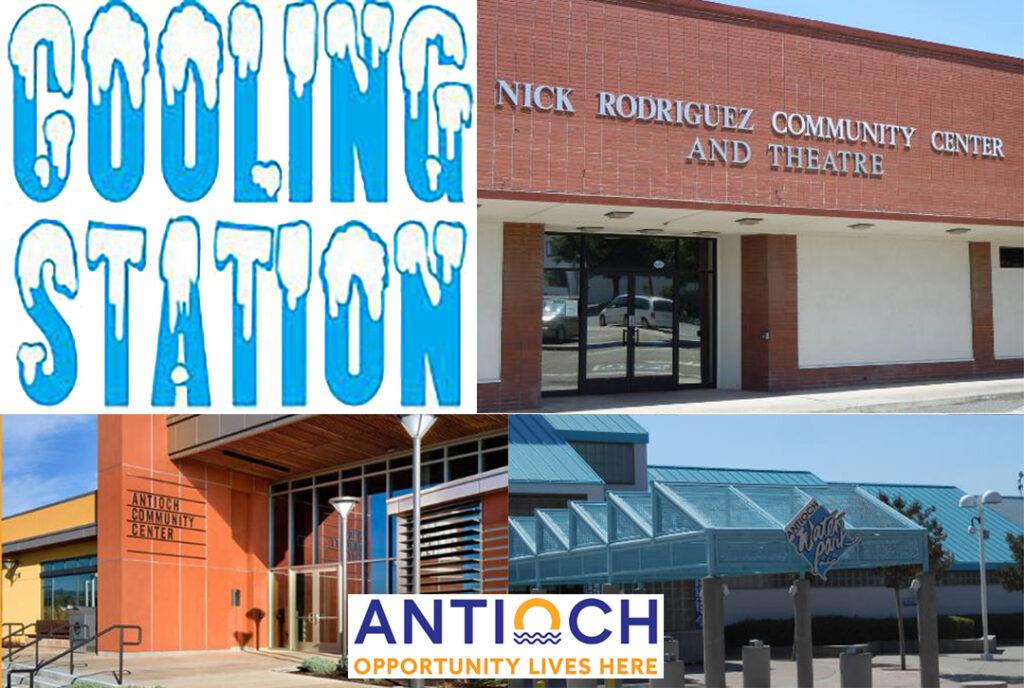
Due to the excessive heat warning, the City of Antioch is providing cooling centers for your convenience. Residents without home air conditioning or with health conditions made worse with extreme heat and poor air quality are encouraged to seek out the cooling centers.
Cooling centers will be held:
Tuesday, July 2nd through Monday, July 8th from 12:00pm-8:00pm at the Nick Rodriguez Community Center in Rivertown, and the Antioch Community Center in Prewett Family Park except for Thursday, July 4th.
On Thursday, July 4th, cooling centers will be held at the Nick Rodriguez Community Center and Antioch Water Park in Prewett Family Park. The Antioch Community Center will be closed.
Nick Rodriguez Community Center is located at 213 F Street
SACRAMENTO, Calif. –In preparation for the Independence Day holiday, the California Highway Patrol (CHP) is launching a statewide enforcement effort aimed at keeping the public safe on our roads. With unsafe speed being the main contributor to crashes in California, the CHP will focus on speed control and promoting safe driving practices throughout the holiday weekend.
“Speeding isn’t just breaking the law – it’s putting lives at risk. Every additional mile per hour reduces a driver’s reaction time and increases the severity of a crash,” said CHP Commissioner Sean Duryee. “We’re asking the public to choose safety over speed to ensure everyone gets home safely.”
To help keep the roadways safe, the CHP will initiate a statewide Maximum Enforcement Period (MEP) beginning at 6:01 p.m. on Wednesday, July 3, continuing through 11:59 p.m. on Sunday, July 7. During this extended holiday weekend, all available CHP officers will be on patrol to encourage safe driving and assist motorists when needed.
Last year during the Independence Day MEP, 68 people were killed in crashes throughout the state. Tragically, nearly half of the vehicle occupants killed in a crash within CHP jurisdiction were not wearing a seat belt. Additionally, CHP officers made 1,224 arrests for driving under the influence during the 102-hour holiday enforcement period. This equates to an average of one DUI arrest every five minutes.
Keep yourself and others safe by designating a sober driver or using public transit or a ride-share service. If you see a driver who seems impaired, call 9-1-1 right away. Be prepared to give the dispatcher details about the vehicle, including license plate number, location, and direction of travel. Your call could save a life.
“The safety of the public is our top priority. Slow down, drive responsibly, and ensure you and your loved ones reach your destination safely,” added Commissioner Duryee.
The mission of the CHP is to provide the highest level of Safety, Service, and Security.
As visitation to East Bay Regional Parks increases in warmer months, encounters with coyotes become more common. Coyotes are native to California and are found in various wildland habitats, as well as in rural and urban areas. They hold cultural and ecological importance throughout the state.
Coyote parents are active and protective of den sites from spring through fall, when new pups are born. It is a normal reaction for them to run away when spotted, although some have become used to human presence and will continue their activities while being watched. Visitors are encouraged to keep coyote safety precautions in mind when visiting Regional Parks throughout the year.
Coyote Safety Tips
Avoid hiking alone so you have help in case of emergency.
Keep children and pets nearby; keep your dog(s) on a leash.
Be aware of your surroundings as you walk, jog, or ride.
Stay on trails.
Never attempt to feed a coyote.
What To Do If You See a Coyote
Keep an eye on the coyote and observe from afar. Do not approach or engage with the coyote; walk away calmly and leave the area quickly. Do not run. If you have small children, keep them close by. If you have a small dog, keep them on a leash.
What To Do If Approached By A Coyote
Rarely, a coyote may approach you. If a coyote moves within 50 feet and does not go away on its own, encourage the coyote to move away to help it retain a natural fear of humans.
Be as big and loud as possible; shout in a deep, loud, and aggressive voice.
Wave your arms.
Keep dogs and children nearby.
Maintain eye contact, which can make coyotes uncomfortable and timid.
If the coyote continues to approach, do not run or turn your back on the coyote but continue to exaggerate the above gestures while backing away slowly.
Help protect all wildlife and their environment. Never feed, approach, or pet wild animals. For emergencies, contact 911 or the East Bay Regional Park District Public Safety line (510) 881-1833, 24 hours a day.
The East Bay Regional Park District is the largest regional park system in the nation, comprising 73 parks, 55 miles of shoreline, and over 1,330 miles of trails for hiking, biking, horseback riding, and environmental education. The Park District receives an estimated 30 million visits annually throughout Alameda and Contra Costa counties in the San Francisco Bay Area.
Will bring back for future votes: more street cameras, ordinance requiring native plant species for new developments, city owned property and resolution opposing Amtrak Station closure.
Ogorchock, Hernandez-Thorpe agree City needs to maintain historic murals
By Allen D. Payton
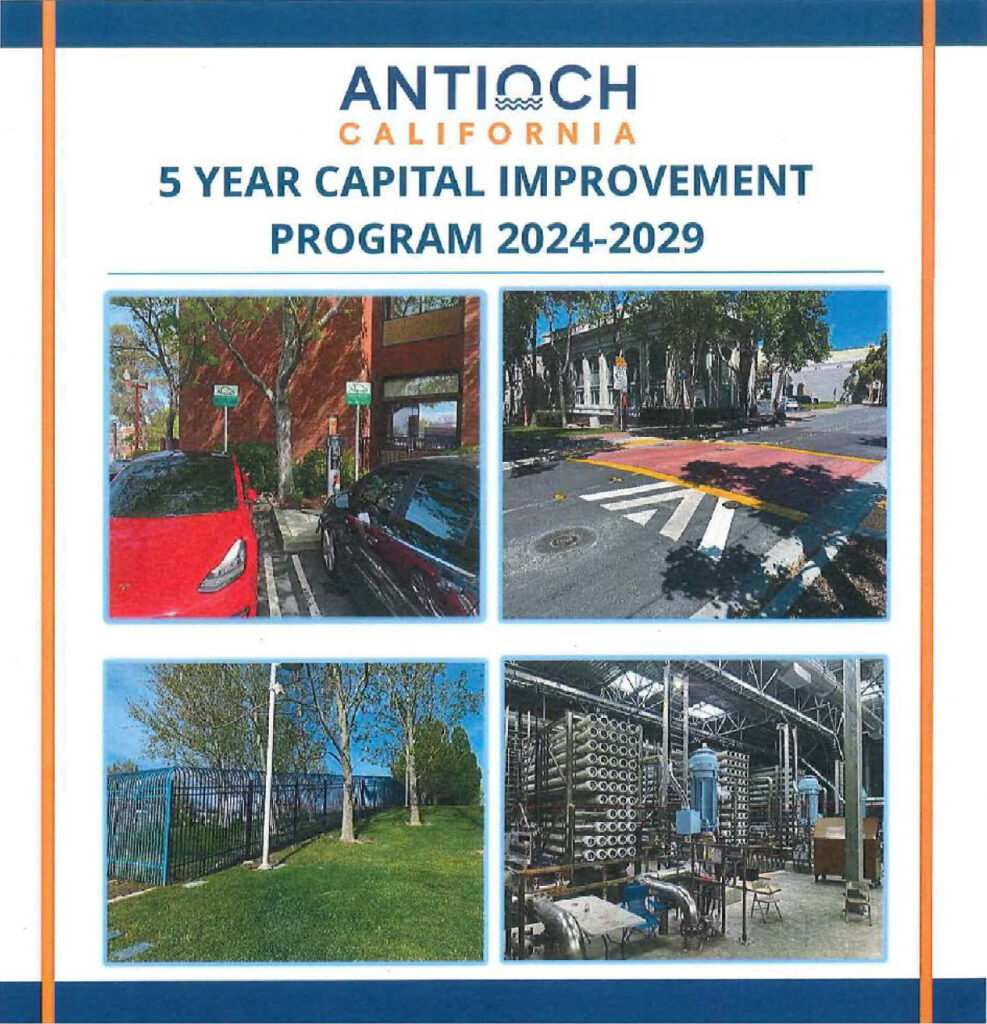
During their meeting last Tuesday night, June 25, 2024, the Antioch City Council adopted the 5-Year Capital Improvement Program (CIP) for 2024-29 which includes $176.85 million for projects in multiple categories including roads, parks and trails, water, sewer system and city-owned buildings. They also agreed to move forward, for future council votes, additional street cameras and an ordinance requiring plants included in new developments and on city-owned property be at least 70% native species.
Finally, the council agreed to return with a resolution opposing the closure of the Antioch Amtrak station and sending a letter to the San Joaquins Joint Powers Authority which governs the service in and through the city. Plus, the mayor and District 3 Councilwoman Lori Ogorchock agreed the City must maintain the historic murals it owns. District 1 Councilwoman Tamisha Torres-Walker was absent for the meeting.
Source: City of Antioch Public Works Department
Council Approves 5-Year CIP Budget
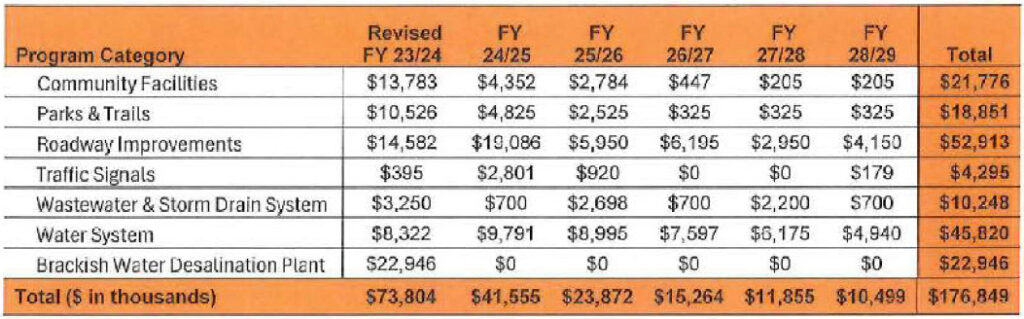
The council heard from Acting Public Works Director Scott Buenting about the 5-Year Capital Improvement Program for 2024-29 with a budget covering $176.85 million for a variety of projects in various main categories. The CIP also shows $7.7 million in projects completed during the 2023-24 Fiscal Year which runs from July 1st to June 30th. The CIP also provides the list of $171.1 million of projects currently in progress of which $116.1 million is for the Brackish Water Desalination Plant. A total of $2.19 million for Community Facilities improvement projects was added to the list which includes $1 million for the police department’s Dispatch Communications Center Improvements and $550,000 for Antioch Water Park improvements.
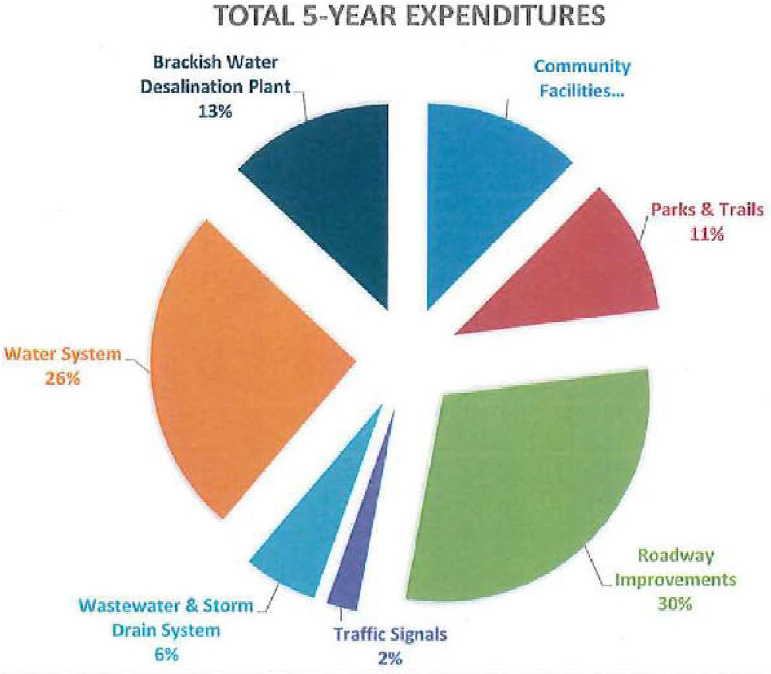
The category to receive the greatest level of funding was $52.9 million for Roadway Improvements followed by $45.8 million for the City’s Water System, not including the desal plant for which $22.95 million was allocated. Community Facilities (City-owned buildings) were allocated $21.8 million followed by $18.85 million for Parks & Trails. The Wastewater & Storm Drain System will receive $10.25 million, and Traffic Signals were allocated $4.3 million.
Antioch 2024-29 CIP expenditures by Program Category. Source; City of Antioch Public Works Department
$20.629 Million for L Street Improvements
Under the Roadway Improvements category, the greatest amount of funding received by a project, $20,629,000, is for the L Street Improvements from Hwy 4 to the marina which includes widening from Sycamore Drive to W. 10th Street. With planned completion in 2028, the project will provide four lanes of traffic, as well as curbs, gutters and sidewalks on both sides of the street, and landscaping.
CIP Budget Sources of Funds
Sources of funding for the projects include $60 million from sewer and water Enterprise Fund and $41.2 million from Special Revenue Funds including Measure J, the county’s half-cent sales tax for transportation, state gas tax and federal ARPA funds approved during COVID. An additional $27.8 million is from Grant Funds, including federal and state program sources, $16.9 million from the State Revolving Loan program, almost $10 million from the City’s General Fund and $2.4 million from Capital Improvement Funds. Over 10 percent of the CIP budget, a total of about $18.6 million, is currently unfunded.
Council Moves Forward Two Proposed Items for Future Votes
The council also discussed matters proposed by two council members. With Torres-Walker absent, her proposed items were held over to the council meeting in late July including creating a new Diversity, Equity, Inclusion and Belonging Officer position and a Health and Safety Analyst position for the Human Resources Department.
“I would like to put this back on the agenda when she can speak on it in late July,” Mayor Lamar Hernandez-Thorpe stated. The others agreed.
Street Cameras
“It’s very important to have these cameras back in our community….capture vital information,” said Ogorchock about her proposed agenda item. “Currently we have 130 cameras. If we had another 130 that would cover all intersections coming in and going out of the city.”
“The cost would be $250 per camera to maintain,” she continued. “They will be huge in capturing drivers and spectators of sideshows.”
“Is there consensus to bring back the cameras for discussion?” the mayor asked.
“I support cameras coming back and the discussion,” Barbanica said.
“OK. That will be coming back,” Hernandez-Thorpe stated.
Taxpayer Protection Act Opposed, But No Vote As It Was Removed from Nov. Ballot
Ogorchock, who asked for this item to be on the agenda for discussion and a vote by the council to oppose it, said, “I have really good news about this. The California Supreme Court ruled the Taxpayer ‘Deception’ Act would be removed from the November ballot.”
However, the measure was actually entitled the Taxpayer Protection and Government Accountability Act and if passed would have required all new local taxes to be enacted via a two-thirds vote of the electorate. (See related article)
Ralph Hernandez said, “Unfortunately, you don’t have really any information there in the packet. At this time without a lot of the information…if you’re looking at tax increases, I’m against it. I think the public already suffered enough in this economy.”
“This was a ballot measure sponsored by the California Business Roundtable that would impact cities like us negatively,” the mayor explained. “The Supreme Court decided it can’t even be on the ballot.”
Policy on Use of Native Plant Species in New Developments
Ogorchock also asked for this item to be on the agenda for discussion. One speaker asked that the policy, “include private developments and city land and parks. There are a variety of nurseries that offer native plants. Native plants can be acquired at reasonable costs.”
“Direct staff that when native plants – more than 70% be native plants,” she continued. “Without that, birds in general can’t reproduce. They need lots and lots of caterpillars. Keystone species provide the habitat for caterpillars.”
Another speaker, Alexander Broom, said, “A mandate or an ordinance would be a huge step in the right direction for new developments and city property. There’s just so many benefits.”
Ogorchock said, “I do believe we need to start looking at adding this to the General Plan. This is something we can do within our city, not only with new developments but with City property. I’m for having a 70% policy of native species.
I definitely concur,” District 4 Councilwoman Monica Wilson said. “Invasive species of plants have been planted and wreaked havoc on our environment. I think this is a plus for our city to do. It can play a part in our Climate Action Plan.”
“I’m definitely in favor of it coming back, at least 70%,” Barbanica stated.
Asked if the requirement on new development can be done with developers, Acting Community Development Director Kevin Scudero said, “I can’t find a city in the state that has one.”
“I think it’s not that difficult to do it we just need to do it,” Ogorchock added.
“That will come back,” the mayor said in conclusion.
Agree to Bring Back Resolution Opposing Amtrak Station Closure
Before the council discussed the Antioch Amtrak Station closure Ogorchock, who had requested the item to be on the agenda, suggested Hernandez-Thorpe public comments on the matter first, which he did.
One resident, Tashena Garret said, “We are still fighting to save our train. We, again, are not giving up.”
Another resident, who the mayor referred to as Mr. Gums, said, “I’m in support of the Amtrak train station staying. I would like all the council members to show their support for the Amtrak station staying.” He wanted the council to issue a press release stating that.
“I did meet with ACCE and a couple other individuals regarding the Amtrak station,” Ogorchock stated. “And in order for them to have a really good conversation with Senator Glazer, Assemblyman Grayson, Supervisors Federal (Glover) and maybe Burgis, we would like to have a resolution regarding the need, why we need that station and how important it is to our community.”
“So, I think that when they have the resolution in hand and they go and meet with these elected officials then they have something from the City stating why it’s so important,” she reiterated.
“What we’re asking for is a resolution to come back saying we never agreed to this,” Hernandez-Thorpe stated.
“I don’t know if it needs to say, that we didn’t agree to it,” Ogorchock responded. “Basically, it needs to say who it impacts, how many people, ridership, people go to work, basically…actually I started a resolution.”
“You guys had a draft,” the mayor said to City staff members.
“Well, the attorney said you would give me one,” Ogorchock stated.
“Do you want it to come back late July?” Hernandez-Thorpe asked, referring to the next council meeting (as they won’t hold one the second Tuesday in July). “We could call a special meeting.”
He then mentioned that the July 19th Board of Directors meeting of the San Joaquins Joint Powers Authority, which oversees and operates the Amtrak line in and through Antioch, had been cancelled. The next meeting is scheduled for Sept. 20th in Martinez, according to the organization’s website.
“Oh, but you want it for your advocacy efforts,” the mayor said to staff.
The council members then agreed to bring back a resolution for a vote opposing the closure of the Antioch Amtrak Station at their meeting on July 23rd.
“But I think it’s important that we include language we were never asked to weigh in, we were never asked our opinion,” Hernandez-Thorpe said, “Whoever made the decision, according to the San Joaquins, and you’ve all seen the video – I sent it to you – that this was the city manager, former city manager Ron Bernal who made this decision. He never told us about it. He never asked us to make a decision or weigh in. For the city manager to singularly make that decision on his own, I just think it was inappropriate and it needs to be noted.”
“So, everybody agree to that?” the mayor asked. “OK. So, consensus, there.
The City is supposed to be maintaining and repairing the murals approved by the Antioch City Council, including the one removed from the W. 4th Street building wall this past week, the Sesquicentennial mural on the building wall at 505 W. 2nd Street, the Veterans Memorial mural at the foot of L Street near the Antioch Marina and boat launch, Love Conquers All mural on Sunset Drive off A Street behind the Chevron Station and a the painted utility boxes throughout town. Photos by Allen D. Payton (top left & center, bottom left & 2nd from left). Photos by City of Antioch (bottom 3rd to the right and corner). Photo by Google Earth (top right)
Ogorchock, Hernandez-Thorpe Agree City Must Maintain Historic Murals
During Council Communications and future agenda items, Ogorchock spoke about the murals in the city following the removal of the historic, council-commissioned mural on W. 4th Street this past week. (See related articles here and here)
“The mural on 2nd Street, we do have an easement on that property, next to the Nick Rodriguez building,” she stated. “It does need some repairs. I don’t want to go through the same issues. We need to make sure because we have an agreement, that is a written agreement, that we would maintain these. So, we need to go back and do what we need to do on that mural because there’s parts of it…that is weathered.”
“Then we need to make sure, we have the one at the Marina,” Ogorchock continued. “So, we need to make sure that all the murals are being maintained and repaired along with the (utility) boxes that we have.”
“The ones we own, I think the issue is with the easements on a few of them,” said Hernandez-Thorpe. “If we could take that back and I had an understanding…it’s really hard. And we do have all that money we set aside for murals, and we need to use some of that for the ones we’ve said, historically that we’re going to maintain.”
“On that, we do need to make sure that the mural money that we put aside was for a new mural,” Ogorchock pointed out. “That Mayor Pro Tem Wilson has asked for, too.”
With no further discussion on the matter, the council then voted to adjourn the meeting.
Kelly Gonzales is the founder and owner of Pacific Senior Care Services LLC.
Started in owner’s former Antioch home, honored with awards each year
By Allen D. Payton
Having finished commercial aviation and tourism studies at Columbia College and working for an airline at an airport in Peru, Kelly Gonzales immigrated to the United States at age 19. Then after working in banking and financial services for 20 years, she wanted to pursue her passion and did that by forming Pacific Senior Care Services in 2014 using her skills to help place people into care homes.
Gonzales was particularly inspired by the care her retired Army colonel and veterinarian father needed and received in Lima, Peru after he suffered a stroke. But she couldn’t really help him living over 15 hours away by flight. Instead, Gonzales and her team have been able to fulfill the company’s slogan and mission of “Meeting Elder Needs With Love and Compassion” in Contra Costa County and the Bay Area.
“My father was the main reason I started the business,” she said.
Now her company is celebrating its 10th Anniversary in business. A former Antioch resident, Gonzales started the business in her home then opened the company’s main office in Walnut Creek.
“I thank the Lord for enabling me to fulfill my calling,” she shared. “I never thought in my life I would be doing this. Working with the right people we’ve been able to help many families in the community. It’s been a blessing. I have good people around me, our support staff, and contractors.” She thanked them and “all those who gave us leads through the years.”
“Families who we’ve helped call us later and let us know of others we can provide services to,” Gonzales stated.
The company’s short-term plans include, “opening an office in Sacramento, later this year, Lord willing, and relocate our other office from San Mateo to Redwood Shores to serve families on the peninsula,” she said.
Gonzales’ daughter, who is a Certified Medical Assistant and attended Diablo Valley College, and now in the process of earning her nursing designation, works with her making it a family-operated business.
“We are also forming a homecare agency with partners in the industry,” she continued. They plan to also offer that service in the Sacramento area and San Mateo County.
Gonzales’ and Pacific Senior Care Services were chosen to represent the National Long Term Care Planning Council to create a team in the Bay Area.
“The San Francisco Bay Elder Planning Council was created to help solve critical aging issues and planning for the final years by providing a free central source of information, with senior advisors and professionals within our network,” she shared. “Guiding family members seeking help for their loved ones is the main focus. Another purpose of our planning council is to encourage people to prepare for the future needs for aging services.”
Awards & Honors
Under Gonzales’ leadership Pacific Senior Care Services PSCS) has also been honored with several awards through the year, including being named one of the 2024 Best Full Service Senior Care Providers in California by Global Health & Pharma Magazine, Social Care Awards.
Last year the company was honored in the California Business Awards 2023 as a Leading Provider of Senior Care Services – Northern California by the New World Report and in 2017 and 2022 PSCS was honored for Excellence in Customer Service by City Beat News.
The company has been honored with other awards every year they’ve been in business.