







Author Archive

Coast-to-Coast relay to celebrate America 250

Friday, May 29th, 2026
Longest continuous, non-motorized relay in world history will have stops in Walnut Creek, Antioch July 6-8

Interested individuals or teams can participate

By Dave Whitson, ADT 250 Relay Director, American Discovery Trail Society

FRONT ROYAL, VA – In 2026, the American Discovery Trail Society (ADTS) celebrates the outdoors and 250 years of our independence with the American Discovery 250 Relay— a 6,800-mile (11,000 km) journey along the entire American Discovery Trail from California to Delaware, traversing through hundreds of cities, towns, villages and hamlets, starting in July and ending around Thanksgiving. This event will be the longest continuous, non-motorized relay in world history. The ADTS invites all to join in the celebration by participating for a day or more in a relay, attending one of over 100 local events, or sharing your story of personal growth and adventure. Together, we commemorate America’s past and unify our country.

Source: ADR250

Specialized Batons

Participants will carry a specialized baton displaying the header and carrying a copy of the Declaration of Independence. There will be three batons to choose from – each engraved with the three founding principles in the document: Life, Liberty and the Pursuit of Happiness. There will be three different colors assigned to each baton as well – red, gold and blue.

Source: ADR250

We have provided an informational webinar presenting an overview of the event which you can link to HERE

Interested participants or teams are asked to register for free at discoverytrail.org/america-250-relay.  Runners, cyclists, hikers, wheelchair users and horseback riders are all encouraged to take part. We also encourage interest from those who wish to help with logistics, welcoming events or sponsorships. 

The ADTS is making the turn-by-turn route instructions and GPS tracks free to the public during the 2026 year as part of the celebrations thanks to a generous donation from Indiana Trails. 

Source: ADR250

DATES HAVE BEEN SET! 

California dates are from July 1st-15th with stops in Walnut Creek and Antioch on July 6th and 7th, leaving on the 8th. The California segment will begin at Limantour Beach in Marin County where we’ll gather for the American Discovery 250 Relay kick-off, cross the Golden Gate Bridge and end with a final leg from Tahoe City on the Tahoe Rim Trail into Nevada on July 15th.

Contra Costa County Segments

  • Monday 07/06/2026 — UC Berkeley, CA at 8:00 a.m. run and walk to Heather Farms Walnut Creek, CA — 28.3 miles We’ll meet on the corner of Bancroft and College Ave, right on the edge of the UC Berkeley campus. The Telegraph Channing Garage is a nearby parking option. Estimated arrival time: 5pm
  • Tuesday 07/07/2026 — Heather Farms Walnut Creek, CA at 8:30 a.m. run and walk to Antioch Community Park, CA — 36.6 miles The day begins with a special event–a breakfast hosted by the City of Walnut Creek, in collaboration with Save Mount Diablo. Free food! (We’re going to need it.) We’ll aim to hit the road around 9am. Lunch-time gathering in Clayton, hosted by the City of Clayton. Details to follow. Estimated arrival time: 7pm.
  • Wednesday 07/08/2026 — Antioch Community Park, CA at 8:30 a.m. bike to Sacramento – William Land Park, CA — 69.4 miles We depart from Antioch / Worth Shaw Community Park. The City of Oakley will offer a refreshment stop for participants at Antioch/Oakley Regional Shoreline around 9:30am. A support vehicle will be accessible in Oakley (7.5 miles), Isleton (30 miles), Locke (39.6 miles), and Clarksburg (55 miles), and also on-call for road-side support. Water will be available in the vehicle to top off bottles, and it will also be possible for participants to have some of their own supplies transported. Estimated arrival time: 4pm.

The entire relay calendar is now available to review here: discoverytrail.org/adt-relay-calendar.

Source: ADR250

Many Sections of the Trail are Multi-Modal and ADA Accessible

On many days we can have hikers, runners, bicyclers, and others. Thus, a 70-mile “bike” day will certainly include bicyclists who go the full distance, but there also can be people who meet up at the starting point in the morning and walk for a mile or more, or there may be walkers who gather at sites where the bikers stop for lunch or at the end of the day. Also some days listed as “hike” can include families or others who wish to ride their bikes.

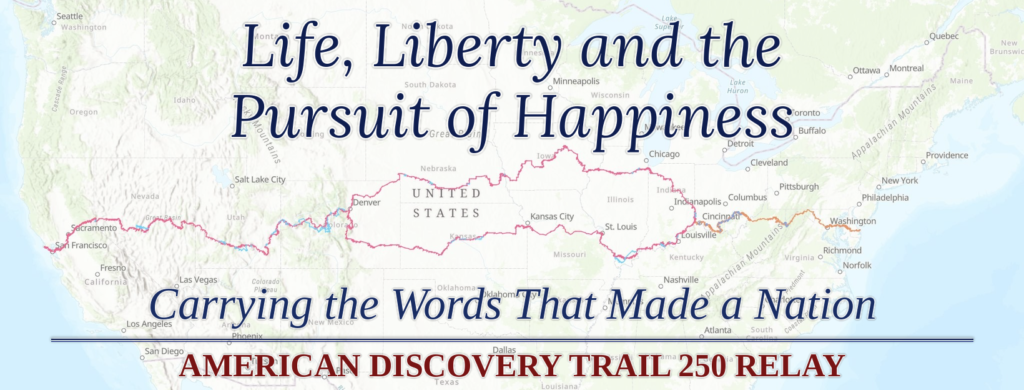
There are some days when certain modes are not practical or allowed, such as no bicycles in wilderness areas. Thus, the sign-up form asks the date, the mode of transit, and the desired starting and ending points. Note that the relay will split in Denver, so in September and October we are running two relays at the same time, one through the south-central region and through the north-central region. We unite in late October in Cincinnati.
Source: ADR250

About the American Discovery Trail

The American Discovery Trail is the nation’s first non-motorized coast-to-coast trail established in the USA in 1990. Since then, hundreds have taken the challenge to walk, bike, wheelchair or horseback the entire trail (or sections thereof) with life-changing results.

It runs for 6,800 miles through 15 states and Washington, D.C. The route incorporates numerous local, state and national trails, with most of them designed for walking, hiking, and running and for bicycle and equestrian use. It connects scores of scenic and historic trails, backcountry roads, national parks and forests plus thousands of state and local properties of historic, cultural and natural significance. Users can experience their local environment, or the 23 ecosystems the trail passes through – deserts, mountains, forests, waterfronts, and plains. You can learn more about the ADT by visiting www.discoverytrail.org

Allen D. Payton contributed to this report.

Dana Eaton seeks promotion to Contra Costa County Superintendent of Schools

Friday, May 29th, 2026
Source: Eaton campaign

Brentwood Union School District Superintendent will apply his student-centered approach countywide

“We have a moral responsibility to make sure our children’s education is better than the one that we received,” – Dr. Dana Eaton

By Lisa Tucker

BRENTWOOD – In January, Dana Eaton launched his candidacy for Contra Costa County Superintendent of Schools. This is an open seat. 

“Students and learning are at the center of my work as superintendent of schools for the Brentwood Union School District and in my previous roles as a teacher and principal,” said Eaton.  “I have consistently championed early literacy, student mental health, supporting the whole child, and school safety as foundational priorities, and will continue to do so as Contra Costa Superintendent of Schools.” 

Dr. Eaton is serving his 13th year as superintendent of schools for the Brentwood Union School District and his 17th year as a superintendent overall.  According to his LinkedIn profile, he previously worked as Superintendent for the Jefferson School District in Tracy from 2009 to 2013. Eaton has a nearly 30-year career in education including as a teacher and principal.

Dana with his wife, Renee and their children, James and Emily. Source: Eaton campaign.

He earned his Bachelor’s degree in Liberal Arts and Sciences/Liberal Studies from San Francisco State University, a Master’s degree in Educational Leadership from Saint Mary’s College of California and a Doctor of Education – EdD degree in Educational Leadership from the University of La Verne.

Eaton currently serves on the Fiscal Crisis and Management Assistance Team State Governing Board, the state’s school finance oversight organization; the California Collaborative for Educational Excellence Superintendent Advisory Panel, the state’s support provider to school districts in need of academic assistance; and, is state president of the Association of California School Administrators (ACSA) Superintendency Council, where he advocates on behalf of students, teachers, and educational leaders at the state and federal level.

“This experience has prepared me to help districts maintain sound fiscal practices and improve their Local Contral and Accountability Plans (LCAPs) to provide outstanding educational opportunities to every student,” said Eaton.

Current Contra Costa Superintendent of Schools, Lynn Mackey, is retiring and will not run for re-election. She has endorsed Eaton, stating “Dana is a highly experienced, well-respected superintendent here in Contra Costa County.  He is deeply committed to public education, understands the role of the County Office, and brings steady, student-centered leadership.”

Dr. Dana Eaton speaks during a campaign fundraiser at McCauley Estate Vineyards in Brentwood on April 7, 2026. Photos by Allen D. Payton

During a campaign fundraiser on April 7th, the candidate said, “I really believe in the power of public education. At the same time, I think we’re in a time when we are at risk for our children and our children’s children having an inferior education. I think that as adults who have benefited from a public education that we have a moral responsibility to make sure our children’s education is better than the one that we received. And that’s why I’m running for County Superintendent of Schools.”

In recognition of Eaton’s leadership, he was named ACSA Superintendent of the Year for Alameda and Contra Costa Counties in both 2016 and 2023.  He was also named Brentwood Citizen of the Year in 2019 by the Brentwood Chamber of Commerce.

“As Superintendent, I will work to attract and support high-quality teachers and prioritize student success and learning whether in general education, special education, or alternative settings,” said Eaton.

Eaton comes from a long line of educators. His grandparents, mother, sister and wife all served their communities as teachers. Eaton lives in Brentwood with his family. 

The primary election is in June in which he faces one opponent. Whoever receives a majority of the vote wins and will begin their term in December.

For more information about Dr. Eaton and his campaign visit www.eatonforschools.com.

Allen D. Payton contributed to this report.

Traffic signals across Contra Costa County are getting smarter

Thursday, May 28th, 2026
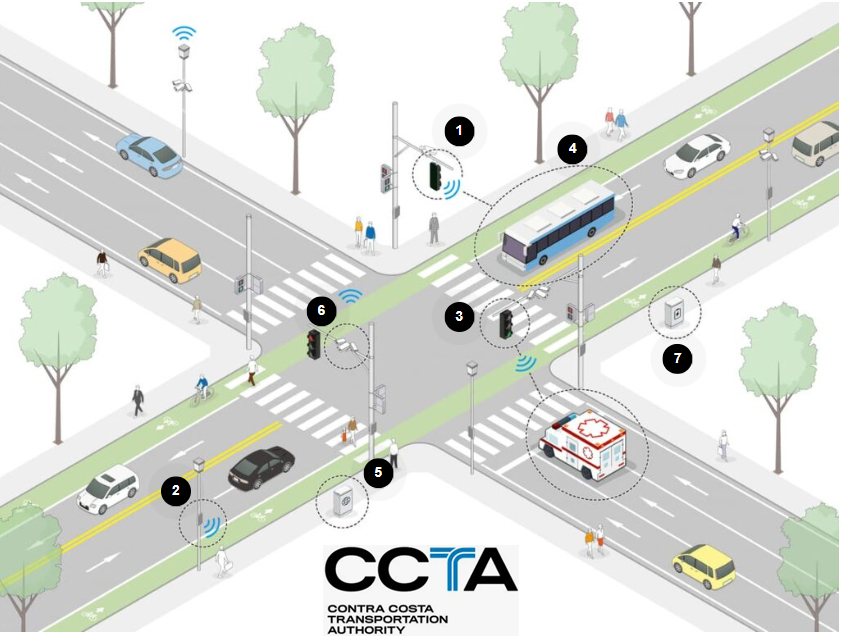
Source: CCTA

CCTA introduces Countywide Smart Signals Project at approximately 365 intersections, 15 in Antioch

By Lindy Johnson, Director of External Affairs & Mike Blasky, Communications, Contra Costa Transportation Authority

At a groundbreaking event in Danville on Wednesday, May 27, 2026, the Contra Costa Transportation Authority (CCTA) marked the advancement of its Countywide Smart Signals project, a countywide effort to modernize approximately 365 intersections and give local agencies better real-time tools to improve safety, reduce unnecessary stops, and help traffic move more smoothly on some of the county’s most important corridors.

The project spans all 19 cities and towns, along with unincorporated Contra Costa County, and focuses on major Routes of Regional Significance where upgraded equipment can strengthen coordination and improve day-to-day traffic operations across jurisdictions. Antioch has 15 locations along Wilbur Avenue, A Street, W. 10th Street, Auto Center Drive, Somersville and Buchanan Roads.

A special thank you to CCTA Senior Engineer Andy Dillard, whose work and leadership helped move this project from concept to construction. His experience, including his earlier work with the Town of Danville, has been instrumental in shaping a project that started with local needs and is now growing into a countywide system upgrade.

Key Features of the Smart Signals include:

Traffic Signal Synchronization

Makes traffic lights work together so drivers spend less time in traffic, reducing travel times and delays while enhancing safety.

Video/Radar Vehicle, Pedestrian, and Bicycle Detection

Uses sensors to locate approaching vehicles, people, and bikers, and automatically adjust traffic lights for safer crossings. Provides real-time traffic data so cities can spot issues, improve timing, and keep roads safe.

Emergency Vehicle Preemption

Gives green lights to fire trucks, police cars, and ambulances so they can reach emergencies more quickly.

Transit Signal Priority

Helps buses move through traffic more smoothly to stay on schedule.

High-Speed Network

Connects signals through high-speed links so they can share information instantly.

Remote-View Sensors

Lets engineers see what’s happening at intersections and respond faster to problems.

Battery Back-up Systems

Keep traffic signals up and running during power outages.

Smart Signal Key Features. Source: CCTA

“The Countywide Smart Signals project is about bringing our traffic signal system up to a modern standard and giving our cities and towns better tools to keep people moving safely and efficiently,” said Tim Haile, Executive Director of CCTA. “These upgrades will help intersections work better together, support safer crossings for people walking and biking, and create the connected foundation we need for better traffic management over time.”

Upgrades to traffic signals could include signal synchronization, vehicle, pedestrian, and bicycle detection, emergency vehicle preemption, transit signal priority, high-speed network connections, remote-view sensors, and battery backup systems, depending on local jurisdiction needs. Initial upgrades will begin in communities such as Danville and Concord, with additional countywide work to follow.

“This is exactly the kind of countywide investment that delivers local value,” said Candace Andersen, Supervisor, District 2, Contra Costa County. “For residents, it means smarter coordination, safer intersections, and better support for emergency response and transit. For our local jurisdictions, it means modern tools and stronger connections along the corridors that matter most.”

“We are proud to host this groundbreaking in Danville and help launch an effort that will benefit communities across Contra Costa County,” said Newell Arnerich, Mayor of Danville. “Danville residents experience every day how important signal timing and traffic operations are to safety and quality of life. Projects like Countywide Smart Signals will help our communities manage traffic more effectively while improving conditions for drivers, pedestrians, bicyclists, and first responders.”

“Modern, connected transportation infrastructure is essential to keeping our communities safe and moving. I’m proud to have secured more than $7 million in federal funds to ensure our community has cutting-edge technology to reduce commutes and ensure safety. Contra Costa is leading the nation in investments like Countywide Smart Signals to help improve mobility, reduce delay, and strengthen the transportation networks commuters rely on every day,” said Congressman Mark DeSaulnier, who represents California’s 10th Congressional District. “Today’s Contra Costa Transportation Authority’s Smart Signals project groundbreaking was many years in the making! I have been a proud champion of Smart Signals both here in Contra Costa and back on Capitol Hill where I have secured millions of federal dollars to bring this technology to our community. Thanks to this new project, CCTA will modernize traffic signals at more than 350 intersections throughout Contra Costa, implementing state-of-the-art Smart Signals technology to improve traffic flow and roadway safety to get CA-10 residents to and from home safely and quickly.”

CCTA says the project is designed to deliver three core benefits: safer travel, smoother trips, and better tools for cities and towns. Over time, the connected system is intended to support a broader countywide view of traffic conditions that can help agencies coordinate during major events and emergency situations. The project is funded at a total of $30.8 million through Measure J, local city contributions, as well as federal and state contributions.

We’re excited to see this work move forward and grateful to all of our city, county, regional, state, federal, and transit partners helping bring smarter infrastructure to Contra Costa County.

Residents can learn more, view the interactive project map, and download the project factsheet at ccta.ca.gov/projects/countywide-smart-signals.

CCTA also has a short educational video that explains the project here:
https://www.youtube.com/watch?v=rX-Uh-Uuwo4

About the Contra Costa Transportation Authority

The Contra Costa Transportation Authority is a public agency formed by Contra Costa voters to manage countywide transportation sales tax revenue and to implement voter-approved projects and programs. CCTA is responsible for planning, funding, and delivering critical transportation infrastructure and services to keep Contra Costa County and the Bay Area moving. For more information visit Contra Costa Transportation Authority.

Allen D. Payton contributed to this report.

Tri Delta Transit announces Youth Ride Free 2026

Thursday, May 28th, 2026

June 1st-July 31st

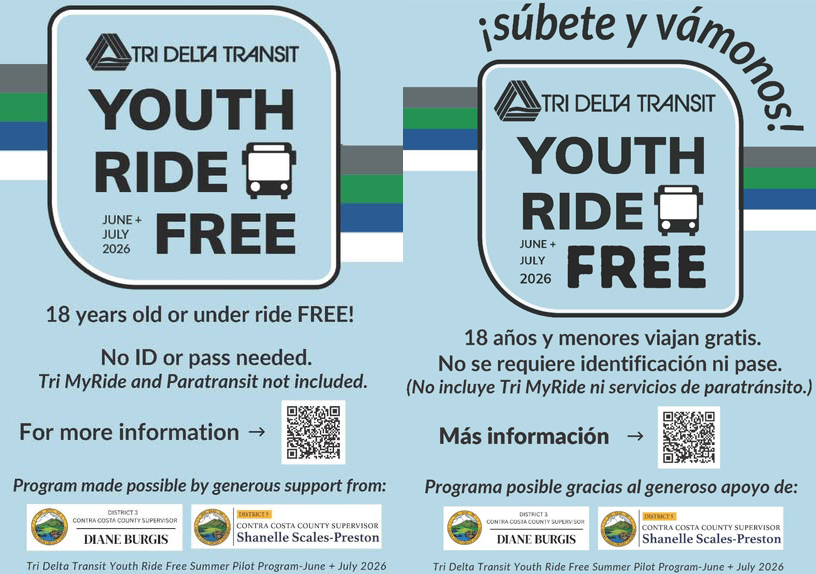
Tri Delta Transit is excited to announce Youth Ride Free 2026. This program, funded by County Supervisor Burgis and County Supervisor Scales-Preston, provides FREE rides for ages 18 and under from June 1st-July 31st on Tri Delta Transit fixed and express route buses. Tri MyRide and paratransit are not included. No fares, no applications, no ID, no passes are needed. So, enter your travel era and ride to jobs, summer program, entertainment, school and more.

Tri Delta Transit se complace en anunciar el programa Youth Ride Free 2026 o Los Jóvenes Viajan Gratis 2026. Este programa es financiado por las Supervisoras del Condado de Contra Costa, Supervisora de el Distrito 3, Diane Burgis y Supervisora de el Distrito 5, Shanelle Scales-Preston.

Youth Ride Free 2026/Los Jóvenes Viajan Gratis 2026 ofrece viajes GRATIS para personas de 18 años o menos empezando desde el 1 de junio hasta el 31 de julio en los autobuses de rutas fijas y expresas de Tri Delta Transit. Tri MyRide y el servicio de paratránsito no están incluidos en este programa.


No se necesitan tarifas, aplicaciones, identificación, ni pases. ¡Así que incia tu era de viajes, ya sea viaja a trabajos, programas de verano, entretenimiento, la escuela y más!

For more information visit Youth Ride Free – Summer Pilot Program – June +July 2026 -Tri Delta Transit.

After four years of confusion Antioch Council renames City’s newest department

Wednesday, May 27th, 2026
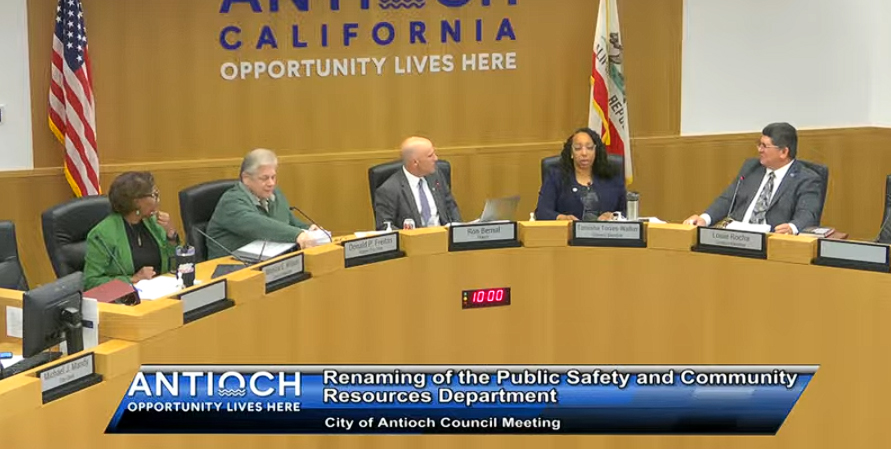
An apparently disappointed Councilwoman Tamisha Torres-Walker speaks on renaming the department during the council meeting on May 26, 2026. Video screenshot.

Public Safety & Community Resources Department is not part of police or fire services

By Allen D. Payton

At the urging of Mayor Pro Tem and District 3 Councilman Don Freitas, during their meeting on Tuesday, May 26, 2026, the Antioch City Council agreed to correct and clear up confusion of including the words “Public Safety” in the name of the newest department which is not part of police or fire services. Instead of its current name, the Public Safety & Community Resources Department, the brainchild of District 1 Councilwoman Tamisha Torres-Walker who has an expanded definition of the term, will be renamed simply, the Community Services Department. The councilmembers also voted to change the titles of the department’s staff.

The council approved the new department in February 2022 on a 4-1 vote. At that time, Torres-Walker tried to redefine the term saying, “a lot of us have decided that public safety is a lot more than policing. It’s about quality of life, environmental justice, youth services, housing. Public safety is about economic dignity, access to jobs, clean water, clean air. All of those things, not just policing. Policing is a part of public safety and we have forgot about that as a community. And I think being able to have this department be called the Department of Public Safety and Community Resources will also help reorient our community to understand that public safety doesn’t just mean policing. It also means access to quality, well organized resources in the city.”

But the department’s name has caused confusion because the majority of people don’t define the term the same as the councilwoman does.

According to the department’s webpage, it consists of three divisions including Violence Intervention & Prevention Division, Youth Services Division and Housing Division. That can also cause confusion as new housing is handled by the Community Development & Economic Development Department and its Planning Division. But the Housing Division of the newly renamed department “provides a range of programs and services designed to support tenants, landlords, and unsheltered community members.”

City Staff Report & Recommendations

In introducing the item, #10 on the agenda, Acting City Manager Ana Cortez said, “The proposed change is intended to better align the department’s public identity with the current vision and focus on prevention.”

According to the City staff report by department Director Monserrat Cabral, “While the department collaborates closely with the Antioch Police Department, first responders, schools, County agencies, and other public safety partners, the department itself is not a law enforcement entity.

“The department’s primary functions are rooted in prevention, intervention, stabilization, human services, outreach, youth development, housing support, violence interruption, and community engagement, with a focus on improving quality of life outcomes and strengthening long-term community well-being for Antioch residents.

“However, nonprofit partners, outside agencies, and community stakeholders often assume the department is a law enforcement division or enforcement-based office due to the inclusion of the phrase ‘Public Safety’ in the department title. This confusion has created challenges including:

• Residents being uncertain whether the department provides direct community services;

• Hesitancy from vulnerable populations who may be reluctant to engage with anything perceived as enforcement-related;

• Misunderstanding regarding the department’s role during outreach and community engagement efforts;

• Difficulty clearly communicating the department’s mission externally; and

• Ongoing confusion between the PSCR Department and the Antioch Police Department.

During her presentation on the matter, Cabral said, “Since its creation, the department has evolved significantly.”

The staff report further reads, “the department…today oversees a broad and diverse portfolio of community-serving functions, including:

• Violence Intervention & Prevention;

• Housing & Homelessness Services;

• Youth Development & Workforce Programs;

• Community Engagement & Outreach;

• Crisis Response & Stabilization Partnerships;

• Grant Administration & Community-Based Funding Initiatives; and

• Nonprofit and Intergovernmental Partnerships.

City staff offered alternative names for the department. The report read, “Common naming themes emerging across municipalities include:

• Human Services;

• Community Services;

• Community & Human Services;

• Community Well-Being;

• Community Support Services;

• Neighborhood Services; and

• Community Development & Wellness.

Staff offered multiple names from other agencies and recommended the new name be the Human and Community Services Department. The recommendation also included “Changing the Department Director title from “Public Safety and Community Resources Director” to “Human & Community Services Director”; and the “Public Safety Manager” classification overseeing Violence Intervention & Prevention functions to “Community Engagement Manager”.

Council Discussion & Direction

Since the item was for discussion only, no council action was expected on renaming the department during Tuesday’s meeting. But a vote was taken.

Torres-Walker was the first council member to speak on the item saying, “We have a recommended name, here. Should we just go with it and call it a night?”

Freitas responded, “No. No.” He then said, “I do realize there is differences of opinion about renaming it. From my perspective, I would just rename it the Community Services Department. Period. I’m trying to be all inclusive. Make sure it’s flexible now and in the future and it’s understandable. I don’t want to sound like a department of the federal…department of the U.S. government. So, from my perspective the Community Services Department serves all that bill and that’s what I support.”

Freitas then made a motion to rename the department and “change the classifications of the certain positions.”

Cabral pointed out that the council would not be changing classifications, just the titles and they would be “changing the code.”

“Yes,” Freitas responded.

District 2 Councilman Louie Rocha seconded the motion.

District 4 Councilwoman Monica Wilson mentioned, “Community Services Department.”

Bernal responded, “We have a Community Development Department.” He then asked Freitas if he would support placing the words “Department of” at the beginning. The Mayor Pro Tem declined.

An apparently disappointed Torres-Walker then could be heard saying softly, “It’s too late to care.”

Bernal asked if there were any more comments and turned to the District 1 Councilwoman who reiterated, “I just said I don’t care. Let’s vote. It’s late.”

Wilson said, “I personally like ‘Human and’. But if everybody is fine with Community Services then that’s alright.”

The motion then passed on a 5-0 vote.

See staff report for agenda item 10.

See 6:39:22 mark of Council meeting video.

Antioch Council again violates City Flag Display Policy hanging “Pride Flag” from dais inside Chambers

Wednesday, May 27th, 2026
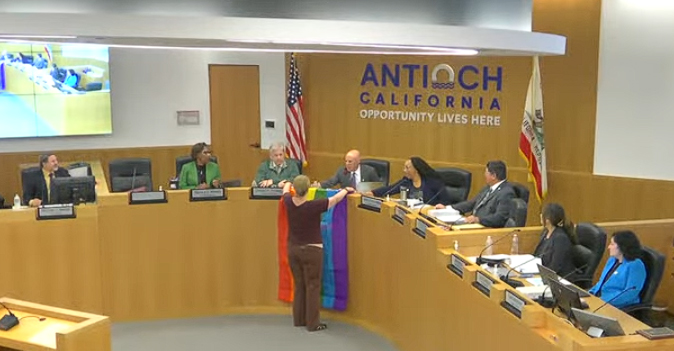
A donated “Pride Flag” hangs from the Antioch City Council dais inside the Council Chambers during their meeting Tuesday, May 26, 2026, in violation of the City Flag Display Ordinance. Video screenshot.

Once again adopts proclamation recognizing June as “Pride Month”, “honoring…contributions, history, …resilience of LGBTQ+ community” and says “City of Antioch is committed to celebrate the history and diversity of our city’s lesbian, gay, bisexual, and transgender community”

Torres-Walker complains of no “Pride Parade” in Antioch

By Allen D. Payton

During their regular meeting on Tuesday, May 26, 2026, after approving the “Pride Month” proclamation on a 5-0 vote, the City Council allowed a rainbow flag to be hung from the dais in front of Mayor Ron Bernal. That violates the unanimously adopted City of Antioch Flag Display Policy approved on Feb. 11, 2020, when Bernal was city manager. The policy, adopted after the council for the first time flew the “Pride Flag” on the pole at City Hall, clearly states only the American, State and City flags can be displayed inside the Council Chambers.

Section 2.07 Display of Flags in the City Council Chambers of the policy reads: “The American Flag, State Flag and City Flag shall be the only flags displayed in the City Council Chambers. The American Flag shall be displayed in the first position of honor. This position is on the Mayor and City Council’s right as they face the audience or to the observer’s left. The State Flag shall be displayed in the second position of honor. This position is to the observer’s right of the American Flag. The City Flag shall be displayed to the observer’s right of the State Flag.”

See the Policy under item 5 of the Feb. 11, 2020, council meeting agenda, here or view it on the Herald website.

In recent years, the Council also allowed the Transgender and Progress Pride flags to be displayed inside the Council Chambers, and District 1 Councilwoman Tamisha Torres-Walker has displayed other small flags on the dais in front of her, all in violation of the Flag Policy. She no longer does that.

Pride Month Proclamation

This year’s proclamation once again recognizes June as “Pride Month” in the City. But a new clause was added which states, “and each following June”.

The proclamation was presented to Nicole Lapointe, the Clinical Director of the Rainbow Community Center in Concord whose mission she said, “is to build community, equity and well-being among lesbian, gay, bisexual, transgender, queer, questioning, intersex, asexual or agender and two-spirit people and our allies.”

But a proclamation isn’t enough for Torres-Walker. She complained that she and other residents have to go to other cities to attend a “Pride Parade”.

“I know that the city of Antioch does have a large non-gender-conforming community,” the councilwoman claimed. “I’m also wondering why I have to go to Concord or Clayton or San Francisco to attend a Pride Parade. So, people have to leave this city to be recognized, and people have to force flags on us when we should really be committed to not just a proclamation once a year, but we should be committed to valuing all of our residents, especially individuals in the LGBTQUIA plus non-gender conforming community.”

According to a speaker during public comments on the item, later identified by Torres-Walker as named Mary, the flag hanging from the dais was donated by an Antioch resident. The woman presented the flag to Bernal who, along with Torres-Walker, helped her hang it on the center of the dais in front of him.

A woman, named Mary, hangs a “Pride Flag” from the council dais with the help of Mayor Bernal and Councilwoman Torres-Walker during the meeting on May 26, 2026, in violation of City policy. Video screenshot.

A woman, later identified by Torres-Walker as named Mary, then presented the flag to Bernal who, along with Torres-Walker, helped her hang it on the center of the dais in front of him.

The proclamation reads as follows:

RECOGNIZING JUNE 2026 ASPRIDE MONTH IN THE CITY OF ANTIOCH

WHEREAS, June is recognized across the United States and around the world as Pride Month, honoring the contributions, history, and resilience of LGBTQ+ community;

WHEREAS, “every individual” is equal before and under the law and has right to equal protection and benefit of the law without discrimination based on race, national or ethnic origin, color, religion, sex, age, or mental or physical disability;

WHEREAS, the City of Antioch recognizes that diversity, inclusion, dignity, and equal protection for all residents strengthen the social, cultural, and civic fabric of the community, and reaffirms its commitment to fostering a welcoming environment where individuals of all backgrounds, identities, and abilities are treated with respect and afforded equal opportunity to live, work, and participate fully in community life;

WHEREAS, the long and ongoing struggle to transgender, lesbian, gay, bisexual, and other sexual minorities for basic civil and human rights continues to provide inspiration to all;

WHEREAS, the City of Antioch is committed to celebrate the history and diversity of our city’s lesbian, gay, bisexual, and transgender community, and promotes a society in which all residents can live free from discrimination; and

WHEREAS, Pride Month is an opportunity to celebrate this harmony in which we coexist.

NOW, THEREFORE, I, RON BERNAL, Mayor of the City of Antioch, hereby proclaim the month of June 2026, and each following June, as “PRIDE MONTH” in the City of Antioch and invite everyone to reflect on ways we can live and work together with a commitment to mutual respect and understanding.

MAY 26, 2026

RON BERNAL, Mayor

See Council meeting video.

Opinion: CoCoTax says vote no on Measure G – a $1.88 billion burden Contra Costa can’t afford

Wednesday, May 27th, 2026
All graphics & charts source: CoCoTax

By Mike Arata

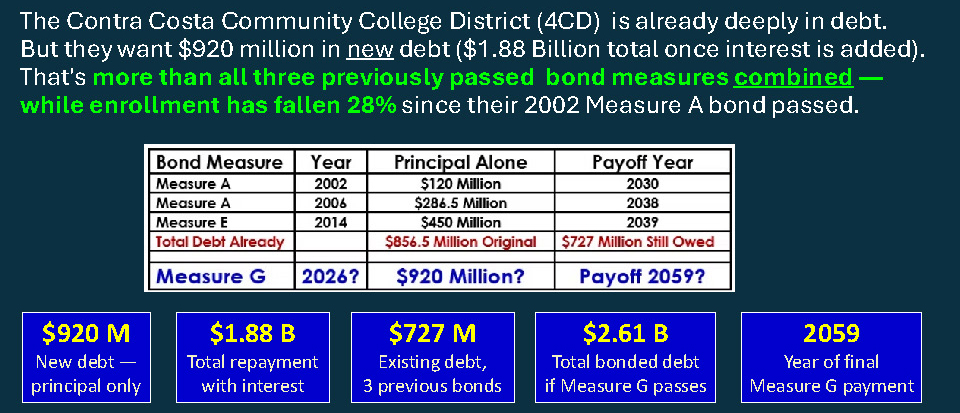
On June 2, Contra Costa County voters will decide whether to saddle themselves — and their children — with the largest bond debt in the history of the Contra Costa Community College District (4CD). Measure G asks for $920 million in new borrowing. With interest, the true cost climbs to $1.88 billion, with final payoff projected in 2059. CoCoTax has opposed this measure in official ballot arguments, in public presentations, and in a detailed response to a recent article in the Contra Costa College Advocate.

The case against Measure G is straightforward: it is far too much money, sought too soon given outstanding bond debt, by a district that hasn’t demonstrated the fiscal discipline to deserve it.

Already Drowning in Debt

4CD still owes on three bond measures as is:   2002’s Measure A ($120 million), 2006’s second Measure A, ($286.5 million), and 2014’s  Measure E ($450 million) —  totaling $856.5 million in principal alone. County taxpayers still owe nearly $727 million on those existing obligations, with the final payment on Measure E not expected until 2039. Measure G would pile $1.88 billion more on top of all that. If it passes, total bonded indebtedness reaches $2.61 billion, secured by Contra Costa County property values — with no senior exemption.

Enrollment Is Down 28% — Yet They Want to Build More

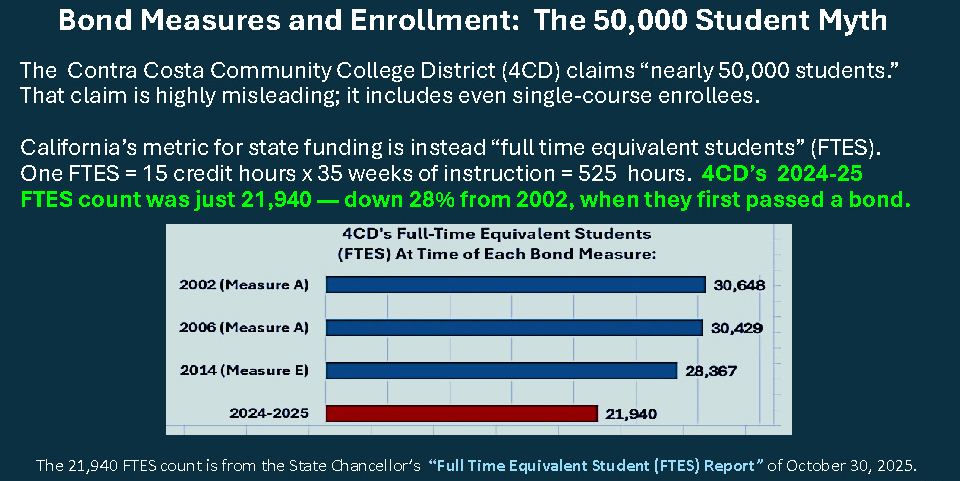
4CD advertises “nearly 50,000 students,” but that figure is misleading. California’s actual funding metric is Full-Time Equivalent Students (FTES). According to the State Chancellor’s October 2025 FTES Report, 4CD’s count was just 21,940 — down 28% from 30,648 when Measure A passed in 2002. Expanding costly new facilities while enrollment trends sharply downward is the opposite of responsible stewardship.

“Deferred Maintenance” — Deferred Forever?

Roofing repairs, seismic retrofits, HVAC upgrades, and electrical work appear repeatedly in 4CD bond project lists going back to 2002. How many bond measures must pass before these basics get done? There’s a core problem: 4CD’s maintenance budget has crept from just 0.10% to 0.20% of Plant Replacement Value over the past decade, when the commercial building standard is 2–5%. Routine maintenance gets deferred so the general fund can support other priorities — including lavish administrative compensation — and then bond money pays for the fixes, with interest on top.

Executive Pay That Outstrips the Governor’s

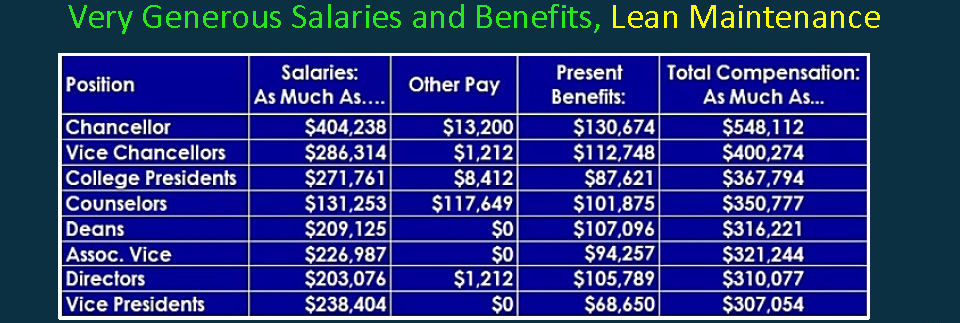
While seeking $920 million in new principal from taxpayers, 4CD’s Chancellor drew a $404,238 salary (as of 2024) — plus $130,674 in benefits, for total compensation reaching $548,112. That salary alone exceeds the official pay of the President of the United States and far surpasses Governor Newsom’s $245,929.  Vice Chancellors, College Presidents, and Directors also earn hundreds of thousands in total compensation. Lavish pay and lean maintenance are two sides of the same General Fund coin.

Who’s Funding “Yes on G”?

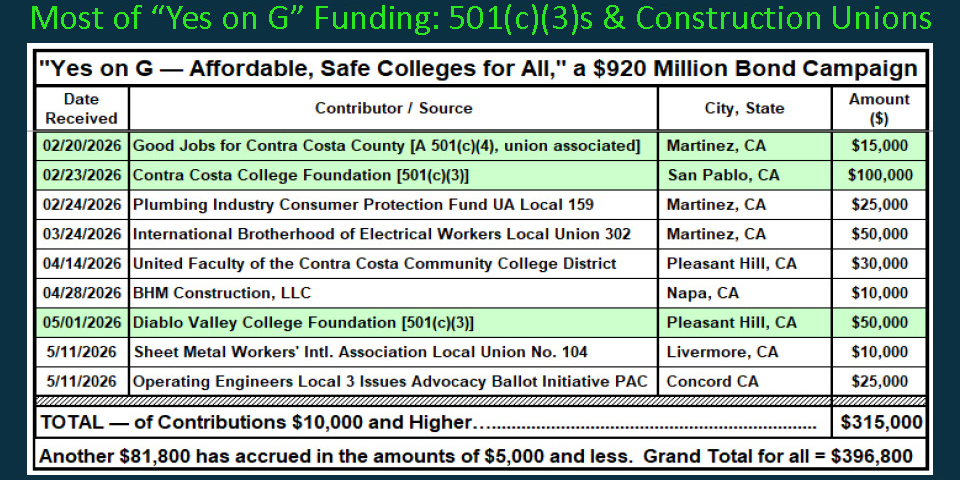
The pro-Measure G campaign has raised nearly $400,000 so far — with the bulk coming from the tax-exempt Contra Costa College Foundation ($100,000), the DVC Foundation ($50,000), and multiple construction unions (IBEW Local 302, Plumbers Local 159, Sheet Metal Workers Local 104, and others). Contractor unions have a direct financial interest in a $920 million construction program. Ordinary property-tax-paying residents have no equivalent organized voice — a textbook example of what economists call “Public Choice Theory.”

The Bottom Line

Property owners already pay an average of $13.97 per $100,000 of assessed value toward 4CD’s existing bonds. Measure G adds another $10 — and that rate could rise if the county’s assessed values don’t grow at the 4% annual pace 4CD projects, projections that, by 4CD’s own admission, “are not binding upon 4CD.”

4CD should maintain its existing buildings with its existing budget rather than repeatedly turning to taxpayers for borrowed billions. Vote NO on Measure G.

More information: NOonMeasureG.info

Arata is an Executive Committee member of the Contra Costa Taxpayers Association

Upcoming Events

CoCoTax Lunch, June 26: Former State Senator Steve Glazer Discusses BART Accountability
Friday, June 26, 2026 | 11:45am – 1:15pm PDT

CoCoTax Lunch, July 24: County Budget Overview with County Administrator Monica Nino
Friday, July 24, 2026 | 11:45am – 1:15pm PDT

For more information about the Contra Costa Taxpayers Association visit cocotax.org.

Opinion: Former and current AUSD staff, parents share concerns about Antioch school district

Tuesday, May 26th, 2026

Provide salary information for senior management

Dear Antioch Unified School District Board Members,

Given the severity of the district’s deficit, the community deserves to understand why the Board continues to authorize expensive contractors to perform work that qualified district staff are fully capable of handling. In education, sustainable improvement comes from setting clear expectations, providing support, and building internal capacity. Antioch is a resilient community filled with talented professionals. Our people deserve the opportunity and the trust to meet the standard.

It is also important to acknowledge that many of these same consultants were used in Pacifica and Sequoia, districts where the Superintendent departed in under two years amid controversy. Why would the Board select a leader without a demonstrated record of long-term, successful superintendent leadership.

Board President Dr. Jag Lathan, you are currently running for County Superintendent. If effective oversight and leadership cannot be demonstrated in a mid‑sized district like Antioch, how will you lead an entire county. Voters are watching and waiting for you to do what is right.

The district’s increasing reliance on high‑cost consultants is fiscally irresponsible and deeply concerning especially during a financial crisis. This year alone, consultant contracts are projected to exceed half a million dollars, including external providers for executive coaching, financial consulting, data analysis, and organizational climate assessments. Only a small portion of these contracts appear justified given staffing shortages. The rest raise serious questions about duplication of services, transparency, and fiscal priorities. The district already employs dedicated, effective leaders who have invested their careers and their hearts into serving Antioch’s students. Overlooking this internal capacity wastes resources and damages morale. Replacing qualified internal leaders with consultants occupying long‑term roles is unjust, irresponsible, and demoralizing. At what point will the Board accept accountability for these decisions?

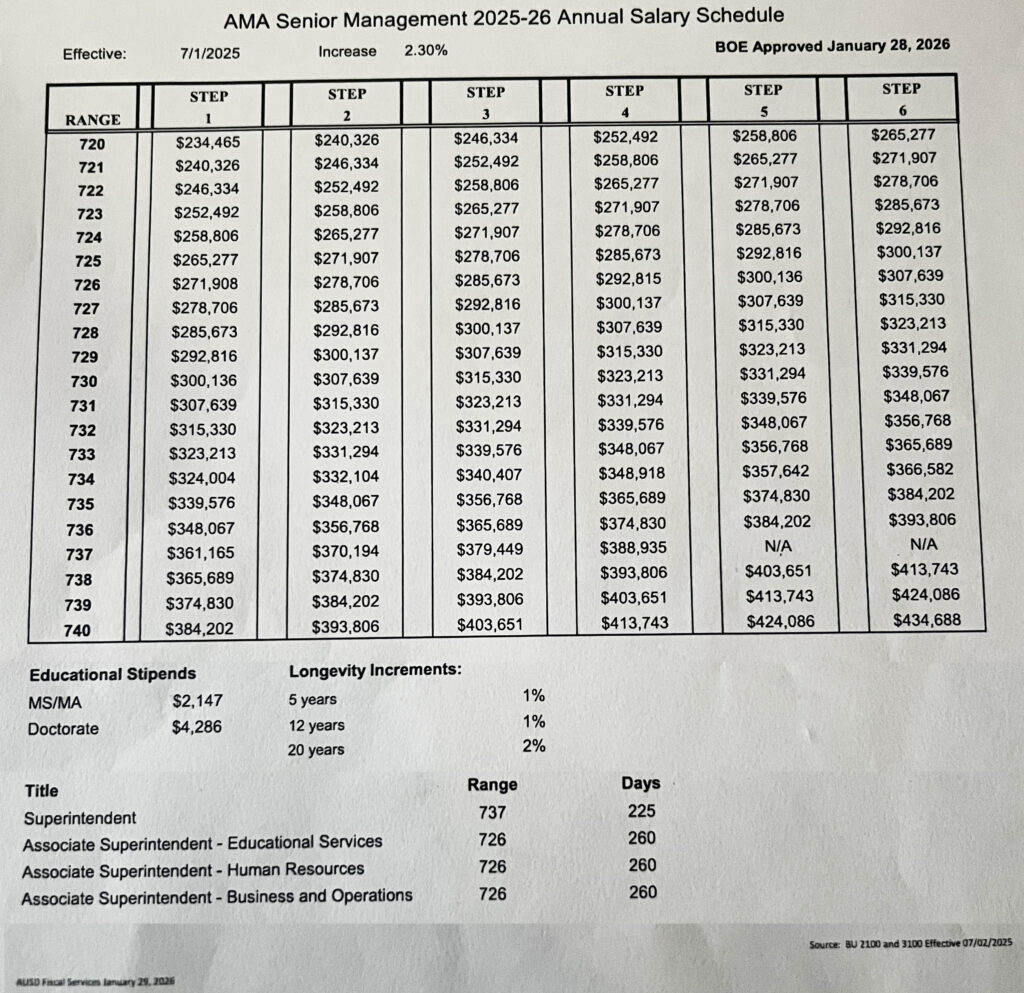
AUSD Senior Management Salary Chart 2025-26. Source: Amy Bettencourt

There has also been a mass exodus of leadership and long‑term teachers. This exodus is directly tied to the current district leadership. Why is the Board not interviewing these long-standing, highly respected employees to understand why they are leaving AUSD?

Attorney fees have been repeatedly discussed at board meetings and often dismissed by comparing them to previous years. But this year, the number of law firms brought in under Dr. Williams has significantly increased legal costs. If the highly publicized employee bullying lawsuit from last year were removed from the comparison, would last year’s attorney fees still exceed the current year’s. That is a question the community deserves answered.

According to individuals familiar with the superintendent hiring process, community panelists were puzzled by the Board’s decision. Several candidates reportedly ranked higher among parents, staff, and students including two Latino leaders who panelists felt could more closely relate to and serve the district’s student population. Insiders state that Dr. Williams ranked last among five finalists in some community feedback summaries. Despite these concerns, Dr. Williams assumed leadership of AUSD in July 2025.

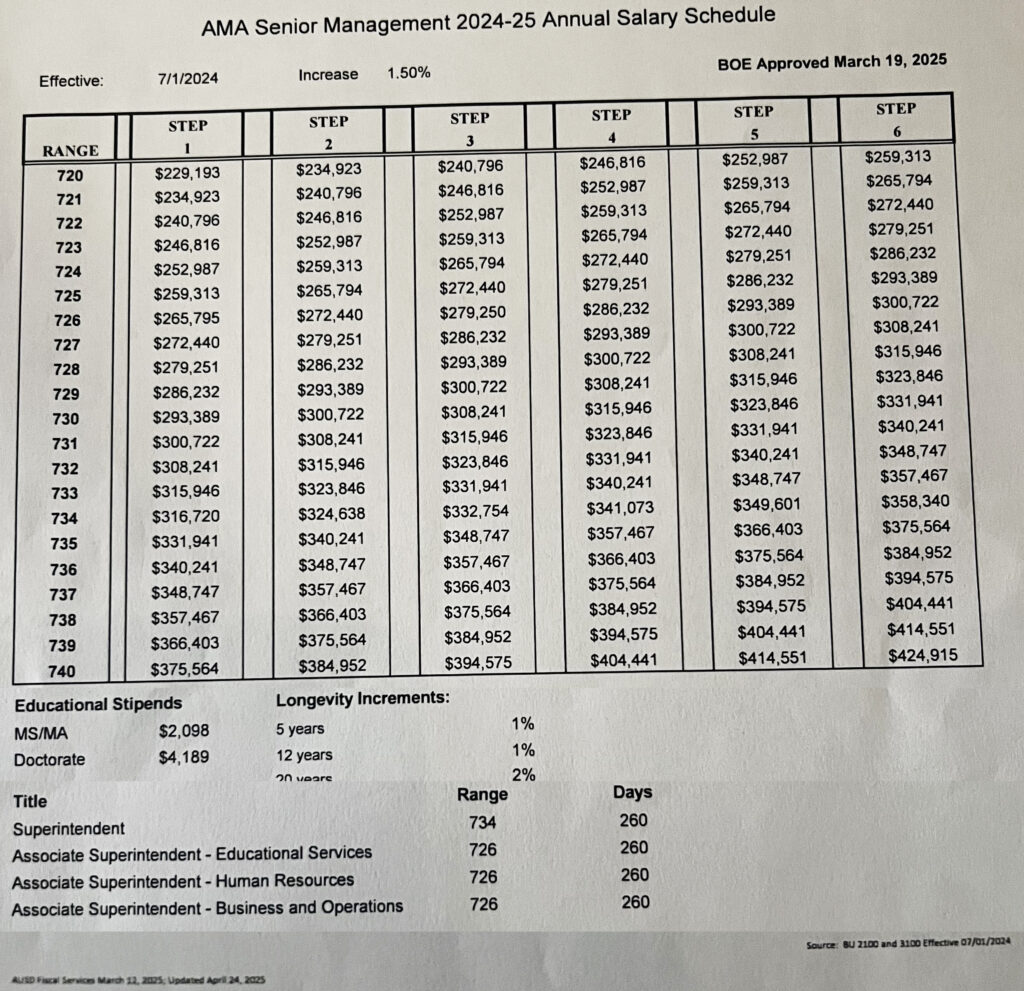
AUSD Senior Management Salary Chart 2024-25. Source: Amy Bettencourt

It is public knowledge that entering the 2025–26 school year, AUSD faced an approximate $12 million deficit. The CBO in place at the time who had full knowledge of the deficit and a fiscally sound plan to address it without harming student services or requiring staff layoffs was placed on leave almost immediately by Dr. Williams. It has been stated repeatedly at board meetings that the approved raises and continued 100% district‑paid health benefits did not contribute to the now $31 million deficit. That is not accurate. The increased deficit is directly tied to the raises and benefits negotiated by Dr. Williams and her attorney.

Another contributing factor is the Superintendent’s newly created salary schedule. Historically, AUSD superintendents were placed on salary schedule 734 with a 260-day work year. Dr. Williams negotiated a new 737 range with a 225-day work year 35 fewer days than her senior management team. The previous superintendent, at year six, earned $358,340 annually ($1,378 per day). Dr. Williams began at $361,165 annually ($1,605 per day) and will top out at $1,728 per day.

Despite this significantly higher, per‑day rate, district staff report that Dr. Williams is rarely present in the district office, and when she does arrive, it is often afternoon. She is not beginning her day at school sites, and her whereabouts during the workday are frequently unaccounted for. Given these concerns, why was an entirely new salary schedule created without any data demonstrating long‑term success, improved student outcomes, or consistent leadership presence. Her history shows the opposite, with districts left in turmoil.

At what point will the Board seek honest insight from current and former employees rather than relying on soundbites and publicity efforts. The community is asking for transparency, accountability, and the responsible use of AUSD funds. Every dollar spent should reflect a commitment to students, staff, and the long‑term stability of this district—not to unnecessary contracts, unchecked legal fees, or inflated administrative compensation.

Respectfully,

Amy Bettencourt, former Director of Educational Services, Antioch Unified School District and Concerned Staff, Parents and Citizens

In a note included with the emailed letter to the editor Bettencourt wrote, “I know I left Antioch USD at the end of February due to the toxicity and storm the new superintendent brought to the district, but I continue to hear from a large group of employees who are desperately trying to elevate their concerns publicly.”