While working to increase ridership currently averaging on weekdays about 40% of pre-COVID figures
By Bay Area Rapid Transit District
As BART strives to increase ridership, which is averaging about 40% of weekday pre-COVID figures, BART fares will increase January 1, 2025, to keep pace with inflation so that the agency is able to pay for continued operations and to work toward restoring financial stability. BART’s current funding model relies on passenger fares to pay for operations.
Fares will increase 5.5 percent on New Year’s Day. The increase is tied to the rate of inflation minus a half-percentage point. It’s the second such increase – the first took effect January 1, 2024.
The average fare will increase 25 cents, from $4.47 to $4.72. BART’s fare calculator and Trip Planner have been updated with the new fares for trips with the date 1/1/25 and beyond. Riders can learn how the increase will affect their travels by entering a 2025 date for their trip.
“We understand that price increases are never welcome, but BART fares remain a vital source of funds even with ridership lower than they were before the pandemic,” said BART Board Vice President Mark Foley. “My Board colleagues and I voted in June 2023 to spread necessary fare increases over two years rather than catching up all at once. At the same time, we voted to increase the Clipper START means-based discount from 20 percent to 50 percent to help those most in need.”
The fare increase is expected to raise about $14 million per year for operations. Combined with the previous year’s fare adjustment, BART will use this $30 million per year to fund train service, enhanced cleaning, additional police and unarmed safety staff presence, and capital projects such as the Next Generation Fare Gates project.
Discounts available for those who are eligible
The regional Clipper START program is an important resource for low-income riders of BART and other Bay Area transit systems. The program is for adult riders with a household income of 200% of the federal poverty level or less. Administered by the Metropolitan Transportation Commission, program participants receive a personalized Clipper card that cuts half the cost of fares on more than 20 transit systems.
Limited income riders get 50% off with Clipper START.
The RTC Clipper card is a version of Clipper created for passengers under 65 with qualifying disabilities to provide 62.5% off.
Regular, predictable increases a long-term strategy
January’s fare increase is the latest adjustment in a strategy to provide BART funding while providing riders predictable, scaled changes to the costs of riding. In 2004, BART first implemented this inflation-based fare increase program that calls for small, regular, less-than-inflation increases every two years, allowing fares to keep up with the cost of providing reliable and safe service.
BART is also much less expensive than driving on a cost per mile basis. The Internal Revenue Service standard mileage rate for driver is 67 cents per mile; BART riders pay an average of 27 cents per mile, 60% less than the cost of driving.
Outdated funding model
BART’s current funding model relies on passenger fares to pay for operations. Even with the fare increase, BART is facing a $35 million operating deficit in FY26 and $385 million in FY27. Since BART’s outdated model of relying on passenger fares to pay most operating costs is no longer feasible because of remote work, the agency must modernize its funding sources to better match other transit systems throughout the country that receive larger amounts of public funding. BART needs a more reliable long-term source of operating funding and continues to advocate at the federal, state, and regional levels for the permanent funding needed to sustainably provide the quality transit service the Bay Area needs.
Addressing BART’s ongoing financial crisis will take a variety of solutions including securing new revenue and continuing to find internal cost savings. BART costs have grown at a rate lower than inflation, showing we have held the line on spending. We have implemented a service schedule that better matches ridership, and we are running shorter trains, reducing traction power consumption and maintenance costs.
Founder and Director of Mau Loa Ohana dance studio in Antioch, Monique Castaneda’s love of life and personal relationship with God didn’t come to an end with her death. Monique passed away on November 23, 2024, at the age of 58 after a courageous fight with Polymyositis and B Cell Lymphoma, surrounded by loved ones who will continue to honor her legacy of sharing the Aloha Spirit and living their lives to the fullest.
Monique was born on May 5, 1966 in Oakland, California, graduated from Presentation High School in Berkeley and worked at Wells Fargo Bank retiring at an early age to be a full-time mother.
Monique lived a purpose driven life by uplifting those in need through dance and was a disciple for Christ sharing her love for God through praise and dance. She founded the annual “Hula Away The Cancer Ho’ike” in 2010 to fundraise for The American Cancer Society, Relay for Life and St. Jude’s Children’s Hospital donating thousands of dollars for cancer research.
Her final show was held on October 12, 2024, at Antioch’s El Campanil Theatre.
Monique’s passions were her love for God, family, fashion, fitness, travel and Mau Loa Ohana. Her loving personality was contagious to everyone she met. The hula studio was her happy place and those that Walked-In, Hula-Out with the Aloha Spirit.
Monique is survived by her loving husband, Raul; daughters Alexsandra and Kiana; son-in-law Gregory; grandson Oliver; Sisters Joyce and Tina; and many cousins, nieces and nephews.
Church window the arrested burglar broke using an axe on Thursday, Nov. 28, 2024. Photos: Antioch PD
“But the righteous are as bold as a lion.”
Used axe to break in
By Antioch Police Department
When the pastor at First Family Church on Contra Loma responded to check an alarm in the early hours of Thanksgiving he was not expecting to confront a burglar, but that’s what happened. When the burglar saw his wicked deeds had been discovered he decided to fight with the pastor instead of repent. What he did not know was the pastor would win this battle of good and evil, and he held down the perp until APD arrived and placed the man in custody.
We are thankful today that the pastor was uninjured during this incident and hopeful that with amazing community members like we have been highlighting lately, we can turn the tide on crime in our city.
The axe in the photo was used to break a window on the church which is how the burglar entered.
Presented by City of Antioch and Celebrate Antioch Foundation
Join us for the annual Holiday Delites Celebration in Antioch’s historic, downtown Rivertown on Saturday, December 7th! This event features the community’s illustrious holiday parade on W. 2nd Street at 5:00 p.m. filled with live performers and moving floats, family photo opportunities with Santa, cookie decorating, lighting of the City Christmas Tree, a possible lighted boat parade on the river by local yacht clubs, and much more!
Visit the Sip and Shop Artisan Faire on G Street from 1:00pm-5:00pm hosted by the Celebrate Antioch Foundation. You and your family won’t want to miss this!
Please Note: The evening parade and tree lighting is tentative based on weather. In case of heavy downpour on December 7th, the event will unfortunately be cancelled.
Sign your group up to light up the night with your festive floats, bright costumes, and holiday spirit. Let’s make this celebration the brightest yet! Become part of the magic that is Holiday Delites by visiting antiochca.gov/holiday-delites.
Mark your calendars for the annual Newberry’s Block Toy Drive. Sunday, December 8. 11:00 am-3:00 pm at Lumpy’s Diner, 5891 Lone Tree Way in Antioch.
Please bring an unwrapped gift or $20 donation. Your generous donation will bless underprivileged kids around our area this Christmas season.
Newberry’s B.L.O.C.K. is the nonprofit organization formed by former American professional football player and center for the 49ers, Jeremy Newberry, Benefiting Leagues Offering Children Kindness. It provides underprivileged children the opportunity to participate in sports by sponsoring scholarships and equipment to youth programs
Climate Action & Resilience Plan proposed actions chart. Source: City of Antioch
Mitigations include reducing Vehicle Miles Travelled, expanding bicycle and BART ridership but encourages telecommuting, expand bus system, moratorium on gas station construction, natural gas ban in new construction, growing own food through community gardensand the “Hight Priority Action” of urban farming, plus, buying second-hand items, reducing air travel
“GHG emissions have fallen since 2018” – City staff report
By Allen D. Payton
Even though greenhouse gas emissions have decreased in Antioch over the past several years, according to the staff report on item #6J on the Consent Calendar for tonight’s Antioch City Council meeting, residents and businesses aren’t doing enough to meet state goals. In response, the council is being asked to approve the 2025-2030 Climate Action & Resilience Plan (CARP). The report states, “In 2022 the State of California passed AB 1279 (known as The California Climate Crisis Act), mandating that emissions statewide must fall to 85% of 1990 levels by 2045. The City must update its climate goals to reduce emissions in accordance with State law.” Adopting the plan “at this time allows the City to link it to the U.S. Department of Housing and Urban Development Five-year Consolidated Plan, giving some programs identified in the CARP a possible funding source for the next 5 years.”
Chart shows greenhouse gas emissions have decreased in Antioch from 2018 to 2022. Source: City of Antioch
Furthermore, the staff report reads, “In 2010, the City adopted its first Climate Action Plans (CAPs). These CAPs, and subsequent CARP’s, included greenhouse gas (GHG) emission reports from 2005-2022. GHG emissions have fallen since 2018, according to inventories conducted as a part of this CARP update (Fig. A). This document is the second edition of the CARP, which incorporates resiliency into climate work. By incorporating resilience into the climate plan, implementation work is eligible for federal Community Block Development Grant (‘CDBG’) funding.”
Proposed Mitigations
The proposed mitigations to reduce GHG’s in Antioch are as follows:
Transportation Emissions – “encouraging the shift away from single occupancy internal combustion engine (ICE) vehicles” and “to reduce total Vehicle Miles Traveled” which is known as Mode Shift.
Develop a Mobility Plan for Antioch
Expand bicycle ridership
Increase BART ridership
Expand current bus system
Work to make downtown more accessible by active transportation and public transportation
Expand bus from BART Station to Antioch’s downtown Rivertown
Continue L Street improvements such as implementation of bike lanes, bus shelters and signal timing
Work regionally to encourage telecommuting options where appropriate (which reduces the need for BART and bus ridership).
Transportation Electrification
Strategically expand EV charging stations
Install charging stations in commercial centers, downtown and in community centers.
Support residents with financing home charger installation with information about rebates.
Support installation of EV chargers in multifamily complexes.
Provide financial incentives and support outreach for programs and policies that encourage the switch to EV.
Implement the purchasing guide for switching the city fleet to EVs by 2029.
Continue advocating for gas station construction moratorium or consider adding the requirement to install EV charging stations at any new gas station.
Electricity Use
While Antioch’s total electricity use has remained more or less consistent since 2005 except for a spike in 2020 and 2021 – during COVID – electricity-related emissions have drastically decreased from 52.7% to 20.3% between 2005 and 2022. This can be attributed to the decreasing share of carbon-based fuels, such as natural gas, that powers PG&E electricity.
Natural Gas Use
Consumption of natural gas in commercial and residential facilities decreased modestly between 2005 and 2017, and since 2018 has remained largely steady with a slight uptick in 2022. Electrical appliances have slowly begun to replace natural gas-powered appliances in some homes, and household solar energy projects have also reduced the share of natural gas in total energy use.
The California Air Resources Board passed a regulation in 2022 that mandated phasing out gas appliances in the state starting in 2030. The City of Antioch can help support this transition through assisting residents with signing up for rebates and continuing to promote organizations such as the Bay Area Regional Energy Network (BayREN), which focuses on on energy, water and greenhouse gas reduction.
Residential Energy Proposed Actions
Energy Efficiency Improvements in homes
Continue outreach for BayREN home improvement rebates
Support Contra Costa County’s Weatherization Program
Encourage Fuel Switching from natural gas to electricity
Consider a natural gas ban in qualifying new construction.
Explore the requirement electric panel upgrades during major renovations or during home sales.
Explore the use of battery storage in tandem with solar.
Partner with organizations like Bay Area SunShares for discounts and Grid Alternatives, formed ‘to build community-powered solutions to advance economic and environmental justice through renewable energy” for expansion of solar installation in Antioch homes and businesses.
Expand outreach to landlords and contractors about electrification.
Continue on bill financing (OBF) and metered energy efficiency, that, according to the U.S. Department of Energy, is an option in which a utility or private lender supplies capital to a customer to make energy efficiency improvements and is repaid through regular payments on an existing utility bill.
Commercial Energy Proposed Actions:
Increase participation in the Green Business (SMB) program
Help the program conduct outreach
Consider additional incentives
Encourage energy audits in commercial buildings
Expand participation in BayREN business programs.
Expand outreach to business owners and contractors about electrification and its benefits.
Incentivize local renewable energy projects.
Source: City of Antioch
Waste
Waste makes up a small fraction (6.1%) of Antioch’s greenhouse gas emissions but have the potential for quick impact. Since 2005, the tonnage of total waste has decreased substantially, though most of the reductions were accomplished by 2010 and waste related emissions have decreased by nearly 29% since 2005.
Organization waste as a percentage of total waste has declined slightly, also reducing emissions. When organic waste is put in the trash bin and joins the landfill, its decomposition lacks oxygen and leads to methane release. Methane is a short-lived but incredible potent greenhouse gas in the atmosphere and is 28 times more powerful at trapping heat than carbon dioxide.
California’s SB 1383 requires every jurisdiction to provide organic waste collection services to all households and businesses. (See related article) Antioch’s composting program has helped reduce the share of organics in landfill by storing decaying matter in productive soil.
Proposed Actions:
Expand awareness and reach of commercial and residential composting program
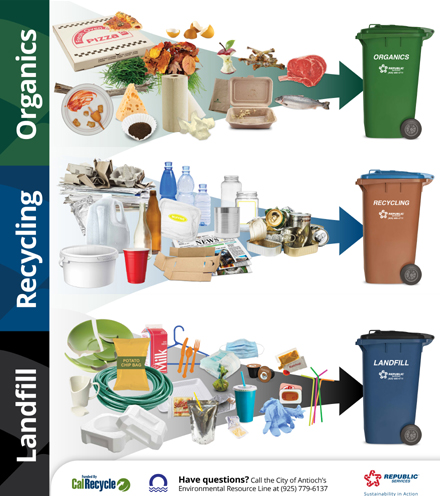
Provide more community outreach into h ow to correctly sort waste (what should be put in compost, recycling, landfill and what is hazardous waste).
Hire part-time staff to work primarily on outreach for the program with a focus on community events.
Examine urban farming as a way to work toward a circular economy through local use of compost generated from local organic waste.
City and Waste Hauler coordinate to provide more frequent community compost giveaway offerings for residents to improve their garden soil health for growing their own food. Currently there is one annual event.
City encourages and funds the creation of more community gardens throughout Antioch, especially in low-income, food-insecure neighborhoods that create their own compost for food waster and/or receive compost from the City’s Waste Hauler (Republic Services).
Expand food rescue programs
Assist food rescue organizations in working with more restaurants (and other edible food generators) to maximize donation of all edible food.
Partner with homeless shelters to provide food from rescue efforts.
Campaign to reduce single-use plastics to reduce waste and plastic pollution.
Increase education efforts to the public on the many ways that plastic is harmful and how to use less of it, especially single-use plastic.
Consumption Based Inventory
Consumption-based emissions are those that are released in the production of all goods that are consumed by a community. The report shows a chart that includes food consumed, electricity, natural gas and vehicle fuel use, appliances, entertainment equipment and clothing purchased and services.
The report states, “The scale of Antioch’s contributions to global greenhouse gas emissions is significantly higher when taking a more holistic approach to a community’s carbon emissions…the community can strive to be more conscious about consumption and travel patterns. Purchasing locally produced goods…can lower the emissions associated with the transportation required to move goods across counties, states and countries. Reducing air travel can also drastically reduce a household’s carbon footprint.
Proposed Actions:
Encourage residents to buy items second hand whenever possible, to reduce overall emissions from consumption.
Support programs such as fix-it clinics, maker spaces and sharing networks.
Community Engagement
Youth Engagement Proposed Actions Include:
Encourage AUSD to incorporate topics about climate change, environmental resilience and green technology into the curriculum beginning in elementary schools. Antioch High School is already a leader in incorporating sustainability into the curriculum.
Bike Path Challenge – support students in designing and developing a bike path from Black Diamond Mines Regional Preserve to the downtown waterfront area.
Prepare the Antioch workforce for a changing climate
Invest in workforce training programs for construction, green building, electricians,
mechanics, advanced manufacturing and PV installers.
Provide opportunities for low-income residents to acquire living wage jobs
Reduce commuting times for Antioch residents and workers
Retain and expand small local businesses, which are hubs for jobs, critical infrastructure and community resilience.
Proposed Actions Include:
Establish local preference policies in procurement guidelines.
Work with Northern Waterfront Economic Development Initiative (NWEDI) on strengthening an equitable local green economy with local jobs and effective workforce development programs.
Partner with educational institutions to promote green career pathways and provide professional experiences to students in building, planning and conservation.
Economic Security and Equity
The report states, “The heat-or-eat dilemma already faced by low-income families by may soon become a ‘cool-or-eat’ dilemma during the summer months. Damages related to flooding, which will occur in neighborhoods with higher levels of low-income residents, put further strain on household finances and health.
In these ways, Antioch’s low-income residents are most vulnerable to the projected effects of climate change. The City should develop the capacity to aid and support low-income neighborhoods in responding to these challenges.”
Source: City of Antioch
Proposed Actions
Hire low-income community representative to better understand the needs of low-income neighborhoods and more effectively conduct engagement efforts
Develop guidelines to encourage urban farming and home gardening in the Antioch community
Center equity in consideration of climate policy and programming.
Benefits include:
Equity:
Provide increased economic opportunity for low-income communities and communities of color
Build trust between the City of Antioch and low-income communities and communities of color
Improve the health of low-income communities and communities of color
Improve the qualify of life for unsheltered persons.
Public Health:
Improve outdoor and indoor air quality
Reduce health events related to extreme heat
Resource Conservation:
Improve sustainability by reducing use of finite resources
Water
Energy
Single-use plastics
Transportation Goals:
Reduce the Vehicle Miles Travelled in the Antioch community through encouraging transportation mode shift
Reduce emissions impact of Vehicle Miles Travelled through vehicle electrification
Energy Goals:
Increase fuel switching from natural gas to electricity
Increase energy security by reducing energy demand
Reduce the impact of electricity use on greenhouse gas emissions
Waste Goals:
Begin building the system to transform Antioch into a low carbon, low waste community and contribute to a circular economy
Gather community engagement and support for a circular economy
According to the U.S. Environmental Protection Agency (EPA), “A circular economy keeps materials and products in circulation for as long as possible. A circular economy reduces material use, redesigns materials and products to be less resource intensive, and recaptures ‘waste’ as a resource to manufacture new materials and products.”
Community Development Goals:
Strengthen Antioch’s social and economic systems to promote resilience
Remove barriers to economic, political and social participation in low-income communities and communities of color
Expand engagement between the City of Antioch and the Antioch community
The Antioch City Council’s regular open session meeting begins at 7:00 p.m. in the Council Chambers at City Hall, 200 H Street in historic, downtown Rivertown. The meeting can also be seen via livestream on the City’s website or viewed on either Comcast local cable channel 24 or AT&T U-verse channel 99.
Antioch Police Lt. Matt Koch was joined by Interim Chief Brian Addington (left) and Captain Joe Vigil (right) during the graduation ceremony on Nov. 20, 2024, in Del Mar, California. Photo: Antioch PD
SBSLI, established by the California Commission on Peace Officer Standards and Training (POST), is one of the most respected leadership programs in law enforcement. Over the course of eight months, participants engage in intensive training designed to enhance leadership, critical thinking, and team-building skills. SBSLI challenges its graduates to reflect on their leadership styles, develop emotional intelligence, and master the tools needed to inspire and guide their teams in today’s dynamic public safety environment. The institute is name for the 29th Sheriff of Los Angeles County.
The dedication and perseverance it takes to complete this rigorous program are a testament to Lt. Koch’s commitment to excellence. His graduation is not only a personal milestone but also a win for our entire team, as he brings back invaluable insights to help strengthen our department.
Interim Chief Brian Addington and Captain Joe Vigil were honored to attend the ceremony in Del Mar, California on Wednesday, Nov. 20, 2024, to support and celebrate this incredible achievement. Lt. Koch, your hard work and determination continue to make us proud!
Koch began his career in law enforcement with the Antioch Police Department as a cadet in 1996, then served as a reserve officer in 1999 until being hired as a police officer in August 2001. He was promoted to the position of lieutenant in June.