By Ahdel Ahmed, Public Relations Manager, San Joaquin Joint Powers Authority
Stockton, CA – The San Joaquin Joint Powers Authority (SJJPA) is proud to introduce a new chapter in the history of California’s intercity passenger rail services with the rebrand from Amtrak San Joaquins to Gold Runner, effective November 3, 2025.
Gold Runner signals a bold new era for intercity passenger rail and bus service in California’s heartland, an identity that honors the past while moving confidently toward the future.
One of the founding goals of the Joint Powers Authority was to ensure local, dedicated management of the service, including control over marketing and brand direction. With continued investment from the State of California, SJJPA has been able to develop and implement strategies that elevate the service’s profile, strengthen ridership, and align messaging more closely with the communities it serves. The Gold Runner brand marks an important milestone in this mission, giving SJJPA the ability to steward the brand, one that reflects the Authority’s vision, values, and regional identity.
SJJPA has been proud to partner with Amtrak in managing and growing the service since 2015. The transition to the Gold Runner brand builds on this strong collaboration and shared commitment to passengers. Amtrak remains a critical partner, and together both organizations will continue to pursue co-branding opportunities that enhance connectivity and ensure a seamless, unified experience for riders across California.
“Gold Runner represents more than a new name, it’s a symbol of our commitment to our passengers and California’s communities,” said David Lipari, Interim Executive Director of the San Joaquin Joint Powers Authority. “This new identity captures the energy and optimism of our region while positioning us for the future of passenger rail and intercity bus service. It reflects the spirit of partnership, innovation, and service that defines everything we do.”
The Gold Runner identity is designed to align with SJJPA’s long-term expansion plans and California’s broader rail strategy, while fostering stronger connections with neighboring rail services. Just as important, it highlights what makes the system unique: an expansive Thruway Bus network that connects more than half of all riders to destinations across the state.
By uniting rail and bus service under a single, cohesive identity, SJJPA can more effectively communicate the full scope of mobility it provides, support future expansion, and deliver a clearer, more consistent experience for passengers. The Gold Runner name reflects both the heritage and momentum of the Central Valley, representing speed, connection, and California pride.
To celebrate this milestone, SJJPA will host a launch event on Friday, November 14, 2025, from 11:00 A.M. to 1:00 P.M. at the ACE Rail Maintenance Facility, located at 1020 E Alpine Avenue, Stockton, CA. The event will feature the unveiling of Gold Runner-branded trains and Thruway buses, remarks from transportation leaders, and a ribbon-cutting ceremony marking the beginning of this exciting new era for California’s passenger rail.
About the San Joaquin Joint Powers Authority (SJJPA)
Since July 2015, SJJPA has been responsible for the management and administration of Gold Runner, previously Amtrak San Joaquins. SJJPA is governed by Board Members representing each of the ten (10) Member Agencies along the 365-mile Gold Runner Corridor. For more information on SJJPA seewww.sjjpa.com. Gold Runner is Amtrak’s 6th busiest route with 18 train stations throughout the Central Valley and Bay Area, providing a safe, comfortable and reliable way to travel throughout California. Gold Runner is currently running six daily round-trips. In addition to the train service, Gold Runner Thruway buses provide connecting service to 135 destinations in California and Nevada including Los Angeles, Santa Barbara, San Diego, Napa Valley, Las Vegas and Reno.
Use it for trips on BART, Tri Delta Transit, County Connection, WestCAT, AC Transit and more
Multi-agency trip to Mount Tamalpais State Park Dec. 14 to celebrate
By Carter Lavin, Co-Founder, Transbay Coalition
The Bay Area transit advocacy group Transbay Coalition, along with Seamless Bay Area and Hiking By Transit has launched new calculator, created by Evan Tschuy, to help show Bay Area residents how much they will save with the new Clipper 2.0 set to launch in December. It will automatically provide discounts of up to $2.85 per trip to people when they transfer between transit agencies (e.g. AC Transit to WestCAT, Muni to BART, VTA to Caltrain, SolTrans to the Ferry, The Vine to the Ferry, Sonoma County Transit to SMART, etc).
You are about to be able to save a bunch of money when taking transit in the Bay Area. Right now, when you transfer between bus and rail services, you generally have to pay the full fare for both legs of the trip, or if you’re lucky you might get a small discount. But starting in December, when you transfer between agencies, your fare gets reduced by $2.85 — down to potentially free — with the new Clipper 2.0.
Plus, under Clipper 2.0 you will be able to tap on to transit with your credit or debit card – no Clipper Card needed. So next time you want to bring friends, family, and out-of-town visitors onto transit with you, they don’t need to get a new card, they can just use their credit or debit card to tap in.
Bay Area transit trips are about to get a lot more affordable, and to help folks understand how much they’ll save, Transbay Coalition launched The Clipper 2.0 Savings Calculator with our friends at Hiking By Transit and Seamless Bay Area. Go to the Calculator, enter in the information about a trip you want to take that would require switching between agencies and check out how much you’ll save.
For Clipper 2.0 fares, the following rules are applied:
Each time you transfer to a new agency, your next fare is discounted up to:
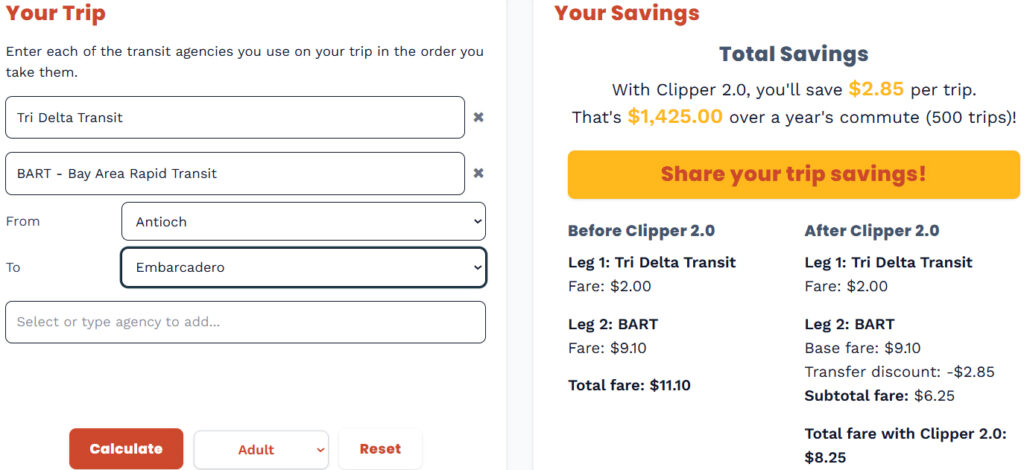
Adult: $2.85
Youth & Senior/RTC: $1.40
Senior/RTC on BART: $1.10 (to reflect the further Senior/RTC fare discount on BART)
The discount value does not depend on your previous fare, so AC Transit ($2.50) to BART will give a $2.85 discount off of your BART fare
AC Transit is introducing a new transfer policy with Clipper 2.0, allowing one free transfer between local buses
Example of a trip from Antioch using Tri Delta Transit and BART to the Embarcadero Station in San Francisco. Source: Clipper 2.0 Calculator
Other agencies may have updated their transfer policies, but at this time this tool is not aware of any other changes. This tool does not take into account the transfer time limit; Clipper 2.0 interagency transfers have a 2-hour time limit from first tap, while Clipper 1.0 fares have various different time limits depending on the specific agency pairs.
Fares on the website are an estimation only, based on the current information provided by the Metropolitan Transportation Commission. As some details have yet to be released, some assumptions have been made. This website will be updated as possible to reflect new information.
Multi-Agency Trip to Mt. Tamalpais State Park Dec. 14
To celebrate this big transit win, Hiking by Transit is hosting a multi-agency trip to Mount Tamalpais State Park on December 14th to celebrate.Come on out!
Plus, this Sunday, you’re invited to the garden party joint fundraiser for Transbay Coalition & Seamless Bay Area – get your tickets here.
The Transbay Coalition is a grassroots public transportation advocacy group championing bold near-term solutions to the Bay Area’s regional transportation crisis. Founded to campaign for dedicated bus-only lanes on the Bay Bridge and its approaches, we’re striving to create an equitable and efficient public transit system and reduce greenhouse gas emissions. Learn more about the Transbay Coalition
About Seamless Bay Area
Seamless Bay Area is a not-for-profit project whose mission is to transform the Bay Area’s fragmented and inconvenient public transit into a world-class, unified, equitable, and widely-used system by building a diverse movement for change and promoting policy reforms. Learn more about Seamless Bay Area
About Hiking by Transit
Hiking by Transit connects people in the Bay Area to our beautiful parks and preserves, car-free, by providing maps and hiking guides across the nine-county region and through advocacy for increased access and increased understanding. Visit Hiking by Transit
Public comment through Dec. 18 on Draft Plan Bay Area 2050+, EIR for housing, transportation, economic development and the environment
East Bay WebinarNov. 5
By Veronica Cummings, Principal Public Information Officer, Engagement & John Goodwin, Assistant Director of Communications, Metropolitan Transportation Commission
After more than two years of public discussion, technical analyses and refinement, the Metropolitan Transportation Commission (MTC) and the Association of Bay Area Governments (ABAG) today released Draft Plan Bay Area 2050+ and the Plan Bay Area 2050+ Draft Environmental Impact Report for public review and comment.
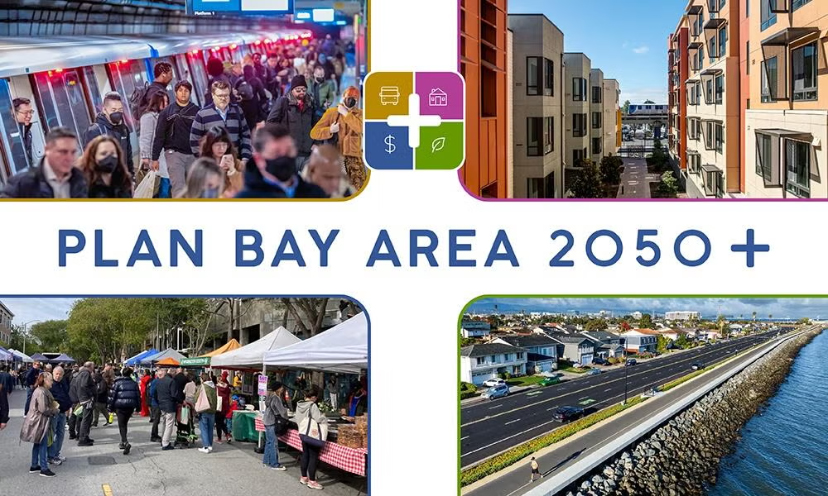
Draft Plan Bay Area 2050+ charts a course for the future of the Bay Area over the next 25 years. Designed to guide growth and investment across the region’s nine counties and 101 cities, the latest plan aims to advance an integrated vision for a Bay Area that is affordable, connected, diverse, healthy and vibrant for all. The plan contains 35 strategies for public policies and investments that can be implemented to help the Bay Area build more homes, reduce commute times, and create vibrant downtowns and natural areas for everyone to enjoy. These strategies also aim to keep people safe from natural hazards, support a strong economy and provide stable housing.
Unique to this plan cycle is Transit 2050+, a parallel and first-of-its-kind planning effort conducted by MTC and ABAG in partnership with Bay Area transit agencies to re-envision the future of Bay Area public transit.
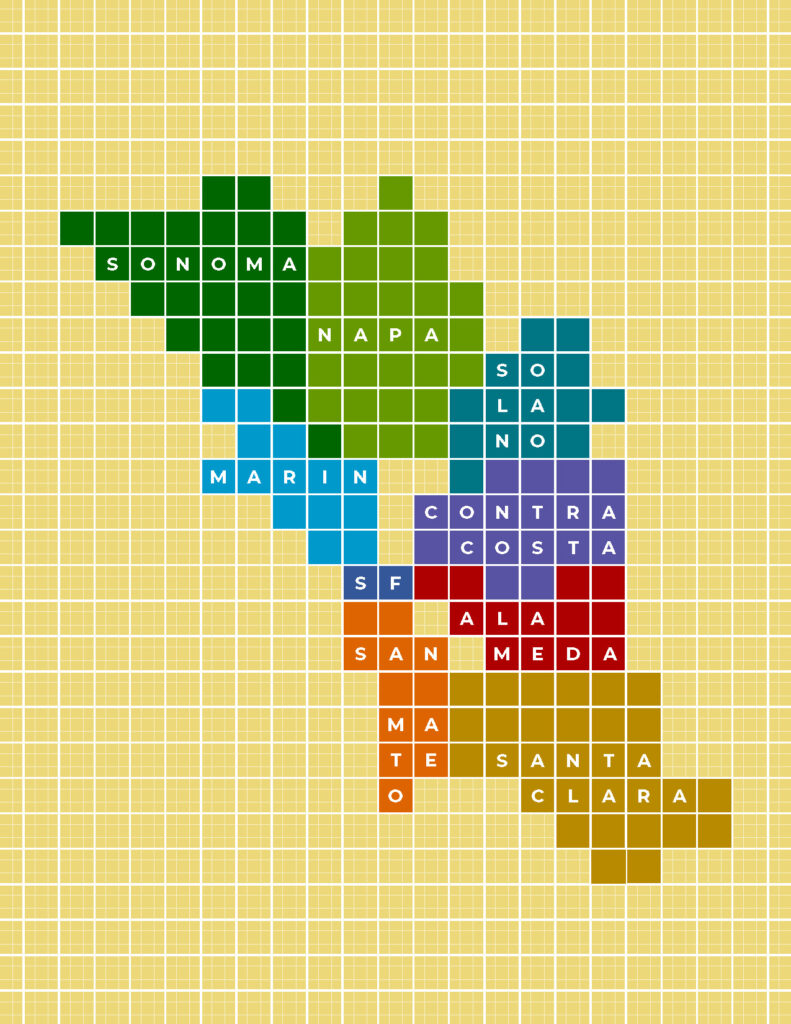
Plan Bay Area includes all nine Bay Area counties and 101 cities. Source: Plan Bay Area
MTC and ABAG have scheduled a series of webinars and public hearings for comment on Draft Plan Bay Area 2050+ and associated supplemental reports, as well as on the Draft Environmental Impact Report for Plan Bay Area 2050+. All interested people, agencies and other organizations are encouraged to attend a webinar or public hearing, where they can ask questions and offer comments on these documents. Full event details are listed below:
Webinar #2 — West Bay Wednesday, October 29, 2025 6-7:30 p.m. Zoom link: https://bit.ly/westbaywebinar Webinar ID: 831 4140 5598 Passcode: 096944 888-788-0099 US Toll Free
Webinar #3 — South Bay Thursday, October 30, 2025 6-7:30 p.m. Zoom link: https://bit.ly/southbaywebinar Webinar ID: 822 2561 7467 Passcode: 356845 888-788-0099 US Toll Free
Webinar #4 — East Bay Wednesday, November 5, 2025 6-7:30 p.m. Zoom link: https://bit.ly/eastbaywebinar Webinar ID: 869 8283 4999 Passcode: 682098 888-788-0099 US Toll Free
In addition to these webinars, MTC and ABAG will host three public hearings around the Bay Area to provide opportunities for all interested agencies, organizations and individuals to comment on the Draft Plan and Draft Environmental Impact Report. The full list of hearings is as follows:
Public Hearing #1 — MTC Planning Committee and ABAG Administrative Committee Friday, November 14, 2025, at 9:40 a.m. or upon the conclusion of the Bay Area Infrastructure Financing Authority Network and Operations Committee, whichever is later. Bay Area Metro Center -or- Zoom Boardroom, 1st Floor 375 Beale Street, San Francisco
Public Hearing #2 — Fremont Wednesday, December 3, 2025, at 6 p.m. Olive Hyde Art Center and Gallery -or- Zoom 123 Washington Boulevard, Fremont Zoom link: https://bit.ly/drafthearing2 Webinar ID: 875 7625 3306 Passcode: 178983 888 788 0099 US Toll Free
Public Hearing #3 — Novato Thursday, December 4, 2025, at 6 p.m. Best Western Plus Novato Oaks Inn -or- Zoom 215 Alameda del Prado, Novato Zoom link: https://bit.ly/drafthearing3 Webinar ID: 898 0347 9624
Passcode: 129009
888 788 0099 US Toll Free
Interested Bay Area residents, agencies and organizations also are encouraged to view and comment on the draft plan online at planbayarea.org/draftplan. Comments will be reviewed by officials from both ABAG and MTC as they consider the adoption of Final Plan Bay Area 2050+, slated for early 2026.
Written comments will be accepted via mail to MTC Public Information Office, Attn: Plan Bay Area -or- Draft EIR Comments, 375 Beale Street, Suite 800, San Francisco, CA, 94105; or via email (Draft Plan Bay Area 2050+ inbox: info@planbayarea.org; Draft EIR inbox: eircomments@bayareametro.gov). Comments by phone can made at (415) 778-2292.
The comment period for all documents will close Dec. 18, 2025, at 5 p.m.
Do you need an interpreter or any other assistance to participate? Please call (415) 778-6757. For TDD or hearing impaired, call 711, California Relay Service, or (800) 735-2929 (TTY), (800) 735-2922 (voice) and ask to be relayed to (415) 778-6700. We require at least three working days’ notice to accommodate requests.
¿Necesita un intérprete u otra asistencia para participar? Por favor llámenos con tres días de anticipación al (415) 778-6757. Para telecomunicaciones para personas sordas y discapacitadas, favor de llamar al 711, el Servicio de Retransmisión de California (CRS) para TTY/VCO/HCO a Voz o para Voz a TTY/VCO/HCO al (800) 855-3000 y pedir que lo retrasmitan al (415) 778-6700.
ABAG is the council of governments and the regional planning agency for the 101 cities and towns, and nine counties of the Bay Area. MTC is the transportation planning, financing and coordinating agency for the nine-county San Francisco Bay Area.
Over $107 million for Contra Costa projects including $46.9 million on Hwy 4 from Hillcrest Avenue in Antioch to Byron Highway near Brentwood
By Edward Barrera, Division Chief, Caltrans Public Affairs
In August, the California Transportation Commission (CTC) approved $3 billion in allocations to enhance safety and mobility across the state highway system and expand multimodal travel, including bike lanes and pedestrian pathways. Guided by Governor Gavin Newsom’s Build More, Faster – For All infrastructure agenda, these improvements will make California communities safer, cleaner and increase access to active transportation options.
Of the $3 billion allocated, $663 million derives from Senate Bill (SB) 1, the Road Repair and Accountability Act of 2017 and approximately $2 billion from the federal Infrastructure Investment and Jobs Act of 2021 (IIJA). The funds will serve as a catalyst to increase the capacity of the state’s transportation system, rehabilitate aging roadways and improve travel times, while balancing community impacts and promoting environmental benefits.
The “…investments reflect California’s long-term commitment to safer roads, smarter traffic management and expanded transportation choices that get people where they need to go,” said Caltrans Director Dina El-Tawansy.
“The funds allocated…reflect the Commission’s commitment to investing taxpayer dollars strategically. These investments will improve the safety and reliability of the state’s transportation network and support a thriving economy by improving the movement of freight and reducing out-of-pocket expenses for all California,” said Darnell Grisby, Chair of the California Transportation Commission.
Projects in Contra Costa County approved by the Commission include:
$46,900,000 on SR-4 in and near Antioch and Brentwood, from Hillcrest Avenue to Byron Highway, to rehabilitate pavement and drainage systems, upgrade facilities to ADA standards, install Accessible Pedestrian Signals (APS), high-visibility crosswalks, bike loop detectors, and construct Class II bike lanes. This will extend pavement service life and improve ride quality.
$42,374,000 on I-680 in San Ramon and Danville, from Alcosta Boulevard to 0.1 mile north of Diablo Road, to rehabilitate pavement, upgrade guardrail, and upgrade facilities to ADA standards. This will extend pavement service life and improve ride quality.
$14,584,000 on SR-24 in Orinda, at the Caldecott Tunnel, to rehabilitate and upgrade the ventilation system in Bores 1, 2, and 3. This will ensure structural integrity and prolong tunnel service life.
$1,301,000 on SR-4 in Concord, 0.5 mile east of Port Chicago Highway, to reconstruct a failed slope embankment and repair a displaced down drain due to heavy rainfall in February and March 2025. Work includes installing Rock Slope Protection (RSP), and repairing the down drain, guardrail, and dike. This will enhance driver and pedestrian safety.
• $1,275,000 on SR-4 near Pittsburg, 0.3 mile west of Bailey Road, to reconstruct a slope embankment and repair a displaced down drain due to heavy rainfall in February and March 2025. Work includes installing Rock Slope Protection (RSP). This will improve roadway safety.
$999,000 on SR-24 in Lafayette, from 0.7 to 1.0 mile east of Acalanes Road, to rehabilitate pavement due to ponding and water seepage caused by heavy rainfall in February and March 2025, which led to cracking and settlement. This will extend pavement life and improve safety.
IIJA is a once-in-a-generation investment in our nation’s infrastructure to improve the sustainability and resiliency of our country’s energy, water, broadband and transportation systems. The total funding for California is nearly $54 billion. This includes investments to upgrade the state’s roads, bridges, rail, public transit, airports, ports, waterways and the electric vehicle charging network.
SB 1 has invested approximately $5 billion annually toward transportation projects since its adoption. It provides funding split between the state and local agencies. Road projects progress through construction phases more quickly, based on the availability of funds, including those partially funded by SB 1.
Visit build.ca.gov to learn more about transformative infrastructure projects happening in communities throughout the state.
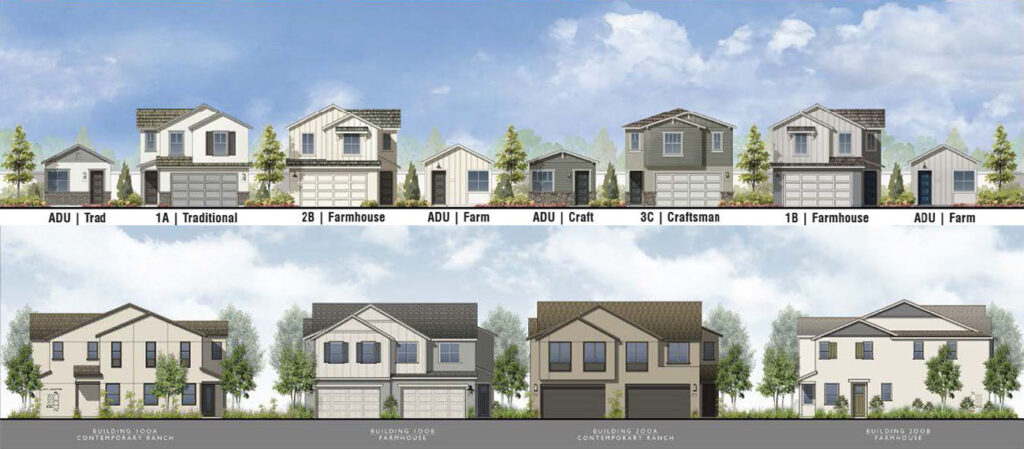
Renderings of the single-family homes and accessory dwelling units (top) and the duplexes (bottom) in the proposed Vineyard Crossing rental housing project. Source: BrightSky Residential
Will discuss $30 million lawsuit by desal plant general contractor
By Allen D. Payton
During their meeting on Tuesday, Oct. 14, 2025, the Antioch City Council will consider approving a 137-unit rental housing project in the northeast part of the city, within the City’s Priority Development Area north of the Antioch BART station. They will also consider spending an additional $245,000 on an Organizational Efficiency Implementation Consultant and splitting the $21 million L Street Pathway to Transit Project into two projects.
City Faces $30M+ Lawsuit by Desalination Plant General Contractor
Before the regular meeting, the council will hold a three-hour Closed Session, beginning at 4:00 p.m., for labor negotiations with the Management Unit, Treatment Plant Employees’ Association, Operating Engineers Local Union No. 3, Confidential Unit, Antioch Police Officers Association, and Antioch Police Sworn Management Association. In addition, the council will discuss two lawsuits, including: Shimmick Construction Co v. City of Antioch, Contra Costa Superior Court Case No. C25-01690 for Unlimited Breach of Contract/Warranty by the General Contractor for non-payment for work on the City’s Brackish Water Desalination Plant in which they are seeking damages of $30 million plus interest; and Antioch Adams Warehouse et al. v. Jason Walker (and City of Antioch), Contra Costa Superior Court Case No. MSC 18-02260 regarding a property dispute on Cesa Lane, as well as anticipated litigation.
Consultant for Organizational Efficiency Implementation Services
According to the City staff report, for Item 2.P., “It is recommended that the City Council adopt a resolution approving a Professional Services Agreement with K. Zelenka Consulting to provide organizational efficiency implementation services and other functions in an amount not to exceed $245,000…that will help the City Manager advance the City’s adopted efficiency review recommendations and ensure continuity in several key initiatives. The
consultant will concentrate on facilitating process improvements, coordinating efforts across departments, and supporting the City’s ongoing commitment to organizational effectiveness and customer-focused service delivery.”
In addition, the report reads, “K. Zelenka Consulting is in the process of completing the City’s comprehensive organizational efficiency audits, which have identified a series of actionable recommendations to improve operations, streamline processes, and enhance overall service delivery.
“The consultant will immediately continue the Operational Assessments with the Human Resources Department (in final draft phase) and will begin assessments for Antioch Police Department (APD) Dispatch Center, Community and Economic Development Department, and Parks and Recreation Services Department this month. The consultant will also identify new opportunities for process improvement, recommend strategies to enhance service delivery, and assist with community engagement and stakeholder communication related to organizational changes. As directed by the City Manager, the consultant may provide policy and program analysis and attend City Council or community meetings to present updates.
“Because K. Zelenka Consulting conducted the original organizational efficiency audits and possesses specialized knowledge of the City’s operations, her continued involvement is essential to maintain momentum and ensure consistency in implementation.
“Funding for this initiative will come from cost savings achieved during the vacancies of the Assistant City Manager and Executive Assistant positions within the City Manager’s office, while recruitment efforts to fill the open roles continue and commence.”
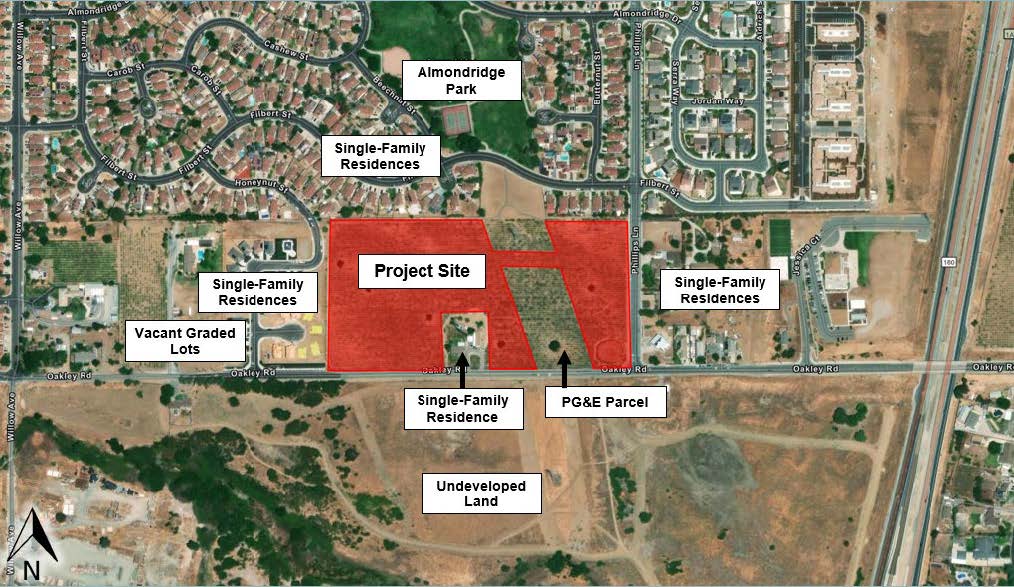
Vineyard Crossing Project Site map. Source: City of Antioch
Vineyard Crossing Rental Housing Project – Part of Almondridge, City’s PDA
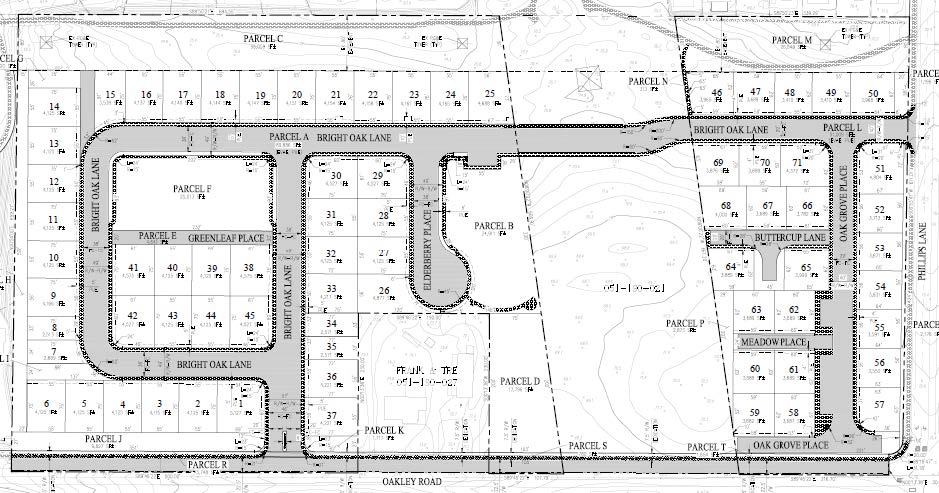
Under Item 6, the Council will consider approving a 137-unit housing project by Walnut Creek-based BrightSky Residential on 14.6 acres located northwest of the intersection of Phillips Lane and Oakley Road within the City’s Priority Development Area near the BART Station. According to the City staff report, the proposed project would subdivide the project site into 71 individual lots containing 137 residential units total with 45 single-family residential lots and 40 accessory dwelling units (ADUs) on the western parcel. A condominium map could be recorded for the duplex lots 46-71 on the eastern parcel, for 26 duplex building lots creating 52 condominium lots.
In addition, the “proposed project designates 10% of base units (13 of the ADUs total) as affordable to low-income households to obtain a density bonus of 16 additional units (included in the 137) as well as waivers from certain development standards, in accordance with state density bonus law.” They would be deed-restricted and available for households earning 60 percent of the Area Median Income (AMI). The City’s proposed Inclusionary Housing Ordinance, which would require designating 15% of units in new developments as affordable, cannot apply as the Council has not yet adopted it.
The applicant has indicated that they intend to own and operate the entire project after construction as a rental housing community. However, the proposed Vesting Tentative Map is for condominium purposes for the duplex lots on the eastern parcel and would allow for the possible future sale of each residential duplex unit.
The project site is part of the Almondridge South Planned Development District that was entitled in 1991 but only partially developed since that time. Single-family residences were developed to the west of the project site, but both of the project parcels have remained undeveloped.
As part of the City’s 2003 General Plan, the western project parcel was designated Medium Low Density Residential with a density of up to 6 dwelling units/acre permitted and the eastern project parcel was designated Medium Density Residential with a density of up to 10 dwelling units/acre permitted.
The project applicant submitted a preliminary development plan and received feedback from the Antioch Planning Commission and City Council in December 2023 and January 2024 respectively.
The applicant submitted a Preliminary Application under SB 330 (The Housing Crisis Act of 2019). Through the Preliminary Application process put in place under SB 330, housing developments may only be subject to the ordinances and objective standards in effect at the time when a completed Preliminary Application is submitted. To qualify, projects had to be submitted prior to Jan. 1, 2025.
Rezoning Not Required, ADU’s Not Counted Toward Density per State Law
While the project does not conform to the adopted Planned Development zoning standards for the site such as lot size and setbacks, it is consistent with the density established in the General Plan, and therefore per state law, a rezoning is not required to develop the project. Additionally, per state law, accessory dwelling units are not counted as units for the purposes of determining the proposed density of a project.
As part of Plan Bay Area, each of the 101 cities in the nine-county Bay Area were required to set aside land for a Priority Development Area (PDA) near public transit planned for new homes, jobs and community amenities, including higher-density housing. In order for Antioch to obtain approval for a BART extension and station, the city council had to agree to 2,500 housing units in the City’s 400-acre PDA. It includes the land east of the BART station and north to E. 18th Street.
Amenities located on the western parcel of the site would include a recreation center with an outdoor pool area as well as a children’s play area. Amenities located on the eastern parcel would include an activity lawn area with park benches in the northern portion of the parcel.
Parking
The project provides a total of 408 parking spots. This includes 194 spots within 2-car garages for each single-family home and duplex unit, 130 spots within the single-family home and ADU driveways, and 84 spots on streets. Projects receiving a density bonus are entitled to reduced parking standards, with a maximum parking requirement of 1.5 parking spaces for a 3-bedroom unit (all units proposed for the development, with the exception of the ADU’s are 3-bedroom). The 45 single family homes and 52 duplex units would therefore require 146 parking spots.
The project parking therefore exceeds what is required for a density bonus project, and in fact also exceeds standard municipal code requirements for parking (single family detached – 2 spots per unit in a garage plus 1 guest spot – 135 total – single family attached – 2 spots per unit plus 1 per 5 units for guest parking – 114 spots total).
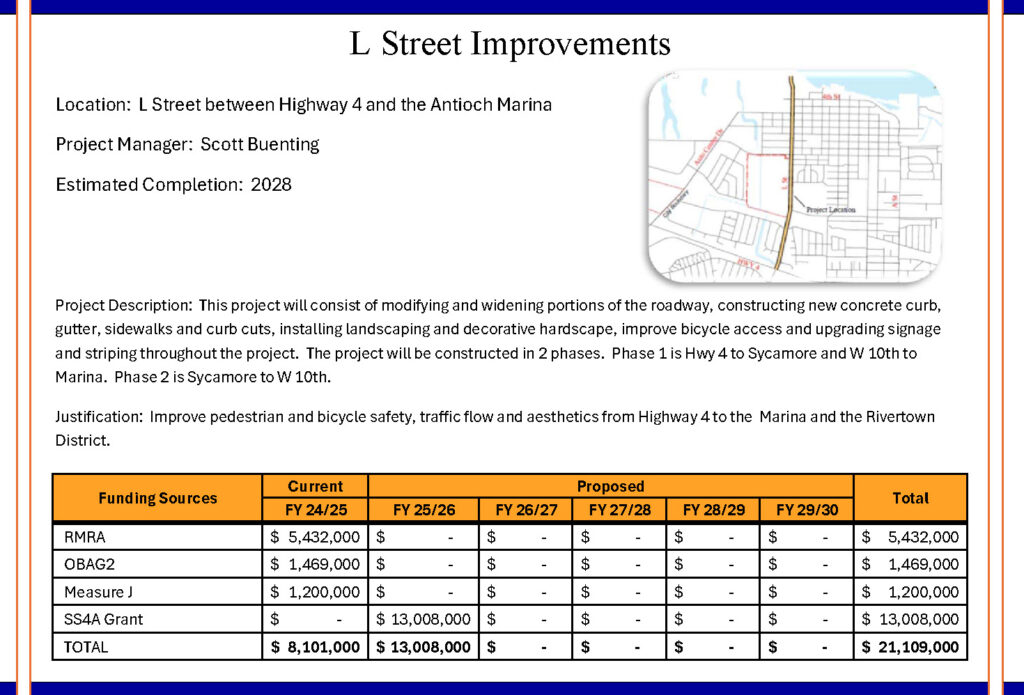
L Street Improvements Plan. Source: City of Antioch 5-Year CIP 2025-30
Split $21 Million L Street Pathway to Transit Improvement Project into Two
Under Item 8 the council will consider splitting the planned $21 million L Street improvement project into two projects to reserve funding.
According to the City staff report for the item, the L Street Pathway to Transit (“Project”) will improve accessibility for all modes of transportation and beautify the L Street corridor between Highway 4 and the Antioch Marina.
“The first phase of work on the Project will consist of modifying portions of the roadway, constructing new concrete curb, gutter, sidewalks and curb cuts, installing landscaping and decorative hardscape, improve bicycle access and upgrading signage, and striping throughout the Project from Highway 4 to Sycamore Drive, and from West Tenth Street to the Marina.
“The second phase of work will consist of widening the roadway to four lanes between West 10th Street to West 18th Street, installation of new sidewalks on the western side of the roadway, ADA-compliant upgrades, signal improvements at the intersection of W. 10th and W. 18th Streets, enhanced bus facilities, and the addition of bike lanes. (P. W. 234-16).
“In order to keep the funding sources separately, staff recommends separating this work into two projects. The first phase will be funded by Measure J funds in the amount of 1,191,465 and the One Bay Area Grant (OBAG2) in the amount of $1,469,000. The second phase will be funded by the state’s Road Maintenance and Rehabilitation Account (RMRA) in the amount of $5,244,167, and a U.S. Department of Transportation’s Safe Streets and Roads for All (SS4A) Grant in the amount of $13,008,000, which has already been budgeted for in the 5 Year Capital Improvement Program 2025-2030.”
The meetings will be held in the Council Chambers at City Hall, 200 H Street, in Antioch’s historic, downtown Rivertown. They can also be viewed via livestream on the City’s website and the City’s YouTube Channel, on Comcast Cable Channel 24 or AT&T U-verse Channel 99.
Leighann Kingsbury. Photos courtesy of her sister.
By Allen D. Payton
According to Antioch Police Lt. Joe Njoroge, a pedestrian was struck by a train on Tuesday evening, Oct. 7, 2025, in the area of 6th and A Streets. BNSF, the railroad company, are the primary investigators, he added.
According to Contra Costa County Deputy Coroner Aaron Carson, the victim was identified as Leighann Kingsbury, 34 years old, from Massachusetts.
Antioch homeless advocate Nichole Gardner spoke with Kingsbury’s sister who said she was from Worcester and moved here 14 years ago and confirmed Leighann was unhoused at the time of her death.
Please be advised that Wilbur Avenue On-ramp to southbound SR-160 and E. 18th Street Off-Ramp on southbound SR-160 will remain closed throughout the closure. This extended closure is required to safely and efficiently complete construction activities in the area.
DETOUR DIRECTIONS?
Detour signs will be posted, and Changeable Message Signs (CMS) will alert drivers of the closure. Drivers should expect delays, allow extra travel time and exercise caution while navigating the detours. All work is weather permitted. Caltrans appreciates the public’s patience and cooperation while crews perform this critical work.
Existing transportation funding strained by rising construction costs, population growth, potential decrease in state gas tax revenue
“115 of 1,374 bridges are rated poor/structurally deficient, with significant deterioration” – TRIP Report
By Carolyn Bonifas Kelly, Director of Communication & Research, TRIP
San Francisco, CA – While additional state and federal transportation funding is allowing California to repair and improve roads and bridges, a new report documents looming challenges including population growth, rising congestion, construction cost inflation and declining fuel-tax revenue. The report by The Road Information Program, TRIP, a national transportation research nonprofit based in Washington, DC, examines California’s road and bridge conditions, congestion and reliability, highway safety, economic development, vehicle travel trends, and the impact of recent state and federal transportation funding increases.
The TRIP report, “Keeping California Mobile: Providing a Modern, Sustainable Transportation System in the Golden State,” finds that throughout the state, traffic fatalities have increased significantly in the last decade despite recent downward trends, 50 percent of major roads are in poor or mediocre condition, five percent of locally and state-maintained bridges (20 feet or more in length) are rated poor/structurally deficient, and traffic congestion costs the state’s drivers $55 billion annually in lost time and wasted fuel. In addition to statewide data, the TRIP report includes regional pavement and bridge conditions, congestion data, highway safety data, and cost breakdowns for the Los Angeles, Riverside-San Bernardino, Sacramento, San Diego, San Francisco-Oakland and San Jose urban areas.
The TRIP report finds that 73 percent of major locally and state-maintained roads in the San Francisco-Oakland urban area are in poor or mediocre condition, costing the average motorist an additional $1,106 each year in extra vehicle operating costs, including accelerated vehicle depreciation, additional repair costs, and increased fuel consumption and tire wear. Statewide, 28 percent of California’s major roads are in poor condition and 22 percent are in mediocre condition. TRIP estimates that the state’s drivers lose $24.2 billion annually in extra vehicle operating costs as a result of driving on deteriorated roads.
In the San Francisco-Oakland area, eight percent of bridges (115 of 1,374 bridges) are rated poor/structurally deficient, with significant deterioration to the bridge deck, supports or other major components. This includes locally and state-maintained bridges that are 20 feet or longer. Statewide, five percent of California’s bridges are rated poor/structurally deficient. Most bridges are designed to last 50 years before major overhaul or replacement. In California, 54 percent of the state’s bridges were built in 1969 or earlier.
According to the TRIP report, traffic congestion in the San Francisco-Oakland area causes 111 annual hours of delay for the average motorist and costs the average driver $3,406 annually in lost time and wasted fuel. On average, San Francisco-Oakland drivers waste 38 gallons of fuel annually due to congestion. Statewide, drivers lose $55 billion annually because of lost time and wasted fuel due to traffic congestion. Due to the Covid-19 pandemic, vehicle travel in California dropped by as much as 41 percent in April 2020 (as compared to vehicle travel during the same month the previous year).By 2025, vehicle miles of travel in California had rebounded to five percent below 2019’s pre-pandemic levels. Congestion reduces job accessibility significantly. In California’s six largest metros, the number of jobs accessible within a 40-minute drive during peak hours were reduced by 44 percent in 2023 as a result of traffic congestion.
Source: TRIP
Traffic crashes in California claimed the lives of 24,508 people from 2019 to 2024. The state’s 2024 traffic fatality rate of 1.19 fatalities for every 100 million miles traveled was slightly lower than the national average of 1.2. The number of traffic fatalities and the fatality rate per 100 million vehicle miles of travel in California spiked dramatically in 2020 and 2021 before falling each year from 2022 to 2024. But, despite recent progress, from 2014 to 2024 the number of traffic fatalities in California increased 24 percent and the state’s traffic fatality rate increased 29 percent. From 2019 to 2023, 30 percent of those killed in California crashes involving motorized vehicles were pedestrians or bicyclists. In the San Francisco-Oakland area, 36 percent of traffic fatalities between 2019 and 2023 (306 of 934) were pedestrians or bicyclists.
“California’s future depends on transportation infrastructure that can withstand the challenges of a changing climate and a growing population,” said Senator Dave Cortese, chair of the California Senate Transportation Committee. “These investments don’t just move people and goods—they cut emissions, strengthen communities, create jobs, and spur economic growth. The TRIP report makes clear that smart infrastructure investments are among the most powerful tools we have to support California’s workforce and drive long-term economic prosperity.”
Improvements to California’s roads, highways and bridges are funded by local, state and federal governments. In April 2017, the California legislature enacted SB 1 — the Road Repair and Accountability Act. SB 1 increased state revenues for transportation by increasing the state’s gasoline and diesel taxes, implementing a transportation investment fee on vehicles and initiating an annual fee on zero emission vehicles. SB 1 is estimated to increase state revenues for California’s transportation system by an average of $5.2 billion annually through to 2027. In addition to state transportation funding, the Infrastructure Investment and Jobs Act (IIJA), signed into law on November 2021, provides $25.3 billion in federal funds to the state for highway and bridge investments in California over five years, representing a 29 percent increase in annual federal funding for roads and bridges in the state over the previous federal surface transportation program. The IIJA is set to expire on September 30, 2026.
“California’s transportation system is the backbone of our daily lives, connecting millions of people to work, school, and opportunity,” said Assemblymember Lori Wilson, chair of the California State Assembly Transportation Committee. “The TRIP report provides the proof points behind what we already know: our infrastructure needs are urgent and growing. As we transition to cleaner vehicles and more sustainable mobility, we must secure fair and reliable funding solutions to ensure tomorrow’s infrastructure serves Californians better than today’s.”
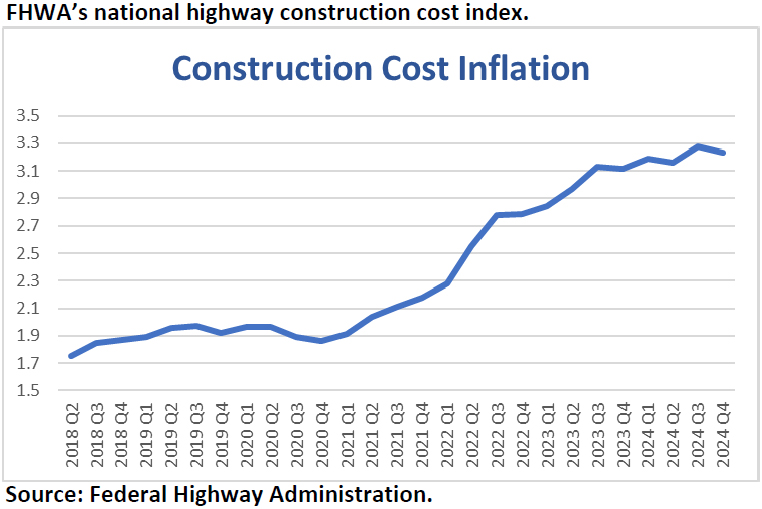
The ability of revenue from California’s motor fuel tax – a critical source of state transportation funds – to keep pace with the state’s future transportation needs is likely to erode as a result of increasing vehicle fuel efficiency, the increasing use of electric vehicles and inflation in highway construction costs. The Federal Highway Administration’s national highway construction cost index, which measures labor and materials cost, increased by 48 percent from the beginning of 2022 through the fourth quarter of 2024.
The California Legislative Analyst’s Office (LAO) found that steps taken by California to reduce greenhouse gas emissions, including programs and policies that are targeted at increasing the adoption of zero-emission vehicles (ZEVs), increasing the use of lower-carbon fuels, and reducing the number of vehicle miles traveled will reduce state transportation revenues by $4.4 billion over the next decade. This reduction in state transportation spending which is projected to result in poorer road conditions. However, the recent federal rollbacks to California strict emissions requirements will impact these programs and policies.
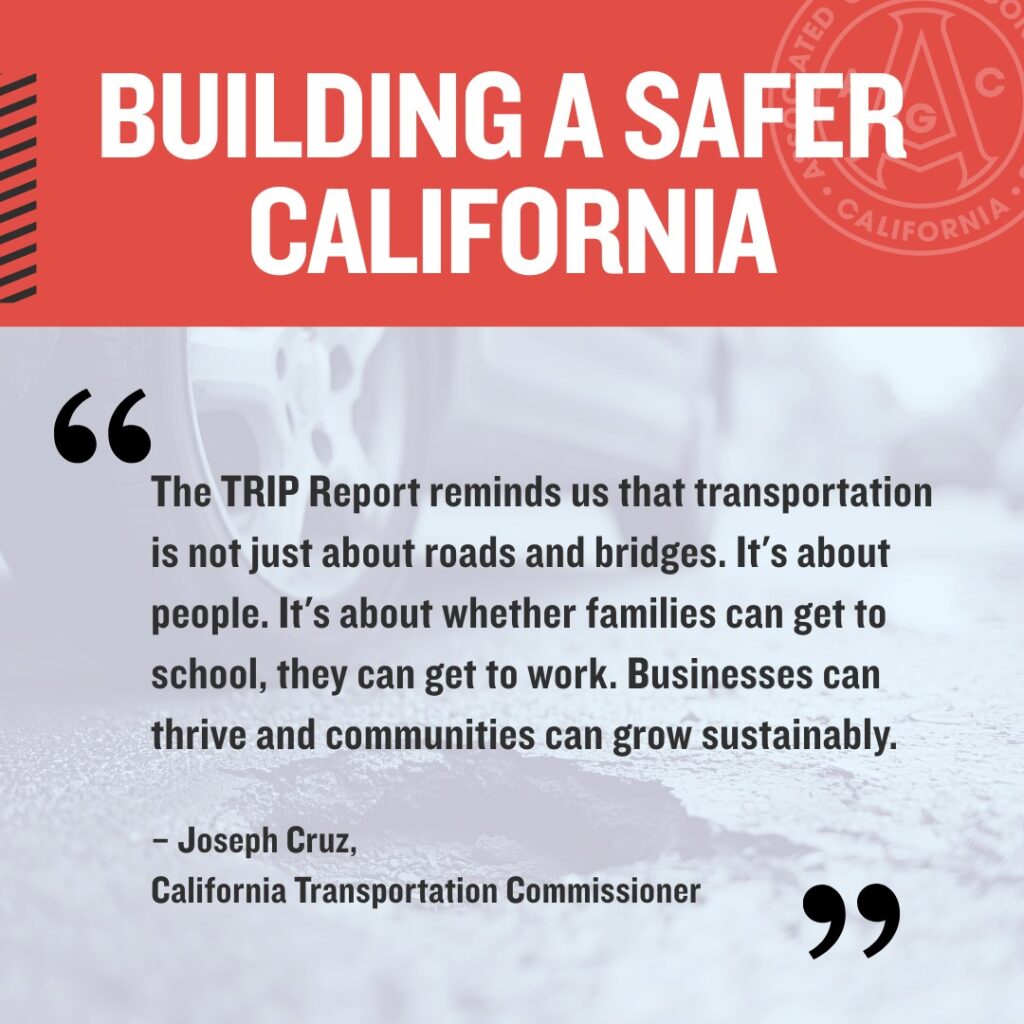
“Our deteriorating transportation system costs Californians lives, time, and money,” said California Transportation Commissioner Joseph Cruz. “Every investment in improving and maintaining our roads, bridges, and transit networks is an investment in people. These projects don’t just build infrastructure – they create good jobs, support local economies, and ensure California’s workforce is at the center of the solution.”
Source: TRIP
The efficiency and condition of California’s transportation system, particularly its highways, is critical to the health of the state’s economy. In 2023 California’s freight system moved 1.4 billion tons of freight, valued at $2.8 trillion. From 2022 to 2050, freight moved annually in California by trucks is expected to increase 65 percent by weight and 100 percent by value (inflation-adjusted dollars). The design, construction and maintenance of transportation infrastructure in California supports approximately 420,000 full-time jobs across all sectors of the state economy. Approximately 7.1 million full-time jobs in California in key industries like tourism, retail sales, agriculture and manufacturing are dependent on the quality, safety and reliability of the state’s transportation infrastructure network.
“California’s transportation dollars are already being stretched thin by increased inflation in construction costs and declining fuel tax revenue,” said Dave Kearby, TRIP’s executive director. “Without additional transportation investment, needed projects that would make the state’s roads safer, smoother and more efficient will not move forward.”