Offers tips for those attending SF’s fireworks show off the Golden Gate Bridge
By BART Communications
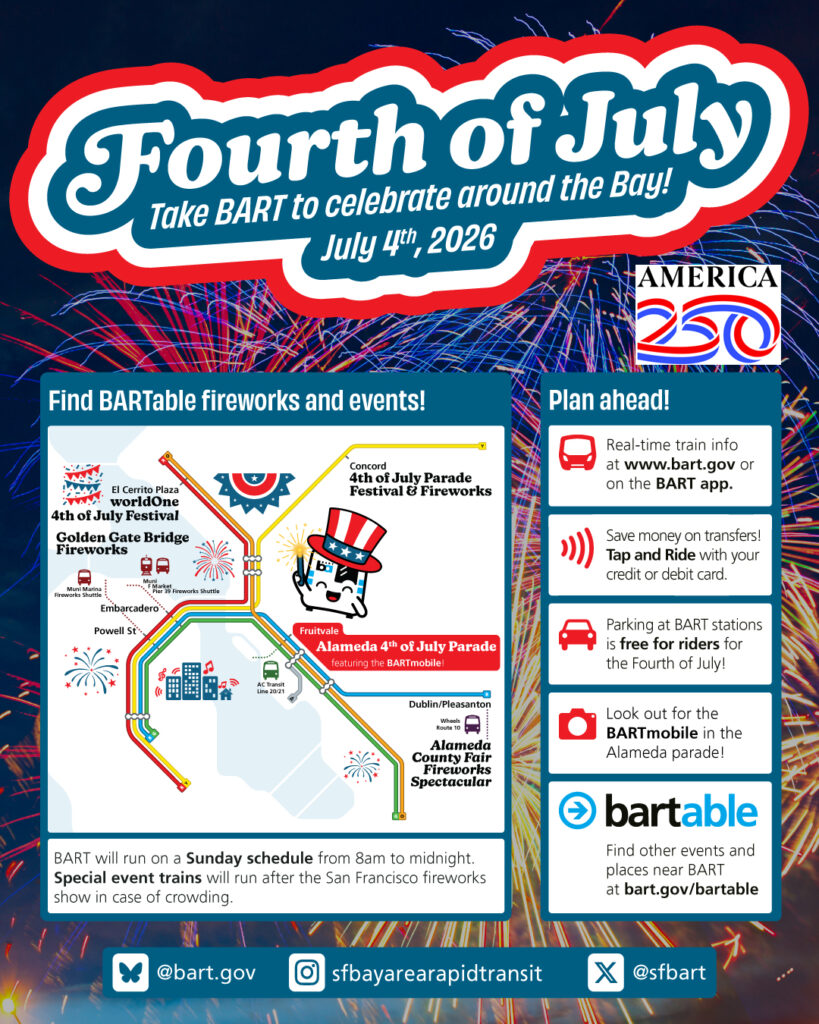
For Fourth of July on Saturday, July 4, BART will be running a Sunday schedule (8am-midnight). We will run 5-line service until 8pm and then 3-line service after 8pm.
5-line service means all lines will be running, including the Green and Red lines, which provide direct service into San Francisco.
Extra trains may be added in case of crowding after fireworks in San Francisco. The fireworks show in San Francisco will be from the Golden Gate Bridge beginning at 9:30pm. The best viewing spots are at Crissy Field, Marina Green, and Pier 39.
Muni is providing a Marina Fireworks Shuttle from Powell Street BART Station and a Pier 39 Embarcadero Fireworks Shuttle from the Embarcadero BART Station. Muni’s F-Line also serves Embarcadero to Pier 39. See Muni’s webpage with information. People looking to take BART home, should immediately return to BART to catch the last trains of the evening. The Muni shuttle service could take up to 60 minutes to connect to a BART Station.
The last train to run through downtown San Francisco stations towards the East Bay (with connections to all stations) is at around 12:25am. The last train to run through downtown San Francisco stations towards Daly City/Millbrae is at around 1:10am (this train does not stop at SFO Station). The last train to run through downtown San Francisco that will stop at SFO Station is at around 12:40am.
Planning and paying for your trip
Plan your door-to-door trip using BART’s Trip Planner. Itineraries will include key transfer information. You can also check Real Time Departures for the stations you use.
Parking at BART stations (except Milpitas and Berryessa stations) is free on weekends.
Every BART station has restrooms except Pittsburg Center, 12th St./Oakland City Center, Civic Center, 16th St. Mission, 24th St. Mission, and the Oakland International Airport Station (Coliseum Station has a restroom).
All Bay Area transit, including BART, accepts contactless debit or credit cards and mobile payment methods such as Apple Pay and Google Pay for adult fare payment. No setup is required. Just Tap and Ride. Each person needs their own card or device. Clipper cards are also accepted.
Riders who use more than one transit agency in a single trip (e.g., BART to VTA) will only be charged full fare on the first operator. A transfer discount of up to $2.85 will apply on any additional transit agency the rider uses within a two-hour window. Transfer discounts are calculated automatically using Tap and Ride or Clipper for accounts that have been upgraded to the next generation system (click here to upgrade your card).
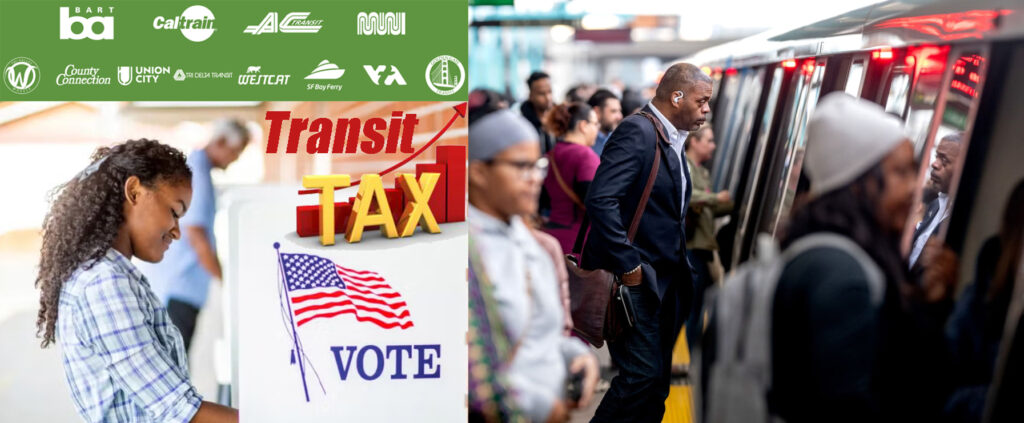
Will appear on Bay Area ballots across five counties including Contra Costa
By Jeff Cretan, West Advisors
SAN FRANCISCO BAY AREA — The Metropolitan Transportation Commission (MTC) has announced that the Connect Bay Area regional transit funding measure has officially qualified for the November 2026 ballot after elections officials confirmed the campaign submitted enough valid signatures across Contra Costa, Alameda, San Francisco, San Mateo and Santa Clara counties.
The announcement follows the Connect Bay Area campaign’s submission of more than 305,000 signatures in May, far exceeding the 186,000 valid signatures required to qualify the measure. The MTC’s official certification sent on June 30 declared that the registrars of voters across the five counties each conducted their individual county counts and submitted the results to the MTC and the total submitted far exceeded the qualification threshold.
The measure if adopted would increase the sales tax in Contra Costa, Alameda San Mateo and Santa Clara counties by a half cent and one cent in San Francisco County for 14 years. As previously reported, the measure would generate approximately $980 million annually across the five counties.
The success of this effort was built on one of the largest grassroots transit organizing efforts the region has ever seen and unprecedented support from business, labor, and community organizations across the Bay Area.
The Connect Bay Area five-county sales tax measure would provide long-term operational funding for major Bay Area transit agencies while supporting projects to strengthen and better connect transit systems across the region. It will protect major transit agencies like BART, Muni, Caltrain and AC Transit from devastating service cuts, help VTA grow to better serve residents, workers, and businesses, and provide direct support to counties for transit improvements.
Connect Bay Area also strengthens accountability for transit agencies. SB 63 – the legislation authored by Senators Scott Wiener and Jesse Arreguín that enabled Connect Bay Area – requires independent financial reviews, continued efficiency improvements, and stronger regional coordination before the measure even appears on the ballot.
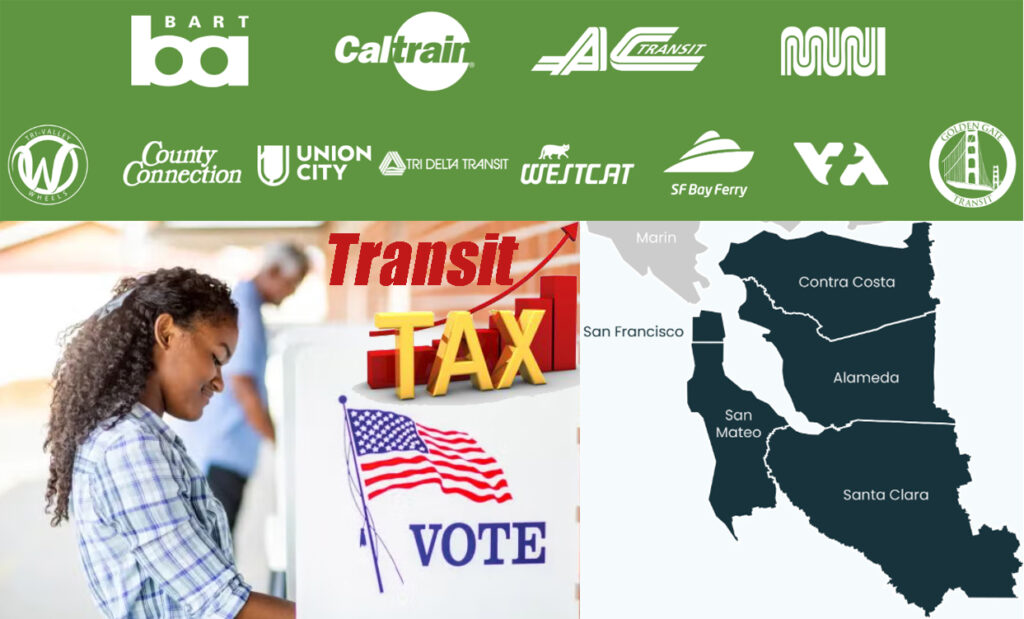
The five counties that would be included in the tax measure vote. Source: Connect Bay Area
Unprecedented Grassroots, Labor and Business Support
The Connect Bay Area campaign has grown in support over the last several months with more than 80 elected officials and more than 90 labor, business, and advocacy organizations signing on in support. Major businesses from across the region helped raise more than $5.5 million to qualify the measure and prepare for the November election.
Since launching in January, Connect Bay Area mobilized more than 1,000 volunteers and advocates across Alameda, Contra Costa, San Francisco, San Mateo, and Santa Clara counties. Supporters gathered signatures at transit stations, farmers markets, community events, neighborhood meetings, and major public gatherings throughout the Bay Area.
The overwhelming signature total that led to the measure’s qualification for the ballot reflects broad public support for transit and growing awareness of the urgency surrounding the future of Bay Area public transportation.
Without sustainable transit funding, the Bay Area could face catastrophic service reductions:
BART: Up to 15 station closures, elimination of two lines, and service cuts of up to 70%
Caltrain: Hourly train service, no weekend service, and weekday shutdowns after 9 p.m.
Muni: At least 20 bus routes eliminated and service reductions of 30% or more
AC Transit: Service cuts of at least 16%
The campaign will now turn its full attention toward the November election, building on the unprecedented coalition of volunteers, businesses, labor organizations, transit riders, and community advocates who helped qualify the measure.
About Connect Bay Area
The Connect Bay Area campaign is a five-county Regional Transit Measure on the November 2026 ballot. The measure would establish a 0.5% sales tax in Alameda, Contra Costa, San Mateo, and Santa Clara counties and a 1% sales tax in San Francisco to provide additional support for Muni. It would provide long-term operational funding for major Bay Area transit agencies while supporting regional projects that strengthen transit throughout the region.
The Regional Transit Measure will:
Protect and improve service on BART, Muni, Caltrain, SamTrans, VTA, and AC Transit.
Prevent catastrophic transit service cuts across the Bay Area.
Reduce traffic congestion and emissions while supporting California’s climate goals.
Support the Bay Area economy by strengthening downtown recovery and regional mobility.
The measure includes strong accountability and oversight provisions, including independent financial reviews for every transit operator, regional coordination requirements to ensure systems work better together, and a citizen oversight committee to monitor spending and performance. A recent independent study required under SB 63 found Bay Area transit agencies have already achieved approximately $1 billion in operational efficiencies while identifying additional opportunities to improve service and reduce costs.
The Connect Bay Area Transit Committee is comprised of labor, business, and transit advocates, including Bay Area Council, SEIU 1021, ATU 1555, South Bay Labor Council, SPUR, and SAMCEDA, alongside an advocacy council of more than 20 organizations representing transit, housing, environmental, equity, senior, and disability organizations.
For more information about the Connect Bay Area campaign or to get involved, visit connectbayarea.com.
CCTA introduces Countywide Smart Signals Project at approximately 365 intersections, 15 in Antioch
By Lindy Johnson, Director of External Affairs & Mike Blasky, Communications, Contra Costa Transportation Authority
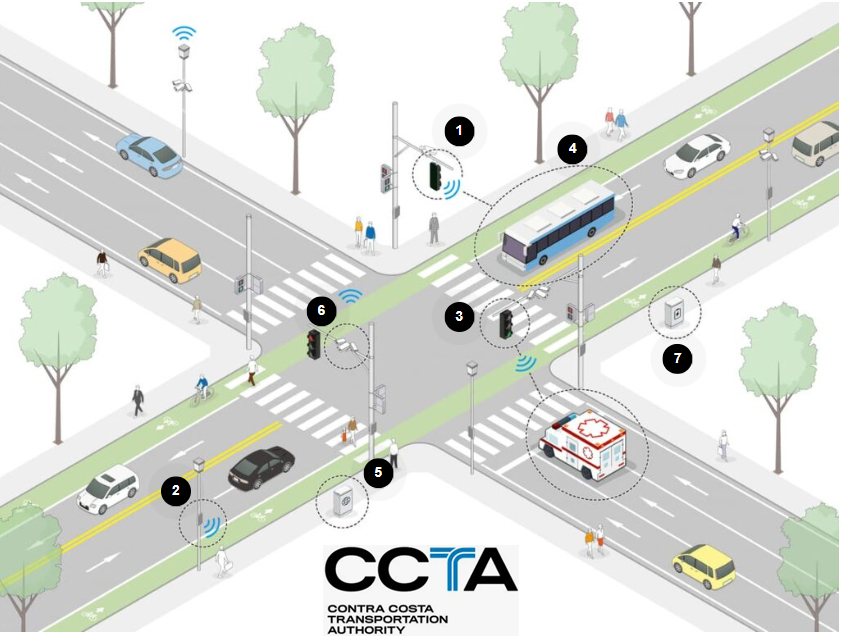
At a groundbreaking event in Danville on Wednesday, May 27, 2026, the Contra Costa Transportation Authority (CCTA) marked the advancement of its Countywide Smart Signals project, a countywide effort to modernize approximately 365 intersections and give local agencies better real-time tools to improve safety, reduce unnecessary stops, and help traffic move more smoothly on some of the county’s most important corridors.
The project spans all 19 cities and towns, along with unincorporated Contra Costa County, and focuses on major Routes of Regional Significance where upgraded equipment can strengthen coordination and improve day-to-day traffic operations across jurisdictions. Antioch has 15 locations along Wilbur Avenue, A Street, W. 10th Street, Auto Center Drive, Somersville and Buchanan Roads.
A special thank you to CCTA Senior Engineer Andy Dillard, whose work and leadership helped move this project from concept to construction. His experience, including his earlier work with the Town of Danville, has been instrumental in shaping a project that started with local needs and is now growing into a countywide system upgrade.
Key Features of the Smart Signals include:
Traffic Signal Synchronization
Makes traffic lights work together so drivers spend less time in traffic, reducing travel times and delays while enhancing safety.
Video/Radar Vehicle, Pedestrian, and Bicycle Detection
Uses sensors to locate approaching vehicles, people, and bikers, and automatically adjust traffic lights for safer crossings. Provides real-time traffic data so cities can spot issues, improve timing, and keep roads safe.
Emergency Vehicle Preemption
Gives green lights to fire trucks, police cars, and ambulances so they can reach emergencies more quickly.
Transit Signal Priority
Helps buses move through traffic more smoothly to stay on schedule.
High-Speed Network
Connects signals through high-speed links so they can share information instantly.
Remote-View Sensors
Lets engineers see what’s happening at intersections and respond faster to problems.
Battery Back-up Systems
Keep traffic signals up and running during power outages.
Smart Signal Key Features. Source: CCTA
“The Countywide Smart Signals project is about bringing our traffic signal system up to a modern standard and giving our cities and towns better tools to keep people moving safely and efficiently,” said Tim Haile, Executive Director of CCTA. “These upgrades will help intersections work better together, support safer crossings for people walking and biking, and create the connected foundation we need for better traffic management over time.”
Upgrades to traffic signals could include signal synchronization, vehicle, pedestrian, and bicycle detection, emergency vehicle preemption, transit signal priority, high-speed network connections, remote-view sensors, and battery backup systems, depending on local jurisdiction needs. Initial upgrades will begin in communities such as Danville and Concord, with additional countywide work to follow.
“This is exactly the kind of countywide investment that delivers local value,” said Candace Andersen, Supervisor, District 2, Contra Costa County. “For residents, it means smarter coordination, safer intersections, and better support for emergency response and transit. For our local jurisdictions, it means modern tools and stronger connections along the corridors that matter most.”
“We are proud to host this groundbreaking in Danville and help launch an effort that will benefit communities across Contra Costa County,” said Newell Arnerich, Mayor of Danville. “Danville residents experience every day how important signal timing and traffic operations are to safety and quality of life. Projects like Countywide Smart Signals will help our communities manage traffic more effectively while improving conditions for drivers, pedestrians, bicyclists, and first responders.”
“Modern, connected transportation infrastructure is essential to keeping our communities safe and moving. I’m proud to have secured more than $7 million in federal funds to ensure our community has cutting-edge technology to reduce commutes and ensure safety. Contra Costa is leading the nation in investments like Countywide Smart Signals to help improve mobility, reduce delay, and strengthen the transportation networks commuters rely on every day,” said Congressman Mark DeSaulnier, who represents California’s 10th Congressional District. “Today’s Contra Costa Transportation Authority’s Smart Signals project groundbreaking was many years in the making! I have been a proud champion of Smart Signals both here in Contra Costa and back on Capitol Hill where I have secured millions of federal dollars to bring this technology to our community. Thanks to this new project, CCTA will modernize traffic signals at more than 350 intersections throughout Contra Costa, implementing state-of-the-art Smart Signals technology to improve traffic flow and roadway safety to get CA-10 residents to and from home safely and quickly.”
CCTA says the project is designed to deliver three core benefits: safer travel, smoother trips, and better tools for cities and towns. Over time, the connected system is intended to support a broader countywide view of traffic conditions that can help agencies coordinate during major events and emergency situations. The project is funded at a total of $30.8 million through Measure J, local city contributions, as well as federal and state contributions.
We’re excited to see this work move forward and grateful to all of our city, county, regional, state, federal, and transit partners helping bring smarter infrastructure to Contra Costa County.
The Contra Costa Transportation Authority is a public agency formed by Contra Costa voters to manage countywide transportation sales tax revenue and to implement voter-approved projects and programs. CCTA is responsible for planning, funding, and delivering critical transportation infrastructure and services to keep Contra Costa County and the Bay Area moving. For more information visit Contra Costa Transportation Authority.
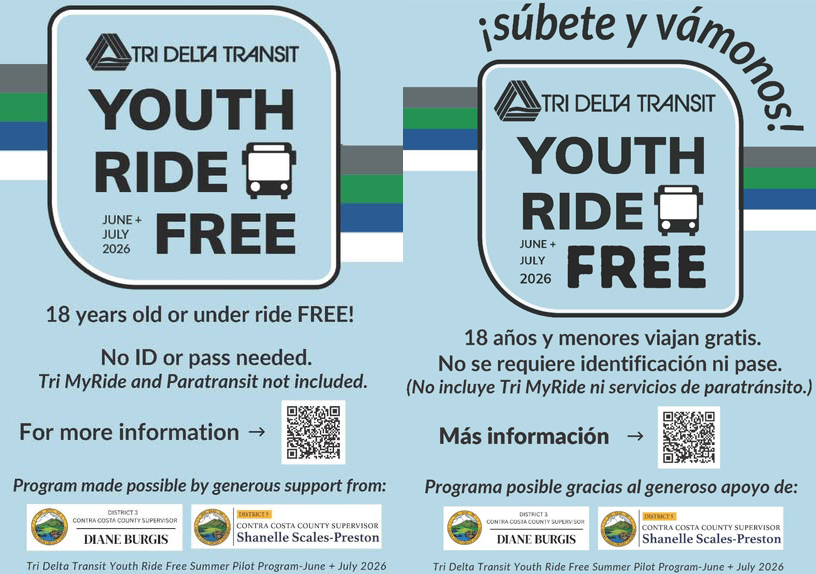
Tri Delta Transit is excited to announce Youth Ride Free 2026. This program, funded by County Supervisor Burgis and County Supervisor Scales-Preston, provides FREE rides for ages 18 and under from June 1st-July 31st on Tri Delta Transit fixed and express route buses. Tri MyRide and paratransit are not included. No fares, no applications, no ID, no passes are needed. So, enter your travel era and ride to jobs, summer program, entertainment, school and more.
Tri Delta Transit se complace en anunciar el programa Youth Ride Free 2026 o Los Jóvenes Viajan Gratis 2026. Este programa es financiado por las Supervisoras del Condado de Contra Costa, Supervisora de el Distrito 3, Diane Burgis y Supervisora de el Distrito 5, Shanelle Scales-Preston.
Youth Ride Free 2026/Los Jóvenes Viajan Gratis 2026 ofrece viajes GRATIS para personas de 18 años o menos empezando desde el 1 de junio hasta el 31 de julio en los autobuses de rutas fijas y expresas de Tri Delta Transit. Tri MyRide y el servicio de paratránsito no están incluidos en este programa.
No se necesitan tarifas, aplicaciones, identificación, ni pases. ¡Así que incia tu era de viajes, ya sea viaja a trabajos, programas de verano, entretenimiento, la escuela y más!
Multiple Bay Area transit agencies would benefit from the five-county sales tax measure. Photo: MTC. Map source: Connect Bay Area
Connect Bay Area far surpasses 186,000 signatures required to qualify BART, regional transit funding measure
By Jeff Cretan, West Advisors
SAN FRANCISCO BAY AREA — The Connect Bay Area campaign today announced it has submitted more than 305,000 signatures to qualify a regional transit funding measure for the November ballot — blowing past the 186,000 valid signatures required.
The success of this effort is built on one of the largest grassroots transit organizing efforts the region has ever seen and major support from business and labor organizations.
The Connect Bay Area five-county sales tax measure would provide long-term operational funding for major Bay Area transit agencies, while supporting projects to strengthen and connect transit systems across the region. It will protect major transit agencies like BART from devastating service cuts and help VTA grow to better serve residents, workers, and businesses.
Connect Bay Area also strengthens accountability for transit agencies. SB 63 – the legislation authored by Senators Scott Wiener and Jesse Arreguin that enabled Connect Bay Area – set strong accountability requirements to take effect before the measure even gets on the ballot. The measure requires independent financial reviews and continued efficiency improvements from transit agencies.
Unprecedented Grassroots, Labor, and Business Support
The Connect Bay Area Campaign has grown in support over the last several months with more than 80 elected officials and more than 90 labor groups and advocacy organizations signing on in support. Major businesses from across the region have helped to fundraise over $5.5 million so far to get the measure on the ballot and prepare for the November election.
Since launching in January, Connect Bay Area has mobilized more than 1,000 volunteers and advocates across Alameda, Contra Costa, San Francisco, San Mateo, and Santa Clara counties. Supporters gathered signatures at transit stations, farmers markets, community events, neighborhood meetings, and major public gatherings throughout the Bay Area.
The overwhelming signature total reflects the broad support for transit and the awareness of urgency surrounding the future of Bay Area public transit.
Without sustainable transit funding, the Bay Area could face catastrophic service reductions:
BART: Up to 15 station closures, elimination of two lines, and service cuts of up to 70%
Caltrain: Hourly train service, no weekend service, and weekday shutdowns after 9 p.m.
Muni: At least 20 bus routes eliminated and service reductions of 30% or more
AC Transit: Service cuts of at least 16%
The more than 300,000 signatures – which were the result of both a paid effort and an advocate-led grassroots effort – will now be officially counted and validated by the Departments of Elections for each of the five counties over the next few weeks before the measure can officially be placed on the ballot.
“We’re blown away by the over 1,000 Bay Area volunteers, transit advocates, and labor partners who contributed to getting transit funding on the November ballot,” said Lian Chang, co-lead of the Connect Bay Area grassroots signature gathering effort. “This is the largest grassroots signature-gathering effort in the history of the Bay Area, and represents thousands of hours spent by people from all backgrounds and all corners of our five-county region to protect this thing—transit—that matters to millions of Bay Area residents. Everyday more voters are getting on board to support our economy, social justice, the environment and reducing congestion. And we’re just getting started.”
“This is a resounding statement by Bay Area voters that they believe in the value of our regional transit systems and how important they are to keeping our region moving,” said Libby Schaaf, President and CEO of the Bay Area Council. “Now we must turn our attention to November and protecting the many billions of dollars we’ve invested over many decades to build these systems while also making them more efficient, cost-effective, safe and convenient for the millions of commuters who rely on them.”
“Public transit is a cornerstone of our economy and an essential public good that keeps our region affordable for residents,” said Congressman Kevin Mullin. “Connect Bay Area will protect the public transportation service we all rely on while ensuring strong accountability so every dollar delivers reliable, safe transit.”
“The Bay Area’s public transit is a core pillar of our region’s ability to usher in a climate-smart, affordable, and just future,” said Amanda Brown-Stevens, Executive Director of the Greenbelt Alliance. “Greenbelt Alliance is excited to be a part of this grassroots coalition to help protect and enhance our public transportation and reduce pollution.
About Connect Bay Area
The Connect Bay Area campaign will bring a five-county sales tax to the ballot in November 2026 through a citizen signature gathering effort. The rate will be set at 0.5%, with the exception that San Francisco will be set at a 1% rate to provide additional support for Muni. This measure will provide long-term operations funding for major Bay Area transit agencies and support regional projects to strengthen transit throughout the Bay Area.
The Connect Bay Area measure will support the future of public transportation in the Bay Area:
Protect and improve service on BART, Muni, Caltrain, SamTrans, VTA, and AC Transit
Prevent catastrophic service cuts that could devastate the Bay Area
Keep traffic and emissions down, preventing gridlock and protecting climate progress;
Support the Bay Area’s economy, ensuring that downtown recovery and regional mobility remain strong.
Connect Bay Area has strong accountability and oversight provisions, including dependent financial reviews for every transit operator, regional coordination mandates to ensure systems work better together, and a citizen oversight committee to monitor spending and performance. A recent independent study required by Connect Bay Area found the agencies had saved $1 billion in operational efficiencies and set new actions for the agencies to take to further improve efficiency and service.
The Connect Bay Area Transit Committee is comprised of labor, business, and transit advocates, including Bay Area Council, SEIU 1021, ATU 1555, SPUR, and SAMCEDA, alongside an advocacy council of more than 20 organizations representing transit, housing, environmental, equity, and senior and disability groups.
For more information about the Connect Bay Area campaign or to get involved, visit https://connectbayarea.com/
Will invest in roads, bridges, transit, rail transportation and highway and motor carrier safety programs over five years
By Cameron Niven, Communications Director, Office of Congressman John Garamendi
WASHINGTON, D.C. – On Friday, May 22, 2026, Congressman John Garamendi (CA-08), a senior member of the House Transportation and Infrastructure Committee, secured critical wins for California in the bipartisan Building Unrivaled Infrastructure and Long-term Development for America’s 250th Act (BUILD America 250 Act) (H.R.8870). This five-year surface transportation reauthorization bill will invest in America’s roads, bridges, transit, rail transportation and highway and motor carrier safety programs.
“America’s economy is nothing without our infrastructure,” said Rep. Garamendi. “I’m proud to have secured essential provisions in the BUILD America 250 Act that will improve the lives of my constituents as much as the roads they drive, the bridges they cross and the trains they ride. This bipartisan bill will restore our aging bridges and repair crumbling roads to build out safe, accessible transit and bike infrastructure.”
The total funding authorization in the bill is about $580 billion over FY2027–FY2031 and will replace the expiring Infrastructure Investment and Jobs Act (IIJA) funding approved in 2021.
“No legislation of this scope is perfect, and while I am disappointed it does not include all my amendments, I am committed to building on the work that has been done and I am glad that this Committee was able to come to an agreement that will benefit Californians,” Garamendi continued.
The BUILD America 250 Act includes several key provisions authored by Congressman Garamendi:
The “Transportation Emergency Relief Extension Act” with Senator Padilla, Senator Cornyn and the late Congressman LaMalfa (H.R.4847)
Extends deadline for construction obligation for highway projects funded through the Emergency Relief Program from two to four years. This will ensure state and local governments have adequate time to fully utilize federal funds awarded to repair roads damaged by disasters
Key provisions from his “Transportation Emergency Relief Funds Availability Act” (H.R.3193)
Extends the obligation deadline for Emergency Relief Program funds for public transportation projects from two to five years. This will afford state and local governments the time and certainty needed to complete these projects efficiently and responsibly.
Key provisions from his “Expedited Federal Permitting for California Act” (H.R.4908)
Permanently extends the program that allows states that have assumed the responsibility for environmental reviews to make approvals for projects under state laws rather than the National Environmental Policy Act (NEPA). This commonsense reform will simply let certain federally funded transportation projects make use of existing state permitting processes without the need for a redundant, less stringent federal environmental review.
Key provisions from his “Bridge Corrosion Prevention and Repair Act” with Congressman Bost (H.R.4170)
Requires USDOT to carry out a study on best practices for addressing corrosion on weathering steel bridges, as well as the frequency and method of inspecting corrosion on steel bridges. Corrosion costs the United States billions of dollars every year while putting public safety at risk. The persistent corrosion of our roads and bridges needs to be addressed with the urgency this issue demands.
Key provisions from his “Airport TIFIA Certainty Act” (H.R.6168), with Congressman Hurd
Reauthorizes the TIFIA credit assistance program and preserves the 15% allowance for airports. This ensures low-interest federal financing remains available for critical airport projects. Sacramento Airport recently received a $36.1 million TIFIA loan to deliver critical infrastructure upgrades for California travelers.
An overview of the major provisions in the BUILD America 250 Act is included below:
Investing in Safe, Reliable, Accessible and Affordable Transit
The nation’s transit systems provide a safe, affordable and environmentally friendly means of travel for millions of Americans. Transit agencies are modernizing service to meet the needs of communities post-pandemic; making investments in safer and more reliable systems; and working to ensure accessibility for all. The BUILD America 250 Act continues the federal government’s partnership in these efforts through robust funding, new worker protections, and streamlining provisions to deliver transit projects faster.
Keeping the Focus on Safety
The BUILD America 250 Act seeks to build on the Infrastructure Investment and Jobs Act’s focus on safety byinvesting in state and local safety projects, addressing the safety of all road users, and insisting on evidence-based strategies to save lives. This bill:
Guarantees $3.75 billion in funding for the Safe Streets and Roads for All grant program which provides local communities with competitive federal funding for safety action plans and demonstration projects. More than 75 percent of the country is covered by a SS4A safety plan; five more years of funding will ensure many more communities can turn their safety vision into a reality.
Protects the 10 percent Transportation Alternatives program (TAP) set aside (the main source of formula funding for bicycle and pedestrian infrastructure) within the Surface Transportation Block Grant program. Retains a requirement that states invest a significant portion of TAP funds based on population, ensuring small and under-served communities maintain access to these dollars.
Allows local communities to use Highway Safety Improvement Program (HSIP) dollars as the local match for TAP. This provision, which comes from the Sarah Debbink Langenkamp Active Transportation Safety Act, will help
Safe Integration of Autonomous Commercial Motor Vehicles
The BUILD America 250 Act creates the nation’s first-ever regulatory framework for autonomous commercial motor vehicles,harnessing the benefits of innovation without sacrificing safety, jobs, or accountability on our roads.
This legislation directs the Secretary to establish a performance-based safety standard that manufacturers and operators of commercial vehicles equipped with automated driving systems (ADS) must meet in order to operate in interstate commerce.
To ensure this standard is nuanced, rigorous and pro-safety, the bill convenes a broad panel of more than 13 critical stakeholders––including safety organizations, labor unions, industry groups and academic experts––to set the safety standard’s requirements and adapt current Federal Motor Carrier Safety Administration (FMCSA) regulations, ensuring ADS-equipped commercial vehicles are subject to the same safety and performance standards as any other commercial vehicle.
Taken together, this framework is built on three fundamental pillars: Safety, Qualified, and Robust Work Force, and Accountability.
Supporting Local Communities
The BUILD America 250 Act provides nearly$83 billion over five years in Highway Trust Fund highway and multimodal funding to local communities. The bill continues several competitive grant programs for local governments to directly apply for funds; provides Metropolitan Planning organizations with a path to become direct recipients of federal planning funds; and improves the flow of funds to communities of all sizes.
Garamendi represents California’s 8th Congressional District in the U.S. House of Representatives which includes a majority of Solano County and portions of Contra Costa County including portions of Antioch.
$1.97 million will benefit Antioch, Oakley to improve commute times, reduce delays and ease congestion
$1.1 million for CC District Attorney’s Office to fight organized retail theft, labor trafficking
By Office of Congressman Mark DeSaulnier
Washington, D.C. – On Tuesday, May 12, 2026, Congressman Mark DeSaulnier (CA-10) announced that he secured over $16 million for community projects across Contra Costa and Alameda Counties. These projects will support public health and safety, transportation accessibility and community development, and environmental protection and sustainability in California’s 10th Congressional District.
Each year, Congress provides Member-directed federal funding to a select number of community projects through the appropriations process. Under this process, each House member is allowed to submit 15 project requests on behalf of their Congressional District to the Appropriations Committee that meet the criteria set forth by the Committee.
“From lowering everyday costs for families to bolstering traffic safety to increasing access to public, recreational spaces, these projects will improve quality of life in our community, and I am proud to have fought for and secured the funding that will make them possible,” said DeSaulnier. “I am grateful for the partnership of our local governments and organizations in developing such thoughtful projects.”
Transportation Accessibility and Community Development Projects:
$1,970,010 for the Contra Costa Transportation Authority (CCTA) to upgrade and develop a network of smart traffic signals between Antioch and Oakley to improve commute times, reduce delays and ease congestion.
$1,200,000 for the Contra Costa County Public Works Department to create a separate bike path to fill a gap in the County-wide bicycle network along Marsh Drive in unincorporated Pacheco, which will improve safety for all road users and access to local commercial centers, recreational centers, and additional connections to the local mass transit system.
$1,000,000 for the Contra Costa County Public Works Department to construct bicycle and pedestrian facilities on Treat Boulevard in the Contra Costa Centre Transit Village in Walnut Creek to close a critical gap along the Iron Horse Regional Trail, which would improve safety for non-motorized road users and improve connectivity for first and last mile connections to public transit and local commercial establishments.
$850,000 for the Town of Danville to install fiber optic cables and construct new conduit and junction boxes for 54 traffic signals in Danville to enable real-time traffic signal optimization to reduce traffic congestion and improve safety, and allow for future implementation of smart city technologies.
$850,000 for the City of Dublin to improve safety and accessibility of Village Parkway by narrowing vehicle lanes, adding lighting, and constructing buffered bike lanes, wider sidewalks, and protected intersections.
$850,000 for the East Bay Regional Park District to construct visitor facilities such as restrooms, drinking fountains, public parking areas, and a turnout lane on Bailey Road to allow for the Thurgood Marshall Regional Park to be opened up to the public.
Public Health and Safety Projects:
$1,915,000 for the Contra Costa County Fire Protection District (Con Fire) to replace and install equipment, including backup generators, shore power plugs, and automatic transfer switches, at radio towers across Contra Costa County that are used for communication between law enforcement, fire, and emergency medical services to improve system reliability during emergencies and disasters that result in the loss of power.
$1,145,144 for the Diablo Water District to provide structural and foundational reinforcements to water infrastructure to mitigate risks associated with major seismic events, safeguard water supply, and contribute to the region’s overall disaster preparedness strategy.
$1,034,487 for the City of Concord to make improvements to the Emergency Operations Center in Concord to ensure its longevity, efficiency, and resilience as it serves as a critical hub for bolstering regional preparedness, response, and recovery efforts during emergencies and disasters.
$1,000,000 for the City of Walnut Creek to purchase 120 body worn cameras, charging docks, and equipment to promote transparency, accountability, and public trust in the police department.
$600,000 for the Contra Costa County District Attorney’s Office to create an Organized Retail Theft (ORT) Prevention and Prosecution Unit with the goal of addressing increased levels of retail theft crimes, helping local law enforcement better confront these types of crimes, and improving public safety.
$500,000 for the Contra Costa County District Attorney’s Office to enhance the identification and referral of survivors of labor trafficking and cases of labor trafficking occurring in the County, increase the capacity of the District Attorney’s Office to investigate cases of labor exploitation and trafficking, and improve the quality and scope of services provided to underserved and marginalized victims of human trafficking.
Environmental Protection and Sustainability Projects:
$2,000,000 to the Central Contra Costa Transit Authority (County Connection) to construct a battery system to allow the agency to charge its zero emission buses overnight, and provide a source of power to maintain operations during emergencies.
$1,092,000 to the Central Conta Costa Sanitary District (Central San) to upgrade the water treatment facility’s ultraviolet (UV) technology to reduce the energy footprint of water treatment and protect public health and water quality in the region.
$273,000 for the Marine Mammal Center to help build scientific literacy and environmental stewardship of the coastal zone for 2,700 students and their teachers in Contra Costa County and to develop a pipeline for the future STEM workforce.
“Federal Community Project Funding for Organized Retail Theft Prevention is an investment in safer communities and a stronger justice system. These resources empower my office to hold offenders accountable, disrupt organized criminal enterprises, and protect the businesses and residents that help our county thrive,” said Diana Becton, District Attorney, Contra Costa County. “Supporting the Healing and Justice for Labor Trafficking Survivors Project honors the resilience of survivors and reinforces the commitment to justice with compassion. This funding will expand critical services, remove barriers to recovery, and ensure that trafficking survivors have the support they need to rebuild their lives with dignity and hope.”
“Thank you to Congressman DeSaulnier for securing this federal investment for the Antioch and Oakley Smart Signals Project. These upgrades will improve safety and make travel more reliable for everyone. They also complement CCTA’s countywide effort to modernize intersections across every city and town in Contra Costa County, building a more connected signal network that helps traffic flow and improves safety regionwide as more locations come online,” said Darlene Gee, Chair of the Contra Costa Transportation Authority (CCTA) Board of Commissioners.
“We are grateful to Congressman DeSaulnier for his leadership and support of our Community Project Funding request, which will allow us to strengthen and modernize the emergency power infrastructure that supports the East Bay Regional Communications System. This investment will fund the replacement and installation of critical equipment at radio tower sites throughout Contra Costa County. These improvements will significantly enhance the reliability of the public safety radio network for firefighters, emergency medical services, and all first responders serving Contra Costa County and northern Alameda County, particularly during emergencies and disasters that include power outages. Congressman DeSaulnier’s continued advocacy helps ensure we have the dependable infrastructure to protect and serve our communities,” said Lewis Broschard, former Fire Chief, Contra Costa County Fire Protection District.
“The Town of Danville is deeply grateful to Congressman Mark DeSaulnier and his dedicated staff for their steadfast support in securing federal funding for our Townwide Fiber Project. This critical investment will modernize our traffic infrastructure, creating smarter, safer, and more efficient streets for everyone in our community. We look forward to continuing our strong partnership to deliver these transformative improvements,” said Mayor Newell Arnerich, Town of Danville.
“Central San is grateful for the leadership and support of Congressman DeSaulnier in securing Community Project Funding for our UV Disinfection Replacement Project. This funding will allow us to modernize critical wastewater infrastructure, improve system resilience, and ensure continued compliance with regulatory standards. By transitioning to a state-of-the-art, energy-efficient UV disinfection system, we expect to reduce energy demand by up to 60 percent while enhancing reliability for the communities we serve,” said Roger Bailey, General Manager of Central Conta Costa Sanitary District (Central San).
“This funding is a powerful investment in the next generation of ocean stewards,” said Jeff Boehm, Chief External Relations Officer at The Marine Mammal Center. “Through our Ocean Ambassadors program in Contra Costa County and beyond, we equip educators and young people with the knowledge, skills, and inspiration to protect our ocean and the wildlife that depend on it. We are deeply grateful to Congressman DeSaulnier for championing this project and for recognizing the critical role education plays in conservation.”
“This $2 million award represents an important step toward a more sustainable and resilient transit system for central Contra Costa County and leverages our state efforts to advance zero-emission infrastructure. We thank Congressman DeSaulnier for recognizing the value of this project and for his strong support of investments that benefit our community,” said Bill Churchill, General Manager of Central Contra Costa Transit Authority (County Connection).
“We are deeply grateful for this grant funding, which will enable us to upgrade our Body-Worn Cameras and strengthen evidence preservation infrastructure. These tools are vital for ensuring transparency, accountability, and public safety. While our department already utilizes Body-Worn Cameras, this upgrade is essential to maintaining cutting-edge technology and best practices in the years ahead. We sincerely thank Congressman Mark DeSaulnier and his team for their support and collaboration in securing this critical investment for our community,” said Ryan Hibbs, Chief of Police, City of Walnut Creek.
“The Marsh Drive Class I bike and pedestrian path will close a critical gap in Contra Costa County’s active transportation network, improving safety and access for people walking and biking in the Pacheco area. We are grateful to Congressman DeSaulnier for championing this project and helping deliver infrastructure that directly benefits the community,” said Warren Lai, Director, Contra Costa County Public Works Department.“The Treat Boulevard Complete Streets project will make a key corridor safer and more accessible for non-motorized users, supporting walking and biking. The project will help connect non-motorized transport users from the high-density housing at the Pleasant Hill BART station with grocery stores and other essential services in Walnut Creek. We appreciate Congressman DeSaulnier’s leadership in securing this funding and advancing transportation improvements that enhance quality of life in Contra Costa County.”
“We thank Representative DeSaulnier for securing critical funding to advance the South of Bailey Road project at Thurgood Marshall Regional Park – Home of the Port Chicago 50,” said John Mercurio, Director, East Bay Regional Park District. “The Representative is a longtime friend of the Park District. This support helps us move forward in opening public access to a landscape of both remarkable natural value and deep historical significance. As we develop the park, the Park District remains committed to honoring the legacy of the Port Chicago 50 and ensuring this important chapter of our nation’s history is remembered and shared with future generations.”
Transparency and Accountability
The projects are subject to a strict transparency and accountability process, which is detailed here by the Appropriations Committee. Examples of this vetting include certifying that Members have no financial interest in these projects, an audit of a sampling of these projects by the Government Accountability Office, and a requirement for demonstrated community support and engagement for each submission. More information on each project and the certifications of no financial interest can be found here.
Budget requests for infrastructure, transportation, community development, public and environmental health and safety
$1.7 million for Antioch Police Real-Time Operations Center
$10 million forVasco Road safety & mobility improvements
By Mairead Glowacki, Communications Director, Office of Congressman Mark DeSaulnier
Washington, D.C. – Today, Congressman Mark DeSaulnier (CA-10) announced that he advanced over $46.7 million for 20 projects to benefit Contra Costa and Alameda Counties for consideration by the U.S. House Committee on Appropriations as part of the Fiscal Year 2027 appropriations process. These projects would help to improve quality of life for the people of California’s 10th Congressional District by upgrading infrastructure and transportation accessibility and increasing public and environmental safety.
“Simply put, my number one priority in Congress is to make life better for the people I represent, and the $46.7 million we are advancing will help to do just that by investing in safety and easing congestion for drivers, bikers, and pedestrians alike, housing, emergency preparedness, crime prevention, and more,” said DeSaulnier. “I am continuously grateful to our local governments and organizations for their thoughtful project submissions, and I look forward to fighting to see the projects through the legislative process to bring this important funding home.”
Infrastructure Upgrades, Transportation Accessibility and Community Development Projects:
$5,000,000 for the County of Contra Costa to design a new roadway connection that will improve regional mobility between Contra Costa and San Joaquin Counties using a connector route that shifts interregional traffic from Byron Highway and local roads in the Town of Byron to Vasco Road, to accommodate higher traffic volumes.
$5,000,000 for the County of Contra Costa to construct safety countermeasures along a 12.1-mile segment of Vasco Road between Marsh Creek Road and the Alameda County line in unincorporated Byron, California to decrease the number of accidents on this busy thoroughfare.
$4,000,000 for the City of Brentwood to construct infrastructure and site improvements to prepare a site to house the Brentwood Agricultural Technology Innovation Center.
$2,800,000 for the City of Lafayette to construct the Brown Avenue to Pleasant Hill Road segment of the Aqueduct Pathway, a fully accessible Class I separated bicycle and pedestrian facility located within the East Bay Municipal Utility District (EBMUD) aqueduct corridor in downtown Lafayette, California.
$2,000,000 for East Bay Regional Park District to construct a dedicated bus staging and drop-off area designed to accommodate regional transit agencies and other visitors, and remove aging rail infrastructure to replace it with accessible, multi-use pathways as part of the second phase of a project to allow for the Thurgood Marshall Regional Park to be opened up to the public.
$2,000,000 for the City of Lafayette to construct a 48-unit development of supportive and affordable housing for individuals with intellectual and developmental disabilities.
$2,000,000 for the City of San Ramon to continue buildout and close gaps in the citywide fiber optic network supporting transportation operations, public safety, and future smart city technologies.
$1,750,000 to the City of Walnut Creek to install a new traffic signal at the intersection between Treat Boulevard and Arkell Road in Walnut Creek, California, which is currently controlled by stop signs.
$1,500,000 for the County of Contra Costa to construct separated wheeled (bicycle, e-bike, and scooter) and pedestrian pathways in the Iron Horse Corridor from Bollinger Canyon Road to Crow Canyon Road in the City of San Ramon to separate wheeled and pedestrian modes and improve user safety.
$1,300,000 for the County of Contra Costa to construct a new youth center in Brentwood, California that will provide academic counseling and employment training in the culinary field.
$1,296,000 for the City of Orinda to complete pavement rehabilitation work and widening on the Camino Pablo Pathway in Orinda, California to expand and maintain aging infrastructure that currently sees heavy pedestrian use.
Public and Environmental Health and Safety:
$5,000,000 for the City of Concord to make improvements to the City of Concord’s Emergency Operations Center (EOC) to ensure that it can continue to function as a critical hub for regional preparedness, response, and recovery efforts during emergencies and disasters.
$3,150,000 for Central Contra Costa Sanitary District to add Densified Activated Sludge (DAS) technology to Central San’s existing large-scale Membrane Aerated Biofilm Reactor (MABR) demonstration site and share results with wastewater agencies across the region. DAS and MABR are complementary, cutting-edge technologies that could enhance nitrogen removal and environmental protection while leveraging existing treatment facilities.
$2,000,000 for the City of San Ramon to replace the Police Department’s aging Records Management System (RMS), associated software, and supporting equipment. The project will modernize the City’s public safety technology infrastructure by implementing a next-generation RMS, preserving and migrating existing police records, and integrating with electronic files. The project may also incorporate a unified interface that allows officers and investigators to securely access data from multiple regional law enforcement systems within a single platform, improving efficiency, and reducing the need to switch between separate applications.
$1,800,000 for the County of Contra Costa to build two mobile communications sites to enhance the resiliency of first responder radio communications in the event of a natural disaster or other widespread threat.
$1,684,990 for the City of Antioch to establish a Real-Time Operations Center (RTOC) to serve as the Antioch Police Department’s central hub for intelligence and information-sharing, integrating existing technologies—including gunshot detection, public safety cameras and Computer-Aided Dispatch (CAD)—into a unified, citywide system that enhances crime monitoring, investigative efficiency and officer response.
$1,650,000 for the County of Contra Costa to expand Contra Costa County’s ability to prioritize and investigate unsolved nonfatal and fatal violent crime, prevent future crimes, and enhance victim/witness safety through coordinated, data driven investigations, focused prosecution, and survivor support services.
$1,000,000 for the City of Orinda to maintain and improve the North Orinda Shaded Fuel Break to reduce the probability of catastrophic fire spread while improving firefighter access and operational effectiveness, specifically by maintaining previously treated areas, conducting hazard tree identification and abatement, and expanding interagency coordination.
$936,930 for the Town of Moraga to replace and upgrade existing police radios, a combined total of 65 handheld portable radios and 44 vehicle mounted mobile radios, used by the Lafayette, Moraga, and Orinda police departments.
$923,000 for Mt. View Sanitary District to initiate pump station and collection systems upgrades by studying the root causes of system stress and the most efficient and effective repair methods.
“We are grateful to Congressman DeSaulnier for advancing Antioch’s Real-Time Operations Center project for federal consideration. This investment reflects the kind of forward-looking public safety infrastructure cities need to serve growing communities, improve coordination across government functions, and deliver smarter, more effective services to the public,” said Bessie Marie Scott, Antioch City Manager.
“For over 135 years the Iron Horse Trail has connected communities in Contra Costa, with the railroad running from 1891-1978, followed by its use as the much-beloved pedestrian and bicycle trail we enjoy today. This $1.5 million investment in the Iron Horse Trail Double Tracking Pilot is about improving safety and enhancing its use as an active transportation corridor. Creating trail separation allows pedestrians to enjoy their walks on the trail without safety concerns related to faster moving bikes. Bicyclists will be able to use their separated bikeway to get to and from work, school, and transit centers more efficiently,” said Candace Andersen, Contra Costa County Supervisor (District II).
“We are deeply grateful to Mark DeSaulnier for selecting the Downtown Aqueduct Pathway Project for Community Project Funding consideration. The Congressman’s support is instrumental in helping Lafayette advance a transformative project that will create a safe, continuous, and car-free route between neighborhoods, downtown destinations, and regional transit,” said Carl Anduri, Mayor of Lafayette.
“We are deeply grateful to have the Congressman’s support of these projects, which reflect San Ramon’s commitment to modernizing critical infrastructure, enhancing public safety, and investing in technology that improves the daily lives of our residents,” said Mark Armstrong, Mayor of San Ramon. “We value the Congressman’s continued partnership and advocacy on behalf of the San Ramon community and appreciate the opportunity to advance to Committee review of these transformative investments that will strengthen mobility, resilience, and public safety citywide.”
“Thank you to Congressman DeSaulnier for championing innovative solutions to one of the Bay Area’s most critical regulatory challenges: reducing nitrogen discharges to the Bay while keeping costs manageable for wastewater customers. The MABR and DAS Bay Area Regional Demonstration Site will advance technologies aimed at better protecting our beautiful Bay, while potentially saving billions of dollars across our region and beyond. We’re grateful for Congressman DeSaulnier’s vision, leadership, and commitment to clean water infrastructure that benefits our communities and the environment both now and, in the future,” said Roger Bailey, General Manager of the Central Contra Costa Sanitary District.
“Thank you to Congressman DeSaulnier for his leadership and support in strengthening community safety and supporting survivors of violence. The Contra Costa Unsolved Violent Crime & Victim Safety Initiative expands the county’s ability to prioritize and investigate unsolved shootings and increase clearance rates – which is the percentage of crimes that result in an arrest or other official resolution. Moreover, the initiative pairs data-driven investigations with survivor-centered services to keep victims and witnesses safe, rebuild community trust, and make sure families affected by violence received the justice and attention they deserve,” said Diana Becton, Contra Costa County District Attorney.
“We appreciate Congressman DeSaulnier for championing investments that expand opportunities for young people in East County. The Brentwood Youth Center Project will create a new 15,000 square foot facility offering culinary training in healthcare, culinary arts and skilled trades, academic support, and mental health counseling spaces—providing local youth with safe, modern, and accessible resources right in their community. This project strengthens workforce development into career pathways, supports whole person development, and ensures Brentwood’s young residents have the tools they need to thrive,” said Tamia Brown, Executive Director, Contra Costa County Workforce Development Board.
“On behalf of Contra Costa County, I want to thank Congressman DeSaulnier for his steadfast support of Contra Costa County projects that will provide wide-benefits to the community—from transportation safety improvements on Vasco Road and the Byron Highway, to critical investments in youth development, public safety communications, and solutions that strengthen justice for victims and families. His continued partnership ensures we can deliver safer roads, stronger emergency response, expanded youth opportunities, and improved community safety for residents across all of Contra Costa and beyond. We are deeply grateful for his leadership and his commitment to bringing meaningful federal resources home to Contra Costa,” said Diane Burgis, Chair of the Contra Costa County Board of Supervisors.
“We are grateful to Representative DeSaulnier and his team for their support of this critical wastewater infrastructure work,” said Lilia Corona, Mt. View Sanitary District General Manager. “The Next-Generation Pump Station and Collection System Projects will bolster the process of replacing equipment at the end of its service life. We’re excited by this major step forward for sanitary operations in Contra Costa County, which will allow Mt. View Sanitary District to continue delivering exceptional service quality to our customers.”
“We are grateful to Congressman DeSaulnier for supporting these important infrastructure and wildfire mitigation projects. The Camino Pablo Pathway will enhance pedestrian mobility and connect key parts of our community, while the North Orinda Shaded Fuel Break will significantly reduce wildfire risk and strengthen emergency response capabilities across the broader Lamorinda region. These projects represent critical investments in Orinda’s safety, sustainability, and quality of life,” said Brandyn Iverson, Mayor of Orinda.
“We are grateful for the support of Congressman DeSaulnier in advancing the Lamorinda Public Safety Radio Replacement project for funding. Through replacing and upgrading the radios used by the Lafayette, Moraga and Orinda Police Departments, this project will enhance public safety throughout the region and ensure that law enforcement officers are equipped to address emergency situations, evacuations, and other critical incidents. Congressman DeSaulnier’s efforts are helping to keep our communities and law enforcement officers safe with this critical investment in public safety communications equipment,” said Jon King, Chief of Police for the Moraga Police Department.
“Thank you to Congressman DeSaulnier for supporting our community’s continued efforts to make Vasco Road safer for all who rely on it. The Vasco Road Safety Improvements – Phase 3 Project delivers targeted, community‑supported safety upgrades along the corridor, including proven Federal Highway Administration countermeasures designed to reduce collisions and improve visibility. These improvements will help protect commuters and enhance regional mobility along this critical East County route,” said Warren Lai, Director of Public Works, Contra Costa County.
“We are grateful to Congressman DeSaulnier for his continued leadership and support of vital East County transportation investments,” Lai continued. “The Vasco Road–Byron Highway Connector Project will reduce cut-through traffic in Byron, improve regional mobility between Contra Costa and San Joaquin counties, and enhance safety by providing a more efficient route for commuters and goods movement. This project represents an important step toward long term connectivity and economic opportunity for the region.”
“Brentwood has a robust agricultural history, and a long-standing legacy of providing fresh produce and products from our locally-owned farms to tables across America. This funding investment represents the next chapter in this story and the future of farming. The Agricultural Technology Innovation Center will bring together agriculture, education, and technology to create jobs, support workforce development, and strengthen our nation’s food systems. Federal investment in critical infrastructure is the key to unlocking this opportunity, and we are grateful for Congressman DeSaulnier’s leadership and vision in advancing a project that delivers both regional and national impact,” said Susannah Meyer, Mayor of Brentwood.
“We are grateful to Congressman DeSaulnier for his strong support of Concord’s Emergency Operations Center upgrades. This investment strengthens our ability to protect residents, coordinate a regional response, and ensure our community is prepared when it matters most,” said Laura Nakamura, Mayor of Concord.
“Thank you to Congressman DeSaulnier for his commitment to strengthening public safety and emergency response across the East Bay. The East Bay Regional Communications System – Mobile Communications Sites on Wheels Project will provide deployable, towable mobile towers that ensure backup radio coverage during disasters, domestic terrorism, or large-scale incidents—significantly enhancing the resiliency, reliability, and interoperability of communications for first responders in Contra Costa and Alameda counties. This investment ensures that when emergencies strike, our communities and safety personnel can rely on a stable, redundant system that keeps critical communications operational when they’re needed most,” said David Swing, Executive Director of the East Bay Regional Communications Authority.
“The City of Walnut Creek greatly appreciates Congressman DeSaulnier’s leadership and continued support in advancing safety for our residents. This critical infrastructure project for a new traffic signal will improve the efficiency of regional traffic, emergency vehicle response times, and safety for all modes of transportation,” said Kevin Wilk, Mayor of Walnut Creek.
Selection and submission of projects to the Appropriations Committee is the first stage of the process for Community Project Funding. Each project submitted must meet the criteria set forth by the Committee, which can be found here, and must then be passed in the Committee and by both the House and Senate before it becomes law. The projects are subject to a strict transparency and accountability process, which is detailed here by the Appropriations Committee. Examples of this vetting include certifying that Members have no financial interest in these projects, an audit of a sampling of these projects by the Government Accountability Office, and a requirement for demonstrated community support and engagement for each submission. More information on each project and the certifications of no financial interest can be found here.