Archive for the ‘News’ Category

Four wanted for grand theft in smash and grab robbery of Antioch drug store Saturday night

Sunday, November 28th, 2021

By Corporal James Colley #4705, Antioch Police Field Services Division

On November 27, at approximately 8:36 pm, APD Officers responded to Walgreens, located at 3416 Deer Valley Road on a report of four subjects looting the store. Upon APD arrival, officers learned three Black male adults and one Black female adult, wearing COVID-19 style masks and hoodie-style sweatshirts, entered the store, and ran directly toward the cosmetic section. Once in the cosmetic section, the subjects used hammers to smash open the locked plexiglass cases and stole approximately $2,400-worth of products. No suspects were apprehended and there were no injuries reported by Walgreens staff.

The incident is described as grand theft.

Anyone with information is asked to call the Antioch Police Department non-emergency line at (925) 778-2441. You may also text-a-tip to 274637 (CRIMES) using the key word ANTIOCH.

Sales taxes – how much, what are they for and who raised them

Sunday, November 28th, 2021

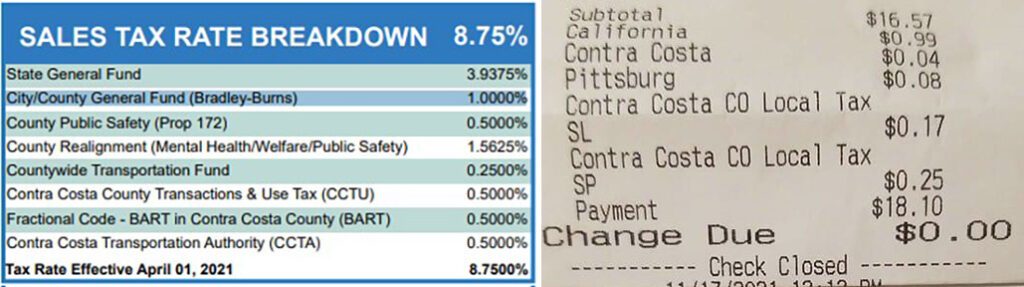
CCC Sales Tax Rate Breakdown chart and Chick-fil-A receipt.

I didn’t know that! Receipt from new Pittsburg Chick-fil-A raises questions – here are the answers

By Allen Payton

A post by someone, on Facebook, of their sales receipt from the new Chick-fil-A restaurant in Pittsburg, shows a breakdown of the sales tax they were charged. That started a discussion of what each of the line items is for.

I had never seen the sales tax broken down that way, previously, and I used to be a partner in a restaurant which collected sales tax and dealt some with it. I also served on the Contra Costa Transportation Authority for four years, but never knew the county received an additional .25% and the cities 1% in sales tax for transportation above the .5% for which we oversaw the expenditures. Nor have I seen the breakdown of the 6%, until now.

So, I set out on a quest to learn the details of the sales taxes we pay for many if not most of the purchases we make in Contra Costa County.

Once you read this, you too may say as I did, “I didn’t know that!”

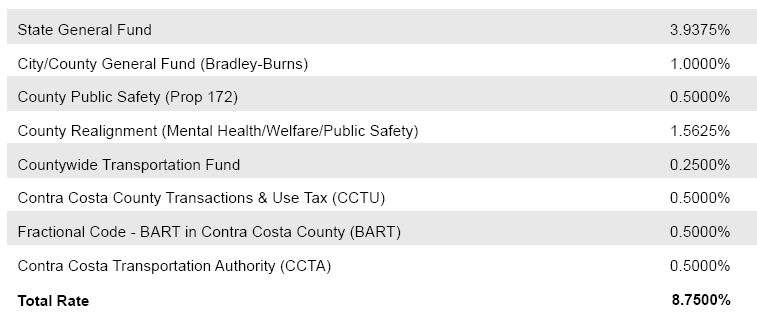
County Finance Director Lisa Driscoll pointed out that on the Sales Tax page of the County’s website, each Quarterly Tax Report includes a breakdown of the sales tax, which answered most of my questions. She also mentioned the 1% “Bradley‑Burns” tax which is received by the cities for transportation.

On the State Auditor’s website, about The Bradley‑Burns Tax and Local Transportation Funds, it reads, “The tax charges 1.25 percent on the retail sale or use of tangible personal property in the State, of which 1 percent is allocated to counties or incorporated cities to use at their discretion and the other 0.25 percent is allocated to county LTFs.”

In Contra Costa County we also pay the voter-approved half-cent sales tax for BART operations, another half-cent sales tax from Measure J, passed in 2004, for transportation projects which is overseen by the Contra Costa Transportation Authority, a half-cent approved by the voters with the passage of Prop. 147 in 2019 for public safety, and another half-cent from Measure X, passed last year, which is allocated by the Board of Supervisors. (See related article)

Source: Contra Costa County

Driscoll also shared, “The County does not actually collect any sales tax and the rate varies by location. Retailers engaged in business in California must register with the California Department of Tax and Fee Administration (CDTFA) and pay the state’s sales tax, which applies to all retail sales of goods and merchandise except those sales specifically exempted by law. The unincorporated rate is listed below.”

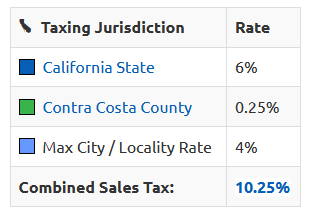
Each city’s sales tax rate can be different because they might also have a local sales tax the voters passed, such as in Antioch where they passed two half-cent sales tax increases, mainly to pay for more police, and has a rate of 9.75%. The highest sales tax rate can be a whopping 10.25% and the only city in Contra Costa County to have the maximum is El Cerrito! To see the sales tax rate in your city or community, click here.

As someone who advocates shopping local instead of online, to help support our local retailers and keep our sales tax revenue, you’d think I would know this stuff. But alas, no. So, this has been enlightening for me.

Plus, people, including me, tend to forget about the voter-approved taxes, including 2% of the sales tax in our county, and it’s good for us to be informed or reminded of why we’re paying them and who imposed the various taxes on “we the people”. Just like with the $9.5 billion for the California high-speed rail, about which I’m constantly having to remind people who complain about the state spending their tax dollars on it, that the voters approved that amount in bonds for the project. The same with the law making it only a misdemeanor for shoplifting less than $950 in goods due to Prop. 47. People, we did it to ourselves! LOL

As for the breakdown in the state sales tax and the 1% Bradley-Burns sales tax, say it with me, “I didn’t know that!” Well, now we do.


All are invited to the Grand Community Chanukah Celebration in Brentwood Sunday, Dec. 5

Friday, November 26th, 2021

Eight lights of Antioch’s Chanukah Menorah to be lit beginning Saturday night

This year, Chanukah begins on the eve of Nov. 28, which is Nov. 29 according to the Jewish calendar and runs for eight days through the eve of Dec. 6. Chanukah celebrates the cleansing of the Temple following the revolt of the Maccabees against King Antiochus IV Epiphanes of the Seleucid Greek Empire of Syria, after he issued his decrees forbidding Jewish religious practice.

Chanukah is known as the Festival of Lights, because it commemorates the traditional account of the miracle of finding one cruse of sacred oil—enough for one day—that lasted for eight days, the length of time it took to produce more sanctified oil for the N’er Tamid (Eternal Light) in the Temple. Chanukah is also known as the Festival of Dedication, as the Temple was sanctified again, and dedicated to true worship of the living God.

To remember that miracle, menorahs holding eight candles are lit, one per night, during the Chanukah celebration. Antioch has an eight-light Menorah, first erected in 2019, located in Waldie Plaza across W. 2nd Street from City Hall in historic, downtown Rivertown. One light will be lit each night beginning Saturday.

You’re invited to come, celebrate the Festival of Lights with Chabad of the Delta and our surrounding communities as we light the grand Menorah during the Community Celebration on Sunday December 5 at 4:30 pm at Brentwood City Park at 2nd and Oak Streets.

Our local community leaders will participate in kindling the giant “Menorah of Freedom”. There will be fun activities for everyone including:

  • Chanukah crafts, glitter art and photo ops!
  • Delicious, traditional latkes and donuts!
  • A Grand Raffle!
  • Saul Kaye Jewish Blues Musical entertainment!
  • Acrobatic performance by Red Panda Acrobats!

For many of us, Chanukah prompts warm, loving memories from our childhood. We light the Menorah every night of the 8-night holiday. These lights offer warmth, joy, strength, inspiration and renews our sense of identity.

Rabbi Peretz Goldshmid, director of the Chabad of the Delta Jewish Center, describes Chanukah as “a holiday that enriches our lives with the light of tradition. In ancient times our ancestors rededicated the Temple in Jersusalem with the Menorah. Today, we rededicate ourselves to making this world a better and brighter place.”

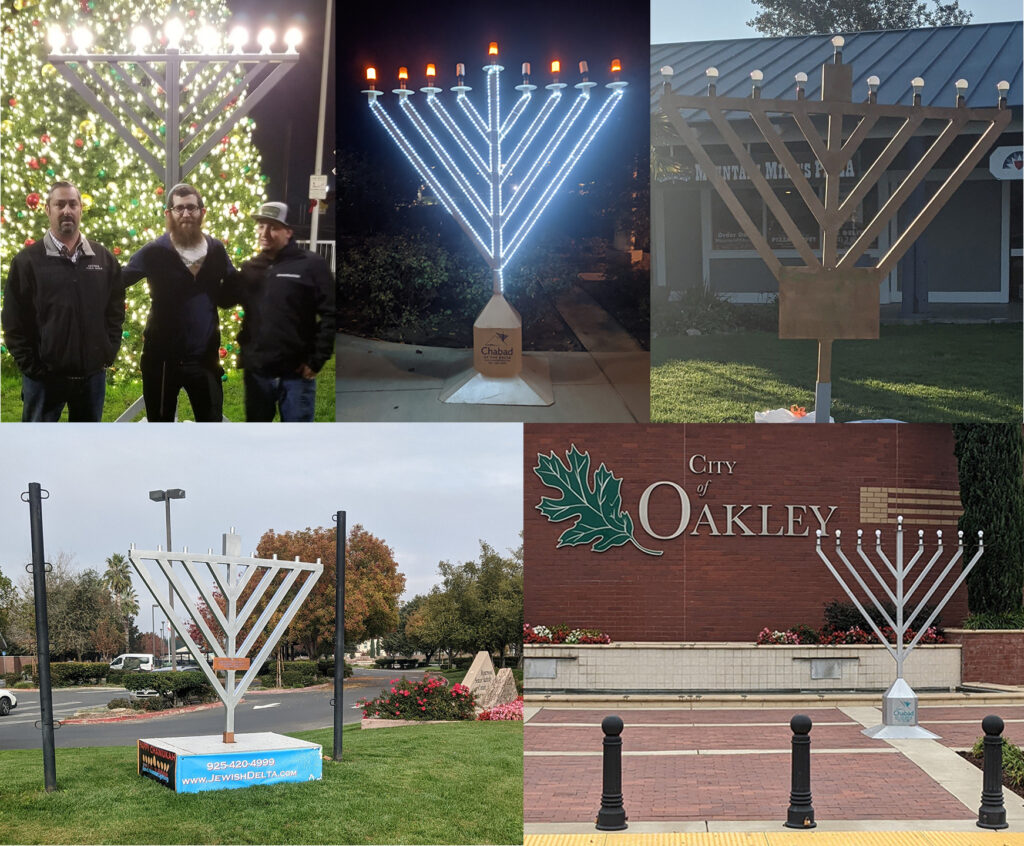
Menorahs placed by Chabad of the Delta (L to R, top row) in Antioch with city employees and Rabbi Goldschmid in the center, the grand Menorah in Brentwood City Park, in Discovery Bay, (bottom row) in Brentwood near Veterans Park and in Oakley. Herald file photo of Antioch Menorah, all others courtesy of Rabbi Peretz Goldschmid.

Chabad of the Delta has placed Menorahs in Oakley at City Hall on Main Street, and another one in Brentwood at Balfour Road near Veterans Park, and this year we’ve placed a new in Discovery Bay at the Holiday Square on Discovery Bay Blvd.

As we celebrate in East Contra Costa, we join millions the world over, promoting the universal message that good will prevail over evil, freedom over oppression and light over darkness.

Make sure not to miss this opportunity to celebrate with your family and friends!

For more information and free Menorah Kits, contact Chabad of the Delta at (925) 420-4999 or online @ JewishDelta.com/Chanukah.

Contra Costa Supervisors vote 5-0 to finalize 2021 redistricting map

Friday, November 26th, 2021

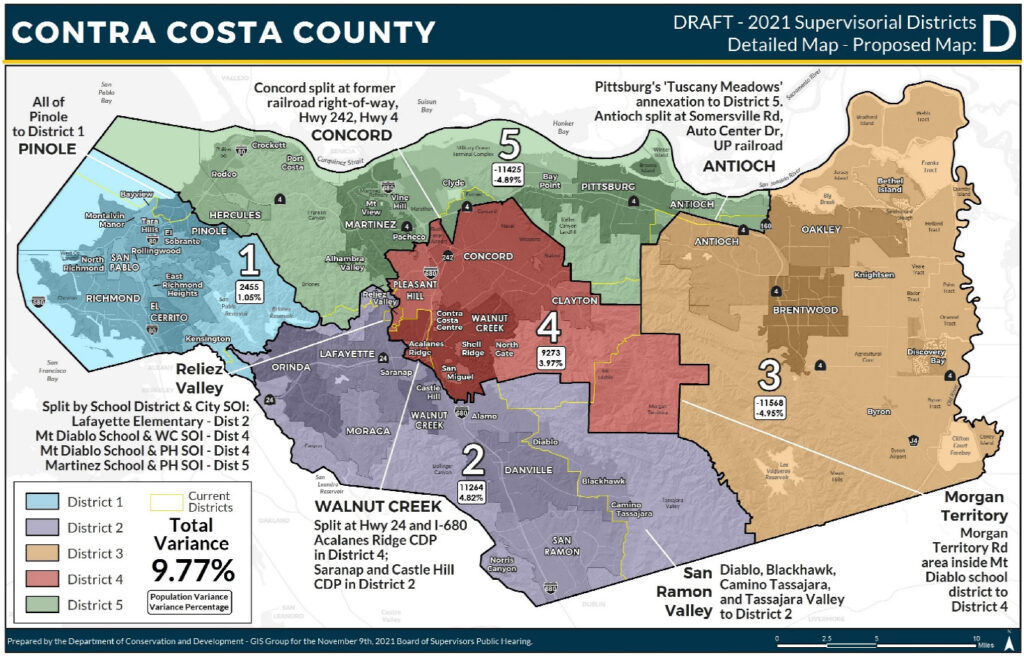
Contra Costa Board of Supervisors approved the 2021 Redistricting Map D. Source; Contra Costa County

Only 93 people provided public input, nine alternate maps submitted

Antioch split between Districts 3 and 5 along Somersville Road, Auto Center Drivand the Union Pacific Railroad right-of-way

By Daniel Borsuk

During their final public hearing for the 2021 redistricting process on Tuesday, Nov. 23, the Contra Costa County Board of Supervisors voted 5-0 to approve the 2021 Redistricting Map D on Tuesday that shows Supervisor Candace Andersen’s District 2 and Supervisor Federal Glover’s District 5 gaining territory at the expense of District 3 Supervisor Dianne Burgis and District 1 Supervisor John Gioia. (See agenda item D.1)

The supervisors’ action on the final redistricting map beat the mandatory Dec. 15 deadline by 22 days after county officials conducted a series of public hearings and workshops that drew meager citizen input.

“For the six workshops a total of 21 individuals provided public comment either in person or by Zoom or phone call; and an additional 72 individuals were on the Zoom or phone call in portions of the workshops but chose not to speak,” a county document stated in defense of the public participation.  A total of nine public submissions of alternative maps were included in the process. (See related article)

No matter how uneven the county process might have been in attracting public participation, two districts – District 2 and District 5 – scored the most territory and potential political clout from the decennial redistricting process.
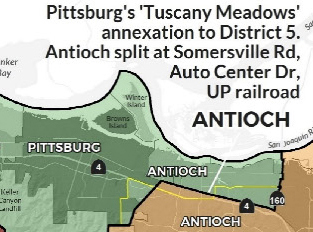
From CCC Board of Supervisors 2021 Redistricting Map D.

Map D keeps Antioch split in two between Districts 3 and 5, as the city currently is, but in different ways. This time the districts are split along Somersville Road and Auto Center Drive and the Union Pacific Railroad right-of-way. Herald publisher Allen Payton asked the supervisors to consider splitting Antioch along the city boundary line with Pittsburg and Highway 4, which he said makes more sense for residents to know what district they live in and to match the current and expected district boundaries for Antioch City Council District 1. Burgis said she tried to make that happen but the population figures to comply with the 5% deviation legal requirement, didn’t work.
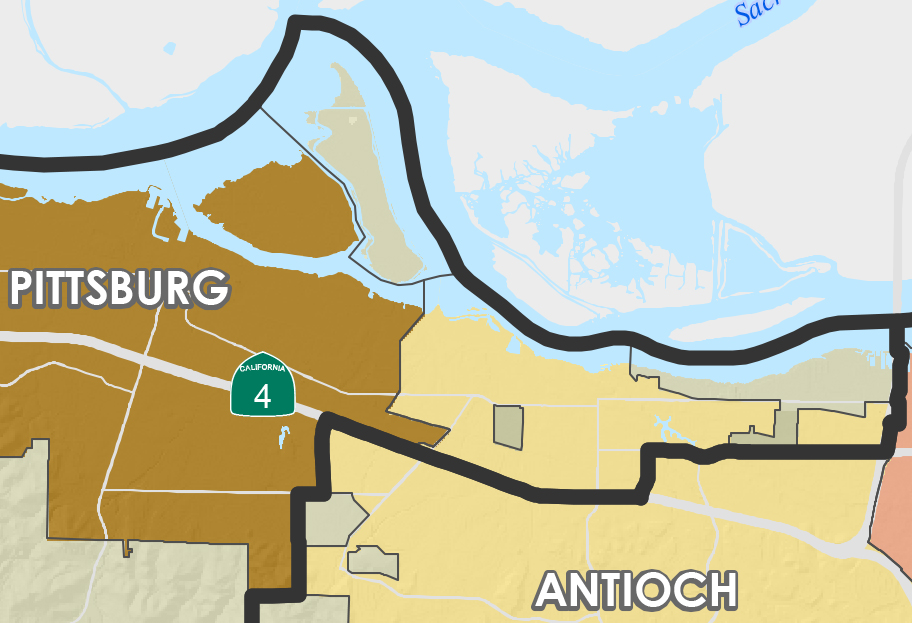
CCC Supervisor 2011 Districts current Antioch-Pittsburg split.

After the final vote on the map, Board Chair Burgis of Brentwood put a positive spin on the two-month redistricting activity stating.

“The Contra Costa County Board of Supervisors thanks the community for its participation in this decennial process,” she said. “We have been committed to a robust Redistricting and public outreach process with public hearings, a dedicated website at CoCoRedistricting.org, public workshops, and multiple ways for the public to share input, including an online mapping tool to draw maps and submit comments.  We want to thank you for staying informed and playing a role in this important process.”

“I’d like you to not vote on this today,” requested Sherrill Grower, one of three persons who spoke at Tuesday’s meeting. “I feel like this map disenfranchises the public particularly along the northern waterfront. I am not pleased with the proposed district boundaries.”
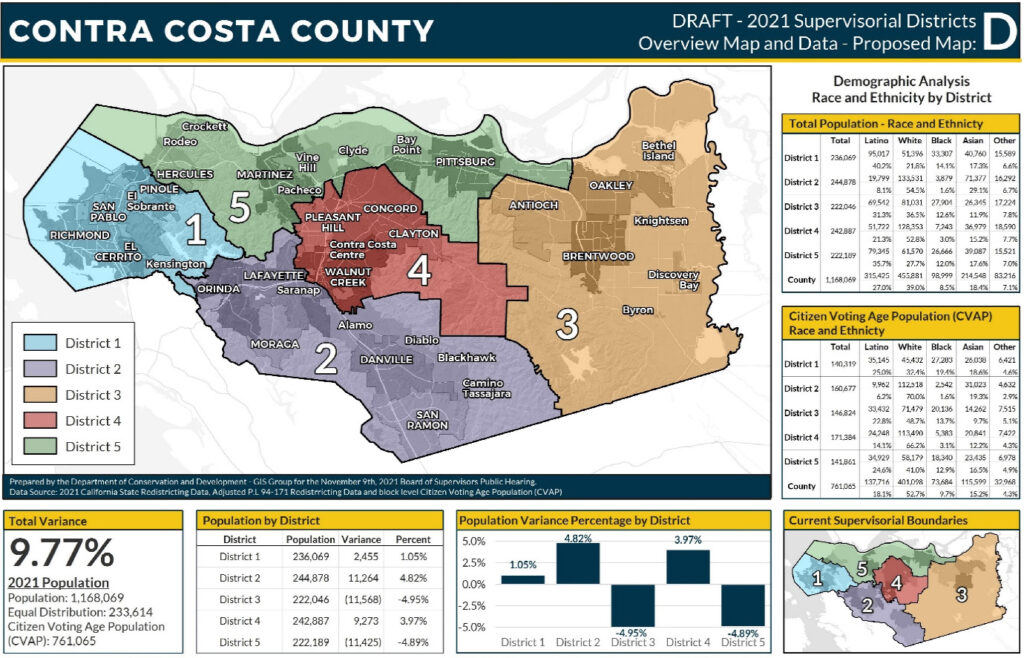
Map D with population statistics. Source: Contra Costa County

With the new map, District 4 now covers most of Walnut Creek split at Highway 24 and Interstate 680 with District 2 Supervisor Andersen representing the other portion of the city, primarily Rossmoor.

District 4 underwent the smallest population gain of the five districts with a 1.65 percent increase from 2010 to 2020, to 229,348 residents, according to Census data. Whites represent 51.7 percent of District 4’s population followed by Latinos at 22.4 percent, Asians at 15.2 percent, Blacks at 3 percent and 7.7 percent for others.

District 4 Supervisor Karen Mitchoff, who has announced she won’t seek re-election in 2022, also saw the city of Concord, which is in District 4, split with Glover’s District 5 by Highways 4 and 242 and the former railroad right-of-way.

Mainly because Andersen’s District 2 experienced the biggest population gain of any of the other districts, from 2010 to 2020 it gained more territory. Population-wise, District 2’s population rose from 218,017 in 2010 to 243,565 in 2020. Whites make up 55 percent of the district’s population followed by Asians at 28 percent, Latinos at 8.5 percent, and Blacks at 1.6 percent and others at 6.8 percent.

District 2 will now cover Tassajara Valley, Blackhawk, Diablo and Camino Tassajara, all formerly were represented by Supervisor Burgis.

District 3, which saw its population rise 2.85 percent to 203,711 from 2010 to 2020, covers most of Antioch and the other growing cities of Brentwood and Oakley and communities of Bethel Island, Knightsen, Discovery Bay, and Byron.

District 2 also contains the cities of San Ramon, Danville, Moraga, Lafayette, and Orinda. The census designated Alamo, Blackhawk, Diablo, Camino Tassajara, Saranap, and Castle Rock as contained in District 2.

In addition to the cities of Pleasant Hill and Clayton, the Contra Costa Centre, Acalanes Ridge, Shell Ridge, San Miguel and North Gate are in District 4.

Glover, who offered no comment on the final redistricting map, also gained territory. He not only retains the Northern Waterfront, an area now under planning study for future industrial and economic development from Crockett to Oakley, but District 5 now, no longer has a portion of Pinole that was formerly split by District 1’s Gioia and District 5’s Glover.

Not mentioned publicly, District 5 is due to benefit economically and demographically when bulldozers rev up at the former Concord Naval Weapons Station where the Seeno Company has won City of Concord approval to build 13,000 housing units and commercial developments on 5,046 acres on the former Naval weapons base property in north Concord. Construction should be well underway over the next 10 years.

Based on U.S. Census data, District 5’s population increased from 203,744 in 2010 to 228,463 in 2020. Thirty-five percent of the district’s population is Latino, 27.5 percent is White, 17.9 percent is Asian and 12.4 percent is Black.

Supervisor John Gioia was pleased with the redistricting results, especially when more urban-like district contains the cities of Richmond, San Pablo, El Cerrito, and Pinole. Kensington, North Richmon, East Richmond Heights, El Sobrante, Rollingwood, Tara Hills, Montalvin Manor, and Bayview are also included in District 1.

District 1’s population grew from 203,437 persons in 2010 to 224,726 in 2020, according to U.S. Census data. Latinos represent 40.9 percent of the district’s population followed by whites at 21.7 percent, Asians at 16.8 percent and Blacks at 16.8 percent

“The boundaries are very similar to our local transportation district,” observed Gioia. “There is no gerrymandering.”

Overall, Contra Costa County’s population increased 11.4 percent to 1,168,064.

Allen Payton contributed to this report.



Contra Costa DA joins forces with other prosecutors to combat organized retail theft

Wednesday, November 24th, 2021

As thieves turn to new tactics, Bay Area, San Joaquin County prosecutors form alliance to ensure accountability

By Bobbi Mauler, Executive Assistant, Contra Costa County Office of the District Attorney

Today, Nov. 24, 2021, Contra Costa District Attorney Diana Becton announced an alliance between Contra Costa, Alameda, San Francisco, Marin, San Mateo, Santa Clara and San Joaquin counties, law enforcement, and state agencies to combat the recent increase in organized retail theft. Each office has pledged a prosecutor to collaborate and participate in the joint effort. (See related article)

“Fencing and organized retail theft rings operate across jurisdictional boundaries,” said Contra Costa District Attorney Diana Becton. “As prosecutors, we must respond to the nature of these crimes and operate with our partners to more effectively meet this challenge. Those responsible for perpetuating these crimes are working together as a team, and to ensure accountability for their crimes, law enforcement needs to work together as a team too. These caught and arrested will be prosecuted to the full extent of the law.”

“Organized retail theft has adverse and costly impacts on business owners and consumers alike,” said San Joaquin District Attorney Tori Verber Salazar. “Through a partnership with our neighboring counties, we will hold all parties accountable, including fencing rings and individuals who purchase stolen goods. We commend Governor Newsom and Attorney General Bonta for taking organized retail theft seriously and we implore the community to report suspicious resell activity to assist law enforcement’s efforts in tracking organized retail theft rings.”

While police work to strengthen investigations and collaborations across jurisdictional boundaries, prosecutors’ offices similarly can better ensure accountability through information sharing. The partnership between counties and local agencies would allow for the sharing of information through data collection, crime analytics, as well as pooled investigative tools to successfully prosecute those involved with organized retail theft schemes. In addition to the shared resources between counties, the District Attorney’s Offices would continue to collaborate with their local retailers and State Representatives to ensure statues that cover organized theft rings are enforceable and improve safety for consumers.

“Retail theft crimes are affecting all counties in the Bay Area as well as across the nation.  Collaboration and shared strategies with neighboring prosecutors and law enforcement partners are critical to both preventing and responding to organized retail theft,” said San Francisco District Attorney Chesa Boudin.  “This alliance of prosecutors is committed to developing strategies to combat these organized crimes.  Together, we are determined to stop those who participate in organized retail theft, including by dismantling the fencing networks that make this type of crime profitable.”

“The recent premeditated retail theft mob action in multiple cities across Northern California is intolerable and will not be accepted by District Attorneys, law enforcement officials and our community members,” said San Mateo District Attorney Steve Wagstaffe.  “Anyone caught engaging in such criminal conduct should expect to find themselves facing prosecution, conviction and incarceration. There is no leniency for such behavior.”

“The recent acts of retail thefts, robberies and mass-mob burglaries throughout Northern California will not be tolerated. These are clearly carefully orchestrated crimes, working together in large groups to create a mob-like mentality,” said Alameda County District Attorney Nancy O’Malley. They are instilling fear in merchants, customers, and the wider community. This is especially appalling at a time where many are out and about during the holiday season. Be assured that those caught and arrested will be prosecuted to the full extent of the law.”

“California has seen shifts in crime trends and tactics, and Bay Area prosecutors are forming this partnership to meet the moment,” said Cristine DeBerry, Executive Director of the Prosecutors Alliance of California.  “Partnerships like these reflect the need to implement modern solutions to modern problems. These crimes happen quickly, and they may not be caught in the act.  Through information sharing and coordination, there will be greater likelihood of arrests and accountability than everyone working in isolation.”

Contra Costa Community College District students get access to online courses statewide

Wednesday, November 24th, 2021

Source: California Community Colleges

By Timothy Leong, PIO, 4CD

Contra Costa Community College District (4CD) colleges — Contra Costa College, Diablo Valley College and its San Ramon Campus, and Los Medanos College and its Brentwood Center — are among the first 15 colleges in the state to become Teaching Colleges on the California Virtual Campus – Online Education Initiative (CVC-OEI) Exchange cross-enrollment platform. CVC-OEI is designed to ensure more students are able to successfully complete their educational goals and achieve their higher education degree or certificate by increasing access to and success in high-quality online courses.
4CD students can now quickly enroll in online courses offered at other eligible community colleges in the state without completing another college application, and vice versa. In addition, transcripts and financial aid are also coordinated to streamline these processes for students.

“If students can’t find the class they need that suits their schedule at their own campus, the CVC-OEI Exchange provides an easy and seamless way for them take a course online at other community colleges in the system,” says 4CD Dean of Distance Education Joanna Miller. “This expanded access to online classes will ultimately help our students complete their educational goals and advance more quickly toward their careers or 4-year colleges.”

The CVC-OEI is a collaborative project among California’s community colleges and is funded by a grant disbursed by the California Community College Chancellor’s Office. CCC and DVC have been members of the CVC Consortium since 2018, with Los Medanos College joining in 2020. For more information about the CVC-OEI, visit https://cvc.edu/about-the-oei/ or contact Andrea Hanstein at ahanstein@cvc.edu.

About 4CD

The Contra Costa Community College District is one of the largest multi-college community college districts in California. The 4CD serves a population of 1,159,540 people, and its boundaries encompass all but 48 of the 734-square-mile land area of Contra Costa County. 4CD is home to Contra Costa College in San Pablo, Diablo Valley College in Pleasant Hill, Los Medanos College in Pittsburg, as well as educational centers in Brentwood and San Ramon. The District headquarters is located in downtown Martinez. For more information visit www.4cd.edu.


Antioch Council spends $2.3 million in extra tax revenues but nothing for homeless or more cops

Wednesday, November 24th, 2021

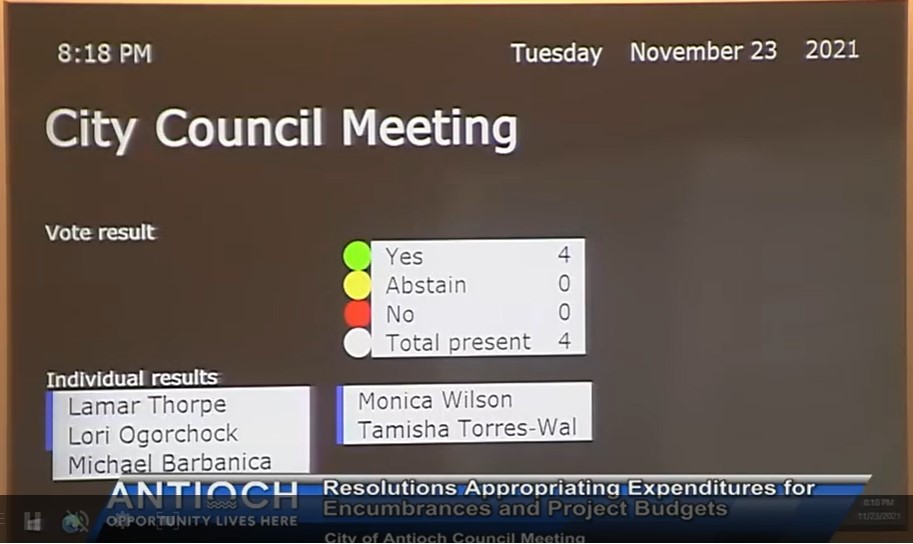
The Antioch City Council uses their new display board showing how they voted during their meeting on Tuesday, Nov. 23, 2021. Video screenshot.

Approve $1,500,000 for renovation of City Hall second floor

Thorpe, Torres-Walker want to renovate Hard House for council member offices, plus staff for each council member

By Allen Payton

During Tuesday night’s meeting, Nov. 23, 2021, Antioch Finance Director Dawn Merchant said the city council will have an additional $2.3 million to spend in this year’s budget, with over $2.5 million additional from sales tax, including over $1.5 million more from Measure W’s 1% sales tax revenues. The council members chose to allocate the funds but included nothing to pay for more police officer or to help the homeless.

According to the City staff report on the item, “The major contributing factors to net revenues higher than projected are:

  • $1,542,781 higher Measure W/1% sales tax than projected.
  • $1,006,854 higher sales tax than projected.
  • $435,820 more in building permit revenue than anticipated.
  • $231,737 more in property tax revenue than anticipated.
  • $160,000 more in interest and rental revenue than anticipated.
  • Approximately $532,000 additional revenues than anticipated from various miscellaneous sources.

There was also a $1,571,461 reduction in revenues for the amount billed to the Department of Water Resources (DWR) for our usable river water days as the money was not received until October 2021 requiring us to record this revenue in FY22 instead.”

Plus, there were $6,425,217 less in expenditures than projected for Fiscal Year 2021. The major contributing factors to net expenditures lower than projected are:

$383,762 less in operating subsidy than projected to the Animal Shelter.

$557,686 less in operating subsidy than projected to Recreation programs.

$2,007,481 in salary savings from all unfilled positions. $1,051,661 represents non- Police salary savings which the City Council will need to allocate to one-time projects and/or unfunded liabilities per the City’s one-time revenue policy. The appropriation has been included in the budget amendments in Exhibit C to Attachment A.

$271,532 in purchase orders as of June 30,2021 not yet entirely spent. The carry forward of the budgets for these is included in the budget amendments in Exhibit A to Attachment A.

$1,941,089 in project budgets outstanding as of June 30, 2021, not yet entirely spent. The carryforward of the budgets for these is included in the budget amendments in Exhibit B to Attachment A.

$1,054,466 in non-salary savings in the Police Department budget.

$328,786 in non-salary savings in Public Works.

$2.85 and $3.1 Million More in FY22 and FY23

As a result, city staff is projecting increases to Fiscal Year 2022 General Fund sales tax and 1% sales tax projections by $2,849,683 and FY23 by $3,121,657 based on FY21 closing numbers and current sales tax projection trends.

Council Allocates Funds But, None for More Police Officers or Homeless

Staff also proposed how to spend the additional funds, including paying for projects the City has already begun and moving up items from the FY22 budget.

Mayor Lamar Thorpe suggested holding off on approving costs related to establishing the new Community Resources Department.

Then without any comments from the public, District 3 Councilwoman Lori Ogorchock made, and District 2 Councilman Mike Barbanica seconded a motion to approve the remaining items. But both Mayor Pro Tem Monica Wilson and Thorpe said they would rather discuss them on a item by item basis. The motion failed 2-3 with District 1 Councilwoman Tamisha Torres-Walker joining Thorpe and Wilson in voting no.

The council members then reviewed the other proposed budget items, with Thorpe seeking consensus

  • Consideration of vehicles and equipment for the seven (7) new Code Enforcement Officers approved in the budget at a General Fund FY22 cost of $245,000 and $21,000 in FY23.
  • Consideration of an Administrative Assistant for Human Resources. The FY22 General Fund budget cost would be $30,769 (includes $5,000 for computer and other startup costs) and $110,479 in FY23.
  • Consideration of a Finance Analyst for Finance. Finance would request this not be budgeted until FY23 with a General Fund cost of $181,981, which includes $5,000 for computer and other startup costs.
  • Consideration of a Community Development Technician for Community Development at a FY22 General Fund budget cost of $42,513 (includes $2,000 startup costs) and $167,253 in FY23.
  • Consideration of a GIS Technician position for Public Works at a FY22 General Fund budget cost would be $32,039 and $137,554 in FY23.
  • Consideration of an Administrative Assistant position for Public Works at a FY22 cost of $24,290 and $104,068 in FY23.

Items Without Consensus or to Be Brought Back Later

  • Community Resources Department for an Administrative Analyst at a cost of $40,426 in FY22 and $166,894 in FY23; an Administrative Assistant at a cost of $24,290 in FY22 and $104,068 in FY23; building furnishings/remodel and repairs at an estimated cost of $1,000,000 to accommodate the staffing of the new department.
  • Consideration of Prewett Park Perimeter Fence Replacement at a FY23 General Fund budget cost of $200,000.
  • L Street Improvements project at a FY22 unknown funding source cost of $9,281,000.
  • The plan is to wait for possible funds from the recently approved federal infrastructure bill.
  • Wilson wanted a study session to discuss the various “corridors”.
  • Thorpe responded, “there will be a study session.”
  • Dedicated CORE Team at a General Fund cost of $250,000 in FY22 and FY23. – Both Ogorchock and Barbanica supported it, now.
  • Consideration of Police Department Community Room Technology Upgrades at a FY22 General Fund cost of $300,000. – Barbanica argued that the room serves as the Emergency Operations Center.

Approve New Budget Requests

According to the city staff offered a list of new budget requests all of which the council supported. They are:

  1. A Recreation Coordinator for Youth Services was approved in the adopted 2021-23 budget for funding approved in FY23. This is being requested to begin funding in FY22 to assist the Youth Network Services Manager getting programs and services running. This request would add $47,726 to the FY22 General Fund budget assuming funding for 5 months.
  1. Promotion of a Senior Computer Technician position to a Network Administrator. The FY22 and 23 budget impacts are $2,741 and $8,724 respectively funded from the Information Services Internal Service Fund.
  2. Addition of one (1) Administrative Analyst I position in the City Clerk’s office to meet the work demands of running the office. The FY22 General Fund budget impact, assuming the position is filled for 3 months is $40,426 and the annual FY23 impact would be $166,894.
  3. Reclassification of one (1) Administrative Assistant I position in the City Clerk’s office to an Administrative Analyst I position. The FY22 and FY23 General Fund budget impact would be $6,181 and $27,060 respectively.
  4. Addition of two (2) General Laborer positions to be funded with NPDES funds at a FY22 cost of $47,692 and $211,960 in FY23. If these positions are approved, the NPDES reserves will be depleted beginning in FY24 and the positions will need to be funded with the General Fund starting in FY24. Public works has been installing trash capture devices in the City’s storm drain system to comply with State requirements to keep trash and pollutants from entering our streams and waterways. These trash capture devices require monthly inspections and cleaning. Public Works does not have adequate staffing to perform this work on an ongoing and continuing basis so a request for bids was issued. Bids were received and the cost of contracting this service exceeded the cost of performing this work in house with these two (2) additional positions being requested.
  1. Add $150,000 to the Information Systems Fund FY22 budget to cover cybersecurity measures to be put in place to protect the City’s network.
  2. Addition of one (1) Payroll Specialist position at a FY22 General Fund cost of and $40,527 and $168,132 in FY23. Payroll processing is a critical function of the City and is processed bi-weekly for over 350 full time employees and up to a couple hundred more part time employees depending on the season. The City currently has one full time Payroll Specialist with some additional support from an Accounting Technician and the Deputy Finance Director to process payroll. Another position is severely needed to not only handle the volume, especially with all the additional positions added in this new budget cycle, but to be able to continue processing payroll when the one position is absent.
  1. Reclassification of two (2) Office Assistant positions in Recreation to Administrative Assistant II positions at an estimated cost of $10,030 in FY22 and $20,254 in FY23 to the General Fund.
  2. Reclassification of one (1) Administrative Assistant III position in Recreation to an Administrative Analyst I position at an estimated cost of $3,849 in FY22 and $13,730 to the General Fund.
  3. Remodel of 2nd floor and basement of City Hall at an estimated cost to the General Fund of $1,500,000 in FY22.

City to Receive $10.8 Million More in Federal COVID Relief Funds

The City of Antioch will be receiving a total of $21,550,900 in funds from the American Rescue Plan Act (“ARPA”). $10,775,450 was received in May 2021, with the remaining balance of $10,775,450 to be received in May 2022.

A discussion item was brought to City Council on July 27th whereby City Council Members discussed holding town hall meetings within each of their respective districts to speak with community members regarding the use of funds. As a reminder, the main priorities and principals of the funding are to provide relief to:

  • Support urgent COVID-19 response efforts to continue to decrease the spread of the virus and bring the pandemic under control;
  • Replace public sector revenue to strengthen support for vital public services and help retain jobs;
  • Support immediate economic stabilization for households and business; and
  • Address systemic public health and economic challenges that have contributed to the unequal impact of the pandemic on certain populations.
  • Recipients may use these funds specifically to:
  • Support public health expenditures (as outlined in the interim final rule);
  • Address negative economic impacts caused by the public health emergency, including economic harms to workers, households, small businesses, impacted industries and the public sector for those within a Qualified Census Tract or to other populations, households or geographic areas disproportionately impacted by the pandemic;
  • Replace lost public sector revenue to provide government services to the extent of lost revenue (for the first measurement period ending calendar year December 2020, the City of Antioch has no revenue loss and therefore government services cannot be funded in this category); and
  • Invest in water, sewer, and broadband infrastructure (as outlined in the interim final rule).

The Department of the Treasury has not yet issued final rules for spending of the funds which may provide further clarification and guidance from the interim final rule initially released. It is recommended that the City Council set a date for a future study session on allocation of the funds.

$1 Million in One-Time Funds, Mayor Wants to Use Them on Hard House for Council Member Offices

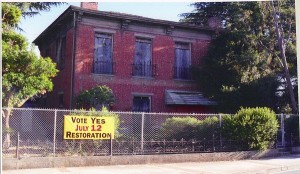
The Hard House on W. 1st Street in Antioch. Herald file photo from 2011.

Thorpe wanted the city to put money into the Hard House “as an extension of city hall…with offices for council members.” The brick building was the home of the City’s first mayor and is located on W. First Street next to the Lynn House Gallery and across from the Amtrak Station.

The Hard House was once proposed to be donated to a non-profit organization that planned to reinforce it to earthquake standards and completely restore the building. Other ideas were to turn it into a bistro or offices.

“It was pretty disappointing to show up here and see there was no space for city council members which is pretty telling of our role, here,” Torres-Walker said. She also asked to have staff for individual council members to come back for a future discussion.

“I agree with Councilwoman Torres-Walker regarding staffing support,” Thorpe said. “The public believes we are full-time, but we have full-time jobs. I believe it’s long past due.”

Ogorchock wanted all the funds to be spent to pay down the City’s unfunded liabilities.

But upon advice from City Manager Ron Bernal who said the staff could come back with more details on the proposals, it was decided the council will hold off on deciding how to spend the one-time funds.


Antioch Council approves another cannabis business, votes down committee for city manager recruitment

Wednesday, November 24th, 2021

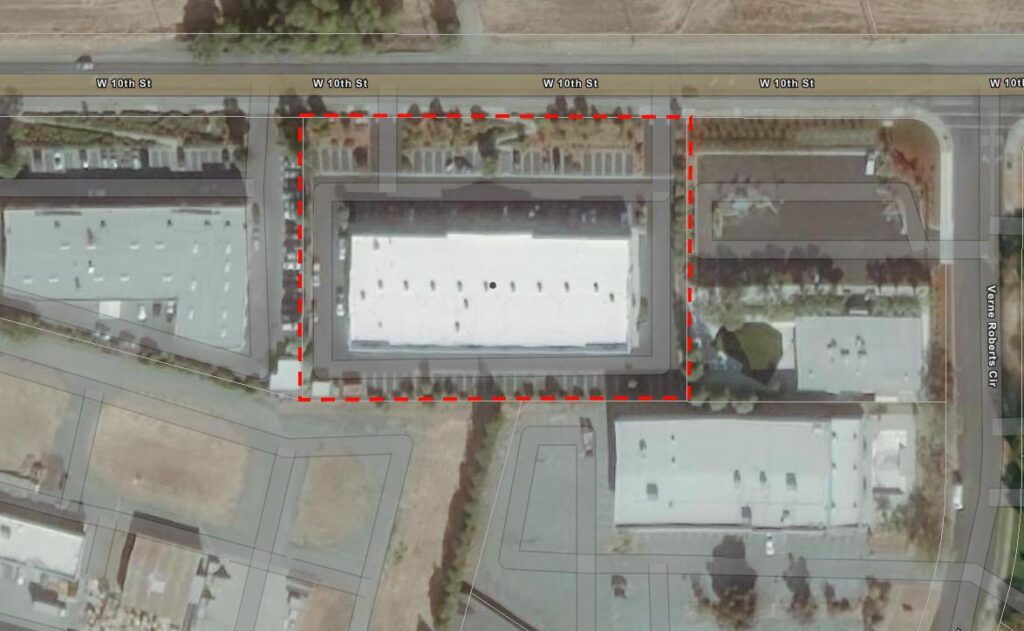
Delta Labs site on W. 10th Street. From presentation during Antioch City Council meeting on Tuesday, Nov. 23, 2021

Thorpe nominates Barbanica, Ogorchock to city manager recruitment ad hoc committee then votes against appointing them

Agree to settle employment discrimination lawsuit by former female Antioch cop against police department on 4-1 vote

Extend contract for city Public Information Officer at $8,000 per month for another six months

By Allen Payton

During their meeting Tuesday night, Nov. 23, 2021, the Antioch Council approved another cannabis business, one that processes marijuana through a cold-water extraction, on a unanimous vote, approved settling a former female cop’s employment discrimination lawsuit against the police department on a split vote, and fails to form an ad hoc committee for the hiring of a new city manager on another split vote. They also voted unanimously to extend the city’s PIO contract for another six months.

Before the regular meeting began, following the council’s closed session, City Attorney Thomas Lloyd Smith reported out regarding the lawsuit of Blanco v. City of Antioch, United States District Court Northern District of California, Case No. 3:20-cv-02764-TSH. The city council decided to settle the case, with Barbanica voting no, Smith said.

On April 21, 2020, former Antioch Police Officer Brittney Blanco filed a Civil Rights Employment Discrimination lawsuit against the police department. The case was filed in U.S. District Court, California Northern District. Blanco served on the force from July 2017 until August 2019. No word was given regarding the details of the settlement.

Extend $8K Monthly PIO Contract

During the Consent Calendar, the council voted unanimously to extend the contract for the City’s public information officer, Rolando Bonilla, of San Francisco-based Voler Strategic Advisors at $8,000 per month for another six months, through May 15, 2022. The total contract is not to exceed $256,000. Bonilla has been the City’s PIO since fall 2019. PIO Contract Extension ACC112321

Public Comments Now In-Person, Still Online and By Phone

At the start of the regular meeting, Mayor Lamar Thorpe stated that public comments from those in attendance at the council meetings would be heard first, followed by those who submitted their comments online or call in.

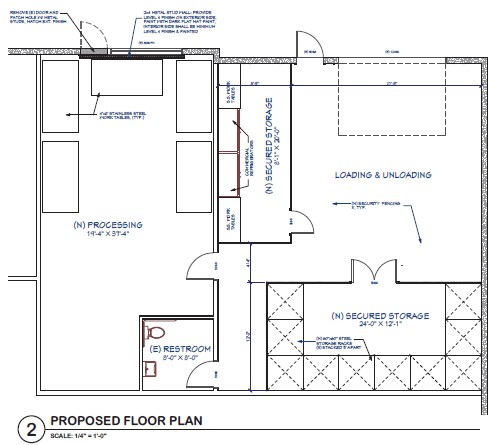
Delta Labs floorplan. From Antioch City Council meeting Nov. 23, 2021.

Unanimously Approve Another Cannabis Business

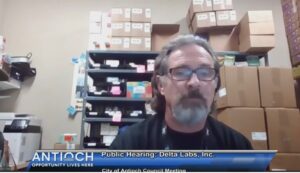
Delta Labs owner Rick Oak speaks about his business during the council meeting.

The council then held a public hearing on another cannabis business. According to City staff, “Delta Lab is proposing a cannabis operations facility with non-volatile extraction” manufacturing. It will be located in the same building where the same family owns Delta Dispensary on W. 10th Street. Delta Labs – city staff report ACC112321

The applicant, Rick Oak, along with his two sons, Dustin and Richard, spoke about their project which is “a cold-water extraction facility and family owned.” He showed a floorplan of the project and explained the product is dropped off process using small washing-type machines using ice to “knock off the hash from the product”. Then it’s stored in refrigerators until sold and picked up by truck.

District 3 Councilwoman Lori Ogorchock was the only member to ask a question about security.

“There’s a guard in our lobby in the dispensary,” Oak said.

With no one from the public speaking against the project, the council approved it on a 5-0 vote.

City Manager Recruitment Ad Hoc Committee

The council then considered forming an ad hoc committee on the recruitment of a permanent city manager.

“I think we have too much going on, right now,”said Wilson. “I think we should hold off until after the new year.”

Ogorchock volunteered to be on the ad hoc committee and Barbanica volunteered, too.

Thorpe then offered them as his nominees to the ad hoc committee.

Ogorchock made the motion and Barbanica seconded it, to approve the formation of the ad hoc committee, the appointment of the two council members, and a termination date of seven months.

“I’m looking at an estimated timeframe of April 30, 2022,” said Administrative Services Director Nickie Mastay.

The motion then failed on a 2-3 vote with Thorpe, Wilson and District 1 Councilwoman Torres-Walker voting no.

“Since that didn’t pass, it will come back, later,” Thorpe said.