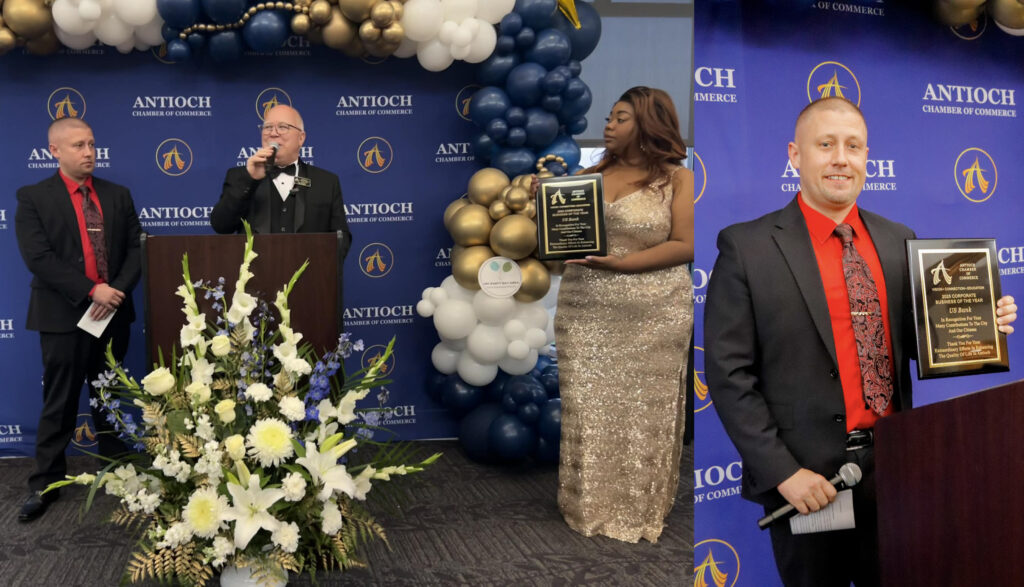
Jesse Ingram, manager of the Antioch U.S. Bank branch is presented with a plaque as the 2025 Antioch Corporate Business of the Year by Antioch Chamber of Commerce Chair Jim Becker and Vice Chair Dominique Coleman during the annual Gala, Friday, March 27, 2026. Photos by (left) Allen D. Payton, (right) Chamber of Commerce
By Antioch Chamber of Commerce
The 2025 Antioch Large Corporate Business of the Year award goes to U.S. Bank, a company with a legacy of over 100 years and a longstanding commitment to supporting communities across the nation, including Antioch. Honored during the Antioch Chamber of Commerce’s annual Gala, Friday night, March 27, 2026, Antioch Branch Manager Jesse Ingram, the Chamber’s Co-Chief Ambassador, accepted the award on behalf of the bank during the ceremony.
U.S. Bank has been a tremendous partner to the Antioch community, providing not only financial support but also dedicating the time and energy of its staff through volunteering and community engagement. Their contributions have touched countless lives, from generous donations to hands-on participation in local programs and initiatives that strengthen the social and economic fabric of the city.
During the COVID-19 pandemic, U.S. Bank stepped forward to support the local community in numerous ways. They provided critical relief assistance for customers, launched premium payment programs for frontline employees, and expedited their community giving initiatives to respond to urgent needs. Additionally, the bank played a vital role in helping local small businesses access Paycheck Protection Program loans, assisting more than 108 small businesses in navigating the challenges of the pandemic and ensuring their continued operation.
U.S. Bank’s dedication to housing and financial stability has also made a lasting impact. In 2025, the bank partnered with RCF Connects to provide $1 million in down payment assistance grants to first-time homebuyers in Contra Costa County, helping 78 low-income families achieve the dream of homeownership. The majority of these families purchased homes in Antioch, directly contributing to the growth and vitality of the local community.
Beyond financial contributions, U.S. Bank’s staff have been active participants in the Antioch Chamber of Commerce’s events, generously donating their time and funding the events. Their support reflects a true partnership with Antioch, demonstrating a corporate culture that prioritizes giving back and strengthening the communities in which they operate. U.S. Bank chooses Antioch as a focus of their philanthropy and for their continued commitment to improving lives through financial assistance, volunteerism, and community engagement.
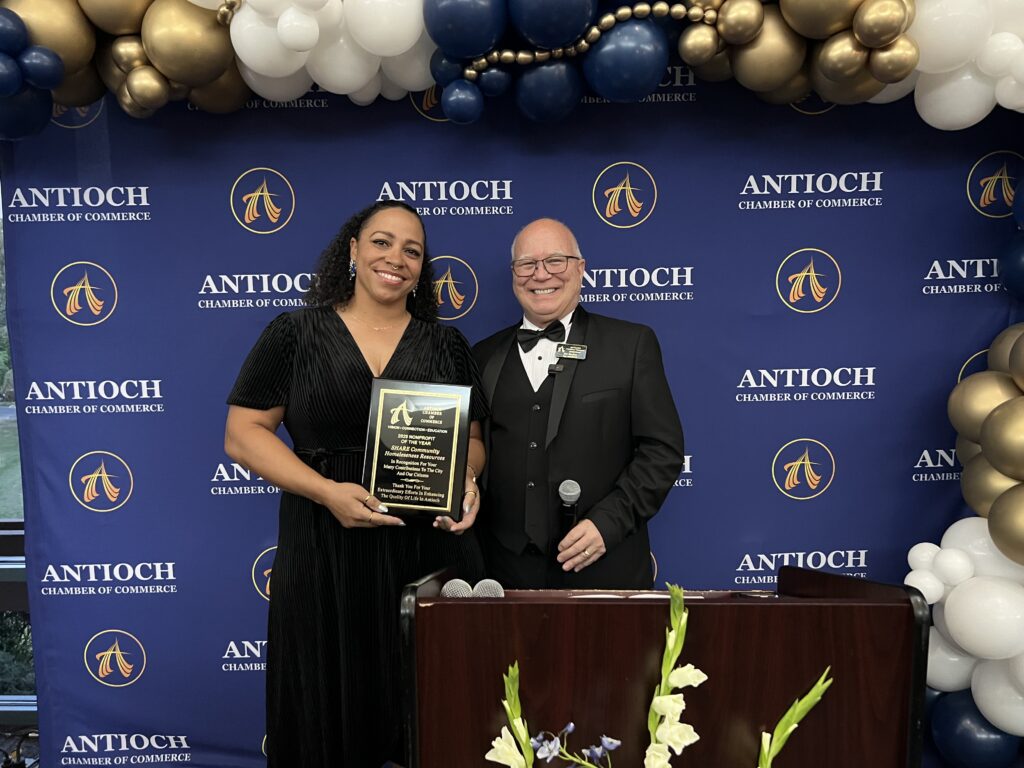
Executive Director Ricka Davis-Sheard is presented with a plaque by Antioch Chamber of Commerce Chair Jim Becker honoring S.H.A.R.E. Community as the 2025 Antioch Non-Profit of the Year during the annual Gala on March 27, 2026. Photo by Allen D. Payton
By Antioch Chamber of Commerce
During the Antioch Chamber of Commerce’s annual Gala, held Friday night, March 27, 2026, S.H.A.R.E. Community was honored as the 2025 Antioch Non-Profit of the Year. S.H.A.R.E. stands for Sharing Hope, Abundance, Resources and Encouragement.
S.H.A.R.E. Community is a remarkable nonprofit organization dedicated to serving unhoused neighbors in our community. Their programs provide mobile showers, hygiene kits, and laundry vouchers, offering individuals an opportunity to feel confident again and helping to restore a sense of dignity that is often lost during times of homelessness.
“We’re super excited to be chosen Non-Profit of the Year for 2025 by the Antioch Chamber of Commerce,” said, Executive Director Ricka Davis-Sheard who was presented with a commemorative plaque by Chamber Chair Jim Becker.
Founded in 2019 with a mission centered on sharing hope, resources, abundance, and encouragement, S.H.A.R.E. Community has become a lifeline for many. They work in partnership with a wide range of local agencies, including hair salons, pet food providers, veteran support services, and mental health organizations, ensuring that the needs of their clients are met in a holistic and compassionate way.
SHARE Community has provided over 9,000 showers and distributed 18,000 hygiene kits to individuals experiencing homelessness. Many participants in the program have gone on to secure stable housing and have returned as volunteers, creating a full-circle transformation that exemplifies the organization’s profound impact.
Despite operating with a small budget and limited resources, SHARE Community continues to expand its services and outreach, fueled by the dedication of its volunteers and the support of the local community. Their tireless efforts not only address immediate needs but also inspire hope, foster resilience, and empower individuals to reclaim their confidence and independence.
S.H.A.R.E. Community is more than a nonprofit—they are a beacon of compassion, demonstrating that with care, creativity, and community support, meaningful change is possible for some of the most vulnerable members of society.
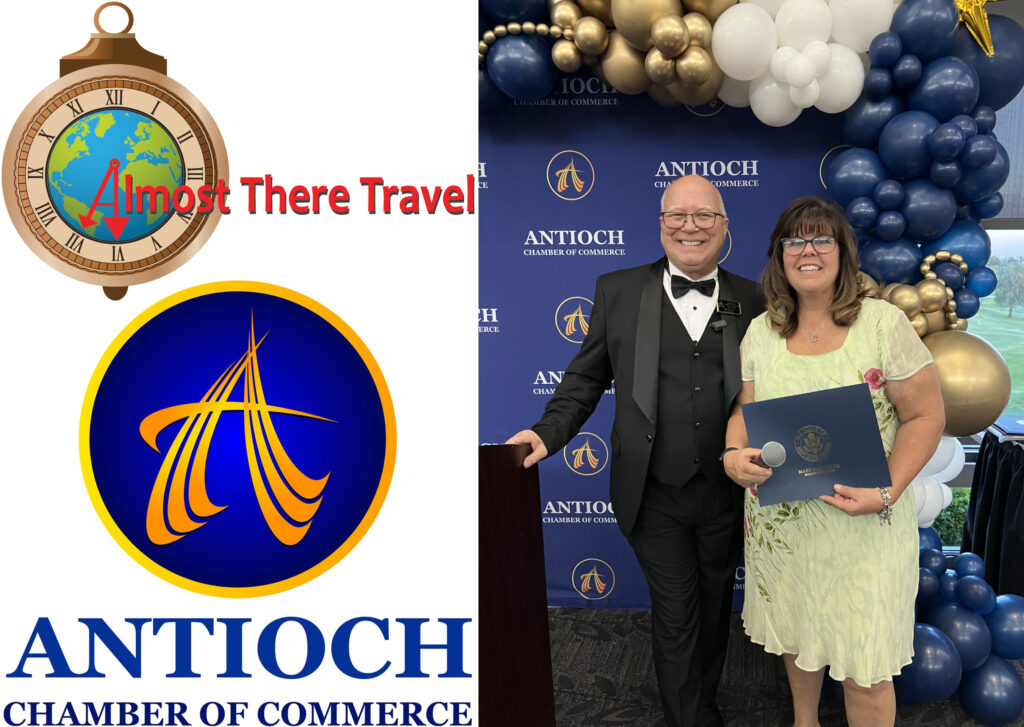
Almost There Travel owner Tammy Larsen is honored with the 2025 Antioch Small Business of the Year award by Chamber Chair Jim Becker during the annual Gala on Friday, March 27, 2026. Photo by Allen D. Payton
“We’re one of the very last brick and mortar travel agencies” – Tammy Larsen, owner
By Antioch Chamber of Commerce
During the Antioch Chamber of Commerce’s annual Gala, Friday night, March 27, 2026, Almost There Travel was recognized as the 2025 Antioch Small Business of the Year, an honor that reflects their dedication to exceptional service, personalized travel experiences and meaningful community impact.
This award is a testament to the passion and hard work of owner Tammy Larsen and her team, who go above and beyond to help clients explore the world with ease, creativity, and care. Their commitment to excellence has earned the trust and loyalty of their clients, making every journey not just a trip, but an unforgettable experience.
Beyond their success in the travel industry, Almost There Travel plays a vital role in the local community. They proudly offer annual Chamber Travel discount trips, making travel more accessible to community members. The owners are actively involved in the revitalization of downtown Antioch and are strong supporters of local events.
Their dedication extends even further through volunteering their time to help plan and coordinate community events, ensuring they are well-organized, engaging, and well-attended. Their generosity also includes providing travel discounts to support and give back to the community they serve.
Almost There Travel, located at 506 W. 2nd Street, truly embodies what it means to be a small business with a big impact, and this recognition is well deserved.
“Our passion is travel. We love to travel, ourselves. Please come visit us. We’re one of the very last brick and mortar travel agencies,” said Larsen. “So, come down to Rivertown. Just stop in. It doesn’t cost you anything. Thank you.”
Budget requests for infrastructure, transportation, community development, public and environmental health and safety
$1.7 million for Antioch Police Real-Time Operations Center
$10 million forVasco Road safety & mobility improvements
By Mairead Glowacki, Communications Director, Office of Congressman Mark DeSaulnier
Washington, D.C. – Today, Congressman Mark DeSaulnier (CA-10) announced that he advanced over $46.7 million for 20 projects to benefit Contra Costa and Alameda Counties for consideration by the U.S. House Committee on Appropriations as part of the Fiscal Year 2027 appropriations process. These projects would help to improve quality of life for the people of California’s 10th Congressional District by upgrading infrastructure and transportation accessibility and increasing public and environmental safety.
“Simply put, my number one priority in Congress is to make life better for the people I represent, and the $46.7 million we are advancing will help to do just that by investing in safety and easing congestion for drivers, bikers, and pedestrians alike, housing, emergency preparedness, crime prevention, and more,” said DeSaulnier. “I am continuously grateful to our local governments and organizations for their thoughtful project submissions, and I look forward to fighting to see the projects through the legislative process to bring this important funding home.”
Infrastructure Upgrades, Transportation Accessibility and Community Development Projects:
$5,000,000 for the County of Contra Costa to design a new roadway connection that will improve regional mobility between Contra Costa and San Joaquin Counties using a connector route that shifts interregional traffic from Byron Highway and local roads in the Town of Byron to Vasco Road, to accommodate higher traffic volumes.
$5,000,000 for the County of Contra Costa to construct safety countermeasures along a 12.1-mile segment of Vasco Road between Marsh Creek Road and the Alameda County line in unincorporated Byron, California to decrease the number of accidents on this busy thoroughfare.
$4,000,000 for the City of Brentwood to construct infrastructure and site improvements to prepare a site to house the Brentwood Agricultural Technology Innovation Center.
$2,800,000 for the City of Lafayette to construct the Brown Avenue to Pleasant Hill Road segment of the Aqueduct Pathway, a fully accessible Class I separated bicycle and pedestrian facility located within the East Bay Municipal Utility District (EBMUD) aqueduct corridor in downtown Lafayette, California.
$2,000,000 for East Bay Regional Park District to construct a dedicated bus staging and drop-off area designed to accommodate regional transit agencies and other visitors, and remove aging rail infrastructure to replace it with accessible, multi-use pathways as part of the second phase of a project to allow for the Thurgood Marshall Regional Park to be opened up to the public.
$2,000,000 for the City of Lafayette to construct a 48-unit development of supportive and affordable housing for individuals with intellectual and developmental disabilities.
$2,000,000 for the City of San Ramon to continue buildout and close gaps in the citywide fiber optic network supporting transportation operations, public safety, and future smart city technologies.
$1,750,000 to the City of Walnut Creek to install a new traffic signal at the intersection between Treat Boulevard and Arkell Road in Walnut Creek, California, which is currently controlled by stop signs.
$1,500,000 for the County of Contra Costa to construct separated wheeled (bicycle, e-bike, and scooter) and pedestrian pathways in the Iron Horse Corridor from Bollinger Canyon Road to Crow Canyon Road in the City of San Ramon to separate wheeled and pedestrian modes and improve user safety.
$1,300,000 for the County of Contra Costa to construct a new youth center in Brentwood, California that will provide academic counseling and employment training in the culinary field.
$1,296,000 for the City of Orinda to complete pavement rehabilitation work and widening on the Camino Pablo Pathway in Orinda, California to expand and maintain aging infrastructure that currently sees heavy pedestrian use.
Public and Environmental Health and Safety:
$5,000,000 for the City of Concord to make improvements to the City of Concord’s Emergency Operations Center (EOC) to ensure that it can continue to function as a critical hub for regional preparedness, response, and recovery efforts during emergencies and disasters.
$3,150,000 for Central Contra Costa Sanitary District to add Densified Activated Sludge (DAS) technology to Central San’s existing large-scale Membrane Aerated Biofilm Reactor (MABR) demonstration site and share results with wastewater agencies across the region. DAS and MABR are complementary, cutting-edge technologies that could enhance nitrogen removal and environmental protection while leveraging existing treatment facilities.
$2,000,000 for the City of San Ramon to replace the Police Department’s aging Records Management System (RMS), associated software, and supporting equipment. The project will modernize the City’s public safety technology infrastructure by implementing a next-generation RMS, preserving and migrating existing police records, and integrating with electronic files. The project may also incorporate a unified interface that allows officers and investigators to securely access data from multiple regional law enforcement systems within a single platform, improving efficiency, and reducing the need to switch between separate applications.
$1,800,000 for the County of Contra Costa to build two mobile communications sites to enhance the resiliency of first responder radio communications in the event of a natural disaster or other widespread threat.
$1,684,990 for the City of Antioch to establish a Real-Time Operations Center (RTOC) to serve as the Antioch Police Department’s central hub for intelligence and information-sharing, integrating existing technologies—including gunshot detection, public safety cameras and Computer-Aided Dispatch (CAD)—into a unified, citywide system that enhances crime monitoring, investigative efficiency and officer response.
$1,650,000 for the County of Contra Costa to expand Contra Costa County’s ability to prioritize and investigate unsolved nonfatal and fatal violent crime, prevent future crimes, and enhance victim/witness safety through coordinated, data driven investigations, focused prosecution, and survivor support services.
$1,000,000 for the City of Orinda to maintain and improve the North Orinda Shaded Fuel Break to reduce the probability of catastrophic fire spread while improving firefighter access and operational effectiveness, specifically by maintaining previously treated areas, conducting hazard tree identification and abatement, and expanding interagency coordination.
$936,930 for the Town of Moraga to replace and upgrade existing police radios, a combined total of 65 handheld portable radios and 44 vehicle mounted mobile radios, used by the Lafayette, Moraga, and Orinda police departments.
$923,000 for Mt. View Sanitary District to initiate pump station and collection systems upgrades by studying the root causes of system stress and the most efficient and effective repair methods.
“We are grateful to Congressman DeSaulnier for advancing Antioch’s Real-Time Operations Center project for federal consideration. This investment reflects the kind of forward-looking public safety infrastructure cities need to serve growing communities, improve coordination across government functions, and deliver smarter, more effective services to the public,” said Bessie Marie Scott, Antioch City Manager.
“For over 135 years the Iron Horse Trail has connected communities in Contra Costa, with the railroad running from 1891-1978, followed by its use as the much-beloved pedestrian and bicycle trail we enjoy today. This $1.5 million investment in the Iron Horse Trail Double Tracking Pilot is about improving safety and enhancing its use as an active transportation corridor. Creating trail separation allows pedestrians to enjoy their walks on the trail without safety concerns related to faster moving bikes. Bicyclists will be able to use their separated bikeway to get to and from work, school, and transit centers more efficiently,” said Candace Andersen, Contra Costa County Supervisor (District II).
“We are deeply grateful to Mark DeSaulnier for selecting the Downtown Aqueduct Pathway Project for Community Project Funding consideration. The Congressman’s support is instrumental in helping Lafayette advance a transformative project that will create a safe, continuous, and car-free route between neighborhoods, downtown destinations, and regional transit,” said Carl Anduri, Mayor of Lafayette.
“We are deeply grateful to have the Congressman’s support of these projects, which reflect San Ramon’s commitment to modernizing critical infrastructure, enhancing public safety, and investing in technology that improves the daily lives of our residents,” said Mark Armstrong, Mayor of San Ramon. “We value the Congressman’s continued partnership and advocacy on behalf of the San Ramon community and appreciate the opportunity to advance to Committee review of these transformative investments that will strengthen mobility, resilience, and public safety citywide.”
“Thank you to Congressman DeSaulnier for championing innovative solutions to one of the Bay Area’s most critical regulatory challenges: reducing nitrogen discharges to the Bay while keeping costs manageable for wastewater customers. The MABR and DAS Bay Area Regional Demonstration Site will advance technologies aimed at better protecting our beautiful Bay, while potentially saving billions of dollars across our region and beyond. We’re grateful for Congressman DeSaulnier’s vision, leadership, and commitment to clean water infrastructure that benefits our communities and the environment both now and, in the future,” said Roger Bailey, General Manager of the Central Contra Costa Sanitary District.
“Thank you to Congressman DeSaulnier for his leadership and support in strengthening community safety and supporting survivors of violence. The Contra Costa Unsolved Violent Crime & Victim Safety Initiative expands the county’s ability to prioritize and investigate unsolved shootings and increase clearance rates – which is the percentage of crimes that result in an arrest or other official resolution. Moreover, the initiative pairs data-driven investigations with survivor-centered services to keep victims and witnesses safe, rebuild community trust, and make sure families affected by violence received the justice and attention they deserve,” said Diana Becton, Contra Costa County District Attorney.
“We appreciate Congressman DeSaulnier for championing investments that expand opportunities for young people in East County. The Brentwood Youth Center Project will create a new 15,000 square foot facility offering culinary training in healthcare, culinary arts and skilled trades, academic support, and mental health counseling spaces—providing local youth with safe, modern, and accessible resources right in their community. This project strengthens workforce development into career pathways, supports whole person development, and ensures Brentwood’s young residents have the tools they need to thrive,” said Tamia Brown, Executive Director, Contra Costa County Workforce Development Board.
“On behalf of Contra Costa County, I want to thank Congressman DeSaulnier for his steadfast support of Contra Costa County projects that will provide wide-benefits to the community—from transportation safety improvements on Vasco Road and the Byron Highway, to critical investments in youth development, public safety communications, and solutions that strengthen justice for victims and families. His continued partnership ensures we can deliver safer roads, stronger emergency response, expanded youth opportunities, and improved community safety for residents across all of Contra Costa and beyond. We are deeply grateful for his leadership and his commitment to bringing meaningful federal resources home to Contra Costa,” said Diane Burgis, Chair of the Contra Costa County Board of Supervisors.
“We are grateful to Representative DeSaulnier and his team for their support of this critical wastewater infrastructure work,” said Lilia Corona, Mt. View Sanitary District General Manager. “The Next-Generation Pump Station and Collection System Projects will bolster the process of replacing equipment at the end of its service life. We’re excited by this major step forward for sanitary operations in Contra Costa County, which will allow Mt. View Sanitary District to continue delivering exceptional service quality to our customers.”
“We are grateful to Congressman DeSaulnier for supporting these important infrastructure and wildfire mitigation projects. The Camino Pablo Pathway will enhance pedestrian mobility and connect key parts of our community, while the North Orinda Shaded Fuel Break will significantly reduce wildfire risk and strengthen emergency response capabilities across the broader Lamorinda region. These projects represent critical investments in Orinda’s safety, sustainability, and quality of life,” said Brandyn Iverson, Mayor of Orinda.
“We are grateful for the support of Congressman DeSaulnier in advancing the Lamorinda Public Safety Radio Replacement project for funding. Through replacing and upgrading the radios used by the Lafayette, Moraga and Orinda Police Departments, this project will enhance public safety throughout the region and ensure that law enforcement officers are equipped to address emergency situations, evacuations, and other critical incidents. Congressman DeSaulnier’s efforts are helping to keep our communities and law enforcement officers safe with this critical investment in public safety communications equipment,” said Jon King, Chief of Police for the Moraga Police Department.
“Thank you to Congressman DeSaulnier for supporting our community’s continued efforts to make Vasco Road safer for all who rely on it. The Vasco Road Safety Improvements – Phase 3 Project delivers targeted, community‑supported safety upgrades along the corridor, including proven Federal Highway Administration countermeasures designed to reduce collisions and improve visibility. These improvements will help protect commuters and enhance regional mobility along this critical East County route,” said Warren Lai, Director of Public Works, Contra Costa County.
“We are grateful to Congressman DeSaulnier for his continued leadership and support of vital East County transportation investments,” Lai continued. “The Vasco Road–Byron Highway Connector Project will reduce cut-through traffic in Byron, improve regional mobility between Contra Costa and San Joaquin counties, and enhance safety by providing a more efficient route for commuters and goods movement. This project represents an important step toward long term connectivity and economic opportunity for the region.”
“Brentwood has a robust agricultural history, and a long-standing legacy of providing fresh produce and products from our locally-owned farms to tables across America. This funding investment represents the next chapter in this story and the future of farming. The Agricultural Technology Innovation Center will bring together agriculture, education, and technology to create jobs, support workforce development, and strengthen our nation’s food systems. Federal investment in critical infrastructure is the key to unlocking this opportunity, and we are grateful for Congressman DeSaulnier’s leadership and vision in advancing a project that delivers both regional and national impact,” said Susannah Meyer, Mayor of Brentwood.
“We are grateful to Congressman DeSaulnier for his strong support of Concord’s Emergency Operations Center upgrades. This investment strengthens our ability to protect residents, coordinate a regional response, and ensure our community is prepared when it matters most,” said Laura Nakamura, Mayor of Concord.
“Thank you to Congressman DeSaulnier for his commitment to strengthening public safety and emergency response across the East Bay. The East Bay Regional Communications System – Mobile Communications Sites on Wheels Project will provide deployable, towable mobile towers that ensure backup radio coverage during disasters, domestic terrorism, or large-scale incidents—significantly enhancing the resiliency, reliability, and interoperability of communications for first responders in Contra Costa and Alameda counties. This investment ensures that when emergencies strike, our communities and safety personnel can rely on a stable, redundant system that keeps critical communications operational when they’re needed most,” said David Swing, Executive Director of the East Bay Regional Communications Authority.
“The City of Walnut Creek greatly appreciates Congressman DeSaulnier’s leadership and continued support in advancing safety for our residents. This critical infrastructure project for a new traffic signal will improve the efficiency of regional traffic, emergency vehicle response times, and safety for all modes of transportation,” said Kevin Wilk, Mayor of Walnut Creek.
Selection and submission of projects to the Appropriations Committee is the first stage of the process for Community Project Funding. Each project submitted must meet the criteria set forth by the Committee, which can be found here, and must then be passed in the Committee and by both the House and Senate before it becomes law. The projects are subject to a strict transparency and accountability process, which is detailed here by the Appropriations Committee. Examples of this vetting include certifying that Members have no financial interest in these projects, an audit of a sampling of these projects by the Government Accountability Office, and a requirement for demonstrated community support and engagement for each submission. More information on each project and the certifications of no financial interest can be found here.
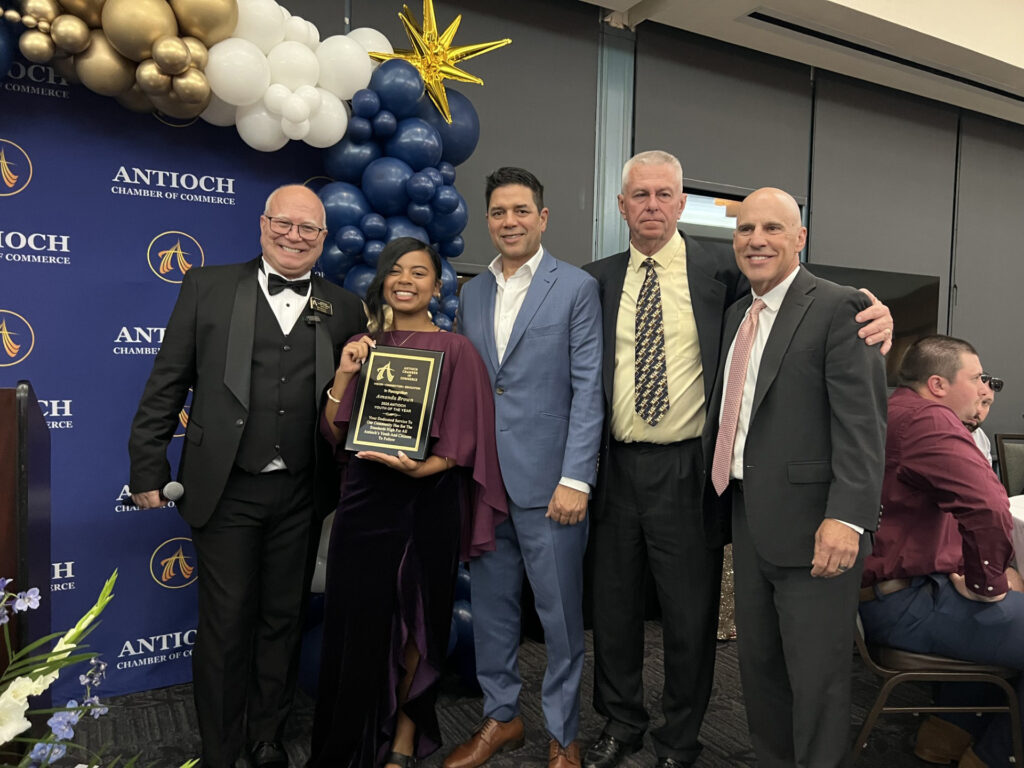
2025 Antioch Youth of the Year Amanda Brown is presented with a plaque by Chamber Chair Jim Becker (left) and with a scholarship check by Tom Jenkins of the Antioch Rotary Club and Tom Hartrick of the Rotary Club of the Delta-Antioch, who were joined by Mayor Ron Bernal during the Gala ceremony Friday, March 27, 2026. Photo by Allen D. Payton
Deer Valley High Senior Class President also presented with $1,500 scholarship by local Rotary Clubs
By Antioch Chamber of Commerce
During the Antioch Chamber of Commerce’s annual Gala, Friday night, March 27, 2026, Amanda Brown was honored as Antioch’s 2025 Youth of the Year.
She is an exceptional student whose dedication, leadership, and passion for service truly set her apart. As senior class president at Deer Valley High School, she plays a pivotal role in planning and executing student activities, earning a reputation as a dependable leader and trusted mentor among her peers.
Amanda has become the school’s premier Master of Ceremonies for large events. Last year during the Deer Valley High School Special Olympics, she emceed the event with remarkable compassion, high energy, making every participant feel valued and celebrated. Her skill, poise and heart for service have made her the go-to emcee, admired for bringing joy and professionalism to every occasion.
Beyond her leadership at school, Amanda actively contributes to the community. She teaches cooking classes and leads youth enrichment activities at the Antioch Recreation Center, inspiring younger students and fostering a positive, supportive environment. Her dedication to helping others, combined with her excellent attendance, academic achievement and strong work ethic, demonstrates a rare combination of character, talent and service-mindedness.
Amanda Brown is more than a student leader—she is a remarkable young person whose compassion, initiative, and integrity continue to impact everyone around her. She exemplifies the very best of youth leadership, and her contributions promise a bright future of meaningful service and community engagement.
During the Gala ceremony, Amanda was presented with a scholarship for $1,500 from $750 contributed by each the Antioch Rotary Club and Rotary Club of the Delta (Antioch).
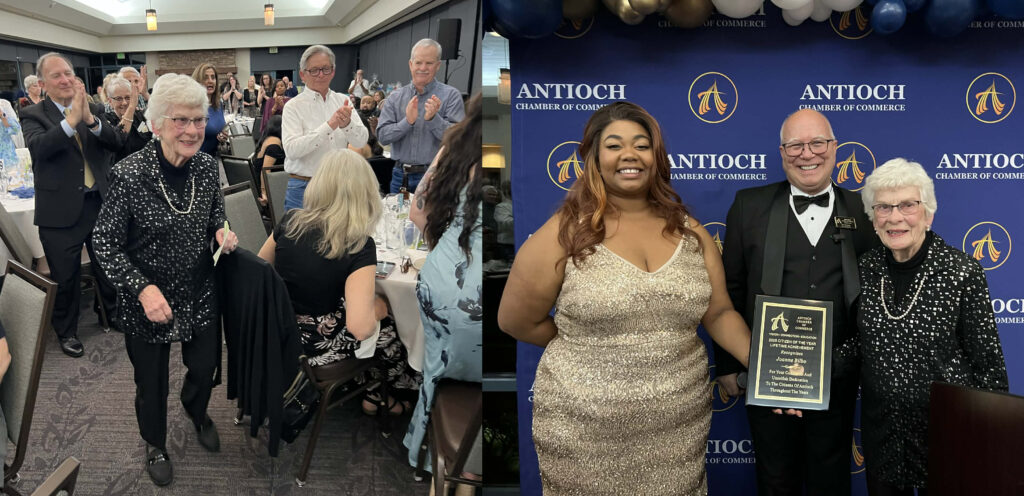
Joanne Bilbo is applauded by family and friends and presented with a plaque as the 2025 Antioch Citizen of the Year for Lifetime Achievement by Antioch Chamber of Commerce Vice Chair Dominique Coleman and Chair Jim Becker during the annual Gala, Friday, March 27, 2026. Photo by Allen D. Payton
“I’m an honorary doer. I think that’s a better title for me.”
By Antioch Chamber of Commerce
During the Antioch Chamber of Commerce’s annual Gala, Friday night, March 27, 2026, Joanne Bilbo, a lifelong resident of Antioch, was honored as the 2025 Citizen of the Year for Lifetime Achievement in recognition of her unparalleled dedication to her community. At 96 years young, Joanne’s life is a shining example of volunteerism, leadership and service.
She joined the Catholic Young Ladies at age 16 and has been a devoted, long-standing member of Most Holy Rosary Church. Affectionately known as the “Dessert Lady,” Joanne has spent decades delighting parishioners with her famous bundt cakes at church events, always serving with joy and generosity.
Her commitment extends beyond the church: she has been a dedicated board member of the Antioch Historical Society, earned the affectionate title of “Ticket Lady” for managing museum event tickets for countless community events, and was honored in 2023 as a Community Leader by the Sports Legends Hall of Fame Museum, where she served on the board for more than a decade.
Joanne’s impact on Antioch reaches into every corner of the community. She and her husband, Marshall Bilbo, married in 1960 and raised two children while owning and operating Ernie’s Liquors for many years. She has been a vital presence in the Antioch Chamber of Commerce and the Rotary Club of Antioch, contributing her time, energy, and leadership to countless initiatives.
As a board member of Antioch Friends of the Arts, she oversaw the purchase and dedication of the Cannery Lady statue on W. First Street in historic, downtown Rivertown, celebrating Antioch’s rich history and culture. In 2003, she joined a philanthropic organization dedicated to raising scholarships for women, further extending her impact on future generations. Through her decades of volunteerism, her warm presence, and her unwavering commitment to community, faith, and service, Joanne Bilbo has become a beloved and inspiring figure in Antioch—truly deserving of the title Citizen of the Year.
See video of Joanne’s speech during the Gala in which she said, “I’m an honorary doer. I think that’s a better title for me.”
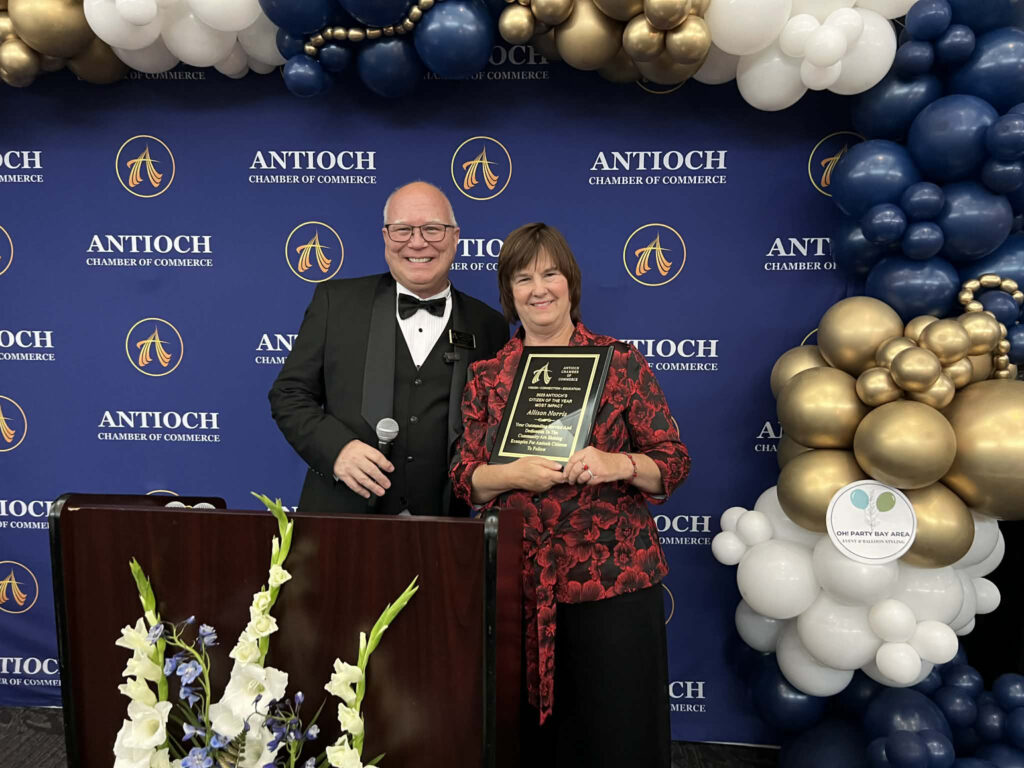
Antioch Chamber of Commerce Chair Jim Becker presents Allison Norris with her plaque recognizing her as the 2025 Antioch Citizen of the Year for Most Impact during the annual Gala on Friday, March 27, 2026. Photo by Allen D. Payton
By Antioch Chamber of Commerce
During the Antioch Chamber of Commerce’s annual Gala, Friday night, March 27, 2026, Allison Norris, founder of the charitable organization Snug As A Bug, was honored as the 2025 Antioch Citizen of the Year for Most Impact for her extraordinary dedication to improving the lives of those in need.
Through her organization, Allison provides handmade quilts and bags to children, teens, adults, and veterans, offering warmth, comfort, and a tangible reminder that someone cares. Over the years, she has supported hundreds of individuals in Antioch and surrounding communities, creating meaningful connections and helping people navigate moments of hardship. In 2024 Allison tirelessly created quilts for veterans and contributed to the Antioch Stand Down on the Delta, an event supporting those who have served. Her outreach extends to local schools, hospitals, police departments and social service agencies, where she ensures that foster youth, families facing crisis and individuals experiencing trauma receive the physical comfort of a quilt and the emotional support that accompanies it.
Allison’s impact reaches far beyond the quilts she creates. She continuously volunteers her time at the Woman’s Club of Antioch, her church, and local schools, using these partnerships to bring other volunteers into the fold and create meaningful opportunities for community engagement. Through her dedication, she strengthens the social fabric of Antioch, demonstrating the power of compassion in action. Guided by her motto, “Building Community with Community,” Allison never seeks recognition for her work, choosing instead to focus on the real, lasting impact she makes every day. Her unwavering commitment, generosity and leadership have touched countless lives, inspiring others to give back, reinforcing a culture of care, resilience and community in every corner of Antioch.
45-year-old in stable condition, 41-year-old in critical condition
By Acting Lt. Gary Lowther #4032, Antioch Police Field Services Division
On Sunday, March 29, 2026, at about 5:30 p.m., Antioch Police officers responded to reports of gunfire in the 4200 block of Lone Tree Way, near Mokelumne Way.
Officers arrived within minutes and searched the area, but no victims were initially located.
A short time later, Antioch Police Dispatch was notified that two adult men arrived at a local hospital with gunshot wounds. Officers were able to confirm that both individuals, a 45-year-old man and a 41-year-old man, were involved in the earlier shooting.
Both men were transported to a trauma center. One is listed in stable condition, and the other remains in critical condition.
The incident has been labeled an attempted homicide and the Antioch Police Department Investigations Bureau is actively investigating the incident.
Anyone with information is encouraged to contact Antioch Police Detective Ricardo Angelini at (925) 437-6056 or rangelini@antiochca.gov.
This preliminary information was provided by the Field Services Division. Any additional updates will be released by the Investigations Bureau.