At the Nick Rodriguez Community Center, 213 F Street in Antioch’s historic, downtown Rivertown. Hosted by the Contra Costa Health Department’s Violence Prevention Program and Gun Violence Prevention Coalition, and Bridge Builders to the New Generation.
According the CCHealth’s website, The Violence Prevention Program uses a public health approach to prevent and reduce gun violence in Contra Costa County by providing high-risk populations with social support and services informed by evidence-based practices and equity principles. The program, established in October 2022, was made possible through a three-year grant from the U.S. Department of Justice Community-Based Violence Intervention and Prevention Initiative.
The Violence Prevention Program is partnering with community stakeholders to develop a Gun Violence Reduction Strategic Plan for the county. The plan will focus on developing social-emotional learning programs for at-risk youth, building workforce development opportunities and career paths, and working with communities to improve the physical environment, neighborhood appearance and community engagement.
Currently, the program is working with the nonprofit consultant on a landscape analysis of the county’s existing violence prevention efforts.
The Gun Violence Prevention Coalition is a diverse, community and multi-agency-driven collaborative supported by Contra Costa Health’s Violence Prevention Program. The Coalition seeks to increase collaboration among residents, community partners, and agencies who are interested in and are actively involved in reducing gun violence and advancing gun-violence prevention policies. The Coalition’s goal is to prevent and reduce the incidence of gun violence and its associated negative community and health impacts.
By Julie Yee, Public Affairs Specialist, Western Regional Office, Food and Nutrition Service, U.S. Department of Agriculture
The U.S. Department of Agriculture (USDA) announced Friday, March 1, 2024, that households impacted by widespread power outages that started on February 4th as the result of a strong winter storm in California could be eligible for replacement of Supplemental Nutrition Assistance Program (SNAP)/CalFresh benefits. This is one of many recent steps USDA has taken to ensure California residents in need have food to eat.
Rather than require SNAP households to report food losses individually, USDA allowed the State of California to approve automatic mass replacements for residents of certain zip codes who lost food as a result of the power outages and winter storm. The waiver applies to specified zip codes from 27 counties. More details will be made available through the California Department of Social Services (CDSS).
SNAP participants in areas hardest hit by the power outages may have a portion of their February benefits replaced. SNAP recipients residing in other affected areas may request replacement benefits by filing an affidavit with the local office attesting to disaster-related loss.
Additionally, USDA has approved CDSS’ request to waive the 10-day reporting requirement for replacement of food purchased with SNAP benefits that were lost as a result of power outages due to the winter storms that began in February. The waiver is in effect through March 4, 2024.
USDA’s Food and Nutrition Service is ready to consider additional waivers that may be needed to help program participants who have lost food due to widespread power outages and to simplify the application process for affected households, upon request from the CDSS. Individuals seeking more information about this and other available aid should dial 2-1-1. For more information about California SNAP, visit https://www.cdss.ca.gov/food-nutrition/calfresh.
USDA’s Food and Nutrition Service works to end hunger and improve food and nutrition security through a suite of 16 nutrition assistance programs, such as the school breakfast and lunch programs, WIC and SNAP. Together, these programs serve 1 in 4 Americans over the course of a year, promoting consistent and equitable access to healthy, safe, and affordable food essential to optimal health and well-being. FNS also provides science-based nutrition recommendations through the co-development of the Dietary Guidelines for Americans. FNS’s report, “Leveraging the White House Conference to Promote and Elevate Nutrition Security: The Role of the USDA Food and Nutrition Service,” highlights ways the agency will support the Biden-Harris Administration’s National Strategy, released in conjunction with the historic White House Conference on Hunger, Nutrition, and Health in September 2022. To learn more about FNS, visit www.fns.usda.gov and follow @USDANutrition.
USDA is an equal opportunity provider, employer, and lender.
Matched with “non-binary” Fellow to run program to support new Crossroads to The Delta Project to revitalize the local economy, address commuter challenges, promote a sustainable business ecosystem
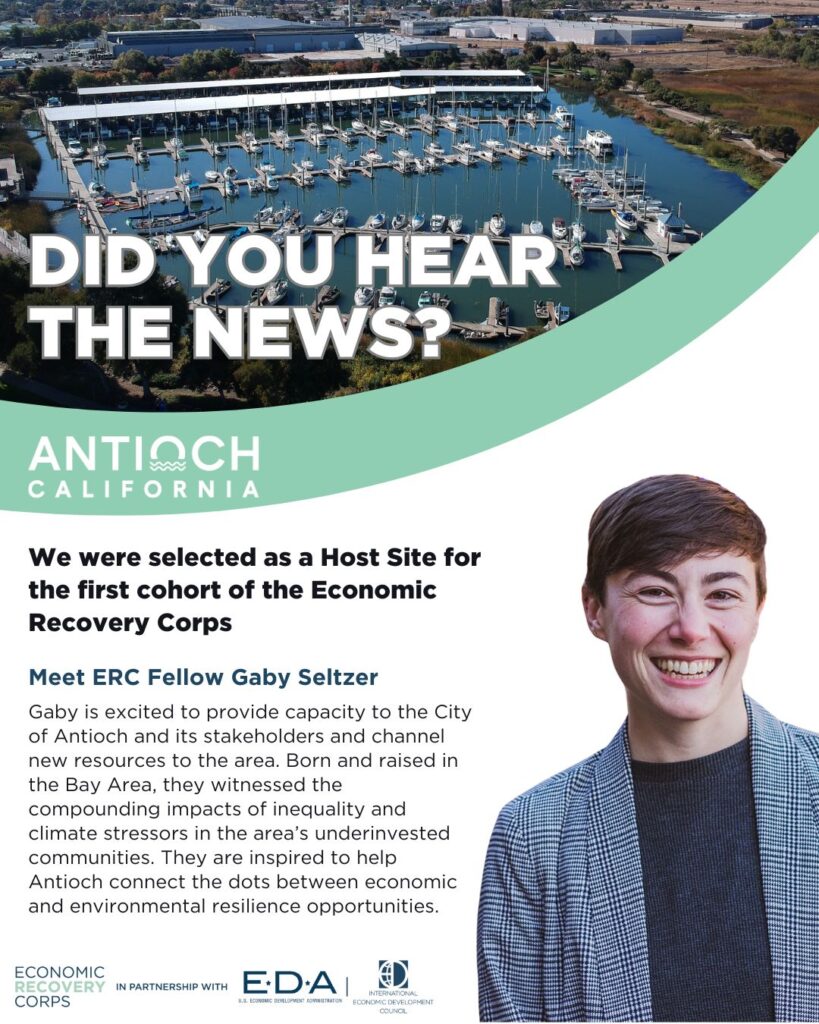
The City of Antioch announced on Wednesday, Feb. 21, 2024, it has been selected as a host site of the first cohort for the Economic Recovery Corps (ERC). The ERC is a new, collaborative initiative designed to accelerate recovery from the COVID-19 pandemic in distressed communities and regions throughout the U.S. by connecting organizations with the talent and capacity needed to advance new ways of doing economic development that promote economic resilience and transformative change. The ERC is working in partnership with the U.S. Department of Commerce’s U.S. Economic Development Administration and the International Economic Development Council.
The ERC Program has the potential to shift the practice of economic development nationwide in an unprecedented manner.
Utilizing strategic partnerships, innovative industry development and data-driven planning, the project addresses issues such as lengthy commutes, limited local job opportunities and underutilized city resources. The challenges posed by the COVID-19 pandemic include a disbanded public safety office, staff shortages, struggling small businesses, and an underused waterfront. The ERC Fellow will research, audit, manage, or develop up to six key initiatives, covering areas like district-based associations, OceanTech, advanced manufacturing, supplier diversification programs, and assessing small business grant impact. The project aims to contribute to Antioch’s economic recovery and sustainability, fostering a resilient and vibrant community.
About the Fellow
The City also introduced ERC Fellow Gaby Seltzer who was matched with the Antioch community. Seltzer will play a pivotal role in revitalizing the local economy, address commuter challenges, and promote a sustainable business ecosystem. Gaby will be living and working in our community for the next 2.5 years.
The ERC’s website provided background about Antioch’s fellow in the program.
“Gaby is passionate about building community wealth and power through sustainability initiatives. ‘Their’ professional background is in grassroots food systems work, including managing a social enterprise program that increased access to healthy foods at corner stores in Washington, DC’s food apartheid neighborhoods. Through this work, ‘they’ helped locally-anchored businesses build resilient partnerships with residents, governments, academic institutions, and industry groups.
Witnessing the power of local networks to foster sustainability and social justice led Gaby to Presidio Graduate School, where ‘they’ honed ‘their’ cross-sector organizing skills through an MBA and MPA in Sustainability. While pursuing these degrees ‘they’ consulted for several economic resilience organizations. ‘They’ also served as an Environmental Defense Fund Climate Corps Fellow twice: first designing a data portal to drive climate investments to frontline communities at the City of Seattle, and next building datasets and learning materials to drive climate adaptation programming at Pacific Gas & Electric Company.
In ‘their’ spare time, Gaby enjoys spending time outside and hosting gatherings.”
Asked if there is just one or more fellows, how Seltzer was matched with Antioch and in which city department the fellow will be working, Antioch Economic Development Manager Bret Sweet responded, “There was only one fellow, Gaby Seltzer. Gaby has asked us to use ‘they’, ‘them’ and ‘their’ in reference.”
“I applied for the program and went through a fairly intensive pitch process along with (Acting City Manager and Economic Development Director) Kwame (Reed),” he explained. “Once we were selected, we formed a panel of city and county employees to interview multiple candidates. As it worked out, we scored the highest and Gaby ranked Antioch the highest, so we were matched. There are 65 fellows in the program and only two were sent to California. As I learned at the kick-off last week in Portland, apparently ‘more than half the candidates asked to work on the Antioch project’.”
“Gaby works in the Economic Development Department here and will also work a bit with the Economic Development Department at the county,” Sweet added.
About the Project
Asked about the name of the project, Sweet shared, “Crossroads to the Delta project is the name we designed for the six initiatives we asked applicants to work on. Here is the project as it appeared to applicants: Crossroads To The Delta
“It was the name of the project for the ERC. It is not something established by the council,” he continued. “It was named crossroads to highlight Antioch’s positioning between San Francisco, Palo Alto, Stockton and Sacramento.”
“Gaby and I worked all last week at the kick-off in Portland to update the project goals based on feasibility, bandwidth and resources. We will probably have the page updated by next month,” Sweet said.
Learn more about the ERC program and the various projects across the US and stay up to date on the ERC’s happenings by signing up for updates at www.iedconline.org/ERC_Updates.
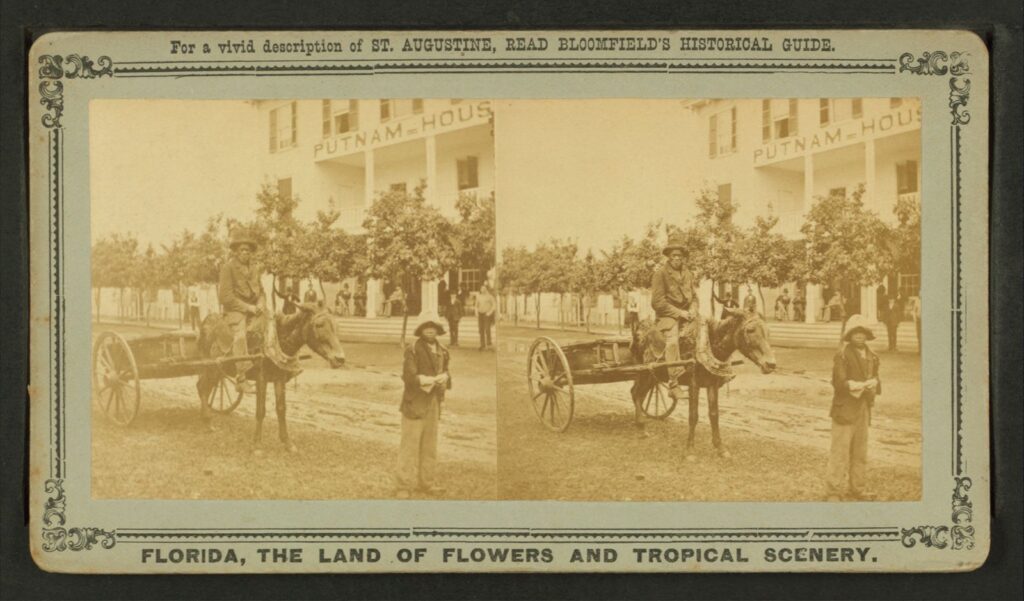
“15th Amendment, or the Darkey’s millenium: 40 acres of land and a mule.” Man and boy with cart in front of the Putnam House, Palatka, Fla. Source: The Miriam and Ira D. Wallach Division of Art, Prints and Photographs: Photography Collection, from The New York Public Library. (1850 – 1930). (PUBLISHER’S NOTE: Objects depicting racist and/or stereotypical imagery or language may be offensive and disturbing, but the National Museum of African American History and Culture in which this photo is displayed aims to include them in the Collection to present and preserve the historical context in which they were created and used. Objects of this type provide an important historical record from which to study and evaluate racism).
Using federal land, not cash
By Allen D. Payton, Publisher
During this Black History Month, as I’ve been arguing for several years, I believe it’s time for all Americans to agree reparations promised to freed slave families following the Civil War in 1865 should finally be fulfilled – but to their descendants.
First, let me point out the fact – especially to my fellow Republicans who might oppose them – that reparations were first, a Republican idea, ordered by Union Army Major General William Tecumseh Sherman, and supported by President Abraham Lincoln, the nation’s first Republican president. As a reminder, the Republican Party was formed to abolish slavery, and Lincoln and the Union Army successfully fought the Civil War to accomplish that goal.
40 Acres & A Mule
You may have heard the phrase “40 acres and a mule”, which was made more popularly known by movie actor and director Spike Lee who labeled his production company “40 Acres and a Mule Filmworks”. But you may not know that the phrase originated with reparations. That’s because Special Field Orders No. 15 were issued by Sherman on January 16, 1865, before the Civil War ended that May, granting “a plot of not more than (40) forty acres of tillable ground” to families, “made free by the acts of war and the proclamation of the President of the United States He also later ordered the army to lend mules to the freed slaves for their farming efforts.
The orders included the confiscation of 400,000 acres of plantation land along “a strip of (Atlantic) coastline stretching from Charleston, South Carolina to the St. John’s River in Florida, including Georgia’s Sea Islands and the mainland 30 miles in from the coast.” The land was to be divided into parcels on which approximately 18,000 formerly enslaved families and other Black people then living in the area would be settled.
The purpose was to provide for the freed slaves both a means to earn a living and support themselves, and the result would have been giving them an asset that could be passed on to future generations.
According to History.com, “The freedmen set out to begin working their new land immediately, with a group of 1,000 settling on Georgia’s Skidaway Island. In subsequent months as many as 40,000 freedmen settled on the redistributed land.”
Order Rescinded
Unfortunately, after Lincoln’s assassination just three months after the order was issued, his running mate on the National Union Party ticket in 1864, Democrat Vice President Andrew Johnson, following his ascension to the presidency, rescinded Sherman’s order. He returned to Confederate owners the 400,000 acres of land. Thus, the freed slaves were denied the land they had been granted and reparations were never offered to them by the federal government, again.
Why Reparations Now?
Some people argue that it’s been over 150 years, so why do Black Americans need reparations, today? My initial response is that they’re long past due. But my main answer is two-fold. One is the fact that a major issue among most Blacks in the U.S., today is a lack of asset ownership, including homes, real estate, investments and businesses. For example, the average Black family has one-tenth the assets of the average white family in the U.S.
Disparity in Household Wealth
According to the U.S. Census Bureau’s Wealth and Asset Ownership Detailed Tables: 2020, Table 1. Median Value of Assets for Households, from the Survey of Income and Program Participation, Survey Year 2021, the median net worth for all households was $140,800. However, when broken down by ethnicity, the median “Black alone” household had one-tenth the assets of the median “White alone” household, or $18,430 compared to $178,500. The disparity is even greater when compared to the median “White alone, non-Hispanic” household which had assets of $217,500.
My argument for the disparity and second one in favor of why reparations, now is the fact that for nearly 250 years, almost all Blacks in the U.S. couldn’t own property because they were property, nor did they get paid. They also couldn’t get an education. So, the rest of us, whose ancestors were never subjected to the horrors and evil of chattel slavery, in effect had a 250-year head start!
Yes, I’ve heard the arguments about the Irish, which is my ancestry, and how they were mistreated, or others who were indentured servants. But those were not the same as being a slave sold, bought and owned by someone else, as well as their future generations to follow.
A Federal Responsibility, Not State or Local
Second, reparations are not a state or local issue, but a federal responsibility. Long before the day the Declaration of Independence was signed on July 4, 1776, and in spite of the fact it enshrined the statement that, “that all men are created equal, that they are endowed by their Creator with certain unalienable Rights, that among these are Life, Liberty and the pursuit of Happiness,” and then from the signing of the U.S. Constitution on September 17, 1789, to Lincoln’s issuance of the Emancipation Proclamation and the end of the Civil War, our federal government allowed slavey. It continued for another 65 years after the Constitution was ratified on May 29, 1790, for a total of 246 years since the first African slaves were brought to our country in 1619. So, again, reparations are a federal responsibility.
(A side, historical note on the Three-Fifths Compromise and clauses in the Constitution. It was not intended by the framers to further devalue the lives of slaves, but to reduce the influence in Congress by the slave states, by preventing them from having additional members in the House of Representatives and a greater number of electors in presidential elections. The slave states wanted to include the slaves in the census count, while the free states didn’t want them included at all. The compromise determined that three out of every five slaves were counted when establishing a state’s total population. A benefit to the slave states was it reduced the amount of taxes they had to pay to the federal government.
In Article I, Section II, Clause III of the Constitution, the Three-Fifths Compromise is stated as:
“Representatives and direct taxes shall be apportioned among the several states which may be included in this Union, according to their respective numbers, which shall be determined by adding to the whole number of free persons, including those bound to service for a term of years, and excluding Indians not taxed, three fifths of all other persons.”
See also James Madison’s writings in Federalist Paper No. 54 in which he argues that slaves were both property and people, and thus required some degree of representation).
But I digress. Back to the issue at hand.
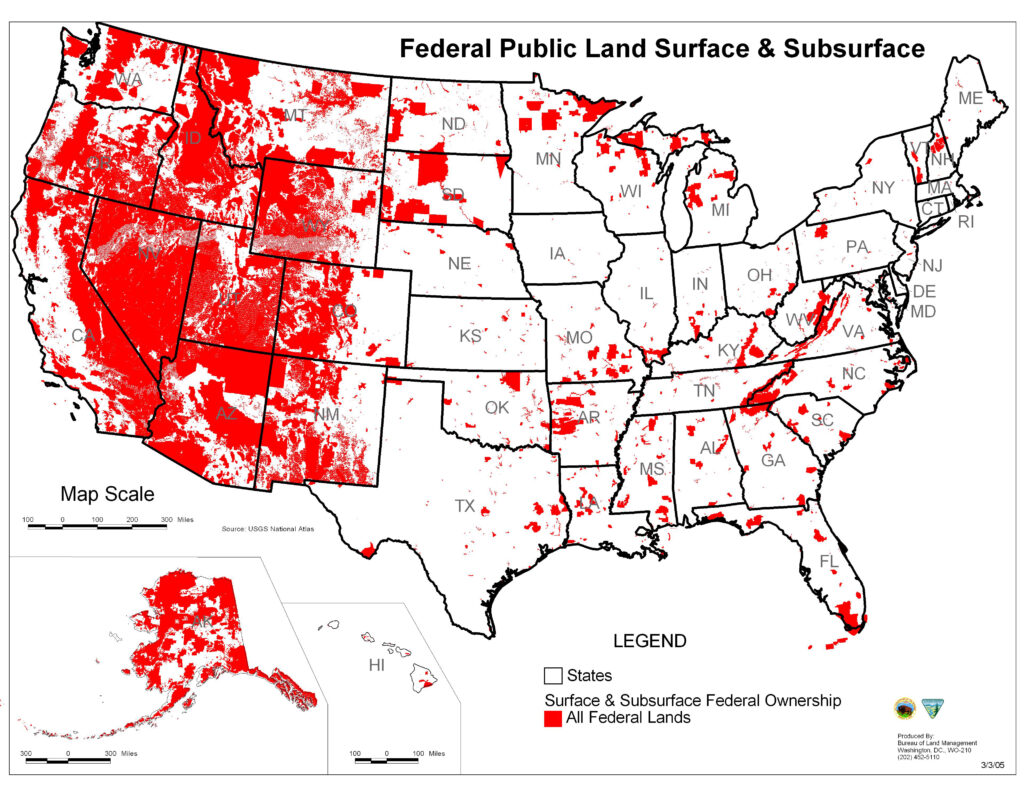
Source: Federal Bureau of Land Management
Reparations Are About Land, An Asset
Third, to my Democrat friends I remind them, reparations were initially land and that’s what they still should be, today, not cash. They should be about helping Black Americans own an asset for their use, from which to generate income and to pass on to future generations.
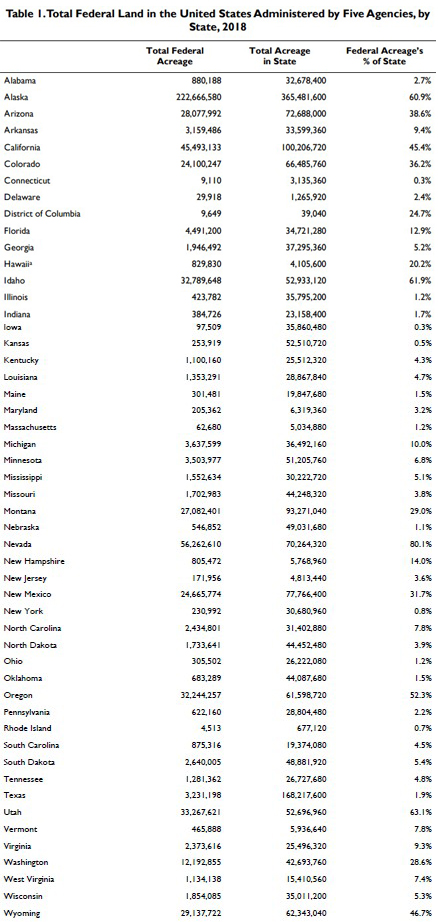
The federal government owns over one-fourth of the land in the U.S. According to a 2020 report and 2023 report by the Congressional Research Service, it amounts to “roughly 640 million acres, about 28% of the 2.27 billion acres of land in the United States”.
Looking at a map you’ll see the federal land is “heavily concentrated in 12 western states (including Alaska), 3 where the federal government owns roughly half of the overall land area.” That includes 45.4% of California, 60.9% of Alaska, 38.6% of Arizona, 36.2% of Colorado, 20.2% of Hawaii, 61.9% of Idaho, 29.0% of Montana, 80.1% of Nevada, 52.5% of Oregon, 63.1% of Utah, 28.6% of Washington and 46.7% of Wyoming. The federal government also owns 12.9% of Florida.
Much of that land is either in national parks (79.9 million acres), in national forests (192.9 million acres) or is farm and ranch land leased to farmers and ranchers. Five federal agencies administer most of it, including the Bureau of Land Management (BLM), Fish and Wildlife Service (FWS), and National Park Service (NPS) in the Department of the Interior (DOI) and the Forest Service (FS) in the Department of Agriculture. with the Department of Defense controlling 8.8 million acres, and 4% administered by multiple other agencies.
So, my proposal is to give to all Black Americans, who can prove they are a descendant of a slave in America, some of that federal land. It can either be given out on an individual or family basis.
While not all Black Americans are descendants of a slave in the U.S. – for example, Vice President Kamala Harris, whose father descended from a Jamaican slave, would not qualify – for simple calculation purposes let’s say all of them are. Blacks currently make up about 13% of the U.S. population of about 330 million people for a total of 40 million people.
If we gave every Black American one, two or even five acres, that would be 40, 80 or as much as 200 million acres which would still leave 440 million acres remaining for ownership and use by the federal government. (Frankly, I don’t understand why the federal government needs to own so much land, especially ranch land for grazing, anyway.)
The new owners could do what they want with the land: farm it, drill it for oil, gas or water, mine it, lease it, swap it with other reparation land recipients, build a home on it, borrow against it, or perhaps form joint ventures with neighboring property owners and develop new communities, even cities. But I believe the one stipulation should be the land could only be sold to another descendant of an American slave. Then, it could be passed on to future generations.
Another argument I’ve heard or read about reparations is, why should people today have to pay anything when neither they nor their family ever owned slaves. This approach addresses that concern. By giving out federal land, there would be no cost to current taxpayers. While it might reduce revenue to the federal government from a reduction in leased lands, that’s a small price to pay for addressing this 160-year-old matter once and for all time.
Source: Congressional Research Service
No One Has to Participate
Some Black people have stated publicly they don’t need or want the help and find it offensive that they be offered reparations. Let’s be clear, no one who is qualified has to participate in a federal reparations program. But I believe most would. Who wouldn’t want free land?
Those who chose to participate would, of course, have to prove their status, and some form of reparations commission or government agency would have to be formed to verify their status and manage the distribution of the land grants. Once verified, program participants would be entered into a lottery and the property could be distributed in periodic drawings. It could even be televised nationally as the participants’ numbers are drawn, and advertising could be sold, and the revenue shared with the federal government to make up for the loss of land lease revenue.
One Time ProgramMay Take Several Years
To sum up, I say it’s time, once and for all, to fulfill the commitment of reparations ordered in 1865 and give portions of federally owned land to the descendants of slaves in the U.S. It might take several years to accomplish, but I believe we should and could start right away.
Once the land has been distributed and all who want it received their share, then that would be it. We’d be done. Everyone would be happy, and there could be no more complaining. The agency would be disbanded, the issue would be put to rest, and it would be up to the new landowners to make do with theirs what they can.
Now, all we need is for Members of Congress and U.S. Senators to introduce the idea and move it forward.
The Contra Costa County Advisory Council on Equal Employment Opportunity (ACEEO) has one vacant Business seat and two vacant Community seats open to applicants. The successful candidate for the Business seat must own a business within the county, and candidate(s) for the Community seats must either work or reside within the county. All candidates must have an interest in equal employment matters. The ACEEO meets on the fourth Friday of each month from 9:30 a.m. to 11:30 a.m., except for holidays.
The ACEEO assists with the implementation of the County’s Equal Employment Opportunities and Contracting Programs and serves as an advisory committee to the Board of Supervisors. The ACEEO reviews the Equal Employment Opportunities Program and recommends actions to facilitate the attainment of the County’s goals for equal employment opportunities regardless of gender and race/ethnicity.
The Board of Supervisors established the ACEEO on July 9, 1991. The Council has thirteen (13) seats representing the following groups: 4 Community seats; 2 Labor seats; 2 Management seats; 1 Educational seat; 1 Disability seat; 1 Business seat; 1 Veteran seat; and 1 Labor/Trade seat.
Application forms can be obtained from the Clerk of the Board of Supervisors by calling (925) 655- 2000 or visiting the County webpage at www.contracosta.ca.gov/3418. Applications should be returned to the Clerk of the Board of Supervisors, 1025 Escobar St., 1st Floor, Martinez, CA 94553. Applications can also be emailed to ClerkoftheBoard@cob.cccounty.us.
2022 District CA-11 Congressional Art Competition winner, “Growing Up” by Menglin Cai of Danville. Source: Office of Congressman Mark DeSaulnier (when he represented the 11th District)
Deadline for submittals is April 5th
Walnut Creek, CA – Today, Congressman Mark DeSaulnier (D, CA-10) announced he will participate in the nationwide 2024 Congressional Art Competition. High school artists living in California’s 10th Congressional District may begin submitting original artwork to his office virtually from now through Friday, April 5th. The winning piece will be selected by a panel of local judges who will view all artwork electronically and announced at a reception to celebrate all participants following the submission deadline.
Participants may submit one photograph or scan of their artwork, taken in the highest possible resolution, to kaylee.deland@mail.house.gov. Submissions must include the Student Release Form. Artwork entered in the contest may be up to 26 inches by 26 inches, may be up to 4 inches in depth, and not weigh more than 15 pounds. If your artwork is selected as the winning piece, it must arrive framed and must still measure no larger than the above maximum dimensions.
Paintings – including oil, acrylics, and watercolor
Drawings – including pastels, colored pencil, pencil, charcoal, ink, and markers (It is recommended that charcoal and pastel drawings be fixed.)
Collages – must be two dimensional
Prints – including lithographs, silkscreen, and block prints
Mixed Media – use of more than two mediums such as pencil, ink, watercolor, etc.
Computer-generated art
Photography
All entries must be original in concept, design and execution and may not violate any U.S. copyright laws. Any entry that has been copied from an existing photo or image (including a painting, graphic, or advertisement) that was created by someone other than the student is a violation of the competition rules and will not be accepted. Work entered must be in the original medium (that is, not a scanned reproduction of a painting or drawing).
The rules for the 2024 competition are available here or on House.gov.
“Every year I am so impressed by the talent of the students in our district who participate in the Congressional Art Competition,” said DeSaulnier. “I am pleased to again host this event as an opportunity for young artists to showcase and be recognized for their creativity.”
The competition is open to all high school students living in California’s 10th Congressional District. The winning piece will be displayed in the U.S. Capitol and the winner will be invited to Washington D.C. to attend a national reception honoring winners from around the country. All submissions must be emailed to Kaylee.deland@mail.house.gov no later than 5:00 p.m. PT on April 5, 2024.
The Congressional Art Competition is a nationwide high school visual art competition to recognize and encourage artistic talent in the nation and in each congressional district. Since the Competition began in 1982, more than 650,000 high school students have participated. Complete contest guidelines and submissions forms are available on the Congressman’s website here. For more information or help submitting artwork, please contact DeSaulnier’s office at 925-933-2660.
Retired Pittsburg Police Chief Brian Addington has been appointed as Antioch’s interim police chief. Photo: Pittsburg PD
Starts Monday, February 26, 2024
“We’re very lucky to have him as our chief.” – Councilman & retired Pittsburg Lt. Mike Barbanica
Police Officers Association “excited to learn” of appointment
Antioch, CA: Acting Antioch City Manager Kwame Reed has selected retired Pittsburg Police Chief William Brian Addington to serve as Interim Chief of Police until a permanent chief is appointed. Chief Addington brings a wealth of experience and a deep understanding of East Contra Costa County law enforcement to this leadership role. He has a proven track record of leadership and dedication to public safety that are essential to guiding the department during this transitional period. Chief Addington’s first day in the office will be Monday, February 26, 2024.
Chief Addington, who retired in July 2022, understands the challenges and opportunities facing law enforcement in our community. With over a decade of experience as the Police Chief in neighboring Pittsburg, he has demonstrated his commitment to serving the residents of East Contra Costa County with integrity and professionalism.
“We are confident that Chief Addington’s leadership will enhance the safety and security of our community,” Reed said. “His extensive knowledge of local policing issues and his strong ties with the East County community make him the perfect choice to lead the Antioch Police Department during this interim period.”
“Retired Chief Addington will come to Antioch with a strong ability to make tough decisions under difficult circumstances,” said Mayor Lamar Hernandez-Thorpe. “Until the hiring of a permanent chief of police, he’ll work with City Hall to continue to rebuild police staffing levels and decrease 911 response times.”
Addington expressed his gratitude for the opportunity to serve as Interim Chief of Police, stating, “I am honored to join the dedicated men and women of the Antioch Police Department. We will work tirelessly – with a renewed focus on serving our community – and upholding the department’s mission of protecting and serving the residents of Antioch with integrity, compassion, and professionalism.”
UPDATE: According to City of Antioch Human Resources Director Ana Cortez, “Interim Police Chief Addington’s compensation will be $128.14 per hour.” That amounts to about $5,125 per week for 40-hours or work.
When reached for comment District 2 Councilman and retired Pittsburg Police Lt. Mike Barbanica said, “I’m very supportive of Chief Addington. He’s a great addition to the APD. We’re very lucky to have him as our chief. I worked with him for many years at the PPD. In fact, he worked for me when. When I was a Bureau Commander and I had the pick of the list, Brian Addington was my first choice. He was my right-hand person. He’s an outstanding administrator. He’s the right choice.”
“Addington and I worked together ridding the department of corruption, investigating officers who were falsifying arrest reports and we ended up removing the officer from the police department,” the councilman added.
Police Officers Association “Excited to Learn” of Appointment
Antioch Police Officers Association Vice President Sgt. Loren Bledsoe was asked for comment about Addington’s appointment. He responded, “The APOA was excited to learn that Chief Addington was selected for the position of Interim Chief of Police. APD has always shared a strong working relationship with the Pittsburg Police Department, and we look forward to the opportunity to support the mission and vision of Chief Addington here, at APD.”
About Brian Addington
According to a press release from the Pittsburg Police Department when Addington retired, “In 1994, Officer Brian Addington made, what we think, was the best decision of his career. He joined the Pittsburg Police Department after having served for a year and a half with the Suisun City Police Department. That decision left a lasting mark on our department and our Pittsburg community as he rose through the ranks to become our Police Chief serving in that role for the last decade.
Chief Addington started as an officer in patrol on the Strategic Enforcement Team (SET) where he served for several years focused on reducing street-level crimes. From there, he became an undercover detective in the Narcotics Unit. In 1998, he was promoted to Sergeant where he trained and mentored officers in a wide variety of assignments. Chief Addington’s rise through the ranks included a promotion to Lieutenant in 2004 and then Captain in 2010.
He served as our Public Information Officer as well as duties in patrol, training, narcotics, criminal and administrative investigations and so much more.
As Police Chief, he focused on transparency and breaking down barriers between police and the community we’re sworn to serve. His modern approach to law enforcement strategies resulted in both a 10% decrease in crime and more than a 100% increase in diversity among the ranks of the Pittsburg Police Department. These are achievements that will last for decades to come.
Chief Addington brought respect and a broader footprint for the Pittsburg Police Department through his service and leadership in many roles including membership with the FBI National Academy Associates, California Police Chiefs Association, and the International Association of Police Chiefs.”
Addington’s Business, Education and Personal Background
According to his LinkedIn profile, since retiring, Addington founded WBA Consulting and Investigations, LLC and is Chief Operations Officer for Vacaville-based Cole Pro Media.
When reached for comment Addington said, “I work part-time for Cole Pro Media which works with law enforcement agencies on communications strategy.”
His profile on the WBA website offers more about his experience and knowledge. “His expertise covers the full range of policing disciplines based on his experiences in a law enforcement agency in California.
Brian provides expert advice on best practices in policing, leadership development, organizational assessments, training, independent investigations, and community engagement and media relations.
Brian has also served as an advisor and consultant to various law enforcement agencies and executives in developing strategies and best practices to address the ever-changing demands placed on law enforcement professionals.”
He was able to retire at age 50 under the previous compensation package for many law enforcement agencies in the state, including the CHP and Antioch Police Department. Addington said he will be 52 in March.
“My intent was always to work after I retired,” he stated.
Addington is married, and together with his wife they have a total of eight children “in a blended family.”
He earned a bachelor’s degree in psychology and a master’s degree in organizational leadership, both from Chapman University. In addition, Addington graduated from the FBI National Academy in 2012 and the California POST (Police Officer Standards and Training program) Command College in 2011.
He’s been a board member with the Pittsburg Police Activities League since 2014.
Asked why he goes by Brian, Addington shared, “My dad was William Calvin Addington, and I’m William Brian. My mom called me Brian. So, I just go by my middle name.”
Addington said he was born in San Gabriel in the L.A. area and his family moved to Concord when he was three years old.
“We then moved when I was eight to Fairfield. So, I grew up in Solano County,” he added.
While he officially starts Monday, Reed was asked if Addington will be sworn in that day or during next Tuesday’s council meeting. He responded, “for the Oath of Office we are planning that now with it being tentatively set some time Tuesday afternoon.”
“They’ve beena massive failure…They have no credibility with anybody because they take on the role of being anti-police…It gives them a forum. They enjoy it. They get to grandstand.” – APOA attorney Mike Rains
“We look forward to the opportunity to work with the new Oversight Commission” – APOA VP Sgt. Loren Bledsoe
By Allen D. Payton
In response to the appointment of the seven members to the City of Antioch’s new Police Oversight Commission this past week, Antioch Police Officers Association attorney Mike Rains, who says his firm represents about 180 police associations throughout California, shared his extensive thoughts and concerns about the commission, the city’s government and police department.
“I didn’t know the people who they appointed. I guess, knowing it’s Antioch, they’re not going to appoint anyone who will be fair to police,” he stated. “It’s meaningless, ritualistic crap. That’s all you can say about this new commission.”
“I’ve been dealing with civilian review of police for 40 years. Antioch is no different. It can be effective and can work but only if those who sit in review of the police actions are fair and objective in evaluating the evidence. But what has happened, almost everywhere, is selecting people to the position who have an agenda,” Rains stated. “They think they sit on the panels to be advocates for their own personal agenda. They’ve been a massive failure.
They have no credibility with anybody because they take on the role of being anti-police.”
Says Oakland Police Commission Decisions Overruled Most of the Time
During his arguments in favor of forming the new commission, Mayor Lamar Hernandez-Thorpe mentioned the police commissions in San Francisco and Oakland as examples. Rains shared his experiences with one.
“Take a look at the Oakland Police Commission. They’re in complete disarray. Nobody pays attention to them. City officials overrule them most of the time,” he stated. “In the few cases the city officials succumb to the pressure, and discipline was imposed, we took them to arbitration, and it was overturned because it was unfair, and no arbitrators would uphold them.”
“Like in Berkely, they’ve had the same model,” Rains shared. “It gives them a forum. They enjoy it. They get to grandstand. It gives them their one day of glory in a hearing.”
Antioch’s Commission Only Advisory
But unlike the police commissions in the larger cities in the Bay Area and elsewhere, which are charter cities, because Antioch is a general law city, as previously reported, the Police Oversight Commission does not have the same powers and can only serve in an advisory role to the city council. Rains called it, “A meaningless process.”
“As if any of these folks know about police policy. It’s going to be their personal philosophy without any knowledge at all of what universally is accepted for police practice,” he continued. “I’m sure it’s going to be a joke. Everything coming out of Antioch is, right now.”
About the City Government & Mayor
Rains then turned his attention to how the city’s government is being operated.
“The city is severely mismanaged, and they keep running it into the ground,” he stated. “It’s indicative of what Mayor Thorpe has been doing. The mayor won’t let the police chief run the department and that’s how it’s been since Chief Ford was there.”
“Lamar Thorpe and his cronies, they can’t run it. That’s what’s causing the disfunction,” Rains continued. “They continue to do this crap and think these little ‘show and tells’ like this police commission thing will show they’re competent. But they’re incompetent. Instead of hiring competent department heads to run the city.”
“It’s sad for the people of Antioch,” stated Rains, who doesn’t’ live in the city. “They need to vote out all these people and elect people who are smart and care and don’t have a personal agenda that will dominate their decision-making.”
About the Police Department
He then spoke about the police department where his clients, the members of the APOA work.
“I feel sorry for the cops who work there, still,” Rains shared. “I think they should just leave en masse because of the lack of leadership at all levels in city hall. They need to let the police chief do his job.”
“My office represents over 180 police associations in the state and Antioch is the only one where the police chief has been deprived of running his own department,” he stated. “It’s being run by the city attorney, the mayor and possibly the acting city manager, and the human resources director. Why would anyone want to work there?”
When pointed out that the mayor claims 16 new sworn officers have been recruited to the department since the council approved the hiring incentive package Rains said, “They’re probably not going to be able to retain officers. I think officers, if they come there, it doesn’t take them long to see what’s going on, because the city is running it into the ground, and they want out. There are other departments that are competent with competent leadership and they’re going to go there.”
“The public needs to know the mayor and the city attorney, his ally, have done the people a disservice in the way they’ve run that place into the ground,” Rains added.
APOA Willing to Work With New Commission
APOA Vice President Sgt. Loren Bledsoe offered a different response to the formation of the commission and appointment of the seven commissioners. When asked for comment he wrote, “We look forward to the opportunity to work with the new Oversight Commission to develop strategies to improve public safety. As a strong believer in the concepts of 21st Century Policing, I look forward to this opportunity and hope it will only strengthen relationships with the community.”
Hernandez-Thorpe, Smith Offered Opportunity to Respond
An email was sent to both Hernandez-Thorpe and City Attorney Smith Saturday afternoon with a link to the article offering each the opportunity to respond to Rains’ claims. Neither had responded as of Saturday night.
UPDATE 1: Rains Commends APOA’s Comments
However, after reading the article, Rains shared additional comments saying, “After seeing the comments by Loren Bledsoe, I commend him for extending an olive branch to the new commission and indicating the POA’s desire to work in a cooperative fashion with them.”
“As the attorney for the association, I do not have the same optimistic view that a cooperative and harmonious relationship can be established,” Rains continued. “But if anybody can do it, Loren Bledsoe can on behalf of the association, And I commend him for his comment and his attempt to work things so that the commission can function objectively and effectively and make the lives of the citizens of Antioch better and to make the working lives of the cops in Antioch better, as well.”
Please check back later for any updates to this report.