Information on 2.7 million public employees from 2,518 agencies and 54 pension plans
Shows 15 police officers in Contra Costa County were paid more than $500,000 in 2022, including the highest to El Cerrito Police Chief at over $850,000 plus, 10 others from his dep’t
Also, shows highest paid in Antioch PD was a Captain at $476,018.55
Highest paid in the state was Vallejo Police Chief at $953,396.61
Transparent California, the state’s largest database of public pay and pension data, has completed data collection efforts for records detailing 2022 employee compensation and pension payments made by almost all public agencies in our state!
In the last year we’ve added data on 2.7 million public employees obtained from 2,518 agencies, and 1.4 million pension records from 54 pension plans to our database. Added to our existing data from the last decade results in a total of 42 million records available on the site. All obtained from the agency’s own pay data using requests made under the California Public Records Act, all are available online for free to anyone with an interest at http://transparentcalifornia.com.
Pay and benefit costs are the single largest expense in our government. Transparent California’s site provides members of the public with unprecedented visibility into that spending. Knowing how government employees are personally benefiting from state and local spending is critical to ensuring true accountability in our government.
In 2022 over a million public employees, and over 125,000 pension recipients, enjoyed compensation packages totaling over $100,000 per year. Using the data available we can see the City Manager in Norco was provided total compensation of $539,705, the school superintendent in Ontario-Montclair was paid $643,796, and a police lieutenant in Vallejo made $839,798.
(Editor’s Note: According to an April 2021 ABC7 News report, Vallejo Police Lieutenant Herman Robinson, a 47-year employee with the department was fired. According to an April 2022 Vallejo Sun report, an arbitrator ordered Robinson be reinstated with back pay and be paid an additional 10% interest on his back pay. He “was one of the most highly paid city of Vallejo employees and received $179,590 in base pay and $196,941 in overtime pay for calendar year 2020, according to Transparent California, a website that tracks California government worker salaries. With benefits included, Robinson earned $547,403.68.”
Thus, the $839,798 Robinson was paid in 2022 included two years of compensation and the 10% interest on the back pay.)
UPDATE: That information was shared with Transparent California’s Director of Research, Todd Maddison. In response he wrote, “Thanks, appreciate the background. We are rarely if ever given the ‘story’ behind any particular pay data, and with over 4 million records a year to collect we usually don’t investigate unless someone feels the number is erroneous. We do offer agencies the ability to make a note if they want so site users don’t think an outlier is ‘normal pay’, but we’re rarely taken up on that.
Meanwhile, in 2022 there were 67 police employees who made total pay only (excluding benefits) of over $400,000. I’ve attached a spreadsheet of police employees in case you’re interested.”
That spreadsheet shows the highest paid police officer in Contra Costa County in 2022 was Richmond Police Sergeant Florencio Rivera, whose total compensation was $512,432. A total of 15 officers in the county were paid more than $500,000 each, with 11 of them from the El Cerrito PD.
The Transparent California website gives ordinary taxpayers access to such data, illuminating the spending that drive state and local government deficits, including the $73 billion in red ink being projected by the state.
Data collection for 2023 compensation is now starting. Those who want to monitor specific agencies can subscribe (free) or support the effort by sponsoring data collection from that agency.
Maddison noted, “2022 data collection was a great achievement. We’re particularly proud our small donor funded team lapped the State Controller’s Office’s government-funded effort in K-12 education, collecting data from 1055 districts to their 424. We’re focused on giving the people of California the data they deserve to see how their tax dollars are being spent.”
A complete Antioch School Board was in attendance for both the closed session and regular meeting, on Wednesday, May 8, 2024. They applauded the district employees of the year. But Superintendent Stephanie Anello was absent and still out on sick leave. Video screenshot.
Before evaluating Anello; with her absence Board President Hernandez again unable to conduct her evaluation
By Allen D. Payton
During a closed session meeting on Wednesday, May 8, 2024, the Antioch Unified School District (AUSD) Board was anything but unified as a vote to terminate Superintendent Stephanie Anello’s contract failed two-three. While how each trustee voted was not reported out by Board President Antonio Hernandez, it can safely be assumed he was joined by Trustee Jag Lathan in supporting the motion and it was opposed by Trustees Mary Rocha, Gary Hack and Dr. Clyde Lewis, Jr.
It was Hernandez’s third attempt in three weeks to hold the closed session board meeting to discipline, dismiss or release Anello followed by her performance evaluation. The superintendent was still out on sick leave, for a total of two weeks as of today, foiling his efforts for the latter agenda item. (See related articles here and here)
The closed-door meeting, which is required for personnel matters, began at 6:00 p.m. and was attended by all five board members, following one public comment by Kim Atkinson, a Purchasing Technician for the school district. She is the wife of union leader Brian Atkinson, president of the Antioch Chapter 85 of the California Schools Employee Association. He also holds the position of Assistant Regional Representative for the statewide union.
District employee Kim Atkinson speaks during public comments prior to the AUSD board closed session meeting on Wed. May 8, 2024. Video screenshot.
“Who is running our district, right now?” she asked. “We are in crisis without a leader. Kenny Turnage was at a school district golf tournament, last Friday. Is this how the district handles administrative leaves? Do we need to have the state step in?”
“Liz (Robbins – the District’s Chief Business Official) brought Kenny Turnage to the office. I was terrified,” Atkinson continued. “On the video you can see he walked out with files. What files does he need when he’s on administrative leave?”
However, it was the annual Antioch Rotary Golf Tournament that Turnage attended at the Lone Tree Golf Course.
Following the closed session, which lasted about 50 minutes, the board held a special Recognitions session that was to begin at 6:45 p.m. but started late.
District Teachers, Classified Representatives of the Year Honored
Before the regular meeting began, AUSD Teacher of the Year Nicole Vicknair of Bidwell Continuation High School and runner up Samantha Marquardt of Marsh Elementary were honored by Associate Superintendent of Educational Services Christine Ibarra. (See related article) Vicknair is also one of the finalists for the Contra Costa County Teacher of the Year, which will be determined later this year.
In addition, Danielle French was honored as the 2024 Classified Representative of the Year, as well as finalists, Lisa Bagwell and Jezebel “Jijie” Siao.
The meeting took a brief break for photos of the award winners and board members, as well as refreshments.
Hernandez Announces Failed Closed Session Vote to Terminate Anello
At 7:15 p.m., Hernandez called the meeting back to order and reported out of closed session. He said, “A motion and second to terminate the superintendent’s contract were made. The vote was two-three, and the motion did not pass. However, Hernandez did not say how each individual board member voted.
During public comments by district staff, Brian Atkinson spoke saying, “The executive board of our chapter took a vote of no-confidence for the cabinet.”
He then mentioned “the desk on the roof”, which is one of the complaints against Turnage. “They called it a joke. Two people thought it was funny. That’s in the paperwork” referring to the findings from one of two district investigations into the matter.
His wife Kim then spoke again repeating much of what she had said earlier.
That was followed by shouts from those in attendance of, “What do we want? Justice. When do we want it? Now,” which weren’t gaveled down by Hernandez.
Rocha Warns of Impact on Bonds from District Turmoil
Toward the end of the meeting, under Agenda Item 22 entitled Rocha read from prepared remarks warning of the impact on the bond ratings from the current district turmoil. She said, “I’d like to make my own statement, explain and clear some facts. I’m just making a statement.”
“As to the special board meetings, from one day to the next I was told to come to a meeting. It was my birthday weekend. I was not contacted by the board chair and I’m the co-chair,” Rocha added.
Lewis said, “I do want to clarify, I found out about the first board meeting, I wasn’t available for both of those meetings. I found out the day of. I think the way it’s painted in the media I refused. No. I found out the day of.”
UPDATE: In a post on his Facebook page, Thursday morning, Lewis offered additional information about the special meetings. He wrote, “I want to thank everyone who reached out to check on me since last night, you are truly appreciated.
Just for clarity, there were questions about why I was not in attendance for the unilaterally called special board meetings. In both instances, I was informed of the meeting the day of the meeting was set to occur. Professional courtesy and collaborative leadership would (or should at least) dictate that scheduling a meeting should begin with identifying availability.
I’m not saying these decisions are politically motivated or informed, but I’m not, not saying that either.” #keepitabuck #politicalpressurerevealed
Antioch School Board Trustee Jag Lathan (left) and Board President Antonio Hernandez were the only members to attend a special meeting he called for Thursday, April 25, 2024, resulting in a lack of quorum and the meeting cancelled. The banner on the wall behind them recognizes the district in the state’s California Pivotal Practice Program which “celebrate(s) excellence in education and honor(s) exemplary schools, districts, teachers, students, and classified employees.” Video screenshot.
Following no quorums for special board meetings on the matter
Questions go unanswered by Hernandez about his efforts and by district staff on complaints against Turnage, two possible investigations
By Allen D. Payton
Only two Antioch Unified School District (AUSD) Board members attended the second special meeting called by Board President Antonio Hernandez for Thursday, April 25, 2024. That prevented the closed session from being held to consider the discipline, dismissal or removal of Superintendent Stephanie Anello and her evaluation. The meeting lasted less than a minute. (See the 8:00 minute mark of the board meeting video) (See related article)
As a result, he has included the same two items for the Closed Session portion of the regular board meeting scheduled for next Wednesday, May 8. The agenda items are listed as, 2.B. Public Employee: Discipline/Dismissal/Release [Pursuant to Government Code § 54957] and 2.C. Public Employee Performance Evaluation Title: Superintendent [Pursuant to Government Code section 54957].
The meetings follow his complaints about how Anello has handled the response to employee complaints against Kenny Turnage, who, at least until recently, was Director of the District’s Facilities, Maintenance and Operations Department. It is a repeated attempt by Hernandez, who has recently, publicly called for Anello’s resignation, to oust her since his second month in office following the November 2020 election. (See related article)
April 25 Board Meeting Cancelled
Hernandez, with Area 2 Trustee Jag Lathan sitting at the dais to his right, called the meeting to order at 7:05 p.m. Vice President Mary Rocha, and Trustees Dr. Clyde Lewis and Gary Hack were not in attendance and Anello’s seat was also empty. As previously reported, both Rocha and Lewis said they were unable to attend the meeting, were not asked if they could, and learned of it the day before. Nor did Rocha participate in setting the agenda, although the normal practice of the board is to include the vice president. In addition, Rocha shared that Anello had informed the trustees on Wednesday before the special meeting was called that she would be on sick leave until Tuesday, April 30. As of that day, Anello had still not returned to work.
During the April 25th meeting, a district staff member called the roll then said, “President Hernandez, we do not have a quorum. As you mentioned, the Brown Act (state open meeting law) prevents us from conducting a meeting.” Hernandez repeated what she said for those in the audience saying, “So, because we have not reached a quorum we cannot conduct official business. So, next I will entertain a motion to adjourn, as that is allowed under meetings.” While he was saying that last sentence the video switched to show just the district’s logo and then, as Lathan was making a motion, saying, “I make a motion,” the video ended before completing what she was saying.
Attempts to reach Hack before the meeting asking if he planned to attend and attempts, following the meeting, asking him why he didn’t attend were unsuccessful.
More Questions for Hernandez Go Unanswered
In addition to the questions asked of Hernandez the night before the meeting, which have so far gone unanswered, the following were sent to him after: “Have you received any legal or other advice on how to handle the two items on your special meeting agenda? If so, from whom did you seek it? Since there was no quorum for either special meeting will you now place those two items on the agenda for the next regular school board meeting scheduled for May 8 and hold a closed session prior to its start at 7:00 p.m.?”
He did not respond. However, the last question was answered when the May 8th board meeting agenda was released on Friday.
Anello has not had an evaluation since at least January 2021 as the board has not been able to agree on the goals the members want her to achieve, upon which her evaluation could be based.
Some of the previous questions asked of Hernandez included, “Upon what do you plan to base the board’s evaluation of the superintendent? Have you and the board set any goals for the superintendent to achieve? Do you think it’s appropriate to call for the superintendent’s resignation before evaluating her performance? How can you fairly evaluate a superintendent after you’ve publicly called for their resignation?” Again, he has not yet responded.
Questions for District Staff Also Go Unanswered, Public Records Act Request Submitted
Questions were also emailed to Anello and other AUSD staff members, copying Kenny Turnage, sent on Saturday, May 27, have also gone unanswered.
They were asked if an internal investigation had already been conducted, by whom, and if it was someone in the District’s Human Resources Department and possibly Senior Director of Certificated HR Carrie Wells. They were also asked for the findings and if it was determined the desk Turnage moved to the top of a district maintenance department building was an extra desk from storage, not the employee’s and that Turnage did it as a joke.
The district staff members then were asked if any of that information was incorrect to provide the correct information.
They were also asked if the investigation, reported by NBC Bay Area, will be handled internally or by an outside agency or individual.
The district staff was also asked if what Trustee Rocha had shared, and was reported in a previous Herald article, that as of Wednesday morning April 24, Anello was on sick leave and that the board was informed prior to the special meeting being called for Thursday, April 25 is correct.
Finally, they were asked if Turnage was still working at his desk in the maintenance department office until Friday, April 19 and then placed on paid administrative leave as of Monday, April 22, as shared with the Herald by a district employee. Finally, the district staff members were asked where Turnage is currently working in the district, for his title, responsibilities and if any other district employees answer to him.
They were given until last Monday at noon to respond. Since they failed to, the questions were then submitted as a Public Records Act (PRA) request, for which government agencies have up to 10 business days to respond. The response can also be extended an additional 14 days if necessary. (See “The People’s Business – A Guide to the California’s Public Record Act” by the League of California Cities)
May 8 Board Meeting
Next Wednesday’s meeting will be held in the Board Room in the District Offices at 510 G Street, in historic, downtown Rivertown. The Closed Session begins at 6:00 p.m. with public comments allowed prior, recognitions and the regular meeting will begin at 7:00 p.m. It can also be viewed live on the District’s YouTube channel.
AUSD Area 1 Trustee & Board President Antonio Hernandez (Herald file photo), Superintendent Stephanie Anello and district employee Kenny Turnage II. Photos by Allen D. Payton
Following employee complaints of a supervisor for prank that occurred over a year ago
Second special meeting in a weekscheduled unilaterally by Hernandez – who has publicly called for Anello’s resignation – without confirming if other board members can attend; at least two trustees can’t
By Allen D. Payton
Following Antioch Unified School District employee complaints of their former boss of placing an employees’ desk on the roof in January 2023 and bullying them, and several news reports by NBC Bay Area, Superintendent Stephanie Anello has come under fire from Board President and Area 1 Trustee Antonio Hernandez. Both he and Area 2 Trustee Jag Lathan have been quoted in one or more of the news reports commenting on the employee matter. Now, Hernandez is calling for Anello’s resignation because of the incident. (See related articles here, here and here)
While the Director of Facilities, Maintenance and Operations, Kenny Turnage, II, pulled the prank and, in response, Anello has moved him into the district office to oversee the funds from the recently passed Measure B bond measure.
Before taking his position with the school district, Turnage owned and operated K2GC in Antioch which was voted repeatedly as the city’s best General Contractor over multiple years. While Chair of the Antioch Planning Commission in 2020, he was removed by a vote of the Antioch City Council following comments about COVID on his personal Facebook page. That effort was led by District 4 Councilwoman Monica Wilson who Turnage was expected to run against later that year. He was honored as the 2015 Antioch Citizen of the Year for Most Impact. Instead of running for city council Turnage run unsuccessfully in 2020 for AUSD Area 3 Trustee.
Turnage is good friends with Anello’s husband, former Antioch Police Chief Allan Cantando, which has caused some to complain and speculate the AUSD employee is being given special treatment by the superintendent.
Now, according to another NBC Bay Area news report, based on leaked information not provided to board members in an email but not to other media by the superintendent nor district staff, Anello has called for a separate investigation of the matter without her involved.
Yet, Hernandez has called two special board meetings, with a second one scheduled for Thursday, April 25, 2024 at 7:00 p.m., to Public Employee Discipline/Dismissal/Release [Pursuant to Government Code section 54957] and Public Employee Performance Evaluation Title: Superintendent [Pursuant to Government Code section 54957 and at least two other board members can’t attend. He called the first special meeting for last Friday, but it could not be held for lack of a quorum.
According to Area 3 Trustee Dr. Clyde Lewis who said he can’t attend this week’s special meeting, explained that the school board meeting agendas are set by the president, vice president and superintendent. But Vice President and Area 5 Trustee Mary Rocha was not involved.
When asked to verify that, Rocha said, “I have not been included in any of Antonio’s dealings. He said Thursday he was holding a special meeting on Friday and instructed a staff member to call the other board members. But I was going out of town for my birthday weekend. No meeting was held due to a lack of quorum. So he called another one for this Thursday and I didn’t know about it until school board staff called me and I didn’t know what was on the agenda. I’d only heard it was similar to the one before.”
“I have a funeral to attend tomorrow and family visiting from Texas, and I don’t see the urgency,” she explained. “Stephanie gave notice early Wednesday morning that she’s out on sick leave until Tuesday.”
“But when you’re the board president, out of courtesy, why would you call a special meeting if you didn’t know if your members can attend?” Rocha asked. “He’s talking to the TV and throwing us under the bus trying to claim we don’t care and he’s the only one who does.”
“Now, it’s getting hot with the employees complaining about Kenny Turnage,” she continued. “It’s a personnel matter. Stephanie has to tell us what they’re doing with it. We’ve had people come to the board meetings and complain and it’s been referred to her to handle it. But I have an email from her that she’s calling for a separate investigation without her involved,” confirming that Anello sent her email to board members.
“A separate personnel commission was set up in the 1970’s to protect from nepotism,” Rocha explained. “If we create a new position, their job is to set up job description and wages. There has always been a maintenance director, but the previous person retired and Turnage applied for it. We don’t know who else applied for it. After the person goes through the interviews and then they’re brought to us for approval. We found out who it was, afterwards.”
“You call a special meeting to deal with an employee evaluation and discipline and possible removal when they’ve done something like embezzlement,” the Area 5 Trustee stated. “Every board president is responsible for the annual evaluation. But none of them have scheduled one for the superintendent since, I think the last one by Diane Gibson-Gray. Clyde tried to have one last year. But every year we can’t seem to agree on the right trainer to help us in the evaluation process and set our goals.”
“This is all coming in from the mayor,” Rocha stated. “He and Antonio are best buddies. Then you have Jag. Just go look at all the photos with the mayor. They’re the only two invited. Antonio is always announcing events the mayor invites him to, ribbon cuttings and grand openings. But we’re never invited.”
Asked if this is another attempt by the board minority to terminate Anello, Rocha said, “heck, yes. They tried it with Ellie when she was president.”
That effort was also supported by Hernandez, but Lewis, Rocha and Area 4 Trustee Gary Hack wouldn’t support it.
“They tried it when Debra Vinson was one of two members on the board giving her problems,” Rocha added.
“You can’t evaluate her when you don’t have any goals,” she continued. “That situation with Turnage was a year ago. all of a sudden, they’re bringing it up. But the superintendent did something to handle it. She moved him out of the position and put him in the district office to deal with the bond issue. But we haven’t had much communication with her about it.”
“You have to give employees the opportunity to clean things up. You can’t just fire them. They have rights,” Rocha explained.
“Antonio isn’t giving us the courtesy, he’s just talking to the reporters,” she complained. “The president is just out there condemning the employee. What right does he have to do that?”
“When that reporter showed up at the council meeting with the cameras rolling, the president should have cut the mic,” Rocha stated. “He should have told the reporter, we can’t discuss that, it’s a personnel matter. But he allowed the press to speak against both of them, Stephanie and Turnage. The president kept allowing it to happen.” (See April 10, 2024 Antioch School Board meeting video at the 1:10:17 mark)
Questions were sent to Hernandez late Wednesday night asking why he is scheduling special board meetings before first having district staff poll the members to ensure there will be a quorum as didn’t happen for last Friday’s special meeting that he called. The board president was also asked, “Why are you setting the agenda unilaterally without discussion and confirmation with the board vice president as is the practice? Upon what do you plan to base the board’s evaluation of the superintendent? Have you and the board set any goals for the superintendent to achieve?”
Hernandez was also asked, “Is this another attempt to terminate Ms. Anello like you and then-Board President Ellie Householder unsuccessfully attempted following your election in 2020? Are you the one who leaked the information about the superintendent’s call for a separate investigation? Are you aware Ms. Anello has called in sick through next Tuesday as of Wednesday morning so she won’t be able to attend the closed session for the board to evaluate her? Do you think it’s appropriate to call for the superintendent’s resignation before evaluating her performance? Do you think it’s appropriate for a school board member to publicly speak about a personnel matter and about specific employees? How can you fairly evaluate a superintendent after you’ve publicly called for their resignation?”
Attempts to reach both Turnage and Anello about the employee complaints and the response by the superintendent have been unsuccessful to date.
AUSD board meetings are held in the Board Room at the District Office, located at 510 G Street in historic, downtown Rivertown. Thursday’s special meeting, if held, can be viewed live on the District’s YouTube channel.
Please check back later for his responses and any other updates to this report.
Are you a dynamic individual between the ages of 18 and 26 eager to gain valuable experience, earn money while you learn, and build your portfolio? Apply for the Social Media Intern position at https://form.jotform.com/240706787799174
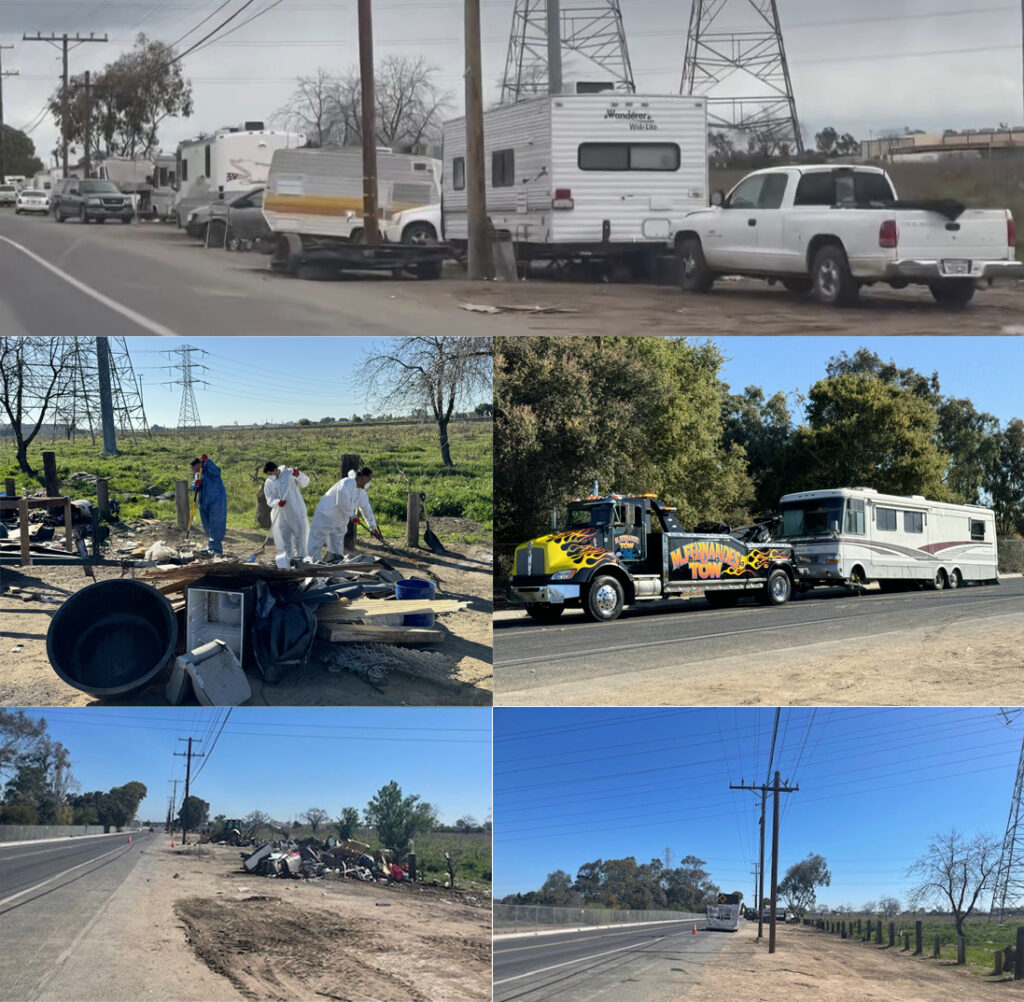
Before, During & After Wilbur Avenue homeless encampment cleanup. Campers and vehicles on March 4, 2024. Source: Video screenshot courtesy of ContraCosta.news. RV towed and City of Antioch workers during clean up on March 19, 2024. Photos courtesy of Mike Burkholder. Photos following the cleanup. Source: City of Antioch.
“No other areas were suggested for them in Antioch or elsewhere.” – Acting City Manager Kwame Reed
Homeless advocates not happy they weren’t notified to be there to help the residents
“…they have just displaced these souls with absolutely no solution as to where they should go” – Nichole Gardner
By Allen D. Payton
On Tuesday morning, March 19, 2024, City of Antioch staff cleared out 70 vehicles and “approximately 100” people from the eastern end of Wilbur Avenue near Hwy 160, between the power plant and vineyards.
A post on the City’s Facebook page reads, “Teaming up to revitalize our community.
Today, numerous City departments partnered to clean up Wilbur Avenue. With a coordinated effort that included our Code Enforcement team, Police Department, Public Works, Public Safety & Community Resources Department, the Angelo Quinto Crisis Response Team (AQCRT), Parking Enforcement, and Antioch Animal Services the Wilbur Avenue area has been abated. In total, 70 vehicles were cleared, and support services were offered to people and pets at the location. Together, we can make a difference!
We would also like to thank our Contra Costa County partners for their support leading up to today.”
Questions were emailed Tuesday after work hours to Public Safety and Community Resources Department Tasha Johnson and Unhoused Resident Coordinator Jazmin Ridley. They were asked how many individuals were living there and how many of them were school-aged children.
They were also asked if another location in Antioch or elsewhere has been offered for the motorhomes and campers. Finally, they were asked what “support services were offered to people and pets at the location” as written in the post. But neither responded. On Wednesday, the questions were then sent again to them and Acting City Manager Kwame Reed.
On Friday, March 22, Reed responded there were “approximately 100” people moved from the Wilbur Avenue encampment. But he shared that information on the number of school-aged children “was not tracked.”
Reed also said, “No other areas were suggested for them in Antioch or elsewhere.” Yet, “over the past 2-3 weeks, staff in association with the Care Team and County’s CORE (Coordinated Outreach Referral, Engagement) Team, visited the location to provide assistance.”
The Antioch Care Team (ACT) was formed in 2021 “to reduce non‐warrant arrests that result during a 911 response; reduce the number of individuals transported to the emergency department for non-life threatening medical-related issues that could instead be addressed in a prehospital care setting; and reduce the number of behavioral health and lower acuity medical calls traditionally responded to by Police and Fire.”
It’s now referred to as the AQCRT.
Advocates Not Happy They Weren’t Informed
In addition, local volunteer homeless advocates, Andrew Becker and Nichole Gardner were asked if they were aware of the cleanup before it occurred and for their comments on the City’s efforts.
Gardner responded, “No. It was unfortunate too because our team would have gladly helped with making sure that the folks that were there knew that the city was clearing out the area (if they did not receive a proper notice) and would have been there to support by supplying bags and helping them pack up their belongings. We could have also provided food, drinks and supplies as it takes a physical toll on folks having to move everything they had on short notice.”
“We know that these sweeps that the city does causes emotional and physical trauma to people in encampments who are dealing with mental illness and hoarding disorders,” she continued. “We have seen individuals break down in tears because they are so emotionally attached to their items.”
“One of the lieutenants at APD used to call us to let us know when there would be a big sweep such as this, we were surprised that he did not reach out after knowing such a large sweep was going to take place,” Gardner shared. “I was told that APD was there which I was confused about because we have the Mental Health Crisis Response team (purple people) for a reason. There was no crime being committed so therefore I don’t know why we are wasting police resources on clearing out encampments, especially when we are lacking so many officers. “
“I am not naïve to think that this area did not need a good cleaning,” she stated. “Some people in encampments tend to suffer from hoarding disorders and hoard things that others consider garbage, but I am disappointed that when these clean ups take place, they not only don’t have a place for people to go for shelter but no safe parking lot for these RV’s. What is more upsetting is that they show up with tow trucks to tow away the only place that they call home and leave them to be in the elements without shelter.”
“It was sickening seeing the City Facebook page about how they cleared the area. The city bragged about cleaning up the area to appease the community members while forgetting that they have just displaced these souls with absolutely no solution as to where they should go,” the local homeless advocate said. “We need a safe parking lot for these RV’s with staff to be sure that they are maintained and people are not bringing in anything that does not fit in their RV.”
“If the city spent more time focusing on being proactive by putting money into mental health, affordable housing, shelters, and safe parking with porta potties and dumpsters and stop spending hundreds of thousands of dollars a year into cleaning up encampments all over the city we wouldn’t be in this situation,” Gardner added.
Becker responded, “I was not aware of the abatement that took place, no notice was given by the City to advocates, locally. We had multiple conversations with the City, previously regarding abatements. We had been told we would be notified as well as CORE.”
“When I arrived at the site at 12:30 pm, 90% of the individuals and their property had been removed,” he continued. “CORE was not on site, only APD and neighboring law enforcement agencies. Beyond the update the City posted online, I have no knowledge of what resources were made available. I also do not know whether individuals’ items were stored or disposed of. There were no alternative temporary encampment locations made available to the residents to my knowledge.”
Later, in response to the information provided by Reed, Becker asked, “Does that assistance mean placement? How many of those people were placed?”
“There were limited services. They said Animal Services was out there. But I had to wrangle two chickens, myself and took them to Animal Services,” he added.
In 2022, the California legislature passed and Governor Gavin Newsom signed AB205 – Energy into law, which requires that the Public Utilities Commission (CPUC) “shall, no later than July 1, 2024, authorize a fixed charge for default residential rates.” As a result, the CPUC is currently reviewing proposals for a tiered, fixed-price structure, as directed by the bill.
According to FOX Business, the state’s three main, investor-owned utilities – Pacific Gas and Electric (PG&E), Southern California Edison (SCE) and San Diego Gas and Electric (SDG&E) – proposed a tiered rate plan: “Households earning $28,000-$69,000 would be charged an extra $20 to $34 per month. Those earning $69,000-$180,000 would pay $51 to $73 per month, and those earning more than $180,000 would pay a $85-to-$128 monthly surcharge.”
According to California Energy Markets, “The first version of the income-graduated fixed charge, or IGFC, could be implemented by SDG&E and SCE by 2026, according to Freedman. PG&E is in the process of changing its billing system, he said, so its implementation would likely be in 2027.”
That’s on top of the 13% increase for both electricity and natural gas rates for PG&E customers approved by a unanimous vote of the CPUC last November that went into effect on January 1, 2024. Plus, another vote on March 7 for $4-$6 in additional monthly fees for the typical ratepayer that will take effect in April, was approved for PG&E to recover $516 million in costs for wildfire mitigation, gas safety and electric modernization.
According to a Canary Media report, “The utilities are also proposing to significantly lower the per-kilowatt-hour charges that customers pay to counterbalance the big increase in fixed charges, and to structure both fixed and volumetric charges in a way that allows lower-income customers to save money overall. Still, the proposal, if enacted, would instantly make California the home of the nation’s highest monthly utility fixed fees, according to analysis by clean energy research firm EQ Research.”
The IGFC would require the CPUC to evaluate every ratepayer’s income annually in order to assess the appropriate fee.
Assemblyman Jim Frazier didn’t vote on the bill in 2021 and State Senator Steve Glazer didn’t vote on AB205 during the State Senate’s floor vote in 2022. Newsom signed the bill into law on June 30, 2022.
Details of New Law
As of July 1, 2022, the applicable portion of the law now reads as follows:
“SEC. 10. Section 739.9 of the Public Utilities Code is amended to read:
(d) The commission may adopt new, or expand existing, fixed charges for the purpose of collecting a reasonable portion of the fixed costs of providing electrical service to residential customers. The commission shall ensure that any approved charges do all of the following:
(1) Reasonably reflect an appropriate portion of the different costs of serving small and large customers.
(2) Not unreasonably impair incentives forconservation, energy efficiency, and beneficial electrification and greenhouse gas emissions reduction.
(3) Are set at levels that do not overburden low-income customers.
(e)(1) For the purposes of this section and Section 739.1, the commission may authorize fixed charges for any rate schedule applicable to a residential customer account. The fixed charge shall be established on an income-graduated basis with no fewer than three income thresholds so that a low-income ratepayer in each baseline territory would realize a lower average monthly bill without making any changes in usage. The commission shall, no later than July 1, 2024, authorize a fixed charge for default residential rates.
(2) For purposes of this subdivision, ‘income-graduated’ means that low-income customers pay a smaller fixed charge than high-income customers.”
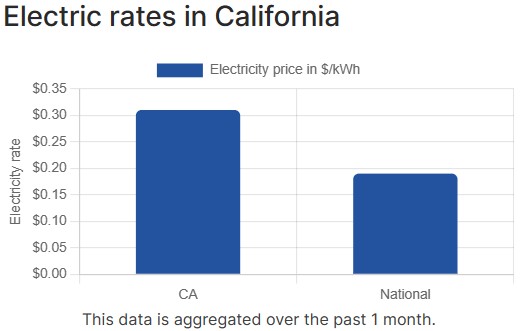
Source: Energy Sage published 3/10/24
Californians Pay 27% More for Electricity Than National Average
According to Energy Sage, California residents currently pay 31 cents per kilowatt-hour compared to the national average of 18 cents per kilowatt-hour. “On average, California residents spend about $256 per month on electricity. That adds up to $3,072 per year. That’s 27% higher than the national average electric bill of $2,426.”
That same day, Assemblymember Jacqui Irwin, (D-Thousand Oaks) and 10 others introduced a bill to repeal AB205. According to Irwin’s press release about the new bill, “The CPUC has had the authority to implement a fixed rate charge, up to $10, since 2015, but has declined to do so. I see no need to rush now. It’s time to put some reasoning back into how we charge for electricity in California.” Bauer-Kahan is listed as a principal coauthor. It was also introduced in the State Senate.
According to the aforementioned Canary Media report, “The newly introduced bill, AB 1999, would limit the CPUC to adding a fixed charge of no greater than $10 a month on customers’ bills to pay for the rising costs of maintaining the state’s utility grids, regardless of household income.”
The bill is in the committee process, was referred to the Assembly Committee on Utilities and Electricity. If approved it will then head to the floors of both houses of the state legislature for votes and if passed, the bill will head to the governor’s desk for his signature or veto.
3/27/24 UPDATE: According to Sylvie Ashford, Energy & Climate Policy Analyst for The Utility Reform Network (TURN) which supports the implementation of an income-graduated fixed charge, and is one of the authors of the organization’s IGFC proposal,
“The IOUs are no longer proposing the charge levels that you cite (e.g. up to $128 per month). The CPUC has already ruled that the first iteration of the fixed charge will have income tier cut-offs based only on the existing CARE/FERA programs, with no ‘high-income’ tier. The IOUs submitted new proposals in the fall, with a max charge of $51-$73 (page 5 of their brief).
It’s not that utilities will “also” lower $/kWh rates. The fixed charge itself lowers rates, as is comprised only of costs that are included in rates today. It shifts some fixed costs out of electricity rates and into a separate line item.
Thus, your headline that “Californians face higher electricity rates based on income” is incorrect. All customers will pay lower electricity rates (15% lower under TURN’s proposal). Some higher income customers will see higher overall bills only if their assigned fixed charge exceeds their savings from the reduced rates. (For example, TURN’s proposal has a maximum monthly fixed charge of $30, and we estimate those customers will see $3-7 bill increases, depending on their usage).”
Iin addition, she shared, “TURN believes that the fixed charge presents a critical opportunity to reduce low-income energy bills in the state. TURN also believes much more is needed to make bills affordable and intervenes widely at the CPUC to oppose rate increases. A few quick points:
The fixed charge will not increase utility revenue/profits; it removes costs from rates and shifts them to a separate line item on your bill.
This will reduce electricity rates ($/kWh) for all Californians, making it more feasible to operate electric vehicles and appliances.
Because the new line item is based on income, it will also reduce overall bills for low-income Californians (likely to be defined as the low-income CARE/FERA discount programs, which cover 30% of the state) and it will make electricity bills less regressive.
TURN strongly opposes the joint proposal of the utilities for fixed charges, and the CPUC is not considering it. The CPUC has already ruled that the first iteration of the fixed charge will have income tier cut-offs based only on the existing CARE/FERA programs, with no ‘high-income’ tier, so the average fixed charge will be low (TURN proposes an average of $23.50, which is the same charge already offered by the Sacramento Municipal Utility District).
Ashford was asked to explain how, if the cost of providing electricity does not differ from one user to the next in one of the three utility company’s service areas, it’s fair to charge one customer more based on their income. She was also asked weren’t renewals supposed to reduce electricity costs and aren’t we relying more on them, now for electricity generation in California,
Ashford responded, to your questions about the fairness of paying based on income, and why rates have been increasing when generation keeps getting cheaper (thanks to renewables): the problem is that your $/kWh electricity rates today are largely comprised of costs that have nothing to do with your personal usage. They are bloated with the fixed costs of the grid, like the utilities’ wildfire mitigation programs and infrastructure projects.
As a result, a UC Berkeley study found that California’s electric rates are highly regressive; low-income households pay more of their income on shared system costs. Households in hot climates, that need to use more electricity to keep cool, also pay more than their fair share of these costs. On the flipside, solar customers are paying less than their fair share, which has created a ‘cost shift’ that hikes rates for everyone else (source).
TURN is a strong advocate of reducing utility spending, which is the most important step to reduce rates. The fixed charge alone doesn’t address that problem, as it simply shuffles the collection of existing costs, but it will make bills more affordable for those that are disproportionately burdened by shared system costs.”
District 5 residents who want to get involved in improving their communities
Applications due March 29
Supervisor Federal Glover announced opportunities for District 5 residents to make decisions affecting their communities. “A lot of policies begin in these county commissions and boards,” said Glover. Commissions are appointed by the Board of Supervisors based on his recommendation. Interested individuals may apply online at: https://contra-costa.granicus.com/boards/forms/321/apply/ or they can contact Supervisor Glover’s office at (925) 608-4200. Completed applications must be received in Supervisor Glover’s office by close of business Friday, March 29, 2023.
Crockett-Carquinez Fire Protection District Fire Advisory Commission: reviews and advises on annual operations and capital budgets; reviews Fire District expenditures; advises the Fire Chief on district service matters; and serves as a liaison between the Board of Supervisors and the community served by the fire district. The seats that are open are: 1 Regular Seat (Appointee 2). Meetings are held on the third Thursday of the month at 7:00 p.m. at 746 Loring Avenue, Crockett, CA 94525. The current seat opening has a term ending December 31, 2024. For information call Dean Colombo at (925) 787-0790.
Emergency Medical Care Committee: Role is to review the County’s ambulance and other emergency services as required in State law; and serves in an advisory capacity to the County Board of Supervisors, and to the County EMS Agency, on matters relating to emergency medical services as directed by the Board. The Committee meets at the Contra Costa County Emergency Medical Services (EMS) Administrative Office, 777 Arnold Drive, Martinez, CA, from 4 p.m. to 5:30 p.m. The current vacancy is for District V – Consumer Representative with a term ending September 30, 2024. For information, call Rachel Morris (925) 608-5454. Rachel.Morris@cchealth.org
Measure X Community Advisory Board: The Measure X Community Advisory Board was established by the Board of Supervisors on February 2, 2021 to advise the Board of Supervisors on the use of Measure X transactions and use tax funds. The current vacancy is for the District 5 Seat – Alternate seat with a term ending March 31, 2025. The meetings are normally scheduled for Wednesday’s at 5:00 p.m. For information call Adam Nguyen at (925) 655-2048. Adam.Nguyen@cao.cccounty.us
Measure X Community Fiscal Oversight Committee: The Measure X Community Fiscal Oversight Committee was established by the Board of Supervisors earlier this year to advise the Board of Supervisors on financial audits of Measure X tax funds. The current vacancy is for the District 5 Seat with a term ending December 31, 2024. The meeting dates and times are to be determined. For information call Adam Nguyen at (925) 655-2048. Adam.Nguyen@cao.cccounty.us
Mental Health Commission: The Mental Health Commission was established to review and assess the community’s mental health needs, services, facilities, and special problems, in order to advise the Board of Supervisors concerning local mental health services and programs. The current vacancies are for the District 5 Seat 3 with a term ending June 30, 2027. The Mental Health Commission meets the first Wednesday of each month from 4:30-6:30 p.m. For information call Angela Beck at (925) 313-9553. Angela.Beck@cchealth.org