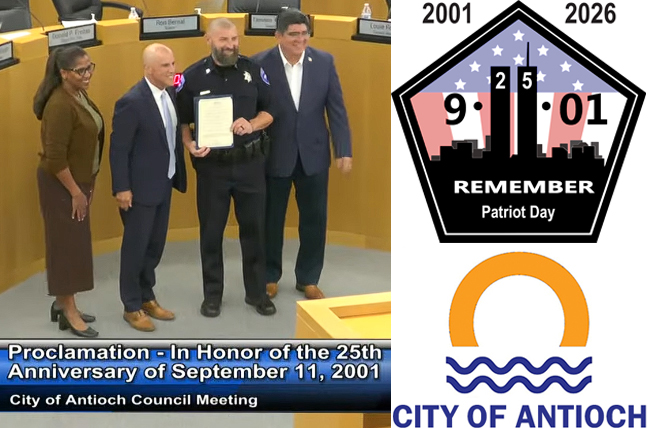
Antioch Mayor Ron Bernal, joined by Councilmembers Monica Wilson (left) and Louie Rocha (right) presents the 9-11 25th Anniversary proclamation to Police Captain Desmond Bittner during the council meeting Tuesday, Sept. 8, 2026. Sources: (Left) Video screenshot (Top Right) U.S. Air Force
By Allen D. Payton
During their meeting on Tuesday, Sept. 8, 2026, the Antioch City Council approved the following proclamation on a 3-0 vote with two council members absent, honoring the 25th anniversary of 9-11, Patriot Day and National Day of Service and Remembrance. It was presented to Antioch Police Captain Desmond Bittner.
Bittner said, “It’s my honor to receive this on behalf of the men and women of the Antioch Police Department and the men and women of the Contra Costa Fire Department who could not be here today and the veterans in both departments. I will share this with them tomorrow.” (See 1:30:20 mark of meeting video)
WHEREAS, September 11, 2026, marks the 25th anniversary of the terrorist attacks of September 11, 2001, when nearly 3,000 innocent people lost their lives in New York City, at the Pentagon, and in Shanksville, Pennsylvania; and
WHEREAS, the events of September 11, 2001, forever changed our nation and continue to impact the families of those who were lost, survivors, first responders, recovery workers, service members, and communities throughout the United States; and
WHEREAS, firefighters, law enforcement officers, emergency medical personnel, military personnel, and countless civilians demonstrated extraordinary courage and selflessness, risking their own lives to save and assist others; and
WHEREAS, in the days and weeks following September 11, Americans came together with compassion, unity, resilience, and a renewed commitment to helping one another, demonstrating the strength of communities in times of adversity; and
WHEREAS, 25 years later, a new generation has grown up without firsthand memories of September 11, making it our shared responsibility to preserve the stories of those who were lost, honor those who served, and ensure that the significance of that day is never forgotten; and
WHEREAS, September 11 is recognized as Patriot Day and a National Day of Service and Remembrance, providing an opportunity to honor those who lost their lives and those who answered the call through reflection, service, compassion, and commitment to our communities; and
WHEREAS, the City of Antioch joins communities throughout our nation in remembering the lives lost on September 11, honoring the heroes who responded, and recognizing the enduring values of courage, service, unity, and resilience;
NOW, THEREFORE, I, RON BERNAL, Mayor of the City of Antioch, do hereby proclaim September 11, 2026, as “Patriot Day and National Day of Service and Remembrance – 25th Anniversary of September 11, 2001” in the City of Antioch, and encourage all residents to pause, remember, honor, and serve in memory of those whose lives were forever changed.
Carraher says he worked to fulfill 2001 Board vote and 2003 commitment to City Council
Yet, all but two on city council, staff, and other theater board and staff in 2022 or 2023 say they didn’t speak to the other sideprior to sale
Theater board, staff unaware of 2022 state law that might have prevented first sale to private party
Sale of theater was not made public by board either in 2023 or this year
By Allen D. Payton
In response to reports by the Herald regarding the purchase by a church of Antioch’s 98-year-old El Campanil Theatre building in the City’s historic, downtown Rivertown, members of the public and this reporter have been posing questions to decision makers and city leaders and conducting research on the original funding for the purchase and renovations in 2002 and 2003, and the first sale to a private party in 2023. Now that the City’s website includes copies of council meeting agendas and minutes dating back to 1997, searches have resulted in discovering a commitment made by the then-president of the El Campanil Theatre Preservation Foundation that the building would be “turned over free and clear to the City” if they were “unable to pay their bills” and a foundation board vote in 2001 giving the City “right-of-first-refusal to the building” if the non-profit “corporation is no longer able to function.”
But when the foundation ran into post-COVID financial difficulties, neither the transfer of the almost 11,000 square foot building happened nor is their proof or confirmation that the theater was first offered to the City before it was sold to a private party in 2023.
In addition, according to a resident and confirmed in state law, prior to the disposition of “all or substantially all” of a charitable non-profit organization’s assets, they are required to inform the California Attorney General for his office’s review and satisfaction. But prior to the sale in 2023, that didn’t happen either.
Overview from Property Report dated Sept. 8, 2026.
Summary
Rick Carraher, a former downtown business owner, the former president of the Rivertown Business District Association which initiated the effort to purchase and renovate the building in 2001, a former member of the City’s Economic Development Commission, as well as the theater’s first board president, first executive director, and later, board member, and the visionary behind the effort, made the 2003 commitment to the City Council before they voted to contribute $750,000 in redevelopment funds to help renovate the building and theater inside.
Carraher stated in an interview with the Herald this past week, “And I think in good faith we did that. The City was approached, first and the mayor and city manager knew of the theater’s financial difficulties,”before the 2023 sale, which Carraher also lined up.
By then, he had stepped down as executive director and again served on the board of directors of the foundation. (See related article)
Then in 2009, in a letter to the mayor and council when seeking a guarantee for the loan to replace the theater building’s HVAC system, Carraher disclosed the 2001 vote by the foundation’s board of directors that gave the City of Antioch the right-of-first refusal to the assets of the non-profit corporation if it could no longer function.
Carraher (pronounced “CARE-uh-her”) said the building was sold to the current owner because he was committed to maintaining the venue for the arts, which the owner reiterated. (See related article)
The theater’s visionary also explained in detail what transpired in 2023 sharing that the then-mayor mentioned to the then-board president one million dollars that was possibly available.
“But that never materialized,” Carraher stated. “So, we started looking for private investors.”
However, both of those people said they spoke to each other about the matter after the theater building was sold that year.
Background
The building includes the theater and three retail spaces on W. 2nd Street, and offices inside upstairs. Two of the street-level spaces are leased to local businesses. The foundation leases the rest of the building, using the third, street-level space as the ticket office. According to Carraher the 2023 sale included the building and all the equipment.
According to the History page on the theater’s website, which he wrote, the building was built in 1928, and it and the theater inside were “owned and operated by the Stamm family for 75 Years, or until 2003. In 2001, a small group of local citizens, including representatives of the Rivertown Business District Association, approached the City of Antioch with their desire to find a way to acquire and restore El Campanil, and to convert its use to one supportive of the Rivertown Renaissance plan. The…Association took the lead in securing funding from Calpine for the development of a comprehensive business plan…” That was the $50,000 initial contribution from Calpine, Carraher shared.
The theater’s history continues, “In July 2002, El Campanil Theatre Preservation Foundation was incorporated as a charitable, non-profit 501(c)3 organization. In early 2003, Calpine Corporation and the City of Antioch entered into an agreement whereby the Foundation received a grant to acquire the Theatre. In July 2003, El Campanil Theatre Preservation Foundation purchased the Theatre and began the process of converting the building to a community performing arts venue.”
Calpine granted the foundation $500,000 for purchase of the building from the Stamm family. Prior to the sale, another church, Fortress Christian Center, had previously rented and occupied the building for several years.
Thanks to Herald reader, Michelle Kuslits, who provided a copy of the minutes for the City Council meeting on Dec. 16, 2003, they show that before the 4-0 vote approving $750,000 in City redevelopment funds for renovations to the building, a commitment was made by Carraher, the then-foundation board president. According to that meeting’s agenda, the council was initially asked, “to provide direction to staff regarding funding of (an additional) $500,000 for the purchase of essential equipment and improvements for renovations to the El Campanil Theatre.” Then-mayor and now-Mayor Pro Tem Don Freitas was absent during the meeting but was supportive of both the $500,000 Calpine grant for the building’s purchase and funding from the City for renovations. (As previously reported, Freitas informed the Herald last week he would be unreachable for the following two weeks).
Portions of the minutes of Item 5. on the Antioch City Council meeting agenda for Dec. 16, 2003, which contain the commitment by Rick Carraher in the highlighted section. Source: City of Antioch
Building Was to “Be Turned Over Free and Clear to the City of Antioch”
According to the meeting minutes (see page 6), “Rick Carraher, President of the El Campanil Preservation Foundation, distributed a handout to the Council and gave a slide presentation on the history and the preservation goals of the El Campanil Preservation Foundation.
“Rick Carraher added this theatre would be used by a number of other community groups, including fund raising efforts for other groups. Regarding the City’s investment in this project, Mr. Carraher stated all monies would be dedicated to equipment and other tangible assets only, and would not pay any bills or consultants with the exception of the restoration plan itself which would be critical to the next phase. Furthermore, 100 percent of the monies would be put back into the theatre.
“Mr. Carraher also stated if the Theatre Preservation Foundation should, in the future, become unable to pay their bills, the Theatre would still have a high value, and the investment would be turned over free and clear to the City of Antioch, therefore the building and all of its contents and improvements would transfer to the City thus ensuring the facility would remain a community treasure.”
However, nothing to that effect was included in the motion adopted by the council. It read, “On motion by Councilmember (Jim) Conley and seconded by Councilmember (Brian) Kalinowski, the Council approving the allocation of $750,000 from the Promenade project to the El Campanil project with the stipulation the funds be repaid with RDA monies as they become available.” RDA refers to the City’s redevelopment agency, which no longer exists. The other two council members at that time were then-Mayor Pro Tem Jim Davis and Councilman Arne Simonsen.
For accuracy, minutes of government meetings are not verbatim and without the video of the meeting, which is not currently available on the City’s website, it’s not known what, if anything the council members said about Carraher’s stated commitment.
When reached for comment, Simonsen shared, “The City Attorney was supposed to put conditions on the property so that it would stay a nonprofit.”
While he claims his commitment was not binding on the theater foundation’s board, Carraher said they made the effort to first offer it to the City to take control either through outright ownership or some form of a partnership prior to the 2023 sale.
Letter from Rick Carraher to the City Council on Jan. 7, 2009, regarding the City serving as guarantor for the HVAC loan which, in the highlighted section, mentions the foundation’s board vote in 2001. Source: City of Antioch
2001 Board Resolution Offering City “Right of First Refusal”
However, a commitment was made in writing. After finding it during a search of City files, City Attorney Lori Asuncion (pronounced uh-SUN-shun), on Tuesday, Sept. 8th, provided to the Herald a copy of the City staff report for an agenda item for the council meeting on Jan. 13, 2009, regarding the City guaranteeing the foundation’s loan for the HVAC system replacement that year. It contains a letter on foundation letterhead dated January 7, 2009, from then-executive director, Carraher to then-Mayor James Davis and the city and council which reads, “On March 9, 2001, the Board of Directors passed a resolution that gives the City of Antioch the Right of First Refusal to the Assets of the Corporation in the event that the Corporation is no longer able to function.”
An email was sent on Wed., Sept. 9th to current board president, Sharon Sobel Idul requesting a copy of the 2001 resolution. She responded, “I mentioned it to our board members. We’ll have to go digging in physical files. I’ll let you know if and when we find these items,” also referring to a copy of the 2003 agreement between Calpine and the City of Antioch. As of publication time on Friday, Sept. 11th that has not yet occurred.
City Redevelopment Funds
After redevelopment agencies in California were officially dissolved as of February 1, 2012, the City of Antioch has served as both the Successor Agency and the Housing Successor to the former Antioch Development Agency (ADA), the City’s name for its former redevelopment agency.
Screenshots of questions posed and information provided by reader Michele Kuslits on the Antioch Herald’s Facebook page, beneath the post of the link to the article entitled, “Owner explains reasons for selling Antioch’s historic El Campanil Theatre.”
Public’s Questions About 2023 Sale
A variety of questions were posted in comments on the Antioch Herald Facebook page, by Kuslits, regarding the 2023 sale and she shared information about a law that went into effect on July 1, 2022, requiring notification by the foundation to the California Attorney General at least 20 days prior to the sale.
Kuslits wrote, “There are alot of questions to ask regarding the actions of the El Campanil Preservation Foundation and The City if [sic] Antioch in the 2023 sale and also the use of the grant, redevelopment funds and charitable donations used to renovate it. Those were public funds:” However, the grant was no public funds, as they were given by Calpine, a private company, directly to the foundation. Yet, they were the subject of the agreement between those two parties and the City.
She also asked, “What conditions were attached to the Calpine grant and the City’s redevelopment funds? Were any deed restrictions, public-use requirements, repayment provisions, rights of first refusal or City approval requirements placed on the property? Did the City, former Redevelopment Agency or Successor Agency consent to the Foundation’s 2023 sale of the property to a private, out-of-state purchaser?
“Before or after that sale, did the City investigate whether transferring the property to a nonpublic entity complied with the original grant agreements, redevelopment requirements and charitable purpose for which the property was acquired and renovated?
“Did the 2023 sale trigger any obligation to repay or reimburse the City or its Successor Agency? Was the City notified of the sale, and were any City-held covenants, liens, restrictions or other rights released or terminated?
“This one is very important: ‘Were the California Attorney General’s requirements governing the disposition of a charitable nonprofit’s principal assets reviewed and satisfied?’
“Were the charitable donations raised to preserve the theater subject to restrictions requiring the property, or the proceeds from its sale, to remain dedicated to a community theater or performing-arts purpose? What protections, if any, remain in effect to ensure that El Campanil continues to be available to the public for performing arts and cultural programming?
Kuslits also asked this reporter some of the same questions, writing, “Did you ask the El Campanil Preservation Foundation: ‘Were the charitable donations raised to preserve the theater subject to restrictions requiring the property or the proceeds from its sale to remain dedicated to a community theater or performing-arts purpose?’ and also: ‘Were the California Attorney General’s requirements governing the disposition of a charitable nonprofit’s principal assets reviewed and satisfied?’ The Foundation should be able to produce its Attorney General notice, appraisal and supporting transaction documents and any Attorney General acknowledgment, waiver or correspondence regarding the 2023 sale.”
2022 State Law Might Have Prevented 2023 Sale
Kuslits was referring to California’s AB 900, from the 2021-22 legislative session. According to For Purpose Law Group, “While it was originally written for charitable trusts, it was designed to close a loophole: before AB 900, California already required similar advance notice from officials of 501(c)(3) charitable organizations (California ‘public benefit’ corporations). Nonprofits that are charitable corporations…are considered ‘entities holding assets subject to a charitable trust’ under the statute.”
According toChurch LawCenter.com, “In 2021, California lawmakers passed AB 900, which went into effect on July 1, 2022. This law aimed to add a new section to the Probate Code to fix an inadvertent loophole in the reporting requirements for California charities. The law at issue requires charities to give written notice to the Attorney General at least 20 days before selling, leasing, conveying, exchanging, transferring, or otherwise disposing of all or substantially all their charitable assets.
“On June 23, 2023, the Attorney General’s Office published a regulation interpreting certain aspects of the new law. The regulation is Section 328.1: ‘Notice of Transactions Involving All or Substantially All Assets of Charitable Corporation or Trust, or Assets in Charitable Trust Held by a Nonprofit Mutual Benefit Corporation.’
“Section 328.1(a) defines ‘substantially all’ as follows: ‘an asset or assets equal to or exceeding 75% of the value of all assets held by the charitable corporation or trust at the time of the notice or at any time during the six months before submitting the notice. Notice must be provided if the transaction involves ‘substantially all’ assets under either book value or fair market value.”
So, whether the theater’s foundation board had transferred the building and all of its assets to the City, to fulfill Carraher’s 2003 commitment to the council, or sold the building, as they did in 2023, the requirements of AB 900 were to still be followed but were not, mainly due to ignorance of the law.
Source: El Campanil Theatre
THE THEATRE’S SIDE of THE MATTER
Carraher Provides Details
Carraher, who with his wife, Janis, owned Rivertown’s iconic Rick’s on Second restaurant, moved out of state four years ago, but continued to serve on the foundation’s board of directors until last year. He was asked about the 2003 council meeting.
“I remember vividly. My ask was for $500,000 going in,” he stated. “I believe it was Brian Kalinowski, who was very excited about the project, wanted to know what we could do if they gave us an extra $250,000. I was prepared and I pulled out of my satchel and said, ‘we will have the nicest seats inside the theater.’ He had said he had just gone to another theater in the area and came away with duct tape on his backside. We thought it would cost $350,000 for top-of-the-line seats.”
Asked if, in 2023 he had forgotten about his 2003 commitment to the city council Carraher stated, “No, I didn’t forget about it. We had lengthy conversations, for sure, with the city management and it could have been council members. I don’t want to hear anybody say, ‘the city never knew’. We would have never sold that building without letting the city know. Obviously, it was public knowledge, because it was offered to Sean McCauley to whom we made an inquiry.” McCauley owns several buildings in Rivertown and Antioch, and is currently a member of the City’s General Plan Advisory Committee.
“But we were not trying to alert and get the neighbors nervous,” Carraher continued. “When we were raising funds, people were concerned. Since the day I joined, we haven’t stopped raising funds.”
Post-COVID Financial Challenges Led to 2023 Sale
Carraher explained the reason for the private sale in 2023 was due to the post-COVID financial challenges the theater was facing and shared more details.
“After COVID, we lost our major funders,” he stated. “The Hewlett Foundation was consistently contributing $150,000 per year. At one point, they gave us an extra $200,000. We also lost the Lesher Foundation after they looked at our books. They were local so they really dug in. They wanted to make sure we were going to be around in a year. I told them I wasn’t sure we would be. I think they got up to $100,000 per year” in contributions.
“So, our income was $500,000 per year during my time and we stayed afloat,” Carraher continued. “$300,000 came from non-earned income, grants, donations, individual and corporate. Earned income is ticket sales and rentals and hard-earned money. Roughly $100,000 from the $200,000 came from rentals, meaning local, community events and activities, like graduations, the fire department’s bell ringing ceremonies. We had weddings in the theater. We truly were a community theater. The other $100,000 was El Campanil Theatre Presents, like Randy Newman, Debbie Reynolds and more recently, The Association. We had the big bands and In The Mood. Those were in-house productions. We got revenue from ticket sales, primarily, and some sponsors – not a lot.”
“But during COVID, our income dropped and we were heavily dependent on COVID funds,” he explained. “People couldn’t go to the theater, and we had to fight to reopen. Once we did, our attendance had dropped and we continued to have monthly operating costs, like our air conditioning system, our utilities and still had staff to maintain the place. During the lean days our operating expenses were $15,000 a month without putting on shows.”
“We started to get some money but that was used to cover old bills,” Carraher shared. “We didn’t have enough revenue because the attendance was miserable. It took time to get rentals to come. The dance studios were hurting from COVID. They had to ramp back up before they could have recitals, again.”
Asked if that was announced publicly, he said,“People did not know, generally, that the theater was for sale. If you go on social media and tell people, ‘business is crappy,’ and people aren’t coming in, are people going to go there? We weren’t trying to get people to stay away, we were trying to get people to come there. It’s just not how you conduct business. There was a lot of thought that went into this.”
Regarding asking the City, Carraher said, “The meetings were not in a formal setting at council meetings. We let it be known, but there was no response from the City that they would take over the theater. (Then-mayor) Lamar (Hernandez-Thorpe) became aware at that time and he came to the theater and spoke briefly to me and probably Kathie Campbell who was president, and said the City has money to spend on activities, about a million dollars and we thought the City was going to partner with us. Something like federal or block grant funds. But that never materialized. It never came through.”
“We thought, ‘the City doesn’t want us.’ So, we started lookingfor private investors,” Carraher stated.
Asked again about his commitment to the council during the 2003 meeting Carraher said, “I don’t recall it. But I’m not going to deny I said it. The first offer was to be made to the City. There is no binding agreement.”
Asked about what is written on the History page of the theater’s website about the agreement between Calpine and the City, he said, “I wrote that history. I don’t remember a document, as such.”
“What was discussed at that council meeting was the first offer would be to the City,” Carraher stated. “And I think in good faith we did that.It wasn’t in the documents. It was the spirit and intent of the foundation to the biggest benefactor we had. My term then and it is now they had the right-of-first refusal. If the Lesher Foundation had contributed the most we probably would have approached them.”
“I don’t believe I ever signed anything. It was a spirit of the event,” he reiterated.
Unaware of 2022 Law
Informed of and asked about the requirements of AB 900 Carraher responded, “I wasn’t an attorney with knowledge of non-profit laws. Like most small non-profits, I was familiar with day-to-day operations and requirements. I never received any notice of the bill in question or its revision in 2022.”
The Ownership Timeline from Property Report paid for by the Herald on Sept. 8, 2026, shows who owned the theater building, when it was sold and for how much.
History of Purchase by Foundation
As Carraher wrote on the History page of the theater’s website, “In 2001, a small group of local citizens, including representatives of the Rivertown Business District Association, approached the City of Antioch with their desire to find a way to acquire and restore El Campanil, and to convert its use to one supportive of the Rivertown Renaissance plan. The Rivertown Business District Association took the lead in securing funding from Calpine for the development of a comprehensive business plan for El Campanil Theatre. The business plan outlined the best strategies for moving the project forward and VenueTech Management Group, LLC, was retained to develop the plan.”
Carraher was president of the business association at that time.
“The Calpine funding was negotiated by then-city manager Mike Ramsey because Calpine was looking to place a pipeline through the city in the downtown area,” Carraher explained. “They were considering running it underground and having to tear up city streets. The City said we’ll give you the rights to put it under the water.”
“Calpine gave us the first $50,000 just to do the study in 2001,” he said.
Asked if there was an agreement between Calpine and the foundation, he said, “I think the City had an agreement with Calpine for the grant to the foundation.”
So, the foundation was not party to that agreement? he was asked. “No, we weren’t,” Carraher stated.
Asked about the $500,000 donation from Calpine, he said, “It came the day before the purchase in 2003. That was received by the foundation because we were a corporation by then.”
“I was negotiating with George Stamm, Sr. to purchase the building. He said, ‘I’ll give you two years to come up with the money.’ I called him back and we had a meeting the next week and I said, ‘here’s your check.’ George was stunned.”
“Calpine gave us the donation,” Carraher continued. “The funds were deposited. I remember seeing our bank balance with a half-a-million dollars in it.”
Regarding the City and the 2023 sale he said, “I think we were looking at terms of what would be a partnership. We would be willing to let the City own it and we would operate it for them. We were open to discussions, but it never got to that point.”
Asked who from the City did he speak with about the sale, Carraher said, “I remember being introduced to a city manager out front of the theater.” He was referring to then-City Manager Cornelius “Con” Johnson.
“At that time, the rumor was that the City might be interested. But I was not privy to any discussions. It was handled by the president,” Carraher explained.
In 2022, Ramsey was board president, and for a short time in 2023, Frank Giovanni took on the role before Kathie Campbell, who joined the board that year, and later was elected president. At that time Carraher was on the foundation’s board. “Kathie said, ‘I met with Lamar at a mixer and it came up.’ Very informal. It was conversation not commitment,” he explained.
Campbell served as president until last year. Carraher who said he “got the 2023 sale started while I was still living in Antioch,” left the board last November. Sobel Idul was elected board president last November and Campbell later resigned.
Screenshots show the members of the El Campanil Theatre Preservation Foundation’s Board of Directors and Executive Director in 2022 and 2023. Source: ECTPF tax returns
Former Board President Kathie Campbell Says She Spoke to Mayor After Sale Occurred
When asked about what Carraher shared Campbell responded, “I was not president when the theatre was sold, that was before my time on the Board. I did speak to Lamar after the sale had gone through, to no avail. Rick and the previous board handled the sale. Per Tung’s post, he worked with Rick to buy the building because they had been working together on the cell tower deal.” She was referring to current owner Tung Bui and the Herald article published last week about his reasons for this year’s sale.
Carraher confirmed that, explaining, “I hired him to be our consultant to negotiate the cell tower project with T-Mobile. When looking for a buyer I asked him to consider it and he made the successful bid.” The tower provided additional revenue for the theater.
Former Board President Frank Giovanni Did Not Talk to Anyone at the City, Provides Additional Details
When reached for comment former board member and president, during 2023, Frank Giovanni said, “I had no conversation with any City official.” He also said he was not aware of the 2022 law.
“The theater was in a bad situation where we had money for two months to run it,” he explained. “We got a hold of Sean McCauley who graciously gave us an audience and graciously gave us a bid. We asked everyone for buyers. I reached out to George Lucas (of Star Wars fame). We were trying to save this jewel.”
“We only had the two offers,” he continued. “Tung said to Rick, ‘why aren’t you giving me an opportunity to buy it?’ He came in with a bid that was better. It was a board decision.”
Giovanni previously held the annual Blues Festival benefit concerts for Antioch students at the theater.
“We gave away $10,000 a year to Antioch schools plus, $5,000 per year for scholarships. When we were done, we were over $100,000 to Antioch schools and music,” he shared.
“No one got paid a dime from our non-profit,” Giovanni added.
“Rick did a great thing for the City and the El Campanil,” he stated. “Rick built a wonderful organization with a clientele that was dying out. As new talent came in you would lose the current customer base. But it was something that could never click over. People aren’t going to the theater anymore. That’s one of the reasons the theater was dying.”
“When Rick was in charge, that place was on point. I think there were plenty of good acts there. Rick did a good job,” Giovanni added.
Former Board President Mike Ramsey Says He Didn’t Speak to Anyone at the City in 2022, Shares About 2003 Purchase
Mike Ramsey served as board president in 2022. When asked if he remembered speaking to anyone from the City he said, “No. I didn’t, fortunately, or unfortunately. I do recall I left the board because I was very disappointed the board was ignoring the financial advice Rick was giving them, that they needed to begin the process of paying off the debts so, when they went out of business all the debts were paid off. They were just burying their heads in the sand.”
“I had no conversations along those lines,” Ramsey reiterated. “But whatever Rick has to say about this is the gospel as far as I’m concerned.”
“He was the only one on that board sticking his neck out and pushing that over and over again and no one on the board wanted to listen to them,” he continued. “He’d done his homework and had spreadsheets and saying we could only last a certain number of months.”
About the 2003 purchase of the building Ramsey said, “Calpine came to me when they came to town and said what can we do to get the City’s support for their gas line that was going to run along the waterfront. I asked them ‘what you can do is give the funds to the El Campanil Theatre to get it back as a performing arts theater, again. Part of my mission of being with the City at that time was trying to revive the downtown. That was a big piece of it. I’m sure they talked with the mayor, they talked to Don to get the council’s support.”
“I said to Calpine that City staff would support them and their gas line if they did something beneficial for the city,” Ramsey added.
Asked why the City didn’t retain some form of ownership or have a council member sit on their board, he stated. “It would have been a grant and the City never entered into an agreement about the operations. It was an out and out grant.”
Executive Director in 2022 and Early 2023 Didn’t Speak with Anyone from City Either
Joel Roster was executive director for the theater until a month before the 2023 sale. When reached for comment and asked if he had spoken to anyone at the City before the sale, Roster said, “No, it certainly didn’t happen while I was there. I left, if I recall, in April, following the board’s decision to eliminate the education program. As things got tight the board’s first move was to do that, and I said, ‘I’m moving on’.”
“I was not in any talks about anything with the City,” he continued. “But if they could afford to do it, the best thing would be for the City to take it over.”
About his time as executive director, and specifically about his last year, Roster said, “We were doing really well, with the (COVID) PPE loans and the grants we were able to secure at that time changed everything.”
“It’s a big place to fill with such a limited staff and you need to get the marketing up to snuff,” he stated. “One of the best things they did was put Sharon as the president of the board. She’s great.”
“Everyone that was there and still there loves that place, deeply,” Roster added.
THE CITY’S SIDE of THE MATTER
Former Mayor Hernandez-Thorpe Says He Didn’t Speak with Anyone from Theatre Until After Sale
Former Mayor Lamar Hernandez-Thorpe was informed of Carraher’s comments and asked to provide his view of what happened and why the City did not take over the theater or partner with the foundation to keep it operating and out of private hands.
He responded with, “I only communicated with Joel during the time he served as Executive Director. My primary communication with him concerned the façade improvement program. I wanted him to work on a proposal because I believed the theater would have been an excellent candidate for that funding.”
“I did not learn about the sale of the theater until Kathie informed me, after Joel had arranged a meeting for the three of us. During that meeting, I expressed to both Kathie and Joel that, if another opportunity involving the sale of the theater arose in the future, I hoped they would keep the City in mind as a potential partner,” Hernandez-Thorpe explained.
“I was disappointed to learn that the theater had been sold to an owner from Oregon or Washington. When I learned the sale price, I was even more dismayed because I believed the City could have potentially purchased the theater, protected the property, and made the necessary improvements to transform it into a civic auditorium and/or public theater for the community. At the time we had a significant amount of unallocated ARPA funds which we could have used, along with healthy rainy-day funds (budget stabilization and reserves).” He was referring to the federal COVID-relief funds, from the American Rescue Plan Act of 2021.
“After my meeting with Kathie and Joel, I informed Brad (Helfenberger), who was the Parks and Recreation Director at the time, about the sale. He was also surprised to learn that the theater had been sold,” the former mayor continued. “We discussed what a great opportunity it could have been for the City and the theater’s nonprofit organization to partner on something meaningful for the community.”
“However, all of those discussions were just that, conversations. Nothing formal resulted from them,” he added.
“What I can say with certainty is that, had I known the theater was for sale before it was sold, I would have brought the matter forward for consideration and advocated for the City to explore purchasing it. That would have been consistent with other efforts I championed as mayor, including pushing the City Council to pursue the development of a town square at the former Beede Lumber Yard and advocating for the restoration and reuse of the Mayor’s House as a City Hall annex,” Herandez-Thorpe explained, referring to the Hard House on W. First Street next to the Lynn House and across the street from the Amtrak Station.
“The theater represented the kind of opportunity I believed the City should explore, specifically, preserving an important community asset while creating a lasting public benefit,” he concluded.
Three of the Two Current, Two Former Councilmembers Say They Never Heard from Anyone at the Theater
Questions were also sent to current council members, Monica Wilson and Tamisha Torres-Walker, and former council members Lori Ogorchock and Mike Barbanica, all of whom were on the city council in 2023 before and after the theater was sold. They were asked if any of them had spoken with Carraher or any of the board members about the possible sale before it occurred and if any of them spoke with representatives of the theatre foundation, what was discussed and were any commitments made of City funds.
Barbanica said, “Absolutely not. That theater is something that is important to the city. That would have immediately been addressed. I used to go to movies there as a kid. It was part of the cruise. I grew up going to that theater. I would have immediately jumped on that and addressed it. The history of that theater is incredible. There’s no way we would have let that happen.”
Ogorchock said, “Nobody ever reached out to me from the board with a text, email or phone call. I was surprised it was sold. I had no clue it was up for sale.”
Regarding the 2023 sale Torres-Walker said, “I don’t remember any conversation, anything being brought to my attention, the council, nothing. Maybe they talked to somebody. But I’ve looked through all my emails about El Campanil and nothing dates back to then.”
“We still had the ARPA funds, and we could have used them to expand public services,” she stated. “If they had brought this to the council back then, for real, for real, I would have advocated we used those dollars.”
The only council member from that time to not yet respond is Wilson after several efforts to reach her and after she was given the opportunity to respond to the Herald’s questions by writing them in a post on her official Facebook page to inform the public. But as of publication time that had not yet occurred.
Former City Managers in 2022 and 2023
Cornelius “Con” Johnson was City Manager from Oct. 26, 2022, until March 17, 2023. Community Development Director Forrest Ebbs was then appointed Acting City Manager from March 17 until June 26, 2023, before leaving for a job in another city.
Kwame Reed was Economic Development Director in 2022 and 2023 and was appointed Acting City Manager on June 13, 2023, serving in the position until Oct. 2025. Carraher said, “I never had a conversation with Kwame Reed except when I was on the Economic Development Commission. He didn’t talk to me about the theater.”
Nevertheless, efforts were made to reach Reed to ask him what he knew about the 2023 sale. But this week, he was out of the office from his current position as Contra Costa’s Deputy County Clerk-Recorder, and he did not respond prior to publication time.
UPDATE 1 – 9/12/26: Reed Responds
Reed responded Saturday morning, Sept. 12 writing, “I do not recall being contacted by anyone regarding the theater at that time. Sorry I cannot provide you with any additional details.”
Former Acting City Manager Ebbs Does Not Remember Speaking with Anyone from the Theater, Says “Theaters Are Considered Public Use” and Treated Different Than Historic Homes
In response to questions about the 2023 sale Ebbs responded, “I wasn’t involved with the sale and unfortunately don’t have much to offer for your story.”
When asked if he remembers meeting with anyone from the theater prior to the sale Ebbs said, “I don’t. I keep racking my brain. I don’t even remember being aware of it. It wouldn’t have come to the City without us being on title. The theater would have had to approach us voluntarily.”
“There should have been a lien against the property,” he continued.
Ebbs then shared examples of other cities with old theaters.
“The City of Tracy owns a historic theater, and they have a foundation and are very hands on,” he stated. “The City of Monterey has one and it’s privately owned but restored with private dollars. They eventually leased it to a church and they were concerned. As a City they stepped in to say they have to allow its use by others.”
“For historic preservation, the interior, the City can have a say,” Ebbs explained. “There are strings attached to that if its federal dollars. Theaters are considered public use. They’re treated different than privately owned historic homes.”
Former City Manager Johnson Says He Didn’t Speak with Anyone from the Theater Prior to Sale
Johnson was asked via email, “since you were city manager from Oct. 26, 2022, until March 17, 2023, and the sale of the El Campanil Theatre occurred in May 2023, prior to the sale, did you remember ever speaking with Rick Carraher, who was on the theatre foundation’s board at the time, or Mike Ramsey, the board president in 2022 and possibly part of 2023, or anyone else from the theater about the City taking it over, to form some kind of partnership or providing funds to prevent a private-party sale?”
“I know for a fact that they didn’t speak to anyone in my office or on my team,” he continued. “That was never an issue for discussion by the city council or the city manager’s office. Any agreement between the city and a private party needs to be vetted by the city council and I know during my tenure, nothing was brought to the city council.”
When informed Carraher said there weren’t any formal discussions Johnson stated, “That doesn’t matter. That’s not official. Anyone can say anything.”
Asked if he was the city manager who Carraher was introduced to Johnson stated, “It wasn’t me. I never heard of anything about the theater. Lamar never introduced me to the director or who you’re referring to.”
To which city manager Carraher was referring Johnson asked, “Was he Black or White?”
When Carraher was asked about the skin color of the city manager to whom Hernandez-Thorpe introduced him in front of the theater prior to the sale, he said, “I believe, Black.” Based on what Carraher said about Reed and who were the city managers during that time, he had to be referring to Johnson.
Questions for Current City Staff, Council Members
Emails were sent to staff, beginning Aug. 28 and to council members last Friday, informing them of “The minutes for Agenda Item 5 of the Antioch City Council’s meeting on Dec. 16, 2023, when the council voted 4-0 to give $750,000 in redevelopment funds to the El Campanil Theatre Preservation Foundation” including Carraher’s commitment.
They were then asked the following questions: “Although, according to the minutes, nothing was included in the motion voted on by the council, which passed 4-0, mentioning the transfer of the building to the City, was that commitment by Mr. Carraher binding? Or was it included in the agreement between the City, the theater foundation and Calpine Corporation, which donated $500,000 to the foundation for purchase of the building? Have you yet been able to locate that agreement from 2003? It’s mentioned on the History page of the theater’s website – www.elcampaniltheatre.com/about-us/the-history”
They were then informed, “what is written on that page only includes an agreement between Calpine and the City, and the foundation was not party to it.”
They were then asked, “whether there was any clause requiring a first-right-of-refusal purchase by the City if the foundation board ever decided to sell it? Or was there anything else in that agreement that gave some kind of rights to the City since $750,000 of redevelopment funds were used for the building’s renovation after it was purchased?”
Staff and Freitas, because he was mayor at the time, were also asked if direction from council was given to staff during the 2003 meeting to create an agreement or some kind of document with the additional language of ‘conditions on the property’ as former Councilman Simonsen mentioned.
City Attorney Responds, Finds Some Documents, Office Still Looking for More
Through email and in a phone call with City Attorney Asuncion, she said Tuesday, she had found the staff report for the 2003 agenda item mentioned above and a document mentioning the 2001 foundation board vote. See ECT Preservation Foundation’s 2003 Request to Council
“There is an old document from January 2009,” Asuncion continued. “A staff report showing a guarantee of the loan for the HVAC system replacement. A letter from Rick addressed to Mayor James Davis and council, that on March 9, 2001, the board of the ECT passed something that gave the City the first-right-of-refusal.That’s all I have is that letter attached to the staff report.” See 2009 council meeting document.
Tuesday evening before this week’s council meeting, Asuncion provided the documents via email writing, “Pursuant to our conversation earlier today, attached please find a copy of the December 16, 2003, staff report related to the El Campanil where council provided funding for ‘essential equipment and improvements for renovations.’ I am also attaching a staff report for the January 2009 loan guarantee which is the only document I’ve been provided so far that evidences this action.”
In addition, the City now has copies of the deeds including the 2009 deed regarding the HVAC loan, Asuncion shared.
But she hasn’t “seen anything that documents the (deed) restriction.”
Asked if she or her staff had found the 2003 agreement between Calpine and the City, Asuncion said, “I’m still digging around, as well.”
Portions of the foundation’s 2024 tax return show declining revenue and operating losses. Source: candid.org.
Theatre’s Finances
In a partial response to questions from the public asking, “what happened to the money” the foundation’s 2021-24 tax returns are available on the candid.org website. They show revenue increasing from 2020 through 2022, then sharp decreases in both 2023 and 2024, to just above the level during the first year of COVID when the theater was closed.
The 2021 return shows 2020 total net revenue of $361,299 of which $362,929 was from “Contributions and grants” and total expenses of $313,278 of which $194,059 was for “Salaries, other compensation and employee benefits” and “Other expenses” of $119,219.
It also shows 2021 total revenue increasing to $561,634 and total expenses also increasing to $453,368 of which $265,702 was for employee costs and $187,666 for other expenses including just $896 for fundraising. That resulted in net revenue of $48,021.
The 2022 return shows a significant increase in total revenue to $902,682 of which $402,874 was from donations, and total expenses of $927,073 which included $655,940 for employee costs and $123,432 for fundraising expenses. The theater also ended that year in the black with net revenue of $78,266.
The 2023 return shows total revenue decreased by over $300,000 to $585,573 of which $174,462 from donations. Expenses included $419,508 spent on employees and $267,391 spent on other expenses including only $5,000 on fundraising, for a total of $686,899 resulting in a loss of $101,326.
In 2024, total revenue decreased again by almost $200,000 to $391,222 of which $313,022 was spent on employee costs and $247,295 was spent on other expenses for a total of $560,317 including $28,830 for fundraising resulting in another loss of $169,095.
The “Net assets or fund balance” has continued to decrease since 2022 from a high of $1,099,233 at the beginning of that year to $827,818 at the end of the year, then down to $610,153 at the end of 2022, $460,133 at the end of 2023 and finally, down to $275,972 at the end of 2024.
Asked about the “Secured mortgages and notes payable to unrelated third parties”? mentioned in the tax returns, Carraher said, “The loan was about $300,000 for replacing the HVAC system.” The City’s loan guarantee was for up to $285,000.
The tax returns show at the beginning of 2023 a loan balance of $198,228 and by the end of that year the balance was zero. That’s because the loan was paid off from the sale of the theater, Carraher shared.
“That was one of the big debts that caused us to say we’re going out of business,” he explained who also shared the HVAC system was replaced by Antioch-based Fertado Heating & Air Company.
More About the Current Board President and This Year’s Sale
Regarding this year’s sale, additional questions were sent to Sobel Idul last Saturday, asking if she had a position with the theater, other than The Nutcracker performances, before becoming board president, did she serve on the board and was she in charge of marketing before becoming president. But Sobel Idul has not yet responded to those questions as of publication time. As previously reported, “The Nutcracker” is a production of the Pittsburg-based Black Diamond Ballet Company, owned by Sobel Idul.
However, Carraher shared, “Sharon had been on the board once before and she was the biggest renter the theater had. ‘The Nutcracker’ was the greatest funder. She came in and has been doing the marketing. All the social media. She’s a wiz. Then Sharon joined the board while Kathie was still president.”
In response to Sobel Idul’s comments published in a previous article last Friday, Downtown Antioch Association leader and Rivertown business owner, Debbie Blaisure shared that in a podcast last year, with Mike Burkholder of ContraCosta.news published July 15, 2025, Campbell said, “the El Campanil Theatre was in serious financial problems and Sharon knew it. She said Sharon got mad at her and got all the board and employees mad at her as well about it and stormed into the board meeting after she did it. Kathie nominated her for president and left a few weeks later. Sharon was one of their biggest customers with ‘The Nutcracker’ and the Board asked her to assist with marketing then the board. That’s how she got involved with the foundation.”
“When I talked to her (Sharon) and Josh in front of my shop after giving them our $3,000 check, she was in charge of the marketing and Josh does remember it and that she only wanted to advertise the $50k fundraiser and not the full amount they needed,” Blaisure continued. “My statement stands. I don’t think we need to correct it as misinformation.” She was referring to the theater’s then-executive director, Joshua Price.
For Now, Carraher Offered Final Say
“I’m giving you my best recollection. There was no one that was closer to this than me,” Carraher stated after being informed of the comments from the others from the theater, council members and former City staff. “I would have never, ever undertaken the sale if I hadn’t spoken to the City first, as a courtesy if nothing else, especially since they were the guarantors on the HVAC loan.”
Public Must Pressure Wilson to Provide Answers
Until Wilson provides answers to the questions posed to her to inform the public if someone from the theater spoke to her, when and what was said and or committed, the public will have to wait to determine if she knew what actually transpired in 2022 and 2023 prior to the first sale of the theater to a private party.
It’s now up to the public to pressure Wilson, who is still in office and running for re-election, to either respond to the Herald, issue a statement or press release to all local media or post her answers publicly on own social media to clarify matters. It’s the age-old questions asked of government officials: “What did you know and when did you know it?”
Please check back later for any additional updates to this report.
Screenshot of El Campanil Theatre building listing on realty.com 9/2/26.
But wasn’t placed on council meeting agenda for discussion and vote
Council voted unanimously both times to just receive and file annual reports of available funds from developer fees
“We did talk to the current owner that he would entertain a sale to the City…we got blind-sided…” – Councilwoman Torres-Walker on this year’s efforts for the City to buy the building
By Allen D. Payton
In response to questions sent to Antioch City staff multiple times beginning Friday, August 28 and to staff and council members on Friday, Sept. 4, it was learned by the Herald on Tuesday, Sept. 8, that the City had more than enough funds to purchase the El Campanil Theatre in both 2023 before the first sale to a private owner, and prior to this year’s sale, as well.
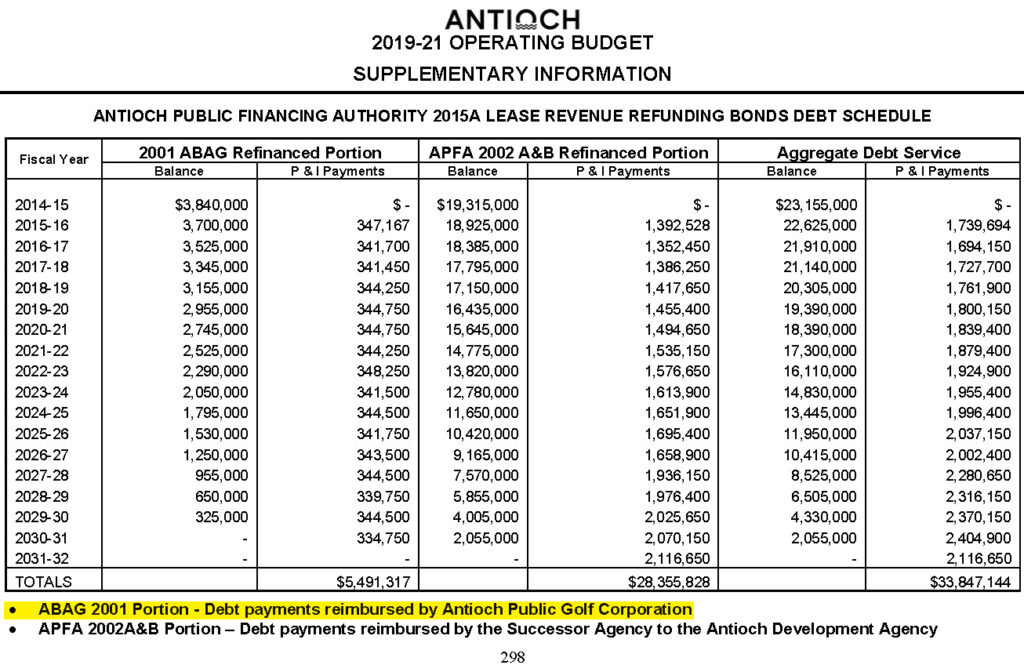
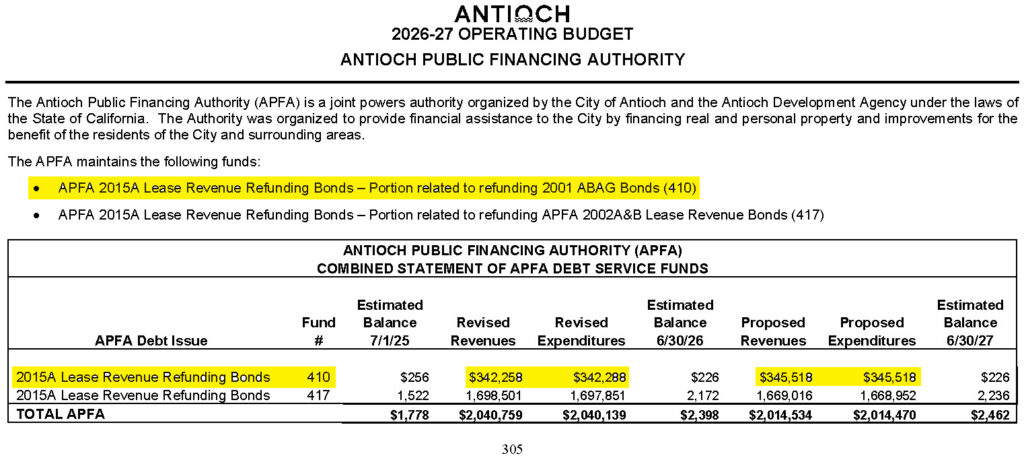
In fact, according to a staff report to the council on Dec. 9, 2025, the City had over $7 million by June 30, 2025, sitting in a fund, as District 1 Councilwoman Tamisha Torres-Walker recently claimed, that can be used to “acquire existing buildings with the intent to convert them into Community Centers.” That is more than enough to have covered the $1.5 million asking price by the current owner and seller. In addition, by June 30, 2023, the month after the first sale of the theater to a private party closed, the City had almost $5.5 million in that same fund. Plus, the Fiscal Year 2021-22 report shows as of June 30, 2022, the fund had a balance of over $4.2 million. So, the City also had enough funds to purchase the theater in 2023 for the $800,000 asking price. (See fourth subsection of related article)
Source: City of Antioch
Questions to Staff and Council if Development Fees Could Be Used to Purchase Theater, More
The questions were sent to City Attorney Lori Asuncion (pronounced uh-SUN-shun), Acting Community & Economic Development Director Kevin Scudero and Acting City Manager Ana Cortez, but since they had not yet responded by Friday night, Sept. 4, those same questions plus, a few more, were then emailed to them, the mayor and all four council members, and City PIO Jaden Baird. Mayor Pro Tem and District 3 Councilman Don Freitas informed the Herald last Wednesday that he would be out of town and unreachable for the following two weeks, and an auto-response email shared that Baird is no longer with the City of Antioch.
They were informed of what Torres-Walker said, that she and Freitas were looking into having the City use development impact fees to purchase the El Campanil Theater and she said there are millions of dollars just sitting there. They were also informed that after researching it on the state’s website, this reporter could not find any legal limitations under the definition of “other civic and community facilities.” They were then provided with a link to the California Department of Housing and Community Development’s webpage regarding the impact fees, Residential Impact Fees in California | California Department of Housing and Community Development and asked the following questions:
“Can they be used by the City to purchase the El Campanil Theatre building? How much in impact fees collected does the City currently have? Why are they sitting there? What were they collected for? What nexus was determined in the study?” and “can the City change the use of the funds after the fact?” They were also asked, “what else can the funds be used for?”
Source: City of Antioch
Development Impact Fees Available to Acquire Community Centers
Scudero responded Tuesday evening with, “The development impact fee program adopted by the city in 2014 accounts for Community Center Expansion as part of the Parks and Recreation Facilities Development Impact Fee. This fee could be used to construct new Community Centers or acquire existing buildings with the intent to convert them into Community Centers.”
He continued writing, “Here is the link to the annual AB 1600 reports that the city files detailing the amount of development impact fees collected and expended in each fiscal year: https://www.antiochca.gov/299/AB1600-Reports.
“That page also has the 2014 study that details the fee program and cost allocation for the fees collected. We are currently in the process of updating the development impact fee study which will involve looking at the current needs of the city and identifying new projects that will need to be constructed to accommodate new development.”
According to the League of California Cities, “A development impact fee is a monetary exaction other than a tax or special assessment that is charged by a local governmental agency to an applicant in connection with approval of a development project for the purpose of defraying all or a portion of the cost of public facilities related to the…project.”
According to City staff, Assembly Bill (AB) 1600, passed in 1987, is part of California statutes that “are collectively known as the ‘Mitigation Fee Act’ and imposes specific requirements on cities that chose to collect development fees” including issuing an annual report within six months of the end of the fiscal year.
The fees can only be “Collected for Capital Facility, Equipment, and Infrastructure Improvements, Cannot Fund Existing Needs…of the City’s existing population, and Must Be Based on a Rational Nexus” i.e. “a reasonable…connection, between new growth and development and the need for a new facility or improvement” and “must be structured such that the revenue generated does not exceed the cost of providing the facility or improvement for which the fee is imposed.”
There are four impact fees imposed on new development in the City: one for General Administration, another for Public Works, a third for Police Facilities and Equipment, and a fourth for Parks and Recreation Facilities, each with a separate, designated fund.
Source: City of Antioch
UPDATE: 2014 Nexus Study Allows Impact Fees to Pay for 82 Percent of Purchase
However, after further research, only 82 percent of the purchase price could come from the development impact fees. According to the 2014 Development Impact Fee Study, under Community Center Facilities, (see page 26) the City is allowed to use development impact fees in the Park and Recreation Fund to pay for up to 82 percent of the purchase or construction of a community facility. At the $1,500,000 asking price for the theater building, that would have been $1,230,000 which meant the Council would have had to find the balance of $270,000 somewhere else in the City budget or negotiated down the price with the seller.
On that page it also reads, “New Community Center space will be predominantly required to maintain service standards as the City population grows. While the General Plan specifies a Community Center standard of 750 square feet per 1,000 residents, the current standard provided is below this level. As a result, 18 percent portion of the cost of developing new facilities…must be attributed to offsetting existing deficiency for existing population, while the remaining 82 percent of costs are attributable to new development’s impact on Community Center needs. The need for future space is estimated at about 20,170 square feet based on the City’s preferred service standard…”
In addition, the Fee Study, under Parks and Recreation Facilities, Nexus Findings, Use of Fee (see page 25), also reads, “Fee revenue will contribute towards parks and recreational facilities in a number of community parks as well as an additional 20,172 square feet of community facility space and new library.”
While the Antioch Community Center had already opened in 2010 before the Study was completed in 2014, the library planned for Prewett Community Park next to the Community Center has yet to be built, but it may not be. So, the 10,936 square-foot theater building fit into the amount of community facility space available as calculated in the nexus.
The new library planned to be 48,000 square feet was estimated to cost $31.9 million at that time but only “20 percent of the library development costs, or $6.5 million, could be funded through impact fees” in the Park and Recreation Fund.
Council Aware of Fund Balances Last December and in December 2022 But Did Not Discuss Using Money
The latest report for the 2024-25 Fiscal Year presented to the Council during their Regular Meeting on Dec. 9, 2025 (see Item 6.Q.), shows an Ending Balance in the Parks and Rec (Fund 324) of $7,404,937.33. So, the City did have the money to purchase the El Campanil Theatre this year for the $1.5 million asking price.
Yet, during the Dec. 9th council meeting, that agenda item on the Consent Calendar was not pulled by any council member for the Council to discuss use of the funds before they voted 5-0 to receive and file the report as part of approving all but four other items. (See 5:27:15 mark of meeting video)
The report also shows that at the end of the 2022-23 Fiscal Year, which was on June 30, 2023, the fund had a balance of $5,491,281.75. In addition, the 2021-22 Fiscal Year report, which shows an Ending Balance of $4,218,197, was presented to the Council during their regular meeting on Dec. 13, 2022. (See Item 4.H.)
Thus, the City also had plenty of money to purchase the theater in 2023 and could have for just $800,000. Yet, during that meeting, the Council did not remove that item from the Consent Calendar either, to discuss use of the money available in the fund before voting 5-0 to receive the report and approve all the other items. (See 1:23:30 mark of meeting video)
Source: City of Antioch
One Councilmember Made Requests to Agendize Protection, But Not Purchase of El Campanil Theatre
A montage of council meeting videos by the ContraCosta.news posted on the Facebook page, shows council members speaking about the theater and one repeatedly requesting to be placed on a future meeting agenda an item for protecting, but not purchasing it. During their meeting on May 13, 2025, under Council Communications and Future Agenda Items, District 4 Councilwoman Monica Wilson asked, “Can we have an agenda item on potential historical sites in the city and how we protect them?”
“Alright,” Mayor Ron Bernal said while taking notes.
“I put that on because I reached out to Councilman Freitas about this because I’m concerned about the El Campanil that it’s not a registered historical site…that someone could come in, purchase it and demolish it,” the councilwoman added.
Freitas responded, “So, I would just suggest we put, dash, because it really is El Campanil.”
“Specific to El Campanil,” Bernal interjected.
“Right?” Freitas asked Wilson. “Right,” she replied.
“So, the Carnegie is completely separate,” Bernal stated. He was referring to the building at 519 F Street, which, according to the Carnegie Libraries website, “has housed the Senior Citizens Center, City Recreation Department, and Antioch Historical Centers” and more recently was leased to a church.
Then during the council meeting on Nov. 4, 2025, Wilson reiterated, “I just wanted to remind or get an update on making sure our El Campanil Theatre is a historical landmark, and I think the Carnegie Library so nobody can come in and demolish it. I wanted to get an update on that.” She repeated the request during the council meeting on Feb. 20, 2026, saying while reading from notes, “Agendize historical sites in Antioch. I think this is getting confused with my other item in regards to identifying sites in Antioch and getting them on the California historical registry so we can protect them.”
Then, most recently, during their meeting last month, on August 25, Torres-Walker repeated what she said in her video posted on Facebook (referred to above) about Freitas and her discussing the theater since last year. But she did not request to place on a council meeting agenda the possible purchase of the theater as it was already in escrow.
Torres-Walker Explains What Transpired This Year
Screenshot of Torres-Walker video about the possible use of development impact fees by the City to purchase the El Campanil Theatre posted on her official Facebook page Aug. 24, 2026.
When reached for comment, Torres-Walker said the City did try to buy the theater building this year and shared details of what she, Freitas and City staff did in their efforts to purchase it, possibly using development impact fees in the Parks and Rec Fund.
“It was $8 million when I brought it up,” she stated referring to the balance in that fund.
About the sale she said, “How I found out this year was seeing a video on Instagram of the pastor in the theater,” (the same as this reporter).
“In July, it was me, Don, Ana Cortez, Shahad and Sharon and the conversation didn’t include ‘this needs to be a rushed process to stop a sale,’” Torres-Walker said referring to Freitas, the acting city manager, the City’s Recreation Department Director Shahad Wright, and current El Campanil Theatre Preservation Foundation board president Sharon Sobel Idul.
Based on the timeline shared by the pastor last week, the church’s offer was accepted after that meeting was held.
“I told Don, last year, we had to do something,” she continued. “I was told the theater was being sold to a church. But we found out that was the AMC (Deer Valley Theaters).” As previously reported, that building, located on Lone Tree Way, was sold to The Bay Area Pentacostals church, whose building in Pittsburg burned in 2022.
“We did talk to the current owner that he would entertain a sale to the City,” Torres-Walker stated referring to Tung Bui. (See related article) “It was brought up at the council that this needed to be a discussion. We have this 90-day list thing. So, it should be on the list that I’ve been asking for over the last 60 days.”
At the end of each council meeting agenda under Council Communications and Future Agenda Items, it reads, “any Council Member may place an item for discussion and direction on a future agenda. Timing determined by Mayor and City Manager – no longer than 90 days.”
However, that item is not included on Special Council Meeting agendas, and no request regarding discussing the theater was made at the end of the regular council meetings on May 12, May 26, June 9, June 23, July 28 or Aug. 11. Not until the Aug. 25th meeting was the theater brought up by Torres-Walker, as mentioned above, after the conditional sale to the church. (See related article) It was during the meeting on April 28th that the Council last discussed one item from their previous 90-Day List, which was to hold a joint meeting between the Council and the Police Oversight Commission.
“Ana Cortez did speak to the owner,” Torez-Walker added. “Me and Don were trying to see if he would entertain a sale to the City and I had questions for the owner because we knew it was on the market.”
“We were all blindsided, because the last conversation we had with Sharon was that the owner was excited about the City buying it and keeping it as an arts and cultural center for the city,” Torres-Walker stated.
“David Storrer told me about the development impact fees. I said, ‘is this a real option?’ He said he was going to look into it,” referring to the City’s then-Acting Community and Economic Development Director, “and he would talk to the Parks and Rec Director,” she continued. “I went to Don and told him about the development impact fees, that this would be an opportunity to bring the Carnegie Library back on and potentially purchase the El Campanil Theatre.”
“Don met with David Storrer, and they were going through legal to make sure it passed what David called, ‘the smell test,’” said Torres-Walker. “Conversations with David Storrer started back in March. David’s contract was terminated in June or July. But things were already in motion.”
“We met with Sharon in July at Monica’s,” the councilwoman stated. “Then conversations started with the City with either the seller or his broker. Ana said he was excited about being in conversations with the City about purchasing the theater and to move forward with an option from the City.”
“Then this video goes out by Pastor Eli of Legendary,” she shared. “I get it if you’re a private property owner, you’re going to go where the money is.”
“I was blind-sided because I didn’t know there was another offer on the table,” Torres-Walker exclaimed. “I thought we were in, right? I thought we were working things out.”
“This is not about being against any church. We can’t discriminate,” she stated. “It was never about a church; it was about preserving arts and culture in downtown. That was the goal before we even knew a sale was taking place.”
About using the development impact fees and what they can be used for Torres-Walker shared, “We have to think about how we’re spending taxpayer dollars. There was no specifics. It didn’t name any projects. It was broad enough terms to interpret what is allowed.”
Asked if she had received the statement from Scudero sent to the Herald she said, “No, I haven’t heard back from staff and I was unaware of Kevin making a statement.” However, the councilwoman was reminded of the annual reports received by the council, including the last one in December with the details of the balance in each fund.
“Once David Storrer left and Bessie was placed on leave and the conversation transferred to Ana, and Kevin was brought in and asked if he could find out about this. So, we’re all playing catch up,” Torres-Walker explained, referring to City Manager Bessie Scott who has been on paid leave since May 5th.
“Staff never tells us what monies can be used for. We have to ask,” the councilwoman stated. “David Storrer said, ‘I don’t know why council isn’t being informed you need to be spending this money.’ Because it is for improvements.”
“Once we found out about it, Councilman Freitas looked into using them,” said Torres-Walker. “The only reason we didn’t want to do a rush job is me and Mayor Pro Tem Freitas didn’t want it to be half-baked and brought to the council. Then we got caught in the trap that we didn’t know we had enough time and we got blind-sided by the sale.”
“We have to be careful speaking on the sale of private property,” she acknowledged. “Because if it puts the sale in jeopardy, we could face potential lawsuits if the sale to Legendary doesn’t go forward.”
“The option to work with the church if they get the keys on the 28th, you can only work together through collaboration,” Torres-Walker stated. “This issue has brought together unlikely partners because people care about this building.”
“I think the challenge I’m faced with is that I’ve been hearing some people say it’s the structure, I’ve heard others say it’s arts and culture. Either way it’s brought people together,” she added.
The councilwoman then switched her focus to the future of the city’s historic downtown, known as Rivertown.
“I think what we should focus on are what are the other opportunities,” she stated. “We’re still in conversations about security downtown, about the Economic Development Commission, Department and Director. We need to look at the mission and purpose of the commission. Oh, and the Rivertown Standing Committee – we have not met since I was elected. Even when me and Don started talking about meeting, the former council member before I was in, that was their thing, so, everyone else pulled out of the space. What we need is to talk about the standing committee and if it’s a pet project of a council member, it dies when they leave. It needs to be championed by the community.”
“Form an Ad Hoc committee and form a commission for Rivertown, downtown or whatever or a task force,” Torres-Walker continued. “Because an ad hoc committee gives council members free reign, rather than a standing committee which has to comply with the Brown Act, with notices and minutes, and two members who make a quorum, which limits the dialogue and people talking at us and us looking at information and people don’t want that right now.”
Again, Freitas informed the Herald last week that he will be unavailable while on vacation for two weeks. Once he has returned and if the City’s mayor pro tem offers any comments, they will be added to this article.
Bernal Was Not Asked to Agendize Purchase of Theater, Did Not Help Church
Mayor Bernal was asked if any of the council members had requested the matter of purchasing the El Campanil Theatre be placed on a meeting agenda for discussion in the past year to either take over the theater or purchase it. He responded simply, “No.”
Bernal was also asked if he was aware the theater was for sale this year before it went public last month. The mayor responded, “Yes. As Tamisha may have told you she, Don and Bessie were working together to find out more about it. I was not involved due to obvious Brown Act implications,” referring to the state’s Open Meeting Law.
Finally, he was asked if he helped the church purchase the theater as has been one of the rumors being spread to which he responded, “No.”
Questions for Current Owner
Questions were sent to current owner Tung Bui Tuesday evening asking if he spoke with Sobel Idul and Cortez or if his broker, Michael Temby did, and if he had anything else to share about what Torres-Walker said regarding entertaining an offer from the City. He was also asked, if it’s true, why he did not give the City enough time to make an offer. But he didn’t respond prior to publication time.
Questions for Theatre Board President
Similar questions were sent to foundation board president Sobel Idul Wednesday evening. But she did not respond prior to publication time.
Questions for Acting City Manager, Mayor
Cortez was appointed Acting City Manager effective May 6, 2026. Following receipt of the information from Scudero she was then asked via email Tuesday night and voicemail on Wednesday, since she was appointed acting city manager did any of the council members ask her to speak with the mayor about placing on a meeting agenda a discussion of using the funds from the Parks and Recreation Facilities Development Impact Fee to purchase the El Campanil Theatre, or were there any discussions about the matter outside of a council meeting with the mayor or council members.
Additional questions regarding what Torres-Walker shared were emailed to Cortez Wednesday evening.
UPDATE 1: Cortez responded Friday afternoon, Sept. 11th, simply writing, “As Mayor Bernal stated on September 8, the City is not in a position to comment on the pending El Campanil sale at this time. Thank you for your understanding!”
More Questions for Acting City Manager, City Attorney
In an immediate response, questions were sent to Cortez and City Attorney Asuncion asking why Cortez can’t tell the public if she spoke with the owner and what was discussed, and that while it was a real estate matter, there were no city council closed session meetings held to discuss it, based on what both the mayor and councilwoman shared, as it didn’t get that far. They were also asked, are such conversations outside of a closed session meeting still protected by the Brown Act (state open meeting law), even if they’re conducted without the city attorney present.
An auto response from Asuncion read, “I will be out of the office Friday September 11, 2026.”
Please check back later for any additional updates to this report.
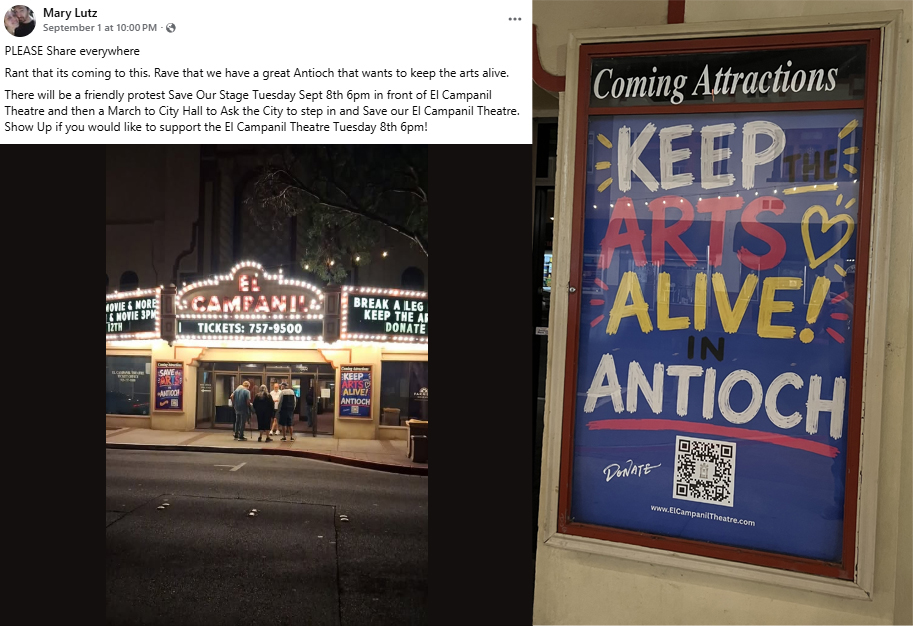
Screenshot of protest march announcement on Antioch resident Mary Lutz’s Facebook page on Sept. 1, 2026 (left), and a poster to the right of the theater’s entrance on Saturday, Sept. 5th. Photo by Allen D. Payton
From El Campanil Theatre to City Hall
Theatre board still raising funds despite Sept. 29th close of escrow
By Allen D. Payton
As previously reported, in a comment on the Antioch Herald Facebook page Tuesday night, following the community meeting at the El Campanil Theatre, Rivertown business owner Mike Gabrielson announced a “friendly protest” and “March to City Hall” before the Council meeting Tuesday night, Sept. 8, 2026, over the sale of the theater building to a church. (See related articles here, here, and here)
That same night, Antioch resident Mary Lutz also issued an invite to the protest march on her Facebook page. She wrote, “Rant that it’s coming to this. Rave that we have a great Antioch that wants to keep the arts alive.
“There will be a friendly protest Save Our Stage Tuesday Sept 8th 6pm in front of El Campanil Theatre and then a March to City Hall to Ask the City to step in and Save our El Campanil Theatre. Show Up if you would like to support the El Campanil Theatre Tuesday 8th 6pm!”
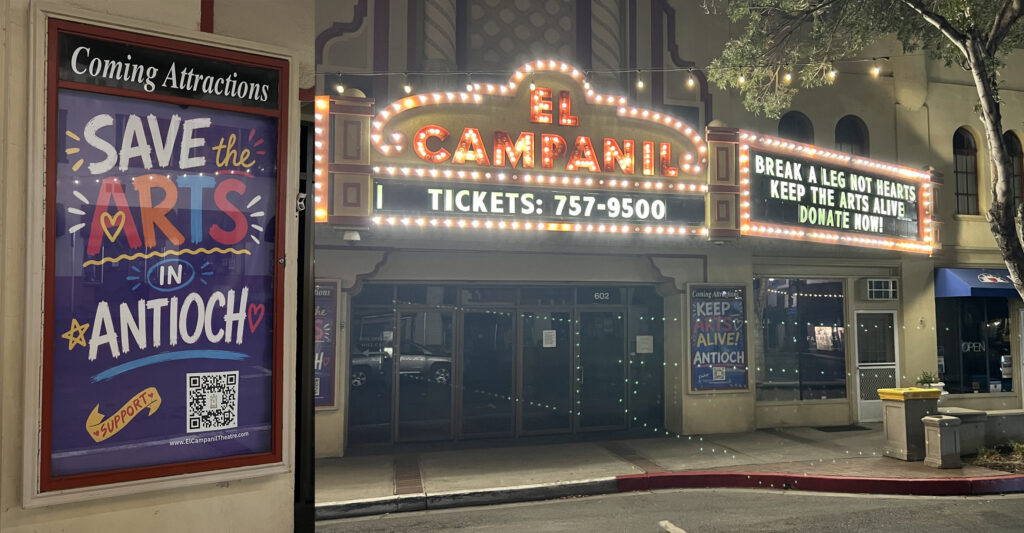
The poster to the left of the entrance of the El Campanil Theatre and marquee with messages attempting to prevent the sale and still raise funds on Saturday, Sept. 5, 2026. Photos by Allen D. Payton
The march will be about two blocks long as the theater is located at 602 W. 2nd Street and City Hall is located at 200 H Street in Antioch’s historic, downtown Rivertown.
The Council meeting begins at 7:00 p.m. with a light agenda of only four items of significance to discuss. But there is nothing on the agenda to discuss the sale of the El Campanil Theatre to the dismay of some residents. (See related article)
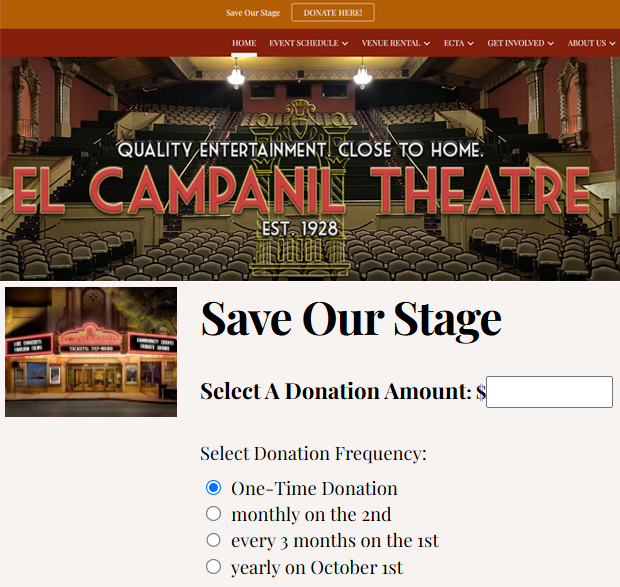
Screenshots show fundraising efforts continue on the theater’s Home and Donation pages of the website on Saturday, Sept. 5, 2026.
Theater Still Operating, Raising Funds
The theater is now displaying new colorful posters out front that read, “Save the Arts in Antioch! and “Keep Arts Alive! in Antioch”. The theater is also promoting an Oct. 17th concert on their Facebook page which is more than two weeks after the Sept. 29th close of escrow.
Even though Board President Sharon Sobel Idul stated and reiterated, “if the sale closes, the Foundation would cease operating El Campanil Theatre,” a message on the marquee reads, “Break a Leg Not Hearts Keep the Arts Alive Donate Now!” Plus, the website is still accepting donations with the message, “Save Our Stage” at the top of the Home page and the Donate page offers options of “One-Time, monthly on the 2nd, every 3 months on the 1st, and yearly on October 1st.”
The Council will discuss pre-approved designs for the City’s ADU Accelerator Rebate Program. Rendering source: City of Antioch
Plus, approve ADU plan designs for program that ends this month, software purchase for SeeClickFix app
Nothing about sale of El Campanil Theatre
By Allen D. Payton
During their meeting Tuesday, Sept. 8, 2026, the Antioch City Council has a light agenda with just a few items of significance. They will discuss finalizing the name change of the Public Safety & Community Resources Department to the Community Services Department, as well as the titles for the staff positions, consider approving using two state grant funded temporary positions in that department and consider adopting pre-approved Accessory Dwelling Unit plans developed through the ADU Accelerator program which ends on Sept. 30. Finally, the Council will vote on purchasing software for the City’s SeeClickFix app.
But there is nothing on the agenda regarding the pending sale of the El Campanil Theatre to the dismay of residents who want and hope the City can take action to stop the sale. Some residents have organized a protest march from the theater to City Hall before the council meeting begins. (See related articles here, here and here)
Screenshot of the department’s page on the City’s website.
Name, Title Changes for Newest City Department, Positions
Under item 5 on the agenda, the Council will conduct a public hearing and introduce an ordinance to rename the Public Safety and Community Resources Department as the Community Services Department. In addition, the council will vote on approving the classification title changes from Public Safety and Community Resources Director to Community Services Director and Public Safety Manager to Community Engagement Manager, subject to completion of applicable labor-relations requirements.
As previously reported, at the urging of Mayor Pro Tem and District 3 Councilman Don Freitas, during their meeting on Tuesday, May 26, 2026, (under agenda item 10) the Antioch City Council agreed to correct and clear up confusion of including the words “Public Safety” in the name of the newest department which is not part of police or fire services. Instead of its current name which was the brainchild of District 1 Councilwoman Tamisha Torres-Walker who has an expanded definition of the term, it will be renamed simply, the Community Services Department. The councilmembers also voted to change the titles of the department’s staff. (See 6:39:50 mark of meeting video)
The council approved the new department in February 2022 on a 4-1 vote. At that time, Torres-Walker tried to redefine and expand the meaning of public safety. But the department’s name has caused confusion because the majority of people don’t define the term the same as she does.
According to the staff report for next Tuesday’s meeting, “As the department’s responsibilities continued to expand, the City Council also began discussing whether the department’s name accurately reflected its mission and public facing role. During several public and administrative discussions, Council considered various naming alternatives intended to better describe the department’s functions and distinguish its community-based services from the law enforcement responsibilities of the Antioch Police Department.”
Name Already Changed on City Website
The department’s page on the City’s website already has the new name in the header, but not in the text below, still including the word resources. That reads, “The City of Antioch’s Department of Community Services Resources is committed to building a safer, healthier, and more resilient community. We work to address the root causes of violence, strengthen opportunities for youth and families, and ensure housing stability for all residents. The Community Services Resources (CSRD) Department works to strengthen community well-being through prevention, intervention, and support services. CSRD houses the City’s Youth Services Network, Housing and Unhoused Services, and Violence Intervention & Prevention Division, providing programs and resources that promote safety, stability, and opportunity for all residents.”
Two Temporary State Grant-Funded Positions for the Renamed Department
Then under item 6, the Council will consider approving the establishment of two limited-term, grant-funded hourly positions to support the City’s direct implementation of community violence intervention, violence prevention, community outreach, case coordination, resource navigation, and community engagement activities. The proposed positions’ titles also retains the word resources: Community Resources Specialist.
The proposed hourly salary range for each of the positions is $39.54 – $48.07.
According to the staff report, the City has been awarded $2,034,800 through the Board of State and Community Corrections’ California Violence Intervention and Prevention (CalVIP) Grant Program with an authorized grant period through Sept. 30, 2029. The approved grant provides funding for two positions to support implementation of the City’s community violence intervention and prevention activities.
The City’s nine pre-approved ADU plan design renderings. Source: City of Antioch
ADU Plans for Accelerator Program That Ends Sept. 30
Under item 4.I. on the Consent Calendar agenda, the Council will consider adopting pre-approved Accessory Dwelling Unit (ADU) plans developed through the ADU Accelerator program. According to the ADU Accelerator Rebate Program information on the City’s website, ADUs are attached or detached residential dwelling units that provide complete independent living facilities for one or more persons on a lot with an existing (or proposed) primary residence.
The State Senate District 7 ADU Accelerator Program, piloted by former State Senator Steve Glazer, is composed of 15 cities in the East Bay of the San Francisco Bay Area, including Antioch.
The program provides individual rebates of up to $7,500 to property owners for new ADU units and up to $30,000 for new ADU units that are deed restricted to low-income households (minimum of 20 years.) As the purpose of the program is to encourage the construction of smaller ADU units, there will be no rebates for units over 1,000 square feet.
The City is matching the low-income rebate amounts with Permanent Local Housing Allocation (PLHA) funding to double the rebates for low-income ADUs to encourage low-income ADU production in Antioch. Antioch homeowners will be able to access up to $30,000 for the construction of a low-income ADU less than 500 square feet.
However, according to the staff report for the agenda item, the rebate program provides individual rebates up to only $15,000 for ADUs that are deed restricted to low-income households (minimum of 20 years.) An email was sent to City staff over the holiday weekend asking which is the correct amount.
UPDATE 1 part 1: Acting Community and Economic Development Director Kevin Scudero responded Tuesday morning, “The ADU Accelerator Program offered up to $15,000 in rebates for the construction of ADU’s. The City of Antioch also had Permanent Local Housing Allocation Program (PLHA) funds allocated towards ADU’s and chose to provide matching funds for deed restricted affordable ADU’s to further incentivize their production. This is why you see the larger rebate number on our website.”
The City of Antioch was granted $216,228.77 for rebates, which was based upon a per capita calculation, and $50,000 to create free permit-ready or pre-approved plans for public use.
The second component of the ADU Accelerator program is the development and adoption of free pre-approved ADU plans which will be free for residents to use.
While the rebate program has been available to homeowners in Antioch since October 1, 2024, it will close September 30, 2026. Staff were also asked if the termination date is correct and if so, why is the council just now being asked to adopt the pre-approved plans.
UPDATE 1 part 2: Scudero also responded Tuesday morning, “Yes, the termination date is correct. In addition to the ADU rebates, the program also provided $50,000 in funding to develop pre-approved ADU Plans. The development of the pre-approved plans was on a dual track with the rebate program. The pre-approved plans are not specific to the ADU’s receiving rebates and will be available to anyone in the future who would like to construct an ADU in Antioch.”
Under item 4.H. on the Consent Calendar, the council will vote on approving an increase to the current Agreement with Tyler Technologies Enterprise Permitting & Licensing (EP&L) for recurring Software as a Service (SaaS) fees and additional support services for a total agreement amount not-to exceed $235,000 per year. The council is also being asked to memorializing the recurring SaaS services which automatically renew each year throughout the term of the contract, which is consistent with the Agreement but inaccurately described in the original resolution.
The software serves the City’s SeeClickFix Application Programming Interface (API).
According to the staff report, the Initial approval by City Council in January of 2021 authorized an amount not to exceed $800,000, for a term ending June 30, 2025. The addition of the SeeClickFix Application Programming Interface (API) allows increased functionality for Code Enforcement complaints that are submitted via the SeeClickFix system, improving Code Case creation and response times, and streamlined updates to the public on complaint status via SeeClickFix. We are in the testing phases currently, and plan to fully implement the API by or before the end of this calendar year.
Finalize agreement to expand DOJ-required monitoring consultant’s contract
Consider potential whistleblower lawsuit
By Allen D. Payton
During a special meeting Monday, August 31, 2026, the Antioch City Council will consider hiring an Economic Development Director and forming a separate Economic Development Department, again. They will also finalize the discussion and vote on expanding the contract with the monitoring consultant required by the settlement agreements with the U.S. Department of Justice, City of Antioch and police department. That will follow a Closed Session to discuss the lawsuit by the natural gas pipeline company and a potential lawsuit by a City employee whistleblower.
Economic Development Director & Department Redo
Under Item 2. on the Special Meeting agenda, the Council will consider once again forming an Economic Development Department and hiring a director for it, following its merger with the Community Development Department by City Manager Bessie Scott, last year.
It also follows the current vacancy in the position of Director of the Community and Economic Development Department since March 3, 2026, when the director was no longer in the position after being hired less than six months earlier. (See related article)
According to the City staff report, the Council “has identified economic development as an important policy priority, including business attraction and retention, investment recruitment, development incentives, redevelopment, workforce partnerships and strategies to strengthen the City’s economic base. At the August 25th budget study session, City Council expressed the desire to explore separating Economic Development from Community Development and re-establishing a separate department with its own Director to have a focused strategy…at a time when economic development and revenue generation are most vital to the City.”
The staff report continues, “the Fiscal Year 2026/27 Economic Development division in the Community and Economic Development Department includes $436,759 in personnel budget for three positions: Senior Economic Development Program Manager, Economic Development Program Manager and Economic Development Specialist. Projected vacancy savings were built into the 2026/27 budget figure assuming it would take several months to fill the positions. There could be a budget impact should City Council decide to add back the Director position.”
The recommended organizational structure of the department would include an Economic Development Director, Senior Economic Development Coordinator and Specialist, eliminating the position and cost for the Economic Development Program Manager.
The staff report also shared, the current salary range for the Antioch Economic Development Director is $13,021-$15,828 per month, which is on the low end of a salary comparison with surrounding cities that’s included. “If a new salary range were established beyond that, it should fall within Antioch’s existing range of executive leadership salaries. If City Council would desire to increase the existing established salary range for the department’s Director, it is recommended to be at a range of $14,185-$17,242, slightly above Brentwood and within the City’s existing structure. The 2026/27 estimated annual salary and benefit cost of the position at this range at Step E would be $393,027.”
Monitoring Consultant Contract
After discussing then postponing the matter during their Aug. 25th meeting, under Item 1 on the Special Meeting agenda, the Council will again consider approving the First Amendment to the Professional Services Agreement with MS Investigative Services and Consulting, LLC, to expand the scope of services to include Independent Monitoring services required under the Allen Settlement Agreement (ASA); and authorizing an additional annual compensation amount of $150,000 for ASA monitoring services and associated Fiscal Year 2026/27 General Fund budget amendment.
According the company’s website, the Principal, Manjit Sappal “served in three California police departments, culminating in his tenure as Chief of Police for the City of Martinez…he also served twice as Interim City Manager…oversaw all municipal departments and guided the City through strategic budget initiatives, ballot measures, and community safety priorities.”
He earned a Master’s degree in Public Administration, a CA Private Investigator License, he’s a Certified Protection Professional, a graduate of the FBI National Academy Session 241 and the Police Executive Research Forum Senior Management Institute and has received DEA Federal Law Enforcement Analysis Training and CA Commission on Peace Officer Standards and Training (POST) Executive, Management, Supervisory, Advance, Intermediate and Basic.
According to the City staff report, “The existing Professional Services Agreement…provides compensation of up to $250,000 annually for consulting and monitoring services required under the USDOJ Memorandum of Agreement (MOA). The proposed First Amendment increases compensation by $150,000 annually to compensate the Consultant for the expanded monitoring responsibilities required under the Allen Settlement Agreement. The additional compensation will be paid hourly at the rate of $210 not to exceed $150,000.”
If the First Amendment is approved, total annual compensation for monitoring services under both agreements will not exceed $400,000 annually. Amending the contract requires a Fiscal Year 2026/27 General Fund budget amendment of $150,000 which will increase the projected deficit of $4,567,879 by $150,000. Funding for future years will be included in draft budgets brought forth for consideration.
Background
According to the City staff report, in April 2023, the USDOJ initiated an investigation into the Antioch Police Department following the public disclosure of text messages exchanged by Antioch police officers containing racist, sexist and discriminatory language. As a result, in Jan. 2025, the City of Antioch, Antioch Police Department and the USDOJ entered into the MOA, requiring implementation of reforms related to constitutional policing, accountability systems, data collection, complaint investigations, community engagement, hiring practices, supervision and oversight.
A key component of the MOA required the City and the USDOJ to jointly select an Independent Consultant to provide technical assistance, compliance monitoring and implementation oversight. Following a competitive and joint evaluation process with USDOJ representatives, MS Investigative Services and Consulting, LLC was selected as the Independent Consultant.
Then, on March 27, 2026, the City entered into the Settlement Agreement in Allen et al. v. City of Antioch, et al, a class action civil rights lawsuit. The Settlement Agreement incorporates many of the same constitutional policing reforms and accountability measures already required under the DOJ MOA and expressly requires that the existing DOJ Monitor also serve as the Monitor under the ASA.
The monitoring consultant submitted the Antioch Police Department’s First Compliance Report in April this year, pursuant to the MOA signed January 2, 2025. The report assesses the Department’s compliance with the MOA for the reporting from that date through March 31, 2026.
That followed the police department’s Self-Assessment Report 1 issued by Chief Joe Vigil on October 15, 2025.
Closed Session
During their Closed Session meeting beginning at 5:30 p.m., under Item 1. the Council will hold a Conference with Legal Counsel on existing litigation by the California Resources Pipeline Corporation (CPRC) v. City of Antioch, Contra Costa Superior Court Case No. MSN21-2354. The lawsuit continues following the Antioch City Council’s 4-0 vote during their meeting on July 28, 2026, to deny the company’s Encroachment Permit Appeal. CPRC is the owner of the low-pressure, natural gas pipeline that runs under the city and has been shut off since 2021. (See related articles here, here and here)
Under Item 2., the Council will hear about and discuss “Significant exposure to one case of litigation pursuant to Government Code Section 54956.9(e)(2). The staff report reads, “The City is in receipt of information concerning facts and circumstances that might result in litigation against the City which are known to a potential plaintiff or plaintiffs pertaining to possible Labor Code Section 1102.5, and Fair Employment and Housing Act violations.” According to Employment Law Aid, “California Labor Code § 1102.5 protects whistleblowers who report violations.”
Meeting Details
Before entering Closed Session and during their Regular Meeting, which begins at 6:30 p.m., the Council will meet in the Council Chambers at 200 H Street, and both can be viewed via livestream on the City’s website, on the City’s YouTube channel or on Comcast cable TV channel 24 or AT&T U-verse channel 99.
More than enough for both the Homekey+ program and Rivertown Square project
“We need to be fiscally prudent by closely monitoring expenses…and minimize General Fund subsidies to high-cost operations, such as the golf course and water park.” – then-City Manager Ron Bernal in 2017-19 Budget message
This past fiscal year, the water park received over $1.6 million to subsidize its operations, and the budget allows for $1.55 million in this fiscal year. In addition, the golf course receives almost $500,000 in debt service and water costs.
According to the City’s Adopted Fiscal Year 2026-27 Budget, “Parks and Recreation provides the City’s residents recreational, preschool, social and meeting space within the community. Recreation Programs are accounted for in the Recreation Special Revenue Fund. The Recreation Support division within the General Fund provides a subsidy to this fund to support operations.”
The General Fund budget shows Recreation Services Support (Recreation Department) receiving $4,812,031, a 12% decrease from the $5,479,935 in the Revised 2025-26 Budget. Of that amount, Recreation Services was approved to receive $1,937,164 from the City’s Measure W one-cent sales tax or 9.7% of the total revenue of over $20 million from that source. The amount makes up 40% of the total budget for the Recreation Department.
Antioch Water Park Subsidy
According to the Fiscal Year 2026-27 City Budget, the Antioch Water Park will receive $1,552,918 from the General Fund and Child Care Fund, of which $87,500 is from the latter, a 5% reduction from the subsidy of $1,627,359 in the Revised 2025-26 Fiscal Year Budget. That totals 60 percent of the water park’s revenue with the difference generated by Current Service Charges, which includes gate fees to enter the park and $111,000 in concession sales from Gator Grill and Allie’s Oasis.
According to Parks & Recreation Director Shahad Wright, “From the last supervisor report, we had over 30,000 guests but there is no breakdown for kids or adult that I can currently pull.”
Lone Tree Golf & Event Center Subsidy
Although this and last year’s City Budgets do not mention the Lone Tree Golf & Event Center (LTGEC), City Finance Director Dawn Merchant shared, “One of the transfers out to the 2015A debt service fund ($345,518 in FY26/27) is for that debt. The General Fund also pays for water at the golf course when they utilize City water (the Golf Course pays Delta Diablo directly for any irrigation water through them). We budget $150K per year, but the amount really fluctuates.”
Of the $345,518 amount, $343,500 will be used this year to pay the debt for improvements to the golf course and expansion of the event center in 2002. It’s shown in the budget as Antioch Public Financing Authority Debt Service Fund 410 (see page 45) and after this fiscal year’s payment, “the ABAG (Association of Bay Area Governments) portion of the debt will be $1,250,000 at 6/30/27 principal and $343,500 interest outstanding. The debt schedule is on page 316 of the budget,” she added.
Over 53,000 Rounds of Golf in FY25-26
According to Wright’s Lone Tree Golf Course Annual Operations Update for Fiscal Year 2025-26 to the Antioch City Council’s Committee for the Lone Tree Golf Course consisting of Mayor Ron Bernal and District 4 Councilwoman Monica Wilson, there were 53,079 rounds of golf played between July 1, 2025, and June 30, 2026. (COG means Cost of Goods)
The report also shows total revenue for the year of $6,600,248 with $3,091,121 from golf, of which $570,678 was generated by the driving range, and $3,509,127 from food and beverages at the Event Center, which includes Champions Bar & Grill and the banquet facility.
Expenses include Cost of Golf at $1,137,587 and Operational at $5,189,024 for Net Income of $331,796. However, as the report points out there is, “No Capital Expense Deducted” from the total included. That would be the $345,518 for debt service mentioned above. So, the LTG&EC actually experienced a net loss of $13,722. But the $331,796 remains within the facility’s budget and is not used to reimburse the City’s General Fund.
Basically, the General Fund is providing a subsidy of over $9.00 per round of golf to those who enjoy playing the sport in Antioch.
Golf & Event Center Previously Mentioned in City Budgets
The LTG&EC was mentioned in the 2014-15 and 2015-17 Budgets, twice on page 243. That reads:
“ASSOCIATION OF BAY AREA GOVERNMENTS (ABAG) 2001 LEASE REVENUE BONDS (411)
“In July 2001, ABAG issued $6,300,000 of Lease Revenue Bonds to refund the outstanding ABAG XXV Irrigation Project Lease and to finance the construction of a new clubhouse at the Lone Tree Golf Course. The Lone Tree Golf Course reimburses the City for all debt service and other expenditures of the fund. All construction funds have been drawn down, and the final debt service payment will be made in July 2031.”
The same message on that same page was included in the FY2015-17 Budget.
Golf Course & Event Center No Longer Reimburses General Fund, Debt No Longer Mentioned in Budgets
But the debt for the LTGC/LTG&EC was no longer mentioned and the golf course only referred to twice in the FY2017-19 Adopted Budget. On Page iii of then-City Manager Ron Bernal’s budget message it reads, “We need to be fiscally prudent by closely monitoring expenses…and minimize General Fund subsidies to high-cost operations, such as the golf course and water park.”
Then on the Supplemental Information page 295 a note at the bottom reads, “ABAG 2001 Portion – Debt payments reimbursed by Antioch Public Golf Corporation.” The same note was provided on the same page of the FY2019-21 Budget. But it was no longer included as of the FY2021-23 Budget.
Merchant was asked if that is because the debt payments have no longer been reimbursed by the Golf Corporation as of FY2022.
She responded, “You are correct that the reference was removed once the Golf Course stopped reimbursing the City. The debt service payments show in the 2015A Lease Revenue Refunding bonds debt service fund. The transfer out in the General Fund is to move money to that debt service fund for payment of the debt service.”
“As you can see from the report Shahad prepared that you provided, the City’s agreement with the Golf Course only requires that they pay us a small annual fee that is escalated by CPI,” she continued. “Many years ago, due to financial stress at the Golf Course, City council agreed to take on the burden of the debt service within the General Fund and not seek reimbursement from the Golf Course for debt service, and thus the current agreement in place.”
Merchant also shared, “The expenses related to the Golf Course were discussed at the (Council’s) budget meetings held on April 21st and May 5th.”
More Questions for Merchant
Merchant was also asked since there are expenses for the Golf & Event Center from the General Fund, why isn’t it mentioned anywhere in the budget? Shouldn’t it be for full transparency to the public?
What I see is on page 306 of the Adopted Budget, entitled, “APFA 2015A LEASE REVENUE REFUNDING BONDS (410) (Portion related to refunding 2001 ABAG bonds)” it reads, “In February 2015, Antioch Public Financing Authority (APFA) Lease Revenue Refunding Bonds were issued to refinance the APFA 2002 A&B Lease Revenue Bonds and the ABAG 2001A Lease Revenue Bonds. The APFA leases the police facility and animal shelter to the City under a site and facility lease and the base rental payments made by the City represent the debt service on the new bonds. This fund accounts for the portion related to the ABAG bonds and debt service is paid by the General Fund. Final debt service is May 2031.”
Then on page 307, entitled, “APFA 2015A LEASE REVENUE REFUNDING BONDS (417) (Portion related to refunding APFA 2002 A&B Lease Revenue Bonds)” it reads something very similar: “In February 2015, Antioch Public Financing Authority (APFA) Lease Revenue Refunding Bonds were issued to refinance the APFA 2002 A&B Lease Revenue Bonds and the ABAG 2001A Lease Revenue Bonds. The APFA leases the police facility and animal shelter to the City under a site and facility lease and the base rental payments made by the City represent the debt service on the new bonds. This fund accounts for the portion related to the 2002 A&B bonds and debt service is reimbursed by Successor Agency to the Antioch Development Agency. Final debt service is May 2032.”
So, if all the money shown on page 306, $345,518, is spent for the Golf & Event Center debt, shouldn’t the information in the chart on that page be about the Golf & Event Center not about the police facility and animal shelter?
Also, on page 45, entitled, “Transfers By Fund”, I think it would be best that under Antioch Public Financing Authority Debt Service Fund 417 it shows “Police Facility and Animal Shelter” and under Fund 410 it shows, “Lone Tree Golf & Event Center” for full transparency to the public (and media).
Merchant Explains Debt for Golf Course, Police Facility & Animal Shelter Combined When Refinanced
In response, Merchant wrote, “The reason on page 306 (and 307) it references the police and animal shelter is because when the ABAG bonds were refinanced with the 2015A lease revenue bonds, to secure the bonds, the Antioch Public Finance Authority entered into a lease agreement with the City for the Police and Animal Shelter essentially being the security for the bonds thus providing a ‘lease payment’ as debt service for the bonds. The Golf Course provides no security for payment of the bonds.”
“I note your comment about the transfers schedule,” she added. “The titles on page 45 represent the actual fund names in the City’s general ledger accounting system, as do all the transfers listed on the schedule.”
Conclusion – It All Comes Down to Priorities
During a recent council meeting on the Homekey+ program, a resident suggested the Golf Course should raise rounds by just $5.00. If they did, that would generate another $265,000 per year, which, along with the current net revenue, would be enough to cover the costs of water and the debt payment.
In addition, while I was a council member when the water park first opened, I suggested contracting out the operations to a private company. I called one in Sacramento. They said they were interested but were in the process of opening Water World (now Six Flags Hurricane Harbor) in Concord at the time. Perhaps, another private company might be interested, now. All it takes is a phone call to start the process. If it were contracted out, that would eliminate the $1.5 million annual General Fund subsidy.
Combine that amount with requiring the Golf Course Board to reimburse the City for the cost of both the water and bond debt payment for a total of almost $500,000, and Antioch’s General Fund would enjoy almost an extra $2 million per year. That’s more than enough to cover the $1.2 million annually for the Homekey+ program and to cover the estimated $250,000 annual maintenance costs of the Rivertown Square project on the former Beede Lumber Company lot in downtown.
It all comes down to priorities. The Council can continue to subsidize the recreation of some – who don’t all live, here which was an argument about not funding the Homekey+ program – or house some of our homeless residents, reducing their impact on our businesses, police department, Code Enforcement and City budget, and add a new, long-planned park and event center in the City’s historic downtown.
I believe it’s time Mayor Bernal and the rest of the council members heed his message from when he was city manager and, of less importance, ensure the debt for the golf and event center be clearly listed in each year’s budgets for full transparency to the public.
In a recent post on her Instagram account, political newcomer Matty Alappat announced her campaign for Antioch City Council in District 4 to unseat incumbent Councilwoman Monica Wilson. According to the City Clerk’s report, she filed her required documents and qualified as a candidate on August 5th. Alappat’s campaign slogan is, “United as Americans. Committed to Antioch” and lists her priorities as, “Public Safety, Clean Communities and Economic Growth.”
Matty Alappat in an AI-generated photo on her campaign website.
Plus, her campaign website includes the slogan, “A Safer, Cleaner Antioch — For All of Us” and she offers “Practical, neighborhood-focused leadership. Replacing political noise with actionable solutions.” She also provides a list of her priorities of “Public Safety, Thoughtful Housing and Homelessness Solutions, Cleaner City and Downtown Revitalization and Local Jobs” and is temporarily using an AI-generated photo of herself on the “About Matty” page which she plans to replace once new photos are taken.
As previously reported, she is listed on the ballot as Metty Mathews Alappat, and according to her LinkedIn page, her most recent job was as a Senior Technical Account Manager for Amazon Web Services until July 2025.
In her Instagram post repeating what is written in her Candidate Statement, Alappat provided more details about herself and why she’s running. She wrote, “I am Matty Alappat and I am running for Antioch City Council, District 4, to help build a safer, cleaner and more prosperous community for all of us.
“For the last 15 years I have worked in the software industry, solving tough problems and leading successful initiatives. I am ready to bring that same practical approach to City Council.
“I was fortunate to be raised by a mom who was a science teacher and a dad who worked in banking. They taught me that success is built on hard work, integrity, respect for others, and giving back to your community — values I still live by today.
“If elected, my top priority will be public safety. I will make sure the police have the resources required to fight crime and protect our neighborhoods.
“We also have to take better care of our city. That means investing in city’s infrastructure, revitalizing downtown, maintaining clean pet-friendly public spaces and bringing in new businesses and good-paying jobs.
“Housing policies must be carefully planned to fit existing neighborhoods and should only move forward where our infrastructure can truly support them. We will partner with nonprofits to help unhoused individuals achieve long-term stability and self-sufficiency, while also focusing on short-term transitional housing options.
“Antioch deserves leadership that brings people together, spends taxpayer dollars wisely, and gets results. I am committed to making Antioch a place we can all be proud of.
“I look forward to earning your support.”
Alappat’s LinkedIn profile shows she has earned six licenses and certificates all in the tech industry. Asked about her education when reached for comment Alappat said she earned a Master’s Degree in History, in 2002 and a B.A. in History, Economics and Political Science, both from theUniversity of Kerala in India.
Alappat moved to Antioch four years ago from Hayward.
“I adopted a dog who is very high energy and my place in Hayward was very tiny,” she shared. “I thought it was time to move to a house with a backyard and looked in this area because it’s more affordable for me.”
Currently, Alappat is in between jobs saying, “I decided to take a break and that’s when I started to think about doing something different.”
Alappat is also running against third-time candidate Sandra White and another first-time candidate, Andrew Becker, who regularly attends and speaks during council meetings. Wilson is seeking her fifth term on the council.