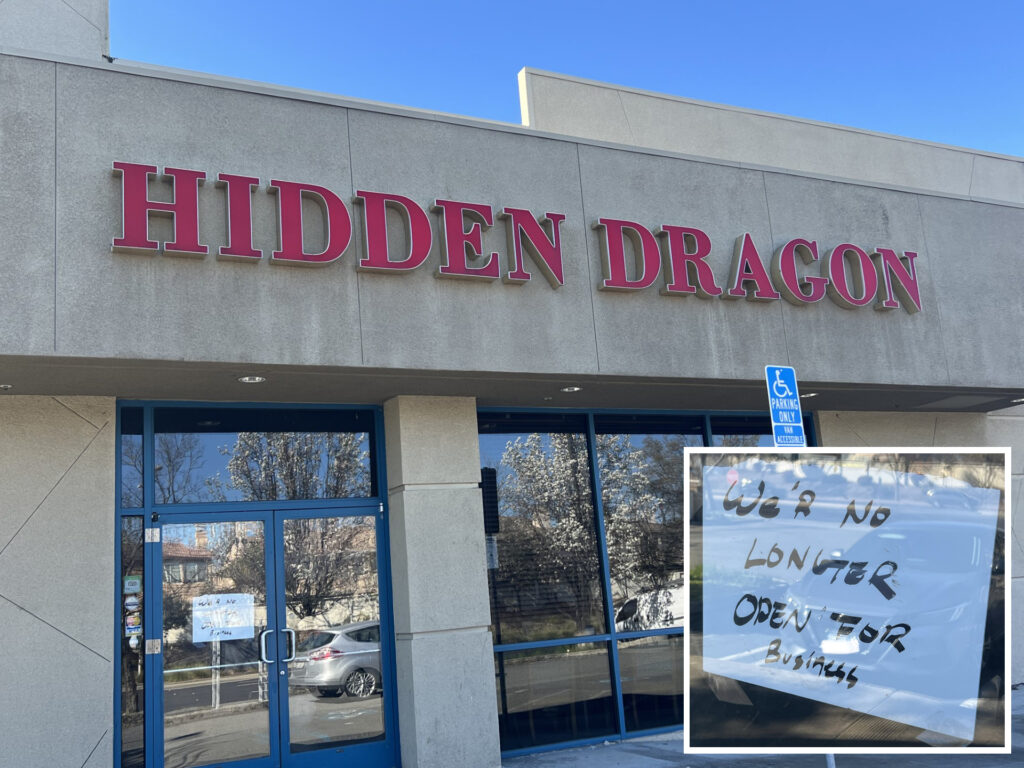
A handwritten sign in the window shows the Hidden Dragon Chinese restaurant on Lone Tree Way in Antioch is “no longer open for business.” Photos by Allen D. Payton
By Allen D. Payton
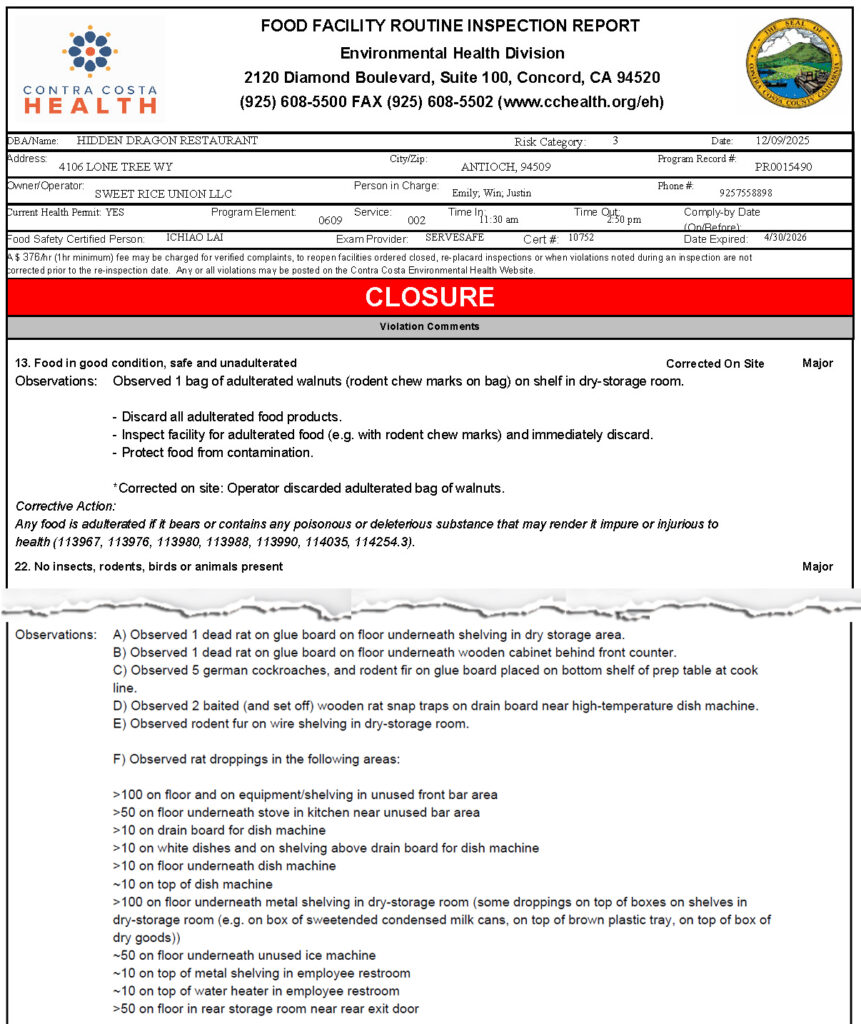
According to the Contra Costa Health Department’s Environmental Health Division, Hidden Dragon Chinese restaurant in Antioch was shut down last April for violations including insects, rodents referred to as rats and mice, birds or animals present. It was shut down again on Dec. 9th for some of the same problems. Both times the owners were instructed to, “Cease and Desist all food activities.”
Located at 4106 Lone Tree Way in the same shopping center at Dallas Ranch Road as the former Rite Aid and now closed Sherwin-Williams Paint Store, the restaurant reopened Dec. 12th following a re-inspection. Then, the owners voluntarily and permanently closed the restaurant in January. An Environmental Health inspector did not learn of that until attempting a re-inspection, yesterday, Monday, March 2, 2026.
The Food Facility Routine Inspection Report dated April 23, 2025, showed a Minor Violation for not having “6. Adequate hand-washing facilities: supplied and accessible. Minor Observations: A) Soap dispenser in employee restroom observed inoperative. B) No paper towels in wall-mounted dispenser in employee restroom. – Ensure all handwashing stations are accessible and stocked with soap and paper towels in mounted dispensers at all times. Corrective Action: Adequate facilities shall be provided for hand washing with soap & towels or drying device provided in dispensers; dispensers shall be maintained in good repair (113953, 113953.1, 113953.2).”
The Major Violation was listed as “22. No insects, rodents, birds or animals present.”
Source: Contra Costa Health Department Environmental Health Division
13. Food in good condition, safe and unadulterated Corrected On Site
Observations: Observed 1 bag of adulterated walnuts (rodent chew marks on bag) on shelf in dry-storage room.
– Discard all adulterated food products.
– Inspect facility for adulterated food (e.g. with rodent chew marks) and immediately discard.
– Protect food from contamination.
*Corrected on site: Operator discarded adulterated bag of walnuts.
Corrective Action: Any food is adulterated if it bears or contains any poisonous or deleterious substance that may render it impure or injurious to health (113967, 113976, 113980, 113988, 113990, 114035, 114254.3).
22. No insects, rodents, birds or animals present
In addition, the report included details of the violations, including:
“A) Observed 1 dead rat on glue board on floor underneath shelving in dry storage area.
B) Observed 1 dead rat on glue board on floor underneath wooden cabinet behind front counter.
C) Observed 5 german cockroaches, and rodent fir on glue board placed on bottom shelf of prep table at cook line.
D) Observed 2 baited (and set off) wooden rat snap traps on drain board near high-temperature dish machine.
E) Observed rodent fur on wire shelving in dry-storage room.
F) Observed rat droppings”
The restaurant was again instructed to, “Cease and Desist all food activities.
– Remove dead rodents, dead cockroaches, and all rodent droppings from facility.
– Thoroughly clean and sanitize all affected areas (including but not limited to floors, shelves, dishes).
– Remove glue boards and snap traps from shelving and from dish-machine drain board. Do NOT place snap traps and glue boards on shelving or on drainboard for dishes.
– Obtain professional pest-control service. Email pest-control report to Daniel.Chavez@cchealth.org. Maintain copies of pest-control reports on site, available for review during inspections.”
County Health Staff Provide Details
When asked about the closure, Karl Fischer, Communications Coordinator for Contra Costa Health asked if there was a red placard in the window. When informed there was just a handwritten sign he said, “It sounds like they might have closed themselves. When we shut down a restaurant, we usually require them to post a red placard in the window.”
“Restaurants are required to close down if they don’t have water or if they have insects,” Fischer continued. “They might be shutting down because they know they have a problem and shouldn’t be serving food, right now.”
Contra Costa County uses a color-coded Placard Program for Permanent and Mobile Retail Food Facilities to publicly report the results of food safety inspections, which includes green, yellow and red placards. Colors are determined based upon inspection findings with green meaning Pass, yellow meaning Conditional Pass and Red meaning Closed. A white placard stands for Placard Pending.
“As soon as they take care of it, they’re back in business. After a day or two, they’ll call us for a reinspection,” he added.
When informed of the report in April 2025 Fischer said, “The restaurant also got shut down on Dec. 9th for rodents.”
According to Kristian Lucas, the County’s Director of Environmental Health, “We regularly encourage all food facilities to self-close when there are any major issues that may affect public health and their food service as a result. Therefore, it may very well be that this facility chose to close on their own volition if Env Health did not officially close the facility.”
In an email, Tim Kraus, Supervising Environmental Health Specialist for Contra Costa Health then shared, “We did not close them permanently. It appears Inspector Daniel Chavez attempted an inspection yesterday and found the same sign mentioned below. His report indicates he communicated with the former owner via text message, who indicated they closed permanently in January of their own volition. I’ve attached a copy of the report from yesterday since it doesn’t appear to have worked its way through to the website yet. I’ve also attached the 12/9 routine inspection that resulted in a closure and the 12/12 reinspection where they were re-opened.”
“The last activity prior to yesterday’s inspection attempt that I see in our system was the re-opening inspection on 12/12/25,” he added.
The restaurant was incorporated as Sweet Rice Union, LLC. But the owners’ names are not listed on the Bizapedia page.
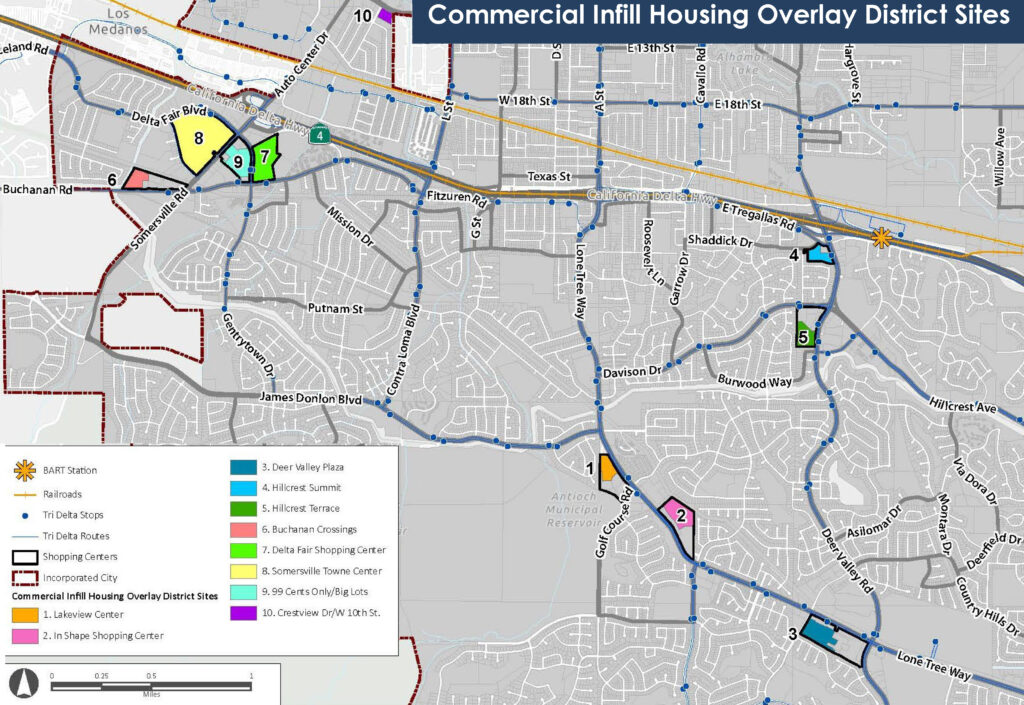
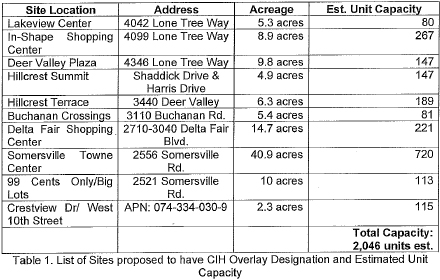
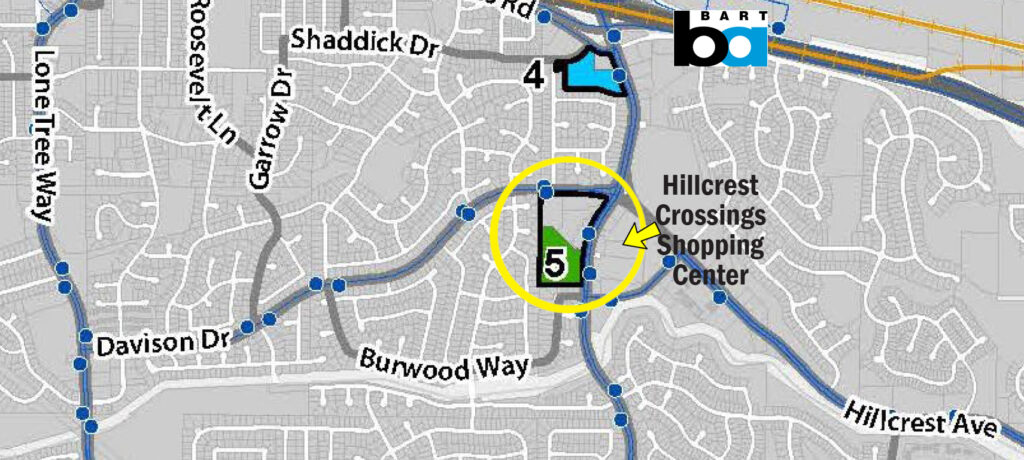
Commercial Infill Housing Overlay District Sites Map shows the 10 parcels rezoned in 2022. Source: City of Antioch
No Planning Commission, Council decisions or public input required due to Council votes in 2022 to rezone 10 commercial properties to include Extremely Low, Very Low and Low-Incomehousing and mixed-use development; not state required
By Allen D. Payton
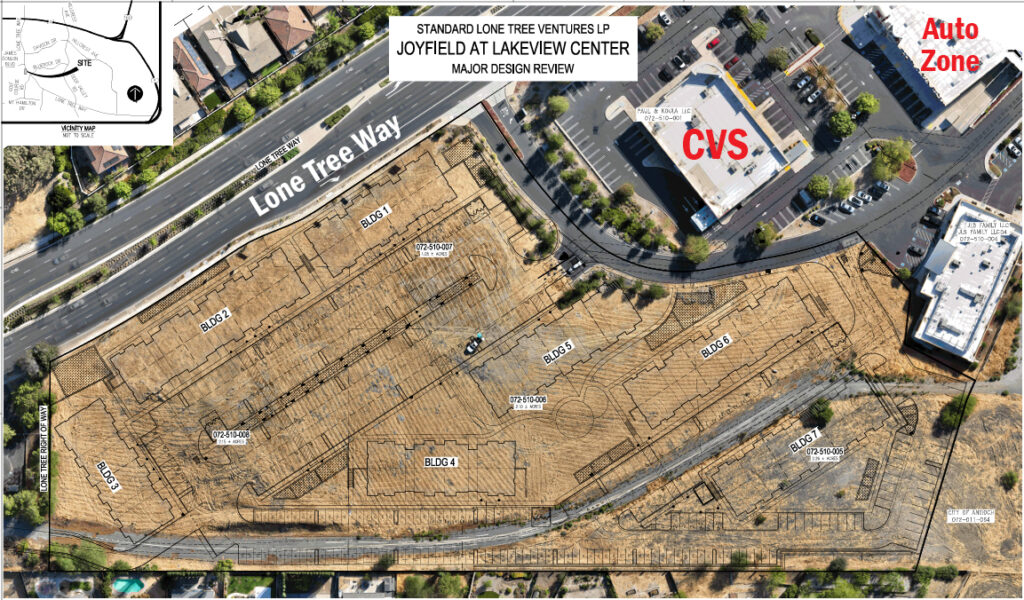
It’s been over 20 years since the residents who live near the Antioch golf course rose up in 2004 and successfully defeated a proposed apartment complex on Blue Rock Drive on the north side of Lone Tree Way. Yet Antioch City staff have “Approved, Administratively” an Extremely Low, Very Low and Low-Income, 233-unit apartment complex on the south side of Lone Tree Way next to the CVS store and shopping center without any public hearings before the Planning Commission or City Council.
But it’s only one of 10 sites throughout the city where the same conversion from commercial zoning to residential development can occur due to multiple votes by the City Council in 2022 where almost 2,500 affordable apartments can be built. Over 2,000 units only require city staff approval. Currently, four of the 10 sites have projects in process and have already been approved by staff, including the largest project, the 702-unit Somersville Town Center apartment complex.
That’s because higher density residential is allowed by right under the Regional Commercial land use designation of the General Plan due to a 2022 amendment to the General Plan Use Element (GP22-01), approved by the City Council, that added a “Commercial Infill Housing Policy.” Pursuant to this policy, the Council designated the various sites with a Commercial Infill Housing (“CIH”) overlay.
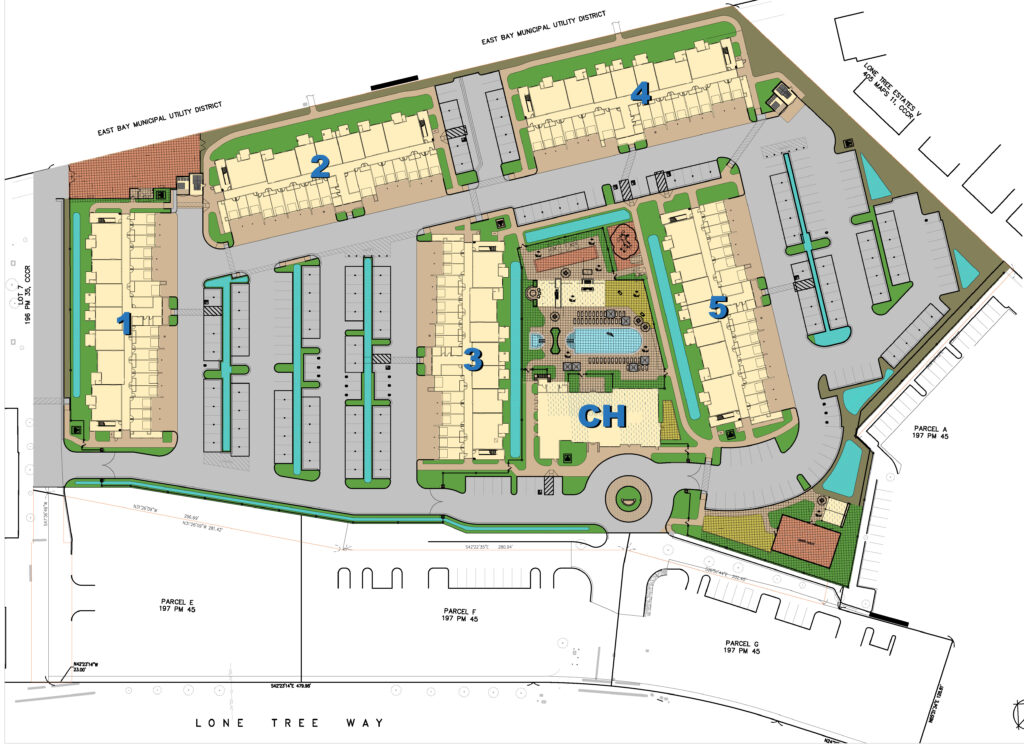
Aerial photo of site of the administratively approved Joyfield at Lakeview Center Apartments on Lone Tree Way near Golf Course Road behind the CVS store. Source: City of Antioch. Labels by the Herald
As part of the strategic infill housing study process in 2022, the specific sites within Antioch were rezoned to allow for the streamlined development of medium- and high-density residential and mixed-use projects. These infill sites are typically vacant and / or underutilized commercial areas of the City.
According to the City staff report for the City Council meeting agenda item on April 12, 2022, “The intent with this policy is to encourage revitalization in commercial developments that have commercial vacancies and relocation of commercial activity to other parts of the city. These sites are eligible for streamlined review subject to compliance with objective standards. This fulfills the need to add more housing through the building of medium and high-density housing and allows for existing commercial sites to be developed with high quality residential development.”
Unanimous Council Votes in Favor of Rezoning
During that meeting, the council voted unanimously through five separate motions to approve the Zoning Map Amendments and Rezone the 10 sites to include a CIH Overlay District designation, an addendum to the 2003 General Plan Environmental Impact Report, the General Plan Amendment, establishing Commercial In-Fill Housing Policies in the Land Use Element, the project’s Objective Design Standards and other administrative requirements to implement the changes.
Nine sites are currently developed with existing commercial uses, requiring demolition, and vary in size from 4.9 to 40.9 acres. One site, located at the southeast corner of Crestview Drive and W. 10th Street, is vacant and is 2.3 acres.
The 10 sites rezoned by the City Council are labeled as:
Lakeview Center – Estimated Units: 80. Actual: 233 See below.
In-Shape Shopping Center – Estimated Units: 267. Actual: 245 See below.
Deer Valley Plaza – Location of former AMC theaters building and parking lot. Estimated Units: 147. No plans yet submitted.
Hillcrest Summit – Estimated Units: 147. Actual: 165 See below.
Hillcrest Terrace – on Deer Valley Road next to McDonald’s, across from Safeway and the Hillcrest Crossings shopping center. Estimated Units: 189. Actual: 165 No plans yet submitted.(Owned by the Antioch Unified School District).
Buchanan Crossings – Estimated Units: 81. Actual: 195 See below.
Delta Fair Shopping Center – Estimated Units: 221 Submitted: 210 Withdrawn See below.
Somersville Towne Center – Estimated Units: 720. Actual: 702 See below.
99 Cents Only/Big Lots shopping center – on Somersville Road. Estimated Units: 113. No plans yet submitted.
Crestview Drive/W. 10th Street – empty lot near Enterprise Rent-A-Car. Estimated Units: 115. No plans yet submitted.
Votes, including two split, on individual sites occurred as follows:
On Nov. 22, 2022, the council voted to rezone and include in CIH Overlay Districts for both the Lakeview Center (Ayes: Ogorchock, Wilson, Barbanica, Thorpe; Noes: Torres-Walker) and Buchanan Crossings (Ayes: Ogorchock, Wilson, Thorpe; Noes: Torres-Walker, Barbanica recused himself) and on Dec. 13, 2022, the council unanimously approved them during the second reading as part of the Consent Calendar.
City of Antioch Principal Planner Kevin Scudero was asked about those votes and when the other eight sites were rezoned and included in CIH Overlay Districts by the City Council. He responded, “The City Council adopted the CIH Overlay on April 12, 2022. The Lakeview Center and Buchanan Crossings parcels were part of the original approval but there was an error in processing and some parcels within the center that were intended to be included were left out of the ordinance. The action on November 22, 2022, was a cleanup to add in the parcels that were mistakenly left off of the original approval.”
Asked if any additional parcels been added to the list of 10, Scudero responded, “No parcels have been added.”
Not State Required
Although the City was awarded $310,000 in SB 2 The Building Homes and Jobs Act grant funding to study feasibility of providing infill, high-density residential development on underutilized and vacant commercial sites, the rezoning was not required by state mandate.
No Additional Commission or Council Meetings with Public Input Required
Once a site has a CIH overlay, residential development is a permitted use under the General Plan. Furthermore, the entitlement process for a residential development within the CIH Overlay is ministerialprovided the proposed project is consistent with the applicable CIH Overlay District Objective Design Standards. That means no additional Planning Commission or City Council hearings with public input are required.
So, instead of future potential commercial and employment areas as the City grows south into the Sand Creek Focus Area, the designated properties will now be used to build over 2,000 apartments and townhomes. Since the change in 2022, developers have been submitting applications to build on many of the sites.
Following are the projects on the City’s Community Development Department, Planning Division’s Current Projects webpage:
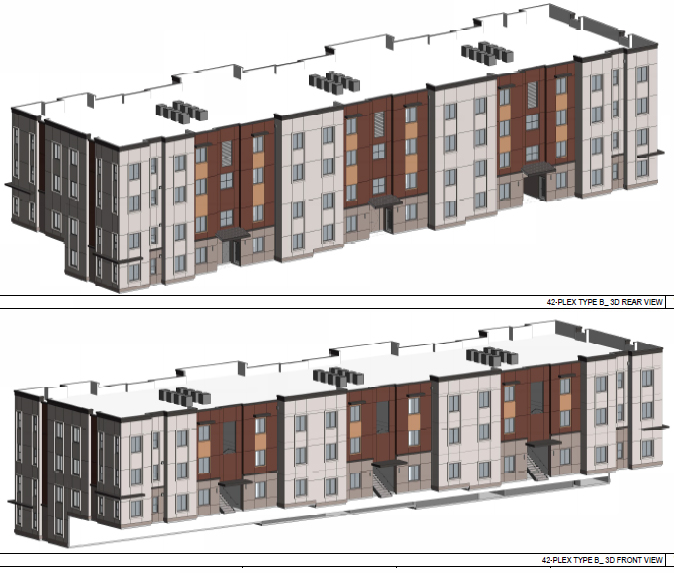
Joyfield at Lakeview Center Apartments read and front views. Source: City of Antioch
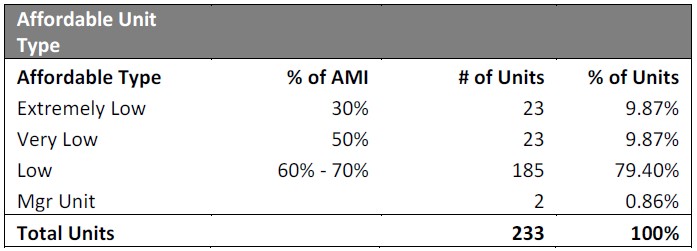
233-Unit Extremely Low, Very Low and Low-Income Lakeview Center ApartmentsNear Golf Cours Road
Labeled “Lakeview Center Multi-family”, it’s described as “Commercial Infill Housing, Administrative Design Review Request for a Multi-family development with 233 affordable units.”
Currently, the General Plan designations for the four parcels on 7.56 acres are Office, Neighborhood Community Commercial or both and each has a CIH overlay zoning. The project has been “Approved, Administratively.”
Source: City of Antioch
Development plans show seven new 3- and 4-story buildings included in the project by Los Angeles-based Standard Communities. The Project will include 350 on-grade parking stalls, community amenities, and site landscaping. The apartments will be single level and arranged in a “stacked flat” configuration. Each unit will be accessed through stairways with direct access to the parking areas. There will be 109 one-bedroom 607 s.f. units, 58 two-bedroom 793 s.f. units and 66 three-bedroom 1,008 s.f. units included.
The architectural style for the Project is “California Contemporary,” simple, and sophisticated. The amenity building is located at the center of the Project and includes a leasing center, clubhouse, business center, fitness center and laundry. The indoor amenity areas will connect to the landscaped courtyard which will include a BBQ area, lounge seating and tot lot. The Project will also have a dog park.
Site map for the Lone Tree Apartments near In-Shape health club. Source: City of Antioch
245-Unit Lone Tree Apartments at In-Shape Shopping Center
The Lone Tree Way Apartments project, proposed by The Spanos Corporation of Stockton, sits on 8.93 acres in Antioch, located between Bluerock Drive and Eagleridge Drive near the In Shape health club. The project, submitted in May 2023, and also “Approved, Administratively”, consists of 245 apartment units within (5) 49-plex, 4 story buildings as well as a stand-alone 2-story community clubhouse (approximately 9,400 SF). Each building is served by an elevator with interior-conditioned corridors. Units will range from 477 SF studios to 1,047 SF 2-bedrooms.
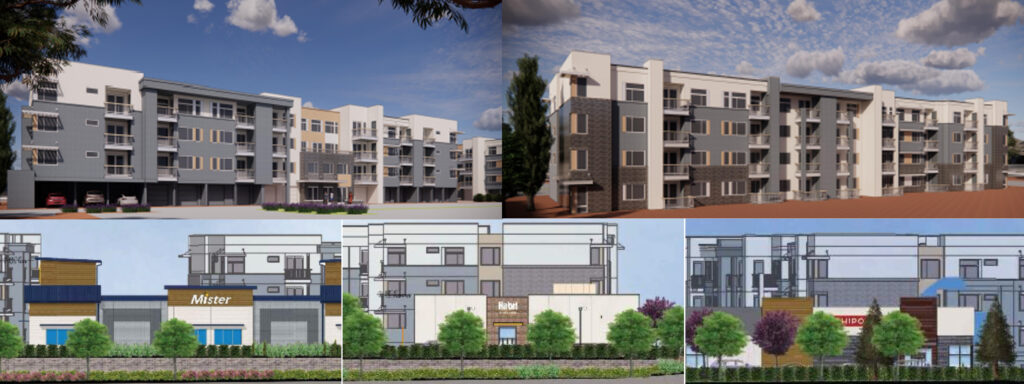
Renderings of the administratively approved Lone Tree Apartments near In-Shape and graphics showing the businesses approved by the city council last year. Source: City of Antioch
Each unit will include washer/dryer, private balcony, and luxury interior finishes. Located centrally within each building will be a pet spa and bicycle café. The community clubhouse will include a leasing center, great room, fitness center, mail and parcel room, game room, theater, sports simulator, rooftop deck and more. Outdoor amenities will include a pool, spa, cabana, fire pit, bocce ball, tot lot, dog park and pickle ball court.
Last year, a commercial project was approved to be located in front of the apartment complex, along Lone Tree Way, which will include a Chipotle Mexican Grill, Habit Burger & Grill and Mister car wash.
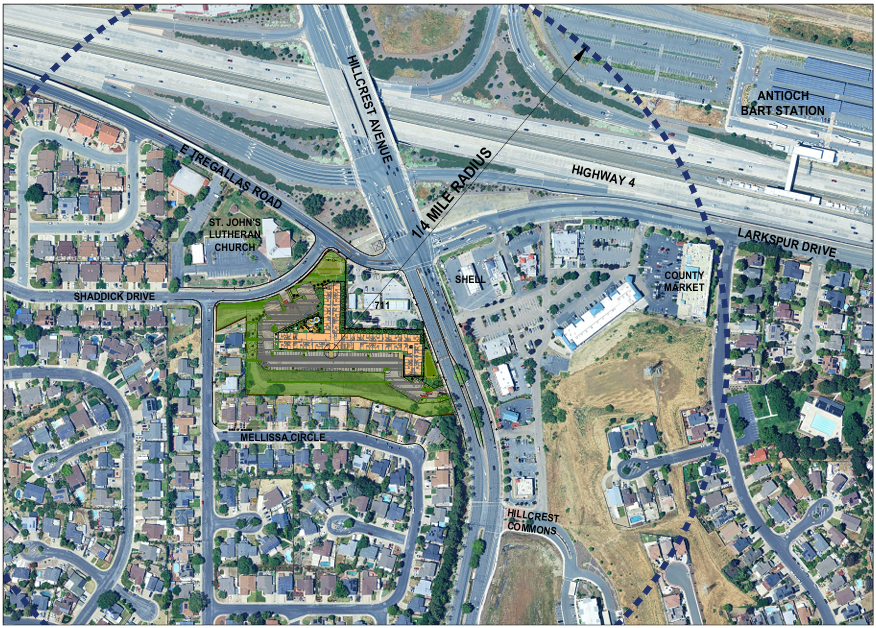
Hillcrest Summit Apartments Location Map. Source: City of Antioch
165-Unit Hillcrest Summit Apartments
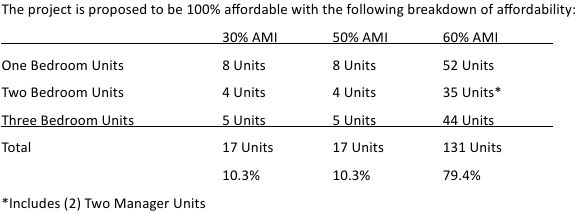
Administrative review for a 165-unit, 100% affordable apartment development, complete with associated parking and site improvements on a Commercial Infill Housing site also “Approved, Administratively”.
Hillcrest Summit Apartments is a proposed 100% affordable apartment project at Hillcrest Avenue and Shaddick Drive on a vacant site behind the 76 Service Station and 7-Eleven. Effective May 26, 2022, the property was included in the Commercial Infill Housing (CIH) Overlay District. The new zoning classification allows for by-right housing development for projects in compliance with Objective Design Standards.
Hillcrest Summit Apartments AMI figures. Source: City of Antioch
In accordance with the purpose of the CIH Overlay District, the project aims to revitalize the underutilized commercial site and increase the city’s housing supply. The convenient location is less than a half-mile from the Antioch BART Station, near access onto Highway 4, and includes a bus stop at the Hillcrest frontage. The project will include 165 residential units on four levels.
165-Unit Hillcrest Terrace Apartments – No Project Yet Submitted
This project, planned for the vacant property located next to the McDonald’s and across Deer Valley Road from the Hillcrest Crossings/Safeway shopping center, consists of a 165-unit affordable senior housing project. The CIH Overlay District would allow for up to 189 units on the 6.3-acre parcel.
The only information about the project available is regarding a loan from the City’s former redevelopment agency. According to a City staff report in the 2023 Annual Comprehensive Financial Report for the Council meeting on Feb. 13, 2024, “In October 1998, the former redevelopment agency made a commitment for $731,175 in housing set-aside funds towards this project.
“Commencing on the first date of disbursement, the loan accrues simple interest at 3% per annum. The 55-year term loan is secured by a deed of trust. Commencing on the June 1 after project completion, and on June 1 of each year thereafter, the developer will pay the Agency one-half of the residual receipts to the extent there is residual receipts. Payments will be first credited against accrued interest and then against principal. Any outstanding principal and interest is due and payable in full in June 2055. In September 2001, the Agency made a commitment of an additional $200,000 due and payable October 1, 2038. Principal and interest outstanding for these loans at June 30, 2023, is $1,599,570.”
Scudero confirmed ownership of the property. “According to our records this site is still owned by the (Antioch Unified) school district,” he wrote. However, there are no current plans submitted for the site.
Source: City of Antioch
195 Affordable Apartments on Buchanan Road next to Grocery Outlet
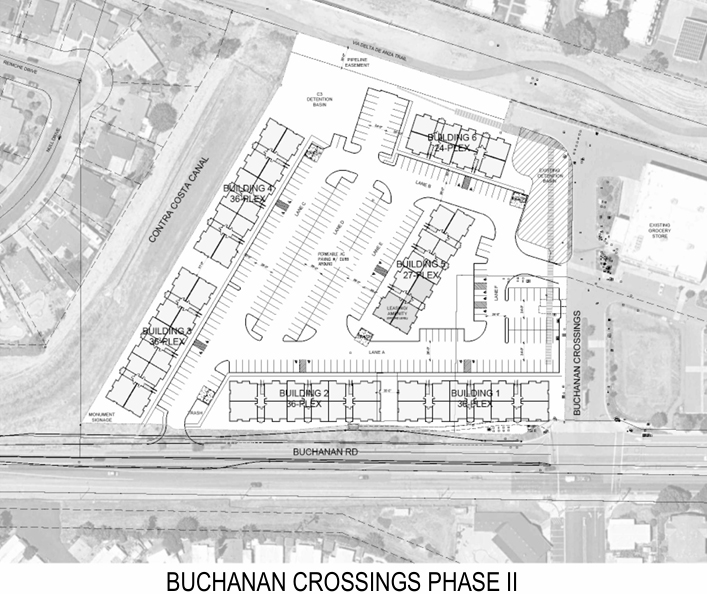
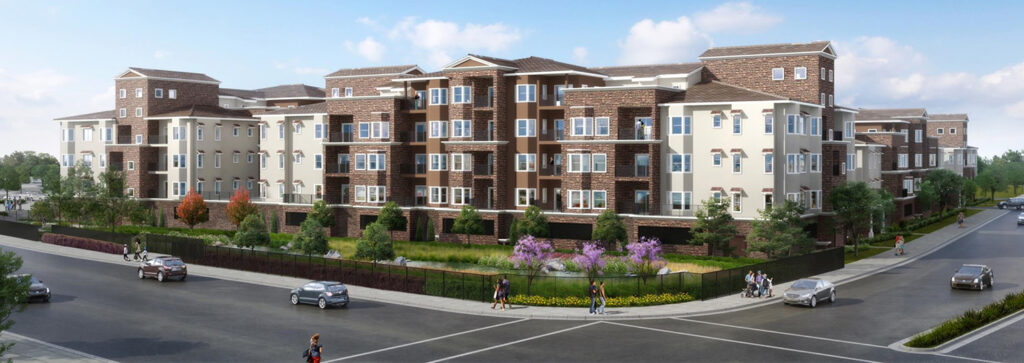
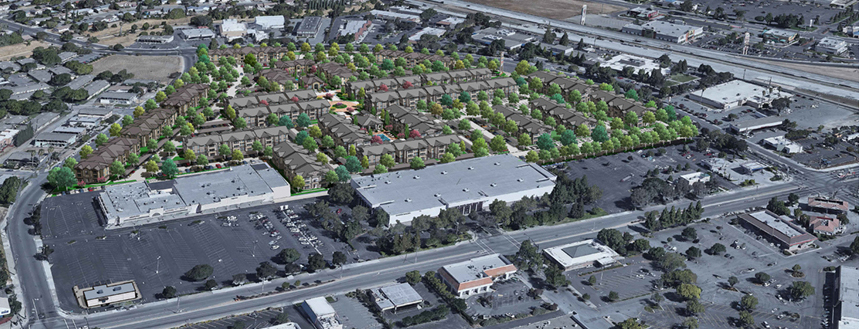
Standard Communities of Los Angeles has another affordable apartment complex in Antioch, known as Buchanan Crossings Phase II, which was also “Approved, Administratively.” The application is for a residential 100% affordable multifamily development project on 6.22 acres along Buchanan Road that will include residential apartment units with associated parking, amenity areas and site landscaping as well as frontage improvements along Buchanan Road.
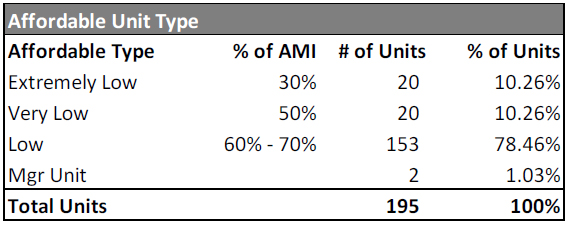
Buchanan Crossings Phase II AMI Units. Source: City of Antioch
The Project will consist of six new 3-story buildings with a total of 195 total affordable residential apartments and 293 on-grade parking stalls. There will be 91 one-bedroom, 49 two-bedroom and 55 three-bedroom units included in the complex.
Both parcels are located within the Western Antioch Commercial Focus Area of the Antioch General Plan and have a Regional Commercial land use designation and the CIH designation added in 2022.
Rendering of proposed Delta Fair Village apartment complex from 2020. Source: City of Antioch
210-Unit Delta Fair Shopping Center Apartments – Withdrawn
The project, which proposed a 4,000 s.f. commercial building and 210 apartments, known as the Delta Fair Village, was withdrawn by the developer after the City Council voted 3-2 in Sept. 2020 to postpone indefinitely his application. That was before the CIH policies were approved and the property rezoned to allow for high-density housing. At that time the plans show the residential units to be condominiums.
Somersville Towne Center Master Plan Aerial Concept with 702 administratively approved apartments. Source: City of Antioch
702-Unit Somersville Town Center Apartment Complex
The largest, new apartment complex currently in process in Antioch, will be the redevelopment of a majority of the Somersville Town Center shopping mall which has also been “Approved, Administratively” due to its location in a Commercial Infill Housing (CIH) Overlay District.
The existing mall includes 500,000 sf+/- of retail floor area. When the buildout is complete the approximately forty-acre site will include 702 new apartment units and 124,872+/- of commercial space.
Development is proposed to occur in two phases. Following demolition of most of the existing shopping mall, the first phase would begin at the northern part of the site and include eleven residential buildings, comprising 330 apartment units. Three-story, walk-up apartment buildings would be arrayed along Fairview Drive and Delta Fair Boulevard, with a central clubhouse facility.
Phase Two will complete the residential master plan adding 372 units in twelve buildings. The resulting design will define two distinct apartment villages, each with a unique architectural identity and community character. On-site parking will provide covered parking spaces for all of the units.
OTHER AFFORDABLE APARTMENT PROJECTS
Wildflower Senior Apartments Project site map. Source: City of Antioch
180-Unit Wildflower Senior Apartments
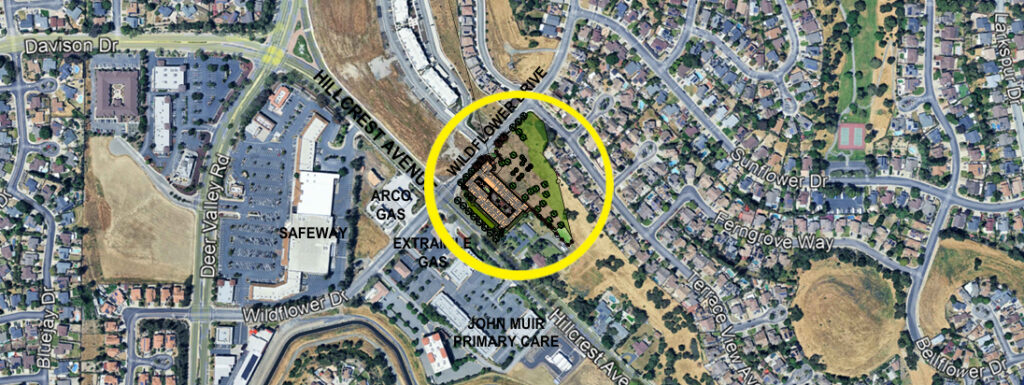
In addition to the administratively approved apartment complexes on the various CIH Overlay District sites, the 180-unit Wildflower Senior Apartments are planned for the corner of Wildflower Drive and Hillcrest Avenue. According to the Project Description, it is a proposed 100% affordable, senior apartment project on a 3.77-acre, vacant site located across Wildflower Drive from the previously approved Wildflower Station Multi-Family project and across Hillcrest Avenue from the Chevron gas station.
The General Plan land use is High-Density Residential with a zoning designation of R-35. The site is identified in the 2023-2031 Housing Element as Site 112. As a Housing Element site, the property has been targeted for redevelopment.
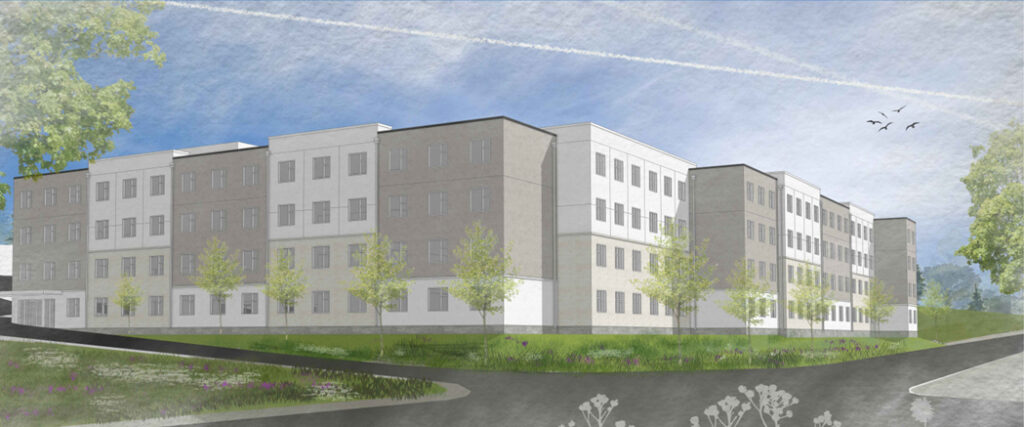
Rendering of Wildflower Senior Apartments Project. Source: City of Antioch
Within the building, a mix of one- and two-bedroom units make up the 180 residential units on four levels arranged around the central courtyard. The 102 one-bedroom units are approximately 559 s.f. each and make up 56.7% of the units. There are also 78 two-bedroom units (43.3% of total) at approximately 771 s.f. each. Two, one-bedroom units will be utilized as manager’s units.
The project will provide 100% of the residential units at 60% Area Median Income (AMI) or less and is currently in processing.
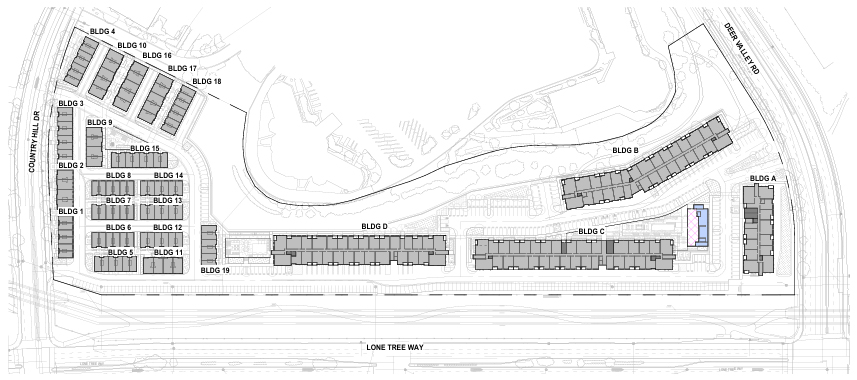
Apartments at Lone Tree site map. Source: City of Antioch
395 Apartments, 101 Townhomes Planned for Lone Tree Way Not Part of CIH But Some Units Will be Affordable
While, according to Principal Planner Scudero, the proposed project labeled, Apartments at Lone Tree, is not part of the CIH zoning overlay district, “the City Council approved the rezoning of the property from commercial to high-density residential in January 2023 as part of the Housing Element approval.”
The project by The Martin Group based in Oakland, is planned for the north side of Lone Tree Way between Country Hills Drive and Deer Valley Road, below the Seventh Day Adventist Church and Hilltop Christian School. The developer proposes 395 apartment units consisting of 25 or 33 junior one-bedroom, 261 or 253 one-bedrooms, and 109 two-bedrooms. In addition, proposed townhome buildings include a total of 84 two-bedroom, 2-bath, 1-car and 27 three-bedroom, 2.5-bath, 2-car units. This project includes 616 vehicle parking stalls with 399 surface parking spaces, and 220 proposed garage spaces. The project sponsor proposes to develop the property per the California state density bonus law.
The 19 townhome buildings are planned for the west end of the property along Country Hills Drive. The four apartment buildings and clubhouse are planned for the center of the property facing Lone Tree Way and the east end near the intersection with Deer Valley Road.
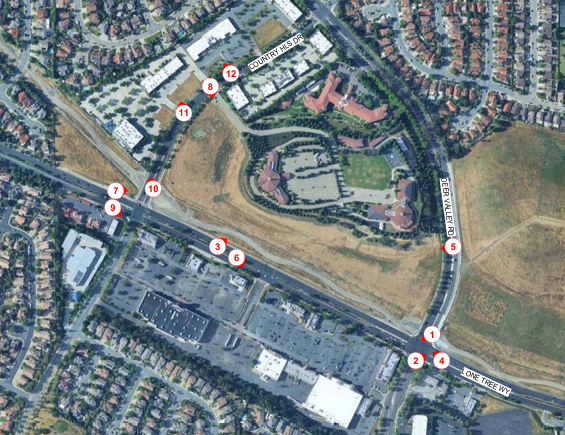
Apartments at Lone Tree aerial map with locations of photos included in the plans. Source: City of Antioch
The project sponsor proposes to develop the property per the California state density bonus law (government code sections 65915-65918). The proposed project can utilize the concessions, incentives and waivers that are afforded.
While the CIH Overlay District is not required by the state, according to the 2021 Guide to the California Density Bonus Law by the Meyers Nave law firm, the Density Bonus is a state mandate requiring cities to adopt ordinances to implement the law. It “provides developers with powerful tools to encourage the development of affordable and senior housing, including up to a 50% increase in project densities for most projects, depending on the amount of affordable housing provided, and an 80% increase in density for projects which are completely affordable.”
“A developer who meets the requirements of the state law is entitled to receive the density bonus and other benefits as a matter of right,” the Guide continues. “Special development bonuses are available for developers of commercial projects who partner with affordable housing developers to provide onsite or offsite affordable housing.”
The developer is currently processing the project application with City staff but did not provide in the Project Description the percentage of units that will be affordable and at what AMI levels.
Rendering of the proposed Apartments at Lone Tree. Source: City of Antioch
Scudero was asked questions regarding the Apartments at Lone Tree project. He was first informed of and asked about the discrepancy in unit totals as the Project Description reads, “PROPOSES A TOTAL OF 395 UNITS CONSISTING OF 33 JUNIOR ONE-BEDROOM, 253 ONE-BEDROOMS, AND 109 TWO-BEDROOMS. TOWNHOMES BUILDINGS PROPOSES A TOTAL OF 84 TWO-BEDROOM AND 27 THREE-BEDROOM TOWNHOMES.” But further down in the Unit and Area Summary chart it shows 25 Junior One-Bedroom and 261 One-Bedroom apartments.
Finally, the Project Description reads, “The project sponsor proposes to develop the property per the California state density bonus law (California government code sections 65915-65918). The proposed project can utilize the concessions/Incentives and waivers that are afforded.”
The state Density Bonus Law means a portion of the units will be affordable. Scudero was asked what percentage of the units will be affordable or if those numbers be submitted later.
Scudero responded, “Regarding the Lone Tree project, we have notified the applicant of the inconsistency in the plans and project description as part of our consistency review. Once we receive a revised submittal we will update the plans on the website. The total unit count of 506 units is correct. Regarding the density bonus, you are correct they will be providing affordable units. They have not determined yet what percentage of affordable they will propose to achieve the density bonus. That will come at a later date.
“Regarding the CIH site at Hillcrest that was approved as part of the original CIH approvals. The ordinance needs a second reading and goes into effect 30 days after that which is why the effective date is later than the original approval date,” he added.
City Staff Provides Additional Information
Questions were emailed to City staff, Mayor Ron Bernal and Councilmembers Don Freitas and Louie Rocha about the apartment and townhome projects.
Staff were asked if the parcels with projects that do not yet have administrative approval can be rezoned, the CIH overlays be eliminated and the projects be stopped. Principal City Planner Scudero responded, “Given the current complexities in state housing laws, we will need to look further into this question and get back to you.”
Staff were also asked if SB330, the state law that streamlines and limits local regulations on housing developments in California, applies to these projects since they’re apartments and not single-family residences. The townhome projects recently approved by the City Council at Wildflower Station and Slatten Ranch were submitted under the law and the council was required to approve them.
Scudero responded, “Yes, SB330 applies to all housing projects that are consistent with the General Plan and Zoning standards.”
The three council members were asked if they were aware of the CIH apartment projects and, if they can, are they willing to reverse the decision on parcels that don’t yet have a project that’s been administratively approved.
Creating Another Sycamore?
Both the councilmembers and staff were asked if approving 702 apartment units where most of Somersville Towne Center currently exists and must be demolished was going to create another Sycamore area, the City’s neighborhood with the greatest crime problems, with too many multi-family units in one area. They were also asked if some of those units could instead be approved as for sale, owner-occupied condominiums.
Scudero responded, “The decision to make a project for sale versus for rent is up to the developer. They are reviewed against the same objective design standards with the one difference being that a for sale project also requires the processing of a map for subdivision purposes.”
Questions Regarding Delta Fair and 99 Cents/Big Lots Shopping Center Projects
The four were also asked if someone has contacted Gabriel Chew, the owner of the property where the Delta Fair Village is proposed, to reconsider submitting and processing it. They were also asked if Chew owns the 99 Cents/Big Lots property and has there been any contact with him or the owner (if different) about redeveloping it.
Finally, they were asked about Deer Valley Plaza, where the former theaters building is located and is included on the list, but no plans have been submitted for it, yet, if it was purchased and going to be a mosque as has been rumored.
Scudero responded, “The Delta Fair Village property owned by Gabriel Chiu is included in the CIH Overlay district and the site is eligible to be developed under the streamlined CIH approval process. The former 99 Cents/Big Lots/CVS building is actually three separate parcels under separate ownership. A church has recently purchased the former CVS and obtained a use permit to operate there.”
A sign on the side of the former theaters building reads, “Bay Area Pentacostals”.
Bernal Must Check with Staff, City Attorney if Stopping Projects Not Yet Approved Possible
Bernal responded with, “I am aware of the overlays the Council approved in 2022 but do not know if the City can ‘undo’ these overlays and will have to find out from City staff and the City Attorney’s office if this is a possibility.
“Regarding Mr. Chiu, I have reached out to him but have been unable to arrange a time for us to meet,” the mayor continued. “My understanding is that he still owns shopping centers on Delta Fair Blvd., 18th and A Streets and Deer Valley Plaza. I’m told he sold the theater to a church which I have seen is currently being renovated.”
“I’ve been told the former CVS and 99 Cent stores at the Bank of America Center on Somersville Road have been purchased by La Palabra de Dios Church and are currently being renovated,” Bernal added, reiterating what Scudero shared.
Rocha Open to Reviewing Commercial Properties Not Yet Administratively Approved
In response to the questions posed to him, Rocha said, “I’m aware of the approved projects and in favor of reviewing all projects as we develop our new General Plan with a focus on rezoning of commercial properties that have not received Administrative Approvals.”
“We have learned the limitations to local government control with properties that were rezoned from commercial to residential under new legislation SB 330 that grants high density housing as part of the States response to the housing crisis without local approvals,” he continued. “I am in favor of advocating for mixed housing and commercial projects that support economic development that provides housing, business and local employment.”
Asked if he had nny concerns about too many low-income rental units being concentrated in one area of the city as part of the redevelopment of Somersville Towne Center and possibly creating more future crime problems, Rocha responded, “I’m in favor of mixed development that provides equitable opportunities for all members of our community.
Pressed again if he is concerned about too many low-income rental units being concentrated in one location, the councilman did not respond.
Barbanica Wanted Up-Scale Housing, Ogorchock Knew They Would be Affordable, Neither Were Aware They Only Required Staff Approval
At the time the CIH rezoning was proposed to the city council, Con Johnson was City Manager, Forrest Ebbs was Community Development Director and Kwame Reed was Economic Development Director.
When reached for comment about the matter, former District 2 Councilman Mike Barbanica said, “It was never the intent to be affordable, low-income housing. It was to be upscale housing and mixed use. I had several meetings with Forrest about rezoning the properties.”
Asked about her votes on the CIH Overlay Districts for the 10 properties, former District 3 Councilwoman Lori Ogorchock said, “Basically, I remember them being infill projects. The one that sticks in my mind was the property behind CVS on Lone Tree Way.”
“I don’t remember them ever allowing them to be administratively approved,” she continued.
“I didn’t meet with Con Johnson because he never had answers and he was going to ask department heads for the answers and then never got back to me,” Ogorchock offered. “He didn’t want us meeting us with department heads without his presence. But I would talk to Forrest.”
“I would have never voted for anything if it was only administratively approved,” she stated. “I believe in the process of the Planning Commission and Council meetings with public input.”
“I do remember them being affordable but, that we couldn’t say ‘no’ to any housing projects because of the new state law. (SB330). I also remember them being mixed use,” Ogorchock added.
Questions for Former Mayor, Current Councilwomen, Torres-Walker Thought She Voted for Mixed-Use
Councilwomen Monica Wilson and Tamisha Torres-Walker, and former Mayor Lamar Thorpe were asked the following questions:
“Were you aware you were giving City staff the authority to approve each project without having to go through the public approval process?”
For the councilwoman they were asked the same questions as the current mayor and councilmen, “Are you willing to either require the five sites that don’t yet have administrative approval to go through the public process, require that they be mixed use instead of just housing or stop and rezone them? They were also asked, “Are you concerned about creating another policing problem area like the Sycamore neighborhood, by concentrating too many rental housing units in the same area at the Somersville Towne Center project?”
Wilson was specifically asked, were you aware of the 2004 effort to stop the apartments from being built on the property where your townhome is located? If so, why would you vote to approve not only an apartment complex there, but one that includes Extremely Low, Very Low and Low-Income units?
Only Torres-Walker responded with, “I am a supporter of affordable housing projects and I have considered the need for housing projects that include options for individuals that fall under the category of Extremely Low, Very Low and Low-Income.”
“When I voted I was under the impression that we were supporting mixed-use and mixed income projects,” she added.
The District 1 Councilwoman was again asked if she was aware that they had given City staff the authority to approve the projects without holding hearings for public input. But she did not respond prior to publication time.
Lakeview Center, Buchanan Crossing Projects on Feb. 24th Council Meeting Agenda
For the council meeting on Tuesday, February 24, 2026, two of the projects were on the agenda, as Items #5 and #6. They were Appeals of the December 18, 2025 Administrative Decision Regarding Lakeview Center Commercial Infill Housing Application and the November 13, 2025, Administrative Decision Regarding Buchanan Crossing Commercial Infill Housing Application. However, both items were requested to be postponed until the next council meeting on March 10, 2026, for Public Hearings.
Multiple efforts to reach Freitas, Wilson and Thorpe for their responses to the questions were unsuccessful. Please check back later for any updates to this report.
Bay Area transit agencies are seeking another half-cent sales tax in November. While most of the $980 million a year in new revenue will go to BART, Muni and AC Transit, smaller agencies will also receive extra tax money, evading the need to reform. Contra Costa County will continue to have multiple bus operators, including two sharing the territory east of the Caldecott. Before voters agree to pour more public money into this hodgepodge of agencies, they should ask whether there are opportunities for reform.
Central and Eastern Contra Costa County are currently split between two distinct bus agencies. Tri Delta Transit covers eastern communities like Antioch and Brentwood, while County Connection serves central hubs including Walnut Creek and Concord. Together, they cover a combined service area of more than 800,000 residents. Both feed riders into BART, yet they maintain completely separate executive teams, planning departments, procurement offices, and administrative staff. In 2024, these two agencies spent a combined $79.8 million to deliver 4.1 million bus rides at an average cost of $19.39 per trip—of which passenger fares covered just $1.33, leaving taxpayers to subsidize the remaining $18.07 per ride.
The financial unsustainability of this arrangement is glaring when looking at farebox recovery and utilization. Passenger fares cover just 7.8 percent of operating costs at County Connection and an even worse 5.5 percent at Tri Delta Transit, meaning taxpayers shoulder nearly the entire burden for systems where 40-foot buses frequently circulate with almost no one on board. The redundancy also affects riders, with Tri Delta’s Route 201X running deep into Concord and County Connection’s Route 93X crossing into Antioch. Riders navigating this corridor face separate fare structures and schedules simply to preserve two entrenched bureaucracies where one would clearly suffice.
My recent California Policy Center analysis of the state’s 85 transit operators highlighted the need to consolidate smaller agencies to rein in administrative overhead, a problem acutely visible at County Connection. The agency employs 249 people directly and negotiates with three distinct labor unions, driving salaries and benefits to $28.7 million, which consumes 62 percent of its $46.4 million operating budget. Tri Delta Transit, conversely, demonstrates the fiscal advantages of leveraging private sector efficiencies. Rather than inflating a massive public payroll, Tri Delta contracts its bus operations to a private company, Transdev, keeping its own overhead lean while retaining fleet ownership. Tri Delta has also pioneered microtransit with its Tri MyRide app, recognizing that deploying a shared van is far more sensible than running a near-empty 40-foot bus on a fixed loop through low-density neighborhoods.
The perverse incentives of the current funding model guarantee that meaningful reform will be ignored in favor of demanding more tax revenue. Merging the two agencies under a single general manager and board, while competitively contracting all operations, could save millions in administrative, operating, and capital costs.
It is important to recognize that Contra Costa bus agencies are not providing a meaningful solution for climate change or congestion. Federal transit data cross-referenced with the Department of Energy’s Transportation Energy Data Book reveals that Contra Costa’s highly subsidized buses average just four passengers and burn 8,400 BTU of energy per passenger-mile, which is more than double the energy intensity of a typical SUV and triple that of a passenger car. Furthermore, Google’s Environmental Insights Explorer indicates that buses account for a statistically insignificant 0.31 percent of all trips in the county, meaning that additional bus funding from the new sales tax won’t alleviate congestion on Interstate 680 or Highway 4.
Subsidized suburban transit should be viewed strictly as a social safety net for those who lack alternatives, not as a green infrastructure project or a cure for regional traffic. When voters go to the polls in November 2026, they should firmly reject the new sales tax measure. Until regional planners dismantle these redundant bureaucracies and implement competitive contracting across a unified eastern and central Contra Costa County transit network, taxpayers are merely subsidizing an inefficient status quo.
Positions on Police Oversight, Parks & Recreation and Sales Tax Oversight Commissions, Board of Administrative Appeals, General Plan Advisory Committee
Application deadline: Feb. 27 at 5:00 p.m.
By Allen D. Payton
The Antioch City Council is seeking residents to serve on the following three commissions and one board. Any interested resident is invited to apply for the following vacancies by 5:00 p.m., Friday, February 27, 2026.
Antioch Police Oversight Commission
One (1) Partial Term Vacancy, expiring November 2026
The Antioch Police Oversight Commission shall advise the City Council and Staff on the administration of the Antioch Police Department and public safety issues to ensure that the policies conform to national standards of constitutional policing. The Commission shall promote, encourage, and facilitate community participation and oversight by reviewing and recommending policies that is sensitive to the diverse needs of residents, aiming to inform the community of its rights and responsibilities on interactions with police officers.
Meetings are held at 6:00 pm on the 1st and 3rd Monday of every month, except in July and December, when meetings occur only once, inside the Council Chambers, at City Hall, except for two meetings per year will be held at locations within Antioch for the purpose of increasing community engagement.
The Commission serves in an advisory capacity to the City Council in matters pertaining to parks, recreation functions and policy, as well as engaging the community in programs and services. The Commission also surveys current and future recreation and park needs of the community to provide sound, year-round program for all ages.
Meetings are held at 7:00 pm on the 3rd Thursday of every month in the Council Chambers at City Hall, 200 H Street.
The Sales Tax Citizens’ Oversight Committee shall review the expenditures and report publicly how the funds are being used to address the City Council’s stated priorities of maintaining Antioch’s fiscal stability, police patrols, 911 emergency response, youth violence prevention programs; ensuring water quality/safety; repairing streets; cleaning up parks/illegal dumping; restoring youth afterschool/summer programs; and other essential services. Each year, an independent auditor shall complete a public audit report of the revenue raised and its expenditure. The Committee’s review shall be completed in conjunction with the City’s budget process. The Committee’s report on its review, whether oral and written, shall be considered by the City Council at a public meeting before April 1 of each year. Any written report shall be a matter of public record.
Meetings are held at least twice annually at a location to be determined.
Three (3) Full Term Vacancies, expiring March 2030
One (1) Alternate Vacancy, Two-Year Term
The Board of Administrative Appeals hears appeals regarding administrative decisions by any official of the City dealing with Municipal Code Interpretations.
Meetings are held at 3:00 pm on the 1st Thursday of every month in the Council Chambers at City Hall, 200 H Street.
The City of Antioch encourages residents to become involved in their local community. One way to do so is to serve on various commissions, boards, and committees. Any interested resident is encouraged to apply.
Purpose: The Committee (GPAC) will serve as one of the primary channels for the community to provide input and make recommendations on the General Plan Update. Participation by members appointed to the GPAC is temporary; the roles and responsibilities of its members will terminate with City Council adoption of the General Plan.
Meetings will generally occur once per month, but there may be months when no meetings are held. The first meeting is anticipated to be held April 2026.
GPAC Requirements:
•Must be a resident of the City of Antioch.
•Members are subject to The Brown Act open meeting law.
•Commissioners are required to submit the Fair Political Practices Commission(FPPC) Form 700 (Statement of Economic Interests) upon assuming office, and everyyear thereafter.
•Commissioners are required to complete a 2-hour online AB1234 Ethics course withinone year of their appointment.
•Newly appointed and reappointed Members are required to take an Oath of Office administered by the City Clerk.
To apply visit Boards & Commissions page on the City’s websiteselect the link to download the application. The application will download onto your computer or mobile device and can be emailed directly to the City Clerk’s Office. You can also print and mail/drop off your application to the City Clerk’s Office at 200 H Street Antioch, CA 94509.
The City Council will vote for each appointment at a future council meeting.
Feb. 18th Board meeting agenda includes layoffs for 104 teachers, counselors, directors, vice principals and 193 classified staff to save $38 million
By Allen D. Payton
According to Danielle Watson, a parent of a child in the Antioch Unified School District, “as of Friday, Feb. 13, the District is allegedly pink-slipping Admin staff and plans to eliminate over 100+ teachers. They are also discussing proposed cuts to Special Education staffing, including classroom aides and support staff.”
As a result, a “Peaceful Protest is planned for Tuesday morning, Feb. 17 at the school district headquarters.
“Nearly one in five AUSD students has an IEP (Individual Education Plan). Parents are asking the Board to re-evaluate cuts and share a public impact analysis prior to finalizing any decisions at the Feb. 18 Board meeting,” she shared. “They are no longer negotiating with Special Education staff.”
Proposed Cuts on Board Meeting Agenda
The Board’s agenda for Wednesday night’s meeting confirms Watson’s concerns showing a total of 297 staff cuts to save almost $38 million in the annual budget.
The cuts are proposed by Superintendent Dr. Darnise Williams and Associate Superintendent for Human Resources Dr. Camille Johnson. According to the staff report for the items, “In the event classified – and certificated – services need to be reduced or discontinued due to lack of work and/or lack of funds, the Education Code requires that the Board take action to reduce/eliminate positions and that affected employees be provided written notice no later than March 15. The District will consider bumping rights, retirements, resignations, releases, and other attrition and give notice only to those employees who, according to seniority and Board-adopted tiebreak and competency criteria, are appropriate for layoff.”
“I would like for Dr. Williams to break this barrier of distrust among parents, staff and the broad community,” Watson stated. “This is her opportunity.”
Her greatest concern is about the cuts to special education teachers and para-professionals, and the safety of the students, especially those who have already demonstrated behavioral challenges.
“It’s concerning to think about the risk to teachers they’ll be causing, by forcing them to mitigate situations by themselves,” Watson said.
Several parents have sent emails to the Board and Superintendent. But as of today, Monday, February 16th, no response has been received from anyone, she shared.
The protest begins at 10 A.M. at the AUSD offices, 510 G Street, in Antioch’s historic, downtown Rivertown.
ANTIOCH, CA — The City of Antioch has been awarded a $2,000,000 grant through the California Violence Intervention and Prevention (CalVIP) Grant Program, administered by the Board of State and Community Corrections (BSCC), following approval at the Board’s February 12, 2026 meeting. The funding will support expanded public safety strategies and community-based initiatives focused on prevention, intervention and long-term community stability, including coordinated partnerships and evidence-based services aimed at reducing violence and improving neighborhood safety.
The grant allows the City to initiate program activities beginning April 1, 2026. City staff will work closely with the BSCC to complete the contract process and fulfill all required onboarding and compliance steps associated with the award. Implementation will include structured reporting and performance monitoring to ensure accountability and measurable outcomes.
“This $2 million investment reflects confidence in Antioch’s approach to building safer neighborhoods through collaboration, accountability and data-informed strategies,” said City Manager Bessie Marie Scott. “These funds will allow us to expand programs that address root causes and improve outcomes for our community.”
“This award enhances our ability to deploy focused prevention and intervention strategies that reduce recidivism and improve public safety,” said Chief of Police Joe Vigil. “We will align these resources with evidence-based practices and community partnerships to ensure measurable impact.”
“This grant provides critical support for sustainable, community-centered initiatives,” said Monserrat Cabral, Director of Public Safety and Community Resources. “Our priority will be transparent implementation, performance tracking, and responsible management of these resources to ensure long-term benefits for Antioch residents.”
Additional information regarding program rollout and implementation milestones will be released as the agreement is finalized.
By Contra Costa County Office of Communications & Media
(Martinez, CA) – The Contra Costa County Board of Supervisors is seeking individuals with sound knowledge and experience in the field of public and private finance, to serve on the Treasury Oversight Committee (Committee) for the seat representing the Alternate County Board of Supervisors, Public Representative Seat 1, and Public Representative Seat 2 for term May 1, 2026 to April 30, 2030.
The Board of Supervisors established the Committee on November 14, 1995. The Committee’s duties include reviewing and monitoring the County Treasurer’s Annual Investment Policy, and ensuring an annual audit is conducted to determine the County Treasurer is in compliance with Government Code §§27130-27137.
To be considered, candidates must be County residents, may not be employed by an entity that has contributed to the reelection campaign of the County Treasurer or a member of the Board of Supervisors in the previous three years, may not directly or indirectly raise money for the County Treasurer or a member of the Board of Supervisors while a member of the Committee and may not work for bond underwriters, bond counsel, security brokerages or dealers, or financial services firms with whom the County Treasurer does business, either during his or her tenure on the Committee or for one year after leaving the Committee. (Government Code §27132.3).
The Committee meets bi-annually in March and September on the third Tuesday of the month at 3:00 p.m. at 625 Court St., Room B010, Martinez, CA 94553. Each meeting lasts approximately one hour.
Application forms can be obtained from the Contra Costa County Clerk of the Board by calling (925) 655-2000 or by clicking on the following link: Submit an Application Online. Applications should be returned to the Clerk of the Board, County Administration Building, 1025 Escobar Street, 1st Floor, Martinez, CA 94553 no later than Thursday, March 5, 2026, by 5 p.m. Interviews will be held at the Internal Operations Committee (IOC) meeting, which will be conducted via Zoom at 10:30 a.m. to 12 p.m. on March 23, 2026. More information about the Treasury Oversight Committee can be obtained by visiting the Treasurer-Tax Collector’s website at https://www.contracosta.ca.gov/690/Treasury-Oversight-Committee.
Lori Asuncion was voted to be the new Antioch City Attorney on Tuesday, Feb. 10, 2026. Photo: LinkedIn
Will be paid $288,000 salary per year, $513,028 in total compensation
By Allen D. Payton
After granting her request to postpone the matter during their last meeting, at which only three members were present, the Antioch City Council voted 5-0to hire former Stockton City Attorney Lori Asuncion as Antioch’s new City Attorney. The matter was placed on the agenda for the Jan. 27th meeting, but both Mayor Ron Bernal and District 4 Councilwoman Monica Wilson. Asuncion made a last-minute request to postpone the vote.
This time, both Bernal and Wilson, who arrived at 7:55 p.m., were there for the vote. But Asuncion was not in attendance.
Interim City Attorney Derek Cole introduced the item saying Asuncion is “an exceptional, very talented attorney with city attorney experience…who I’ve known for several years. She has a fantastic reputation.”
He also spoke about SB707 requiring the council to report out of Closed Session, “the compensation package of your key executive and key department heads. It has to be…put on the record in a public meeting.”
Cole then shared Asuncion will receive an annual salary of $288,000 or $24,000 per month, and benefits of $225,028 for total compensation of $513,028 per year.
It’s a 26.7% increase over the compensation she received in Stockton. According to Transparent California, in 2024, Asuncion earned Regular pay of $290,601, Other pay of $15,300 for Total pay of $305,901. In addition, she received $98,700 in benefits for a total compensation package of $404,601 per year.
No one from the council had any questions for Cole or made any comments, nor were there any public comments before the motion to hire Asuncion was made by Mayor Pro Tem and District 3 Councilman Don Freitas and seconded by Wilson. It passed unanimously.
It’s been 13 months since Thomas Lloyd Smith resigned the position on Jan. 17, 2025. Since then, Cole, of law firm Cole Huber, has served as Antioch’s Interim City Attorney on a contract basis. Asuncion was chosen following a statewide search, several closed session meetings with both the consultant, Recruiter Joe Gorton, from the Bob Hall & Associates recruiting firm, and candidates during the recruitment process.
According to a press release sent out by City PIO Jaden Baird immediately following the vote, “Ms. Asuncion brings more than 18 years of dedicated public service to Antioch, most recently serving as City Attorney for the City of Stockton, where she served as a trusted legal advisor on some of the City’s most complex and high-profile matters.
Ms. Asuncion began her tenure with the City of Stockton in 2007 as a Deputy City Attorney, was promoted to Assistant City Attorney in 2018, and appointed City Attorney in 2022. During her service, she played a critical role in shaping key city policies and ordinances, advancing strategic goals and priorities, leading sensitive investigations, and managing complex litigation. She brings deep expertise in land use law, Brown Act compliance, and litigation management.
Following an extensive and competitive recruitment process, the City Council selected Ms. Asuncion based on her depth of experience, leadership background, and demonstrated expertise in municipal law.
Mayor Bernal welcomed the appointment, stating, “With eighteen years of municipal law experience in the City of Stockton, City Attorney Asuncion brings proven leadership and the ability to navigate complex challenges. I am confident she will be a valuable asset as we continue moving Antioch forward.”
Cole expressed strong support for the appointment, stating, “I am excited that Lori Asuncion will be the next Antioch City Attorney. I’ve had the pleasure of working with Lori through our mutual involvement with the League of California Cities. Lori is widely respected in the City Attorney Community. She has nearly two decades of legal experience in a large city attorney office. She is well prepared to work with the City Council, City Administration, and Executive Team to move Antioch forward.”
Reflecting on her selection, Ms. Asuncion stated, “I am honored that the Mayor and Council chose me to serve the City of Antioch and contribute to the success, stability, and resilience of the community.”
Her leadership reflects a strong commitment to public service, transparency, staff support, and community improvement.
Ms. Asuncion has also been actively involved in professional legal organizations. She has served on the California League of Cities City Attorneys’ Department Nominating and Legal Advocacy Committee and has contributed as an editor to the League’s Municipal Law Handbook.
Born and raised in Stockton, Ms. Asuncion earned her Juris Doctor from the University of the Pacific, McGeorge School of Law in 2005 and holds a Bachelor of Arts degree from California State University, Stanislaus, awarded in 2002.
When asked, Baird responded, Antioch’s Human Resources Department has not yet shared Asuncion’s start date.
UPDATE: On Feb. 18th, Baird said, “Our Attorney’s start date is March 2nd.”