








Despite test score gains California students still lag behind pre-pandemic levels
Saturday, October 11th, 2025
Black and Latino students make progress; pandemic widened math gender gap; more English learners are proficient
New Titles for Four Levels of Achievement: Advanced, Proficient, Developing or Minimal
By Diana Lambert, Zaidee Stavely, Betty Márquez Rosales and Daniel J. Willis, EdSource.org, republished with permission
Top Takeaways
- California test scores show students still struggle with learning loss five years after the Covid pandemic.
- Students improved by 1.8 percentage points in math and English language arts last school year, the largest year-over-year increase since before the pandemic.
- Despite increases, serious equity gaps persist.
- Science scores were the only ones to return to pre-pandemic levels
Five years after the Covid pandemic closed schools and pushed students into a year of distance learning, California test scores show that — despite increases — students are still struggling with learning loss.
During the 2024-25 school year, the number of students who were advanced or proficient in math and English language arts improved by 1.8 percentage points in each subject — the largest year-over-year increase since before the Covid pandemic, according to Smarter Balanced test scores released Thursday. Science scores increased by 2 percentage points.
“There is greater progress this year than we had last year,” said State Board of Education President Linda Darling-Hammond. “Gains in ELA and science are about four times the level of the gains last year, and the gains in math are about twice the level of the gains last year. So, it feels like there is some momentum toward improvement.”
New Titles for Four Levels of Achievement: Advanced, Proficient, Developing or Minimal
The titles of the four levels of achievement are different this year. In March, the California State Board of Education chose new titles to describe how students perform on standardized tests, including the Smarter Balanced tests.
Students will now be labeled as advanced, proficient, developing or minimal to describe their knowledge and skill level.
Students who are advanced, proficient and developing are all working within their grade level band, while students who are at the minimal level are not consistently showing grade-level standards, said State Board of Education President Linda Darling-Hammond.
“Proficient is a pretty high bar because that is very thorough mastery of grade-level standards and advanced is very sophisticated,” she said.
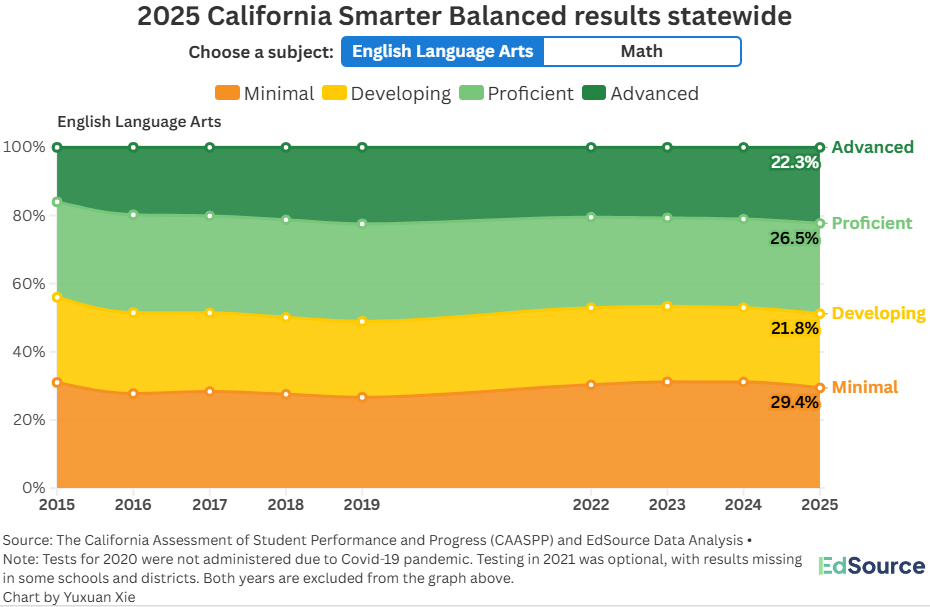
Smarter Balanced tests are given to students in third through eighth grades and in 11th grade as part of the California Assessment of Student Performance and Progress (CAASPP), which also includes the English Language Proficiency Assessment.
CAASPP test scores for California nearly 1,000 school districts and 10,000 schools are available on EdSource’s searchable database.
Despite the improvement at all grade levels, the number of students who were advanced or proficient in English language arts last year only increased to 48.8%, 37.3% in math, and 32.7% in science.

That wasn’t enough to bring scores up to pre-pandemic levels when more than half of California students, 51.7%, met or exceeded state standards in English language arts, and 39.7% met or exceeded state standards in math.
Science scores were the only ones to return to pre-pandemic levels, with 2.8% more students scoring proficient or better last year compared to 2018-19.
Equity isn’t improving fast enough
“I think certainly these scores are headed in the right direction,” said Christopher Nellum, executive director of EdTrust-West, an education advocacy organization. “I would argue, at the wrong speed if we’re serious about equity … we need double-digit gains, not incremental gains.”
The California School Boards Association is also calling for a state plan to close the achievement gap that includes increased funding for school districts with a large population of high-needs students, as well as increased accountability and transparency from the state.
“We shouldn’t let a point or two in a positive direction detract from the fact that millions of California students are still being underserved and those students are disproportionately concentrated in certain demographic groups that have been lacking for decades,” said Troy Flint, chief information officer at the CSBA.
Nation’s third graders have similar scores
California’s third-grade reading scores are similar to most other states in the country, which have grown about 1% a year between 2022 and 2025, said David Scarlett Wakelyn, a partner with Upswing Labs, a nonprofit that works with school districts to improve reading instruction. California has had 0.7% annual growth in reading scores in those years, Wakelyn said.
Third grade is considered a crucial year for students to begin reading to learn, a key indicator for academic success. Last school year, 44.21% of California third graders were proficient or advanced in reading. The year before that, it was 42.8%.
Only Louisiana has returned to pre-pandemic levels for third-grade reading, Wakelyn said. The state, which doesn’t use the Smarter Balanced test, has high-quality curriculum and instructional materials in use across the state, he said.

More English learners are proficient
Slightly more English learners tested as proficient on the English Language Proficiency Assessment for California (ELPAC) than last year. Students who speak a language other than English at home and have not yet achieved proficiency in English are classified as English learners and must take the ELPAC every year until they achieve proficiency.
The test measures proficiency in reading, writing, speaking and listening in English, and has four levels of proficiency — “beginning to develop,” “somewhat developed,” “moderately developed,” and “well developed.”
The percentage of English learners with “well developed” English went up from 14.6% in 2024 to 15.5% in 2025, while the percentage of students at the other levels stayed relatively the same. In 2023, however, 16.5% of English learners achieved the “well developed” level of English.

Students’ progress on the ELPAC is important because once students are reclassified as “fluent English proficient,” they generally do better than native English speakers on English and math tests. For example, 60.2% of former English learners who are now considered proficient met or exceeded the standard in English language arts in 2025, compared to 53.3% of native English speakers.
Martha Hernandez, executive director of Californians Together, an organization that advocates for English learners statewide, said she’s happy that more students have progressed to “well developed” English on the ELPAC, but that the state needs to help more students learn English.
“We need to continue investing in professional development focused on comprehensive English Language Development, especially integrated ELD for all teachers across all subjects. I think that’s critical,” Hernandez said, adding that she was hopeful that the state’s new initiatives to teach reading and math with more focus on including instruction for learning English will help students.
She also said English learners need more access to bilingual programs, since research shows students have stronger outcomes in English when they are enrolled in bilingual programs.
Black and Latino students make progress
The number of Black and Latino students who met or exceeded the standard in English language arts, math and science grew somewhat, with the percentage of students in both groups increasing between 2% and 2.4 % over the last year.
Still, the overall percentage of both Black and Latino students meeting or exceeding the standards remained low, compared to white and Asian students. Only about a third (32.8%) of Black students met or exceeded the standard in English, and only about a fifth (20.1%) did so in math.
Among Latino students, 38.8% met or exceeded the standard in English and a quarter (25.7%) did so in math. In comparison, 61.8% of white students met or exceeded standards in English, and 51% in math, and among Asian students, 74.36% met or exceeded standards in English and 70.3% in math.

Students from all groups are still below pre-pandemic levels in both English and math.
“I don’t get why we are not outraged when two-thirds of any subgroup is not meeting proficiency in core areas like reading and math,” said Tyrone Howard, professor of education at UCLA. He said that state and school districts need to examine what may be helping some Black and Latino students and do more of it.
“I think we know to a large degree what works — high-dosage tutoring, that Black students have access to highly trained, culturally competent teachers, that we have the appropriate language supports for multilingual students,” said Howard. “We just haven’t been committed to it.”
Travis Bristol, associate professor of education at UC Berkeley and faculty director for the Center for Research on Expanding Educational Opportunity, said the small growth among Black and Latino students’ test scores should be celebrated.
“The fact that we see increases in Black and Latinx students suggests, at least to me, that some of the state’s strategies to improve outcomes for these students appear to be working,” Bristol said.
He said successful strategies include a state grant program that provides $25,000 incentive awards for national board-certified teachers in schools with large populations of low-income students, English learners or foster youth, as well as the community schools program, with wrap-around health and other services in schools.
“Because they’re paying off, we need to double down and continue to invest so we are not at a place where only a third of Black students meet or exceed the standard in English language arts, or only a quarter of Latinx students meet or exceed the standard in math,” Bristol said. “No one wants that.”

Pandemic widened math gender gap
For the second school year in a row, both girls and boys improved their scores in math and English language arts. This year’s scores show that 52% of girls met or exceeded English language arts standards versus 45% for boys. In math, 35% of girls and 39% of boys met or exceeded standards.
The difference, however, is in how quickly those improvements are occurring.
Between 2022-23 and 2023-24, math scores for girls and boys improved by 0.79 and by 1.04 percentage points, respectively. In comparing the rates of improvement between 2023-24 and 2024-25, girls’ math improved by 1.59 percentage points while boys’ scores jumped by 1.9.
And in English language arts proficiency, girls improved at about the same rate as boys in 2023-24. But the test scores for the most recent school year show a shift, with girls improving by 1.63 percentage points and boys by 1.91.
Due to the difference in the pace of improvement, boys’ scores are much closer than girls to their pre-pandemic math and English scores.

A difference of a few percentage points between students might not be a big issue, “but what could be happening is that girls are interpreting that in a way that makes them feel discouraged about pursuing different types of careers,” said Ian Thacker, an associate professor of educational psychology at the University of Texas at San Antonio who previously also taught math and physics in California.
Prior to the pandemic, girls were advancing in math at such rates that they either nearly or fully closed gender gaps across California. But since the pandemic, the gap has widened. A recent analysis by the Associated Press, using data from the Stanford Education Data Archive, found that girls had higher math scores than boys in 62% of California districts in 2018-19, but in only 4% in 2023-24.
Researchers say there is no known definite reason for this shift, but theories range from higher rates of mental health challenges among girls during the pandemic to gendered differences in academic expectations for girls and boys.
A study Thacker co-authored in 2022, for example, showed differences in teachers’ beliefs about their students’ capacity to succeed in math.
“It’s more than just ‘how skilled are these students,’” Thacker said. “There’s a lot more going on beneath the surface, especially when it comes to cultural social stereotypes, kind of driving people’s self-perceptions.”
Megan Kuhfeld, director of growth modeling and data analytics for the education research company NWEA, has found California’s scores mirror national trends.
“It is important for districts to reexamine classroom dynamics and instructional practices, particularly in STEM classes. If pandemic-era shifts in behavior and teacher attention have disproportionately benefited boys in STEM classrooms, this may be contributing to the divergence we see in achievement,” Kuhfeld said.

Economically disadvantaged students make gains
Statewide, about 38% of socioeconomically disadvantaged students met or exceeded English language arts standards, up from 37% from the prior year, and just over 26% met or exceeded math standards, up from 25% from the prior year.
The socioeconomically disadvantaged subgroup includes students who meet one of eight criteria, including those eligible for free or reduced-priced meals, experiencing homelessness, enrolled in school while at juvenile hall, and eligible for foster care.
While their test scores remain lower than pre-pandemic levels, they have improved year-over-year, with the most recent test scores showing that socioeconomically disadvantaged students are less than 1 percentage point away from their 2018-19 English language proficiency levels and 1.29 percentage points below their math proficiency levels.
What stands out is that the rate of improvement slowed down this year, particularly in math.

During 2023-24, this student group improved by 1.54 percentage points in English and by over 2 percentage points in math. The most recent scores show they improved by 1.4 in English and by 1.2 in math.
Several of the students included in this subgroup have some of the highest rates of chronic absenteeism and often live in unstable environments, at times moving repeatedly due to changes in foster placement or inability to get to school on time because of inconsistent transportation.
Local context is critical, noted Kuhfeld. “State and national data provide helpful starting points, but the real value comes from using those data to guide deeper, community-level inquiry into which students need the most support and where resources can have the greatest impact.”
It’s important to be aware that a focus on proficiency rates could “obscure meaningful trends,” she added.
“Given what we know about how achievement dropped off for lower-performing students during the pandemic, paying attention to those students is critical,” Kuhfeld said. “Without that level of detail, we risk missing the students most in need of support.”