To enhance DUI enforcement, pedestrian safety, reporting technology
By Jaden Baird, Public Information Officer, City of Antioch
ANTIOCH, CA — The City of Antioch has been awarded $158,000 in traffic safety grants from the California Office of Traffic Safety (OTS), part of more than $140 million in statewide funding announced this week by Governor Gavin Newsom to improve bicycle and pedestrian safety and strengthen enforcement and education programs.
The Antioch Police Department received a $95,000 Police Traffic Services Grant to support impaired-driving enforcement, pedestrian-safety operations, and community education efforts. Funding will also support the department’s annual participation in the Every 15 Minutes program at local high schools, which provides critical education on the dangers of impaired and distracted driving.
This year, Antioch police officers have made 102 DUI arrests and responded to 26 pedestrian-involved collisions. The department will use this funding to expand prevention efforts, improve outreach, and increase targeted enforcement aimed at reducing these incidents.
“Traffic safety remains the number one complaint we receive from the community,” stated Police Chief Joe Vigil. “These grants allow us to expand DUI enforcement, strengthen our pedestrian-safety initiatives, and deepen our partnerships with local schools. We have a responsibility to use every available tool to reduce those numbers and make Antioch’s roadways safer for families, businesses, and visitors.”
A second award, a $63,000 Traffic Records and Roadway Safety Grant, will allow the department to modernize its reporting and data-tracking systems. This includes implementing Crossroads e-Citation technology, which replaces handwritten citations with digitally generated citations produced in the field, and improving data integration between Crossroads, the department’s Record Information Management System (RIMS) reporting software, and Contra Costa County courts. The upgrades are expected to reduce clerical and processing errors by up to 80% and improve Antioch’s statewide reporting compliance.
“This funding strengthens our ability to protect residents through better data, stronger prevention programs, and expanded enforcement capacity,” stated City Manager Bessie Marie Scott. “These investments directly support safer streets, improved tools for our officers, and more effective service to the community.”
From strengthening California’s workforce to contributing billions in statewide industry activity, the CSU’s massive economic impact is undeniable
By Jason Maymon, Senior Director & Amy Bentley-Smith, Director of Strategic Communications, CSU Media Relations & Public Affairs
On Tuesday, November 18, 2025, the California State University (CSU) released its 2025 economic impact report, underscoring the system’s broad contributions to fueling nearly every aspect of California’s economy
The report, Moving California Forward: The Economic Power of the CSU, details the role the CSU plays in strengthening the state’s key industries and preparing a skilled workforce essential to driving economic vitality. The report finds that in 2023–24 alone, CSU-related spending contributed more than $20 billion directly to California’s economy, generating $31.6 billion in statewide industry activity, supporting 210,800 jobs, and producing $2.3 billion in state and local tax revenue.
“This comprehensive report clearly demonstrates that resources entrusted to the CSU should not be considered an expenditure, but rather an investment – and an investment with a powerful and tangible return,” said CSU Chancellor Mildred García. “Importantly, the report measures not only dollars, jobs and industry activity, but also the CSU’s impact on our students’ lives and families, our contributions as a research powerhouse, and the countless benefits our universities deliver to our workforce, to communities across California, and to our nation.”
“Education opens doors — and there is no greater or more prestigious educational system than California’s public universities,” said Governor Gavin Newsom. “These schools are a lifeline for first-generation and working-class students and channel vital talent straight into our workforce. From classrooms to clinics, fields to film sets, CSU graduates power the services, industries, and innovation that make California dominate and thrive.”
“Across California, the CSU is moving California and the state’s workforce forward,” said Stewart Knox, secretary of the California Labor & Workforce Development Agency. “Nearly half of all bachelor’s degrees awarded in our state come from the CSU – preparing talent that meets California’s evolving workforce needs in every region and major industry.”
Source: CSU’s 2025 Economic Impact Report
A Strong Return on Investment for California
For every dollar California invests in the CSU, the system generates $7.69 in statewide industry activity, which increases to $35.53 when factoring in alumni earnings, the report finds. CSU alumni, whose incremental earnings totaled $97.8 billion in 2024, create a ripple effect across industries and communities statewide.
Beyond the financial return, CSU’s role in educating more than half a million students delivers transformative social value by expanding access to higher education and accelerating upward mobility for the nearly 125,000 graduates who walk the commencement stage every year prepared to contribute and lead in their fields.
Source: CSU’s 2025 Economic Impact Report
Powering California’s Workforce and Key Industries
As the producer of nearly half of California’s bachelor’s degrees, the CSU is providing the diverse, educated and skilled professionals required to meet workforce needs in the state’s top in-demand industries. Specifically, within the education and health services and professional and business services sectors, which together account for more than 1 million projected job openings by 2033, the CSU is producing over half of related bachelor’s degrees. CSU’s engineering and construction program also provides more than half of the state’s general engineering graduates, which supports infrastructure growth.
In the 2023-24 academic year, CSU campuses conferred:
29,000 degrees in health care (representing 46% of such degrees awarded in the state)
23,000 degrees in business and professional services (48%)
14,000 degrees in humanities and social sciences (56%)
The CSU also produces:
78% of the state’s agriculture graduates
46% of graduates in public policy and criminal justice
49% of graduates in media, culture and design
37% of new multiple subject credentialed teachers
Source: CSU’s 2025 Economic Impact Report
Regional Impact: Strengthening Communities Across California
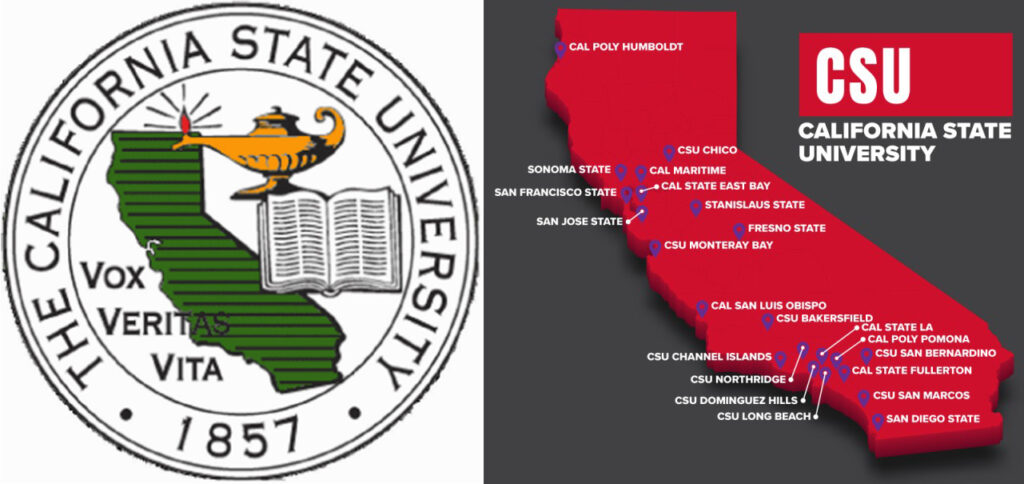
Each of the CSU’s 22 universities serve as anchor institutions, fueling job creation, innovation, and opportunity in their local community. The Economic Impact Report highlights significant regional benefits:
Bay Area: $4.8 billion in industry activity and 31,000 jobs supported.
Central Coast: $3 billion in industry activity and 31,500 jobs supported.
Inland Empire: $1 billion in industry activity and 9,218 jobs supported.
Los Angeles: $10 billion in industry activity and 74,900 jobs supported
North Coast: $718 million in industry activity and 6,598 jobs supported.
Sacramento Valley: $2.8 billion in industry activity and 24,613 jobs supported.
San Diego: $3.9 billion in industry activity and 32,760 jobs supported.
San Joaquin Valley: $2.6 billion in industry activity and 25,300 jobs supported.
These impacts demonstrate how the CSU powers California’s regional economies, ensuring that every corner of the state benefits from higher education, innovation, and workforce development.
For more information, view CSU’s 2025 Economic Impact Report at calstate.edu/impact.
Source: CSU’s 2025 Economic Impact Report
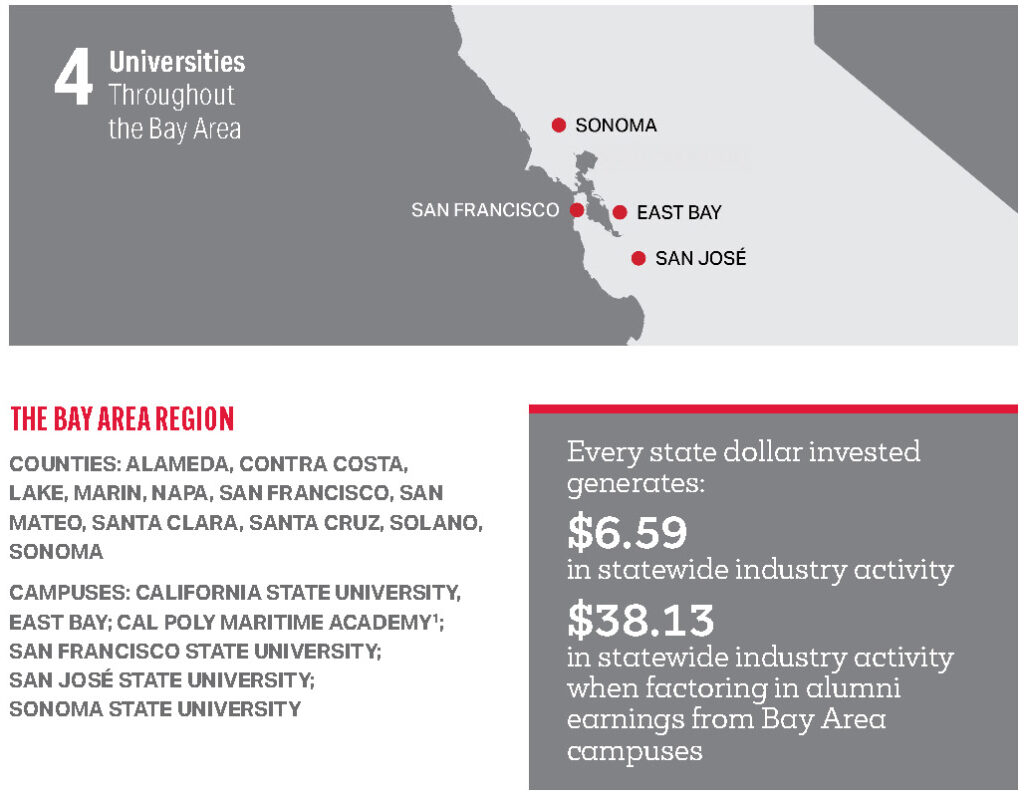
Bay Area Regional Impact
CSU spending through campus operations, capital investment and student spending on and off campus stimulate the economy of the Bay Area region. As detailed in Appendix B of the report, the direct spending for each campus is estimated using CSU financial data, enrollment figures, average student budget estimates and an analysis of California-based alumni earnings over time.
CSUs in the Bay Area had a direct spend of over $3.6 billion during the 2023-24 academic year, comprising the following four categories:
$1.7 billion on operational expenditures
$279.6 million on capital expenditures (four-year average)
$206.2 million on auxiliary expenditures
$1.4 billion on student expenditures
Many CSU alumni from campuses in the Bay Area region remain in California, contributing to the local economy. In 2024, they earned $19.5 billion in incremental earnings due to their CSU degree. That money, when spent in the local economy, sparked secondary impacts.
Source: CSU’s 2025 Economic Impact Report
During the 2023-24 academic year, CSUs in the Bay Area region generated a substantial economic impact across the region, supporting over 31,000 jobs and contributing $2.2 billion in labor income. Campus operational activities were the largest driver, accounting for more than 20,000 jobs and $1.4 billion in wages. Student spending and auxiliary services supported more than 8,000 jobs and injected nearly $1.7 billion into industry activity. Capital expenditures, while smaller in scale, supported 2,300 jobs and over $230 million in wages. Altogether, these activities culminated in $4.8 billion in industry activity and $321 million in tax revenues, underscoring the campuses’ vital role in regional economic vitality and public finance. Table 3 provides a further breakdown of results.
About the California State University
The California State University is the nation’s largest four-year public university system, providing transformational opportunities for upward mobility to more than 470,000 students from all socioeconomic backgrounds. More than half of CSU students are from traditionally underrepresented backgrounds, and more than one-quarter of undergraduates are first-generation college students. Because the CSU’s 22 universities* provide a high-quality education at an incredible value, they are rated among the best in the nation for promoting social mobility in national college rankings from U.S. News & World Report, the Wall Street Journal and Washington Monthly. The CSU powers California and the nation, sending nearly 125,000 career-ready graduates into the workforce each year. In fact, one in every 20 Americans holding a college degree earned it at the CSU. Connect with and learn more about the CSU in the CSU newsroom.
* Transition to 22 universities in progress (Cal Poly SLO and Cal Maritime integrating). The integration process is anticipated to be complete by fall 2026.
El condado insta a los inmigrantes elegibles para Medi-Cal a inscribirse antes de finales de 2025
By Contra Costa County Office of Communications & Media
(Martinez, CA) – Contra Costa County strongly encourages adult undocumented residents without health insurance to enroll in Medi-Cal this year while they are still eligible.
Starting Jan. 1, people ages 19 and older with what the state defines as unsatisfactory immigration status (UIS) – a category that includes undocumented residents and others who do not meet federal eligibility criteria – will no longer be able to enroll in full-scope Medi-Cal benefits, including seniors. The change in eligibility is the result of state budget cuts.
“We want undocumented members of our community to know they need to act quickly and sign up for Medi-Cal before it’s too late,” said Board of Supervisors Chair Candace Andersen. “Enrolling now will ensure they’re covered when the rules change.”
State residents with UIS status who are already enrolled in Medi-Cal before Jan. 1, 2026, will be able to keep and renew most of their benefits, though adults 19 and older will lose dental coverage beginning in July 2026.
“Under the new rules starting on January 1, 2026, it is very important for Medi-Cal recipients who meet the definition of UIS, to stay in contact with the county and check their mail for any notices or renewal forms. One good way to stay in touch is to create an account in BenefitsCal,” said Marla Stuart, Director of Contra Costa County Employment & Human Services Department (EHSD). “Current UIS Medi-Cal recipients who do not complete a renewal on time will lose their Medi-Cal full coverage and will only be eligible for emergency services when they reapply.”
After the new rules take effect, immigration status will not affect Medi-Cal coverage for children under 19 and pregnant women and their infants. Adults 19 and older who are classified as UIS will still be able to receive Emergency Medi-Cal, which covers emergency medical treatment.
“Sign up today. Having Medi-Cal is one of the best investments you can make in your health,” said Dr. Grant Colfax, CEO of Contra Costa Health. “Whether it is through a primary provider, specialist, in urgent care or in the emergency room, having Medi-Cal it key to getting healthcare for you and your family.”
(Martinez, CA) – El condado de Contra Costa recomienda encarecidamente a los residentes adultos indocumentados sin seguro médico que se inscriban en Medi-Cal este año mientras aún sean elegibles.
A partir del 1 de enero, las personas mayores de 19 años con lo que el estado define como estatus migratorio insatisfactorio (UIS), una categoría que incluye a los residentes indocumentados y otras personas que no cumplen con los criterios federales de elegibilidad, ya no podrán inscribirse en los beneficios completos de Medi-Cal, incluidas las personas mayores. El cambio en la elegibilidad es el resultado de los recortes presupuestarios estatales.
“Queremos que los miembros indocumentados de nuestra comunidad sepan que deben actuar rápidamente e inscribirse en Medi-Cal antes de que sea demasiado tarde”, dijo la presidenta de la Junta de Supervisores, Candace Andersen. “Inscribirse ahora asegurará que estén cubiertos cuando cambien las reglas”.
Los residentes del estado con estatus de UIS que ya estén inscritos en Medi-Cal antes del 1 de enero de 2026 podrán mantener y renovar la mayoría de sus beneficios, aunque los adultos mayores de 19 años perderán la cobertura dental a partir de julio de 2026.
“Según las nuevas reglas que comienzan el 1 de enero de 2026, es muy importante que los beneficiarios de Medi-Cal que cumplan con la definición de UIS, se mantengan en contacto con el condado y revisen su correo para ver si hay avisos o formularios de renovación. Una buena manera de mantenerse en contacto es crear una cuenta en BenefitsCal”, dijo Marla Stuart, directora del Departamento de Empleo y Servicios Humanos del Condado de Contra Costa (EHSD). “Los beneficiarios actuales de Medi-Cal del UIS que no completen una renovación a tiempo perderán su cobertura total de Medi-Cal y solo serán elegibles para los servicios de emergencia cuando vuelvan a presentar la solicitud”.
Después de que entren en vigor las nuevas reglas, el estado migratorio no afectará la cobertura de Medi-Cal para niños menores de 19 años y mujeres embarazadas y sus bebés. Los adultos de 19 años o más que estén clasificados como UIS aún podrán recibir Medi-Cal de emergencia, que cubre el tratamiento médico de urgencia.
“Inscríbase hoy. Tener Medi-Cal es una de las mejores inversiones que puede hacer en su salud”, dijo el Dr. Grant Colfax, director ejecutivo de Contra Costa Health. “Ya sea a través de un proveedor de atención primaria, un especialista, en atención urgente o en la sala de emergencias, tener Medi-Cal es clave para obtener atención médica para usted y su familia.”
La liberación de los beneficios de CalFresh en California para noviembre
All County offices will be closed for Veterans Day holiday, Tuesday, Nov. 11
By Tish Gallegos, PIO, Contra Costa County Employment & Human Services Department
(Martinez, Calif.) – California residents are seeing the restoration of their CalFresh benefits to Electronic Benefit Transfer (EBT) cards as the federal government issues 100% of the funding following a court order. CalFresh, known federally as the Supplemental Nutrition Food Assistance Program (SNAP), provides critical food assistance to households and County residents.
The California Department of Social Services (CDSS) has confirmed the loading of CalFresh benefits to EBT cards for November-eligible recipients who should have received them from Nov. 1-6. CDSS expects the loading to continue for those who were regularly scheduled to receive them Nov. 7-10.
CalFresh recipients can check on their CalFresh benefits by visiting BenefitsCal.com, calling 1(866) 663-3225, or visiting an EHSD office (find office locations at ehsd.org). Note that all County offices will be closed for the Veterans Day holiday on Tuesday, November 11.
With the release of funding to load EBT cards, Contra Costa County is pausing its recently announced plan to distribute debit cards to CalFresh participants eligible for the benefit in November. The distribution was expected to fill the gap from the lapse of federal funding that threatened the food security of 107,020 individuals in Contra Costa County, more than half children and older adults. Earlier this week, the Board of Supervisors’ unanimously approved up to $21 million from the County’s General Fund authorizing the Employment & Human Services Department (EHSD) to implement the debit card distribution plan.
“We are committed to supporting our community members and remain prepared to possibly distribute the debit cards at a later time if CalFresh (SNAP) funding is further disrupted,” said Board Chair Candace Andersen, District 2 Supervisor. “It is uncertain what will happen with CalFresh benefits for December, and we will hold the County funds in reserve as we watch for the federal government to reach a funding solution.”
The Board of Supervisors declared a local emergency this week due to the federal government shutdown disrupting CalFresh funding. The declaration stands for 60 days, and EHSD expects to report back to the Board about the need to continue the local emergency.
For residents who need food resources, the Food Bank of Contra Costa & Solano’s Find Food in My City page is available to search by city or zip code for food distribution sites. Community members can also call (855) 309-FOOD (3663).
Additional Resources
Contra Costa Crisis Center- crisis-center.org; call 988 or (800) 273-8255; or text “HOPE” to 20121
ehsd.org – CalFresh updates related to the federal government shutdown
En Español
(Martínez, California) – Los residentes de California están viendo la restauración de sus beneficios de CalFresh a las tarjetas de Transferencia Electrónica de Beneficios (EBT) ya que el gobierno federal emite el 100% de los fondos luego de una orden judicial. CalFresh, conocido federalmente como el Programa de Asistencia Alimentaria de Nutrición Suplementaria (SNAP por sus siglas en Inglés), brinda asistencia alimentaria crítica a los hogares y residentes del condado.
El Departamento de Servicios Sociales de California (CDSS por sus siglas en Inglés) ha confirmado la carga de los beneficios de CalFresh a las tarjetas EBT para los beneficiarios elegibles para noviembre que deberían haberlos recibido del 1 al 6 de noviembre. CDSS espera que la carga continúe para aquellos que están programados regularmente para recibirlos del 7 al 10 de noviembre.
Los beneficiarios de CalFresh pueden verificar sus beneficios de CalFresh visitando BenefitsCal.com, llamando al 1(866) 663-3225 o visitando una oficina de EHSD (encuentre las ubicaciones de las oficinas en ehsd.org). Tenga en cuenta que todas las oficinas del condado estarán cerradas por el feriado del Día de los Veteranos el martes 11 de noviembre.
La Junta de Supervisores sigue comprometida a apoyar a los hogares que no reciben beneficios de CalFresh debido al cierre del gobierno. Cualquier hogar que no haya recibido sus beneficios antes del lunes, puede llamar o venir a una ubicación de EHSD para obtener ayuda. Consulte ehsd.org para conocer las ubicaciones.
A principios de esta semana, la Junta de Supervisores aprobó por unanimidad hasta $21 millones del Fondo General del Condado que autoriza al Departamento de Empleo y Servicios Humanos (EHSD) a implementar el plan de distribución de tarjetas de débito.
“Estamos comprometidos a apoyar a los miembros de nuestra comunidad y seguimos preparados para posiblemente distribuir las tarjetas de débito si los fondos de CalFresh (SNAP) se interrumpen aún más”, dijo la presidenta de la junta, Candace Andersen, supervisora del Distrito 2. “No está claro qué sucederá con los beneficios de CalFresh para diciembre, y mantendremos los fondos del condado en reserva mientras esperamos que el gobierno federal llegue a una solución de financiamiento”.
La Junta de Supervisores declaró una emergencia local esta semana debido al gobierno federal interrupción de la financiación de CalFresh. La declaración tiene una duración de 60 días, y EHSD espera informar a la Junta sobre la necesidad de continuar con la emergencia local.
Para los residentes que necesitan recursos alimentarios, la página Find Food in My City del Banco de Alimentos de Contra Costa y Solano está disponible para buscar por ciudad o código postal los sitios de distribución de alimentos. Los miembros de la comunidad también pueden llamar al (855) 309-FOOD (3663).
Recursos adicionales
• Centro de Crisis de Contra Costa: crisis-center.org; llame al 988 o al (800) 273-8255; o envíe un mensaje de texto con la palabra “HOPE” al 20121
• Base de datos 211 de Contra Costa – Centro de crisis de Contra Costa – base de datos completa de servicios sociales y de salud locales para residentes de Contra Costa
• CAfoodbanks.org – Sitio web de los Bancos de Alimentos de California
• ehsd.org – Actualizaciones de CalFresh relacionadas con el cierre del gobierno federal
Over $107 million for Contra Costa projects including $46.9 million on Hwy 4 from Hillcrest Avenue in Antioch to Byron Highway near Brentwood
By Edward Barrera, Division Chief, Caltrans Public Affairs
In August, the California Transportation Commission (CTC) approved $3 billion in allocations to enhance safety and mobility across the state highway system and expand multimodal travel, including bike lanes and pedestrian pathways. Guided by Governor Gavin Newsom’s Build More, Faster – For All infrastructure agenda, these improvements will make California communities safer, cleaner and increase access to active transportation options.
Of the $3 billion allocated, $663 million derives from Senate Bill (SB) 1, the Road Repair and Accountability Act of 2017 and approximately $2 billion from the federal Infrastructure Investment and Jobs Act of 2021 (IIJA). The funds will serve as a catalyst to increase the capacity of the state’s transportation system, rehabilitate aging roadways and improve travel times, while balancing community impacts and promoting environmental benefits.
The “…investments reflect California’s long-term commitment to safer roads, smarter traffic management and expanded transportation choices that get people where they need to go,” said Caltrans Director Dina El-Tawansy.
“The funds allocated…reflect the Commission’s commitment to investing taxpayer dollars strategically. These investments will improve the safety and reliability of the state’s transportation network and support a thriving economy by improving the movement of freight and reducing out-of-pocket expenses for all California,” said Darnell Grisby, Chair of the California Transportation Commission.
Projects in Contra Costa County approved by the Commission include:
$46,900,000 on SR-4 in and near Antioch and Brentwood, from Hillcrest Avenue to Byron Highway, to rehabilitate pavement and drainage systems, upgrade facilities to ADA standards, install Accessible Pedestrian Signals (APS), high-visibility crosswalks, bike loop detectors, and construct Class II bike lanes. This will extend pavement service life and improve ride quality.
$42,374,000 on I-680 in San Ramon and Danville, from Alcosta Boulevard to 0.1 mile north of Diablo Road, to rehabilitate pavement, upgrade guardrail, and upgrade facilities to ADA standards. This will extend pavement service life and improve ride quality.
$14,584,000 on SR-24 in Orinda, at the Caldecott Tunnel, to rehabilitate and upgrade the ventilation system in Bores 1, 2, and 3. This will ensure structural integrity and prolong tunnel service life.
$1,301,000 on SR-4 in Concord, 0.5 mile east of Port Chicago Highway, to reconstruct a failed slope embankment and repair a displaced down drain due to heavy rainfall in February and March 2025. Work includes installing Rock Slope Protection (RSP), and repairing the down drain, guardrail, and dike. This will enhance driver and pedestrian safety.
• $1,275,000 on SR-4 near Pittsburg, 0.3 mile west of Bailey Road, to reconstruct a slope embankment and repair a displaced down drain due to heavy rainfall in February and March 2025. Work includes installing Rock Slope Protection (RSP). This will improve roadway safety.
$999,000 on SR-24 in Lafayette, from 0.7 to 1.0 mile east of Acalanes Road, to rehabilitate pavement due to ponding and water seepage caused by heavy rainfall in February and March 2025, which led to cracking and settlement. This will extend pavement life and improve safety.
IIJA is a once-in-a-generation investment in our nation’s infrastructure to improve the sustainability and resiliency of our country’s energy, water, broadband and transportation systems. The total funding for California is nearly $54 billion. This includes investments to upgrade the state’s roads, bridges, rail, public transit, airports, ports, waterways and the electric vehicle charging network.
SB 1 has invested approximately $5 billion annually toward transportation projects since its adoption. It provides funding split between the state and local agencies. Road projects progress through construction phases more quickly, based on the availability of funds, including those partially funded by SB 1.
Visit build.ca.gov to learn more about transformative infrastructure projects happening in communities throughout the state.
AB 692 will prohibit ‘stay-or-pay’ contracts that trap nurses and other workers in exploitative debt arrangements with employers
By California Nurses Association
California Nurses Association (CNA), the largest union of registered nurses in the state of California, applauds Governor Gavin Newsom for taking action to protect workers from employers’ use of predatory debt contracts and signing Assembly Bill 692 (A.B. 692) into law on Monday, Oct. 13. A.B. 692 prohibits employers from requiring workers to pay a debt, fee, or penalty if the workers wants to leave their job, expressly making these kinds of exploitative workplace debt arrangements unlawful.
“California is taking a proactive step forward to support the thousands of nurses and nearly one in 12 workers who are in exploitative stay-or-pay contracts,” said Sandy Reding, RNand CNA president. “We are grateful for Assemblymember Kalra championing this bill and to Governor Newsom for stepping up with the labor movement to stand up to Trump’s assaults on worker protections. California leads the rest of the country by signing this bill into law.”
A.B. 692 was authored by Assemblymember Ash Kalra (D-San Jose) and sponsored by CNA, as well as a broad coalition of co-sponsoring organizations, including the California Federation of Labor Unions, California Employment Lawyers Association, Protect Borrowers, and the American Economic Liberties Project.
“It has been an honor to work with CNA in abolishing exploitative stay-or-pay contracts and stopping employers from creating debt to trap and intimidate workers,” said Assemblymember Kalra. “I am grateful Governor Newsom signed A.B. 692, ensuring workers are not coerced into employment debt agreements and can be empowered to leave bad jobs.”
“Today, Governor Newsom signed an important bill to ban employer debt traps and protect nurses, actors, athletes and so many other workers. Employers use training repayment schemes to trap workers in jobs with low wages, unsafe conditions, and abusive managers,” said California Labor Federation President Lorena Gonzalez. “It doesn’t matter if you work in a hospital or play professional sports, no worker should have to pay an employer back if they leave a job. We are proud of California’s progress that will help workers level the playing field.”
A.B. 692 addresses the growing number of employers that are using debt as an exploitative tool to trap workers in jobs, often with low wages and substandard working conditions, and to bust unions. Sometimes called “stay-or-pay” contracts, employers coerce workers into predatory arrangements that require the worker to pay an alleged debt or other financial penalty to their employer if the worker leaves their job before a prescribed period of time–whether the worker is fired, laid off, or quits. With the threat of having to pay back a debt or fee to their employer, “stay-or-pay” contracts indenture workers to remain at a job and chills workers from seeking better wages or working conditions.
California Nurses Association/National Nurses United is the largest and fastest-growing union and professional association of registered nurses in the nation with more than 100,000 members in more than 200 facilities throughout California and more than 225,000 RNs nationwide.
By Greg Burt, Vice President, California Family Council
SACRAMENTO, CA — Governor Gavin Newsom has once again proven his contempt for California parents. Yesterday afternoon, he signed AB 495, a bill that fundamentally undermines parental rights and opens the door for abuse, kidnapping, and government interference in family life, all while claiming it “protects parents and children.”
After months of warnings from parental rights advocates, faith communities, and constitutional attorneys, Newsom ignored every concern. In a calculated act of deception, his office released a statement claiming AB 495 safeguards parental authority. In reality, this law allows any adult, without verification, without parental consent, and without even notifying parents, to make medical and educational decisions for a child.
CFC President: Newsom’s Assault on Parental Rights Endangers Children
“Governor Newsom is deliberately trying to deceive parents by claiming this bill protects them, when in fact it does the opposite,” said Jonathan Keller, President of California Family Council. “AB 495 strips parents of their constitutional rights and hands them over to unverified strangers. It is unconstitutional, it is illegal, and no school or medical facility should recognize or accept the authority of a Caregiver’s Authorization Affidavit without a verified signature from a parent or legal guardian. Newsom knows exactly what this bill does, but he’s hoping the press and the public won’t read it for themselves.”
“AB495 allows…any adult claiming to be a relative within five degrees of kinshipcan sign a Caregiver Authorization Affidavit giving them the ability to ‘authorize any other medical care.’ And all this can be done with no parent signature, no notary, no verification and no parent notification required.”
Despite claims to the contrary, AB 495 allows ANY adult to use the new Caregiver Authorization Affidavit as “sufficient to authorize enrollment of a minor in school and authorize school-related medical care.” Then any adult claiming to be a relative within five degrees of kinshipcan sign a Caregiver Authorization Affidavit giving them the ability to “authorize any other medical care.” And all this can be done with no parent signature, no notary, no verification and no parent notification required. This law will allow unvetted adults to make medical decisions, enroll children in school, and act as de facto guardians, even though parents would remain legal guardians.
“Governor Newsom deceptively describes AB 495 as a caregiver planning tool for undocumented immigrant parents. It’s more accurately described as a child trafficker’s and child predator’s dream bill,” said Dean Broyles, Esq., President and Chief Counsel of the National Center for Law & Policy. “Its sweeping application is not limited to immigrant families, does not require any parental notice or consent, and lacks even the most basic safeguards to protect children. Anyone falsely claiming kinship can easily sign the affidavit, access a child, obtain medical care, and enroll them in another school. Even the most basic safeguard of a notary is not required to confirm the true identity of the person accessing your child. AB 495 violates fundamentally constitutionally protected parental rights, endangers California’s children, and will be appropriately legally challenged and struck down.”
“With AB 495, state-sanctioned kidnapping is now legal,” warned Julianne Fleischer, Senior Legal Counsel at Advocates for Faith & Freedom. “This is more than overreach — it is a betrayal of families and a blatant disregard for parental rights. This unprecedented intrusion into parental rights marks a deeply concerning moment for our state — one for which Gavin Newsom must answer.”
“Governor Newsom’s actions define him, not his smooth talk and 100-watt smile,” added Erin Friday, Esq., President of Our Duty – USA. “Behind that veneer, is a man who consistently signs bills that eviscerate parental rights. Handing a child over to an adult five degrees separated by marriage, divorce, or blood based upon an unverified one-page document with any pre-authorization of the parents, is beyond the pale.”
CFC Calls for Defiance and Parental Vigilance
California Family Council is calling on schools, hospitals, and clinics to refuse to accept any Caregiver Authorization Affidavit that is not verified or notarized by the child’s legal parent or guardian.
“Governor Newsom may have signed this bill into law,” Keller said, “but parents are under no moral or legal obligation to accept its legitimacy. This bill violates both the Constitution and common sense. No one, not a school administrator, not a doctor, not a government bureaucrat, has the right to override a mother or father’s authority.”
CFC urges parents to take immediate action to protect their families:
* Update emergency contact lists at schools and medical offices to include ONLY those adults you trust to make educational and medical decisions for your child.
* Submit written directives stating that NO ONE outside your listed contacts is authorized to pick up or make decisions for your child.
* Support efforts to legally challenge AB 495 and restore parental rights in California law.
“This coalition will not rest,” Keller concluded. “We will work with our partners, our attorneys, and thousands of California parents to overturn this unconstitutional law. Parents, not politicians, are the rightful guardians of their children.”
About California Family Council
California Family Council works to advance God’s design for life, family, and liberty through California’s Church, Capitol, and Culture. By advocating for policies that reinforce the sanctity of life, the strength of traditional marriages, and the essential freedoms of religion, CFC is dedicated to preserving California’s moral and social foundation.
Five-county half-centsales tax would include Contra Costa County, last 14 years; in addition to existing half-cent BART operations sales tax
By John Goodwin, Assistant Director of Communications & Rebecca Long, Director, Legislation & Public Affairs, Metropolitan Transportation Commission
Gov. Gavin Newsom on Monday, October 13, 2025, signed into law state Senate Bill 63, authorizing a November 2026 ballot measure to prevent major service cuts at BART and other Bay Area transit systems and to make improvements to transit affordability, accessibility and reliability in the region. The new law allows the measure to be placed on the ballot either through action by a newly formed Public Transit Revenue Measure District governed by the same board as the Metropolitan Transportation Commission (MTC) or via a citizen’s initiative.
The half-cent sales tax would be in addition to the half-cent sales tax for BART operations in Contra Costa, Alameda and San Francisco counties in place since the 1960’s.
Enactment of the bill — authored by state senators Scott Wiener (D-11) of San Francisco and Jesse Arreguín (D-7) of Berkeley, and co-authored by Sen. Laura Richardson of Los Angeles County and Assemblymembers Mia Bonta (D-18) of Alameda County and Matt Haney (D-17) and Catherine Stefani (D-19) of San Francisco — clears the way for voters in Alameda, Contra Costa, San Francisco, San Mateo and Santa Clara counties to consider a 14-year regional transportation sales tax that would generate approximately $980 million annually across the five counties. The bill authorizes voter consideration of a half-cent sales tax in Alameda, Contra Costa, San Mateo and Santa Clara counties and a one-cent sales tax in San Francisco.
Approximately 60 percent of the revenue that would be raised if voters approve the measure will be dedicated to preserving service on BART, Muni, Caltrain, AC Transit — which an independent analysis confirmed face annual deficits of more than $800 million annually starting in fiscal year 2027-28 — as well as San Francisco Bay Ferry and smaller transit agencies providing service in the five counties to keep buses, trains and ferries moving. About one-third of the revenue would go to Contra Costa Transportation Authority, Santa Clara VTA, SamTrans and the Alameda County Transportation Commission, with flexibility to use funds for transit capital, operations, or road paving projects on roads with regular bus service.
If a regional tax measure wins voters’ approval next fall, about 4.5 percent, equivalent to $43 million in fiscal year 2027-28, will go toward improving the rider experience, funding priorities identified in the 2021 Bay Area Transit Transformation Action Plan.
“In addition to averting major service cuts for regional operators, MTC advocated for the measure to include dedicated funding to make Bay Area transit more affordable, reliable, and easy to use so that it becomes a system that will attract more riders,” noted Commission Chair and Pleasant Hill Mayor Sue Noack.
The suite of rider-focused improvements includes:
Free and reduced-fare transfers that could save multi-agency riders up to $1,500 per year and are estimated to increase transit ridership by some 30,000 trips per day.
Expansion of the Clipper START® program, which provides a 50% fare discount, to reach 100,000 additional low-income adults.
Improvements to accessibility for seniors and people with disabilities.
Transit-priority projects to make bus trips faster, and mapping and wayfinding improvements to make transit easier to use.
Bay Area transit riders take more than 1 million trips each day, with over 80 percent of these trips on Muni, BART, Caltrain or AC Transit. Riders include tens of thousands of students, seniors, people with disabilities, and low-income residents who can’t afford to own a car. Clipper START customers accounted for nearly 400,000 transit trips across the region in August 2025 and the fare-discount program is growing at a rate of more than 20,000 customers each year.
SB 63 includes several oversight and accountability provisions to reassure voters their tax dollars will be used responsibly. These include establishing an independent oversight committee to ensure expenditures are consistent with the law. Membership will include at least one representative from each county in the Public Transit Revenue Measure District, appointed by each county’s board of supervisors.
The new law also requires BART, Muni, Caltrain and AC Transit to undergo a two-phase independent third-party financial efficiency review overseen by its own oversight committee composed of four independent experts, four transit agency representatives, and an MTC Commissioner. MTC is responsible for procuring the third-party consultant to conduct the review and for staffing the Oversight Committee.
A maintenance-of-effort clause in SB 63 requires BART, Muni, Caltrain, AC Transit, Golden Gate Transit, SF Bay Ferry and the bus operators in Alameda and Contra Costa counties to maintain existing levels of funding for operating purposes if a 2026 tax measure is passed by voters. The legislature established this requirement to ensure the measure supplements, rather than replaces, current operations support, with provisions for exceptions that are subject to MTC approval.
To provide additional oversight regarding the quality of the transit service provided in each county participating in the measure, the legislation allows a county transportation agency or board of supervisors within the District’s geography to require review by an ad-hoc adjudication committee if they believe a transit agency funded by that county’s portion of the measure’s revenue is not applying standards (such as service levels, fare policy, cleanliness, maintenance, access and safety) consistently across counties or if those standards disproportionately disadvantage service or transit equipment/station quality in that county. The committee is composed solely of representatives from counties contributing revenue measure funds to the transit agency under review. Its determinations are binding and may result in withholding up to 7 percent of the transit agency’s funds, a strong incentive for agencies to deliver high quality service that follows consistent standards across all five counties.
What Local Transportation Officials are Saying:
“The BART Board of Directors supported SB 63 because it will cover a significant portion of BART’s operating deficit caused by remote work and will allow us to maintain current service levels and improve the rider experience,” said BART General Manager Bob Powers.
“SB 63 is a step towards protecting essential Muni service and will equip us with resources to continue meeting the needs of San Francisco and the growing region,” said Julie Kirschbaum, San Francisco Municipal Transportation Agency Director of Transportation.
“Through Governor Newsom’s leadership and the support of voters, SB 63 will help protect transit for our more than three million monthly riders. In fact, this summer, we took proactive steps to preserve service by redesigning 103 bus lines through our new Realign network. Designed over two years, this all-new network maintains service at 85 percent of pre-pandemic levels. SB 63 gives voters a chance to ensure that these vital bus lines – and our riders’ lifelines – are protected for the future,” said AC Transit Board President Diane Shaw.
“Caltrain has been reinvented as a state-of-the-art rail system, delivering the best service this corridor has seen in its 161-year history. We are seeing the benefits every day with growing ridership, cleaner air, quieter trains, and less-congested roads. To sustain these benefits, it is essential that Caltrain be funded. We are deeply grateful to Governor Newsom and the California Legislature for their leadership in crafting and supporting this legislation, which gives voters the opportunity to consider the vital Connect Bay Area measure in November 2026,” said Caltrain Executive Director Michelle Bouchard.
“SB 63 represents a transformative opportunity to invest in the future of public transit,” she said. With this measure, we can deliver faster, more frequent service and ensure better connections for all riders across Santa Clara County,” said Carolyn Gonot, Santa Clara Valley Transportation Authority General Manager and CEO.
“We’re excited the Connect Bay Area Act is moving forward and voters will soon have the opportunity to shape the future of public transit along the Peninsula and surrounding Bay Area communities. Next November’s vote will be a pivotal moment to secure reliable, connected and sustainable transportation. With this measure, we can ensure SamTrans, Caltrain and our regional transit partners have the stable funding needed to serve riders for years to come,” said SamTrans Board of Directors Chair Jeff Gee.
MTC is the transportation planning, financing and coordinating agency for the nine-county San Francisco Bay Area.
BART Issues Statement of Support
BART issued the following statement on Governor’s signing transit funding measure SB 63:
“BART is grateful to Governor Newsom for signing Senate Bill (SB) 63 into law. The Governor has been a steadfast advocate of transit and BART specifically, recognizing our role in moving the region and strengthening the economy. SB 63 is a historic opportunity to allow voters in five counties of the Bay Area to consider a sales tax measure in November 2026 aimed at preserving and improving transit.
A regional transportation funding measure would provide a reliable funding source for BART and other agencies to address deficits caused by remote work. The BART Board of Directors supported SB 63 because it will cover a significant portion of BART’s operating deficit and allow us to maintain current service levels and improve the rider experience.
Before measure funds become available, BART will rely on internal cuts, efficiency measures, and a series of one-time solutions to pay for operations. BART will continue to identify additional cost savings and efficiencies to address our deficit, and we welcome the enhanced accountability measures and financial efficiency review included in SB 63.
BART is also grateful to Senators Scott Wiener and Jesse Arreguín for championing this legislation and their fierce advocacy for transit funding.”