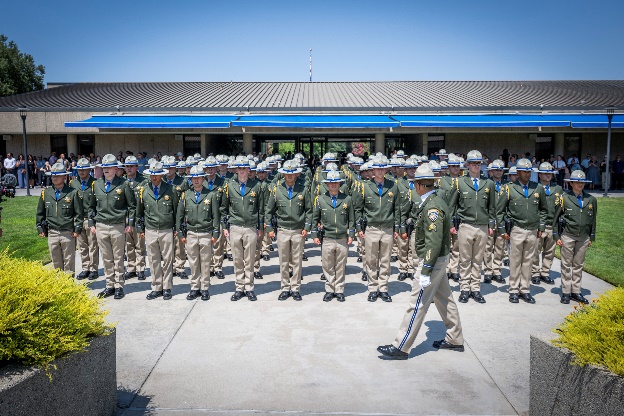
CHP Commissioner Sean Duryee administers the Code of Honor to the 102 new officers on Friday morning, July 12, 2024. Photo: CHP
After completing 1,200 hours of intensive training over 26 weeks
By Tami Grimes, PIO, CHP
SACRAMENTO, Calif. – The California Highway Patrol (CHP) proudly introduced 102 of the state’s newest officers during a swearing-in ceremony today at the CHP Academy in West Sacramento. In a continued effort to fill vacant officer positions, these men and women hail from communities throughout California, as well as Colorado and Oregon.
“Having successfully completed the last 26 weeks of intensive training, the CHP is pleased to welcome these new officers to the CHP family. They are beginning a career of service and I trust they will do everything they can to take care of their communities,” said CHP Commissioner Sean Duryee. “Every corner of the State deserves to have the best trained and prepared personnel, and I am confident these new officers will be able to provide the highest level of safety, service, and security possible.”
CHP Commissioner Sean Duryee inspects the cadets before the ceremony on Friday, July 12, 2024. Photo: CHP
Before offering his prepared remarks, Duryee said to the audience of the new officers’ family members and friends, “Alright, listen. I was a little disappointed to that approach. Not from the cadets, from the crowd. You all gotta get a little fired up. This is a celebration.”
“I don’t know what they’ve told you how this place is,” he continued with a smile. “But this is a celebration, today. So, as we celebrate them let’s get a little rowdy. Yeah?” to which the audience applauded and cheered in response.
While at the CHP Academy, cadets receive over 1,200 hours of training and start with subjects including nobility in policing, leadership, professionalism and ethics, and cultural diversity. Additionally, cadets receive instruction on mental illness response and crisis intervention techniques. Training also covers vehicle patrol, crash investigation, first aid, and the apprehension of suspected violators, including those who drive under the influence. Cadets also receive training in traffic control, report writing, recovery of stolen vehicles, assisting the motoring public, issuing citations, emergency scene management, and various codes, including the California Vehicle Code, Penal Code, and Health and Safety Code.
The Code of Honor was administered by Duryee and repeated by the cadets as follows: “I, a member of the California Highway Patrol, subscribe in word and deed to the following; To serve the United States of America and the State of California honestly, and conscientiously; and fulfill my oath as a soldier of the law; to uphold and maintain the honor and integrity of the California Highway Patrol; Be loyal to my fellow officers; respect and obey my seniors in rank; and enforce the law without fear, favor or discrimination; to assist those in peril or distress and if necessary lay down my life rather than swerve from the path of duty; my person conduct shall at all times be above reproach; and I will never knowingly commit any act that will in any way bring discredit upon the California Highway Patrol or any member thereof; to all of this I do solemnly pledge my sacred honor as an officer with the California Highway Patrol.”
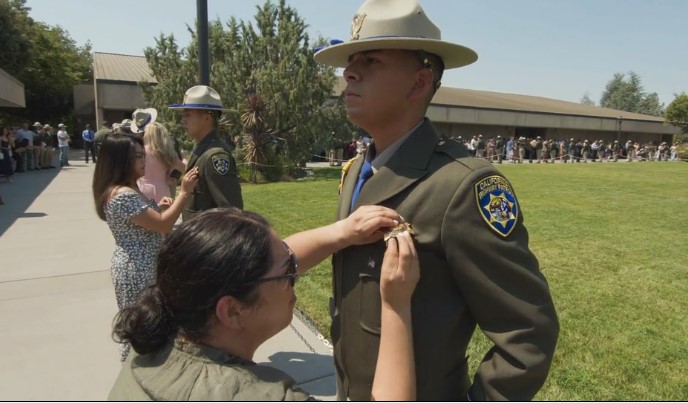
Family members and friends pinned the new officers’ badges to their uniforms. Video screenshot
Today’s graduation concludes the new officers’ stay at the Academy prior to their reporting to one of the 102 CHP Area offices throughout the state on July 22. (View ceremony video and highlight video)
The CHP continues the search for service-minded individuals who are interested in a career in law enforcement in support of its ongoing, multiyear recruitment campaign to hire 1,000 officers. In 2023, the CHP added 407 officers to its ranks. With today’s swearing-in, an additional 409 officers have been sworn in this year and there are still two more cadet classes scheduled to complete the Academy before the end of 2024.
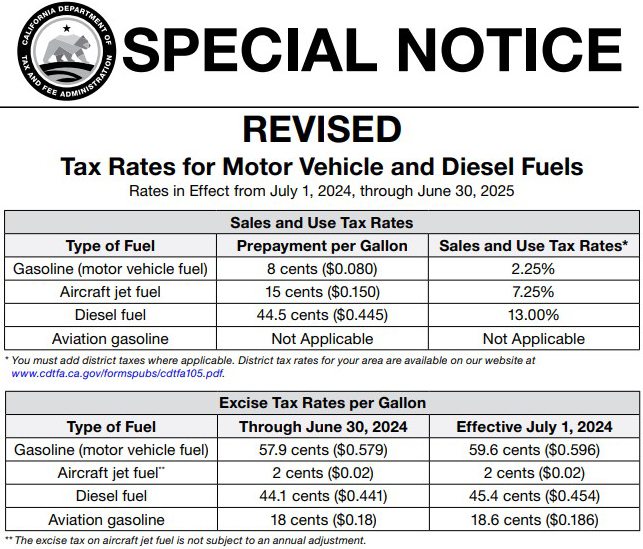
State’s excise tax on gasoline increased July 1 from 57.9 to 59.6 cents per gallon and from 44.1 to 45.4 cents per gallon for diesel fuel.
No end in the lawto annual increases based on state CPI
By Allen D. Payton
If you’re not already aware, the State of California gas tax increased today, July 1, 2024 according to the announcement in May by the Department of Tax and Fee Assessment (CDTFA). According to that notice as reported by the California Taxpayers Association, the state’s excise tax* on gasoline increased today “from 57.9 cents per gallon to 59.6 cents per gallon and from 44.1 cents per gallon to 45.4 cents per gallon for diesel fuel.”
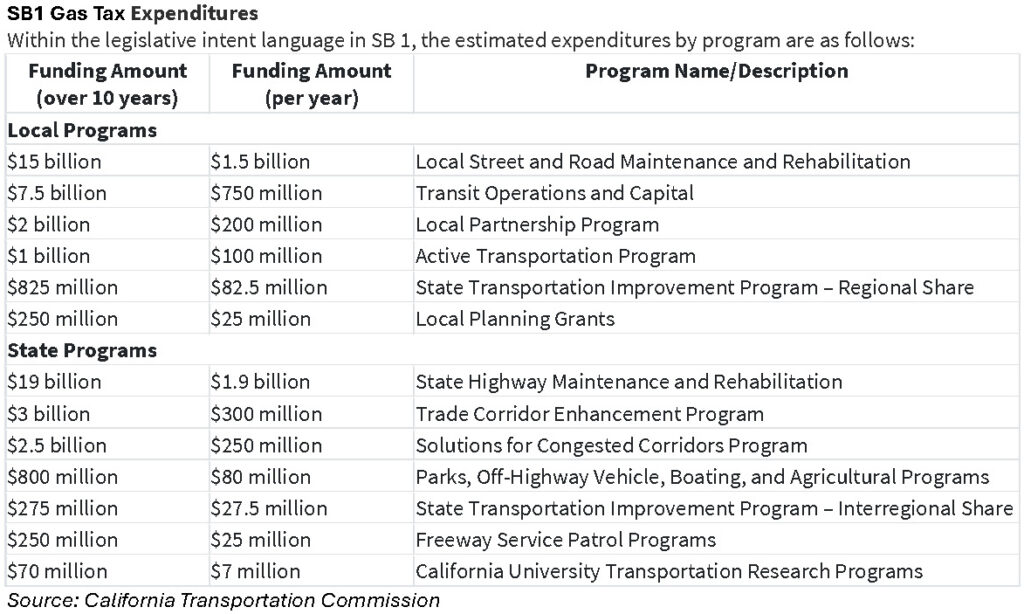
According to the California Transportation Commission, “the Legislature passed and the Governor signed SB 1 (Beall, 2017)…increasing transportation funding and instituting much-needed reforms. SB 1 provides the first significant, stable, and on-going increase in state transportation funding in more than two decades.”
Contra Costa’s representatives at that time split on the bill, with then-Assemblyman Jim Frazier, who was chairman of the Assembly Transportation Committee, and Assemblyman Tim Grayson voting in favor, and State Senator Steve Glazer voting against.
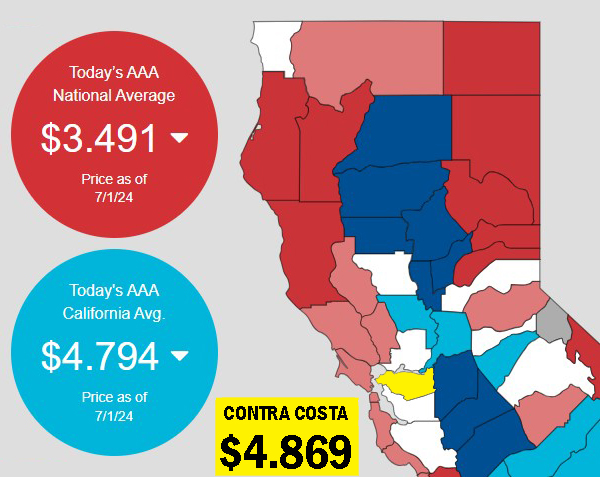
Source: AAA
As of Monday, according to the American Automobile Association (AAA), which updates prices daily, drivers in Contra Costa County are paying an average of $4.869 per gallon of regular unleaded gas, while today’s Bay Area average is $4.943, California’s average is $4.794 and the national average is $3.491 per gallon.
Taxes & Fees in the Price for a Gallon of Gas
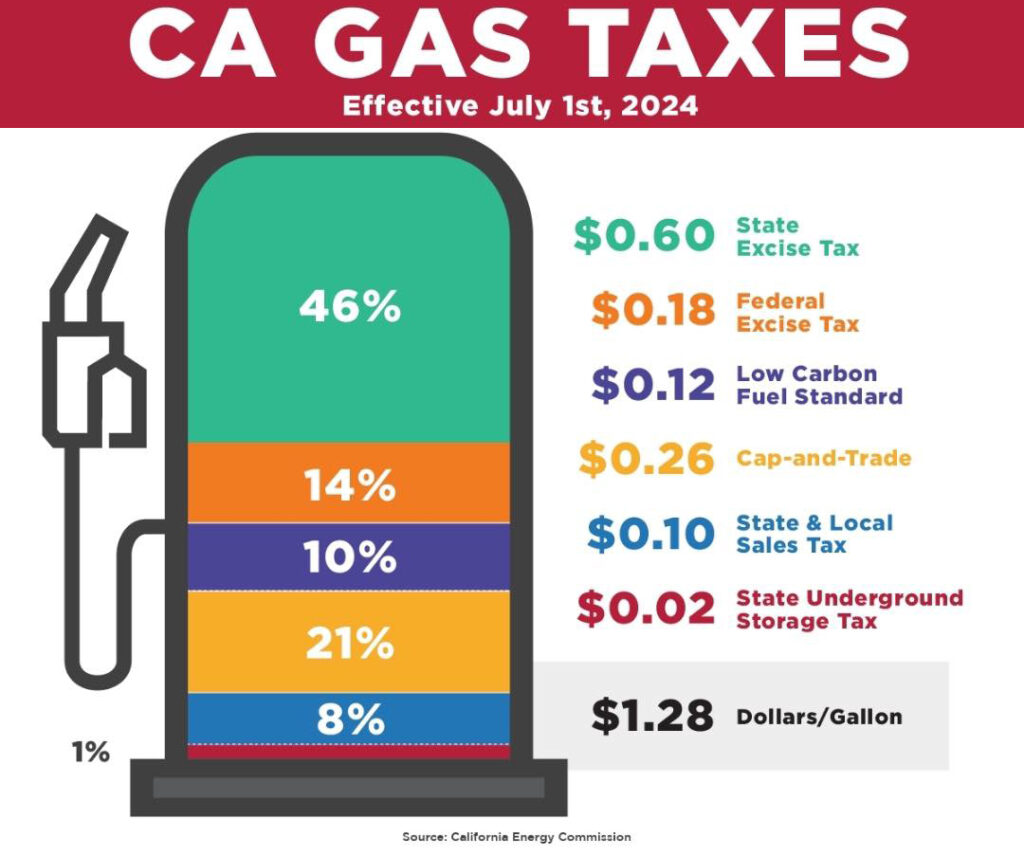
According to data from the California Energy Commission, drivers are now paying 90 cents in taxes per gallon of gas:
$0.596 on state excise tax
$0.184 on the federal excise tax
$0.10 cents on more state and local sales taxes
$0.02 for a state underground storage tank fee
Plus, $0.51 for state environmental programs fee for a total of $1.41 in taxes and fees per gallon of gas.
Source: CA Dept of Tax & Fee Assessment
But why does the state gas tax keep increasing each year? It’s due to the passage of a bill in 2017, not a vote of the people, as some folks misremember. According to the Metropolitan Transportation Commission (MTC), State Senate Bill 1 (SB1) entitled the Road Repair and Accountability Act of 2017, “was passed by a two-thirds majority in the California Legislature and signed into law by Governor Jerry Brown in 2017. As the largest transportation investment in California history, SB 1 is expected to raise $52.4 billion for transportation investments statewide over the next decade.” It marked “the first increase in the state excise tax on gasoline since 1994.”
It requires the CDTFA to annually adjust the rate by the increase in the California Consumer Price Index (CPI) which is as calculated by the Department of Finance (CDFI). According to the CADFI, the CPI “measures price changes in goods and services purchased by urban consumers. The all urban consumer (CPI-U) represents the spending patterns of the majority of the population which includes professionals, the self-employed, the poor, the unemployed, and retired people, as well as urban wage earners and clerical workers (CPI-W). The U.S. Bureau of Labor Statistics (BLS) compiles and publishes the CPI for the Los Angeles area monthly, the Riverside area bimonthly, San Diego County bimonthly, the San Francisco area bimonthly, and the nation each month. A California CPI is calculated…as a population-weighted average of the BLS-published local area CPIs. The California CPI formula was developed by the California Department of Industrial Relations (CADIR).”
According to the CDIR, the CPI “Is a measure of the average change over time in the prices paid by urban consumers for a fixed market basket of goods and services. The CPI provides a way to compare what this market basket of goods and services costs this month with what the same market basket cost, say, a month or year ago.” This year, the California CIP was determined to be 3.3% in February and 3.8% in April.
History of Recent CA Gas Tax Increases
In addition, according to details provided by the CDTFA, “*Effective July 1, 2010, under the Fuel Tax Swap Law, purchases and sales of gasoline are exempt from the state portion of the sales and use tax rate (then 6 percent), and a corresponding increase in the excise tax rate on that gasoline was imposed.” Then, “Effective November 1, 2017, Senate Bill 1 imposed an additional $0.12-per-gallon gasoline tax.” Finally, “Effective July 1, 2020, Senate Bill 1…requires CDTFA to annually adjust the rate by the increase in the California Consumer Price Index.”
Proposed Use of Funds
The majority of the revenue from the state gas tax is intended for “Local Street and Road Maintenance and Rehabilitation” at $1.5 billion per year over 10 years and $1.9 billion for “State Highway Maintenance and Rehabilitation.”
Also, according to the MTC, “In the Bay Area, most of this money will be directed to cities, counties and public transit agencies to tackle the enormous backlog of maintenance and repairs for local streets, roads and transit systems. SB 1 money also will be available for new projects, including bicycle and pedestrian improvements.”
Asked if the law sunsets and the annual increases end or if they continue indefinitely a staff member for CDTFA responded, “CDTFA is required by law to adjust the motor vehicle fuel and diesel fuel excise tax rates annually based on the California Consumer Price Index as calculated by the Department of Finance. SB1 did not include a sunset date.”
For additional information on SB1 see the answers by the California Department of Transportation (Caltrans) to the Frequently Asked Questions, here and by the California State Controller’s Office, here.
Of 764 city employees Antioch’s highest paid was a police sergeant at $349,993
SACRAMENTO — State Controller Malia M. Cohen has released the 2023 self-reported payroll data for cities and counties on the Government Compensation in California website. The data covers 517,358 positions and a total of more than $40.72 billion in 2023 wages.
Users of the site can:
View compensation levels on maps and search by region;
Narrow results by name of the entity or by job title; and
Export raw data or custom reports.
The newly published data includes 462 cities and 52 counties. The City of Hayward had the highest average city employee wage in California, followed by Atherton, Pleasant Hill, and Beverly Hills. The counties with the highest average employee wages were Alameda, Contra Costa, Napa, Monterey, and Ventura. The city employee with the highest total wages in California was a police officer for the City of Santa Monica, while the top 20 highest-paid county employees work in health care professions.
For the City of Antioch, the data show a total of 764 employees worked sometime during the year who were paid $44,888,017 in wages and $13,815,659 in retirement and health contributions. The highest paid employee was a police sergeant who earned total wages of $349,993 which included $165,795 in regular pay, $126,573 in overtime and $57,625 in other pay, listed as car allowances, meeting stipends, incentive pay, bonus pay, etc.
California law requires cities, counties, and special districts to annually report compensation data to the State Controller. The State Controller also maintains and publishes state and CSU salary data. Five counties and 20 cities failed to file or provided incomplete or late information. San Francisco is both a city and a county; the website reports San Francisco as a city.
Since the website launched in 2010, State Controller’s Office has published pay and benefit information on more than two million government jobs in California, as reported annually by each entity.
As the chief fiscal officer of California, Controller Cohen is responsible for accountability and disbursement of the state’s financial resources. The Controller has independent auditing authority over government agencies that spend state funds. She is a member of numerous financing authorities, and fiscal and financial oversight entities including the Franchise Tax Board. She also serves on the boards for the nation’s two largest public pension funds. Follow the Controller on X at @CAController and on Facebook at California State Controller’s Office.
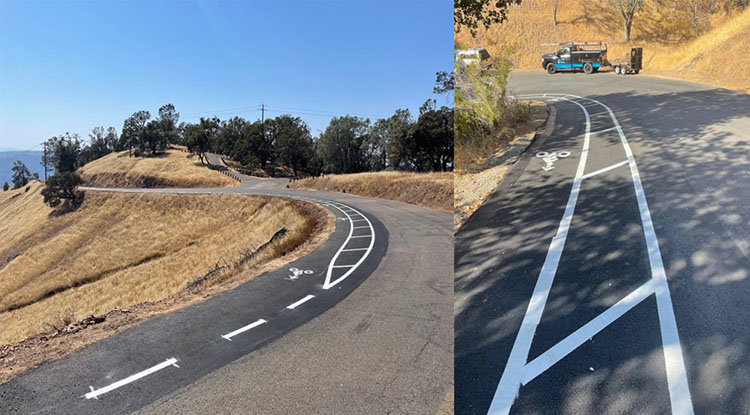
Examples of newly installed bicycle turnouts at Mount Diablo State Park. Source: CA State Parks
By Clint Elsholz, Superintendent, Diablo Range District, CA State Parks
California State Parks, in partnership with the California State Parks Foundation, Mount Diablo Cyclists, and community donors, began construction on June 3, on 22 new bike turnouts at Mount Diablo State Park (SP). Once completed, these new turnouts will bring the total turnouts in the park to 67. Turnouts allow bicyclists, who move at slower speeds as they pedal uphill, to pull out of the main traffic lane into their own lane so that vehicles can pass safely.
“State Parks is very excited to implement these critical safety measures with our partners,” said Diablo Range District Superintendent Clint Elsholz. “Each turnout can provide our visitors with a safer and more enjoyable park experience.”
Project construction is expected to be completed by fall 2024. Here is what the public can expect during construction:
The three park roads receiving new turnouts (South Gate Road, Summit Road and North Gate Road) will be closed on weekdays, from 8 a.m. on Monday through 2 p.m. on Friday. The park will be fully open on the weekends during the project.
This work will be done in three phases, with the first phase beginning on June 3, on South Gate Road. Southgate Road will remain closed on weekdays for approximately five weeks until the project moves to Summit Road and then to North Gate Road.
Vehicles, bicyclists, equestrians, and hikers will be prohibited on the closed roads until the project is completed.
Camping will only be allowed on Friday and Saturday nights in campgrounds along closed roads.
All trails and fire roads will remain open throughout the project.
At the completion of this important road safety project, California State Parks and its partners will plan a celebration event to commemorate these safety improvements and recognize contributors to the project. Road closures updates and celebration event information will be provided at parks.ca.gov/MountDiablo.
Public safety at this popular destination remains a priority for State Parks. Over the past few years, several safety enhancements have been implemented, such as double yellow line striping on the roads, designating passing areas, repaving portions of the road, improving safety signage, and installing designated bike turnouts. To date, State Parks has installed 45 bike turnouts at Mount Diablo SP. Along South Gate Road, there are a total of 17 turnouts, 16 along North Gate Road, and 12 along Summit Road.
Visitors to Mount Diablo SP are encouraged to share the road. Here are some tips to keep your visit safe and enjoyable:
All Users
Check the weather, bring water, and wear layers.
Don’t forget sunscreen.
Obey park rules.
Park in designated areas.
Tell someone where you are going and when you plan on returning.
Help us keep animals wild by viewing them from a safe distance. Do not touch or feed them.
Drivers and Cyclists
Observe posted speed limits.
Stay in your lane on blind curves and do not cut corners.
Do not pass on double yellow lines and until you have a clear view of oncoming traffic, and it is safe to do so.
Wearing headphones that cover both ears is illegal. Wear only one headphone if you must.
Hikers
Use the “buddy system” – hike with a friend or family member.
Drink and carry plenty of water (a minimum of 1 quart every 2 hours).
Wear sturdy, comfortable, closed-toe shoes to help prevent injury.
Stay within designated trails. Do not walk off-trail or enter closed areas.
Equestrian Riders
Check the weather, bring water, and know where to find water. Bring snacks for you and your horse.
Know your level. Trails can be beginner, intermediate, and advanced.
Groom and condition your horse before leaving the barn.
Bring your own first aid kit and cell phone. Attach it to your body, not your horse or saddle.
Ride with a buddy.
Wear a helmet and protective clothing.
Carry a compass and a trail map.
Although the rule is that cyclists and hikers yield to horses, be prepared for that not to happen.
If your horse kicks, tie something red in its tail.
Make sure to leave enough distance between horses. You should be able to see the hooves of the horse in front of you.
California State Parks provide for the health, inspiration and education of the people of California by helping to preserve the state’s extraordinary biological diversity, protecting its most valued natural and cultural resources, and creating opportunities for high quality outdoor recreation.
California State University Maritime Academy, aka Cal Maritime, may be merging with California Polytechnic State University San Luis Obispo, aka Cal Poly SLO. Photo by Neil Sterud
By Neil Sterud
The Spring 2024 semester at California State University Maritime Academy (Cal Maritime) has been marked by regular sessions inviting all interested parties to propose ideas for institutional improvement and cost-saving measures. Students have been kept well-informed about the institution’s state through regular emails, fostering a sense of community and transparency.
In a significant development, the Chancellor’s Office has recommended the integration of Cal Maritime with California Polytechnic State University, San Luis Obispo (Cal Poly SLO). This proposal, if approved by the CSU Board of Trustees, aims to address Cal Maritime’s financial and enrollment challenges. Interim President Michael J. Dumont, J.D., shared the news with the Cal Maritime community, highlighting the potential benefits of this integration for advancing the educational mission of both institutions, increasing enrollment, and safeguarding critical academic programs.
The proposed integration is seen as a strategic response to the fiscal crisis and declining enrollment, which Cal Maritime has been grappling with. Over the past seven years, enrollment has decreased by 31%, from 1,107 students in 2016 to just over 750 in 2023. The financial instability has reached a point where further budget reductions risk compromising Cal Maritime’s unique educational mission. President Dumont noted, “Our ability to obtain additional permanent funding in an amount sufficient to make a marked impact is impossible given the current budget environment.”.
Despite the challenges, the integration with Cal Poly SLO is viewed as a promising opportunity. Cal Poly SLO, with its renowned engineering programs and dynamic enrollment management capabilities, was chosen due to its programmatic similarities with Cal Maritime. The integration is expected to enhance the core educational missions of both institutions, providing greater stability and creating more opportunities for students. It will also allow for increased research opportunities and the potential to compete for greater federal funding in areas such as national security and renewable energy.
However, it is important to acknowledge that most mergers fail to achieve their objectives. The success of this integration will depend on careful planning and execution, along with the active involvement and support of all stakeholders. As President Dumont emphasized, “The integration will allow both institutions to fully leverage our mutual strengths and build upon similarities, including a shared foundation in applied learning.”
The CSU Board of Trustees will consider the proposed integration at their meetings in July and September, with a final vote expected in November 2024. If approved, the integration would begin in July 2025, with the first maritime academy students enrolling as Cal Poly SLO students in fall 2026.
Despite these financial difficulties, Cal Maritime consistently ranks as a top university for return on investment and high-paying jobs. As the institution approaches this critical juncture, the community’s involvement and input will be essential in shaping a sustainable and successful future. The regular sessions held during the spring semester have set the stage for an inclusive and collaborative process, ensuring that the voices of students, faculty, staff, and alumni are heard and considered in this transformative journey.
Assemblywoman Wilson Supportive of Merger
On June 6, Assemblywoman Lori Wilson who represents the 11th Assembly District, which includes Vallejo, released the following statement regarding the CSU Chancellor’s proposal to integrate Cal Maritime in Vallejo with Cal Poly SLO:
“The recent news of California State University Maritime Academy (Cal Maritime) integrating into California Polytechnic State University, San Luis Obispo, is a significant development for our community. My office will be closely monitoring the details of this proposal and will remain actively engaged. We encourage the community and stakeholders to vet this proposal as well. My primary concerns are ensuring that administrators, faculty, and students are well taken care of and preserving Cal Maritime as a beacon of excellence in our community.
While this proposed transition on the surface may not be ideal, it may be necessary to prevent Cal Maritime’s closure, which would be a huge loss for our community. I am optimistic that changing the university’s administrative structure and integrating it with a renowned CSU campus will allow Cal Maritime to thrive well into the future. We, as a community, must remain vigilant to ensure this process of integration is transparent and meets the needs of our community.”
Neil Sterud is an Antioch resident and a senior at Cal Maritime.
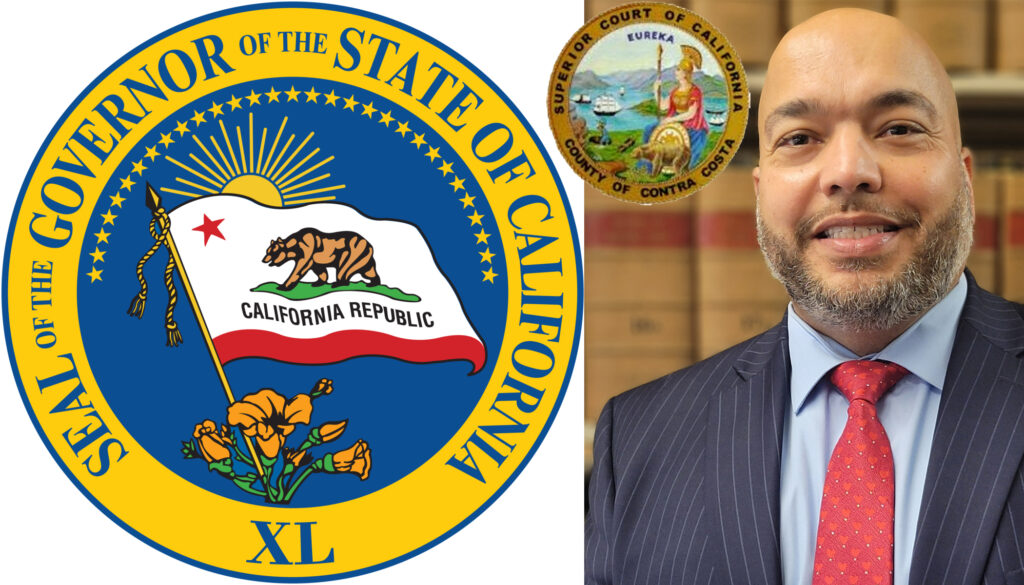
New Contra Costa County Superior Court Judge Michael Nieto. Photo source: Office of the Governor of California
SACRAMENTO – Governor Gavin Newsom announced on Tuesday, June 18, 2024, his appointment of 15 Superior Court Judges, which include one in Contra Costa County; two in Los Angeles County; one in Marin County; one in Napa County; one in Riverside County; one in Sacramento County; three in San Diego County; one in San Francisco County; two in San Joaquin County; one in San Mateo County; and one in Santa Clara County.
Michael Nieto, of Contra Costa County, has been appointed to serve as a Judge in the Contra Costa County Superior Court. Nieto has served as an Assistant District Attorney at the Alameda County District Attorney’s Office since 2022 and has been a Deputy District Attorney there since 1997.
According to his LinkedIn profile, Nieto worked in private practice as an associate attorney for McCutcheon Doyle Brown & Enersen from June 1994 to Dec. 1996 and earned a Bachelors of Arts in Government from Harvard University.
He has served as an Adjunct Professor at the University of California College of the Law, San Francisco since 2013. Nieto earned a Juris Doctor degree from the University of California College of the Law (formerly Hastings), San Francisco. He fills the vacancy created by the retirement of Judge Clare Maier. Nieto is a Democrat.
The annual compensation for each of the judicial positions is $238,479.
“The measure exceeds the scope of the power to amend the Constitution via citizen initiative” – CA Supreme Court
“Today’s ruling is the greatest threat to democracy California has faced in recent memory…the California Supreme Court has put politics ahead of the Constitution” – Californians for Taxpayer Protection and Government Accountability
By Allen D. Payton
In response to a lawsuit by Gov. Gavin Newsom and the state legislature, the California Supreme Court justices unanimously ruled, today, Thursday, June 20, 2024, the measure known as the Taxpayer Protection and Government Accountability Act amounts to an illegal constitutional revision and removed it from the November election ballot. However, proponents vowed tocontinue to explore their legal options and efforts to minimize
According to Ballotpedia, “The initiative would have amended the California Constitution to define all state and local levies, charges, and fees as taxes. The initiative would have also required new or increased taxes to be passed by a two-thirds legislative vote in each chamber and approved by a simple majority of voters. It would also have increased the vote requirement for local taxes proposed by local government or citizens to a two-thirds vote of the local electorate. The increased vote requirements for new or higher taxes would have not applied to citizen-initiated state ballot measures. As of 2024, state tax increases require approval by a two-thirds vote in each chamber or a simple majority vote at a statewide election
In addition, a ‘yes’ vote on the measure would have supported “amending the state constitution to define all state and local levies, charges, and fees as taxes and to require new state taxes proposed by the state legislature to be enacted via a two-thirds legislative vote and voter approval and new local taxes to be enacted via a two-thirds vote of the electorate.”
However, according to the Associated Press, “The biggest impact…would have been that the measure threatened to retroactively reverse most tax increases approved since Jan. 1, 2022. Local governments warned they would have lost billions of dollars in revenue that had previously approved by voters. And it would have threatened recent statewide tax increases.”
Proponents
Proponents of the measure, Californians for Taxpayer Protection and Government Accountability, self-described as “a bipartisan coalition of homeowners, taxpayers and businesses committed to ensuring California remains affordable for families and accountable to its voters,” led the campaign in support of the initiative. The campaign explained the initiative, saying, “The Taxpayer Protection and Government Accountability Act will give voters the right to vote on all future state taxes and holds politicians accountable for new fees and other increased costs paid by working families and all Californians. The measure increases accountability by requiring politicians to spend new or higher tax revenue on its intended purpose. It will provide much-needed relief to families, farmers, and business owners, helping them to combat the growing cost-of-living crisis facing all Californians.”
According to the NAIOP, the measure would have given “voters the right to vote on all future state taxes and holds politicians accountable for new fees and other increased costs paid by working families and all Californians.” It would have increased “accountability by requiring politicians to spend new or higher tax revenue on its intended purpose. It will provide much-needed relief to families, farmers, and business owners, helping them to combat the growing cost-of-living crisis facing all Californians. The Act doesn’t cut any current state or local government funding. It simply gives voters the right to vote on all future tax increases and stops working families from paying billions more in “hidden taxes” imposed by unelected bureaucrats. They are currently gathering signatures and will need $70 million in fundraising efforts to pass the ballot measure in November of 2022.”
Supporters Respond, Will Seek Legal Options, Continue Efforts
In response to the court’s ruling, the Taxpayer Protection and Government Accountability Act (TPA) campaign issued the following statement from Rob Lapsley, president of the California Business Roundtable, Jon Coupal, president of the Howard Jarvis Taxpayers Association (HJTA) and Matthew Hargrove, president and CEO of the California Business Properties Association:
“Today’s ruling is the greatest threat to democracy California has faced in recent memory. Governor Newsom has effectively erased the voice of 1.43 million voters who signed the petition to qualify the Taxpayer Protection Act for the November ballot. Most importantly, the governor has cynically terminated Californians’ rights to engage in direct democracy despite his many claims that he is a defender of individual rights and democracy. Evidently, the governor wants to protect democracy and individual rights in other states, but not for all Californians.
We are disappointed that the California Supreme Court has put politics ahead of the Constitution, disregarding long-standing precedent that they should not intervene in an election before voters decide qualified initiatives.
Direct democracy and our initiative process are now at risk with this decision, showing California is firmly a one-party state where the governor and Legislature can politically influence courts to block ballot measures that threaten their ability to increase spending and raise taxes. Using the courts to block voters’ voices is the latest effort from the Democrats’ supermajority to remove any accountability measures that interfere with their agenda – a failed agenda that continues to drive up the cost of living with little accountability and few results.
This ruling sends a damning message to businesses in California and across the country that it is politically perilous to invest and grow jobs for the future.
In light of this ruling and the state’s large budget deficit, a huge amount of tax increases are on the way that are sure to make California’s cost of living even higher.
We will continue to explore our legal options and fight for the people’s right to hold their government accountable through direct democracy.”
———–
Opponents
The measure was opposed by Governor Newsom, CA Attorney General Rob Bonta, FSCME California, SEIU California State Council, California Special Districts Association, California State Association of Counties, and League of California Cities. Graham Knaus, executive director of the California State Association of Counties (CSAC), said, “This deceptive initiative would undermine the rights of local voters and their elected officials to make decisions on critical local services that residents rely upon. It creates major new tax loopholes at the expense of residents and will weaken our local services and communities.”
Bonta had relabeled the measure’s title to, “Limits Ability of Voters and State and Local Governments to Raise Revenues for Government Services. Initiative Constitutional Amendment.” The summary he required to be included on signature petition sheets read as follows: “For new or increased state taxes currently enacted by two-thirds vote of Legislature, also requires statewide election and majority voter approval. Limits voters’ ability to pass voter-proposed local special taxes by raising vote requirement to two-thirds. Eliminates voters’ ability to advise how to spend revenues from proposed general tax on same ballot as the proposed tax. Expands definition of ‘taxes’ to include certain regulatory fees, broadening application of tax approval requirements. Requires Legislature or local governing body set certain other fees.”
In spite of that, supporters were still able to gather the required signatures to qualify the measure for the ballot. The signature gathering occurred in 2022.
Court’s Decision
According to information about the case #S281977 entitled LEGISLATURE OF THE STATE OF CALIFORNIA v. WEBER (HILTACHK) on the state Supreme Court’s website, it “presented the following issues: (1) Does the Taxpayer Protection and Government Accountability Act (TPA) constitute an impermissible attempted revision of the California Constitution by voter initiative? (2) Is this initiative measure subject to invalidation on the ground that, if adopted, it would impair essential government functions?”
The court wrote in its unanimous opinion, “we conclude that the TPA would clearly ‘accomplish such far reaching changes in the nature of our basic governmental plan as to amount to a revision’ of the (state) Constitution. The measure exceeds the scope of the power to amend the Constitution via citizen initiative.”
“It is within the people’s prerogative to make these changes, but they must be undertaken in a manner commensurate with their gravity: through the process for revision set forth in Article XVIII of the Constitution,” the decision continued.
The court concluded by “directing the (CA) Secretary of State to refrain from taking steps to place” the initiative “on the November 5, 2024 election ballot or to include the measure in the voter information guide.”
However, Section 3 of that Article clearly reads, “The electors may amend the Constitution by initiative.” Coupal of the HJTA was asked to explain what the court is referring to and what other approach or process should the proponents have followed. He did not respond prior to publication time.
Joins the other Assemblymembers representing Contra Costa: Wilson, Bauer-Kahan and Wicks, who support offering up to 20% for down payment or closing costs, not to exceed $150,000
By Allen D. Payton
A bill to make illegal immigrants eligible for the California Dream for All Shared Appreciation Loan Program, which provides up to 20 percent of downpayment assistance to prospective homebuyers, passed the State Assembly last month on a vote of 56-15. All four Assemblymembers representing Contra Costa County voted in favor of Assembly Bill 1840, including Tim Grayson (D-15), who represents Antioch, Lori Wilson (D-11), Rebecca Bauer-Kahan (D-16) and Buffy Wicks (D-14).
Wicks also voted for the bill, authored by Assemblyman Joaquin Arambula (D-31), as a member of the Assembly Appropriates Committee.
AB1840 Assembly Floor vote on May 21, 2024. Source: leginfo.legislature.ca.gov
According to CalFHA, “The Dream For All Shared Appreciation Loan is a down payment assistance program for first-time homebuyers to be used in conjunction with the Dream For All Conventional first mortgage for down payment and/or closing costs. Upon sale or transfer of the home, the homebuyer repays the original down payment loan, plus a share of the appreciation in the value of the home.”
The program offers up to 20% for down payment or closing costs, not to exceed $150,000 and is not on a first come, first served basis. The homebuyer must register for a voucher and a randomized drawing will select registrants who will receive the voucher. The program requires at least one borrower be a first-generation homebuyer and all borrowers must be first-time homebuyers.
According to the Legislative Counsel’s Digest, “Existing law establishes the California Housing Finance Agency in the Department of Housing and Community Development, and authorizes the agency to, among other things, make loans to finance affordable housing, including residential structures, housing developments, multifamily rental housing, special needs housing, and other forms of housing, as specified. Existing law establishes the California Dream for All Program to provide shared appreciation loans to qualified first-time homebuyers, as specified.
Existing law establishes the California Dream for All Fund, which is continuously appropriated for expenditure pursuant to the program and defraying the administrative costs for the agency. Existing law authorizes moneys deposited into the fund to include, among other moneys, appropriations from the Legislature from the General Fund or other state fund.
This bill would specify that an applicant under the programwho meets all other requirements for a loan under the program, including, but not limited to, any requirements imposed by the Federal National Mortgage Association or other loan servicer, shall not be disqualified solely based on the applicant’s immigration status.
By expanding the persons eligible to receive moneys from a continuously appropriated fund, this bill would make an appropriation. The bill would recast the fund so that appropriations from the Legislature from the General Fund or other state fund are deposited into the California Dream for All Subaccount, which the bill would create and make available upon appropriation by the Legislature for specified purposes.”
AB 1840 is now up for votes by the State Senate Housing and Judiciary Committees before a possible vote on the floor.