Galatea on a Dolphin, a 19th century Italian marble sculpture, illuminated in the Lily Pond on the Main Terrace of Hearst Castle – one of the many works that can be viewed as part of the ‘Art Under the Moonlight’ tour. Photo from California State Parks
‘Art Under the Moonlight’ tours will allow guests to explore William Randolph Hearst’s famed art collection like never before
By California Department of Parks and Recreation, Divisions of Boating and Waterways, Historic Preservation and Off-Highway Motor Vehicle Recreation
SAN SIMEON, Calif.— California State Parks is excited to announce a new limited series of evening tours at the iconic Hearst Castle® this fall. The “Art Under the Moonlight” tours will offer guests a unique opportunity to explore William Randolph Hearst’s world-renowned art collection like never before – under the enchanting glow of the moon. These guided tours will be available on select Fridays and Saturdays from Oct. 4 through Nov. 16. Due to the limited availability, reservations are highly recommended.
WHAT: ‘Art Under the Moonlight’ tours WHEN: Select Fridays and Saturdays from Oct. 4 – Nov. 16, 2024 WHERE: Hearst San Simeon State Historical Monument (Hearst Castle®) COST: $50 for guests over 12 years old, $25 for children ages 5-12, no cost for children under 5. ACCESSIBILITY: The tour will involve navigating 160 stairs and will take moderate effort. An ADA-accessible version of the tour that involves no stairs and can accommodate up to four people per tour is also available. HOW TO JOIN: Visit HearstCastle.org or ReserveCalifornia.com to make your reservation. The tour lasts 100 minutes.
The new tour offers a rare chance to view illuminated outdoor works of art while learning about their significance through time and enjoying their beauty as one of Hearst’s honored guests would have done in the 1930s. Inside the historic castle, guests will get an intimate look at the art collection that the influential media mogul amassed during his time there.
“This is an incredible opportunity to be under the moonlight on the same path that Mr. Hearst and his guests strolled while smelling the fragrant blooms and hearing the calming sound of the hilltop fountains,” said San Luis Obispo Coast District Superintendent Dan Falat. “The evenings are magical here, and this one-of-a-kind art collection is shown off in the best lighting.”
About Hearst Castle®
La Cuesta Encantada, “The Enchanted Hill” high above the ocean at San Simeon, was the creation of two extraordinary individuals, William Randolph Hearst and architect Julia Morgan. Their collaboration, which began in 1919 and continued for 28 years, transformed an informal hilltop campsite into the world-famous Hearst Castle® – an estate that comprises the magnificent 115-room main house plus three sumptuous guesthouses, pools, and 127 acres of terraced gardens, fountains, and paths. The main house, “Casa Grande” and the three guesthouses, “Casa del Monte,” “Casa del Sol,” and “Casa del Mar” are home to Hearst’s extraordinary art collection and have hosted many influential guests, including President Calvin Coolidge, Winston Churchill, George Bernard Shaw, Hedda Hopper, Joan Crawford, Charlie Chaplin, and a diverse array of luminaries from the sports, show business, and publishing industries.
The California Department of Parks and Recreation, popularly known as State Parks, and the programs supported by its Office of Historic Preservation and divisions of Boating and Waterways and Off-Highway Motor Vehicle Recreation provide for the health, inspiration and education of the people of California by helping to preserve the state’s extraordinary biological diversity, protecting its most valued natural and cultural resources, and creating opportunities for high-quality outdoor recreation. Learn more at parks.ca.gov.
Up to $150,000 for a 20% down payment, awaits Newsom’s signature or veto
Glazer votes against, Grayson for
By Allen D. Payton
The California State Senate passed the bill, on Tuesday, August 27, 2024, to give home loan down payments to illegal immigrants on a 25-14 vote with 1 Democrat abstaining from voting. It follows the action in May by the Assembly, which passed it on a 56-15 vote with 6 Democrats and 3 Republicans not voting. Now the controversial Assembly Bill 1840 is on Governor Newsom’s desk awaiting his decision.
State Senator Nancy Skinner (D-SD9) who represents portions of West Contra Costa County voted yes, while State Senator Steve Glazer (D-SD7), who represents the rest of the county including Antioch, voted against the bill authored by Assemblyman Joaquin Arambula (D-AD31) of Fresno. As previously reported, all four Assemblymembers representing Contra Costa County, including Tim Grayson (D-AD15), Lori Wilson (D-AD11), Rebecca Bauer-Kahan (D-AD16) and Buffy Wicks (D-AD14), voted to pass the bill.
It would expand eligibility of the California Dream for All Shared Appreciation Loan program, to be renamed under the bill to the Home Purchase Assistance Program, by removing any disqualifications based on an applicant’s immigration status. If approved, illegal immigrants could enter the lottery system under the program and qualify for the 20% in down payment assistance up to $150,000.
However, not all illegal immigrants would qualify for the program. Under AB 1840, only those with taxpayer ID numbers or Social Security numbers could apply. According to the language of the bill “This bill would specify that an applicant who meets all other requirements for a loan under the program and who is otherwise eligible under applicable federal and state law, shall not be disqualified solely based on the applicant’s immigration status.”
According to a June 28, 2024, press release from the governor’s office, out of 18,000 people who applied to the program this year, only 1,700 were chosen and according to a report by KQED, in 2013, the program ran out of money in the first 11 days. The bill would greatly expand the number of applicants, due to the California Dream program targeting low- to middle-income first-time buyers.
According to the program details, “The Dream for All Shared Appreciation Loan is a down payment assistance program for first-time homebuyers to be used in conjunction with the Dream For All Conventional first mortgage for down payment and/or closing costs. Upon sale or transfer of the home, the homebuyer repays the original down payment loan, plus a share of the appreciation in the value of the home.” In addition, one borrower must be a first-generation homebuyer and all borrowers must be first-time homebuyers.
Contact the Governor
To contact the governor to offer your input on how he should respond to the bill use the online form on the office’s website at www.gov.ca.gov/contact/. But you’ll have to select Immigration Issues/Concerns and write AB1840 in the comment as it is not currently in the Active Bills list. You can also call Newsom’s office at (916) 445-2841 and leave a message with or for his staff.
Join the “Find 30 Species for CA 30×30” Biodiversity Week Challenge!
By Mt. Diablo State Park staff
Did you know over 600 species of plants grow on Mount Diablo? We are part of what makes California a #biodiversity hotspot with 32% of all #nativeplants found in the U.S.!
Join us on California Biodiversity Day, Saturday, September 7th, for a guided hike to celebrate California and Mount Diablo’s biodiversity. We’ll visit the park’s Coulter pines, discover why they are also called big-cone pine, and learn about the challenges they are facing. Our acting Natural Resources Manager for the District will be on hand to share how we are trying to both help the trees and enhance biodiversity in the area with methods including prescribed fire.
You can be part of the effort too by participating in the day’s bioblitz to record what is living in the area now so we can see what changes later. If you’d like to do this, no special knowledge is required, just bring a phone or camera and download the iNaturalist app.
From 9am-noon on Saturday, September 7. Meets at the Mitchell Canyon Visitor Center located in Mount Diablo State Park at the south end of Mitchell Canyon Road in Clayton. Fee: $6 per vehicle, $5 for seniors. Pay with check or exact change or pay digitally by scanning the QR code by the entrance sign. Bring your curiosity, plenty of water, and wear sturdy shoes.
California Biodiversity Day Events
From September 7–15, join in one or more of the many California Biodiversity Day events being held across the state! Get outside and explore the nature around you—in your backyard, neighborhood, local parks, and open spaces—and share your findings on iNaturalist. No matter where you are in California, you can discover and celebrate nature and contribute to our understanding of where plants and animals are found!
As a global biodiversity hotspot, California has an immense array of nature to explore. We’ve compiled a few resources to guide folks in learning more about the nature around them, while contributing valuable data that can be used to answer important local conservation questions.
Help celebrate California’s biodiversity and help inform the state’s 30×30 initiative by taking a closer look at nearby nature and documenting your finds on iNaturalist! Explore the nature around you however you choose, whether that’s visiting the coast, enjoying a long hike, walking to a nearby park, observing the birds outside your window, or looking for spiders under your couch.
Join the “Find 30 Species for CA 30×30” Biodiversity Week Challenge!
September 7 – 15, the California Natural Resources Agency is putting forth a challenge for California Biodiversity Week: can you find and document 30 species in California?
September 7- 15, find and photograph 30 (or more!) wild plants, animals and fungus anywhere in California.
Learn more as your observations are identified.
By joining the project, any observations you make in California from September 7 to 15 will automatically be added to the project and will help inform the California 30×30 initiative.
Make observations in your neighborhood, in your local park, while out hiking… or join in one of the many events being held throughout California during California Biodiversity Week.
Spread the word! Use the hashtag on social media #CABiodiversityDay. For more information visit Find 30 Species Project.
Other ways to explore California’s Biodiversity
There are events and activities being held around the state for California Biodiversity Week! Check out the California Biodiversity Day website to find a bioblitz to participate in, a talk to attend, or a nature walk to join!
Try to get bingo with these California Biodiversity Bingo sheets you can download and play with your family, friends, and community!
Background
Established in 2018, California Biodiversity Dayis part of California’s first Biodiversity Initiative to safeguard the state’s natural heritage in response to the growing loss of biodiversity across the state. In 2020, a groundbreaking Executive Order was signed to protect 30% of California’s lands and waters by 2030, known as California 30×30 . Together, these initiatives protect biodiversity, build resilience to climate change, and ensure equitable access to nature for all Californians. By participating in California Biodiversity Day, you can connect with the nature around you while also contributing to these important conservation goals.
Presented by the CA Office of Traffic Safety, CA Department of Transportation & iHeart Media
Entry deadline: Aug. 29
WHAT: The California Office of Traffic Safety (OTS) and the California Department of Transportation (Caltrans) are teaming up with iHeartMedia to announce a statewide contest for a chance to win up to $500 in cash gift cards and prizes. To enter, participants will share with us how they are a traffic safety champion and make a commitment to safe road behaviors. This contest is only open to individuals who are legal U.S. residents of the State of California. Any participants ages 14 and up can enter the contest. For participants under the age of 18 years old, a parent/guardian must sign the registration form.
WHY: Twelve people are killed on California roads every day. The roads are shared by drivers, bicyclists, pedestrians, electric scooters, and other mobility assistance devices such as wheelchairs. When we’re on the road, every action we take gets us to a safer place. Safe roads depend on all of us. The objective is to encourage others to share how they watch out for one another as we start a movement for safer roads together.
WHEN: Contest and submission period: Now through 11:59 p.m. PDT on August 29, 2024.
Winner notification: September 2024/Public Winner Announcement: September 2024.
Aerial video screenshots of a new bike turnout on Mt. Diablo. Source: CA State Parks Foundation
Memory of local cyclist Joe Shami inspired community to improve safety for bicyclists and motorists
Paid for with public and private funds
By Annette Majerowicz, Communications Consultant, Full Court Press Communications for the California State Parks Foundation
Mount Diablo, CA– California State Parks Foundation, on Friday, celebrated the completion of 22 new bike turnouts at Mount Diablo State Park. There are now a total of 67 bike turnouts in the park. Bike turnouts allow bicyclists, who move at slower speeds as they pedal uphill, to pull out of the main traffic lane into their own lane so that vehicles can pass safely.
The new turnouts were inspired by the memory of Joe Shami who was a passionate advocate for increasing safety for bicyclists and cars at Mount Diablo State Park. Known by locals as “The Legend of Mount Diablo,” Joe’s passion for Mount Diablo State Park and cycling was exemplified by over a decade of weekly trips up the mountain well into his 80s.
“Tragically, Joe was struck and killed by a vehicle while riding his bicycle in Lafayette,” said Randy Widera, Director of Programs of the California State Parks Foundation. “Although he is not with us today, Joe left a special gift in his will to California State Parks Foundation. This gift helped make these additional bike turnouts on Mount Diablo possible. We know Joe would be pleased that his generous gift is making Mount Diablo safer for bicyclists to enjoy.”
Two of the 22 new Mt. Diablo bike turnouts. Source: CA State Parks Foundation
For many years, cycling at Mount Diablo State Park has been a popular — but dangerous — activity. From 2010 to 2014, there were an average of 23 car and bike collisions per year. According to California State Park officials, this also frequently resulted in road rage showdowns between drivers and riders. After the first turnouts were created, collisions dropped to three accidents in two years, and road rage significantly diminished.
In an incredible show of dedication to this work, California State Parks allocated the same amount as Joe’s gift from the department’s annual roads allocation funding to this project. Taking this initial funding as a challenge, a passionate group of volunteers comprised of Alan Kalin, Mark Dedon, and Ted Trambley spent four months doing outreach in the park and at Peet’s Coffee in Danville with locals, cyclists, and visitors to raise additional funds.
“The new bike turnouts on Mount Diablo are a testament to Joe Shami’s inspirational life,” said Mark Dedon, Mt. Diablo Cyclists leadership team member. “The community understands the importance of the new turnouts for the safety of both bicyclists and motorists. People we spoke with were happy to contribute to make these turnouts a reality.”
Through their efforts and with the support of California State Parks Foundation, they inspired over 300 individuals, organizations, and companies to donate the additional funding needed to make the bike turnouts possible. (See brief bike turnout video)
California State Parks Foundation, an independent, member-supported nonprofit with over 50 years of history, is dedicated to protecting and preserving the California state park system for the benefit of all. We work in parks and in Sacramento with partners, park staff, and policymakers to address the challenges parks face. To make real and lasting change we are working to build a movement of people who enjoy and advocate for their parks now, and for future generations. Learn more at www.calparks.org, or find California State Parks Foundation on Facebook, or Instagram and Twitter (@calparks).
About Mount Diablo State Park
Located in the San Francisco Bay Area to the east of Walnut Creek, people have been drawn for generations to Mount Diablo for its spectacular views from the summit which extend over 100 miles in all directions on a clear day. Visitors have been attracted by the complex geology that has created amazing rock formations such as the “wind caves” at Rock City, and by the mountain’s variety of habitats which are home to over 600 species of plants and an amazing array of wildlife such as butterflies, bats and birds of prey, tarantulas, bobcats, lizards, snakes and deer.
In 2021 Mount Diablo celebrated its 100th year as a State Park. Though 100 years is a long history as a park, the importance of Mount Diablo was recognized long before that. For thousands of years Native Americans were the caretakers of this land. Many groups considered and treated the mountain as a sacred place and continue to do so today.
Since becoming a park in 1921, Mount Diablo has been protected as a natural area, and over the past 100 years the park has grown from only a few hundred acres to over 20,000 acres. Today it is a destination for those who would like to view wildlife and wildflowers, experience beautiful views, hike, camp, picnic, run, cycle, climb, ride horses, or gaze at the stars.
Instead of passing bill she carried – See UPDATE with details of “Deal Framework”
CA journalists “oppose this disastrous deal”
“The future of journalism should not be decided in backroom deals…Not a single organization representing journalists and news workers agreed to this undemocratic and secretive deal with one of the businesses destroying our industry.” – Media Guild of the West
Senator Glazer who has his own bill on the matter opposes deal says it, “seriously undercuts our work toward a long term solution to rescue independent journalism” and doesn’t include Meta (Facebook, Instagram) and Amazon
By Allen D. Payton
Assemblymember Buffy Wicks (D-AD15, Oakland)
SACRAMENTO – On Wednesday, August 21, 2024, Assemblymember Buffy Wicks (D-AD15, Oakland) announced the establishment of a first-in-the-nation partnership with the State, news publishers, major tech companies and philanthropy, unveiling a pair of multi-year initiatives to provide ongoing financial support to newsrooms across California and launch a National AI Accelerator.
Together, these new partnerships will provide nearly $250 million in public and private funding over the next five years, with the majority of funding going to newsrooms. The goal is to front-load $100 million in the first year to kick-start the efforts. The total investment could increase over the next several years if additional funding from private or state sources becomes available.
“This agreement represents a major breakthrough in ensuring the survival of newsrooms and bolstering local journalism across California — leveraging substantial tech industry resources without imposing new taxes on Californians,” said Governor Gavin Newsom. “The deal not only provides funding to support hundreds of new journalists but helps rebuild a robust and dynamic California press corps for years to come, reinforcing the vital role of journalism in our democracy.”
Assemblymember Wicks, who represents portions of Western Contra Costa County, authored AB 886 to help ensure the sustainability of local journalism, as news outlets across the country are downsizing and closing at alarming rates. A Northwestern University study published last year found an average of two and a half newspapers in the United States close every week, and that our nation has lost two-thirds of its newspaper journalists since 2005. California has lost more than 100 newspapers in the last decade alone.
The new suite of initiatives includes multi-faceted support for publishers across California to address challenges that have impacted the depth and breadth of news coverage in the state. They will help ensure the sustainability of existing and new online publications – with an emphasis on small, local outlets and community-facing journalism.
“As technology and innovation advance, it is critical that California continues to champion the vital role of journalism in our democracy,” saidWicks. “This partnership represents a cross-sector commitment to supporting a free and vibrant press, empowering local news outlets up and down the state to continue in their essential work. This is just the beginning. I remain committed to finding even more ways to support journalism in our state for years to come.”
California news publishers will be the beneficiaries of a News Transformation Fund, to be administered by the UC Berkeley School of Journalism, providing financial resources that preserve and expand California-based journalism. The funding will include contributions from technology platforms and the State of California, supporting innovative new investments that promote local journalism. The funding will support California-based state and local news organizations, particularly those serving California local news deserts, underserved and underrepresented communities, and outlets that prioritize California coverage.
“The University of California is proud to partner with Governor Newsom and legislative leaders to bolster the critical work of local news organizations and journalists in California,” said UC President Michael V. Drake, M.D. “Californians depend on robust local and diverse news organizations to stay informed about their communities, and the University and specifically the UC Berkeley School of Journalism stand ready to support this endeavor.”
Funding for the initiative would be complemented by direct support from the State, helping news organizations keep and grow newsroom staff and offsetting the costs of producing local news and information.
“A vibrant press is crucial for strong communities and a healthy democracy. This is a first step toward what we hope will become a comprehensive program to sustain local news in the long term, and we will push to see it grow in future years,” saidCalifornia News Publishers Association CEO Chuck Champion and Board Chair Julie Makinen. “We will work with the state and tech companies to make the most of this initiative. We’re grateful to Assemblymember Wicks for her passionate advocacy on behalf of our 700-plus member newsrooms.”
Partners in this initiative also reiterated their strong commitment to strengthening newsroom and ownership diversity for ethnic and underserved communities. The Governor also announced his support for AB 1511 (Santiago), which aims to increase the state’s ongoing commitment to place official marketing, advertising and/or outreach advertising with local and underrepresented media outlets.
“Ethnic and community media outlets in California have a long history of serving as trusted messengers of culturally responsive news to historically underrepresented and underserved communities,” said Assemblymember Miguel Santiago. “These initiatives ensure that California is embracing private sector innovation while developing partnerships with and seeding investments from the public sector to empower local publishers and journalists that are vital to a healthy, thriving democracy.”
Additionally, researchers and businesses will have access to new resources to explore the use of AI to tackle some of the most complex challenges facing society, and strengthen the workforce through a new National AI Innovation Accelerator. This will be administered in collaboration with a private nonprofit, and will provide organizations across industries and communities — from journalism, to the environment, to racial equity and beyond — with financial resources and other support to experiment with AI to assist them in their work. The AI accelerator will empower organizations with the new technology, and complement the work of the Journalism Fund by creating new tools to help journalists access and analyze public information.
“We appreciate the thoughtful leadership of Governor Newsom, Assemblymember Wicks, Chair Umberg, and Senator Glazer on these issues,” said Kent Walker, President of Global Affairs and Chief Legal Officer for Alphabet (Google’s parent company). “California lawmakers have worked with the tech and news sectors to develop a collaborative framework to accelerate AI innovation and support local and national businesses and non-profit organizations. This public-private partnership builds on our long history of working with journalism and the local news ecosystem in our home state, while developing a national center of excellence on AI policy.”
“A strong press is a key pillar of democracy, and we’re proud to be part of this partnership to utilize AI in support of local journalism across California,” said Jason Kwon, Chief Strategy Officer for OpenAI. “This initiative builds on our longstanding work to help newsrooms and journalists around the world leverage AI to improve workflows, better connect users to quality content, and help news organizations shape the future of this emerging technology.”
Work will begin immediately to stand up both initiatives, which will go live in 2025. Included below is a range of quotes from additional supporters.
What others are saying:
“The work of local independent publishers is essential to a well-functioning democracy, and this new public-private partnership provides immediate and needed relief. Lawmakers should be proud of this program, which builds on California’s innovative Local News Fellowship with millions of new dollars in a way that prioritizes small publishers and those serving underrepresented groups.” – Chris Krewson, Executive Director of Local Independent Online News (LION) Publishers, a national nonprofit with 76 of its 600 publisher members in California
“The new public-private partnership provides a pioneering, ambitious program that will offer significant help to local newsrooms that give Californians the information they need to participate in a healthy democracy. It’s encouraging that lawmakers and tech platforms found a way to work together to forge an innovative solution that can be a model for other states.” – Lance Knobel, CEO of Cityside Journalism Initiative, the nonprofit behind Richmondside, Oaklandside and Berkeleyside
“California is leading the way with this first-in-the-nation investment to protect the press and sustain quality journalism. This fund will help news outlets and journalists adapt to a changing landscape with new tools and funding to embrace emerging technologies. This is especially helpful for ethnic and community media which is comprised largely of under-resourced family businesses whose strongest connections are to their community.” – Regina Wilson, Executive Director, California Black Media
“California is home to the largest concentration of multilingual news outlets serving immigrant and ethnic communities in the US. This breakthrough public private partnership to support local journalism brings welcome recognition of the ethnic media sector’s indispensable role in connecting these diverse communities to each other and to the wider public realm.” – Sandy Close, Director of Ethnic Media Services (EMS), a California-based nonprofit which works with 2000 ethnic news outlets nationwide, including over 300 in California
“It represents an equity-media model for the nation,” added Julian Do, EMS Co-Director
“Protecting and rebuilding California’s robust media ecosystem and ensuring it serves immigrants, Latinos and communities of color equally requires an important role for philanthropy, our tech and private sector, and yes, California’s State Government. We see this historic agreement as just the first major step where the State of California can lead the way in building a sustainable media ecosystem for the most diverse state in the Union.” – Arturo Carmona, President of the Latino Media Collaborative
“This is a win for all Californians. Disinformation flourishes when quality journalism disappears. This critical funding will help local publishers survive and keep their communities informed and engaged.” – Neil Chase, CEO of CalMatters and former editor of The Mercury News and East Bay Times
“The revival of a strong, independent community-minded local press is vital for California. All things considered, this agreement both injects new money into doing that and helps spur the innovation, tech and otherwise, required at this moment. As a companion to the California Local News Fellowship, it’s another brick in the rebuilding of California journalism.” – Ken Doctor, Newsonomics news analyst and Lookout Local founder and CEO
“Supporting local news and journalism is vital to enabling a fully informed and engaged community. We are very pleased to see California as a leader in building this public-private partnership that will substantially impact local journalism and essential news coverage in communities throughout California. This vital funding will support our local news and will enable an expansion of our initiative to add to the depth of our bilingual coverage and journalists in Napa Valley – where 40% of the population is Latino.” – Marc Hand, CEO and Board Chair of Highway 29 Media, a publisher of newspapers serving communities in Napa Valley
California Journalists’ Guild Opposes Deal, Calls it a “Shakedown”
In addition, the Media Guild of the West, which represents journalists and had supported Wicks’ bill, issued a statement on Wednesday opposing the deal entitled, “California’s journalists do not consent to this shakedown.”
The guild’s representatives and signatories to the statement (see below) wrote, “This afternoon, Google, California Assemblymember Buffy Wicks, California Governor Gavin Newsom and many of California’s publishing lobbies announced ‘a first-in-the-nation partnership with the State, news publishers, major tech companies and philanthropy, unveiling a pair of multi-year initiatives to provide ongoing financial support to newsrooms across California and launch a National AI Accelerator.’
After two years of advocacy for strong antimonopoly action to start turning around the decline of local newsrooms, we are left almost without words. The publishers who claim to represent our industry are celebrating an opaque deal involving taxpayer funds, a vague AI accelerator project that could very well destroy journalism jobs, and minimal financial commitments from Google to return the wealth this monopoly has stolen from our newsrooms.
Not a single organization representing journalists and news workers agreed to this undemocratic and secretive deal with one of the businesses destroying our industry. Moments ago, the following opposition letter was filed with the California legislature:
We represent journalists and news workers who provide essential news for millions of Californians in print, digital, broadcast, commercial and nonprofit newsrooms.
The future of journalism should not be decided in backroom deals. The Legislature embarked on an effort to regulate monopolies and failed terribly. Now we question whether the state has done more harm than good.
California’s journalists and news workers OPPOSE this disastrous deal with Google and condemn the news executives who consented to it in our names.
Signed,
Matt Pearce, President, Media Guild of the West, The NewsGuild-CWA Local 39213 Jon Schleuss, President, The NewsGuild-CWA Annie Sciacca, President, Pacific Media Workers Guild, The NewsGuild-CWA Local 39521 Carrie Biggs-Adams, President, NABET-CWA Local 51 Javad Ayala, President, NABET-CWA Local 53 Kevin Gallo, Regional Vice President 5, NABET-CWA Frank Arce, Vice President, Communications Workers of America District 9
Glazer Also Opposes Agreement, Calls it “Inadequate”
State Senator Steve Glazer (D-SD7, Orinda).
State Senator Steve Glazer (D-SD7, Orinda), who represents most of Contra Costa County and has his own bill on the matter, SB911, also does not support the deal and on Wednesday issued the following “Statement on Wicks-Google Agreement”:
“Despite the good intentions of the parties involved, this proposal does not provide sufficient resources to bring independent news gathering in California out of its death spiral.
Google’s offer is completely inadequate and massively short of matching their settlement agreement in Canada, in supporting on-the-ground local news reporting.
Democracies live and die based on the free exchange of information and oversight between government and its people. Autocracies and dictatorships thrive when that information is constrained or manipulated.
The hollowing out of independent news gathering and the monopoly power of these digital platforms is an existential threat to our democratic republic.
This agreement, unfortunately, seriously undercuts our work toward a long term solution to rescue independent journalism
There is a stark absence in this announcement of any support for journalism from Meta (parent company of Facebook and Instagram) and Amazon. These platforms have captured the intimate data from Californians without paying for it. Their use of that data in advertising is the harm to news outlets that this agreement should mitigate.”
Questions for Wicks About the Agreement and Initiatives Go Unanswered
Questions were emailed Wednesday night to Wicks’ Director of Communications, Erin Ivie, asking, “Do you email out press releases to media that cover her district? Was there a press conference held announcing the agreement?”
Other local media publishers in Contra Costa County didn’t receive the press release about the agreement nor an invitation to any press conference at which it was announced, either.
She was also asked the following:
“Why didn’t she reach out to the local media that cover her district for our input like Congressman Mark DeSaulnier did for his legislation?
Which news publishers, major tech companies and philanthropy are party to the agreement?
Can you ease provide copies of the two initiatives mentioned in the press release or the link to where they can be found?
What are the definitions of ‘newsroom’, ‘local journalist’ and ‘local news outlets’ mentioned in the press release, including in a quote by the Assemblywoman?
Which newsrooms will qualify for the funds? Who will determine which newsrooms will receive the funds and how much they will receive?
Will the funds be provided directly from the tech companies and philanthropy to the newsrooms, or will they be funneled through a state government agency? Will there be an application process and to whom will the applications be submitted?
Who will be working on both initiatives? How does a local news publisher get involved in the process?”
Finally, Ivie was asked, “Won’t the allocation of taxpayer funds included in the agreement still require legislation to be passed? If so, what will be the process? Will the Assemblywoman continue to pursue passage of AB866? If so, will it be amended to include the elements of the agreement?
UPDATE: Wicks’ Staff Provides Details of Deal
In response, Ivie provided the “Deal Framework, Measures to support democracy, journalism and AI innovation” (see below). In addition, she provided answers to the Herald’s questions:
“Eligible for the funding are nonprofit and for-profit news organizations who have been around for at least two years. The funding is awarded by headcount, overseen by a diverse board (outlined further down).
The one exception is commercial broadcasters, who were carved out of the agreement because they continue to generate healthy profits from advertising dollars.
The funds will be distributed by the UC Berkeley School of Journalism, by an approved claims administrator who typically handles complex distributions of class action settlements. Details of the application process are forthcoming, but in the meantime, anyone interested can contact our office to get on a list to receive those details.
The state is currently committed to providing a minimum of $70M over 5 years, and that commitment is limited to the journalism fund only. Google has committed to $110M minimum over the same time frame, plus $62.5M for their AI accelerator.
That means that taxpayer funds could be used to support the journalism fund, but not the work of the AI accelerator. It will not require legislation to be passed, but it will require a budget allocation (in January), which the Governor has already committed to.
Our office, Google, the UC Berkeley School of Journalism, plus a seven-member governing board. That board will consist of two CNPA members, one member from Ethnic Media Services, one from Local Independent Online News (LION), one from Latino Media Collaborative, one from California Black Media, and one from Media Guild of the West.
Any local news publisher who wants to get involved can email our office and be brought into the fold. If you’re interested, please email our Legislative Director Zak Castillo-Krings at zak.castillo-krings@asm.ca.gov.
The agreement was made in lieu of AB 886, and the bill will no longer move forward.”
Deal Framework
Measures to support democracy, journalism and AI innovation
1. Summary: Creation of first-in-the-nation partnerships that will provide nearly $250 million in public and private funding over the next five years, with the majority of going to support newsrooms. The goal is to front-load $100 million in the first year to kickstart the efforts. Total investment could increase over the next several years if additional funding from private or state sources becomes available.
2. State Contribution: 30mm in year one. 10mm in each of the next four years (years 2-5). All money will be contributed to a new fund established at UC Berkeley School for Journalism.
3. Google Commitment to Journalism, up to 30mm a year, as follows:
a. Year one:
$15mm to the Journalism Fund
$5mm to AI fund accelerator
$10mm in funding for existing journalism programs
b. Years 2-5: Google continues its contribution to Journalism Fund at 10mm minimum. Google maintains 10mm in funding for existing journalism programs
4. National AI Accelerator
a. Managed by as-yet-to-be finalized non-profit organization, under terms to be
defined by funders
b. Google commitment of additional 10mm to Accelerator
c. Google commitment of additional 2.5mm to fund AI research
d. Additional contributions from other tech companies
5. UC School of Journalism non-profit public charity
a. Administration costs are not to exceed a customary overhead
b. Purpose is to bolster UC’s efforts to support and catalyze local news
throughout the state
c. Overseen by a 7-member governing board:
i. CNPA member
ii. CNPA member
iii. Ethnic Media Services
iv. Local Independent Online News
v. Latino Media Collaborative
vi. California Black Media
vii. Media Guild of the West
d. Funds allocated by board to be distributed by claims administrator
e. 12% of funding reserved for locally focused publications and publications targeting underrepresented groups
f. The function of the board will be to validate the distribution formula based on the number of journalists per publication. Funds to be distributed to eligible organizations by dividing the number of eligible journalism positions or
freelancers of each organization by the total number of overall eligible positions multiplied by the total eligible amount in the fund consistent with the current language of AB886. The board will have no other discretion relative o the distribution of funds.
g. The definition of a journalist does not include broadcasters
6. Additional State Support:
a. California will work with its departments on plans to prioritize state government advertising in local publications and publications in underserved markets, with the goal of redirecting millions in advertising dollars.
Erin Ivie, Director of Communications, Office of Assemblymember Buffy Wicks and Steven Harmon, Communications Director for the Office of State Senator Steve Glazer contributed to this report.
399,000 positions paid almost $29 billion in total wages
Includes Contra Costa Superior Court and Cal State East Bay data
SACRAMENTO — State Controller Malia M. Cohen has published the 2023 self-reported payroll data for state departments, superior courts, and California State Universities (CSU) on the Government Compensation in California website. The data covers more than 399,000 positions and approximately $28.87 billion in total wages for those agencies and institutions.
Users of the site can view compensation levels on maps and search by region, narrow results by name of the entity or by job title, and export raw data or custom reports.
The newly published data were reported by:
• 24 CSU institutions (116,235 employees),
• 56 superior courts (20,884 employees), and
• 157 state departments (262,097 employees).
California law requires cities, counties, and special districts to annually report compensation data to the State Controller. The State Controller also maintains and publishes state and CSU salary data. However, no such statutory requirement exists for the University of California, California community colleges, superior courts, fairs and expositions, First 5 commissions, or K-12 education providers; their reporting is voluntary. Two superior courts either did not file or filed a report that was non-compliant, including those in Alameda County and Tuolumne County.
The site contains pay and benefit information on more than two million government jobs in California, as reported annually by each entity.
In addition, the report shares, “This California State University includes payments toward the unfunded liability of the employer sponsored retirement plan.” For more information visit www.csueastbay.edu/hr.
The State Controller’s Government Compensation in California website provides information on employee pay and benefits for approximately 2 million positions at more than 5,000 public employers. Public employers annually report employee compensation to the State Controller’s Office. It allows the public to view and search employee job titles, build charts and graphics, and download custom reports and raw data.
About Controller Cohen
As the chief fiscal officer of California, Controller Cohen is responsible for accountability and disbursement of the state’s financial resources. The Controller has independent auditing authority over government agencies that spend state funds. She is a member of numerous financing authorities, and fiscal and financial oversight entities including the Franchise Tax Board. She also serves on the boards for the nation’s two largest public pension funds. Follow the Controller on X at @CAController and on Facebook at California State Controller’s Office.
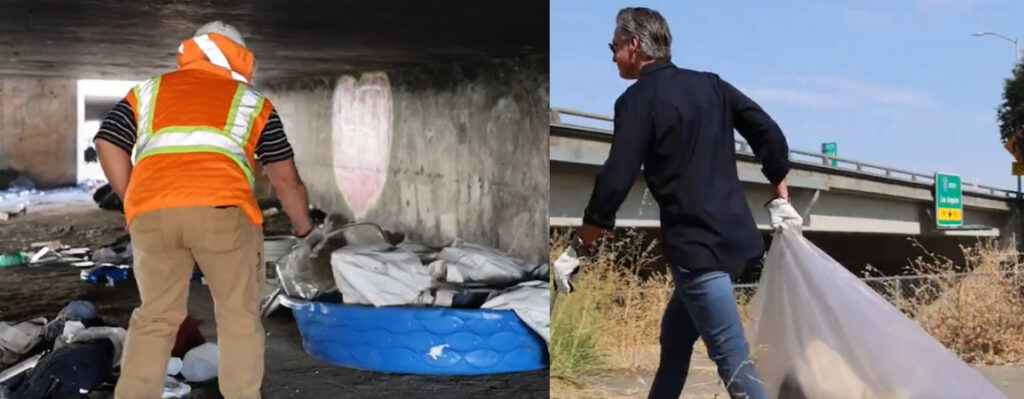
A state worker cleans out an encampment under a freeway overpass. Gov. Gavin Newsom contributes to the effort following the announcement of his executive order on Thursday, July 25, 2024. Video screenshots. Source: Office of the CA Governor
Following U.S. Supreme Court ruling
Encourages local governments to adopt similar policies
“We’re done. It’s time we move with urgency at the local level to clean up these sites. This executive order is about…getting the sense of urgency that’s required of local government to do their job.” – Gov. Newsom
What you need to know: Governor Newsom today issued an executive order directing state agencies to urgently address homeless encampments while respecting the dignity and safety of Californians experiencing homelessness. The Governor’s order, which follows the Supreme Court’s decision in Grants Pass, also urges local governments to use substantial funding provided by the state to take similar action.
SACRAMENTO, CA — Building on California’s ongoing work and unprecedented investments to address the decades-long issue of homelessness, Governor Gavin Newsom issued an executive order today ordering state agencies and departments to adopt clear policies that urgently address homeless encampments while respecting the dignity and well-being of all Californians.
With the recent U.S. Supreme Court decision in Grants Pass v Johnson, local governments now have the tools and authority to address dangerous encampments and help provide those residing in encampments with the resources they need.
“This executive order directs state agencies to move urgently to address dangerous encampments while supporting and assisting the individuals living in them — and provides guidance for cities and counties to do the same. The state has been hard at work to address this crisis on our streets. There are simply no more excuses. It’s time for everyone to do their part.” said Newsom. “We’re done. It’s time we move with urgency at the local level to clean up these sites. This executive order is about…getting the sense of urgency that’s required of local government to do their job.”
The governor’s executive order directs state agencies and departments to adopt humane and dignified policies to urgently address encampments on state property, including by taking necessary and deliberate steps to notify and support the people inhabiting the encampment prior to removal.
Governor Newsom has made record-level investments to address the housing crisis, investing over $24 billion across multiple state agencies and departments, including billions of dollars in funding to assist local jurisdictions in providing services and wrap-around support to people living in encampments. In Fiscal Year 2022-2023, these investments helped lift more than 165,000 people out of homelessness and into interim or permanent housing.
California blueprint
Governor Newsom’s order directs state agencies and departments to adopt policies and plans consistent with the California Department of Transportation’s (Caltrans) existing encampment policy. Since July 2021, California has resolved more than 11,000 encampments, and has removed 248,275 cubic yards of debris from encampments along the state right of way in preparation for Clean California projects. Prioritizing encampments that pose a threat to the life, health, and safety of the community, Caltrans provides advance notice of clearance and works with local service providers to support those experiencing homelessness at the encampment, and stores personal property collected at the site for at least 60 days.
The order encourages local governments to emulate the state’s successful model to adopt local policies and to use all available resources, including those provided by the state’s historic investments in housing and intervention programs, to address encampments within their jurisdictions.
Proposition 1 funding available for local governments
Governor Newsom also encourages local governments to apply for the newly available $3.3 billion in competitive grant funding from Proposition 1 to expand the behavioral health continuum and provide appropriate care to individuals experiencing mental health conditions and substance use disorders — with a particular focus on people who are most seriously ill, vulnerable, or homeless.
Proposition 1 includes two parts: a $6.4 billion Behavioral Health Bond for treatment settings and housing with services, and historic reform of the Behavioral Health Services Act (BHSA) to focus on people with the most serious illnesses, substance disorders, and housing needs. The state also recently released the Proposition 1 Behavioral Health Services Act: Housing Supports Primer (July 2024) for counties, which explains how to spend the projected $950 million annual BHSA revenue on housing interventions.
Unprecedented investments to support communities
Governor Newsom is tackling California’s homelessness crisis head-on. Since he took office, the state has developed a Statewide Action Plan for Preventing and Ending Homelessness and the Governor has demanded unprecedented accountability from local governments to do their part to end the homelessness crisis through regionally coordinated action plans. The Governor has also pioneered nation-leading homeless and housing reforms and invested more than $24 billion to address this crisis with state and local support, including $4.85 billion for Homeless, Housing Assistance and Prevention Grants for local jurisdictions to prevent and reduce homelessness, $1 billion in Encampment Resolution Funding to assist local jurisdictions in providing services and supports to people living in encampments, and $3.3 billion for Homekey to rapidly expand housing for persons experiencing homelessness.
WHEREAS California is experiencing a homelessness crisis decades in the making, with over 180,000 people estimated to have experienced homelessness on any given night in 2023, including 123,000 people who experienced unsheltered homelessness, living in tents, trailers, and vehicles across the state; and WHEREAS within the first year of my Administration I fast-tracked the development of shelter through Executive Order N-23-20, which directed departments to assess and facilitate the use of available state land and resources for short-term emergency homeless shelters; and WHEREAS since the beginning of my Administration, the State has made unprecedented investments to address the homelessness crisis head on, investing more than $24 billion across multiple state agencies and departments, including $4.85 billion in flexible funding to local jurisdictions to prevent and reduce homelessness through Homeless Housing, Assistance and Prevention grants, $1 billion in Encampment Resolution Funding to assist local jurisdictions in providing services and supports to people living in encampments, and $3.3 billion to rapidly expand housing for persons experiencing homelessness through Homekey; and
WHEREAS the State has redoubled its commitment to holding local jurisdictions accountable to reduce homelessness, including by strengthening and enforcing requirements that local jurisdictions plan for their fair share of housing and by conditioning state homelessness funding on rigorous reporting and measurable performance metrics; and
WHEREAS it is imperative to act with urgency to address dangerous encampments, which subject unsheltered individuals living in them to extreme weather, fires, predatory and criminal activity, and widespread substance use, harming their health, safety, and well-being, and which also threaten the safety and viability of nearby businesses and neighborhoods and undermine the cleanliness and usability of parks, water supplies, and other public resources; and
WHEREAS while every jurisdiction must do more to address encampments, state and local agencies taking proactive steps to remove encampments have been stymied in those efforts by lawsuits and injunctions, leaving officials without the tools or guidance necessary to address the crisis on their streets; and
WHEREAS in September 2023, I called on the United States Supreme Court to grant review in City of Grants Pass v. Johnson to clarify that state and local officials can take reasonable actions to resolve encampments while respecting the humanity of all Californians; and
WHEREAS in June 2024 the Supreme Court overturned Ninth Circuit Court of Appeals precedent that restricted the government’s authority to enforce laws regulating encampments, recognizing that jurisdictions may tailor their enforcement practices to reflect policy-driven approaches to addressing homelessness; and
WHEREAS with the threat of these types of injunctions removed, there is no longer any barrier to local governments utilizing the substantial resources provided by the State, in tandem with federal and local resources, to address encampments with both urgency and humanity, or excuse for not doing so; and WHEREAS guidelines that prioritize offers of shelter and services as a first step to resolving any encampment best respect the dignity of every Californian and provide meaningful paths to ending homelessness; and
WHEREAS the California Interagency Council on Homelessness leads California’s efforts to prevent and end homelessness; and
WHEREAS the California Department of Transportation maintains a policy directive that prioritizes removal of encampments that pose threats to life, health, and safety, while partnering with local governments and nonprofit providers to facilitate offers of shelter and supportive services in advance of a removal; and WHEREAS the California Department of Transportation has, since July 2021, removed 11,188 encampments and 248,275 cubic yards of debris from these encampments along the state rights of way.
NOW, THEREFORE, I, GAVIN NEWSOM, Governor of the State of California, in accordance with the authority vested in me by the State Constitution and statutes of the State of California, do hereby issue the following Order to become effective immediately:
IT IS HEREBY ORDERED THAT:
1) Agencies and departments subject to my authority shall adopt policies, generally consistent with California Department of Transportation’s Maintenance Policy Directive 1001-R1, to address encampments on state property, including through partnerships with other state and local agencies, and shall prioritize efforts to address encampments consistent with such policy. Such policies shall include the following:
a. Whenever feasible, site assessment in advance of removal operations to determine whether an encampment poses an imminent threat to life, health, safety or infrastructure such that exigent circumstances require immediate removal of the encampment.
b. Where exigent circumstances exist, as much advance notice to vacate as reasonable under the circumstances.
c. Where no exigent circumstances exist, posting of a notice to vacate at the site at least 48 hours prior to initiating removal
d. Contacting of service providers to request outreach services for persons experiencing homelessness at the encampment.
e. Collection, labeling, and storage for at least 60 days of personal property collected at the removal site that is not a health or safety hazard.
2) All departments and agencies not under my authority are requested to adopt policies consistent with the guidelines in Paragraph 1.
3) Local governments are encouraged to adopt policies consistent with this Order and to use all available resources and infrastructure, including resources provided by the State’s historic investments in housing and intervention programs where appropriate and available, to take action with the urgency this crisis demands to humanely remove encampments from public spaces, prioritizing those encampments that most threaten the life, health, and safety of those in and around them.
4) The California Interagency Council on Homelessness shall develop guidance and provide technical assistance consistent with this Order for local governments to follow in implementing their local homelessness programs.
IT IS FURTHER ORDERED that, as soon as hereafter possible, this Order be filed in the Office of the Secretary of State and that widespread publicity and notice be given of this Order. This Order is not intended to, and does not, create any rights or benefits, substantive or procedural, enforceable at law or in equity, against the State of California, its agencies, departments, entities, officers, employees, or any other person.
IN WITNESS WHEREOF I have hereunto set my hand and caused the Great Seal of the State of California to be affixed this 25th day of July.