







Archive for the ‘Politics & Elections’ Category

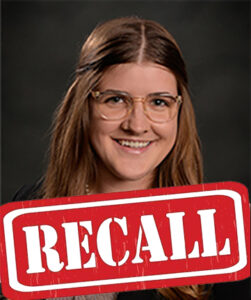
Embattled Antioch School Board president served with recall notice

Saturday, October 9th, 2021

Proponents include parents, teachers, staff and a principal

“the students of Antioch Unified School District were no longer the focus of the Board of Education and drastic action was needed” – David and Lindsey Amezcua

Second Antioch official to currently face potential recall including the city’s mayor
By Allen Payton

On Friday afternoon, Oct. 8, 2021, Antioch School Board President Ellie Householder was served with a notice of recall by David Amezcua, a registered voter and resident of the school district. She was served in the parking lot of her home at 4:41 p.m. according to Amezcua’s wife, Lindsey who was with him.

Householder is the second Antioch official to currently face potential recall including the Mayor Lamar Thorpe. But unlike the mayor, who tossed his recall notice on the ground, twice, when served with his papers, the embattled trustee accepted them and simply said, “Beautiful,” Amezcua shared. (See related article)

The notice includes a list of 20 registered voters who reside within the district and are parents, teachers, staff and a principal.

“The decision to initiate a recall was not made lightly. We discussed the seriousness of taking this action for several months before we decided to act,” the Amezcaus said on behalf of the signers. “It became apparent to us that the students of Antioch Unified School District were no longer the focus of the Board of Education and drastic action was needed to correct the direction we are headed.”

“When the Vote of No Confidence (by AUSD faculty and staff) wasn’t enough to get the trustees to vote to remove Householder as president, we decided to start this process. We are a group of parents, teachers, staff, and administrators that know AUSD needs a leader that wants to work with our educators to achieve collective goals, a leader that is supportive, a leader that wants to effect change in a constructive manner,” they added. “As has been the rally cry for several years, #WeAreAUSD and we demand better.” (See related article)

The notice offers the reasons for the recall including abuse of power and violations of state Education Code and federal law, which are cited in the notice.

“NOTICE OF INTENTION TO CIRCULATE RECALL PETITION

TO THE HONORABLE Elizabeth Householder: Pursuant to Section 11020, California Elections Code, t he undersigned registered qualified voters of the Antioch Unified School District (AUSD), in the State of California, hereby give notice that we are the proponents of a recall petition and that we intend to seek your recall and removal from the office of AUSD Trustee, Antioch, California, and to demand election of a successor in that office.

The grounds f or the recall are as follows:

You are disrespectful of Board Members, Staff and Public who disagree with you during AUSD Board meetings. You have committed Brown Act violations by blocking/deleting comments on Social Media (eliminating equal access). You assert the president must not only collaborate on, but approve, the board agenda. (Ed. Code/Board Policy does not require board president’s approval); You abuse your authority by calling and/or adding agenda items at special meetings that were neither urgent nor necessary. You violated the Family Educational Rights and Privacy Act (FERPA), by publicly posting an unauthorized video of students without permission. You have committed numerous Robert’s Rules of Order Violations during meetings presided over by you: Allowed a substitute motion on a non-debatable “motion to table”; Ongoing efforts to limit or eliminate public comment by removing agenda items without consensus of the board; Stopping public comments midstream when you felt it wasn’t appropriate or directly related to the agenda item; Requesting staff to use personal judgement on which public comments should be entered into public record and which should not; and Abused presidential authority by not recognizing staff / board members’ requests to speak/provide input during a public meeting.”

Recall Proponents

The 20 signers of the recall petition include Lindsey Amezcua, John Muir Elementary School Principal Michael Flosi, former Antioch Council Member and current Planning Commissioner Martha Parsons, former Antioch Planning Commission Chair Janet Rossini Zacharatos, Contra Costa County 2021 Humanitarian of the Year Velma Wilson, and Allison Pantell, April Scott-Garrett, Baltazar and Celestina Perez, Daniel and Denise Rundall, Elizabeth Rieger, Gregory Andelin, Jessica Fernandez, Jessie Allen Lee Wison, Joshua David Isenbarger, Kathleen Cabrera (who served Thorpe his recall notice), Kelsey Martinez, Lakisha Monique Jarvis, Laura Young, Leslie and Robert Scudero, Mary-Ann Bellante, Nancy Mauri, Norma Barela, Shanae Nicole Souza, Susan Jimenez, Tamara Daste, Victoria Lee Virgen.

Recall Process

Householder’s term ends in December 2022, and she currently lives in Area 1 which is represented by Trustee Antonio Hernandez. So, unless the board decides to redraw the current trustee area lines to move her into Area 2, during this year’s redistricting process, Householder will not be able to run for reelection. Householder is also Antioch’s elected city clerk serving in a term that continues through December 2024.

She has seven days to offer a written response to the notice which will be included with the reasons and printed on the petitions which will be used to gather signatures. The district includes all of Antioch and portions of both Oakley and Pittsburg. Householder was elected in 2018 and serves in an at large seat representing the entire school district. (See  map)

According to the Procedure for Recalling State and Local Officials on the California Secretary of State’s website, and the Guide for Recalls on the Contra Costa County Elections website, organizers must gather the signatures of at least 15% of registered voters in the Antioch Unified School District, if the registration is between 50,000 and 100,000, to qualify the recall for the ballot. There are approximately 70,000 registered voters in the district which requires organizers gather approximately 10,500 signatures within 160 days or about 66 per day on average. (Actual figures cannot be determined until the County Elections office reopens on Monday.)

The notice also includes the following details for the recall process:

The original notice and proof of service will be filed with the Contra Costa County Clerk/Recorder.

Elections Code section 11023. (a) Within seven days after the filing of the notice of intention, the officer sought to be recalled may file with the elections official, or in the case of a state officer, the Secretary of State, an answer, in not more than 200 words, to the statement of the proponents.

(b) If an answer is filed, the officer shall, within seven days after the filing of the notice of intention, also serve a copy of it, by personal delivery or by certified mail, on one of the proponents named in the notice of intention.

(c) The answer shall be signed and shall be accompanied by the printed name and business or residence address of the officer sought to be recalled.

Efforts to reach Householder for comment were unsuccessful prior to publication. Please check back later for any updates to this report.


Free online mapping tools for redistricting now available for public use

Monday, October 4th, 2021

Help draw your representatives’ districts the way you’d like to see them; provided by 2020 California Citizens Redistricting Commission and Statewide Database

SACRAMENTO, CA—On Saturday, Oct. 2, the 2020 California Citizens Redistricting Commission announced the Statewide Database’s release of two free-to-use tools to help Californians submit redistricting plans to the Commission. These are the only redistricting applications through which users can submit their input directly to the state of California’s official redistricting process.

“The Commission is excited to share these free resources to help people draw their own district maps,” stated Commission Chair Sara Sadhwani. “The success of this decennial process depends on the participation of all Californians. We want to hear from everyone and want to know if our line drawing is heading in the right direction.”

“The Statewide Database is proud to provide two map creation tools that are free of charge,” said Karin Mac Donald, Director of the Statewide Database. “The key to participation is access. These online tools aim to expand access to every Californian in hopes that they have the tools necessary to participate in the redistricting process.”

Tell the CRC about your community today!

The previously released Draw My CA Community allows users to draw a map of and respond to a few simple prompts about their Communities of Interest. When finished, users can submit community input directly to the California Citizens Redistricting Commission for consideration in the statewide redistricting process. (https://drawmycacommunity.org/)

Draw My CA Districts is a free-to-use online tool for creating district maps

Through the newly released Draw My CA Districts web application, users can create district maps throughout the state of California and submit those maps directly to the Commission. (https://drawmycadistricts.org/)

Draw My CA is a free-to-use plugin for the open-source GIS platform, QGIS

Today’s release of the Draw My CA QGIS plugin allows users to download a California redistricting application to their own computer.  With this plugin, users can create redistricting plans for the state of California and submit those maps directly to the Commission while having access to a full GIS platform. Draw My CA will be available 10/03/2021 at: https://www.redistrictinggroup.org/installer/.

To learn more about these tools, please visit https://drawmycalifornia.org/.

Both the online district mapping tools (Draw My CA Districts and Draw My CA) include functionality to assist users to comply with population deviation, contiguity and assignment checks.

  • % Deviation check – tells the user to what extent any of their districts are above or below the ideal population of the distinct type they are working on
  • Contiguity check – lets the user know if their districts are contiguous or not
  • Assignment check – lets the user know if they have unassigned areas in their redistricting plan

The Commission must follow the following criteria, in this order, when drawing district maps:

  1. Districts must be of equal population to comply with the US Constitution.
  2. Districts must comply with the Voting Rights Act to ensure that minorities have an equal opportunity to elect representatives of their choice.
  3. Districts must be drawn contiguously, so that all parts of the district are connected to each other.
  4. Districts must minimize the division of cities, counties, neighborhoods and communities of interest to the extent possible.
  5. Districts should be geographically compact: such that nearby areas of population are not bypassed for a more distant population. This requirement refers to density, not shape. Census blocks cannot be split.
  6. Where practicable each Senate District should be comprised of two complete and adjacent Assembly Districts, and Board of Equalization districts should be comprised of 10 complete and adjacent State Senate Districts.

In addition, the place of residence of any incumbent or political candidate may not be considered in the creation of a map, and districts may not be drawn for the purpose of favoring or discriminating against an incumbent, political candidate, or political party.

Every 10 years, after the federal government publishes updated census information, California must redraw the boundaries of its electoral districts so that the state’s population is evenly allocated among the new districts.

In 2008, California voters passed the Voters First Act, authorizing the creation of the independent California Citizens Redistricting Commission to draw new State Senate, State Assembly, and State Board of Equalization district lines. In 2010, the Voters First Act for Congress gave the Commission the responsibility of drawing new Congressional districts following every census.

For more information, please visit WeDrawTheLinesCA.org.


California school choice initiative for Nov. 2022 ballot filed with Attorney General

Monday, October 4th, 2021

Would allow creation of “Education Savings Account” for each K-12 student; organizers will need to gather signatures of one million voters

By Michael Alexander

Labor Day is the traditional end of the summer and the beginning of fall.  Before government created the perpetual school year, Labor Day also marked the beginning of the school year. This year, Labor Day marked the beginning of what will be a decisive and tumultuous year.  Californians will have the opportunity to establish true educational freedom in our wonderful Golden State.

School Choice Initiative Filed with Attorney General

In August, key leaders of the California School Choice Foundation joined other Californians to formally present a school choice initiative to the California Attorney General’s office for what is known as “Title and Summary.”  We expect to receive that summary no later than October 12, 2021.  Once that happens, we can then begin to gather the 1.0 million valid signatures necessary to place it on the November 2022 ballot.  Just to make sure, we plan to gather 1.5 million signatures.

Empowers Parents and Revolutionizes Education in California

The key four points of the initiative are these:

Educational Freedom Act

  1. An Education Savings Account (“ESA”) will be established for each K-12 child in California on request.
  2. Each year, that account will be credited with the student’s share of what are known as Prop 98 funds. That share will begin at $14,000 per year per student.
  3. The parent will be able to direct the ESA trust funds to a participating, accredited private or parochial school. The money will follow the student not the politicians.
  4. Any unspent funds will accumulate and can be spent on college, vocational training or other qualified educational expense.

This plan is both simple and revolutionary.  Once passed, California will become the first state to enact universal school choice.  More important, it will be the first state to recognize that It’s Your Kids, Your Money and Your Choice!

Get Ready and Get Involved NOW!

I need not tell you that school choice is the hottest issue in the country.  It was the linchpin of at least two candidates in the recall election:  Larry Elder and Kevin Kiley.  Each endorsed our school choice initiative. You can understand why this is initiative is already driving bureaucrats and social engineers insane.  No matter what happened in the recall election, school choice is not going anywhere.  Thousands of supporters are now mobilizing to get it on the ballot and pass it.  Scores of candidates for statewide and local offices will make school choice the focal point of their campaigns.

This is why you need to get involved right now.  We don’t have a moment to lose.

Super Sunday – Happy Halloween!  Trick or Treat? 

As I mentioned above, we are not standing still for a moment.  We know we will be able to start gathering signatures a month from now.  We have been organizing and advocating for the last three years.

We want to hit the ground running.  That’s why we are pre-planning a major event for October 30-31.  Whether you call it Super Sunday or Halloween, you need to let us know what church or other venue you will be covering on that weekend.  Our goal is to calendar at least 1,000 events statewide.  Nothing will send a more powerful message than this.  Friends and foes alike will know we are serious about our freedom and the future of our children.

This campaign will run for the next 13 months, ending in victory on Tuesday, November 8, 2022.

The following was provided by Stephen Smith.

Q1.  What about California’s public education system led to this grassroots effort for the initiative?

The reasons are legion.

  1. California schools can hardly be called an “education” system. Despite spending $20,000 per student per year – – that’s an average of $500,000 per classroom of 25 – – California schools rank near the bottom of the nation at 48th place. This has happened even though per pupil spending has almost doubled in the last decade.
  2. Increasingly, California schools preferred to indoctrinate rather than educate. In the face of vigorous parental opposition, social engineers (*1) disguised as “educators” continue their efforts to implement critical race theory. They also have frustrated efforts of parents to opt out of equally controversial “sex-ed” programs. (*2)
  3. Parents are outraged by the closure of the schools and mask mandates. Eighteen months after the start of the Covid panic, schools are still not fully reopened.
  4. Parents are frustrated by being ignored by school boards, teachers’ unions and politicians. They feel strongly – – and correctly – – that they are the parents and should be making basic decisions about the health, education and formation of their children. This is a basic human right that is frustrated daily by a leviathan system that cares little for them for their children. (*3)

(*1) https://freebeacon.com/coronavirus/la-teachers-union-president-there-is-no-such-thing-as-learning-loss/  “There is no such thing as learning loss,” the union president told Los Angeles Magazine. “Our kids didn’t lose anything. It’s OK that our babies may not have learned all their times tables. They learned resilience. They learned survival. They learned critical thinking skills. They know the difference between a riot and a protest. They know the words insurrection and coup.” Cecily Myart-Cruz, president of the United Teachers Los Angeles (UTLA)

(*2) https://capitolresource.org/ca-sex-education/

(*3) CPC report and polling data https://californiapolicycenter.org/new-polling-shows-covid-19-shifted-california-voters-opinions-on-schools-2/

Q2. How will the state provide the $14K per student?

  1. The principal source will be Proposition 98 tax revenues which, in the coming school year, will average approximately $14,000 per student. In fact, as noted above, the State spends approximately $20,000 per student per year.
  2. Ultimately, of course, parents, like every other taxpayer in California, will pay dearly for their own K-12 education as well as that of their children. Politicians and other advocates of centralized, inefficient, and incompetent government schools, never let on that under proposition 98, 40% of California state tax revenues are earmarked for what they are pleased to call “education.” As a practical matter, therefore, everyone in California will pay for K-12 education their entire lives. The only question is whether they get the education they pay for. Therefore, we say: It’s Your Kids, Your Money, and Your Choice.

Q3. Why do students and families need school choice?

  1. It should be recognized that what we call “school choice” is another way of describing parental choice. As discussed above, California schools, dominated by corrupt teachers’ unions and politicians have utterly failed to educate our children. This system particularly affects poor and minority communities who have no ability to escape the system. Therefore, they have no opportunity to escape the cycle of poverty and ignorance that so often characterizes our inner cities.
  2. It is not only that they need school choice. It benefits all of us. In California, indeed in America itself, real progress depends upon economic, social, and political mobility. The foundation of this mobility is a decent education without which our poorest citizens cannot hope to participate fully in our complex economy and our form of government. The current government school monopoly both creates and sustains a permanent underclass. This system is not only immoral, but also dangerous.  Therefore, our school choice initiative must first be understood as a preferential option for the poor.
  3. School choice is wildly popular among parents and citizens at large. There are several polls showing that approximately 70% of black and Latino Democrat parents desire some form of school choice.
  4. Another example is homeschooling. It is estimated that there were only 73,000 homeschooled children in 1973.  In the wake of school closures and the rapid decline in education, that number has swollen to as much as 5 million.  These parents are tired of arguing with the teacher unions and politicians.

Q4. Is this the first ballot initiative of its kind in the U.S.?

  1. This is not the first time that Californians have tried to get some form of school choice. There was an initiative on the ballot in the early 90’s and again in 2000.  Both failed.  That said, there are several states that have various forms of school choice that often include the ability of parents to choose a public school to attend but only within the system.  Other state programs do allow limited funds to attend a private school or provide funds for certain educational expenses procured outside the system.  Arizona and Florida are examples of each.  Some states have put Education Savings Accounts into place to implement parental choice.
  2. The Educational Freedom Act initiative goes further than any other proposal of which we are aware. It grants the right of any parent to request the creation and funding of an Education Savings Account that they can use to enroll their child in any accredited school of their choice and save anything left over for college or vocational training.  It is both simple and revolutionary.

Q5. Why does it need to happen through a voter referendum instead of the state legislature?

  1. This is simple. The politicians, special interests and the teachers’ unions have a monopoly on what millions of Californians say, think and do.  They also control for their own benefit 40% — over $100 billion – of the California budget.  They will not give up this power willingly.  We anticipate that the enemies of educational freedom will spend $100 – 200 million to defeat parents’ rights.

Q6. What is most important for people to know?

  1. The most important thing for people to know is that help is on the way. For the first time:
  2. Parents, not politicians, bureaucrats or zip codes, will determine how and where their children will be education.
  3. Because all schools, both public and private, will have to compete for students, ALL schools will get better.
  4. Because of competition, all schools will have to deal respectfully with parents who will be customers with a choice.
  5. Parents, including homeschoolers, will be able to shape their children’s education in a way best suited to their needs and talents, not the government’s.
  6. Because educational funding will now follow the student and empower parents, California will experience unprecedented innovation in education. California will once again lead the nation in educational innovation and excellence.

For more information visit www.CaliforniaSchoolChoice.org or our Facebook page.

Michael Alexander is President and Chairman of the Board and Stephen Smith is Vice President of Californians for School Choice.

Allen Payton contributed to this report.

Antioch Mayor Thorpe served with recall notice, refuses to receive

Friday, September 24th, 2021

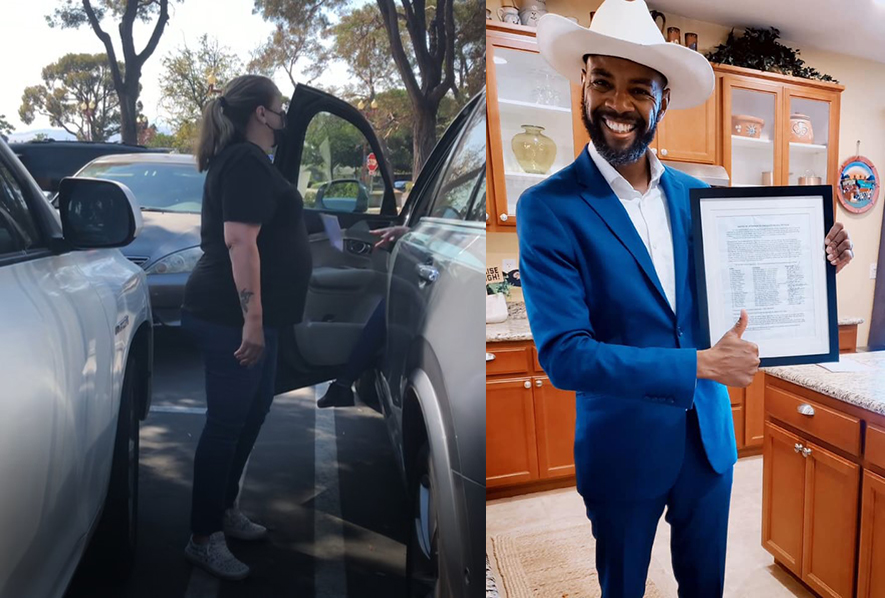
Video screenshot of Antioch Mayor Lamar Thorpe tossing the recall notice out of his car after being served by resident Kathy Cabrera. Thorpe with framed notice posted on his official Facebook page on Friday, Sept. 24, 2021.

Tosses it onto City Hall parking lot, twice; later picks it up, has it framed and posts photo with it on Facebook

“We believe that the citizens of Antioch deserve better,” – Kathy Cabrera, recall proponent

9,400 signatures of registered Antioch voters needed within 160 days to qualify for the ballot

By Allen Payton

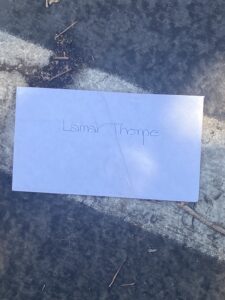
Recall petition on ground in the Antioch City Hall parking lot after Mayor Lamar Thorpe tossed it there. Photo by Kathy Cabrera.

Less than a year into his four-year term, Antioch Mayor Lamar Thorpe was served with recall papers in the parking lot of City Hall, Friday afternoon, Sept. 24, 2021, by one of the 20 residents who signed them, including several community leaders. Antioch resident Kathy Cabrera served Thorpe, but he refused to receive the required, legal recall notice, going so far as to toss it out of his car onto the ground, video shows. (Download and watch the video, here: Thorpe served recall vid1  or see the video on the Herald Facebook page)

“Today, at 12:30 p.m. at the City Hall parking lot I served Antioch Mayor Lamar Thorpe with a notice of intention to circulate recall petitions,” Cabrera said when reached for comment. “He said he didn’t know who I was and wouldn’t accept service.”

Thorpe can be heard in the video saying, “I don’t know who you are. Get away from my car.”

She then tossed the paperwork into his car and Thorpe tossed it back out. Cabrera then picked it up and placed it under his windshield wiper repeating, “you’ve been served.  You’ve been served.” He got out of his car, took the recall notice off his windshield and tossed it on the ground, again and drove off.

According to Cabrera, after driving off Thorpe circled back and picked up the notice off the ground. Later, he took a photo with the document in a frame, which Thorpe posted on his official Facebook page.

When reached for comment, Cabrera offered some of the group’s reasons for recalling the mayor.

“We believe that the citizens of Antioch deserve better,” she said. “We’ve seen a variety of good city employees, businesses and residents leave during his tenure at mayor. The people of Antioch are frustrated with the political games, constant self-promotion, and his lack of leadership and in the wrong direction.”

“We are moving forward with the recall process and will soon be out gathering signatures to let the citizens’ voices be heard,” Cabrera added.

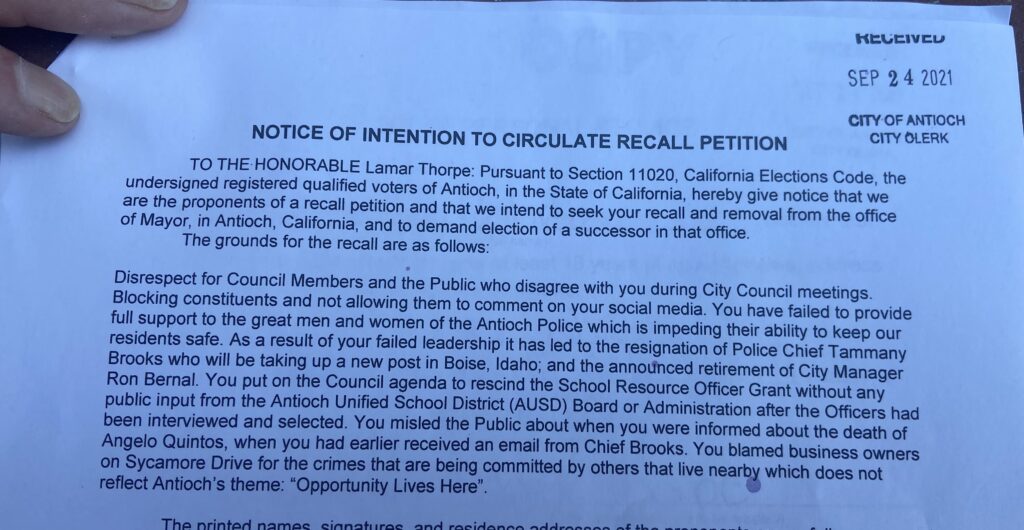
Top part of Notice of Intent. Photo by Kathy Cabrera.

The Notice

More and the official reasons for recalling Thorpe are included in the notice which will be part of the petitions that Antioch voters will be asked to sign. Following is the text of the notice Thorpe was served, Friday:

NOTICE OF INTENTION TO CIRCULATE RECALL PETITION

TO THE HONORABLE Lamar Thorpe: Pursuant to Section 11020, California Elections Code, the undersigned registered qualified voters of Antioch, in the State of California, hereby give notice that we are the proponents of a recall petition and that we intend to seek your recall and removal from the office of Mayor, in Antioch, California, and to demand election of a successor in that office.

The grounds for the recall are as follows:

Disrespect for Council Members and the Public who disagree with you during City Council meetings. Blocking constituents and not allowing them to comment on your social media. You have failed to provide full support to the great men and women of the Antioch Police which is impeding their ability to keep our residents safe. As a result of your failed leadership it has led to the resignation of Police Chief Tammany Brooks who will be taking up a new post in Boise, Idaho; and the announced retirement of City Manager Ron Bernal. You put on the Council agenda to rescind the School Resource Officer Grant without any public input from the Antioch Unified School District (AUSD) Board or Administration after the Officers had been interviewed and selected. You misled the Public about when you were informed about the death of Angelo Quintos, when you had earlier received an email from Chief Brooks. You blamed business owners on Sycamore Drive for the crimes that are being committed by others that live nearby which does not reflect Antioch’s theme: “Opportunity Lives Here”.

————-

Signature Gathering Expected to Begin in October

“The petitions won’t be available until about three weeks,” said former Antioch City Clerk Arne Simonsen. He is one of the 20 recall proponents and was with Cabrera to submit the notice and the proof of personal service to the city clerk’s office, following the interaction with the mayor.

The Proponents

Besides Cabrera, who is the director of a non-profit organization for cats in the city, and Simonsen, the other 18 proponents represent a cross-section of residents in Antioch, including Antioch School Board Trustee Mary Rocha, former Antioch Planning Commission Chair, Ken Turnage II, who was removed by the council, last year, after posting controversial remarks about seniors and COVID on his Facebook page; former Councilwoman and current Planning Commissioner, Martha Parsons; Velma Wilson, the county’s 2021 Humanitarian of the Year; former Mello-Roos Board President, Terry Ramus; plus Tom Hartrick, Lindsey and David Amezcua, Ricardo Cabrera, Nicole Silva, Kathy Vasquez, James Davis (not the former Mayor of Antioch), Mary and Roy Ledford, Katherine J. Belleci, Truman Davis Jr., Clarke Wilson, James Wilson, and Thomas McNell, the co-author, with Ramus, of Antioch’s growth-metering ballot initiative Measure U that was passed by 69% of the vote in 1998.

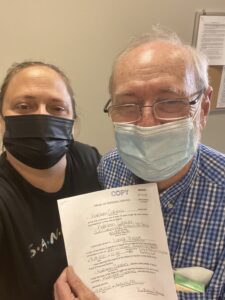
Recall proponents Kathy Cabrera and Arne Simonsen with a copy of the proof of service form date stamped by the Antioch City Clerk’s office. Photo by Kathy Cabrera

The Process

The mayor has seven days to provide a response of no more than 200 words, which will be include on the recall petition for circulation for gathering signatures. But he’s not required to provide one.

The notice includes additional details about the process.

“Elections Code section 11023. (a) Within seven days after the filing of the notice of intention, the officer sought to be recalled may file with the elections official, or in the case of a state officer, the Secretary of State, an answer, in not more than 200 words, to the statement of the proponents.

(b) If an answer is filed, the officer shall, within seven days after the filing of the notice of intention, also serve a copy of it, by personal delivery or by certified mail, on one of the proponents named in the notice of intention.

(c) The answer shall be signed and shall be accompanied by the printed name and business or residence address of the officer sought to be recalled.”

UPDATE: According to the Procedure for Recalling State and Local Officials on the California Secretary of State’s website, and the Guide for Recalls on the Contra Costa County Elections website, organizers must gather the signatures of at least 15% of registered voters in Antioch, if the registration is between 50,000 and 100,000, to qualify the recall for the ballot. As of the November 2020 election, there were 62,394 registered voters in the city which requires they gather approximately 9,400 signatures within 160 days or about 59 per day on average.

Thorpe received 19,792 votes to win the election for mayor, last November out of 44,539 votes cast, for 44.44% of the vote. Should the recall make it to the ballot, just like in the recent gubernatorial recall election, he will face an up or down vote. In addition, a separate vote for the replacement candidates will decide who will be the city’s next mayor for the remainder of the term through Dec. 2024. If a majority of those voting, vote yes to recall Thorpe, the candidate with the most votes in the replacement election wins.

Past Antioch Recalls

Thorpe is the second Antioch mayor to be served with recall papers in the past 35 years, including Wade Harper in 2014 and 2015, and Joel Keller in 1986. But the attempts against Harper, by the same organizers, were unsuccessful, first due to improperly publishing the notice in the paper, and the revived effort failed to gather enough signatures. Organizers for the effort against Keller thought they had collected enough signatures and submitted them. But it didn’t make it to the ballot as it was tossed out by the county elections office after too many signatures were disqualified. Antioch School Board Trustee Debra Vinson was served with recall papers in 2016 but the effort didn’t make it to the ballot.

The last time a successful recall of an Antioch councilmember occurred was in 1995 when Councilwoman Elizabeth Rimbault was recalled. (This reporter also faced recall on the same ballot but beat it by 52-48%).

An effort to reach Thorpe for comment and asking him why he threw the notice on the ground, was unsuccessful prior to publication time.

Please check back later for any updates to this report.
Gubernatorial Recall Election results available Tuesday night

Monday, September 13th, 2021

Initial unofficial results for the Recall Election will be available shortly after 8:00 pm

By Dawn Kruger, Civic Outreach/Engagement Specialist, Contra Costa County Clerk-Recorder-Elections Department

The first unofficial results report for the Gubernatorial Recall Election will be released shortly after at 8:00 pm on election night, September 14 and posted to the Elections Division website www.cocovote.us immediately afterward. The initial posted results will be Vote by Mail ballots that are returned through Monday, September 13 and in person early votes from prior to election day.

The second report, with results from the polls, will be issued at approximately 9:30 pm with subsequent updates approximately every half hour until all poll precincts have reported. The final unofficial election night report is expected to be issued by 1:00 am.

The first interim report will be posted by 5:00 pm on Friday, September 17 and will contain results from timely Vote by Mail ballots received on and after Election Day. The second interim report will be posted by 5:00 pm on Friday, September 24. Additional results will be posted each Friday afternoon up to certification which is expected to be October 8. All results remain unofficial until certification.

The availability of updated reports will be communicated via Twitter and Facebook. Changes to the reporting schedule, if any, will also be communicated on these social media sites.

The Contra Costa Elections Division social media pages are:
https://www.Twitter.com/CoCoElections
https://www.facebook.com/ContraCostaElections/


Tips and reminders for voting safely in the September 14th Recall Election

Saturday, September 11th, 2021

By Dawn Kruger, Civic Outreach/Engagement Specialist, Contra Costa County Clerk-Recorder-Elections Department

The Contra Costa Elections Division would like to remind residents that the Division is taking great steps to make sure that voting in the September 14th Recall Election is as safe as possible. Health officials have said that voting by mail is the safest option. Voters are encouraged to return their ballot by mail postmarked on or before Election Day or drop their ballot off at one of the County’s 36 official drop boxes.

“For everyone’s safety, we are urging voters to vote by mail and to reserve in-person voting for those that require in-person services,” said Clerk-Recorder-Registrar Deborah Cooper, the County’s top Elections Official. “Voting by mail protects voters, poll workers and our volunteers by limiting personal contact. In person voting locations will follow health protocols, which may cause delays and lines due to social distancing. The easiest and fastest way to vote in this election is to cast the ballot that we sent to you returning it by mail or into one of our official ballot boxes located throughout the County.”

In-Person Services

If you need in-person services to cast your ballot, Contra Costa County residents have early voting options at eight Regional Early Voting sites throughout the county as of Friday, September 10th.

All registered Contra Costa voters will be able to vote at any of the locations, which will be open Monday September 13 from 11 am to 7 pm.

The sites are:

  • Ambrose Community Center, 3105 Willow Pass Rd., Bay Point
  • Antioch Community Center, 4703 Lone Tree Way, Antioch
  • Brentwood Community Center, 35 Oak St., Brentwood
  • El Cerrito City Hall, 10890 San Pablo Ave., El Cerrito
  • Fair Oaks Church, 1925 Risdon Rd., Concord
  • Hyatt House Pleasant Hill, 2611 Contra Costa Blvd., Pleasant Hill
  • Richmond Memorial Auditorium, 403 Civic Center Plaza, Richmond
  • San Ramon Valley United Methodist Church, 902 Danville Blvd., Alamo

Polling Places

Polling places will be open on Election Day, Tuesday September 14 from 7am to 8 pm.  Please check the back of your Voter Information Guide for your polling place or go to our website and check “My Voting Information”.

Additional Drop-off Options

In addition to the Official Drop Boxes and Regional Voting Center sites, vote-by-mail ballots can also be dropped off at the Elections Division “Pop-up” Trailer locations on Monday September 13 at the following sites during the following times:

  • Monument Crisis Center, 1990 Market St., Concord 9 am-10:30 am
  • Contra Costa College, 2600 Mission Bell Dr., San Pablo 11 am-1:30 pm
  • Richmond Civic Center, 450 Civic Center Plaza, Richmond 2 pm-3:30 pm

Drive through drop off will be available at the The Clerk-Recorder-Elections Offices on Saturday September 11th from 10 am-3 pm, Monday September 13th from 9 am-5pm and on Election day, September 14th from 7 am-8 pm.

Conditional Voter Registration

If you missed the voter registration deadline, you can still register and vote in person using Conditional Voter Registration. It is a one-stop opportunity to register and cast your ballot and is available at our office-555 Escobar Street in Martinez, Regional Early Voting sites, and all polling places on Election Day.

Accessible Voting Equipment and Additional Language Access

Official ballots and voting instructions are printed in English, Spanish and Chinese.  Voting equipment with accessible features are available at every in-person voting location for voters who may need assistance due to a disability.   Additional language resources are available through accessible vote by mail and ballot translation guides available online and at in person voting location.

Be Prepared

It helps to come prepared. Bring your Sample Ballot or Voter Information Guide to help you make your selections. Copies are also available at the polls and information is available online.

Leave the T-Shirts, Buttons, and Hats at Home

Please remember that voters have the right to cast a ballot free from intimidation or distraction. Electioneering, including wearing anything with a campaign slogan on it, is prohibited within 100 feet of any in-person voting location.  Anyone wearing such campaign slogans will be asked to remove or cover them while they are in the voting location.  Please help our poll workers by respecting the non-partisan nature of the voting locations.

Follow Safety Procedures

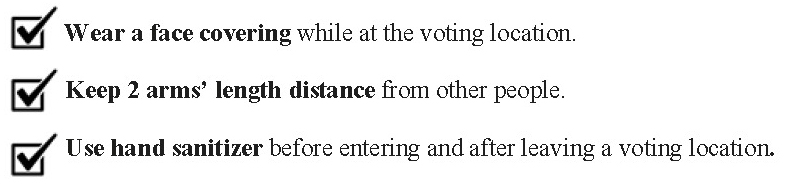
Protect your health and the health of other voters and election workers at voting locations by taking the following precautions:

VOTING LOCATION SAFETY CHECKLIST

For more information on voting options for the Recall Election, visit www.cocovote.us  or call 925.335.7800.

Voter registration for governor’s recall election closes Monday

Sunday, August 29th, 2021

By Dawn Kruger, Civic Outreach/Engagement Specialist Contra Costa County Clerk-Recorder-Elections Department

Contra Costa County—Debi Cooper, County Clerk-Recorder & Registrar of Voters announced today that the close of registration for the upcoming September 14, 2021 Gubernatorial Recall election is fast approaching on August 30th. 

“This is the deadline for voters to register to be sent an Official Ballot in the mail and be provided their assigned polling place information if they choose to vote in person on Election Day,” she said. “After this date, voters will be required to register and vote in person.”

Register to Vote:

Voters can register to vote most conveniently online at https://registertovote.ca.gov, or complete a voter registration card available at most post offices, city halls, and libraries throughout the county.  Online registration must be completed before midnight.  Paper registration cards must be postmarked by August 30th. 

To be eligible to vote in this election, a registered voter must be a U.S. Citizen, at least 18 years of age by Election Day, a resident of the state, and not currently serving a federal or state prison term for the conviction of a felony.

You must update your registration if you have moved or changed your name (married, divorced, etc.).

You can check your voter registration status online at http://www.cocovote.us by clicking on the “My Voting Information” button.

After the August 30th registration deadline, new voters will be required to register and vote in person at one of the County’s early voting sites, the Elections Division in Martinez, or at a polling place on Election Day. Cooper’s advice: “Register early so you will receive a ballot in the mail. If you choose to vote in-person, already being registered will speed up the process at your polling place on Election Day.”

California Citizens Redistricting Commission to launch Communities of Interest virtual meetings

Monday, June 7th, 2021

SACRAMENTO, CA—On Thursday, June 10th, the 2020 California Citizens Redistricting Commission (Commission) will launch the first in a series of Communities of Interest (COI) virtual hearings to capture community specific data that will help Commissioners to respect community boundaries to the best of their abilities when drawing district lines, as is mandated by California’s line drawing criteria.

When the Commission begins drawing maps using census data, they will need to follow this set of criteria, in this order, as outlined in the California Constitution.

  1. Districts must be of nearly equal population to comply with the U.S. Constitution.
  2. Districts must comply with the Voting Rights Act to ensure that minorities have a fair opportunity to elect representatives of their choice.
  3. Districts must be drawn contiguously, so that all parts of the district are connected to each other.
  4. Districts must minimize the division of counties, cities, neighborhoods, and communities of interest to the extent possible.
  5. Districts should be geographically compact such that nearby areas of population are not bypassed for more distant populations.
  6. Where practicable, each Senate District should consist of two complete and adjacent Assembly Districts, and Board of Equalization districts should consist of ten complete and adjacent State Senate Districts. This is known as nesting.

We can obtain the city and county information from those jurisdictions, but we need the neighborhood and communities of interest information from Californians directly.

“The Commission is excited to hear directly from Californians about their Communities of Interest during our initial COI input meeting on Thursday, June 10th from 12 – 8 PM. Although we have been accepting Communities of Interest submissions online since March, these virtual input sessions are yet another opportunity for communities to share with the Commission about their Communities of Interest,” stated Commission Chair Isra Ahmad.

During these input meetings, participants will be asked to describe their community and will be encouraged to consider highlighting the following:

  1. Begin with your county or city.
  2. Mention the street names and significant locations in your neighborhood to help us identify the parameters of your community.
  3. What are your shared interests?
  4. What brings you together?
  5. What is important to your community?
  6. Are there nearby areas you want to be in a district with?
  7. Nearby areas you don’t want to be in a district with? Why or why not?
  8. Has your community come together to advocate for important services, better schools, roads, or health centers in your neighborhood?

Registration is not required to participate in these public input meetings. The call-in number for public input on the day of each event will be (877) 853-5247.

For more information regarding the June 10th event, please visit our website at: https://www.wedrawthelinesca.org/june_10_mtg. To view a full list of upcoming meetings, please visit: https://www.wedrawthelinesca.org/meetings. Additionally, Californians can skip the line and provide their input online by visiting: https://drawmycacommunity.org/. The online COI tool is available in fourteen languages and includes tutorials.

Every 10 years, after the federal government publishes updated census information, California must redraw the boundaries of its electoral districts so that the state’s population is evenly allocated among the new districts.

In 2008, California voters passed the Voters First Act, authorizing the creation of the independent California Citizens Redistricting Commission to draw new State Senate, State Assembly, and State Board of Equalization district lines. In 2010, the Voters First Act for Congress gave the Commission the responsibility of drawing new Congressional districts following every census.

For more information, please visit WeDrawTheLinesCA.org.