Economic Development Department partners with key stakeholders to offer direct services to the small business community.
By Collette Hanna, Executive Director, Alliance for Community Development & Jaden Baird, PIO, City of Antioch
ANTIOCH, CA — The City of Antioch Economic Development Department has launched the Antioch Business Collaborative, a collective effort to support the city’s small business community. The Antioch Business Collaborative brings together technical assistance providers and funders to provide one-on-one as well as group advisory services, and access to capital for small businesses located in the city of Antioch. It provides a range of resources to help ensure small business success in the Antioch community.
The Antioch Business Collaborative is an economic development initiative of the City of Antioch, with the goal of providing support to the over 3,000 small businesses in the city. The initiative is funded by the American Rescue Plan Act, with targeted support provided to businesses through 2027. Through the Antioch Business Collaborative, small businesses can contact one of the designated partners for help with any of the following services:
• Technical assistance on starting a business, writing a business plan, budgeting, financial management, marketing, and other topics • Workshops and accelerator programs • Assistance with access to capital including low-interest loans and grants
Antioch Business Collaborative partners include: • Alliance for Community Development • Arroyo West • East Bay Small Business Development Center • ESO Ventures • Pacific Community Ventures • Renaissance Center • Uptima Entrepreneur Cooperative • Working Solutions CDFI
In addition, according to Gaby Seltzer, the City’s Economic Recovery Corps Fellow, the Antioch Chamber of Commerce “has been actively involved as a supporting partner in this effort. The Chamber and the Antioch Business Collaborative are two separate but mutually supportive business resources. The Antioch Business Collaborative is a group of organizations funded by city contracts to provide free technical assistance to all Antioch businesses. The Chamber is a membership organization that provides input and promotes these services to its members.”
“We are very proud to support the small business community in Antioch, understanding that they play a critical role in building the entire Antioch economy. Our businesses deserve support to help them grow and thrive, and our residents and community need their existence for our everyday needs of goods and services. We’re happy to have this partnership in place to build and grow the Antioch economy,” said Brad Helfenberger.
Businesses can visit www.growfromwithinantioch.com to learn more about the Antioch Business Collaborative and to find a partner with which to work on growing their business.
Dress like a cow to eat free on opening day at new location in the Slatten Ranch Shopping Center on Lone Tree Way
Breakfast begins at 6:30 a.m.
A new Chick-fil-A® restaurant will begin serving guests in Antioch on Thursday, April 3 at 6:30 a.m. Chick-fil-A, Inc. has selected Evan Hawthorne to serve as the local Owner-Operator of Chick-fil-A Antioch at Lone Tree Way in the Slatten Ranch Shopping Center. The new restaurant brings approximately 100 jobs to the community.
To celebrate the restaurant moo-ving into town, Hawthorne and his team are inviting the community to show off their cow spots at the restaurant on opening day for one free entrée*!
New Owner-Operator Evan and his wife Lindsey Hawthorne (with scissors), her father Dan Kosin, the owner of a location in Fremont, and team held a ribbon cutting followed by a separate ribbon cutting with the Antioch Chamber of Commerce and local officials, including Mayor Ron Bernal and Councilman Don Freitas, during what was labeled a “small closed private ceremony” Wednesday, April 2, 2025. Photos by Zeno Group.
Whether it’s a full cow suit or a simple cow-spotted accessory, Guests of all ages are encouraged to join the fun. The celebration takes place on opening day, offering the community a chance to celebrate the iconic Chick-fil-A Cows seen in TV commercials and on billboards. Guests dressed in cow attire can redeem the offer of one free entrée inside the restaurant or in the drive-thru.
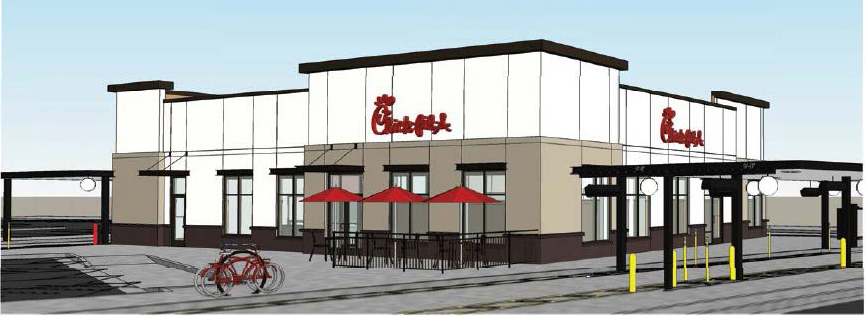
Located at 5705 Lone Tree Way, Chick-fil-A Antioch at Lone Tree Way will serve Guests Monday through Saturday from 6:30 a.m. to 10 p.m., offering dine-in, drive-thru and carry-out.
Rendering of the new Chick-fil-A location in Antioch. Source: City of Antioch
Locally Owned and Operated • “Chick-fil-A holds a special place in my family’s heart, and I am forever grateful to my father-in-law for introducing me to the brand – it has truly changed my life,” said Hawthorne. As we open our doors in Antioch, my goal is to make a meaningful impact by bringing our community together through service and care. I look forward to mentoring future generations while serving great food with genuine hospitality.”
Evan started his journey with Chick-fil-A as a Team Member at his father-in-law’s restaurant in Fremont, California and advanced to General Manager. Today, he is thrilled to become the local Owner-Operator of the first Chick-fil-A in Antioch – a dream nearly eight years in the making.
Caring for the Antioch Community Hawthorne is committed to giving back to the Antioch community by: • Recognizing 100 local heroes making an impact in the Antioch area by providing them with free Chick-fil-A entrées for a year. • Participating in the Chick-fil-A Shared Table® program, which redirects surplus food to local nonprofits, helping to create over 35 million meals nationwide to date. • Celebrating the opening with a $25,000 donation from Chick-fil-A, Inc. to Feeding America to support local hunger relief efforts of Food Bank of Contra Costa and Solano, a Feeding America partner food bank, in honor of the new restaurant.
For the latest news and updates on Chick-fil-A Antioch at Lone Tree Way, visit the restaurant’s Facebook page and follow along on Instagram. For more on Chick-fil-A’s high-quality menu options, click here.
*Guests who dress in cow attire on opening day can redeem the offer of one free entrée inside the restaurant or in the drive-thru. Breakfast offer options are a Chick-fil-A® Chicken Biscuit, Egg White Grill or 4-ct Chick-fil-A Chick-n-Minis® . Lunch/dinner offer options are Chick-fil-A® Chicken Sandwich, Spicy Chicken Sandwich, 8-ct Grilled Nuggets and a 5-ct Nugget Kid’s Meal for kids. The offer is limited to one per person in cow attire, per day, while supplies last. Customizations are not available for this offer and no purchase is necessary. See the restaurant for more details.
About Chick-fil-A, Inc. Chick-fil-A, Inc. is the third largest quick-service restaurant company in the United States, known for its freshly-prepared food, signature hospitality and unique franchise model. More than 200,000 Team Members are employed by local Owner-Operators in more than 3,000 restaurants across the United States, Canada and Puerto Rico.
Chick-fil-A opened its first restaurant in the UK in early 2025 with the goal of launching five locations across the UK within the next two years. The first Singapore restaurant is set to open in late 2025, marking the brand’s entry into Asia.
Chick-fil-A local Owner-Operators live and work in the communities their restaurants serve, each supporting local efforts to address hunger, education, and making a positive impact. The family-owned and privately held company was founded in 1967 by S. Truett Cathy. More information on Chick-fil-A is available at www.chick-fil-a.com and @ChickfilANews.
Mike Green offers his thanks for the recognition during the Gala on Friday, March 28, 2025. Lori Ogorchock (second from left) is joined by (L-R) friends Kristen Vistalli, Antioch School Board Trustee Mary Rocha, Debbie Toth, Lucia Albers and Phyllis Gordon. Photos by Kord Holland
For Most Impact and Lifetime Achievement, respectively
By Antioch Chamber of Commerce
During the annual Gala on Friday, March 28, 2025, the Antioch Chamber of Commerce honored Deer Valley High School Vice Principal Mike Green as the 2024 Antioch Citizen of the Year for Most Impact and former Councilwoman Lori Ogorchock with the 2024 Antioch Citizen of the Year for Lifetime Achievement award. The event was held at the Lone Tree Golf & Event Center.
2024 Citizen of the Year for Most Impact – Mike Green
Mike is the kind of volunteer every community dreams of – dedicated, selfless and endlessly giving. His commitment to service extends both locally and internationally, having traveled alongside his father to Mexico and Zambia to assist with dental work for those in need. A natural leader from a young age, Mike achieved the rank of Eagle Scout at just 12 years old and has since continued his scouting journey as a Scoutmaster, tirelessly fundraising and mentoring young scouts.
Beyond scouting, Mike has devoted his career to shaping young minds, serving as an elementary school principal and now as the Vice Principal at Deer Valley High School. His passion for helping students reach their full potential extends to the athletic field, where he previously coached track at Deer Valley. His impact in Antioch runs deep – serving on the boards of Delta Advocacy, the Leo Fontana Foundation, and the Rotary Club of the Delta, where he has championed initiatives supporting low-income families, youth, and seniors.
Mike’s generosity does not stop there. He founded the Home Team program, which provides minor home repairs for local seniors, ensuring they can live safely and comfortably. His heart for service is also evident in the kitchen, where he volunteers as a sous chef, preparing meals for community dinners benefiting causes such as the Elderly Wish Foundation and Special Needs Christmas events. The list of Mike’s contributions could go on and on, but one thing is clear—his impact is profound, and his dedication to Antioch is unmatched. He is truly an incredible, selfless, and exemplary member of our community.
Business owners, community leaders, family and friends of the honorees enjoyed the annual Gala at Lone Tree Golf & Event Center.
2024 Citizen of the Year for Lifetime Achievement – Former Councilwoman Lori Ogorchock
Lori is the true definition of a servant leader, dedicating countless hours to understanding and uplifting her community. Her passion and commitment have driven numerous initiatives that have positively impacted Antioch and beyond.
From coaching youth sports to organizing fundraising efforts, Lori has always prioritized the well-being of children and families. She played a pivotal role in coordinating the first Women’s March in Antioch, raising awareness for women’s rights in East County. She also initiated the Veterans Banner Program, a heartfelt tribute that honors local veterans by displaying their images along the city’s main streets.
As a dedicated board member of PAL (Police Activities League), Lori works tirelessly to support fundraising efforts for youth programs, ensuring that children have access to positive activities and opportunities. Additionally, she serves as the Chair of the Elderly Wish Foundation, granting seniors their final wishes and bringing joy to their lives in their most precious moments. Lori’s impact extends even further as she was instrumental in the opening of Antioch’s Family Justice Center, providing essential resources and support for individuals and families in need.
Her efforts have not only strengthened community programs but have also inspired countless individuals to take action and give back. Whether advocating for women’s rights, honoring veterans, supporting youth, or fulfilling the wishes of seniors, Lori’s selfless contributions have touched lives in profound ways. Her lifelong commitment to service and advocacy is a testament to her character, making her a truly deserving recipient of this award.
The suspects crashed their stolen getaway car into a fence. Contra Costa Sheriff’s Deputies and other emergency personnel with one of the suspects in the back of a Sheriff’s vehicle on Thursday, March 27, 2025. Photos by and courtesy of Mike Burkholder, ContraCosta.news
See 4/1/25 Update: Suspects identified; all four are from Antioch, one was arrested for similar charges in December and January
By Allen D. Payton
According to Pleasant Hill Police Lt. Jason Kleven, on Thursday, March 27, 2025, “The Pleasant Hill Police Department responded to a report of a possible robbery in progress at the 7-Eleven store parking lot located at 601 Patterson Blvd. Two delivery truck drivers were making a scheduled delivery when several suspects stole multiple cartons of cigarettes from the truck’s cargo area. No weapons or injuries were reported during the theft.
The suspects fled the scene in a stolen vehicle. Pleasant Hill Police Detectives later located the vehicle traveling on Highway 4 near Concord. With the help of a police helicopter, the vehicle led authorities to the city of Antioch, where the vehicle stopped near Fremont Elementary School. Four suspects then fled on foot from the vehicle.
With the support of Antioch Police, Pittsburg Police, the Sheriff’s Office, and the helicopter, officers set up a perimeter. All four adult suspects were apprehended and arrested.
The investigation remains active, and authorities are asking anyone with information that may assist in the investigation to contact the Pleasant Hill Police Investigations Bureau at (925) 288-4630.
According to a press release by Lt. Joe Njoroge of the Antioch Police Field Services Bureau, “At approximately 2:57 p.m., APD Dispatch received a report about a suspect vehicle involved in a previous incident in Pleasant Hill. APD was requested to assist in locating the vehicle, which was quickly found in the area.
While driving near the intersection of F Street and W. 13th, the suspect vehicle collided with a fence. The suspects then fled the scene on foot. Pleasant Hill PD arrived shortly after, and with the assistance of the Contra Costa Office of the Sheriff and APD, all suspects were apprehended.”
Njoroge later said the four suspects included three males and one female.
3/28/25 10:45 AM UPDATE: In response to a question from an eyewitness who claimed another person was also arrested, the lieutenant said, “A fifth person was detained but he was not associated so, he was released on scene.”
Antioch Police issued a Community Alert on Facebook Thursday afternoon that they were “working in the area of Antioch Middle School and the surrounding area of F Street from W. 13th to W. 18th. Expect heavy police presence in the area. If you see anything suspicious, please call 911 or (925) 778-2441 immediately.”
Later APD provided an update, writing, “We have now cleared the area. Thank you for your patience and cooperation. There is no danger to the community, and the subjects we were looking for have been arrested. Stay safe, and as always, report any suspicious activity to 911 or (925) 778-2441.
4/1/25 UPDATE: According to Pleasant Hill Police, the four suspects were 20-year-old Robert Lee Crawford (born 12/9/04), a six-foot tall, 165-pound Black male from Antioch, 19-year-old Robert Samule Garcia-Scrape of Antioch (born 7/22/05), a five-foot, 11-inch tall, 200-pound White male with blond hair, 21-year-old Jailen Emani Scales of Antioch (born 2/3/04), a six-foot tall, 200-pound Black male and 24-year-old Marieilacqua Bartholomew, a five-foot, one-inch tall, 130-pound Black female, also from Antioch.
According to the Contra Costa Sheriff’s Office, Crawford is being held in the West County Detention Center on no bail; Garcia-Scrape is being held in the Martinez Detention Facility on no bail and his next court appearance is on April 15 at 1:30 p.m. in Department 03, Superior Court, Mt. Diablo; and Scales is also being held in the West County Detention Center on no bail.
According to localcrimenews.com, Scales was arrested last year, on Dec. 6th by San Francisco Police for burglary, conspiracy to commit a misdemeanor, carrying a loaded firearm on a person or in a vehicle while in a public place, receiving or concealing stolen property, and resisting, obstructing or delaying a peace officer. He was arrested again on Jan. 15, this year by Fremont PD for robbery, carrying a loaded firearm and with intent to commit a felony, carrying a concealed weapon with a large capacity magazine, receiving stolen property – motor vehicle, and elder or dependent adult abuse.
No additional information could be found through online searches for Bartholomew. However, according to Pleasant Hill Police Lt. Jason Kleven, she is also still in custody.
Dotted red outline shows project location and monument sign located at entrance (inset). Source: City of Antioch
Majority of parcel that’s remained vacant for 20 years finally being developed, just not as originally envisioned
By Allen D. Payton
Starting their regular session an unusual 55 minutes late, the Antioch City Council met on Tuesday, March 25, 2025, and approved the new Lone Tree Retail Project on an unusual 3-2 split vote with Councilmembers Don Freitas and Monica Wilson joining in opposition.
The meeting began with a closed-door meeting at 6:00 p.m. before the regular session began at 7:55 p.m.
“We had a closed session before this. So, here we are ready to go,” Mayor Ron Bernal explained for the delay.
Acting City Attorney Derek Cole reported out from Closed Session saying, the Council met to discuss three items. The first was an employee evaluation. No reportable action. Second was conference with real property negotiators on the Sycamore Square police substation. The council gave direction to its negotiators. No reportable action. Third, was a “Qui Tam” including several agencies. No reportable action was taken, he stated.
Tenants and locations for the approved Lone Tree Retail project. Source: City of Antioch
Lone Tree Retail Project Approved on Split Vote The Lone Tree Retail project on three parcels totaling 3.22 acres next to the In-Shape Fitness health club at 4099 Lone Tree Way, is part of an 18-acre Master Planned Development, named Antioch Town Center, that had previously been approved in 2004, when Freitas was Mayor, for fitness, grocery and hard and soft retail uses. The health club was built in 2007, but the rest of the site has remained undeveloped.
Following council discussion with both Freitas and Wilson expressing their concerns that the project didn’t fit with what they had envisioned for the site, the Council voted 3-2 on Tuesday night to approve the project.
According to the City staff report, the new project consists of three buildings: a car wash, fast casual restaurant (aka Quick Service Restaurant or QSR), and combination, fast casual restaurant and retail building, along with associated site improvements Tenants with signed leases include Mister Car Wash, Habit Burger & Grill, Chipotle and to be determined retail. It will also include an adjacent multi-family residential project on the nine acres behind the project.
A representative of the project applicant, Architecture Plus, Inc. of Modesto, Paul Rothbard, former CEO and owner of In-Shape Health Clubs, said the larger restaurants suggested by members of the public won’t work at that location as those types of restaurants want freeway visibility.
At the March 11th meeting, he said they also had spoken with multiple grocery stores, but none were interested.
Street view renderings show the three retail project buildings with the future multi-family housing behind. Source: City of Antioch
“The rear nine acres are in contract with a developer, a local, Central Valley, to build a residential complex,” Rothbard said. “They’re ready to go…in Q3 of this year.” His father and partner on the project, Morton, was also in attendance at the meeting.
The son said they’re hoping to be under construction with the retail project by this August and have it completed by next July.
Rothbard also mentioned that the Chipotle will have a drive-through for picking up orders made on the app.
The Council then heard opposition from three members of the community during their March 11th meeting, with the main concerns being the fast food uses, no grocery store and no affordable housing included in the adjacent multi-family residential development.
Brian Heron of Fresno-based Commercial Retail Associates, who has been working on the property with the Rothbards since 2005, responded to those concerns, saying, “Under the previous PD..7,000 square-foot, sit down, in-house restaurants were suggested. Back then, we had agreed to get those 7,000 square-foot restaurants. Since COVID, it’s a whole new world. By and large those are obsolete concepts and…not willing to come to this location. And we have tried…many and many a time.”
The brands are “in demand in your community,” he added.
“We have tried getting all the grocers,” Heron continued. “We’ve spoken to Sprouts…to Nugget…from big to small. We went from Food 4 Less, down. We’ve tried Amazon. There isn’t a grocer for this site. We went into the next phase of that development, anchor…in 2008, 2009. The market shifted. Once again, change.”
During Council discussion, Freitas spoke first saying he was “very surprised”, “disappointed” and “very, very saddened.”
“We had a very, very grandiose view of this particular development…and I embraced it,” he continued. “I’m conflicted…because the world has changed, and we all are aware of that.” Mayor Pro Tem and District 2 Councilman Louie Rocha asked, “Are we really in a position that we can turn away business and revenue?”
District 1 Councilwoman Tamisha Torres-Walker then said, “What the opponents are saying is ‘we don’t want this, bring us something else.’ But this is not our property. We’re talking to the actual owners who are trying to develop it because they lost money on it for 20 years for not being able to get a project completed.”
But then she switched things up and said, “My recommendation was to sell it to someone who wanted to develop more housing.”
Mayor Ron Bernal spoke next saying, “I was also surprised, not at the uses, but the way they’re oriented.” He asked if staff if there was an attempt to place the drive-through on the back side of the building. When you’re looking at 30 cars sitting up there with marginal landscaping, that’s a whole different looking project to me.
City of Antioch Associate Planner Nathan Tinclair responded saying, “One of the things we have to look at on this parcel is it’s already partially developed. There’s already this main entrance drive with the main, kind of circle with the access points to the adjacent parcels.”
He then shared his concerns with the project being presented to council “with a couple days’ notice to look at it on really tiny sets of plans” as well as landscaping, since “Lone Tree is lower and the pads, higher.”
At Freitas’ urging, the council voted 5-0 to continue the item until their meeting last night, March 25th.
A noise study was completed to confirm that noise generated by the new project does not create a significant impact, in excess of the noise levels permitted in the City of Antioch General Plan.
According to Tinclair, the Planning Commission at their February 19, 2025 meeting, with two members (Robert Martin and Christian Hills) absent and one vacancy, voted 4-0 to approve the Addendum to the Adopted Initial Study/Mitigated Negative Declaration. All four members, Chair Kevin Riley, Vice-Chair Seth Webber, and Commissioners Jennifer Perez and Cortney Jones, voted in favor.
The IS/MND was approved by the City Council in 2005. But the motion to adopt the Final Development Plan, Use Permit and Design Review failed on a 3-1 vote, with Webber voting no, as motions require four “yes” votes to pass.
Nevertheless, on Tuesday, the Council majority of Bernal, Rocha and Torres-Walker approved all four requirements for development of the project, while Freitas and Wilson voted “No”.
(L-R) New Animal Control Officer Danika “Dani” Anderson, and new officers Rich Siemietkowski, Jake Merrill, Rhondon Pollard and Tanner Andrade join Acting Chief Joe Vigil (center) following their oaths of office ceremony on Monday, March 24, 2025. Photo: Antioch PD.
Plus, new Animal Control Officer; brings total sworn to 84
By Antioch Police Department
Meet our newest APD Team Members!
Please join us in welcoming four new lateral officers and our newest Animal Control Officer to the Antioch Police Department family! They were administered their oaths of office during a ceremony at the Antioch Police Facility on Monday, March 24, 2025.
Officer Tanner Andrade Tanner grew up in Brentwood and now lives there with his wife, Lauren, and their three daughters. He enjoys spending time with family, friends, and his two German Shepherds, Xena and Eleanor. Tanner joins us after serving over two years with San Bruno PD. Fun Fact: Tanner is an avid video game player!
Officer Rhondon Pollard Rhondon was raised in Stockton and is a proud Bear Creek High graduate. After nine years in the Army National Guard, he followed his lifelong dream of becoming a police officer, serving two years with Oakland PD. Rhondon is excited to bring his experience to APD. Fun Fact: Rhondon loves going out for ramen with his wife.
Officer Jake Merrill Jake was born in Stockton and graduated from Escalon High School in 2007. He earned his associate and bachelor’s degrees before serving in the military and working for the Santa Clara County Sheriff’s Office. Fun Fact: Jake enjoys spearfishing in Big Sur and scuba diving in Monterey.
Officer Richard Siemietkowski Rich, a US Marine Corps veteran, has extensive law enforcement experience, including time with the Lake County Sheriff’s Department and the Veterans Affairs Police. Most recently, he worked as a full-time police instructor. In his downtime, Rich loves camping with his family and supporting his daughter’s horse competitions. Fun Fact: Rich enjoys rebuilding classic cars and training in Jiu Jitsu.
Animal Control Officer Danika (Dani) Anderson Dani grew up in Stockton and recently relocated to Antioch. She has over 10 years of experience in the veterinary field, dedicating her life to advocating for animals. Dani enjoys baking, spending time with her two daughters and husband, and watching history documentaries. Fun Fact: Dani once won an axe-throwing battle!
We’re excited to have each of them on board. Welcome to the APD family!
According to Lt. Michael Mellone, there are now 84 sworn officers on the police force “and more coming. We’re projecting six more in the next month.”
Two of the six students featured, Kadynce and Ebei at DVHS Cheer Practice in Antioch, CA. Source: Three Frame Media
Watch first episode tonight at 9 pm on KQED Channel 9
A six-part limited docuseries entitled, “The Class” following six students from Deer Valley High School in Antioch, CA as they pursue higher education dreams during a challenging pandemic year, begin airing tonight, Monday, March 24, 2025, on KQED Channel 9 at 9:00 p.m. It premiered on PBS stations beginning March 18, 2025.
The series arrives exactly five years after the COVID-19 Pandemic shut down schools across the U.S. in 2020. The Class is made available to PBS by KQED Presents, the national distribution service of KQED, the San Francisco-based PBS and NPR member station.
From Tony- and Grammy-winning Executive Producer Daveed Diggs (Blindspotting, Snowpiercer, Hamilton), Executive Producer Nicole Hurd (President, Lafayette College) and award-winning filmmakers Jaye and Adam Fenderson (First Generation, Unlikely), this dramatic six-part series was filmed over the course of the 2020-2021 school year and documents the remarkable challenges faced by these high school students during the pandemic and a particularly critical moment in their personal and academic development. With resilience and determination, they face obstacles head-on, inspired by their dedicated college adviser, known as “Mr. Cam.” His guidance empowers them to overcome barriers and unexpected challenges toward their dreams of a college degree.
“We hope these students’ stories restore faith in the promise of college and the opportunities it provides for those who came of age during the pandemic. It has been an incredible journey to make this series, and we’re so grateful to Daveed, Nicole, KQED, and the extended village that has come alongside to make it possible,” stated Jaye and Adam Fenderson of Three Frame Media.
The Fendersons connected with Nicole Hurd through College Advising Corps, the organization she founded, and were immediately drawn to its model of training recent college graduates to serve as advisers in public high schools. When planning the project during the early days of the pandemic, their vision was to capture an adviser guiding students who had missed the end of their junior year—along with crucial milestones like SATs—through the college application process. However, when production began during the summer of 2020, the pandemic was far from over, and the story evolved into something far more complex and powerful than they had originally imagined.
A wide virtual search for potential advisers across the country found Mr. Cam, with his charisma and passion for the work shining through, making him an essential subject for the series. With him and Deer Valley High School on board, the team met with many incredible students and selected six seniors – Ahmad, Ebei, Emily, Javonte, Kadynce, and Raven – as subjects who represent a wide range of voices and perspectives shared among their generation.
Set in the East Bay, the series captures the essence of the community—from the local crew to the musical artists featured—creating a deeply authentic reflection of the place the students call home. Hurd introduced longtime friend and Oakland native Daveed Diggs to the project and he signed on to Executive Produce, lending his song “Night Time” to the series’ main title theme.
“High school has always been a challenging time, but in the age of COVID, it took an extra dose of courage and perseverance to succeed. As an Oakland native and a fierce advocate for expanding opportunities in education, I am proud to be a part of ‘The Class, ’ which highlights the stories of six incredible Bay Area teens as they fight to achieve their dreams,” stated executive producer Daveed Diggs.
Throughout the launch of the series, the filmmakers will engage in a national impact campaign, encouraging audiences to discuss their experiences living through the COVID-19 pandemic and how it has affected their mental health and overall well-being as it pertains to their academic and social lives. The series and impact campaign is made possible with support in part from the John M. Belk Endowment, Lumina Foundation, Gates Foundation, Evelyn & Walter Haas, Jr. Fund, Ascendium Education Group, Ballmer Group, Uplifting Capital, Ellucian, and ECMC Foundation.
The Class debuted on PBS on March 18, 2025 (check local listings), with new episodes airing weekly and streaming on the PBS app. It airs on KQED channels as follows: Fridays at 8pm on KQED 9 starting 3/21, Saturdays at 6pm on KQED 9 starting 3/22, Mondays at 9pm on KQED 9 starting 3/24, and Sundays at 8pm on KQED Plus starting 3/23.
The Class cast – Top Row (L-R): Mr. Cam, Ahmad, Ebei and Emily. Bottom Row (L-R): Javonte, Kadence and Raven. Photos: Three Frame Media.
ABOUT THE CAST Mr. Cam Originally hailing from Oakland, Cam has returned to his alma mater Deer Valley High School as a college adviser. A first-generation college graduate himself, Cam is the only college adviser on a campus with 2000+ students and works tirelessly to empower his students as they navigate the ups and downs of this unprecedented school year
Ahmad Basketball means everything to Ahmad who transferred to Deer Valley High School to play for their championship winning team. But with indoor sports on hold, this year’s season remains uncertain and Ahmad worries about his sports prospects.
Ebei A highly decorated track and field star, Ebei is the youngest of five siblings. On top of being a dedicated student, Ebei juggles a busy schedule as an ASB leader and cheerleader and strives to keep school spirit alive despite the unprecedented start to their senior year.
Emily Hailing from a close-knit family, Emily is the middle child of five sisters. While the pandemic sent students home to learn, Emily’s frontline job in food service remained in-person. Now she juggles working part-time while trying to keep up her grades to get into college.
Javonte Javonte has come into his own during high school emerging as an outgoing leader. He has the grades and accolades to go on to college, but with so much uncertainty in the world he starts to reconsider his options.
Kadynce As a cheerleader and member of the Mock Trial Team, Kadynce is quick to let her voice be heard. She dreams of attending a 4-year university, going on to law school, and fighting against issues of injustice but the COVID pandemic has made even her best laid plans feel uncertain.
Raven A self-taught musician, Raven picked up his first instrument at the age of 7 and enjoyed being part of the Deer Valley High School award-winning choir. Raven aspires to attend a 4-year university but with the challenges of remote learning, he worries about his grades and chances of getting in.
ABOUT THE FILMMAKERS: Adam Fenderson and Jaye Fenderson, Directors and Producers The Fendersons are an award-winning husband and wife filmmaking team and the founders of Three Frame Media, an independent production company focused on character-driven storytelling that engages audiences and drives impact. Together, they directed and produced the critically acclaimed documentary First Generation, which follows four high school students striving to become the first in their families to attend college. The film’s success led to Go College! Now, an educational initiative with Wells Fargo aimed at breaking down barriers to college access. Their follow-up documentary, Unlikely, investigated America’s college dropout crisis and featured influential voices, including LeBron James, Howard Schultz, and leading experts in higher education. The Class is the duo’s first original television series directed and produced through Three Frame Media.
ABOUT THREE FRAME MEDIA: Founded by award-winning husband and wife filmmaking team Adam and Jaye Fenderson, Three Frame Media produces original documentary content that entertains audiences, fosters dialogue, and inspires lasting change. Their award-winning debut film, First Generation, garnered international acclaim as it followed four high school students striving to be the first in their families to go to college. Through theatrical releases, film festivals, and credits spanning NBC, ABC, Lifetime, Discovery, CNBC, and more, their work continues to engage and impact people from across the globe, reinforcing the power of storytelling to connect and inspire.
ABOUT KQED: KQED serves the people of Northern California with a public-supported alternative to commercial media. An NPR and PBS affiliate based in San Francisco, KQED is home to one of the most-listened-to public radio stations in the nation, one of the highest-rated public television services and an award-winning education program helping students and educators thrive in 21st-century classrooms. A trusted news source and leader and innovator in interactive technology, KQED takes people of all ages on journeys of exploration — exposing them to new people, places and ideas. kqed.org
By Juliet V. Casey, Director of Marketing, Los Medanos College
Pittsburg, Calif. – Ten students from Los Medanos College (LMC) will present their work at the 2025 National Conference on Undergraduate Research (NCUR). This is the second time LMC research has risen to warrant national exposure in a field dominated by four-year universities.
The conference will be held April 7 in Pittsburgh, PA.
“Undergraduate research opportunities are incredibly important for students, and I am so proud that Los Medanos College intentionally provides research opportunities within our science courses,” LMC President Pamela Ralston said. “It’s wonderful to see so many of our students selected to present on a national stage.”
LMC was among the first community colleges to adopt STEM course-based research in 2014 and was one of the first members of the National Science Foundation-funded for the Community College Undergraduate Research Initiative in 2015.
Biology professor Briana McCarthy, who was among the faculty spearheading the initiative for LMC, said that when the grant cycle ended in 2018, the college sought another well-respected venue where students could present their research and found NCUR.
“This will be our second year to bring a group of students to NCUR,” McCarthy said. “This is our biggest group yet!” The college sent seven students to the conference last year, when LMC was one of only a handful of community colleges selected to participate.
The national conference, organized by the Council on Undergraduate Research, promotes high-quality, mentored undergraduate research, scholarship and creative inquiry.
Lindsay Currie, executive officer of the Council on Undergraduate Research, said the critical thinking, problem-solving and collaboration skills that undergraduates attain through research are essential in today’s world.
“When colleges and universities actively involve undergraduates in research, they are not only shaping the next generation of scholars and leaders but also accelerating discovery and advancement across disciplines,” Currie said. “The earlier we invest in research experiences, the faster we can drive innovation and progress, while ensuring we have an equipped future workforce.”
Currie said abstract submissions for the conference are on the rise. The event drew 3,500 submissions in 2023 and 4,000 in 2024. The conference is set to surpass 4,000 submissions in 2025. The growth in submissions reflects the growing recognition of undergraduate research as a vital part of academic and professional development, she said. “The increase in submissions demonstrates that students and institutions alike see the value in presenting research, engaging with peers and mentors, and contributing to the broader scholarly conversation,” Currie said.
LMC STEM Students Presenting at NCUR Zarah Abatcha – Examining Effects of Indole-3-Acetic Acid and Phosphorus Deprivation On Root And Shoot Growth In Brachypodium Distachyon (Faculty advisor: Dr. Jill Bouchard) Michaela Aquino – The Impact of Home-Cooked Shrimp Flavors on Chitin’s Effectiveness in Adsorbing Methylene Blue Dye from Wastewater (Faculty advisor: Dr. Mindy Capes) Maddy Delauter – Owl pellets as bio-indicators for heavy metals (Faculty advisor: Professor Briana McCarthy) Jonathan Mattes – Preparation of Banana Peel Effect on Adsorption of Anionic and Cationic Dyes (Faculty advisor: Dr. Mindy Capes) Jazmyn Montes – Adsorption of Methylene Blue using Fish Scales and Fish Chitin (Faculty advisor: Dr. Mindy Capes) Daniel Murillo – Adsorption of Methylene Blue using Fish Scales and Fish Chitin (Faculty advisor: Dr. Mindy Capes) Carolina Padilla – Adsorption of Anionic and Cationic Dyes with Pumpkin Peels (Faculty advisor: Dr. Mindy Capes) Jin Christian Rimando – Predictive Modelling of Wildfire Dynamics: Analyzing the Park and Borel Fires through Satellite Imagery to Enhance Fire Management in California (Faculty Advisor: Professor Julie von Bergen) Jonathan Reed Ryan – Repurposing Grape Pomace as a Bioabsorbent for Removal of Methylene Blue (Faculty advisor: Dr. Mindy Capes) Brianna Wolf – Abundance of Azolla filiculoides on Dissolved Oxygen Concentration (Faculty advisor: Professor Briana McCarthy)
About Los Medanos College (LMC): LMC is one of three colleges in the Contra Costa Community College District, serving the East Contra Costa County community. Established in 1974, LMC has earned federal designations as a Minority-Serving and Hispanic-Serving institution. It offers award-winning transfer and career-technical programs, support services, and diverse academic opportunities in an inclusive learning environment. With exceptional educators, innovative curriculum, growing degree and certificate offerings, and state-of-the-art facilities, the college prepares students to succeed in their educational pursuits, in the workforce, and beyond. LMC’s Pittsburg Campus is located on 120 acres bordering Antioch, with an additional education center in Brentwood.
About NCUR 2025 The 2025 National Conference on Undergraduate Research (NCUR) is dedicated to promoting undergraduate research, scholarship and creative activity in all fields of study by sponsoring an annual conference for students. Unlike meetings of academic professional organizations, this gathering of student scholars welcomes presenters from all institutions of higher learning and from all disciplines. Overall, this conference offers a unique environment for the celebration and promotion of undergraduate student achievement; provides models of exemplary research, scholarship, and creative activity; and offers student career readiness development. Find out more about the history of NCUR here.