Masaki Quarry (left) with his catch and Jameson Sims shows off the rainbow trout he caught. Photos: EBRPD
Includes CA Free Fishing Day Aug. 30
By Dave Mason, Public Information Supervisor, Public Affairs, East Bay Regional Park District
Groundbreaking Celebrates New Point Molate Bay Trail Extension
East Bay Regional Park District board members, leadership, and staff joined with elected officials, City of Richmond representatives, and community leaders on Friday, Aug. 1, 2025, to break ground on the construction of the Point Molate Bay Trail Extension Project in Richmond. This extension is a major step forward in expanding public access to Point Molate and enhancing regional connectivity along the San Francisco Bay Trail.
Point Molate Bay Trail Extension Project Groundbreaking at Point Molate Beach Park Staging Area in Richmond, California on August 1, 2025. Left photo by Cali Godley. Photos source: EBRPD
Once completed, the new 2.5-mile segment will connect the City of Richmond’s Point Molate Beach Park to the Richmond-San Rafael Bridge, providing seamless access to the existing bike and pedestrian path on the bridge. The trail extension also includes scenic views of the bay shoreline, a 600-foot boardwalk, and interpretive panels sharing the area’s natural and cultural history.
The project is a partnership between the Park District and the City of Richmond, which owns 1.25 miles of the 2.5-mile trail extension project area. The Park District is leading design, permitting, and construction of the trail.
Crab Cove Fish Festival at Doug Siden Visitor Center at Crab Cove in Alameda, California on August 31, 2024. Photo by Cali Godley. Source: EBRPD
Learn about the Fin-Tastic Fish of the San Francisco Bay at the Crab Cove Fish Festival
Crab Cove Fish Festival at Doug Siden Visitor Center at Crab Cove in Alameda, California on August 31, 2024. Photo by Cali Godley. Source: EBRPD
The numerous fish species that thrive in the deep, murky waters of the San Francisco Bay come in all shapes and sizes, from the tiny 2.5-inch Delta smelt, which is endangered, to long-living sturgeons that can reach up to 7 feet. In the bay, pipefish that look like seahorses hide in eelgrass beds. The male plainfin midshipman, also known as the singing toadfish, serenades females along the rocky shore. Swell sharks lay camouflaged egg cases called mermaid purses among the sea kelp. Each of these unique, fin-tastic fish plays a role in keeping the bay healthy and thriving.
On Aug. 23, Crab Cove hosts its annual Fish Festival from 10 a.m. to 3 p.m. Visitors can observe fish up close at the Mobile Fish Exhibit and enjoy fish crafts, face painting, fishy games, and much more! The Doug Siden Visitor Center and Aquarium at Crab Cove in Alameda is a great place to learn about local fish species.
Also consider dropping in on Wednesdays or weekend afternoons at 3 p.m. to watch fish feeding.
Photos: EBRPD
CA Free Fishing Day
Saturday, Aug. 30, is a free fishing day in California and in the East Bay Regional Park District as both Park District fishing fees and state fishing license requirements are waived for visitors. Fishing is a great way to spend time outdoors—from first-timers to seasoned anglers. It’s a fun activity for all ages that offers a chance to slow down, enjoy nature, and connect with family and friends.
There are plenty of opportunities in the East Bay to cast a line. The Park District offers 10 fishing lakes, five bay and delta shoreline piers, and 25 miles of bay and delta shoreline for fishing. For more information, visit ebparks.org/recreation/fishing.
The East Bay Regional Park District is the largest regional park system in the nation, comprising 73 parks, 55 miles of shoreline, and over 1,330 miles of trails for hiking, biking, horseback riding, and environmental education. The Park District receives an estimated 30 million visits annually throughout Alameda and Contra Costa counties in the San Francisco Bay Area.
SACRAMENTO, CA — In a stirring and impassioned announcement before his congregation last week, Pastor Jack Hibbs of Calvary Chapel Chino Hills (a congregation of over 10,000) issued an urgent call to action for Californians: mark your calendars and make your way to Sacramento on Tuesday, August 19th for a rally and lobby day opposing Assembly Bill 495, a bill critics say obliterates parental rights and creates legal loopholes making child kidnapping easy.
“I have to tell you, if this bill passes, I am going to ask you to leave the state of California,” Pastor Hibbs declared from the pulpit. “You got to get out. You got to run with your kids. You got to go.”
The bill is the first piece of legislation authored by newly elected Assemblywoman Celeste Rodriguez (D–San Fernando). She sold AB 495 as a “compassionate” solution for children of detained immigrant parents. But opponents warn the measure does far more, and far worse, than what its title suggests.
The Threat of AB 495: A Legal Loophole for Kidnapping?
The “Family Preparedness Plan Act of 2025” would allow unrelated adults, broadly defined as an “adult caregiver” with a “mentoring relationship with the child” to assume custody-like control over a child through a one-page Caregiver’s Authorization Affidavit. No court appearance. No notarization. No parental consent or notification. No background check. No verification of identity required.
“Presto, someone walks away with your child,” warned attorney and president of Our Duty-USA Erin Friday, who called AB 495 “a child trafficker’s and kidnapper’s dream bill.”
“California wants to let someone that is not related to your child remove her from school, enroll her in any other school in the state, authorize any medical treatment of her, including mental health services and drugs, without the parents’ notice and knowledge or consent. This is not fear-mongering. I’m not being hyperbolic,” she said. “These unintended consequences are terrifying, and they are unavoidable.”
Even medical decisions, including psychiatric drug prescriptions and sex-trait modification procedures, could be authorized by these unvetted adults without the knowledge or consent of the child’s parents.
August 19th Rally: Mobilizing for Parental Rights
Real Impact and Capitol Resource Institute have pulled together a coalition of parental rights advocates, legal experts, pastors, and concerned citizens, to hold the “NO on AB 495 Rally and Lobby Day” featuring Pastor Hibbs as keynote speaker. Other speakers include best-selling author and speaker Heidi St. John and Jonathan Keller, President of California Family Council, with more speakers to be announced soon.
“I’m going to ask all of you to drive, bus, fly, I don’t care how you get there,” Hibbs told his church. “We’re looking for a minimum of 5000 people to be there that day.”
Schedule – Tuesday, August 19, 2025
1:00 PM PT – Rally Begins (West Steps of Capitol, 1315 10th Street, Sacramento)
2:00 PM PT – Lobby Training
2:30 PM PT – Legislative Office Visits
This isn’t the first time Hibbs has rallied thousands to the Capitol. A previous event back in 2022 drew nearly 2000 people to the Capitol to protest a bill to legalize infanticide. Organizers hope to top that turnout this time.
A State in Crisis
Hibbs’ warning is dire, and he isn’t mincing words. “I would not subject my child to one second in this public school system with this new law, AB 495,” he thundered.
California Family Council agrees the bill is incredibly dangerous. “AB 495 is a grave threat to the God-given responsibility of parents to raise and protect their children,” said Greg Burt, CFC’s Vice President. “It undermines every safeguard we have in place for child welfare and does so in the name of compassion. But compassion without guardrails is not mercy, it is madness.”
A Biblical Call to Courage
Pastor Hibbs was clear: this is a line in the sand.
“If you have kids in the state of California and this passes, you gotta go,” he said. “Your child’s safety is number one in your life, and I don’t care if you like the weather, and I never thought that day would ever come when I would encourage you to leave.
California Family Council works to advance God’s design for life, family, and liberty through California’s Church, Capitol, and Culture. By advocating for policies that reinforce the sanctity of life, the strength of traditional marriages, and the essential freedoms of religion, CFC is dedicated to preserving California’s moral and social foundation.
The injured boy’s bicycle was down in the intersection of Lone Tree Way and Muirwood Way following the collision with an SUV Monday night, August 4, 2025. Photo courtesy of a resident who chose to remain anonymous
By Lt. Matthew Koch #3018, Antioch Police Field Services Division
On Monday, August 4, 2025, at approximately 6:46 PM, Antioch Police officers witnessed a motor vehicle collision involving a bicyclist at the intersection of Lone Tree Way and Muirwood Way. A Nissan Pathfinder was traveling westbound on Lone Tree Way and proceeded through the intersection of Muirwood Way, when the vehicle struck a 13-year-old male who was riding his bicycle northbound across Lone Tree Way.
Officers immediately rendered aid to the male juvenile who was on the ground and unresponsive. The juvenile was life-flighted to an area hospital with major injuries, where he is listed in critical but stable condition. The 24-year-old male driver of the Nissan remained on scene and cooperated with investigators. Alcohol and/or drugs do not appear to be a factor.
The Antioch Police Department’s Traffic Unit took over the investigation. This collision investigation is in the preliminary stages and the names of the parties involved are not being released at this time. Based on preliminary information at the scene, speed does not appear to be factor in this collision.
This information was made available by the Traffic Unit. Anyone with information is asked to call the Antioch Police Department non-emergency line at (925)778-2441 or Traffic Collision Investigator Officer Egan at 925-204-1587, email jegan@antiochca.gov.
Angel G. Luévano. Photo by Luis Nuno Briones. Source: Todos Unidos
Luévano Consent Decree determined in 1981 written civil service test unfair to Black and Hispanic applicants
“Today, the Justice Department removed that barrier and reopened federal employment opportunities based on merit—not race.” – U.S. Assistant Attorney General Harmeet K. Dhillon on Aug. 1, 2025.
“The Decree has had its usefulness and a tremendous effect on the country. Millions of minorities and women hold jobs because of that class action lawsuit. It wasn’t DEI. It didn’t just benefit minorities and women. The (alternative) Outstanding Scholar Program…was actually used 70% by whites.” – Angel Luévano
By Allen D. Payton
On Friday, August 1, 2025, Assistant Attorney General Harmeet K. Dhillon announced that the Civil Rights Division of the U.S. Department of Justice (USDOJ) had ended a 44-year-old decree mandating race-based government hiring. It’s named for Antioch resident Angel G. Luévano, who, with a group of attorneys in 1979, brought a class action lawsuit on behalf of African Americans and Hispanics over the Professional and Administrative Career Examination (PACE). They claimed disparate impact against them based on their test results violated Title VII’s equal employment opportunity provision of the Civil Rights Act of 1964. Dhillon claimed the decree “imposed draconian test review and implementation procedures” on the Office of Personnel Management (OPM).
The 1979 Luévano v. Campbell lawsuit, against the then and first Director of the Officer of Personnel Management, Alan Campbell, resulted in a settlement during the final days of President Jimmy Carter’s Administration, just prior to President Ronald Reagan’s inauguration, eliminating use of the PACE test. According to court documents filed in March 2025 by the USDOJ, “on January 9, 1981, after two years of litigation, Plaintiffs and OPM jointly moved for ‘an order granting preliminary approval to a Consent Decree.’ Luevano, 93 F.R.D. at 72. The parties signed the Decree eleven days prior to the change in administration, and the Court accepted the Decree on February 26, 1981.”
In addition, according to the Civil Rights Litigation Clearing House Case Summary, in the Decree the “federal government in part agreed to…establish two special hiring programs, Outstanding Scholar and Bilingual/Bicultural.”
The lawsuit title was later changed to Luevanov. Ezell, named for Charles Ezell, the current Acting OPM Director. This year’s court filing reads, “Federal law requires many federal jobs be filled based on merit alone. Beginning in 1974, OPM employed a test to do just that. The Professional and Administrative Career Examination (‘PACE’) was a challenging, written examination that measured cognitive and other skills. It quickly proved an effective way of predicting future job performance, thereby increasing the efficiency and capability of the federal workforce. But it did not last long.”
In a Aug. 1 post on Dhillon’s official X (formerly Twitter) account she wrote, “Another federal government DEI program bites the dust! Today, the @CivilRights Division ended a 44-year-old decree that bound the federal government to use DEI in its hiring practices” and shared the news release from the USDOJ announcing the end to the decree:
“Today, the Justice Department’s Civil Rights Division ended a court-imposed decree initiated by the Carter administration, which limited the hiring practices of the federal government based on flawed and outdated theories of diversity, equity, and inclusion.
In Luevano v. Ezell, the Court dismissed a consent decree based on a lawsuit initially brought by interest groups representing federal employees in 1979. The decree entered in 1981 imposed draconian test review and implementation procedures on the Office of Personnel Management—and consequently all other federal agencies—requiring them to receive permission prior to using any tests for potential federal employees, in an attempt to require equal testing outcomes among all races of test-takers.
“For over four decades, this decree has hampered the federal government from hiring the top talent of our nation,” said Dhillon. “Today, the Justice Department removed that barrier and reopened federal employment opportunities based on merit—not race.”
“It’s simple, competence and merit are the standards by which we should all be judged; nothing more and nothing less,” said U.S. Attorney Jeanine Pirro for the District of Columbia. “It’s about time people are judged, not by their identity, but instead ‘by the content of their character.’”
Luévano Responds
In response to the decree’s dismissal, Luévano said, “I agreed to vacate the Decree through the Mexican American Legal Defense and Education Fund (MALDEF) because I don’t want to make bad law. There are two interveners on the other side that wanted to broaden the attack.”
Asked when he agreed to it, he said, “Last week. Attorneys for both sides met with the judge last Thursday to resolve the matter.”
“The Decree has had its usefulness and a tremendous effect on the country,” Luévano continued. “Millions of minorities and women hold jobs because of that class action lawsuit. The Decree affected 118 job classifications in federal hiring nationwide.”
“I’m extremely proud of the effect that it has had on federal hires and getting minorities and women into federal jobs,” he stated. “It affected my decision to join, it was the key for me to join federal civil rights compliance in the Labor Department.”
Asked why he was the lead plaintiff he said, “I took the PACE exam because I wanted to get into a federal job. I achieved an 80 on the test – a passing grade, even though it’s been reported I flunked the exam. That’s not true. The result was I did not get referred to federal openings. They were only referring people with a 100 on their tests to jobs.”
“I learned about the case through the Legal Aid Society which had brought many cases in the construction industry. Our unit was successful in getting the Freedom of Information Act (FOIA) to be effective. I went to them and said, ‘that happened to me’ in the Office of Personnel Management. That’s the lead HR department in the federal government. They’re the gatekeepers to federal employment.”
“I asked them, is there something we can do about this. They said, ‘funny you should ask. We are looking for someone to do something about this’ and we began working on the lawsuit,” he shared.
“One of the things I was able to achieve was alternatives to merit selection in federal employment, the Outstanding Scholar and Bilingual/Bicultural programs that each agency implemented,” Luévano stated.
“I gave up back pay and also the class, to get them to agree to the decree,” he continued. “When you win a case, you usually get a settlement. But I was the one who gave up back pay for myself and for the class to get those two remedies. That was really big. That is huge. Who gets alternatives to merit-based hiring at the national level? They used it to bring in minorities and women.”
“It wasn’t DEI. It didn’t just benefit minorities and women. The Outstanding Scholar Program as an alternative to discriminatory merit-based hiring was actually used 70% by whites,” he stated. “But that’s OK. I wanted to crack the discriminatory employment barriers to federal hiring.”
“When I was in D.C. I met with the second in command at the OPM, while we were in Puerto Rico. He said, ‘Angel, you know it’s not what you know. It’s who you know. I said to him, ‘I know you!’ He replied, ‘But I don’t have any power.’ I’ve learned that every where I’ve gone. As you go up the ladder it gets narrower and narrower and harder and harder.”
“We used the impact theory to prove there was discrimination. There are only two theories, that one and disparate treatment,” Luevano explained.
“I negotiated through my lawyers,” he continued. “We had a lot of attorneys. They included the Lawyers Committee for Civil Rights out of D.C., MALDEF, the Puerto Rican Legal Defense Fund, NOW, and the Legal Aid Society of Alameda County where I worked out of Oakland as a senior law clerk in the impact litigation unit.”
He started as a summer management intern with the General Services Administration as a GS-5 employee in 1972 while in law school. Then he went to work for the Department of Defense compliance division in Burlingame.
They merged all the compliance divisions under the Labor Department.
“They leaped me from a GS-9 to a 12,” he stated. “So, I skipped 10 and 11. I met all of the qualifications.”
He ultimately rose to the level of a GS-15 as Deputy Director of Program Operations for the Labor Department’s Office of Federal Contract Compliance Programs.
“I was number four in the agency nationwide and retired after 30 years in government,” Luevano shared. “That happened to a guy who wouldn’t have even gotten into a federal job because of PACE. Yet, I was qualified, I earned it and I moved up.”
“I had a great career. I helped write the regulations on how to detect employment system discrimination and I trained the trainers nationwide,” he continued. “That was because of my law background. I went to Hastings for four years. Even though I don’t have the degree, I have the equivalent of a Master’s in Law.”
About the timing for the lawsuit settlement Luévano shared, “Our lawyers showed up. Their lawyers showed up, the attorneys for the outgoing Carter Administration. The attorneys for the Reagan Administration showed up and wanted to put a stop to the resolution of the Consent Decree. The judge said, ‘No, you’re not in power, yet.’”
“We were all happy, we signed the Decree and made history,” he stated. “I’m humbled by this tremendous achievement.”
Luévano was recognized for his efforts at one of the conferences of LULAC, the League of United Latin American Citizens, in which he later rose to the level of California State Director and V.P for the Far West. Image de California gave him an award during one of their conferences at which he spoke about the Consent Decree.
“If we hadn’t accomplished that we’d still be back in the dark ages of discrimination,” Luévano stated.
“I’m actually writing a book, a memoir about it,” he added. “I’m working with Harvard on that.”
He and his wife Argentina have been involved in the Antioch community with the Kiwanis Club of the Delta-Antioch, where he was president last year and Argentina is currently secretary. They both also served as Lt. Governors for the organization in Division 26, Area 9 in Northern California. Then Angel was elected as Trustee for the entire Division which includes California, Nevada and Hawaii.
In addition, since May 2004, Angel has also served as Executive Director for Todos Unidos, an Antioch-based non-profit organization established to raise the educational, economic, health and social outcomes of underserved communities along the Suisun Bay and the greater San Joaquin Delta area.
U.S. News & World Report’s annual study rates hospitals among the top 30 percent in the nation for the treatment of complex medical conditions and procedures
Antioch rated high performing in 6 adult procedures & conditions; Oakland/Richmond ranked #4, Walnut Creek ranked #9
By Elissa Harrington, Sr. Media Relations & PR Rep, Kaiser Permanente Northern California
OAKLAND, CA – Kaiser Permanente Northern California’s hospitals are once again being nationally recognized for providing patients with comprehensive care and evidence-based treatments for complex medical conditions and procedures.
U.S. News & World Report’s 2025-2026 Best Hospitals annual report ranks all 21 Kaiser Permanente Northern California hospitals as “high-performing” – or among the top 30% of hospitals in the nation – for at least one of the 37 measures evaluated. The measures include congestive heart failure, pneumonia, colorectal cancer surgery, stroke, and diabetes.
Approximately, 4,500 hospitals participated in the study, which analyzes hospital performance for 15 specialty care areas and 22 procedures and conditions. The “high performing” designation honors those hospitals that deliver high-quality care when treating complex medical conditions.
Kaiser Permanente hospitals are consistently recognized nationally for providing high-quality and safe patient care leading to better health outcomes.
“This recognition reflects our ongoing commitment to provide superior, quality health care to improve the lives of our patients, members, and the communities we serve,” said Mike Bowers, FACHE, interim president of Kaiser Permanente’s Northern California region. “Our hospitals are leaders in the nation because our highly skilled care teams put our patients at the center of everything they do.”
Hospitals ranked among best in state
Kaiser Permanente Northern California has eight hospitals designated as “Best Regional Hospitals” because they are ranked among the best in the state: Oakland/Richmond ranked #4, Walnut Creek ranked #9, Roseville, San Francisco, San Jose, Santa Clara and South Sacramento.
Kaiser Permanente Vallejo is also ranked as one of the top 50 hospitals in the nation for rehabilitation. And Kaiser Permanente South Sacramento is recognized as a “Best Regional Hospital for Community Access” for the care it provides to underserved populations.
Kaiser Antioch Medical Center, a general medical and surgical facility, is rated high performing in six adult procedures and conditions, including: Heart Failure; Stroke; Hip Fracture; Hip Replacement; Chronic Obstructive Pulmonary Disease (COPD) and Pneumonia.
“Our physicians, nurses, and care teams work collaboratively to deliver high-quality, high-value, patient-centered care,” said Maria Ansari, MD, FACC, chief executive officer and executive director of The Permanente Medical Group. “We remain committed to advancing evidence-based treatments and leveraging the latest innovations in technology to improve the lives of our patients to live longer and healthier.”
In its hospital analysis, U.S. News & World Report uses publicly available data such as volume, mortality rates, infection rates, staffing levels, and patient satisfaction rates, among other factors.
The annual ratings and rankings are designed to help patients, and their health care providers make informed decisions about where to receive care for challenging health conditions or elective procedures.
About Kaiser Permanente
Kaiser Permanente is committed to helping shape the future of health care. We are recognized as one of America’s leading health care providers and not-for-profit health plans. Founded in 1945, Kaiser Permanente has a mission to provide high-quality, affordable health care services and to improve the health of our members and the communities we serve. We currently serve nearly 12.6 million members in 8 states and the District of Columbia. Care for members and patients is focused on their total health and guided by their personal Permanente Medical Group physicians, specialists, and team of caregivers. Our expert and caring medical teams are empowered and supported by industry-leading technological advances and tools for health promotion, disease prevention, state-of-the-art care delivery, and world-class chronic disease management. Kaiser Permanente is dedicated to care innovations, clinical research, health education, and the support of community health. For more information, go to about.kp.org.
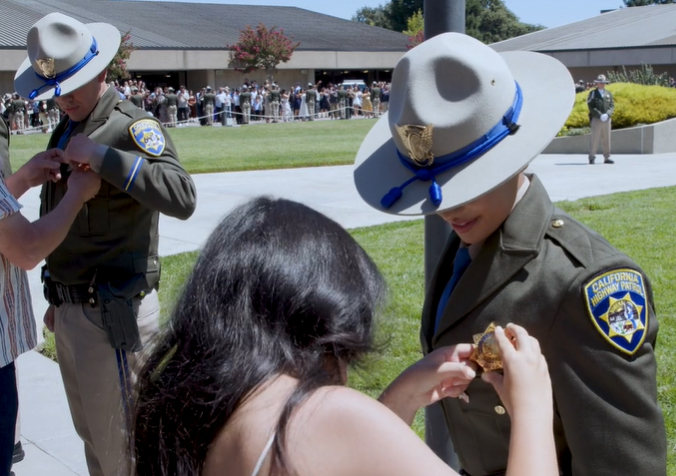
Nearly 500 CHP officers have been sworn in so far in 2025 as Department continues its statewide push to enhance public safety.
By Jaime Coffee, Director of Communications, Office of Media Relations, California High Patrol
SACRAMENTO—The California Highway Patrol (CHP) proudly welcomed 130 newly sworn officers on Friday, celebrating their successful completion of 26 weeks of intensive training at the CHP Academy in West Sacramento. This milestone marks another step in the Department’s ongoing mission to increase public safety across California.
“This graduation represents more than a ceremony; it signifies a solemn pledge to protect and serve. These officers have demonstrated their dedication to keeping California’s communities safe and upholding the CHP’s core values,” said Commissioner Sean Duryee.
New CHP Officers listen to Commissioner Sean Duryee during the ceremony on Friday, Aug. 1, 2025.
These new officers will now report to one of the CHP’s 102 Area offices across California to start their law enforcement careers, protecting and serving communities throughout the state’s 58 counties.
This group of graduates brings a rich blend of backgrounds and experience, including several with public safety and military service, former college athletes and even one with a unique background as a public address announcer.
New CHP Officers take their oaths of office on Friday, August 1, 2025.
During academy training, cadets receive instruction in traffic enforcement, crash investigation, defensive tactics, firearms, emergency vehicle operations and community policing. The curriculum also focuses on legal responsibilities, communication, ethics and cultural awareness to prepare cadets to serve California’s diverse population.
Following today’s graduation ceremony, nearly 300 cadets remain at the CHP’s live-in training facility and an additional 160 cadets are set to start instruction on August 11 as part of the Department’s ongoing efforts to enhance public safety across the state.
The CHP continues to actively recruit dedicated individuals who are ready to make a difference in communities throughout California. A career with the CHP offers comprehensive training, competitive benefits and opportunities for professional growth and advancement.
To learn more about joining the CHP, please visit our website to take the first step towards a rewarding career in law enforcement.
The CHP provides the highest level of Safety, Service, and Security to everyone in California.
Clavo & Canela Cocina + Café is a family-owned Salvadoran restaurant located in the heart of Antioch’s historic Rivertown district. They serve fresh, made-from-scratch dishes like pupusas, tamales, traditional breakfasts rooted in love, tradition and flavor.
Join owners Edwin and Carla Menjeivar, other Rivertown business owners and City officials for the restaurant’s Grand Opening with ribbon cutting ceremony on Saturday, August 9, 2025, from 1:00 PM to 3:00 PM.
The restaurant is located at 310 G Street. For more information visit their Facebook page: Clavo&Canela Cocina-Cafe Rivertown.
Last week, in response to new directions at the federal level under the Trump Administration, Kaiser Permanente issued the following statement on “Gender Affirming Care for Patients Under 19”:
Kaiser Permanente is dedicated to providing safe, high-quality, and evidence-based care to all our members, including adolescents. We are proud of the care and coverage we provide for transgender patients. Our work in this area and the inclusive care we provide for LGBTQ+ individuals and their families is recognized in the community.
Since January, there has been significant focus by the federal government on gender-affirming care, specifically for patients under the age of 19. This has included executive orders instructing federal agencies to take actions to curtail access and restrict funding for gender-affirming care, hospital inquiries by the Centers for Medicare & Medicaid Services, and regulatory changes to coverage and broader federal agency review, including by the Federal Trade Commission. Most recently, the U.S. Department of Justice issued subpoenas to doctors and clinics providing gender-affirming care to transgender youth, as part of ongoing federal investigations.
In response to these federal actions, many health systems and clinicians across the country have paused or discontinued providing gender-affirming care for adolescents.
As the legal and regulatory environment for gender-affirming care continues to evolve, we must carefully consider the significant risks being created for health systems, clinicians, and patients under the age of 19 seeking this care.
After significant deliberation and consultation with internal and external experts including our physicians, we’ve made the difficult decision to pause surgical treatment for patients under the age of 19 in our hospitals and surgical centers. This pause is effective August 29, 2025. All other gender-affirming care treatment remains available. We continue to meet with regulators as well as our clinicians, patients, their families, and the community with the goal of identifying a responsible path forward.
We recognize that this is an extremely challenging and stressful time for our patients seeking care, as well as for our clinicians whose mission is to care for them. We will work closely with each patient to support their care journey.
We will remain a voice and advocate for safe, high-quality, and evidence-based care for transgender patients.
Elissa Harrington, Senior Media Relations and Public Relations Representative for Kaiser Permanente Northern California was asked:
“Were those surgeries offered at Antioch, Walnut Creek and/or Richmond Kaiser hospitals?
Also, why does Kaiser continue to participate in and support the delusion that someone can change their gender with the labeling of the surgeries as “gender-affirming care”?
Why would Kaiser allow its doctors to participate in mutilating children and scaring them for life based on the confusion and mental disorder of gender dysphoria? According to the Mayo Clinic, ‘A diagnosis for gender dysphoria is included in the Diagnostic and Statistical Manual of Mental Disorders (DSM-5)…published by the American Psychiatric Association.’
Furthermore, how can the doctors that performed such surgeries argue they were not violating the Hippocratic Oath, specifically to ‘do no harm’?
Is counseling offered instead to children and adults experiencing such confusion and a mental disorder?”
But Harrington did not respond. Please check back later for any updates to this report.