







Archive for the ‘News’ Category

Grieving Burgis hands over Contra Costa Board of Supervisors’ gavel to Mitchoff

Wednesday, January 12th, 2022

Supervisors approve Grand Jury report on animal shelter consolidation with Antioch, countywide sidewalk obstruction ordinance, two years’ worth of ammunition for Sheriff’s Office

Contra Costa County District 3 Supervisor Diane Burgis

By Daniel Borsuk

A grieving, yet stoic Contra Costa County District 3 Supervisor Diane Burgis conducted on Tuesday her final meeting as Board Chair a month to the day that her husband, Richard Clayton, took his own life. Showing remarkable resilience, Burgis thanked her family, fellow board members, her staff, county employees and constituents for their support.

“We accomplished so much in 2021,” said Burgis, who wore a black dress.  “The annexation of the Contra Costa County Fire District with the East Contra Costa County Fire District will make Contra Costa County so much safer.”

Burgis, whose served on the Board’s Airports’ Committee, praised how the County has developed both the Byron and Buchanan airports, especially Byron with the startup of innovative aeronautical enterprises near the airport.

“I am so proud of our health workers,” Burgis said. “The county public health services have become a model of the state.”
Contra Costa County District 4 Supervisor Karen Mitchoff. Official photo.

For her work, fellow board members presented Burgis with a picture of Marsh Creek, one of Burgis’ favorite environmental cleanup sites.

“That was really hard for you to do,” District 1 Supervisor John Gioia of Richmond said of Burgis after handing over the gavel to newly sworn in Chair Karen Mitchoff of Ditrict 4 in Pleasant Hill. “We’re all behind you.”

Mitchoff, who will not seek re-election to the supervisorial post that she has held since January 2011, said, “In my final year as an elected official for Contra Costa County, I am excited about what lies ahead and ready to work together to keep improving the quality of life in our county.”

An avid reader, Mitchoff noted that last year she read 60 books, mostly audiobooks.  As a gift for her fellow board members, Mitchoff gave each supervisor a copy of the historical book, “The 1619 Project,” written by Nikole Hannah-Jones.

District 5 Supervisor Federal Glover, who has served on the Board since 2000, will serve as Board Vice Chair.  Glover, who was in line to become chair this year passed on accepting the post to allow Mitchoff to take on the leadership duties in recognition of her more than 40 years of public service.

Third Grand Jury Report on Consolidating County, Antioch Animal Shelters Approved

Without hearing any public comment, Supervisors approved a third Grand Jury report, this one recommending that the County hire a consultant to study the potential consolidation of the County run animal facility in Martinez and the City of Antioch animal shelter run by the Antioch Police Department.

“Public and private animal shelters are experiencing pressure from the explosive growth in the homeless animal and abandoned pet populations,” the new Grand Jury Report states. “Community outreach and education are high priorities for both Contra Costa and Antioch Animal Services, the two public animal shelters within the county.”

The grand jury report went on to state, “The Grand Jury recommends that Contra Costa Animal Services (CCAS) engage a consulting firm for guidance on the possible redistribution of animal services that could be achieved by a gradual process of cost-sharing and shelter coordination. A comparable consolidation currently underway between Monterey County and the City of Salinas Animal Shelters provides a possible model for the integration of Contra Costa and Antioch Animal Shelter services.”

The grand jury also recommends that the two public animal shelters improve their emphasis on community outreach to comfort homeless animal overpopulation.

In addition, the report calls on both the County and City of Antioch to resolve the ongoing problem of abandoned animals left at the Antioch shelter by residents outside the City of Antioch. “Although there is an informal working relationship between CCAS and AAS personnel on this issue, a more formal agreement between AAS and CCAS would facilitate abandoned pet retrieval at both shelters.”

Animal Services Home to Home Contract Approved

In a related animal shelter issue, Supervisors passed a Home-to-Home contract that will not cost the County any funds.  Maddie’s Fund will pick up the tab to re-home pets.  The Home-to-Home Network will lessen boarding of homeless dogs and cats in County Shelter.  Home-To-Home adoptions are free.

Sidewalk Obstruction Ordinance Revised

Without hearing any public comment, Supervisors amended the County Sidewalk ordinance.  The revision permits the County Director of Public Works to “abate any sidewalk obstruction.”

“An adjacent owner shall keep the sidewalk abutting the adjacent owner’s property free and clear of all weeds, rubbish, dirt, rocks, debris, or any other obstruction that interferes with the free passage of pedestrians,” the new ordinance states

Approve Two-Year Ammo Contract for Sheriff’s Office

Supervisors approved a $450,000 contract with Dooley Enterprises, Inc. to deliver Winchester ammunition for the Sheriff-Coroner from Jan. 1, 2022 to Dec. 31 2023. The Sheriff-Coroner’s Office has used Winchester ammunitions for training and duty ammunition purposes for more than 20 years.


 

Glazer, 42 other state legislators from both parties call for increase to Renters Tax Credit 

Wednesday, January 12th, 2022

From $60 to $500 for single residents and $120 to $1,000 for single parents and couples in eligible households. Focused on poorest. Last changed in 1979.

State Senator Steve Glazer. (D-7-Orinda)

SACRAMENTO – Low-income California renters who have been drowning in unaffordable housing costs would see much-needed relief under a bill unveiled Wednesday by State Senator Steve Glazer (D-Contra Costa) and co-authors representing more than one-third of the Legislature.

The legislation, SB 843, would increase the California renter’s tax credit for the first time in more than 40 years and would represent significant help to renters across California. Eligible households would receive $500 for single residents and $1,000 for single parents and couples. Currently, eligible renters have their tax liabilities offset by only $60 for single filers or $120 for joint filers.

The bill would make the tax credit more valuable to the poorest Californians by making single parents eligible for the same credit as couples and allowing people to receive the full credit even if the amount exceeds their tax liability.

“We’ve treated renters like the doormat outside California’s economic recovery house,” Glazer said. “We cannot make an economic comeback without renters having their rightful place inside. Renters have waited 42 years for a modest level of fairness in our tax code. We can’t make them wait any longer.

“An increase in the renters’ tax credit will mean that people don’t have to choose between putting food on the table, taking their kids to the doctor, and making the rent.”

Those eligible for the new renter’s credit would be single filers making $43,533 or less and joint filers making $87,066 or less. Nearly 2.4 million renters would be eligible for the tax credit, according to 2019 Franchise Tax Board estimates.

California has not increased the renter’s credit since 1979. The proposed increase accounts for inflation since then. SB 843 provides direct help to renters – those who typically struggle the most to find affordable housing, and who have been hit hard during COVID-19.

Glazer’s previous attempt to increase the credit – SB 248 – was described by CalMatters as the “most bipartisan bill of the year.”  That bill had 30 co-authors. SB 843 already has 43 — and counting — from across the state and all parts of the ideological spectrum.

Assemblyman Steven Choi, R-Irvine, a principal co-author, said: “Nearly half of the state’s residents are renters, but we simply have not done enough to help them with our state tax policies. This legislation can serve as one tool to make renting more affordable. It would be a real boost to working families who are struggling to make ends meet with the high cost of living in California.”

Too many renters have struggled for too long, said Senator Melissa Hurtado, D-Sanger.

“California renters have struggled to meet rent prior to the pandemic, and have faced rents that in some areas have tripled,” said Senator Hurtado. “Even with steps we have previously taken, many renters face homelessness. This tax relief credit will provide much needed relief for renters, and I am happy to support it.”

Senator Susan Rubio, D-Baldwin Park, said there couldn’t be a better time than now to help renters.

“We need to help California renters, many of whom are struggling, with permanent financial relief,” said Senator Susan Rubio. “I want to thank Senator Glazer for introducing this bill, and I’m happy to be a co-author. Increasing the renters tax credit, while we have a healthy budget surplus, will put money where it’s needed the most and help families now and in the future.”

Republican Leader Scott Wilk, R-Santa Clarita, said so many historic moments have come and gone without much help for renters. Until now.

“A lot has changed since 1979: my LA Clippers relocated to Los Angeles, the internet was ‘born,’ the Berlin wall fell, and a NASA spacecraft flew past Pluto,” Wilk said. “One thing that hasn’t changed? California’s $60 renter’s tax credit. Offering low-income renters such little assistance is inexcusable and reflects a bygone era. I am excited we are taking serious steps to put this behind us, too.”

Senator David Cortese, D-San Jose, said: “I’d like to thank Senator Glazer for his leadership as well as my colleagues for introducing this bill that will significantly expand our state’s renters tax credit and provide much needed relief to not only millions of low-income renters, but also our ‘missing middle’-income population that is often overlooked. And by doing so, this bill will provide stability to our families and prevent the displacement of valuable members of our communities – including our teachers, nurses, nonprofit employees as well other essential workers who are being forced to leave the state due to high cost of living and skyrocketing rents.”


Assemblyman Kevin Mullin, D-San Mateo, a co-author, said, “Renters have been disproportionately affected by the economic consequences of COVID-19. Until the pandemic is fully behind us and jobs can return to full capacity, some renters may continue to face a risk of homelessness or housing instability. Updating the renters tax credit is a way of providing critical direct relief to some of California’s most vulnerable.” 

Assemblywoman Janet Nguyen, R-Huntington Beach, said: “After a difficult two years throughout the COVID-19 pandemic, it is my priority to find and work toward solutions that lower the cost of living. This tax credit will help many families in our community not have to choose between paying for rent and providing food for their family. I look forward to continuing to work with my colleagues to get this bill passed through the Legislature and onto the Governor’s desk.”

Jiseon Kim, a University of California Los Angeles senior majoring in history and public affairs and Head of Advocacy at Swipe Out Hunger at UCLA, said that students are among the many Californians facing high housing costs today, “one of many obstacles they face in being able to earn their degrees. This bill would help address our cost of living issues and will contribute to all students’ overall educational success.”

Senator Brian Jones, R-Santee, said the bill recognizes the needs of working families.

“The State’s $45 billion budget surplus was built on the backs of hardworking Californians, including renters, who now deserve a break,” Jones said.

The Renter’s Tax Credit is a common-sense idea that offers urgently needed relief to California’s millions of families burdened with high rent, said David Knight, Executive Director of the California Community Action Partnership (CalCAPA). While California homeowners receive $5.8 billion in tax relief through mortgage deductions, renters’ relief has been barely a blip on the radar, Knight noted. The cost of the new renter’s credit would be around $1.2 billion, according to 2019 Franchise Tax Board estimates.

“It’s a matter of fairness,” Knight said. “California’s housing policies have favored homeowners for decades by offering them a tax credit for the interest on their mortgages. But, renters haven’t been granted similar benefits. CalCAPA is proud to support this important bill, which makes our housing policy more fair and equitable.”

Senator David Min, D-Irvine, said: “Housing remains a top issue for Californians in every corner of our state. From the rising cost of living to the COVID-19 crisis, California renters have faced no shortage of challenges in recent years. I’m honored to be a coauthor of SB 843, which will help thousands by making crucial and long overdue updates to the California Renters Tax Credit.”

The renter’s credit was established in 1972. Since its only increase in 1979, rents in California have more than quintupled while the renters credit remained flat. Median state rent exceeds $1,500 a month for a two-bedroom apartment, and rentals in cities like San Francisco average more than $2,700 a month.

Senator Bob Archuleta, D-Pico Rivera, said: “Expanding eligibility for the renters tax credit is incredibly important. Especially now, as Californians continue to struggle with the pandemic, it is important we do everything we can to make California more affordable for all Californians. I am proud to be a coauthor of Senate Bill 843, and thank Senator Glazer for his leadership on this issue.”

Assemblywoman Laurie Davies (R-Laguna Niguel), a co-author, said, “California is facing a housing crisis unlike anything we have ever seen before. In addition to a lack of housing, we also have one of the nation’s highest costs of living. The existing renters tax credit has not been raised since 1979 and due to inflation plus a stagnant economy, Californians are hurting now more than ever. Modernizing and updating this credit to keep up with 21st century living standards is the right thing to do to provide relief to low-and-middle income renters.”

Assemblymember Carlos Villapudua, D-Stockton, said: “The ever-rising cost of housing in California has led us to a worrying poverty rate that is unsustainable for our families today and for future generations,” said Assemblymember Villapudua. “Too many of us now spend well over 30 percent of our income on rent which forces struggling families into making difficult decisions and cutting priorities. An increase in this tax credit for renters across California would provide essential relief for these individuals as they work to meet these rising costs to keep a roof over their heads.”


Antioch MLK event postponed due to COVID-omicron surge

Wednesday, January 12th, 2022

Due to the current Omicron surge, the Dr. King Celebration event scheduled to be held at Deer Valley High School’s Theater on Monday has been postponed.  Student submissions for the contest are being scored and winners will be announced next week.

It is our hope to celebrate the life and legacy of Dr. King during Black History Month.  More information will be shared once finalized.

Thank you for your flexibility and understanding.  The health and safety of our students, staff, volunteers, and guests are always our priority.

Velma Wilson, Event Organizer


Antioch Council directs staff to work on ordinance to allow cannabis events

Wednesday, January 12th, 2022

The red highlighted area is the location of the Contra Costa Event Park (fairgrounds).

First one proposed for this summer at fairgrounds

“I know it will make Antioch a destination place” – Councilwoman Torres-Walker

By Allen Payton

During their meeting Tuesday night, a majority of the Antioch City Council members supported creating an ordinance to allow cannabis events in the city, including at the Contra Costa Event Park (county fairgrounds), in response to an application by CoCo Farms. They have a permit from the state to hold 10 events per year.

“This process came out of a need to answer that we can’t say no or yes to,” Mayor Lamar Thorpe explained. “This came as a result of a request of the state.”

During public comments J.R. Wilson said he was speaking on behalf of the Delta Veterans Group “in support…to allow temporary cannabis events.”

Longtime Antioch resident Tom Menasco also spoke in favor of the proposal.

“I would like to support and encourage you to do whatever it takes,” he said, mentioning benefits to the community, “Specifically taxation.”

“These are going to be money-making events,” Menasco stated. “In addition to that, non-profits will benefit from, when they do produce revenue, we will benefit. If we miss this opportunity Concord or someone else will take advantage of this.”

“It was our application to the state,” said Martin Wesley of CoCo Farms. “We’ve worked with the fairgrounds. It’s additional tax revenue and will bring additional people into Antioch. Security will be top of mind.”

“We have a state license to have 10 of these a year and we thought Antioch should be our first,” he added.

District 4 Councilwoman Monica Wilson asked, “Can this go to the cannabis committee so we can properly vet this?”

Thorpe spoke of a timetable.

“For the future, we have a committee,” District 4 Councilwoman Monica Wilson pointed out.

“I know I support this. I support process, period,” said District 1 Councilwoman Tamisha Torres-Walker. “I know it will make Antioch a destination place. We’re constantly talking about how to get more revenue and get more people to Antioch as a destination.”

“It’s not saying we’re opening the floodgates, and it will be a yes or no,” Barbanica said. “If it is a yes, then.

“What is the timeline,” Ogorchock said.

“I believe the applicant’s event is coming up,” City Attorney Thomas L. Smith said.

“420” people in the audience could be heard saying.

“The week of 420 (April 20th) is out of the cards, to do it right,” Wesley said. “The earliest we could do this is July or August.”

“We just did one in Santa Rosa and they sold 50,000 tickets,” he added.

“There’s time to go back to the Cannabis Committee,” Wilson said. “So, I ask that it go back.”

“City Attorney, there’s no time in the process?” she asked.

“I didn’t say that,” Smith responded. “Whatever the council directs.”

“It’s a discussion item. Did you get direction?” Thorpe asked Smith.

“I believe I have direction,” Smith responded.

“So, we can make the July timeframe,” Thorpe added.

Questions for City Attorney

Questions were sent Wednesday morning to City Attorney Smith asking, if the council is required to approve a cannabis event in the city and/or at the Contra Costa Event Park (fairgrounds). In addition, since Prop. 64 which legalizes recreational marijuana use in California gives councils the authority to deny any and all cannabis businesses in their city, he was asked if that also applies to cannabis events, as they would be commercial activities, with ticket sales and on-site cannabis sales.

According to the Local Government Reference Guide to Prop. 64, under “Land Use: Proposition 64 includes multiple local-control provisions that respect local government police powers to: ban commercial cannabis activity, and regulate businesses through local zoning and land-use requirements, and/or business license requirements within their respective jurisdiction by ordinance. However, no local jurisdiction may ban: the consumption of cannabis within its jurisdiction, the allowance of up to six plants for personal use, or the transportation of cannabis through the jurisdiction.”

Finally, Smith was asked if the state Department of Cannabis Control authorize a temporary cannabis event within the city, such as at a park, even if the council opposed it.

Please check back later for updates to this report.

Antioch Council approves new 126-unit high-density multifamily rental housing project on Wildhorse Road

Tuesday, January 11th, 2022

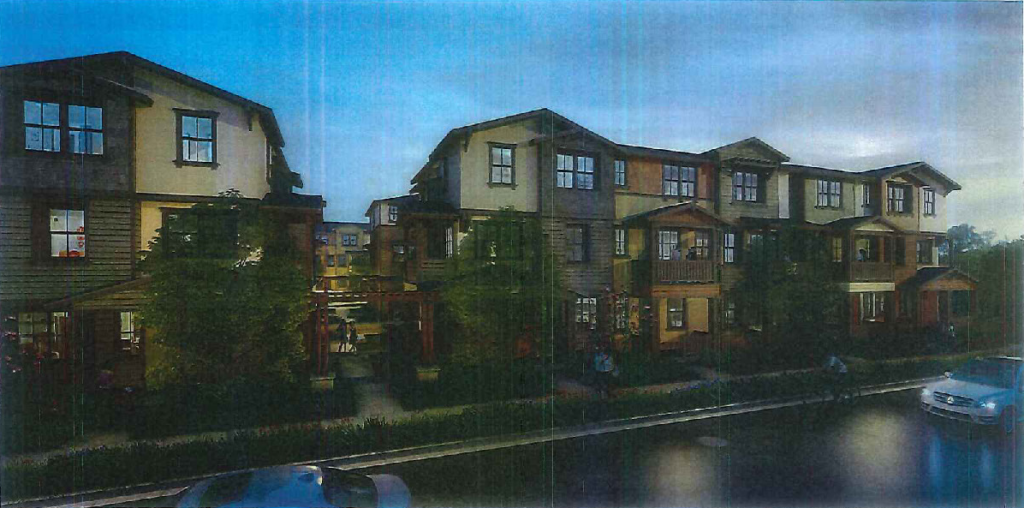
Rendering of the approved 126-unit Wildhorse Multifamily Housing Project.

By Allen Payton

During a public hearing on a new multi-family project off the extension of Wildhorse Road, Tuesday night, the Antioch City Council voted 4-0 to increase the density on 11.72 acres to allow for 126 units of market-rate rental housing. The project could later be converted to condominiums for sale.

Mayor Lamar Thorpe had to recuse himself due to the proximity to his home, that could impact its value.

The complex will be the first market-rate, multi-family housing project since the Cross Pointe Apartments were built on Lone Tree Way between Vista Grande Drive and Heidorn Ranch Road.

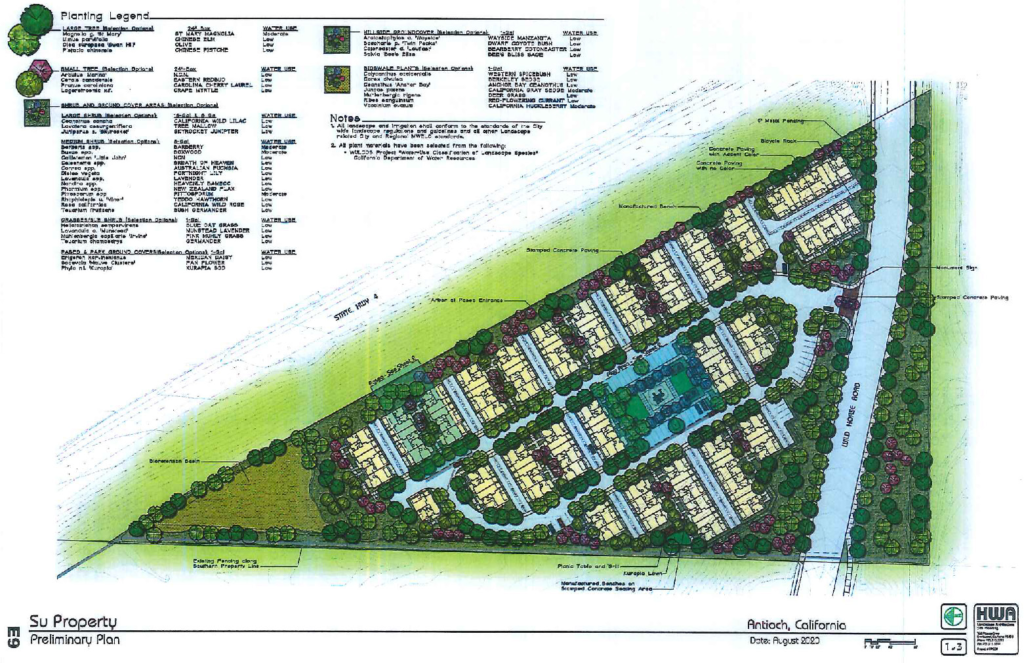
The Preliminary Plan for the approved Wildhorse Multifamily Housing Project.

One member of the public spoke, complaining that the City doesn’t have enough affordable housing.

“We do not require our developers to pay in-lieu fees, so we can provide affordable housing,” Andrew Becker said. “We keep hearing ‘it’s too late’. But we still have huge projects like this, multi-million-dollar projects come in.”

The project proponent then had 10 minutes to speak but only spoke briefly.

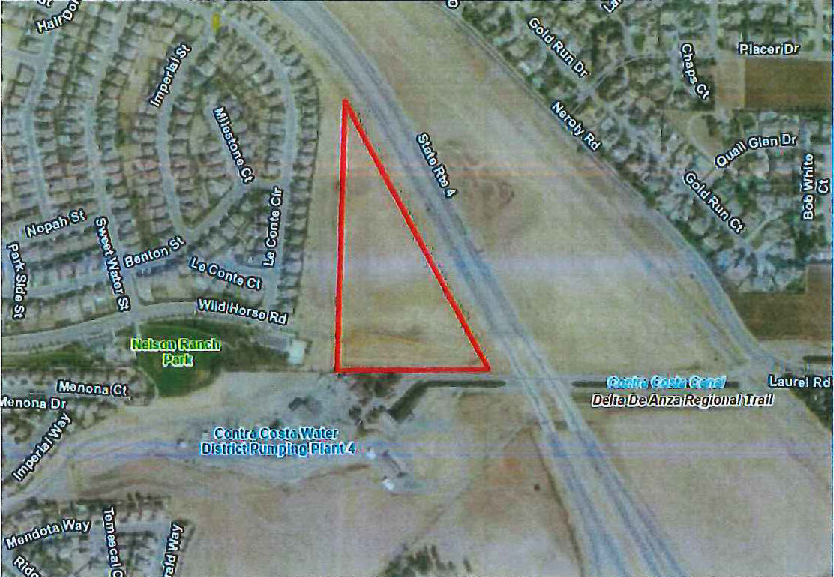
“My family has owned the properties since the late ‘80’s,” Phillip Su said. “This is part of the Nelson Ranch project that was approved.”

There was no opponent to speak against the project. But another member of the public spoke, agreeing with the first speaker.

“How many units are going to be for low-income families to purchase a home? How many units will be rental? I have to agree with the very first person that this has gotten out of hand that we’re allowing developers to build multi-million-dollar homes,” she said. “I’m just concerned that we’re trying to have Antioch be a family city, up and coming. But we have developers coming in here trying to make money and not concerned about the impact. This could draw the criminal activity. The ones who can afford the high rents, here…those are the criminal elements. You know, we have an unhoused problem here, in this county. We have families who are renting and working legitimate jobs and want to buy a home. What we’re looking for is the dollars and cents. What positive impacts is it going to have on the lower income, the working class. What kind of impact will it have on us?”

The site map for the approved Wildhorse Multifamily Housing Project, next to Highway 4.

Ogorchock asked about a CFD (Community Facilities District) for fire.

“It is my desire to have a CFD,” she said.

“The project is conditioned to meet all fire requirements,” said Senior Planner Zoe Meredith.

“Also, I saw that there’s a park in there and I have concerns that it’s not an all-abilities park,” Ogorchock said.

“Even though it will be a private park it will be built to city standards,” Community Development Director Forrest Ebbs responded.

Ogorchock also asked for speed humps to prevent sideshows and added them, and the all-abilities park to her motion for approval.

“How did we come to the decision of condos, instead of townhomes?” District 4 Councilwoman Monica Wilson asked.

“They don’t have a map for condos. It’s being proposed as a multi-family rental project,” Ebbs responded.

But they can come back and place a condo map on the project in the future and convert the rentals to

“This is a challenging site. This density is comparable to other projects in Antioch. We don’t see much more dense than this,” Ebbs said.

Antioch Council discusses more redistricting maps, including fourth new map submitted Monday night

Tuesday, January 11th, 2022

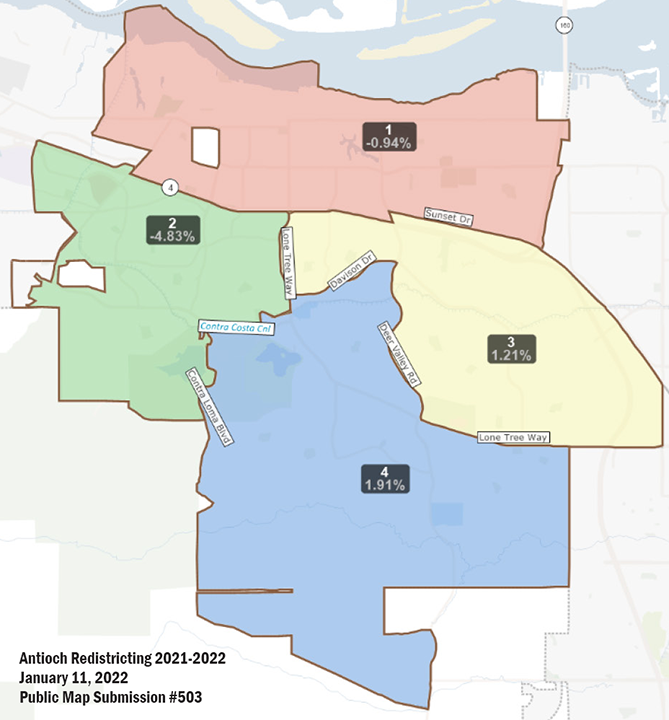
Antioch Redistricting Public Map #503 submitted Monday night is slightly incomplete on the west side of the proposed District 2. There were no User Comments provided. Source: www.antiochca.gov/fc/district-elections

Torres-Walker stands for Pledge of Allegiance; mayor welcomes Con Johnson as interim city manager, finally refers to him as “retired San Francisco Police Lieutenant”

By Allen Payton

During a public hearing at the beginning of Tuesday night’s meeting, the Antioch City Council reviewed new maps submitted by members of the public, as well as the eight maps previously reviewed, including three drawn by the consultant and five submitted by members of the public. In a surprise to some residents watching, District 1 Councilwoman Tamisha Torres-Walker stood for the Pledge of Allegiance, for the first time since the council returned to holding in-person meetings.

“Since the last meeting we have had four new submissions,” said Karin Mac Donald, owner and Senior Researcher of Q2 Data and Research. “Two of the public submissions don’t meet the Fair Maps Act” due to “contiguity”. She was referring to Maps 39 and 49 reviewed by the council at a previous meeting.

See all maps on the City’s Redistricting webpage under Draft Maps and Public Map Submissions.

“You have one more mapping meeting on Jan. 25th,” she added. “It would be good to whittle down the number of maps” for consideration.

A fourth new map, #503, was submitted last night. (See related article)

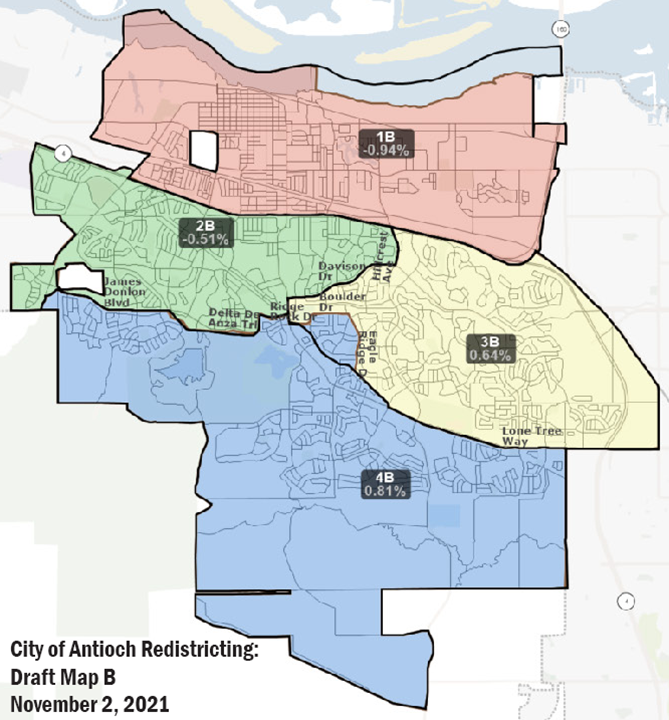
During public comments, resident Harry Thurston, one of only two residents to speak, again advocated for Map B, as he had at a previous meeting.

Resident Sharon Johnson asked, “what is the reason for redistricting when you just did it two years ago? My neighbors and I are wondering.”

“If you’re going to do it…” she continued, then said she also supported Map B “because it keeps current neighborhoods together.”

Drawn by consultant. Notes: Current Antioch City Council boundaries are shown in black on this map. Proposed boundaries are shown in brown and filled in with color. Draft Map B only modifies the boundary between District 3 and 4.

“This process is required every 10 years. What we did last time was not redistricting but districting due to a lawsuit…based on the Census,” Mayor Lamar Thorpe explained

The current districts are based on the 2010 Census. The new districts will be based on the 2020 Census which includes a population increase of 15,000 residents.

During that process in which the council adopted the current districts in May 2018, Thorpe asked Consultant Mac Donald about the current process. “Will we see drastic changes in where the lines will be?”

She responded by saying, “I think that depends on what you wanted to do. There is no law…that says you must start with the districts drawn in the last process.”

Thorpe then stated, “So, we can start with a completely new…or go with what we have and try to adjust the lines accordingly.” (See related articles here and here)

Council Reviews New Maps Submitted by the Public

“I would like to see the new maps that were submitted,” said District 3 Councilwoman Lori Ogorchock.

Jane Hood of Q2 then reviewed the four new submitted maps 91, 95, 99 and 503.

She pointed out that the new map, #503 was incomplete, as it is does not include a small portion on the west side of District 2. “It should be included with District 2,” Hood stated.

Ogorchock asked to see Map 91, again, which Hood put up on the screen.

About Map 95 Hood then said, “You’ll see this changes things, a bit.”

She then presented Map 99 and provided the population deviation percentages and described the boundaries.

“The last submission we have was received last night, which is #503,” Hood said, then reviewed the district boundaries and population percentages.

“This process continues until February so there’s time to submit maps,” Thorpe said.

“Do you want me to include all those maps in the staff report?” asked City Attorney Thomas L. Smith.

“Yes, please,” Thorpe replied. He then asked to review the City’s current districts map and the last two maps that the council considered in 2018.

“This map was created through public engagement and by the elected officials,” he said about a map that the council did not approve, known as Quadrants C. As reported previously, that map used major thoroughfares on the south side of Highway 4 as the dividing lines, such as Putnam Drive, Lone Tree Way and Deer Valley Road, as well as the Delta DeAnza Trail on the west side of the city.

Thorpe then spoke about the current districts map.

“This map wasn’t created by any public officials or by any member of the public,” he said. “This map was created by the consultant. No lines were changed…it was literally the exact map created by the consultant. I point this out because there’s been some implications that lines were moved to accommodate one individual council member. That’s a bold-faced lie.”

“That map passed on a 3-2 vote,” Thorpe continued. “There was some interest particularly by Latino residents up north that they haven’t had representation. This process was fair…of the highest regard. This map is fair.”

However, the consultant drew the map after extensive input from both members of the public and city council during several meetings and special workshops, during the 2018 process. Also, at that time, Thorpe said he supported having two council members represent the north side of the freeway stating, “North Antioch deserves two council people.” But in an Op-Ed by him published the day before, he advocated for one district north of the freeway. Plus, Thorpe was one of the three council members, along with Wilson and then-Councilman Tony Tiscareno to approve the current map with just one council member representing that area of the city.

In addition, during the 2018 process for creating the current map, then-Mayor Sean Wright said, “When you gerrymander you draw crazy lines to make sure you have the people in your district. When drawing the lines, I went down the major thoroughfares. I didn’t look at which family is where. I’m in favor of Quadrants C going forward and Working Draft 1.” (See related article)


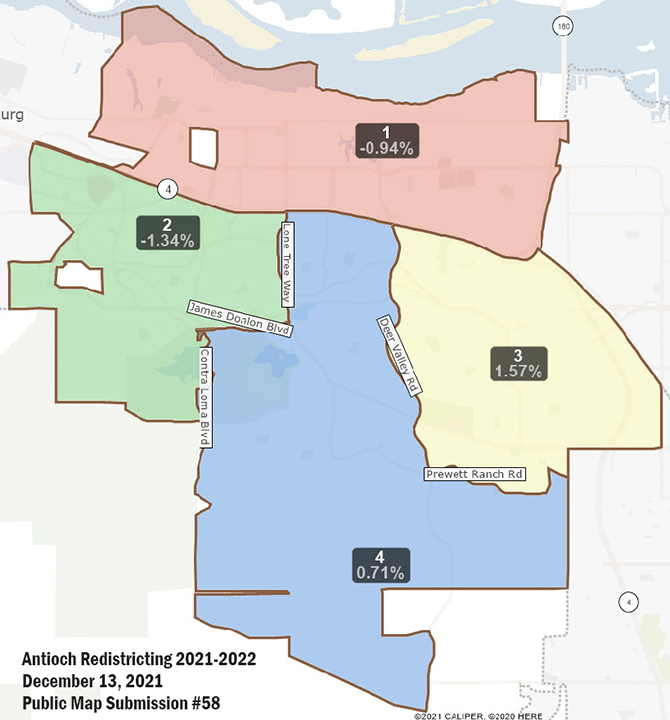
User Comments: “This leaves all current council members in their districts and makes more sense including the Silverado Drive area in District 2 instead of District 4, and makes Districts 2, 3 and 4 north-south oriented districts instead of east-west.”

Barbanica then asked to see Map 58 and for the Q2 staff to “go over the boundaries?”

Hood then described the district boundaries and population deviation percentages from average.

“It’s just an easy map to follow,” Barbanica said.

Thorpe Introduces Interim City Manager Johnson as Retired Police Lieutenant

The mayor then closed the public hearing and began the introductions of new city staff members.

“It is my duty to introduce our new city manager. Con Johnson is here, today. He took the helm, officially by himself, last week,” Thorpe said. “He’s a retired San Francisco Police Lieutenant. Con, we welcome you.”

“I would just like to thank the mayor and entire council members for this opportunity to work for this wonderful city,” Johnson said.

Driver arrested car impounded following crash while doing donuts in Antioch Tuesday

Tuesday, January 11th, 2022

A driver crashed his car into a light pole while doing donuts in the Antioch Marina parking lot on Tuesday, Jan. 11, 2022. Photos by APD

Not the kind the cops are known to enjoy! Suspect tried to flee scene; see video

By Antioch Police Department

While Police Officers have an affinity for donuts, I think we can all admit that not all donuts are created equal. On this occasion, Antioch Officers were dispatched to the Marina due to reports of a white Camaro doing donuts and then crashing into a light pole. If that wasn’t bad enough, the subject then attempted to flee the scene (see our post regarding leaving the scene of a collision).
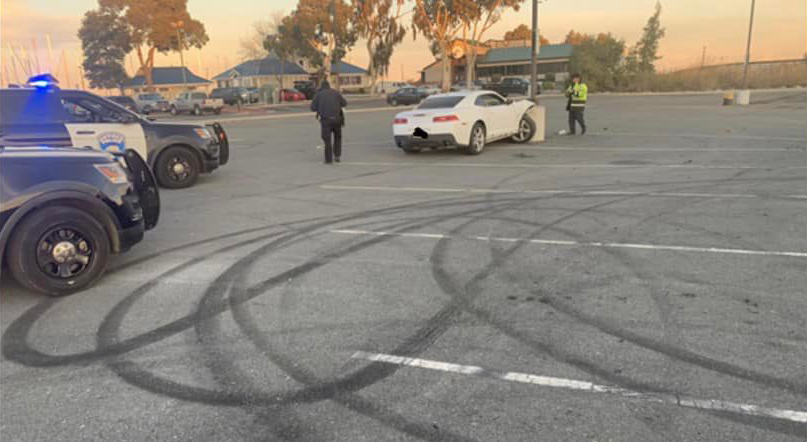

As a result, the 25-year-old subject was arrested for reckless driving and a 30-day hold was placed on his vehicle (Though he wouldn’t have been able to drive away anyways). (See video)

While we are on the topic of reckless driving, sideshows continue to be a huge issue in the greater Bay Area and law enforcement remains committed to using the full extent of the law to stop people involved in such activity. In addition to having your vehicle towed, any driver participating in a sideshow can have their driver’s license suspended up to six months and be subject to arrest.

Skidmarks in the Antioch Marina parking lot left by the driver of the car doing donuts.

Sideshows are extremely dangerous and affect every driver on the road. We all share the road together and have an obligation to each other to drive responsibly.

Make better donut selections please, perhaps something with sprinkles. -6136 #drivesafe #donuts #antiochca

Contra Costa Health Services to unveil new initiative Wednesday to serve people experiencing mental health crises

Tuesday, January 11th, 2022

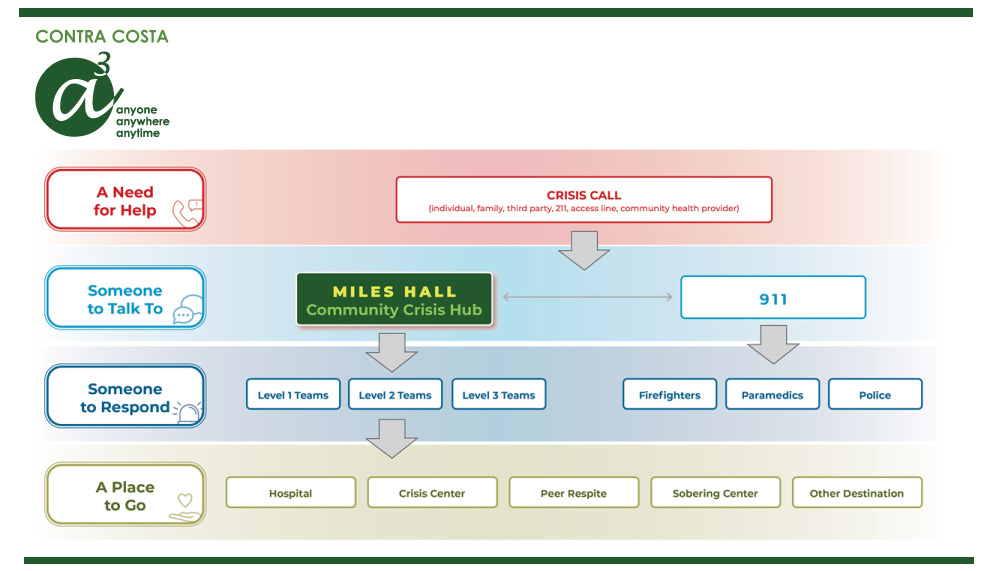
Entitled “Anyone, Anywhere, Anytime” (A3) – The service will be accessed through 911 and the Miles Hall Community Crisis Hub

WHEN: 4 to 5:30 p.m. Wednesday, January 12, 2022

WHERE: The A3 Community Crisis Initiative Event will be held via Zoom. Everyone is welcome to attend and participate using this link. The event will also be broadcast on Contra Costa TV.

Contra Costa Health Services (CCHS), civic leaders and community advocates will deliver an online community update about Anyone, Anywhere, Anytime (A3), a new system for delivering safe, appropriate care to county residents who are experiencing behavioral health emergencies.

A3, developed in partnership with local government, first responders, mental health advocates, patients and families, will be implemented with funds from Contra Costa County’s Measure X sales tax. The program is intended to connect people in crisis with the care they need in the moment, and reduce intervention by local law enforcement where clinical expertise is more appropriate.

“Our community recognized an unmet health need and has come together in an unprecedented way,” Contra Costa Health Director Anna Roth said. “When fully implemented, A3 will ensure that everyone in our community can receive culturally and clinically appropriate crisis services whenever help is requested because of a behavioral health emergency.”

A3, currently a pilot program, will expand into a 24-hour service over the next 18 months that sends crisis response teams including behavioral health professionals directly to behavioral health emergency calls, in coordination with other first responders.

Source: CC Health Services

The service will be accessed through 911 and the Miles Hall Community Crisis Hub, a call center staffed by clinicians from CCHS who can triage calls, determine appropriate responses and dispatch crisis response teams. It is the central component of the model. Miles Hall was a local youth who was tragically killed by police while experiencing a mental health crisis in 2019 during a law enforcement encounter.

CCHS is now developing and hiring staff for the program, supported by a one-time allocation of $5 million in Measure X funds for infrastructure, and $20 million in ongoing funds to support operation of the program, including staffing. Rep. Mark DeSaulnier also submitted two requests for Community Project Funding for behavioral health in Contra Costa County. If approved, more than $2 million in federal funding would be used to expand these services.

Information about A3 can be found at https://cchealth.org/bhs/crisis-response/. This website will be updated throughout 2022.

People experiencing a behavioral health crisis or anyone who needs to obtain help for others can currently access services by calling 911, 211, or our mobile crisis response at 1-833-433-2672.