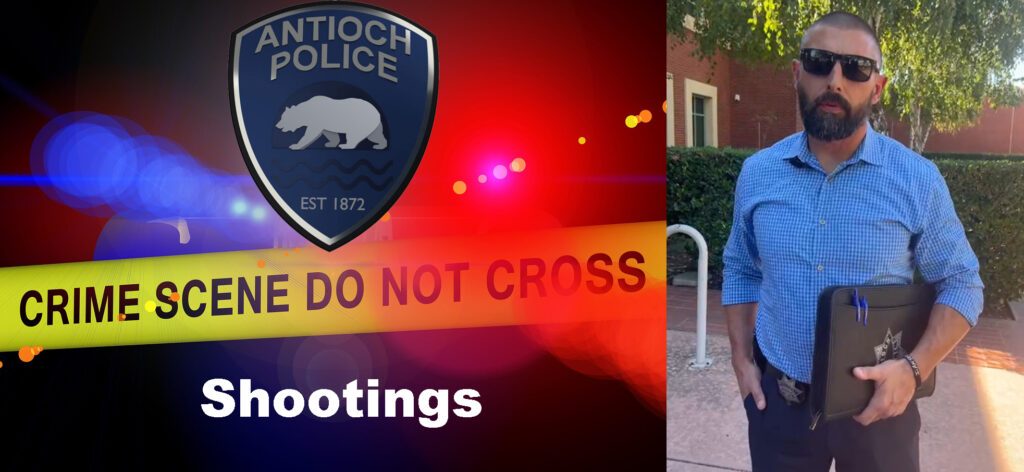
Antioch Police Investigations Lt. Desmond Bittner answered questions about the recent shootings during a press briefing on Monday, Sept. 23, 2024. Antioch Herald Facebook Live video screenshot by Allen D. Payton
“We can’t say for sure it’s gang related. I’m sure it probably plays a factor.” – Investigations Lt. Bittner
This month’s 15th shooting on Sunday was self-inflicted, possible suicide attempt
By Allen D. Payton
After Antioch Mayor Lamar Hernandez-Thorpe made a statement on his official Instagram account on Sunday, Sept. 22, 2024, about the recent spate of 14 shootings in Antioch this month and claiming they “are being investigated as gang-rivalries” the Antioch Police leaders provided more accurate information and details on Monday. During an afternoon press briefing Lt. Desmond Bittner of the APD Investigations Bureau said, “We can’t say for sure it’s gang related. I’m sure it probably plays a factor.”
Following the briefing regarding the shootings, including four over the past week, Bittner repeated much of what he shared in a press release issued later Monday afternoon. It offers information about a previously unreported 15th shooting that occurred yesterday, Sunday, Sept. 22nd, which was a possible attempted suicide.
The police lieutenant wrote, “Over the past week, officers have responded to four additional shootings. Of the four shootings, one appears to be related to the shootings that began on September 2nd following the shooting death of Elijah Scales. The related shooting occurred on September 21st at 7:56 pm, in the 1100 block of Sycamore Drive. At least 17 bullets were fired, and three nearby businesses were struck by the gunfire. Fortunately, no one was struck (Report 24-8510).” (See related article)
Four Unrelated Shootings
“The three shootings listed below have no relation to the shootings that occurred September 2nd – 16th,” the press release continued. “We have also determined the shooting that occurred on Monday, September 16th at the Contra Costa County Fairgrounds has no relation to the string of shootings.
Sunday, 9/22, 5:27 am (Carpinteria Drive) – Report 24-8523. Self-inflicted gunshot wound. The man is currently in stable condition.
Sunday, 9/22, 9:21 am (20 E. 18th Street) – Report 24-8527. At least eight rounds fired. One man was shot and is currently in critical condition. One woman was also shot and has since been treated and released from a local hospital. (See related article)”
Bittner then shared the list of the other shootings and again asked for the public’s help to identify the suspects as they are currently unknown. (See related article)
Addington shared earlier that the shooting of the “18-year-old on Cavallo was an isolated incident, the shooting at Rite Aid (on E. 18th Street Sunday morning) is unrelated” to the others. About all the other shootings Addington added, “It’s a turf issue.”
Additional Details from Monday Press Briefing
During the press briefing, Investigations Lieutenant Bittner said, “I can’t say for certain that all the shootings are related to the initial homicide Elijah Scales that happened on September 2nd. But we believe that they’re related, not all of them. They’re still under investigation, all of them. We haven’t made any arrests on them. We can tell you…the shooting that occurred at the Contra Costa County Fairgrounds, that one is not related in any way.”
“And then the shootings that happened this past weekend…on Cavallo and Sunset, that we do not believe is related to anything from the Sycamore corridor from the Elijah Scales shooting,” he continued. “The same for the shooting that occurred on East 18th Street and A, that’s not related, either…to anything on the Sycamore corridor.”
“The shooting that happened the other night (Saturday) in the 1100 block of Sycamore…at least 17 rounds fired, nobody was struck,” Bittner stated. “Three of the businesses were hit by gunfire.” He was referring to the Sycamore Square shopping center.
“We did have a shooting on Cavallo. This was the 16th, I believe,” the lieutenant continued. “A male was shot at a memorial location for Elijah Scales. The last we were aware he was still in critical condition and that’s still under investigation.”
Asked for an update on the man shot at the shopping center on Sunday Bittner said, “He’s still in critical condition. That’s still under investigation.”
Asked by another reporter, “are we talking about feuding groups of gangs?” the lieutenant responded, “It’s hard to say. We can’t say for sure it’s gang related. I’m sure it probably plays a factor. That’s something we’re still investigating.”
Asked for any message he wanted to put out to the public Bittner said, “My message is pretty similar to what the chief said last week and that this isn’t going to be tolerated, and everybody deserves to live in a safe community, and we just want to keep things as safe as possible and all this needs to stop. So, we’re going to do all we can to make sure this comes to a stop.”
Asked by the other reporter if Elijah Scales was known to the police for any previous criminal activity, he said, “Not that I’m aware of.” Asked about the man who was shot at Scales’ memorial Bittner said, “I think he was in his late- to mid-40’s and he was an associate of Elijah Scales’ family.” Asked if the shooting was a drive-up, drive-by or walk-up the lieutenant responded, “I believe it was a drive-by.”
“All our officers on the patrol level are doing a great job responding quickly conducting thorough investigations,” Bittner stated. “And then if it rises to the level of where our investigators come out, our investigators are doing the same thing. Every case like this, every shooting we take seriously. We do very detailed, thorough investigations. We do all we can to try and identify the people responsible.”
Asked what he would say to residents who might be concerned or are scared the lieutenant responded, “I’d say try to be vigilant. If you see something that doesn’t look right, notify the police. If you do hear gunfire, do the right thing, call the police and let us know. Be a good witness.”
Bittner was also asked for any motive for the shooting on Sunday and said, “At this point we’re still working on it. We don’t have a motive identified.”
Asked about the suspects who were seen walking away from the scene of that shooting the lieutenant said, “I believe we have some strong leads as far as suspects, vehicles and so forth. So, that case is looking good. I’m pretty confident we’ll get it resolved.”
Anyone with information can contact Investigations Sergeant Bill Whitaker at (925) 779-6876 or wwhitaker@antiochca.gov or Detective Cox at (925) 481-8147 or by email jcox@antiochca.gov.
Was not provided to local media to promote and share with readers
Scathing comments directed at council
City staff provide questions, responses but won’t say how they guaranteed only Antioch residents participated, stats on hiring process, nor when Bessie Mae Scott will start, Ogorchock says Monday, Oct. 7th
By Allen D. Payton
During the council meeting on August 28, 2024, when the new city manager, Bessie Marie Scott was hired on a 3-2 vote, District 1 Councilmember Tamisha Torres-Walker said a survey had been taken as part of her argument that the hiring process had been transparent to the public. After waiting for three weeks to obtain information about the public survey the City of Antioch conducted, Human Resources Department Director Ana Cortez provided the details. They include the questions, responses and the number of participants provided through the Survey Monkey website. The greatest number of people who answered any of the six questions during the 10-day survey was just 21. The survey also allowed general comments to several of the questions, which included many that were critical of the mayor and the city council, and several complaints about the homeless, crime and lack of police. The responses were received between March 20th and 30th.
Following the council meeting that night, Cortez, City Attorney Thomas Lloyd Smith and members of his department staff were asked how many responses the survey received, how did it guarantee only Antioch residents participated, when and where was the public survey about the city manager position shared and for them to provide a copy of the questions and results. They were informed the Herald was not provided information about the survey so that it could be shared with our readers for greater participation.
They were also asked for Ms. Scott’s start date, how many candidates applied, withdrew from the process and were interviewed by the city council.
The questions were sent again on Wednesday, Sept. 18 and to Councilmembers Lori Ogorchock and Mike Barbanica asking for their assistance in obtaining the information and answers. The councilwoman responded simply, “Working on it”. On Thursday, Sept. 19, Cortez responded with the following: “Please see below the link to the survey for the City Manager search. You will find the questions that were asked and the results.”
Cortez also said, “The Survey was shared in our social media outlets – City of Antioch’s Facebook page, Instagram, and website. The survey with a QR Code was posted outside the City Council Chambers and on the HR front door.” But it was not shared with any of the local media that covers the City of Antioch.
Of the six questions with preselected multiple-choice answers included in the survey, 21 people answered four, 16 answered one and 15 provided additional comments. Following are the questions and all of the responses:
Q1 Which type of leader should Antioch have as its City Manager? (Please prioritize most important as 1 and least important as 5. Select up to 5.) Answered: 21 Skipped: 0
Chart of responses to survey Question 1. Source: City of AntiochResponses to survey Question 1. Source: City of Antioch
Comments (7)
“They not be a yesman to Thorpe. We’ve seen Con Johnson fired for leaking to DA. Kwame is a yesman. FORD says he will come back if Thorpes not in office… so that tells me Thorpe did or asked Ford to be unethical. Thorpe dictatorship should not have an iota of say in this hiring.” 3/30/2024 06:46 AM
“Leader- lead by example” 3/25/2024 09:01 PM
“Not influenced by Mayor and City Council” 3/25/2024 03:01 PM
“They are not aligned with any one individual (mayor) and vote their own mind and their actions speak louder than their words.” 3/23/2024 02:02 PM
“Someone who is not scared to go against others in order to make things right. Someone who is not in bed with dirty politicians or dirty authority figures. Someone who will call out when wrong is wrong. Someone who will stand up and fight against the petty theft’s, vehicle and home burglaries juvenile violence.” 3/20/2024 04:06 PM
“We need someone that cares about the residents. Making care of our roads and infrastructure a priority.” 3/20/2024 02:12 PM
“Antioch is facing so many pivotal moments right now- will we continue to be viewed as the new dump of the east bay or can we make a comeback? A city manager will need to act quickly to solve the most pressing problems we are facing.” 3/20/2024 12:22 PM
Chart of responses to Question 2. Source: City of Antioch
Q2 Which three of the following management styles do you believe are essential for the City Manager to successfully lead Antioch? Please prioritize most important as 1 and leat [sic] important as 3. Select up to 3). Answered: 21 Skipped: 0
Source: City of Antioch
Comments (5)
“City directives by council members.. if they are illegal, Unethical the City manager should report such incidents to the DA office.l” 3/30/2024 06:46 AM
“Be involved with other agencies in the City- bridge the gap” 3/25/2024 09:01 PM
“Find a way to get the mentally ill people wandering our streets vandalizing our businesses removed so law abiding citizens feel safe on our streets.” 3/20/2024 02:12 PM
“Stand up to the current mayor and not follow in his destructive path the city is on.” 3/20/2024 01:21 PM
“Just lead strong!!! And be honest! We are desperate for a change.” 3/20/2024 12:22 PM
Chart shows total answers to each of the responses for Question 3. Source: City of Antioch
Q3 Which five of the following abilities and skills do you believe are most essential to perform the work of the City Manager? Answered: 21 Skipped: 0
Answer Choices
Responses
Skill in conflict resolution and collective bargaining experience
71.43% 15
Skill in City finance
66.67% 14
Experience working on racial equity issues
14.29% 3
Ability to work with a City Council that sometimes have differing opinions and perspectives
66.67% 14
Ability and desire to really listen
52.38% 11
Ability to recruit and develop a diverse workforce
19.05% 4
Ability to work together and openly with members of the community
42.86% 9
Ability to build diverse teams within the organization
23.81% 5
Ability to remain focused on the City’s long-term goals
61.90% 13
Ability to challenge the status quo and view issues through a racial equity lens
“Ability to stand up and not allow a councilmember or mayor to wrongfully influence or threaten them.” 3/30/2024 07:49 AM
“Equity is just a term to not treat people Equal. I want a person who doesn’t use the race cardvas [sic] an excuse. Buy lifts up ALL citizens of Antioch.” 3/30/2024 06:46 AM
“Ability to recognize, retain great employees and promote.” 3/25/2024 09:01 PM
“All of the above.” 3/22/2024 09:01 PM
“Listen to all of the community no matter what race they are.” 3/20/2024 02:12 PM
“Someone who can focus on the task right now. Yes, the long-term goals, but we have so many urgent immediate problems to solve. Someone who can get to work quickly and make immediate changes for the better.” 3/20/2024 12:22 PM
Q4 What are the top three positive trends you see in Antioch that the next City Manager will encounter upon starting in their new role? Answered: 16 Skipped: 5
Answer Choice 1 (16 responses)
“Open mind.” 3/30/2024 08:41 PM
“Getting a new mayor.” 3/30/2024 09:04 AM
“Residents determined to see the city succeed.” 3/30/2024 07:49 AM
“Do not be a yes man to Thorpe.” 3/30/2024 06:46 AM
“Future planning.” 3/28/2024 05:08 PM
“New mayor.” 3/25/2024 11:27 PM
“Hopefully the transition of a new mayor.” 3/23/2024 02:02 PM
“Hiring qualified employees at all positions.” 3/22/2024 09:01 PM
“Hopefully new Mayor and council.” 3/21/2024 08:00 AM
“The developer, Sean McCauley.” 3/20/2024 07:45 PM
“A growing community.” 3/20/2024 04:06 PM
“Police staff strengthened.” 3/20/2024 02:21 PM
“There are no positives right now.” 3/20/2024 01:21 PM
“Homeless and their destruction.” 3/20/2024 12:22 PM
“Current mayors term being up soon.” 3/20/2024 11:06 AM
“Clean up the trash from the homeless.” 3/20/2024 09:25 AM
Answer Choice 2 (12 responses)
“Visionary.” 3/30/2024 08:41 PM
“New council members.” 3/30/2024 09:04 AM
“Treat people Equal.” 3/30/2024 06:46 AM
“Working with all department heads.” 3/28/2024 05:08 PM
“City folks ready for a change.” 3/25/2024 11:27 PM
“Hopefully the transition of a new dynamic city council.” 3/23/2024 02:02 PM
“Not to hire friends of elected people.” 3/22/2024 09:01 PM
“Community Events throughout the City.” 3/20/2024 07:45 PM
“New Mayor in 2025” 3/20/2024 02:21 PM
“Trash!!!!! Everywhere. Antioch is called the new dump.” 3/20/2024 12:22 PM
“City cleaning up homeless encampments.” 3/20/2024 11:06 AM
“Stopping the side shows.” 3/20/2024 09:25 AM
Answer Choice 3 (11 responses)
“Positive growth in equity for every citizens.” 3/30/2024 08:41 PM
“Get Police staffing levels back up.” 3/30/2024 09:04 AM
“Be the best qualified for the job, not hire due to skin one.” 3/30/2024 06:46 AM
“Forecasting budget.” 3/28/2024 05:08 PM
“Future growth.” 3/25/2024 11:27 PM
“Developing a better public persona and face for city of Antioch.” 3/23/2024 02:02 PM
“Safe Streets (speed bumps).” 3/20/2024 07:45 PM
“New council members in 2025.” 3/20/2024 02:21 PM
“Rebuilding the run down, boarded up, sad looking shopping centers and streets.” 3/20/2024 12:22 PM
“Police being fully staffed.” 3/20/2024 11:06 AM
“Getting the police department back up and running right. Backing the new police chief.” 3/20/2024 09:25 AM
Q5 What are the top three challenges you think will face the new City Manager? Answered: 21 Skipped: 0
Answer Choice 1 (21 responses)
“City Council.” 3/30/2024 08:41 PM
“Lamar Thorpe Hernandez.” 3/30/2024 09:04 AM
“the mayor.” 3/30/2024 08:57 AM
“Worst crime city has ever encountered.” 3/30/2024 07:49 AM
“Working with corrupt city council’s members.” 3/30/2024 06:46 AM
“Transition.” 3/28/2024 05:08 PM
“City council.” 3/25/2024 11:27 PM
“Violence in community.” 3/25/2024 09:01 PM
“Homelessness.” 3/25/2024 03:01 PM
“Bad representation on the city council.” 3/23/2024 02:02 PM
“Stop the racism that the black residents create.” 3/22/2024 09:01 PM
“Budget restrictions.” 3/21/2024 08:00 AM
“Reckless driving.” 3/20/2024 07:45 PM
“Not enough police staff.” 3/20/2024 04:06 PM
“Homeless.” 3/20/2024 02:21 PM
“Homelessness.” 3/20/2024 02:12 PM
“Thorpe.” 3/20/2024 01:21 PM
“Lamar Thorpe and his oppressive nature to others.” 3/20/2024 12:22 PM
“Member of the city council.” 3/20/2024 11:06 AM
“Deal with a dysfunctional city council.” 3/20/2024 09:49 AM
“The mayor and his groupies.” 3/20/2024 09:25 AM
Answer Choice 2 (21 responses)
“Police Officers Association.” 3/30/2024 08:41 PM
“Tamisha Walker Torres.” 3/30/2024 09:04 AM
“people caring more about the criminals than the law abiding citizens.” 3/30/2024 08:57 AM
“Lack of folks wanting to work for the city of Antioch due to current leadership.” 3/30/2024 07:49 AM
“Dealing with Antiochs deficit spending in a responsible way.” 3/30/2024 06:46 AM
“If he’s an outsider familiarity with us.” 3/28/2024 05:08 PM
“Loitering: contributing to majority of theft in the neighborhoods.” 3/20/2024 07:45 PM
“Huge rise is petty crimes, burglaries of homes and cars, juvenile delinquency.” 3/20/2024 04:06 PM
“Crime.” 3/20/2024 02:21 PM
“Crime.” 3/20/2024 02:12 PM
“Wilson.” 3/20/2024 01:21 PM
“Not having the freedom to clean up the city (too much red tape and not enough support).” 3/20/2024 12:22 PM
“People who don’t care about the state of the city.” 3/20/2024 11:06 AM
“Deal with a community that is not proud of its city anumore [sic].” 3/20/2024 09:49 AM
“The crime.” 3/20/2024 09:25 AM
Answer Choice 3 (19 responses)
“Back the Blue advocates.” 3/30/2024 08:41 PM
“Lack of Police.” 3/30/2024 09:04 AM
“Homeless.” 3/30/2024 08:57 AM
“A Mayor who continually ‘strong arms’ the City Manager.” 3/30/2024 07:49 AM
“Dealing with policies presented to council that is not good for the whole of Antioch.” 3/30/2024 06:46 AM
“Staffing city office with decent people.” 3/25/2024 11:27 PM
“Economy in Antioch.” 3/25/2024 09:01 PM
“Businesses leaving.” 3/25/2024 03:01 PM
“Economic development of a dying city.” 3/23/2024 02:02 PM
“Business closures.” 3/21/2024 08:00 AM
“Homelessness.” 3/20/2024 07:45 PM
“Homelessness and city up keeping.” 3/20/2024 04:06 PM
“Blight.” 3/20/2024 02:21 PM
“Economic development.” 3/20/2024 02:12 PM
“Walker.” 3/20/2024 01:21 PM
“The city council not supporting the new city manger [sic].” 3/20/2024 12:22 PM
“Crime.” 3/20/2024 11:06 AM
“Deal with money being wasted.” 3/20/2024 09:49 AM
“Finding good people to work for the city.” 3/20/2024 09:25 AM
Q6 Do you have any other comments related to the recruitment for Antioch’s next City Manager? Answered: 15 Skipped: 6. Following are the 15 responses:
“We need a woman in this position.” 3/30/2024 08:41 PM
“pretty bad when I can’t see anything positive that this city council and mayor has done,” 3/30/2024 08:57 AM
“we have a corrupt City council, that have conspired to gerrymander, that don’t care about Brown Act Violations. Good freaking luck.” 3/30/2024 06:46 AM
“Some people can have the ambition and desire to make the city anew without a college degree. We have all seen the past folks with a degree it doesn’t mean nothing. Find someone willing to grow and learn with the community and some experience but is passionate about the job. That makes a difference.” 3/25/2024 11:27 PM
“I want someone who will be able to bring someone that can work with the community. Gap or bridge the City with other agencies in the community to help our youth, elder community, single moms, by bringing jobs, create programs for youth, community, sustainability grants to continue growing our city. We need to turn around Antioch. Antioch is becoming a hard community to live where all you see and hear about in the news is crime, death. We want to be able to have someone that can hear the community’s needs and make something happen.” 3/25/2024 09:01 PM
“Get someone who has experience with turning around a blighted and dying city. Someone who will not be influenced by the Mayor or the City Council but will just do what is right and be tough. All of the innovative programs and projects don’t matter because our city is overrun by gun violence, gang violence, drug dealing, sideshows, idiots racing through the streets on dirt bikes, shoplifting, burglary, and homeless camps everywhere! Businesses are leaving, good citizens are leaving, we are going to leave if the Mayor is reelected because he’s a bully and people can’t get things done at the City, Find a mature and tough, experienced, city manager of ANY race and ANY gender; just someone who knows how to fix these problems that are literally killing our beautiful city, don’t listen to the idiots in the city council, just tell them to pipe down and get Antioch back on its feet!! Pittsburg did it, we can too.” 3/25/2024 03:01 PM
“Good luck!” 3/23/2024 02:02 PM
“Antioch has become a hot mess. The new City Manager will have his work cut out for him. Hopefully he will get to work with a new mayor and city council that will have the city in their best interest both economically and financially. Money needs to be spent wisely and Antioch needs to be cleaned up.” 3/21/2024 08:00 AM
“This City used to feel like home and now it’s just where I live. It’s so sad to see the deterioration of this once beautiful family oriented community.” 3/20/2024 07:45 PM
“If we could please recruit someone who isn’t scared to go against the grain. Someone who isn’t a yes man. Someone who has a vision for Antioch and wants to charge those that contribute to torment of the residents. Someone who reinforces the police department and wants the best for the department to flourish and serve its residents. Someone who will utilize funds to clean the city up and make it was it was 20 years ago. Someone who will bring businesses back to life and encourage tourism. People are moving out of Antioch because of the violence and no follow through of crimes by our DA’s office. We need someone who isn’t scared and stands up against anyone in the wrong. Be a voice for us long time Antioch residents.” 3/20/2024 04:06 PM
“First and foremost we need a Mayor that stays in his own lane so the City Manager and City staff can do their jobs.” 3/20/2024 02:12 PM
“We have all been waiting a very long time. We feel broken, tired, frustrated and hopeless. Let’s hope this doesn’t end up another dead end and disappointment.” 3/20/2024 12:22 PM
“Would prefer someone not associated with any member of the current council” 3/20/2024 11:06 AM
“Be tough and not be intimidated by anything or anyone” 3/20/2024 09:49 AM
“Some one that has common sense” 3/20/2024 09:25 AM
More Questions for City Staff
Because no answers to the other questions posed to Cortez, City Attorney Smith and his staff, they were again asked the same as well as some additional questions. Those included, “Since it doesn’t show any details about the residency of the participants how did the survey ensure only Antioch residents participated? Did they have to provide their home address or mark a box confirming they are an Antioch resident? Who developed the questions?”
“Is a total of 21 participants an adequate sampling out of approximately 115,000 residents in Antioch? How many responses were you hoping for? Did the city council direct you to conduct the survey? When? Was it during public or closed session?
Finally, they were asked, “Since so few people participated, do you think in the future it would be best to send out an announcement with a link to the survey to the local media to inform the public so more people will know about it?”
But they did not respond.
When asked later for the new city manager’s start date, Ogorchock said, “October 7th is what she shared with us.”
Please check back later for any updates to this report.
OTHER UNRELATED QUESTIONS FOR THOMAS RE Former City Employees and Comments Made About Them by Councilmembers Following Separation of Employment
Thomas, regarding the comments by the mayor about both Ron Bernal and Con Johnson in which he disclosed some information regarding their employment and separation, did what he say violate their rights?
Can councilmembers speak publicly about former city employees and things that were said and done while they were still employed with the City or the reasons for their separation from employment?
The bicyclist and victim of the fatal hit-and-run was 29-year-old mother of two, Linda Woolridge. Herald file photo
By Sgt. Rob Green #3639, Antioch Police Traffic Unit
The Antioch Police Department traffic unit has continued to work diligently over the past several weeks on the investigation of a fatal hit-and-run traffic collision that took the life of a 29-year-old female bicyclist on July 27, 2024. It occurred in the area of Lone Tree Way and Sagebrush Drive. (See related article).
The case has been filed with the Contra Costa County District Attorney’s Office. Charges are as follows: Vehicular Manslaughter – PC 192(C)(1)-Felony, DUI causing death – VC 23153(a)-Felony, Hit and Run causing death – VC 20001-Felony.
NCQA rates Kaiser Permanente Northern California’s Medicare and commercial health plans highest in California, among highest in nation
By Antonia Ehlers, PR and Media Relations, Kaiser Permanente Northern California
OAKLAND, Calif.– Kaiser Permanente Northern California’s health plans are once again recognized as the highest rated in California – and among the highest in the nation – for providing expert, coordinated care, and exceptional service.
Kaiser Permanente’s Medicare and commercial health plans in Northern California each received 4.5 out of 5 stars, according to the National Committee for Quality Assurance (NCQA) 2024 Health Plan Ratings. This is the ninth ratings period that Kaiser Permanente Northern California has been the highest-rated plan in the region and among the highest in the country. Nationally, only 8% of the health plans are rated 4.5 stars or higher.
NCQA also ranks Kaiser Permanente Northern California health plans as best in the state for overall treatment, prevention, equity, and patient experience.
“Kaiser Permanente Northern California is a national leader when it comes to putting patient care first, and ensuring we are exceeding our members’ needs with a focus on providing high-quality, safe, and equitable care,” said Carrie Owen Plietz, FACHE, president of Kaiser Permanente’s Northern California region. “This NCQA recognition reiterates our commitment to delivering world-class service to those who entrust us with their care.”
Source: NCQA
For 2024, NCQA analyzed more than 1,000 plans – commercial, Medicare, and Medicaid – for quality and service nationwide. All of Kaiser Permanente’s commercial and Medicare plans received the highest rating, or were tied for the highest rating, in all of the geographic regions we serve. Kaiser Permanente had more 5-star or 4.5-star plans than any other health care organization for the ninth ratings cycle in a row.
“This exceptional rating from NCQA is yet another testament to the expert and coordinated care provided by our clinical teams in Northern California,” said Maria Ansari, MD, FACC, CEO and executive director of The Permanente Medical Group. “Our highly skilled physicians and dedicated care teams continue to deliver innovative and equitable care that translates to healthier lives for our 4.6 million patients.”
Source: NCQA
NCQA is a national, private not-for-profit organization that surveys health plans for performance in a wide range of clinical service measures including consumer experience, prevention, equity, and treatment.
NCQA primarily used the 2023 Healthcare Effectiveness Data and Information Set, or HEDIS®, to establish its ratings. HEDIS is the most widely used performance measurement tool in health care.
The 2024 ratings and methodology are posted on the NCQA’s website at https://www.ncqa.org/.
Antioch Mayor Lamar Hernandez-Thorpe announced on Sunday, Sept. 22, 2024, that the recent shootings are part of “gang rivalries”. Sources: The mayor’s Instagram & Herald file photos
Informs public instead of police chiefabout efforts, requests following violence ending in deaths of two men
Also suggests possibly “restricting access” to the city’s two high-crime neighborhoods, a “curfew”, asking “governor to send the National Guard“
“There are gang overtures to this 100%. But I do think there are other motives,” – Interim Chief Brian Addington who has already requested help from DA, CHP.
“We can’t say for sure it’s gang related. I’m sure it probably plays a factor. That’s something we’re still investigating.” – Investigations Lt. Desmond Bittner
By Allen D. Payton
In a post on his official Instagram account on Sunday, Sept. 22, 2024, Antioch Mayor Lamar Hernandez-Thorpe said the spate of recent shootings in the city are due to a gang war. As of Sunday morning, there have been 14 shootings this month, two that resulted in the deaths of two young men, ages 20 and 18, and are now being investigated as homicides, and one of businesses and a vehicle. The mayor made the announcement while standing alone at the podium inside the Council Chambers and reading from prepared remarks. He’s asking the Contra Costa District Attorney’s Office, regional law enforcement partners and CHP to help the City’s depleted police force which is currently down 40 sworn officers from 115 approved by the council. Hernandez-Thorpe also said, “if the violence does not subside,” he is “calling on the governor to send the National Guard”.
The mayor wants a multiple-agency effort to stop the gun violence including possibly the National Guard.
In his announcement he said, “My fellow Antioch residents, I’m Mayor Lamar Hernandez-Thorpe. No resident should live in fear. Absolutely no one. Especially in the city of Antioch. Unfortunately, residents in the Sycamore corridor and off of Cavallo Road have experienced an unprecedented level of gun violence as a result of a man who was killed on September 2nd.” However, the individual shot on September 2nd died of his injuries while in the hospital on Sept. 5th. (See related articles here and here)
“Those communities have experienced over two weeks, two weeks of unnecessary shootings. We believe that the shootings are retaliatory in nature and are being investigated as gang-rivalries,” the mayor stated. “As a result of the violence, we’ve added extra patrols to the Sycamore community at undisclosed times.”
“Since this appears to be retaliatory in nature, yesterday, another individual was a victim of gun violence around Cavallo Road,” Hernandez-Thorpe continued. (See related articles here and here)
“These gangs, let me be very clear. These gangs have no regard for human life, they have no regard for law enforcement, and they have no regard for you or me,” he stated. “Therefore, I’m calling on the Contra Costa District Attorney’s Office to support the Antioch Police Department, through the Safe Streets Task Force. We need your help, both immediately and for long-term eradication of these gangs.”
“We also need to hold these gang members accountable to the fullest extent of the law.
“I’m also calling for mutual assistance from our regional law enforcement partners so that we can continue to add more patrols to both the Sycamore and Cavallo Road.
“Lastly, I’m calling on Governor Newsom for more CHP support to again, support our efforts in Cavallo Road and in the Sycamore corridor.
“Since the start of the wave of gun violence, I’ve been in constant communication with the Antioch police chief and Councilwoman Tamisha Torres-Walker who represents both these communities.
“I’m also in constant communication with local leaders and faith leaders who I will be meeting with tomorrow to see if we can develop community-led solutions to some of these challenges and to reassure the public that we’re working on this.
“If the violence does not subside, I will continue to push for tougher action and tougher measures to end the violence. That will include restricting access to the Sycamore community and restricting access to Cavallo Road.” However, the most recent shooting, which injured a man and a woman on Sunday morning, occurred in the parking lot of the Antioch Square shopping center located on the corner of W. 18th and A Streets. (See related article)
The mayor also proposed “a curfew and calling on the governor to send the National Guard so we can bring an end to the gun violence.”
“I can’t reiterate that no community, no resident in the city of Antioch should live in fear. We will work hard to bring an end to this violence,” he concluded.
In addition to the 13 shootings of individuals in September resulting in two deaths, a 14th shooting occurred Saturday night of businesses and a vehicle on Sycamore Drive. (See related article)
Regarding the Safe Streets Task Force the Contra Costa DA’s Office shares, “In collaboration with the FBI, the Office has formulated a countywide task force to fight violent crime on a countywide basis. The task force includes several FBI agents, investigators from the District Attorney’s Office, and officers from the Pittsburg, Antioch, and Richmond Police Departments, and the Sheriff’s Office. This task force will operate throughout the county in innovative ways to reduce violent crime.”
Ogorchock Not Aware of Gang War or Mayor’s Announcement, Barbanica Said He Knew, Wanted Chief to Provide Proper Information
Asked if she was aware of the mayor’s announcement, District 3 Councilwoman Lori Ogorchock said, “I had no idea. I don’t know this is a gang war.”
District 2 Councilman Mike Barbanica said he was aware, but the former police lieutenant shared, “Do I have some information about the shootings? Of course. There’s a reason I haven’t gone public with it. I want to be very careful…I want it coming from the police department because they know what they can and can’t release and to not interfere with the investigations.”
“I told the mayor the general public needs to understand what’s occurring, here,” he continued. “There are people out there in fear and we need to calm down the fear and have the police department let the public know. What does he do? He goes out and does his own press release. That’s not how it’s done.”
“As politicians we’re given information prior to it going to the public,” Barbanica stated. “I’m not going to comment on a gang war or anything, because I don’t want to interfere with the investigations.”
“If the police department has information they want to share that’s fine,” the councilman continued. “Not a local politician who doesn’t have all the information. The last thing we want to do is hamper an investigation by releasing the wrong information. I’m all for the public being informed but by the right source, with what is deemed appropriate for the public to know at this point. It’s a balancing act.”
Questions for Hernandez-Thorpe
Questions were sent to Hernandez-Thorpe was Monday morning asking who told him that the recent shootings are part of a gang war and when did you learn it, if the information was shared with all the council members and if has contacted District Attorney Diana Becton about the matter and what shared in his announcement.
The mayor was also asked if he still believes the shootings from this gang war are due to a lack of jobs for the individuals involved, as he mentioned in a TV news interview last week.
He did not respond prior to publication time.
Questions for City Manager, Police Chief
In addition, a link to the mayor’s Instagram video and questions were sent to Acting City Manager Kwame Reed and Interim Police Chief Brian Addington asking to confirm what Hernandez-Thorpe announced, that the shootings are part of a gang war.
They were also asked where he obtained his information, when was it shared with him, and if it was also shared with all the council members. The two city staff leaders were also asked if they knew Hernandez-Thorpe was going to announce it and did they want the public to know that information.
Finally, they were asked what can be done with the DA’s Office and the Governor’s office to help.
Police Chief Says More Officers Assigned to Sycamore Area, Has Asked CHP, DA’s Task Force for Help
In response, Addington said, “It’s no secret that we’ve been in contact with the CHP and they’ve sent in patrols three times. We post it every time on our social media. They’ve come out three different days and worked a 10-hour shift. I believe it’s been six CHP Officers. But they haven’t been able to send anyone out for the past couple months. So, I reached out to them to let them know we’ve had several shootings and asked for their assistance.”
“They’re also doing this in Oakland and San Francisco,” he added.
Asked about the Safe Streets Task Force, the chief said, “That’s always been an option. It used to be the FBI’s but now it’s run by the DA’s office. I’ve been in contact with them on Friday and on Sunday.”
“They’re move of an investigative task force. Due to staffing levels, we haven’t been able to have an Antioch officer assigned there. So, we’re looking to do that.
“I don’t want to say the DA’s office doesn’t work collaboratively with us on these violent crimes because they do,” Addington stated. “We just are asking what else they can do. If we assign one of our investigators to their task force, what else does that bring. They said, it brings additional investigatory resources.”
Asked about additional information on the shootings the chief said, “Anything official on the cases will come from the police department. There are gang overtures to this 100%. But I do think there are other motives. We’re actively investigating and making progress. This information changes as we investigation. These are all very fluid. We corroborate and eliminate information pretty rapidly in these investigations.”
“The officers that we have assigned to Sycamore on Friday have already reduced the shootings, there,” he said. “We’ve had meetings with our faith-based leaders, as well.”
“If the community has any information about the shootings, please contact Detective Cox,” the chief added. His contact information is (925) 481-8147 or by email jcox@antiochca.gov.
Addington said the police department will provide more information about the shootings Monday afternoon.
Department Staffing Update
About department staffing and the addition of sworn officers he shared, “We’re doing everything we can to get things under control. We have seven new officers in the Field Training right now, and some of them are laterals. Our numbers are improving but it takes time. We have 17 total in or are scheduled to go to the academy. I guarantee we will have more who will go before the academies start.”
Antioch Police Investigations Lieutenant Desmond Bittner during a press briefing on the shootings on Monday, Sept. 23, 2024. Facebook Live video screenshot by Allen D. Payton
UPDATE 1: During the press briefing Monday afternoon, Lt. Desmond Bittner said, “I can’t say for certain that all the shootings are related to the initial homicide Elijah Scales that happened on September 2nd. But we believe that they’re related, not all of them. They’re still under investigation, all of them. We haven’t made any arrests on them. We can tell you…the shooting that occurred at the Contra Costa County Fairgrounds, that one is not related in any way.”
“And then the shootings that happened this past weekend…on Cavallo and Sunset, that we do not believe is related to anything from the Sycamore corridor from the Elijah Scales shooting,” he continued. “The same for the shooting that occurred on East 18th Street and A, that’s not related, either…to anything on the Sycamore corridor.”
“The shooting that happened the other night (Saturday) in the 1100 block of Sycamore…at least 17 rounds fired, nobody was struck,” Bittner stated. “Three of the businesses were hit by gunfire.”
“We did have a shooting on Cavallo. This was the 16th, I believe,” the lieutenant continued. “A male was shot at a memorial location for Elijah Scales. The last we were aware he was still in critical condition and that’s still under investigation.”
Asked for an update on the man shot at the shopping center on Sunday Bittner said, “He’s still in critical condition. That’s still under investigation.”
Asked by another reporter, “are we talking about feuding groups of gangs,” the lieutenant responded, “It’s hard to say. We can’t say for sure it’s gang related. I’m sure it probably plays a factor. That’s something we’re still investigating.”
Asked for any message he wanted to put out to the public Bittner said, “My message is pretty similar to what the chief said last week and that this isn’t going to be tolerated, and everybody deserves to live in a safe community, and we just want to keep things as safe as possible and all this needs to stop. So, we’re going to do all we can to make sure this comes to a stop.”
Asked by another reporter if Elijah Scales was known to the police for any previous criminal activity, he said, “Not that I’m aware of.”
Asked about the man who was shot at Scales’ memorial Bittner said, “I think he was in his late- to mid-40’s and he was an associate of Elijah Scales’ family.” Asked if the shooting was a drive-up, drive-by or walk-up the lieutenant responded, “I believe it was a drive-by.”
“All our officers on the patrol level are doing a great job responding quickly conducting thorough investigations,” Bittner stated. “And then if it rises to the level of where our investigators come out, our investigators are doing the same thing. Every case like this, every shooting we take seriously. We do very detailed, thorough investigations. We do all we can to try and identify the people responsible.”
Asked what he would say to residents who might be concerned or are scared the lieutenant responded, “I’d say try to be vigilant. If you see something that doesn’t look right, notify the police. If you do hear gunfire, do the right thing, call the police and let us know. Be a good witness.”
Bittner was also asked for any motive for the shooting on Sunday and said, “At this point we’re still working on it. We don’t have a motive identified.”
Asked about the suspects who were seen walking away from the scene the lieutenant said, “I believe we have some strong leads as far as suspects, vehicles and so forth. So, that case is looking good. I’m pretty confident we’ll get it resolved.”
Addington also added, the shooting of the “18-year-old on Cavallo was an isolated incident, the shooting at Rite Aid (on Sunday morning) is unrelated” to the others and “one of the shootings had a domestic aspect to it.”
About the other shootings Addison added, “It’s a turf issue.” (See related article)
Please check back later for any other updates to this report.
Businesses in the Sycamore Square shopping center were struck by gunfire Saturday night, Sept. 21, 2024. Herald file photo.
By Lt. John Fortner, Antioch Police Field Services Division – Patrol
On Saturday, Sept. 21, 2024, at 7:56 pm Antioch Police officers responded to the 1100 block of Sycamore Drive on reports of several gunshots being fired. Several officers responded immediately, and once on scene they searched the area. Officers did not locate any victims struck by gunfire however, they located three businesses and one parked vehicle (unoccupied) that were struck by gunfire. The suspects fled the area in a vehicle and were not located by police.
No gunshot victims have come forward or been identified at this time. Evidence was collected and the investigation is ongoing.
Antioch Police investigate the shooting scene around a vehicle in the parking lot next to the Rite Aid store on W. 18th Street near A Street Sunday morning, Sept. 22, 2024. Photo courtesy of Mike Burkholder, ContraCosta.news
UPDATE: Female grazed by gunshot, male shot multiple times
In shopping center parking lot at A and W. 18th Streets; city’s 13th shooting this month
By Allen D. Payton
Con Fire incident report of shooting on Sept. 22, 2024. Source: Pulse Point
According to reports from residents, two people were shot Sunday morning, in the shopping center parking lot at A and W. 18th Streets. According to Pulse Point, the incident was described as a Medical Emergency at 9:22 AM with multiple Con Fire units were dispatched and the scene was cleared by them by 10:40 AM.
Antioch Police arrived on scene and began their investigation. Bullet shell markings could be seen on the ground at the crime scene near a vehicle parked next to the Rite Aid store.
According to dispatch audio there were two men believed to be the suspects who left the scene: “Responsible number one, BMA (Black male adult), six-foot, wearing a black hooded sweatshirt, black jeans, grey shoes. (Unintelligible) number two, the driver, BMA, six-foot, wearing a red and white jacket, black shoes. (Unintelligible) number one was the shooter last seen on foot eastbound on 18th Street. I don’t know if he got back into the vehicle. No other information at this time. Use caution. Notify Antioch PD.”
This incident is the 13th shooting in Antioch this month. Two of the other 12 resulted in homicide including one on Friday. (See related articles here, here and here)
UPDATE: According to Lt. John Fortner of the Antioch Police Field Services Division – Patrol, “On 9/22/24, at 9:21am Antioch Police officers responded to the Antioch Square parking lot, located on A Street at East 18th Street, for reports of multiple gunshots being fired. Once officers arrived at the scene, they located a female adult victim with a non-life-threatening grazing gunshot wound, and a male adult victim who sustained multiple gunshot wounds. The victims were administered first aid and transported to local area hospitals for medical care. The male victim is listed in critical condition at this time.
“The suspect(s) fled the scene in a vehicle and were not contacted by police. At this time witnesses are being contacted, evidence was collected from the scene, and the investigation is ongoing.”
The SJJPA Board of Directors meeting was held in the Contra Costa County Board of Supervisors Chambers on Friday, Sept. 20, 2024. Video screenshot.
Plan must include improvements to safety for riders and Amtrak staff, preventing homeless encampments, financial commitment
“Antioch needs to make a commitment,” Supervisor Diane Burgis
“Don’t drop the stop” residents repeated
Only about 40 round-trip riderships a day from the Antioch-Pittsburg stop
“We weren’t invited by the city council…to make a presentation or we would have done so…there haven’t been any calls to action by the owner of the station” meaning the City of Antioch,” SJJPA Executive Director Stacey Mortensen.
By Allen D. Payton
During the meeting of the San Joaquin Joint Powers Authority (SJJPA), which governs the Amtrak system to and through Antioch, on Friday, September 20, 2024, the Board of Directors received a presentation on a proposed plan by Mayor Lamar Hernandez-Thorpe to keep the station open and heard an earful from Antioch residents and others. Many repeated the slogan, “Don’t drop the stop.” Only three of the board members were in attendance in the Contra Costa County Board of Supervisors Chambers in Martinez, including Vice-Chair and Merced County Supervisor Rodrigo Espinosa, Contra Costa District 3 Supervisor Diane Burgis and Tracy Mayor Nancy Young. Burgis represents portions of Antioch on the Board of Supervisors. The other SJJPA board members participated online via Zoom. (See meeting video)
As previously reported, the SJJPA Board voted to decommission the Antioch station during their March 24, 2023, meeting. It wasn’t until July this year that the Antioch City Council responded with a letter requesting the board change their vote and it wasn’t until last week that the mayor said he had a plan to address the SJJPA’s concerns with safety and homelessness at and near the station.
Closure of the Antioch station is now planned for mid- to late-2027, according to SJJPA staff. So, there’s time for a plan to be approved by the city council, which is expected to hear about it, next month, and to be implemented. That should give the SJJPA Board what they need to then go to BNSF Rail, which owns the rail line in and through Antioch, to request an exception to their rule requiring a six-mile distance between stations. The planned new Oakley Amtrak station is less than that distance from Antioch’s which gave the board another reason to close it.
“The lack of visible evidence by the City to improve the situation over the years, and the comments by the Amtrak Inspector General…made it difficult to not make a decision.” SJJPA Executive Director Stacey Mortensen
SJJPA Executive Director Says Issue Dates Back Almost 15 Years, There’s Been No Plan from City
SJJPA Executive Director Stacey Mortensen opened with a presentation on the history of the station and the reasons for the board’s decision for its decommissioning. She shared a system map showing the Amtrak San Joaquins routes and said, “some of these stations are in areas dealing with the same issues as Antioch,” including homelessness and crime.
“They have gone on for almost 15 years,” she stated. “They’ve gone on through different city councils, different mayors, different city managers, different staff. I would be hopeful to keep the station opened.”
“These discussions have been occurring long before the authority existed,” Mortensen continued. “They went on so long.”
Speaking of the lack of communication between the authority and the city and other agencies she said, “They can’t find a neat path of communication…by any of the communities,” referring to no email or paper trail as reported by the Herald from multiple public records requests. “We weren’t invited by the city council or any of the entities to make a presentation or we would have done so,” she added.
“The City of Antioch owns the station property,” Mortensen explained. “They have a long-term lease with the BNSF. A little over 80% of the passengers are heading east. It’s been asserted Antioch residents would lose their only access to jobs in the Bay Area. But Antioch residents have access to eBART. Granted it does not go into the Valley.”
She mentioned ridership is “about 40 round trips a day. Intercity ridership is different,” and “The six-mile spacing. That is true. However, the trains switch to the UP route just outside of here, in Martinez. They deal with spacing on a case-by-case basis. That track is governed by UP criteria.” Mortensen was referring to the shorter distance between the Oakland and Emeryville stations that she was asked about by the Herald.
Speaking of last year’s board meeting at which they voted to decommission the station she said, “The Board gave Mayor Hernandez-Thorpe an opportunity to give a presentation. The lack of visible evidence by the City to improve the situation over the years, and the comments by the Amtrak Inspector General…made it difficult to not make a decision.”
Tamika Smith has spent time over the past few years…trying to seek a solution,” Mortensen added before turning over the presentation to her.
“Over 10 years ago, about 15, Amtrak staff did meet with Antioch staff…and the words were, ‘rip out the platform’,” Smith stated. “The wheelchair lift was broken into and stolen, twice. The new one has been installed. But the homeless have defecated on the handle. The hazmat team has to be called out” to clean it up before being used.
She mentioned a “Lack of response by the Antioch Police department” and said, “representatives have met with different city managers. We met with the interim city manager and interim chief of police. During that meeting we agreed to anything that Antioch can do to make the station safer for passengers…and more importantly Amtrak staff.”
Mortensen responded saying, “There was no plan presented to staff at that time. We were very disappointed there was no plan to report out and present to you, today.”
“All of the calls for action…have been really been to protest the decision. That is understandable,” she continued. “But there haven’t been any calls to action by the owner of the station. There was a letter from the City of Pittsburg supporting keeping the station open. The Board left a lot of doors open in the decommissioning option. But all those options include keeping the Antioch station safer.”
Mortensen stated, “the goal was a future with an Antioch station open.”
Mayor Young read a statement from Chair and Sacramento County Supervisor Patrick Hume, who was absent from the meeting.
“This board made the decision to open a new station in Oakley,” she read. “If certain steps were taken…heighten security for the safety of the passengers..we could then ask for an exception to BNSF on the spacing between the stations.”
“Any suggestion that an action has been undone…is inaccurate,” Hume’s statement continued. “We look forward to working with all parties.”
“I would have to echo many of what he said, here,” Young stated. “We made it clear…we’re not making a decision to not open Oakley. But we’re looking at opportunities to save…the station in Antioch.”
“We stressed the partnerships we have in other cities which keeps the stations open,” she continued. “So, we’re looking to Antioch to provide the answers…and number one the safety of the ridership but also the employees.”
“I’m very sensitive to those who are homeless. But we want to make sure we’re looking at options…to make that area safe,” Young said. “We asked if the City of Antioch would be open…to putting together a plan to keep the station open. I’m still hopeful. But it takes partnership.”
“There is possibility that there is something we can do to work out a solution…to go talk to BNSF so they can work out the spacing…and that we can salvage that and not continue with the decommissioning,” she added, concluding her remarks. That received a round of applause.
“(Acting City Manager) Kwame and myself do not have the authority to approve a plan. The city council has felt cut out by this process. That’s why I’m bringing it back to council,” – Mayor Lamar Hernandez-Thorpe
Photos taken on July 4, 2024, show a homeless encampment (yellow circles) and residents at the Antioch Amtrak station. Herald file photos
Mayor Presents Proposed Plan with List of Solutions
Mayor Lamar Hernandez-Thorpe then provided his presentation saying that the meeting was “certainly not the same as we had last year. This time we have the city of Antioch, here.” Speaking of the board’s vote and matters surroundin it he said, “There’s no sense in arguing over spilled milk.”
“I don’t know what meeting you had with the chief and Kwame. But our agreement was for me to come here today to present a plan,” he stated. “Kwame and myself do not have the authority to approve a plan. The city council has felt cut out by this process. That’s why I’m bringing it back to council but not at the next meeting because myself and Councilwoman Torres-Walker would be absent. So, it’s going to be on the agenda for the meeting in October.”
The mayor then read from the proposal which include, “Increase security presence,” during specific hours of the day. “Create a faire-only zone…to ensure only people who are supposed to be there.”
“Consistent enforcing of no encampment in the landscaping area,” the mayor continued.
“To show that photo from years ago…take a picture, today,” he complained to the SJJPA staff. (However, the Herald photos taken on July 4, 2024 – above – show a homeless resident’s tent in the landscaped area of the station and homeless residents sitting on the concrete bench).
The list also includes, “Decorative fencing around the landscape area to make it more difficult” for a homeless encampment there, the mayor shared.
“Please stop suggesting we haven’t been working on our train station,” Hernandez-Thorpe stated raising his voice.
Speaking of the homeless residents at or near the station he said, “We literally took those and put them in your hotel, Diane, in Pittsburg,” referring to the Delta Landing transitional housing facility at the former Motel 6 on Loveridge Road.
When asked by the acting SJJPA board chair if there were any other officials in the audience who wanted to speak, Hernandez-Thorpe said a representative from Congressman John Garamendi’s office was there and the congressman opposed the closure. But that person did not speak to the board. Antioch District 2 Councilman Mike Barbanica was also in attendance but did not speak during the meeting.
Calls for Service at Antioch station from Jan. 2021 through Dec. 2022. Source: Amtrak Police via SJJPA
Public Comments Include Complaints of Being Excluded from Process, Accusation of Racism, False Allegations
The SJJPA board members then heard comments from about 25 Antioch residents and others opposed to the Amtrak station’s closure many repeating the slogan, “Don’t drop the stop.”
Pittsburg resident Nicole Errington said, “I find it very offensive that homeless people are being blamed for what’s happening there,” and then read the letter from the Pittsburg City Manager Garrett Evans mentioned by Hernandez-Thorpe.
A woman representing ACCE Antioch (Alliance of Californians for Community Empowerment Action) said, “ACCE met with Diane Burgis team. She had no idea what we wanted to meet about. There’s been talks about this being in the works for the past 15 years. Everything’s being blamed on our new mayor, but he’s been making changes. He’s only been there for four years.” (Actually, Hernandez-Thorpe has been on the council for almost eight years).
“I find it very interesting that the community was not made aware. I find it interesting the blame of crime,” she continued. “You keep talking crime but where’s the actual numbers, please? Be nimble and keep the station opened.”
Eddie Gums, vice chair of ACCE Antioch, spoke about, “Amtrak employees being assaulted. That makes no sense. I ride the train regularly. It’s a joke. It comes down to being racist. In 15 years, you haven’t done anything to make things better. The root of the problem is the money…you want to take away from Antioch…to take away from the homeless. Oakley doesn’t care about the train. The game is over. When we fight, we win.”
Tashina Garrett, chair of ACCE Antioch said, “I’m here because of Ms. Burgis, Ms. Smith, all these people who want to share these lies. We finally had a meeting with Ms. Burgis. She tried to put things off on Ms. Smith. But we couldn’t have a meeting with her.”
“Ms. Mortensen, ‘who was in discussion about the station decommissioning? Why isn’t Amtrak helping out with the policing of the station as they do all others?’” she asked. “I’m sick and tired of being sick and tired of Antioch being blamed…of Mayor Thorpe being blamed.”
Garrett mentioned during last year’s meeting that “Diane Burgis said, ‘Oh, yeah, this has been in the works for 10 years.’ Who are the people who made this decision?” She asked if it was, “Mike Barbanica who is running for Supervisor of Contra Costa County? Is it Back the Blue?” (Barbanica has only served on the city council for four years).
Another speaker said, “I heard of all these meetings with city staff, city council members, the chief of police. But where were the meetings with the public?”
“I’ve had the opportunity to compare crime for all the stations along the route,” a member of the Transbay Coalition said. “Antioch doesn’t stand out. Oakland-Jack London Square…is more affected by violent crime. Antioch is more affected by vehicle break-ins.”
Transbay Coalition. “Ultimately, the data are not there to support the crime at the Antioch station is enough to close the stop.”
Resident and homeless advocate Andrew Becker was the final member of the public to speak saying, “Amtrak came to Antioch in the ‘80’s but came to the United States in the ‘70’s. The San Joaquins line…doesn’t affect our community currently. In 1971 Amtrak decided to discontinue the San Joaquins line and move over to the Capitol Corridors.”
“State leaders took action and in 1974 to bring back that line. Why was there no stop in Antioch until the ‘80’s. Antioch used their redevelopment money to redevelop that site. There was siding there. In the 90’s the station facility was put in for space for a ticket agent, but it was never staffed. That’s Amtrak’s commitment to our community.”
“When Amtrak came to Antioch there were 40,000 residents. Now there are over 115,000 residents. Antioch has 40 census tracts, 17 of them are low-income.”
“We are disconnecting communities,” he stated.
“I do think the component of having city council buy-in and backing it up with a budget…that’s what will move things along.” – Contra Costa County Supervisor Diane Burgis
Board Member Comments.
Burgis spoke first saying, “In March of 2023 I attended my first meeting of the SJJPA and this issue came up and I spoke of this being a difficult situation and that if they were going to go forward with this, I would support Antioch…whether it was technology, finding some way.
I know people need a bad guy and I’ll take that if that’s my role.
The problem is in those 18 months I’ve asked staff several times ‘have you heard from Antioch.’” They did not say, ‘what do we need to do to fix this.’”
“I think what Mayor Hernandez-Thorpe recommended…is a good start. But the reason staff wanted to meet with city staff was for brainstorming…to talk about keeping the station opened or reopening it.”
“The next step is for the city council to be supportive if that and for them to fund it,” she continued.
“You’re right, Antioch is beautiful. Downtown is a wonderful place to bloom, and I support that. But we need to…we don’t want to leave people behind.”
“I’ve met with ACCE many, many times. So, if there was a misunderstanding, it’s because there’s a lot of issues I’ve met with ACCE about,” Burgis said.
“There’s no plans. She’s correct. We don’t have any solutions. We need commitments,” she continued. “We’re all ready to lean in. But it’s just what has been communicated is Antioch needs to make a commitment. I feel very encouraged about what Lamar has presented. I’m looking forward to it being voted on by the city council and funded.”
Board member Mayor Young of Tracy said, “We’re here, now, at this point, for solutions. My first meeting ever hearing about this was last March, as well. The discussion was about decommissioning.”
“We’re here as a board that deals with a whole rail line, not just one station,” she continued. “We sit on multiple transportation boards and we’re fighting for our communities, all the time.”
“What I petition for you all is that you’re working as passionately and diligently within Antioch,” Young said. “We have very current safety concerns. There are different places that have issues. But this right here focuses on Antioch. We’re at a starting point of solutions. The bottom line is you want to keep your stop in Antioch.”
“We want to make sure we’re on the same page as solutions,” she continued. “Believe me we’re hearing from the community. We’re not going to get into your own personal things with your city. What you do to help support that station…when you stand up for your area…you all have to be that powerful voice where it matters for your city.”
“Help us help you. Encourage the plan. Because this is going to save our station,” Young stated. “Then we’ll have something to go to BNSF.”
“We’re here because we hear you. The faster you get things done…let’s get things done, together. Support your own city. Make sure people aren’t defecating on the handle so they don’t have to call out the hazmat team. Help us help you,” she reiterated.
Board member and Stanislaus County Supervisor Vito Chiesasaid, “I appreciate him going to take it to council. I think that was the understanding when he met with Chair Hume and Member Young. I’m a party to most of these decisions along the way. It boils down to me as a safety issue. For us to do otherwise without a commitment…Supervisor Burgis has said it once, twice to me, she wants to keep the station open. You have my commitment to listen. We want to keep the station open. The question is, ‘can we keep the station open?’ Help me help you.”
“Your voices were heard, today,” said acting Board Chair Espinosa. “I ran for this board to protect my community in Hanford. It takes an elected official to promote your city. If you can prove to us you have ridership that meets the demand, we’ll keep it open.”
Board member and Madera County Supervisor Leticia Gonzalez said, “I echo all of the comments. I am committed. I actually spoke to Mayor Lamar Thorpe on March 23rd. I was recently assigned to this commission. Safety is of major concern to all us. I am committed to working toward a solution for all of us.”
Conclusion: Formation of Working Group, Commitment from City Council
In an attempt to wrap up discussion on the matter, Mortensen then said, “We wanted to hear everything you shared, today. It’s welcome. The fight is needed. Moving forward we are committed…always being future focused is our motto. I will propose something to you…if you are comfortable. Everyone wants to go out of here with an active path. Would you consider setting up a committee…with a member of this board or whatever number you think, a member from the Antioch City Council, the Pittsburg City Council and member of the public? It’s just a thought to ensure further dialogue. If we could do it, together, fight it out, together, realize what we could do, together.”
“I think that’s a great idea. I would recommend that,” Burgis said.
Young also supported the proposal.
“OK. I will take that direction,” Mortensen responded.
“He can do his own plan. You would have a multi-disciplined group…in concert with that plan. It will take the council a couple meetings to hear a concept.”
Hernandez-Thorpe said, “I was under the impression I was going to get feedback from this board today on this plan. I’m all for the committee. But I want to stay focused on what I came here for. This is my proposal. I’m here for this.”
“They also want Amtrak involved. We can give so much input. But it’s really coming from the operators,” Burgis said.
“I know you need to understand if that’s a good enough plan to go forward with something,” Young said.
Smith said, “I would recommend we reconvene a meeting with your chief and the Amtrak Inspector…because what you presented today was more than what we heard earlier this week.”
“Just to make sure. We’ll have the meeting then I will present this to the council,” Hernandez-Thorpe asked.
“Yes,” SJJPA staff responded.
“I like the committee idea because it creates an institutional structure,” the mayor said. “I doesn’t have to be formal.”
“I do think the component of having city council buy-in and backing it up with a budget…that’s what will move things along,” Burgis stated.
“To keep the station open if we have to make investments, that’s what we’ll do,” Hernandez-Thorpe said. “I understand the public feels they’ve been misled. Trust is always going to be an issue.”
“I’d like to envision…that we are putting more people on trains and that they are using it to go to work, and more people are going west…to keep more people from cars on the road,” Burgis added.
“As you’re investing…for the community to invest in this treasure you’re trying to develop in downtown,” Young shared.
“I asked for a delay in decommissioning the station so we could present a plan,” the mayor responded. “Now, we have the opportunity to present a plan. It will include investments, as well.”
The SJJPA board then moved on to other business on the meeting agenda.
Following the meeting, Hernandez-Thorpe was asked for a copy of his proposed plan which he will be presenting to the city council next month. In addition, questions were sent to both Acting City Manager Kwame Reed and Interim Police Chief Brian Addington asking for details from their meeting with Smith. None of them responded prior to publication time.
UPDATE 1: Later, Chief Addington said he and Reed met with Smith via Zoom on Tuesday, Sept. 17th and that he spoke with her about the need for increased safety, with possible private security at and near the station. For any other matters discussed during their meeting he left up to the city manager to share.