“Hardworking Californians face a severe shortage of affordable housing options, and minimum wage workers must work an average of 88 hours per week to afford a modest one-bedroom rental at fair market rates. The HOME Act will help change that,” said Representative Garamendi.
“The Senate’s affordable housing legislation includes my HOME Investment Partnerships Program, which, for the first time since 1994, will bring this crucial program into the 21st century,” Garamendi continued. “It will provide states and local governments with the funding needed to construct and rehabilitate affordable rental housing, as well as expand homeownership opportunities for working families. I’d also like to thank Senator Masto for introducing this bill in the Senate and Representative Beatty for co-leading in the House.”
On February 9th, Garamendi voted in favor of the Housing for the 21st Century Act (H.R. 6644), which passed the House with strong bipartisan support. Then, on March 12, the Senate overwhelmingly passed the 21st Century ROAD to Housing Act. The bipartisan bill combines elements of both the House and Senate-passed legislation. The 21st Century ROAD to Housing Act includes 18 sections drawn from both the House and Senate bills, including Garamendi’s HOME Act.
This comprehensive housing package will take important steps to boost the nation’s housing supply, improve affordability, and increase oversight and efficiency of federal regulators and housing programs.
HOME Background
The HOME Investment Partnerships Program (HOME) is the largest federal affordable housing block grant and is HUD’s flagship affordable housing production program.
Since 1990, HOME has helped state and local housing agencies support a wide variety of housing needs, from financing new construction and home repairs to funding down payment and rental assistance. It also provides additional funding to housing developments financed by the Low-Income Housing Tax Credit, helping the program serve more extremely low-income people, including seniors, veterans, those experiencing homelessness, and people with disabilities.
Since 1992, the HOME program in California has:
Invested $5.27 billion into housing across the state;
Built or preserved 121,727 homes;
Given rental assistance to 43,840 families;
Supported 277,318 jobs; and
Generated $19.2 billion in local income.
The program was last re-authorized in 1994 and needs critical updates to better address today’s housing crisis. Garamendi’s HOME Investment Partnerships Reauthorization and Improvement Act would reauthorize the HOME program and make several much-needed improvements. Specifically, it would:
Authorize $5 billion in HOME funding for fiscal year 2024 and boost the funding for the program by five percent annually through 2028. Garamendi’s legislation would address chronic underfunding of the affordable housing investment program, which received only $1.5 billion in 2023;
Improve HOME’s ability to provide downpayment assistance to homebuyers and home repair assistance to homeowners;
Enable HOME funds to support Community Land Trusts and other shared equity homeownership programs; and
Increase access to HOME funds for nonprofits and provide state and local governments loan guarantee options that would allow them to leverage their future HOME funds for investments today.
Representative Garamendi has spent his entire career advocating for affordable housing, robust homeowner protections, and rental assistance programs. As California’s first-ever elected Insurance Commissioner, Garamendi successfully implemented Proposition 103, which reformed the homeowner insurance industry and lowered homeownership insurance rates.
In 2023, Garamendi and Rep. Zoe Lofgren (D-CA) led members of California’s congressional delegation in sending a letter to California Insurance Commissioner Ricardo Lara urging him to use his power under state law to protect homeowners in the face of an insurance crisis. During his congressional tenure, Garamendi worked with Habitat for Humanity to establish a financing mechanism that utilized existing funding to build new veteran housing units.
The Office of Congressman John Garamendi has also worked with local partners to increase access and support the development of affordable housing projects throughout California’s 8th Congressional District including: Contra Costa County Board of Supervisors, East Bay Housing Organizations, Tiny Village Spirit, Eden Housing, Multi-Faith ACTION Coalition (MFAC), Hope Solutions, Interfaith Council of Contra Costa, Crankstart Foundation, and the California Association of Housing Authorities.
The bill is endorsed by: Hercules Vice Mayor Alexander Walker-Griffin, Hercules Council Member Dilli Bhattarai, Richmond City Council Member Cesar Zapeda, National Council of State Housing Agencies, Institute of Real Estate Management, National Association of Hispanic Real Estate Professionals, National Association of Realtors, Enterprise Community Partners, National Apartment Association, National Multifamily Housing Council, National NeighborWorks Association, National Community Development Association, National Alliance of Community Economic Development Associations, National Association of Local Housing Finance Agencies, Council of State Community Development Agencies, National Coalition for Asian Pacific American Community Development, Local Initiatives Support Corporation, Grounded Solutions Network, and Habitat for Humanity.
Garamendi represents California’s 8th Congressional District in the U.S. House of Representatives which includes the northern and western portions of Contra Costa County and a majority of Solano County.
Will instead include proposed Inclusionary Housing Ordinance in General Plan Update process;could come back in “a year or so”
“We need to take a comprehensive view of how all these things are going to impact our community and to do this piecemeal is wrong.” – Mayor Pro Tem Freitas
“Antioch…is still the most affordable place in the East Bay and if we don’t keep it affordable then it won’t be.” – Councilwoman Torres-Walker
By Allen D. Payton
During their meeting Tuesday night, March 10, 2026, the Antioch City Council voted 4-1, with District 1 Councilwoman Tamisha Torres-Walker voting against, to postpone a decision on the proposed Inclusionary Housing Ordinance (IHO) and include it in the General Plan Update process. Since, according to City staff, that process will take one to three years, it could allow enough time for the remaining proposed, new-home subdivisions in the Sand Creek Focus Area to be approved. That’s the part of Antioch where upscale homes have been planned for more than 30 years to meet the higher-end portion of the city’s housing mix.
It’s also the part of Antioch that Mayor Pro Tem and District 3 Councilman Don Freitas said he wants excluded from the ordinance.
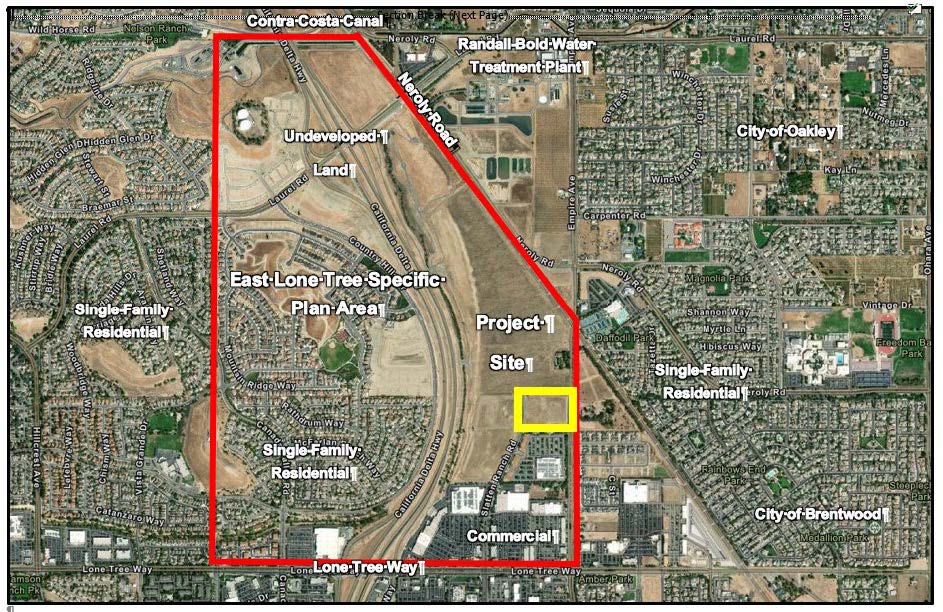
The expectations have been the Sand Creek area homes will attract business owners to Antioch to create local jobs and employ residents in the 200-acre East Lone Tree Specific Plan area off Laurel Road near the J.C. Penney store, and allow them to escape the commutes on Highway 4 and Vasco Road. Only four more potential developments on the west side of Deer Valley Road including the Richland Communities-Leung, Zeka Ranch and Oak Hill Park LLC/Richfield-Bridle Hills projects, and one on the east side, referred to as the Chen property, located south of the Kaiser Antioch Medical Center and west of Dozier-Libbey Medical High School, are remaining to be submitted, processed and/or approved.
In addition, two more new single-family housing projects on Somersville Road, known as Rialto Place, and on James Donlon Blvd., known as Sorrento Village, are also in process, and would probably be approved before an ordinance is adopted. That would leave mostly in-fill, single-family housing and multi-family housing projects throughout the city to which an ordinance would apply. Those include five of the 10 Commercial Infill Housing Overlay District affordable apartment projects and multiple other projects, including the currently on-hold Rancho Meadows on the north side of Antioch, that have yet to be built, as well. (See related articles here and here)
Followingan hour of the staff presentation and public input, mostly by representatives of out-of-town organizations and a few residents in support, and opposition from one resident, the council then took up the matter for another hour asking questions of staff and the consultant and discussing it before the vote. (See council meeting video beginning at the 5:27:30 mark)
Council Questions, Discussion & Comments
District 2 Councilman Louie Rocha asked if the IHO would apply to developments already approved. Planning Manager Zoe Merideth responded, “This would be for new development moving forward.”
Asked by Mayor Ron Bernal about the point in time when the ordinance would be applicable to a new housing project, she responded, “It would generally be deemed complete also under SB330 if you file a complete preliminary development application, that vests your rights at the time…which are most housing projects at this point.”
Torres-Walker, referring to the comments of local homeless and affordable housing advocate Andrew Becker, was concerned “the ordinance would essentially do nothing based on the developments that are currently in the pipeline.”
“Is it a paperweight?” she asked.
“No,” was the reply from Greg Goodfellow, Associate Principal for PlaceWorks, the consulting firm that helped develop the City’s proposed IHO. “The big picture for me, here is to think of the IHO as one tool in such a large shed of tools for affordable housing.”
“I don’t do things to be symbolic. I want this to mean something,” the councilwoman said.
“My point is it’s not going to do everything,” Goodfellow responded.
Source: City of Antioch
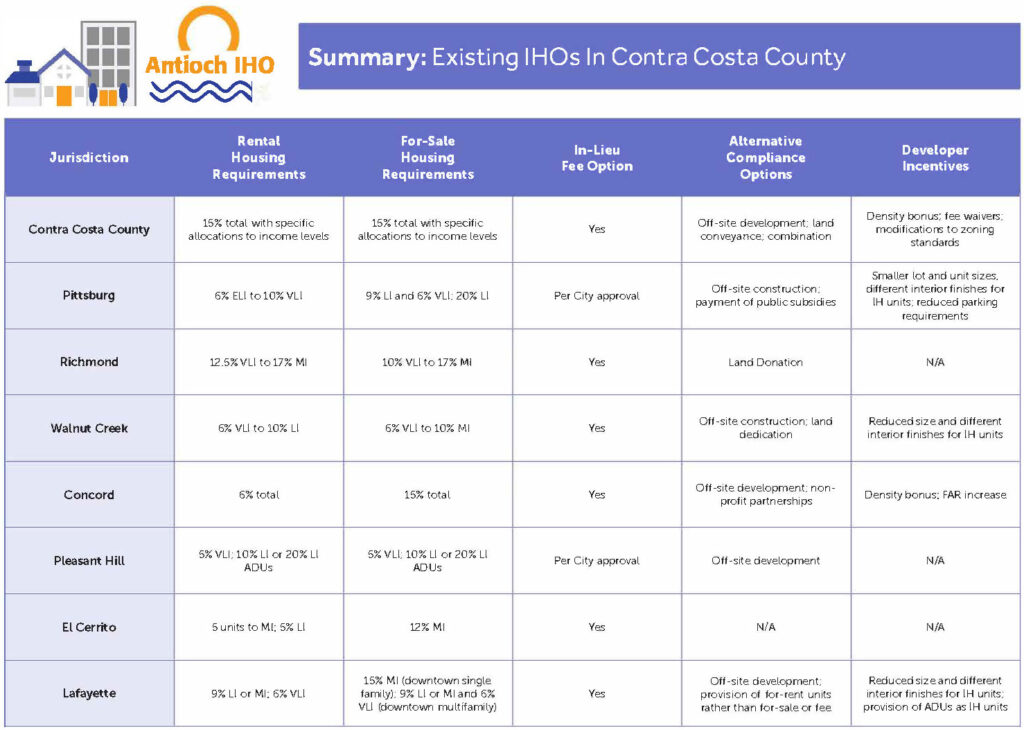
Mayor Pro Tem Freitas then asked about the chart staff provided in their presentation showing that “there are only seven cities listed” that have IHO’s and that most had much lower percentages than the 15 percent recommended by staff and 20 percent requested by some members of the public and organization representatives.
“That’s not all of them. Those were just examples,” the consultant stated. “I don’t know the exact number. I’m sorry.”
Freitas then mentioned, “The City would have to hire three to six individuals to oversee this,” and the fact the City is facing deficits this and next year. “Where would we get the money?” he asked. “Would we get it out of the (IHO) Trust? The Trust can’t pay those fees?”
“No,” Goodfellow responded. “This IHO…could be taken care of with the leadership of existing staff.”
Part of the costs of the annual review for the program would be covered by developer fees Merideth explained.
A discussion over adequate staffing for all housing programs in the city ensued.
Freitas then asked about the need outlined on page 8 of the staff report for “additional building height” to accommodate density increases “required to make rental projects feasible” and “potential parking regulation exemptions.”
“What concerns me is engineering says, even if you approve this project, you are at Level F for traffic. That’s gridlock,” the councilman stated. He was referring to, according to the U.S. Department of Transportation, the Level of service for traffic flow, which measures automobile congestion and travel time delay, on a scale of A, which is the best, to F, which is the worst.
“I’m concerned that the qualify of life in Antioch will deteriorate,” Freitas added. “The citizens of Antioch I know, they don’t want to have high-density, three- and four-story buildings. They don’t.”
“Antioch, historically, since I was born here, has always been a haven for affordable housing,” he continued. “Yes, I know it’s screwed up, now. But is it going to help us or hurt us?”
“We are now going to be doing the General Plan, number one,” Freitas stated. “Number two, we do have Senate Bill 300, Senate Bill 330 and now we have a proposal on inclusionary housing. We need to take a comprehensive view of how all these things are going to impact our community and to do this piecemeal is wrong.”
“The reality is, we do have an issue of affordability,” he said. “My feeling is, this is not the place, tonight to make that decision. Our legal requirement is to do the study. We have fulfilled that. But I believe we fold it in to the General Plan review.”
“I want staff to tell me how are we going to oversee this. How are we going to implement this. We have no plan,” Freitas continued. “It’s just a policy, let’s do it, let’s put it in. That’s irresponsible as far as I’m concerned.”
“It’s an amazing study,” he said. “I just think it would be wrong to approve this tonight.”
Freitas Says Ordinance Shouldn’t Apply to Sand Creek Area Developments
“The other problem to me is….quote, unquote, it is citywide,” Freitas said about another of his concerns with the ordinance. “I spent three years of my life doing the last General Plan (which was adopted in 2003 when he previously served as mayor)…and we consciously made a decision that there are parts of our community we don’t want high rises, we don’t want high-density. We want executive housing primarily in the area which was Urban Area number one, the Sand Creek Area. I don’t think this should be applied citywide.”
“We need to make some qualitative judgments and some areas I don’t think it should apply,” he reiterated. “Because I think cities want the whole gamut…from executive housing to absolutely affordable housing.”
“I guess I’m frustrated with this. I think it’s the wrong approach. I think we need to delay this,” Freitas stated. “I think we need to fold it into the General Plan and do a much better job of how we’re going to pay for this because it’s not here. Reading this report scares me more than anything with how we’re going to financially do it and the exemptions that are being called out.”
“Thank you for letting me rant and rave,” he concluded to laughter from Torres-Walker and others. “I’m OK. I feel good,” he said with a smile on his face.
Torres-Walker States Her Support
The District 1 councilwoman then said, “I support this. I always have. Antioch…is still the most affordable place in the East Bay and if we don’t keep it affordable then it won’t be. I know there is definitely NIMBYism (Not In My Back Yard) that exists in the city. I know there are places people do not want this kind of housing and we have to figure things out. I think this is important.”
Then speaking of the staffing issue to support the proposed IHO and City’s other housing programs Torres-Walker concluded, “I don’t think residents who are trying to afford to live in Antioch should have to suffer because we haven’t figured out our institutional challenges.”
Wilson Supports Inclusionary Housing “Whenever” Council Votes
District 4 Councilwoman Monica Wilson spoke next saying about Torres-Walker’s comments, “a lot of it I agree with.” Then to Freitas she said, “I get your frustration…but on the other hand we need affordable housing. I hear about people who are either couch surfing, living in their homes, living on the street and they have a job. We need to do something. I get we need to have a plan with programs that are going to work, be successful and be maintainable. We need to do something for housing to be affordable.”
“I support this. Regardless, if we vote on it today or whenever, I’m in support of inclusionary housing,” Wilson concluded.
Rocha Supports “the Concept” But Approving it Now Would be “Winging It”
Rocha spoke next saying, “I support the concept all along. But I have more questions and concerns about…how we do it right, how we structure it.”
“So, if we’re going to vote tonight, my answer would be ‘no’,” he stated. “If we’re going to have staff look at it, get some feedback to look at how we can make it feasible, workable for us, with staffing, with all of the questions that have come up, then I can consider that.”
“Looking at this, tonight, I can’t support this vote, tonight based on so many questions and concerns,” Rocha continued. “Otherwise, I think we’re just winging it.”
Freitas then said, “I’m generally supportive, but, you know, we have to do it right. We all support affordability. In my opinion, this is too critical to screw up.”
Staff Says General Plan Update Will Take “Two to Three Years”
Torres-Walker then asked staff, “How long is it going to take to finish the General Plan?”
Interim Community Development and Economic Development Director David Storer responded, “We’re saying anywhere from two to three years depending on the process.”
Bernal Also Supports Including IHO with General Plan Process
Mayor Bernal then weighed in saying, “My biggest concern with this…is the fact that we’ve been thrown for a loop when it comes to the housing legislation that has come out of Sacramento. We’ve only had two projects approved, we have eight or 10 in the pipeline. We have three-story units going up right in the back of residential on Golf Course Road which is going to be a nightmare firestorm.” He was referring to the Joyfield at Lakeview Center Apartments for extremely-low, very-low and low-income residents.
“So, we don’t even know the impacts of current legislation on our city let alone adding one more moving part to it that’s just going to complicate things,” the mayor continued. “The other part of this, and I keep harping on it, is we need to get our budget under control…in order to know where we’re headed as a city, how we’re going to afford to pay for things like extra staffing.”
“The other thing that has always frustrated me is RHNA (Regional Housing Needs Allocation) numbers are just dumped on us,” Bernal stated. “We’re going after these arbitrary numbers that a group in the larger Bay Area (speaking of MTC & ABAG) has come up with and I don’t know if that’s what’s best for our community.”
“I know it’s what we’re mandated to do but I don’t know if that’s best for our community. That’s where the General Plan comes in and I think that folding this in with the General Plan process…,” concurring with Freitas. “Because what the General Plan process is going to do is tell us how many units we have left in our 25-year building sphere that we’re going to be building, that then we would know how many units we’re going to get out of this. Right now, there isn’t any certainty of that.”
“My point is I think there are a lot more questions than there are answers,” he continued. “I think there are a lot of moving parts, right now, when it comes to Sacramento, development and how it’s going to impact Antioch with so much vacant land and so much residential opportunity, and I just think this would add one more element of complication to it.”
“So, I’m not going to be supportive of moving it to a date certain…because I don’t see the benefit or the purpose of it,” Bernal concluded.
Housing in Land Use Element of General Plan Update Could Be Done in “a Year or So”
Freitas then confirmed with Storer, that the first of seven issues to be dealt with during the General Plan Update is the Land Use Element, which includes housing policy, and said, “Some of the questions we’re all asking…I think we could move that forward…we could bring back the IHO within a year or so for action.”
Bernal then advocated to “bring it back organically when it’s time.”
Freitas then asked City Manager Bessie Scott, “Does the city manager want to offer any words of wisdom?” to which she simply replied, “Um, no,” to laughter from the council members and those still in the audience as it was after 11:50 p.m.
“That’s called a wise city manager,” Bernal stated in jest.
Freitas then made the motion to move the item off-calendar, “with the understanding that the General Plan will prioritize this entire discussion.” Rocha seconded the motion and it passed 4-1 with Torres-Walker voting “no”.
Proposed Plan for housing, transportation, the economy and environment in the nine counties will go to committee for review on Friday, March 13
Offers strategies, investments and outcomes for Contra Costa County
By John Goodwin, Assistant Director of Communications & Leslie Lara-Enríquez Assistant Director, Public Engagement, Metropolitan Transportation Commission
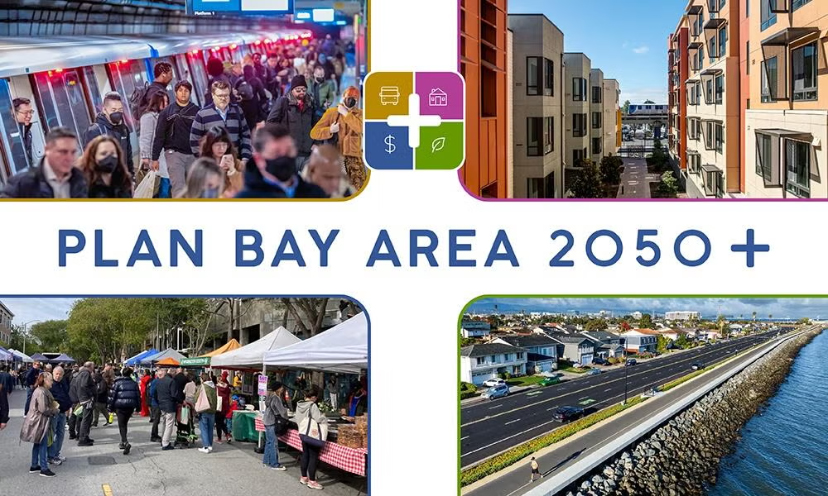
Plan Bay Area 2050+ is the latest long-range plan to guide growth and investment across the region’s nine counties and 101 cities. The plan seeks to advance an integrated vision for a Bay Area that is affordable, connected, diverse, healthy and vibrant for all by 2050. It focuses on the four areas of housing, transportation, the economy and environment.
The Contra Costa Centre Transit Village. Photo credit: Karl Nielsen
The plan and its related reports will be presented for review and consideration at a joint meeting of the MTC Planning Committee with the ABAG Administrative Committee on Friday, March 13, before the documents are referred to their respective approving bodies. The ABAG Executive Board will consider certification of the Final EIR and adoption of the final plan at its March 19 meeting. At its March 25 meeting, MTC will consider certifying the Final EIR and adopting the final plan, as well as adopting the accompanying Air Quality Conformity Analysis and an amendment to the 2025 Transportation Improvement Program.
The release of the proposed final Plan Bay Area 2050+ follows a 59-day public comment period for the Draft Plan and the Draft EIR that closed on December 18, 2025. The proposed final plan and Final EIR have been updated to reflect feedback received during the public comment period.
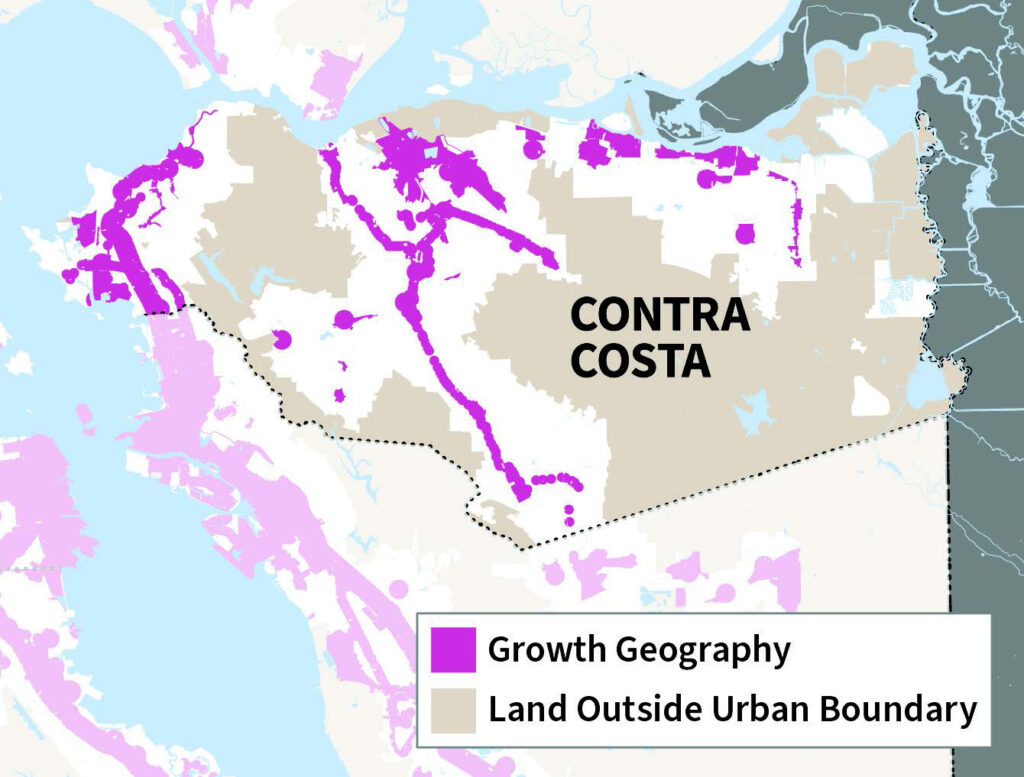
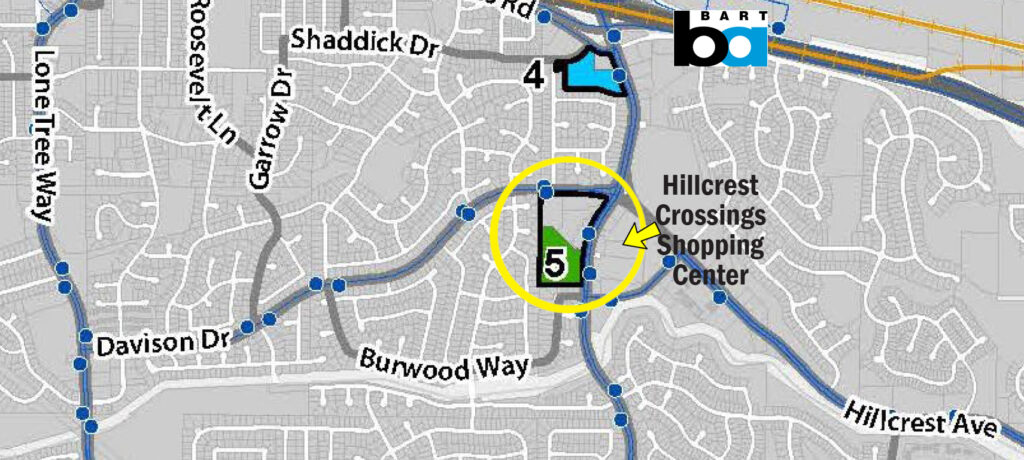
The map above shows Contra Costa County’s Growth Geographies, which are areas identified in Plan Bay Area 2050+ to help guide future housing and job growth. These areas are designated by local jurisdictions or based on their proximity to transit and access to opportunity. Source: MTG/ABAG
The Plan includes Partner Resources: Regional Tools for Local Action that local jurisdictions and partner agencies can use to develop plans, seek funding and take action to make a better Bay Area. It offers a fact sheet for each county, including Contra Costa, which spotlights strategies, investments and outcomes.
Plan Bay Area 2050+ is the latest long-range regional plan for the nine-county Bay Area. The plan lays out a series of funding and policy strategies that can create a more affordable, connected, diverse, healthy and vibrant future for all Bay Area residents in 2050. Unique to this plan cycle is the parallel Transit 2050+ planning effort, which culminated in the first-of-its-kind plan to re-envision the future of Bay Area public transit, in partnership with transit agencies across the region.
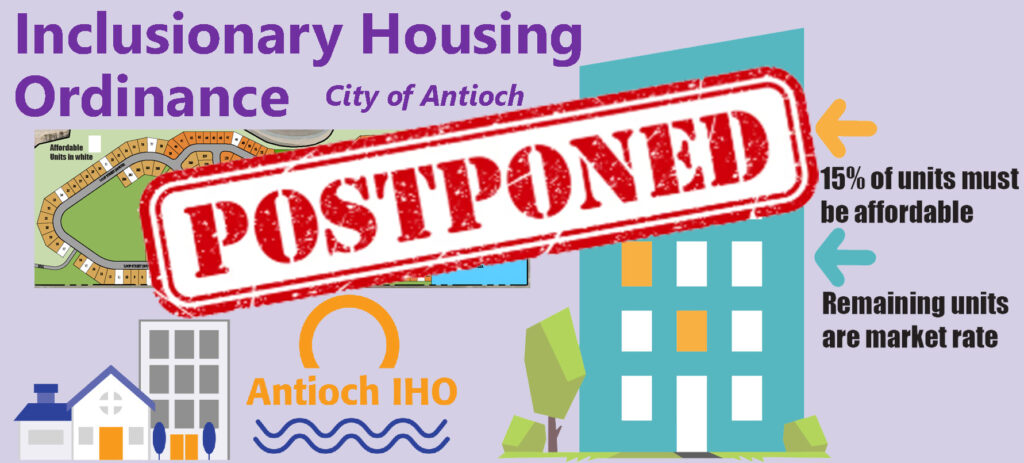
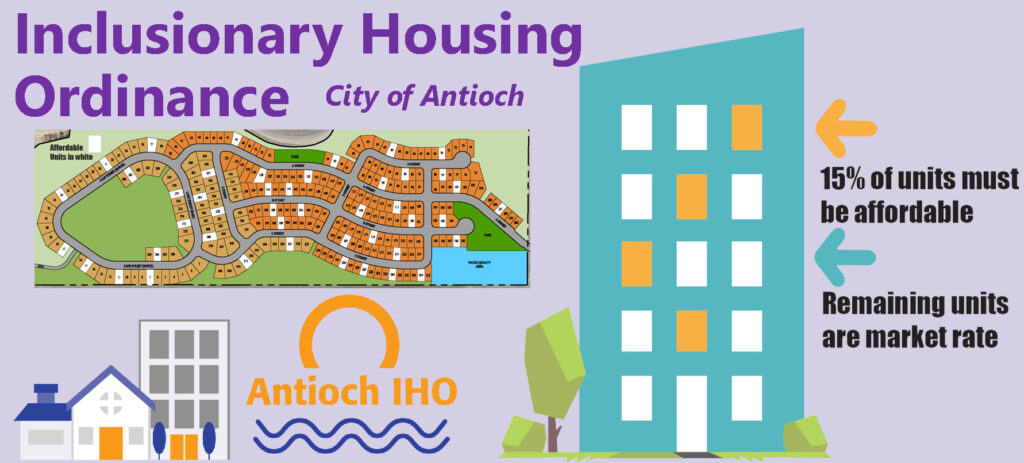
Inclusionary Housing Ordinance will require developers to privately-subsidize housing bysetting aside 15% of new units for low-income buyers/residents or pay a $200K per unit fee
Will also establish affordable Inclusionary Housing Trust Fund requiring more City staff
Building Industry says ordinance not state required, will have opposite effect
“The higher the inclusionary requirement, the fewer market-rate homes are constructed” – UC Berkeley, UCLA joint study
Participants might not be allowed to keep increase in equity, but share it with City instead
By Allen D. Payton
During their meeting tomorrow night, Tuesday, March 10, 2026, the Antioch City Council will require new home developers to set aside 15% of housing units for Very Low-Income, Low-Income, and Moderate Income households. Although it’s not required by the state and opposed by the Building Industry Association of the Bay Area, on February 4, 2026, the Planning Commission voted 4-0, with two members absent, to recommend the City Council adopt an Inclusionary Housing Ordinance (IHO). The IHO would apply to both single-family homes and both for rent and for sale multi-family projects.
Antioch would be only the eighth city out of 19 to approve such an ordinance.
Program Participants Might Not Get to Keep Equity Growth or Must Share it With City
The lower-income homebuyers who would participate in and benefit by the program would be able to purchase the same home as their neighbors but at a much lower price. Yet, when they sell the home, they might only be allowed to keep the amount of their original downpayment but not receive any of the increase in equity as the home must be resold to another buyer who qualifies, whenever the sale occurs “in perpetuity”. The other option would be the seller would have to share the increase in equity with the City.
Section 3.3 DISPOSITION REQUIREMENTS of the Financial Feasibility Analysis for the ordinance reads:
“An inclusionary ordinance will likely require that households purchasing an affordable unit qualify based
on income and that the sales price qualify as affordable to that household. The program will also have to identify what restriction, if any, will be applied to future resales of these affordable units. Different state and federal programs have different requirements.
We recommend that the city’s ordinance restrict future resales so that the purchasing household also be income-qualified and the sales price represents an affordable housing payment for the purchasing household. We further recommend that this restriction be enforced by a deed restriction for a period of 45 years. This would be consistent with some federal affordable housing programs, but it is worth noting that it is unlikely that federal funding would be involved with mixed-income inclusionary housing projects.
As an alternative, Antioch could consider using provisions similar to the State Density Bonus Law. The original purchaser would still have to be income-qualified and the sales price would have to be qualified as affordable to the purchasing household. The purchasing household would not be restricted from selling the property in the future at then market-rates or to selling to households that are not qualified as low income. However, there would be an equity sharing agreement, and the city would receive the amount of the original sales price write-down and a proportional share of any appreciation in value. Antioch could then use its share of the sales price to support other affordable housing projects and programs.”
However, the proposed ordinance in Section 9-5.4308 – Ongoing Affordability and Occupancy reads, “A. Ongoing Affordability of For-Sale Units. In order to maintain the availability of For-Sale Inclusionary Units constructed pursuant to this Article, the affordable sales prices of for-sale Inclusionary Units shall be restricted in perpetuity, and reset upon resale of the unit(s), as documented through an Inclusionary Housing Agreement, as prescribed in Section 9-5.4305.F, recorded against the property.”
Program Details, Previous Findings Stated Antioch IHO “Not Warranted…Not Reasonable”
According to the City staff report for the agenda item, #8, an IHO is a zoning tool that requires developers to allocate a percentage of housing units in market-rate developments as “affordable”, or below-market rate (BMR) units. Many HOs include the option of paying a fee (“in-lieu” fee) rather than building the required affordable units onsite.
Inclusionary ordinances require that a specific percentage of units in market-rate development projects be offered at below market rates, typically to Very Low-Income (VLI), Low-Income (LI), and Moderate Income (MI) households (see below for definitions). These percentages are known as inclusionary requirements.
Developers would be given the option to instead pay an in-lieu fee, which is proposed at $202,500 per unit, and the City would collect the fees and be deposited into an Inclusionary Housing Trust Fund (IHTF) to be used for affordable housing purposes. The purpose of the IHTF is to assist in the creation and preservation of affordable housing in the City of Antioch for the benefit of extremely low, very low, low and moderate-income households.
The staff report also explained that Antioch has considered adopting an IHO since approximately 2009. Past City leadership concluded that market rate housing in Antioch was already adequately affordable. In 2016, the Contra Costa Grand Jury released a report titled Where Will We Live: The Affordable Housing Waiting List Is Closed. The report recommended that Antioch should consider adopting an IHO. The City responded to this recommendation on August 9, 2016, stating that the City, assuming 2000-2009 home values, “already provides a diversity of housing options and is accessible to households of all income levels…” Therefore, an IHO was “not warranted and is not reasonable.”
IHO Income Levels
The Area Median Income (AMI) per household in Contra Costa County is $159,800. The three categories of affordable housing typically accommodated in IHOs are:
Very Low-Income (VLI) Housing. Units affordable to households earning 0-50% of the Area Median Income (AMI).
Low-Income (LI) Housing. Units affordable to households earning 51-80% of AMI.
Moderate Income (MI) Housing. Units affordable to households earning 80-120% of AMI.
The State also recognizes Above-Moderate Income Housing, which are units affordable to households earning more than 120% of AMI. However, this affordability level is not provided for in IHOs.
Proposed Ordinance Applies Citywide Including New Sand Creek Area Subdivisions
The proposed City of Antioch Inclusionary Housing Ordinance is composed of the following basic regulations:
Applicable Geography. The proposed IHO requirements apply to Residential Development Projects citywide.
Affordability Term. The proposed IHO requires all BMR units to be affordable in perpetuity.
Threshold Project Size. The proposed IHO requirements apply to all Residential Development Projects consisting of five or more units.
Income and Affordability Requirements. As proposed, 15 percent of all new Residential Development Projects shall be affordable to VLI and LI incomes.
Specifically:
Ten percent of the BMR units shall be affordable to VLI households.
Five percent of the BMR units shall be affordable to LI households.
The first BMR unit shall be affordable to VLI households, the second unit shall be affordable to LI households, and so forth for all the BMR units in the project.
Affordability Standards. The proposed IHO includes standards to ensure that affordable units are of the same quality as Market Rate Units. Per the IHO, all affordable units shall:
Be built in the same proportion as the Market Rate Units.
Have an average square footage of at least 90 percent of Market Rate Units with the same bedroom count.
Be developed with the same bedroom count ratio as the Market Rate Units.
Have the same quality of exterior design and overall quality of construction as the Market Rate Units.
Have the same quality and type of interior finishes and features as the Market Rate Units.
Meet all site, design, and construction standards included in the City’s Building Regulations, Planning and Zoning.
Only seven other cities out of 19 in the county, plus, the County have IHO’s. Source: City of Antioch
Planning Commission Recommendations
During the Feb. 4th Planning Commission meeting one member of the public opposed the IHO with six members of the public representing coalitions of housing advocates spoke in favor. A letter in support was submitted by Joey Flegel-Mishlove, East Bay Housing Organizations, on behalf of California Center for Movement Legal Services, Contra Costa Budget Justice Coalition, East Bay Alliance for a Sustainable Economy, East Bay Housing Organizations, Ensuring Opportunity Campaign to End Poverty in Contra Costa County, Hope Solutions, Lift Up Contra Costa County, Monument Impact, Multi-Faith ACTION Coalition, Public Advocates, Rising Juntos and United Latino Voices of Contra Costa County. They wanted to set “the IHO’s overall inclusionary rate at 20%.”
The Commission provided recommendations and requested that the City Attorney review them prior to the City Council reviewing the IHO including:
That the housing units created with the IHTF shall be prioritized for residents of Antioch.
However, the City Attorney responded, “the City of Antioch generally cannot lawfully adopt a broad resident-priority rule for assistance funded by inclusionary in-lieu fees, particularly for homebuyer subsidies. California law strongly protects statewide housing objectives and fair housing principles, and such a preference would likely conflict with those goals.”
That the IHO and IHTF gives preference to local unions.
But the City Attorney responded, “the City of Antioch cannot lawfully require private developers to give priority to union labor over non-union contractors on inclusionary housing projects. Such a requirement would first be preempted by federal law under the National Labor Relations Act (NLRA), which governs private-sector labor relations and occupies the field to the exclusion of most local regulation.”
Developers’ Share Concerns
According to the staff report, during a December 2024 workshop, local housing developers “stressed that the difficulty of qualifying for home loans may impede the function of an IHO. Per participants, lower income households in Contra Costa typically face severe economic barriers to mortgage qualification, including an adequate down payment. As such, requiring the construction of for-sale units for very low-income or low-income households may be an unproductive path toward privately subsidized affordable housing.”
Building Industry Says IHO’s Aren’t State Required, Don’t Work, Benefits “Lucky” Few
In a letter to the council members and commissioners for the study session during the Planning Commission meeting on April 16, 2025, the Eastern Division of the Building Industry Association of the Bay Area submitted a letter opposing the ordinance saying they aren’t required by the state and they don’t work, making the cost to build the market rate housing to high.
The letter reads, “the California Housing & Community Development staff informs us that no jurisdiction is required to study the feasibility of an inclusionary ordinance or adopt such a program as part of the housing element review process.”
The BIA letter also includes a policy brief published in 2019 and updated in 2021by the Mercatus Center at George Mason University which “found that none of the six major studies of inclusionary programs show that they increase the housing supply or lower prices. Instead, much of the research comes to the opposite conclusion: Except for a very small number of people lucky enough to secure one of the affordable units, inclusionary programs cause overall housing prices and rents to rise, further reducing affordability for everyone else.”
“‘Relying on new housing construction to provide subsidized units is not a strategy that can lead to more housing that’s affordable for more people,’ wrote research fellow Emily Hamilton. ‘In cases where inclusionary zoning raises house prices generally, the costs of the policy fall hardest on the lowest-income.’”
An IHO “improves housing affordability for a few at the risk of worsening affordability for many, and it taxes precisely the activity needed to ameliorate the housing shortage and bring down rents: development.”
The BIA letter also states, “a 15 percent inclusionary requirement is infeasible for all single-family large lot developments and only partially feasible for single-family small lot and townhome developments. On the rental side, only high-density multifamily projects are fully feasible for very low, low and moderate income households. The market for very dense rental housing in Antioch is limited, at best. Overall, adopting a 10 or 15 percent inclusionary requirement will result in fewer homes being built in Antioch.”
The BIA requests City “staff to work with the development industry on alternative incentive-based approaches.”
Local Real Estate Broker Says IHO “Unnecessary”, “Built on…Fundamentally Socialist Ideology…Failed Model”
In a letter to the Commission, local real estate broker, Mark Jordan wrote, “an inclusionary housing ordinance is unnecessary, unsupported by current case law, and of questionable constitutional validity. Adoption of this ordinance would expose the City to avoidable legal and financial risk.” His letter cited a successful lawsuit against City of East Palo Alto and as a result, “significantly modified its inclusionary housing ordinance” and possibly paid the man who sued that city.
In a previous email to the City Council dated Sept. 15, 2025, Jordan wrote, “Though rarely stated outright, the lnclusionary Housing Ordinance is built on a fundamentally socialist ideology-one that demands others pay the price for systemic outcomes beyond their control. But socialism, like Marxism, is a failed model. It doesn’t uplift communities; it burdens them and eventually collapses under its own weight.
“If life hasn’t turned out the way we want, the answer isn’t to demand others pay the price. The answer is to adapt, to work harder, to upskill, to disengage from distractions-and to pursue our own happiness through self-reliance.
“In closing, I urge you to table this ordinance. It is ill-timed, legally risky, economically unwise, and ideologically misguided.”
Antioch Housing Already Affordable, Hundreds of Units Already Approved or in Approval Process
The City is already meeting its Regional Housing Needs Allocation (RHNA) requirements for very low- and low-income housing. A total of 1,248 new housing units are required in those categories. Yet, as previously reported, over 2,000 apartment units have either been or can be approved by staff through the 10 Commercial Infill Housing Overlay Districts about by the City Council in 2022, many of which will be affordable, including in the extremely-low, very-low and low-income housing categories.
In addition, according to Redfin.com, “The housing market in Antioch, CA, is currently competitive, with homes selling for a median price of $603K. The market is somewhat competitive, with homes selling in about 40 days on average. The median sale price per square foot is $306, down 3.2% since last year. In December 2025, Antioch home prices were down 1.2%.”
Finally, according to Realtor.com, “The housing market in Contra Costa County, CA, presents a range of home values and prices. As of February 2026, the median price for a single-family home is $780,000, with a median AVM value of $801,000 for properties sold in the last year.” According to RocketMortgage.com, AVM value is “an estimated property value generated by an Automated Valuation Model using algorithms and real estate data.”
Questions for Mayor, Council Members
An email was sent to the mayor and four council members Monday afternoon, asking questions about the ordinance:
They were asked, “since it’s not required by state law why do you feel an IHO is necessary in Antioch, since our city is already going to have at least five if not 10 more affordable housing apartment complexes as part of the Commercial Infill Housing Overlay Districts?”
They were also asked, “why does the proposed ordinance apply citywide and therefore include the remaining Sand Creek Focus Area developments that have yet to be approved, when those homes have long been intended to be the more upscale, higher priced homes for that end of our housing mix?”
Finally, they were asked, “why use this option to achieve the RHNA requirements when Antioch homes are less expensive than the average throughout the county?”
No responses were received to the email and further efforts to contact each of the council members were unsuccessful prior to publication time. Please check back later for any updates to this report.
Council Meeting Details
The Council meeting begins with a Closed Session at 4:30 p.m. for a Conference with legal counsel regarding “significant exposure to litigation.”
That will be followed at 5:00 p.m. for a Special Meeting/Study Session on the fiscal year 2026-27 budget and an update on the Code Enforcement Division’s progress and operations.
The regular meeting will begin at 7:00 p.m. The latter two meetings will be held in the Council Chambers at 200 H Street, or can be viewed via livestream on the City’s website or on Comcast cable TV channel 24 or AT&T U-verse channel 99.
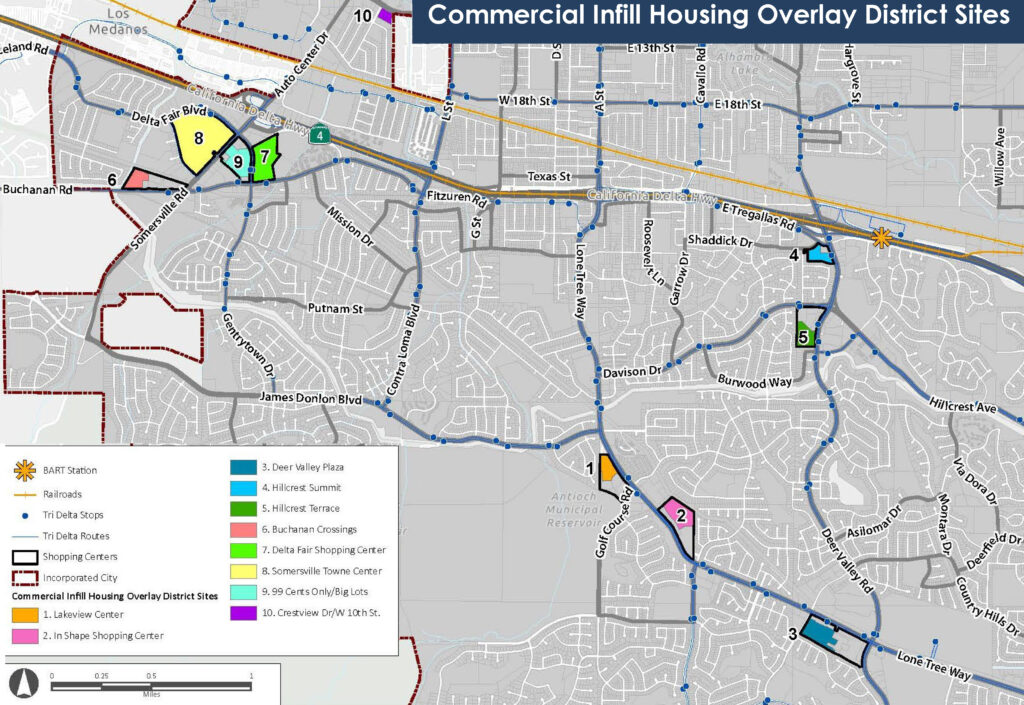
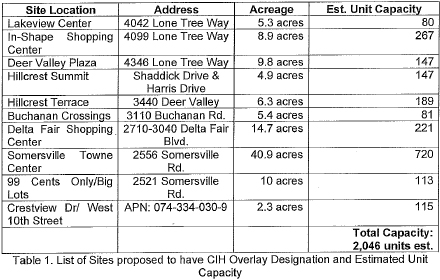
Commercial Infill Housing Overlay District Sites Map shows the 10 parcels rezoned in 2022. Source: City of Antioch
No Planning Commission, Council decisions or public input required due to Council votes in 2022 to rezone 10 commercial properties to include Extremely Low, Very Low and Low-Incomehousing and mixed-use development; not state required
By Allen D. Payton
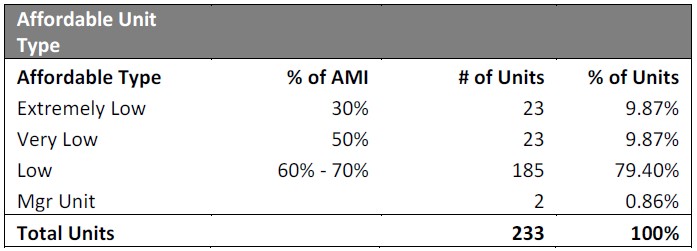
It’s been over 20 years since the residents who live near the Antioch golf course rose up in 2004 and successfully defeated a proposed apartment complex on Blue Rock Drive on the north side of Lone Tree Way. Yet Antioch City staff have “Approved, Administratively” an Extremely Low, Very Low and Low-Income, 233-unit apartment complex on the south side of Lone Tree Way next to the CVS store and shopping center without any public hearings before the Planning Commission or City Council.
But it’s only one of 10 sites throughout the city where the same conversion from commercial zoning to residential development can occur due to multiple votes by the City Council in 2022 where almost 2,500 affordable apartments can be built. Over 2,000 units only require city staff approval. Currently, four of the 10 sites have projects in process and have already been approved by staff, including the largest project, the 702-unit Somersville Town Center apartment complex.
That’s because higher density residential is allowed by right under the Regional Commercial land use designation of the General Plan due to a 2022 amendment to the General Plan Use Element (GP22-01), approved by the City Council, that added a “Commercial Infill Housing Policy.” Pursuant to this policy, the Council designated the various sites with a Commercial Infill Housing (“CIH”) overlay.
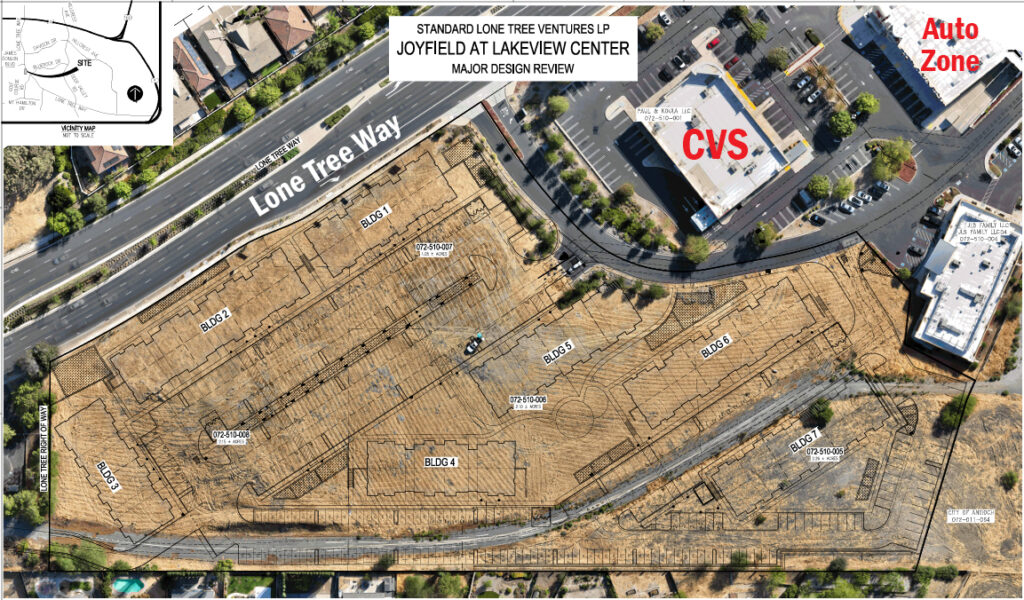
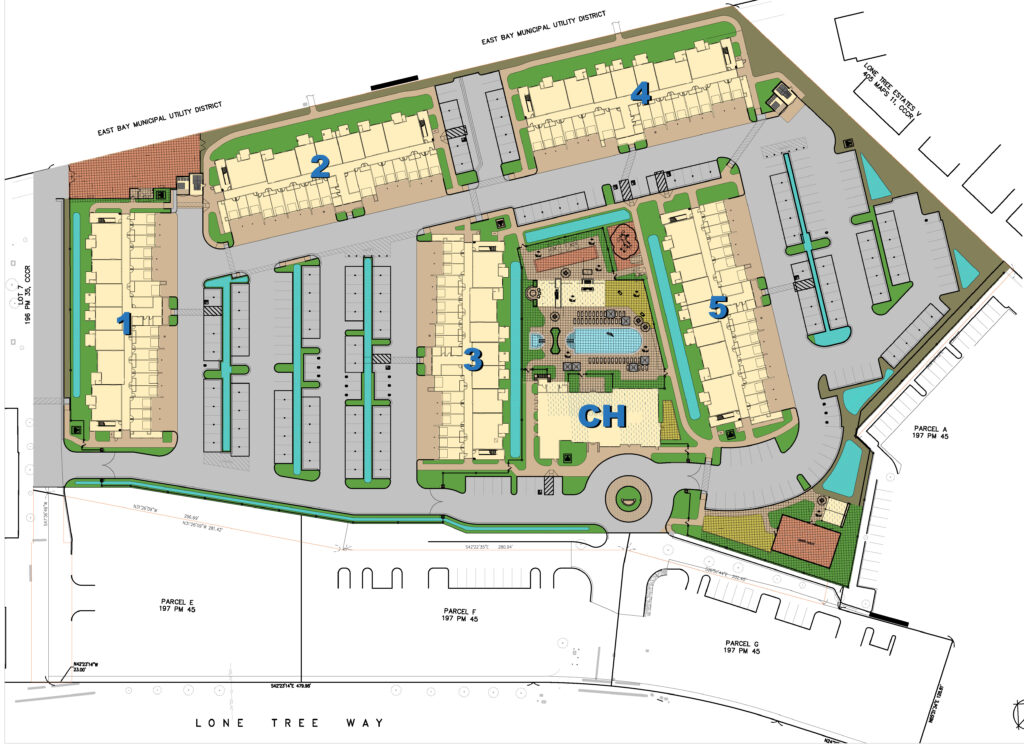
Aerial photo of site of the administratively approved Joyfield at Lakeview Center Apartments on Lone Tree Way near Golf Course Road behind the CVS store. Source: City of Antioch. Labels by the Herald
As part of the strategic infill housing study process in 2022, the specific sites within Antioch were rezoned to allow for the streamlined development of medium- and high-density residential and mixed-use projects. These infill sites are typically vacant and / or underutilized commercial areas of the City.
According to the City staff report for the City Council meeting agenda item on April 12, 2022, “The intent with this policy is to encourage revitalization in commercial developments that have commercial vacancies and relocation of commercial activity to other parts of the city. These sites are eligible for streamlined review subject to compliance with objective standards. This fulfills the need to add more housing through the building of medium and high-density housing and allows for existing commercial sites to be developed with high quality residential development.”
Unanimous Council Votes in Favor of Rezoning
During that meeting, the council voted unanimously through five separate motions to approve the Zoning Map Amendments and Rezone the 10 sites to include a CIH Overlay District designation, an addendum to the 2003 General Plan Environmental Impact Report, the General Plan Amendment, establishing Commercial In-Fill Housing Policies in the Land Use Element, the project’s Objective Design Standards and other administrative requirements to implement the changes.
Nine sites are currently developed with existing commercial uses, requiring demolition, and vary in size from 4.9 to 40.9 acres. One site, located at the southeast corner of Crestview Drive and W. 10th Street, is vacant and is 2.3 acres.
The 10 sites rezoned by the City Council are labeled as:
Lakeview Center – Estimated Units: 80. Actual: 233 See below.
In-Shape Shopping Center – Estimated Units: 267. Actual: 245 See below.
Deer Valley Plaza – Location of former AMC theaters building and parking lot. Estimated Units: 147. No plans yet submitted.
Hillcrest Summit – Estimated Units: 147. Actual: 165 See below.
Hillcrest Terrace – on Deer Valley Road next to McDonald’s, across from Safeway and the Hillcrest Crossings shopping center. Estimated Units: 189. Actual: 165 No plans yet submitted.(Owned by the Antioch Unified School District).
Buchanan Crossings – Estimated Units: 81. Actual: 195 See below.
Delta Fair Shopping Center – Estimated Units: 221 Submitted: 210 Withdrawn See below.
Somersville Towne Center – Estimated Units: 720. Actual: 702 See below.
99 Cents Only/Big Lots shopping center – on Somersville Road. Estimated Units: 113. No plans yet submitted.
Crestview Drive/W. 10th Street – empty lot near Enterprise Rent-A-Car. Estimated Units: 115. No plans yet submitted.
Votes, including two split, on individual sites occurred as follows:
On Nov. 22, 2022, the council voted to rezone and include in CIH Overlay Districts for both the Lakeview Center (Ayes: Ogorchock, Wilson, Barbanica, Thorpe; Noes: Torres-Walker) and Buchanan Crossings (Ayes: Ogorchock, Wilson, Thorpe; Noes: Torres-Walker, Barbanica recused himself) and on Dec. 13, 2022, the council unanimously approved them during the second reading as part of the Consent Calendar.
City of Antioch Principal Planner Kevin Scudero was asked about those votes and when the other eight sites were rezoned and included in CIH Overlay Districts by the City Council. He responded, “The City Council adopted the CIH Overlay on April 12, 2022. The Lakeview Center and Buchanan Crossings parcels were part of the original approval but there was an error in processing and some parcels within the center that were intended to be included were left out of the ordinance. The action on November 22, 2022, was a cleanup to add in the parcels that were mistakenly left off of the original approval.”
Asked if any additional parcels been added to the list of 10, Scudero responded, “No parcels have been added.”
Not State Required
Although the City was awarded $310,000 in SB 2 The Building Homes and Jobs Act grant funding to study feasibility of providing infill, high-density residential development on underutilized and vacant commercial sites, the rezoning was not required by state mandate.
No Additional Commission or Council Meetings with Public Input Required
Once a site has a CIH overlay, residential development is a permitted use under the General Plan. Furthermore, the entitlement process for a residential development within the CIH Overlay is ministerialprovided the proposed project is consistent with the applicable CIH Overlay District Objective Design Standards. That means no additional Planning Commission or City Council hearings with public input are required.
So, instead of future potential commercial and employment areas as the City grows south into the Sand Creek Focus Area, the designated properties will now be used to build over 2,000 apartments and townhomes. Since the change in 2022, developers have been submitting applications to build on many of the sites.
Following are the projects on the City’s Community Development Department, Planning Division’s Current Projects webpage:
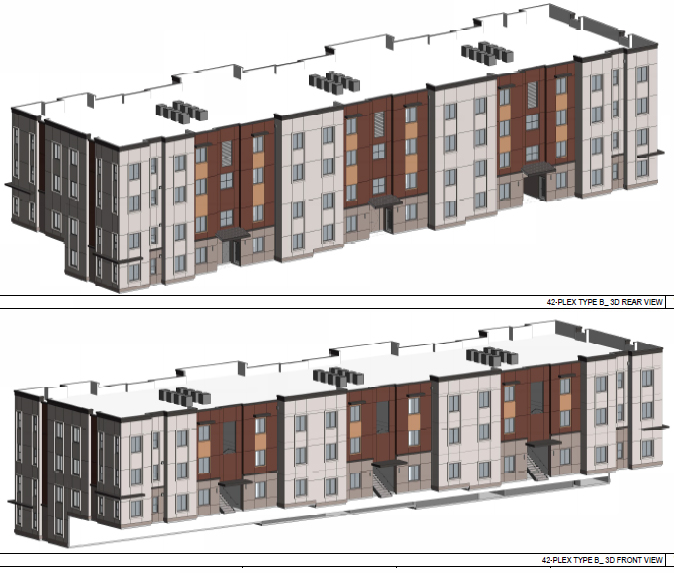
Joyfield at Lakeview Center Apartments read and front views. Source: City of Antioch
233-Unit Extremely Low, Very Low and Low-Income Lakeview Center ApartmentsNear Golf Course Road
Labeled “Lakeview Center Multi-family”, it’s described as “Commercial Infill Housing, Administrative Design Review Request for a Multi-family development with 233 affordable units.”
Currently, the General Plan designations for the four parcels on 7.56 acres are Office, Neighborhood Community Commercial or both and each has a CIH overlay zoning. The project has been “Approved, Administratively.”
Source: City of Antioch
Development plans show seven new 3- and 4-story buildings included in the project by Los Angeles-based Standard Communities. The Project will include 350 on-grade parking stalls, community amenities, and site landscaping. The apartments will be single level and arranged in a “stacked flat” configuration. Each unit will be accessed through stairways with direct access to the parking areas. There will be 109 one-bedroom 607 s.f. units, 58 two-bedroom 793 s.f. units and 66 three-bedroom 1,008 s.f. units included.
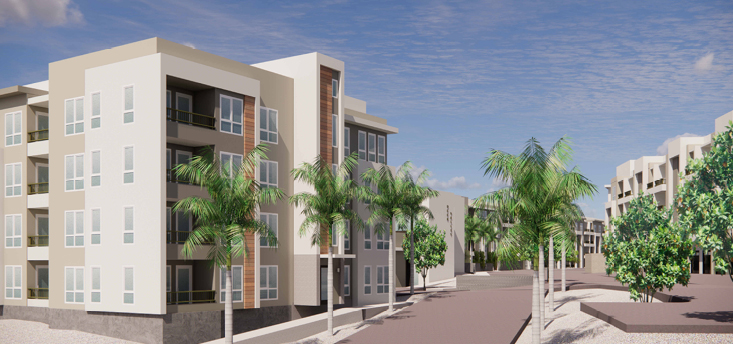
The architectural style for the Project is “California Contemporary,” simple, and sophisticated. The amenity building is located at the center of the Project and includes a leasing center, clubhouse, business center, fitness center and laundry. The indoor amenity areas will connect to the landscaped courtyard which will include a BBQ area, lounge seating and tot lot. The Project will also have a dog park.
Site map for the Lone Tree Apartments near In-Shape health club. Source: City of Antioch
245-Unit Lone Tree Apartments at In-Shape Shopping Center
The Lone Tree Way Apartments project, proposed by The Spanos Corporation of Stockton, sits on 8.93 acres in Antioch, located between Bluerock Drive and Eagleridge Drive near the In Shape health club. The project, submitted in May 2023, and also “Approved, Administratively”, consists of 245 apartment units within (5) 49-plex, 4 story buildings as well as a stand-alone 2-story community clubhouse (approximately 9,400 SF). Each building is served by an elevator with interior-conditioned corridors. Units will range from 477 SF studios to 1,047 SF 2-bedrooms.
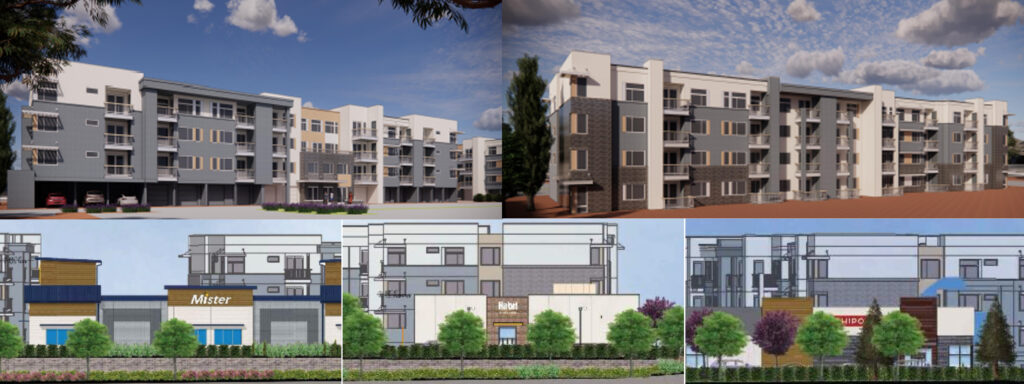
Renderings of the administratively approved Lone Tree Apartments near In-Shape and graphics showing the businesses approved by the city council last year. Source: City of Antioch
Each unit will include washer/dryer, private balcony, and luxury interior finishes. Located centrally within each building will be a pet spa and bicycle café. The community clubhouse will include a leasing center, great room, fitness center, mail and parcel room, game room, theater, sports simulator, rooftop deck and more. Outdoor amenities will include a pool, spa, cabana, fire pit, bocce ball, tot lot, dog park and pickle ball court.
Last year, a commercial project was approved to be located in front of the apartment complex, along Lone Tree Way, which will include a Chipotle Mexican Grill, Habit Burger & Grill and Mister car wash.
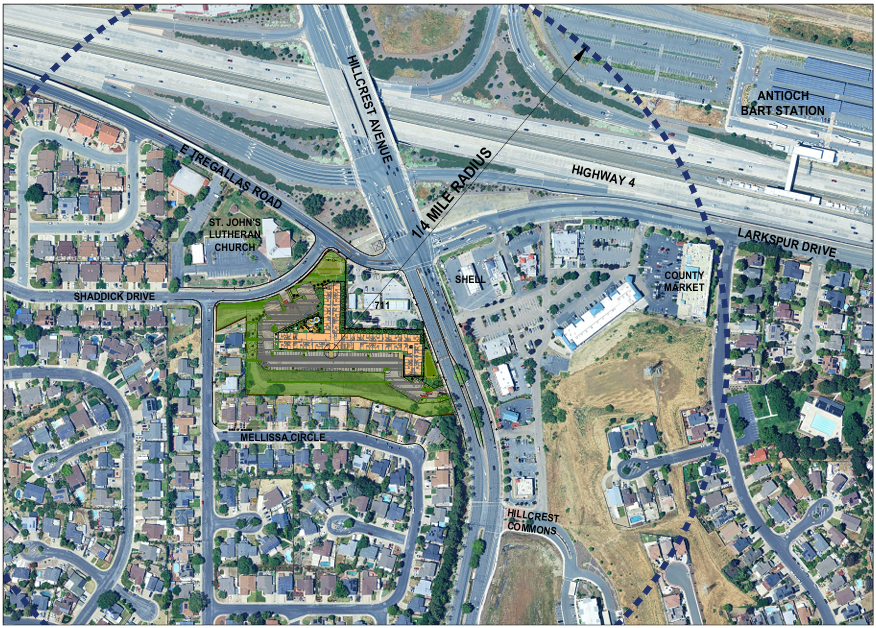
Hillcrest Summit Apartments Location Map. Source: City of Antioch
165-Unit Hillcrest Summit Apartments
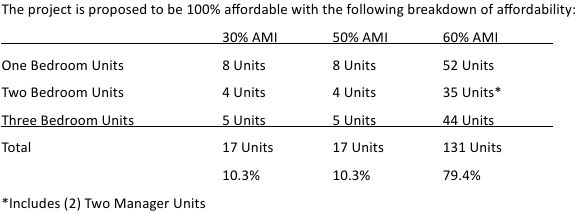
Administrative review for a 165-unit, 100% affordable apartment development, complete with associated parking and site improvements on a Commercial Infill Housing site also “Approved, Administratively”.
Hillcrest Summit Apartments is a proposed 100% affordable apartment project at Hillcrest Avenue and Shaddick Drive on a vacant site behind the 76 Service Station and 7-Eleven. Effective May 26, 2022, the property was included in the Commercial Infill Housing (CIH) Overlay District. The new zoning classification allows for by-right housing development for projects in compliance with Objective Design Standards.
Hillcrest Summit Apartments AMI figures. Source: City of Antioch
In accordance with the purpose of the CIH Overlay District, the project aims to revitalize the underutilized commercial site and increase the city’s housing supply. The convenient location is less than a half-mile from the Antioch BART Station, near access onto Highway 4, and includes a bus stop at the Hillcrest frontage. The project will include 165 residential units on four levels.
165-Unit Hillcrest Terrace Apartments – No Project Yet Submitted
This project, planned for the vacant property located next to the McDonald’s and across Deer Valley Road from the Hillcrest Crossings/Safeway shopping center, consists of a 165-unit affordable senior housing project. The CIH Overlay District would allow for up to 189 units on the 6.3-acre parcel.
The only information about the project available is regarding a loan from the City’s former redevelopment agency. According to a City staff report in the 2023 Annual Comprehensive Financial Report for the Council meeting on Feb. 13, 2024, “In October 1998, the former redevelopment agency made a commitment for $731,175 in housing set-aside funds towards this project.
“Commencing on the first date of disbursement, the loan accrues simple interest at 3% per annum. The 55-year term loan is secured by a deed of trust. Commencing on the June 1 after project completion, and on June 1 of each year thereafter, the developer will pay the Agency one-half of the residual receipts to the extent there is residual receipts. Payments will be first credited against accrued interest and then against principal. Any outstanding principal and interest is due and payable in full in June 2055. In September 2001, the Agency made a commitment of an additional $200,000 due and payable October 1, 2038. Principal and interest outstanding for these loans at June 30, 2023, is $1,599,570.”
Scudero confirmed ownership of the property. “According to our records this site is still owned by the (Antioch Unified) school district,” he wrote. However, there are no current plans submitted for the site.
Source: City of Antioch
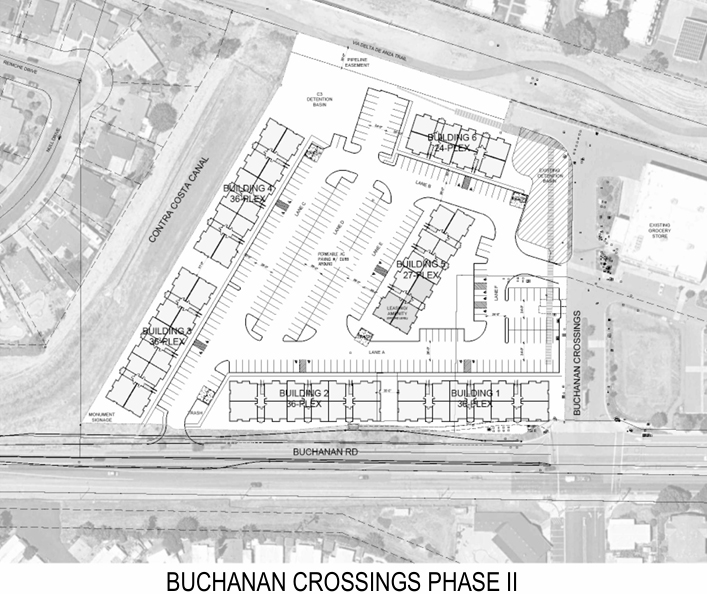
195 Affordable Apartments on Buchanan Road next to Grocery Outlet
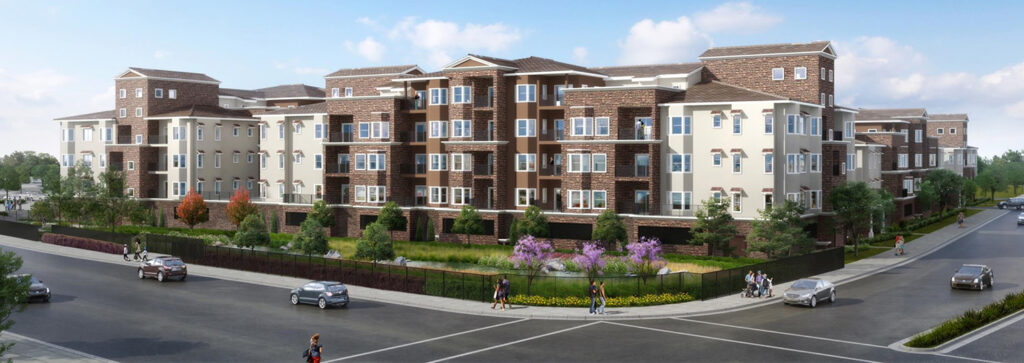
Standard Communities of Los Angeles has another affordable apartment complex in Antioch, known as Buchanan Crossings Phase II, which was also “Approved, Administratively.” The application is for a residential 100% affordable multifamily development project on 6.22 acres along Buchanan Road that will include residential apartment units with associated parking, amenity areas and site landscaping as well as frontage improvements along Buchanan Road.
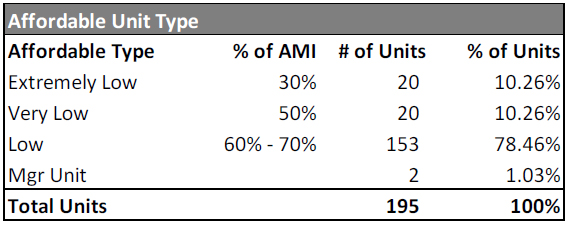
Buchanan Crossings Phase II AMI Units. Source: City of Antioch
The Project will consist of six new 3-story buildings with a total of 195 total affordable residential apartments and 293 on-grade parking stalls. There will be 91 one-bedroom, 49 two-bedroom and 55 three-bedroom units included in the complex.
Both parcels are located within the Western Antioch Commercial Focus Area of the Antioch General Plan and have a Regional Commercial land use designation and the CIH designation added in 2022.
Rendering of proposed Delta Fair Village apartment complex from 2020. Source: City of Antioch
210-Unit Delta Fair Shopping Center Apartments – Withdrawn
The project, which proposed a 4,000 s.f. commercial building and 210 apartments, known as the Delta Fair Village, was withdrawn by the developer after the City Council voted 3-2 in Sept. 2020 to postpone indefinitely his application. That was before the CIH policies were approved and the property rezoned to allow for high-density housing. At that time the plans show the residential units to be condominiums.
Somersville Towne Center Master Plan Aerial Concept with 702 administratively approved apartments. Source: City of Antioch
702-Unit Somersville Town Center Apartment Complex
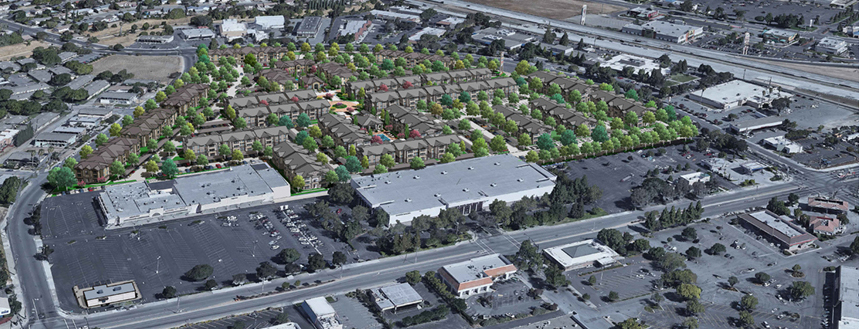
The largest, new apartment complex currently in process in Antioch, will be the redevelopment of a majority of the Somersville Town Center shopping mall which has also been “Approved, Administratively” due to its location in a Commercial Infill Housing (CIH) Overlay District.
The existing mall includes 500,000 sf+/- of retail floor area. When the buildout is complete the approximately forty-acre site will include 702 new apartment units and 124,872+/- of commercial space.
Development is proposed to occur in two phases. Following demolition of most of the existing shopping mall, the first phase would begin at the northern part of the site and include eleven residential buildings, comprising 330 apartment units. Three-story, walk-up apartment buildings would be arrayed along Fairview Drive and Delta Fair Boulevard, with a central clubhouse facility.
Phase Two will complete the residential master plan adding 372 units in twelve buildings. The resulting design will define two distinct apartment villages, each with a unique architectural identity and community character. On-site parking will provide covered parking spaces for all of the units.
OTHER AFFORDABLE APARTMENT PROJECTS
Wildflower Senior Apartments Project site map. Source: City of Antioch
180-Unit Wildflower Senior Apartments
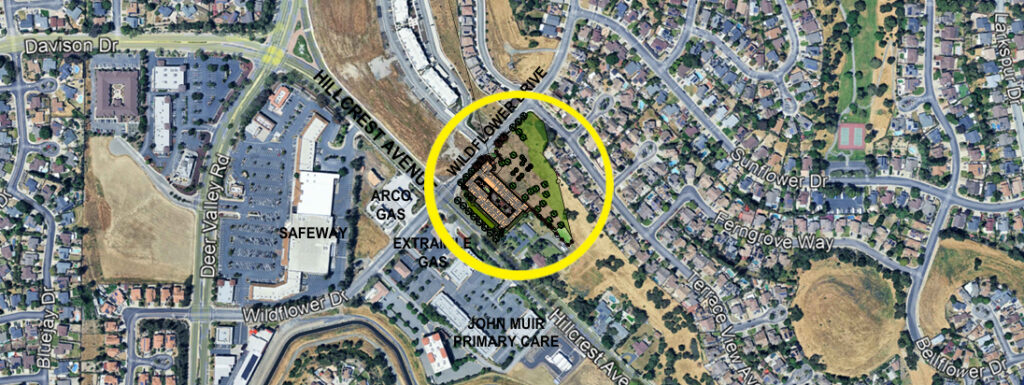
In addition to the administratively approved apartment complexes on the various CIH Overlay District sites, the 180-unit Wildflower Senior Apartments are planned for the corner of Wildflower Drive and Hillcrest Avenue. According to the Project Description, it is a proposed 100% affordable, senior apartment project on a 3.77-acre, vacant site located across Wildflower Drive from the previously approved Wildflower Station Multi-Family project and across Hillcrest Avenue from the Chevron gas station.
The General Plan land use is High-Density Residential with a zoning designation of R-35. The site is identified in the 2023-2031 Housing Element as Site 112. As a Housing Element site, the property has been targeted for redevelopment.
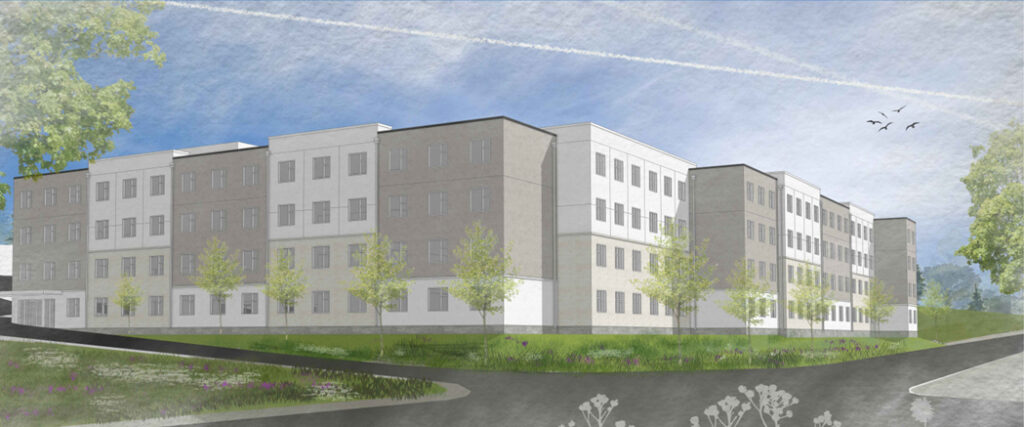
Rendering of Wildflower Senior Apartments Project. Source: City of Antioch
Within the building, a mix of one- and two-bedroom units make up the 180 residential units on four levels arranged around the central courtyard. The 102 one-bedroom units are approximately 559 s.f. each and make up 56.7% of the units. There are also 78 two-bedroom units (43.3% of total) at approximately 771 s.f. each. Two, one-bedroom units will be utilized as manager’s units.
The project will provide 100% of the residential units at 60% Area Median Income (AMI) or less and is currently in processing.
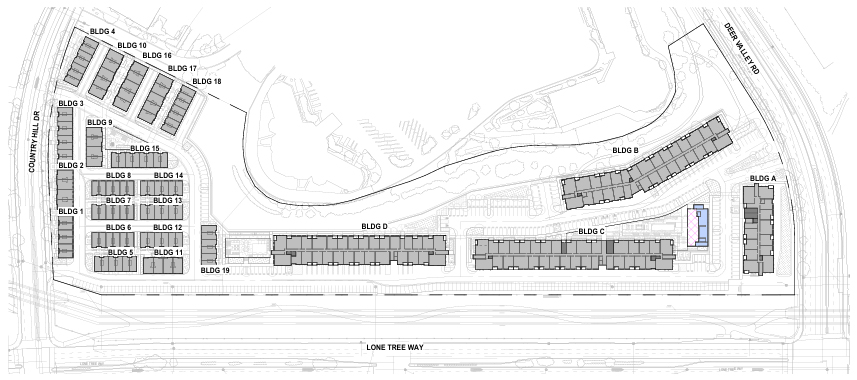
Apartments at Lone Tree site map. Source: City of Antioch
395 Apartments, 101 Townhomes Planned for Lone Tree Way Not Part of CIH But Some Units Will be Affordable
While, according to Principal Planner Scudero, the proposed project labeled, Apartments at Lone Tree, is not part of the CIH zoning overlay district, “the City Council approved the rezoning of the property from commercial to high-density residential in January 2023 as part of the Housing Element approval.”
The project by The Martin Group based in Oakland, is planned for the north side of Lone Tree Way between Country Hills Drive and Deer Valley Road, below the Seventh Day Adventist Church and Hilltop Christian School. The developer proposes 395 apartment units consisting of 25 or 33 junior one-bedroom, 261 or 253 one-bedrooms, and 109 two-bedrooms. In addition, proposed townhome buildings include a total of 84 two-bedroom, 2-bath, 1-car and 27 three-bedroom, 2.5-bath, 2-car units. This project includes 616 vehicle parking stalls with 399 surface parking spaces, and 220 proposed garage spaces. The project sponsor proposes to develop the property per the California state density bonus law.
The 19 townhome buildings are planned for the west end of the property along Country Hills Drive. The four apartment buildings and clubhouse are planned for the center of the property facing Lone Tree Way and the east end near the intersection with Deer Valley Road.
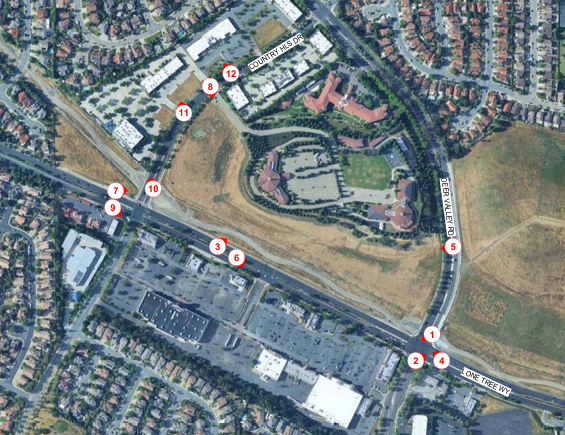
Apartments at Lone Tree aerial map with locations of photos included in the plans. Source: City of Antioch
The project sponsor proposes to develop the property per the California state density bonus law (government code sections 65915-65918). The proposed project can utilize the concessions, incentives and waivers that are afforded.
While the CIH Overlay District is not required by the state, according to the 2021 Guide to the California Density Bonus Law by the Meyers Nave law firm, the Density Bonus is a state mandate requiring cities to adopt ordinances to implement the law. It “provides developers with powerful tools to encourage the development of affordable and senior housing, including up to a 50% increase in project densities for most projects, depending on the amount of affordable housing provided, and an 80% increase in density for projects which are completely affordable.”
“A developer who meets the requirements of the state law is entitled to receive the density bonus and other benefits as a matter of right,” the Guide continues. “Special development bonuses are available for developers of commercial projects who partner with affordable housing developers to provide onsite or offsite affordable housing.”
The developer is currently processing the project application with City staff but did not provide in the Project Description the percentage of units that will be affordable and at what AMI levels.
Rendering of the proposed Apartments at Lone Tree. Source: City of Antioch
Scudero was asked questions regarding the Apartments at Lone Tree project. He was first informed of and asked about the discrepancy in unit totals as the Project Description reads, “PROPOSES A TOTAL OF 395 UNITS CONSISTING OF 33 JUNIOR ONE-BEDROOM, 253 ONE-BEDROOMS, AND 109 TWO-BEDROOMS. TOWNHOMES BUILDINGS PROPOSES A TOTAL OF 84 TWO-BEDROOM AND 27 THREE-BEDROOM TOWNHOMES.” But further down in the Unit and Area Summary chart it shows 25 Junior One-Bedroom and 261 One-Bedroom apartments.
Finally, the Project Description reads, “The project sponsor proposes to develop the property per the California state density bonus law (California government code sections 65915-65918). The proposed project can utilize the concessions/Incentives and waivers that are afforded.”
The state Density Bonus Law means a portion of the units will be affordable. Scudero was asked what percentage of the units will be affordable or if those numbers be submitted later.
Scudero responded, “Regarding the Lone Tree project, we have notified the applicant of the inconsistency in the plans and project description as part of our consistency review. Once we receive a revised submittal we will update the plans on the website. The total unit count of 506 units is correct. Regarding the density bonus, you are correct they will be providing affordable units. They have not determined yet what percentage of affordable they will propose to achieve the density bonus. That will come at a later date.
“Regarding the CIH site at Hillcrest that was approved as part of the original CIH approvals. The ordinance needs a second reading and goes into effect 30 days after that which is why the effective date is later than the original approval date,” he added.
City Staff Provides Additional Information
Questions were emailed to City staff, Mayor Ron Bernal and Councilmembers Don Freitas and Louie Rocha about the apartment and townhome projects.
Staff were asked if the parcels with projects that do not yet have administrative approval can be rezoned, the CIH overlays be eliminated and the projects be stopped. Principal City Planner Scudero responded, “Given the current complexities in state housing laws, we will need to look further into this question and get back to you.”
Staff were also asked if SB330, the state law that streamlines and limits local regulations on housing developments in California, applies to these projects since they’re apartments and not single-family residences. The townhome projects recently approved by the City Council at Wildflower Station and Slatten Ranch were submitted under the law and the council was required to approve them.
Scudero responded, “Yes, SB330 applies to all housing projects that are consistent with the General Plan and Zoning standards.”
The three council members were asked if they were aware of the CIH apartment projects and, if they can, are they willing to reverse the decision on parcels that don’t yet have a project that’s been administratively approved.
Creating Another Sycamore?
Both the councilmembers and staff were asked if approving 702 apartment units where most of Somersville Towne Center currently exists and must be demolished was going to create another Sycamore area, the City’s neighborhood with the greatest crime problems, with too many multi-family units in one area. They were also asked if some of those units could instead be approved as for sale, owner-occupied condominiums.
Scudero responded, “The decision to make a project for sale versus for rent is up to the developer. They are reviewed against the same objective design standards with the one difference being that a for sale project also requires the processing of a map for subdivision purposes.”
Questions Regarding Delta Fair and 99 Cents/Big Lots Shopping Center Projects
The four were also asked if someone has contacted Gabriel Chew, the owner of the property where the Delta Fair Village is proposed, to reconsider submitting and processing it. They were also asked if Chew owns the 99 Cents/Big Lots property and has there been any contact with him or the owner (if different) about redeveloping it.
Finally, they were asked about Deer Valley Plaza, where the former theaters building is located and is included on the list, but no plans have been submitted for it, yet, if it was purchased and going to be a mosque as has been rumored.
Scudero responded, “The Delta Fair Village property owned by Gabriel Chiu is included in the CIH Overlay district and the site is eligible to be developed under the streamlined CIH approval process. The former 99 Cents/Big Lots/CVS building is actually three separate parcels under separate ownership. A church has recently purchased the former CVS and obtained a use permit to operate there.”
A sign on the side of the former theaters building reads, “Bay Area Pentacostals”.
Bernal Must Check with Staff, City Attorney if Stopping Projects Not Yet Approved Possible
Bernal responded with, “I am aware of the overlays the Council approved in 2022 but do not know if the City can ‘undo’ these overlays and will have to find out from City staff and the City Attorney’s office if this is a possibility.
“Regarding Mr. Chiu, I have reached out to him but have been unable to arrange a time for us to meet,” the mayor continued. “My understanding is that he still owns shopping centers on Delta Fair Blvd., 18th and A Streets and Deer Valley Plaza. I’m told he sold the theater to a church which I have seen is currently being renovated.”
“I’ve been told the former CVS and 99 Cent stores at the Bank of America Center on Somersville Road have been purchased by La Palabra de Dios Church and are currently being renovated,” Bernal added, reiterating what Scudero shared.
Rocha Open to Reviewing Commercial Properties Not Yet Administratively Approved
In response to the questions posed to him, Rocha said, “I’m aware of the approved projects and in favor of reviewing all projects as we develop our new General Plan with a focus on rezoning of commercial properties that have not received Administrative Approvals.”
“We have learned the limitations to local government control with properties that were rezoned from commercial to residential under new legislation SB 330 that grants high density housing as part of the States response to the housing crisis without local approvals,” he continued. “I am in favor of advocating for mixed housing and commercial projects that support economic development that provides housing, business and local employment.”
Asked if he had nny concerns about too many low-income rental units being concentrated in one area of the city as part of the redevelopment of Somersville Towne Center and possibly creating more future crime problems, Rocha responded, “I’m in favor of mixed development that provides equitable opportunities for all members of our community.
Pressed again if he is concerned about too many low-income rental units being concentrated in one location, the councilman did not respond.
Barbanica Wanted Up-Scale Housing, Ogorchock Knew They Would be Affordable, Neither Were Aware They Only Required Staff Approval
At the time the CIH rezoning was proposed to the city council, Con Johnson was City Manager, Forrest Ebbs was Community Development Director and Kwame Reed was Economic Development Director.
When reached for comment about the matter, former District 2 Councilman Mike Barbanica said, “It was never the intent to be affordable, low-income housing. It was to be upscale housing and mixed use. I had several meetings with Forrest about rezoning the properties.”
Asked about her votes on the CIH Overlay Districts for the 10 properties, former District 3 Councilwoman Lori Ogorchock said, “Basically, I remember them being infill projects. The one that sticks in my mind was the property behind CVS on Lone Tree Way.”
“I don’t remember them ever allowing them to be administratively approved,” she continued.
“I didn’t meet with Con Johnson because he never had answers and he was going to ask department heads for the answers and then never got back to me,” Ogorchock offered. “He didn’t want us meeting us with department heads without his presence. But I would talk to Forrest.”
“I would have never voted for anything if it was only administratively approved,” she stated. “I believe in the process of the Planning Commission and Council meetings with public input.”
“I do remember them being affordable but, that we couldn’t say ‘no’ to any housing projects because of the new state law. (SB330). I also remember them being mixed use,” Ogorchock added.
Questions for Former Mayor, Current Councilwomen, Torres-Walker Thought She Voted for Mixed-Use
Councilwomen Monica Wilson and Tamisha Torres-Walker, and former Mayor Lamar Thorpe were asked the following questions:
“Were you aware you were giving City staff the authority to approve each project without having to go through the public approval process?”
For the councilwoman they were asked the same questions as the current mayor and councilmen, “Are you willing to either require the five sites that don’t yet have administrative approval to go through the public process, require that they be mixed use instead of just housing or stop and rezone them? They were also asked, “Are you concerned about creating another policing problem area like the Sycamore neighborhood, by concentrating too many rental housing units in the same area at the Somersville Towne Center project?”
Wilson was specifically asked, were you aware of the 2004 effort to stop the apartments from being built on the property where your townhome is located? If so, why would you vote to approve not only an apartment complex there, but one that includes Extremely Low, Very Low and Low-Income units?
Only Torres-Walker responded with, “I am a supporter of affordable housing projects and I have considered the need for housing projects that include options for individuals that fall under the category of Extremely Low, Very Low and Low-Income.”
“When I voted I was under the impression that we were supporting mixed-use and mixed income projects,” she added.
The District 1 Councilwoman was again asked if she was aware that they had given City staff the authority to approve the projects without holding hearings for public input. But she did not respond prior to publication time.
Lakeview Center, Buchanan Crossing Projects on Feb. 24th Council Meeting Agenda
For the council meeting on Tuesday, February 24, 2026, two of the projects were on the agenda, as Items #5 and #6. They were Appeals of the December 18, 2025 Administrative Decision Regarding Lakeview Center Commercial Infill Housing Application and the November 13, 2025, Administrative Decision Regarding Buchanan Crossing Commercial Infill Housing Application. However, both items were requested to be postponed until the next council meeting on March 10, 2026, for Public Hearings.
Multiple efforts to reach Freitas, Wilson and Thorpe for their responses to the questions were unsuccessful. Please check back later for any updates to this report.
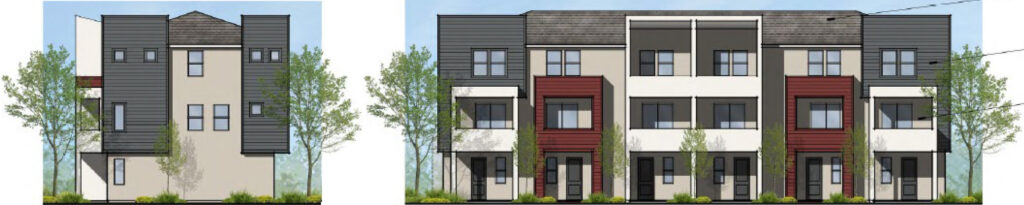
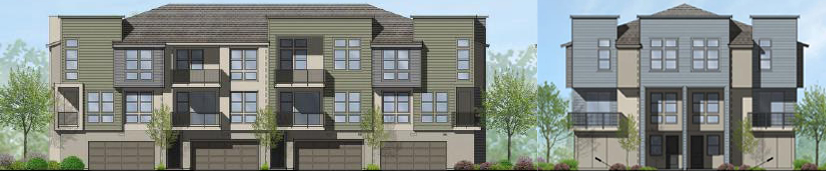
Renderings of the proposed Wildflower Station Row Townhomes. Source: DeNova Homes
Will again consider Wildflower Station Townhomes 2 project by troubled developer Tuesday night
Learn how state law is forcing Council to approve new housing developments
By Allen D. Payton
After the Antioch City Council held a public hearing during their meeting on Sept. 23, 2025, on the proposed Wildflower Station Townhomes 2 Multifamily Residential Project by troubled DeNova Homes, postponed a decision until their meeting last Tuesday, Oct. 28, but split 2-2, with District 1 Councilwoman Tamisha Torres-Walker was absent, the Council will once again consider the project during a special meeting tomorrow night, Tuesday, Nov. 4, 2025.
The council meeting is scheduled then instead of the regular day of the second Tuesday of each month due to the Veterans Day holiday on Nov. 11th.
It will be the third time the Council will consider the project by the embattled developer, whose father and son leaders were indicted in April on charges of bribing an Antioch city councilman last year. (See related articles here, here and here). During last Tuesday’s meeting, Antioch resident Melissa Case named former Councilman Mike Barbanica as the target of the attempted bribe but who has repeatedly told the Herald he will not speak about an open investigation. So, the target could also have been former Mayor Lamar Hernández-Thorpe.
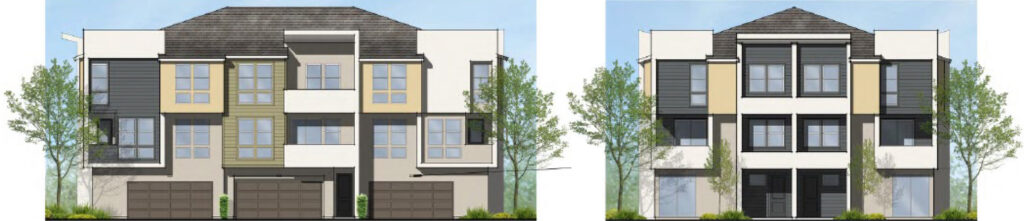
Rendering of proposed Wildflower Station Back-Back Townhomes. Source: DeNova Homes.
Council Approved Developers’ Other Townhomes Project on Oct. 28
Like DeNova Homes’ Slatten Ranch Townhomes Project, approved last Tuesday night on a 3-1 vote, with District 3 Councilman Don Freitas voting against, the Council is expected to also approve the Wildflower Station project because it, too, was submitted under SB330 which basically ties the councilmembers’ hands. The law gives certain protections to developments that follow the law’s procedures. (See below)
Both Mayor Pro Tem and District 2 Councilman Louie Rocha and District 4 Councilwoman Monica Wilson complained during last week’s council meeting about the state forcing the councilmembers to approve the project. Yet, Wilson along with Freitas, voted against it. The Council then voted 4-0 to continue the item until tomorrow night’s meeting which Torres-Walker is expected to attend and potentially break the tie vote.
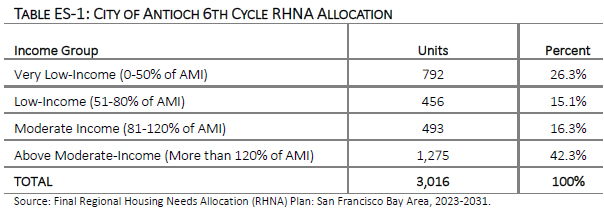
Antioch’s Regional Housing Needs Allocation of between 2023-31 shows the quantity of units in each of four income categories for a total of 3,106 new units that must be approved by the City Council. Source: Association of Bay Area Governments
State Housing Law Forces Councilmembers to Approve New Developments – HAA, HCA, RHNA
Retroactively “freezes” residential zoning standards to what they were on January 1, 2018.
Does not allow jurisdictions to enforce moratoriums or growth control measures on new housing development.
Prevents jurisdictions from imposing or enforcing new design standards on housing projects that are not “objective”.
Plus, “The HCA strengthens the Housing Accountability Act – HAA – (Gov. Code §65589.5) which states that a housing development project that complies with the objective standards of the general plan and zoning ordinance must be approved by the agency, unless the agency is able to make written findings based on the preponderance of the evidence in the record that either: 1) the local government has already met its Regional Housing Needs Assessment (RHNA) requirement (Antioch hasn’t); 2) there is an impact to the public health and safety and this impact cannot be mitigated; 3) the property is agricultural land (it’s not); 4) the approval of the project would violate State or Federal law and this violation cannot be mitigated; or, 5) the project is inconsistent with the zoning and land use designation and not identified in the general plan housing element RHNA inventory (it isn’t).”
According to a Sept. 2020 Technical Assistance Advisory by the California Department of Housing and Community Development’s Division of Housing Policy Development, the HAA “establishes limitations to a local government’s ability to deny, reduce the density of, or make infeasible housing development projects, emergency shelters, or farmworker housing that are consistent with objective local development standards and contribute to meeting housing need.”
In addition, the Advisory explains that SB330/HCA “set forth vesting rights for projects that use a new pre-application process,” which both townhome projects did. Most of the bill’s provisions were to sunset on January 1, 2025, but they were extended until January 1, 2030, with the passage of SB8.
The RHNA – now referred to as the Regional Housing Needs Allocation – requires the City of Antioch to approve 3,016 new homes in four income categories between 2023 and 2031. (See related articles here and here, and chart above)
Wildflower Station Townhomes 2 Site Map. Source: City of Antioch
Wildflower Station Townhomes 2 Project
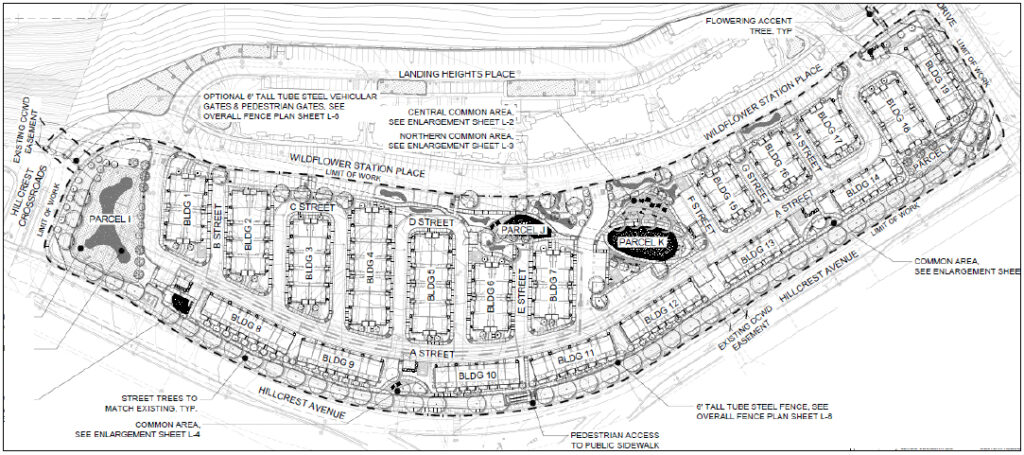
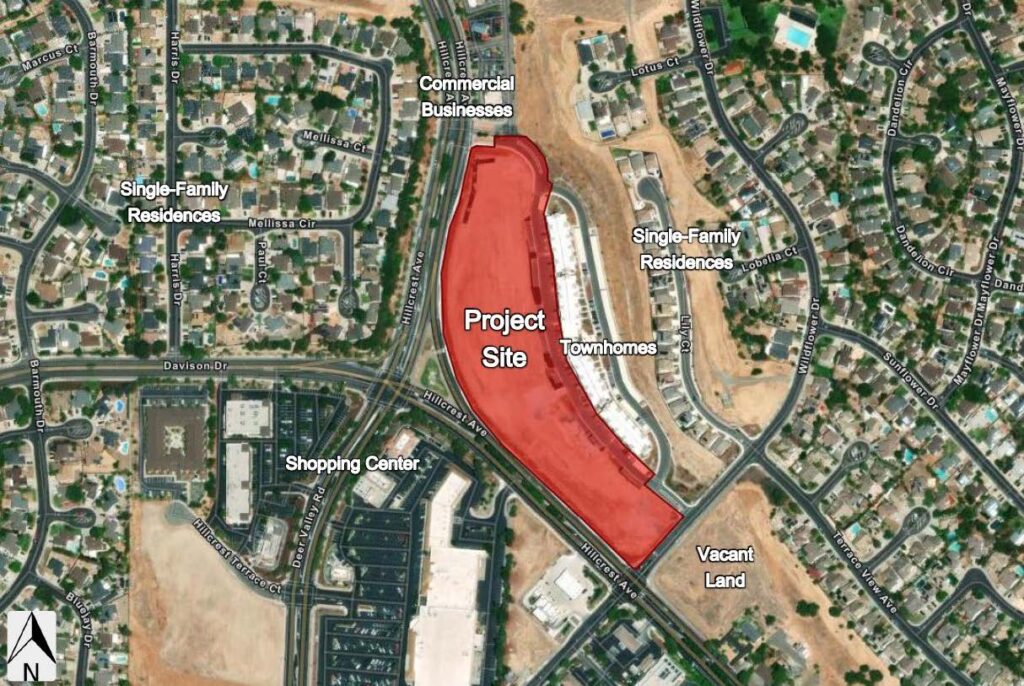
The proposed Wildflower Station Townhomes 2 Multifamily Residential Project is a 159-unit townhome-style condominium development. It is planned for the four-parcel, 10.35 acre vacant property near the intersection of Hillcrest Avenue and Deer Valley Road and bordered by Wildflower Drive to the east and the road next to the KFC restaurant in the Hillcrest Crossroads shopping center which also serves the existing condo development.
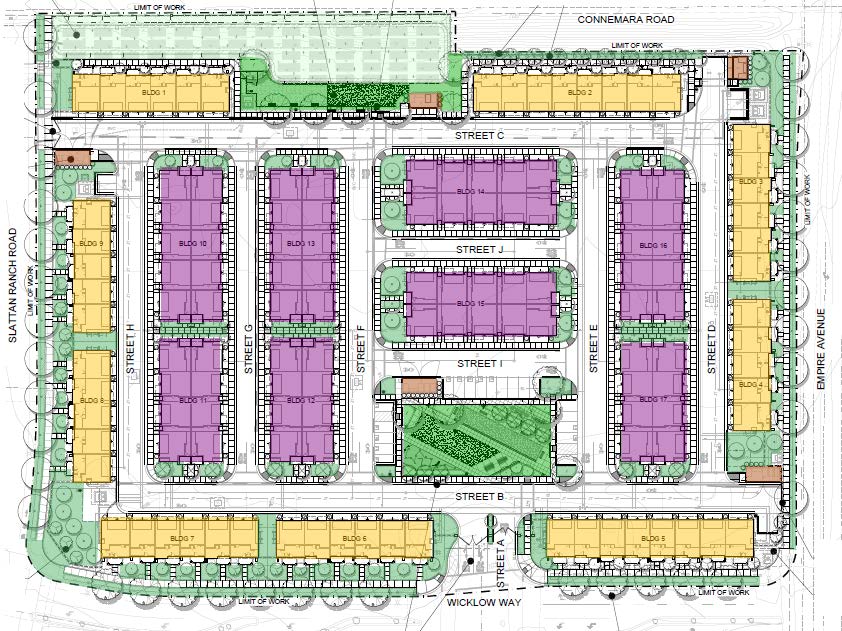
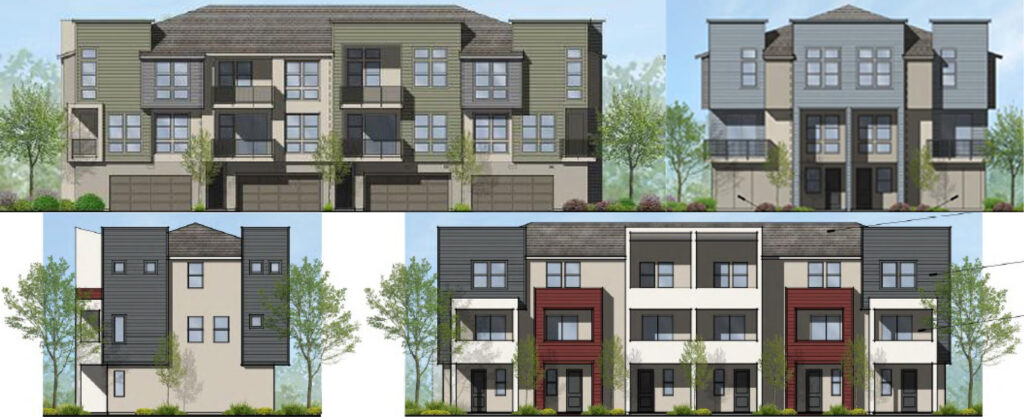
According to the City staff report for the agenda item, #6, the proposed project consists of a Vesting Tentative Subdivision Map to create 19 residential lots for 19 three-story buildings, containing 159 new townhome condominiums in two different building styles: “back-to-back” and row townhome-style. Both styles of townhomes include individual one-car or two-car garages with the living areas primarily on the second and third levels above the garage parking.
Proposed Wildflower Station Townhomes 2 Project Site Map. Source: DeNova Homes
The proposed project would include a total of 2.8 acres of landscaping and open space, consisting of two open play areas and open space for bioretention. The play areas would include 25 additional parking spaces with another 57 surplus shared parking spaces with the adjacent Wildflower Station development. The 159 residential units would consist of a mix of two- and three-bedrooms units, ranging in size from 1,135 to 1,381 square feet.
The project site was part of the larger 23-acre Wildflower Station project that includes 22 single family homes (on the ridgeline above), the 98-condominium stacked flat homes immediately adjacent and planned commercial development that was entitled in 2018. The single-family homes and condos were built, but the commercial parcels along Hillcrest Avenue (the current project site) weren’t and the land sat undeveloped.
In 2023, the City Council revised the General Plan and rezoned the four parcels to High Density Residential District (R-25). The proposed project would result in a density of approximately 20 du/ac.
The project was also submitted in 2023 as a Preliminary Housing Application under SB330.
Con Fire Quarterly Report
Before the item is heard, the Council will receive the Contra Costa County Fire Protection District – Quarterly Report presentation by Fire Chief Lewis Broschard.
The meeting will be held in the Council Chambers at City Hall, 200 H Street, in Antioch’s historic, downtown Rivertown. They can also be viewed via livestream on the City’s website and the City’s YouTube Channel, on Comcast Cable Channel 24 or AT&T U-verse Channel 99.
Renderings of the planned Slatten Ranch Townhomes approved by the City Council on Tuesday, Oct. 28, 2025. Source: DeNovaHomes
Embattled DeNova Homes’ 129 units at Slatten Ranch passes on split vote; 159 units at Wildflower Station fails on tie vote with Torres-Walker absent, continued until next Tuesday.
“It’s…unfortunate our hands are going to be tied due to state law” – District 4 Councilwoman Monica Wilson
“We are very limited in what actions we can take.” – Mayor Pro Tem Louie Rocha
By Allen D. Payton
During their meeting on Tuesday, October 28, 2025, the Antioch City Council voted to approve one of two new townhome projects by DeNova Homes in the Slatten Ranch area on the eastern edge of the city on a split 3-1 vote. Another townhome project on Hillcrest Avenue and Deer Valley Road in the Wildflower Station development failed on a 2-2 vote with District 1 Councilwoman Tamisha Torres-Walker absent. The council members pointed out that their hands are tied by state law, SB330 – The Housing Crisis Act of 2019, under which plans for both developments were submitted, and were forced to approve both.
It was the second time the Council reviewed the projects by the embattled developer, whose father and son leaders were indicted in April on charges of bribing an Antioch city councilman. (See related articles here, here and here).
Slatten Ranch Townhome Development Plan. Source: DeNova Homes
Approve 129 Slatten Ranch Townhomes
Following another presentation on the 129-unit Slatten Ranch Townhomes project by the developer’s representatives as well as public comments by residents including some members of local unions concerned about growth and jobs, the council members discussed the project and questioned City staff.
District 3 Councilman Don Freitas who has been critical of the project, especially that it allows housing in the City’s 200-acre East Lone Tree Focus Area that was intended for commercial and economic development foorr creation of local, well-paying jobs, was first to question staff. He said, “In the report…it states that…the project has been adequately analyzed…under CEQA (California Environmental Quality Act) and further review is not required. Traffic…will exceed City standards at the intersection…Level of Service F, which is the worst traffic conditions we can have.”
“The mitigation…they’re going to give one-fourth of the traffic light,” he asked with incredulity. “Empire and Wicklow. Level F. How does that pass CEQA?”
Antioch Planning Manager Zoe Merideth responded, “Vehicle miles traveled is a different standard…that’s what’s in the Housing Element EIR (Environmental Impact Report). Also, in the City’s General Plan, we have the Level of Service…and guidelines under that.”
“We’re still going to have Level F at Empire…and Wicklow for all of Eastern Contra Costa County,” Freitas reiterated.
“But we’re going to have mitigation,” Planning Manager Meredith stated.
“One-fourth of traffic signal is adequate?” Freitas asked again.
“There will be a turn pocket,” Meredith responded. “There will be additional left-turn storage prior to…building permit and occupancy. They’re looking at build out (in the area)not just at the project.”
Then Freitas again raised the issue of the children’s park that would be seen at the entrance to the development.
“Even though the public testimony about children’s safety, nothing’s changed,” he stated.
“Our issues and concerns that led us to pausing this until tonight,” said Mayor Pro Tem and District 2 Councilman Louie Rocha. “SB330, it says, is intended to streamline housing…to address the housing crisis in California. The concerns we brought up about traffic, children’s safety, just fall off the table…since they meet CEQA standards, there’s nothing else we can do.”
“As a General Law City we…are being required to follow laws…and in this case it has do with housing laws,” he continued. “We would hope that the applicant would show concerns we have for our residents and families.”
“It’s very clear…as far as local government we are very limited in what actions we can take. That’s what brings us here, tonight,” Rocha stated.
District 4 Councilwoman Monica Wilson then asked the developer’s attorney, Golub about his possible comment at the last council meeting of not having to care about the working conditions. “I hope I misheard you,” she stated.
“So, am I. I really don’t recall raising that,” he responded. “I certainly don’t have any notes in front of me. I don’t think I mentioned that at all.”
Then he recalled what he did say that Wilson might have misunderstood.
“State law is very explicit and clear…any CEQA review…the opponent has to show any peculiar I’m not aware of any evidence why this project would address any of those concerns. We reviewed carefully the comments raised by the labor union’s attorney. The issues that seem to be raised don’t relate to any peculiar aspects of this project. It’s a standard development. We’re not taking any kind of unusual conditions that will have any unusual impacts on working conditions. There are a bunch of state laws we have to follow.
“The project is supposed to be approved,” he added.
“I think it’s unfortunate you didn’t take the opportunity to hear all the concerns the last time. I feel like you’re just reiterating in your letter. You didn’t address any of their concerns,” Wilson stated.
“It’s also unfortunate our hands are going to be tied due to state law,” she added.
East Lone Tree Focus Area Map and Slatten Ranch Townhome Project location (in yellow box). Source: City of Antioch
Dana Tsubota, Chief Legal Officer of DeNova Homes said, “We’re happy to have conversations with all of the staff members. We’ve gone through two years of detailed review with staff. We’re happy to continue to have those discussions. When we build something, we’re in partnership with the City for a very long time.
We are limited by the City’s objective standards,” she continued. To make sure all the pieces fit and have all the units in the project as the City is requiring. If there is something we can do we’re happy to.”
“There’s a period of time between an approval and building permit…to ameliorate or soften the impact…there’s a certain amount of latitude we have to change the site plan,” said Antioch Interim Community and Economic Director David Storer.
“This council saw it for the first time a little over a month ago,” said Mayor Ron Bernal.
He then asked about Empire Avenue saying, “Historically, it’s been a joint project with the City of Brentwood. There is no condition of approval for them to build one-half of the street on their side. If this builder doesn’t build it…it falls back on the City and we don’t have any money…we don’t have an impact fee.”
“The center median is not included,” said Scott Buenting.
“Who will build it?” Bernal asked about the additional lane of traffic on the west side of Empire Avenue adjacent to the project.
“We have curb and gutter on our side,” Buenting responded.
“Why isn’t this project being conditioned to do it?” Bernal asked about the widening of Empire Avenue next to the project.
“I’m not sure,” said Buenting.
“I’d like to add it as a condition of approval. As long as Antioch fulfills our responsibility, for our half of the street,” Bernal stated.
“You’ll have to ask the applicant,” Storer responded.
“We’d be happy to look at a specific proposal,” said Golub. “But we don’t necessarily see a nexus of impact by this development. It could be very costly.”
After a 10-minute break for City staff to consult with the developer’s representatives, Interim City Attorney Derek Cole said, “To deal with this issue, there will be a general conditions that will require the improvements to the road…that will allow us to work with the applicant to reduce the concerns of the impacts of nexus. I believe we have to hear from the developer on this.”
Storrer then proposed some language for the council to consider for the additional condition of approval on the road widening.
The developer’s attorney Dan Golub. “I think we just heard there’s an objective standard. The time has come and gone. We’re willing to sit and work with you on this.”
“It’s an arterial design standard,” Bernal stated.
“I must go on the record opposing this. The outcome of that would be something we could agree to. We will work with you,” Golub stated.
Bernal, in violation of Roberts Rules of Order, then made a motion to approve the project with the added condition that the developer is required to improve Empire Avenue to one-half arterial road standard with consultation with Design Review and City Attorney.”
In proportionate share,” Cole added. “The City Engineer will make that determination.”
“From Wicklow to the north property line of the project,” Bernal added.
Rocha seconded the motion which passed 3-1 with Freitas voting against.
Rendering of proposed Wildflower Station Back-Back Townhomes. Source: DeNova Homes
Don’t Approve 159 Wildflower Station Townhomes on Tie Vote
The Council then received a brief presentation on the 159-unit Wildflower Station Townhomes 2 Multifamily Residential Project planned for the four-parcel, 10.35 acre vacant property near the intersection of Hillcrest Avenue and Deer Valley Road and bordered by Wildflower Drive to the east and the road next to the KFC restaurant in the Hillcrest Crossroads shopping center which also serves the existing condo development.
“According to our General Plan, developers are supposed to pay their way,” said former Councilman Ralph Hernandez during Public Comments. This project has been another one that’s being dumped on the city, not properly mitigated. You have to charge the right amount of money…for our police services. The project right next door is already telling you how dangerous it is.” He was referring to the condo project previously built and units sold.
Alora McGuire spoke next “on behalf of Contra Costa Residents for Responsible Development”, representing union members and residents in Antioch and surrounding areas. She said the group did not want the council to oppose the project but wanted the developer to address noise impacts.
Jason Buster of Plumbers and Steamfitters union Local 159, representing 300 Antioch families that are members of other unions, including electricians and sheet metal workers. “We advocate for projects that are more sustainable and equitable for the city of Antioch. We’re proud of our work to reduce the environmental impacts of projects.”
“The project is fully exempt from CEQA due to SB330,” said DeNova’s attorney Golub. “We’re very willing to fence and gate this property. It’s not an objective standard. But it doesn’t mean we’re not willing to consider it.”
Proposed Wildflower Station Townhomes 2 Project Site Map. Source: DeNova Homes
Wilson asked, “Why was the commercial piece removed from this plan?”
“This is a Housing Element site, and it was rezoned with the update,” Meredith said.
“That’s unfortunate,” Wilson stated even though she approved the rezoning during a council vote.
Rocha then made a motion to approve the project.
“Obviously, it was intended at one time to be a mixed development. But that was changed in 2023,” he stated.
Wildflower Station Townhomes 2 Site Map. Source: City of Antioch
Bernal seconded the motion and without further discussion the council did not approve the project on a two-two tie with both Freitas and Wilson voting to oppose.
“The motion does not carry. This does not preclude us from continuing the item until we have a fifth member present,” Cole explained.
Bernal then made a motion to continue the item until the Council’s next meeting on Tuesday, Nov. 4th. (It will be held instead of the normal second Tuesday, which falls on Veterans Day, Nov. 11th. Rocha seconded the motion and it passed 4-0.
Renderings of the proposed Slatten Ranch Townhomes (above) and Wildflower Station Townhomes (below). Source: DeNova Homes
DeNova Homes proposes129-unit Slatten Ranch Townhomes Project, next to J.C. Penney store which Freitas strongly opposes and 159-unit Wildflower Station Townhomes 2 Multifamily Residential Project on Hillcrest Avenue near Deer Valley Road
“I am furious that this is being shoved down our throats. I do not want to give up some prime property for economic development.” – District 3 Councilman Don Freitas
By Allen D. Payton
The two proposed housing projects by DeNova Homes will return for the Antioch City Council to consider during their meeting on Tuesday, Oct. 28, 2025. An indictment by the U.S. Attorney’s Office for the Northern District of California of the company’s co-founder and his vice president son for alleged bribery of an Antioch Councilman last year was announced in April.
The alleged bribe was related to a previous project in Antioch, known as Aviano, a multi-phase, 533-unit single-family home residential development in the Sand Creek area on the south side of the city.
Proposed Slatten Ranch Townhome Project Location Map. Source: DeNova Homes
The two developments are the proposed 129-unit Slatten Ranch Townhomes Project (#5 on the agenda), located on a 6.41-acre vacant project site north of Wicklow Way next to the J.C. Penney store, east of Slatten Ranch Road and west of Empire Avenue; and the 159-unit Wildflower Station Townhomes 2 Multifamily Residential Project (#6 on the agenda) planned for the four-parcel, 10.35 acre vacant property near the intersection of Hillcrest Avenue and Deer Valley Road and bordered by Wildflower Drive to the east and the road next to the KFC restaurant in the Hillcrest Crossroads shopping center which also serves the existing condo development.
Wildflower Station Townhomes 2 Site Map. Source: City of Antioch
The Council previously considered the projects during their meeting on Sept. 23, 2025, but postponed both to Tuesday’s meeting following opposition from the public and council concerns. District 3 Councilman Don Freitas offered the strongest opposition to the Slatten Ranch project which is planned for the East Lone Tree Focus Area. The 200 acres north of Hwy 4 and east of Laurel Road were set aside by the City Council in 1998 and planned for commercial and economic development for the creation of local, well-paying jobs. But the previous council rezoned a portion of the property to allow for housing.
“I have lots of problems with this particular project. It’s both a blessing and a curse,” he stated then shared that during his years as mayor from 2000-2008, “J.C. Penney’s came forward and locate on the site they eventually built on,” due to the freeway access.
“That area was envisioned as one of the most important economic development sites in the City of Antioch,” Freitas continued. “This project doesn’t belong in this space. That’s why I oppose this project.”
“While housing is critical, so is economic development,” he added. “I am furious that this is being shoved down our throats. I do not want to give up some prime property for economic development.” (See 3:01:51 mark of meeting video)
However, plans for the housing projects were submitted under SB 330, the Housing Crisis Act of 2019 (D-Skinner), which Freitas referenced, and gives development special provisions in the approval process, which, among other things, limits the total number of hearings by a local government agency.
Slatten Ranch Townhome Development Plan. Source: DeNova Homes
City staff recommends that the City Council adopt the resolution approving the Vesting Tentative Subdivision Maps for both the development of the 17 Slatten Ranch Townhome and 19 Wildflower Station Townhome buildings and Design Review for the proposed architecture and landscaping for each project.
The meeting will be held in the Council Chambers at City Hall, 200 H Street, in Antioch’s historic, downtown Rivertown. They can also be viewed via livestream on the City’s website and the City’s YouTube Channel, on Comcast Cable Channel 24 or AT&T U-verse Channel 99.