In our ongoing effort to boost community engagement, we’re bringing the meeting to you!
Venue: Antioch Community Center at Prewett Family Park, 4703 Lone Tree Way
Date: August 19th
Time: 6:30 p.m.
About the Meeting:
The Antioch Police Oversight Commission, which typically convenes at Antioch City Hall, will hold this meeting at the Antioch Community Center. Twice a year, we change locations to make our meetings more accessible and to encourage greater community participation.
The Commission’s mission is to advise the City Council and Staff on the administration of the Antioch Police Department and public safety matters. Our goal is to ensure that our policies meet national standards for constitutional policing.
Your Voice Matters! Come share your thoughts and help us shape the future of public safety in Antioch.
399,000 positions paid almost $29 billion in total wages
Includes Contra Costa Superior Court and Cal State East Bay data
SACRAMENTO — State Controller Malia M. Cohen has published the 2023 self-reported payroll data for state departments, superior courts, and California State Universities (CSU) on the Government Compensation in California website. The data covers more than 399,000 positions and approximately $28.87 billion in total wages for those agencies and institutions.
Users of the site can view compensation levels on maps and search by region, narrow results by name of the entity or by job title, and export raw data or custom reports.
The newly published data were reported by:
• 24 CSU institutions (116,235 employees),
• 56 superior courts (20,884 employees), and
• 157 state departments (262,097 employees).
California law requires cities, counties, and special districts to annually report compensation data to the State Controller. The State Controller also maintains and publishes state and CSU salary data. However, no such statutory requirement exists for the University of California, California community colleges, superior courts, fairs and expositions, First 5 commissions, or K-12 education providers; their reporting is voluntary. Two superior courts either did not file or filed a report that was non-compliant, including those in Alameda County and Tuolumne County.
The site contains pay and benefit information on more than two million government jobs in California, as reported annually by each entity.
In addition, the report shares, “This California State University includes payments toward the unfunded liability of the employer sponsored retirement plan.” For more information visit www.csueastbay.edu/hr.
The State Controller’s Government Compensation in California website provides information on employee pay and benefits for approximately 2 million positions at more than 5,000 public employers. Public employers annually report employee compensation to the State Controller’s Office. It allows the public to view and search employee job titles, build charts and graphics, and download custom reports and raw data.
About Controller Cohen
As the chief fiscal officer of California, Controller Cohen is responsible for accountability and disbursement of the state’s financial resources. The Controller has independent auditing authority over government agencies that spend state funds. She is a member of numerous financing authorities, and fiscal and financial oversight entities including the Franchise Tax Board. She also serves on the boards for the nation’s two largest public pension funds. Follow the Controller on X at @CAController and on Facebook at California State Controller’s Office.
Congressman Mark DeSaulnier (D, CA-10). Employees at Chevron’s solar photovoltaic project. Source: Chevron Corp.
Following announcement of HQ move to Texas
“I’m disappointed, but not surprised” – Congressman Mark DeSaulnier who represents San Ramon. “Chevron’s actions and investments do not align with its stated commitment to reducing greenhouse gas emissions.”
Chevron responds
By Allen D. Payton
Washington, D.C. – On Friday, Aug. 2, 2024, Congressman Mark DeSaulnier (D, CA-10) made the following statement on Chevron’s decision to move its headquarters from San Ramon, a city he represents in Congress, to Texas.
“I am disappointed, but not surprised, to see Chevron’s announcement that it will be leaving San Ramon. I have long been involved and advocated for California’s renewable portfolio standard and climate goals to protect both public health and the environment, and for years I have encouraged Chevron to be a diverse energy company investing in clean renewable sources of energy as we in California have been responsibly transitioning away from climate destroying energy and towards clean energy that protects the climate and public health. Unfortunately, these efforts have been much less successful than I had hoped and, in many ways, Chevron left California years ago. I hope as Chevron relocates their corporate facilities, they will keep California’s climate goals in mind. I’ve reached out to the city of San Ramon and I would be happy to work with Chevron, or any other company, in reaching these important energy goals and to continue to support its employees in Contra Costa County.” (See related article)
However, according to Wikipedia, Chevron has been pursuing alternative energy sources. operations include geothermal solar, wind, biofuel, fuel cells, and hydrogen.[145] In 2021 it significantly increased its use of biofuel from dairy farms, like biomethane.[146]
Chevron has claimed to be the world’s largest producer of geothermal energy.[51] The company’s primary geothermal operations were located in Southeast Asia, but these assets were sold in 2017.[147][148][149][150]
Prior, Chevron operated geothermal wells in Indonesia providing power to Jakarta and the surrounding area. In the Philippines, Chevron also operated geothermal wells at Tiwi field in Albay province, the Makiling-Banahaw field in Laguna and Quezon provinces.[151]
In 2007, Chevron and the United States Department of Energy‘s National Renewable Energy Laboratory (NREL) started collaboration to develop and produce algae fuel, which could be converted into transportation fuels, such as jet fuel.[152] In 2008, Chevron and Weyerhaeuser created Catchlight Energy LLC, which researches the conversion of cellulose-based biomass into biofuels.[153] In 2013, the Catchlight plan was downsized due to competition with fossil fuel projects for funds.[154]
Between 2006 and 2011, Chevron contributed up to $12 million to a strategic research alliance with the Georgia Institute of Technology to develop cellulosic biofuels and to create a process to convert biomass like wood or switchgrass into fuels. Additionally, Chevron holds a 22% stake in Galveston Bay Biodiesel LP, which produces up to 110 million US gallons (420,000 m3) of renewable biodiesel fuel a year.[155][156]
In 2014, Chevron began reducing its investment in renewable energy technologies, reducing headcount and selling alternative energy-related assets.[163]
In 2015, the Shell Canada Quest Energy project was launched[164] of which Chevron Canada Limited holds a 20% share.[165] The project is based within the Athabasca Oil Sands Project near Fort McMurray, Alberta. It is the world’s first CCS project on a commercial-scale.[164]
Chevron’s Advanced Clean Energy Storage (ACES) Project will use an electrolyzer like this one to convert renewable resources, such as wind and solar, into hydrogen and then store that hydrogen for later use. Photo: Chevron
DeSaulnier Doubles Down
DeSaulnier was asked why he would make the comment about Chevron when the company has been pursuing and investing in alternative energy sources in multiple ventures since 2006 including geothermal, solar, wind, biofuel, fuel cells and hydrogen. He was also asked what else he wanted Chevron to do.
DeSaulnier’s office responded, “Congressman DeSaulnier believes Chevron’s actions and investments do not align with its stated commitment to reducing greenhouse gas emissions – moving out of California which has some of the most progressive climate and energy policies, to Texas, which is a heavy fossil fuel supporter, is evidence of that. Additionally, Chevron’s production hit a record 3.1 million barrels of oil-equivalent per day last year and it expects 2024 production to be even higher and a 2022 study found that Chevron does not match its investments to its pledges as it is still financially reliant on fossil fuels.”
Chevron Responds, Move is About Better Collaboration
Asked if the company had a response to DeSaulnier’s initial statement, Chevron spokesman Ross Allen provided the following statement:
“In addition to our release out Friday morning, our Chairman and CEO Mike Wirth spoke about our move on CNBC and BloombergTV. We also hosted our regularly scheduled Earnings Call, where the topic was addressed during both prepared remarks and the Q&A with investors — (an official transcript will be posted to the website early next week).
As you note, we have areas of disagreement with California policymakers about the shape and direction of energy policy. At Chevron, we support affordable, reliable and ever-cleaner energy – and we believe certain state policies threaten those goals. But our headquarters relocation is about better collaboration and engagement with executives, employees, and business partners.”
“Learn more about our extensive sustainability efforts and capital projects in our 2023 Corporate Sustainability Report — Chevron, which details the way we are achieving “lower carbon, higher returns,” Allen added.
Read the latest news on Chevron’s hydrogen and renewable fuels, like biodiesel, renewable natural gas and sustainable aviation fuel at Alternative Fuels Newsroom — Chevron.
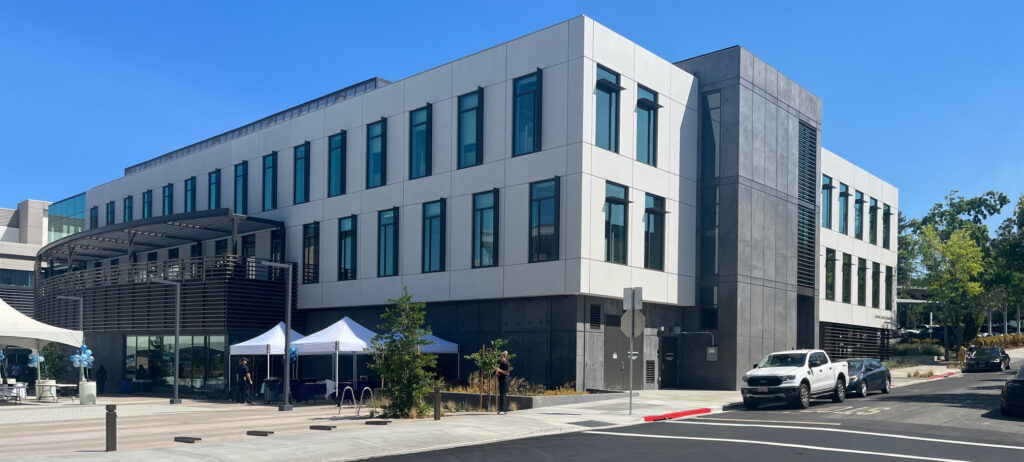
The grand opening of the new Contra Costa County Administration Building and Plaza was held on Tuesday, July 9, 2024. Photos: Contra Costa County
A new government facility to better fit its environment
Includes new plaza, public law library
By Kristi Jourdan, PIO, Contra Costa County
County and city officials celebrated the grand opening of Contra Costa County’s new Administration Building Tuesday morning, July 9, 2024. Located on Pine Street in the heart of downtown Martinez, the three-story cutting-edge office administration building and civic plaza was unveiled on the historic grounds previously occupied by a taller, outdated office tower and a jail dating back to around 1902. Both were demolished to make way for the modern development including the County’s other new administration building across Escobar Street that houses the Board of Supervisors’ Chambers.
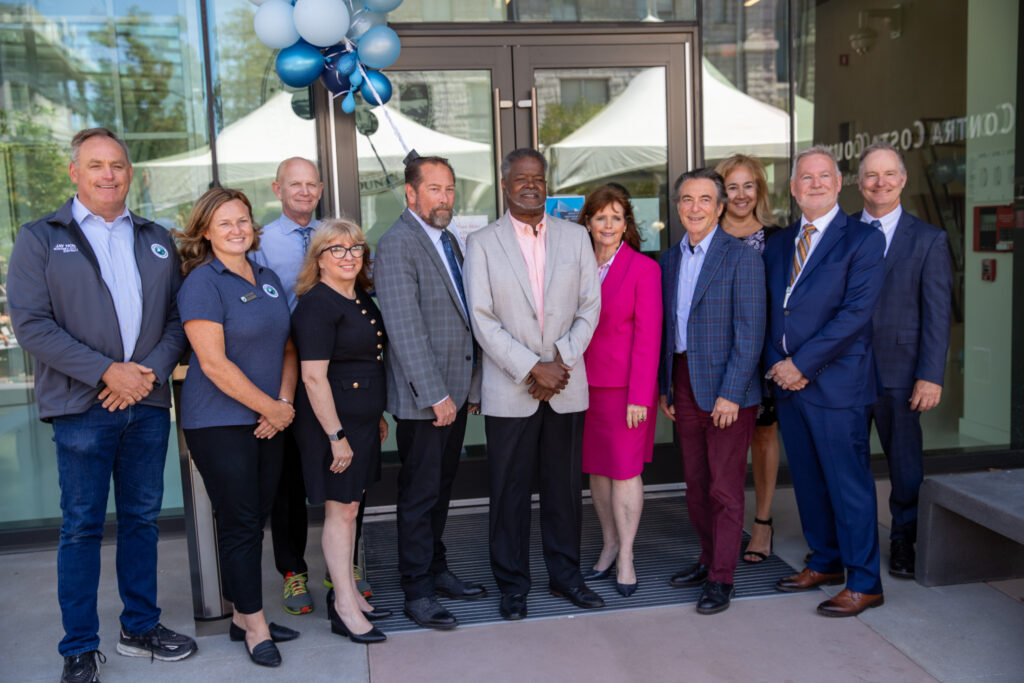
Members of the Contra Costa County Board of Supervisors and the Martinez City Council, county staff and representatives of both Webcor Builders and design firm Perkins & Will gathered for the building’s grand opening.
Speakers included Board Chair and District 5 Supervisor Federal Glover, District 1 Supervisor John Gioia, District 2 Supervisor Candace Andersen, District 3 Supervisor Diane Burgis and District 4 Supervisor Ken Carlson, Chief Assistant County Administrator Eric Angstadt and Martinez Mayor Brianne Zorn, and representatives of design firm Perkins & Will and Webcor Builders.
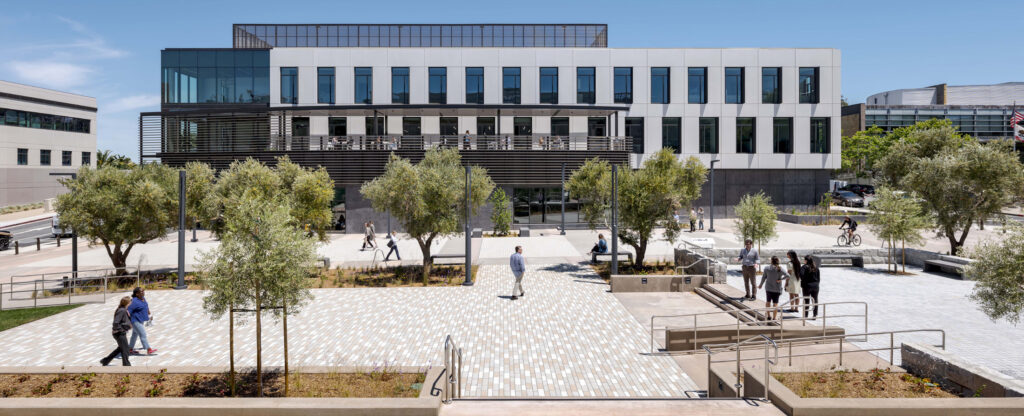
The new County Administration Building and Plaza.
The new $65 million building replaced a programmatically obsolete and contextually out of scale office tower and showcases state-of-the-art architecture that harmonizes beautifully with the surrounding historic buildings. It also rejuvenates the public plaza formed by the vacation of a city street within the County administration campus. It embodies sustainability with on-site photovoltaics for high-performance energy use, responsibly sourced finishes, and low embodied carbon materials.
The entrance and a retail space inside the new County Administration Building.
The development significantly enhances community space by adding a new public law library, ground-floor retail spaces, and a parking garage. The plaza also includes street improvements and an advanced stormwater system tailored to the site’s unique groundwater challenges and topography. Internally, the building acts as a hub for several County administrative departments, including the Public Defender, County Sheriff’s Civil Division and the Office of Racial Equity and Social Justice, consolidating essential services under one roof to improve service delivery and enhance community interaction.
The new building marks a significant contribution to Contra Costa County, where modernity meets tradition and community service meets innovation.
Alexandra Pony of Pony Communications and Allen D. Payton contributed to this report.
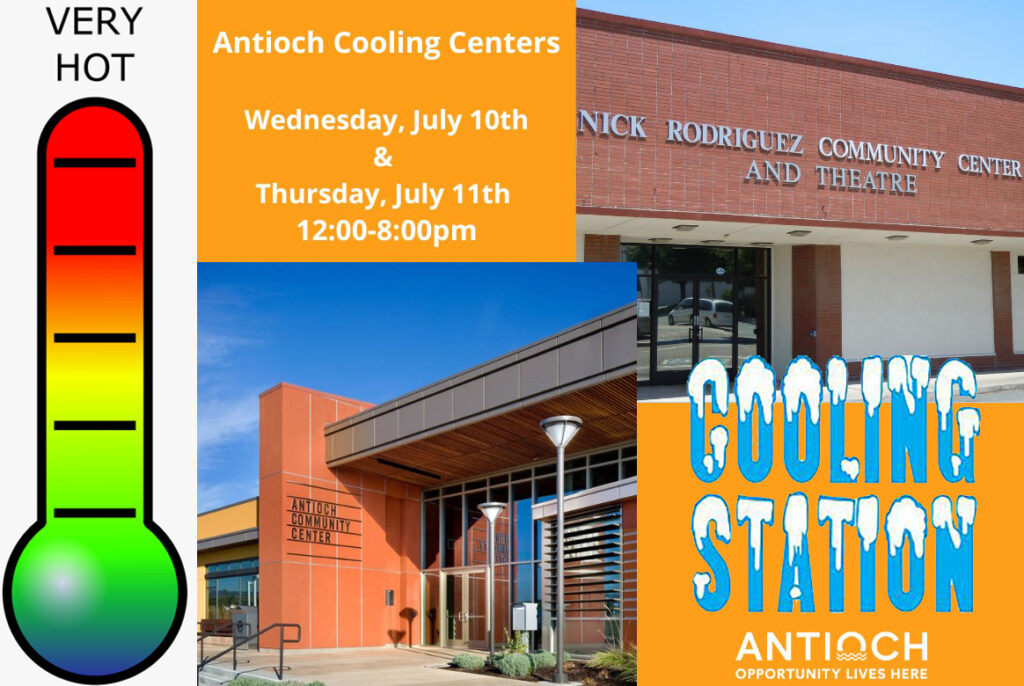
Due to the excessive heat occurring throughout this week, with the temperature forecast of 102 degrees on Wednesday and 105 degrees on Thursday, the City of Antioch is providing cooling centers for your convenience. Residents without home air conditioning or with conditions made worse with extreme heat and poor air quality are encouraged to seek out the cooling centers.
Cooling centers will be held:
Wednesday and Thursday, July 10th and July 11th | 12pm-8pm
Rep. John Garamendi announces his cancer diagnosis in a video on his X feed on Monday, July 8, 2024 and his official photo.
By Office of Representative John Garamendi
WASHINGTON, DC—Congressman John Garamendi (CA-08) on Monday, July 8, 2024, released the following statement about his diagnosis of early stage, treatable blood cancer:
“My wife Patti, a leader in the Congressional Families Cancer Prevention Program, ensures I stay vigilant about preventative screenings and care. Freezing abnormal bumps is standard, but a call from my doctor changed everything: “When will you be back in California? You need to come in for a series of tests.” Thus began my journey with early-stage Multiple Myeloma, a form of treatable blood cancer.
“Today, I started my path to remission with chemo-immunotherapy as an outpatient at Kaiser Oncology in Sacramento. With early detection, excellent doctors, and the love and support of Patti, our entire family, my extraordinary staff, and congressional colleagues, I know I’ll get through this while continuing to serve my constituents and advance American democracy. I’m grateful our President initiated the Cancer Moonshot and that California’s efforts in stem cell research and taxing cigarettes in the 1980s for cancer research have advanced therapies benefiting not only me, but every family dealing with cancer.
“Throughout my treatments, which my doctor expects will last a few months, I will continue working on my long list of projects and goals for my constituents in Contra Costa and Solano counties. However, alongside destroying cancer cells, chemotherapy weakens natural antibodies and the immune system. My doctors have cautioned me to minimize exposure to COVID-19, flu, and other viruses, so I will limit travel to Washington and public events during the treatment process.
“My thoughts and support are with families managing cancer or any health condition, and with the doctors, nurses, and medical personnel who offer comfort and hope. I am confident that the treatments will be effective, allowing me to continue serving impacted families and my constituents in Congress for years to come.”
In a video post on his X (formerly Twitter) feed on Monday, Garamendi read his statement and wrote, “Like 1.9 million Americans each year, I recently received the dreaded call from my doctor informing me that I had cancer. I am thankful to have caught this early, and we are confident that I will soon be in remission.”
The 79-year-old Garamendi represents the northern waterfront and western communities of Contra Costa County including the northern portion of Antioch in the U.S. House of Representatives.
“Demonstrates continued progress toward key plan goals” of housing, transportation, economy and environment in the nine counties including “a gradual shift away from the use of single-occupancy cars and trucks.”
Includes over $1.2 trillion to maintain existing transportation system, build and buy affordable housing, “Provide an income-based monthly payment to all Bay Area households” and to “Adapt to Sea Level Rise.”
Also working on parallel Transit 2050+ plan
Public input opportunities
By MTC & ABAG staff
The Metropolitan Transportation Commission (MTC)’s and the Association of Bay Area Governments (ABAG)’s newly released Plan Bay Area 2050+ Draft Blueprint analysis outlines how the nine-county region can advance an affordable, connected, diverse, healthy and vibrant Bay Area for all residents by the year 2050.
The Blueprint is essentially a draft version of the plan. It is a foundational framework for a future vision of the Bay Area that includes:
Forecasts and Assumptions about the Bay Area’s future (population, jobs, financial needs and revenues, sea level rise, etc.);
Strategies for public investment and policy reform; and
Geographies where future housing and/or job growth can be focused under the plan’s Strategies.
The Blueprint is then analyzed through computer-generated models and simulations to measure how successful the strategies are in achieving shared goals for the future, such as housing affordability, reduced greenhouse gas emissions and much more.
As the first draft of the Bay Area’s next long-range plan, the Draft Blueprint demonstrates significant progress toward reaching key goals for housing affordability, post-pandemic economic recovery and environmental health and sustainability. This includes the addition of 840,000 affordable homes, with a total of nearly 1 million permanently affordable homes regionwide by 2050; a 17 percent increase in the number of lower-income households living within a half-mile of transit service; and a gradual shift away from the use of single-occupancy cars and trucks. MTC and ABAG planning staff stress that the expected progress would only come about if all the strategies to be detailed in Plan Bay Area 2050+ are implemented.
Source: MTC & ABAG
The full range of performance and equity outcomes from the Plan Bay Area 2050+ Draft Blueprint analysis may be found in the Draft Blueprint Compendium, which also demonstrates how the Bay Area can accommodate some 1.3 million additional jobs and nearly 1 million new households by the year 2050.
The Compendium shows the following proposed budget highlights for three of the Plan’s categories:
Transportation Strategies
$382 billion for T1 – Operate and Maintain the Existing System. Commit to operate and maintain the Bay Area’s roads and transit infrastructure while transitioning to zero-emission transit vehicles.
Housing Strategies
$250 billion for H2 – Preserve Existing Affordable Housing. Acquire homes currently affordable to low- and middle-income residents for preservation as permanently deed-restricted affordable housing, including opportunities for resident ownership.
$302 billion for H4 – Build Adequate Affordable Housing to Ensure Homes for All. Construct enough deed-restricted affordable homes to fill the existing gap in housing for the unhoused community and to meet the needs of low-income households.
Economic Strategies
$205 billion for EC1 – Implement a Statewide Guaranteed Income. Provide an income-based monthly payment to all Bay Area households to improve family stability, promote economic mobility and increase consumer spending.
Environment Strategies
$94 billion for EN1 – Adapt to Sea Level Rise. Adapt shoreline communities, infrastructure and ecosystems affected by sea level rise.
The Draft Blueprint also identifies challenges that will have to be addressed as part of the Final Blueprint process over the coming months. More work is needed to reduce greenhouse gas emissions as well as to identify transportation investment priorities for the plan’s fiscally constrained transportation project list. The Draft Blueprint does not include significant transportation expansion or enhancement investments, as these will be identified through Transit 2050+ and the Final Blueprint process.
hoto source: MTC. Credit: Joey Kotfica
What’s Next?
In light of the pandemic’s lasting impact to public transportation, MTC is collaborating with the region’s transit operators on Transit 2050+ , a parallel planning effort to re-envision the future of public transit in the nine-county Bay Area. Two key updates in this process will be released in July: the Draft Project Performance Assessment and the Transit 2050+ Draft Network. It will be a comprehensive overhaul of the six transit-related strategies included in Plan Bay Area 2050.
The Draft Project Performance Assessment will analyze the costs and benefits of major capacity-increasing projects being considered for inclusion in Plan Bay Area 2050+, the vast majority of which are transit projects. These investments, including those adopted in Plan Bay Area 2050, now face a significantly reduced projected revenue stream. This is due largely to slow post-pandemic transit ridership recovery and other economic changes.
The Transit 2050+ Draft Network will identify strategies and investments (capital and operating) envisioned through 2035 and over the long term through 2050. Development of the Draft Network has been guided in part by public engagement conducted in summer 2023, when nearly 3,000 Bay Area residents provided input on the future of Bay Area transit. The Draft Network also is being informed by an existing needs and gaps assessment conducted in partnership with local transit agencies, the Draft Project Performance Assessment, local priorities and improvements to transit network connectivity and customer experience.
Source: MTC & ABAG
Summer 2024 Public Engagement
Beginning in August, MTC staff will conduct a second round of public engagement for Plan Bay Area 2050+, the content of which will focus on:
Sharing both the Draft Blueprint outcomes and the Transit 2050+ Draft Network
Gathering feedback to inform the development of the Final Blueprint and address identified Draft Blueprint challenges
Identifying early priorities for implementing Plan Bay Area 2050+
There will be a variety of in-person and virtual opportunities for the public to participate. Stay up-to-date on upcoming engagement activities in your community by subscribing to the Plan Bay Area 2050+ mailing list. There also will be dedicated engagement opportunities for technical partners and stakeholders, which will be publicized on the Plan Bay Area website’s Partner Engagement page.
Following an analysis of public input, the Commission and the ABAG Executive Board are expected to consider approval of the Final Blueprint in late 2024.
By Office of Contra Costa County Supervisor Federal Glover
We need your feedback!
The Workforce Development Board of Contra Costa County (WDBCCC) and the Contra Costa County Employment & Human Services Department (EHSD) invite you to review and provide feedback on the draft document titled “Implementation Plan for Measure X-Funded Youth Centers.”
According to the county’s website, “Measure X is a countywide 20-year, ½ cent sales tax approved by Contra Costa County voters on November 3, 2020. The ballot measure language stated that the intent of Measure X is ‘to keep Contra Costa’s regional hospital open and staffed; fund community health centers, emergency response; support crucial safety-net services; invest in early childhood services; protect vulnerable populations; and for other essential county services.’”
This document outlines the plans for three new youth centers in Supervisorial Districts 3, 4, and 5. Your input is crucial and will help county policymakers and administrators shape the design and implementation of these centers.
Public Review Period: July 1 – July 10, 2024, until 5:00 PM.